Category: News
NY MTA, LIRR Unions Reach ‘Fair Deal’ To End Strike After Commuter Chaos Grips NYC
NY MTA, LIRR Unions Reach ‘Fair Deal’ To End Strike After Commuter Chaos Grips NYC
New York’s MTA reached a tentative labor deal with five Long Island Rail Road unions, ending the first LIRR strike in more than 30 years. Roughly 3,500 workers walked off the job Saturday, sparking commuter chaos for several hundred thousand people who heavily rely on the train service.
“Tonight, the @MTA reached a fair deal with the five LIRR unions that delivers raises for workers while protecting riders and taxpayers,” Governor Kathy Hochul wrote on X late Monday.
The good news is that LIRR service will resume at noon today. However, for the 300,000 people who rely on the service to get to work this morning, the disruption still appears to be ongoing.
Tonight, the @MTA reached a fair deal with the five LIRR unions that delivers raises for workers while protecting riders and taxpayers.
I’m pleased to announce that phased LIRR service will resume beginning tomorrow at noon.
— Governor Kathy Hochul (@GovKathyHochul) May 19, 2026
LIRR confirmed that service will remain disrupted this morning because there is not enough time to get crews into position to run trains.
Limited Long Island Rail Road service will resume tomorrow with shuttle buses continuing to operate through the AM rush.
Customers should continue to work from home on Tuesday if possible. Check our website for details: https://t.co/QNV4sIPCsH pic.twitter.com/DYjK8UTDkY
— LIRR (@LIRR) May 19, 2026
The lefty union behind the commuter chaos is the Brotherhood of Locomotive Engineers and Trainmen, which stated on X overnight, “The coalition of five labor unions, including BLET, today ended their 3-day strike at Long Island Rail Road after coming to terms on a tentative contract.”
The coalition of five labor unions, including BLET, today ended their 3-day strike at Long Island Rail Road after coming to terms on a tentative contract. The strike began just after midnight on Saturday, May 16. Read more: https://t.co/9C6qkMxEI8 pic.twitter.com/tGOqdfJ47A
— Brotherhood of Locomotive Engineers and Trainmen (@BLET) May 19, 2026
Related coverage:
“Please Work Remote”: NYC Braces For Commuter Chaos With Ongoing LIRR Strike
Lefty Union Paralyzes Long Island Rail Road As Strike Sets Commuter Chaos Countdown For Monday
Bloomberg noted, “The unions were seeking a 5% boost, or close to it, while the MTA offered close to 4.5% along with ways to find savings to help pay for the higher raise.”
Tyler Durden
Tue, 05/19/2026 – 06:55
International Energy Agency Is Wrong To Forecast Coal’s Demise
International Energy Agency Is Wrong To Forecast Coal’s Demise
Authored by Tom Harris via The Epoch Times,
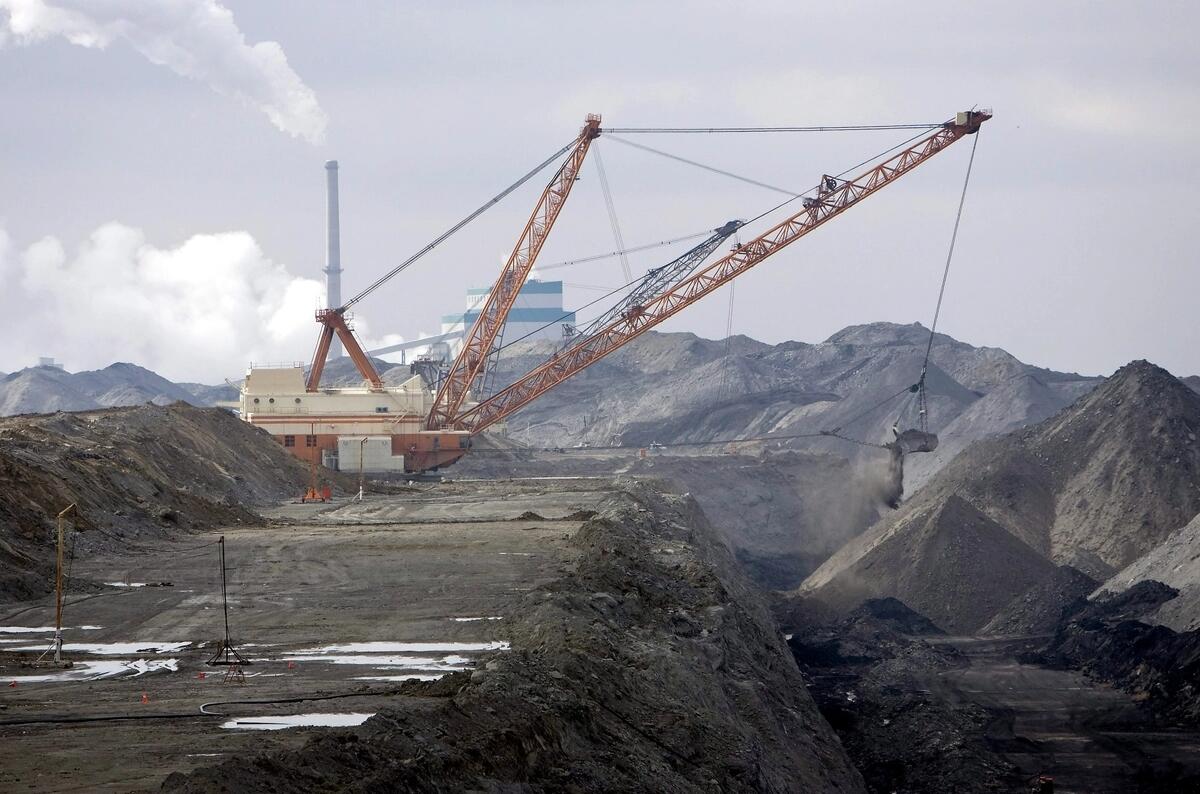
Activists would have us believe that coal is a dying energy source. But, thankfully for American coal states such as West Virginia and the Canadian provinces of Saskatchewan and Nova Scotia—all of which use millions of tonnes of coal every year to generate electricity—that is not even remotely true.
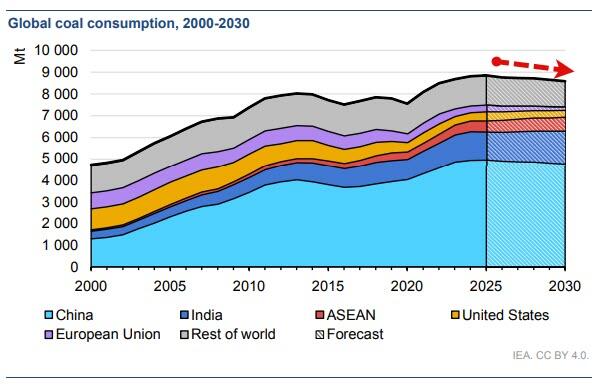
However, the world is burning more coal now than ever, reaching a record 8.85 billion metric tonnes annual consumption by the end of 2025. Since 2020, annual coal consumption has increased by 1.40 billion tonnes.
Most of this has come from China, of course, which makes up about 55 percent of global coal consumption (the United States makes up about 5 percent of global consumption). Although the International Energy Agency (IEA) predicts a decline in demand over the next five years, The Kobeissi Letter more realistically predicts that demand will continue to rise, and points out that “past forecasts of peak coal demand have repeatedly proven wrong.”
A graph on the IEA’s website that illustrates coal consumption (in metric tonnes, Mt) from 2000 to 2022, shows estimates for 2024 to 2026 that seem improbable.
Regardless, the IEA writes that increased demand for renewables is the primary cause for the estimated decline in coal consumption, and that “Global coal demand is expected to effectively plateau over the coming years, showing a very gradual decline through to 2030.” However, they also write that coal use is expected to increase in India by about 3 percent per year and in Southeast Asia by about 4 percent per year up to 2030.
In reality, we can’t expect China to slow its coal production anytime soon. Currently consuming about 3 billion tonnes annually, they will clearly dominate global trends in coal consumption in the years to come. Although the IEA also expects a slow decline in coal consumption in China over the next five years, with the gradual but marked decline of climate change alarmism worldwide and China’s ambition to expand its economy, this prediction doesn’t seem to hold much credibility either.
As The Kobeissi Letter states, coal remains in high demand, and the pipe dream of climate activists to kill coal doesn’t account for the security and convenience that this energy supply affords us. Like nuclear electricity—another power source that is vital to providing electricity for large portions of the world—the fuel for coal-fired power generation can be stored right on a power plant’s site for long periods of time, providing stable energy for society. We especially need coal during deep freezes because natural gas can falter in extreme cold due to “just-in-time” pipeline delivery. Gas flows can slow or freeze entirely, as seen in winter storms Uri (2021) and Elliott (2022), leaving grids vulnerable. And, not surprisingly, in each of these storms, wind and solar delivered very little, and sometimes no power at all, causing millions to lose electricity and causing hundreds of deaths from the cold.
CO2 Coalition energy expert Dick Storm says that “coal is indispensable” and that it is “the lowest cost proven source of primary energy for electricity generation ever in history.” The Canadian province of Ontario, where I live, proved this case well. In 2002, coal provided about 25 percent of the province’s power, and we enjoyed very low electricity rates. But in 2005, then-Premier Dalton McGuinty held a news conference and, pointing to the pile of coal beside him, said it was “old technology” and that, to save the climate and protect the air, Ontario would phase out all coal-fired electricity generation. This made no sense in light of the facts:
1. Coal is not a technology. It is a resource, and the degree to which it causes pollution when burned depends on the technology used to burn it. Reducing carbon dioxide emissions from a coal plant is unquestionably costly, difficult, and of course, unnecessary. Reducing real pollution is often well worth the price and far easier to accomplish with a coal station by using the latest pollution control technology.
2. Seen in a global context, Ontario’s emissions are trivial—one-quarter of Canada’s 1.6 percent of global emissions. So, no matter what one believes about the causes of climate change, McGuinty’s announcement and the province’s painful reduction to 0 percent coal-fired power were merely virtue signalling and showmanship. It had no impact on climate whatsoever.
It did, however, have a huge impact on consumer electricity rates, which, depending on the year, doubled or even tripled as coal was replaced with more expensive power, including a massive expansion of industrial wind turbines. Of course, soaring power rates are politically problematic, so the government decided to hide the increase in the tax base, and today’s rates are merely 50 percent higher than those in 2002. But we all eventually pay for this massive increase, just not directly on our power bill.
Renewable energy has only been able to survive thus far because it is heavily subsidized by tax dollars. These subsidies have, unfortunately, caused coal-fired power stations to be less profitable to operate, by comparison, compounded by the fact that regulations have crippled the industry. It is important to increase our expansion of coal plants, Storm tells us. 800,000 megawatts of new power generation, the equivalent of 80 New York cities, will be needed in the United States in the next 25 years to keep up with demand. This is simply not possible with renewable energy, and although nuclear and other conventional power will be significant players in this, coal will remain a steady, reliable power source to provide us with these vast amounts of power.
Rather than phase out coal, Saskatchewan should build more plants. Since Alberta phased out this important energy source, it will soon come knocking again begging for more power from Saskatchewan’s black gold.
Tyler Durden
Tue, 05/19/2026 – 06:30
https://www.zerohedge.com/energy/international-energy-agency-wrong-forecast-coals-demise

“Answering The Call”: Ford Motor Eyes WWII-Style Production Push For Trump’s War Economy
“Answering The Call”: Ford Motor Eyes WWII-Style Production Push For Trump’s War Economy
One month after we reported that the Trump administration was in talks with U.S. manufacturers about converting idle civilian industrial capacity into weapons production, as conflicts across Eurasia deplete critical weapons stockpiles, Ford Motor signaled Monday morning that it is prepared to support a Western defense-industrial mobilization.
Much like during World War II, Ford said it is exploring how its commercial vehicles and related technologies could help governments in North America and Europe quickly build up their defense in the most cost-effective way.
“Traditional, purpose-built military hardware takes years to develop and costs billions. By using commercial, off-the-shelf solutions from Ford, governments can access world-class technology at a fraction of the time and cost,” Ford wrote in a press release.
Ford said its trucks, such as the F-Series and Ranger, along with technologies like Pro Power Onboard, could support military mobility, transport, and field operations.
“We have always partnered with government customers in times of peace, crisis, and conflict to serve society. During World War II, Ford’s assembly lines produced hundreds of thousands of aircraft, trucks, and engines for the Allied effort,” Ford pointed out.
Last month, The Wall Street Journal reported that not only Ford, but also GM, Aerospace, and Oshkosh were in talks with the Trump administration to convert civilian industrial capacity into weapons production.
The effort to boost the war economy is part of what Defense Secretary Pete Hegseth has described as putting the defense industrial base on a “wartime footing.”
Evidence of converting underused civilian industrial capacity has already been seen with the German automaker Volkswagen, which will soon transform its Lower Saxony factory from producing T-Roc Cabriolets to manufacturing parts for the Iron Dome missile interceptor system.
One major vulnerability is labor disruption. Far-left unions could weaponize strikes and other work stoppages to slow or derail America’s defense-industrial buildup at a moment when conflicts across Eurasia, from Ukraine to Iran, are already drawing down critical weapons stockpiles.
We suspect other major U.S. manufacturers will soon issue statements similar to Ford’s amid Trump’s push for a booming war economy.
Tyler Durden
Tue, 05/19/2026 – 05:45

“The Political Shift Is Inevitable”: AfD Leader Weidel Heralds New Polling High For Party
“The Political Shift Is Inevitable”: AfD Leader Weidel Heralds New Polling High For Party
The latest Insa Sunday poll has given the anti-immigration Alternative for Germany (AfD) party a new record high for voter support. At 29 percent, up 1 point, the AfD has an even greater lead over the Christian Democrats (CDU/CSU), which fell 1 point to 22 percent.
A YouGov poll just last week showed AfD at 28 percent and the CDU/CSU at 22 percent.
AfD co-leader Alice Weidel took to X to celebrate the news, pointing out that Germany’s current ruling coalition stands now at just 34 percent.
“The political shift is inevitable—we will put the interests of our country and our citizens back at the forefront!” she wrote.
Inzwischen würden 29% der Bürger AfD wählen, während die Regierungsparteien zusammen auf nur noch 34% kommen. Die politische Wende ist unausweichlich – wir werden die Interessen unseres Landes und unserer Bürger wieder in den Vordergrund stellen! pic.twitter.com/cX1IKHeGbW
— Alice Weidel (@Alice_Weidel) May 16, 2026
This continues the downward trend for the CDU/CSU alliance, currently governing Germany in coalition with the SPD. Back in February 2025, the CDU/CSU and SPD together received almost 45 percent of the second-round votes. In mid-April, points out Junge Freiheit, they were still polling at 25 percent according to Insa, while the AfD reached 26 percent. Just a month earlier, the CDU and CSU were slightly ahead of the AfD.
Meanwhile, the Social Democrats (SPD) continue to weaken, dropping one point to 12 percent, behind the Greens, who gained 1.5 points to reach 14 percent. The Left Party now stands at 10 percent, down 1 point, and the FDP and BSW, at 3 percent each, would not even enter parliament.
Chancellor Friedrich Merz (CDU) has been under increasing pressure due to the ongoing economic stagnation, layoffs, bankruptcies, and energy crisis. There have even been calls for new elections, particularly from its coalition partner, the SPD.
As Remix News reported earlier this month, the SPD is upset over proposed cuts to social programs, backed by the CDU, to address Germany’s increasing budget deficit.
The SPD, however, is not Merz’s only problem, as a significant right-leaning faction of the CDU is increasingly unhappy with his performance and what they feel is the CDU’s inability to pass laws and reforms with the far-left SPD as its partner.
CDU MP Christian von Stetten, for example, reportedly told a business event recently that the coalition would “definitely not” last the full four years of its term.
Tyler Durden
Tue, 05/19/2026 – 05:00
UBS Reactivates Supply-Chain Stress Watch After Detecting Alarmingly Rapid Deterioration
UBS Reactivates Supply-Chain Stress Watch After Detecting Alarmingly Rapid Deterioration
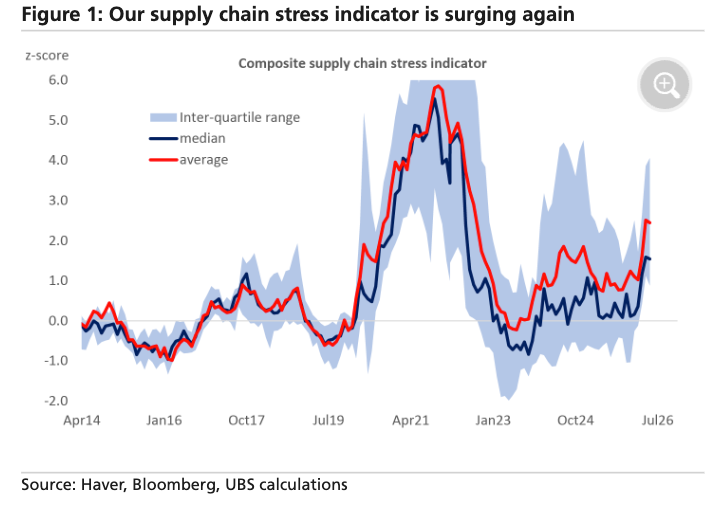
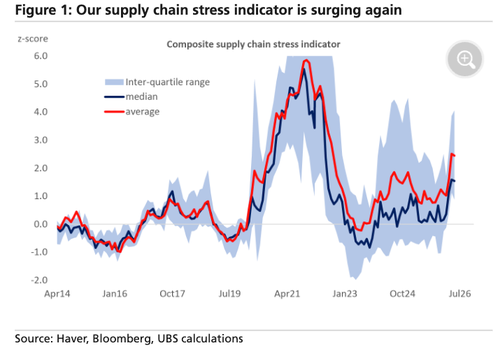
One week after Maersk CEO Vincent Clerc warned CNBC of a “new wake-up call” for global trade amid the ongoing disruption of the Strait of Hormuz and a deepening energy crisis that could intensify further in June, UBS analysts are out with a new note telling clients they have “reactivated” their Global Supply Chain Stress Index in response to increasingly alarming signals emerging across global logistics networks.
“Supply chain stress is rising at its fastest pace since the early pandemic,” UBS analyst Pierre Lafourcade wrote in a note on Sunday.
Lafourcade explained that global supply chain stress is emerging quickly, with the index rising by 1.2 standard deviations in March and April, the second-largest two-month jump since July 2020.
“We are now reactivating it to assess disruptions stemming from the Middle East conflict,” he said, noting that the last time the index was published was in February 2023, or the period in which Covid snarled supply chains.
The Global Supply Chain Stress Index is surging again.
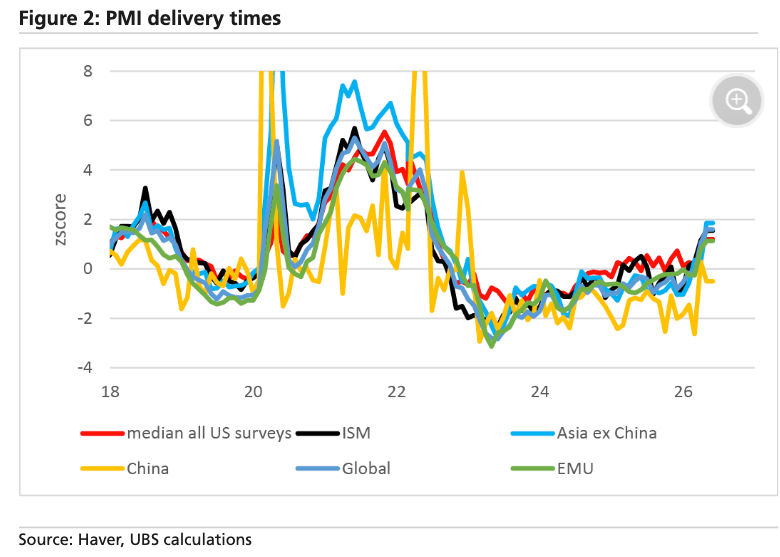
PMI delivery times are increasing again.
The full note can be read by Professional subscribers here at our new Marketdesk.ai portal.
Related:
Maersk CEO Warns Iran War Is A “New Wake-Up Call” For Global Trade
Trump’s Project Freedom Likely Triggered By Oil Market’s One-Month Countdown To Chaos
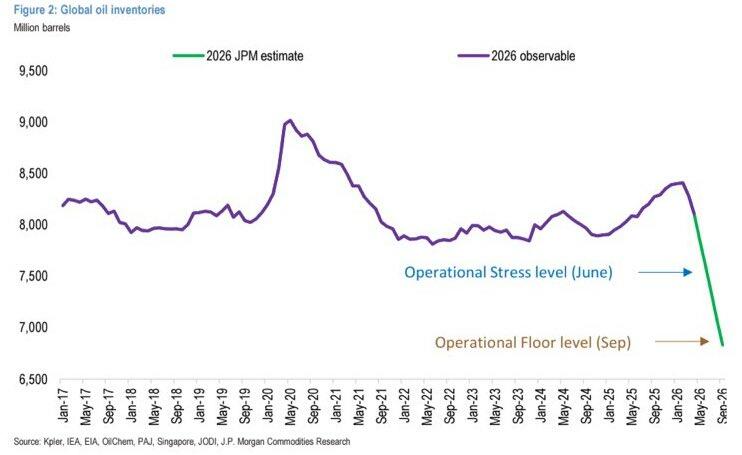
JPMorgan analysts warned that the world is spiraling toward a catastrophic cliff-edge shortage of crude oil if the maritime chokepoint remains blocked for another four weeks.
With that said, June is only a few weeks away, and early indications suggest that continued disruption of the maritime chokepoint could begin to materially affect global trade next month, with risks extending well beyond that if the chokepoint remains shuttered.
Separately, with Brent back in triple-digit territory, UBS analyst Dimitrios Laloudakis pointed to surging yields worldwide:
US yields join G10 peers in estimating rate hikes for 2026. 2y yields comfortably above moving averages. Cross asset implications should drag equities lower, vol higher, and duration to selloff.
It appears something has to give if Hormuz remains choked by the end of the month.
Tyler Durden
Tue, 05/19/2026 – 04:15

Pakistan Deploys Thousands Of Troops, Jet Fighter Squadron To Saudi Arabia
Pakistan Deploys Thousands Of Troops, Jet Fighter Squadron To Saudi Arabia
Pakistan has deployed 8,000 troops, a squadron of fighter jets, and an air defense system to Saudi Arabia under a mutual defense pact, Reuters reported on Monday, citing security and government officials.
The officials described the Pakistani deployment as a “substantial, combat-capable force intended to support Saudi Arabia’s military if the kingdom comes under further attack,” Reuters wrote.
Illustrative via Pakistan air force
Pakistan’s military cooperation with the Saudi kingdom is expanding amid threats by the US and Israel to renew military operations against Iran, which ceased following the announcement of a ceasefire on April 8.
During the war, Iran carried out attacks against US military bases and energy infrastructure in Saudi Arabia in response to the kingdom’s support for the US and Israeli aggression.
Saudi Arabia responded by launching numerous unpublicized strikes on Iran. However, Riyadh has sought in recent weeks to de-escalate the conflict, while Islamabad has served as a mediator in talks between Washington and Tehran.
The defense agreement signed between Saudi Arabia and Pakistan reportedly requires both Islamic countries to come to each other’s defense in the event of an attack.
Reuters noted that Saudi Defense Minister Khawaja Asif has previously suggested the agreement offers Saudi Arabia protection under Pakistan’s nuclear umbrella.
According to the sources speaking with the news agency, Pakistan has deployed a full squadron of around 16 warplanes, including JF-17 fighters made jointly with China, two squadrons of drones, and around 8,000 troops. Pakistan has pledged to send additional troops if needed, as well as a Chinese HQ-9 air defense system.
Both countries benefit from the alliance, as Pakistan has a large military due to its decades-long conflict with India, while Saudi Arabia provides badly needed foreign currency to Pakistan’s heavily indebted government.
Talks are reportedly underway to bring both Turkiye and Qatar into the Saudi–Pakistani alliance.
Pakistani Defense Minister Khawaja Muhammad Asif revealed during an interview with Hum News on 11 May that a deal to bring Turkiye and Qatar into the mutual defense pact with Saudi Arabia is being “finalized.”
“If Qatar and Turkiye also join the existing agreement between Saudi Arabia and Pakistan, it would create significant cooperation in both the economic and defense spheres in our region and reduce external dependence,” Asif told Pakistan-based Hum News, adding that their inclusion would be “a welcome development.”
Last week, the Financial Times (FT) reported that Saudi Arabia has “floated” the possibility of reaching a “non-aggression pact” between Iran and neighboring states modeled on the 1975 Helsinki Accords, which eased tensions during the Cold War in Europe.
The Ambassador of the Kingdom of Saudi Arabia to Pakistan, H.E. Nawaf bin Saeed Ahmad Al-Malkiy, called on Deputy Prime Minister / Foreign Minister Senator Mohammad Ishaq Dar @MIshaqDar50 today.
Discussions focused on the fraternal Pakistan–Saudi Arabia relations. DPM/FM… pic.twitter.com/oaQ4HraDev
— Ministry of Foreign Affairs – Pakistan (@ForeignOfficePk) May 18, 2026
The Saudi-proposed pact for the day after the US-Israeli war on Iran ends reportedly has support from several European capitals, which view it as “the best way to avoid future conflict” and have urged Arab states to support it.
The British daily cites an unnamed Arab diplomat who says that such a pact would be welcomed “by most Arab and Muslim states, as well as by Iran,” although concerns remain about Israel’s continued threats to reignite the war regardless of any deal.
Tyler Durden
Tue, 05/19/2026 – 03:30

Belarus Rattles Europe With Drills Involving Russian Tactical Nukes
Belarus Rattles Europe With Drills Involving Russian Tactical Nukes
The Belarusian Defense Ministry announced Monday that its specialized military units have kicked off surprise combat drills specifically focused on the deployment and use of tactical nuclear weapons, which is a sign of yet more atomic saber-rattling on Europe’s eastern flank.
According to the official statement blasted out across Telegram on Monday: “Today, in the interests of increasing the readiness of the armed forces for the use of modern weapons, including special ammunition, training of military units for the combat use of nuclear weapons and nuclear support has begun under the leadership of the chief of the General Staff of the armed forces,” the ministry wrote.
Prior drills, illustrative: Russian Defense Ministry Press Service via AP
The Kremlin-aligned state is moving hardware and testing infrastructural elements required to field atomic ordnance.
According to the ministry, the drills are designed to verify the readiness of weapons and military equipment to execute combat operations out of non-traditional, surprise launch areas.
Dual-capable delivery platforms have reportedly been been moved into position: “Military units of the missile forces and aviation are involved in the event. During the training, in cooperation with the Russian side, it is planned to practice delivering nuclear weapons and preparing them for use,” the ministry said.
But interestingly, Belarus’s Ministry of Defense also stressed that this event “is not directed against third countries and poses no threat to security in the region.”
Belarusian drills are typically deeply integrated to ‘Union State’ operations. Under a formal mutual defense pact, Moscow has long pledged that any attack threatening the very existence of Belarus could be met with a Russian nuclear response.
Belarusian President Alexander Lukashenko has at the same time long welcomed and touted that ally President Putin authorized the stationing of tactical nuclear weapons in Belarus, which borders Poland.
This has long been a major concern of NATO, and the nukes were reportedly transferred there – under the oversight of Russian military officers – in the context of the escalating Ukraine war and threats and counter-threats hurled between Moscow and the West.
Ukraine and Europe are predictably quite angry and nervous over the development, naturally. A Ukrainian Ministry of Foreign Affairs statement said, “By turning Belarus into its nuclear staging ground near NATO borders, the Kremlin is de facto legitimizing the proliferation of nuclear weapons worldwide and setting a dangerous precedent for other authoritarian regimes.”
Tyler Durden
Tue, 05/19/2026 – 02:45

“Closely Monitoring The Situation”: Germany Fears Next Migration Wave After Spanish PM Welcomes Hundreds Of thousands Of Illegals
“Closely Monitoring The Situation”: Germany Fears Next Migration Wave After Spanish PM Welcomes Hundreds Of thousands Of Illegals
With Spanish Prime Minister Pedro Sánchez legalizing what could amount to as many as 1.6 million migrants, other EU member states are getting worried, and not just neighboring France.
While the Socialist prime minister’s announcement originally aimed to naturalize some 500,000 migrants by handing them residency permits and work permits, German authorities estimate that there could be as many as 850,000 applicants in Spain, writes Bild. Leaked internal Spanish police documents have already put this estimated number even higher, at 1.6 million.
Since the announcement in mid-April, hordes of undocumented migrants have been overwhelming local offices across the country, with nearly 130,000 applications in the first week alone. Remix News posted videos of these crowds.
🇪🇸🔴The line of migrants seeking legalization wraps around an entire massive building in Spain. pic.twitter.com/lNxZqzslg0
— Remix News & Views (@RMXnews) April 23, 2026
French conservatives sounded the alarm early on, with National Rally leader Jordan Bardella slamming the ability for residence permits to freely move around the EU.
“I believe that free movement within the Schengen Area should be reserved exclusively for nationals of European countries. Obtaining a residence permit in Spain, for example, should not allow free movement throughout all European Union countries,” he wrote.
Now, Germany’s Foreign Office in Berlin has stated: “We are closely monitoring the situation and are in contact with Spain.”
A spokesperson for the Interior Ministry also sought to clarify that a Schengen residence permit does not, in principle, authorize employment in Germany. Having one allows you to enter Germany and stay for a maximum of three months at a time.
The domestic policy spokesman of the CDU/CSU parliamentary group, Alexander Throm (CDU), also expressed his concerns, according to Bild: “Such mass legalization sends a devastating signal to the world and creates an incalculable pull effect.”
Police union representative Manuel Ostermann has also warned of potential consequences given that many entering Europe are attracted to German jobs and benefits.
“If the Spanish minority government fails, and a future government reduces payments or terminates residency permits, many of the migrants will continue their journey to Germany and remain here. Whether permitted or not,” he warned.
Of course, jobs in Germany are already becoming scarce, including over 120,000 industrial jobs being shed last year, and after years of mass immigration, the German economy continues to go from weakness ot weakness.
Germany has already had problems with secondary migration from Greece for years. Last April, the country’s Federal Administrative Court authorized migrant deportations to Greece for the first time in years.
Ostermann is now warning: “The migration crisis is not over. Germany must therefore consistently eliminate the remaining pull factors,” he says, adding that Germany should abolish “excessive financial incentives” and replace them with the principle of “bread and butter.”
Tyler Durden
Tue, 05/19/2026 – 02:00
Escobar On Xi’s “Constructive Strategic Stability”
Escobar On Xi’s “Constructive Strategic Stability”
Authored by Pepe Escobar,
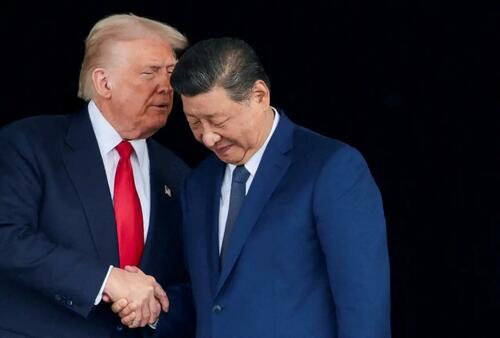
If all of us are magnanimous enough, we might infer that Xi and Trump agreed on a three-year stability framework.
The headline on the front page of China Daily this past Thursday was a thunder and lightning “Red-carpet welcome for Trump in Beijing”.
Well, complete with electric jumpin’ children waving flowers and a visit to the Temple of Heaven, built in 1420, symbolizing the connection between heaven and humanity.
Youth meet tradition. The generation that will lead fully modernized China meets deep History. A dazed and confused POTUS could barely absorb a running masterclass in civilization.
Xi Dada was proverbially sharp: “We should be partners, not rivals.” The Exceptionals were stunned. All that after the non-stop litany of trade wars, tech sanctions, non-stop Taiwan hysteria, military encirclement, geoconomic confrontation, anti-China rhetoric.
Cool down. Be cool.
Oh, the twists and turns of the most important bilateral relation on the planet. Even as both economies are quite intertwined, bilateral trade in goods reached 4.01 trillion yuan ($590 million) in 2025. In global terms, that’s not exactly groundbreaking: only 8.8% of China’s total foreign trade.
At the state banquet, Xi’s sharp rhetorical dagger performed the feat of uniting MAGA and the rejuvenation of the Chinese nation:
“The people of China and the United States are both great peoples, achieving the great rejuvenation of the Chinese nation, and making America great again, can go hand in hand.”
The barbarians were puzzled. Again.
Then Xi explained where we are, concisely. It took only one sentence:
“The transformation not seen in a century is accelerating across the globe, and the international situation is fluid and turbulent.”
Compare it to when he first referred to the “transformation”, in public, for a global audience: right after the meeting with Putin in the Kremlin in the Spring of 2023.
And then Xi immediately asked: “Can China and the United States overcome the Thucydides Trap and create a new paradigm of major-country relations?”
As much as the Thucydides Trap is yet another feeble US ThinkTank-land concoction – the best analysts of Thucydides are Greeks and Italians, not the Beltway gang – Xi’s metaphor was actually stressing that China, now, is the leader of the new emerging order.
And it got here without firing a shot.
That “constructive strategic stability”
Xi then deployed his new vision for US-China relations – at least for the next 3 years – via a quite startling slogan: “constructive strategic stability” (italics mine).
Yet that presents three serious problems.
The Empire of Chaos is not constructive: it’s destructive.
It’s not strategic: at best it’s crudely tactical, tactics changing all the time.
And it’s not about stability: it’s about instilling and deploying chaos, alongside lies, plunder and, as we see in Venezuela and especially Iran, piracy.
So Xi, rationally, cannot possibly expect “cooperation” from the Empire as “the mainstay” of the relationship, much less “healthy stability with competition within proper limits.”
If all of us are magnanimous enough, we might infer that Xi and Trump agreed on a three-year stability framework which should be interpreted as a structural reset – featuring cooperation first, then managed competition, and predictable peace as the end result.
Well, never forget we are dealing, in the immortal definition of Grandmaster Lavrov, with a “non-agreement capable” US.
And of course there’s the “Taiwan question”. Xi at his sharpest: “’Taiwan independence’ and cross-Strait peace are as irreconcilable as fire and water”. The Americans must exercise “extra caution” in “handling the Taiwan question”.
Xi called it “the most important issue in China-US relations”. For Beijing, this is the ultimate red line. Team Trump may still not understand the stakes. Taiwan is the variable with the potential to reset the whole, optimistic three-year “peaceful” equation to zero.
And incidentally, American MSM spin that Xi traded non-interference by the US in Taiwan for “helping” the US in Iran is absolutely ridiculous. China and Iran have an all-evolving strategic partnership.
While all that was proceeding in Beijing, I had the pleasure of spending a long geopolitical lunch in Shanghai with the remarkable Li Bo, the general director of Guancha, the number one independent media in China, with at least 120 million daily followers.
Among other nuggets, Li Bo explained that Taiwan is not a problem for Beijing: it’s an internal matter that will be solved peacefully. The real problem is the rearming of Japan, especially now when under the frankly militaristic Sanae Takaichi administration.
Now for the real VIPs in the Trump-Xi show. After all the “evil empire” craze, the decoupling hysteria, the de-risking paranoia, the sanctions tsunami, the tariff tsunami, the war rhetoric, we have an oligarchic bunch with a collective market capitalization of over $10 trillion flying to Beijing to literally beg Xi Jinping, in person, for…deals.
Trump was estatic:
“I wanted the number one from each empire! Jensen Huang, Tim Cook, Elon Musk, and the other titans… the best in the world are here, right in front of you.”
Then, the clincher:
“They’re here today to pay respect to you and to China. They come hungry to do business, invest, and create. From our side, it’ll be 100% reciprocal.”
The “indispensable” nation paying tribute to the real 21st century geoeconomic empire. History will have a ball with it.
The keys to the new Temple of Heaven
Tesla, Apple, Boeing, GE Aerospace, everyone may desperately need China’s rare earths: China controls nearly 99% of the global processing capacity for rare-earth minerals. Yet China, structurally, and increasingly, does not need these American behemoths.
The combined revenue exposure to China across the top 12 companies represented by their CEOs on this trip is over $300 billion a year.
Musk needs to keep building Teslas – the Gigafactory, his primary export hub, is outside of Shanghai – without a 100% tariff. Jensen Huang needs chip export licenses so Nvidia may sell into this immense AI market (but China doesn’t need Nvidia anymore). Tim Cook needs Apple’s $70 billion China supply chain to remain steady.
The real problem is BlackRock’s Larry Fink avid for Chinese financial markets to “open up” for extra Wall Street profits (Li Bo told me at best the Chinese will let them open a little office in Hainan island…) Fink, moreover, is the actual new leader of the Davos gang, directly responsible for the funding of AI surveillance data centers all over the US.
The White House readout was beaming on “expanding market access for US businesses into China and increasing Chinese investment into US industries”; “increasing Chinese purchases of US agricultural products”; and Xi expressing “interest in purchasing more US oil”.
Yet there’s not a single word about any “trade discussions” coming from the Chinese Ministry of Commerce.
So in theory we had this trillionaire CEO party eager to “open up” China for American business/trade. Business in Shanghai was definitely not impressed. After all China is actively building its own independence – it’s all enshrined in the targets of the new Five-Year Plan – while the US, via these trillionaire CEOs, essentially demonstrated the formalization of its own dependence.
While all this sound and fury was going on in Beijing, the Foreign Ministers of Russia, China (not Wang Yi, he remained in Beijing side by side with Xi), India and, crucially, Iran, and others, were in New Delhi for a very important BRICS summit focused on what Moscow defined as reforming the system of “global governance” with a predominant role for the Global South.
BRICS may be in a coma. But if there’s anyone capable of resurrecting it, it’s Grandmaster Lavrov and Russia, side by side with China and emerging global power Iran. Once again: it’s the new Primakov triangle, RIC (Russia-India-China) which will find the real keys to open a new Temple of Heaven.
Views expressed in this article are opinions of the author and do not necessarily reflect the views of ZeroHedge.
Tyler Durden
Mon, 05/18/2026 – 23:25
https://www.zerohedge.com/geopolitical/escobar-xis-constructive-strategic-stability

Software CEO Convicted In Massive $1 Billion Medicare Fraud Scheme Targeting Seniors
Software CEO Convicted In Massive $1 Billion Medicare Fraud Scheme Targeting Seniors
In a verdict hailed by federal officials as a major blow against one of the most egregious health care fraud operations in Florida history, a jury in the Southern District of Florida convicted Brett Blackman, 42, of Johnson County, Kansas, on multiple conspiracy charges related to a sprawling scheme that bilked Medicare and other federal programs out of more than $1 billion.
Brett Blackman / Credit: Department of Justice
Blackman, the founder, owner, and CEO of HealthSplash, was found guilty of conspiracy to commit health care fraud and wire fraud, conspiracy to pay and receive health care kickbacks, and conspiracy to defraud the United States and make false statements in connection with health care matters. He faces a maximum of 20 years in prison on the primary fraud counts, plus additional time on the others. Sentencing is scheduled for August 26, 2026, according to the DOJ.
From “Healthcare Innovator” to Fraud Mastermind
Prior to his legal troubles, Blackman positioned himself as a serial entrepreneur and healthcare technology disruptor. He described HealthSplash as a visionary platform built on blockchain and smart contracts to connect patients, providers, servicers, and payers with transparent, friction-free care. The company aimed to eliminate suffering by delivering healthcare data instantly and shifting the system from reactive to proactive.
Blackman had expanded a medical compliance documentation firm called PMDRx into DMERx (Power Mobility Doctor Rx, LLC) to broaden its offerings. HealthSplash acquired DMERx in September 2017. Court documents portray a starkly different reality: the platform became a tool for generating false and fraudulent doctors’ orders for durable medical equipment (DME), primarily orthotic braces, and other prescriptions.
How the Scheme Worked
Prosecutors said Blackman and co-conspirators aggressively targeted hundreds of thousands of Medicare beneficiaries – often vulnerable seniors – through foreign call centers, spam mailers, and telemarketing. The goal: pressure recipients into accepting medically unnecessary equipment.
Once beneficiaries agreed, the DMERx platform routed orders to telemedicine doctors who signed them—frequently with little or no patient interaction, and sometimes while falsely claiming in-person tests had occurred. Suppliers and pharmacies paid illegal kickbacks for these orders, then billed Medicare and other federal programs (including those serving veterans and military families) more than $1 billion. Federal programs paid out over $450 million on the fraudulent claims.
Evidence at trial included testimony from an undercover agent who posed as a beneficiary. A foreign call center pushed multiple braces on the agent, and a doctor signed orders claiming tests that could only be done in person – despite no real interaction. Blackman’s team allegedly used sham contracts and order manipulation to evade audits.
“This was not health care. It was a billion-dollar fraud machine,” said U.S. Attorney for the Southern District of Florida Jason A. Reding Quiñones. Officials emphasized the scheme’s industrial scale and its exploitation of the sick and elderly.
Co-defendant Gary Cox, former CEO of DMERx, was convicted in a prior trial in June 2025 and sentenced to 15 years in prison.
Flashy Lifestyle Amid Alleged Fraud
Federal releases highlighted Blackman’s lavish displays of wealth, including a music video featuring a waterfront mansion and photos of him adorned in gold accessories, including a large dollar-sign necklace.
Acting Attorney General Todd Blanche called it “cold, calculated, industrial-scale theft.” FBI and HHS-OIG officials stressed that no web of sham companies would protect fraudsters from accountability.
A photo of the mansion shown in Blackman’s music video. / Credit: Department of Justice
The case aligns with broader DOJ efforts, including the recent launch of a dedicated Fraud Division and support for President Trump’s Task Force to Eliminate Fraud.
Tyler Durden
Mon, 05/18/2026 – 23:00