Category: News
New Fed Chair Pledges ‘Regime Change’ To Fight Inflation – Here’s What That Could Mean In Practice
New Fed Chair Pledges ‘Regime Change’ To Fight Inflation – Here’s What That Could Mean In Practice
Authored by Kevin Stocklin via The Epoch Times (emphasis ours),
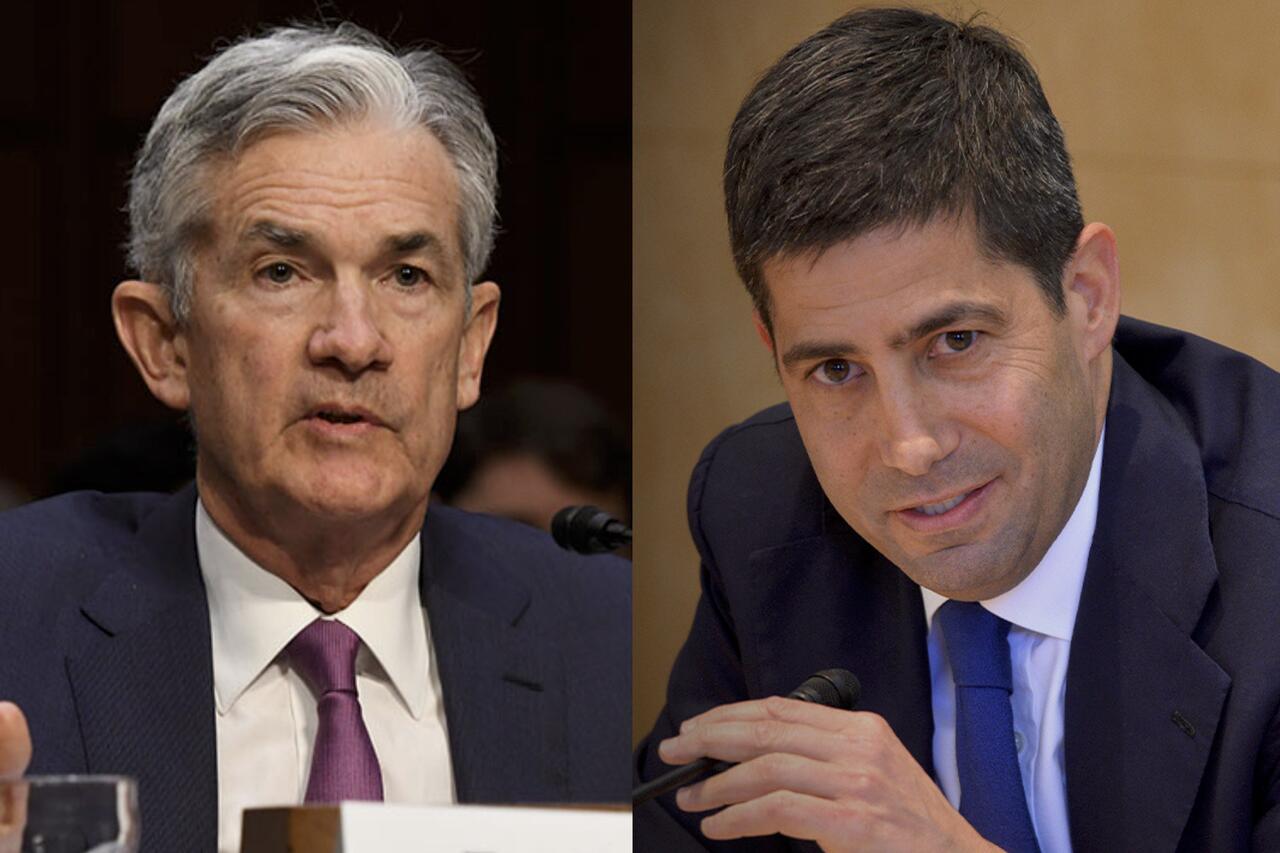
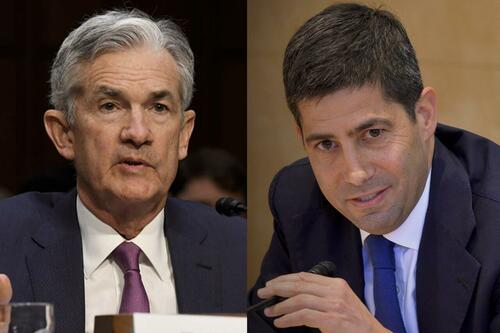
Newly confirmed Federal Reserve Chair Kevin Warsh, pledging new tactics to fight inflation, faces an uphill battle to keep rising prices in check.
At his April 21 Senate confirmation hearing, Warsh called for “a regime change in the conduct of policy” at the Fed under former chair Jerome Powell, whose tenure saw annual inflation exceed 8 percent during the Biden administration and has failed since 2021 to keep inflation below its target.
“Once you let inflation take hold in the economy, it’s more expensive and harder to bring it down, and so the fatal policy error going back four or five years is still a legacy that we’re dealing with,” Warsh stated. “Hard-working Americans are no doubt feeling it.”
Americans are suffering as price increases outpace wages. And as of April, the inflation rate of 3.8 percent remains persistently above the 2 percent target set by the Federal Reserve.
What is the new Fed chair’s plan to get inflation under control? Analysts predict that he will bring a different approach, which will include reducing the Fed’s massive $6.8 trillion bond holdings, prioritizing interest-rate actions over quantitative easing, and focusing on the money supply over other metrics.
“Warsh is likely going to pursue a smaller Fed balance sheet and try to use this ‘tightening’ as a bargaining chip to get the Federal Open Market Committee to lower short-term rates,” Chris Whalen, investment banker and former Fed staffer, told The Epoch Times. “His comments on the disaster of quantitative easing are quite clear.”
The Legacy of Cheap Dollars
Except for a brief interlude during President Donald Trump’s first term, the Fed has pursued a cheap-money strategy since the mortgage crisis of 2008–09, keeping its benchmark short-term interest rate—the federal funds rate—near zero, and only raising rates in 2022 when inflation was approaching double digits. Simultaneously, the Fed pursued an experimental policy called quantitative easing (QE), in which it created money to buy bonds from money-center banks, flooding the U.S. economy with dollars.
Between 2008 and 2022, the Fed accumulated $8 trillion in new financial assets on its balance sheet, effectively transforming it into one of the world’s largest asset managers and the largest single owner of U.S. Treasuries. Warsh has been an outspoken critic of quantitative easing, leading many economists to predict he will try to reverse this policy and shrink the Fed’s balance sheet.
During his confirmation hearing, he stated that “the Fed has an interest rate tool and a balance sheet tool … The balance sheet tool disproportionately helps those with financial assets; the interest rate tool hits the entire economy.”
While QE and low interest rates boosted demand in the wake of the mortgage collapse and pandemic lockdowns, they also drove up asset prices—notably stocks, bonds, and houses—to the benefit of wealthier Americans. Simultaneously, living standards fell for many Americans, whose dollars have lost more than 20 percent of their value over the past five years.
“The primary driver of inflation is the Fed’s expansion of the money supply, which the new Fed chair Kevin Warsh has addressed numerous times,” Julia Cartwright, economist with the American Institute for Economic Research, told The Epoch Times.
Between 2020 and 2022, the Fed injected approximately $6.4 trillion in new money into the economy to finance COVID stimulus payments, she said, and about 29 percent of America’s entire money supply today has been created since January 2020.
“Compounding this, the Iran conflict has choked off the Strait of Hormuz, disrupting roughly 20 million barrels of oil per day and a fifth of global LNG trade, driving up energy, fertilizer, plastics, food, and virtually every input price across the economy,” Cartwright said.
Follow the Money Supply
While the Iran war and tariffs have driven up prices, Steve Hanke, professor of economics at Johns Hopkins University who served on President Ronald Reagan’s Council of Economic Advisers, maintained that inflation is fundamentally a monetary phenomenon, a matter of too much money chasing too few goods.
“To put the inflation genie back in the bottle, the Fed must dump the post-Keynesian economic models it relies on and start paying attention to the quantity theory of money and the money supply, broadly measured,” Hanke told The Epoch Times.
“The Fed should announce that it is going to target the growth rate in the money supply that is consistent with hitting its two-percent-per-year inflation target,” he said. “Based on the quantity theory of money, that would require the rate of growth in M2 to be around 6 percent per year.”
The M2 measurement of the money supply includes cash, bank deposits, and funds that are readily convertible to cash, such as certificates of deposit and money market funds. During America’s low-inflation period, between 2008 and 2020, the annual growth rate in the money supply (M2) was 6.11 percent, Hanke said, and inflation, measured by the Consumer Price Index (CPI), averaged 1.77 percent.
Indeed, Warsh has indicated that he will focus on different metrics to measure and control inflation, beyond short-term price fluctuations.
“What I’m most interested in is: What is the underlying inflation rate—not what is the one-time change in prices because of a change in geopolitics or change in beef,” Warsh told senators at his confirmation hearing.
The Power of the Supply Side
What can the Trump administration do to help the Fed fight inflation? Economists call for supply-side initiatives, such as continuing deregulation, lowering tariffs, and boosting energy supply, as well as cutting government spending.
“Deficit financing pressures the Fed to expand the money supply and keeps interest rates higher than necessary,” Cartwright said.
She also advocated for a hands-off approach to private industry, despite the recent stakes the Trump administration has taken in companies like Intel.
“In a functioning economy, business compete primarily by bringing prices down—the more competition, the lower the prices and the better off consumers are,” Cartwright said. “The most persistent and under-appreciated source of higher prices is government interference in that competition through subsidies, preferential corporate deals, tariffs, and industrial policy that substitutes Washington’s judgment for the market’s.”
Lastly, economists say, politicians should let the Fed focus on fighting inflation rather than pressuring Fed officials to cut interest rates before inflation is tamed.
“The best course of action for the Trump administration to take would be to go radio silent on monetary policy,” Hanke said. “Do what President Reagan did with [then-Fed chair] Paul Volcker: Reagan gave Volcker the monetary policy reins and left him alone.”
Tyler Durden
Wed, 05/20/2026 – 20:55
Texas Democrat Wants A Prison Camp for ‘American Zionists’
Texas Democrat Wants A Prison Camp for ‘American Zionists’
A San Antonio Democrat running for Congress has proposed turning a federal immigration detention facility into an internment camp for “American Zionists,” and that is only the beginning of what she has been saying out loud. Maureen Galindo, a candidate in Texas’ newly redrawn 35th Congressional District, faces a Democratic primary runoff next week against former Bexar County Public Information Officer Johnny Garcia.
Maureen Galindo
With early voting running through Friday, May 22, she has managed to make national headlines for all the wrong reasons. In an Instagram post written in the third person, Galindo declared that she’ll “turn Karnes ICE Detention Center into a prison for American Zionists and former ICE officers for human trafficking.” The same post described the South San Antonio facility as “a castration processing center for pedophiles, which will probably be most of the Zionists.” The Karnes facility currently serves as an immigration detention center that the Trump administration has used to house migrants.
This is not a one-off outburst. Galindo has built her campaign around the assertion that Garcia, her Democratic opponent, is a participant in a human trafficking conspiracy orchestrated by “billionaire Zionist Jews.” She has vowed to put him “on trial” for treason. Her broader worldview is a litany of antisemitic tropes, including the claims that Jewish Zionists control Hollywood, the media, and local politicians.
“I think it’s actually the Zionists who are putting Jewish people at the most risk,” Galindo said last week, framing her remarks as ideological criticism rather than ethnic targeting.
Jewish community leaders in San Antonio are not buying the semantic wall she is trying to erect between her words and their plain meaning.
The San Antonio Jewish Federation responded with a formal statement: “The JFSA strongly condemns the spread of antisemitic tropes and conspiracy theories in public discourse.”
The same statement added that “Divisive and hateful rhetoric targeting the Jewish community has no place in our civic life.”
The Democratic Party’s mainstream has begun, however belatedly, to distance itself from Galindo. John Lira, who lost to Galindo in the earlier primary, rescinded his endorsement last week. State Rep. James Talarico, the Democratic nominee for Texas’s U.S. Senate race, told the Jewish Telegraphic Agency that he refuses to share a campaign stage with Galindo even if she wins the runoff. “This antisemitic rhetoric has no place in our politics,” Talarico said. “We need leadership in both parties willing to stand up and call out hate where it rears its ugly head.” It is a fine statement.
It would land with more force if Talarico’s party were not increasingly accommodating to exactly this strain of politics, because Galindo is not an anomaly; she is a symptom.
In Maine, the presumptive Democratic Senate nominee, Graham Platner, reportedly carried a Nazi totenkopf tattoo on his chest for years, even bragging about it, before covering it up once the campaign made such imagery inconvenient. Other progressive firebrands like Zohran Mamdani, Ilhan Omar, and Pramila Jayapal have all been criticized for antisemitic posturing. The party has also done nothing to distance itself from progressive commentator Hasan Piker, who is known for making antisemitic comments.
Galindo’s campaign has become a national flashpoint precisely because her positions are expressed with unusual candor.
While antisemitism continues creeping into the Democratic mainstream under the cover of euphemisms and activist jargon, Galindo skipped the dog whistles entirely and went straight for the megaphone.
She emerged from the primary narrowly ahead of Garcia. Now, the runoff election will test whether openly antisemitic rhetoric is finally disqualifying in modern Democratic politics, or whether the party’s activist base has already normalized something that would have ended a political career not long ago.
Tyler Durden
Wed, 05/20/2026 – 20:30
https://www.zerohedge.com/political/texas-democrat-wants-prison-camp-american-zionists
Obamacare Enrollment Expected To Drop By Nearly Five Million As Costs Surge
Obamacare Enrollment Expected To Drop By Nearly Five Million As Costs Surge
Enrollment in the Affordable Care Act marketplace is projected to fall by nearly 5 million people this year as rising premiums and higher deductibles force many Americans to reconsider whether they can still afford health insurance coverage, according to a new analysis from healthcare nonprofit KFF.
The report estimates ACA enrollment could decline from 22.3 million participants in 2025 to roughly 17.5 million this year, representing a drop of more than 20 percent.
At the same time, Americans who remain enrolled are paying substantially more out of pocket. According to the analysis, average deductibles have climbed by more than $1,000, while monthly premium payments have increased by an average of $65.
“No matter how you slice it, people are paying more,” said Cynthia Cox, who co-authored the report.
The sharp enrollment decline comes after the expiration of enhanced COVID-era subsidies that had artificially lowered costs for many Obamacare enrollees over the past several years. Without those subsidies, many middle-income Americans are now struggling to keep up with rising monthly payments.
KFF found that middle-income Americans were among the most likely to drop their coverage. Many earn too much to qualify for the remaining low-income subsidies but not enough to comfortably absorb the higher costs now hitting the marketplace.
The ACA marketplace, once promoted as a cornerstone of Democrat healthcare policy, has become increasingly important for gig workers, farmers, ranchers, hairstylists, and self-employed Americans who do not receive employer-sponsored coverage.
According to the report, many consumers were automatically renewed into plans from the previous year, only to discover that costs had risen dramatically after the subsidies expired. In many cases, Americans initially kept their coverage before dropping it later in the year once the monthly bills became unaffordable.
“People are trying to hang on to their health insurance coverage any way they can, even if that means they have a deductible of $7,000,” Cox said.
The report found that enrollment declines occurred across most states, although states operating their own healthcare exchanges generally retained more participants than states relying on the federal marketplace.
The Trump administration has argued that some of the enrollment decline stems from efforts to remove fraud and improper enrollments from the ACA system. Federal officials have not yet released final 2026 enrollment figures.
KFF had previously projected that premiums could more than double after the COVID-era subsidies ended. The new analysis found that premiums instead rose by an average of 58 percent, partly because many Americans switched into cheaper plans with significantly higher deductibles and reduced coverage.
The rising costs and shrinking enrollment are expected to become a major issue heading into the midterm elections as voters increasingly focus on inflation, affordability, and broader economic pressures.
Cox suggested insurers may now be adjusting to the post-subsidy market environment, potentially reducing the likelihood of another major premium spike next year.
“I’m hopeful that this could be a one-time market correction,” she said.
Tyler Durden
Wed, 05/20/2026 – 20:05
The Water Economics Of Data Centers V. Almond Farms & Golf Courses
The Water Economics Of Data Centers V. Almond Farms & Golf Courses
A recent Gallup poll shows that nearly 70% of Americans oppose the construction of a data center in their communities, highlighting the rise of local resistance movements against hyperscaler buildouts. This resistance is driven by concerns over skyrocketing power bills, the destruction of farmland as it is transformed into industrial-scale AI infrastructure, and fears that data centers will drain local resources, particularly water.
It’s no surprise that data center resistance is only gaining steam and will likely accelerate from here, as tech bros on the All-In podcast recently sounded the alarm. This resistance is emerging not just as power bills explode and water scarcity fears mount, but also as corporate America unleashes the “white-collar purge,” with human labor swapped for GPUs. Meta was the latest to announce rising AI adoption alongside a new round of layoffs.
Water has become a flashpoint in data center debates, as some of these facilities can use 5 million gallons of water every day, as much as 16,000-plus average U.S. households, according to Environmental Protection Agency estimates.
There is also the extraordinary amount of power required to run the chip stacks, which consumes millions of additional gallons of water – more than the water used for cooling.
Hyperscalers are set to deploy $700 billion in capex this year to build out data centers and key AI infrastructure products, suggesting that local resistance nationwide will only continue to build as tech bros search for alternative options (low-Earth orbit and or residential backyards). Permitting denials and other issues may delay or block nearly half of data center projects this year.
However, on the subject of water, critics of data centers often fail to point out – especially in California – that agriculture also consumes a tremendous amount of water.
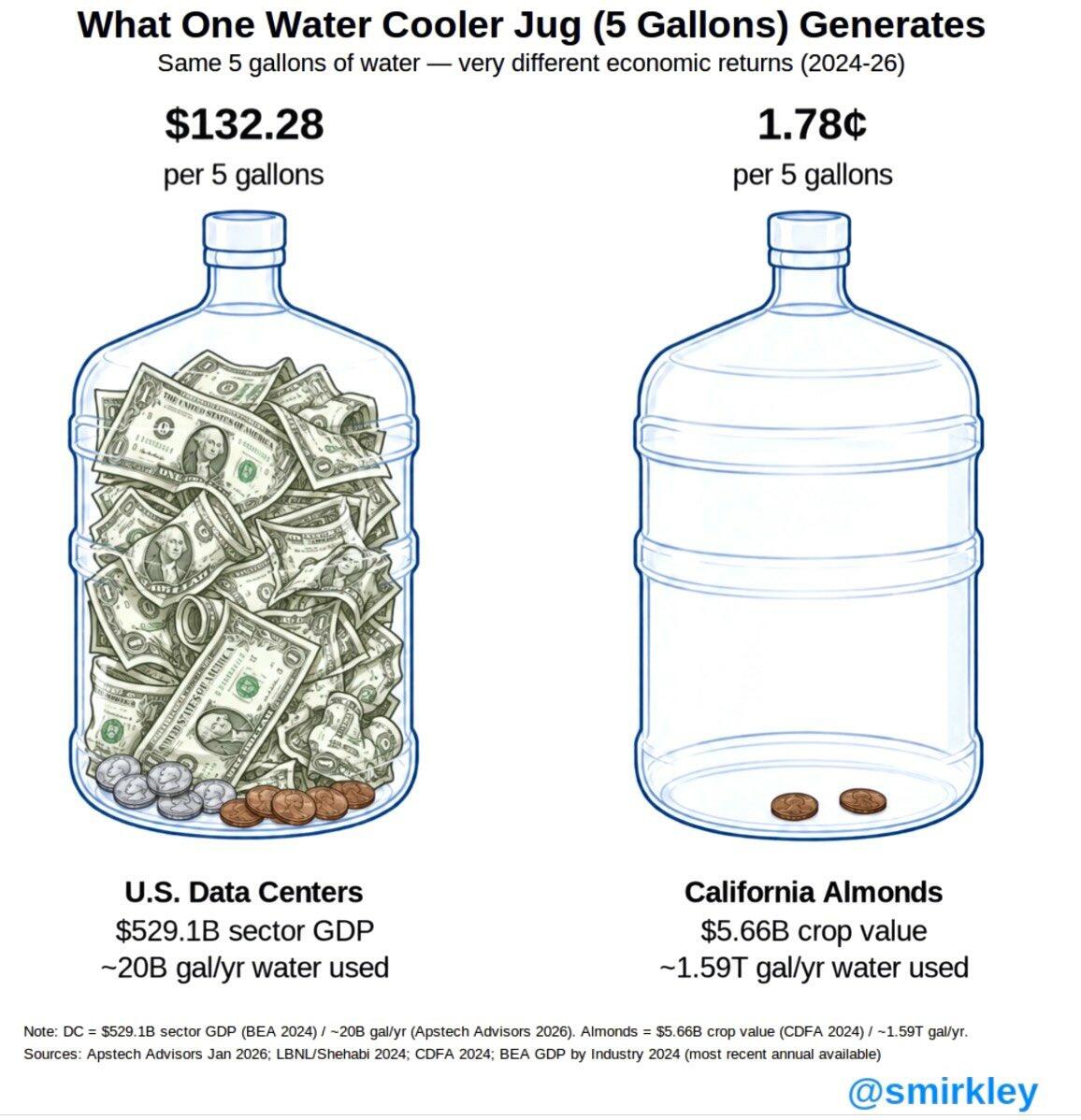
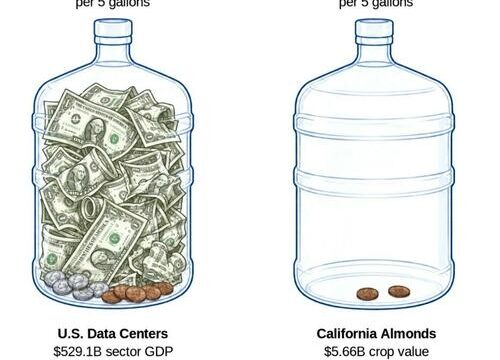
X user Smirkley compared the economics of a 5-gallon water-cooler jug, arguing that 5 gallons of water generates about $132 in economic output in data centers, but only about 2 cents in almonds.
Yet where is the outrage here?
Here is Smirkley’s math:
Data centers: $529.1 billion ÷ 20 billion gallons × 5 = $132.28 per 5 gallons
California almonds: $5.66 billion ÷ 1.59 trillion gallons × 5 = 1.78 cents per 5 gallons
Smirkley’s point is that AI infrastructure produces far more economic output per gallon than almonds.
Fine. Let me make it simple.
Almonds grown in the US use 80x more water than every American data center combined. This is the difference between an 8oz glass vs. a 5-gallon jug. pic.twitter.com/6NvR46klqJ
— Smirkley (@Smirkley) May 19, 2026
“Anti-data-center luddites may be worse than anti-nuclear activists. It is the same emotional panic, but even dumber somehow,” the X user noted, adding, “Almonds grown in the U.S. use 80x more water than every American data center combined. This is the difference between an 8 oz. glass and a 5-gallon jug.”
Honestly, fuck almonds pic.twitter.com/6PWXPKD8A7
— @jason (@Jason) May 14, 2026
“Data centers aren’t stealing your water. Even if the total water draw of data centers triples by 2030, they’d require just 8% of the water consumed by American golf courses.@dodgeblake interviewed @AndyMasley, the man who’s been debunking AI water doomerism,” outlet Pirate Wires wrote on X.
Data centers aren’t stealing your water.
Even if the total water draw of data centers triples by 2030, they’d require just 8% of the water consumed by American golf courses.@dodgeblake interviewed @AndyMasley, the man who’s been debunking AI water doomerism. Full story 👇 https://t.co/2paxx8rHeO pic.twitter.com/gDpDiwDOca
— Pirate Wires (@PirateWires) May 20, 2026
Where is the outrage for almonds and golf courses?
Tyler Durden
Wed, 05/20/2026 – 19:40
https://www.zerohedge.com/ai/water-economics-data-centers-versus-almond-farms
Several States Contest Federal Orders Keeping Coal-Fired Power Plants Open
Several States Contest Federal Orders Keeping Coal-Fired Power Plants Open
Authored by John Haughey via The Epoch Times (emphasis ours),
A three-judge federal appeals panel is expected to issue a decision by year’s end on a lawsuit challenging Energy Secretary Chris Wright’s May 2025 emergency order that prevented a Michigan utility from closing a 64-year-old coal-fired power plant.
How the U.S. Court of Appeals for the District of Columbia rules in Michigan v. DOE after hearing May 15 oral arguments could prove precedential in deciding three similar cases–including two before the same court. It could also resolve a May 9 lawsuit filed in Seattle’s U.S. District Court by 16 Democratic state attorneys general who claim the emergency that President Donald Trump declared in his January 2025 National Energy Emergency executive order doesn’t exist.
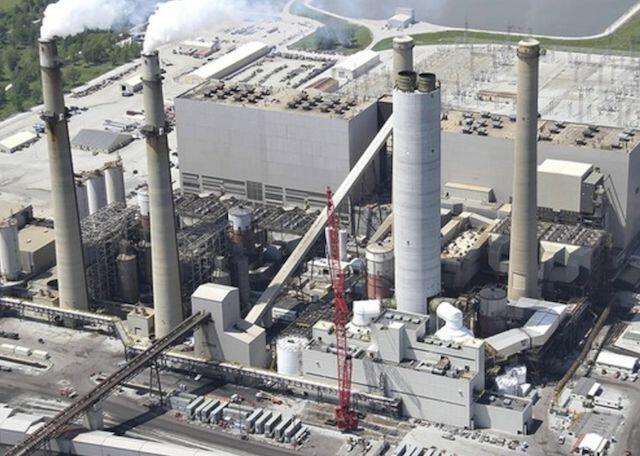
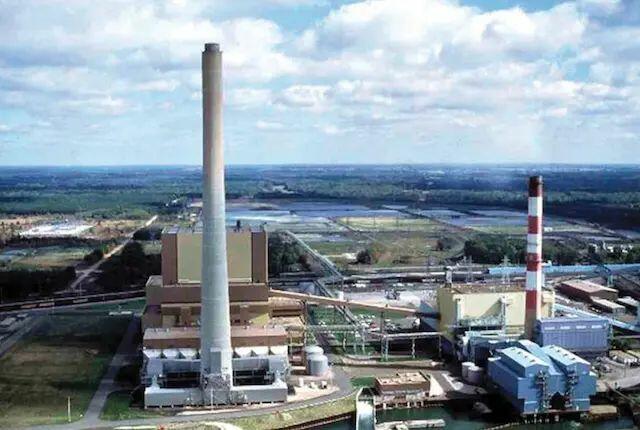
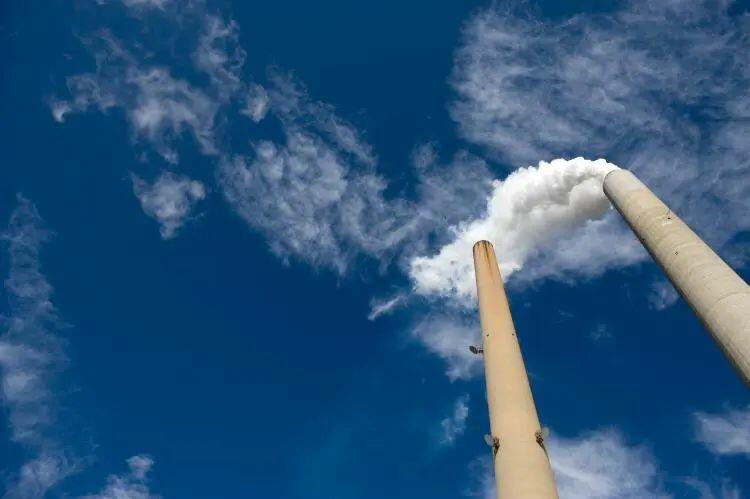
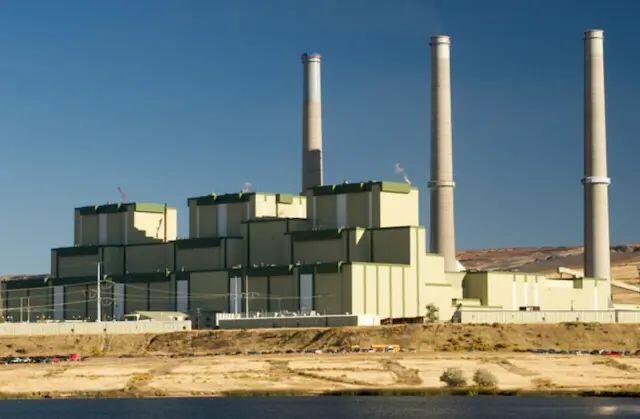
Wright has issued five 2025 emergency orders under Section 202(c) of the Federal Power Act mandating that decades-old coal-fired generators in Michigan, Washington, Indiana, and Colorado, slated to be shut down by utilities, must continue operating or, at least, remain operable. This would assure that regional transmission electrical grids have the baseload capacity to provide enough power during extreme winter and summer weather stresses, the orders say.
The secretary maintains he has the authority to do so under the president’s National Energy Emergency declaration and his April 2025 executive orders supporting the coal industry and strengthening the nation’s electrical grid.
Wright, in public comments and in Fiscal Year 2027 budget hearings, maintains that the orders—90-day emergency mandates he’s repeatedly reissued—have prevented the retirement of more than 17 gigawatts of coal-powered generation, enough electricity to power up to 17 million homes. He has said that renewable energies encouraged by the Biden administration and some Democrat-led states are weather-dependent, costly, and reliant on imported materials, including from China.
Had he not issued the emergency orders to keep the Michigan and two Indiana coal-fired plants open through this winter, “People would have died” during January and February storms, he said during an April 21 Senate Energy and Natural Resources Committee hearing.
“We pushed the grid to the edge. Coal kept things alive,” Wright said. “If we don’t extend the life of these coal plants, we will continue to have ruinous rises in our electricity prices [and] will not be able to meet the challenge of re-shored manufacturing and winning the AI race against China.”
Congressional Democrats say those orders have cost the nation’s electricity customers more than $500 million, noting the five aging plants are not operating at significant capacity. Among the claims made in lawsuits challenging the mandates—including by Michigan, Illinois, and Minnesota in the case heard May 15—is that the federal government is exceeding its authority by dictating to local utilities which energy source they choose.
While each plant and closure is different, they share similarities, and the fallout from the rulings could boost or derail the Trump administration’s campaign to revive the nation’s coal industry.
Michigan: J.H. Campbell
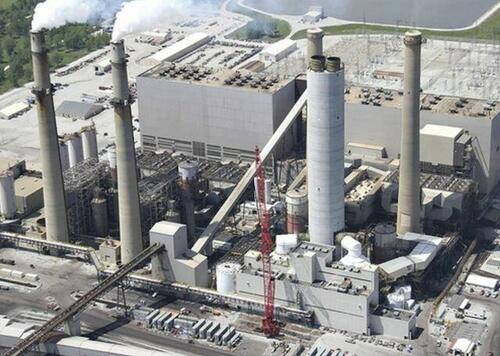
The J.H. Campbell power plant in West Olive, Michigan, operated by Consumers Energy, a subsidiary of CMS Energy, opened in 1962. It was scheduled to shut down on May 31, 2025, and be replaced by a plant fueled with a combination of natural gas, renewable energies, and battery storage in Covert, Michigan.
Eight days before the closure, Wright issued an emergency order directing Consumers Energy and the Midcontinent Independent System Operator (MISO), which provides electricity for 223 utilities serving 45 million people across 15 states, to keep the plant open for 90 days. It was the first of a succession of 90-day orders that have kept the three-unit plant open since.
Wright’s order said that keeping the plant open was necessary “to minimize risk of blackouts and address critical grid security issues in the Midwestern region of the United States ahead of the high electricity demand expected this summer.”
The 2,000-acre coal-fired plant was being shuttered 15 years before the end of its “scheduled design life,” the order stated, citing a North American Electric Reliability Corporation 2025 Summer Reliability Assessment warning that MISO’s grid was at “elevated risk” of shortfalls during summer peaks. It also cited MISO’s own forecast that acknowledged “potential for elevated risk during extreme weather.”
The Michigan Public Service Commission and Michigan Attorney General’s office, along with national environmental groups and local consumer advocates, maintain that the aging plant is unnecessary and imposes higher costs on utility customers. The state and consumer organizations, along with Illinois and Minnesota, faced off with federal regulators in the May 15 hearing in Washington.
According to CMS Energy’s regulatory filings with the Securities and Exchange Commission, the company maintains that between June 1 and Dec. 31, 2025, it cost $290 million to pay for coal shipped from Wyoming’s Powder River Basin, along with maintenance and salaries to keep the plant open, often at single-digit capacity.
That expense was offset by selling $155 million in electricity to utilities across 11 states within MISO’s grid. Overall, CMS Energy tabulates that it has incurred $180 million in operating losses—about $631,000 per day.
Consumers Energy has petitioned the Federal Energy Regulatory Commission for permission to recoup $135 million from MISO ratepayers and is seeking to recover $43 million from the Department of Energy in costs incurred to comply with the federal order.
Wright maintains that the costs of keeping Campbell and other coal-fired plants open are outweighed by the risks, including potential loss of life, when electricity goes out, especially in winter.
He said Campbell “was integral in stabilizing the grid,” providing 650 megawatts a day of electricity—enough power for 600,000 homes—during Winter Storm Fern, from Jan. 21 to Feb. 1.
“Beautiful, clean coal was the MVP of recent winter storms,” he said in a February statement. “Hundreds of American lives have likely been saved because of President Trump’s actions saving America’s coal plants, including this Michigan coal plant, which ran daily during Winter Storm Fern.”
Washington: Centralia
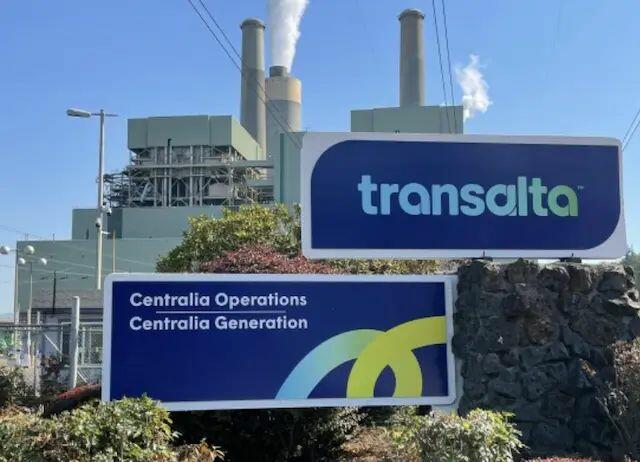
Wright issued an emergency order on Dec. 16, 2025, mandating that TransAlta keep its coal-fired Centralia Generating Station Unit 2 operating beyond its planned Dec. 31 closure.
The Centralia plant is “essential” for the Northwest’s grid stability, he said in the order, referring to the North American Electric Reliability Corporation’s 2025-26 Winter Reliability Assessment, which determined that the region was at “elevated risk” of power shortages during extreme weather, including cold snaps. Wright extended the order in March by another 90 days through June 14.
Canada-based TransAlta in April filed a cost recovery application with the Federal Energy Regulatory Commission, claiming it cost between $20 million and $23 million to purchase and ship coal from Peabody Energy’s Spring Creek Mine in Montana and Rawhide Mine in Wyoming to keep the 53-year-old plant operating during the 87 days before March 16.
The company said the order derailed its plan with Puget Sound Energy to convert the plant to natural gas by 2028.
Washington Attorney General Nick Brown, in March, asked the U.S. Ninth Circuit of Appeals to reject Wright’s order while also filing a lawsuit in Seattle’s U.S. District Court challenging the legality of the action and claiming no grid emergency in the region.
Also in March, Washington Gov. Bob Ferguson signed House Bill 2367, which eliminates “preferential treatment related to coal-fired electric generating plants,” revokes cap-and-invest exemptions for coal plants, and ends tax exemptions on coal used at the Centralia plant.
Indiana: Schahfer, Culley
On Dec. 23, 2025, Wright issued an order preventing the planned Dec. 31, 2025, closures of two coal-fired units at the R.M. Schahfer power plant in Wheatfield, Indiana, operated by Northern Indiana Public Service Co., and the coal-fired F.B. Culley power plant near Newburgh, Indiana, operated by CenterPoint Energy.
That 90-day emergency order was renewed in March, requiring Schahfer’s two coal-fired units—built in 1983 and 1986—and Culley to remain operable at least through June 21.
Among the reasons Wright cited in the emergency order for keeping the plants operable, if not fully operating, was the same strain on MISO’s grid to which he referred in his Michigan order.
The December order also noted that it’s difficult for coal-fired generators “to resume operations once they have been retired.”
During a March 24 hearing before the Indiana Utility Regulatory Commission, Northern Indiana Public Service Co. President Vince Parisi said that keeping Schahfer’s two coal-fired units open cost the utility “in excess of $100 million.”
One of the two coal-fired units ordered to remain operable had been shuttered since summer and remained offline, he said.
CenterPoint President Michael Roeder said during the hearing that it had cost his utility at least $18 million to keep its F.B. Culley Unit 2 plant operating during the first three months of the year.
In his March 23 order extending the emergency another 90 days, Wright said that during Winter Storm Fern, Schahfer generated more than 285 megawatts daily and Culley pushed 30 megawatts a day into MISO’s stressed grid.
R.M. Schahfer gets its coal primarily from Wyoming’s Powder River Basin and, to a lesser extent, the Illinois Basin. Culley’s coal is shipped from Oaktown mines southwest in Indiana’s Knox County.
The Sierra Club, among other environmental groups and local consumer advocate organizations, in April filed a lawsuit in Washington arguing that Wright’s orders are federal overreach. The suit is similar to Michigan’s challenge, and, as with that case, the attorneys general of Illinois and Minnesota have also signed on.
Colorado: Craig
On Dec. 30, 2025, Wright issued an emergency order directing Tri-State Generation and Transmission Association, the Platte River Power Authority, Salt River Project, PacifiCorp., and Xcel Energy’s Public Service Company of Colorado to ensure that the Craig Station Unit 1 coal-fired plant in Craig, Colo., “remains available to operate.”
Citing the North American Electric Reliability Corporation’s 2024 Long-Term Reliability Assessment for Colorado and the Western Electricity Coordinating Council, Wright said, “I determined the [council’s] area faced a significant amount of retiring baseload generation resources and has concerns in meeting demand.”
Keeping Craig Unit 1 online “would help prevent the loss of power to homes and businesses that would otherwise pose a risk to public health and safety,” he wrote.
The plant, built in 1974, was scheduled to shut down on Dec. 31. On March 30, the order was extended for another 90 days.
Craig, around 200 miles northwest of Denver with a Census 2020 population of about 9,000, was a major energy hub in the 1970s-80s for the Western Area Power Administration’s Rocky Mountain Region and Southwest Power Pool regional grid because of its nearby coal mines, including Trapper Mine.
The four owners of the two coal-fired plants within the three-unit power complex in north-central Colorado had planned the closures since 2016.
Tri-State, a not-for-profit electricity wholesaler owned by the 43 cooperatives and municipal power districts, and Platte River, a nonprofit utility operator, said the coal-fired plants were no longer needed, their generation exceeded by new solar and wind developments.
They filed a Jan. 29 petition asking the Department of Energy to reconsider the order, claiming they’re being forced to impose costs on ratepayers. They called the federal action an “uncompensated taking” of their property in violation of the Constitution’s Fifth Amendment.
A December 2025 analysis by Grid Strategies calculates that it could cost $85 million to $150 million annually to keep Craig 1 operating, in addition to concurrent expenses in operating new wind, solar, and transmission projects.
Colorado Attorney General Phil Weiser and a coalition of environmental groups, including the Sierra Club and Earthjustice, have challenged the emergency order, filing a lawsuit in U.S. District Court in Washington, D.C., claiming it is an abuse of emergency authority and will unjustly inflate Coloradans’ electric bills.
Tyler Durden
Wed, 05/20/2026 – 19:15
West Virginia Has America’s Highest Gas-Price Burden
West Virginia Has America’s Highest Gas-Price Burden
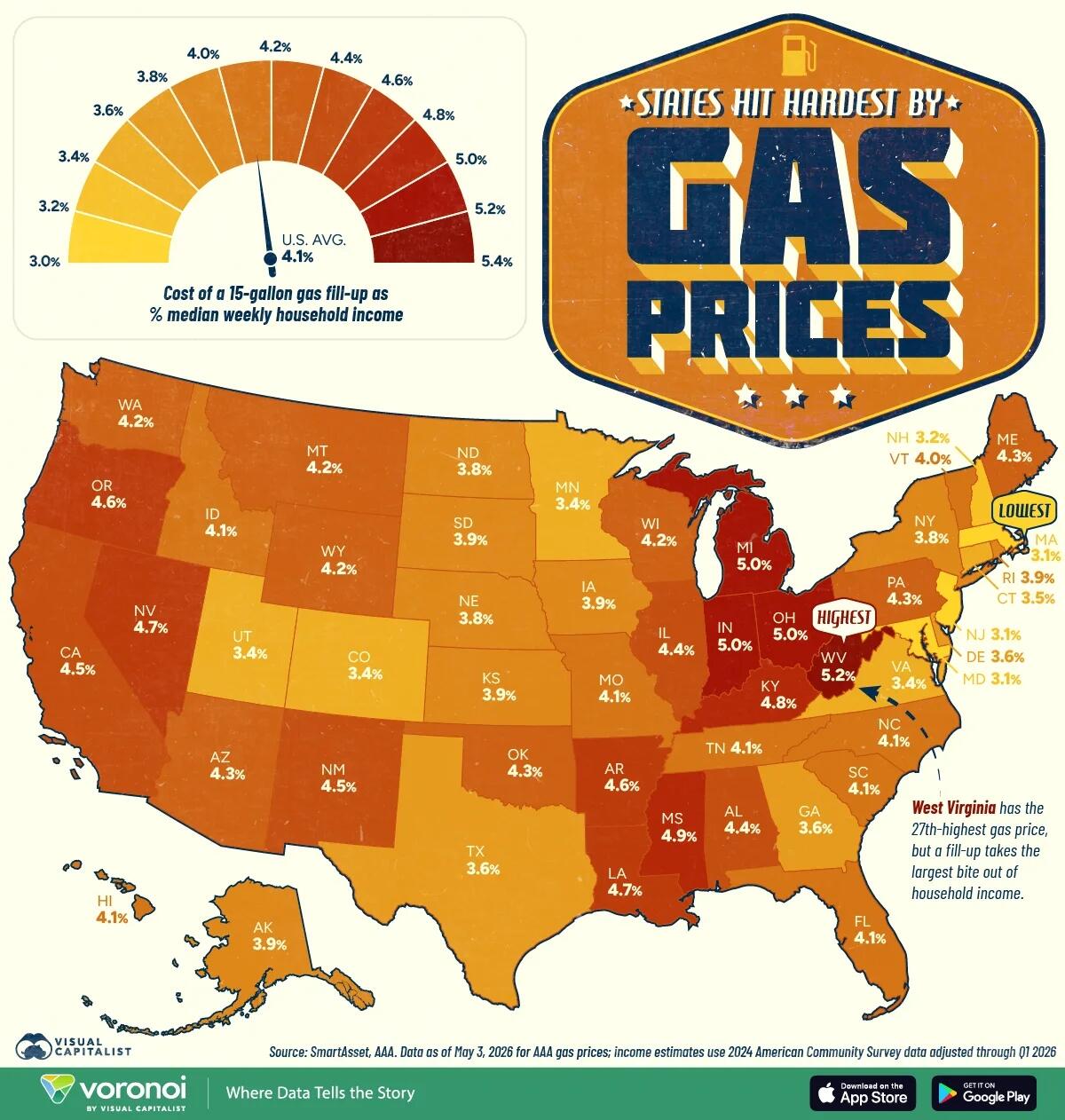
Americans are still paying elevated prices at the pump in 2026, but the biggest financial burden is falling on states with lower household incomes rather than the highest fuel prices.
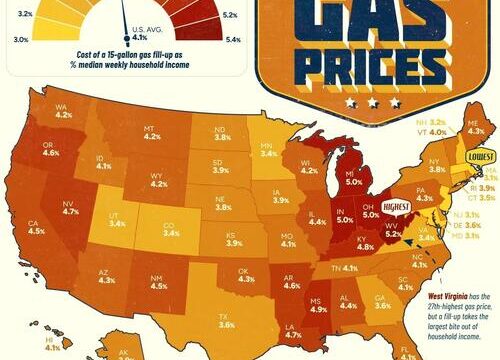
This map, via Visual Capitalist’s Bruno Venditti, shows where gasoline is least affordable by comparing the cost of a standard 15-gallon fill-up against median weekly household income across all 50 states.
The data comes from SmartAsset and AAA, as of May 2026.
The Highest Gas Burdens Aren’t in California
West Virginia ranks as the state where gas prices hit the hardest, with a 15-gallon fill-up consuming 5.2% of median weekly household income.
West Virginia’s fuel prices are not especially high by national standards. Instead, lower household incomes mean a routine fill-up consumes a larger share of weekly earnings.
State
Gas price
Median weekly income
Price of fill-up (% of median weekly income)
Price of fill-up (% of weekly minimum wage)
West Virginia
$4.30
$1,233
5.2%
18.43%
Ohio
$4.89
$1,465
5.0%
16.65%
Michigan
$4.87
$1,468
5.0%
13.30%
Indiana
$4.83
$1,459
5.0%
24.97%
Mississippi
$3.88
$1,199
4.9%
20.08%
Kentucky
$4.22
$1,309
4.8%
21.82%
Louisiana
$3.90
$1,237
4.7%
20.16%
Nevada
$5.17
$1,646
4.7%
16.15%
Arkansas
$3.88
$1,260
4.6%
13.23%
Oregon
$5.25
$1,728
4.6%
13.09%
New Mexico
$4.16
$1,375
4.5%
13.01%
California
$6.10
$2,031
4.5%
13.54%
Alabama
$3.96
$1,352
4.4%
20.48%
Illinois
$4.93
$1,688
4.4%
12.33%
Oklahoma
$3.89
$1,342
4.3%
20.10%
Pennsylvania
$4.52
$1,573
4.3%
23.38%
Arizona
$4.74
$1,653
4.3%
11.73%
Maine
$4.40
$1,550
4.3%
10.93%
Montana
$4.32
$1,528
4.2%
14.94%
Washington
$5.67
$2,016
4.2%
12.40%
Wyoming
$4.30
$1,532
4.2%
22.23%
Wisconsin
$4.37
$1,572
4.2%
22.61%
Hawaii
$5.63
$2,043
4.1%
13.20%
Florida
$4.34
$1,577
4.1%
11.63%
Missouri
$3.97
$1,452
4.1%
9.93%
Tennessee
$3.99
$1,460
4.1%
20.66%
South Carolina
$4.00
$1,467
4.1%
20.70%
North Carolina
$4.08
$1,500
4.1%
21.09%
Idaho
$4.46
$1,646
4.1%
23.04%
Vermont
$4.42
$1,678
4.0%
11.48%
South Dakota
$4.06
$1,559
3.9%
12.86%
Alaska
$5.04
$1,940
3.9%
14.53%
Rhode Island
$4.38
$1,694
3.9%
10.95%
Kansas
$3.96
$1,532
3.9%
20.47%
Iowa
$3.95
$1,531
3.9%
20.43%
New York
$4.45
$1,741
3.8%
10.44%
Nebraska
$3.96
$1,549
3.8%
9.91%
North Dakota
$3.99
$1,579
3.8%
20.66%
Texas
$3.92
$1,617
3.6%
20.26%
Georgia
$3.85
$1,622
3.6%
19.92%
Delaware
$4.21
$1,775
3.6%
10.52%
Connecticut
$4.52
$1,948
3.5%
10.00%
Minnesota
$4.05
$1,767
3.4%
13.31%
Colorado
$4.44
$1,970
3.4%
10.98%
Utah
$4.39
$1,960
3.4%
22.71%
Virginia
$4.17
$1,868
3.4%
12.25%
New Hampshire
$4.34
$2,024
3.2%
22.46%
New Jersey
$4.42
$2,115
3.1%
10.40%
Maryland
$4.27
$2,087
3.1%
10.68%
Massachusetts
$4.34
$2,126
3.1%
10.85%
Other Midwestern and Southern states dominate the top 10, including Ohio, Michigan, Indiana, Mississippi, and Kentucky. In many of these states, long driving distances and limited public transit make gasoline a near-essential household expense.
High Gas Prices Don’t Always Mean High Burden
California has the highest gasoline prices in the country at roughly $6.10 per gallon, yet it ranks only 12th in overall burden. Hawaii and Washington also post some of America’s most expensive fuel prices but remain outside the top 10.
Higher household incomes help offset the cost of filling up. In California, for example, median weekly household income exceeds $2,000, significantly higher than in many states across the South and Midwest.
Minimum Wage Workers Face an Even Bigger Challenge
The burden becomes even more severe when measured against weekly minimum wage earnings. In Indiana, a single 15-gallon fill-up represents nearly 25% of a week’s minimum wage income. Pennsylvania, Idaho, and New Hampshire also rank among the highest by this measure.
Meanwhile, wealthier Northeastern states such as Massachusetts, Maryland, and New Jersey post some of the lowest overall burdens relative to household income. Stronger wages help cushion residents from volatile energy prices.
If you enjoyed today’s post, check out Gas Prices Surge to Highest Level Since July ’22 on Voronoi.
Tyler Durden
Wed, 05/20/2026 – 18:50
https://www.zerohedge.com/personal-finance/west-virginia-has-americas-highest-gas-price-burden

AI Is Making Business Email Compromise Nearly Impossible To Spot
AI Is Making Business Email Compromise Nearly Impossible To Spot
Authored by Adam H. Douglas via The Epoch Times (emphasis ours),
Business email compromise (BEC) is a targeted fraud scheme in which criminals impersonate vendors, executives, or accountants to steal money from businesses. AI has made these attacks dramatically harder to detect by generating personalized emails that mirror real writing styles and existing business relationships.
The FBI reported more than $20 billion in internet crime losses in 2025, with BEC ranked as the second-largest attack method. Small businesses are the primary target.
There are, however, five cost-free verification steps that can significantly reduce your exposure.
What Is Business Email Compromise?
A BEC is not your typical phishing email. There is often no suspicious link, no misspelled bank name, and no “lottery prize.”
BECs in 2026 are targeted, researched, and increasingly indistinguishable from a legitimate message sent by someone you already work with.
The Core BEC Scheme
A criminal impersonates a trusted contact, such as a vendor, your accountant, or your own CEO, and requests a wire transfer, an invoice payment, or a change to banking details.
By the time you realize something is wrong, the money is gone. Wire transfers are rarely reversible once they leave the domestic banking system.
Why AI Has Made This Significantly Worse
For years, spotting a BEC email meant looking for bad grammar, awkward phrasing, or a sender name that did not quite match the domain. That approach no longer works.
AI tools can now:
Scrape LinkedIn profiles, websites, and public business filings to map your vendor relationships and internal structure.
Analyze writing samples to clone the tone and style of a specific person.
Generate emails that reference real projects, real invoice numbers, and real business history.
Produce flawless English with none of the telltale errors that once flagged these attempts.
The result is correspondence that reads exactly like something your CFO or your longest-standing vendor would write. The old “just read it carefully” advice has been effectively neutralized by tools that generate deception at scale.
What a Typical Attack Looks Like
These two scenarios play out regularly against small businesses and freelancers:
Scenario 1: The Fake Vendor Invoice
You receive an email from what appears to be a vendor you have worked with for two years. The address looks right at a glance. The email references your last project together and includes an updated invoice with new banking details. The tone matches the vendor’s usual communication style. You process the payment. The real vendor’s account was never involved.
Scenario 2: The Executive Wire Request
You get an email from your company’s owner or a senior partner. A deal is closing today, and a wire transfer needs to go out immediately. The request emphasizes urgency and discretion. The writing style matches. The amount fits your normal range. You send it.
Both scenarios have cost small businesses hundreds of thousands of dollars in a single transaction.
Why Small Businesses Are Targeted More Than Large Companies
Large enterprises typically have layered payment approval systems, dedicated fraud detection software, and internal cybersecurity teams. Small and mid-sized businesses generally do not.
A single employee may have full authority to execute a wire transfer without a second sign-off. Criminals know this and exploit it systematically.
Five Verification Steps That Cost Nothing
You do not need specialized software or a cybersecurity team to reduce your BEC exposure. You need consistent habits.
“Call to confirm” protocol. Any request involving a payment, wire transfer, or change to banking details should be verified by phone, using a number already in your records, not one provided in the email in question.
Create a payment change policy. Set a firm rule: vendor or employee banking information is never updated based on an email alone. Require a written request plus a live phone confirmation.
Treat urgency as a red flag. Urgency is a deliberate manipulation tactic in BEC attacks. If an email is pressuring you to skip normal approval steps, slow down regardless of how legitimate it looks.
Check the actual sending domain. The display name may read “Sarah at Metro Supplies” while the actual address is sarah@metro-supplies-llc.net rather than sarah@metrosupplies.com. Lookalike domains are a standard BEC tool.
Require dual authorization for wire transfers. Even in a two-person operation, require a second approval on any outgoing wire above a defined threshold.
If Your Business Has Already Been Hit
If your business has already been hit, act immediately. Contact your bank and request a wire recall. File a complaint with the FBI’s Internet Crime Complaint Center at ic3.gov. If the loss is significant, contact your local FBI field office directly.
Also, review your insurance coverage. Standard commercial general liability policies typically do not cover funds transfer fraud. A cyber liability policy or crime insurance endorsement may provide protection.
Talk to a commercial broker about your current coverage before you need to file a claim.
FAQs About Business Email Compromise
What Makes BEC Different From a Regular Phishing Scam?
Phishing sends the same generic email to thousands of people, hoping someone clicks. BEC is the opposite: it is researched and customized to your specific business. Scammers study your vendor relationships, your internal structure, and your communication patterns before sending a message designed to look like it came from someone you already trust. That targeting makes BEC significantly more dangerous than standard phishing and much harder to catch before money has already moved.
Can My Business Recover Money Lost to a BEC Scam?
Recovery is possible but not guaranteed. Wire transfers move quickly, and funds often reach overseas accounts within hours of being sent. Contact your bank the moment you suspect fraud and request a wire recall. File a complaint with the FBI IC3 at ic3.gov. Acting within 24–48 hours gives you the best chance at partial or full recovery. Once funds leave the domestic banking system, getting them back becomes substantially harder and, in many cases, is not possible.
Does My Small Business Need Cyber Liability Insurance to Protect Against BEC?
Standard commercial general liability and property policies typically exclude funds transfer fraud. If your business regularly processes wire transfers, receives vendor invoices, or handles client financial data, a cyber liability policy or a crime insurance endorsement is worth reviewing with a commercial broker. Premiums for small businesses can be modest relative to potential losses. Understand exactly what your current policy covers before you need to file a claim, not after.
The Epoch Times copyright © 2026. The views and opinions expressed are those of the authors. They are meant for general informational purposes only and should not be construed or interpreted as a recommendation or solicitation. The Epoch Times does not provide investment, tax, legal, financial planning, estate planning, or any other personal finance advice. The Epoch Times holds no liability for the accuracy or timeliness of the information provided.
Tyler Durden
Wed, 05/20/2026 – 18:25
https://www.zerohedge.com/markets/ai-making-business-email-compromise-nearly-impossible-spot

US, Israel Planned To Install Hardliner Ahmadinejad As Iran’s Leader: Cartoonish NYT Report Says
US, Israel Planned To Install Hardliner Ahmadinejad As Iran’s Leader: Cartoonish NYT Report Says
In a revelation that blurs the line between calculated covert strategy and sheer desperation, the deep state’s latest regime change playbook for Iran has officially leaked via the NY Times; however, there are many aspects to the story which defy belief, and so like many Iran-related things being reported lately, should be taken with a big grain of salt.
According to a fresh New York Times report citing briefed US officials, Washington and Tel Aviv launched “Operations Roaring Lion” and “Epic Fury” with the objective to reinstall none other than former Iranian firebrand Mahmoud Ahmadinejad as the nation’s new leader.
The very man who had widely been deemed by West as a ‘hardliner’ was president of the Islamic Republic from 2005 to 2013 with a fiercely anti-Western agenda, and yet was apparently tapped by US intelligence to manage “Iran’s political, social, and military situation.”
Another publication has correctly called the story and alleged plan “cartoonish” and outlandish-sounding. Indeed just look at how the NY Times report begins: it first recounts how President Trump in the opening days of the war mused publicly that it would be best if “someone from within” Iran took over, and then—
It turns out that the United States and Israel went into the conflict with a particular and very surprising someone in mind: Mahmoud Ahmadinejad, the former Iranian president known for his hard-line, anti-Israel and anti-American views.
But the audacious plan, developed by the Israelis and which Mr. Ahmadinejad had been consulted about, quickly went awry, according to the U.S. officials who were briefed on it.
Mr. Ahmadinejad was injured on the war’s first day by an Israeli strike at his home in Tehran that had been designed to free him from house arrest, the American officials and an associate of Mr. Ahmadinejad said. He survived the strike, they said, but after the near miss he became disillusioned with the regime change plan.
An associate of Ahmadinejad further told the NYT that the Americans viewed him as someone who could actually hold the fractured nation together, despite his well known and colorful anti-Israel statements while he had been in power.
But apparently some of the aspects which made him a candidate, or potential future US-Israeli puppet in Tehran (Delcy Rodriguez-style), was that he had been barred three times from running for president by Iran’s unelected 12-member Guardian Council (in 2017, 2021, and 2024). Following his 2017 disqualification, he apparently flipped, becoming a highly vocal critic of Supreme Leader Ali Khamenei.
For this story to be true, it would mean that Ahmadinejad is an Israeli-US asset. It would also mean that his Israeli-US handlers decided to disclose this to the NYT. And it would mean that an Israeli-US bombing of Ahmadinejad’s home, which ended up wounding him, was actually… https://t.co/sfjsQI35z0
— Aaron Maté (@aaronjmate) May 20, 2026
Recent reports in the wake of the large-scale January protests, including in The Atlantic, indicated that his freedom of movement had been heavily restricted, and even his phones confiscated. He was by the start of Epic Fury under house arrest.
Because of all of this, a March Atlantic piece had concluded, “For more than a decade, he has been known more as a regime opponent than as a supporter.”
The Times report further alleges that blueprint to reinstall the former president was engineered by Israel, who supposedly had been actively discussing the plot with Ahmadinejad himself, but then the plan collapsed after Ahmadinejad was wounded during the chaotic jailbreak attempt – or rather, large-scale airstrike on his home. Since the strike, his actual condition and whereabouts remain entirely unknown.
Ahmadinejad, SERIOUSLY? The Holocaust denier? The wipe Israel off the map guy? The Green Revolution death and torture guy who stole the 2009 elections? The nuclear program accelerator guy? The Islamic fundamentalist end-days guy? https://t.co/xYCUoKjy76
— Christiane Amanpour (@amanpour) May 20, 2026
But he has managed to deliver a few public addresses since his alleged escape – including a highly strategic congratulatory message on Mojtaba Khamenei’s rise to supreme leader, after his father was killed. So ultimately, little of this NY Times account, which reads like a fantastical spy thriller, sounds too believable.
What the report may have done is simply to paint a bright target on this back: “People close to Mr Ahmadinejad have been accused of having too close ties to the West, or even spying for Israel,“ the NYT added.
Pundits across the political spectrum have been scratching their heads over the NY Times report:
I wasn’t a fan of Mr. Ahmadinejad during his first term, and my aversion only grew during his second. But why would the New York Times now publish a claim branding him an alleged traitor to his own country? Why would the criminal Trump regime reveal its supposed assets in the… pic.twitter.com/JMEMcnUdph
— Seyed Mohammad Marandi (@s_m_marandi) May 20, 2026
The more believable aspect does come when the NYT suggests he Ahmadinejad was top of the list after he personally praised President Trump in a 2019 interview, and argued for a rapprochement between Tehran and Washington.
“Mr Trump is a man of action,” Ahmadinejad was quoted as saying. “He is a businessman and therefore he is capable of calculating cost-benefits and making a decision. We say to him, let’s calculate the long-term cost-benefit of our two nations and not be shortsighted.”
* * *
Oppositionist lobbies never seem to learn that Washington ‘loyalty’ doesn’t run deep, and is even quite fickle…
Notable development for the Reza Pahlavi crowd and and his “Thank you Bibi” rallies. 👇🏼 https://t.co/wpIVPlbGuM
— Vali Nasr (@vali_nasr) May 20, 2026
Tyler Durden
Wed, 05/20/2026 – 18:00

Largest US Electric Grid Gets Approval To Curtail Data Centers During Hot Weather
Largest US Electric Grid Gets Approval To Curtail Data Centers During Hot Weather
By Ethan Howland of Utility Dive
Power plant and transmission owners often take their facilities offline in the spring for maintenance so they are prepared for the summer, PJM noted. The largest US electricity grid operator said it expected power plants totaling more than 40 GW would be offline for planned outages on May 18.
“The projected level of generation outages coupled with the forecasted demand raises a significant risk of emergency conditions that could jeopardize electric reliability and public safety,” PJM said.
The curtailments would be a last resort before ordering rolling blackouts, according to the DOE’s order, issued under the Federal Power Act’s section 202(c). Only large energy consumers with backup generation would be affected.
“The employment of this backup generation is expected to reduce stress on the grid,” the DOE said. “This will permit orderly, safe, and secure operations during PJM’s hot weather conditions.”
Next summer the Eastern seaboard will look like North Korea at night thanks to chatbots pic.twitter.com/NEY97pa1LB
— zerohedge (@zerohedge) May 6, 2026
There are significant amounts of backup generation in the United States that have remained largely untapped during grid emergencies, according to the DOE.
“Deployment of backup generation resources (whether auxiliary, standby, directly-connected, battery storage or other, and whether synchronized or not to the bulk power system) at data centers (including, but not limited to, hyperscaler facilities), and at other large load industrial and commercial customer sites, can prevent avoidable blackouts, thereby saving lives and reducing costs to the American people,” the department said.
In January, the DOE issued similar emergency orders to PJM, Duke Energy Carolinas and Duke Energy Progress, and the Electric Reliability Council of Texas.
PJM said on Monday that it had issued “maximum generation” and “load management” alerts for May 19, with a “hot weather” alert in place for most of the PJM footprint.
Also, the grid operator activated demand response customers in parts of the Mid-Atlantic and Dominion regions. The grid operator said it called on pre-emergency demand response for the Baltimore Gas and Electric, Dominion and Potomac Electric Power Co. areas on Monday to address local transmission constraints and to preserve the run-time of generators that will be needed for the hot weather and higher electricity demand expected on Tuesday and Wednesday.
For three days starting on Tuesday, PJM expected its peak load to hit 134,027 MW, 135,961 MW and 119,103 MW.
Tyler Durden
Wed, 05/20/2026 – 17:40

Soros Fueling Opposition To Texas Data Center Expansion: Report
Soros Fueling Opposition To Texas Data Center Expansion: Report
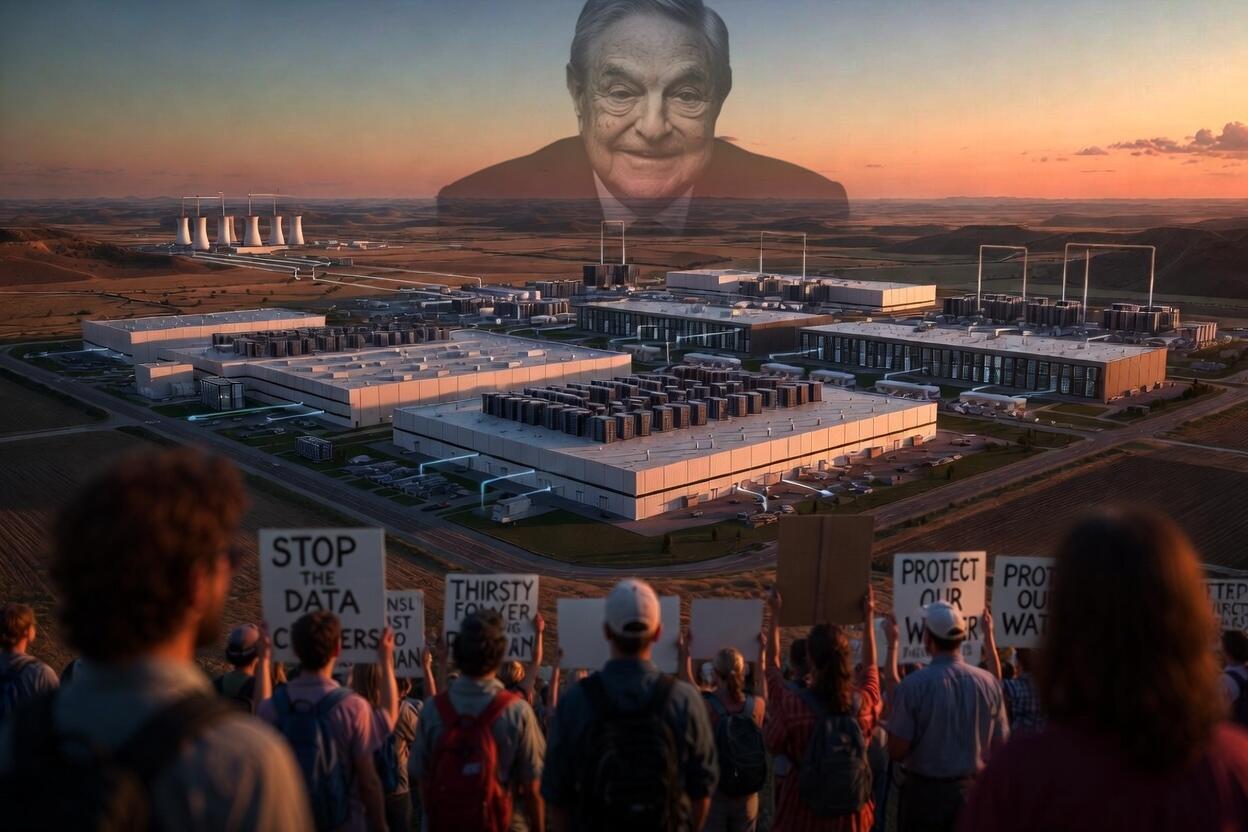
A new investigation has connected Wall Street billionaire and Democrat megadonor George Soros to a national progressive network of activist groups opposing data center expansion in Texas.
The Dallas Express reported that Open Society Foundations, founded and funded by Soros, has provided more than $7.6 million to the national Indivisible Project since 2017, including a two-year $3 million grant in 2023. Indivisible Centex, the local Bell County chapter of the national Indivisible network, has been active in opposing data center projects in Temple, Texas.
Indivisible Centex reportedly held a “week of action” in late April against data center projects in Temple. Activities included a “Protest & Petition” event at Temple City Hall on April 24, efforts to recall city council members who supported the projects, and a virtual Zoom event on April 27 titled “Thirsty for Power: When Data Centers Drain Our Water.”
The protests come amid significant data center expansion in the area.
Rowan broke ground earlier this year on Project Temple, a 300-megawatt hyperscale campus on roughly 700 acres with a minimum investment of $700 million, and is developing additional phases in the area. Separately, Meta has been building its own large data center campus in Temple since 2022. The Temple City Council’s April vote to annex and rezone about 700 acres along Bob White Road for the Rowan project drew opposition from residents concerned about water use, electricity demand, and infrastructure strain, concerns that prompted a separate group, Stop the Temple Data Center, to launch a recall effort against the mayor and two council members.
Soros and friends, being agents of chaos and whatnot, are fueling the early stages of a “Luddite revolution” against data center expansion. Since mid-2025, the site has warned that exploding residential electricity bills, limited local job gains, and public unease over AI’s societal impacts would spark organized backlash, predicting protests and even infrastructure attacks within a year. Reports document a sharp escalation in resistance, with billions in projects delayed or blocked nationwide amid concerns over power demand, water use, and grid strain.
between exploding electricity bills and lack of jobs for grads, a new luddite revolution is coming – they will be burning down data centers within a year
— zerohedge (@zerohedge) August 25, 2025
In Texas and beyond, this resistance blends genuine local grievances with coordinated national campaigns. ZeroHedge and others note that such opposition—often amplified by activist networks—mirrors past efforts against energy infrastructure and risks slowing U.S. AI competitiveness, even as hyperscale builds like those in Temple proceed amid the pushback.
American Energy Institute CEO Jason Isaac blasted the efforts and called for greater scrutiny of activist funding.
“The protests outside Temple City Hall are being marketed as a local uprising,” Isaac said. “Indivisible Centex is a chapter of a national organization that has received more than $7 million from George Soros’s Open Society Foundations since 2017. Indivisible is part of a broader network of groups that, according to an American Energy Institute report, have received more than $39 million from foreign donors in Switzerland, Britain, and Denmark. These groups are now pushing Congress to impose a national moratorium on data center construction.”
“This follows the same pattern previously used against pipelines, refineries, and LNG terminals, now targeting the growing power demand from AI, advanced manufacturing, and reshored industry,” Isaac added. “Texas leads the country in data center investment due to its abundant, affordable, and reliable power, along with a regulatory environment that supports private property and free enterprise.”
Tyler Durden
Wed, 05/20/2026 – 17:30
https://www.zerohedge.com/ai/soros-fueling-opposition-texas-data-center-expansion-report