Category: News

Be Very Afraid: The Hantavirus And Suicide Dolphins
Be Very Afraid: The Hantavirus And Suicide Dolphins
Authored by Donald Jefferies vis substack,
Bend over and keep smiling
Our incomparably bad leaders appear ready to foist another “pandemic” on the always unwary public. They proved in 2020 that the entire world could be shut down in a matter of days. With no troops or police needed. Just a corrupt, kept press, and compromised political “representatives.” They know that nothing sells like fear porn.
The latest potential “pandemic” is called the Hantavirus. Authorities, who are always telling us something, tell us it’s been around for a while. It is spread primarily by contact with an infected rodent. Well, don’t we all routinely have contact with rodents, infected or not? Specifically, the CDC informs us, by contact with rodent “urine, droppings, and saliva.” That’s not a scenario I can easily picture. I didn’t even know rodents had saliva. Just how does one get close enough to come in contact with it? Hantavirus symptoms can include: fatigue, fever, chills, muscle aches, headaches, dizziness, nausea, vomiting, and diarrhea. To a novice, those symptoms sound pretty generic. Like the flu. Or the common cold. Or the never isolated COVID-19. Just read the information on these contrived maladies, provided by the discredited CDC and WHO, with a little discernment. The Medical Industrial Complex in all its splendor. And oh, yes- “Conspiracy theorists” claim “Hanta” means fraud. In Hebrew.
The “experts” also inform us that the primary way the Hantavirus spreads from human to human is through sexual intercourse. Well, we should all be breathing a sign of relief over that. I am not exactly in the loop, but it’s my distinct impression that people, especially young people, are having less sex than perhaps any time since when the Puritans and Calvinism reigned supreme. If you’re looking for a real epidemic, forget rodent excretions. How about the Incel Virus? We have more 30, 40, and 50 year old male virgins in America than this country has ever seen. I think that’s the case in other areas of the world. Young women have been indoctrinated to “not need” men, and thus they don’t really want them. Young men have been forced to the extreme of “going their own way” without female companionship. It’s all very sad, but good news for a virus that is spread through sexual contact. Just stop having sex and there will be nothing to worry about. And refrain from intimate contact with rodents.
It appears as if Donald Trump is once again going to play the dastardly villain here, as he did during the incredibly successful COVID Psyop. He is already being blasted in the state controlled media for “downplaying” this dire threat, and for cutting funding to study the Hantavirus last year. Exactly how would they “study” it? Use prisoners, mental patients, and orphans to test what happens if you French Kiss a rodent? Our government has historically used prisoners, mental patients, and orphans for all kinds of hideous experiments. I covered this in detail in my book Crimes and Coverups in American Politics: 1776-1963. We’ve seen this movie before. Remember, Trumpenstein “downplayed” the seriousness of COVID, as well. But he signed the lockdown orders, and pushed the dangerous warp speed vaccine, He mocked Fauci, but refuses to prosecute him. Naturally, The Simpsons saw it coming. The Hantavirus was referenced on the X-Files in the 1990s. They should have an Emmy for Predictive Programming.
Much as he did during COVID, Trump dismissed the concerns of “journalists” who have been assigned to peddle fear porn, by proclaiming: “We should be fine.” Then, asked by these laughable representatives of a “free press,” if the public should be worried about the “outbreak” spreading, Trumpenstein replied, “I hope not.” Scientific American was among those most alarmed, as they explained, “In 2025 the Trump administration eliminated funding for a group that had been running a pilot project aimed at studying the type of hantavirus that has been confirmed to be behind an ongoing outbreak on a cruise ship.” This project was “conducted through the West African Center for Emerging Infectious Diseases (WAC-EID), one of 10 centers that comprised the Centers for Research in Emerging Infectious Diseases (CREID) network.” All these centers “were shuttered last year after the National Institutes of Health decided the research was ‘unsafe.’” Wait, so they’re upset that he stopped funding research that was determined to be “unsafe?” And why are cruise ships always involved in these productions? Have you seen the video of the very, very gay passenger on the Hantavirus cruise? Assuring us it’s “real?” He invited immediate comparisons to Erika Kirk. I went on one cruise in my life. That was before that guy got knocked off on his honeymoon. And fake “pandemics?” None for me, please.
I’m certainly not predicting that this big, beautiful fake virus is going to become a worldwide, or even just American psyop. I’m not suggesting that they will sell it like they sold COVID. They’ve made doomsters believe that SARS, and the monkey virus, and so many others, were going to shutdown society, just like COVID. They always pulled back, and the potential “pandemics” came and went without anyone noticing. But they really upped the ante during the COVID Psyop, and there was zero pushback from the world’s population. And the same front man- Trumpenstein- is in the Oval Office. Ready to send out conflicting signals, as always. I do think there would be less compliance with their ridiculous “mandates,” which are not laws and definitely not based on “science.” But it’s clear we’re still outnumbered. Actress Jean Smart has spoken out, claiming that her husband died from the Hantavirus in 2021. No disrespect intended, but it was unheard of then, at the peak of COVID. Did he come into questionable contact with rodents? Who was he having sex with? Gene Hackman’s 65 year old wife, we are now told, died from the Hantavirus. Recall how they both were strangely found dead at home in 2025. Who was she having sex with?
As if all this wasn’t enough to worry a befuddled public, Iran is now being accused of using mine-carrying “Kamikaze Dolphins” to attack US warships in the Strait of Hormuz. The poor Suicide Dolphins probably aren’t being promised any virgins in the afterlife, either. The whole Strait of Hormuz confuses me. I don’t know if the Suicide Dolphins are being used to blow it open, because the United States is blocking it, or if they’re assigned to blow up the US ships that try to pass through the Strait that Iran has opened to everyone but America. And Israel, I guess. But it doesn’t look like Israel is doing much fighting. Just bombing civilians, as usual. They’ve already told Trumpenstein that there will be no non-Irish boots on the ground. Psycho Pete Hegseth cryptically told the press, “I can’t confirm or deny whether we have kamikaze dolphins, but I can confirm they don’t.” Well, I’m sure that our Suicide Dolphins would be better than anyone else’s. Where are all the animal rights protesters?
Really, shouldn’t this absurd story about kamikaze dolphins make us all question the whole “suicide bomber” claims? I’ve never found such stories credible. But it plays into the whole “terrorist” mythos. What is the source for the promise of 72 virgins after death (the number seems to vary) which seemingly motivates suicide bombers? Such outlandishness isn’t found anywhere in the Quran, leading reasonable people to suspect it originated from the Mossad or the CIA. By dehumanizing Muslims, they have managed to convince too many good people that they are willing to kill others, with the belief that Allah will reward them for doing so. Primarily through gratuitous sex with a whole lot of different females. That sounds more like the fantasy of a nonbelieving incel than a religious “fanatic.” What is the difference between “devout” and “fanatic?” If there were Muslims whose goal was to be a suicide bomber, wouldn’t they be offended by being replaced by Dolphins, doing the work fanatics won’t?
Remember when the beloved Hillary Clinton claimed that Qadafi/Kadafy/Gaddafi had loaded his troops with Viagra, so that they could become literal raping machines? Talk about projection! If you’ve read my aforementioned Crimes and Coverups book, and/or my latest, American Memory Hole, you know just how much raping our young men in uniform have been guilty of, going back at least to Sherman’s genocidal march through Georgia. And they didn’t need any Viagra. They didn’t discriminate, either. The Union boys loved violating the Black females. During the “good war,” the “greatest generation” raped lots of Germans, and so many Japanese that they had to build a special brothel to accommodate them. During our forever war in Iraq, we all saw the photos of the naked male Iraqi prisoners, with fluorescent bulbs and the like shoved up their anuses. With a pretty, smiling female U.S. soldier beside them. And if Seymour Hersh can be believed, they raped a bunch of boys in front of their mothers.
My friend Tony Arterburn tells me that during WWII, the Allies tried using bats, with little explosive devices strapped on their tiny backs. So I don’t doubt for a second that our government would, if they could, utilize kamikaze dolphins. Or sharks. Or whales. Or shrimp. How far removed was the MKULTRA mind control research, in particular the idea of Manchurian Candidates, from a suicide bomber? It wasn’t “terrorists” who developed those programs. And the “terrorists” didn’t invent “COVID-19” either, and falsify all those statistics to make it appear that it was a new Black Plague. Maybe they can figure out a way to strap vials containing the Hantavirus to the backs of these patriotic dolphins. Unleash the Hantavirus on the Iranians. If they don’t like that, we can send some pretty female soldiers, or even better some transitioned soldiers, to deliver fluorescent light bulbs to lonely Iranian males. Think of how humiliated they’ll be, with transwomen violating them like that. Wage war on us for 47 years, will you?
COVID demonstrated that nothing motivates a society, indeed a world, to become obedient more than fear. The fear of an invisible virus which could kill them. Feeling okay? You’re just asymptomatic. You could still have it! Get the PCR test right away. You know, the one with the 90 percent false positive rate. The one repudiated by the man who developed it, who had the proper sense of drama to die right on the eve of “COVID-19” commanding the attention of the entire world. And call your doctor. Always call your doctor. Don’t decide for yourself. Be responsible and think of others. Did I mention that you should call your doctor? The PCR test isn’t the only discredited one you can take, you know. You may think you’re healthy, but we’ll determine that. If this new Hantavirus whipper snapper requires a vaccine, get it. Get every booster. There may be variants. Endless variants. For years. You’ll have more things stuck in you than Madonna did at the height of her incomprehensible fame.
We are hearing the same codewords that we heard repeatedly during the Greatest Psyop in the History of the World. America, especially under the rudderless leadership of the stupid, orange, micro-penis Trumpenstein, is “unequipped” to deal with the next pandemic. Or unprepared- that works just as well, and isn’t a juvenile pun. The honorable Bill Gates, renowned for catching a venereal disease from Russian babes on Epstein’s Lolita Island, is being lauded now, for his warning about the “next pandemic” in an interview last year. And his website named the Hantavirus as the next pandemic. In 2021. Insider information? Gates is forever warning about future pandemics. It excites him even more than anything Jeffrey Epstein could offer. As a lifelong eugenicist, Gates is obsessed with millions, even billions of human beings dying. He pretends that he would be horrified by this; that he is, in fact, opposed to such a culling of the herd. But his perpetually inappropriate smile suggests otherwise. And his answer to everything is more fear, more vaccinations, and more boosters.
It’s funny. I rarely recall hearing the word “pandemic” throughout the course of my life. I knew about the Black Plague in the Middle Ages. I knew that there had been an exceptionally bad flu during the WWI era. But there was never a sense that we should be “preparing” for some devastating national, or international health crisis. Since “pandemics” appear to be pretty common now, where were they from 1920-2020? Sure, you had Bill Gates and the WHO and the CDC staging a series of “simulations” which prophesized “COVID-19” with eerie accuracy. But the idea that people could be conditioned to wear ludicrous looking masks everywhere, and stay six feet apart, was unthinkable. To be fair, if a real scourge like cancer can be pretty much unknown before 1900, and no one question where it came from, why can’t “pandemics” just pop up every few years, to fulfill one of Bill Gates’s numerous predictions of them? Most people now think “COVID” is a permanent thing.
I wrote the only book that exposes the entire “COVID” fraud from the very beginning, Masking the Truth: How COVID-19 Destroyed Civil Liberties and Shut Down the World. They’ve done everything they can to stop people from reading it. It’s the most shadow banned book in the world. I don’t want to write one about a Hantavirus psyop. I really hope this turns out to be just another monkey virus. No one with a huge platform has ever told the whole truth about “COVID.” It wasn’t created in a Wuhan lab by the dastardly Chinese. It was the flu. Period. Just like Hantavirus will be, if they decide to stage another worldwide production. And I don’t believe “suicide bombers” are any more real than “COVID.” They lie to us all the time. To distract us from the misery so many of us are enduring. To distract us from their continuous crimes and corruption. To distract us from the potholes in the streets and our inadequate wages. To distract us from skyrocketing autism rates and plummeting life expectancy.
The people have to bear some blame here. I don’t care how many indoctrination classes you sat through in public school and college. How many films and TV shows with obvious messaging you watched. I sat through them, too. So did the millions of people who, against all odds, have awakened to the corruption and tyranny. They didn’t perform frontal lobotomies on you. You have the capacity to critically think. To ignore the cultural programming. How stupid would you have to be to fall for another “pandemic?” Or to believe in suicide dolphins? We should all tremble at the prospect of having our fate in the hands of a jury of our peers. Maybe they’ll go too far, with something like a fake alien invasion. But after “COVID,” can they go too far? They shut down the entire world! Don’t let it happen again, even if they back off with the Hantavirus.
Be prepared, as Bill Gates says. But not for a “pandemic.” Be prepared for authoritarian overreach. Remember, opposition to tyranny is obedience to God.
Tyler Durden
Mon, 05/18/2026 – 18:25
https://www.zerohedge.com/political/be-very-afraid-hantavirus-and-suicide-dolphins
McDonald’s Worker Axed After Viral Video Shows Her Shoving Fries In Mouth Then Back In Box
McDonald’s Worker Axed After Viral Video Shows Her Shoving Fries In Mouth Then Back In Box
A Massachusetts McDonald’s worker was axed from her job after a revolting video captured her putting French fries into her mouth and then placing them back into a box, the Worcester Telegram & Gazette reports.
“So you want French fries today, right?” the worker appears to ask a customer while looking into the camera as she puts the fries from her mouth back in a box.
🚨 McDonald’s employee in Southbridge caught on camera STUFFING FRIES IN HER MOUTH before serving them to customers
She literally puts a handful in her mouth, chews them up, then drops them into the red carton like it’s normal.
The video went viral and now there’s a full probe… pic.twitter.com/U2XPCEBsxt
— i Expose Racists & Pedos (@SeeRacists) May 13, 2026
The vile clip went viral last week, prompting Southbridge police to launch an investigation alongside local health officials.
“We are also working to determine whether the food was ultimately served to a customer and to identify any individual who may have been affected,” police said, according to the New York Post.
The nauseating scene triggered an immediate customer backlash at the restaurant, leaving its owners in full damage-control mode.
“The actions of these individuals are unacceptable and do not reflect our organization’s food safety standards or values. We conducted an internal review, and they are no longer employed by our organization,” the Spadea and Balducci families said in a joint statement obtained by the Post.
“We are proactively working with local authorities and the local health department, who found no public health concerns or violations. The wellbeing and safety of our Southbridge community remains our top priority.”
The fired employee, who has yet to be publicly identified, will also face criminal charges at the Dudley District Court.
Tyler Durden
Mon, 05/18/2026 – 18:00

We’ve Optimized Fragility, Failure, Denial, And… Rage
We’ve Optimized Fragility, Failure, Denial, And… Rage
Authored by Charles Hugh Smith via OfTwoMinds blog,
What happens when optimization is itself the point of failure?
In today’s zeitgeist, everything must be optimized or we’ll fail: our time, productivity, fitness, diet, supplements, career, income, wealth–everything must be constantly optimized lest we fall behind or fail.
The grand irony is optimization generates fragility which generates failure which generates denial which eventually generates rage. We’ve optimized global supply chains for efficiency and cost, rendering them exquisitely vulnerable to disruption and collapse. We’ve optimized the global economy for “growth” based on expanding consumption of energy and everything that depends on energy, which is everything.
To fund this endless expansion of consumption, everyone must borrow more money to buy more than their income allows. To enable this endless expansion of debt, money must be nearly free to borrow after adjusting for inflation.
The irony here is when money has no cost, it’s squandered on excess consumption or speculation. The incentive to borrow and spend / invest wisely is that borrowing money has a high cost. Reduce the cost to boost borrowing / consumption / speculation and you create credit-asset bubbles and households, enterprises and governments one mis-step from insolvency.
Optimization raises expectations to lofty heights. The promise of optimization is endless–there’s no limit to optimization, and so there’s no limit to technology, profits, health, wealth and prosperity. If we keep optimizing, everything becomes possible. By tweaking technology and finance, we can endlessly expand consumption and wealth.
The mindset this generates is: follow the rules of optimization and you’ll enjoy all the benefits of success. Optimize your career by borrowing a small fortune to obtain a university diploma, chase the Next Big Thing, optimize your engagement, visibility, and the buzzword du jour, and all the good things in life will be within reach.
The expectations are as fragile as the system they rely on. We’ve been taught that “our vote counts,” that democracy means we have a say in collective decisions via representatives we elect. We’ve been taught we have agency–control of our destiny: work hard, work smart, optimize work flows and innovation, and anyone can be a startup founder who cashes out with millions of dollars–and the high agency that comes from high visibility.
Except all of this that’s presented as stable, trustworthy, predictable and real is fragile, unstable and artificial–simulations of stability, trust and predictability. The belief that this vast system of mythologies, beliefs and “the real world” is as it’s presented is civilizational psychosis, a self-reinforcing state of denial in which some new innovation / optimization will “solve” whatever problems arise.
So what’s the optimized solution when optimization itself is the problem? What if a new product or profitable technology is not a solution but an extension of optimized fragility?
What’s been optimized is centralization of power and control in the hands of the few because distributed capital, agency, power and control are inefficient. So we inhabit a world of overlapping monopolies and cartels, the marriage of state and private sector monopolies. In terms of optimizing profits, the optimized structure is monopoly. Nothing else comes close. So an economy of overlapping monopolies and shared-monopoly (i.e. cartels) is the perfection of a system optimized to maximize profits for the owners of the monopolies.
This is why it doesn’t matter who you vote for, as the decisions are made to suit the interests of those at the top of the optimized concentrations of power pyramid. The masses are fed distractions, us-vs-them divisions, fake virtue-signaling policy-tweak “solutions,” and a circus of entertainment.
As for optimizing security and a place in the sun–oops, you didn’t optimize enough. You didn’t optimize innovation enough, and let’s face it, you didn’t optimize optimization enough, so you failed. Maybe your AI chatbot can console you.
High expectations lead to dreams dashed which leads to denial crumbling on contact with the real world. And when denial crumbles and the scales fall from our eyes, and we see everything that was presented as authentic is actually artificial, a synthetic simulation designed to obscure the gearing of an increasingly fragile system, our sense of betrayal, the shattering of trust, the awareness that we’ve been lied to, conned, to benefit those doing the bamboozling, then we become angry.
We become angry because we’re social beings who depend on trust and truth to function as a group that benefits its members and not just its leaders. When trust and truth have been replaced by artifices to serve the interests of leaders touting how the system benefits everyone, the group dynamics transition from positive to destructive. Nobody likes being conned, and there is a selective advantage to this trait.
Part of the con is to claim that we can collectively transit smoothly from denial to acceptance, skipping the messy, difficult stages of anger, bargaining and depression. (Kubler-Ross’s progression of the five stages of grief: denial, anger, bargaining, depression, acceptance.) But this isn’t how we’re wired, and this progression cannot be optimized away.
So never mind you’re selling your blood to make ends meet while a handful of others are about to reap fortunes in IPOs. Just accept this is your lot in life. Not all outcomes are equal, creative destruction, blah blah blah.
But what if optimization is the techno-speak cover story for a rigged casino? What if all the buzzwords –innovation, growth, super-abundance, and so on–are all techno-speak cover stories for the substitution of economic metrics for a life that’s actually worth living?
We’ve been herded into a Mouse Utopia of metrics–financial metrics, systems, data, models–that leaves out the reality that we exist in a moral universe in which trust and truth matter more than GDP, stock markets, and the hollow, surreal realm of consumerist transactions.
In this universe, anger leads to redress or retribution. The current system is optimized to avoid redress by optimizing the substitution of artifice for authenticity. This optimization has reached such perfection that the status quo leaders, public and private, believe their mastery of this substitution will continue protecting them from public anger come what may. Just pull the levers, and the public will continue believing.
Our leaders have effectively optimized their belief in their own PR. There is no need for redress because the public will accept more of the same: distractions, us-vs-them divisions, fake virtue-signaling policy-tweak “solutions,” and a circus of entertainment.
But this isn’t how the transition from denial to anger works. Applying more of the same will only push anger into rage, where it becomes an emergent force with non-linear dynamics: unpredictable, uncontrollable.
In terms of optimized metrics and systems, rage is irrational. In the moral universe, it’s perfectly rational. What happens when an unexpected asteroid shatters all the interconnected fragilities of hyper-optimized supply chains and finance?
We can rephrase this to: what happens when optimization is itself the point of failure? What happens when the optimization of substituting artifice for authenticity to mask the decay of trust and truth fails?
All this boils down to: what happens when redress is set aside as needless? That leaves retribution as the only outlet for all the energy being converted from denial to anger.
What seemed preposterous before the asteroid is later recognized as destiny.
* * *
My book Investing In Revolution is available at a 10% discount ($18 for the paperback, $24 for the hardcover and $8.95 for the ebook edition). Introduction (free). Become a $3/month patron of my work via patreon.com. Subscribe to my Substack for free
Tyler Durden
Mon, 05/18/2026 – 17:40
https://www.zerohedge.com/geopolitical/weve-optimized-fragility-failure-denial-and-rage
BofA’s Blanch Joins Goldman In Calling For $90 Brent This Year Amid “Pretty Large Deficit” Fears
BofA’s Blanch Joins Goldman In Calling For $90 Brent This Year Amid “Pretty Large Deficit” Fears
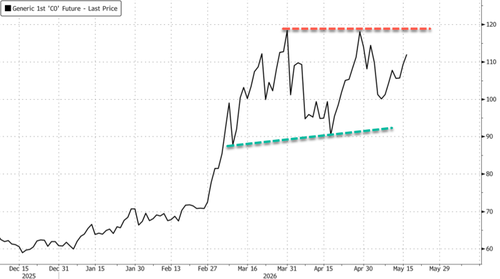
Add Bank of America’s commodities and derivatives research chief to the growing list of Wall Street strategists who see Brent crude sticking around $90 a barrel this year, as any near-term resolution to the Hormuz chokepoint crisis appears increasingly distant. The call follows Goldman’s move several weeks ago to raise its year-end oil outlook to around $90.
BofA analyst Francisco Blanch joined Bloomberg Television’s Surveillance earlier and warned, “We have a pretty large deficit that is running 14 million to 15 million barrels a day short, or 14% to 15% short of what we need to see for prices to stabilize and go down to $60 or $70 a barrel.”
Francisco Blanch, head of commodities and derivatives research at Bank of America Securities, discusses the deficit in the global oil market and says the US will see potential “availability issues” during the summer driving season https://t.co/RK9C9kKKrn pic.twitter.com/IRs1wP51Fj
— Bloomberg TV (@BloombergTV) May 18, 2026
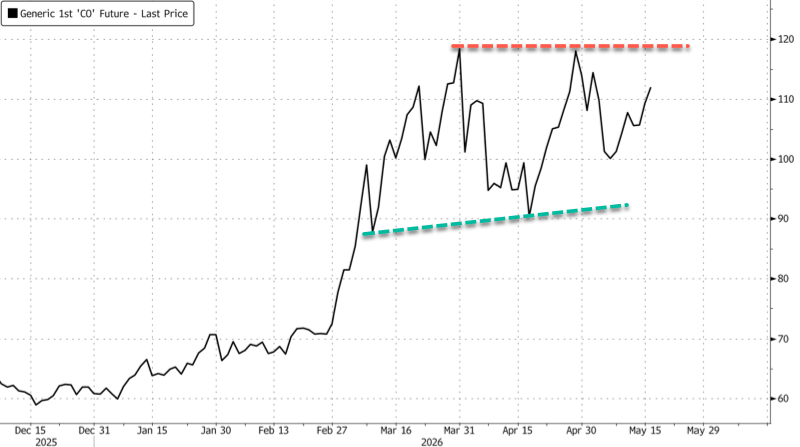
As of late Monday afternoon, Brent crude futures were trading above $112 as the reality of the weeks-long stalemate returned, indicating that the Trump team is not open to any concessions to Tehran.
Blanch’s new outlook hinges on continued Hormuz disruption into next month. He noted that restoring tanker flows through the critical waterway is the optimal outcome but warned that the double blockade would lead to a gradual grind higher in prices, to $120 or $130 a barrel by the end of June or early July.
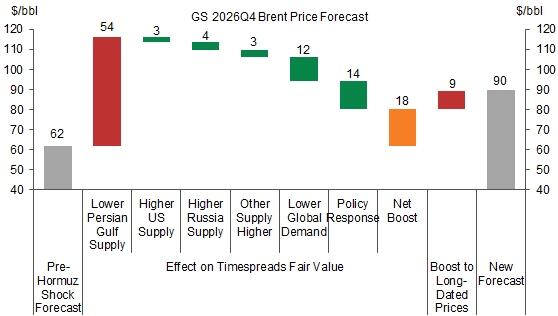
In the final days of April, Goldman analysts raised their fourth-quarter oil price outlook to $90 for Brent and $83 for West Texas Intermediate.
The chart below summarizes why their crude outlook for the fourth quarter is nearly $30 higher than it was before the Hormuz shock:
Frederic Lasserre, head of research at Gunvor, one of the world’s largest oil traders, warned last week that “the tipping point is clearly June. This is the point at which something has to give.”
JPMorgan analysts recently warned that the world is spiraling toward a catastrophic cliff-edge shortage of crude oil if the maritime chokepoint remains blocked for another 4 weeks.
Furthermore, Maersk CEO Vincent Clerc warned that a prolonged Hormuz closure is a “new wake-up call” that could seriously dent global trade.
For more context, former CIA operative and RBC commodities head Helima Croft told clients just days ago that she is “very skeptical of a June grand reopening or even that maritime traffic will return to February 27 levels for the foreseeable future.”
All of this suggests that, with the latest AAA data showing the U.S. national average for unleaded 87 gasoline at $4.55 per gallon, higher prices could certainly arrive ahead of Memorial Day’s driving season and may soon push prices toward the demand-destruction line of $5, unless a resolution to the U.S.-Iran conflict comes very soon.
Tyler Durden
Mon, 05/18/2026 – 17:20
https://www.zerohedge.com/energy/bofas-blanch-joins-goldman-calling-90-brent-year

At Least 3 Dead After San Diego Mosque Shooting
At Least 3 Dead After San Diego Mosque Shooting
San Diego police responded Monday to reports of an active shooter at the Islamic Center of San Diego in the Clairemont area, where authorities say the threat was quickly neutralized but at least three people were killed, including the two suspected gunmen.
🚨 NOW: The children at the Islamic Center active shooting in San Diego were EVACUATED by armed police officers, and the threat is reportedly gone
The school is PreK-3
Terrifying. 🙏🏻
Thankfully, the location is NOT as crowded as it would’ve been on a Friday pic.twitter.com/e9PI6H1klt
— Eric Daugherty (@EricLDaugh) May 18, 2026
Officers were called to the 7000 block of Eckstrom Avenue around 11:40 a.m. after reports of multiple shots fired at the center, which houses the county’s largest mosque and the Bright Horizon Academy school. A heavy law enforcement presence, including SWAT teams, converged on the scene within minutes as children and others were evacuated from the building. Aerial footage showed groups of young students walking hand-in-hand away from the site, surrounded by scores of police vehicles.
By early afternoon, police declared the threat “neutralized” and the scene contained. High-level law enforcement sources told local outlets that two suspects were found dead nearby from apparent self-inflicted gunshot wounds. The Council on American-Islamic Relations confirmed at least one fatality among the mosque community, bringing the reported death toll to three. Details on additional injuries remained limited as the investigation unfolded.
The Islamic Center, a prominent hub for prayer, education and community events in a mixed residential and commercial neighborhood, was not in the midst of formal prayers at the time of the shooting but was active with students and staff. CAIR officials condemned the violence, noting the fear it spread through the Muslim community and families with children at the attached school. “No one should ever fear for their safety while attending prayers or studying,” the group said in a statement.
San Diego Mayor Todd Gloria said he was monitoring the situation closely and receiving updates from law enforcement. Gov. Gavin Newsom’s office confirmed the governor had been briefed, with the state Office of Emergency Services coordinating support. A reunification site was set up for families, and neighbors in the immediate area were initially told to shelter in place.
US police have responded to a shooting at a mosque in California, with officials saying the threat had been ‘neutralised.’
The area around the Islamic Centre of San Diego was locked down, after witnesses said they heard dozens of shots fired. pic.twitter.com/5T44LULrCL
— Al Jazeera English (@AJEnglish) May 18, 2026
As of late Monday afternoon, police had not released the identities of the victims or suspects, nor any information on a possible motive. Homicide investigators remained on scene, and a media staging area was established nearby. The white-domed mosque sits amid homes, apartments and nearby Middle Eastern businesses, in a part of Clairemont Mesa that saw an otherwise ordinary Monday morning turn into a scene of chaos and loss.
This remains a developing story. Authorities urged the public to rely on official updates from the San Diego Police Department as more information becomes available.
Tyler Durden
Mon, 05/18/2026 – 17:05
https://www.zerohedge.com/political/least-3-dead-after-san-diego-mosque-shooting

California Republicans Gain Early Voting Edge In June Primary
California Republicans Gain Early Voting Edge In June Primary
California Republicans are showing unexpected momentum heading into the state’s June 2 primary election, posting stronger early voting numbers while Democrats remain divided across several high-profile races.
More than 900,000 ballots have already been returned in California’s all-mail primary system, according to data compiled by Political Data Intelligence. The early numbers indicate Republicans are outperforming expectations in a state long dominated by Democrats.
As of May 15, Republican turnout stood at 6 percent statewide, compared to 4 percent for Democrats. Despite Democrats maintaining nearly a two-to-one voter registration advantage, Republicans are keeping pace in overall ballot returns.
Of the ballots cast so far, registered Democrats account for roughly 371,000 votes, while Republicans have submitted nearly 335,000 ballots. Another 200,000 ballots came from independents and voters without party affiliation.
California Early Voting Now vs at this point in 2022
At this point in 2022:
🔵 54%
🔴 26%
🟡 20%
(719k Voted)
Now:
🔵 41% (-13)
🔴 37% (+11)
🟡 22% (+2)
(906K Voted) https://t.co/dI1IfKRDjB pic.twitter.com/FRGT6nYz2E
— OSZ (@OpenSourceZone) May 16, 2026
Compared to this stage of the 2022 midterm cycle, Republican participation has surged sharply. Early vote share for Republicans has increased by 11 percentage points, while Democratic share has fallen significantly.
The trend is particularly noticeable in key Southern California counties.
In Orange County, Republicans currently hold an advantage of more than 10,000 ballots returned, despite the county’s increasingly competitive political landscape in recent years.
In San Diego County, Republicans have posted an 11 percent turnout rate, nearly double the Democratic rate of 6 percent, and currently make up a majority of ballots returned.
Even in heavily Democratic Los Angeles County, Republicans are outperforming Democrats in turnout percentage, with Republicans at 4 percent compared to just 2 percent for Democrats, though Democrats still maintain a raw numerical advantage because of their larger voter base.
Political observers say the numbers may reflect renewed Republican enthusiasm and a return to traditional GOP early voting habits after years in which many Republican voters were skeptical of mail-in voting.
“Republicans are potentially returning their ballots at a pre-2020 rate, before [President Donald] Trump and other leaders discouraged it,” PDI Vice President Paul Mitchell told the New York Post. “It’s kind of typical of a low-turnout election that these are the people that always vote in every election.”
The early turnout surge comes as Democrats remain fractured in a crowded gubernatorial primary field. Xavier Becerra currently leads the Democratic field, which also includes billionaire Tom Steyer, former Rep. Katie Porter, San Jose Mayor Matt Mahan, and former Los Angeles Mayor Antonio Villaraigosa.
On the Republican side, voters are choosing between former Fox News host Steve Hilton and Chad Bianco.
California’s “jungle primary” system advances the top two vote-getters to the November general election regardless of party affiliation.
Tyler Durden
Mon, 05/18/2026 – 17:00
https://www.zerohedge.com/political/california-republicans-gain-early-voting-edge-june-primary

The Too-Long Goodbye
The Too-Long Goodbye
Authored by James Howard Kunstler,
“. . . we are witnessing mass formation in real time, where the group delusion becomes the only permissible reality.”
– LH Grey on X
Last week, Stephen Colbert celebrated his May 21 departure from late-night TV by French-kissing his fellow late-night soul-mate hosts goodbye, perhaps to honor the French origins of the Woke political ideology that guided his rocket flight to fame — Michel Foucault (1926–1984), who argued that power was all that mattered and that you could talk any absurdity about sex, mental illness, and criminality into mass belief. . . Jacques Derrida (1930–2004), who argued that reality depends on how you feel about it. . . Jean-François Lyotard (1924–1998), who denounced truth per se in favor of your truth. . . and Gilles Deleuze, father of gender-fluidity.
So, bonne nuit and au revoir, Monsieur Colbert, and don’t let the CBS screen door bump your ass on the way out. Few public figures in our time have done as much damage to the collective mental health of our country than Colbert did in his late-night operations. For instance, the dance routine, broadcast circa April 2021, titled “The Vax-Scene,” when “Joe Biden” and Dr. Fauci rolled out the mRNA products that would eventually maim or kill hundreds of thousands of Americans. Colbert did the shimmy in front of a chorus line costumed as syringes capering to a musical arrangement of the old Latin hit, Tequila (original, by The Champs, 1958). His ignorance about what actually was at stake was surpassed only by his Cheshire Cat caliber smugness. So, what you see in this video is the rectified essence of the demonic idiocy that still animates the Democratic Party. Save it and watch it often to remind yourself what the nation has been battling for so many years.
I was actually a guest on Colbert’s show years ago in its early evening incarnation when the running gag was Colbert pretending to be a right-winger. In the green room before the show, his handlers told me to “not try to be funny because that’s Stephen’s job.” I had just published a novel about what life in America might be like after the collapse of our techno-industrial economy (World Made by Hand). Colbert treated that as a joke, too, of course. He already had the remarkable ability for finding comedy in all the wrong places.
By the time Covid came along, he was no longer a pretend conservative; he was an out-front Democratic Party / Deep State propaganda tool.
It remains to be seen how the party can possibly survive the revelations-to-come of its monumental criminality. Sunday morning, Acting Attorney General Todd Blanche turned up on Maria Bartiromo’s public affairs show. Maria was in a testy mood, repeatedly telling Mr. Blanche that America has lost patience bigly over the complete lack of “accountability” for the various seditions and treasons launched against the public since 2016, in particular, the obvious treachery so many witnessed in the 2020 election.
Mr. Blanche replied, “Well, there’s a ton of evidence that the election was rigged. That’s not something the DOJ needs to tell you about. There’s been evidence about that for many, many years. What I can tell you is that we have multiple investigations going on in Arizona, in Georgia — in Fulton County, Georgia. And that’s exactly what we’re looking at.”
Quite so: evidence for many years, by the truckload, and indeed it was only a month or so ago that the FBI turned up at the Fulton County, GA, election records depository building and seized a truckload of ballots and other material related to the Big Switcheroo that the election workers there pulled off overnight on Nov 3, 2020 —because “broken water mains [toilets, that is],” and all. Mr. Blanche might not need to tell the irascible Maria B about that, but eventually he will have to tell the whole country what happened in Fulton County, GA, and Maricopa County, AZ, and Antrim County, MI, and Milwaukee County, WI, and Philadelphia. . . .
It remains to be seen how the stolen 2020 election business might be rolled into the “grand conspiracy” case being pursued in the grand jury convened at Fort Pierce, Florida. It will probably be a major entrée in the smorgasbord of prosecutable turpitudes presently under consideration. Also remains to be seen how half the country that still calls itself “Left” or “Progressive” or “registered Democrat” will greet the news that “Joe Biden” did not win that crooked election, but rather, their bête noire, Donald Trump, won. And not by a slim margin, but by a ton.
And how will all the other authorities across the land, both public and private, deal with the apparent fact that the country suffered under a fake president for a whole four-year term? Congress will have to say something, make some determination. Or the Supreme Court? Or some combo. All the laws passed under “Joe Biden,” and the executive actions taken by him that were not laws strictly speaking, might have to be rescinded, cancelled, including all the many pardons issued under his autopen.
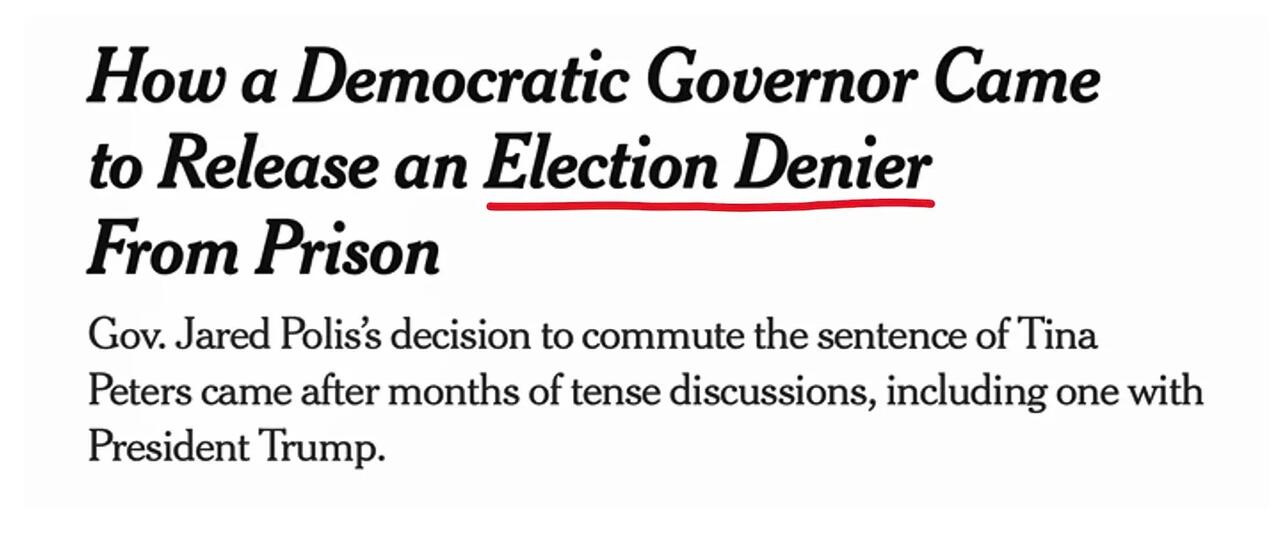
And how will the corrupt, mendacious news media process hard charges of massive and decisive election fraud in 2020? Of course, they never even tried to investigate it, didn’t send a single reporter out to search the thickets, just opened the gas jets to keep the gaslights lit. And they’re still doing it! Only days ago, the disgustingly dishonest New York Times framed their story about the release of Tina Peters in Colorado this way:
Tina Peters, grandmother and Mesa County election clerk, was trying to determine whether a fishy post-election “software update” had wiped the 2020 records out of Mesa County’s Dominion vote-tallying machines. The Colorado authorities, led by Colorado Sec’y of State Jena Griswold, tossed Ms. Peters in jail on a nine-year sentence for examining the machines. Maybe the time is at hand when Jena Griswold gets tossed in jail. Looks like we’ll finally learn the true meaning of the phrase “election denier.”
Tyler Durden
Mon, 05/18/2026 – 16:20

Graham Calls For ‘Short But Forceful’ New Strikes On Iran, Complains Waiting For ‘Status Quo’ Talks Looks Weak
Graham Calls For ‘Short But Forceful’ New Strikes On Iran, Complains Waiting For ‘Status Quo’ Talks Looks Weak
At a moment the US-Iran ceasefire is officially on life support, and with the world’s most critical energy chokepoint remaining blocked while the American consumer is paying the price at the pump, beltway hawks are calling for renewed major military action to ‘solve’ the standoff.
Foremost among them, Senator Lindsey Graham, hit the Sunday news circuit to urge President Trump to rip up the current playbook and resume US major military strikes on Tehran. According to Graham, the current diplomatic paralysis and the shuttered Strait of Hormuz are only fueling Iran’s strategic position while inflicting severe economic pain domestically.
He has perhaps picked up on the bad optics of Trump’s constant barrage of Truth Social posts which often seem written in an exasperated and impatience style.
“I think the status quo is hurting us all,” Graham told NBC News’ “Meet the Press” – as he made the case for using military pressure to get the Iranians to comply with Washington demands on their nuclear program and other issues.
The well-known hawk from South Carolina correctly observed: “The longer the [Strait of Hormuz] is closed, the more we try to pursue a deal that never happens, the stronger Iran gets.” However, this reflects one of those ‘one more escalation step and the problem will be fixed’ approaches among the NeoCons. The ‘just one more thing’ usually perpetuates the quagmire.
He turned to urging the president to “weaken them further” given that “there’s more targets to be had” – which is pretty much also the Israeli line.
Graham further said there are no signs that after the prior 38-day bombing campaign that Iran’s leadership has abandoned what he called the Islamic Republic’s supposed goal “to terrorize the world, destroy Israel, come after us.”
“Gas prices will come down when you put Iran in a box,” Graham added.
Another interesting moment in the interview came when the GOP senator seemed in agreement with Trump on not caring about Americans’ finances in comparison with the Iran nuclear question:
Trump drew criticism last week for saying he was not weighing Americans’ finances in the talks, comments that stirred Republican anxiety ahead of the midterm elections. Graham dismissed that concern.
“It’s worth losing my job,” he told Welker. “If I had to give my job up to make sure Iran would never have a nuclear weapon, I would do it.”
Iran is meanwhile still not backing down, after last Friday Iranian Foreign Minister Abbas Araghchi made clear that Tehran has “no trust” in Washington given its “contradictory messages”.
Graham calling for a “short but forceful” new military escalation against Iran…
I have every confidence that President Trump fully understands the situation with Iran and will not continue to tolerate a refusal to negotiate in good faith along with Iran’s defiant aggression in the Strait of Hormuz and throughout the region.
It is abundantly clear to me…
— Lindsey Graham (@LindseyGrahamSC) May 18, 2026
He reiterated that Washington needs to get serious, while it is US officials saying Iran must show willingness to make compromise. At this point it seems Washington is the more desperate to get a deal done, but each side is waiting out the other.
Tyler Durden
Mon, 05/18/2026 – 15:45

Watch $134 Million Go Up In Smoke As Navy Jets Collide At Air Show
Watch $134 Million Go Up In Smoke As Navy Jets Collide At Air Show
As if Pentagon losses in the Trump-Netanyahu war on Iran weren’t already sapping them enough already, American taxpayers were losers again on Sunday when two U.S. Navy EA18-G Growlers blew up in spectacular fashion after colliding at an air show at Mountain Home Air Force Base in Idaho. Four crew members ejected and were medically evaluated and said to be in stable condition.
EA18-G Growlers are used to jam and suppress enemy radar and other electronics (USAF Photo)
The aircraft were performing a maneuver for the audience at the Gunfighter Skies Air Show when they made contact and then appeared to be locked together. In an instant, the four crew members ejected. As their parachutes successfully deployed, the two jets — valued at a combined $134 million — fell to the ground together and exploded, generating a massive cloud of smoke, and necessitating a careful descent by the crew members who had to avoid landing in the flaming wreckage. Made by Boeing, the EA18-G Growler is an F/A-18 Super Hornet variant that serves as something of an “electronic bodyguard” for other aircraft, by jamming, deceiving or suppressing enemy radar and electronic systems.
BREAKING: Two U.S. Navy jets collided mid-air and exploded during the Gunfighter Skies Air Show at Mountain Home Air Force Base. pic.twitter.com/R66ADWM2TY
— Breaking911 (@Breaking911) May 17, 2026
Jeff Guzzetti, an aviation safety expert, said the unusual collision in which the two jets were seemingly stuck together may have bought the crew members a few more critical moments. “It’s really striking to see,” Guzzetti told Associated Press. “It looks like they struck each other in a very unique fashion to cause them to remain intact and kind of stick to each other and that very well could have saved them.” Some social media users pointed to a wind advisory that had been issued.
While the Air Force will investigate the crash, Guzzetti’s first impression was that it was not a mechanical failure: “It appears to be a pilot issue to me...Rendezvousing with another airplane in formation flight is challenging, and it has to be done just right to prevent exactly this kind of thing.” The jets landed in an empty patch of land far from the audience. The crash started a brush fire that torched 25 acres, and forced the remainder of the show to be cancelled. It was the first edition of the Gunfighter Skies Air Show since 2018, when a hang glider pilot was killed in a crash.
The four aviators were able to land outside the inferno
The two jets are part of the Electronic Attack Squadron 129 at Whidbey Island, Washington. They become the third and fourth Growlers from Whidbey Island to be destroyed in just the past 19 months. In October 2024, both female crew members died when they crashed near Mount Rainer. There were no fatalities in a February 2025 crash in San Diego Bay, in which the two male pilots ejected before their jet met this end:
New footage released shows an EA-18G Growler jet crashing into the San Diego Bay this morning.
The two pilots ejected before the jet crashed into the water.
The crash caused an 80 foot plume of water and mud, according to a witness.
According to the San Diego Union Tribune,… pic.twitter.com/jGJDYehTYZ
— Collin Rugg (@CollinRugg) February 13, 2025
Another aviation expert, Safety Operating Systems CEO John Cox, told AP that the maneuvers used to dazzle air-show crowds leave little room for error. “Air show flying is demanding. It has very little tolerance,” Cox said. “The people who do it are very good and it’s a small margin for error. I’m glad everybody was able to get out.” It’s enough to make you wonder whether such demonstrations are a reasonable use of taxpayers’ assets — to say nothing of the risk to the crew members.
A clearer view of the mid-air collision from a different angle. pic.twitter.com/wpxVQ8wJyp
— Arslan Akbar (@iarslanakbar) May 18, 2026
The Pentagon’s loss of the two 67-million-dollar jets comes amid a very costly US war on Iran waged in tandem with Israel. On April 10, The War Zone reported that US forces had seen at least 39 aircraft destroyed at that point, including 24 MQ-9 Reaper drones, four F-15E Strike Eagles, two MC-130J Commando II’s, an E-3G Sentry, two KC-135 Stratotankers, a CH-47F Chinook, two MH-6M Little Bird helicopters and an A-10C Warthog.
Last week, the Pentagon owned up to $29 billion in costs of the war to date, though there are plenty of skeptics who think it’s likely far higher — along with some insiders. In late April, unnamed US officials who were familiar with the DOD’s internal numbers said it was closer to $50 billion. That’s just the Pentagon’s tab — it doesn’t begin to account for the cost being imposed on American families and businesses via rising outlays for fuel, food and seemingly everything else.
Tyler Durden
Mon, 05/18/2026 – 15:05
https://www.zerohedge.com/military/watch-134-million-smoke-navy-jets-collide-air-show

Saylor’s Strategy Scoops Up Another $2B Bitcoin, Holdings Reach 843,738 BTC
Saylor’s Strategy Scoops Up Another $2B Bitcoin, Holdings Reach 843,738 BTC
Authored by Helen Partz via CoinTelegraph.com,
Michael Saylor’s Strategy, the world’s largest public Bitcoin holder, made another massive BTC acquisition last week as the crypto asset hovered around $80,000.
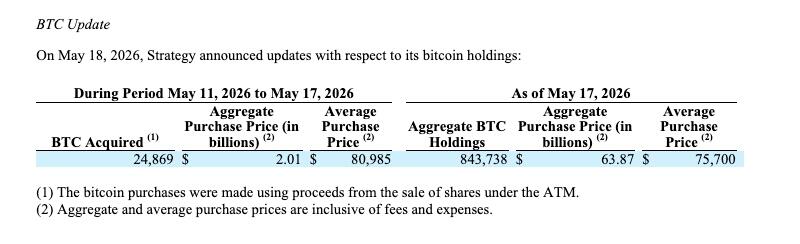
Strategy acquired 24,869 Bitcoin (BTC) for $2.01 billion between May 11 and 17, according Monday’s 8-K filing with the US Securities and Exchange Commission.
Source: SEC
The purchases were made at an average price of $80,985 per BTC, raising Strategy’s cost basis to $75,700.
The company now holds 843,738 BTC, acquired for about $63.87 billion. At the time of publication, the holdings were valued at roughly $65.3 billion, according to CoinGecko.
STRC sales account for 97% of the entire purchase
Strategy funded nearly all of its latest Bitcoin purchase through sales of its STRC perpetual preferred stock, which accounted for about 97% of total proceeds.
According to the SEC filing, Strategy raised roughly $1.95 billion from the sale of about 19.5 million STRC shares.
In comparison, Strategy’s Class A common stock (MSTR) contributed a smaller share of funding, generating about $83.7 million in net proceeds from the sale of 430,344 shares.
Source: SEC
The outcome was broadly in line with expectations from STRC Live, which reported heavy STRC activity during the week, including a record trading day of 15.1 million shares, with estimated purchases of around 15,466 BTC.
The structure mirrors previous large bitcoin buys this year, including a 34,164 BTC purchase, Strategy’s third-largest on record, which was also largely financed through preferred securities rather than common equity.
Strategy co-founder Saylor previously signaled that the company would add to its Bitcoin holdings by posting a chart showing Strategy’s purchase history with 109 Bitcoin acquisition events since 2020.
Its 843,738 BTC now far outpaces BlackRock, the world’s largest asset manager, which holds around 817,000 BTC on behalf of its clients.
The purchases came a week after Saylor raised the possibility of selling Bitcoin during Strategy’s recent earnings call, framing it as a way to better protect the asset’s long-term value.
He said that sticking too rigidly to a “never sell” Bitcoin approach could, over time, work against the very asset the company is built to accumulate and hold.
Tyler Durden
Mon, 05/18/2026 – 14:50