Category: News
“Need Solidarity , Not Stigma”: African Officials Say US Ebola-Related Restrictions Unnecessary
“Need Solidarity , Not Stigma”: African Officials Say US Ebola-Related Restrictions Unnecessary
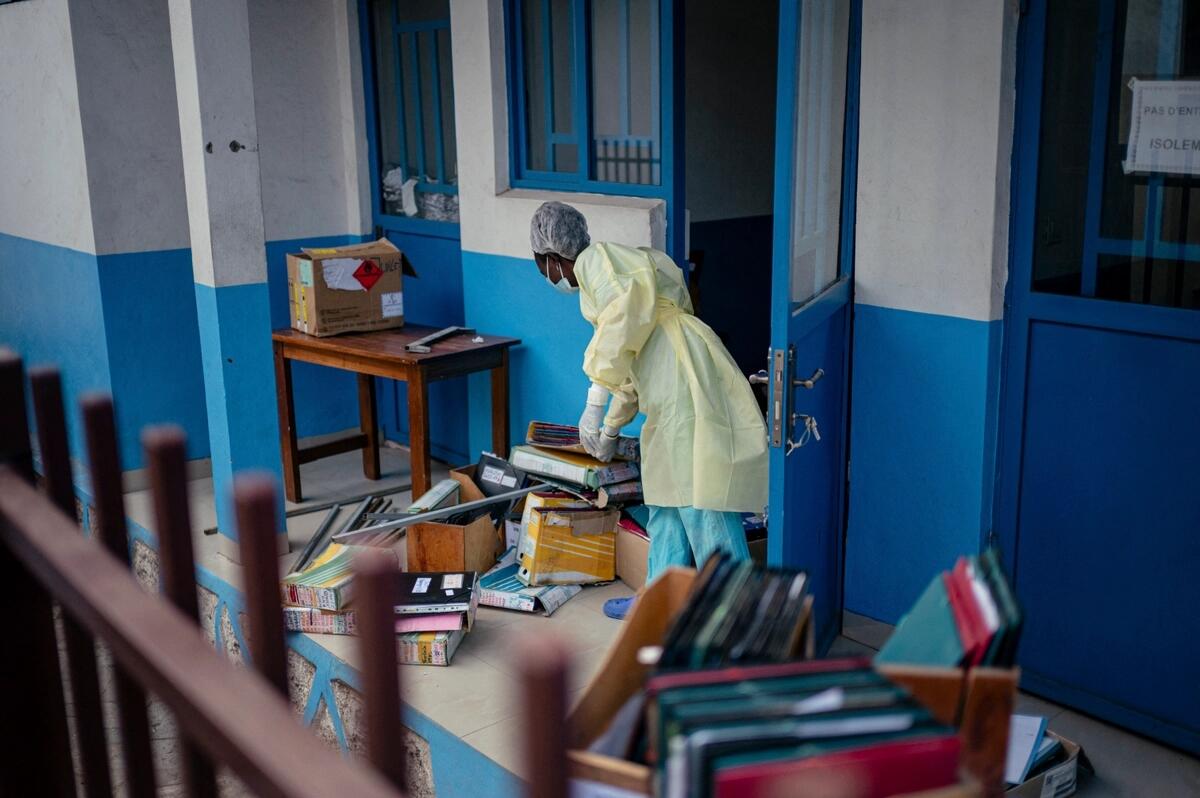
The U.S. government on May 18 said it will not let people without U.S. passports enter the United States if they have been to African countries affected by, or close to, a new Ebola outbreak within the past 21 days.
As Zachary Stieber reports for The Epoch Times, the countries are Uganda, Congo, and South Sudan, the Centers for Disease Control and Prevention (CDC) said in a public health order.
The order, signed by acting CDC Director Dr. Jay Bhattacharya, suspends the right of people from those countries to enter the United States because of “the serious risk posed by the introduction of Ebola disease into the United States by covered aliens based on the emergent outbreak of Ebola disease” in Congo.
The public health order will be in effect for 30 days, according to the CDC.
Federal law enables the CDC to prohibit entry by certain migrants if officials judge that barring their entry will prevent the “introduction, transmission, or spread of communicable diseases from foreign countries.”
U.S. officials also said they are going to step up public health screening and monitoring of other travelers who have arrived from areas affected by the outbreak. Screening includes identifying symptoms such as fever and analyzing possible exposure history.
“At this time, CDC assesses the immediate risk to the general U.S. public as low, but we will continue to evaluate the evolving situation and may adjust public health measures as additional information becomes available,” the public health agency said in a statement.
One American who was in Congo has tested positive for Ebola, and six others were exposed, CDC officials said in a briefing on May 18.
African officials on May 15 first confirmed the outbreak in Congo, reporting 80 confirmed and suspected deaths, and hundreds of confirmed and suspected infections.
The outbreak has since spread to Uganda, and South Sudan borders the region in Congo where many of the cases have been recorded.
The World Health Organization has declared a public health emergency of international concern over the situation, in part because the organization said there were “significant uncertainties to the true number of infected persons and geographic spread associated with this event at the present time.”
The virus behind the outbreak, the Bundibugyo virus, has no vaccine or specific treatment.
Dr. Satish Pillai, the CDC’s manager for Ebola response, told reporters on a call on May 18 that the outbreak is “a highly fluid situation” and that the CDC’s response includes deploying experts to the region as well as helping authorities in Africa attempt to prevent further infections and trace contacts of confirmed cases.
African Officials Say US Ebola-Related Restrictions Unnecessary
Stieber goes to report that African officials said on May 19 that travel restrictions imposed by the U.S. government over fears that Ebola could enter the United States are unnecessary and counterproductive.
The Africa Centres for Disease Control and Prevention said “travel restrictions and border closures are not the solution to outbreaks” and called on countries to refrain from imposing such restrictions.
“The world must avoid repeating the mistakes of previous health emergencies, where fear-driven measures caused major economic damage without delivering proportionate public health benefits,” the public health agency said.
“Africa needs solidarity, not stigma. Africa needs investment, not isolation. Africa needs partnerships that strengthen both economies and health systems. No one is safe until Africa is safe.”
U.S. President Donald Trump told reporters at an unrelated event on Monday that he was concerned about Ebola.
Heidi Overton, deputy director of the White House Domestic Policy Council, said during the event that there are “no cases of Ebola in America.”
“We want to keep it that way, and we are doing everything we can to support Americans in the region,” she added.
Congolese authorities said on Tuesday that there are more than 130 suspected deaths and more than 500 suspected cases linked to the outbreak.
The organization said that international officials should improve communication on risk, invest more in surveillance and infection prevention, accelerate the development of vaccines, and expand laboratory testing for the Bundibugyo virus.
Case fatality rates from past outbreaks caused by the virus have ranged from 30 percent to 50 percent, according to the World Health Organization.
“In the absence of a vaccine, there are many other measures countries can take to stop the spread of the virus and save lives, even without medical countermeasures, including risk communication and community engagement,” Tedros Adhanom Ghebreyesus, director-general of the organization, told the 79th World Health Assembly in Geneva, Switzerland, on Tuesday.
Tyler Durden
Tue, 05/19/2026 – 18:50
Americans Who Can Are Dropping Medical Insurance
Americans Who Can Are Dropping Medical Insurance
Authored by Jeffrey Tucker via The Epoch Times,
Have you observed what is happening with medical insurance in the United States? There is an upheaval taking place. You might be experiencing it yourself.
The Wakely Consulting Group has taken upon itself to track trends in the medical insurance market, both pricing and participation.
Their latest report has documented an ongoing and profound shift, one so dramatic that it portends something truly meaningful for the future.
Lacking serious reform of the system from Congress, it seems that consumers are taking matters into their own hands.
Congress declined to extend subsidies for the Affordable Care Act (ACA) starting in January. Consumers have examined their bills and plans in light of the price increases which range from 25 to 115 percent depending on conditions and levels. More than a million people have dropped their coverage entirely. More will do so through the end of the year.
Wakely comments: “Based on unique data collection from 80 percent of the ACA individual market, Wakely … estimates a material reduction in enrollment for 2026, ranging on average from 17 percent to 26 percent in total.”
This is happening because, fortunately, there is no individual mandate to be enrolled in anything since the Supreme Court deleted that portion of the program.
Individuals are downgrading their coverage to plans with fewer benefits and higher deductibles. Or they are just doing without and paying cash or shopping for crowdhealth options.
The implications for the ACA, also known as Obamacare, are profound.
First, this changes the risk pool calculation in ways that are disruptive. The whole machinery fundamentally depends on large risk pools that mask costs and separate premiums from actual individual circumstance. With such large pools, the architects hoped to take a sideways route to a privatized form of socialized medicine.
That scheme now lies in tatters.
Second, with so many people leaving (obviously those who don’t anticipate system needs) those who remain in the system are less healthy: the very people more willing to pay the higher premiums are those who expect to use the services. From an actuarial point of view, this change puts further pressure on prices. And with risk pools shrinking and data pointing to higher costs, we have a system that seems to be eating itself on both ends.
You would think that the implosion of the medical-care system of the world’s biggest economy would be big news. Somehow it is not. Why has this not been widely reported?
A theory as to why: It is happening too slowly and with too much data diffusion. It is genuinely difficult to get a handle on the pace of the increases because every state is different, every age group is priced differently, and the diversity of real-world experience not only differs on the household level but even on the event level.
Which is to say, you never know until it hits you precisely what you will pay given any particular medical-care event. As for the premiums and deductibles, people are remarkably unwilling to share personal stories of what they face due to privacy concerns and also some element of personal shame related to financial burdens.
The system as it stands is so enormously complicated that hardly anyone can really understand the whole, much less characterize the aggregate experience with the sector. It keeps growing larger, more expensive, and more exploitative, but also more complicated and diffuse, leaving writers like me ever less willing to make a judgment on it.
Price indexes themselves are a mess because of the way adjustments in the data are made, even as regulations and restrictions protect the industry against mandates for disclosures. Just getting the data is a gigantic challenge, as anyone can tell you who is currently trying to reform the system.
Regardless, the experience this year has been bad enough to cause many families to throw in the towel and simply decide what they had previously believed was unthinkable: just bailing on the entire thing. People with employer-provided health care cannot do this for now but those on contract income and with companies with fewer than 50 employees can make choices to change providers or consider opting out completely.
I’ve spoken to many people about what all this implies. What could it mean simply to go without medical insurance at all? It means saving a vast amount of money during extremely hard times. For a family, premiums can be higher than a mortgage on a home, and that is before a single medical service has been used. Once you use it for any reason beyond a simple checkup, the costs only mount from there.
The cost is the fear of a catastrophic event that would lead to utter bankruptcy. But with premiums rising so quickly, many people feel like taking that risk is worth it. If there were catastrophic plans available that did not include the supposed benefit of wellness checkups and preventive care, they would be seized up immediately by millions.
Sadly, the entire system is designed to nearly exclude access to such plans, precisely because that would only shrink risk pools further and drive up costs. A rational reform would simply open up all medical insurance markets but too many in industry perceive that as a threat, which is why this solution is not considered politically viable.
If you have a substantial amount of savings for a rainy day in the bank, the risk associated with dropping coverage entirely is certainly worth taking, Clearly plenty are doing so. Among them, they have discovered that presenting yourself at the doctor or hospital as an uninsured patient causes the costs of care to be quoted as far less than the insured price. Sometimes the cash-only savings can be 50–80 percent.
Everyone knows this. It’s a remarkable fact and very obvious evidence of legal and permissible gouging. Still, it goes on as if it is just fine.
Hence, there can be a major financial advantage to going without insurance entirely. It’s often the case that cash can get you a better deal for a car or a home, but it is true many times over with medical provision. If you are willing to leave the country, the savings can be far greater still.
This is precisely why so many are choosing this route rather than paying sometimes thousands of dollars a month for coverage that they do not use. Other options that people are looking at services like Direct Primary Care, where you pay only $100 a month to have constant access to a prescribing physician who knows your health care needs.
A major beneficiary of these trends are crowd-health services, the new kids on the block that are disrupting the entire industry. It is not insurance. Those who subscribe present themselves to service providers as uninsured and hence benefit from far lower prices. The company then negotiates prices for you, covers them under most conditions, and charges separately for known costs such as pregnancy.
It’s a new model that works with the existing system. If we had reforms that permitted broader Health Savings Accounts, and rewarded opt-outs for employer-provided plans, the crowd health model could reform the entire system. For now, it is a niche market but could be vastly larger by year’s end when many more millions will simply leave the system entirely.
Under current trends, you can see what’s happening here. The system is reforming itself without the permission of the politicians. More of this would happen with some simple reforms like broadening health savings accounts, permitting purely catastrophic coverage, and permitting premiums to adjust based on individual risk. Lacking such reforms, people are leaving anyway.
You might decide to make this choice yourself, provided you are able.
Tyler Durden
Tue, 05/19/2026 – 18:25
https://www.zerohedge.com/personal-finance/americans-who-can-are-dropping-medical-insurance
Korean Bubble Mania: Retail Investors Max Out On Margin Debt, Choose To “Risk Complete Collapse” Than Miss Stock Rally
Korean Bubble Mania: Retail Investors Max Out On Margin Debt, Choose To “Risk Complete Collapse” Than Miss Stock Rally
For many years, Koreans were bitcoin’s best friend.
After bitcoin emerged about a decade ago as the asset class with the most pronounced momentum – both to the upside and the downside – Korea’s daytrading army, famous for being totally unable to do any fundamental valuation analysis but legendary for its wilnningness to piggyback on any momentum with suicidal leverage, became enamored with bitcoin and the result were face-ripping meltups and heartstopping crashes, a daily breathless rollercoaster where 10% moves in hours if not minutes had become the norm.
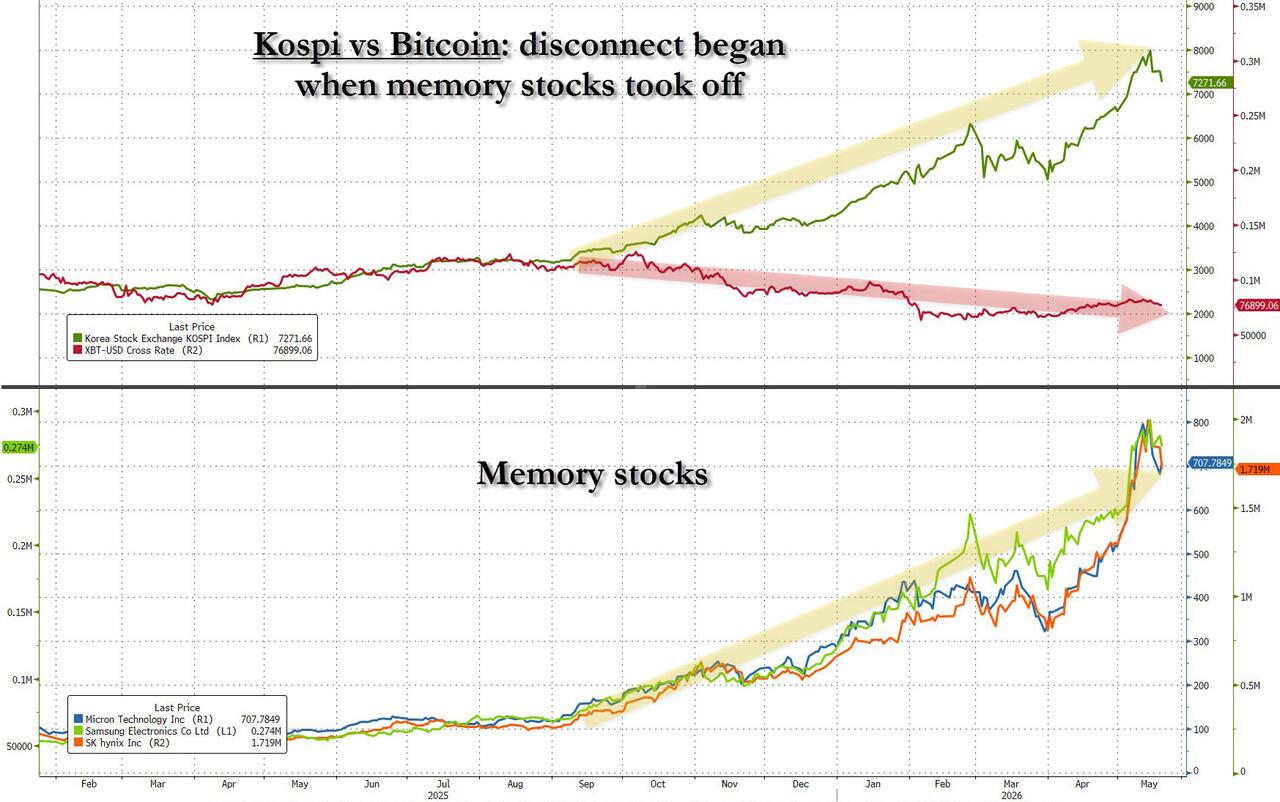
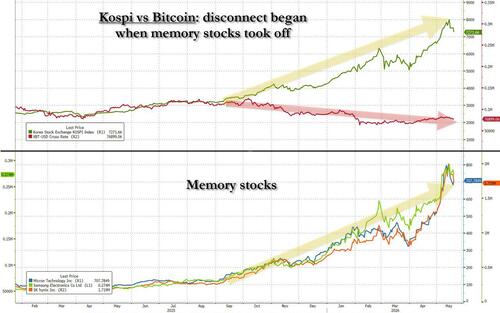
But then, last September something snapped. After bitcoin had tracked Korea’s Kospi index closely for years, the two series – formerly joined at the hips for years – diverged and went their separate ways, the Kospi soaring to never before seen levels, while bitcoin stagnated, shrinking ever lower as its former momentum-addicted traders abandoned it for something shinier, and with much more momentum: memory stocks.
As shown in the chart below, the Kospi-Bitcoin divergence started right around the time last September when memory stocks like Micron, Samsung and SK Hynix began what would be an absolutely historic meltup for the ages (if not so much for bitcoin).
And while we had previously showed our readers a behind the scenes peeks into Korea’s crypto trading culture, nothing prepared us for what is taking place right now… because what is taking place is nothing short of absolute batshit insanity.
Consider this: a single post uploaded May 8 by a Korean civil servant on Blind, the anonymous workplace community app, quickly set off a frenzy online. The post included a screenshot of his brokerage account showing he had poured a staggering 2.3 billion won ($1.7 million) into shares of semiconductor giant SK Hynix, one of the key driving forces behind Korea’s roaring stock market.
But even more striking is that the 1.7 billion won of that investment was financed through margin loans borrowed from his brokerage!
“I believe the semiconductor market will continue its upward climb through 2028, but I’m taking a more aggressive approach to grow my assets faster,” he wrote. Four days later, on May 12, he returned with an update claiming he had already locked in 267 million won in profits.
That same day, another Blind post surfaced – this time from a Seoul Metro employee in her 20s, who wrote that rather than missing out on the rally, she would “risk complete collapse,” adding that she had used 150 percent margin financing to fully leverage into stocks.
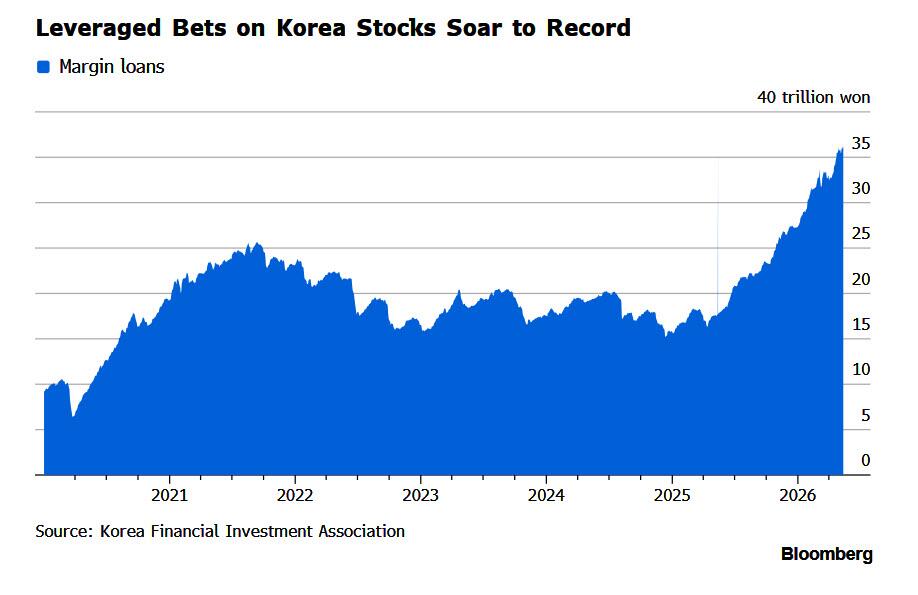
As Korea’s bull market barrels ahead, the Korea Times writes that more momentum-addicted retail investors are turning to borrowed money to magnify returns, despite huge risks of losing more than 100% of one’s capital. As of Friday, outstanding margin loans used for stock purchases had ballooned to a record 36.47 trillion won, according to the Korea Financial Investment Association.
While retail investors end up with all the risk, for Korea’s securities firms, the recent retail mania and associated borrowing boom has become a lucrative windfall.
According to recent industry data, the nation’s 10 largest brokerages – Korea Investment & Securities, Mirae Asset, Samsung, Kiwoom, NH, KB, Shinhan, Hana, Meritz and Daishin – generated a combined 600 billion won in interest income from margin lending in the first quarter of this year, up 55.9% from a year earlier.
Margin loans allow investors to borrow money from brokerages to buy stocks by pledging existing assets as collateral. While this can amplify gains, it also comes with annual interest rates ranging from 7 to 9%, and if share prices fall too sharply, brokerages force-sell holdings to recover their loans.
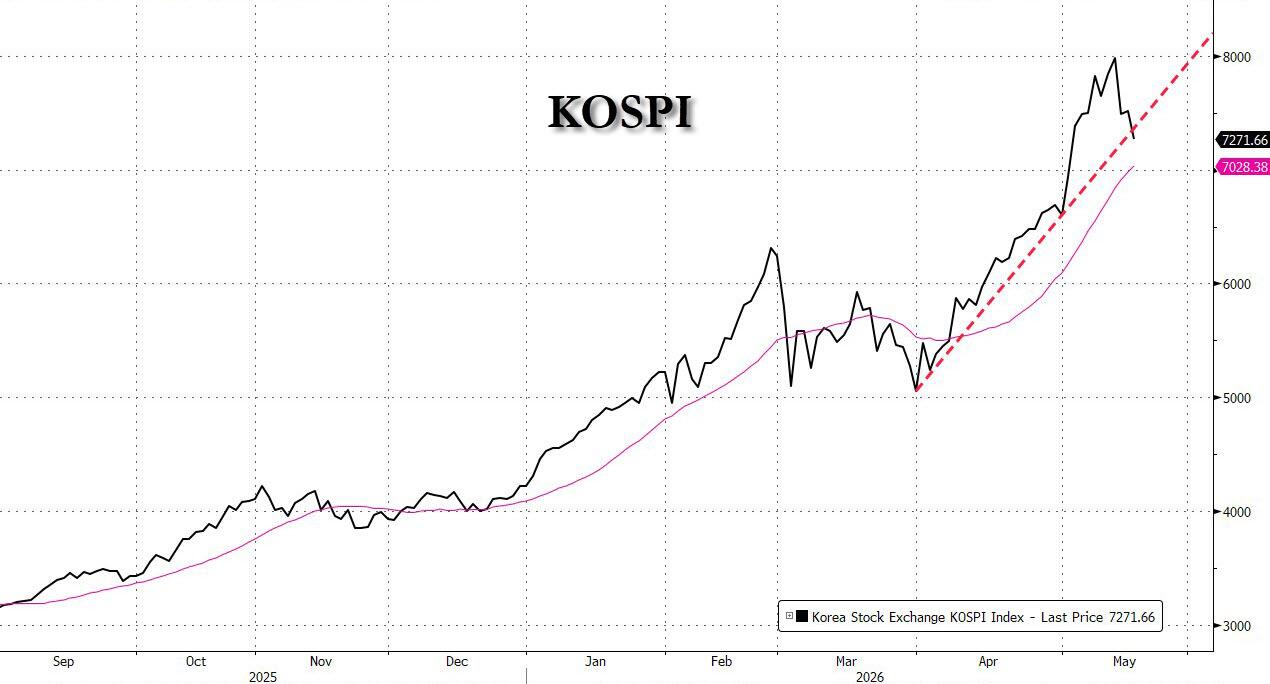
For now, bullish sentiment shows few signs of cooling: with the benchmark KOSPI climbing from the 4,000 range late last year to surpass the historic 8,000 mark in less than half a year, many retail investors appear willing to embrace higher-risk strategies in pursuit of faster gains, similar to what happened in China during the 2015 bubble when margin debt hit daily record highs.
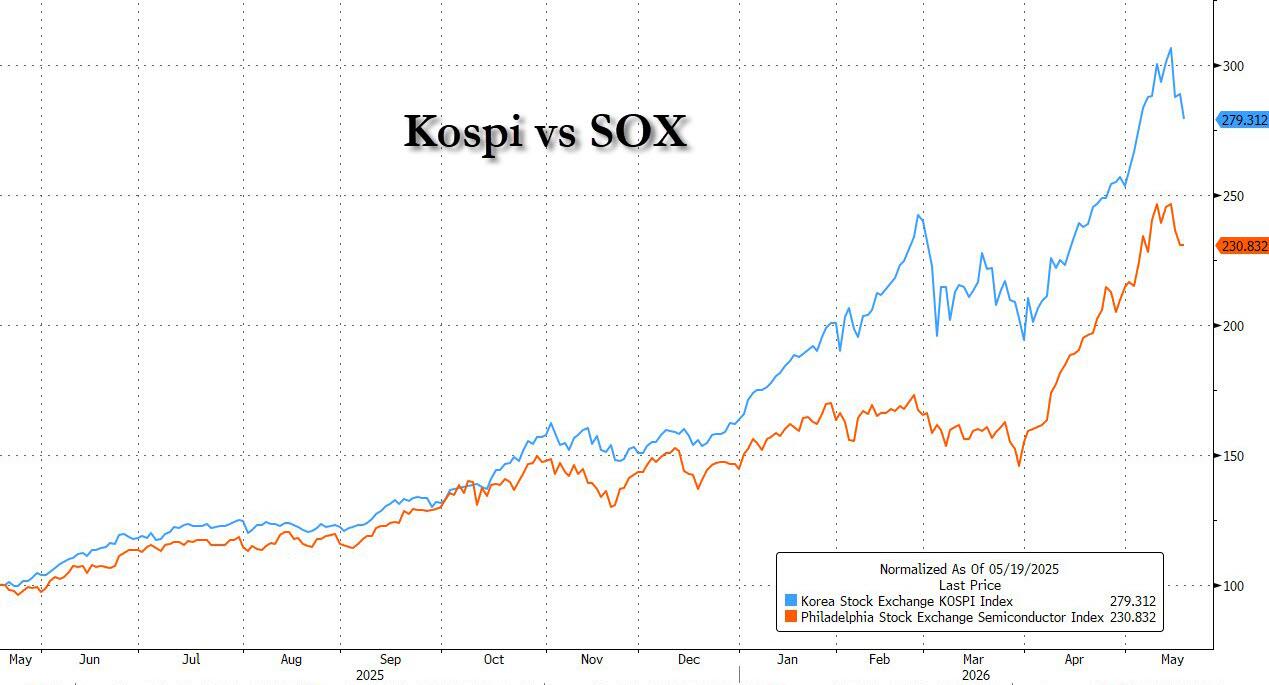
Up 75% this year, the quick ascent of South Korea’s Kospi Index has largely been driven by Samsung Electronics and SK Hynix, which accounted for more than two-thirds of the advance. The surge reflects record profits at the chipmakers, and with valuations still below regional and global peers, some investors argue the rally lacks the excesses typical of past boom-and-bust cycles.
Wall Street, of course, is more than eager to encourage reckless risk taking: in a May 10 report, JP Morgan raised its base-case KOSPI target to 9,000, with a bull-case projection of 10,000, arguing that investors should “stay positioned for further upside and not preemptively anticipate a cycle-end.”
The investment bank pointed to a “higher for longer” memory chip upcycle, fueled in large part by sustained artificial intelligence-driven demand, while also identifying brokers, insurers, holding companies and dividend-heavy sectors as major beneficiaries of the country’s broader market transformation.
Not everyone agrees.
For one, signs of froth are literally everywhere one looks. Key market measures showing uneven earnings growth, rising volatility and record margin debt are beginning to give some investors pause. “This is a party you want to enjoy while staying near the exit,” said Mo Young, a portfolio manager at RootN Global Investors in Seoul. The problem with this is that everyone thinks they can sell before everyone else does. That “strategy” always ends in tears.
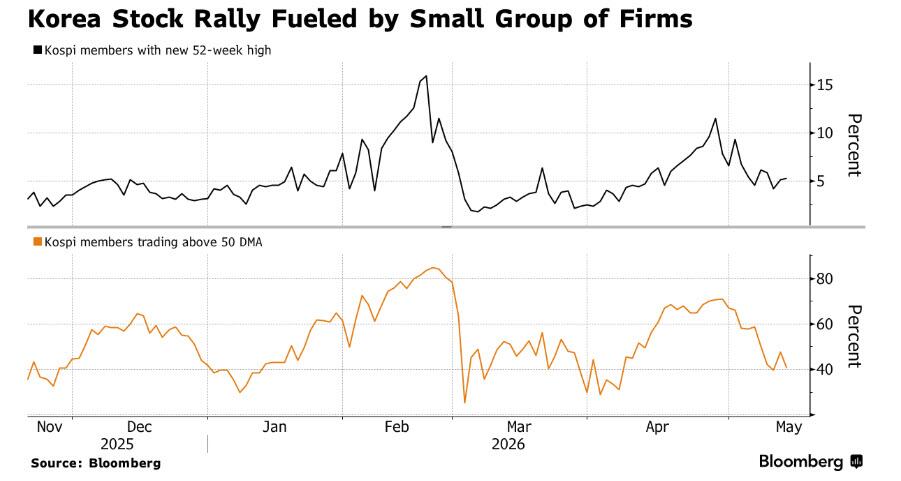
Just like in the US, Korea’s market breadth shows that the rally remains highly concentrated. Just 33% of benchmark stocks are now trading above their 50-day average, down from 70% three weeks ago. Meanwhile, 2% of members – mostly memory and chip stocks – are hitting new 52-week high despite the Kospi’s successive records, which underscores the narrowness of the gains.
“In other words, buying the index is not simply buying a diversified slice of Korea; it is increasingly a concentrated bet on memory semiconductors,” said Christian Heck, a New York-based portfolio manager at First Eagle Investment Management.
“The index itself is no longer obviously cheap, and broad exposure requires underwriting a very large semiconductor-cycle bet,” he added. “Selectivity is essential.”
Palvir Bahia, a fund manager at Polar Capital which manages $40.5 billion said his fund is “monitoring the rising margin debt closely as the market rally has led to an increase in margin debt which heightens market volatility, particularly on down days when retail investors are forced to sell in order to maintain account balances.”
The risk of forced retail liquidations has dragged in the chief of the country’s financial watchdog who expressed concerns that retail investors could suffer losses amid increased market volatility, according to the Financial Supervisory Service (FSS) on Tuesday.
During a meeting on consumer risk response a day earlier, FSS governor Lee Chan-jin said retail investors could increasingly pivot toward highly volatile, risky assets as the country is set to introduce single-stock leveraged, or inverse, exchange-traded funds (ETFs) next week.
And just in case record margin debt and historic call buying wasn’t enough, the watchdog warned that the introduction of single-stock leveraged ETFs could further accelerate capital flights to high-risk financial products. Because that’s just what Korea’s stock bubble needs.
A bubble which may burst any minute since cracks are starting to show in the index itself.
The Kospi dropped nearly 5% on Tuesday, the worst performer across Asia, as chip stocks tracked US peers lower amid rising bond yields. The index is now testing the ultra-steep trend line, with the 21-day moving average sitting just below current levels. As Market Ear notes, “these are short-term make-or-break levels for the AI melt-up.”
As we have observed previously, the Kospi is basically two memory stocks, Samsung Electronics and SK Hynix, which is why the Kospi is basically the SOX on steroids.
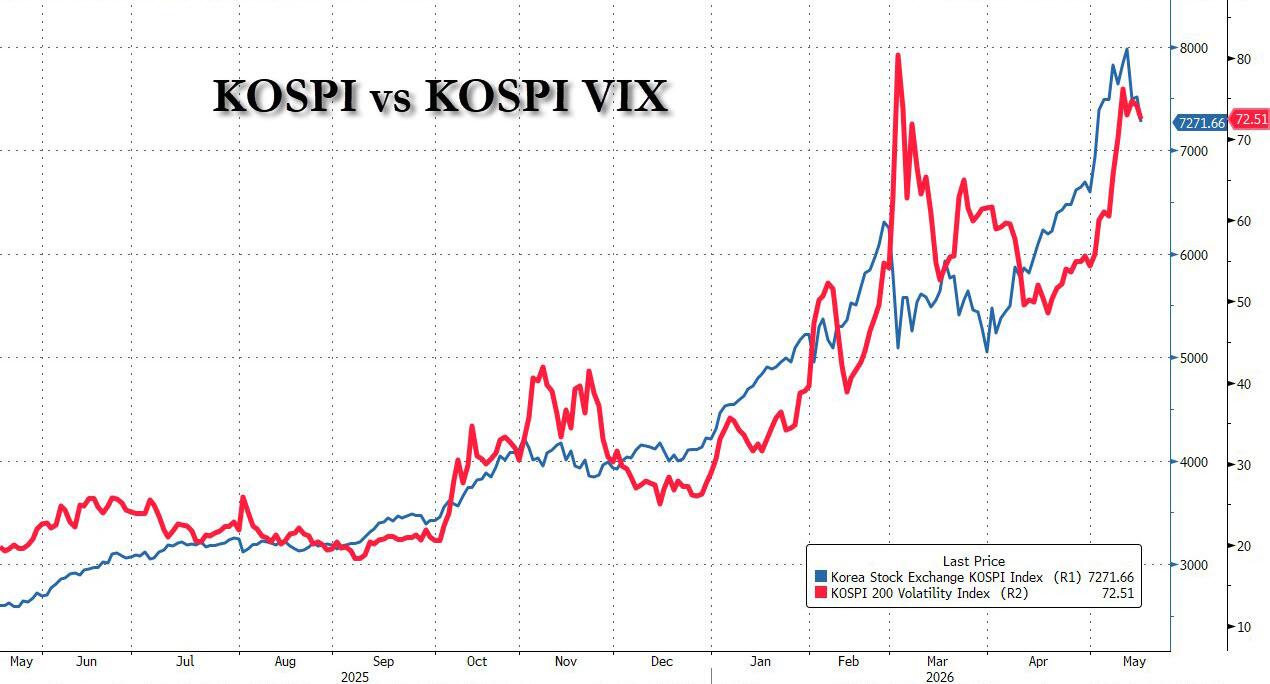
With everyone ignoring stocks and plowing their margin debt right into calls for leverage upon leverage, the Kospi VIX is now a broken market. The spot-up, vol-up regime which signals a “melt-up” phase driven by FOMO and extreme positioning, has been unlike anything seen before, resulting in many investors dismissing buying protection due to stratospheric vols. First, the VIX soared as stocks surged (due to call buying); now vol stays high as the KOSPI sells off. Vols at these levels are pricing around 4.5% daily index moves going forward! That’s not just extreme, that’s batshit insane, and virtually guarantees that all levered investors will be wiped out unless they have tons of available cash balances to absorb margin calls, which they don’t.
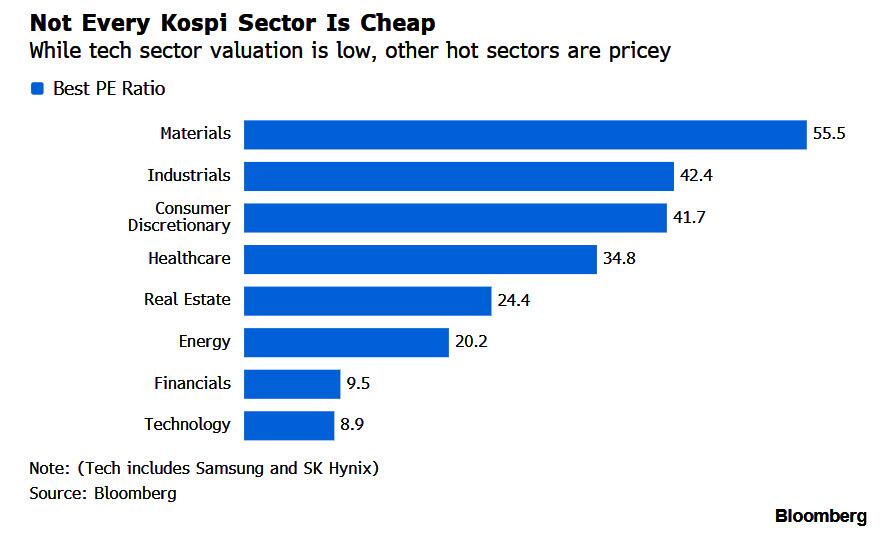
With Samsung and SK Hynix posting record profits, signs of froth are also emerging in smaller stocks where earnings growth is virtually non-existant. Non-tech firms have driven just 4% of the 12-month earnings gain since September, according to William Bratton, head of cash equities research for APAC at BNP Paribas.
Valuations are particularly stretched in materials sectors, which include electric-vehicle firms, trading at nearly 60 times forward earnings. Battery maker Posco Future M Co. stands out at over 300 times, despite carrying the highest number of sell ratings on the Kospi, Bloomberg data shows.
“If there is a meaningful slowdown of inflow from retail investors or systematic traders, or if hedge funds reduce their big positions that were most profitable, the market structure could become even more fragile,” Kim added.
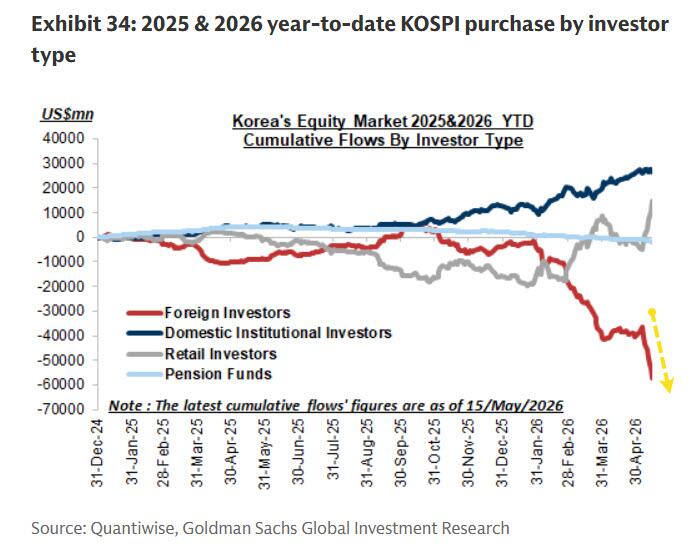
And it’s about to get much more fragile: as Goldman notes, foreigners have net sold the Kospi for the 9th consecutive day (and have been aggressively selling for much of 2026) with today’s latest selling focused in Tech (-$3.4bn). And while local institutions were net sellers for most part of the day, they closed as small net buyers with buying concentrated in Tech (+$168mn). Meanwhile, the willing target of everyone else’s distribution, retail investors, have continued to be net buyers and absorbed all of the supply from foreigners… the same retail investors who are now levered to the gills and are out of funds, so they are buying with the bank’s money.
As we pointed out a week ago, hedging Korea, and partly the broader AI mania, via EWY looked interesting. The last major upside overshoot at the start of the Iran war, eventually mean-reverted all the way back toward the 50 day moving average. Having previously outlined the EWY put spread logic, with the unwind starting to accelerate again, it’s time to start thinking about rolling strikes lower to keep max optionality.
KOSPI may be turning from the leader of the AI melt-up into the market’s most important stress signal, and when it blows, millions of levered retail investors will lose everything they own, and more thanks to the magic of leverage.
Tyler Durden
Tue, 05/19/2026 – 18:00

Mamdani Touts First City-Owned Grocery Store
Mamdani Touts First City-Owned Grocery Store
Authored by Chris Wade via The Center Square,
New York City Mayor Zohran Mamdani on Monday announced the site of the latest city-owned grocery store as the democratic socialist looks to make good on a key campaign pledge.
The 20,000-square-foot store, located in the Bronx’s Hunts Point neighborhood, is part of a $70 million plan that includes opening stores in the city’s five boroughs. The plan calls for hiring a private operator to run the store under the city’s pricing rules. The South Bronx store will be part of a new affordable housing development rising from the site of a former juvenile detention facility.
He said the store, when it opens next year, will help “level the playing field” for shoppers who are struggling to make ends meet in one of the city’s poorest neighborhoods.
“Seventy-seven percent of households in surrounding neighborhoods cannot afford basic needs,” Mamdani said in remarks Monday.
“More than 50% of households have relied on public assistance in the last 12 months alone. And when nearby families go shopping for groceries, there are not enough affordable options nearby.”
Mamdani’s push to open city-run grocery stores fulfills a campaign promise for the democratic socialist, whose lefty agenda also includes plans for universal childcare, tuition-free community colleges, and free bus service.
Many of those plans have been put on hold as the new mayor grapples with a record budget shortfall.
Under the mayor’s plans, which still require City Council approval, the grocery stores wouldn’t pay rent or property taxes, allowing them to keep their overhead costs down and pass on savings to shoppers, according to the Mamdani administration.
Allowing New York City to get into the grocery store business has plenty of detractors, including the United Bodegas of America, which says it will hurt small businesses and the city’s economy.
John Catsimatidis, CEO of New York City grocery chain Gristedes, has threatened to pull out of the market if Mamdani moves ahead with the plans, saying he couldn’t compete with city-run supermarkets.
In his remarks Monday, Mandani turned a quote from the late Republican President Ronald Reagan upside down to make his argument for the taxpayer-funded bodegas.
“He famously said, the nine most terrifying words in the English language are, ‘I’m from the government and I’m here to help.’ It’s a good quote, but I disagree. I think nine more terrifying words are actually, ‘I worked all day and can’t feed my family,’” Mamdani said.
“We are going to use the power of government to lower prices and make it easier for New Yorkers to put food on the table,” Mamdani said.
Tyler Durden
Tue, 05/19/2026 – 17:40
https://www.zerohedge.com/political/mamdani-touts-first-city-owned-grocery-store
Indian Airlines Beg Refiners To Delay Jet Fuel Hikes
Indian Airlines Beg Refiners To Delay Jet Fuel Hikes
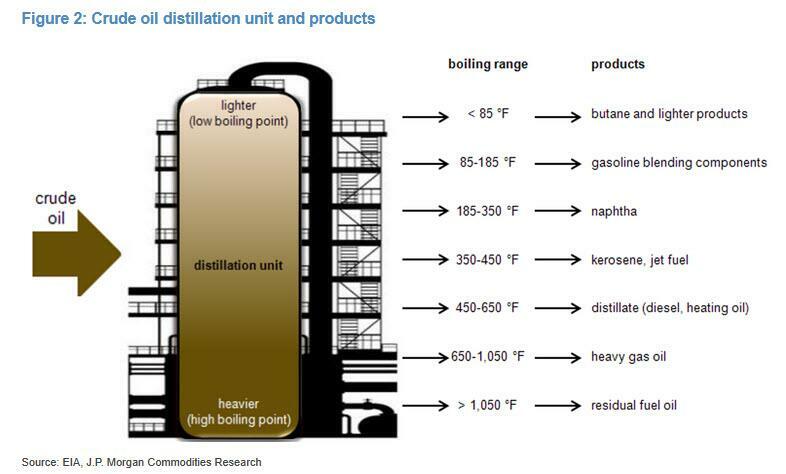
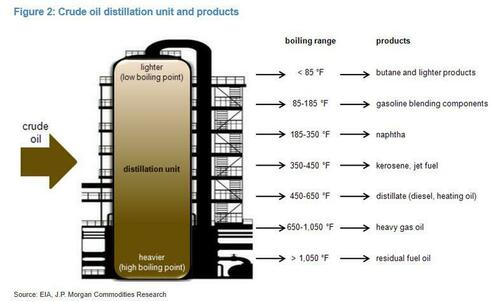
Earlier we reported that after issuing a code red about a month ago, with several airlines warning they may run out of kerosene in weeks if not days, European refiners and airlines have since backtracked on their earlier warnings; instead they now have “almost zero” concerns that jet fuel could run out over summer. That’s because, as we explained in “Where To Find The Next Phase Of The Global Energy Shock“, where we showed that refiners have ramped up production away from cheaper gasoline and toward much more expensive jet fuel…
… while higher imports from the US, Nigeria and Norway have also helped to stabilize supply. As Rabobank said, “It’s the price mechanism at work: jet fuel prices surged in April and are currently around 60% above pre-war levels.”
But while Europe may have procured much needed jet fuel, in many cases thanks to state subsidies which will transform into more expensive debt as Japan found out this week, India has been less lucky.
As Bloomberg reports, India’s airlines have asked state-run oil refiners to hold off on hiking jet fuel prices for domestic flights until the conflict in the Middle East ends, in a bid to alleviate their rising cost pressures and mounting losses.
The proposal was floated by the country’s leading airlines including Air India, IndiGo and SpiceJet, and is being considered by the refiners. India’s oil and gas ministry is also involved in discussions, and may intervene again as it did in April and May. A decision is expected before June 1.
India’s so-called aviation turbine fuel prices are set by the country’s oil marketing companies, which usually make any revisions on the first day of the month. The price setting has been deregulated for years, but in April, after global oil prices surged due to the Iran conflict, the government limited the most recent jet fuel price hike to 25% and required the oil majors to keep them constant in May.
According to Bloomberg, the state-owned refiners, which include Indian Oil Corp., Hindustan Petroleum Corp. and Bharat Petroleum Corp., are also discussing whether to raise jet fuel prices in June by up to 25% for domestic flights. They have been selling jet fuel for domestic flights at about 105,000 rupees ($1,090) per kiloliter, incurring a loss of 92,000 rupees per kiloliter.
The curbs apply only to fuel for domestic flights. Jet fuel prices for international flights, which are not regulated, doubled in April and climbed further to $1,511.86 per kiloliter in May.
Oil constitutes around 40% of airlines’ costs in India. The industry recently warned of flight suspensions and other business disruptions if the government doesn’t put a lid on fuel prices. They are also lobbying for tax reductions or deferments, and some have reduced flight schedules due to a falloff in demand that’s partly a result of higher fares. Airlines are also grappling with a weaker rupee, which makes it costlier for them to pay in dollars for aircraft leases and overseas airport charges.
Since the Iran war, India has announced a slew of measures that include rebates on plane landing and parking charges, regulating increases in jet fuel prices, and tax reductions on fuel for flights operating out of Delhi and Mumbai, its biggest airports.
International flights have also been impacted from the Middle East conflict, as airlines were using the Iran airspace to fly to Europe and America after Pakistan banned Indian airlines from using its airspace earlier. The carriers have passed on higher costs to fliers in the form of increased fares, which has depressed demand in the world’s third-largest domestic aviation market.
State-run refiners on Tuesday raised road transport fuel prices for a second time in less than a week, increasing prices of diesel and gasoline in New Delhi by 1% following a 3% hike last Friday. Those increases are modest in comparison to the 50% surge in Brent crude since the war began.
Tyler Durden
Tue, 05/19/2026 – 17:20
https://www.zerohedge.com/energy/indian-airlines-beg-refiners-delay-jet-fuel-hikes

Trump Announces Expansion Of TrumpRx With 600 New Generic Drugs
Trump Announces Expansion Of TrumpRx With 600 New Generic Drugs
President Donald Trump announced Monday that the administration is dramatically expanding the number of medications available through TrumpRx.gov, adding more than 600 generic drugs in what the White House described as another push to lower prescription costs for Americans.
Trump unveiled the expansion during remarks at the Eisenhower Executive Office Building on the White House campus, calling the move a major step toward making medications more affordable.
🚨 @POTUS announces a major expansion of https://t.co/qDpny1gZzN to feature more than 600 new generic prescription drugs — delivering even more transparency, choice, and savings for Americans. pic.twitter.com/MuPLuYLSB2
— Rapid Response 47 (@RapidResponse47) May 18, 2026
“Today I’m thrilled to announce that we’re increasing the number of drugs available on TrumpRx by nearly seven times, adding over 600 affordable generics to the website, working with industry partners,” Trump said.
The president argued that generic medications often provide the same results as expensive brand-name drugs at a fraction of the cost.
“Cost-effective generic drugs are often available at just a tiny fraction of the price of their brand-name equivalents,” Trump said.
“Sometimes they’re better with the same dosage, the same effectiveness, and the same active ingredients.”
Trump said the expanded platform would offer some of the lowest prescription prices available to Americans, in some cases even beating insurance co-pays and out-of-pocket costs.
“With these additions, TrumpRx will feature the best and lowest prices on prescriptions used by tens of millions of Americans,” he said. “We’re going to be lower.”
The White House also demonstrated a new feature on the website that allows users to compare drug prices at local pharmacies using an interactive map. The presentation was led by Chief Design Officer Joe Gebbia.
Robert F. Kennedy Jr. praised Trump’s efforts during the event and argued that previous administrations had promised lower drug prices without producing results.
“President Trump has asked us to make this, our country, the most affordable medication in the world, and he succeeded in doing that,” Kennedy said.
“I want to say one last thing: President Bush promised to do this, President Clinton promised to do it, President Biden promised to do it, President Obama promised to do it, President Trump actually got it done,” he added.
One of the administration’s partners in the effort is Cost Plus Drugs, co-founded by businessman Mark Cuban, who attended the announcement despite backing former Vice President Kamala Harris in the 2024 election.
Cuban praised the initiative and emphasized that lowering drug costs should transcend partisan politics.
“Republicans want cheaper drugs, independents want cheaper drugs, Democrats want cheaper drugs, and together I think we’re going to do something special,” Cuban said.
Speaking afterward outside the West Wing, Cuban argued Americans should judge policies based on whether they improve people’s lives rather than reflexively opposing them because of politics.
“The only thing I care about is can they reduce the stress of the American people,” Cuban said.
“TrumpRx and Cost Plus Drugs working together is one step towards reducing the stress.”
Tyler Durden
Tue, 05/19/2026 – 17:00
https://www.zerohedge.com/political/trump-announces-expansion-trumprx-600-new-generic-drugs

Chaos Erupts In Bolivia As Socialists Unleash General Strikes And Riots
Chaos Erupts In Bolivia As Socialists Unleash General Strikes And Riots
Socialists in Bolivia, mobilized through the national labor union, highland farmer federations, and supporters of former left-wing President Evo Morales, have ignited social unrest over the U.S.-backed, market-oriented policy agenda of President Rodrigo Paz.
The turmoil comes as the Trump administration seeks to shift the Americas away from socialist regimes and closer to Washington’s pro-capitalist stance.
En Bolivia, obreros, campesinos, maestros de escuela, indígenas y transportistas, llevan mas de 2 semanas paralizando el país contra las políticas neoliberales del gobierno de Rodrigo Paz, y medios occidentales ni informan.pic.twitter.com/ruAizBAOYV
— Aníbal Garzón 🌎 (@AnibalGarzon) May 17, 2026
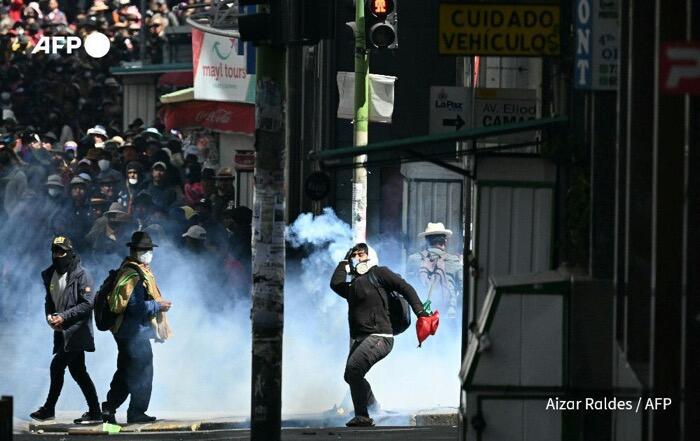
Demonstrators clashed with police in La Paz, attempted to breach government buildings, and set up barricades amid weeks of blockades that have disrupted supplies and driven up grocery prices.
Bloomberg:
BANK BRANCHES IN LA PAZ, BOLIVIA SUSPEND OPERATIONS AMID UNREST
President Paz accused forces linked to Morales and drug traffickers of backing the demonstrations.
Bolivia’s government has ordered the arrest of all the main leaders of the indigenous movements and mineworkers unions.
They’re being charged for Terrorism for having organised the general strike against hunger. Strike continues regardless, now in day 7. pic.twitter.com/5ISk3KPb68
— Ollie Vargas (@Ollie_Vargas_) May 19, 2026
Paz’s election last year abruptly ended two decades of nation-killing socialist rule in the landlocked South American country. Voters, exhausted by economic turmoil, surging inflation, a severe foreign-currency crisis, and declining natural gas output, opted for political change.
The Socialist Labour Party in the U.K. stands in “solidarity” with the Bolivian people…
🚨We send our solidarity to the Bolivian people.
🔴Just six months after US-backed President Rodrigo Paz took office, protesters are demanding his resignation. Bolivia’s government has ordered the arrest of all the main leaders of the indigenous movements and mineworkers unions.… pic.twitter.com/TnYzuVIOIv
— Socialist Labour Party (@soclp_uk) May 19, 2026
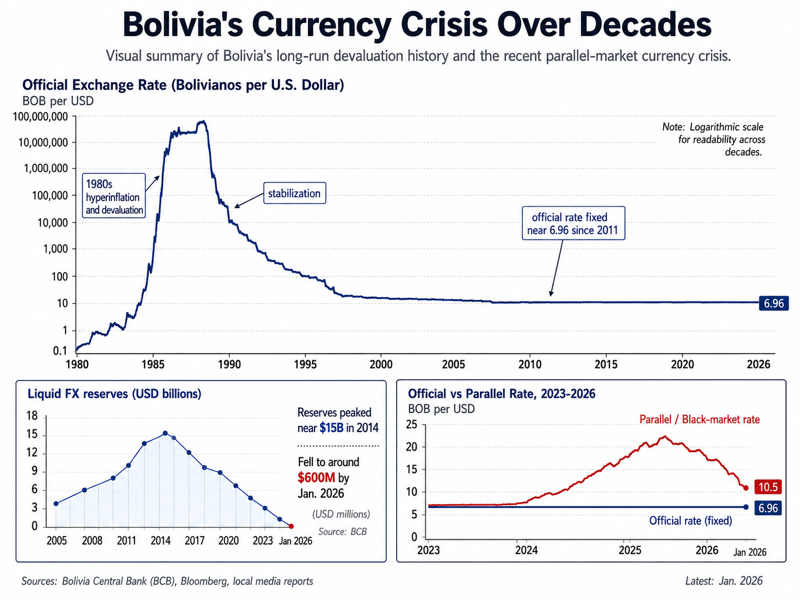
Meanwhile, Bolivia’s currency crisis has been a long time in the making under decades of state-heavy socialist rule.
By 2025, Bolivia was facing a severe dollar shortage, fuel lines, and a forty-year-high inflation. Socialism reached its endgame last year with President Paz’s election victory. Socialists squandered the nation’s inheritance.
Socialism has also reached its endgame in other countries, including:
Argentina, 2023: Voters rejected the ruling Peronist government and elected libertarian Javier Milei amid a severe inflation and currency crisis.
Chile, 2025: Conservative José Antonio Kast defeated the ruling left’s candidate, Jeannette Jara, marking a sharp rightward shift after the Boric era.
As well as the US removal of socialist Nicolás Maduro from Venezuela.
Bolivia’s unrest by socialists attempting to shut down the economy should serve as a warning that socalist NGOs and unions in the US could attempt general strike in the US to derail the economy – we outlined that here.
Tyler Durden
Tue, 05/19/2026 – 16:40
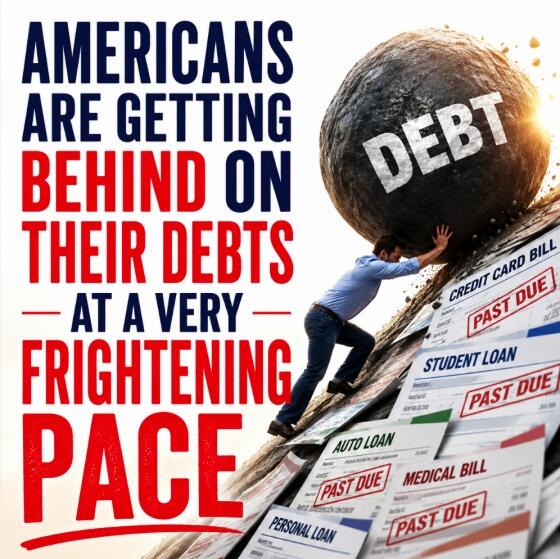
Americans Are Getting Behind On Their Debts At A Very Frightening Pace
Americans Are Getting Behind On Their Debts At A Very Frightening Pace
Authored by Michael Snyder via The Economic Collapse blog,
U.S. households are now 18.79 trillion dollars in debt. In 1980, U.S. households were just 1.4 trillion dollars in debt. Over the past several decades we have witnessed a household debt binge that is unlike anything that we have ever witnessed in our entire history. But if consumers could handle that debt load, there wouldn’t be such a high level of concern. Unfortunately, just like we witnessed prior to the financial crisis of 2008 and 2009, Americans are getting behind on their debts at a staggering rate. This isn’t going to end well, but of course many of you know that already.
The latest numbers published by the Federal Reserve Bank of New York show that delinquency rates for auto loans, student loans and credit card debt have all soared to very alarming levels…
Today, the Federal Reserve Bank of New York (FRBNY) published new data showing that the share of Americans behind on a range of household consumer debts reached all-time highs in the first quarter of 2026. As the nation hurdles toward an historical record of $19 trillion in total household debt, Americans saw the highest rates of auto loan delinquency that FRBNY has ever recorded, rates of credit card delinquency near those last seen at the height of the 2008 financial crisis, and student loan delinquency at its worst since before the COVID-era payment pause.
Thanks to our accelerating cost of living crisis, most U.S. households are barely scraping by from month to month these days.
So if you are feeling financially squeezed right now, I want you to know that you are not alone.
As financial pressure rises, an increasing number of households are reaching a breaking point.
As a result, we are beginning to witness a tsunami of delinquencies…
While families took on more debt, they also fell behind. Credit card delinquency rates are now the highest they have been in 16 years (13.1 percent). Overall student loan delinquency rates soared to 10.3 percent, the highest recorded since 2020. Significantly more student loan borrowers are also entering serious delinquency, with their loans more than 90 days past due (10.9 percent) compared to the first quarter of 2025 (8.0 percent). In fact, delinquency rates have increased for all credit types tracked by the FRBNY since the final quarter of 2025.
Those figures are deeply troubling.
And I haven’t even mentioned mortgages yet.
In April, there were more than 42,000 foreclosure filings…
New data released by real estate analytics firm ATTOM found that 42,430 properties nationwide received foreclosure filings in April 2026, including default notices, scheduled auctions and bank repossessions.
Is that a high number?
Yes, it is.
In fact, it is 18 percent higher than last year’s very high figure for the month of April…
Foreclosure filings across the US have surged 18 percent compared to last year in a troubling sign that mounting financial pressure is beginning to hit homeowners.
It is a red flag that is reminiscent of the foreclosure spike in the run up to the 2008 Great Recession – that financial pressure is mounting for thousands of families.
Many of you clearly remember that we experienced a growing wave of foreclosures well before the financial markets started to crash in late 2008.
It was obvious that the housing bubble was crashing way in advance, and we can see the same thing happening again.
In Seattle, the number of homes listed for sale is nearly twice the usual figure, and prices are beginning to fall…
There are 8,630 homes listed for sale across the Seattle metro right now. In a normal April, there are about 4,600.
Nick Gerli, CEO of the real estate analytics firm Reventure, posted that data on Sunday on X. His read: Seattle’s housing market is going through a historic inventory shock, driven by layoffs, historic unaffordability, and outbound migration. King County values are already down 2.5% year over year. Prices are falling, and a typical listing is still right around $1 million, with a monthly mortgage payment of $7,000 to $8,000. That’s $84,000 to $96,000 a year just on the mortgage. The median household income across the Seattle metro is about $112,000 before taxes. After federal and state deductions, that household is taking home somewhere around $85,000 to $90,000. The mortgage alone consumes virtually all of it.
The market is cracking. Regular people still can’t afford to buy.
Yes, the market in Seattle is most definitely cracking.
And the same thing could be said about dozens of other markets all over the nation.
It is inevitable that home prices will fall because we have reached a point where most of the population simply cannot afford a typical mortgage payment.
In our “K-shaped economy”, those at the very top have been thriving while the vast majority of the country has been deeply struggling.
Sadly, there are a lot of young adults out there that have simply stopped trying.
This is particularly true for young men, and the numbers clearly show that millions upon millions of them have chosen to drop out of the labor force…
The Department of Labor keeps careful track of employment and the demographics thereof. Their latest report on men in the labor force is both mysterious and deeply alarming. It turns out that the labor force is missing about 7 million men who would otherwise be working. Close to a third of working-age men have vanished from the labor force.
The labor force participation rate among “prime age men,” age 25 to 54, in the 1950s approached 100 percent. Now it is 89 percent, meaning roughly 11 percent are not in the labor force (neither working nor looking for work).
Among all men over 16 years of age, the rate is a devastatingly low 66 percent, so about one-third are gone. Among U.S.-born men, nearly 22 percent are gone.
This is really quite shocking.
We really do have a national crisis on our hands.
The number of homeless Americans is at an all-time high.
Most of them are men.
The number of drug addicts in our country is at an all-time high.
Most of them are men.
So many people have been falling through the cracks in the system, and it seems to get worse with each passing year.
Meanwhile, an increasing number of households are falling behind on their debts and America’s middle class is steadily shrinking.
All of the long-term trends are taking us in the wrong direction, and it appears that our economic problems will only accelerate during the months ahead.
Michael’s new book entitled “10 Prophetic Events That Are Coming Next” is available in paperback and for the Kindle on Amazon.com, and you can subscribe to his Substack newsletter at michaeltsnyder.substack.com.
Tyler Durden
Tue, 05/19/2026 – 16:20
https://www.zerohedge.com/markets/americans-are-getting-behind-their-debts-very-frightening-pace
Memorial Day Gas Demand Surge Collides With Hormuz Shock As $5 Demand-Destruction Line Nears
Memorial Day Gas Demand Surge Collides With Hormuz Shock As $5 Demand-Destruction Line Nears
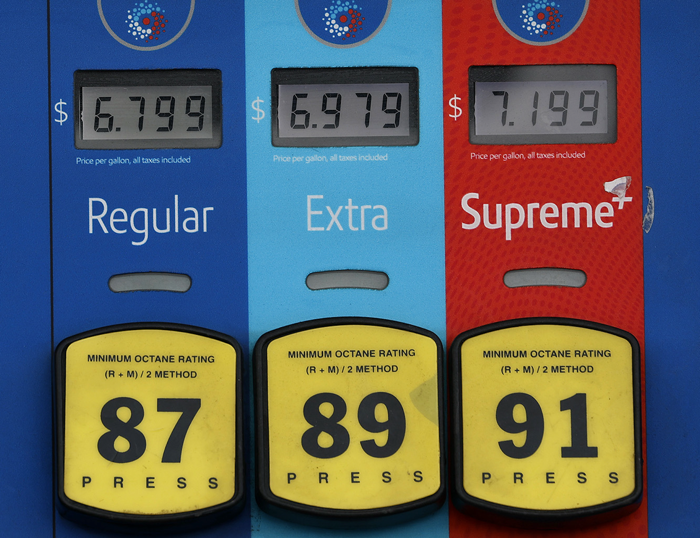
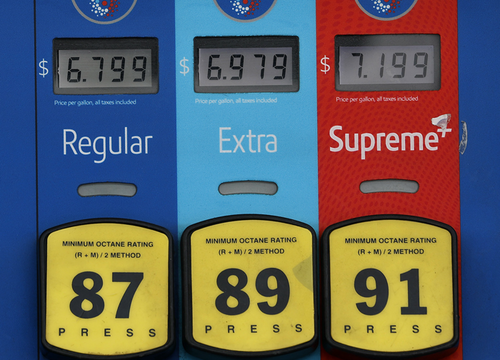
Drivers heading into Memorial Day weekend are set to face some of the highest regular gasoline prices at the pump in years.
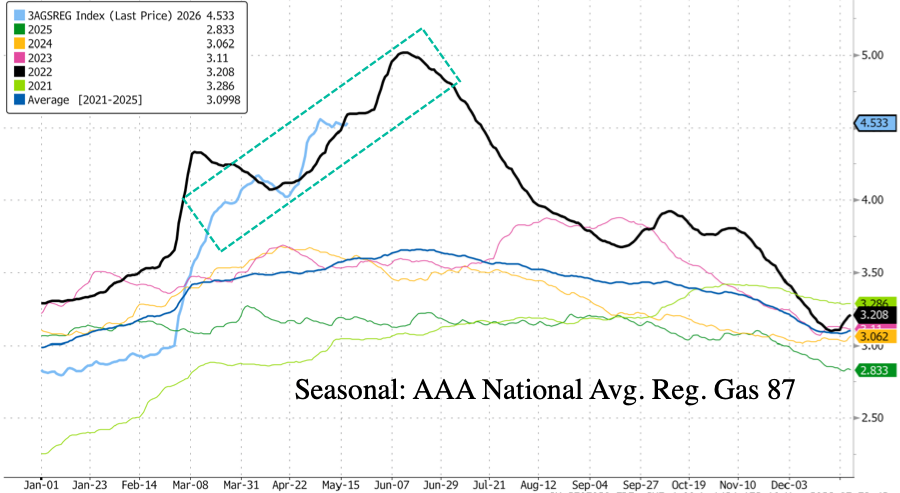
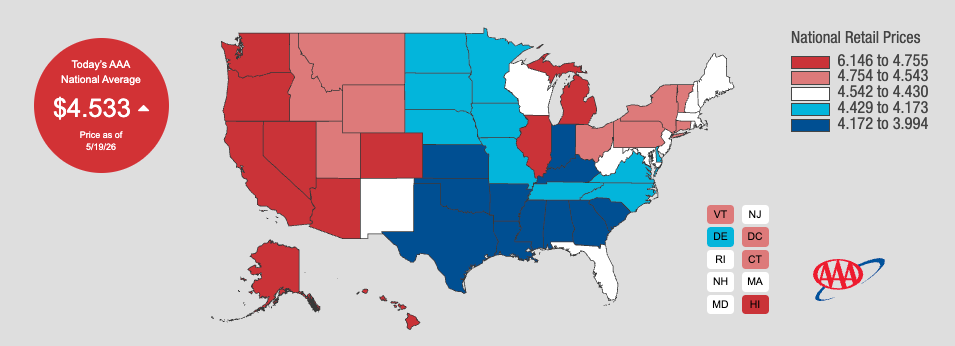
With the U.S. national average sitting at $4.53 per gallon (according to AAA data) and no resolution yet on a U.S.-Iran peace deal or the reopening of the Strait of Hormuz, pump prices risk rising even higher into the holiday weekend as the summer driving season begins.
Let’s start with the chart of the day: AAA retail gas prices in the U.S. on a seasonal basis closely track the 2022 run, when the Russia-Ukraine conflict was in its first several months.
Gas prices in 2022 did not top out until mid-June.
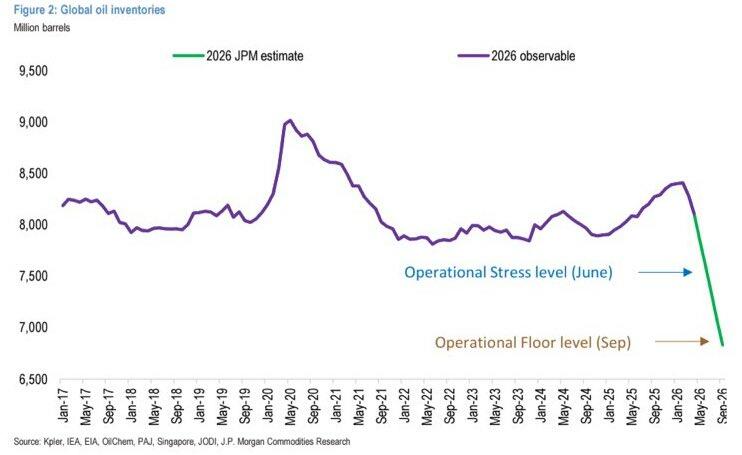
The impending problem, with no near-term Hormuz resolution, as JPMorgan analysts recently warned, is that the world is spiraling toward a catastrophic cliff-edge shortage of crude oil if the maritime chokepoint remains blocked into June.
Former CIA analysts and current RBC commodities head Helima Croft told clients days ago that she is “very skeptical of a June grand reopening or even that maritime traffic will return to February 27 levels for the foreseeable future.”
AAA Retail Gas Price Map
For Memorial Day 2026, AAA forecasts around 39.1 million Americans will travel by car, representing 87% of all holiday travelers. That will create a meaningful near-term lift in gas demand, especially from Thursday through Monday.
EIA notes that gas demand typically rises into the summer driving season, while last year’s Memorial Day period coincided with the highest weekly implied gas demand of 2025 up to that point.
So, in an already tight gas market, a busy Memorial Day driving weekend can certainly pull more barrels through the system, support pump prices, and may only lead to higher prices if no Hormuz resolution is found in the near term. The demand destruction level sits around $5.
Tyler Durden
Tue, 05/19/2026 – 15:40

Nigeria Needs New Export Markets As UAE’s Exit Rattles OPEC
Nigeria Needs New Export Markets As UAE’s Exit Rattles OPEC
By Tsvetana Paraskova of Oilprice.com
Nigeria should market its crude oil to new buyers as the UAE’s decision to leave OPEC is dislocating the balance that the cartel and the OPEC+ group have been seeking for years, according to Wole Ogunsanya, chairman of the Petroleum Technology Association of Nigeria (PETAN).
The official urged Nigeria’s state oil and gas firm NNPC and other producers of Nigerian crude to tap new markets.
“When OPEC gives you a quota, it’s left for you to find who is going to buy it,” Nigerian outlet This Day quoted Ogunsanya as saying.
“And we have one of the best crude oil in the world. So we need NNPC and all producers to market Nigerian production,” the official added.
The abrupt exit of the United Arab Emirates from OPEC and OPEC+ would disrupt the balance the groups have been keeping for years, according to Ogunsanya.
“The decision by the UAE, which they have a sovereign right to do, is for their country’s interest. Our opinion is that it’s going to cause a dislocation of that equilibrium, the ability of OPEC and OPEC+, to manage the price of oil,” he added.
The UAE quit OPEC effective May 1 to pursue its national interests after years of quarreling with fellow cartel members over output quotas and their share of total production capacity.
For years, the UAE has been working to boost its crude oil production capacity to 5 million barrels per day (bpd) by 2027. The UAE insisted that it should be allowed in the OPEC and OPEC+ production deals to actually use more of its growing spare capacity. The country, alongside Saudi Arabia, is one of the few in the region – and the world – that held spare production capacity before the Middle East conflict began.
Nigeria, for its part, has struggled to pump to its quota in recent years as sabotage often led to force majeure at major export streams. However, with a recent crackdown on oil theft and sabotage in the Niger Delta, Nigeria has managed to increase crude production and aims for further growth by 2030.
Tyler Durden
Tue, 05/19/2026 – 15:00
https://www.zerohedge.com/markets/nigeria-needs-new-export-markets-uaes-exit-rattles-opec