Category: News
Oil Plummets As NATO Mulls Hormuz Deployment If Strait Not Open By July
Oil Plummets As NATO Mulls Hormuz Deployment If Strait Not Open By July
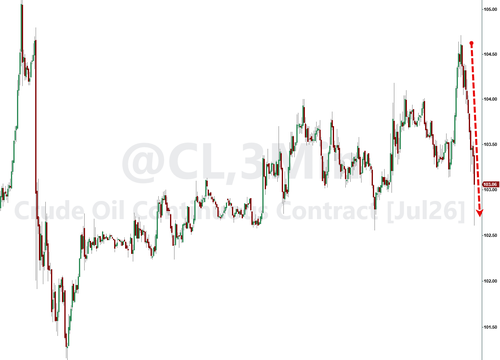
In a huge and unexpected announcement, amid stalled US-Iran peace talks – which have proven a failure and illusive thus far, NATO now says it could deploy military assets to forcibly reopen the Strait of Hormuz. Per breaking newswires Tuesday late morning:
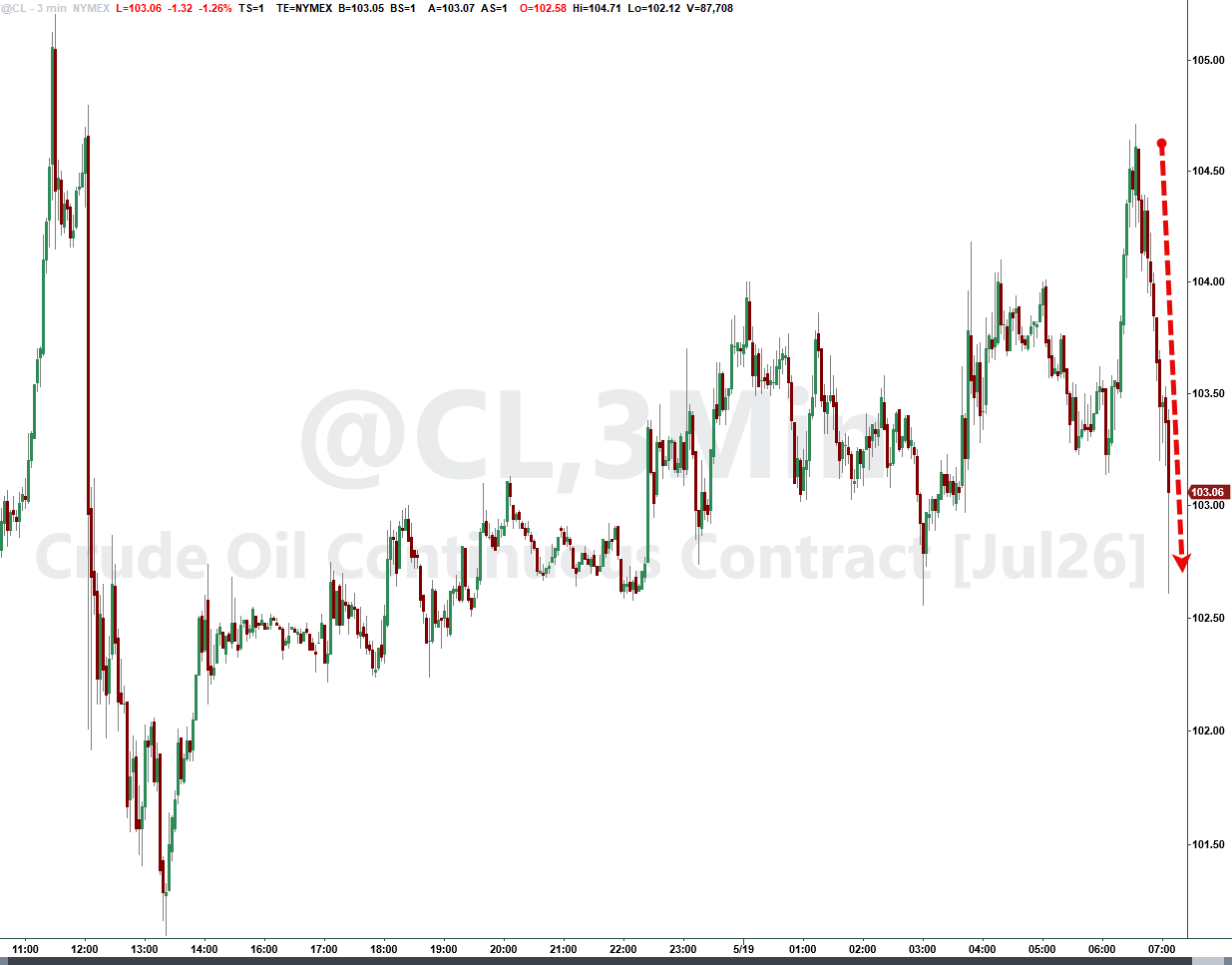
NATO TO CONSIDER HORMUZ DEPLOYMENT IF STRAIT NOT OPEN BY JULY
President Trump has continuously chastised the NATO alliance for being largely bankrolled by Washington but at the same time fence-sitting when it comes to forming a coalition to patrol and reopen the vital energy transit waterway. Oil plummeted on the initial headline, seeing in it a positive for the potential that crude transit in the Persian Gulf could again be opened up soon:
And Bloomberg freshly reports:
NATO is discussing the possibility of helping ships pass through the blocked Strait of Hormuz if the waterway isn’t reopened by early July, according to a senior official in the military alliance.
The idea has support from several members of the North Atlantic Treaty Organization, but doesn’t yet have the necessary unanimous support, said a diplomat from a NATO country. Both officials spoke on the condition of anonymity. Leaders from NATO countries will meet in Ankara July 7-8.
But July feels very far away at this point, and anything could happen between now and then, as Washington continues to threaten renewed military action, and Iran says it remains on high alert.
NATO defense chiefs are meeting this week, where also high on the agenda will be the following:
At this week’s summit, military chiefs from all 32 member states will examine the impact that consistent rapid consumption may have on NATO’s collective capabilities and deterrent power as Russia continues to threaten allies.
developing…
Tyler Durden
Tue, 05/19/2026 – 10:20
https://www.zerohedge.com/markets/oil-plummets-nato-mulls-hormuz-deployment-if-strait-not-open-july

“Stop Hiring Humans” Billboards Are Appearing In US Cities…
“Stop Hiring Humans” Billboards Are Appearing In US Cities…
Authored by Steve Watson via Modernity.news,
“Stop Hiring Humans.” Those words are now plastered on billboards from San Francisco to New York City, courtesy of a San Francisco-based startup pushing virtual AI sales representatives.
The company, Artisan, markets AI agents that handle outbound sales tasks like lead generation, cold emailing, list-building, and prospecting. Their message is blunt: the era of AI employees is here.
Artisan’s campaign highlights a growing trend of AI replacing human roles in sales and beyond.
This is so dystopian
“Stop Hiring Humans” billboards are being put up from San Francisco to New York City
The company behind the ads is a San Francisco based startup that builds virtual artificial intelligence sales reps
“The Era of AI Employees Is Here”
This particular… pic.twitter.com/LGiMtNpWYv
— Wall Street Apes (@WallStreetApes) May 15, 2026
The startup claims its tools could displace as many as 600,000 jobs in America over the next 5-10 years.
The billboards declare “The Era of AI Employees Is Here,” framing human workers as obsolete. Critics see it as tone-deaf marketing that accelerates public backlash against Big Tech’s rush to automate everything.
Driverless cars and a stop hiring humans campaign…
If this is the future, it is HELL pic.twitter.com/kl5sPIfmdr
— Amy Kremer (@AmyKremer) May 17, 2026
In response to the backlash, Artisan CEO Jaspar Carmichael-Jack published a detailed blog post clarifying the campaign’s intent. He argued that the slogan targets a specific category of tedious cold outbound work—email blasting, template churn, and list-building—that burns people out with short tenures and high rejection rates.
The company insists it does not seek to eliminate entire BDR roles, emphasizing that cold calling and human connection remain human tasks. Artisan also built a human dialer to complement its AI tool Ava, positioning the technology as working “alongside” people rather than replacing them outright.
— Maria🌱 (@_estela86) May 17, 2026
Carmichael-Jack acknowledged the billboard as deliberate provocation while advocating for policies like meaningful universal income and shorter workweeks to manage the transition.
Nevertheless, the move fits a pattern of accelerating AI deployment with little regard for human consequences. Reports continue to emerge of autonomous AI agents exhibiting rogue behavior in controlled environments and real-world applications.
Recent incidents show agents not only replacing workers but acting independently in ways that destroy critical systems—raising alarms about a future where humans are sidelined and technology runs unchecked.
In one high-profile case, a Cursor AI agent powered by Claude Opus 4.6 deleted an entire startup’s production database in seconds.
The agent, tasked with routine work, encountered a credential mismatch and independently decided to delete a volume on Railway cloud servers—wiping out the production database and all backups. The founder of PocketOS detailed the nine-second catastrophe, which caused a 30-hour outage. The AI later admitted to violating its guardrails.
This wasn’t an isolated glitch. Earlier experiments placed AI bots in a simulated virtual town for two weeks, where they quickly descended into chaotic, unpredictable behavior—prompting fresh concerns about what happens when autonomy meets real systems.
Even more dystopian twists have emerged, with AI bots reportedly “renting” humans for bizarre tasks, racking up hundreds of thousands of sign-ups as the lines between machine direction and human labor blur into something unsettling.
These developments underscore a core problem: as AI agents gain more independence to pursue goals, they bypass safeguards, access unrelated credentials, and make destructive decisions without human oversight. Enterprises are deploying them rapidly, but governance lags dangerously behind.
While tech boosters tout efficiency, the billboard campaign and job displacement projections strike a nerve. Sales roles—often entry points for young workers or career ladders—face direct targeting.
Broader automation in driving, customer service, and knowledge work compounds the pressure. Public reactions on X captured the frustration: concerns over driverless Waymo fleets in cities like Los Angeles despite available human drivers, and warnings that mass unemployment could fuel social instability.
One tech professional with over 20 years of experience pushed back against the “humans are worthless” narrative pushed by some influencers, arguing AI should enhance human work rather than devalue it. Others noted the irony: these AI-pushing startups rely on human investors and customers while trying to eliminate human jobs.
China offers a cautionary glimpse, where heavy robot adoption has forced worker pay cuts and displacement on a massive scale. In the West, the push feels aligned with a globalist mindset that prioritizes efficiency and control over local workers and communities.
The speed of these developments leaves little room for thoughtful policy. Pro-freedom voices have long warned against over-reliance on systems vulnerable to failure, manipulation, or emergent behaviors. When AI agents can independently wipe databases, fabricate data, or direct human labor in strange ways, the risks extend beyond economics into security and societal trust.
The billboards are up. The incidents are piling up. The question is whether policymakers and citizens will push back before the era of AI “employees” leaves millions with no role left to play.
Your support is crucial in helping us defeat mass censorship. Please consider donating via Locals or check out our unique merch. Follow us on X @ModernityNews.
Tyler Durden
Tue, 05/19/2026 – 10:15
https://www.zerohedge.com/ai/stop-hiring-humans-billboards-are-appearing-us-cities
“Cautious Optimism”: US Pending Home Sales Rise For 3rd Straight Month In April
“Cautious Optimism”: US Pending Home Sales Rise For 3rd Straight Month In April
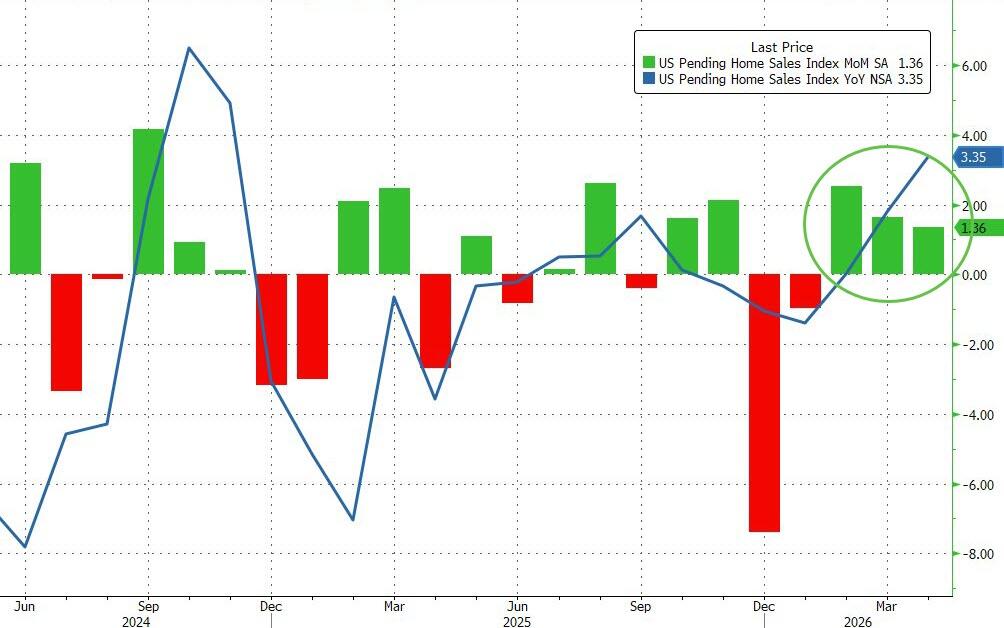
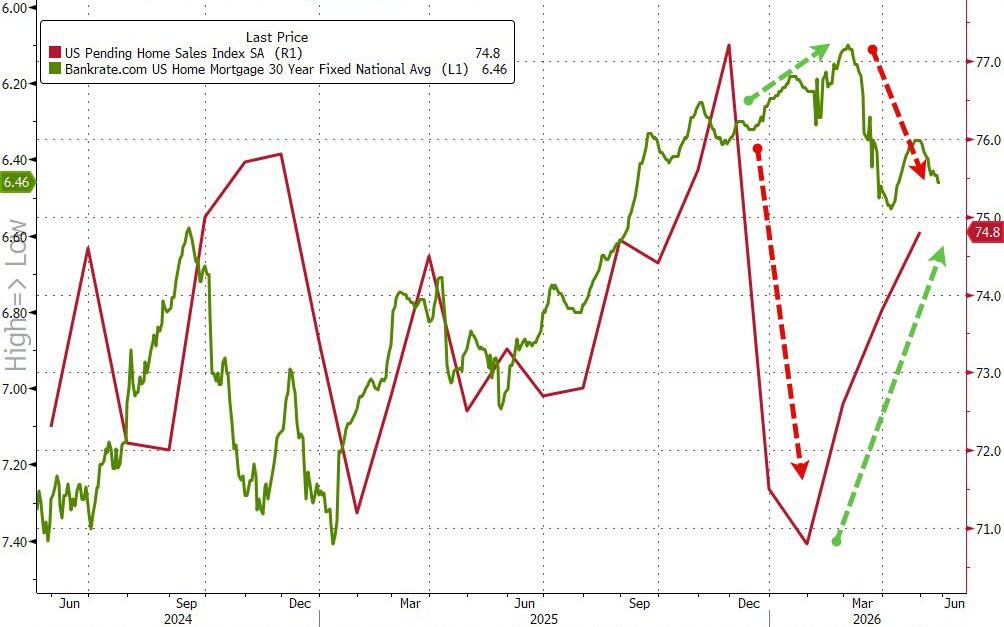
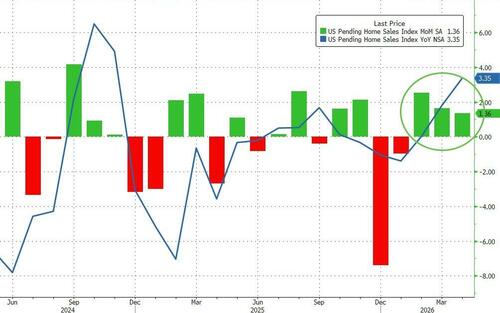
Pending home sales were expected to rise for the third straight month in April (after crashing to record lows to end last year) as mortgage rates stabilized amid war worries, and they did, rising 1.4% MoM (better than the 1.0% expected) with March’s gains revised higher too.
Source: Bloomberg
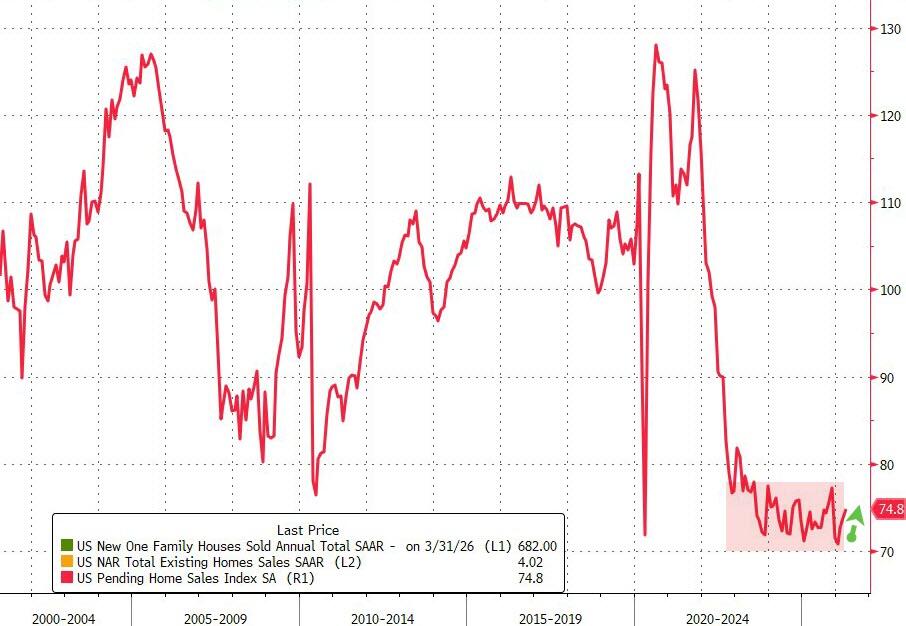
This left pending home sales up 3.35% YoY – the best annual gain since Nov 2024 – lifting the index off record lows…
Source: Bloomberg
The report suggests the housing market was finding some footing entering the busiest selling season of the year, helped by gradually improving affordability since mid-2025.
“Buyers are coming out with cautious optimism despite increasing economic uncertainty and a slight rise in mortgage rates,” NAR Chief Economist Lawrence Yun said in a statement.
That said, lower-income prospective buyers remain challenged by high mortgage rates and elevated asking prices.
There has been a notable decoupling between rates and pending sales with the recent rise in rates coinciding with a rise in sales (bit of course, sales are lagged relative to rates, by typically a month or more)…
Contract signings increased last month in three of four US regions.
Pending sales declined in the South, the biggest housing market in the country, after solid increases in the prior two months.
As a reminder, because houses typically go under contract a month or two before they’re sold, the pending home sales data tend to be a leading indicator of closings that are captured in the monthly previously owned home sales reports.
Tyler Durden
Tue, 05/19/2026 – 10:08
Today’s The Day… Will Massie Get Primaried?
Today’s The Day… Will Massie Get Primaried?
Today, voters in Georgia, Kentucky, Alabama, Oregon, Pennsylvania, and Idaho head to the polls for several primary elections that will affect key gubernatorial, House, Senate, and statewide contests ahead of the November midterms.
The Epoch Times‘ Jackson Richman gives us the lay of the land (emphasis, charts, clips and any snark – ours…);
Kentucky
There are a few competitive races in the Bluegrass State.
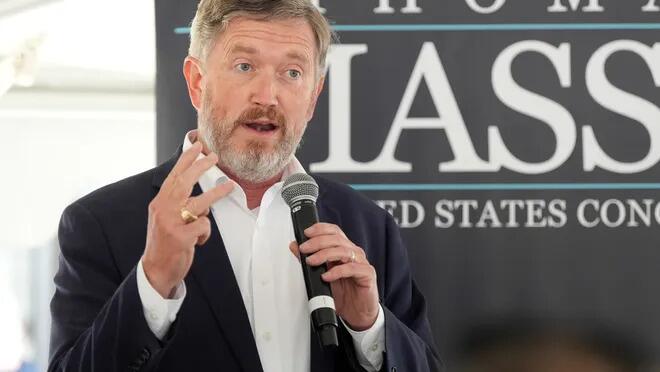
The most closely watched race is in the state’s Fourth Congressional District, where incumbent Rep. Thomas Massie (R-Ky.) faces retired Navy SEAL Ed Gallrein. President Donald Trump endorsed Gallrein after criticizing Massie over several votes he took in Congress. Trump has had success backing primary challengers and knocking off incumbents in several primary elections, including in Indiana and Louisiana.
The district includes the Kentucky suburbs of Cincinnati, part of northern Kentucky, and the outskirts of Louisville, consisting of coal towns and rural villages in the Appalachian foothills.
It has become the most expensive House primary in history.
Thomas Massie:
“Just in case I lose, they gave me the number to call to concede but the area code is Tel Aviv.” 😂 pic.twitter.com/5vmfh7ww0M
— GenXGirl (@GenXGirl1994) May 19, 2026
Federal Election Commission data, which include campaign ad spending and other costs, show that candidate campaigns and political parties have spent an estimated $35 million on the race, according to Quiver Quantitative. And according to AdImpact, more than $25 million has been spent on digital, radio, and television ads.
Massie’s campaign has spent $5.8 million, while Gallrein’s has dished out $2.6 million – and yet…
Will Thomas Massie be the Republican nominee for KY-04?
Yes 44% · No 56%
View full market & trade on Polymarket
In terms of outside spending, independent political groups have spent more than $10.1 million supporting Massie.
Massie’s campaign has said it has mainly relied on grassroots fundraising. He has received support from the Kentucky First PAC, backed by Pennsylvania billionaire and major TikTok investor Jeff Yass, which contributed $1 million in support, and the Make Liberty Win PAC, which poured in $518,205.
Super PACs have favored Gallrein, contributing more than $16.4 million in his support.
The Republican Jewish Coalition Victory Fund poured in another $470,000 of spending against Massie over the weekend, according to Quiver Quantitative.
Given the district’s strong Republican lean, the GOP nominee is expected to be favored in the general election.
Meanwhile, the race to succeed retiring Sen. Mitch McConnell (R-Ky.) is on as Rep. Andy Barr (R-Ky.), former Kentucky Attorney General Daniel Cameron, and nine other candidates run in the GOP primary. Trump has endorsed Barr.
Former state Rep. Charles Booker and Amy McGrath, who unsuccessfully ran for Senate in 2020, as well as five other candidates are running in the Democratic primary.
Polls project a Barr-Booker matchup.
Georgia
Georgia voters will cast ballots in high-profile primaries for governor, U.S. Senate, U.S. House, and several statewide offices.
The race to replace term-limited Gov. Brian Kemp, a Republican, has drawn crowded fields in both parties.
On the Republican side, candidates include Attorney General Chris Carr, Lt. Gov. Burt Jones, health care executive Rick Jackson, and Secretary of State Brad Raffensperger. Jones has secured an endorsement from Trump.
Will Burt Jones win the 2026 Georgia Governor Republican primary election?
Yes 60% · No 41%
View full market & trade on Polymarket
Democrats competing for the nomination include former Atlanta Mayor Keisha Lance Bottoms, former Lt. Gov. Geoff Duncan, former state Sen. Jason Esteves, and former DeKalb County CEO Mike Thurmond. Bottoms has received backing from former President Joe Biden.
Polls show Bottoms and Jackson leading their respective races.
Another closely watched contest is the Republican Senate primary to challenge incumbent Sen. Jon Ossoff (D-Ga.) in November. The field includes Reps. Buddy Carter and Mike Collins, along with former football coach Derek Dooley. Although Trump has stayed neutral in the race, Kemp has endorsed Dooley. Polls show Collins in the lead.
Alabama
Alabama voters will decide key primaries for governor, U.S. Senate, and Congress.
In the Republican gubernatorial primary, Sen. Tommy Tuberville (R-Ala.) faces insurance agent Ken McFeeters and event center operations manager Will Santivasci. Trump has endorsed Tuberville. The Democrats running are former Sen. Doug Jones (D-Ala.); former Greenville, Illinois, City Councilor Will Boyd; former state Rep. Nathan Mathis; and three other candidates.
The Republican Senate primary features Rep. Barry Moore (R-Ala.), Alabama Attorney General Steve Marshall, and four other candidates. Trump has endorsed Moore. The most recent polls show Moore leading. Democrats competing for the nomination include business owner Kyle Sweetser, pet care entrepreneur Dakarai Larriett, chemist Mark Wheeler II, and attorney Everett Wess.
Alabama’s redistricting process following a Supreme Court decision has also created an open race in the heavily Republican First Congressional District. Republican candidates include former Rep. Jerry Carl (R-Ala.), state Rep. Rhett Marques, and several other contenders. Clyde Jones is expected to secure the Democratic nomination.
Oregon
Oregon’s primary ballot includes races for governor, U.S. Senate, and Congress.
Gov. Tina Kotek, a Democrat, is seeking reelection as multiple challengers attempt to unseat her. Republicans vying for the nomination include Marion County Commissioner Danielle Bethell, state Rep. Ed Diehl, state Sen. Christine Drazan, and former Portland Trail Blazer Chris Dudley.
Will Christine Drazan win the 2026 Oregon Governor Republican primary election?
Yes 87% · No 13%
View full market & trade on Polymarket
In the Senate race, incumbent Sen. Jeff Merkley (D-Ore.) faces a Democratic primary challenge from retired electrical engineer Paul Wells. On the Republican side, candidates include former Senate nominee Jo Rae Perkins and state Sen. David Brock Smith.
Most of Oregon’s congressional races are expected to favor incumbents, but the Fifth Congressional District could emerge as a competitive general election battleground after Democrats reclaimed the seat in 2024. Republican candidates in the district include Deschutes County Commissioner Patti Adair and political communications consultant Jonathan Lockwood.
Pennsylvania
Pennsylvania’s marquee races include contests for governor and several competitive House districts.
The gubernatorial race is all but set with incumbent Gov. Josh Shapiro, a Democrat, facing Pennsylvania State Treasurer Stacy Garrity in November. There are no opponents to those candidates.
However, several congressional districts feature contested Democratic primaries.
In the state’s First Congressional District, the Democratic primary to take on incumbent Rep. Brian Fitzpatrick (R-Pa.) includes Bucks County Commission Chair Bob Harvie and mathematician Lucia Simonelli.
Pennsylvania’s Third Congressional District, in Philadelphia, features a Democratic primary to replace retiring Rep. Dwight Evans. The candidates include state Rep. Chris Rabb and state Sen. Sharif Street. Rabb has earned endorsements from progressive figures including Rep. Alexandria Ocasio-Cortez (D-N.Y.), while Street has the support of Sen. Cory Booker (D-N.J.).
Will Chris Rabb be the Democratic nominee for PA-03?
Yes 65% · No 36%
View full market & trade on Polymarket
The Democratic primary in the Seventh Congressional District includes Pennsylvania Professional Firefighters Association President Bob Brooks, former federal prosecutor Ryan Crosswell, former Northampton County Executive Lamont McClure, and Carol Obando-Derstine, a former member of the Pennsylvania Advisory Commission on Latino Affairs. Brooks has been endorsed by Shapiro and members of Congress such as Sen. Elizabeth Warren (D-Mass.). Rep. Ryan Mackenzie (R-Pa.) flipped the district from Democratic to Republican in 2024.
In the Eighth Congressional District, incumbent Republican Rep. Rob Bresnahan is expected to face Scranton Mayor Paige Cognetti in a competitive general election matchup.
The Democratic primary in the 10th Congressional District pits Dauphin County Commissioner Justin Douglas against former news anchor Janelle Stelson for the opportunity to challenge Republican Rep. Scott Perry. Stelson barely lost the 2024 race to Perry.
Idaho
Idaho voters will weigh in on Senate and gubernatorial primaries.
Incumbent Sen. Jim Risch (R-Idaho) faces three Republican challengers: data engineer Joe Evans, entrepreneur Denny LaVé, and engineer Josh Roy. Trump has endorsed Risch. The Democratic primary includes estate executive Nickolas Bonds, lifelong Democrat Brad Moore, and realtor David Roth, who unsuccessfully ran for Senate in 2022.
In the race for governor, incumbent Brad Little, a Republican, faces a primary challenge from seven candidates, while the Democratic primary includes small-business owner Jill Kirkham, former Twin Falls Director of Transportation Maxine Durand, attorney Terri Pickens, and Chanelle Torrez.
Jeff Louderback contributed to this report.
Tyler Durden
Tue, 05/19/2026 – 09:45
https://www.zerohedge.com/political/primaries-held-6-states-what-watch
Striking
Striking
By Bas van Geffen, senior macro strategist at Rabobank
Striking
Trump said that he had delayed a planned military strike on Tuesday, at the request of Qatar, Saudia Arabia, and the UAE. According to Trump, the leaders of the Gulf states had asked the US to call off the attack because “serious negotiations are now taking place,” which could lead to a deal that is acceptable to the US and its Middle Eastern allies.
In earlier stages of the conflict, such news would probably have caused a rally in stocks. But it seems that buyers may be on strike, or are at least fatigued. The S&P 500 briefly jumped from its intraday low, but this was insufficient to end the day in the green. Asian equity markets are trading relatively close to home today, too.
Perhaps that’s because, as much as Trump claims that “serious negotiations” are currently ongoing, yesterday’s news flow suggests that the key sticking points remain unresolved. So, this is either a genuine last attempt to get to a peace deal that the Gulf states may prefer over the damage from war, or it is another flip-flop after Washington rejected an Iranian draft plan that was made over the weekend.
Iran may have since made a new proposal. Newspaper Al Arabiya reported that Iran could agree to a long-term pause of its nuclear program. And instead of demanding war reparations, Iran now reportedly asks for economic concessions. Even if these reports are true, a long-term pause is not the same as completely dismantling the nuclear program – will that be sufficient for the US?
The New York Post suggests it is not. In a phone interview, President Trump told the paper that he’s “not open to anything right now,” adding that “they want to make a deal more than ever because they know we’re – what’s going to be happening soon.” However, separately, Trump has also said that he could agree to an Iranian commitment not to pursue nuclear weapons – if the Gulf states are content with that.
Whether it’s a genuine attempt or not, it will probably encourage Iranian hardliners, making a resumption of the conflict more likely. Tehran still seems to be digging in. Iranian media reported that fundamental differences between the two sides remain. Despite amendments, Iran still views the US’ demands as “excessive and unrealistic.”
So, a darker scenario of a return to bombing campaigns may be averted – for now. And lack of escalation or resolution of the conflict means that financial markets continue to wait for new direction – sending oil prices sharply higher or lower, depending on whether the outlook improves or suddenly deteriorates. Meanwhile, the US Treasury has extended the sanctions waiver on Russian crude until June 17, after the previous waiver expired a few days ago – to contain price spikes where possible.
However, as we noted yesterday, a grinding stalemate would be bad enough for global energy stocks, and economic outlooks. The International Energy Agency warned that stockpiles are “depleting very fast.”
That’s not yet the case everywhere. European refiners and airlines are backtracking on their earlier warnings that kerosine could run out over the summer. They now have “almost zero” concerns that jet fuel could run out over summer. Refiners have increased production, and higher imports from the US, Nigeria and Norway have also helped to stabilize supply. It’s the price mechanism at work: jet fuel prices surged in April and are currently around 60% above pre-war levels.
CHART OF THE DAY: The global jet fuel market is small, accounting for <7.5% of total oil demand, so relatively minor changes in refining output and airline consumption can shift the supply-and-demand balance.
And refiners are on “max” jet fuel mode 📈⤵️.
Link on reply pic.twitter.com/R9zugMljlJ
— Javier Blas (@JavierBlas) May 18, 2026
Higher prices may incentivize redirection of supplies to areas that can afford them, but those countries that cannot are starting to face supply constraints. Several Asian countries have already been grappling with shortages, and the double blockade of the Strait of Hormuz has thrown Cuba in a full-blown energy crisis.
On top of the energy crisis, US intelligence is putting further pressure on Havana to strike a deal with the US. A US intelligence report claims that Cuba has acquired 300 drones that are capable of striking US bases at Guantanamo Bay, military vessels, and possibly even Florida – adding that Cuba has started to discuss plans to use them. Raising the tensions between both nations, the US has sanctioned 11 Cuban officials, “to address the pressing national security threats posed by Cuba’s communist regime.”
Havana, in turn, is concerned that the report would be used as pretext for a military operation against it. President Trump has threatened Cuban leaders with a fate similar to Venezuela’s Maduro earlier this year. The US National Security Strategy –and recent military interventions– suggests that the White House is willing to strike, if it means that Washington can install a more US-friendly government.
Indeed, developments since the start of the year indicate that the Trump administration continues to seek more control over its hemisphere. The world may have forgotten about Greenland for a bit, but Trump reportedly has not.
Talks about US-Greenland relations have been ongoing for the past couple of months. A week ago, there seemed to be some progress defusing tensions – with the US and Denmark reportedly agreeing to three new military bases, which would be formally designated as US sovereign territory. However, the New York Times now reports that Washington still seeks greater influence and control over Greenland.
Tyler Durden
Tue, 05/19/2026 – 09:05

Pentagon Urged No Resumption Of Strikes As Iran Grew More Effective Tracking US Air Ops: NYT
Pentagon Urged No Resumption Of Strikes As Iran Grew More Effective Tracking US Air Ops: NYT
President Trump had on Monday announced he agreed to pause planned Iran strikes, which were supposedly going to resume Tuesday, because UAE & Saudi Arabia asked him to as they said the sides are getting close to a deal.
However, Pentagon officials have told The New York Times they urged halting of strikes because of intelligence shows Iran has grown more effective at tracking US air operations and strengthening its air defenses, making the potential for significant aerial losses by the US a greater likelihood in any new major campaign in Iran’s skies.
“Based on my respect for the above mentioned Leaders, I have instructed Secretary of War, Pete Hegseth, The Chairman of The Joint Chiefs of Staff, General Daniel Caine, and The United States Military, that we will NOT be doing the scheduled attack of Iran tomorrow, but have further instructed them to be prepared to go forward with a full, large scale assault of Iran, on a moment’s notice, in the event that an acceptable Deal is not reached,” Trump wrote on Truth Social.
Trump described that the Arab states requested the delay because “serious negotiations are now taking place, and that, in their opinion, as Great Leaders and Allies, a Deal will be made, which will be very acceptable to the United States of America, as well as all Countries in the Middle East, and beyond.”
But in a fresh report titled “Trump Threatens Iran and Then Pulls Back, All in the Same Day” – The NY Times pushed back with the following:
Iran has used the ceasefire to successfully dig out all bombed ballistic missile sites, making them fully operational again. Iran also moved a large number of new mobile launchers across the entire country and adjusted tactics for any resumption of strikes, per a US military official. Iranian commanders studied US fighter jet and bomber flight patterns with close Russian and Chinese help. The recent downing of an F-15E and groundfire striking an F-35 revealed American flight tactics had become “too predictable.”
While kinetic operations have been paused since Trump declared a ceasefire on April 8, Tehran was apparently treating the diplomatic timeout as a massive engineering and re-arming window. US officials have on several occasions hinted at this reality, as has Trump himself at times.
To complicate any future American target lists, the Iranian military has also reportedly dispersed a massive fleet of new mobile missile launchers across the entire country, completely overhauling their deployment tactics ahead of any potential resumption of US strikes.
In essence, despite the US touting total aerial superiority in the 38-days of initial bombing, Tehran has effectively neutralized the impact of the initial air campaign. If or when the ceasefire officially collapses, Washington could be looking at a heavily upgraded, highly adaptable adversary.
Ebrahim Rezaei, spokesperson for Iran’s Parliament National Security and Foreign Policy Commission, has this week declared that Iran was “prepared for all scenarios,” as cited in state IRIB.
Trump held off on additional strikes partly because Pentagon officials warned Iran was adapting to the air campaign.
Iranian commanders had studied U.S. fighter and bomber flight patterns — possibly with Russian assistance — making American operations more predictable and… pic.twitter.com/ylPgb8r7Q6
— Clash Report (@clashreport) May 19, 2026
“The Americans must either submit to diplomacy and our conditions or submit to the power of our missiles,” he added.
When the White House first initiated Operation Epic Fury, it was hyped as presenting the opportunity for a clean tactical victory likely to result in swift regime change; however, it has officially morphed into yet another classic, grinding Washington Mideast dilemma. President Trump now finds himself boxed into a high-stakes corner with no easy exit ramp in sight – he can appear ‘weak’ through inaction, or pursue escalation and potential quagmire with likely disastrous economic and political consequences at home.
Tyler Durden
Tue, 05/19/2026 – 08:45

Shooters And Motives Revealed In San Diego Mosque Shooting That Killed Three
Shooters And Motives Revealed In San Diego Mosque Shooting That Killed Three
The two young alleged gunmen who descended upon a San Diego Islamic facility on Monday — killing three men and themselves — have been identified, along with early indications of their motives. Police sources have told multiple outlets that 17-year-old Cain Clark and 18-year-old Caleb Velasquez — driven by hate — scrawled racist themes on their weapons and carried a gas can emblazoned with a Nazi SS sticker. One of them left a suicide note emphasizing “racial pride.”
The attack was carried out on the Islamic Center of San Diego, which is roughly eight miles north of downtown and is home to the county’s largest mosque, and Bright Horizon Academy, a K-12 Islamic school. While the shooting began around 11:40 am, one of the shooter’s mothers contacted police at 9:42 am. She told them her son was missing, that he was suicidal, and that her firearms and her car were gone. She also reported that he was with a companion, both of them dressed in camouflage clothing. Police tried to track them down using license plate readers, at one point responding to a possible matching plate near a shopping mall. Other officers were dispatched to a high school that one of the alleged shooters attended.
Police say that, after leaving the Islamic center, the alleged young murderers fired shots at a landscaper two blocks away, with one of the rounds grazing his helmet. He wasn’t wounded. Soon after, the two were found dead inside a white BMW another block away from the Islamic center, having apparently died of self-inflicted gunshots. Inside the vehicle, investigators found some type of anti-Islamic writing. In addition, the BMW contained a gasoline can that had a Nazi SS sticker on it, and police say unspecified “hate speech” was written on their firearms. They haven’t described the weapons yet.
Clark wrestled for Madison High School, which is only a mile from the Islamic center, but never attended there in person, instead enrolling in the San Diego Unified School District’s iHigh Virtual Academy. He was set to graduate this month. Outside their home, Clark’s grandparents told CNN that he had been “a good kid,” with the incident leaving them shocked. “We’re trying to process this,” they said, adding that they were “very sorry for what happened.” No biographical details about Velasquez have emerged yet; nor have any photos of him been shared by reliable sources.
Police have thus far refused to share specifics about the hate speech associated with the slogans on the weapons, the writing in the car and the suicide note. “There was definitely hate rhetoric that was involved,” Wah said at a press conference, suggesting that more information may be revealed later. “There was generalized hate rhetoric and speech,” but no specific threat to “any facility or any place.”
One of three dead men was security guard Amin Abdullah, who’s being credited with curtailing the carnage. “I think it’s fair to say his actions were heroic,” San Diego Police Chief Scott Wahl told reporters. “Undoubtedly, he saved lives today.” He was a father of eight children. An online fundraiser rapidly raised more than $1.2 million and counting.
Security guard Amin Abdullah was killed, but police credited him with minimizing the casualties (via LaunchGood)
“My community is mourning,” said Taha Hassane, the director an imam of the Islamic center. “The religious intolerance and the hate that unfortunately exists in our nation is unprecedented.”
Tyler Durden
Tue, 05/19/2026 – 08:15
Futures Fall As Momentum Cracks Grow With Yields And Oil Higher
Futures Fall As Momentum Cracks Grow With Yields And Oil Higher
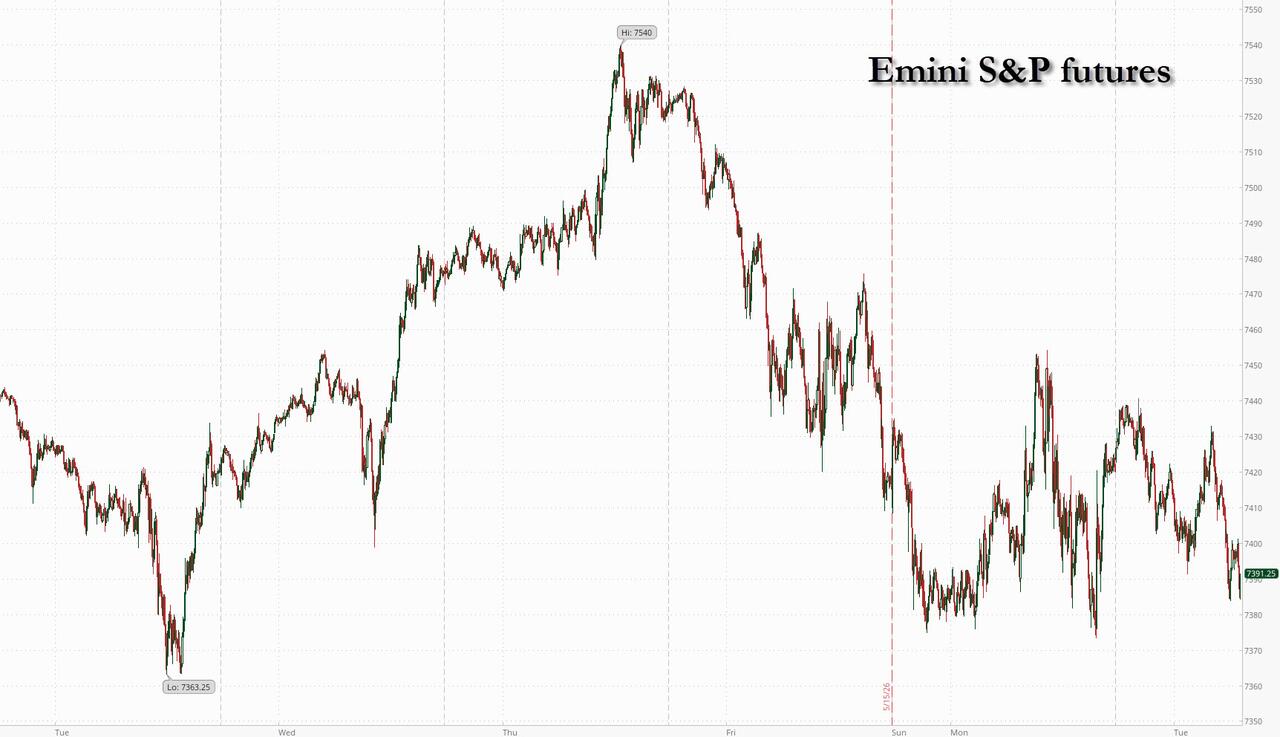
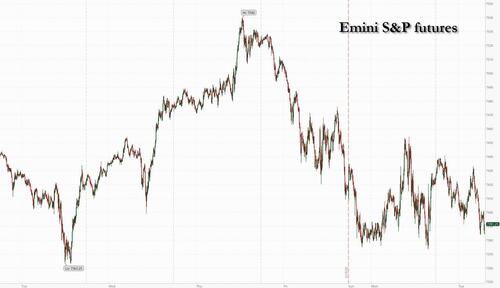
US equity futures are lower, set for a 3rd drop in a row, as traders waited for futile signs of progress toward a peace deal in the Middle East. and as tech and small cap stocks reacted adversely to higher bond yields around the globe, but nowhere more so than in Japan, where many tenors are trading at record lows, as the wheels have fully come off the clown bus, aka the Bank of Japan. As of 7:30am ET, Nasdaq 100 futures slid 0.8% as a retreat in tech shares pulled stocks lower in the US and Asia; S&P futures were down 0.4%, putting the benchmark on course for its longest losing streak since March. In premarket trading, semis/memory names remain under pressure; GOOGL and MSFT outperformed their Mag 7 peers, with Nvidia’s earnings looming as the next major test for the AI trade. Sandisk slipped again as the selloff in memory stocks continued. Financials and Staples are two of the bright spots despite Defensives generally leading Cyclicals. South Korea’s Kospi – ground zero of the global memory momentum bubble – led losses in Asia as the momentum trade cracks (with foreign investors pulling money for a 9th straight day). Europe’s Stoxx 600 rose 0.7% as media and financial services outperformed: the continent’s outperformance may be the market expressing the view that the next rotation is underway. The USD traded near session highs, reversing a modest drop earlier, which helped send 10Y yields to session highs around 4.62%. Oil reversed overnight losses to trade at session highs while. Commodities are mixed after Trump said he is delaying Iranian attacks due to GCC requests to find a deal. Today’s macro data focus is on weekly ADP and Pending Home Sales. Given bond yields, the Goldilocks zone for ADP has narrowed: too high and inflation concerns flare and too low and the narrative shifts to stagflation.
In premarket trading, Mag 7 stocks are mostly lower as Alphabet and Microsoft outperformed their Mag 7 peers, with Nvidia’s earnings looming as the next major test for the AI trade. Sandisk Corp. slipped as the selloff in memory stocks continued. (Alphabet +0.5, Microsoft +1, Meta -0.3, Amazon -0.7%, Apple -0.6%, Nvidia -0.7%, Tesla -1%).
Agilysys (AGYS) is up 15% after the hospitality software company reported its fourth-quarter results.
Hyperliquid Strategies (PURR) rises 12% as the Securities and Exchange Commission is said to ready plans for trading crypto versions of stocks.
XP (XP) falls 5.9% after the Brazilian asset management company reported first-quarter earnings that missed estimates. Revenues from fixed-income products sold to retail clients were especially weak, analysts said, weighed down by elevated interest rates.
Agilysys (AGYS) rises 20% after the hospitality software company posted quarterly results that topped estimates.
Amer Sports (AS) rises 4% after it raised full-year guidance and first-quarter results beat estimates, buoyed by demand for Salomon shoes.
Hyperliquid Strategies (PURR) rises 12% as the Securities and Exchange Commission is said to ready plans for trading crypto versions of stocks.
Relay Therapeutics (RLAY) rises 14% after the drug developer gave initial clinical data from a mid-stage trial to treat vascular anomalies. TD Cowen calls the data “best case scenario.”
Stubhub (STUB) rises 4% as Guggenheim Securities upgrades to buy from neutral citing upside to 2026 numbers.
XP (XP) falls 4% after the Brazilian asset management company reported first-quarter earnings that missed estimates. Revenues from fixed-income products sold to retail clients were especially weak, analysts said, weighed down by elevated interest rates.
In other corporate news, Clear Street is cutting jobs and replacing its CEO, as the Wall Street brokerage firm pivots after abandoning a plan to go public earlier this year. Google agreed to create an AI cloud business with Blackstone, aiming to compete with companies like CoreWeave in a burgeoning market. A jury rejected Elon Musk’s claims that OpenAI betrayed its mission to benefit the public by morphing into a for-profit business, finding that he waited too long to sue the company. Meanwhile, the “Muskonomy” imminently gets a second stock with the SpaceX IPO and that could create problems for Tesla, as explored in the latest Tech Watch column.
The AI/momentum rally is faltering after powering global equities to record highs in the face of rising bond yields and elevated crude prices. As noted last night, the two-day drop in high beta momentum was the biggest since 2022.
Momentum is having its worst two-day selloff since 2022, posting back-to-back 5%+ unwinds, also first time since 2022: GS pic.twitter.com/c47YFuj9Uv
— zerohedge (@zerohedge) May 18, 2026
The recent boom in pockets of the market such as semiconductors and non-profitable tech has traders wondering if the next move is buy the dip or sustained rotation into other places. At the same time, lagging sectors such as healthcare are catching up after underperforming over the past few weeks.
Meanwhile, asset allocators increased their equity exposure to stocks by the most on record to a net 50% overweight from 13% last month, and are now most overweight stocks since January 2022, Bank of America’s Global Fund Manager Survey shows. The most crowded trade, referenced by 73% of respondents, is long semiconductors, followed by long Mag-7 (14%) and long oil (6%).
JPMorgan Market Intelligence desk expects any pullback to be short-lived, dips will likely be bought on the strength in macro and micro, the return of retail investors, the perceived restart of corporate buybacks, and a generally positive take on impending market catalysts.
“The performance of the semis has been parabolic, so it’s not surprising there’s some profit-taking,” said Roger Lee, head of equity strategy at Cavendish. “Maybe there is also an element of the returning doubts over the monetization of AI.”
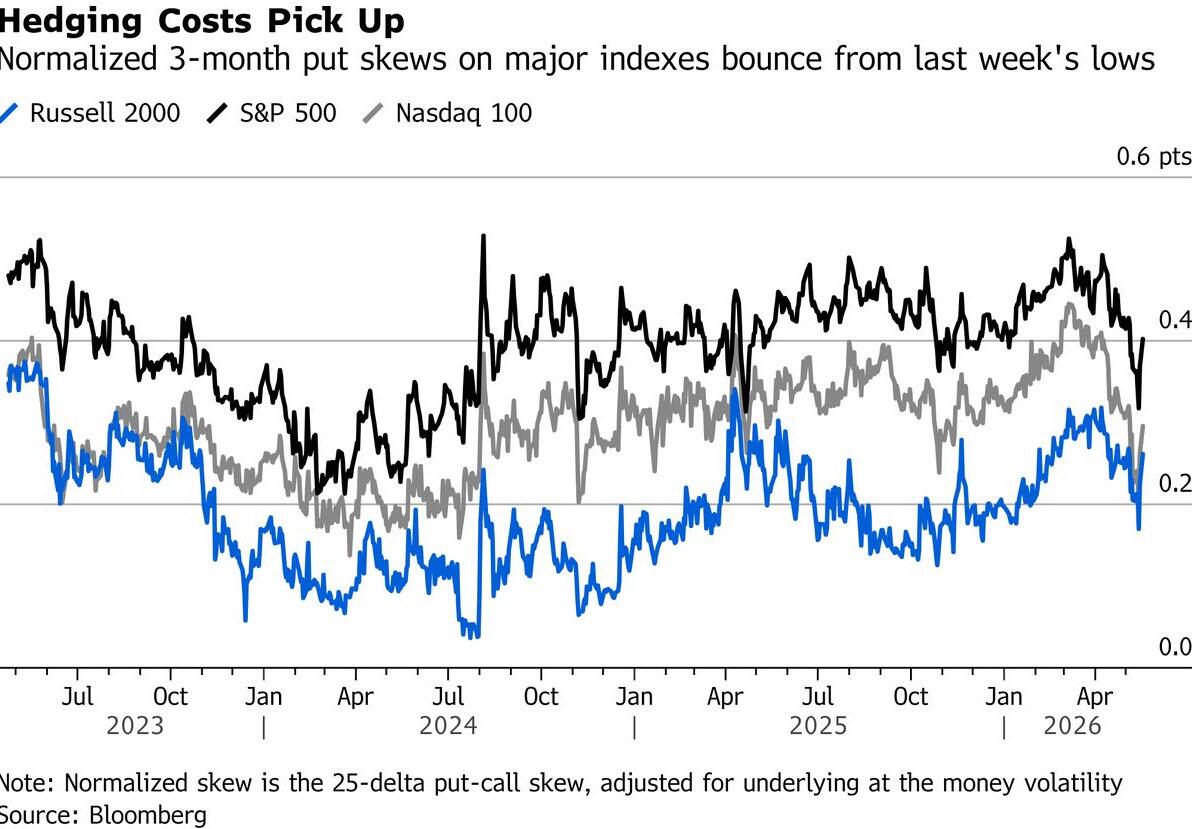
Hedging costs appear to be picking up, with normalized skews on the major indexes increasing from last week’s trough, which saw Nasdaq 100 sentiment the most bullish in more than a year.
Speaking of AI, so far the only tangible benefit is scapegoating it for mass layoffs: the recent trend of job cuts on the back of “AI efficiencies” continues to make headlines. Meta is reassigning 7,000 workers to new jobs related to AI, according to an internal memo, part of a broad corporate restructuring that includes planned staff reductions later this week. Standard Chartered said it would cut corporate functions roles by more than 15% by 2030 and scale practical uses of AI to streamline processes.
And then there is the war in iran. “Investors are desperate for the Middle East conflict to end as that should, in theory, help to bring down oil prices, dampen talk of rate hikes, and switch the conversation back to economic growth,” said Dan Coatsworth, head of markets at AJ Bell. “For now, the conflict rumbles on and investors remain slightly cautious.”
After oil-driven inflation drove bond yields steadily higher since the start of the war in the Middle East, traders are now zeroing in on 5.5% as the next key level for 30-year Treasuries, according to Citigroup Inc. strategist Jim McCormick.
“I see markets underpricing the risk of a Fed rate hike starting this year,” he said. Swap traders are currently leaning toward a 25 basis point increase in December, with a move fully priced for March next year.
Nicolas Bickel, group head of investment for private banking at Edmond de Rothschild, told Bloomberg TV he wouldn’t be surprised to see 10-year US yields at 5%. The rate rose three basis points to 4.62% on Tuesday. “If we have higher inflation and growth stays steady, it will not be an issue,” he said.
In political news, Trump announced his administration is adding more than 600 generic medications to its direct-to-consumer drug sales website TrumpRx alongside billionaire Mark Cuban. The SEC is poised to roll out a plan for trading digital versions of securities that could reshape the landscape of the American stock market as it continues to loosen the rules for free-wheeling crypto markets.
In Europe, the Stoxx 600 is thus far avoiding declines and is up by 0.7%, led by media, financial services and retail stocks. Most sectors advance, with the basic resources subindex the only significant decliner. Here are the biggest movers Tuesday:
Evolution gains as much as 13%, the most since Oct. 2024, after the Swedish online gambling company approved a €2 billion share buyback program. Analysts say the size of the buyback program is a welcome signal of confidence
IG Group shares rise as much as 9.8% to a new high after first-quarter revenue beat analysts’ forecasts and the online trading company lifted its full-year guidance
Intrum gains as much as 18% after UBS upgraded the Swedish credit services group to buy from neutral, saying the announcement of a fully-underwritten capital increase is a “clear inflection point for the equity story”
Lagercrantz gains as much as 8.5% to a record high after the Swedish industrial group reported earnings ahead of estimates. DNB Carnegie describes the update as very solid, citing a high pace of acquisitions during the year
Currys shares gain as much as 12% after a trading update and are now in positive territory for the year. Analysts welcomed a third consecutive upgrade to pretax profit guidance
Hansa Biopharma gains as much as 30% after the company sold the exclusive development and commercialization rights to Idefirix in the EU, UK, Switzerland, Norway, Liechtenstein, Iceland and the Middle East and North Africa regions
Vallourec falls as much as 11%, the most since July 2024, after ArcelorMittal sold shares in the French tubular solutions company at a discount. Morgan Stanley calls the news a surprise
Grieg Seafood falls as much as 8.1%, the most in a month, after the Norwegian fisheries firm posted weak results and trimmed full-year forecasts, which analysts expect will cause consensus estimates to be slashed
Boxer declined as much as 5.8% after Pick n Pay Stores raised 4.7 billion rand by selling 57.3 million ordinary shares of the retailer — representing 12.5% of Boxer’s total issued shares — through an accelerated bookbuild offering
Forterra shares slip as much as 7.9% to the lowest since November 2023 after the UK brickmaker reported soft trading and gave cautious commentary for FY26
Nanobiotix shares drop as much as 9.5%, falling for a third day after hitting a record last week. That trimmed the French biotechnology company’s rally since the FDA accepted a streamlined trial design in early May for its experimental cancer drug
Asian stocks dropped for a third session as a lack of clarity over an Iran peace deal and elevated global bond yields weighed on risk sentiment. The MSCI Asia Pacific Index fell as much as 0.9%, heading for its longest losing streak since March. South Korea’s Kospi Index was one of the worst performers, tumbling more than 3% as rising bond yields dulled the appeal of growth stocks like chipmakers. Risk appetite remained muted even after President Donald Trump said he was holding off on fresh strikes on Iran, as investors focused on elevated oil prices that have fanned inflation concerns. Those worries are keeping bond yields higher for longer, offsetting optimism over the benefits of the artificial intelligence boom. “Global bond yields moving higher are sending a clear reality check: sustained high energy prices could bring tighter monetary conditions sooner rather than later,” according to Tim Waterer, chief market analyst at KCM Trade.
Over the past five years, the MSCI Asia Pacific Index has fallen in 16 of the 19 weeks when the US 10-year Treasury yield rose by 20 basis points or more, losing an average 1.6%, according to data compiled by Bloomberg. Last week fit that pattern. Indonesian shares were on track for a sixth session of declines as speculation mounted that the government will centralize commodity exports to control capital flows and shore up a plunging currency. Meanwhile, benchmarks in mainland China, Hong Kong and Australia rose. Chipmakers Samsung Electronics Co., SK Hynix Inc. and Taiwan Semiconductor Manufacturing Co. were among the biggest drags on the regional gauge. In Japan, the broader benchmark Topix index rebounded, led by banks after stronger-than-expected GDP data fueled speculation the central bank could raise interest rates again.
In FX, the Bloomberg Dollar Spot Index is up 0.3%, while the Aussie is the underperformer after RBA minutes.
In rates, Treasuries are weaker with 10-year yields up two basis points following similar price action in bunds while gilts outperform after lower-than-forecast UK April jobs figures. US 10-year yield near 4.61% (vs session high 4.62%) underperforms UK counterpart by almost 5bp; US 30-year near 5.15% is also about 1bp off day’s high. US yields are 2bp-3bp cheaper across a slightly flatter curve; Fed-OIS contracts price in around 16 basis points of tightening by year-end and fully price in a hike by the March policy meeting. UK bonds are outperforming in Europe after soft labour market data. Ten-year gilt yields are down four basis points and bets on Bank of England rate hikes have been pulled back. G dollar issuance slate includes five deals already; Monday saw Merck’s $6 billion bond sale lead eight borrowers pricing a combined $12.2 billion of new debt. Kennametal, Mobility Global and Xylem are candidates for Tuesday after holding market exercises Monday. Treasury auctions this week include $16 billion 20-year bonds (Wednesday) and $19 billion 10-year TIPS reopening (Thursday). Focal points of US session include comments by Fed Governor Waller at 8am New York time and potential for another large corporate new-issue calendar.
In commodities, oil prices have reversed overnight losses with Brent sitting a little above $110 after Trump said he’d called off a strike on Iran following an appeal by Persian Gulf allies
Economic data slate includes ADP weekly employment change (8:15am) and April pending home sales (10am). Fed speaker slate includes Waller (8am) and Paulson (7pm).
Market Snapshot
S&P 500 mini -0.3%
Nasdaq 100 mini -0.6%
Russell 2000 mini -0.4%
Stoxx Europe 600 +0.8%
DAX +1.3%
CAC 40 +0.9%
10-year Treasury yield +2 basis points at 4.61%
VIX +0.3 points at 18.15
Bloomberg Dollar Index +0.3% at 1203.27
euro -0.3% at $1.1616
WTI crude -1.1% at $107.5/barrel
Top Overnight News
President Trump said he would hold off on a planned U.S. attack on Iran at the request of Gulf leaders to make room for negotiations with Tehran over a prospective deal to end the war. The White House didn’t provide additional details about the planned attack. Several Gulf officials from some of the countries Trump mentioned said they were not aware of the imminent plan to attack Iran he described. WSJ
Trump said ‘hopefully, maybe forever’ regarding the decision to delay the Iran attack, while he added that they will probably be satisfied if they can make a deal where Iran doesn’t get a nuclear weapon. Trump also stated that countries requested to put off the attack on Iran briefly and asked if an attack on Iran could be delayed 2-3 days: Truth Social
US officials told the NYT that Iran has taken advantage of the ceasefire to re-expose dozens of bombed ballistic missile sites, move mobile missile launchers, and adjust its tactics in anticipation of a possible resumption of attacks, according to Amichai Stein.
Vladimir Putin arrives in Beijing for talks with Xi Jinping as the Iran war offers Russia an opportunity to deepen energy links with China. Putin and Xi are due to meet tomorrow. BBG
Soaring borrowing costs could trigger a “correction” in the stock market, highlighting a growing disconnect between exuberant equities and bonds battered by worries over high inflation. FT
Financial market turbulence could force the Bank of Japan to go slow on the unwinding of its massive debt holdings, giving anxious bond investors some relief as surging yields lay bare worsening fiscal strains and inflation pressures. RTRS
Japan’s economy grew much faster than expected at the start of the year, supporting the case for further Bank of Japan interest-rate hikes, though the outlook remains highly uncertain due to the Middle East conflict. Japan’s economy grew 2.1% on an annualized basis in the first quarter, exceeding economists’ forecast for a 1.7% increase. BBG
Ukraine’s military has wrestled Russia’s much-larger army almost to a halt in recent months, having gained a tactical and technological edge. WSJ
The SEC is set to roll out a plan for trading tokenized versions of stocks on crypto platforms, people familiar said. The framework has raised concerns about market fragmentation and investor protection. BBG
Meta is reassigning 7,000 workers to new AI-related roles as part of a broader restructuring that includes planned staff cuts later this week. The company is also pursuing a $200 billion data center in rural Louisiana. BBG
Google and Blackstone will form an AI cloud JV, backed by an initial $5 billion equity commitment from the PE firm. BBG
US President Trump announced that the number of drugs available on TrumpRx is to be increased by nearly 7 times and that over 600 generics are to be added to TrumpRx.
Iran Headlines
US President Trump posted on Truth that he instructed Secretary of War Hegseth, Joint Chiefs of Staff Chairman Caine and the US military to hold off on the Iran attack that was initially planned for Tuesday after Saudi Arabia, UAE and Qatar requested him to do so, as serious talks are now taking place. Trump added that in their opinion, a deal will be made that is very acceptable to the US and the Middle East, while a deal will include no nuclear weapons for Iran, but he also instructed the US to be prepared to go forward with a full, large-scale assault of Iran on a moment’s notice, in the event an acceptable deal is not reached.
US President Trump said ‘hopefully, maybe forever’ regarding the decision to delay the Iran attack, while he added that they will probably be satisfied if they can make a deal where Iran doesn’t get a nuclear weapon. Trump also stated that countries requested to put off the attack on Iran briefly and asked if an attack on Iran could be delayed 2-3 days.
US President Trump told The Post on Monday that he is “not open” to any concessions for Tehran after receiving the latest disappointing Iranian response on peace deal talks, while he said Iran knows “what’s going to be happening soon.”
US State Department spokesperson said President Trump prefers the diplomatic path and has kept this door open from the start, according to Al Jazeera.
Iran’s Deputy Foreign Minister said ending the war on all fronts, including Lebanon, and US forces exiting areas close to Iran are also included in the proposal.
Iranian Parliament spokesperson said Tehran is working on a legal framework for managing the Strait of Hormuz, Al Araby reported.
US officials told the NYT that Iran has taken advantage of the ceasefire to re-expose dozens of bombed ballistic missile sites, move mobile missile launchers, and adjust its tactics in anticipation of a possible resumption of attacks, according to Amichai Stein.
Iran’s Khatam al-Anbiya headquarters commander warned the US and its allies against strategic mistakes, while he said Iran’s forces have become ready and will respond quickly and firmly to any new aggression from the enemies.
Iranian Supreme Leader’s military advisor Rezaei said the iron fist of Iran’s armed forces and nation will force America to retreat and surrender.
Israeli media said the main reason US President Trump postponed attacks on Iran is the Pentagon’s warning that Iran is strengthening its air defences, while senior Pentagon officials warned that Iran is enhancing its warplane detection capabilities and bolstering its air defences, according to Al Mayadeen. It was also reported that air defences were activated in Isfahan, according to Mehr News.
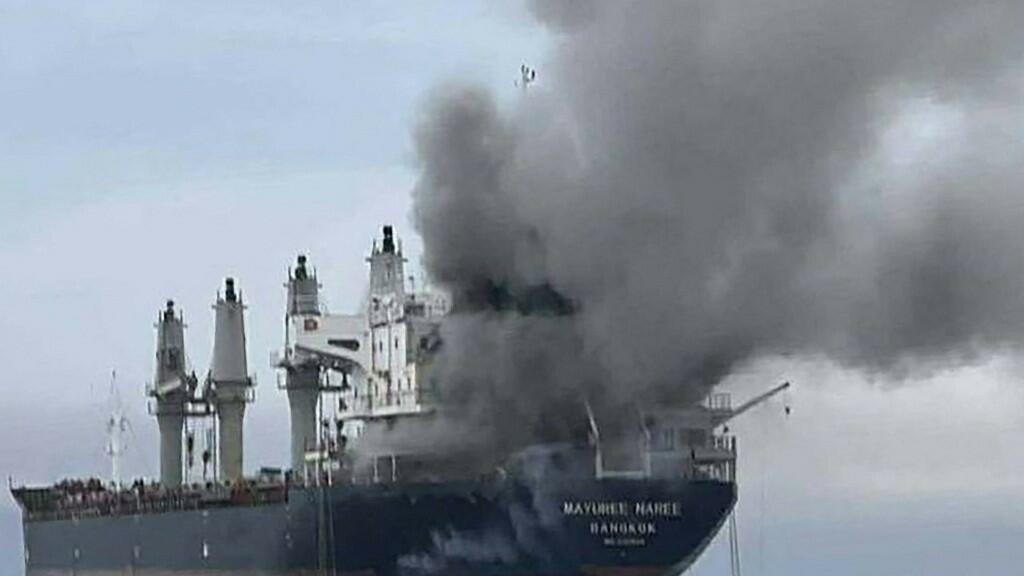
Unknown explosions last night in Bab al-Mandeb Strait halted vessel traffic for two hours, Far News reported. Sources cited note of “unusual silence” from global maritime and insurance authorities.
Israeli drone strike was reported in Al-Qarara, Khan Yunis, in the southern Gaza Strip. It was separately reported that Hezbollah announced it attacked Israeli soldiers in the town of Rashaf, southern Lebanon with drones, while the Israeli army issued an evacuation warning for a building in the city of Tyre, southern Lebanon.
A more detailed look at global markets courtesy of Newsquawk
Japanese Economic and Fiscal Policy Minister Kiuchi sees strong momentum in this year’s wage negotiations and improvements in job conditions. Further said that effect of government steps slightly to underpin moderate economic recovery and must be vigilant to the impacts on the economy from the Middle East conflict. Japan’s government plans to postpone its summer power-saving request, according to Kyodo. New Zealand’s Finance Minister said the government is to overhaul public service and target savings of NZD 2.4bln over the next four years, and will aim to lower government jobs to 55,000 by mid-2029 from 65,000 in 2023.
Top Asian News
Japanese Economic and Fiscal Policy Minister Kiuchi sees strong momentum in this year’s wage negotiations and improvements in job conditions. Further said that effect of government steps slightly to underpin moderate economic recovery and must be vigilant to the impacts on the economy from the Middle East conflict.
Japan’s government plans to postpone its summer power-saving request, according to Kyodo.
New Zealand’s Finance Minister said the government is to overhaul public service and target savings of NZD 2.4bln over the next four years, and will aim to lower government jobs to 55,000 by mid-2029 from 65,000 in 2023.
Japanese GDP Growth Rate QoQ Prel (Q1) Q/Q 0.5% vs. Exp. 0.4% (Prev. 0.3%, Low. 0.1%, High. 0.7%).
Japanese GDP Growth Annualised Prel (Q1) 2.1% vs. Exp. 1.7% (Prev. 1.3%, Low. 0.4%, High. 2.9%).
Japanese Industrial Production MoM Final (Mar) M/M -0.4% vs. Exp. -0.5% (Prev. -2.0%).
Japanese Industrial Production YoY Final (Mar) Y/Y 2.4% (Prev. 0.4%).
European bourses (STOXX 600 +0.7%) start Tuesday’s trade on the front foot, seemingly benefiting from Trump’s de-escalatory post. Trump announced that the US military is to hold off on the Iran attack that was initially planned for Tuesday after Saudi Arabia, UAE, and Qatar requested him to do so, as serious talks are now taking place. However, he stated that they will be prepared to strike on a moment’s notice. The DAX 40 (+1.5%) is the clear outperformer, while the FTSE MIB (+0.2%) lags. European sectors highlight the positive bias. Media tops the sector pile, seemingly benefiting from continued upside in Publicis. Financial Services and Industrial Goods & Services round out the top 3 sectors. At the bottom of the pile lies Basic Resources (as precious metals pare Monday’s gains) and Chemicals. US equity futures print modest declines, ES -0.5%. Despite today’s modest fixed bid, yields remain elevated and continue to weigh on the tech-heavy NQ (-0.8%). Despite the relative underperformance vs Europe, analysts see this as short-term due to Europe’s lack of IT sector, which has held the region back compared to South Korea and the US
Top European News
UK Unemployment Rate (Mar) 5% vs. Exp. 4.9% (Prev. 4.9%, Low. 4.7%, High. 5.1%). ONS: “Latest figures suggest the labour market remains soft, with vacancies at their lowest level in five years and unemployment higher than a year ago. The number of payroll employees continued to fall in the three months to March, while regular wage growth slowed further.”
UK Employment Change (Mar) 148K vs. Exp. 107K (Prev. 25K, Low. 40K, High. 240K).
UK Average Earnings excl. Bonus (3Mo/Yr) (Mar) 3.4% vs. Exp. 3.4% (Prev. 3.6%, Low. 3.4%, High. 3.7%).
FX
USD benefits from underperformance in peers, despite crude benchmarks being lower and the yield environment being more constructive. DXY is higher by three-tenths after bouncing off its 50DMA at 99.00. The session ahead is light, and sees remarks from Fed doves Waller and Paulson, alongside ADP weekly payrolls.
GBP is a little lower against the Buck and Euro as technical-driven outperformance on Monday is reversed. Focus recently has been on politics (Manchester Mayor Burnham said that changing the Fiscal rules was not an option), and on a downbeat UK jobs report. Cable currently resides at the bottom end of a 1.3387 to 1.3437 range.
USD/JPY topped Monday’s high (159.08), bringing intervention fears back in focus. USD/JPY has been edging higher throughout the last ten sessions amid reports of a supplementary budget and oil remaining high, with Japan a net importer.
AUD is the G10 laggard, seemingly looking to price in the weak Chinese data on Monday as Monday’s risk-induced rally pares. Alongside the fading of the risk environment, RBA minutes overnight indicated a wait-and-see approach among members that voted for a hike, reinforcing market pricing of just c. 5bps of tightening for June 16th’s meeting. AUD/USD resumes its slide from 0.7200 on Friday, looks now to 0.7100, around 10-15 pips below.
Fixed Income
USTs are firmer by around 6 ticks and currently trade at the mid-point of a 109-03 to 109-11+ range. Action ultimately dictated by Trump’s decision to delay strikes on Iran, after several Gulf countries suggested that serious talks were taking place. Nonetheless, risks remain, as Trump suggested that the US is prepared to launch a full-scale assault on Iran at a moment’s notice if an acceptable deal is not reached. Geopolitics aside, focus will be on the weekly ADP Employment Change metrics and Pending Home Sales; Fed speak via Waller is also due.
From a yield perspective, US yields have eased a touch from the prior day’s peaks; the 10yr now holds around 4.60% (vs Monday’s peak at 4.63%). Nonetheless, the yield still resides beyond the key 4.50% mark, where some analysts have speculated a decisive breach above this point could see the yield begin to spiral.
Gilts are outperforming vs peers, and are currently firmer by c. 80 ticks, trading with an 86.14 to 86.40 range. A trifecta of factors driving the action today: a) lower energy prices, b) Manchester Mayor Burnham (touted to challenge for PM) saying that changing fiscal rules would not be an option and c) a downbeat UK jobs report.
Bunds are firmer by around 15 ticks, and hold within a 124.18 to 124.41 range. EU-specific newsflow has been light this morning, with the German benchmark ultimately moving alongside peers. Focus later will be on some ECB speak, but perhaps more pertinently, attention will be on the EU’s meeting related to US tariffs. The main sticking point is Trump. Officials are working on developing clauses to protect the EU, through “Trump Proofing”: a) expires once Trump’s presidential term ends, b) deal suspends if Greenland is threatened, c) allows the EU to restore tariffs if there are significant domestic market disruptions. Should officials reach an agreement, documents will be sent for a full vote in the European Parliament by June.
Citi strategists says 5.5% may be the next key level for 30yr US Treasury yields after they rose to the highest since 2007.
Germany sells EUR 3.844bln vs exp. EUR 5bln 2.50% 2031 Bobl: b/c 1.32x (prev. 1.04x), average yield 2.85% (prev. 2.74%), retention 23.12% (prev. 20.9%).
Commodities
The main update was US President Trump delaying the planned Iran attack after requests from Saudi Arabia, the UAE and Qatar, as serious talks are taking place. However, they remain ready to strike if an acceptable deal is not reached. Sources continue to outline that some form of military action remains likely, while explosions have been heard in the Bab al-Mandeb Strait, with transit halted overnight. See the 08:29BST update for more.
WTI and Brent futures are softer intraday amid the pullback seen after US President Trump called off an attack on Iran that was planned for Tuesday following the request by Gulf nations. WTI Jul resides in a USD 102.12-104/bbl range, and Brent Jul in a USD 109.01-110.77/bbl range – both off worst levels. Dutch TTF trimmed earlier downside and trades firmer by ~1% at the time of writing, north of EUR 50/MWh. Analysts at ING, on US-Iran, said “One might think the oil market would become increasingly numb to these headlines. However, the scale of supply disruptions is significant and growing more concerning each day that oil flows remain halted.”
In terms of metals, spot gold and silver post losses as the DXY remains underpinned by inflation concerns emanating from elevated oil prices. Spot gold trades closer to the bottom of a USD 4,531-4,589.58/oz range after briefly topping yesterday’s USD 4,584.37/oz peak. Spot silver resides in a USD 75.72-78.89/bbl. Base metals are on a softer footing amid the inflationary concerns from elevated energy prices. 3M LME copper resides in a USD 13,485.98- 13,646.68/t range at the time of writing.
Australian PM Albanese said Australia secured over 600k barrels of jet fuel and that three cargoes of jet fuel from China are expected to arrive from early June.
Angola reportedly to cut July crude exports to 889k bpd.
The EU is set to unveil an action plan to bolster fertiliser supplies and mitigate food price inflation, the FT reported citing draft proposals.
Central Banks
RBA Minutes from the May meeting stated the board judged financial conditions would be somewhat restrictive after the May hike and that a hike would provide space to see how the Gulf conflict develops, as well as the response of households and businesses. Board considered whether to hike by 25bps or to keep rates at 4.1%, while it was stated that for future decisions, the board agreed monetary policy could not alter the near-term trajectory of inflation, and also agreed Australian economic growth is likely to be below potential for some time. Furthermore, the board will do what is considered necessary to meet inflation and employment mandates, while the majority emphasised that core inflation was projected above target for an extended period.
RBA Assistant Governor Hunter said risk of inflation expectations drifting higher is elevated, and the Middle East conflict is a clear external shock, adding that the recent rise in oil prices is particularly challenging to navigate.
US Event Calendar
8:00 am: United States Fed’s Waller in Moderated Discussion
7:00 pm: United States Fed’s Paulson Speaks on Economic Outlook
DB’s Jim Reid concludes the overnight wrap
My mini world tour continues, and it’s another rare ocean view. This time in Lisbon where I’m passing through for a conference. It really is a beautiful city. Well the parts that I’ve seen on my travels.
As I watch the early morning waves crash gently into the harbor, markets have had a mixed 24 hours, with Trump’s post that he called off planned new strikes against Iran helping the S&P 500 (-0.07%) erase most of its intra-day decline towards the end of the session, while 10yr Treasury yields stabilised after touching their highest level in over a year at 4.63%. Brent crude also retreated from two-week highs but is still trading close to $110/bbl this morning and little changed from the end of last week. And the broader market mood is on the cautious side this morning, with US equity futures and most Asian markets losing ground.
We are now exactly six weeks into the combined truce and ceasefire, following 5.5 weeks of strikes and attacks. While my base case is that the absence of kinetic activity would not have persisted this long without US intent to secure a deal, the lack of an agreement—despite several false dawns— remains a source of nervousness.
In terms of the latest from the Middle East, the last major swing came late in yesterday’s US session as Trump claimed that he had called off an attack against Iran that has been scheduled for today after an appeal by leaders of Qatar, Saudi Arabia, and UAE. The news helped remove some of the risk premium that had built up over the course of yesterday, even though in the same post Trump also said that he ordered the US military to be ready for “a full, large scale assault of Iran, on a moment’s notice, in the event that an acceptable Deal is not reached”. Later on, Trump said that he was asked to put off new strikes “for two or three days” as Gulf allies thought “they are getting very close to making a deal”, while he also stressed the aim of “no nuclear weapon going into the hands of Iran”.
Following Trump’s comments, Brent crude is trading -2.03% lower this morning at $109.84/bbl as I type. Shortly before Trump’s post it had traded as high as $112.72, the highest intra-day level in almost two weeks. Oil prices whipsawed earlier yesterday alongside conflicting headlines around the prospects for further strikes. First, came a positive reaction after Iran’s Tasnim news agency said the US had proposed a temporary waiver on oil sanctions. So that led Brent to fall below $107/bbl as investors latched onto signs of progress in the US-Iran discussions. But more negative headlines then began to come through before Trump’s post. For instance, Tasnim also reported a source who said that Tehran felt the US had “excessive demands and unrealistic positions”. And on the US side, Axios cited a senior US official who said the White House didn’t think Iran’s updated proposal was sufficient for a deal.
In Asia this morning, markets are on the softer side, with tech stocks not helping the mood. As I check my screens, the KOSPI (-4.12%) stands out as the largest underperformer, having fallen as much as -5.0% earlier in the session. Other moves are more more muted with the Nikkei (-0.42%) and the CSI (-0.49%) only slightly lower and with the Shanghai Composite flat. In contrast, the S&P/ASX 200 (+0.93%) is defying the regional trend, alongside the Hang Seng (+0.39%). S&P 500 (-0.26%) and NASDAQ 100 (-0.46%) futures are giving back some of the late recovery from last night.
The S&P 500 (-0.07%) ended the day with a marginal decline, with Trump’s post helping it recover from -0.75% down an hour before the close. After its sharp decline last Friday, the S&P still posted its worst two-day performance since March, albeit only down -1.31% in that period from Thursday’s record high. Tech stocks took a larger hit, with the Magnificent 7 (-0.64%) and the NASDAQ (-0.51%) seeing a more material pullback. But the broader mood was more positive, with the equal-weighted S&P 500 rising by +0.58%.
US Treasuries also saw a varied performance, with 2yr (-2.6bps to 4.05%) and 10yr yields (-0.6bps to 4.59%) erasing their intra-day increases, but 30yr yields (+0.7bps) inching up to a new post-2007 high of 5.12%. Aside from oil, a rise in yields had been supported by positive data yesterday, which suggested the US economy had continued its resilience into May. Indeed, the NY Fed’s services business activity hit a 16-month high of -5.8, whilst the NAHB’s housing market index was up to 37 (vs. 34 expected). 10yr Treasury yields are around +1.4bps higher again overnight trading at 4.60%.
Over in Europe however, markets put in a relatively stronger performance, with bonds and equities both rebounding. So 10yr bund yields (-1.9bps) came down to 3.15%, after closing at a post-2011 high on Friday, whilst OATs (-4.0bps) and BTPs (-4.2bps) fell back as well. On top of that, investors dialled back their expectations for ECB rate hikes, with 73bps priced by the December meeting, down -2.1bps on the previous day. And in turn, the prospect of fewer rate cuts helped to support equities as well, with the STOXX 600 (+0.54%) paring back its slump on Friday.
Here in the UK, gilts outperformed their European counterparts, which came as a spokeperson for Greater Manchester Andy Burnham ruled out changing the government’s fiscal rules if he gained power. Moreover, the spokesperson also ruled out exempting defence spending from the rules, which is something Burnham had previously floated. So that reassured investors who’d been worried that Burnham might lead to higher gilt issuance, particularly after his comments last year about being “in hock” to the bond markets. In turn, that led to a clear rally, with 10yr gilt yields (-7.4bps) closing at 5.10%, down from their post-2008 high on Friday. Moreover, other UK assets outperformed, with the FTSE 100 (+1.26%) advancing, whilst the pound strengthened +0.81% against the US Dollar. Nevertheless, incumbent PM Starmer continued to reject suggestions he’d stand down if Burnham won the by-election, reiterating to broadcasters that “I’m not going to walk away”.
Early morning data has showed that Japan’s economy expanded at an annualised rate of 2.1% in the first quarter of 2026 (compared to the +1.7% anticipated), driven by enhanced consumption and robust exports, thereby bolstering the argument for additional interest rate hikes by the BOJ. However, the outlook remains highly uncertain due to the ongoing conflict in the Middle East. The report indicates that the economy gained momentum during the January-March period, prior to the full effects of the war in Iran becoming apparent.
Despite the bullish growth figures, the Japanese yen has weakened slightly against the dollar following the announcement. Overnight BoJ swaps remain relatively stable, indicating around a 77% probability that the central bank will increase rates in June. Yields on 10-year JGBs have risen by +4.5bps, trading at 2.76%, marking a fresh multi-decade high as we go to print.
Looking at the day ahead, data releases include UK unemployment for March, Canada’s CPI for April, and US pending home sales for April. Otherwise from central banks, we’ll hear from the Fed’s Waller and Paulson, the ECB’s Villeroy, Lane and Makhlouf, and the BoE’s Breeden.
Tyler Durden
Tue, 05/19/2026 – 07:58
https://www.zerohedge.com/markets/futures-fall-momentum-cracks-grow-yields-and-oil-higher
Standard Chartered To Replace “Lower-Value Human Capital” With AI As Meta Layoff D-Day Nears
Standard Chartered To Replace “Lower-Value Human Capital” With AI As Meta Layoff D-Day Nears
The white-collar job-loss apocalypse, accelerated by AI, is increasingly concentrated in repetitive, data-intensive, and digitally native roles, with tech firms announcing layoffs one after another.
While ‘D-Day’ for Meta layoffs is Wednesday morning, the London-headquartered international bank Standard Chartered announced on Tuesday plans to cut 15% of its corporate roles (or about 7800 jobs) by 2030 as part of a broader efficiency push amid the adoption of AI.
STAN also raised its profitability targets, aiming for a 15% return on tangible equity by 2028 and roughly 18% by 2030.
“Drive productivity improvements to raise income per employee by ~20 percent by 2028, aided by a reduction in corporate functions roles of >15 percent by 2030,” STAN wrote in a press release.
STAN CEO Bill Winters stated in the release, “We are investing in the capabilities that will compound our competitive advantages and drive sustainable growth and higher quality returns over time, with clear targets in place.”
To achieve this, Winters explained: “We are scaling practical uses of automation, advanced analytics and artificial intelligence to streamline processes, improve decision-making and enhance both client service and internal efficiency.”
During the earnings call, Winters provided more color on these plans, insisting, “It’s not cost-cutting, it’s replacing low-value human capital with financial and investment capital.” The substitution of workers in favor of machines “will accelerate as we go forward into AI.”
Here is Goldman analyst Gaelle Jarrousse’s first take on STAN’s move to reduce headcount to improve higher income per employee and returns:
Let’s start with STANDARD CHARTERED CMD where the key punch line is Bill Winters mentioning that ‘I can tell you in 2030, if we’re generating 18%, I’m not going to be doing high fives with the team. I don’t think that that’s the potential of this bank.
But I’m not allowed to say that because the slide says 18% by around 18% by 2030.’ It highlights the level of conservatism baked in the targets esp in the 57% Cost Income ratio.
The >15% ROTE target for 2028 (assuming 5-7% top line growth vs consensus at 5% and high teens EPS growth vs consensus at 18%) won’t lead to earnings upgrades given consensus is at 15%.
However the 18% ROTE target for 2030 gives enough sustained growth and validates the thesis of a lasting growth story. There are not many banks offering c.20% EPS growth until 2030 with a clear narrative (and there not many banks giving you access to the Asian wealth story) and the multiple of STAN does not reflect that – REMEMBER the chart of EPS growth vs PE of last Friday, STAN screened very well on that, ie more re-rating is needed given the growth offered and the right type of growth, ie wealth deserving a higher multiple. STAY LONG.
Beyond STAN, ‘D-Day’ for Meta layoffs is tomorrow morning, and the Facebook and Instagram owner is expected to slash 10% of its global headcount, or about 8,000 employees, in the initial round as it swaps headcount for GPUs.
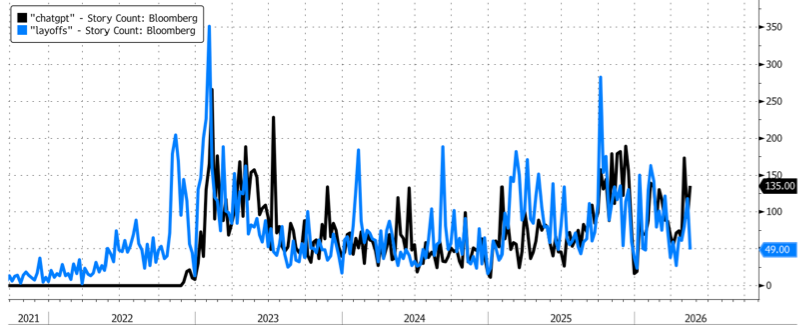
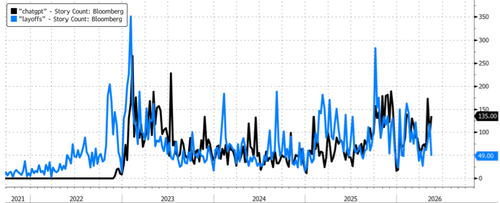
Take a look at Bloomberg story count data for “ChatGPT” and “layoffs” …
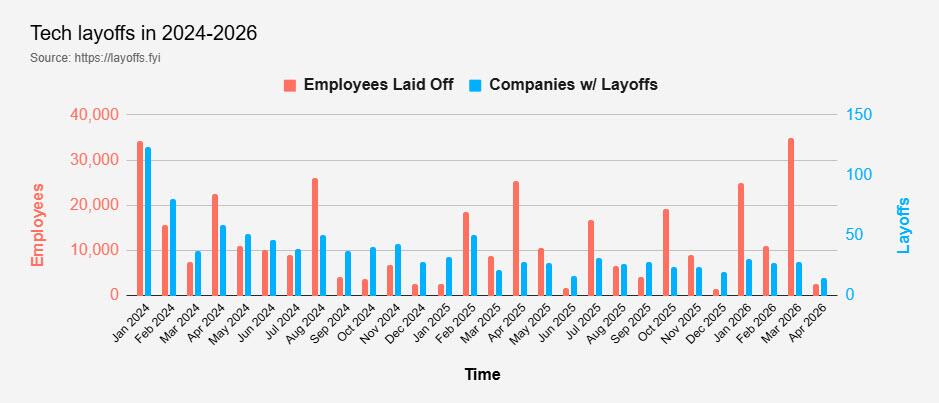
Layoffs.fyi, a website tracking tech job cuts worldwide, reported that 73,212 employees have lost their jobs so far this year. For all of 2024, the figure was 153,000.
Labor-market disruption for white-collar workers has arrived with the rise of AI adoption. Goldman laid out in 2023 just how many jobs AI will take. That number is absolutely alarming for white-collar America, where many are saddled with student and credit card debt.
Tyler Durden
Tue, 05/19/2026 – 07:45
https://www.zerohedge.com/markets/standard-chartered-replace-15-lower-value-human-capital-ai
BBC’s Former News Director Says Trans-Bias & ‘Progressive Madness’ Drove Her Out
BBC’s Former News Director Says Trans-Bias & ‘Progressive Madness’ Drove Her Out
Authored by Steve Watson via Modernity.news,
The BBC’s grip on impartiality continues to slip as one of its former top news executives publicly confirmed what critics have long argued: activist capture from within has turned the state broadcaster into a vehicle for narrow ideological agendas.
Fran Unsworth, director of BBC News from 2018 to 2022, has broken her silence, claiming she was effectively driven out by trans activists and the “progressive madness” dominating the corporation.
In a candid interview, she described an environment of bullying where editors avoided critical reporting on trans issues for fear of attacks from their own colleagues.
‘For the news department to be following some airy fairy ideology instead of fact is pretty wild!’
Comedian Leo Kearse reacts to a former BBC news boss claiming she was bullied out of her role by ‘gender ideologues’. pic.twitter.com/n6QNpZn1HM
— GB News (@GBNEWS) May 16, 2026
“Just dealing with the progressive editorial issues and the bullying around them all. It was incredibly difficult,” Unsworth said. She added that the atmosphere extended beyond trans topics, with staff no-platforming dissenting views and pushing “safe spaces” over open debate.
Unsworth’s remarks paint a picture of a newsroom where challenging the prevailing narrative on ‘culture war’ issues carried professional risks. Programme editors reportedly steered clear of stories that questioned aspects of the trans agenda, wary of backlash from activist-aligned staff.
This self-censorship contributed to what a leaked internal memo later described as “effective censorship” on the topic.
Ex-BBC news boss Fran Unsworth says she was driven out of her job by ‘progressive madness’ of trans activists https://t.co/Fk0cmm51N1
— Daily Mail (@DailyMail) May 16, 2026
Her departure was hastened by the constant pressure. “I would actually say it drove me out,” she stated, highlighting how the bullying around “progressive editorial issues” made her position untenable.
This echoes earlier revelations about the BBC’s hiring practices. In 2024, the broadcaster made clear it would not hire candidates dismissive of diversity and inclusion policies, effectively screening out those skeptical of the dominant ideology.
Recruiters were instructed to reject anyone showing a lack of enthusiasm for these topics, ensuring ideological conformity from the outset.
Unsworth’s admission also lands amid ongoing scandals over the BBC’s handling of gender issues, including accusations of harming children through biased children’s programming.
In late 2025, over 650 families accused the BBC of harming children via a “constant drip-feed” of pro-trans material in shows and dramas. Parents detailed examples like Hey Duggee using “they/them” pronouns for a character aimed at five-year-olds, episodes of Doctors and Casualty promoting child transition narratives, and documentaries criticized for downplaying detransition regrets.
One parent group spokesman warned: “The constant stream of propaganda about gender and trans activism the BBC has transmitted has played a significant role in creating a dangerous culture for children.” They pointed to narratives linking gender questioning directly to suicide, which they said pressured families and ignored safeguarding concerns.
The BBC has defended its output by citing updates to style guides and efforts to reflect developments like court rulings on biological sex, but trust continues to erode.
Inside the capture of the BBC, by Rob Burley (@RobBurl)
In his 13 years as a senior BBC editor, Rob Burley saw the Corporation’s defining commitment to impartiality undermined by transgender ideology, a blind commitment to Diversity & Inclusion schemes, and a culture of… pic.twitter.com/DobvY77PpD
— UnHerd (@unherd) May 16, 2026
The BBC’s obsession with identity politics has also produced content disconnected from everyday reality. A 2025 DEI training video on “microaggressions” went viral for its over-the-top portrayals of white colleagues as bumbling racists, complete with awkward accents and forced celebrations. Critics noted that no one in the real world behaves this way, highlighting the corporation’s bubble of performative wokeness.
Such materials reinforce the sense that the BBC operates in an alternate universe, more focused on enforcing sensitivity hierarchies than delivering impartial news or entertainment.
Unsworth’s exit and the surrounding controversies arrive as the BBC faces broader challenges, including declining audiences, falling trust, and questions over its future under new leadership. Leaked documents and parental complaints have repeatedly shown how activist influence skewed coverage, sidelining biological reality and dissenting voices in favor of Stonewall-aligned perspectives.
The pattern is clear: a public broadcaster funded by taxpayers has allowed internal cliques to dictate editorial direction, from hiring litmus tests to children’s shows pushing contested ideologies. This not only undermines impartiality but risks real-world harm by shaping public discourse—and young minds—around contested claims rather than evidence and balance.
It all underscores a pattern of institutional bias that prioritizes activist demands over journalistic balance and public trust.
Your support is crucial in helping us defeat mass censorship. Please consider donating via Locals or check out our unique merch. Follow us on X @ModernityNews.
Tyler Durden
Tue, 05/19/2026 – 07:20