Category: News
Samsung Union Authorizes Massive Strike At Memory-Chip Plants After Mediation Talks Collapse
Samsung Union Authorizes Massive Strike At Memory-Chip Plants After Mediation Talks Collapse
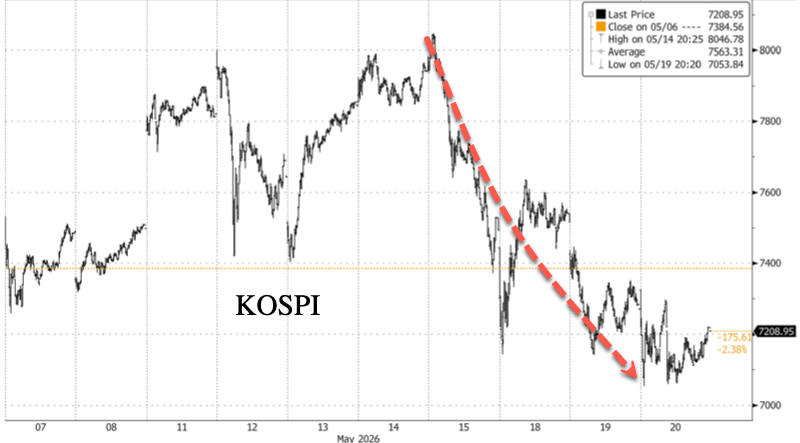
Asian equities extended losses for a fourth straight session, with South Korea’s benchmark KOSPI falling about 1% as the market priced in the shock of an imminent labor action at Samsung Electronics.
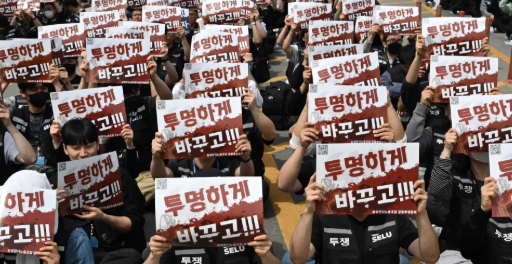
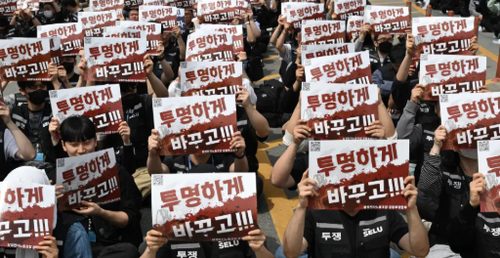
A full-scale, 18-day strike involving more than 47,000 workers at the world’s largest memory-chip maker is set to begin Thursday, raising the risk of production disruptions across the global semiconductor supply chain, which is already tight due to AI data center buildouts.
Samsung Electronics’ talks with its largest union collapsed overnight as union negotiators demanded the removal of a bonus cap, allocation of 15% of operating profit to worker bonuses, and that those terms be written into contracts, citing memory-chip maker SK Hynix’s 10% profit-sharing arrangement.
Samsung negotiators accepted most of the demands, including a proposed 10% operating profit bonus pool and special compensation, but called the union’s remaining requests unsustainable.
“We deeply regret that the post-mediation process has concluded [without resolution] due to delays in decision-making by the management,” Samsung Electronics Labor Union Chairman Choi Seung-ho told reporters at the National Labor Relations Commission in the city of Sejong. “We cannot help but feel disappointed that the mediation ended without the company ultimately reaching a decision.”
Japan’s financial outlet Nikkei Asia reported, “The strike would affect only the company’s domestic plants, which are the base of its chipmaking operations.”
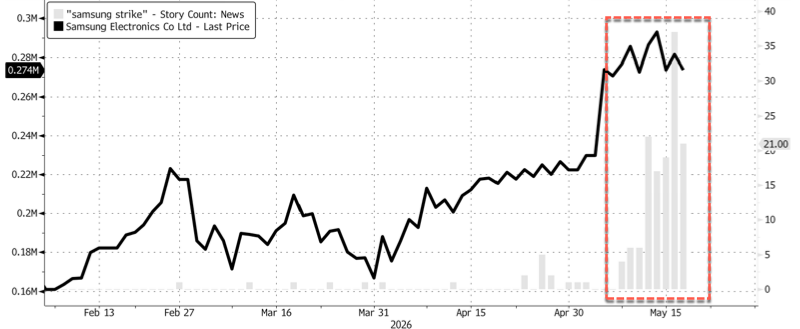
The collapse in talks comes as Samsung shares surge on record profits, driven by soaring demand for memory chips, even as hyperscalers are set to deploy $700 billion in capex to build AI infrastructure in the US. Demand is also rising globally as the race for AI compute intensifies.
TrendForce data show that Samsung is the world’s largest memory chipmaker, with a 36% market share in DRAM chips and one-third in NAND Flash chips.
Commenting on the market reaction, UBS analyst Joe Dickinson noted:
“Asia was lower for a fourth consecutive session, with the KOSPI dropping as much as 3% on Samsung strike risk before partially recovering.”
UBS analyst Kevin Loke commented on the FX reaction:
USDKRW initially traded with an offered tone, with spot opening at 1513.4 and falling nearly 10 won to a low of 1503.8. However, headlines that the Samsung union strike will proceed as planned on Thursday, following a breakdown in talks, pushed the pair back higher toward 1510.
A BoK report to the president estimated a potential impact of up to KRW30 trillion in lost production. For now, USDKRW is likely to remain within a broader 1480–1520 range, with the pair relatively less sensitive to the recent thematic shift toward the global bond sell-off.
Samsung shares fell as much as 4.4% before reversing their losses. Notice “Samsung Strike” headlines in corporate media weighing on shares…
Coverage:
Samsung Strike Threat Sparks Selling Contagion In Memory Stocks
Samsung, South Korean Union Resume Talks As Strike Threat Risks Disrupting Memory Chip Fabs
Samsung, Union Resume Talks After Labor Action Scare; Goldman Says “Korea: Buy”
Bloomberg pointed out, “The government has previously hinted that it could resort to rarely used emergency powers to prevent a strike if the parties fail to reach an agreement. South Korea has invoked the emergency arbitration mechanism only four times since 1969.”
Tyler Durden
Wed, 05/20/2026 – 07:20
A “Rubbish, Knee-Jerk Reaction”: UK Treasury Pushes Food Price Caps As Inflation Re-Accelerates
A “Rubbish, Knee-Jerk Reaction”: UK Treasury Pushes Food Price Caps As Inflation Re-Accelerates
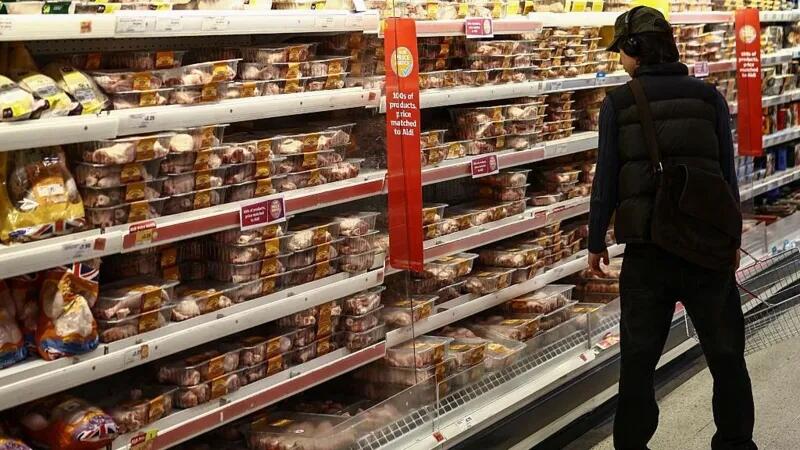
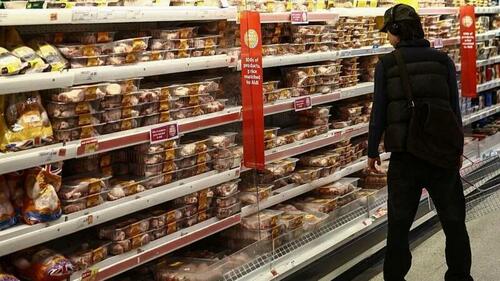
UK supermarkets are being urged by the government to limit food prices in return for easing regulations.
As first reported by The Financial Times, the price caps are ‘voluntary’ and would apply to key groceries – such as eggs, bread, and milk – according to retail industry sources with knowledge of the plans.
In return, the government has said it would offer “incentives” to the supermarkets, which the people said could include easing packaging policies and potentially delaying costly changes to rules around healthy food.
As one may well expect, supermarkets are understood to be strongly opposed to the plans.
The Treasury has declined to comment.
The proposals come as Sir Keir Starmer’s government is battling to address public concern over the cost of living.
Scottish retailers recently condemned a similar policy by the Scottish National Party as a “1970s-style” gimmick.
One person close to a supermarket said the Treasury’s initiative was “a rubbish, knee-jerk reaction to the SNP”.
UK food inflation rose to 3.7 per cent in April, and the foreign secretary, Yvette Cooper, has warned the world is “sleepwalking into a global food crisis”, with the Middle East war throttling supply chains.
And in line with the magical thinking, the Treasury has also told supermarkets that it would like guarantees that British farmers would not lose income from shop price caps.
Former Brexit minister Lord Frost weighed in on social media platform X, calling the proposal “remarkable (and remarkably bad) if true.
“There are certainly plenty of people in this govt whose understanding of economics is so poor that they might consider it a good idea.”
SNP leader John Swinney has defended his party’s approach, arguing he faces a “public health responsibility” to ensure affordable nutrition for people “struggling to afford a very basic shop.”
“It is a completely ill-thought-out, last-minute idea . . . The idea that the government can set price better than the market is for the birds,” one person familiar with the discussions told the FT.
Tyler Durden
Wed, 05/20/2026 – 06:55

UK COVID Inquiry’s Endorsement Of Censorship Sets Chilling Precedent
UK COVID Inquiry’s Endorsement Of Censorship Sets Chilling Precedent
Authored by Molly Kingsley via DailySceptic.org,
According to the UK’s Covid Inquiry, whose fourth report was published in April, there was “in principle, nothing unlawful or inappropriate in the government monitoring publicly available social media to identify potential trends in disinformation or misinformation” during the pandemic period.
The same report, in declining to criticise the censorious activities of the UK Government during the pandemic, noted that the UK government’s Counter Disinformation Unit was required to ensure that its actions were “lawful, necessary and proportionate”.
On a careful reading of this language, the inquiry stops (just) short of expressly endorsing the full scope and extent of the government’s censorship operation. However, the relevant sections of the inquiry’s report create the distinct, and we can assume deliberate, impression that the CDU’s censorship operation was conducted in accordance with constitutional and democratic principles, and was not only justified but was necessary and proportionate.
As someone who was on the receiving end of that censorship operation, with the receipts to evidence the very broad scope of commentary that was judged by the CDU to be wrongful or dangerous, this came as a serious disappointment, albeit not a great surprise.
Some would argue that in a national emergency scenario, some degree of information monitoring and intervention might be justified.
The trouble with that argument is that one very quickly then has to grapple with the fact that – as we saw during the pandemic period – it’s precisely in moments of national crisis – moments where critical decisions must be made in complex situations – that contrasting views are most valuable and essential.
As Jay Bhattacharya, Acting Director of the US Centres for Disease Control, has put it: “Dissent is the very essence of science.”
In my own case, the offending posts and articles caught by the CDU were typically either opinion pieces or comments quoted in mainstream news articles. They included such outlandish and outrageous statements as, “It would be unforgivable to close schools”, “Let children use playgrounds” and “It is indefensible that children’s lives are still not back to normal when the rest of society is”. Clearly, many would now agree with these viewpoints. However, even if some, or indeed many might not have agreed with those points of view at the time, the fact that they were valid, lawfully-expressed opinions cannot be disputed.
Perhaps the CDU’s hypersensitivity would not have mattered so much if, as according to the Covid Inquiry’s account, all that was happening during that period was “monitoring” of public sentiment by the government. The inquiry’s report notes that the CDU had ‘trusted flagger’ status with all of the major social media platforms, the effect of which was that CDU flags received special attention; but the same report is at pains to record that decisions about removing or suppressing content “remained exclusively a decision for each social media platform”.
Yet a subsequent investigation by the Telegraph revealed that 90% of the posts referred to social media companies by the CDU were taken down. Indeed, evidence given to the inquiry by the former head of the CDU confirmed that when information was flagged by the CDU it “immediately goes to the top of the pile. Whoever it is in whatever company then acts on it. It is the same system they have across government for things like terrorist content.”
What makes this even worse is that the remit of the CDU went beyond anything that could reasonably be termed mis- or disinformation. In particular, we know in relation to Covid vaccine-related commentary – because a CDU official told a Parliamentary Select Committee in December 2020 – that each of the following categories of content was considered for flagging and removal as ‘anti-vaccine misinformation’:
commentary about the speed of the development of the Covid vaccines: “It is not safe, those kinds of narratives”;
commentary about side-effects from the Covid vaccines; and
commentary about “monetary and big business and links to pharma”, which seems to indicate that criticism of the pharma industry and its financial influence were off limits.
All of this is in sharp contrast to events on the other side of the pond. In May 2024, a US Congressional report observed in the context of its examination of the Biden administration’s pandemic censorship operations:
“By suppressing free speech and intentionally distorting public debate in the modern town square, ideas and policies were no longer fairly tested and debated on their merits. Instead, policymakers implemented a series of public health measures that proved to be disastrous for the country.”
Free debate is one of the key measures of the health of a democracy. Without it, we lose the ability to challenge and to stress test ideas. As we saw during the pandemic, it is often when speech is most controversial that the need to hear it is greatest.
In contrast with the US where a degree of candid investigation of core pandemic failings, especially concerning the suppression of speech and social media censorship, is now taking place, our own Covid Inquiry has completely side-stepped its duty to properly interrogate serious infringements of cornerstone rights and principles of public discourse. Given the investigations going on in the US and the fact that key reports have been public for close to two years, not only is this approach wilfully blind but it is an affront to the liberal democratic ideal of free speech. It sets an appalling precedent, whereby in future public health crisis (or potentially any crisis) we can now expect broad-in-scope monitoring and narrative control of lawful, and indeed essential, contrasting views to be the norm. And, it is disingenuous. At the same time that the inquiry has defended the patent overreach of the government’s censorship operation, it has completely ignored the flagrant, extensive and devastating mis- and disinformation propagated during that same period by pharmaceutical companies, government ministers and senior public health officials who were permitted and encouraged to make statements which were manifestly inflated, exaggerated, coercive or untrue.
Official statements overstating the safety and efficacy of the Covid vaccine programme, particularly when combined with coercive policies affecting children, are blatant examples of dangerous misinformation.
Each of the major vaccine manufacturers has now been found guilty by the UK regulator, many on repeated occasions, for the persistent overstating of benefit and understating of harm in relation to their Covid vaccine products. And yet the inquiry’s report is completely silent on this topic.
Unfortunately the end result, as predicted by many Daily Sceptic readers, is a shameful whitewash that will only further corrode trust in public health.
Tyler Durden
Wed, 05/20/2026 – 06:30
https://www.zerohedge.com/markets/uk-covid-inquirys-endorsement-censorship-sets-chilling-precedent
Global Rush For “Non-Red” Suicide Drones Begins As Taiwan Sees Booming Orders
Global Rush For “Non-Red” Suicide Drones Begins As Taiwan Sees Booming Orders
Four years of war in Ukraine have rewritten how warfare is fought, accelerating the urgent need for low-cost aerial unmanned systems and ground robots. It has also prompted Taiwan to emerge as a supplier of low-cost suicide drones.
Taiwan’s national news agency, the Central News Agency, reported that a Taichung-based Taiwanese drone manufacturer is now focused on producing a domestically made variant of Iran’s Shahed one-way attack drone.
CNA said Carbon-Based Technology’s main exports are “triangular-wing drones with a control range of over 90 km, and catapult-launched small attack drones.”
CNA noted that demand for these attack drones is soaring, with “plans to expand the factory three to five times.” The company is facing “production capacity” constraints due to surging orders.
“The payload can be adjusted according to mission requirements, conforming to the current global military ‘asymmetric warfare’ trend,” CNA stated, describing CBT’s suicide drones.
CNA noted, “The Russia-Ukraine war sparked a global surge in demand for “non-red” (non-Chinese) drones. This, combined with Taiwan government support, brought rapid overseas interest and orders from countries including Japan, India, and Southeast Asia.”
The acceleration of suicide drone production also comes as the possibility of a Chinese invasion remains a very real threat, drawing heavily from lessons learned in Ukraine.
The broader takeaway is that Taiwan views drone manufacturing as both a national security capability and an industrial policy to supply Western militaries.
As we have outlined before, militaries around the world are entering a major procurement cycle to stockpile low-cost one-way attack drones, as lessons from Ukraine and the Gulf region rapidly reshape modern warfare.
Tyler Durden
Wed, 05/20/2026 – 05:45

Starmer Hit With Legal Threat After Barring Conservative Speakers From Entering UK For National Rally
Starmer Hit With Legal Threat After Barring Conservative Speakers From Entering UK For National Rally
Authored by Thomas Brooke via Remix News,
U.K. Prime Minister Keir Starmer has been issued with a formal letter of claim after several foreign politicians, commentators, and activists were blocked from entering the United Kingdom ahead of a major rally in London last weekend.
The legal threat was announced over the weekend by Dutch commentator Eva Vlaardingerbroek, who said she and others had instructed a lawyer to act on their behalf over potentially defamatory remarks made by the prime minister last week.
“Today, Dominik Tarczyński, Don Keith, Ada Lluch, Joey Mannarino, and I have formally instructed our lawyer, Francesco Gargallo di Castel Lentini, to issue a Letter of Claim to Keir Starmer,” Vlaardingerbroek wrote on X. The lawyer mentioned is Vlaardingerbroek’s Italian husband.
Enough is enough.
Today, @D_Tarczynski, @RealDonKeith, @AdaLluch, @JoeyMannarino and I have formally instructed our lawyer, @Fr_Gargallo, to issue a Letter of Claim to @Keir_Starmer. The letter demands that he immediately retract his defamatory statements in which he labelled us… pic.twitter.com/myseUDpc8U
— Eva Vlaardingerbroek (@EvaVlaar) May 16, 2026
“The letter demands that he immediately retract his defamatory statements in which he labelled us ‘far-right agitators’ who wish to incite violence.
“Should he fail to comply, we reserve all our legal rights to pursue further action against him.”
The dispute follows a speech delivered by Starmer last Monday in which he said his government had barred what he described as “far-right agitators” from entering Britain to attend the Unite the Kingdom march organized by Tommy Robinson.
The demonstration took place in London on Saturday. Ahead of the event, those named in the letter received notices from the Home Office informing them that their U.K. Electronic Travel Authorisation (ETA) had been cancelled. The message stated that their presence in Britain was not considered “conducive to the public good.”
Among those affected was Polish MEP Dominik Tarczyński, a conservative politician and outspoken opponent of mass migration.
“This is what communism looks like in the 21st Century. I have just been denied entry to the U.K. in order to speak at the largest patriotic event in Europe,” Tarczyński wrote on social media after being refused entry.
In total, 11 people were reportedly banned from entering the U.K. to attend the rally. They included American nationals, Don Keith and Joey Mannarino, and Spanish conservative influencer Ada Lluch.
Mannarino wrote in response, “None of us want to incite violence. None of us are agitators. We are simply people who want to see Europe remain Europe, the U.K. remain the U.K., America remain America, and so on.”
The letter of claim, dated May 13, was addressed to Starmer at 10 Downing Street and described the prime minister’s remarks as “potentially defamatory, untrue and denigratory.” It said the statements had been made against private citizens, parliamentarians, and lawyers, and demanded a formal retraction.
The row also comes amid broader warnings issued ahead of those attending the London protest. The Metropolitan Police cautioned that certain placards and chants could amount to hate crimes and lead to prosecution.
Those warnings followed new guidance from the Crown Prosecution Service on acts that may be treated as stirring up hatred.
Director of Public Prosecutions Stephen Parkinson defended the guidance, saying, “This is not about restricting free speech. It is about preventing hate crime and protecting the public, particularly at a time of heightened tensions.”
Tyler Durden
Wed, 05/20/2026 – 05:00

South African Farming Crisis May Trigger Food Shortages Across The Continent
South African Farming Crisis May Trigger Food Shortages Across The Continent
For decades South Africa has operated as the breadbasket for half of the African continent, and the vast majority of that food was grown by white farmers (Boers and Afrikaners). In other words, the very survival of Africans has long been dependent on the hard labor of the white people they are taught to despise.
South Africa has around 142 race-based laws which largely discriminate against white citizens, especially when property, business and government office is involved. The Expropriation Act of 2024 allows the socialist government to confiscate any land of their choosing to “redress past discriminatory laws or practices” (land owned by white citizens). This is part of a project to “fulfill land reform goals” (transfer wealth and farming operations to black citizens).
The problem is, when land is seized or forced into sale to black owners, farming production reportedly collapses. That is to say, once the white farmers are gone, crop yields fail and the black owners often resell the land and leave. In other cases, the new owners allow the land to languish, using the homes for living but never cultivating the surrounding property.
Black South Africans own more farmland per capita than French, German and Spanish farmers combined, yet, starvation persists in the region. Excuses as to why this is happening persist, but the fact remains that if Africa wants steady food production, they will have to rely on experienced white Afrikaners to make it happen because no one else is going to do it.
Furthermore, the government’s failure to maintain basic infrastructure has forced local farmers to take on the costs in order to keep food production on track and the roads ready for freight.
The pressure from government projects for “reparations” as well as the constant threat of violence from militant race communists targeting white farmers has made the job difficult. Now, shortages of diesel and fertilizers caused by the Iran War are creating a perfect storm of circumstances which may cause a food crisis going into 2027. If the shortages are not rectified, half of the African continent will be throttled by a lack domestic food supplies.
The war is, apparently, the straw that’s breaking the camel’s back. After years of the South African government sabotaging its most productive citizens and replacing them with less useful farmers, it was only a matter of time before a Black Swan event would lead to collapse.
Iran’s refusal to allow safe passage of tankers from countries like Saudi Arabia and Kuwait is, interestingly, hurting BRICS nations far more than it is hurting the US or the west. Around 25% of South Africa’s oil supplies pass through the Strait of Hormuz. South Africa also imports around 80% of its fertilizer supplies.
The US blockade is only targeted at ships coming from Iranian ports with Iranian oil. All other ships are allowed to pass.
For now, the region is relatively safe from food shortages due to an unusually solid harvest in 2025, but 2027 looms and predictions are up in the air as to what will happen. Once a planting season has passed, there is no way to make up the loss. Foreign imports of food would be the obvious solution, but it’s a costly one. Meaning, price inflation is likely for most of Africa in 2027 and government rationing is a possibility.
The end result will undoubtedly be blamed on the closure of the Hormuz, but South Africa’s progressive policies set the stage and created the house of cards that is Africa’s food supply chain. They are completely unprepared for any significant supply shocks, and the result could be disastrous.
Tyler Durden
Wed, 05/20/2026 – 04:15

UK Schools Push Radical Race Doctrine On Kids, Claiming Black People ‘Cannot Be Racist’
UK Schools Push Radical Race Doctrine On Kids, Claiming Black People ‘Cannot Be Racist’
Authored by Steve Watson via Modernity.news,
Schools in the north of England are teaching pupils that black people cannot be racist towards white people.
According to materials adopted by a group of Sheffield schools, led by Notre Dame High School, teenagers are explicitly told: “Black people can be racially prejudiced towards a white person which is wrong and totally unacceptable. However, this is not racism. Racism is racial prejudice plus power. In the UK, white people hold the cultural power.”
For children as young as 7, lessons focus on “empathy building” around “privilege,” asserting that white people are “likely to be privileged by the colour of their skin” and have a “responsibility” to reduce racism by monitoring their language, challenging friends, and reporting incidents.
Pupils told it’s impossible for black people to be ‘racist’ to white peers https://t.co/hE74ZXEs2z
— Daily Mail (@DailyMail) May 18, 2026
Handouts for older pupils push narratives on criminal justice, claiming black people are disproportionately targeted by police due to racism, with questions guiding students toward that conclusion.
The scheme aims to “interrupt systemic racism” and promote “strong social justice values,” according to its creators.
Shadow Education Secretary Laura Trott slammed the materials, noting “It is deeply alarming that children as young as seven are being exposed to divisive identity politics in schools under the banner of ‘anti-racism education’… Labelling children by race and teaching them to focus on what divides them will only foster resentment and deepen division.”
Shadow minister Neil O’Brien called it “political indoctrination” and vowed to tackle such content.
These latest examples highlight a disturbing pattern in UK education: grooming children with critical race theory concepts, framing whiteness as inherently privileged and problematic, while shielding certain groups from accountability and cracking down on any dissent.
This comes as nurseries in Wales, funded by over £1.3 million in taxpayer money, have been urged to report “racist” incidents involving toddlers to police, turning playgrounds into surveillance hubs for the state’s anti-racism agenda.
Childcare workers are being trained to spot and log “racist incidents” by children barely out of nappies, with instructions to contact police via 999 or 101 if it could amount to a hate crime.
Funded by the Welsh Government and pushed by Diversity and Anti-Racist Professional Learning (DARPL) at Cardiff Metropolitan University, the program covers over 300 nurseries, playgroups, and childminders. It demands audits of resources for “diversity” and discussions of skin colour with toddlers to create “anti-racist” environments from the cradle.
Critics rightly point out that toddlers lack the cognitive ability to be racist, yet the state treats them as potential thought criminals.
UK schools have also pushed books telling children “there’s plenty of room” for small boat migrants, framing mass illegal immigration as something positive and inevitable.
The Green Party has also floated such extreme proposals for what to teach children, while the government urges schools to snitch on “anti-Muslim hostility” in an Orwellian surveillance push.
Counter-terror police have warned teens that sharing “funny content” could be terrorism, and a taxpayer-funded video game literally flags kids questioning mass migration as potential extremists.
Parents of a child who questioned why he had to celebrate Ramadan in school when he is not a Muslim were sent a letter informing them of the ‘racist’ incident.
British children are being conditioned to view their own heritage and skin colour as sources of guilt, accept open borders and cultural replacement without question, and self-censor any pushback—or face reports, labels, and potential police involvement.
This is not education. It is state-sponsored division and thought control, bankrolled by taxpayers under a Labour government disconnected from reality.
Parents are waking up to the grooming, and the pushback is growing. Childhood must be reclaimed from ideologues before an entire generation is lost to this divisive nonsense. Freedom of thought and equal standards for all—not racial power games—should define British values.
Your support is crucial in helping us defeat mass censorship. Please consider donating via Locals or check out our unique merch. Follow us on X @ModernityNews.
Tyler Durden
Wed, 05/20/2026 – 03:30

NATO Scrambles Jet, Shoots Down Ukrainian Drone Over Estonia, In War First
NATO Scrambles Jet, Shoots Down Ukrainian Drone Over Estonia, In War First
It’s being widely reported as a major “first” of the war: a NATO fighter has jet shot down what is believed to have been a stray Ukrainian drone over a Baltic country.
The incident happened over southern Estonia on Tuesday, resulting in a regular NATO patrolling unit being forces to urgently scramble a pair of F-16 fighter jets in response. After the shoot-down, Ukraine owned up to it by issuing public apology.
via Associated Press, file image
Kiev called it an “unintended incident” – but then also suggested Russia caused it by diverting the drone’s path through electronic warfare.
“We apologize to Estonia and all our Baltic friends for such unintended incidents,” a Ukrainian government statement said. “We have been and remain in close cooperation through our specialized institutions to get to the heart of the matter in each case and seek ways to prevent them, including through the direct engagement of our expert groups.”
The Ukrainian Foreign Ministry then deflected, calling attention to Russian actions: “Moscow does this on purpose, together with intensified propaganda,” it said.
Estonian Defense Minister Hanno Pevkur had earlier described that the drone’s trajectory left the military with no choice: “we decided that we needed to take it down,” he had earlier announced.
“Most probably, today we can say that it was a drone that was, let’s say, meant to hit Russian targets,” he conceded, appearing to accept Ukraine’s explanation. According to further details:
A Romanian F-16 Nato jet shot down a drone over Estonia on Tuesday in what appears to be the latest case of Russian electronic jamming diverting long-range Ukrainian drones into the alliance’s territory.
A local resident told the Estonian public broadcaster, ERR, that he had seen two fighter jets – part of a Nato force policing the skies over the Baltic states – flying in the area before a loud bang that brought the drone down. He said the drone had crashed about 30 metres from the nearest residential building.
Moscow, for its part, has been warning Baltic countries against allowing Ukraine to launch drones from their territories, or to allow their airspace to be used for such hostile attacks.
For example, Russia’s Foreign Intelligence Service (SVR) has freshly called out Latvia: “The primitive Russophobia of Latvia’s current rulers proved stronger than their capacity for critical thinking or their sense of self-preservation,” it said in a Tuesday statement.
However, Ukraine as well as Baltic officials have slammed the Kremlin statements as part of “yet another disinformation campaign.”
The whole incident is unusual given that typically NATO jets scramble in response to Russian drones. But here we have an ally vs. ally drone shootdown, and happening in airspace which is deemed NATO’s domain.
Tyler Durden
Wed, 05/20/2026 – 02:45
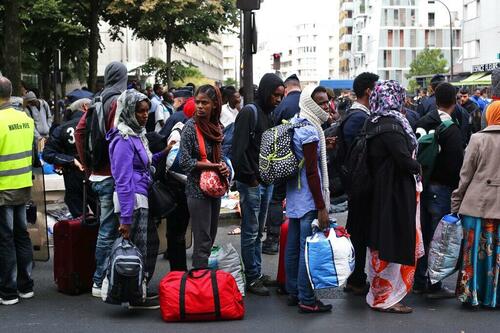
Nearly Half Of French Voters May Support National Rally, And Immigration Is A Major Concern
Nearly Half Of French Voters May Support National Rally, And Immigration Is A Major Concern
Last Friday, an Ipsos poll conducted for the Jean-Jaurès Foundation, Le Monde, and Cevipof indicated that 45 percent of French voters are now considering voting for the National Rally (RN) in the 2027 elections, meaning the anti-migration party’s candidate is favored to win the presidency.
According to Antoine Bristielle, director of the Foundation’s Opinion Observatory, the poll shows that RN “has managed to unite very different electorates around a common foundation, but that its cohesion remains fragile as soon as one moves away from this foundation.”
The Jean-Jaurès Foundation identifies four main profiles of RN voters, which can be grouped into two categories.
The “identity-based liberals” include older, politically engaged voters firmly rooted in the right, as well as the “forgotten France,” which represents “a working-class bloc, more economically vulnerable, marked by a strong sense of abandonment and combining demands for social protection with identity radicalism.”
However, the other two groups are more recent profiles, demonstrating the RN’s expansion to new voters.
The “shifting France,” representing those “less politically engaged and still uncertain,” and the “opportunistic radical right.”
This latter group of voters, seen as “more affluent, more educated, and highly politically engaged,” is, according to the report, “already largely aligned with the RN’s positions” but may have voted for other right-wing parties in the past.
Immigration, as expected, is a paramount topic for at least three of the four groups.
“There are too many immigrants in France” is confirmed by 97 percent of “forgotten France,” 99 percent of “identity-based liberals,” 43 percent of “shifting France,” and 96 percent of “opportunistic radical right.”
As to the statement, “Now, I no longer feel as at home as before,” the percentages of support were 96, 98, 72, and 94, respectively.
The full study is available here.
Tyler Durden
Wed, 05/20/2026 – 02:00

House Lawmaker Introduces Legislation To Expose CCP Exploitation Of Sister City Agreements
House Lawmaker Introduces Legislation To Expose CCP Exploitation Of Sister City Agreements
Authored by Frank Fang via The Epoch Times (emphasis ours),
A House lawmaker has introduced legislation to prevent foreign adversaries, particularly the Chinese Communist Party (CCP), from exploiting sister city partnerships and jeopardizing U.S. national security.
Rep. Chip Roy (R-Texas), who serves on the House Judiciary Committee, introduced the Sister City Transparency Act (H.R.8833) on May 14. In a statement announcing the bill, Roy’s office said local governments across the United States maintain roughly 1,800 sister-city partnerships with foreign municipalities, including 157 with communities in China.
“America’s local communities should never be left vulnerable to foreign influence operations masquerading as cultural exchange,” Roy said in a statement on May 14.
“The Sister City Transparency Act brings much-needed oversight and accountability to these partnerships, helping ensure they serve the interests of the American people—not the strategic ambitions of the Chinese Communist Party or other foreign adversaries.”
Study on Sister City Partnerships
The legislation would direct the comptroller general—the head of the U.S. Government Accountability Office (GAO)—to conduct a study of sister-city partnerships with communities in countries deemed to have “significant public sector corruption,” including Russia and China, the lawmaker’s office explained. According to the language of the bill, the measure would specifically target countries that scored 45 or lower on Transparency International’s 2019 Corruption Perceptions Index.
China scored 41 in the 2019 index and 43 in the 2025 index.
The study would identify how foreign communities select U.S. communities for sister city partnerships, including whether certain economic activities or demographic factors influence those decisions; analyze the activities conducted in these partnerships and their economic and educational outcomes; review what types of information these partnerships make publicly available, including details related to contracts; and review how American communities “safeguard freedom of expression” and mitigate risks such as “foreign espionage and economic coercion” within these partnerships, according to the legislation.
Another part of the study would look into whether these partnerships involve economic arrangements that could make American communities “vulnerable to malign market practices” or educational arrangements that could “diminish the freedom of expression,” according to the legislation. Additionally, it would assess the extent of foreign access to local commercial, educational, and political institutions, and whether foreign actors could achieve “strategic objectives” contrary to U.S. economic or national security interests.
The legislation would also require a study of whether these partnerships are linked to broader foreign malign activities, such as “human rights abuses and academic and industrial espionage,” and how U.S. communities can prevent misuse of visa programs connected to them, according to the legislation.
The comptroller general would have six months to submit a report on its study to six congressional committees, including the armed services and foreign affairs committees in both chambers. The report would include findings, conclusions, recommendations, and, if necessary, a classified annex.
Concerns Over CCP Influence
“The CCP has demonstrated a pattern of exploiting international partnerships to expand influence, gather intelligence, and apply political pressure. Similar to concerns raised with Confucius Institutes, sister city relationships can create vulnerabilities for American communities, including exposure to foreign espionage, economic coercion, and ideological influence operations,” Roy’s office stated.
Similar legislation (S.1351) was introduced in the Senate in April 2025 by Sens. Marsha Blackburn (R-Tenn.) and Thom Tillis (R-N.C.).
“Communist China is exploiting sister city partnerships to achieve its own strategic objectives, and we need to make certain we are not enabling this activity in our own communities,” Blackburn said in a statement at the time. “This legislation would shine a bright light on these partnerships to keep our enemies from furthering their own dangerous agendas.”
Tyler Durden
Tue, 05/19/2026 – 23:25