Category: News
Lowe’s CEO Warns Housing Market “Most Difficult” Since Financial Crisis As DIY Project Demand Crumbles
Lowe’s CEO Warns Housing Market “Most Difficult” Since Financial Crisis As DIY Project Demand Crumbles
Home improvement retailers such as Home Depot and Lowe’s warned this week that consumers remain reluctant to splurge on big-ticket home improvement items, as elevated mortgage rates, high home prices, energy inflation, weakening sentiment, and broader macroeconomic uncertainty weigh on demand.
Let’s begin with Home Depot, which on Wednesday reported mixed first-quarter results. At the same time, management said on the conference call that it is not expecting a “marked improvement in underlying demand.”
Bernstein analyst Zhihan Ma pointed out that Home Depot’s foot traffic has been negative for five straight quarters, underscoring the persistent downturn in the home improvement space.
Ma maintained a “cautious outlook” and expects a “gradual path to a home improvement market rebound,” as high mortgage rates and inflation in material costs do not help the “affordability hurdle for homeowners to engage with big-ticket discretionary projects.”
Fast forward to Wednesday morning, and Lowe’s reiterated its full-year forecasts but warned that households are dialing back big-ticket do-it-yourself projects.
What caught our attention was Lowe’s CEO Marvin Ellison, who warned analysts on an earnings call earlier that:
I think overall this has been the most difficult housing market that I’ve faced in this business since the financial crisis. And as Brandon mentioned, it’s almost exclusively or disproportionately on the DIY customer.
That’s the majority of where our revenue comes from. And so I look at it from this perspective, you know, we’ve delivered four quarters of positive comps in an environment where the DIY has faced more economic pressure than I’ve ever seen before.
DIY softness comes as U.S. housing turnover sits at historic lows because of affordability woes, some of the worst in a generation, and elevated mortgage rates.
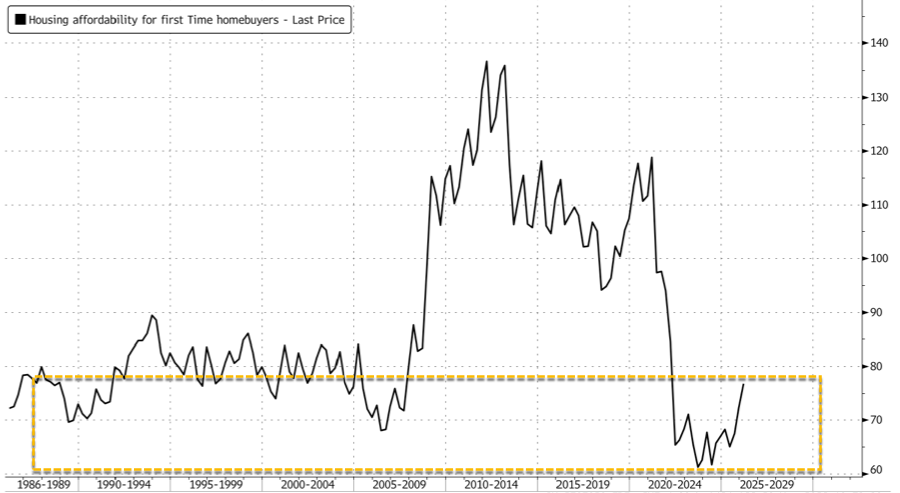
Housing affordability for first-time homebuyers remains at a four-decade low.
This, of course, means fewer home sales, which typically translate into fewer move-in renovations, remodels, flooring upgrades, kitchen projects, and other big-ticket home improvement purchases.
At the start of the week, Wayfair CFO Kate Gulliver issued a similar warning at JPMorgan’s conference, signaling that demand for big-ticket home items is unlikely to recover this year.
Tyler Durden
Wed, 05/20/2026 – 17:20
SpaceX Files For Nasdaq IPO Under Symbol SPCX
SpaceX Files For Nasdaq IPO Under Symbol SPCX
Update (1650ET): As expected, SpaceX filed its S1.
The stock is expected to list on Nasdaq and Nasdaq Texas under the ticker “SPCX.”
No specific share count, price range, or total offering size is finalized yet (placeholders are used).
But, with expectations of a $1.5 trillion market cap, that means SPCX will trade at a 77x LTM Revenue multiple!
Mission and Overview
SpaceX’s mission is to make life multiplanetary, advance scientific understanding of the universe, and extend consciousness to the stars. It positions itself as a vertically integrated builder across Space, Connectivity (Starlink), and AI (via xAI acquisition).
The company has revolutionized space access with reusable rockets (Falcon family, Starship development), built the world’s largest LEO satellite constellation for broadband, and is scaling AI compute and frontier models (Grok) with real-time data from X.
Key Corporate Details
Dual-class structure: Class A (1 vote/share) and Class B (10 votes/share). Elon Musk (founder, CEO, CTO, Chairman) will retain dominant voting control post-IPO (majority of the board via Class B and overall voting power), making SpaceX a “controlled company” under Nasdaq rules.
Basis of presentation: Financials include retrospective recasts for the xAI acquisition (Feb 2026) and X Holdings (via xAI, 2025), plus a 5-for-1 stock split (May 2026).
Underwriters: Led by Goldman Sachs, Morgan Stanley, BofA, Citigroup, J.P. Morgan, and others.
Consolidated Financial Highlights (preliminary/selected):
Q1 2026: Revenue $4.69B, operating loss $1.94B, Adjusted EBITDA $1.13B.
FY 2025: Revenue $18.67B, operating loss $2.59B, Adjusted EBITDA $6.58B.
Heavy capex (especially AI) and Starship R&D; Starlink (Connectivity) is the current profit engine.
Business Segments (as of/through Q1 2026 and FY 2025)
Space (launches, Dragon, Starship development):
Dominant global launch provider (>80% of mass-to-orbit in recent years, >99% Falcon success rate).
Key vehicles: Falcon 9 (reusable, ~23t to LEO), Falcon Heavy (~64t), Dragon (cargo/crew to ISS), Starship (in testing, targeting full reusability and massive scale).
Revenue: $619M (Q1 2026), $4.1B (2025). Still investing heavily in R&D/Starship.
Connectivity (Starlink):
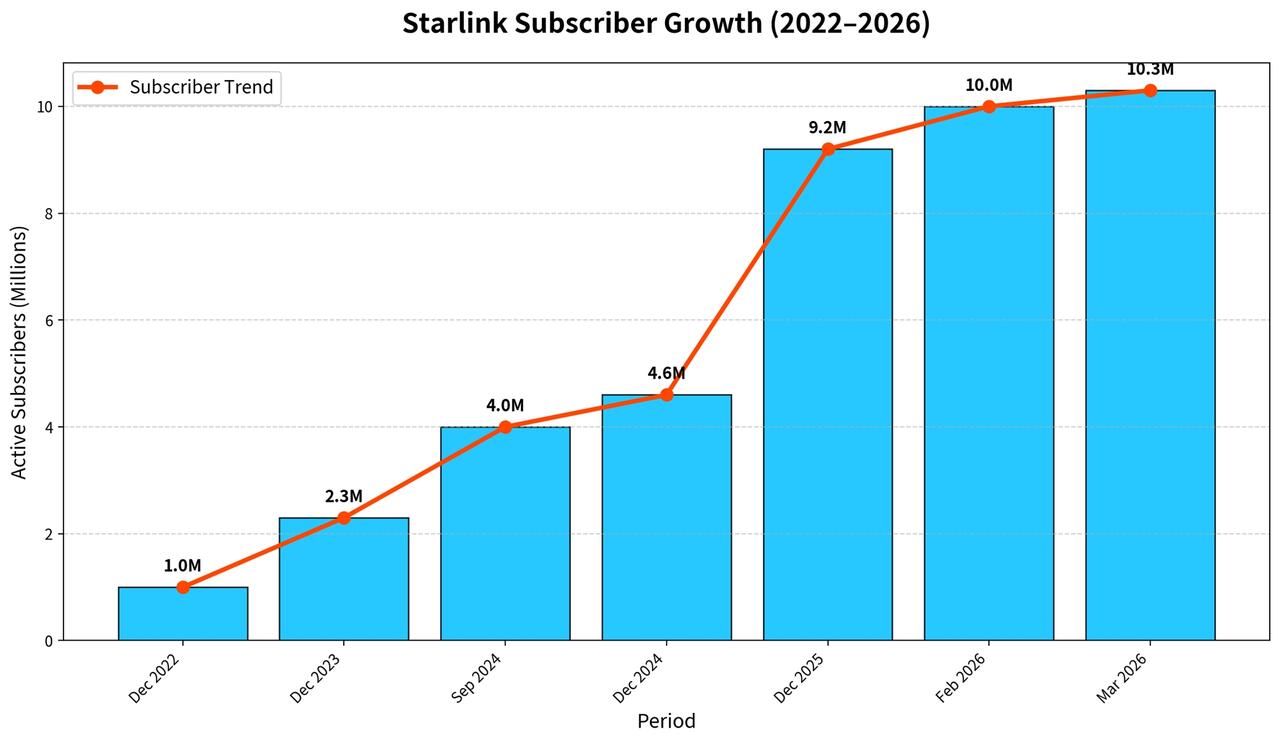
~9,600 broadband/mobile satellites in LEO (~10.3M subscribers across 164 countries/territories as of Mar 31, 2026).
High-speed, low-latency broadband (median ~225 Mbps peak for residential); expanding enterprise, government, maritime/aviation, and satellite-to-mobile (direct-to-phone, ~650 dedicated satellites, ~7.4M devices in ~30 countries).
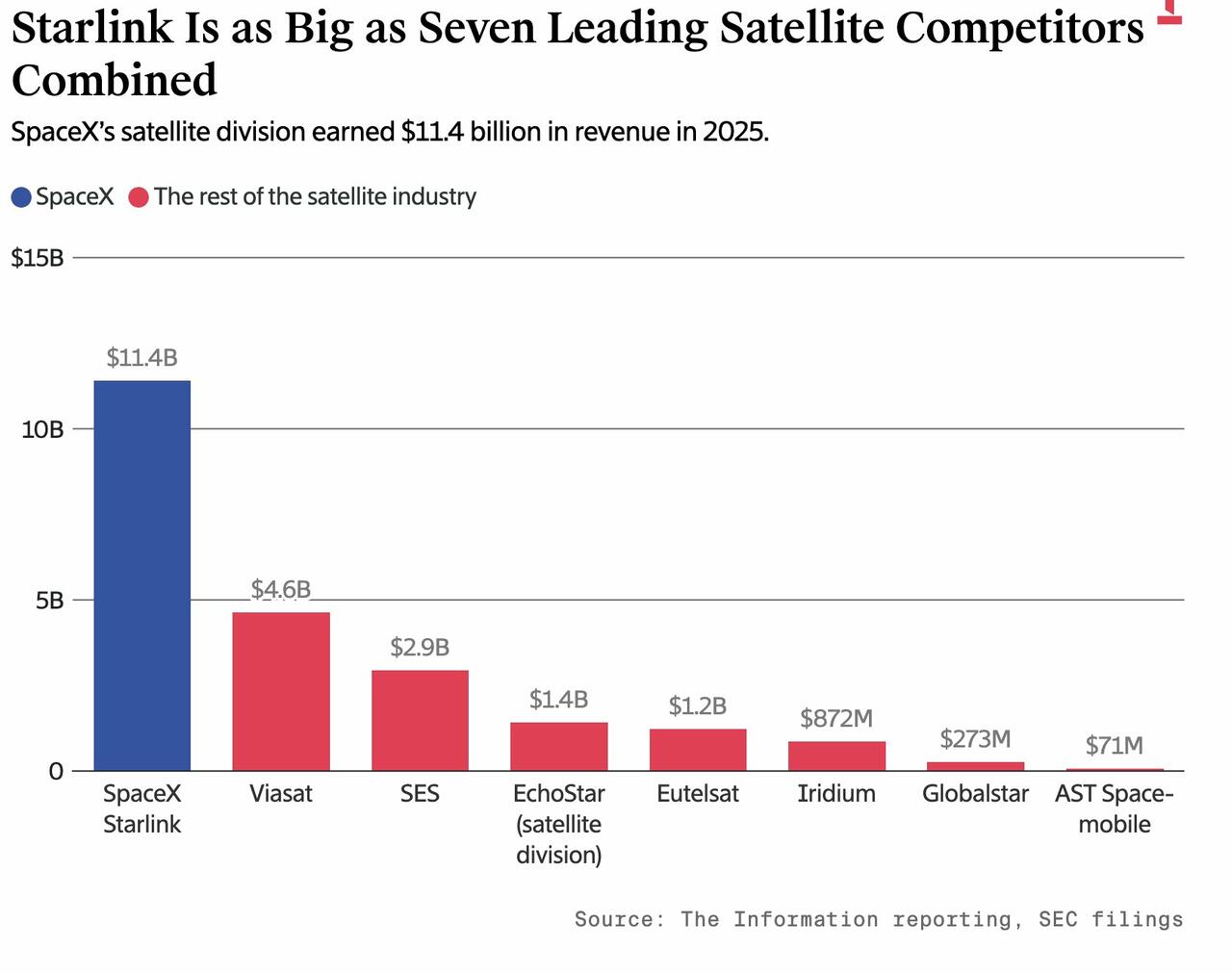
Strong growth: Revenue $3.26B (Q1 2026), $11.4B (2025, +~50% YoY); highly profitable at segment level.
AI (xAI/Grok/X integration):
Gigawatt-scale terrestrial AI training clusters (e.g., COLOSSUS); plans for orbital AI compute satellites (using solar power, starting ~2028).
Grok frontier models (truth-seeking, strong scientific reasoning benchmarks); integrated with X (~1.3B supported accounts, 550M MAUs, hundreds of millions of daily posts).
Revenue $818M (Q1 2026), $3.2B (2025), but heavy losses due to compute/infrastructure investments.
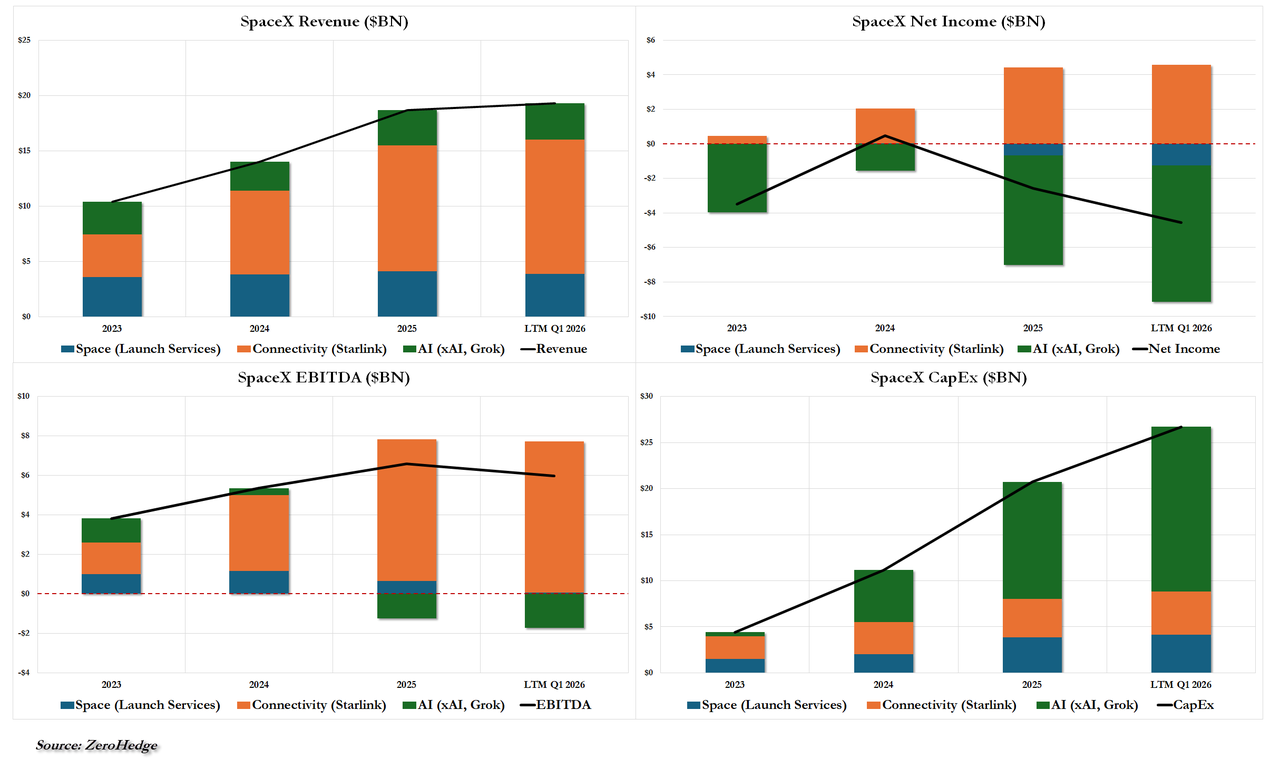
Here’s the financials visualized (xAI is represented by the green slabs)…
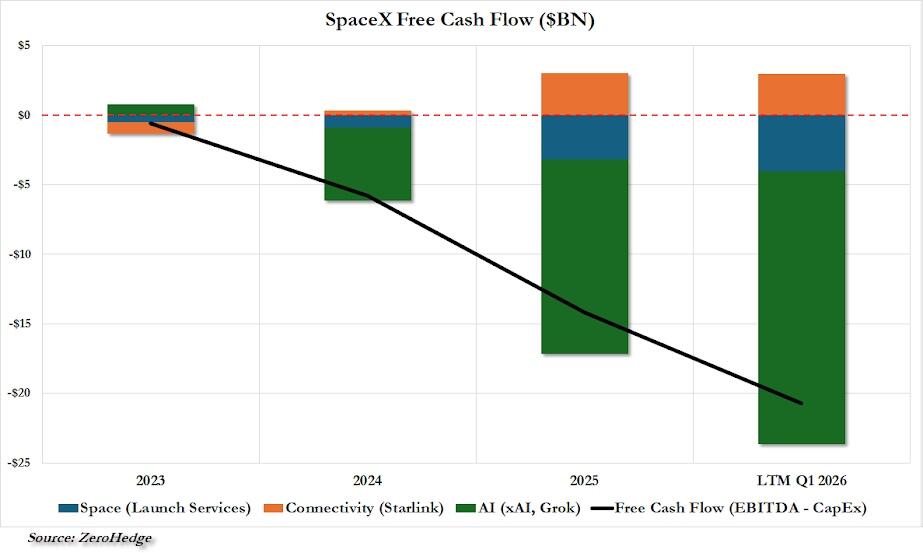
Free cash flow struggling under the weight of that giant green slabs…
So, xAI is the giant money suck while Starlink keeps the engine running (but despite breaking out in 2025, Starlink user growth seems to be slowing a little):
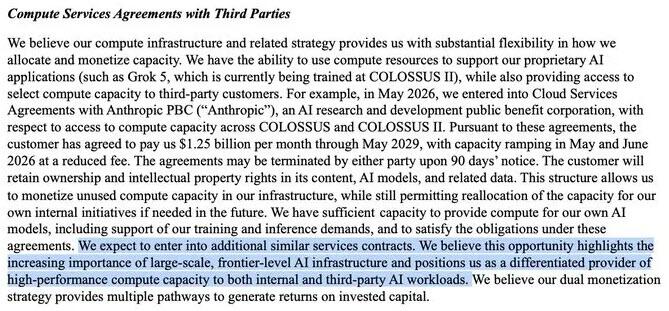
Finally, one thing that stood out was that Anthropic is paying xAI $1.25BN per month (through May 2029) to utilize ‘Colossus’ for AI compute.
Musk took to X to explain further his vision for this segment:
As the recently expanded partnership with Anthropic demonstrates, SpaceX is offering AI compute as a service at significant scale.
We are in discussions with other companies to do the same.
Over time, especially with orbital data centers, we expect to serve AI at extremely high scale.
If you build it (in space), they will come?
Read the full 270-page S1 here…
* * *
Ahead of Thursday’s scheduled launch of SpaceX’s Starship V3 rocket, there are indications that Elon Musk’s rocket and AI company could release its IPO filing as soon as this afternoon, giving investors, analysts, and competitors a rare look inside the finances and ownership structure of Musk’s space empire.
Starship and Super Heavy V3 moved to the pad at Starbase for final testing and preparations for launch pic.twitter.com/vU21Owvoif
— SpaceX (@SpaceX) May 19, 2026
On Tuesday, The Wall Street Journal reported that Goldman Sachs secured the lead-left role on SpaceX’s upcoming IPO, positioning it as the top banker on what could become one of the largest public offerings in history.
SpaceX is expected to seek a valuation of up to $2 trillion, raising an estimated $75 billion to help fuel its AI and Starship rocket-launch ambitions after merging with xAI and pursuing plans for orbital data centers.
The company confidentially filed IPO documents with the SEC in early April, and its public S-1 filing is expected at any moment today.
Last Friday, Reuters reported that the IPO is set for pricing on June 11, followed by a June 12 debut.
The ticker “SPCX” leads the Polymarket bet, “What will SpaceX’s public ticker be?” at 91% by lunchtime in New York.
Will SpaceX’s public ticker be another ticker?
Yes 91% · No 9%
View full market & trade on Polymarket
Elon Musk virtually attended a summit in Tel Aviv on Monday, where he said, “We’ve got to get the SpaceX IPO stuff going here pretty soon.” Those comments put a bid into AST SpaceMobile, EchoStar, and Rocket Lab.
Bloomberg’s Eric Johnson outlined what exactly to look for when the S1 drops:
The company, known formally as Space Exploration Technologies Corp., is expected to pick Nasdaq as its listing venue, which would set it up for potential inclusion in the Nasdaq 100.
The IPO filing could include key financial details like revenue and net income across its launch, Starlink and artificial intelligence businesses, as well as capital spending on key programs like its colossal Starship rocket.
key programs like its colossal Starship rocket * SpaceX’s filing is set to reveal the hierarchy of the banks running the deal. Goldman Sachs Group Inc. and Morgan Stanley are the lead firms, with Bank of America Corp., Citigroup Inc. and JPMorgan Chase & Co. also working on the transaction, people familiar with the matter have said.
SpaceX will list its largest shareholders, including Musk himself and Alphabet Inc.’s Google; its investors also include Valor Equity Partners, Sequoia and Andreessen Horowitz.
We should find out how voting control of the company will be set up. SpaceX is considering a dual-class share structure, people with knowledge of the plans have said, which could allow Musk to maintain control of the company even with a minority stake.
The filing likely won’t include information on the price range per share, number of shares offered, shares outstanding or precise shareholdings. Those usually come at the start of formal marketing, which could be as early as June 4, ahead of pricing as soon as June 11, Bloomberg News reported.
The Information’s Cory Weinberg published five charts making sense of the IPO numbers:
1. SpaceX is expected to file its S-1 publicly as soon as tomorrow.
We’ve reviewed parts of the draft prospectus and tried to make sense of the numbers. Here are 5 charts that explain the company before the largest IPO in history goes live.
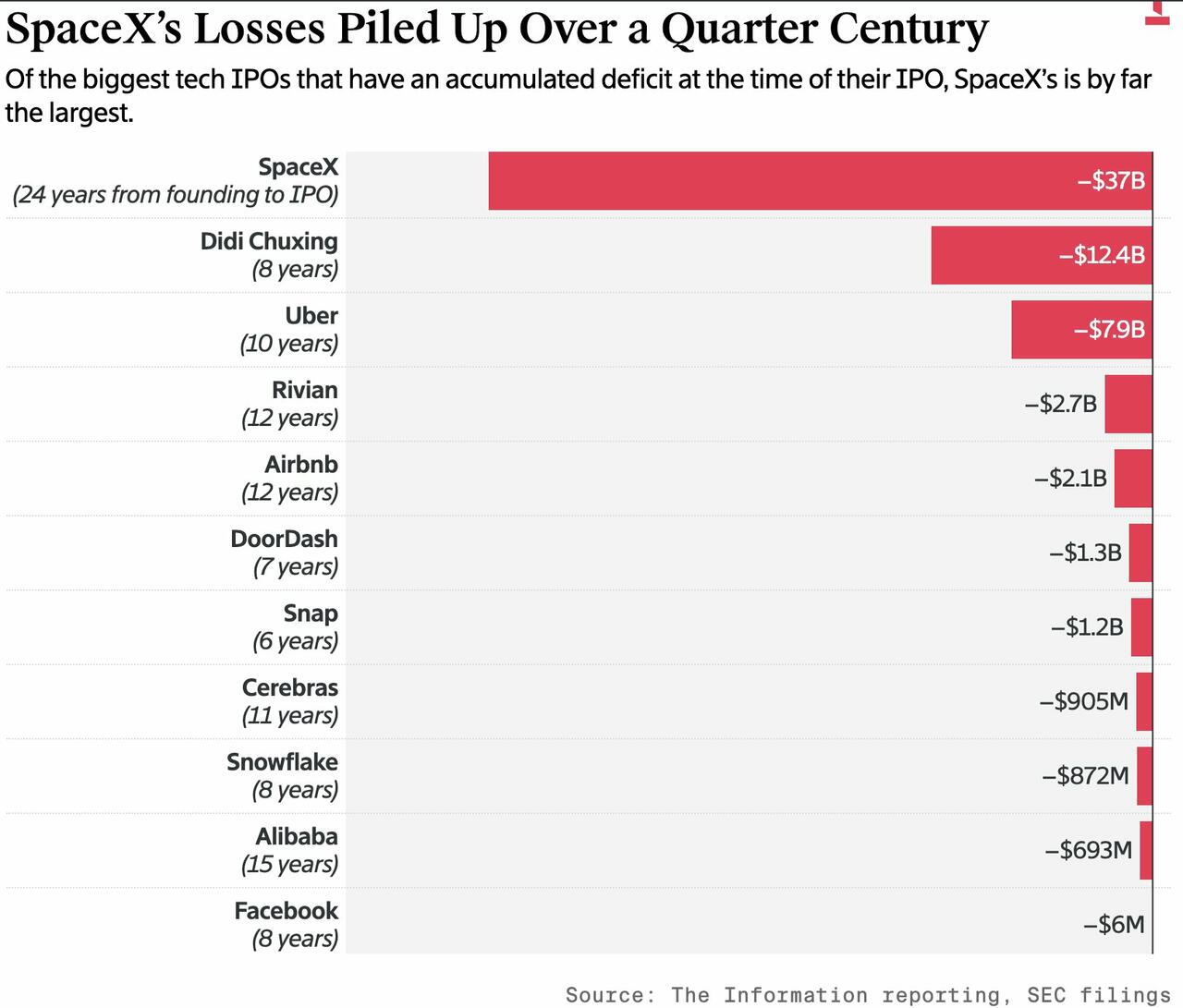
2. The company has accumulated $37 billion in losses over its 24-year history — larger than what the next 10 major loss-making tech IPOs *combined* had to disclose at their offerings.
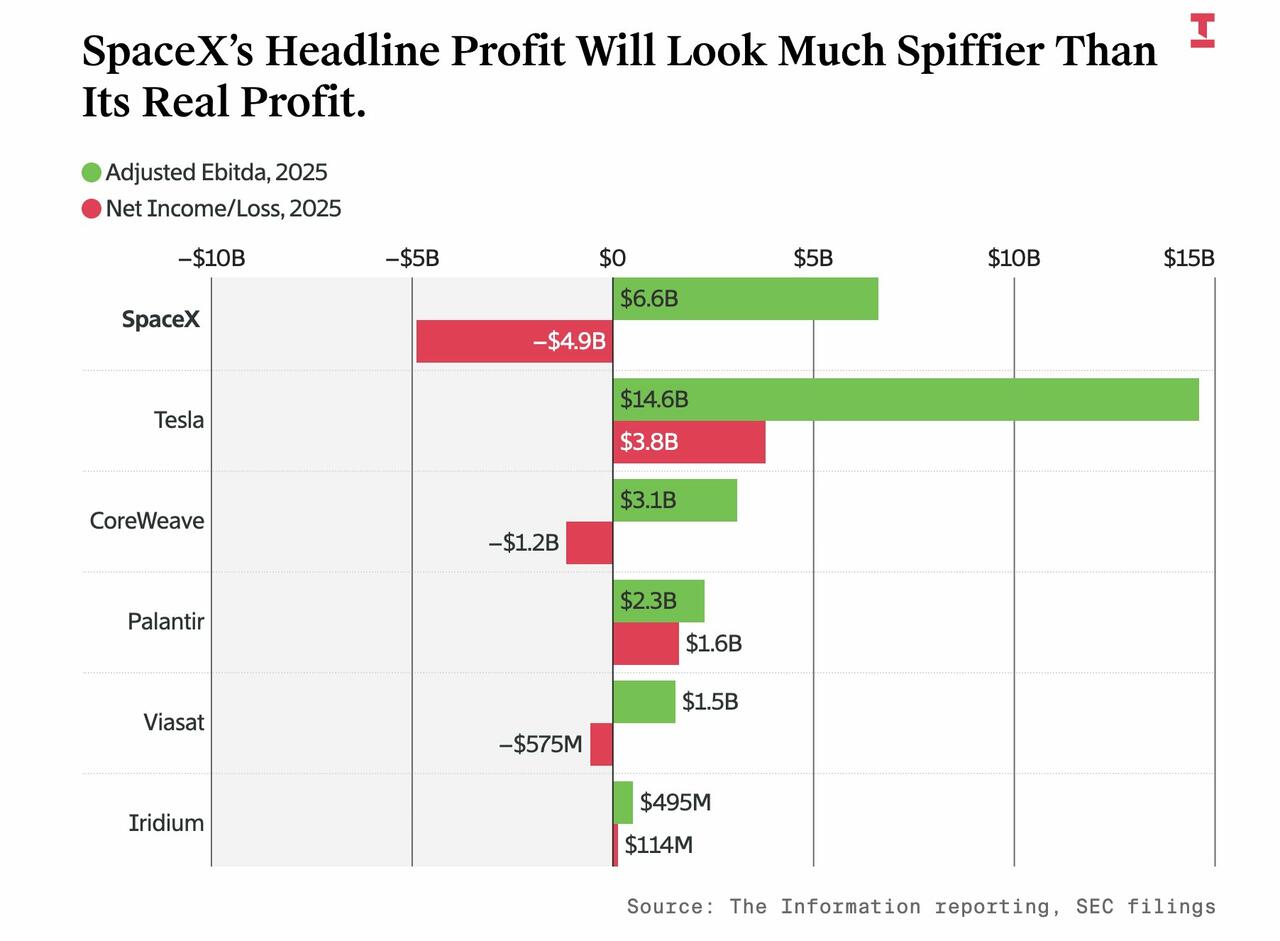
3. SpaceX will tell investors it has $6.6 billion in ‘adjusted’ profit last year. Under standard accounting, it lost $4.9 billion.
That gap between headline profit and actual profit is larger than at CoreWeave, Viasat, or Tesla.
4. Starlink dominates. The satellite internet business generated $11.4 billion in revenue last year — more than 7 leading publicly traded satellite communications operators combined.
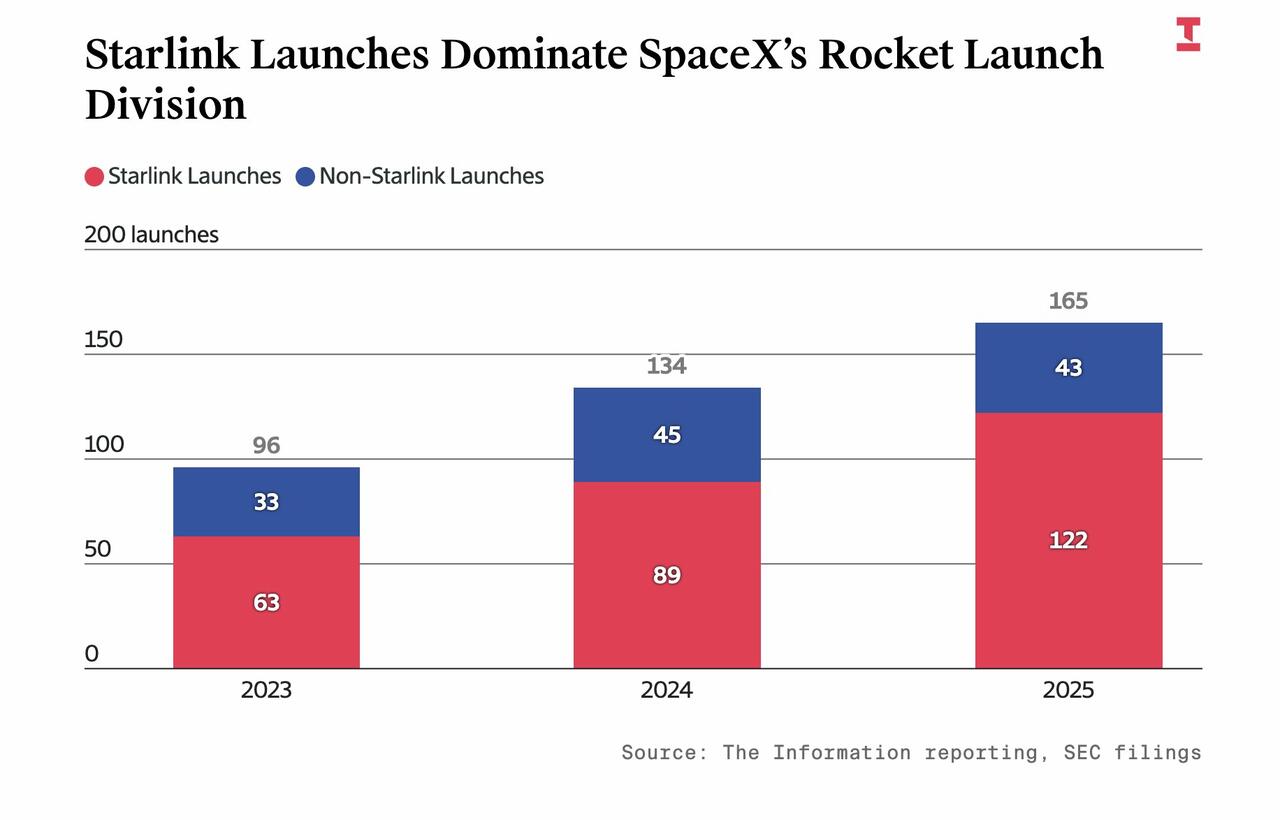
5. The Space segment — SpaceX’s launch business — grew only 8% last year. That’s because about three-quarters of Falcon 9 launches were for internal Starlink missions rather than outside customers.
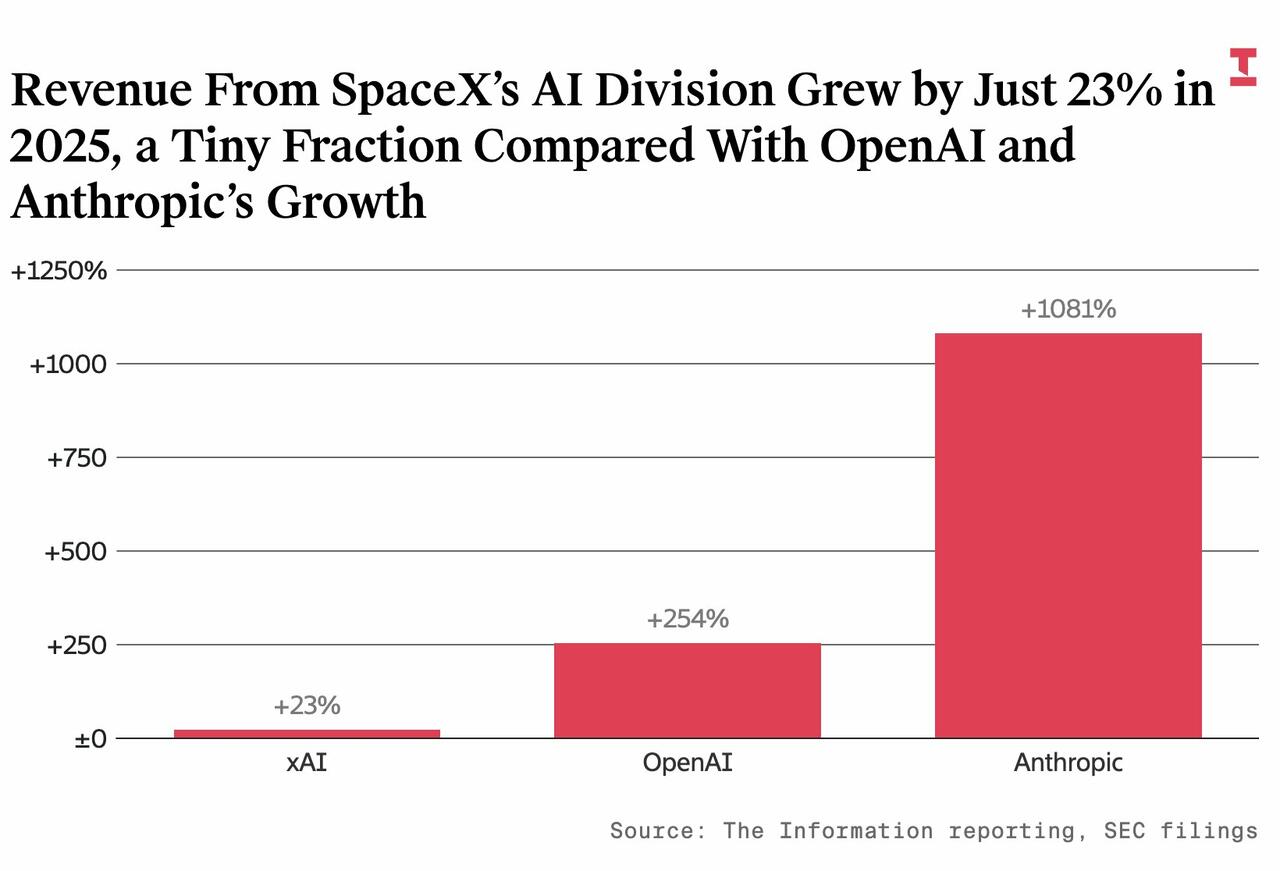
6. The AI segment (X plus xAI) grew 23% last year, compared to over 1,000% for Anthropic and nearly 300% for OpenAI. xAI was slowest-growing of the major AI labs.
View Weinberg’s report here.
With SpaceX set to be the first out of the gates among the three giant tech IPOs, we can’t help but wonder how well the record high market will absorb such supply (and what will be sold to make room for it)…
Shares of Goldman Sachs and Morgan Stanley were up around 4% during the lunch hour. These banks are expected to be the lead managers on the IPO.
Tyler Durden
Wed, 05/20/2026 – 17:00
https://www.zerohedge.com/technology/watch-watch-spacexs-ipo-filing-drop-imminent
Nvidia Unchanged Despite Big Earnings Beat And Solid Guidance
Nvidia Unchanged Despite Big Earnings Beat And Solid Guidance
As we discussed extensively in our preview, besides the Q1 revenue and guidance ($82BN+ and $90BN whisper respectively), Wall Street was expecting to get more color on the following topics during today’s call and Q&A:
Potential for increased shareholder cash returns,
Vera Rubin ramp timing (2H 26E),
Gross margin durability (~75% amidst continued memory/other cost inflation),
Update to the $1 Trillion 25-27 forecast, esp. contribution from LPU racks, CPU and Vera Rubin Ultra, not included before
Potential upside from agentic AI to the server CPU business;
Competitive landscape changes against Google TPU, agentic CPU, other ASICs.
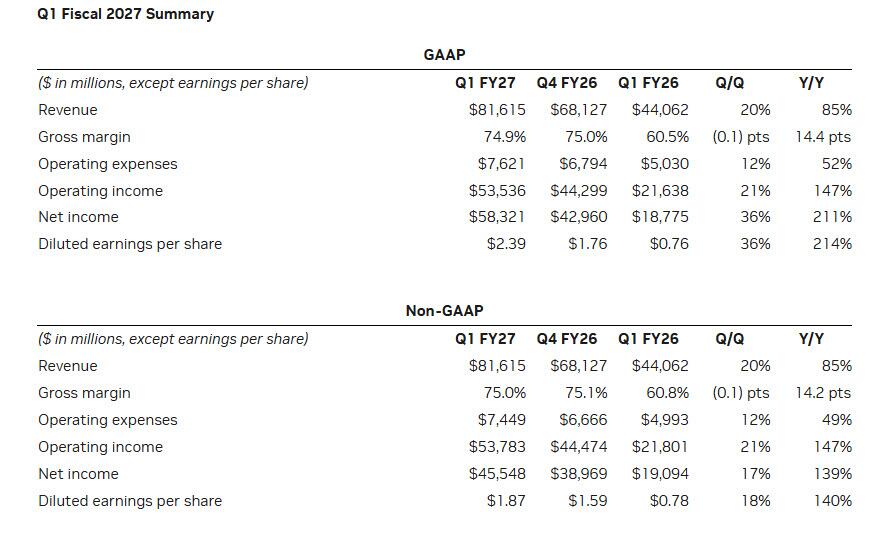
With that in mind, here is what the world’s biggest company just reported for Q1:
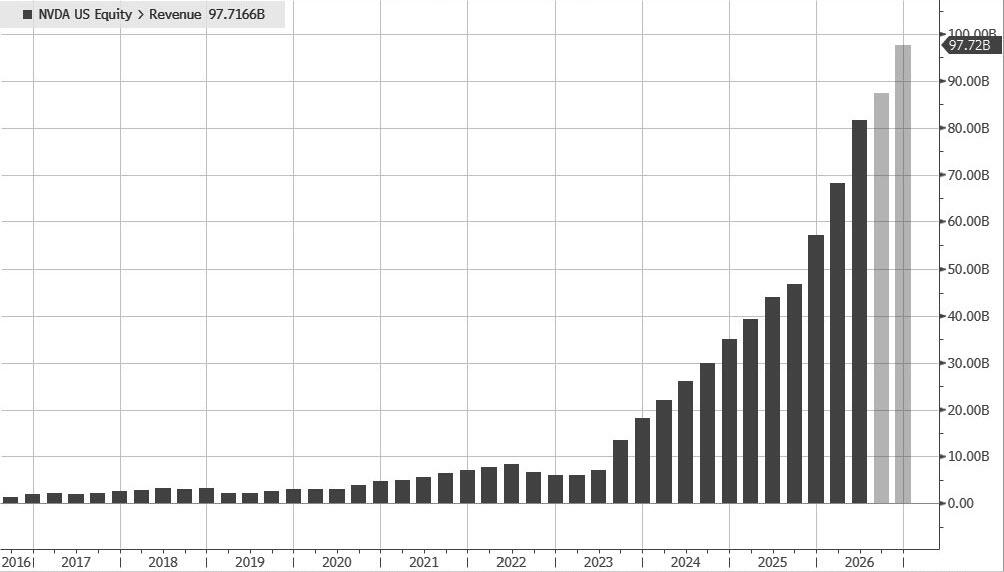
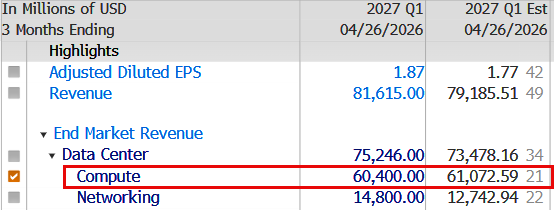
Revenue $81.62BN, beating Exp $79.19BN, but a bit light of the $82BN whisper
Adj EPS $1.87, beating Exp $1.76
Adj. Gross Margin 75%, beating Exp. 74.5%
Solid all around.
The company’s all-important disclosed Data Center revenue was a record $75.2 billion in Q1, up 21% from the previous quarter and up 92% from a year ago. Nvidia also said that Vera Rubin is on track for second half of 2026.
“The buildout of AI factories — the largest infrastructure expansion in human history — is accelerating at extraordinary speed,” said Jensen Huang, founder and CEO of NVIDIA. “Agentic AI has arrived, doing productive work, generating real value and scaling rapidly across companies and industries. NVIDIA is uniquely positioned at the center of this transformation as the only platform that runs in every cloud, powers every frontier and open source model, and scales everywhere AI is produced — from hyperscale data centers to the edge.”
Looking ahead, the company guided to revenue of $91.0 billion (plus or minus 2%), which is on top of the whisper number that had been discussed earlier. Certainly a solid guide, especially since NVIDIA is not assuming any Data Center compute revenue from China in its outlook.
Some more guidance:
Additionally, gross margins are expected to be 74.9% and 75.0% (GAAP and non-GAAP) plus or minus 50 basis points.
Operating expenses are expected to be approximately $8.5 billion and $8.3 billion (GAAP and non-GAAP, respectively).
A quick word on margins: as Bloomberg explains, 75% in an environment where, as the CFO defends it, they are shifting between architectures and Blackwell-based platforms are ramping up. Typically new chip ramps pressure margins because yields and supply chains can be messy at the start/early on. Nvidia holding at 75% is good, if almost unrealistic.
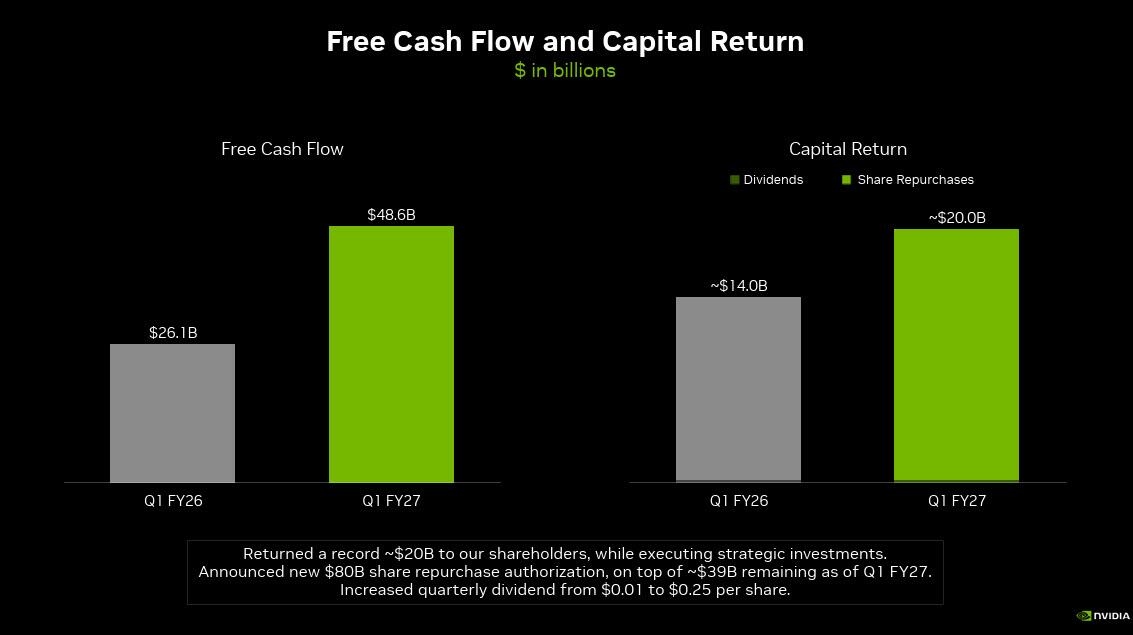
In Q1, the company generated $48.6 billion in free cash flow, a staggering amount, which helped fund $20.0 billion in shareholder returns in the form of shares repurchased and cash dividends (as of the end of the first quarter, the company had $38.5 billion remaining under its share repurchase authorization). More importantly, the Board of Directors approved an additional $80.0 billion to the Company’s share repurchase authorization. Also of note, Nvidia’s cash and marketable debt were $50 billion at the end of the quarter. That was down by a couple of billion dollars.
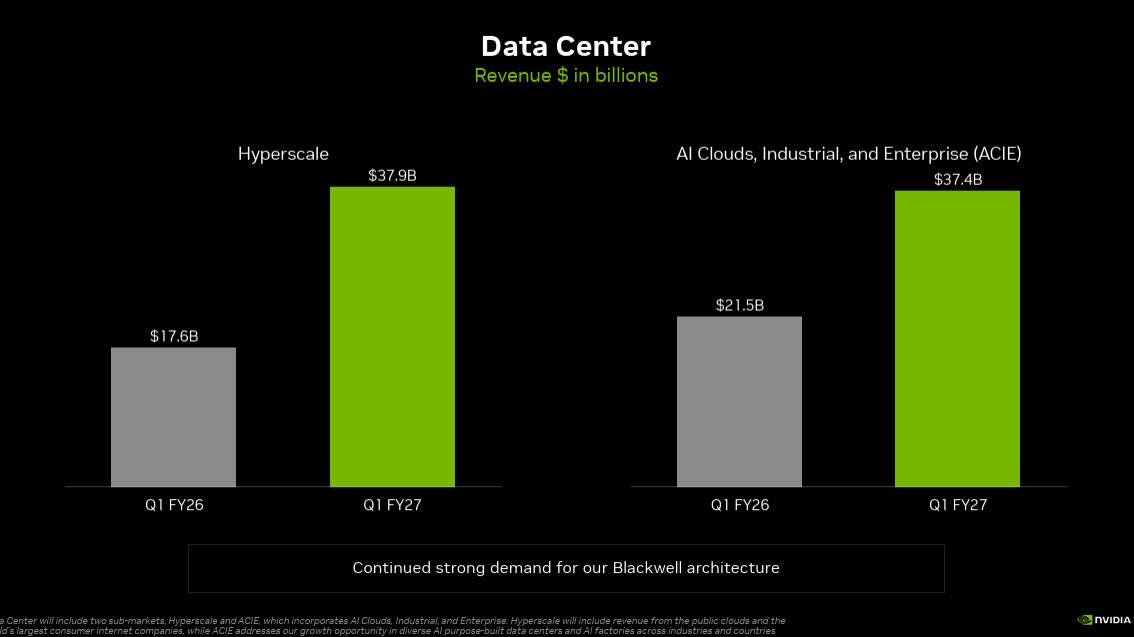
Another notable thing is that NVIDIA said it was transitioning to a new reporting framework that “better reflects its current and future growth drivers.” NVIDIA will have two market platforms — Data Center and Edge Computing.
Within Data Center, NVIDIA will report two sub-markets, Hyperscale and ACIE, which incorporates AI Clouds, Industrial and Enterprise. Hyperscale will include revenue from the public clouds and the world’s largest consumer internet companies, while ACIE addresses NVIDIA’s growth opportunity in diverse AI purpose-built data centers and AI factories across industries and countries.
Edge Computing highlights data processing devices for agentic and physical AI including PCs, game consoles, workstations, AI-RAN base stations, robotics and automotive.
Under the previous sub-markets, Data Center compute revenue was a record $60.4 billion, up 77% from a year ago and up 18% sequentially. Data Center networking revenue was a record $14.8 billion, up 199% from a year ago and up 35% sequentially. The only problem: Compute missed expectations, which probably explains why NVDA will no longer break it out.
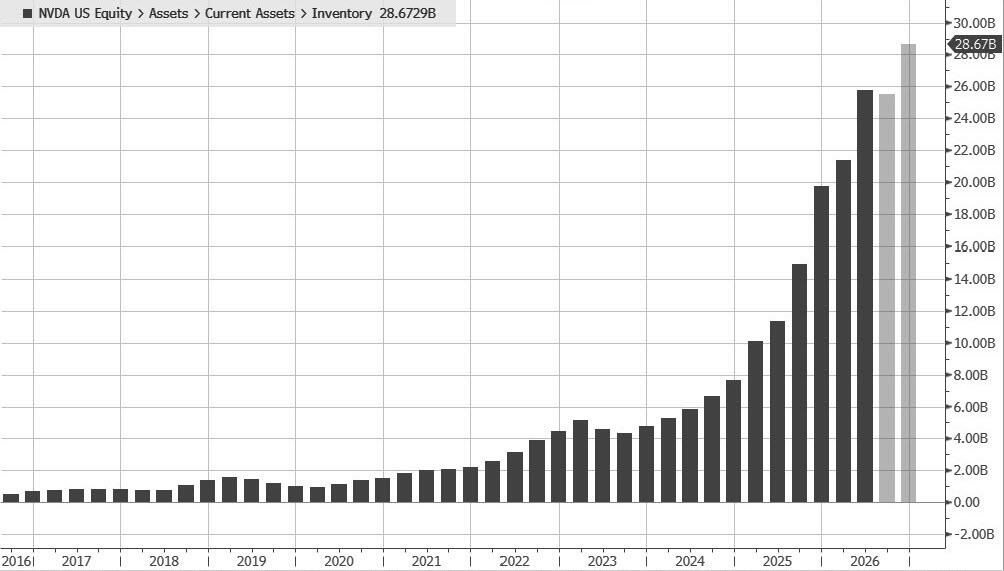
And another red flag: inventory soared. Usually this is a horrible sign for component makers. In this case Nvidia is saying that it has been spending to secure strategic inventory and capacity to “meet demand beyond the next several quarters.” Of course, there would not be a shortage to begin with if inventory was not being massively stockpiled.
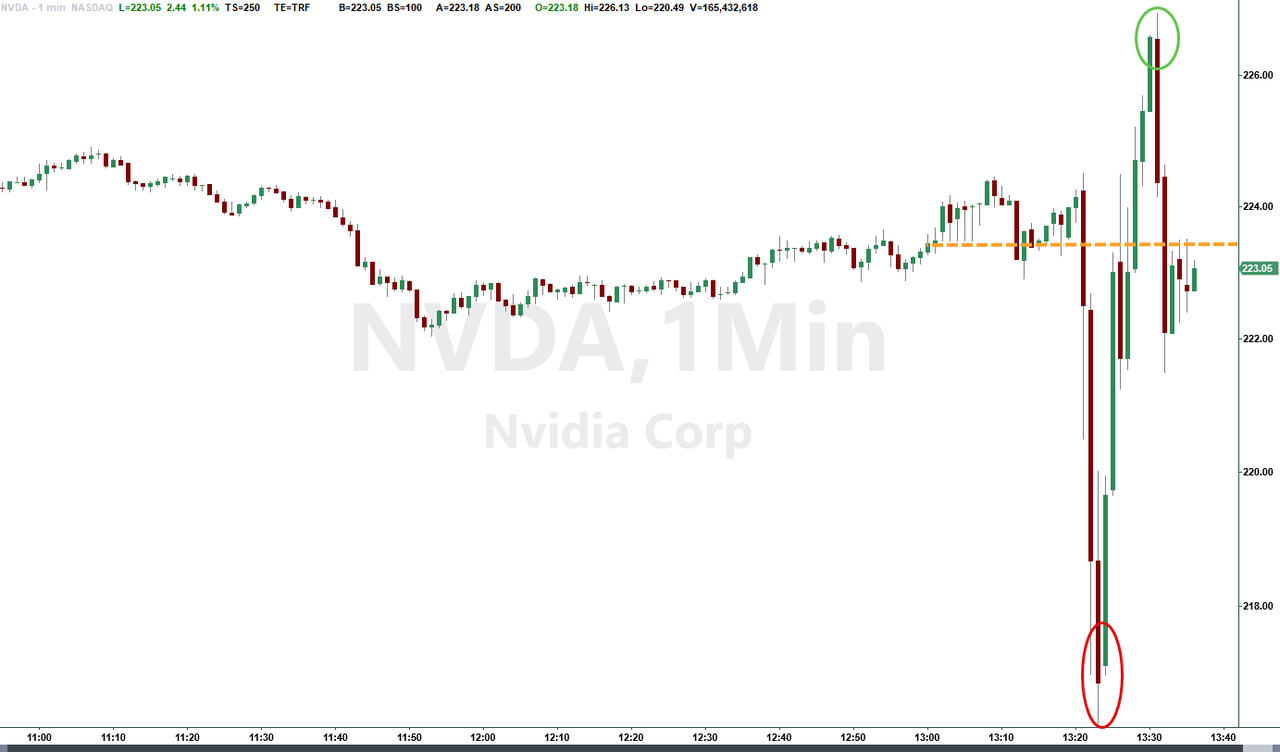
In any case, the market is glossing over the negatives, and focusing on the solid beat and guidance (even if compute appears to be lagging), and as a result after briefly dumping then pumping, the stock is unchanged, which means all that options traders who were betting on a 5.5% move after hours are about to see their calls and puts expire worthless.
Tyler Durden
Wed, 05/20/2026 – 16:48
https://www.zerohedge.com/markets/nvidia-unchanged-despite-big-earnings-beat-and-solid-guidance
A Troubling Trend: Why More Workers Are Tapping 401(k)s Early And How To Resist
A Troubling Trend: Why More Workers Are Tapping 401(k)s Early And How To Resist
Authored by Due via The Epoch Times,
What’s the main goal of your 401(k)? Well, my dear Watson, it’s to provide for your retirement. Specifically, it’s a long-term investment that benefits from compound interest. But for a record number of Americans, the “long term” is taking a back seat to immediate financial struggles.
In 2025, 6 percent of Vanguard 401(k) plan members took hardship withdrawals. That’s a big jump from 4.8 percent in 2024 and much higher than the roughly 2 percent annual rate we saw before the pandemic.
This trend, highlighted by the World Economic Forum and MarketWatch, paints an alarming picture of the American workforce’s financial health. Costs are rising, stress is growing, and well-intentioned regulatory changes are having unintended consequences.
That said, now is the time to investigate why this is happening and to identify the hidden costs. And, most importantly, you need realistic ways to avoid making your retirement nest egg an emergency fund.
The Breakdown: What’s Driving the Surge?
It’s not a coincidence that hardship withdrawals are at an all-time high. This is the result of several powerful economic forces colliding:
A Squeeze of Rising Costs and Financial Stress
It’s not a secret that life has gotten more expensive. Even though some metrics indicate a slowdown in inflation, the cumulative effect of price hikes in groceries, housing, and other essentials over the last few years has significantly reduced consumer purchasing power. As an example, consumer prices are approximately 25 percent higher than they were in January 2020.
As such, a small unexpected expense can trigger a crisis for many families with little to no financial buffer. In fact, according to a Bankrate survey, just 47 percent of Americans have sufficient liquidity or access to funds to cover a $1,000 emergency expense.
The Urgent Nature of the Withdrawals
These withdrawals aren’t for vacations or new cars. According to Vanguard, the median withdrawal amount in 2025 was $1,900. And, among the reasons people tapped their 401(k)s, these were the most common:
Avoiding foreclosure or eviction (36 percent)
Medical expenses (31 percent)
Tuition (13 percent)
Primary residence repairs (11 percent)
Primary residence purchase (5 percent)
Ultimately, withdrawals represent a broader challenge: Americans have relatively few retirement savings at their disposal.
Lowered Hurdles Have a Positive Impact
Ironically, some recent regulatory changes intended to ease the burden may be contributing to the rise. As a result of legislation such as the SECURE Act 2.0 (SECURE refers to Setting Every Community Up for Retirement Enhancement.) and legislation from the pandemic era, it’s now significantly easier to access funds in a 401(k). Depending on the situation, the rules now allow withdrawals of up to a defined amount (like $1,000) without penalty for “unforeseeable or immediate financial needs.”
As important as this flexibility is in a real catastrophe, it also lowers the psychological and logistical bar to leveraging these funds. The result, though, is that your retirement account looks more like a savings account, which is a very dangerous mentality.
The True Cost of ‘Easy Money’
When you’re facing eviction or a huge medical bill, $5,000 from your 401(k) can seem like a lifeline. But that lifeline comes at a heavy price, one that is often overlooked in times of crisis, such as the following.
Immediate Tax Consequences
Unlike a 401(k) loan that you repay with after-tax funds, a hardship withdrawal is permanent. Therefore, the withdrawal amount is generally taxable as ordinary income. When you take out $10,000, for example, and are in the 22 percent tax bracket, you’ll immediately owe $2,200 in federal taxes, which reduces your actual relief to $7,800.
Potential Penalties
If you’re under 59 ½ years old, you will likely face an additional 10 percent early withdrawal penalty on top of income tax. That’s another $1,000 gone from your $10,000 withdrawal, bringing the total cost of immediate access to 32 percent.
The Devastating Sacrifice of Compound Growth
Obviously, this is the highest and most invisible cost. Imagine if the $10,000 you withdrew had been left to grow for another 20 years. With an average annual return of 7 percent, that money would have grown to about $38,700. By taking out that money now, you are not only borrowing $10,000 from your future self; you’re erasing almost $39,000 from your retirement account.
This is a magic trick. That’s the power of compound interest. Knowing this sooner will help you realize that 401(k) withdrawals aren’t “easy money”—they’re incredibly expensive loans.
The Irony: A Healthy System With Struggling Participants
An astounding contradiction can be found within the same 2025 data: even though record numbers of people are tapping into their 401(k)s for emergencies, the average 401(k) balance actually grew by 13 percent since 2024.
In addition, more recent analysis from Fidelity shows average 401(k) balances climbed more than 11 percent, indicating that nest eggs have rebounded after recent swings in the markets.
Although this may seem confusing, it indicates a widening gap. While many workers contribute consistently and benefit from employer matches, consistent contributions, and strong market conditions. Their wealth is growing.
Meanwhile, the 6 percent of participants who resort to hardship withdrawals constitute a vulnerable segment of the population. Although the retirement system appears healthy on the surface, they’re suffering the brunt of the affordability crisis. This is a powerful reminder that “average” statistics can mask serious underlying problems.
Realistic Strategies to Keep Your 401(k) Locked
If recent data tells us anything, it’s that relying on your 401(k) as a backup checking account is a high-stakes gamble. To ensure your retirement fund remains dedicated to your future, you need a proactive defense. Here are realistic, actionable options to keep that vault closed.
Re-Evaluate and Automate Your Budget
This is the foundational work that makes everything else possible. If you don’t track your spending, you can’t control it. Before you can build momentum, you have to stop the bleeding by identifying exactly where your cash is going.
Audit your “leaks.” For one month, track every cent. You’ll likely find “ghost” expenses, like unused subscriptions, frequent small convenience purchases, or delivery fees, that are quietly draining your ability to save.
Establish a “needs vs. wants” hierarchy. Be ruthless. Shelter, utilities, groceries, and minimum debt payments are non-negotiable needs. Everything else is a want. If your financial foundation feels shaky, wants must be the first thing to go.
Use the right tools. Modern technology makes this much less painful. Using financial apps, such as WalletHub or Monarch Money, can put you in total control. By linking your accounts, your expenses are automatically categorized, allowing you to see your spending patterns in real-time. These tools also allow you to effortlessly manage and cancel subscriptions in one place, ensuring you aren’t paying for services you no longer use.
Build a ‘Firewall’ Emergency Fund
An emergency fund is the only thing standing between a flat tire and a raided retirement account.
Start with a mini-goal. Don’t let the “six months’ expenses” rule overwhelm you. Start with a small target you can afford, whether it’s $300 or $1,000. That single amount covers the vast majority of common shocks, from a basic car repair to an urgent medical copay.
Make it invisible. Set up a recurring transfer from your checking account to a separate high-yield savings account on the day you get paid. Even $25 or $50 per pay period builds a psychological and financial buffer. If the money never hits your main account, you won’t miss it.
Explore Smarter Alternatives for Fast Cash
Before you touch your 401(k), exhaust every other avenue. Retirement should be the last door you open.
Low-interest personal loans. You can manage debt or major expenses with a low-interest personal loan from a credit union or bank without incurring heavy taxes or losing compounding interest. For well-qualified borrowers, fixed-rate loans offer predictable, manageable monthly payments with rates as low as 10 percent.
0 percent APR balance transfers. If high-interest credit card debt is the primary stressor, a zero percent introductory APR card can give you a 12-to-18-month window to pay down the principal without accruing more interest.
Community and state programs. Local and federal organizations assist with housing and utility crises, such as 2-1-1, HUD, and the Homeowner Assistance Fund (HAF). Before sacrificing your future security, take advantage of these programs designed to prevent eviction and foreclosure.
A Final Safety Valve: The 401(k) Loan
If you have truly exhausted every other option and are facing an immediate crisis, such as eviction, a 401(k) loan is generally a better choice than a hardship withdrawal.
Why is it better? Essentially, you’re borrowing money from yourself and paying the interest back to yourself. In addition, it does not trigger the 10 percent early withdrawal penalty or immediate income tax.
The critical caveat. You must repay it, typically within five years, via payroll deduction. Be aware that if you leave your job, the remaining balance is often due immediately. If you can’t pay it back, it defaults into a withdrawal—triggering the exact taxes and penalties you were trying to avoid at a time when you may be least able to afford them.
Conclusion: Protecting Your Future, One Day at a Time
Vanguard’s 2025 data is alarming. Americans are increasingly financially vulnerable to the point that their primary tool for future security is being wiped out by today’s pressures. This is not a sustainable path.
The first step is to understand the “why” behind this trend, which is rooted in financial stress, urgent needs, and simplified rules. The second step is to acknowledge the true, exorbitant cost of this immediate relief.
In the end, building a financial infrastructure that can withstand storms is the key to preventing your 401(k) from being a go-to ATM. Start with a real budget and an emergency fund, no matter how small. Even when today’s demands seem overwhelming, you must discipline yourself and put your future first.
Remember, your 401(k) shouldn’t be viewed as a piggy bank but as a tool to ensure you’ll have the lifestyle you want in your golden years. Don’t risk your retirement for a temporary fix. The costs are simply too high.
By John Rampton
The views and opinions expressed are those of the authors. They are meant for general informational purposes only and should not be construed or interpreted as a recommendation or solicitation. The Epoch Times does not provide investment, tax, legal, financial planning, estate planning, or any other personal finance advice. The Epoch Times holds no liability for the accuracy or timeliness of the information provided.
Tyler Durden
Wed, 05/20/2026 – 16:20
Trump Order Increases Scrutiny Of Illegal Immigrants’ Banking Activity
Trump Order Increases Scrutiny Of Illegal Immigrants’ Banking Activity
Authored by Aldgra Fredly via The Epoch Times,
President Donald Trump signed an executive order on May 19 directing Treasury Secretary Scott Bessent to provide banks with an advisory on financial risks posed by individuals living in the country illegally.
In his order, Trump urged banks to pay attention to credit risks posed by offering mortgage loans, car loans, credit cards, and other consumer credit products “to the inadmissible and removable alien population.”
“Many of those borrowers face the possibility of the loss of wages due to removal or their employers’ decisions to comply with immigration law,” the president stated.
“Lending to aliens without legal work authorization or who face a substantial loss-of-wage risk creates a structural ‘ability to repay’ deficiency that undermines the safety and soundness of the national banking system.”
The order directs Bessent to issue an advisory to banks on identifying red flags tied to payroll tax evasion by employers or labor brokers, as well as accounts opened in another person’s name to obscure the real beneficial owner’s identity.
Other warning signs highlighted in the order include the use of payment services that are unregistered with regulators to make “off-the-books” wage payments—meaning that employers did not report wages to authorities—labor trafficking, and the use of individual taxpayer identification numbers to obtain credit products or open bank accounts without verified lawful immigration status in the United States.
The order also requires the Treasury Department to consult with financial regulators and propose changes to the Bank Secrecy Act that would allow banks and other financial institutions to obtain customer identity information.
The proposed changes would allow banks to collect information on whether account holders have “lawful immigration status and employment authorization in the United States when such information is relevant to assessing risks associated with fraud, identity misrepresentation, sanctions evasion, or other illicit financial activity,” according to the order.
Sen. Tom Cotton (R-Ark.) has previously urged Bessent to conduct a review on “current rules that allow illegal immigrants to obtain financial services and access to the U.S. banking system.”
In an October 2025 letter to Bessent, Cotton said major banks currently accept identification documents from other countries as primary identification without verifying the immigration status of applicants in the United States.
“Access to the American banking system is a privilege that should be reserved for those who respect our laws and sovereignty,” Cotton wrote in the letter.
“When individuals are allowed to open accounts without verifying legal status, we are permitting illegal aliens to establish financial roots and integrate economically, all while bypassing the legal channels that millions use properly.”
Tyler Durden
Wed, 05/20/2026 – 15:40
Senate Advances Measure To Withdraw US Involvement In Iran Conflict
Senate Advances Measure To Withdraw US Involvement In Iran Conflict
Authored by Kimberley Hayek via The Epoch Times,
The Senate advanced legislation Tuesday directing President Donald Trump to withdraw American forces from the Iran conflict unless Congress authorizes continued operations or declares war.
Lawmakers approved the resolution by a 50–47 vote.
The measure, rooted in the 1973 War Powers Resolution, cleared a key procedural hurdle after Sen. Bill Cassidy (R-La.) voted for the resolution. Cassidy, who had previously voted against similar measures introduced several times this year, delivered the decisive margin.
Three other Republicans—Sens. Rand Paul (R-Ky.), Susan Collins (R-Maine), and Lisa Murkowski (R-Alaska)—also voted for the resolution. Only one Democrat, Sen. John Fetterman (D-Penn.), voted against it. Three Republicans, Sens. John Cornyn (R-Texas), Thom Tillis (R-N.C.), and Tommy Tuberville (R-Ala.) were absent.
Senate Minority Leader Chuck Schumer (D-N.Y.) reacted immediately.
“Republicans are starting to crack, and momentum is building to check him,” he said in a statement after the vote, referring to Trump. “We are not letting up.”
Cassidy announced his changed position in an X post before the vote.
“While I support the administration’s efforts to dismantle Iran’s nuclear program, the White House and Pentagon have left Congress in the dark on Operation Epic Fury,” he wrote.
“Until the administration provides clarity, no congressional authorization or extension can be justified.”
The senator’s reversal followed his primary election loss Saturday in Louisiana. Trump had endorsed Cassidy’s challenger, Rep. Julia Letlow (R-La.), and the defeat left Cassidy defiant upon his return to Washington.
Letlow won more than 44.8 percent of the vote, while Louisiana Treasurer John Fleming received 28.3 percent and Cassidy received 24.8 percent, according to results after 99 percent of the votes were tallied.
Support for an Iran War Powers resolution has slowly gained support with each tally.
Sen. Mike Rounds (R-S.D.), who supports the initial decision to strike Iran’s nuclear sites but favors congressional debate, explained the shift in tone.
The War Powers Resolution of 1973 “does provide an avenue for that discussion and debate to occur.” He added, “But I think a number of our members maybe just feel like it’s time to have the debate.”
Democrats highlighted economic fallout from the stalemate. Sen. Chris Murphy (D-Conn.) said on the floor, “Peace negotiations are stuck and so day after day after day grocery prices climb, gas prices climb.”
The resolution would require the president to pull U.S. troops unless lawmakers act. Trump has maintained that a fragile ceasefire declared after initial strikes ended active hostilities, potentially sidestepping the law’s requirements.
The resolution would mandate congressional authorization of U.S. involvement in the conflict, which began with Israeli and U.S. strikes on Iranian targets at the end of February.
Previous attempts to end the Iran operation failed in the Senate. Republicans had blocked comparable resolutions until Cassidy’s vote and the rising concerns over increasing energy costs.
The conflict began on Feb. 28 when U.S. and Israeli forces launched strikes against Iran. Called Operation Epic Fury by the United States, it targeted Iranian nuclear sites and killed Iranian Supreme Leader Ali Khamenei along with other senior Iranian officials. Trump formally notified Congress on March 2 that U.S. forces had entered into combat operations, which set off the 60-day statutory clock under the 1973 War Powers Resolution.
The 1973 law states that a president “shall terminate any use of United States Armed Forces … unless the Congress has declared war or has enacted a specific authorization for such use of United States Armed Forces” within 60 days of notifying Congress of hostilities.
Tyler Durden
Wed, 05/20/2026 – 15:00
https://www.zerohedge.com/political/senate-advances-measure-withdraw-us-involvement-iran-conflict
Trump AI Executive Order To Seek Early Access To Advanced Models
Trump AI Executive Order To Seek Early Access To Advanced Models
After Anthropic’s ‘Mythos’ model sent shockwaves through the cybersecurity world due to its ability to find and exploit software vulnerabilities at breakneck speed, the Trump administration is reportedly on the cusp of issuing a much-discussed executive order that would encourage AI companies to provide information on their advanced models to the government before public release.
According to Axios, the order – which could come as soon as this week – will outline plans for a voluntary framework – meaning companies can just ignore it – under which AI labs would share their models with the government at least 90 days before public release, while also giving access to certain critical infrastructure providers.
Mythos and OpenAI’s latest model, GPT-5.5-Cyber, have raised alarm bells both inside and outside government due to their ability to find and exploit software vulnerabilities with unprecedented speed.
The EO will also cover cybersecurity, and “aims to secure the Pentagon and other national security agencies, boost cyber hiring, shore up cybersecurity systems across the country at places like hospitals and banks, and encourage threat sharing about breaches between the AI industry and government.”
The component covering the advanced ‘frontier’ models such as Mythos would involve multiple layers of government review to see if it qualifies as a “covered frontier model,” and then assess them prior to public release.
The voluntary 90-day pre-release sharing framework lets the government:
Review models early via national security and civilian agencies.
Assess risks.
Advise labs or critical infrastructure providers.
Prepare defenses if needed.
This gives the White House situational awareness on what’s coming down the pike, without trying to outright regulate or slow U.S. AI companies (which would contradict the administration’s “America first / global dominance” stance on AI).
In short: It signals “we want to keep an eye on the dangerous models” to the public and adversaries, builds relationships for threat intel, and keeps the U.S. competitive. Whether companies actually engage will depend on norms, pressure, and self-interest. If the final version (expected soon) adds more carrots/sticks, its teeth could sharpen.
Tyler Durden
Wed, 05/20/2026 – 14:45
https://www.zerohedge.com/ai/trump-ai-executive-order-seek-early-access-advanced-models
Data Centers Could Be 33% Of Commercial Building Electricity Use By 2050: EIA
Data Centers Could Be 33% Of Commercial Building Electricity Use By 2050: EIA
By Diana DiGangi of UtilityDive
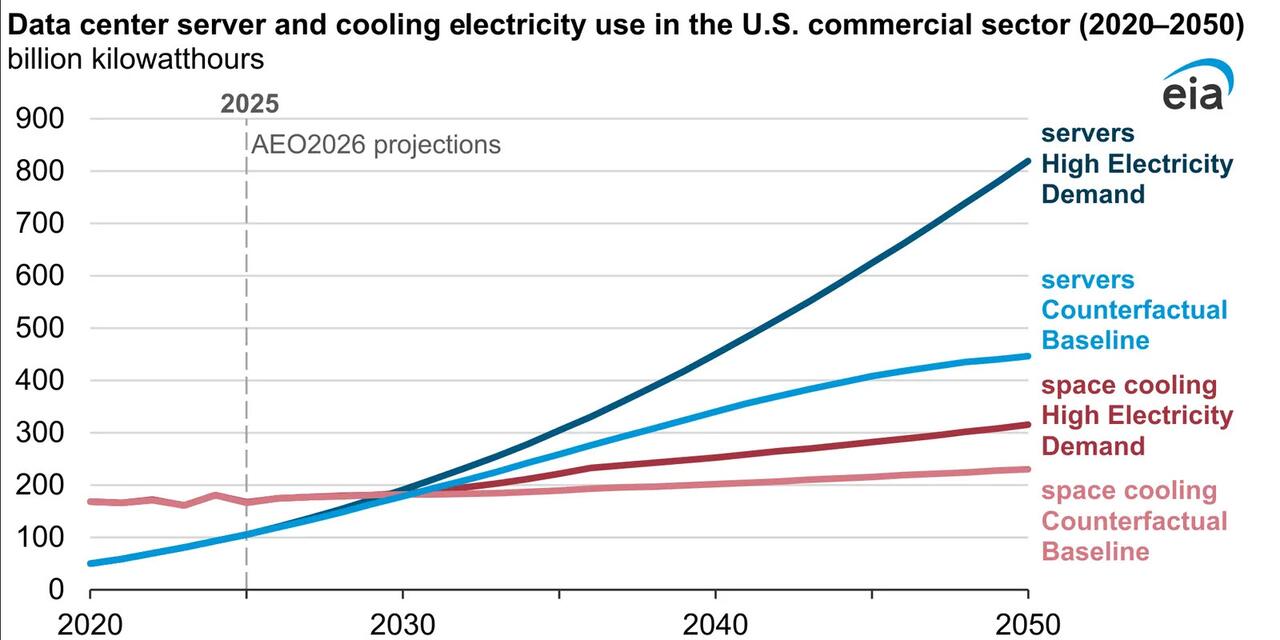
The U.S. Energy Information Administration projects that data centers will “increasingly skew more energy intensive” and that electricity consumed by them will increase across all commercial building stock, with their servers growing to make up an estimated 22% to 33% of commercial building electricity use by 2050, according to an April report.
In its 2026 Annual Energy Outlook, EIA modeled various scenarios to explore how much data centers might drive demand in the medium and long term. In its high electricity demand scenario, the agency assumed “growth in the installed stock of AI servers follows an exponential trend through 2050” and didn’t make any assumptions about increases in computational efficiency beyond historical trends.
“These assumptions lead data center server energy use alone to grow to 818 billion kilowatt hours in 2050 in the High Electricity Demand case,” EIA said. “Server electricity consumption in 2050 is more than 16 times that in 2020.”
In its counterfactual base case, EIA models how “U.S. and world energy markets would operate through 2050 under laws and regulations in force as of December 2025,” but said that this “should not be regarded as the most likely of the cases.”
EIA projects that electricity consumption in the U.S. will continue to grow through 2050 at an annual rate of 0.9% to 1.6%, “with data center server energy use a major factor,” after the previous five years saw a 2.1% average annual demand increase, which followed 15 years of nearly flat demand.
“Energy use in commercial buildings, home to data center activity, grows more rapidly than in the residential or industrial sectors in all modeled cases,” the report said. In a Tuesday release, EIA noted that “across all cases, servers alone accounted for an estimated 7% of commercial sector electricity consumption in 2025.”
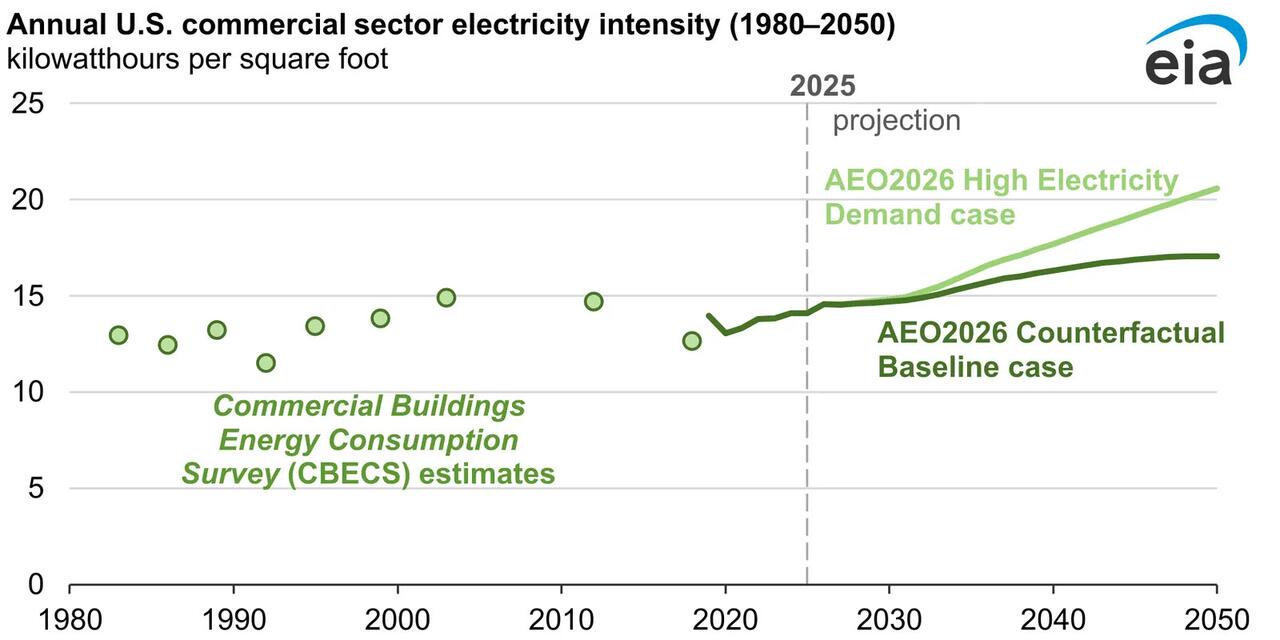
In both EIA’s high electricity demand scenario and its counterfactual base case, the commercial sector’s electricity intensity — measured in kilowatt hours of electricity consumed per square foot — eventually exceeds the 2003 historical high of 14.9 kWh per square foot for the first time in either 2031 or 2032, depending on the scenario.
In its counterfactual base case, EIA projects that “after 2040, servers will become increasingly efficient, resulting in a 10% reduction in average annual operational power draw every three years, above and beyond historical efficiency trends. However, continued growth in server installations drives overall consumption growth.”
Tyler Durden
Wed, 05/20/2026 – 14:25
Warsh Faces Uphill Battle As FOMC Minutes Show Deeply-Divided Fed Against Easing Bias
Warsh Faces Uphill Battle As FOMC Minutes Show Deeply-Divided Fed Against Easing Bias
Tl;dr: FOMC Minutes confirm a deeply-divided Fed with a hawkish bias as “majority” saw hike likely warranted, “many” preferred removing easing bias.
* * *
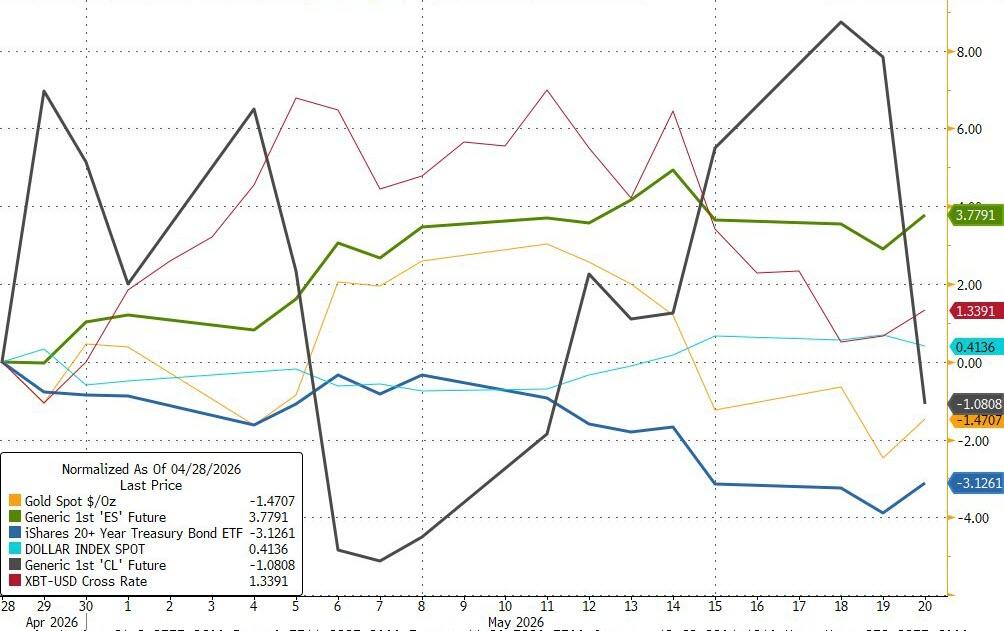
Since the last FOMC meeting (Powell’s last), on April 29th, stocks and the dollar are up, bonds and gold are down and oil has swung violently in between…
Source: Bloomberg
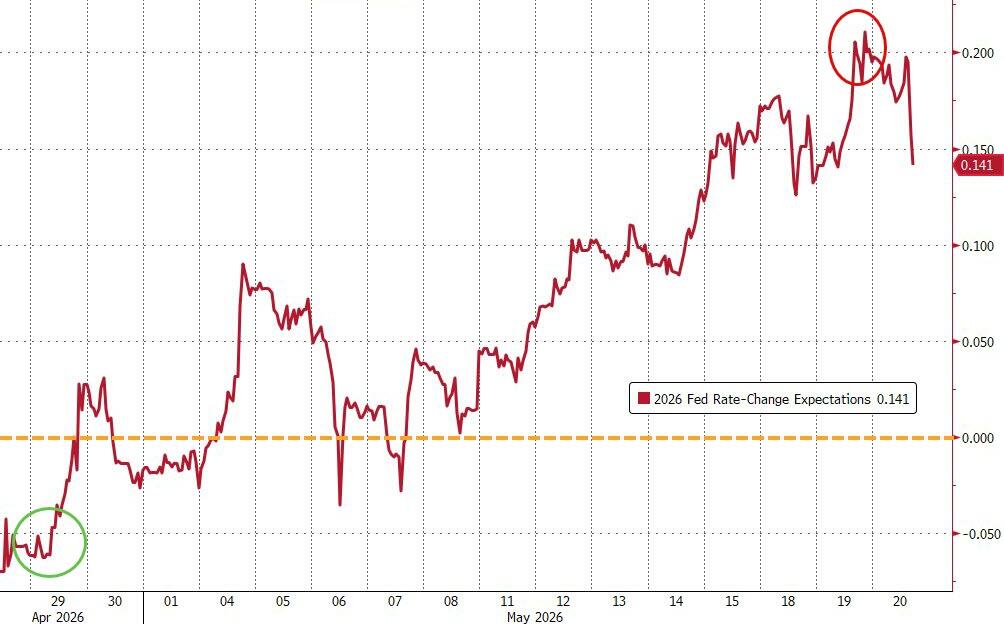
Expectations for Fed action this year has surged hawkishly from a 20% chance of a single rate-cut to an almost 100% chance of a single rate-hike this week (before today’s decline)…
Source: Bloomberg
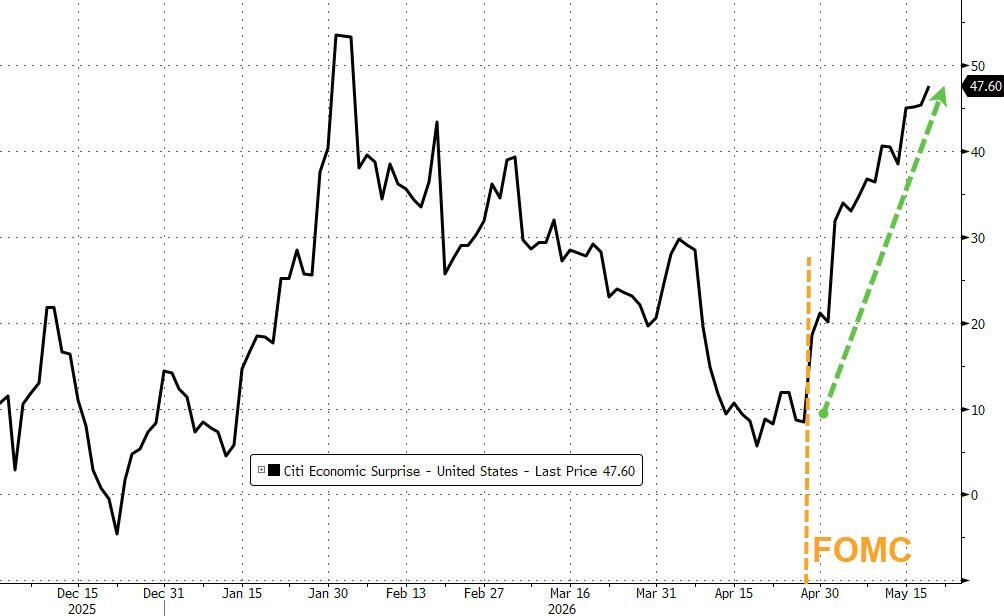
And that hawkish shift has occurred as US macro data has dramatically surprised to the upside (with both growth and inflation data higher than expected)…
Source: Bloomberg
Today’s FOMC minutes will be closely watched for further details surrounding the increasingly hawkish split within the Committee following the April meeting.
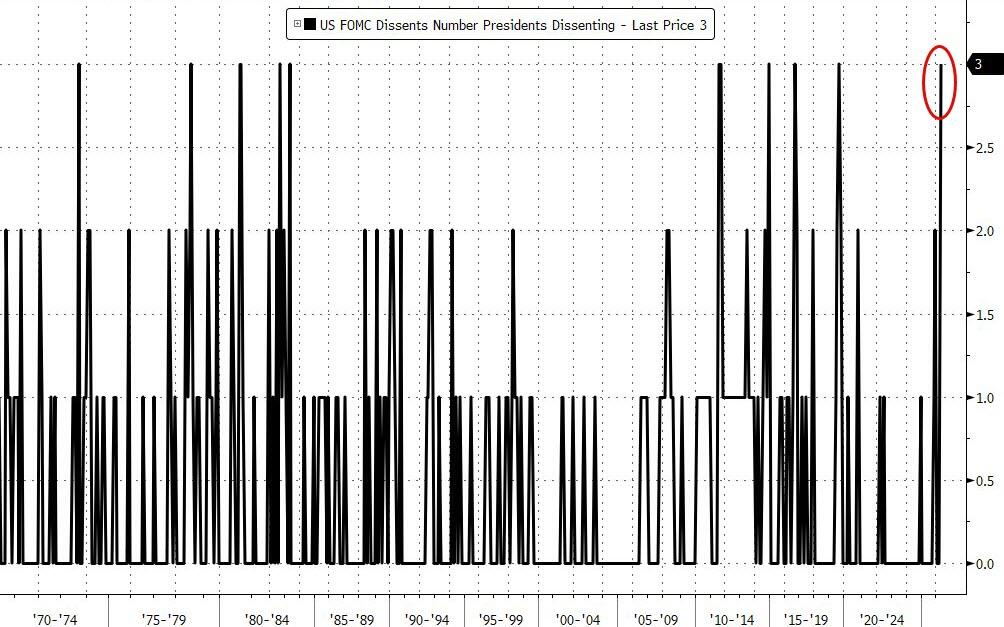
With three voters dissenting against retaining the easing bias – and Fedʼs Collins later suggesting she would have supported removing it too – markets will look to see how broad support was for removing the easing bias, particularly after Powell said more officials now view a hike just as likely as a cut.
So what did the Minutes show…?
Main headlines from the Minutes:
*FED: VAST MAJORITY SAID INFLATION COULD STAY ELEVATED LONGER
*FED: OFFICIALS SAID INFLATION, WAR COULD MEAN LONGER RATE HOLD
*FED: OFFICIALS EXPECTED JOB MARKET TO STAY STABLE IN NEAR TERM
*FED: MANY PREFERRED REMOVING EASING BIAS FROM STATEMENT
*FED: MAJORITY SAW HIKE LIKELY WARRANTED IF INFLATION PERSISTS
*FED: SEVERAL SAW RATE CUTS THIS YEAR IF INFLATION DISSIPATES
Inflation fears…
With regard to the outlook for monetary policy, participants generally judged that the continued elevated inflation readings together with uncertainty related to the duration and economic implications of the Middle East conflict could necessitate maintaining the current policy stance for longer than previously anticipated.
Several participants highlighted that it would likely be appropriate to lower the target range for the federal funds rate once there are clear indications that disinflation is firmly back on track or if solid signs emerge of greater weakness in the labor market.
A majority of participants highlighted, however, that some policy firming would likely become appropriate if inflation were to continue to run persistently above 2 percent.
To address this possibility, many participants indicated that they would have preferred removing the language from the postmeeting statement that suggested an easing bias regarding the likely direction of the Committee’s future interest rate decisions.
Labor optimism…
Another factor supporting a more hawkish Fed outlook: improving signals from the labor market.
At the Fed’s March meeting, officials’ most recent data in hand was the ugly February jobs report.
At the time, many officials were worried that “labor market conditions appeared vulnerable to adverse shocks,” per the March minutes.
But by their April meeting, Fed officials had their hands on the more upbeat March report, and most took the numbers as evidence of stabilization, according to the newly released April minutes.
After the April Fed meeting, the strong April jobs report released earlier this month added further evidence that the labor market may be finding its footing.
More hawkish-er…
The minutes from the Fed’s April meeting show that a growing group of officials raised hawkish concerns as the Iran conflict lifted inflation.
At the central bank’s previous meeting in March, a group of “some” participants had said there was a strong case for the Fed to give balanced guidance that its next move could be either a hike or cut, leaning against the status quo that an eventual cut was in the cards.
In April, this group grew to include “many” officials who would have preferred more neutral language in the policy statement.
Staff Economic Outlook
The staffs outlook for economic activity was slightly stronger than the one prepared for the March meeting.
Not too much new that we didn’t get from the presser (or post-presser comments) but now it’s confirmed that The Fed is deeply divided with the bottom line being that the dynamic disclosed from these Minutes may create challenges for incoming Chair Warsh, whose first meeting will be in June.
While Warsh has advocated lower rates, he may find limited support for a more dovish stance within the current Committee.
Additionally, Warsh has advocated for a tighter balance sheet policy. Last week, Fed Governor Barr argued that easing bank liquidity requirements to shrink the Fedʼs balance sheet would undermine financial stability and increase the Fedʼs market footprint. Barr said the 2023 banking stresses suggest liquidity requirements should rise, not fall. As such, traders will also watch the minutes for any discussion surrounding future balance sheet strategy alongside the debate over the easing bias.
On a side-note, when President Trump was asked today about the fact that the markets are now pricing in rate-hikes (and whether he thinks Warsh will deliver the lower rates that Trump has long demanded), his remarks were surprisingly placid.
“I’m going to let him do what he wants to do,” Trump said.
“He’s a very talented guy, he’s going to be fine, he’s going to do a good job.”
Trump is seemingly giving Warsh some room to maneuver, implying that he may not immediately get the Powell treatment even if Warsh delivers a hawkish monetary policy message in his early months in office.
Read the full Minutes below
Tyler Durden
Wed, 05/20/2026 – 14:05
Regulator Clears Environmental Review For Dow And X-energy Reactor Project
Regulator Clears Environmental Review For Dow And X-energy Reactor Project
The Nuclear Regulatory Commission (NRC) has completed its environmental assessment for the Long Mott Generating Station, a proposed four-reactor Xe-100 project at Dow’s Seadrift, Texas site.
📆 #NRCNews: We’ve completed our environmental assessment of the proposed Long Mott Generating Station ahead of schedule. https://t.co/aQ2Lf548Lx pic.twitter.com/MznwpfQjTz
— NRC (@NRCgov) May 18, 2026
A Finding of No Significant Impact (FONSI) was issued after the review wrapped up in under a year.
The NRC has dramatically shortened review timelines across multiple advanced reactor projects in recent months. We have previously covered how the agency has cut license renewal times by roughly half and completed several first-of-a-kind reviews well ahead of historical norms.
“6–12 Months For Construction Permits” – The Nuclear Regulation Overhaul https://t.co/Zrsj6FTvy6
— zerohedge (@zerohedge) April 29, 2026
The Long Mott project is backed by the Department of Energy’s Advanced Reactor Demonstration Program (ARDP). The four reactors are intended to supply power to Dow’s large chemical manufacturing operations, with the potential for high-temperature process steam to be explored at a later stage.
If completed, it would be among the first grid-scale advanced reactors dedicated to serving an industrial site in North America.
The project still faces a recent regulatory nuisance. In February, the NRC granted intervention to the San Antonio Bay Estuarine Waterkeeper on a contention that Long Mott Energy, the Dow subsidiary developing the project, has not sufficiently demonstrated its financial qualifications.
The assertion is hard to take seriously. Dow is one of the largest chemical companies in the world, and X-energy counts Amazon among its major backers. Yet the financial qualifications issue will now proceed to a hearing.
Other contentions raised by Waterkeeper, including challenges related to the reactor design and environmental impacts, were rejected by the Board.
For now, the Long Mott project has cleared one of the more visible early hurdles. The financial qualifications hearing will likely result in dismissal, but not until after Waterkeeper has made every attempt possible to delay the project.
Tyler Durden
Wed, 05/20/2026 – 14:00