Category: News
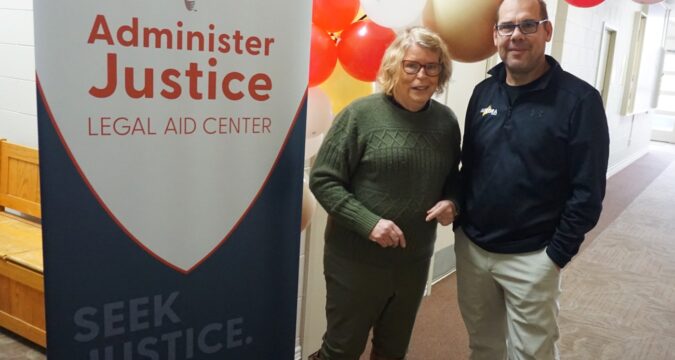
Column: More Fox Valley churches opening legal aid clinics to address justice issues
At age 79, Linda Dudley has already traveled plenty of miles on her faith journey.
The now-retired Aurora woman founded Parkview Christian Academy, a Yorkville school that’s grown by leaps and bounds since its inception in 1997. She’s also taught hundreds of Bible classes over the decades and even dipped her toe into immigration assistance.
Yet something still felt incomplete, as if she’d not yet figured out where God wanted her to be, until Dudley heard about a national organization called Administer Justice that was established 25 years ago to help provide affordable civil legal aid to those in need.
On Saturday, she led a nine-person volunteer team that opened one of this Elgin-based nonprofit’s quickly expanding Gospel Justice Centers at First Presbyterian Church in Aurora, where Dudley has been an active member since moving to the city more than 60 years ago.
“This just feels right,” said the longtime educator, saying the Hebrew translation of “justice” is “fairness,” a concept referred to more than 1,000 times in the Bible.
“In a world of confusion and fear, we Christians are called to be Christ followers. This ministry is here to provide help, prayer, resources and encouragement for those who are not experiencing that form of justice, fairness,” she said.
“Isn’t that just what Jesus Christ teaches us, apart from politics, finances and judgement?”
It seems more churches are asking that same question. According to Administer Justice Vice President of Engagement Emily O’Donnell, over 100 of these clinics are operating in churches across the nation, with another 40 in the process of starting within the next few months.
The Fox Valley is seeing more than its share of that expansion, with a couple dozen in the region, including Elgin, the Tri-cities, Naperville and particularly in Aurora with six sites.
There’s a couple reasons the centers have grown so significantly in the past year, said O’Donnell. For one, there’s been more effort by Administer Justice to promote this initiative after the pandemic stalled the momentum. Plus, “more churches are starting to pay attention” to this issue and “embracing the idea that pushing for justice is not something to fear but rather to embrace,” she told me.
“You can’t read the Bible and not see it,” O’Donnell said, noting that it’s not just nondenominational churches getting involved but mainline congregations, including Protestants and Catholics.
“We might have different theological and political positions,” she said, “but we can all agree this is what Jesus calls the church to do.”
Administer Justice was founded by Bruce Strom, a graduate of Judson University in Elgin and the University of Illinois, who became a successful attorney, even arguing cases before the U.S. Supreme Court before answering the call of a higher power.
What started as a personal mission to use his legal training to serve the most vulnerable turned into a spiritual mission where Strom, now also a pastor, author and speaker, is blending his faith with justice work.
Each Gospel Justice Center – which is open one day a month for a few hours – revolves around volunteer lawyers and church members offering brief legal advice, guidance and prayer in a community setting. Attorneys – they are not expected to go beyond a one-time consultation – are essential, but other roles are needed, such as client and community advocates, interpreters and those who do intake and follow-up.
The Rev. Trevor McMaken, whose City of Light Church is opening Aurora’s sixth Gospel Justice Center with a ribbon-cutting at 9 a.m. Feb. 7 at Hill Elementary School, often has people coming to him with legal questions, he said, uncertain who to trust or how to go about maneuvering in a legal system that “can get complicated really quickly.”
According to Administer Justice, low-income Americans do not get any or enough legal help for 92% of their civil legal problems. This simple but accessible model allows ordinary Christians to help their neighbors navigate those hurdles while also showing them the hope of the gospel, organizers said.
In addition to First Presbyterian and City of Light, other Aurora churches with centers include Redeemer, Oasis, Village Bible and Westminster, which opened its center a few months ago.
Louis Jacobs, who co-leads the clinic at Westminster, is encouraged by what he’s witnessed so far, with more clients coming through the doors as word spreads.
Most cases, noted O’Donnell, revolve around family law and landlord problems, but those frequently involve immigration issues, a cause that is leading more churches to “reach out to ask” how they can help.
Appointments are encouraged by calling 855-818-4554, which is also the number on the Administer Justice website for those interested in starting a clinic. McMaken said he’d also like to hear from organizations or businesses willing to put out cards or flyers to spread the word about these expanding legal aid clinics.
“It’s about all these centers working together,” he said, “to let people know we are here and we can help.”
dcrosby@tribpub.com

Home Show in St. Charles offers one-stop shop for homeowners eyeing big projects
Carolyn Tiltz and her husband Adam of St. Charles have been thinking about redoing their kitchen and bathrooms and decided that the annual Chicago Home Show at the Kane County Fairgrounds over the weekend might be the perfect place to do some one-stop shopping.
“We have some home projects coming up in the coming year – the kitchen and maybe some bathrooms – so we’re here to get some ideas,” Carolyn Tiltz said as she and her husband checked out some vendors on Saturday. “This is our first time at the show. There seem to be a lot of vendors here and it’s good to meet some of the people in person. You see a lot of people recommended online, but it’s nice to put a face with the companies.”
The two-day event at the fairgrounds in St. Charles featured more than 130 business representatives, organizers said, offering services that included kitchen and bath remodeling, windows, doors and siding, solar power, roofing, landscaping and more.
Matt Ward, show manager, said the event is now in its fourth year at the fairgrounds after being held at Pheasant Run in St. Charles “beginning about 15 years ago.”
Ward said popular categories at the show include “kitchen and bath remodeling which is always huge” along with replacement windows, patio doors and flooring.
“Some of the hot new trends over the past few years include some different landscaping techniques and designs, as well as power generators and some back-up stuff,” he said. “There is also some new solar technology as well.”
Ward said visitors enjoy the variety of vendors at the show “as well as homeowners being able to actually talk to the contractors.”
“Many of the companies have the professionals right there in the booths that can answer questions and help people move forward with what the next steps would be versus just capturing information so they can really talk to the professional and interview them to see who would be the best to perform the work,” he said.
One of this year’s vendors was Well Expert, located in East Dundee. Salesman Patrick Guido said the company has been at the show “a few times before” and does window wells, covers and basement window replacements.
“We’ve been in business 31 years. We bring new things here regularly,” he said.
He said having the show in January makes sense.
“In terms of this being held in winter, there’s no disconnect in terms of the construction season,” he said. “You need time to order materials and get things lined up so you’re ready to go in the spring.”
Carolyn Tiltz and her husband Adam of St. Charles stop at a booth on Saturday, Jan. 24, 2026, at the annual Chicago Home Show held over the weekend at the Kane County Fairgrounds in St. Charles. (David Sharos/For The Beacon-News)
Adam Tiltz said on Saturday that he could check off a few to-do boxes “if we made a few connections and maybe found a general contractor.”
Mark Schmidt of Batavia had other plans while visiting the show, saying that he “had already done windows and showers and stuff. I’m not looking to upgrade, just looking to see what’s here.”
“Maybe some new products in general,” he said. “I come to this show every year and I usually come to see what’s new and see the people we’ve done business with and say hello. Every time I come here I leave with something.”
David Sharos is a freelance reporter for The Beacon-News.

Review: ‘Birds of North America’ at A Red Orchid Theatre offers autumnal balm for a cold winter night
As inviting theatrical titles go, “Birds of North America” is one only an ornithologist could love. But the new show at Red Orchid Theatre turns out to be a gorgeous little 90-minute two-hander, a beautifully acted and directed father-daughter play capable of transporting you away from the frozen tundra and back to when leaves were just beginning to fall and birds still sang from the trees.
The other highly distinctive thing about director Kirsten Fitzgerald’s production is the sound design by Ethan Korvne. Recorded live, it’s a compilation of original music and bird sounds and although that may sound twee, it’s so well done as to be utterly enveloping, and, thanks also to the intimacy of this particular space and some surround-sound speakers, it creates an immersive experience. Not in some flashy way, but in a manner that enhances the fundamental intimacy of the piece.
I’ve got young-adult kids, and plenty of friends in the same complicated boat, so I’m aware of the potentially fraught nature of conversations as parents have to learn, slowly, to give up authority, and moderate the oh-so-important life-lessons, while being existentially incapable of suspending their love and concern, not to mention the life trajectory for their child that they imagined in their minds.
That’s really what this play by Anna Ouyang Moench (a writer on “Severance” and other TV shows) is all about. We watch a father (played by John Judd) and his millennial daughter (Cassidy Slaughter-Mason) across a decade of days as they stand in a suburban backyard and watch birds.
Another truth that parents realize when their kids hit the ‘tween years is that conversation flows better when there is a distraction, especially one that allows talking without constant eye contact. (I always found heading to the Chicago Cubs ideal for that purpose.) So it goes here as the daughter slowly reveals a variety of personal and professional problems to her loving but very crusty dad. Eventually, mortality intrudes, although not necessarily in the way you expect.
This is hardly the first play with this kind of conceit, of course. But this writer eschews sentimentality and scrambles other expectations: It is the father, a crusading scientist, who is the more progressive of the two, looking down on his daughter’s expedient employment choices and arguing for a career of moral purpose, a life that perhaps was easier to achieve for his own generation.
John Judd and Cassidy Slaughter-Mason in “Birds of North America” at A Red Orchid Theatre. (Evan Hanover)
“Birds of North America” has had a couple of other productions around the country; none of them had the benefit of Judd, one of the Chicago theater’s most remarkable actors and a perfect fit for this role because he knows how to keep an audience on a kind of knife edge as he builds his character, never making him either too hostile or too benign. This is a really beautiful performance and one of Judd’s best. (I’ve seen many.) Like his fellow Chicago actor Keith Kupferer, Judd is especially adept at playing men who have only a limited access to their own emotions and his work here is, well, everything one could ask. He’s well-matched by Slaughter-Mason, who has the opposite job, in many ways, but one with its own pitfalls, all of which she avoids.
The acting work is not unexpected at this particular theater, of course, but the design goes far beyond the typical. There is just something about the autumnal colors on Morgan Laszlo’s set, as richly lit by Seojung Jang. I was transported.
Red Orchid attracts a younger audience than many theaters and just down the row from me, the moment the lights came back up, a young woman said she planned to go home and hug her dad. Then back out into the cold we all went.
Chris Jones is a Tribune critic.
cjones5@chicagotribune.com
Review: “Birds of North America” (4 stars)
When: Through Feb. 22
Where: A Red Orchid Theatre, 1531 N. Wells St.
Running time: 1 hour, 30 minutes
Tickets: $55 at 312-943-8722 and aredorchidtheatre.com
https://www.chicagotribune.com/2026/01/26/review-birds-red-orchid-theatre/
La Unión Europea investiga el chatbot de IA Grok de Musk por generación de imágenes sexualizadas
Associated Press
BRUSELAS (AP) — Los reguladores de la Unión Europea abrieron el lunes una investigación formal sobre la plataforma de redes sociales de Elon Musk, X, después de que su chatbot de inteligencia artificial, Grok, comenzara a difundir imágenes deepfake sexualizadas no consensuadas en la plataforma.
El escrutinio desde Bruselas se produce después de que Grok provocara una reacción global al permitir a los usuarios, a través de sus herramientas de generación y edición de imágenes de IA, producir imágenes con los rostros de personas reales en las que aparecían mujeres con bikinis transparentes o ropa reveladora. Los investigadores dijeron que algunas imágenes parecían incluir a menores. Algunos gobiernos prohibieron el servicio o emitieron advertencias.
El ejecutivo de la UE, compuesto por 27 naciones, dijo que estaba investigando si X ha hecho lo suficiente, como requieren las regulaciones digitales del bloque, para contener los riesgos de difundir contenido ilegal, como “imágenes sexualmente explícitas manipuladas”.
Eso incluye contenido que “puede equivaler a material de abuso sexual infantil”, dijo la Comisión Europea. Estos riesgos ahora se han “materializado”, dijo la comisión, exponiendo a los ciudadanos del bloque a “daños graves”.
Los reguladores examinarán si Grok está cumpliendo con sus obligaciones bajo la Ley de Servicios Digitales, el amplio conjunto de normas del bloque para mantener a los usuarios de internet a salvo de contenido y productos dañinos.
En respuesta a una solicitud de comentarios, una portavoz de X dirigió a The Associated Press a una declaración anterior en la que la compañía afirma que sigue “comprometida a hacer de X una plataforma segura para todos” y que tiene “tolerancia cero” para la explotación sexual infantil, la desnudez no consensuada y el contenido sexual no deseado.
La declaración de X del 14 de enero también decía que dejaría de permitir a los usuarios representar a personas en “bikinis, ropa interior u otra vestimenta reveladora”, pero sólo en lugares donde sea ilegal.
“Los deepfakes sexuales no consensuados de mujeres y niños son una forma violenta e inaceptable de degradación”, afirmó Henna Virkkunen, vicepresidenta ejecutiva de la comisión.
“Con esta investigación, determinaremos si X ha cumplido con sus obligaciones legales bajo la DSA, o si ha tratado los derechos de los ciudadanos europeos, incluidos los de mujeres y niños, como daños colaterales de su servicio”, dijo Virkkunen, quien supervisa la soberanía tecnológica, la seguridad y la democracia.
La Comisión también dijo el lunes que está ampliando una investigación separada sobre X para determinar si la plataforma ha estado cumpliendo con los requisitos de la DSA. Esa investigación se abrió en 2023 y aún está en curso. Hasta ahora, ha resultado en una multa de 120 millones de euros (entonces 140 millones de dólares) en diciembre por incumplimientos de los requisitos de transparencia.
___
Esta historia fue traducida del inglés por un editor de AP con la ayuda de una herramienta de inteligencia artificial generativa.

Three Lessons From Venezuela’s Economic Collapse
Three Lessons From Venezuela’s Economic Collapse
Authored by Matthew Mitchell via TheDailyEconomy.org,
President Trump has accepted the Nobel Peace Prize that was awarded to Venezuela’s opposition leader, María Corina Machado.
Unlike Machado, however, he does not accept the central lessons that can be gleaned from five decades of Venezuelan misrule.
There are three.
Lesson 1: Past prosperity is no guarantee of future prosperity.
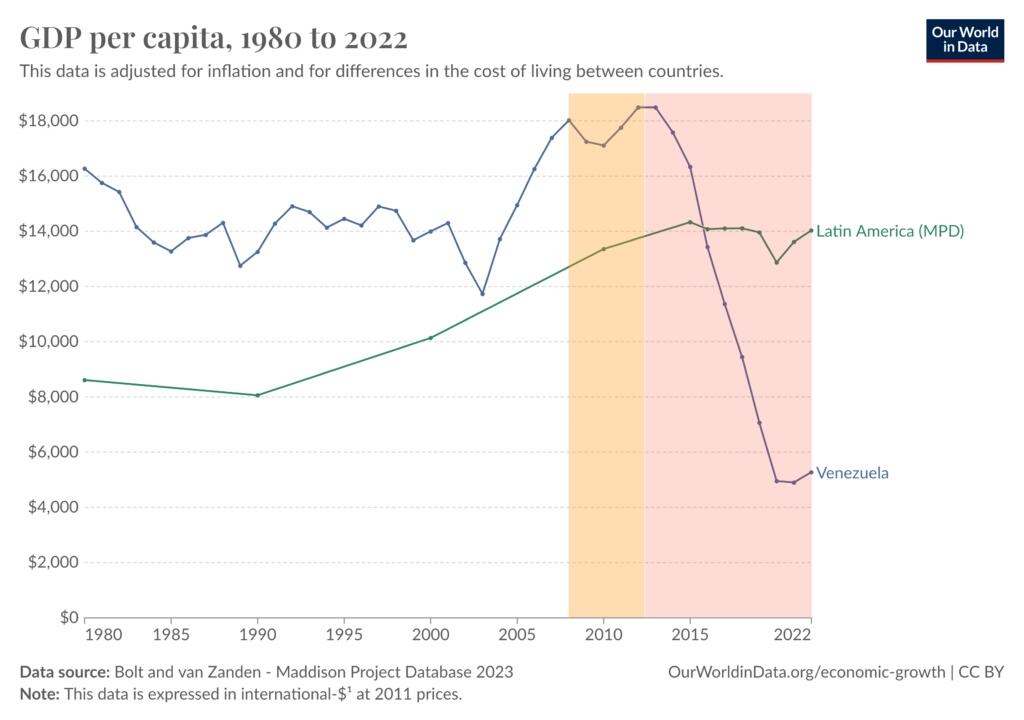
In 1970, Venezuela was the wealthiest country in Latin America. Sitting atop the world’s largest proven oil reserve, it churned out more than 3.5 million barrels of oil a day. Using GDP per person as a metric, its citizens earned 2.7 times as much as the rest of Latin America — about the same as the average Finnish, Japanese, and Italian citizen.
This prosperity bought Venezuelans better health, longer life, and more creature comforts — especially fancy foreign cars that poured into the country as oil poured out. And it wasn’t just the wealthy that benefited. Venezuela’s poverty rate was about a third of what it was in the rest of Latin America.
The zenith was around 1977. Thanks to the global oil crisis of a few years earlier, crude prices had quadrupled. Amidst the boom, President Carlos Andrés Pérez made the fateful decision to nationalize the country’s oil industry, hoping to use its wealth to fund economic development and poverty relief. Instead, by combining public and private interests, the decision proved a boon for corruption, eventually turning the country into a petrostate.
Almost immediately, incomes began to fall. By 1999, average Venezuelans were earning less than 90 percent of what they had three decades earlier. But the worst was yet to come.
Which brings us to the second lesson.
Lesson 2: Policy matters.
Oil was not the only explanation for Venezuela’s 1970s prosperity. The government spent and taxed modestly. It left most industry in private hands. Inflation was low. And international trade was almost entirely free of tariffs and regulatory barriers to trade.
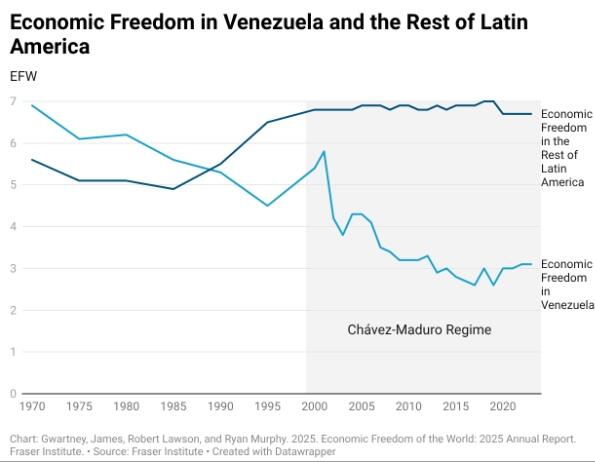
In 1970, Venezuela scored a little less than 7 on the Fraser Institute’s 10-point Economic Freedom of the World index, making it the 13th most economically free country in the world, just ahead of Japan.
But as the rest of the world liberalized in the 1980s and 1990s, Venezuela went in the opposite direction. The government ramped up transfers and subsidies and began to acquire more assets. Property rights grew less secure. Inflation reached 26 percent in 1980 and over 50 percent in 1995. By 2000, Venezuela had slipped to 116th in economic freedom.
In 1999, as the economy faltered, a frustrated electorate turned to an outsider, Hugo Chávez. Chávez had risen to fame seven years earlier when he led an unsuccessful coup d’état against the democratically elected government (ironically led by Andrés Pérez, who had returned as president in 1989).
Though left-of-center, he did not begin as a radical. Instead, he positioned himself as a populist reformer who could steer a “Third Way” between socialism and capitalism. But he grew more radical after a failed coup attempt against him in 2002. By 2005 he had fully embraced the socialist label, recasting his movement as “Socialism of the 21st Century.”
It wasn’t just branding. He nearly doubled transfers and subsidies and more than doubled government investment. He tightened control over the government-owned oil company and nationalized other industries, including steel, iron, mining, cement, farming, food distribution, grocery chains, hotels, telecommunications, and banking. The government stopped respecting and protecting private property. Annual inflation bounced around from 20 to 60 per cent. At the time of his death in 2013, Venezuela’s overall economic freedom was close to 3 on the 10-point scale, making it the least economically free country in the world.
But as the government took, nature gave. The country’s massive Orinoco Oil Belt continued to churn out about 2.5 million barrels of oil every day. As a result, GDP per person recovered.
Many Western observers, from Senator Bernie Sanders to director Oliver Stone, saw this as a sign that socialism works. But the reality is that Venezuela’s oil-fueled boom had only managed to bring incomes back to 1970s levels. Moreover, careful econometric analyses comparing Venezuela’s performance to that of other similarly situated countries, found that Venezuela consistently under-performed.
Chávez died in 2013, leaving the country in the hands of his Vice President, Nicolás Maduro. Maduro clung fast to Chávez’s policies, but as global oil prices plummeted, Socialism of the 21st Century began to look a lot like socialism in the 20th century: incomes collapsed, poverty exploded, and inflation became hyper (reaching over one million percent in 2018).
Maduro responded predictably, imposing price controls that produced massive shortages of household necessities. About a quarter of the population fled the country.
But the cost was not merely economic. Which brings us to the final lesson.
Lesson 3: Economic and Personal Freedom are Deeply Intertwined.
Socialism is typically imposed at the point of a gun. But notwithstanding his attempted 1992 coup, Chávez had come to power through free and mostly fair elections. This seems to have been one reason why Western observers were so taken in by the regime. Writing in her 2007 book, The Shock Doctrine, Naomi Klein claimed that Venezuelan “citizens had renewed their faith in the power of democracy to improve their lives.”
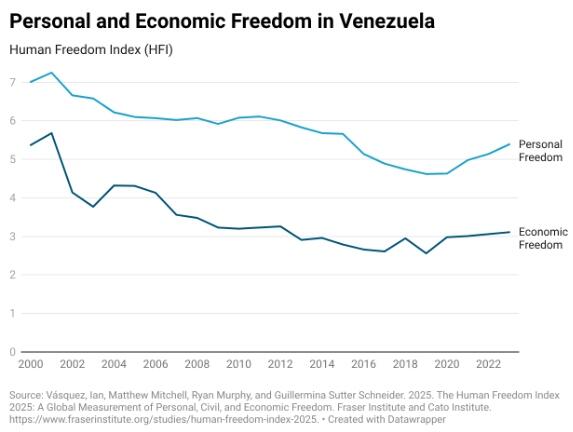
But if she had looked closer, she would have seen the early signs of Venezuela’s anti-democratic turn. The Human Freedom Index, co-published by the Fraser Institute and the Cato Institute, builds on the Economic Freedom of the World index by adding 7 additional areas of personal freedom. As the figure below shows, the regime cracked down on personal freedoms just as it limited economic freedoms. By the time Klein wrote her book, Venezuela had already severely restricted freedom of expression, freedom of religion, freedom of association, freedom of movement, and the rule of law.
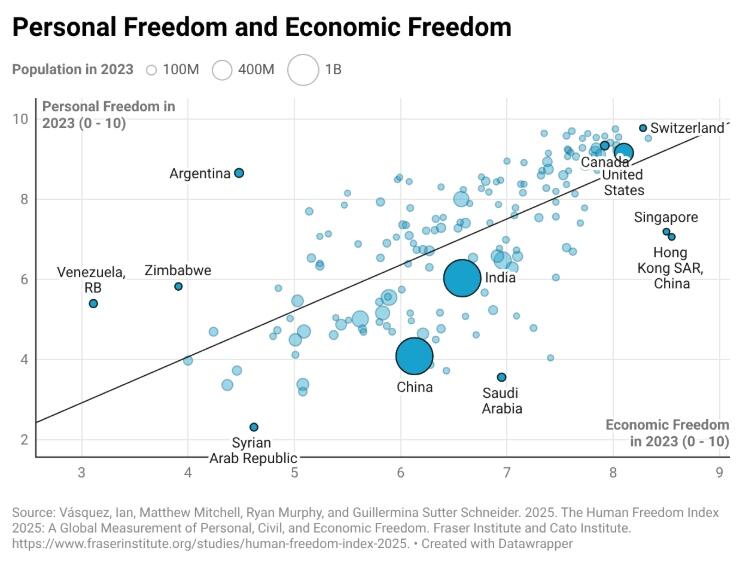
This, unfortunately, is common. As we see in the final figure, most regimes that restrict economic freedom also tend to restrict personal freedom. It is easy to imagine why. People value their economic liberties, so regimes that seek to severely repress these liberties often cling to power by suppressing dissent. And because socialist regimes own the means of production — including media production like radio, print, and TV outlets — they have a handy tool at their disposal for suppression.
What now?
As the Cato Institute’s Marcos Falcone recently explained, one Venezuelan who seems to have internalized these lessons is María Corina Machado. As a decades-long leader of the opposition, she has consistently championed both personal and economic liberty. She traces much of the country’s corruption, mismanagement, and stagnation to its 1976 nationalization of the oil industry.
And she is wildly popular. In the unified opposition primary of 2024, she ran on a platform of complete oil privatization and won 90 percent of the vote. Maduro refused to let her run in the general election, so she backed Edmundo González Urrutia and he is estimated to have won 70 percent of the vote. But Maduro refused to recognize the result and clung to power.
Now, apparently, President Trump is in charge. But like Maduro before him, Trump refuses to recognize the results of the last election. He claims that Machado lacks the “respect” and “support” to lead. Polls, meanwhile, indicate that she is favored by more than 70 percent of the country. While accepting her re-gifted Nobel Prize, Mr. Trump has decided to give the reins to Maduro’s Vice President, the socialist Delcy Rodriguez, calling her a “terrific person” and predicting a great Venezuelan renaissance.
As for privatization, Trump instead says “we’re going to keep the oil.” He claims that Rodriquez will be “turning over” up to 50 million barrels to the US, the proceeds of which will be “controlled by me, as President of the United States of America.”
Meanwhile, he is strong-arming US oil companies to invest in the country, telling them that if they want to recover their property that was seized by President Andrés Pérez in 1976, they’d better cooperate in rebuilding Venezuela’s infrastructure. For their part, the companies have been reluctant to do so, citing the country’s poor track record of protecting private property.
Like Andrés Pérez, Chávez, and Maduro, Trump seems to imagine that the right central plan will unlock the country’s vast oil wealth. But history teaches a different lesson.
Tyler Durden
Mon, 01/26/2026 – 06:30
https://www.zerohedge.com/geopolitical/three-lessons-venezuelas-economic-collapse

Global Energy Transition Threatened By Critical Transformer Shortages
Global Energy Transition Threatened By Critical Transformer Shortages
By Haley Zaremba of Oilprice.com
The global clean energy transition has passed a tipping point as renewable energies have simply become too cheap to fail. Worldwide, nations both rich and poor are rushing to install more and more wind and solar capacity to keep up with rising energy demand rates driven by global economic development and the age of AI. But while countries have been investing heavily into increased production capacity, investments in critical grid infrastructure have not kept pace, leading to a major energy transition bottleneck and a potential threat to energy security for an increasing number of countries.
The United States and Europe are both facing critical transformer shortages and aging and inadequate grid infrastructure, and the threat that this shortage poses to energy security is already being felt through historic blackouts such as last year’s cascading grid failure in Spain and Portugal. While these setbacks have raised the profile of infrastructure investing in European policy spheres, “ambition is not yet being matched by action from governments, policy-makers, investors and businesses,” according to a recent report from the World Economic Forum.
In the United States, specialists foresee a yearslong transformer crunch, with little to no relief forthcoming. While companies have rushed to ramp up production of power transformers and distribution transformers, keeping up with skyrocketing demand is an impossibly tall order. Wood Mackenzie estimates that, since 2019, U.S. demand for power transformers has jumped by 116 percent, while demand for distribution transformers has shot up 41 percent.
“This surging transformer demand has created a significant supply deficit, with domestic manufacturing capacity unable to keep pace,” Wood Mackenzie Senior Analyst Ben Boucher. “Utilities are routinely turning to the import market to meet project timelines. In 2025, imports will account for an estimated 80% of US power transformer supply and 50% of the distribution transformer supply. This market imbalance is escalating costs and lead times and is delaying our ability to bring generating plants online in pace with the surging energy demand.”
However, some experts disagree with this takeaway, arguing that the transformer “shortage” is overblown if not fabricated, and the issue lies in self-inflicted procurement problems. There’s room for debate because the issue is a complex one stretching over many different economic sectors and supply chains. Whether the problem is one of supply or one of procurement, however, the impact is the same – major bottlenecks for new electricity with potential pitfalls for national energy security.
“Over the past few years, what started as a squeeze has gradually morphed into a crisis,” Power Magazine recently reported. The Power article contends that this growing crisis has been “furnished by years of underinvestment in domestic manufacturing, a sudden surge in post-pandemic construction and electrification, and volatility in grain-oriented electrical steel (GOES) and copper markets, which steadily pushed lead times for large power and generator step-up (GSU) transformers beyond historical norms.”
And those driving factors are showing little signs of changing, indicating that delay times for transformer delivery are going to continue to stretch on. Even though demand for these products is now growing exponentially, this spike is coming in the wake of years of lackluster demand, and would-be investors are still warming up to the idea that they’ll get a return on their investment in the sector.
Hitachi, one major producer of such transformers, for example, has strategically only invested in transformer development when the purchase of those components is already guaranteed and buyer-backed. “Nobody wants to overinvest” in new production facilities, according to Hitachi Energy CEO Andreas Schierenbeck.
Through these kinds of up-front deals, Hitachi has planned $1 billion in new manufacturing capacity across the United States. However, Schierenbeck told news outlet Semafor this week that these deals are “probably not enough to close the gap between supply and demand… There are still customers who are just in the old world with transactional behavior, and they’ll have to be lucky to get a slot.”
Tyler Durden
Mon, 01/26/2026 – 06:30
https://www.zerohedge.com/markets/global-energy-transition-threatened-critical-transformer-shortages

Father-son plan soft opening of Richton Park Fresh Market this week
In an area where chain grocery stores have closed in recent years and municipal officials say they struggle to attract grocery stores, Sal Omer, an independent grocery store owner, said it’s simple.
Omer said growing up, his father, also a grocer, told him that as long as customers are happy and you treat them well, they will come back.
Omer said he and and his father have opened three suburban grocery stores together, and they plan to have a soft opening this week for Richton Park Fresh Market.
The market will fill a 15,000-square-foot building at 3736 Sauk Trail that has been vacant since the previous occupant, a Save-A-Lot store, closed in 2024 and left residents worried about their ability to access fresh, affordable food.
Municipal officials have struggled to fill the space with a full grocer. Omer said he aims for the store to fill a gap in access to fresh, affordable meat and produce.
“It’s important to have fresh meat and a lot of fresh things because they don’t have it,” Omer said.
Omer said the store will offer fresh meat that’s prepared by a butcher in the store, along with a grill where customers can request meat to be cooked without an additional fee. He said he is still working on the licensing to open the grill, however.
He also said the store will offer fresh produce that he picks out and delivers himself, which he said saves some delivery costs and keeps the prices low. He said doing this helped him keep prices low at his Chicago Heights store, La Super Carniceria y Taqueria.
Omer also said he plans to customize the food to what the community needs. He said he will take suggestions and product requests from customers during the soft opening in an effort to get to know the customers and their needs.
Overall, he said, he plans to treat the store community like a family. He said because the store is family owned, it allows him to put a lot of time and effort into meeting the customers’ needs and keeping costs low, which he said will keep people coming back.
“Customers will see me everyday, you know, anything they want, they’ll ask me, and I’ll try to do everything they like,” he said.
The exterior of the new Richton Park Fresh Market in early January 2026. The store is scheduled to have a soft opening this week. (Village of Richton Park)
Omer said he also plans to keep costs low by starting out with a limited number of employees and items at the soft opening and expand. He said he plans to start out with a low profit margin and has already established a hard working team of employees after receiving more than 100 job applications.
While he is not hiring anymore, he said he could have more job openings down the road.
While Omer said he expects a soft opening in the next week, he said he is unsure when the store will fully open.
Brandon Boys, the Richton Park director of economic development, said Friday residents seem most excited to see the offerings at the butcher counter as well as the store’s full-service offerings in the produce and deli sections.
He said the market, in Richton Park’s Town Center area, is within walking distance of several neighborhoods, additional neighborhood retail and the Metra Electric station.
The village approved a resolution in December requesting the grocery store receive a Cook County Class 7D property tax incentive from the Cook County Assessor. The incentive would provide a reduced assessment level for 12 years.
The program, established in 2022, aims to address food deserts by fostering grocery store development.
Municipal officials have called the east side of Richton Park where the store is located a food desert. A food desert is usually defined as an area without a grocery store that offers fresh affordable food within a 1-mile radius, according to Michael Mallon of Mallon & Associates, who conducts grocery feasibility studies.
The Richton Park Save-a-Lot store closed in 2024 due to high property taxes, according to the property owner Yellow Banana, a grocery company owned by a Cleveland-based investment firm. The company owned several other Save-a-Lot stores in the Chicago area that have closed due to financial issues.
awright@chicagotribune.com
https://www.chicagotribune.com/2026/01/26/richton-park-fresh-market-opening/
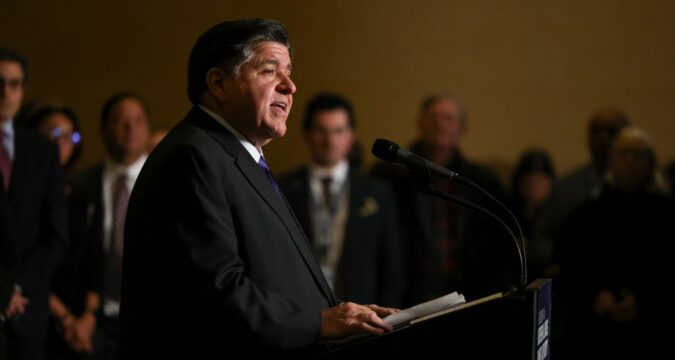
Illinois law shielding officials’ personal information amid political violence sparks transparency backlash
SPRINGFIELD — Amid growing national fears about politically motivated violence and threats, Illinois lawmakers moved swiftly last fall to pass a sweeping statute allowing public officials to shield their personal information from public view.
But the new law — signed last month by Gov. JB Pritzker — also erects a barrier between citizens and records long considered essential to democratic accountability, including marital status and basic information about whether lawmakers, county clerks and other officials actually live in the districts and communities they serve.
Passed by the Senate in the waning hours of the Illinois General Assembly’s fall session — as lawmakers pushed through higher-profile measures such as a Chicago-area transit overhaul — the measure has begun raising free-speech and public accountability concerns. While the law’s stated purpose was to protect public officials from real-world threats, critics argue its reach is overly broad and extends well beyond safeguarding elected officials and their families from potential harm.
Transparency and press advocates say the statute threatens democratic oversight by creating a new legal mechanism that can shield information from public view, limit voters’ ability to scrutinize those in power and weaken the public’s right to know.
“This is basically a sledgehammer that will allow lawmakers to censor information about them from the internet, even information that poses no legitimate security concern and actually really matters for the public to know,” said Caitlin Vogus, senior adviser with the Freedom of the Press Foundation.
Under the law, government agencies, businesses and private individuals must redact and refrain from sharing the personal information of many current and former public officials upon request, though notably not those seeking office. Home addresses, phone numbers, personal email addresses and even marital status can all be removed from public view at the official’s discretion. The statute makes no explicit exception for journalism or political speech and applies retroactively, allowing officials to demand the removal of previously published material.
Questions as basic as whether an elected official meets residency requirements — a cornerstone of representative government — could become legally fraught to investigate or publish.
Society of Professional Journalists Executive Director Caroline Hendrie said she understands lawmakers’ safety concerns, but that they shouldn’t override the need for government transparency.
“This statute goes way too far in chilling the kind of public interest reporting that needs to happen so that public officials can be held accountable,” Hendrie said. “They need to understand that they are accountable to the public.”
Democratic Rep. Katie Stuart of Edwardsville, the chief House sponsor of the law, said the legislation was modeled after a 2012 measure that allows judges to request the shielding of their personal information. That law was enacted after the 2005 killings of the husband and mother of U.S. District Judge Joan Lefkow by a disgruntled litigant.
Stuart said the measure reflects a sobering escalation in political hostility and violence.
“Our spouses, our children, our loved ones deserve to be protected and not be put at risk,” Stuart said. “And really, nobody needs their life at risk to do the job of serving the public.”
She said she has received multiple threats and canceled public events due to safety concerns — an experience she said isn’t uncommon.
Recent incidents have underscored those fears. A right-wing provocateur posted a video from outside Pritzker’s home in Chicago’s Gold Coast neighborhood in September and urged followers to “take action” shortly after the assassination of conservative activist Charlie Kirk.
Last year, a suburban Chicago man was accused of threatening state Rep. Nicole La Ha and her family after allegedly contacting the Republican lawmaker through her website.
And last week, a city of Chicago employee was sentenced to two years’ probation after pleading guilty in connection with threats made against Republican state Sen. Andrew Chesney of Freeport.
The threats and violence extend beyond Illinois’ borders. In April, a man set fire to the governor’s mansion in Pennsylvania, threatening the life of the state’s Democratic governor, Josh Shapiro, and his family. In June, a gunman went to the homes of two Democratic Minnesota lawmakers, killing former House Speaker Melissa Hortman and her husband and wounding state Rep. John Hoffman and his wife.
More than 40% of state legislators experienced threats or attacks between 2021 and 2023, according to a Brennan Center for Justice report.
A spokesperson with Pritzker’s office didn’t address the transparency issues critics have raised about the bill and instead said that with the rise of political violence and threats, public officials deserve to have their safety taken seriously.
“As public officials and their families across the country face an alarming increase in violent threats, rhetoric and harassment, Gov. Pritzker signed the bipartisan Public Official Safety and Privacy Act into law to help protect the safety of Illinois public officials at every level of local and state government,” the spokesperson said in a statement.
Democratic state Sen. Adriane Johnson of Buffalo Grove, the law’s Senate sponsor, said those realities demanded action.
“I hear the concerns,” Johnson said about the transparency and accountability issues. “Not to diminish or downplay the concern by reporters and others, but to me, it is critically important that we allow legislators to have their personal information, contact information removed if they so choose.”
The statute applies to a wide range of public officials — constitutional officers, state’s attorneys, county clerks, public defenders, members of boards of election commissioners, and both current and former state lawmakers. Anyone who unlawfully publishes a public official’s or their family’s personal information online could face a felony charge — and a sentence of two to five years in prison — if the person knew or should have known the posting of the information posed an imminent and serious threat and if the violation is a proximate cause of injury or death.
To invoke the protections, an official or their representative must submit a written request identifying the information to be removed. Businesses and individuals have a few days to comply; government agencies have five. Addresses for elected officials and candidates running for public office across the state have already been removed from front-facing web pages and spreadsheets maintained by the Illinois State Board of Elections.
Carolyn Iodice, legislative and policy director for the Foundation for Individual Rights and Expression, said the law’s structure invites misuse.
“While I don’t think the intent of lawmakers here is to suppress news or criticism, the fact is, the law is extremely amenable to abuse for those purposes,” Iodice said.
Reporters investigating whether a lawmaker lives outside their district could be forced to remove their reporting or face legal action. A similar statute in New Jersey was used by city officials in New Brunswick to successfully sue and prevent a journalist from publishing the address of a top law enforcement official to show that the official lived more than two hours from the community he served.
Johnson, the Senate sponsor, said such cases are rare and claimed the State Board of Elections would identify residency violations, though the board has long lacked the staffing necessary to investigate residency discrepancies. Johnson also said constituents could still file complaints if they suspect an official does not live in the appropriate district.
John Patterson, spokesperson for Democratic Senate President Don Harmon, said the recently passed law can be amended if needed, but added that such concerns weren’t previously voiced.
“This is the first we’ve heard of any potential issues. We’re always willing to consider clarifications if warranted,” Patterson said in an emailed statement. “To the best of my knowledge, those hypothetical concerns have not emerged. Violence targeted against public officials is a very real threat in our society today.”
The law’s reach extends beyond residency.
Vogus, of the Freedom of the Press Foundation, said officials accused of domestic violence or extramarital affairs could force the removal of news articles or online posts mentioning such allegations since they would disclose the officials’ marital status, which is defined by the statute as personal information.
“It sends an extremely chilling message to reporters,” she said. “Politicians have a powerful tool to go after them, to potentially sue them for posting news articles that are completely true and that are revealing something really important that Illinois citizens have a right to know.”
Stuart, the House sponsor, said allegations of abuse are not proven facts and, when she was asked whether a lawmaker should be able to remove an article detailing proven abuse that did not name the spouse, she said the question was highly technical and bordered on sensational journalism. In practice, journalists typically avoid publishing home addresses or identifying victims of domestic abuse. But critics argue the law does not distinguish between responsible editorial judgment and censorship.
Concerns about safety are not unique to Illinois. About 40 state capitols now require security screenings with metal detectors, according to the National Conference of State Legislatures. Following Hortman’s assassination, several states moved to shield lawmakers’ home addresses. At least five — Arizona, Florida, Idaho, Texas and Washington — allow legislators to withhold their addresses from public records requests. The Illinois State Capitol has metal detectors, with armed security throughout the building, following a 2004 incident in which a gunman fatally shot an unarmed security guard.
Louisa Duggan, policy director for the Vote Mama Foundation, which researches and supports mothers who serve as lawmakers, said elected officials should not feel they are endangering their families by serving.
“It’s targeting people who are choosing to serve, especially those with young families at home,” Duggan said. “They don’t want to worry about their kids while they’re on the campaign trail.”
But Iodice said Illinois lawmakers already have tools to address security threats without restricting public information. Laws against stalking, conspiracy and incitement are on the books, and the new statute also allows officials to use campaign funds for personal and home security upgrades.
Iodice added that she believes the law would struggle to withstand a constitutional challenge because of its sweeping scope.
“It’s not that the government officials can’t do anything here, but they cannot take steps that would censor wide swaths of information that aren’t at all necessary to protect them,” Iodice said.
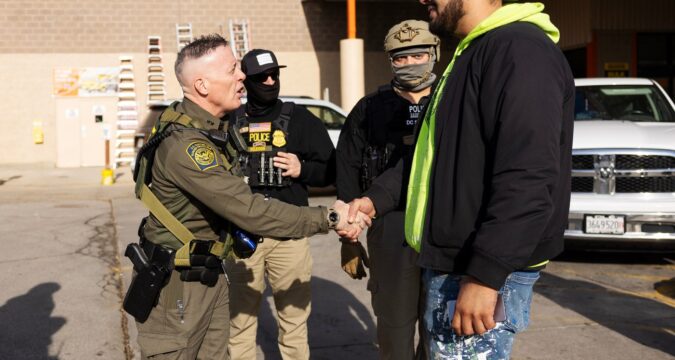
Letters: News outlets are denigrating federal agents and glossing over the reality of illegal immigration
Day after day, news media including the Chicago Tribune denigrate Immigration and Customs Enforcement and its agents as they enforce immigration law throughout the country.
They gloss over the reality that immigrants who have entered the country without legal permission have no right to be here and that the law directs ICE to detain and deport such individuals. If you detest immigration law, work with the system to change those laws, but opposing federal officials from executing what is the law of the land is neither virtuous nor patriotic in the least.
Instead of trying to portray this entire problem as if it were caused by President Donald Trump, remember that the real fault lies with President Joe Biden and others whose actions encouraged the massive volume of illegal entries into the U.S.
— David Howard, Rockford
Warrants and ICE action
Please help expand the reach of the story about Immigration and Customs Enforcement agents entering homes without judicial warrants. We’re out of alarm bells, and there will be no more warning signs. Our time to refuse consent and to fight back against the great fascist unraveling is now, now, now. We need every person and civic institution that fears abuse of power to stand up and refuse.
The Constitution was conceived to limit precisely this overreach — those who would break down our literal doors and stomp into our homes, all in the name of law and order.
What wholly avoidable nightmare this country has stumbled into.
— Nick Christensen, Chicago
Shaped by political urgency
It appears the Donald Trump administration may have boxed itself in by issuing strong, definitive public statements about the Minneapolis shooting death of protester Renee Good before a full evaluation of the evidence was possible. Conclusions were advanced early, effectively foreclosing careful analysis at a moment when the facts were still emerging. As video footage from multiple angles has circulated, the incident has become increasingly complex and less amenable to a single, tidy narrative.
Having reviewed the available videos, I did not see clear evidence supporting the claim that Good was a terrorist attempting to kill ICE agent Jonathan Ross. Nor do the recordings clearly show Ross being struck by Good’s vehicle or suffering injury at the moment he used lethal force. While the footage does not definitively resolve the question of justification, it plainly complicates the account initially offered by federal officials.
I am generally supportive of the president, but party loyalty does not require accepting a disputed narrative as settled fact. If anything, this incident suggests that premature certainty may have extended beyond the officer involved to those who rushed to defend his actions.
At this point, credibility would be better served by calling for a thorough, impartial and transparent investigation. Without such scrutiny, the public is unlikely to accept an account that appears shaped more by political urgency than by a careful weighing of the evidence. The sooner that process begins, the better.
— Scott Thompson, Bloomington, Indiana
Sane-washing his words
The Jan. 22 front-page article “On Greenland, Trump’s messages weave in, out,” written by The Associated Press, sane-washes the petty, vindictive, shameful ravings of President Donald Trump. He insulted our allies as a group and singled out specific leaders for personal insults. The content of the speech was a litany of lies, fantasy and exaggerated claims.
Trump’s words and actions are alienating us from our close allies. I searched the Tribune but did not find coverage of the eloquent speech by Canadian Prime Minister Mark Carney detailing the rupture of U.S. relations with our allies and America becoming a bully and adversary instead of a leader and friend.
The words and actions of our president no doubt have Champagne corks popping in Beijing and Moscow. The only chance this country has for survival is massive voter turnout and rejection of Trump’s destructive authoritarian regime.
— Douglas Nyhus, Frankfort
Let’s protect world’s family
We have been part of a global brotherhood. The goal is to enhance our lives by sharing safety measures, shielding each other from outside dangers; advancements in intelligence; and natural resources. It is what a functioning family does to protect each other.
President Donald Trump has turned us into a warring family; he wants all the power and none of the responsibilities. He pouts, saying he will leave if this mama’s boy does not get the biggest piece of the pie. He has evolved from a caricature to an enemy within. He is dragging our country into his personal fight with his fragile ego.
We need to act together to protect our family of humankind.
— Joanne Hoffman, Highland Park
Republicans, stand up
For months, we’ve watched our country sink into decline. We’ve watched President Donald Trump’s agenda ruin the democratic values that my father and uncles fought for in World War II. Our NATO allies no longer trust the U.S.
We’ve watched American citizens get shot or dragged out of their homes so Immigration and Customs Enforcement can meet some artificial quota.
Where are the Republicans in Congress willing to stand up to this disastrous agenda? In keeping silent, they’ve created a monster. Is their job security worth more than saving American democracy?
Where are the heroes of today? Stand up! We need you.
— Linda Morton, Harvard
Coverage of testimony
I want to thank the Tribune for its Jan. 23 publication of nonpartisan coverage of the testimony of Jack Smith. The front-page coverage, which the subject deserved, simply stated the facts.
We need more of that kind of coverage.
— Christine Mazzone, Arlington Heights
Change primaries’ process
A recent editorial (“The number of Americans who feel politically homeless is rising. Understandably so,” Jan. 20) states an increasing number of Americans are becoming politically homeless, although many still lean toward one of the major parties. Voters in primary elections may nominate extremists to run in the general election, leaving independents no choice but to vote for the lesser of two evils or to abstain from voting for either.
The solution to voters being limited to a choice between two extremists is to change the primary system. Both parties have qualified candidates in the primaries who do not win because of their moderate views. In a reformed primary system, everyone would get the same ballot that would have a list of candidates for each party. The voter would check a box to indicate they are voting as a Republican, Democrat or independent. Two tallies for each candidate would indicate how many votes were from party regulars and how many from independents. The parties could then choose to nominate either the candidate who got the most votes from party members or the most total votes from both party members and independents.
— Robert Hernquist, Chicago
Submit a letter, of no more than 400 words, to the editor here or email letters@chicagotribune.com.

Editorial: As Route 66 turns 100, I-55 ranks among Illinois’ most dangerous roads
A century ago, bootleggers were roaring down Chicago’s newly paved streets and the shops that once served horse-and-buggies were adding gas pumps and offering mechanical repairs. In 1926, with automobiles on the rise, a patchwork of roadways between Chicago and Los Angeles got a new designation.
Route 66 was born.
Today, America is preparing to celebrate the 100th anniversary of a historic road that united a huge swath of the country and shaped car culture into the 21st century. For all that has changed since then, however, one depressing fact remains.
Driving Route 66 was dangerous back in its heyday, earning it nicknames such as “Dead Man’s Alley” and the “Bloody Road.” Traveling by car along the highways that succeeded Route 66 still presents a deadly hazard — much more dangerous than need be.
Nationwide, fatalities among motorists have remained stubbornly high. Interstate 55, which has largely replaced Route 66 in the Chicago area, is notorious for being one of the most dangerous routes in Illinois.
The good news is that 100 years after Route 66 got its name, America has the technology and experience to make driving much less deadly. Yet progress is coming slowly, mainly for one reason: Us.
Human error is the No. 1 reason for carnage on the highways. And people-proofing cars has proven harder than anyone might have imagined when Chicagoans were taking out their Model T’s for Sunday drives on the Mother Road.
As the Chicago Auto Show prepares to open Feb. 7, this is a good time to ask why roughly 40,000 people still die each year in wrecks that are seemingly avoidable, especially given so many new safety features.
Slipping behind the wheel of the new models with all their advanced technology at the Auto Show can make an ordinary driver feel like a Top Gun pilot. High safety scores have become a key selling point for new vehicles. Three-point seat belts, antilock brakes and air bags became standard equipment long ago, and fully autonomous driving could very well be the future.
So why aren’t fatal crashes a thing of the past, like Route 66 itself?
Car and Driver magazine recently evaluated the latest technology that keeps drivers in their lanes, detects blind spots and automatically hits the brakes in emergencies. Today’s state-of-the-art sensors, cameras and radar equipment can indeed contribute measurably to safety.
Yet the magazine’s test driver found that active safety systems, as they’re known, are “somewhat of a mixed bag,” highlighting a difference between the systems “working as designed and actually doing any good.”
The average age of America’s 300-million-strong passenger vehicle fleet on the road today is almost 13 years, a record. It takes a long time for new technology to penetrate.
Crash and injury rates are starting to come down again after spiking between 2011 and 2020, an increase frequently blamed on stepped-up cellphone use and related distractions.
Fatality rates, a separate measure, are coming down more slowly. Could that be due to higher speeds? Larger and more powerful vehicles? A surge in impaired drivers from legal cannabis? Those are all possibilities.
It’s also worth asking to what extent the roads themselves contribute to fatalities.
Studies funded by the insurance industry and personal-injury law firms regularly cite I-55 as among the state’s most dangerous arteries, with Safe Roads USA ranking it in the top four. From 2019 to 2023, I-55 saw 108 fatal crashes, according to the National Highway Traffic Safety Administration, and it’s no wonder.
In the Chicago area, the traffic is often dense, mixing trucks and cars traveling at different speeds, with merging traffic and lanes that become turn-only. Around Springfield, too, I-55 is congested and hazardous, while in rural areas its monotonous straightaways invite motorists to floor it. Of those fatal I-55 crashes, more than 40% occurred in central Illinois.
Last year, the Illinois Department of Transportation completed one of its busiest construction seasons ever, making hundreds of safety improvements, including upgrades to I-55. Road design and engineering have improved dramatically since the days of Route 66, and through the Rebuild Illinois capital campaign, the state is making big investments to modernize driving infrastructure.
On the downside, speed limits nationwide are higher than ever. Some highways have posted limits of 80 mph and up. Stricter federal guidelines would help.
But let’s face it: The high fatality rates mostly come down to driver error, or, to put it more broadly, driver irresponsibility.
We need to slow down, especially on highways, and most especially during bad weather. Stay off the phone. Wear those seat belts. Never drive under the influence of alcohol or weed. Be mindful of the vehicles around you. Use directional signals. And considering how many old beaters are on the road, spring for new tires and brakes.
Ray Rose on the porch of the Hackberry General Store in Hackberry, Arizona, on Route 66, June 6, 2025.(E. Jason Wambsgans/Chicago Tribune)
In its recently published guidebook celebrating the 100th anniversary of Route 66, Illinois’ Office of Tourism recommends a little time traveling. Motorists can come close to the original route by following a 300-mile course from Chicago through Willowbrook, Pontiac and Bloomington-Normal, on past Springfield and into St. Louis.
In some places, the original is inaccessible, paved under I-55, for instance, or on private property today. Even on the marked historic route, the conditions vary, from a four-lane divided highway south of Joliet that feels like an interstate to two-lane straightaways through quiet small towns.
The state’s No. 1 piece of advice for getting your kicks: “Take it slow.” At 300 miles start to finish, “You could cover it in a day,” the guidebook allows. But please don’t — for all the reasons enumerated above.
Submit a letter, of no more than 400 words, to the editor here or email letters@chicagotribune.com.
https://www.chicagotribune.com/2026/01/26/route-66-i55-55-route-55-car-crash-safety/