Category: News

SK Hynix Soars On Microsoft Supply Deal Report; KOSPI Breaks Out, Shrugs Off Tariff Threat
SK Hynix Soars On Microsoft Supply Deal Report; KOSPI Breaks Out, Shrugs Off Tariff Threat
SK Hynix shares hit an all-time high in overnight trading in South Korea after a local media outlet reported that the semiconductor company, which specializes in memory chips, has become the sole supplier of advanced memory for Microsoft’s new artificial intelligence chip. Also overnight, despite President Trump’s tariff threat against South Korea for “not living up” to a trade deal cemented last year, the Korea Composite Stock Price Index surged above 5,000 for the first time.
Business Korea reports that Hynix will exclusively supply high-bandwidth memory (HBM) for Microsoft’s next-generation AI chip, the Maia 200.
Here’s additional color from the local outlet:
According to industry sources on Jan. 27, SK Hynix is reported to supply its latest product, HBM3E (5th generation), to the Maia 200 AI accelerator that Microsoft unveiled on Jan. 26 (local time). Additionally, SK Hynix appears to be participating as the exclusive supplier for the product.
The Maia 200, manufactured based on Taiwan’s TSMC’s 3-nanometer (nm; 1nm = 1 billionth of a meter) process, is characterized by enhanced efficiency in AI inference tasks. It uses 216 gigabyte (GB) HBM3E, with six units of SK Hynix’s 12-layer HBM3E installed.
Microsoft has already installed the chip in its Iowa data center in the United States and is expanding its applications by adding it to its Arizona data center as well.
The report catapulted SK Hynix shares on the KOSPI nearly 9% higher on the session. The stock is now up 23% year to date and trading at record highs.
A larger timeframe shows the trend is absolutely parabolic.
Jung In Yun, chief executive officer at Fibonacci Asset Management Global, said the move higher in Hynix shares supports “dip buying and rising HBM earnings expectations.” He added, “We will probably see SK Hynix earnings meeting expectations again.”
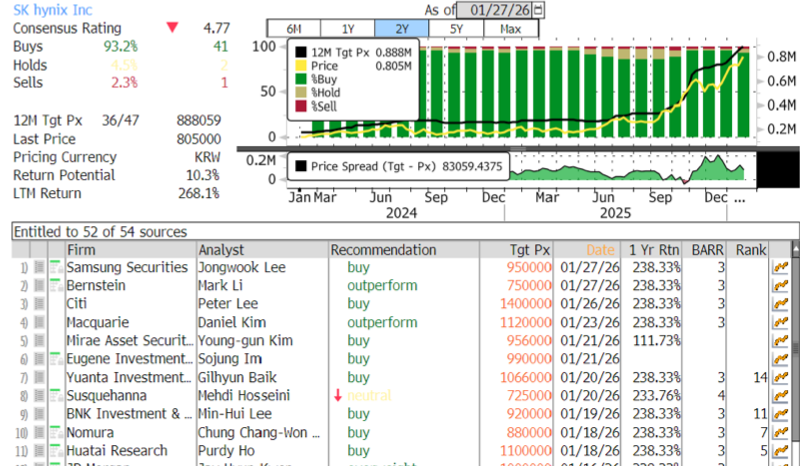
Another positive tailwind emerged after Citigroup analysts raised their price target on SK Hynix by 56% to a street-high 1,400,000 won, reaffirmed its buy rating, and placed the stock on a 30-day upside catalyst watch.
“The memory market is shifting toward semi-customization, with memory customers required to sign a contract a year prior to actual product delivery,” analyst Peter Lee wrote. “In 2026, we foresee global DRAM/NAND pricing growth to be significantly better than expected.”
According to Bloomberg data, Wall Street analysts rate SK Hynix with 41 buys, 2 holds, and just 1 sell.
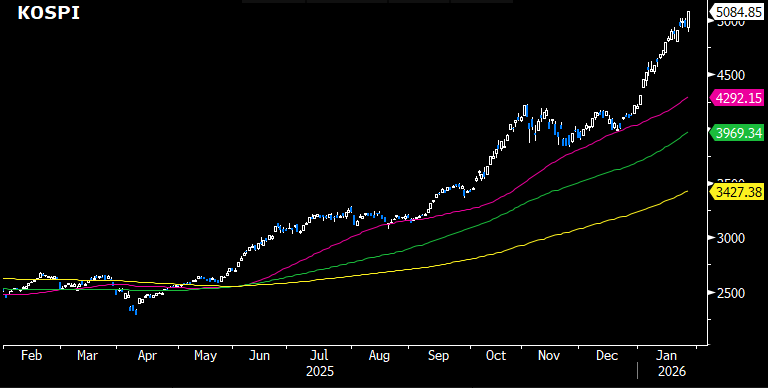
More broadly, KOSPI made a “clear breakout above 5,000 and closed @ 5,085 today, marking YTD growth of +21%,” Goldman analyst Heather Oh told clients earlier.
Heather provided clients with the drivers in the KOSPI today:
Concerns over potential tariff hikes, with Trump vowing to raise tariffs on Korean goods, including autos and pharma, from 15% to 25%, led to a weaker market open. However, the KOSPI quickly recovered to close at an ATH. Most sectors rallied, with the exception of tariff-impacted areas such as Autos (-0.8%) and Steel (-0.8%). Semiconductors were a notable outperformer, surging by 6.3% ahead of the earnings and ongoing optimism on HBM developments.
What were the main drivers today?
Optimism is building ahead of the heavy earnings season, with January 29th being a key date for Samsung Electronics (005930, +5%) and SK Hynix (000660, +9%) earnings reports. GIR recently raised its KOSPI target to 5,700 (from 5,000), driven by earnings upgrades rather than P/E multiple expansion.
Positive sentiment prevails as pension funds are anticipated to inject approximately W7tn more into Korean equities. The largest pension fund has increased its 2026 domestic equities allocation target to 14.9% (up from 14.4%) and will temporarily postpone rebalancing, thereby alleviating selling pressure when allocations diverge from the strategic asset allocation (SAA) range.
Today’s Investor positioning
Turnover breakdown: Foreign 31%, local institutions 19%, Retails 50%.
Net Inflows: Institutional flow-led rally today signals a healthy setup for further upside. Foreign: +$588m. Mainly passive program buying led the rally (+$760m). Buying was concentrated in Tech (+$743m) and Financials (+$86m). Local institutions: +$164m. Buying was concentrated in Tech (+$278m). Retail: -$706m. Profit taking was heavily concentrated in Tech (-$1b), followed by Banks (-$93m).
Five Charts That Matter:
KOSPI Price Performance
Earnings
5-Day Investor Positining Trend (KOSPI (left) vs. KOSDAQ (right))
MF Positioning
H/F Positioning
Related research:
First Victims Of ‘Great Memory Crunch’ Emerge As Data Centers Soak Up Global Supply
“Entered New Era”: SK Hynix To Build $13 Billion Memory Plant As Nvidia CEO Says AI Demand Soaring
“Market That Never Existed”: Nvidia CEO Sparks Frenzy In Memory Stocks
Soaring Memory Costs Sink Nintendo Shares; Goldman Says Selloff Is Buy-The-Dip Opportunity
UBS Says Soaring Memory Chip Prices To “Turbo-Charge” Samsung Earnings
When your entire market is a couple of memory stocks:
“This number really blew my mind. GS earning est for Korea in 2026 is – wait for it – 75% (granted its mostly only 2 names). followed by 12% in 2027. And trading at ~11x forward.” – GS S&T pic.twitter.com/UZsIrcngMD
— zerohedge (@zerohedge) January 25, 2026
The whole discussion on memory is shaping up to be a big theme in 2026 amid data center buildouts.
Tyler Durden
Tue, 01/27/2026 – 06:55

In an indie comedy about estranged friends reuniting in rural Illnois takes center stage
In the ultra low-budget indie comedy “Everything Fun You Could Possibly Do in Aledo, Illinois,” Chicago theater actors Jennifer Estlin and Sara Sevigny star as estranged friends who reunite in middle age.
Brenda and Gabby were once childhood besties in the small town of Aledo. When their lives diverged after high school, they lost touch. Brenda stayed put after getting pregnant and subsequently got married. Now, three decades later, she’s a widow and a bored empty-nester. This is how Gabby, a world-traveler with three divorces under her belt who left town in search of adventure, finds her old friend when she returns home, hiding a few secrets that boil down to money troubles and a dissatisfaction with the way her supposedly glamorous life has turned out.
It’s an awkward and stilted reunion that is quickly smoothed over with wine and a trip down memory lane, including a bucket list (small town version) Gabby unearths that they wrote in their youth: “‘Make out with someone under the bleachers,” Brenda reads it aloud, unconvinced it’s worth pursuing. “Make out with someone in a corn field.’ This is just a lot of making out.”
“Ha, no wonder you got pregnant,” comes the reply.
Directed by Bethany Berg, it’s a minor comedy about minor mid-life crises. The two pals aggravate and amuse each other in equal measure, and there’s a quiet sweetness to their antic friendship, with the film channeling a similar tone as the HBO series “Somebody Somewhere.” (The movie is available to rent on Amazon.)
“More than anything, I was drawn to the story of female friendship,” says Berg, “the kind where you reconnect after years without speaking and it feels like no time has passed. As we get older, there are versions of ourselves we think we’ve lost. But sometimes it just takes one person to bring that version back. If you can squeeze a 30-minute lunch with them into your schedule, you’re lucky. Spending a whole summer with them? That’s something that only happens in the movies. Well, at least this movie.
“I wanted Gabby and Brenda’s friendship to feel like they shed all those layers of resentment, guilt and responsibility that can build up over time, transforming back into their teenage selves. Laughing over stupid stuff, finding fun wherever they go, making fun of boys. Those are the kinds of female friendships I remember having as a girl. I don’t think you ever grow out of needing something like that – even as an adult.”
In an era where regurgitated intellectual property reigns supreme, a straightforwardly simple but meaningful original story can feel the most radical.
But the town of Aledo itself, with a population of about 3,500, might be the movie’s most distinctive choice.
“The movie is set in my family’s hometown on my dad’s side,” says producer and co-writer Christina Shaver. “What’s so interesting about this little town is that Suzy Bogguss (the country singer-songwriter), who is in our film, is from Aledo. And an up-and-coming country singer named Margo Price is also from Aledo, as is an artist named Gertrude Abercrombie, who had her work just sell at auction for over a million dollars. It’s a sweet little town that has given us some artists.”
Because Shaver frequently visited Aledo in childhood, she wanted to go back and film something there.
“Everyone in town was on our side and helping us out. We decided to shoot at the laundromat on a whim, like five minutes before, and I called the owner and he was like, ‘Yeah! Just lock up when you leave.’ We needed a golf cart and one of the women in town said, ‘You can use mine, just drive it back and leave the key on top when you’re done.’ It’s very low-key there. They were so supportive. So it was a very charming place to film and I think part of it was that the people there knew that my family is from there and that really went a long way.”
From left: Sara Sevigny (Gabby) and Jennifer Estlin (Brenda) star as estranged childhood friends who reunited in the indie film “Everything Fun You Could Possibly Do in Aledo, Illinois.” (Julia Hunter)
The budget was $200,000, a combination of “self-financing and also there is financing we got through an individual in Aledo who literally won the lottery,” per Shaver. A number of economies were required. “We shot in ‘live’ locations,” Shaver says, “meaning we didn’t close down many places when we filmed there, it was just whoever was there was included in the film, which I thought was great. It was a really interesting way to shoot a scripted film and also include elements of the town. I think that’s why the town really loves the film, because they see themselves in it, and it’s not a fictionalized version of themselves.”
Director Berg says, “We had the mayor on speed dial. We had the keys to the public pool. When we asked the local police if we could shut down a side road, they just shrugged, handed us traffic cones and said ‘You can try.’ I love Aledo. I love it more than Paris, Berlin and London combined. I almost don’t want you to publish this because I don’t want anyone else to shoot a movie there. It’s ours! Stay away!”
Shaver hopes to film other projects in Aledo as well. “We are looking to do a Christmas film in Aledo, so that’s next on the docket. And I have a documentary about Gertrude Abercrombie that we’re working on. She died in 1977, but she grew up in Aledo before moving to Hyde Park, where she was a surrealist painter. She was affiliated with jazz icons like Dizzy Gillespie and Charlie Parker and Sonny Rollins, and she would host these amazing salons in her home. Sometimes the jazz artists would sleep over because it was segregated in Chicago in the ’40s and ’50s, so she would open up her home to them. Her art has gone from no one really knowing it to really blowing up in the art market right now.”
With the film industry in such a state of flux, how is that affecting Shaver’s efforts as a producer?
“So much feels derivative because people know what makes money and they just want to keep making money,” she says, “which is great, they should, that’s what their business is.
“But for me, my business is independent film and expressing myself through art, and that may not yield much revenue. So the way that I structured this film was not with the idea that I would make a ton of money from it. I would love to. But I’m making movies because of a desire to express something, not because I need the film to make a profit.”
https://www.chicagotribune.com/2026/01/27/everything-fun-aledo-illinois-movie/

‘Ted Lasso’ writer and actor brings pre-Broadway show to Steppenwolf
Brendan Hunt, the Chicago improvisor who became the co-creator of “Ted Lasso” and plays the popular character of Coach Beard on that hit, soccer-themed Apple TV show, will stage a solo show at Steppenwolf Theatre with Broadway as his ultimate aim.
In a telephone interview while shooting the new Season 4 of “Ted Lasso,” Hunt described his show, “The Movement You Need,” as “in the vein of sentimental but amusing solo shows, built around me and my mom having a complicated relationship, as is obligatory for the genre.”
He also said that “one area of concord and agreement was The Beatles” and that his show was inspired by his meeting Paul McCartney (a benefit of the success of “Ted Lasso”) and wanting to say things to the iconic Beatle that he decided were inappropriate for the context of the meeting.
The show, directed by Ashley Rodbro, will play at Steppenwolf for three weeks later this spring, reflecting that Chicago theater’s increased willingness to present as well as produce work.
Hunt grew up in Chicago’s Lakeview neighborhood, and although his family moved around, it was “always within walking distance of Wrigley Field.” The piece has had a short workshop version at the Hollywood Fringe Festival, but Hunt said it was a dream come true to stage his full, 85-minute work at Steppenwolf. “There were a bunch of theaters on the table,” he said, “but to do the show in Chicago and at Steppenwolf is a dream.”
In 2003, I reviewed Hunt in a Boom Chicago sketch comedy revue that came to Second City from Amsterdam; his best character was Roy Keane, then the famously acerbic Irish member of the Manchester United soccer team. He was also an understudy for “Mojo” at Steppenwolf, but never went on.
Vivek J. Tiwary is the lead commercial producer of the project.
Chris Jones is a Tribune critic.
cjones5@chicagotribune.com
“The Movement You Need: An Evening with Brendan Hunt” will play April 19 to May 10 on the Steppenwolf Theatre mainstage, 1650 N. Halsted St.; tickets ($55-$105) go on sale at noon Thursday at 312-335-1650 (Steppenwolf members get preferential access Tuesday) and at www.steppenwolf.org
https://www.chicagotribune.com/2026/01/27/brendan-hunt-ted-lasso-steppenwolf/

Georgia Scrambles After Leak Reveals Rising Dependence On Russian Gas
Georgia Scrambles After Leak Reveals Rising Dependence On Russian Gas
Georgia’s imports of Russian gas rose sharply in 2025, with newly disclosed pricing showing higher costs than in previous years.
The leak has sparked political backlash, as critics warn of renewed dependence on Gazprom and heightened risks of corruption and leverage.
Authorities have launched a security investigation, framing the disclosure as a cyber incident rather than addressing the substance of the pricing shift.
Officials are in damage-control mode in Georgia after the supposed unauthorized publication of a late 2025 state decree showing that the government’s reliance on Russian natural gas imports is growing and Tbilisi is now paying more for Russian imports than it has in the past.
Earlier in January, Russia’s state-owned Gazprom announced it supplied 40.4 percent more gas to Georgia in 2025 than in the previous year. This surge can be seen within a broader Russian strategy to increase energy exports southward to partially offset the loss of the EU market due to sanctions. Gazprom also reported increases of over 20 percent in gas deliveries to Kazakhstan, Uzbekistan, and Kyrgyzstan.
But the increase in import volume is only part of the story in Georgia: the revelation that Georgia is paying a premium for Russian gas has dealt a serious PR blow to Georgian Dream leaders.
On January 13, the Georgian Government Administration published a decree, dated December 25, 2025, detailing the cost of gas purchased from Gazprom, although it was formally classified as a commercial secret. According to a local media outlet, Georgian Business Media (BMG), the contract specifies that Georgia pays $215 per thousand cubic meters (tcm) for the first 250 million cubic meters of Russian gas. Any imports above that volume cost $185/tcm. Previously, the country paid a flat rate of $185/tcm.
“From 2025, the cost of imported Russian gas has therefore increased,” a BMG report noted, even as Georgia continues buying larger volumes each year.
For Georgia, the growth in Russian imports marks a stunning turnaround that coincides with the Georgian Dream’s geopolitical pivot away from the EU and United States. For much of the past two decades, following its brief war in 2008 with Russia, Georgia worked to wean itself off Russian energy and instead secure gas from Azerbaijan.
Azerbaijan presently is Georgia’s main supplier, with Azerbaijani gas imports planned to account for 87 percent of the overall total for 2026. But imports from Baku are declining as the share of Gazprom’s more expensive imports steadily climbs.
Russia’s rising share is raising questions about the government’s motives. Critics argue that moving away from internationally protected gas supplies to “old, unreliable infrastructure” exposes Georgia to both political blackmail and graft.
“We are effectively being tied to Gazprom. This is not just a political alignment issue, but also a matter of corruption, as all agreements with Gazprom are confidential and involve private interests,” former MP and economist Roman Gotsiridze said.
Curiously, even though the pricing decree was published by a government-connected entity, top Georgian Dream officials are treating the disclosure as an unauthorized and potentially illegal leak.
Georgia’s State Security Service has launched an investigation into alleged sabotage and “unauthorized access to a government computer system.”
A statement issued by the State Security Service added: “the basis for the investigation was information received from the Georgian Government Administration that an alleged cyberattack and certain manipulations were carried out on the administration’s website, which aimed to damage the state interests of Georgia by spreading incorrect information in the public space, including causing political and economic consequences harmful to the country.”
Tyler Durden
Tue, 01/27/2026 – 06:30
https://www.zerohedge.com/energy/georgia-scrambles-after-leak-reveals-rising-dependence-russian-gas

Daniel DePetris: Donald Trump stirs up trouble in US-Canada relations
Days after President Donald Trump dropped his tariff threat against eight European countries over their opposition to the United States acquiring Greenland, the self-proclaimed “tariff man” instituted another warning against yet another ally: Canada. “If Canada makes a deal with China, it will immediately be hit with a 100% Tariff against all Canadian goods and products coming into the U.S.A.” Trump wrote on Truth Social last week.
For Canada, U.S. tariffs in the Trump era are nothing new. On March 12, Trump slapped 25% tariffs on all steel and aluminum imports into the United States, and Canada was no exception. Ottawa retaliated shortly thereafter with a similar tariff rate. A month later, the two countries taxed each other’s auto parts as well. Most observers speculated that this tit for tat was an attempt by both countries to enhance their leverage heading into this year’s renegotiation of the U.S.-Canada-Mexico trade accord, a reasonable assumption given Trump’s obsession with reopening deals he previously signed.
The latest tariff threat, however, comes at a time when one of the world’s typically most fruitful and amicable bilateral relationships is getting iced over due to conflicting personalities at the top and a philosophical difference of how international politics should work. Ties between Trump and Canadian Prime Minister Mark Carney, which used to be dominated by mutual praise — Trump called Carney “a world-class leader” during their bilateral meeting at the White House in October — is now hitting speed bumps. Last week, at the World Economic Forum in Davos, Trump explicitly called out Carney during his speech and warned him that if it wasn’t for the United States, Canada would be struggling to survive as a state. Hours later, Trump withdrew his invitation to Carney to join his Board of Peace, a slight that was about as petty as disinviting a friend from your birthday celebration for forgetting to tag you on Instagram.
Even so, personality disputes can be papered over if countries share mutual goals and interests. For the most part, the United States and Canada have been fortunate enough to live in a world where they do. Neither wants chaos and confrontation in the Western Hemisphere; both aim to preserve North America as one of the world’s most lucrative markets; and the U.S. and Canadian militaries operate together on a daily basis through NORAD, the continent-wide defense network that often scrambles aircraft to ward off Russian fighter jets near Alaska. Not to be outdone, Washington and Ottawa share supply chains for everything from agriculture to cars. And at more than $600 billion last year, the U.S.-Canada trade relationship is a moneymaker.
But Trump’s recent antics, his style of negotiation and the constant U.S pressure tactics against Canada have caused unnecessary turbulence. The weekslong drama over Greenland, in which Trump not only sought to use economic pressure on NATO allies but also refused to rule out annexing the Danish territory by force — a threat Trump dropped last week — has given Canada and other middle powers a reason to reassess where they stand. Carney has transformed into a de facto spokesman for those middle powers, none of which want to turn into supplicants or get caught with their pants down between two superpowers, such as the United States and China, that are increasingly using coercion as a method of statecraft.
Carney’s address to the delegates in Davos took the form of a wake-up call to states that had assumed the so-called rules-based international order would be there permanently. Not so, Carney said. Without tying it specifically to the United States, the Canadian prime minister alleged that great powers are now intent on leveraging their economic heft, geopolitical influence and military power to extract concessions from smaller states. Supply chains, the dollar-based financial system and market access, Carney said, are now being deployed as geopolitical weapons. The lesson for Carney and a growing number of Canadians is becoming clearer by the day: “In a world of great power rivalry, the countries in between have a choice: Compete with each other for favor or to combine to create a third path with impact,” he said.
Carney is putting his money where his mouth is. Driven by a desire to lessen Canada’s dependence on the United States, the leader has sought to broaden Ottawa’s strategic relationships with other states. The aim: Take away some of Trump’s power, spread Canada’s chips into multiple baskets and ensure that Canadians have other options if the alliance with Washington descends to lower depths. Last year, Canada signed a defense cooperation agreement with the European Union and negotiated a pact that allowed Canadian defense firms to tap into the EU’s $170 billion loan program meant to spur military modernization. This month, Carney traveled to Beijing in a bid to repair some of the animosity between Canada and China. The gambit worked to an extent; both agreed to lower tariffs on several of each other’s industries, causing Trump to blast Carney for purportedly turning Canada into a transit point for Chinese goods heading to the United States.
Of course, we shouldn’t get too carried away. The U.S.-Canada relationship isn’t going to collapse just because the two guys calling the shots are at each other’s throats. Defense ties remain solid, NORAD is still working as it should, and bilateral trade is so intertwined that walking away from it completely would elicit economic consequences we couldn’t even begin to imagine.
Yet there can still be damage done even if an alliance doesn’t completely collapse. And that’s a pretty apt description of where we are — two allies who still agree on plenty but are not as chummy as they were even a year prior. Trump should ask himself whether stirring a hornet’s nest serves any purpose other than pointlessly alienating a benevolent neighbor that is beginning to pad its insurance policy by reaching out to non-hemispheric powers.
Daniel DePetris is a fellow at Defense Priorities and a foreign affairs columnist for the Chicago Tribune.
Submit a letter, of no more than 400 words, to the editor here or email letters@chicagotribune.com.

Column: Nearing age 100, it’s springtime for Mel Brooks in new Judd Apatow documentary
Before I tell you why you should watch the new documentary about Mel Brooks, I will tell you that 25 years ago, he told me, “You may be right. I have done everything there is to do in show business. … Everything except to be tall. That’s the one thing I’ve never accomplished, being tall. But I’m looking forward to that.”
He was a relative youngster then, 74 years old, but at a very important point in his life. He was generally regarded as a comedic giant, and why not? He had spent his life making people laugh, first as a Catskills comic and then as part of a glittering writing team (along with Woody Allen and Neil Simon) for Sid Caesar’s pioneering TV programs “Your Show of Shows” and “Caesar’s Hour”; as the co-creator of “Get Smart”; as the 2000 Year Old Man on a series of best-selling comedy albums with pal Carl Reiner; as movie writer, director, producer and actor in such films as “The Producers,” “Young Frankenstein” and “Blazing Saddles.”
But he had not had a critical or box-office hit since his 1977 Hitchcock spoof “High Anxiety.” And there he sat on a cold December day in 2000 in New York, taking a big risk, for many believed that the success or failure of the musical version of “The Producers” he was overseeing would provide the final sentence to his career.
Well, we all know what happened. “The Producers” would open in Chicago, move to Broadway and win a record 12 Tony Awards. The career carried on, and now here is Brooks, as charming, smart and, of course, funny as ever, as the centerpiece of a thoughtfully thrilling documentary now airing on HBO Max. “Mel Brooks: The 99 Year Old Man!,” exclamation point more than justified.
It may be a bit long at almost four hours (in two episodes, now streaming), but it is impossible not to enjoy. Its length is forgivable since one can sense the excitement and affection of filmmaker Judd Apatow, who interviews Brooks at length. Apatow, along with co-director Michael Bonfiglio, has previously also captured in documentary form George Carlin and Garry Shandling.
Drawing on ample archival footage and candid interviews, he and Bonfiglio take us back to the beginning with Brooks (born Melvin Kaminsky), the youngest of four boys of a widowed mother in Brooklyn, all of them off to World War II, all safely returned, with Brooks telling Apatow, “War changed me. If you don’t get killed in the Army, you can learn a lot.”
Mel Brooks attends the Los Angeles premiere of the HBO film “Mel Brooks: The 99 Year Old Man!” on Jan. 20, 2026. (Rodin Eckenroth/Getty)
His career moves to the raucous Sid Caesar writers’ room and we do also hear, rather wistfully, from Brooks’ three children and his first wife, former Broadway dancer Florence Baum, before he was off to moviemaking in California in the early 1960s. His granddaughter Samantha is charming.
You will hear Brooks tell a terrific Cary Grant story (one he has told many times over the years on the various late-night talk shows where he has been a frequent guest) but, more tenderly, tales of his courtship and marriage to actress Anne Bancroft. Gene Wilder shares feelings that go far deeper than director and star. And we get details of Brooks’ long friendship with writer-director Reiner, from the early 1960s to their sharing dinners together as widowers every night watching “Jeopardy” on TV.
Bancroft died in 2005; their son, novelist Max, is tender in interviews. Reiner’s wife Estelle died in 2008 and Reiner in 2020. Hearing Reiner’s son, filmmaker Rob, talk about his father and Brooks gives one a chill, knowing this was one of the final conversations before he and his wife Michele Singer Reiner’s December murders.
The number of people with whom Brooks has shared his creative life will impress and perhaps surprise you. There’s Richard Pryor, who did a bit of writing for “Blazing Saddles,” who says, “He’s a loving man. It’s about love with him.”
The late director David Lynch credits Brooks with saving his career by hiring him to direct “The Elephant Man” after seeing Lynch’s “Eraserhead.” In addition to his own movies, Brooks produced such films, through his Brooksfilms, as “The Fly,” “My Favorite Year,” “Frances” and others, taking a rare low profile lest his name lead moviegoers to think they would be seeing comedies.
Naturally, we hear from a large crowd of showbiz folks and all of them — Ben Stiller, Jerry Seinfeld, Dave Chappelle, Sarah Silverman, Conan O’Brien, Josh Gad, Robert Townsend, Matthew Broderick, Nathan Lane and others — are complimentary. There must be someone in that backbiting swamp that is Hollywood who isn’t a Brooks fan, but such a person is not to be found here.
Whatever your relationship with Brooks beforehand, this film will enrich it. Will you understand what makes him tick? I don’t know, and you won’t care. Just spending time with him is satisfying enough.
His famously quick wit has not lost a step. When Apatow asks, “You lost your father at an early age?” Brooks quickly replies, “No, no. My father died.”
His ability to recall names and places and laughs is, frankly, astonishing. He is not only able to remember but to enjoy, to savor. We should all be so lucky.
In the film, he says, “Sometimes my comedy is just to celebrate the joy of being alive.” And as he has said many times in his many years, he has always used humor as “a defense against the universe.” Few, if any, have done it better.
rkogan@chicagotribune.com
https://www.chicagotribune.com/2026/01/27/mel-brooks-judd-apatow-documentary/

Palos Park 3-bedroom house with heated, saltwater, in-ground pool: $1.6M
Address: 11901 S. 92nd Ave., Palos Park
Listed: Oct. 7, 2025
Price: $1,595,000
Listing agent: Christine Wilczek and Jason Bacza, Realty Executives Elite, 630-755-0600
This three-bedroom, 2½-bathroom home sits on 4 acres in a wooded area of Palos Park with a private road. The house opens to a two-story foyer and has a kitchen with custom cabinetry, brick backsplash, granite, a farmhouse sink and Viking stainless steel appliances. The dining room has chandeliers and a ceiling with shiplap detail. The main-level primary suite has two walk-in closets, a sitting area and a bathroom with a freestanding soaking tub and a separate shower. The family room has a stone fireplace with views of the grounds. The backyard includes a gazebo, a fireplace, a brick paver patio, a fire pit with a flagstone patio, and a private creek. It also features a heated, saltwater, in-ground pool with a slide and a retractable cover. A two-story red barn has four stalls for horses. The house also has an attached three-car garage with heated flooring.
The backyard of this home at 11901 S. 92nd Ave., Palos Park, includes a gazebo, a fireplace, a brick paver patio, a fire pit with a flagstone patio, a two-story red barn and a private creek. (Illuminate Estates)
The backyard of this home at 11901 S. 92nd Ave., Palos Park, includes a gazebo, a fireplace, a brick paver patio, a fire pit with a flagstone patio, a two-story red barn and a private creek. (Illuminate Estates)
The backyard of this home at 11901 S. 92nd Ave., Palos Park, includes a gazebo, a fireplace, a brick paver patio, a fire pit with a flagstone patio, a two-story red barn and a private creek. (Illuminate Estates)
The backyard of this home at 11901 S. 92nd Ave., Palos Park, includes a gazebo, a fireplace, a brick paver patio, a fire pit with a flagstone patio, a two-story red barn and a private creek. (Illuminate Estates)
The backyard of this home at 11901 S. 92nd Ave., Palos Park, includes a gazebo, a fireplace, a brick paver patio, a fire pit with a flagstone patio, a two-story red barn and a private creek. (Illuminate Estates)
The backyard of this home at 11901 S. 92nd Ave., Palos Park, includes a gazebo, a fireplace, a brick paver patio, a fire pit with a flagstone patio, a two-story red barn and a private creek. (Illuminate Estates)
The backyard of this home at 11901 S. 92nd Ave., Palos Park, includes a gazebo, a fireplace, a brick paver patio, a fire pit with a flagstone patio, a two-story red barn and a private creek. (Illuminate Estates)
The backyard of this home at 11901 S. 92nd Ave., Palos Park, includes a gazebo, a fireplace, a brick paver patio, a fire pit with a flagstone patio, a two-story red barn and a private creek. (Illuminate Estates)
The backyard of this home at 11901 S. 92nd Ave., Palos Park, includes a gazebo, a fireplace, a brick paver patio, a fire pit with a flagstone patio, a two-story red barn and a private creek. (Illuminate Estates)
The backyard of this home at 11901 S. 92nd Ave., Palos Park, includes a gazebo, a fireplace, a brick paver patio, a fire pit with a flagstone patio, a two-story red barn and a private creek. (Illuminate Estates)
Some listing photos are “virtually staged,” meaning they have been digitally altered to represent different furnishing or decorating options.
To feature your luxury listing of $1,000,000 or more in Chicago Tribune’s Dream Homes, send listing information and high-res photos to ctc-realestate@chicagotribune.com.
https://www.chicagotribune.com/2026/01/27/11901-92nd-avenue-palos-park/
‘Not sustainable’: New SNAP work requirements could leave up to 340,000 Illinois residents without enough food
Kenneth Robinson has gotten used to counting dollars and cents at the grocery store.
He can afford eggs with the $150 he receives a month in SNAP benefits, so they stay in his cart. Ground beef or fish, on the other hand, may have to go back on the shelf after he counts prices in line, the 61-year-old Englewood resident said.
“I struggled most of my life. A lot of things are too high, out of my budget,” Robinson said Monday morning at a news conference at Chosen Bethel Family Ministries’ food pantry. “SNAP helps me ease the pain and get those things that I need.”
These calculations are about to get more complicated for Robinson and potentially hundreds of thousands of other Illinois residents, with new SNAP work requirements set to go into effect Sunday. As the deadline looms, officials urged those on SNAP to notify the Illinois Department of Human Services of their work status or eligible exemptions so as not to risk losing benefits.
Adults ages 55 to 64, and parents without children younger than 14, will be required to prove they’re working, volunteering or participating in job training for at least 80 hours a month to keep their SNAP benefits, according to IDHS.
These groups were exempt from work requirements prior to President Donald Trump signing into law last year the sweeping “One Big Beautiful Bill.” It also repealed work exemptions for homeless individuals and veterans. Up to 340,000 Illinoisans could be affected, IDHS said.
“Trump’s budget bill is designed to deliberately prevent Americans and Illinoisans from receiving assistance through the SNAP program by implementing new requirements that burden states and individuals who rely on this 100 percent federally funded benefits resource,” IDHS said in a statement.
SNAP participants who qualify for work-requirement exemptions — like having a child under 14 or a medically certified disability — should alert IDHS immediately to avoid losing benefits, said Camerin Mattson, a spokesperson for the Greater Chicago Food Depository. Those who don’t qualify for an exemption will need to prove they’ve met the work requirement.
Either way, a form to submit to IDHS and more information can be found at saveoursnap.org, she said.
It’s imperative that participants notify IDHS as soon as possible, Mattson said, because adults who don’t meet the work requirements (or alert the department of an exemption) can only get food stamps for three months in a three-year period. The clock starts on Feb. 1, meaning individuals could lose benefits entirely by May.
Robinson is worried he may not be able to meet these new requirements. Robinson, who has a criminal record of various drug charges, said he struggles to find a consistent job because of his history and his age. He said he works odd jobs as much as he can, like security or maintenance.
“A second chance, that’s all I’m asking for, give me a chance,” Robinson said. “People think it’s all people who don’t want to work, lazy people, that’s not me.”
Robinson said he was also cut off from food stamps in November as the longest government shutdown in history lumbered on. Nearly 2 million people across the state — and more than 40 million nationwide — were left scrambling during the federal back-and-forth on funding. He said he struggled to celebrate Thanksgiving because he didn’t know how he’d afford turkey or other food.
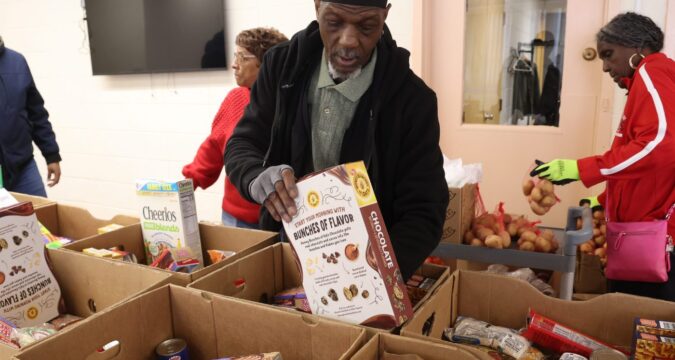
Robinson volunteers about five hours a week at Chosen Bethel Family Ministries’ food pantry, where he also relies on food donations. For around two years, he’s unloaded boxes, set up tables and connected with others over “how we’re being hurt by the administration cutting things.” He believes God will help lead to a solution.
“I do want to work. I do want to add to my legacy and be a part of other people’s lives and be a part of society,” he said. “So I volunteer. It’s the only place that will have me to work.”
The Rev. Sandra Gillespie, at Chosen Bethel Family Ministries, speaks at the Bread of Life food pantry in Chicago on Jan. 26, 2026. (Antonio Perez/Chicago Tribune)
The Rev. Sandra Gillespie, the assistant pastor at Chosen Bethel Family Ministries, said many of her clients are in a similar situation as Robinson and they’re “terrified.” She spends time with clients searching for jobs on Indeed or for other volunteer opportunities. But the options are slim for those with a criminal background, mobility issues or minimal work experience.
Because many of the changes are confusing, many clients also don’t fully understand the new requirements, she said. Her food pantry, which is open Mondays and Thursdays, serves about 200 families per week. They give out canned goods, meat, fruit and more.
“What’s scary is the look on their faces when I say, ‘You could potentially lose your SNAP for three years,’” Gillespie said. “That is ridiculous.”
She said she’s been struggling for months to keep up with demand. Between a tough economy and the government shutdown, people have been lining up outside. They may have to limit the amount of food given to each person or limit the number of days they can visit if the crowd continues to grow.
“This past Thursday, when the wind chill was 20 below zero, we did over 100 people who stood in line for a couple hours,” Gillespie said. “Another (300), 400 people, that’s not sustainable for us.”
Indeed, for every meal provided by the Feeding America network of food banks, SNAP provides the equivalent of nine meals, said Mattson, with the Greater Chicago Food Depository. She said food pantries can serve as temporary stopgaps, but can’t replace SNAP.
“When you take that support away, it’s going to create a need we were never designed to meet,” Mattson said.
Gillespie said she hopes the government rethinks the SNAP requirements because food is “basic human right.”
“We want to make sure that all of our people are able to eat and that they are able to get not just anything, but nutritious, healthy food,” Gillespie said.
https://www.chicagotribune.com/2026/01/27/snap-work-requirements-illinois/

Letters: We can’t afford to tune out what’s happening in Minnesota and across the country
Regardless of where you sit on the political spectrum, we cannot afford to look away.
What’s happening in our country right now is being witnessed by the world: U.S. citizens killed by federal immigration agents in major American cities.
Tuning out may feel easier — but silence only deepens the divide. Privilege allows some to tune out. This moment demands we don’t.
Our lives and our country’s hard-fought democracy are at stake.
— Glenn Eden, Chicago
We see the lies
Paper tigers line the streets, faces obscured, eyes filled with indifference and rage, fingers twitching to make a point. Lives are stolen before our eyes, followed by a barrage of excuses by those who dare to blame and deny others their right to have their name cleared.
We see the lies, we hear the lies, we know the lies, as the president and his inner circle, itching to rule, take a hatchet to our democracy.
But history has shown that people have a breaking point; they tolerate only so much. And inner circles erode, leaving tyrants exposed and shedding mediocre tears before they topple.
— Laura Schmetterer Thill, Arlington Heights
Wake up, America
From Silverio Villegas González in Chicago to Renee Good and Alex Pretti in Minneapolis to homicide victims in Immigration and Customs Enforcement detention centers, the Department of Homeland Security continues a sick and twisted playbook: Kill, defame and blame the victims, block investigations and take no responsibility.
Wake up, America. To add to the imbecility of it all, we the people are paying for soldiers to cut us down.
— Kelly Shannon, Chicago
Who has our backs?
We have a federal government that is selectively employing violence to create an atmosphere of terror among Americans.
Thankfully, the U.S. has not become like Germany and Italy of the 1930s. We still have a free press, judges who issue injunctions and politicians who are speaking out. But we also have an administration that is using forces, as Benito Mussolini employed the squadristi, to terrorize with impunity populations in cities that oppose them.
This is what should concern all of us: The violence by federal officials has been committed with impunity in Democrat-controlled cities. We are not a fascist country, but Germany and Italy became full fascist countries because no one in the capitals held accountable those who committed the targeted violence.
Trump officials have said Immigration and Customs Enforcement agents have “absolute immunity” and cannot be investigated by local law enforcement. ICE agents have behaved brutally and will continue to do so because they see themselves as essentially above the law. If this continues, more Americans will certainly die, and our country will divide into two camps facing each other with hostility, leading to more dire consequences.
The administration says to ICE: We have your back. Citizens who are only filming ICE’s actions are being arrested, beaten and killed. Who has lawful citizens’ backs?
We may not be a fascist country, but we certainly are on the road to becoming one. To stop the escalating violence, members of Congress should use their powers to hold the federal government accountable.
The whole world is watching. Act. Have our backs. Be for all the people.
— Ian Kelly, former U.S. ambassador to the OSCE and to Georgia, Highland Park
Change this tragedy
There is a democratic foundation here that passively allowed collapse. We are now a failed experiment in freedom, human decency, laws and courageous action.
We can still change this tragedy going forward.
— Elynne Chaplik-Aleskow, Chicago
Treatment of protesters
Watching the videos from Minneapolis, I have to wonder: When did protesting violence become “violently resisting”? (And punishable by being shot to death.)
— Richard Wetzel, Chicago
Figure out solutions
It has become popular to demonize federal immigration agents and to make them responsible for the recent unfortunate deaths of two protesters in Minneapolis. Rather than blaming these agents, perhaps the political leaders in Minnesota should be the ones held responsible. Their rhetoric has been bombastic.
It’s time for all parties to stop placing blame and figure out how things could be made better. Immigration and Customs Enforcement is not the enemy, and no one wants to see innocent immigrants demonized or deported.
There must be a reasonable solution.
— Dan Schuchardt, Wheaton
Where is Congress?
I just watched the video of another killing in Minneapolis. The victim is lying on the ground, surrounded by federal agents. He is defenseless. Then he is shot, and from what I read, there could have been up to 10 shots fired. Why?
Good Lord, what is happening in what is supposedly the greatest country on this earth? Arrest these agents and put them on trial. All members of Congress, regardless of party affiliation, should be on their feet screaming to end the Immigration and Customs Enforcement and Border Patrol intrusions on the safety of our citizens.
— Richard Dreger, Batavia
Fear of being shot, killed
I am extremely angry about the killing of the intensive care unit nurse in Minneapolis by federal agents. Homeland Security Secretary Kristi Noem has said these agents were trained. Some are saying that they didn’t get enough training.
These agents do not have the temperament to carry a gun or wear a uniform. Anyone who shoots someone four times, 10 times, has too much anger to be on the street. They seem to have a lot of hatred toward immigrants and anyone they see as different from themselves. These men are no different in nature than the German Gestapo, who also claimed to be only following the law.
I think we need to have a singing revolution as the Estonians did against the Russians. It’s the only way (I hope) that we can protest without the the fear of being shot and killed.
— C. Huber, River Forest
Mayor’s stance on ICE
I’m certain Mayor Brandon Johnson has no clue on how Immigration and Customs Enforcement was formed.
Congress, which makes our laws, is the only governmental body that can repeal them. Johnson should consult with U.S. Sens. Dick Durbin and Tammy Duckworth and Illinois Attorney General Kwame Raoul to begin the process of repealing the Homeland Security Act of 2002.
— Joseph A. Murzanski, Orland Park
Take our country back
Don’t we all want the same thing? Don’t we all want practical and humane immigration policy? Don’t we all want sensible and safe gun policy? Don’t we all want intentional energy policy that focuses on saving the planet rather than destroying it for money? Don’t we all want crime policy that focuses on rehabilitation and prevention by meeting people’s basic needs, addressing mental health and trauma, and working with marginalized communities instead of against them? Don’t we all want geopolitical policy that focuses on uniting, rather than dividing? Don’t we all want our hard work to allow us to take care of our families? Don’t we all just want to be able to keep our families safe? Don’t we all just want the freedom to take care of ourselves and our loved ones?
Why is this so hard if we all want it? Could it be because we are being lied to by people who just want to hoard resources, and so they have us demonizing each other? Can we commit to stop listening to the lies and instead listen to each other?
Our humanity binds us. Can we please take our country back from the liars and cheats?
— Abby Gagerman, Deerfield
Submit a letter, of no more than 400 words, to the editor here or email letters@chicagotribune.com.

Restaurant review: Cafe Yaya exceeds expectations as an ephemeral bakery and neighborhood bistro in Chicago
Cafe Yaya, the familial Mediterranean and French bakery and bistro in Lincoln Park, by the chefs and owners of Michelin-starred Galit next door, exceeds high expectations with deep explorations.
James Beard Award-winning executive chef Zachary Engel co-owns the businesses in Chicago with operations director Andrés Clavero and beverage director Scott Stroemer.
Mary Eder-McClure, executive pastry chef at both restaurants, has established Cafe Yaya as an ephemeral bakery destination since opening last March with her extraordinary range of sweet and savory work available throughout the day and night.
When I arrived one night, they had already put away the tiny countertop daytime pastry case and dimmed the lights as the reclaimed vintage storefront space filled with friend groups and young families.
“People can come and go at different times and have a similar yet different experience,” said Engel. “And everything is very intentional, to be comforting and familiar, but always paying homage to Galit or where we’ve cooked before.”
I loved my visits (at brunch, happy hour, dinner and even takeout for pastries), indeed finding some classic bistro fare on the menu, but most impressed by their interpretations.
A smoky Big Sis lamb burger, with a za’atar-spiced aioli and an enigmatic amba honey mustard, has deservedly become a bestselling signature item. It refers to big sister restaurant Galit, which was named for Engel’s older daughter, Margalit. The chef created a similar burger there for COVID era takeout. He continues to use only lamb from Trent Sparrow at Catalpa Grove Farm near Dwight, Illinois.
Amba, a complex condiment with Iraqi Jewish and Indian roots, is one of Engel’s favorite ingredients.
“It’s fermented curried green mango,” said the chef. “It makes this very fruity, zippy, sweet, tangy, well-spiced, kind of funky mustard.”
Chef/owner Zachary Engel at Cafe Yaya on Jan. 20, 2026. (Terrence Antonio James/Chicago Tribune)
Middle Eastern-style toppings of baby Persian cucumber, pickles, red onion and shredded lettuce finish the lovely lamb burger, tucked in a potato bun. At happy hour, it’s a deal at $16, and comes with a nice side of shoestring fries. The bun and fries are the few items not made in-house.
The Yaya fries, however, are absolutely house-made and fried four times, explained server Arthur Bastardo at dinner. They’re so golden and glorious that you may rethink the potato. I call them The Yaya Potato, because “fries” is not quite sufficient. Dusted with umami-imparting kombu salt and served with an allium-forward green garlic labneh ranch dip, their childlike origin story is surprising.
“My younger daughter, who the restaurant is named after, loves french fries and ranch dressing,” said Engel. “I wanted to do something that was just kind of almost to the point of silly.”
The Yaya fries at Cafe Yaya. (Terrence Antonio James/Chicago Tribune)
Her namesake Yael was a biblical heroine who’s depicted in one of the many beautiful murals at the restaurant by Ilana Engel. The artist (and chef’s sister) also designed the feminine and powerful branding. Look for her frescoes on the exposed brick walls in the main dining room, and more art on the second floor that’s open as a workspace away from home.
The chef credits the french fry research of chef Heston Blumenthal and author J. Kenji López-Alt. But the Yaya fries make a much bolder statement. They transform potatoes into striking edible sculptures, intended to be silly, but seriously shatteringly crisp on the outside, while buttery soft on the inside.
The stunning shakshuka is by far the most popular dish at brunch, assured server David Neitzke-Pizarro without hesitation when I asked.
The shakshuka with malawach at Cafe Yaya. (Terrence Antonio James/Chicago Tribune)
A forest of fresh herbs covers a radiant tomato landscape that’s hiding a pair of soft yolk eggs. It’s brilliantly matched with malawach, the Jewish Yemenite flatbread that’s wood-fired here and pulls apart in lacy croissant layers.
But the beauty of a place like Cafe Yaya comes with its creative daily specials.
A radiant quiche of the day was studded with tender nuggets of butternut squash when I went, with a perfect petite salade verte alongside. A silky soup of the day offered another view on the squash, blended smooth and swirled with labneh and pomegranate ribbons, then bejeweled by Urfa-spiked pepitas. A Thanksgiving-esque toasted marshmallow-topped squash challah extravagantly challenged the idea of morning pastry. And Mary’s daily slice was Eder-McClure’s rich New York cheesecake by way of the tropics with precious guava pâte de fruits, the chewy French fruit confection.
The Cafe Yaya iced drink. (Terrence Antonio James/Chicago Tribune)
Drinks should start with The Cafe Yaya by day, which I had lightly iced, and was essentially like a delightfully nutty pistachio espresso milkshake. A seasonal Hot Date latte with brown sugar and warm baharat spices hints at a comforting infusion of fig cookies. An elegantly frothy and not too sweet cold brew coffee shakerato can also be made boozy with amaro. But the Yaya Old Fashioned is the cocktail to get, beautifully balanced with bourbon, coffee, cardamom bitters and the caramel essence of medjool dates.
The L.B.L.T. carries a touch of that sweetness in house-made lamb bacon layered with lettuce, tomato and their za’atar aioli on that potato bun.
“It’s cured with curing salt and brown sugar for seven days,” said Engel about the lamb. “Then we finish it with a pastirma spice, so paprika, cumin and fenugreek.”
They let that sit overnight, before smoking, slicing thin and cooking on the griddle. Just when you think everything’s been done with bacon, theirs is so delicate and different, crisped ribbons with a distinctive flavor.
The sandwich became so popular after tomato season that they couldn’t take it off the menu. Now the tomatoes are heirloom from hothouses, and unfortunately, my tomato slices were mushy. I say wait until summer tomatoes return from their purveyors, Frillman Farms and Nichols Farm, or just order a side of lamb bacon like the friend group next to me did.
Mary’s biscuit sandwich fared a bit better with sun-dried tomato, but the rustic crusty biscuit style was thick and hard to eat as a sandwich with the awkward Yaya egg sticks tumbling out.
A caramelized onion miso labneh dip is so subtle and small, but comes with your choice of generous dippers: socca (chickpea flatbread that’s woodfired here); simit (the circular sesame bread often called a Turkish bagel); a bread basket with a fantastic focaccia; an adorable quartet of challah rolls; and a cornucopia of crudités. Get everything except the socca, which was sadly gummy.
A French onion dip challah pastry, on the other hand, was fun and smothered in ruffled potato chips, but a bit overwhelmed by too much dip.
This Week’s Ice Cream Sundae featured two scoops of an autumnal vanilla apple butter swirl ice cream, with hazelnut and an intriguing croissant crunch, but curiously no saucy topping.
The sublime baklava, though, flaky and floral with orange blossom and Midwestern honey, honors the ancient pastry with the technique Eder-McClure has been perfecting since she was 9 years old.
“My mom would make baklava for Rosh Hashanah,” said the pastry chef. “As soon as I became able, my mom was like, ‘You can sit down at the table and make the baklava, because I’ve got a whole other dinner party to worry about,’ so it became my job every year.”
Pastry chef Mary Eder-McClure at Cafe Yaya. (Terrence Antonio James/Chicago Tribune)
She also translates those flavors into an ingenious baklava bun, reminiscent of a cinnamon roll with flecked fragrant orange zest.
“The cardamom kouign-amann is my personal favorite,” said Eder-McClure in a rare chef’s admission.
Her variation on the legendary caramelized pastry may be the best I’ve had outside of France, and took me back to Brittany, where it was invented.
“I wanted to make it a little different, so I added a little cardamom sugar in between the layers,” said the pastry chef. “It’s also something that I myself enjoy eating and I don’t eat a lot of sweets.”
Fortunately a properly made kouign-amann is not that sweet. I do wish that there was a bit more cardamom flavor, as does the chef.
“I would do more too,” she said. “But some people are so sensitive with those flavors.”
The shakshuka bun, a fan favorite, evidently needs no adjustments since it sells out every day.
“We make a limited amount, because they have a whole egg inside,” said Eder-McClure. “They generally sell out by 11 a.m.”
Pastries at Cafe Yaya, from top left: shakshuka bun, baklava, baklava bun, tahini brownie, French onion dip challah and cardamom kouign-amann. (Terrence Antonio James/Chicago Tribune)
I can attest to that, because despite multiple attempts, I missed them, even after ordering a box of pastries online, which are chef’s choice with no option to choose. Full disclosure: my identity was revealed through that order. I picked up at brunch, and my check showed “Louisa Chu Tribune.” They did add a lovely little fudgy tahini brownie and jumbo rice krispy treat without charge, but I bought another pair at the counter and gave the treats to the table next to me.
A highly underrated Cubano croissant also made the box, with smoked ham, Swiss cheese, sharp mustard and pickle bits, made daily in tribute to operations director Clavero’s Miami roots.
Closer to home, I asked Engel about a notation that’s across their website’s “What We Do” page, menus, checks and clarified by servers.
In practice, they now simply add a 20% service charge in lieu of a gratuity for full service when dining in, 10% for counter service and takeout, and no further tips are expected.
“I think that people want to think that every restaurant fits into some cookie-cutter mold of how it operates,” said the chef. “And as someone who owns two restaurants, I can tell you that that is definitively not a fact of the world.”
Everybody operates differently, he said, and how they choose to operate is dependent on what makes sense for them. The service charge in lieu of gratuity and the health care surcharge help benefit all their employees and have given them the ability to create a more professional work environment, he added.
“And it shows our employees that when they go on in the future, it is a feasible thing for them to do when they are the decision makers for a business.”
Cafe Yaya
2431 N. Lincoln Ave.
Open: Tuesday to Thursday 7:30 a.m. to 9 p.m., Friday 7:30 a.m. to 10 p.m., Saturday 8 a.m. to 10 p.m., Sunday 8 a.m. to 9 p.m. (closed Monday)
Prices: $24 (Big Sis lamb burger), $15 (The L.B.L.T), $11 (Yaya fries), $15 (Yaya Old Fashioned cocktail), $8 (The Cafe Yaya refresher); $21 (shakshuka), $4 (baklava), $36 (online preorder box of half dozen sweet and savory pastries, chef’s choice)
Sound: OK (61 to 66 dB)
Accessibility: Wheelchair accessible with restrooms on single level
Tribune rating: Three stars, excellent
Ratings key: Four stars, outstanding; three stars, excellent; two stars, very good; one star, good; zero stars, unsatisfactory.
Meals are paid for by the Tribune.
Big screen or home stream, takeout or dine-in, Tribune writers are here to steer you toward your next great experience. Sign up for your free weekly Eat. Watch. Do. newsletter here.
https://www.chicagotribune.com/2026/01/27/restaurant-review-cafe-yaya-chicago/