Category: News

New Woke Star Trek “Starfleet Academy” Series Is An Embarrassing Critical Failure
New Woke Star Trek “Starfleet Academy” Series Is An Embarrassing Critical Failure
The charm of Star Trek as a concept is that the franchise offers a relatively positive vision of humanity’s future rather than the predictable doomsday scenarios that have saturated television for decades. Setting aside the show’s strange ties to the RAND Corporation and Gene Rodenberry’s pandering to the United Nations, Star Trek essentially imagines a civilization in which the politics of today have become irrelevant and humans have moved on to the stars.
It would be fair to say that the show has always been “liberal”, but certainly never “woke.” Wokeness requires that today’s far left ideologies remain central to every discussion. Nothing is ever subtle. Nothing is ever represented in allegory or symbolism – The audience must be bashed over the head with blatant propaganda 24/7.
One would think any Hollywood writer with an IQ above 80 would realize that they can’t use the politics and vernacular of 2026 activism in a show set over 1000 years in the future. The problem is, most of Hollywood is operating on an IQ closer to tap water and their egos are so inflated they actually believe that their beliefs will be the same beliefs celebrated centuries from now.
Paramount’s latest foray into Star Trek, called “Starfleet Academy”, definitely does not boldly go where no man has gone before. Rather, it goes where every other far-left vehicle has gone before, into the proverbial dumpster. Audiences are not watching or buying, but Hollywood refuses to learn.
The show is now being referred to as “Dawson’s Creek in space”, with audience reviews largely negative. IMDB has the series at a 4.3 and the Rotten Tomatoes audience score is sitting at stinking 43%.
The first episode of the series was released by Paramount for free on YouTube which led to an embarrassingly low live viewer count of only 1300 people. The video has limped to 230,000 views in 11 days; a dismal showing for a major studio production costing up to $10 million per episode, and these numbers don’t even account for the people viewing the show simply to make fun of it.
Paramount+ does not release detailed streaming data (out of a sense of self preservation), but the information that’s available indicates the series is a bomb.
Starfleet features many predictable woke themes, including an insufferable white liberal girl-boss (played by Holly Hunter) taking in a poor lost minority orphan and preaching to a perfect pie chart classroom full of DEI students about feelings and progressive values. There are, of course, multiple LGBT themes (very rarely touched on in previous Star Trek series) including lots of fat lesbians and a gay Klingon. Starfleet proudly showcases its obese cast as if Ozempic doesn’t exist in the 32nd Century.
Another fixture of the series common in modern TV is the overt inclusion of annoying autistic people, as if autism is an identity to be celebrated rather than a growing health crisis that needs to be solved.
Finally, the dialogue is cited by many fans as painfully adolescent; as if it was written by children for Reddit fan fiction, or generated by a bargain-bin AI program.
Keep in mind, it’s now 2026 and woke entertainment has been dead for a few years – Long enough for Paramount to know better than to release this kind of series into the wild. Perhaps they are gluttons for punishment, or perhaps the woke mafia in Hollywood simply refuses to accept defeat.
If the goal is to force the public to consume woke propaganda then they have failed because no one is watching this show. If the goal was to make money then they have failed because, again, no one is watching this show. It is unfortunate, however, that yet another popular franchise once beloved by millions of fans has been relegated to the media dustbin. It has been murdered by the woke hubris of low talent hacks motivated by ideology and activism rather than merit and imagination.
Tyler Durden
Mon, 01/26/2026 – 23:00
What Broke Trade Was The Fiat Dollar
What Broke Trade Was The Fiat Dollar
Authored by Jeffrey Tucker via The Epoch Times,
The postwar trading order is taking on an entirely new shape.
We can put brackets around the old one, like a tombstone: 1944–2025.
Having known some of the economists and statesmen who put together the old order, I’m in a position to explain what they had in mind and also what went wrong with it. What will replace it is still very much in flux but the outlines are being drawn daily.
Let’s go back in time to Oct. 29, 1929 when the stock market crashed. There was panic in the air and great confusion about what to do and what not to do. However, absent any serious action by government, the financial markets began to recover over six months, even as downward price pressure on commodities began to show.
Congress responded with a very large increase in tariffs. The reason was partially a holdover from what had happened two decades earlier. The income tax had replaced reliance on tariff revenue, and many members of Congress had their doubts about this change. Indeed, resentment against the income tax was growing. Reverting to tariffs and away from a drive to free trade seemed like a possibility.
Many economists at the time warned about this tariff act. The concern was that this would shatter relationships with foreign markets when they were most fragile. The entire financial and industrial world at the time, including many small farmers, were concerned that this action was ill-advised. There was no love for the income tax but bringing back the tariff was deeply unpopular within professional circles.
The day that President Herbert Hoover signed the Smoot-Hawley Tariff Act was June 17, 1930. That very day, the stock market stopped its trajectory toward recovery and reversed. Over the course of the several weeks surrounding this act, financial markets fell fully 20 percent. Lacking another explanation, all eyes turned toward the tariff bill as the cause. A few years later, those tariffs started to fall.
This prompted two huge commitments on the part of the upper echelon of opinion makers, economists, and statesmen. They blamed the decline on the tariff, deploying the crude analytical tool “After this, therefore, because of this.” Therefore, first, they committed themselves to a long-term plan to restore the downward trajectory of tariffs. Second, they decided to remove discretion over tariffs from Congress and put it entirely in the hands of the executive.
That’s where matters stood as the Depression went on and on and economic conditions continued to decay. The New Deal did not work to end the economic crisis, despite what they say. Even as the nation marched forward to yet another war, the economic problems persisted.
After the war, the forces for freer trade and against tariffs got their chance. The Bretton Woods agreement of 1944 was all-encompassing: finance, monetary rules, and trade. The trade piece of this was to be the International Trade Organization but it was never ratified. Instead, we got the much milder General Agreement on Tariffs and Trade. As a separate agreement, a new version of the gold standard was revived. In the new iterations, nations would stop promising domestic convertibility of money. Rather, accounts between nations would be settled by physical shipments of gold.
This was called the gold-exchange standard. It established dollar supremacy for the main parts of the world economy. There was always a problem with the plan, one known from the start. Nations using the same monetary standard also need to coordinate fiscal and monetary policies, a scheme that was impossible to deploy among all sovereign nations. A second problem is that without such settlements, wages and business costs across nations could remain permanently divergent, giving exporting nations an advantage over importing ones. With the dollar as the world standard, the United States stood to lose all manufacturing advantages should the agreement ever break down.
By the late 1960s, with huge pressures from war and welfare piling up in all nations, the Bretton Woods agreement did indeed break down. The United States became a net importer of goods, meaning that its outward gold shipments would only increase, depleting stockpiles that secured the soundness of the currency. Financial managers, bankers, and economic planners were powerless to stop this simply because the international agreement required that international accounts be settled in gold.
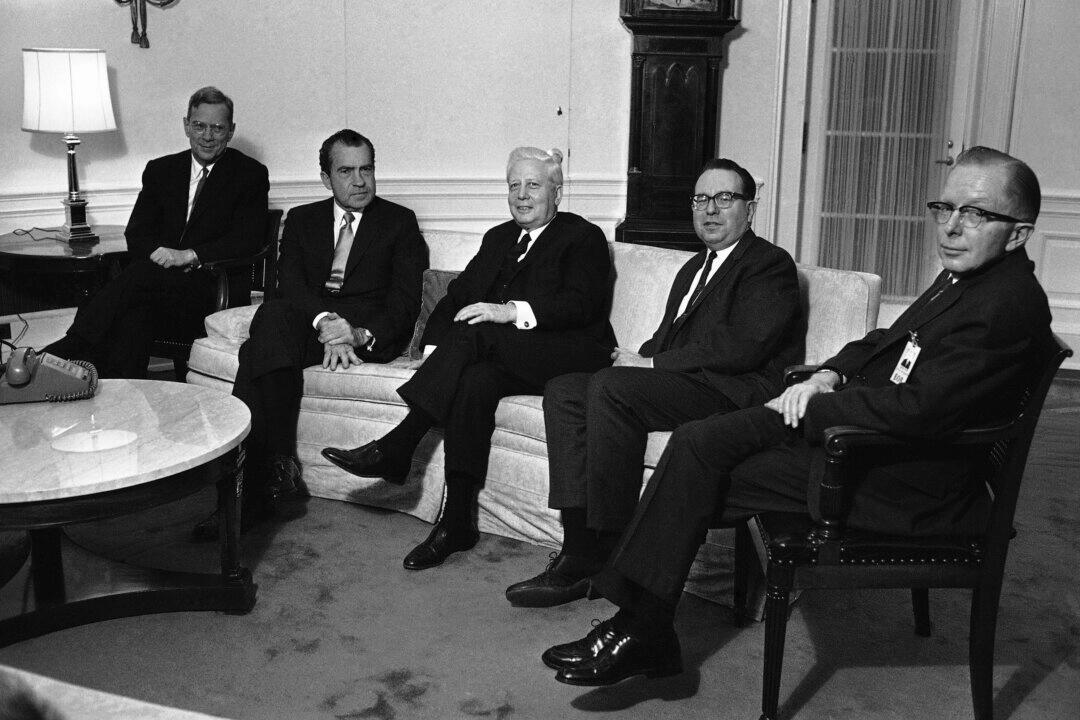
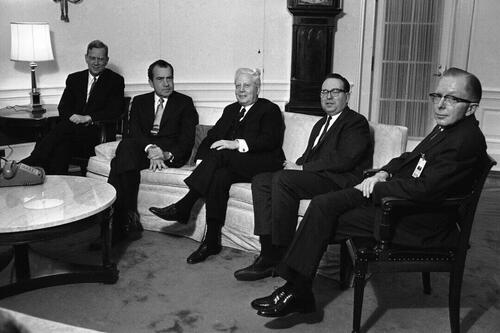
President Richard Nixon (2nd-L) poses at the White House in Washington, with four government officials he named as his economic “Quadriad” on Jan. 23, 1969. (L-R) Chairman William M. Chesney Martin Jr., of the Federal Reserve Board; Nixon; Secretary of the Treasury David M. Kennedy; Budget Director Robert Mayor and Chairman Paul McCracken of the Council of Economic Advisers. AP Photo/ Harvey Georges
Richard Nixon was the president who had to deal with the crisis once the gold outflows became near terminal. On Aug. 15, 1971, Nixon broke the whole international monetary order by suspending gold convertibility. The United States would no longer ship its gold in exchange for goods. This move shocked the world. Improvising, a new agreement was reached 18 months later. With the Smithsonian Agreement, a new global system of fiat money was born. There would be a market for currencies to trade against each other but with absolutely no tether to gold.
The dollar retained its global supremacy. Any economist schooled in both trade theory and monetary theory (fewer and fewer are) could have predicted what would happen. The U.S. industrial base would be gradually dismantled as nations discovered how their lesser-valued currencies gave them an advantage as exporters. The United States would retain its exporter status on natural resources but manufacturing was surely doomed.
It was also easily predictable that the United States would begin running trade deficits with essentially everyone because the market for dollars was international and settlement was no longer a necessary feature of the system. Japan and then China figured out the new metrics of international trade, and policymakers sat by and watched with astonishment how one American industry after another evaporated: pianos, watches, household electronics, apparel, textiles, steel, cars, tools, ships, and on it goes.
The math of the situation made this inevitable. International trade in the days of the gold standard tended to yield what David Ricardo called the Law of One Price. Gold settlement equilibrated prices and wages internationally in the same way they did domestically. With the Smithsonian Agreement, the disequilibration would be permanent and further worsening to the disadvantage of the country hosting the world’s most valuable and most-used currency.
It should have been obvious that such a situation was not sustainable. It was Donald Trump who called it out alongside his suggested remedy of old-world tariffs. The theory was that by adding an import tax, the manufacturing disadvantage of the dominant nation would be remedied—a prescription that had never been deployed before simply because these conditions have never before prevailed.
The architects of the Bretton Woods system are today likely rolling in their graves to see the global system of trading revert to walled gardens of tariffs, zones, and regional supply lines, alongside the inevitable tensions that such a system produces. But keep in mind: the system they set up could result in no other. By attempting to gamify a gold standard without the discipline that comes from domestic convertibility, they made the present world inevitable. That it took 70 years to get here makes it no less part of the logical and political trajectory any intelligent observer could have foreseen.
The fiat money system was the shepherd of the breakdown of world trade, in addition to fueling astonishing levels of leverage, debt, inflation, and financial irresponsibility all around. This sad story points to an eternal truth. You cannot ever trust governments with the production and management of money. When they are not abusing the system to serve themselves, they are mismanaging it to make it untrustworthy for everyone else to use.
Tyler Durden
Mon, 01/26/2026 – 22:35
https://www.zerohedge.com/geopolitical/what-broke-trade-was-fiat-dollar

Dane Farrar develops into more than just a scoring guard for Batavia. It’s his defense too. ‘Kind of my role.’
In his first season as a varsity starter, junior guard Dane Farrar hasn’t developed into a prolific scorer for Batavia, but he could be described as something of a prolific player.
The 6-foot-2 Farrar contributes to the Bulldogs’ success in many aspects on the court.
“I average five to 10 points most nights,” he said. “I’m usually on the other team’s scorer. I can play almost any position on the offense, and if it’s a small team, I can guard all the positions.
“That’s kind of my role.”
Farrar’s role was pretty typical Saturday afternoon for the host Bulldogs in a 55-37 victory over Hinsdale Central in the 32nd annual Jim and Sylvia Roberts Batavia Night of Hoops.
While he scored only five points, Farrar stepped up for Batavia (13-8) by grabbing 10 rebounds, blocking two shots, making three steals, dishing out two assists and drawing a charge.
Senior forward Brett Berggren led with 15 points and senior point guard Xavier Justice added 13 points for the Bulldogs, who are 8-1 in their last nine games after battling through December to get and stay above .500.
But in the end, it was Farrar’s effort that went a long way Saturday.
“Dane does a lot of things,” Batavia coach Jim Nazos said. “He came up with a loose ball too that led to a 3-pointer for us. There’s been a lot of different guys at different times stepping up.”
Farrar wasn’t particularly pleased with his defense, however, as senior guard Cole Bero scored a game-high 26 points for Hinsdale Central (8-13).
Batavia’s Dane Farrar (15) defends the drive of Geneva’s Gabe Jensen (2) in the second quarter of a DuKane Conference game in Geneva on Friday, Dec. 19, 2025. (H. Rick Bamman / The Beacon-News)
“Dane drew the straw of guarding No. 3, who was very good,” Nazos said of Bero.
Bero was basically a one-man show, though, with only three other Red Devils scoring.
And Batavia met its team goal defensively, which has been carrying the load since the new year.
“We’ve come together as a team and really focus on defense in practice,” Farrar said. “And then our bench players have done a lot for us when we’re in foul trouble, especially with defense.
“We’ve held most teams under 42 about every game and we can capitalize on that. We try to keep the other team under 10 points each quarter. We’ve been doing pretty well with it. On offense, we try to get to the 50s, and if we can, we should get a win out of it.”
The Bulldogs went 5-7 before the calendar flipped to 2026, giving up an average of 47.7 points a game. In the new year, they’re allowing only 41.6.
Hinsdale Central had quarter scores of 12, seven, nine and nine points, respectively.
“We were very good at losing one-possession games in November and early December,” Nazos said. “It’s an enjoyable group to coach because they compete. They see things, and when they’re not good things, they start to trust amongst each other.”
A key win came Friday with a 48-43 decision over Glenbard North, a DuKane Conference rival that had beaten the Bulldogs twice before this winter. The Panthers won 49-47 in overtime on Dec. 5 in a conference game and 49-45 on Dec. 30 in a Jack Tosh Christmas Tournament game at York.
St. Charles East’s Gavin Szerlong (10) works the ball between Batavia’s Dane Farrar (15) and Jax Abalos (3) in the fourth quarter of a DuKane Conference game in St. Charles on Friday, Jan. 10, 2025. (H. Rick Bamman / The Beacon-News)
Nazos believes the best is yet to come, for both his team and Farrar.
“I really think we’ve got our best ball ahead of us, even though we’ve had a nice little stretch here,” Nazos said. “The key has been doing a lot of good things defensively.
“There’s been good team defensive awareness, communication and limiting a team’s possession, getting tips and steals. It’s helped a ton.”
And Farrar?
“He can defend — he can rebound,” Nazos said. “He sees the floor really well and hits open shots. And you would never think it sometimes, but I think he could grow a few more inches. His parents are a little taller.
“Next year, I think you’re going to see another guy in him, too.”
https://www.chicagotribune.com/2026/01/26/dane-farrar-batavia-basketball/
Watch: Massive “Beast” Oil Rig Tips Over On Alaska’s North Slope
Watch: Massive “Beast” Oil Rig Tips Over On Alaska’s North Slope
A large mobile drilling rig known as “The Beast” tipped over Friday afternoon while being transported along a gravel road on Alaska’s North Slope, prompting an emergency response from local and company officials, according to Yahoo.
The incident happened around 4:45 p.m. and involved the Doyon 26 rig, which was operating for ConocoPhillips. In a joint statement, ConocoPhillips Alaska and the North Slope Borough said all workers were accounted for and that no one suffered serious injuries.
ConocoPhillips later reported that eight people — including two who were on the rig and six early responders — were treated at nearby medical clinics and released.
After the rig overturned, a fire broke out, but officials said it was “contained and controlled” by Friday evening with emergency crews on site. Authorities also emphasized that “there was no damage to local community infrastructure and no impact to pipelines or fuel transportation.”
By Saturday afternoon, officials said the response had moved into “an environmental impact assessment and mitigation effort,” and traffic in the area had returned to normal.
🚨🇺🇸 NORTH AMERICA’S BIGGEST LAND RIG TIPS OVER IN ALASKA
Doyon 26 toppled while being moved on a gravel road near ConocoPhillips’ Alpine field yesterday. Small fire broke out, got put out fast.
At 9.5 million pounds and nicknamed “The Beast,” it’s the largest mobile land rig… pic.twitter.com/1SsRYBRQOk
— Mario Nawfal (@MarioNawfal) January 24, 2026
Gov. Mike Dunleavy posted on social media that he had “been in contact with ConocoPhillips leadership” and that there “appears to be minimal damage to the environment” so far. He added that the company was “working on plans to recover the rig.”
The Doyon 26 rig, ordered by ConocoPhillips in 2016, is one of the largest mobile land rigs in North America. Weighing about 9.5 million pounds, it set a long-distance drilling record in Alaska in 2022 and played a key role in developing oil reserves in western North Slope fields. Its size allows it to cover roughly three times the area of traditional rigs.
The rig was constructed, owned, and operated by Doyon Drilling, a subsidiary of Doyon, an Alaska Native regional corporation.
ConocoPhillips said Saturday that Doyon Drilling “is leading response and recovery efforts under a Unified Command structure including representatives from the State of Alaska, the Federal Government and the North Slope Borough.”
Tyler Durden
Mon, 01/26/2026 – 22:10
https://www.zerohedge.com/markets/watch-massive-beast-oil-rig-tips-over-alaskas-north-slope

Two people shot in the head, one fatally, on Far South Side
A Far South Side shooting late Monday afternoon left a man dead and a woman critically injured, Chicago police said.
Two men, 27 and 37, and a 44-year-old woman were sitting inside an SUV in the 8500 block of South Aberdeen Street at around 4:45 p.m. in the city’s Auburn Gresham neighborhood when they were approached by several people, according to Chicago police. At least one of the people who approached the car produced a firearm and opened fire. The offenders fled in an unknown direction, police said.
The 37-year-old man was shot in the head twice and pronounced dead at UChicago Medicine, police said. The woman was also shot in the head and transported to Advocate Christ Medical Center, where she was initially listed in critical condition. The 27-year-old man wasn’t shot, police said.
There was no one in custody as of Monday night as Calumet area detectives investigated.
https://www.chicagotribune.com/2026/01/26/auburn-gresham-shooting/

Two people shot in the head, one fatally, on Far South Side
A Far South Side shooting late Monday afternoon left a man dead and a woman critically injured, Chicago police said.
Two men, 27 and 37, and a 44-year-old woman were sitting inside an SUV in the 8500 block of South Aberdeen Street at around 4:45 p.m. in the city’s Auburn Gresham neighborhood when they were approached by several people, according to Chicago police. At least one of the people who approached the car produced a firearm and opened fire. The offenders fled in an unknown direction, police said.
The 37-year-old man was shot in the head twice and pronounced dead at UChicago Medicine, police said. The woman was also shot in the head and transported to Advocate Christ Medical Center, where she was initially listed in critical condition. The 27-year-old man wasn’t shot, police said.
There was no one in custody as of Monday night as Calumet area detectives investigated.
https://www.chicagotribune.com/2026/01/26/auburn-gresham-shooting/

Juliana Stratton takes progressive lane, only one who calls for abolishing ICE in Democratic US Senate debate
The three major Democratic candidates vying to succeed retiring U.S. Sen. Dick Durbin clashed Monday night over who would be the strongest opponent to President Donald Trump and his aggressive deportation enforcement operations, each vowing to varying degrees to end the current tactics of his federal immigration agents.
The hourlong debate, held with 50 days remaining until the March 17 primary, found Lt. Gov. Juliana Stratton to be the clear aggressor among the three, seeking to stake out the most progressive lane by attacking rival congressional members Raja Krishnamoorthi of Schaumburg and Robin Kelly of Lynwood for being “status quo” Washington Democrats.
At one point, Krishnamoorthi, responding to Stratton’s attacks, jokingly told the audience at the University of Chicago’s International House, “I should have brought some body armor here.”
Stratton was the lone contender to call for the abolishment of the Immigration and Customs Enforcement agency in the wake of the fatal shootings of two U.S. citizens in Minnesota by immigration enforcement agents there. Krishnamoorthi called for an end to “Trump’s ICE,” no additional funding for immigration enforcement operations and an inspector general to investigate the agency. In Congress, Kelly has filed articles of impeachment against Kristi Noem, secretary of Homeland Security, which is over ICE and Border Patrol.
“I want to abolish ICE because this agency cannot be reformed,” said Stratton, the two-term running mate of Gov. JB Pritzker. “We are looking at what’s happening and it doesn’t matter whose ICE it is. ICE needs to be abolished and we need to move this country forward and make sure our communities are safe.”
The issue of whether to abolish ICE has become a new dividing line between Democratic progressives and moderates. Moderates fear that calls for the outright abolition are akin to past progressive calls to “defund the police,” which cost the party support at the ballot box in previous elections.
Krishnamoorthi said that, unlike his primary rivals, he had already “done the hard work of trying to hold ICE accountable” by getting rejected on one visit to Homeland Security’s Broadview detention facility, later being allowed to make an inspection of it, and saying he learned there that “they not only target people with (criminal) convictions, they go after people who are merely charged and who are collaterally present. That means innocent citizens.”
Kelly said she wants to see ICE dismantled. That, along with her attempt to impeach Noem, an unlikely prospect in the GOP-controlled House, would “build an agency that people can trust.”
“The Department of Homeland Security is too big, too unwieldy and not accountable and we need to do all this in the guise of immigration reform,” Kelly said. “They’re not going after the murderers and rapists that they said that they were (going after). It’s a total embarrassment. And we do have to stop Kristi Noem’s reign of terror through all of our cities.”
After the debate, Krishnamoorthi told reporters that his call to “abolish Trump’s ICE” aligns with the stance of Pritzker, who has endorsed Stratton.
Krishnamoorthi said ICE does have important functions apart from the current high-profile immigration crackdown, including combating human trafficking and drug smuggling. And, he said, some of the most aggressive immigration enforcement tactics, including Saturday’s fatal shooting in Minneapolis, have come from Border Patrol agents rather than ICE personnel.
Stratton, however, pointed to Border Patrol in response to a post-debate question about who would take on immigration enforcement responsibilities if ICE were eliminated.
“There is Border Patrol and … we, of course, need secure borders,” Stratton said. “But look at what ICE is doing right now. I mean, we have people who have now been murdered by ICE, and it is dangerous, and all of us are at risk.”
Stratton during the debate also questioned Krishnamoorthi’s credibility on the issue of reforming immigration enforcement, citing his acceptance of campaign funding from a Homeland Security contractor, a demonstration that fundraising was a higher personal priority. Krishnamoorthi said that after learning he had received the funds, he contributed them to immigration relief organizations.
But as Stratton touted that her campaign was the only major contender not to accept corporate political action committee donations, both Krishanmoorthi and Kelly pushed back.
“I take corporate PAC money, but check the record. Check how I vote. I vote like the people who put me in office want me to vote,” Kelly said, noting that a current TV ad backing Stratton is being paid for by a “dark money” PAC and “we don’t know who’s behind those commercials.”
Krishnamoorthi accused Stratton of “hypocrisy” on the PAC contribution issue. When Stratton also accused him of voting for a House resolution that offered “thanks” to ICE, he said “99% of that resolution was about condemning antisemitism following an attack on 14 Jews in Boulder, Colorado.”
“I’m going to condemn antisemitism eight days out of the week,” he said, “and that was one that the Jewish community especially wanted me to vote for.”
Krishnamoorthi said he could support lengthening the current two-year term for House members and possibly adding term limits and age limits to members of both chambers. But Stratton said serving is “about whether you get things done for people, not an actual numerical, not a number.” She then went on to contend that Krishnamoorthi had passed only four bills into law during his five terms in the House, each to rename a post office.
But Krishnamoorthi said he also had sponsored provisions for such items as increased mental health funding and a modernization of skills-based education among “76 other bills signed into law.”
“I think what people need is the truth, lieutenant governor,” Krishnamoorthi said.
The debate was held at the University of Chicago’s International House and hosted by the school’s Institute of Politics along with the Chicago Sun-Times and WBEZ-FM 91.5. Another debate among the three, the first on broadcast TV, will take place Thursday at 7 p.m., hosted by ABC-7, Univision and the League of Women Voters of Illinois.
Ahead of Monday’s event, the PAC aligned with Stratton began running a half-minute digital ad on social media sites to drive her message of opposing ICE.
“Stratton has made clear ICE must be abolished, not reformed, not retrained, abolished,” a narrator says in the Illinois Future PAC ad. “Every candidate on the debate stage knows what ICE is doing to our state and our country. Juliana Stratton will do what it takes to stop it. And that’s the difference.”
Krishnamoorthi, whose vast fundraising lead over his rivals has helped him secure almost unchallenged access to the TV airwaves, also unveiled a new broadcast ad featuring ICE just prior to the debate.
“Donald Trump has weaponized ICE against our cities and our people. Torn apart families …terrorized neighborhoods. We should abolish Trump’s ICE,” Krishnamoorthi says in the ad. “We can’t have a government or ICE running out of control. It’s morally wrong, and it’s unlawful.”
Earlier in the day, Stratton also moved to demonstrate support from the Latino community, announcing the endorsement of retiring U.S. Rep. Jesús “Chuy” García and several state lawmakers. Also endorsing Stratton was Patty García, whom Jesús García controversially maneuvered to succeed him in the Democratic primary for the 4th Congressional District.
https://www.chicagotribune.com/2026/01/26/illinois-senate-debate-democrats-stratton-aggressor/
Juliana Stratton takes progressive lane, only one who calls for abolishing ICE in Democratic US Senate debate
The three major Democratic candidates vying to succeed retiring U.S. Sen. Dick Durbin clashed Monday night over who would be the strongest opponent to President Donald Trump and his aggressive deportation enforcement operations, each vowing to varying degrees to end the current tactics of his federal immigration agents.
The hourlong debate, held with 50 days remaining until the March 17 primary, found Lt. Gov. Juliana Stratton to be the clear aggressor among the three, seeking to stake out the most progressive lane by attacking rival congressional members Raja Krishnamoorthi of Schaumburg and Robin Kelly of Lynwood for being “status quo” Washington Democrats.
At one point, Krishnamoorthi, responding to Stratton’s attacks, jokingly told the audience at the University of Chicago’s International House, “I should have brought some body armor here.”
Stratton was the lone contender to call for the abolishment of the Immigration and Customs Enforcement agency in the wake of the fatal shootings of two U.S. citizens in Minnesota by immigration enforcement agents there. Krishnamoorthi called for an end to “Trump’s ICE,” no additional funding for immigration enforcement operations and an inspector general to investigate the agency. In Congress, Kelly has filed articles of impeachment against Kristi Noem, secretary of Homeland Security, which is over ICE and Border Patrol.
“I want to abolish ICE because this agency cannot be reformed,” said Stratton, the two-term running mate of Gov. JB Pritzker. “We are looking at what’s happening and it doesn’t matter whose ICE it is. ICE needs to be abolished and we need to move this country forward and make sure our communities are safe.”
The issue of whether to abolish ICE has become a new dividing line between Democratic progressives and moderates. Moderates fear that calls for the outright abolition are akin to past progressive calls to “defund the police,” which cost the party support at the ballot box in previous elections.
Krishnamoorthi said that, unlike his primary rivals, he had already “done the hard work of trying to hold ICE accountable” by getting rejected on one visit to Homeland Security’s Broadview detention facility, later being allowed to make an inspection of it, and saying he learned there that “they not only target people with (criminal) convictions, they go after people who are merely charged and who are collaterally present. That means innocent citizens.”
Kelly said she wants to see ICE dismantled. That, along with her attempt to impeach Noem, an unlikely prospect in the GOP-controlled House, would “build an agency that people can trust.”
“The Department of Homeland Security is too big, too unwieldy and not accountable and we need to do all this in the guise of immigration reform,” Kelly said. “They’re not going after the murderers and rapists that they said that they were (going after). It’s a total embarrassment. And we do have to stop Kristi Noem’s reign of terror through all of our cities.”
After the debate, Krishnamoorthi told reporters that his call to “abolish Trump’s ICE” aligns with the stance of Pritzker, who has endorsed Stratton.
Krishnamoorthi said ICE does have important functions apart from the current high-profile immigration crackdown, including combating human trafficking and drug smuggling. And, he said, some of the most aggressive immigration enforcement tactics, including Saturday’s fatal shooting in Minneapolis, have come from Border Patrol agents rather than ICE personnel.
Stratton, however, pointed to Border Patrol in response to a post-debate question about who would take on immigration enforcement responsibilities if ICE were eliminated.
“There is Border Patrol and … we, of course, need secure borders,” Stratton said. “But look at what ICE is doing right now. I mean, we have people who have now been murdered by ICE, and it is dangerous, and all of us are at risk.”
Stratton during the debate also questioned Krishnamoorthi’s credibility on the issue of reforming immigration enforcement, citing his acceptance of campaign funding from a Homeland Security contractor, a demonstration that fundraising was a higher personal priority. Krishnamoorthi said that after learning he had received the funds, he contributed them to immigration relief organizations.
But as Stratton touted that her campaign was the only major contender not to accept corporate political action committee donations, both Krishanmoorthi and Kelly pushed back.
“I take corporate PAC money, but check the record. Check how I vote. I vote like the people who put me in office want me to vote,” Kelly said, noting that a current TV ad backing Stratton is being paid for by a “dark money” PAC and “we don’t know who’s behind those commercials.”
Krishnamoorthi accused Stratton of “hypocrisy” on the PAC contribution issue. When Stratton also accused him of voting for a House resolution that offered “thanks” to ICE, he said “99% of that resolution was about condemning antisemitism following an attack on 14 Jews in Boulder, Colorado.”
“I’m going to condemn antisemitism eight days out of the week,” he said, “and that was one that the Jewish community especially wanted me to vote for.”
Krishnamoorthi said he could support lengthening the current two-year term for House members and possibly adding term limits and age limits to members of both chambers. But Stratton said serving is “about whether you get things done for people, not an actual numerical, not a number.” She then went on to contend that Krishnamoorthi had passed only four bills into law during his five terms in the House, each to rename a post office.
But Krishnamoorthi said he also had sponsored provisions for such items as increased mental health funding and a modernization of skills-based education among “76 other bills signed into law.”
“I think what people need is the truth, lieutenant governor,” Krishnamoorthi said.
The debate was held at the University of Chicago’s International House and hosted by the school’s Institute of Politics along with the Chicago Sun-Times and WBEZ-FM 91.5. Another debate among the three, the first on broadcast TV, will take place Thursday at 7 p.m., hosted by ABC-7, Univision and the League of Women Voters of Illinois.
Ahead of Monday’s event, the PAC aligned with Stratton began running a half-minute digital ad on social media sites to drive her message of opposing ICE.
“Stratton has made clear ICE must be abolished, not reformed, not retrained, abolished,” a narrator says in the Illinois Future PAC ad. “Every candidate on the debate stage knows what ICE is doing to our state and our country. Juliana Stratton will do what it takes to stop it. And that’s the difference.”
Krishnamoorthi, whose vast fundraising lead over his rivals has helped him secure almost unchallenged access to the TV airwaves, also unveiled a new broadcast ad featuring ICE just prior to the debate.
“Donald Trump has weaponized ICE against our cities and our people. Torn apart families …terrorized neighborhoods. We should abolish Trump’s ICE,” Krishnamoorthi says in the ad. “We can’t have a government or ICE running out of control. It’s morally wrong, and it’s unlawful.”
Earlier in the day, Stratton also moved to demonstrate support from the Latino community, announcing the endorsement of retiring U.S. Rep. Jesús “Chuy” García and several state lawmakers. Also endorsing Stratton was Patty García, whom Jesús García controversially maneuvered to succeed him in the Democratic primary for the 4th Congressional District.
https://www.chicagotribune.com/2026/01/26/illinois-senate-debate-democrats-stratton-aggressor/
“Sleep Tight, America. We Got This”: NatGas And Coal Power Plants Prevented Grid Collapse During Historic Winter Blast
“Sleep Tight, America. We Got This”: NatGas And Coal Power Plants Prevented Grid Collapse During Historic Winter Blast
Submitted by Criterion Research President James Bevan,
Winter Storm Fern’s Arctic blast from January 21-26 provided clear data on generation dispatch patterns during extreme cold weather events. The storm stressed multiple U.S. power grids, such as PJM and ERCOT and demonstrated the operational characteristics of different generation types under peak winter demand conditions.
As the cold rolled in – Criterion’s pipeline data showed huge increases in deliveries to gas-fired power plants. That included dozens of active plants hitting all-time highs, along with a huge amount of peaking capacity firing online to help keep the grid stable.
We analyzed the top 20 interstate gas power meters by net change versus seven days ago to see what meter stations ramped up the most over that time.
Thirteen of the top 20 meters had zero or near-zero baselines 7 days ago, indicating these delivery points were barely being… pic.twitter.com/SMXwUtMu5L
— Criterion Research (@PipelineFlows) January 25, 2026
Gas & Coal Step Up Amidst High Demand
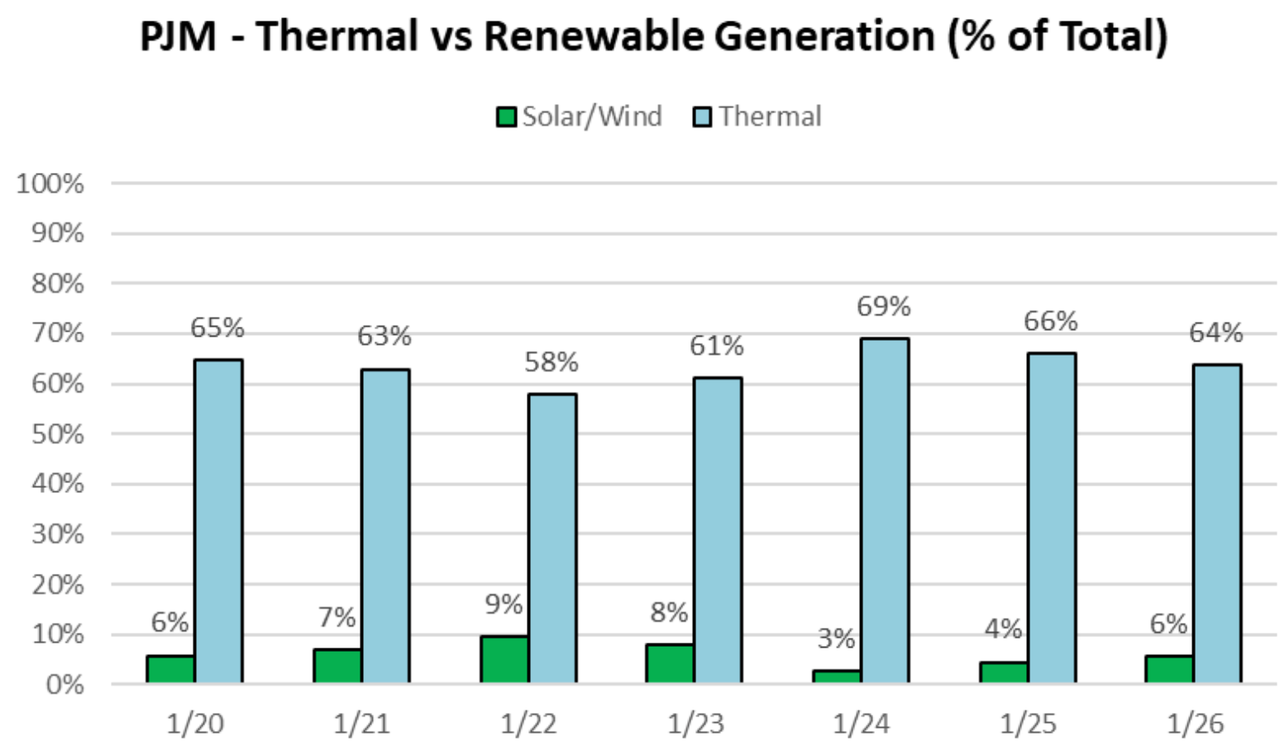
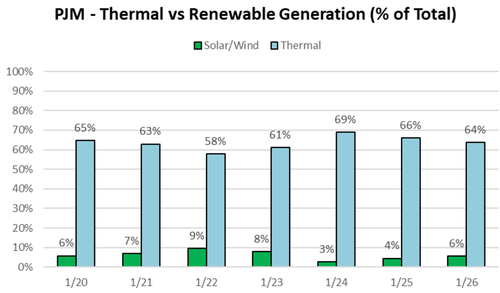
During peak demand periods in PJM – the nation’s largest grid operator – thermal and nuclear generation dominated the dispatch stack. As the cold conditions arrived, natural gas provided 43% of generation and coal contributed 23%, while wind and solar fell to a combined 3-4% of the total fuel mix.
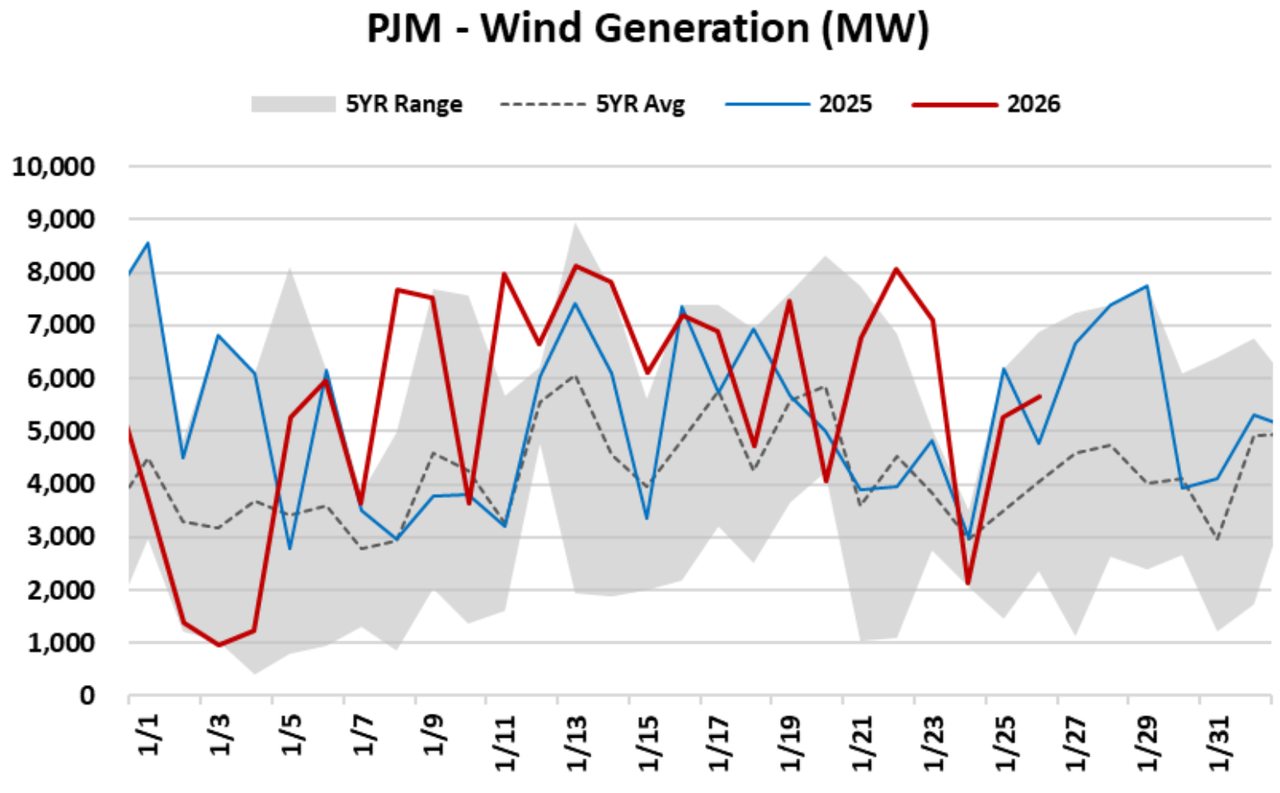
PJM wind levels fell to month-to-date lows over the weekend as load intensified, fading to a mere 2,142 MW on Saturday as gas burns ramped to 55,655 MW (a seasonal high).
Solar is already a limited part of the PJM fuel mix, and its output of 2,372 MW on Saturday had limited impacts vs thermal, and solar dropped even further yesterday, with output at a low of 442 MW.
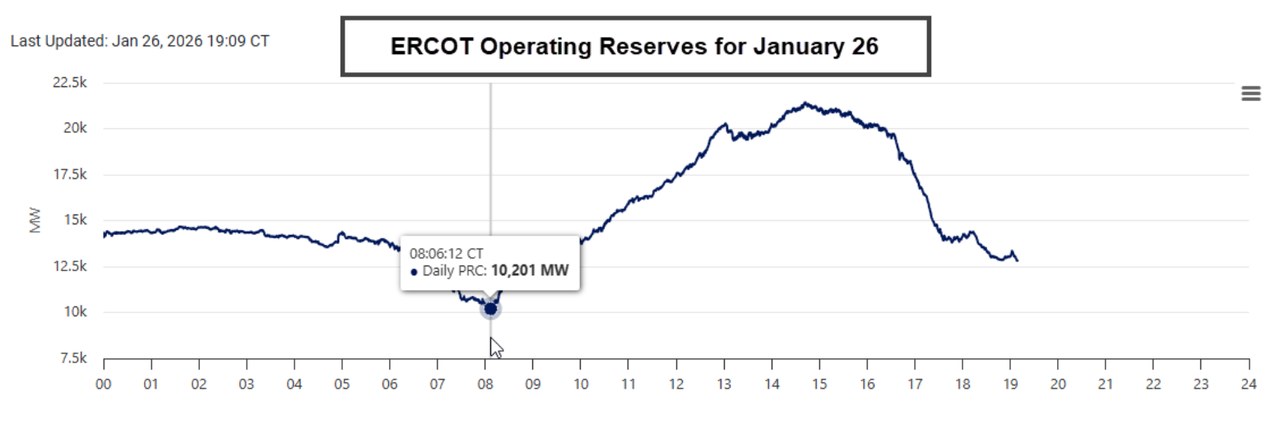
In ERCOT, the grid maintained operating reserves above 11,000 MW throughout the event. The thousands of natural gas facilities that underwent weatherization and inspection protocols following Winter Storm Uri performed as designed, with minimal forced outages reported.
To meet peak load, ERCOT thermal assets have accelerated to record levels. That includes live readings of natural gas burns that surged to new 5YR highs in the morning – reaching 48,477 GW at one point.
Got Gas? ERCOT data showed gas burns pushing to record highs of >48 GW this morning to meet rising demand amidst a lack of wind and solar (its dark outside right now..)#natgas #ongt #ercot pic.twitter.com/8EtJfOwecr
— Criterion Research (@PipelineFlows) January 26, 2026
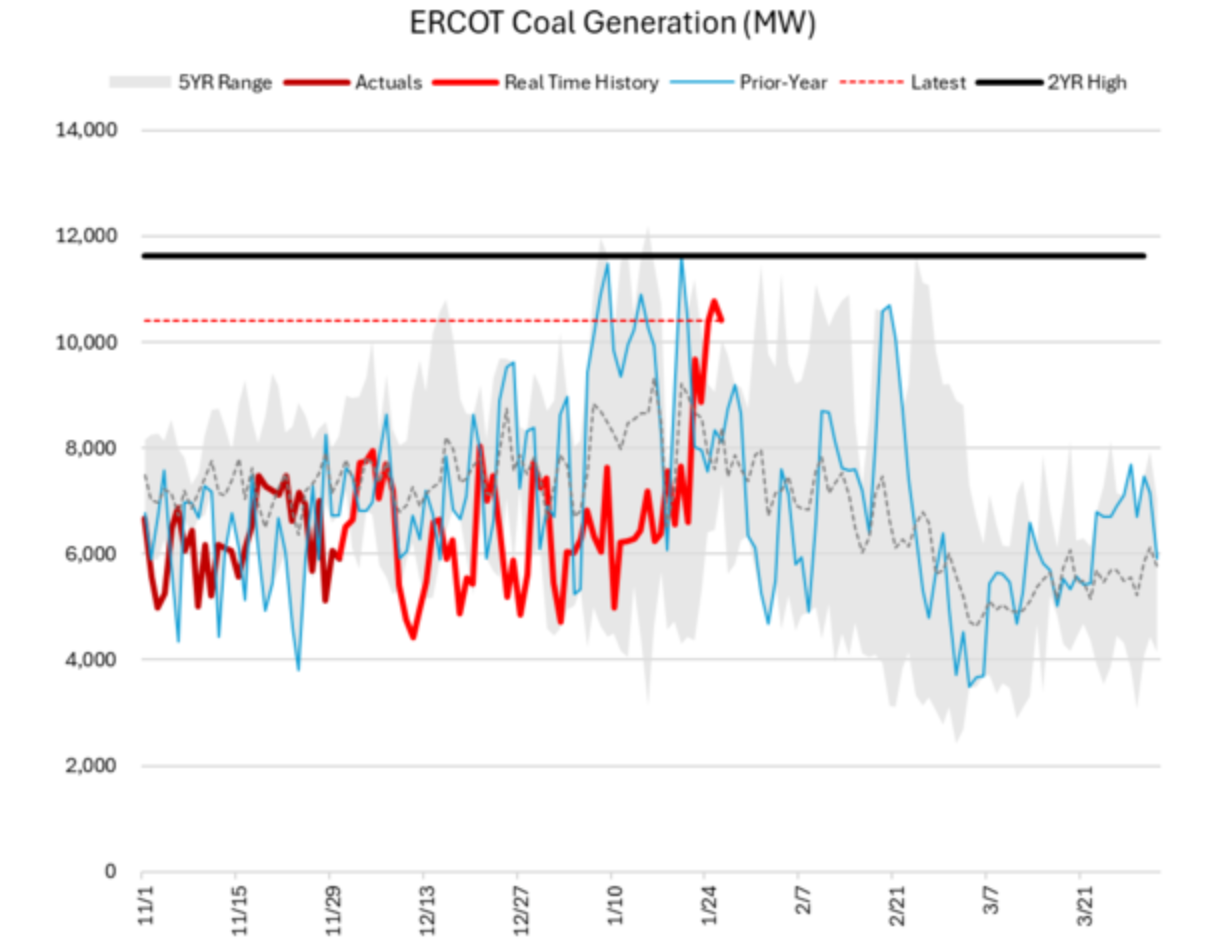
ERCOT coal burns lifted as well, nearing 10,400 MW early in the morning as peak load levels hit.
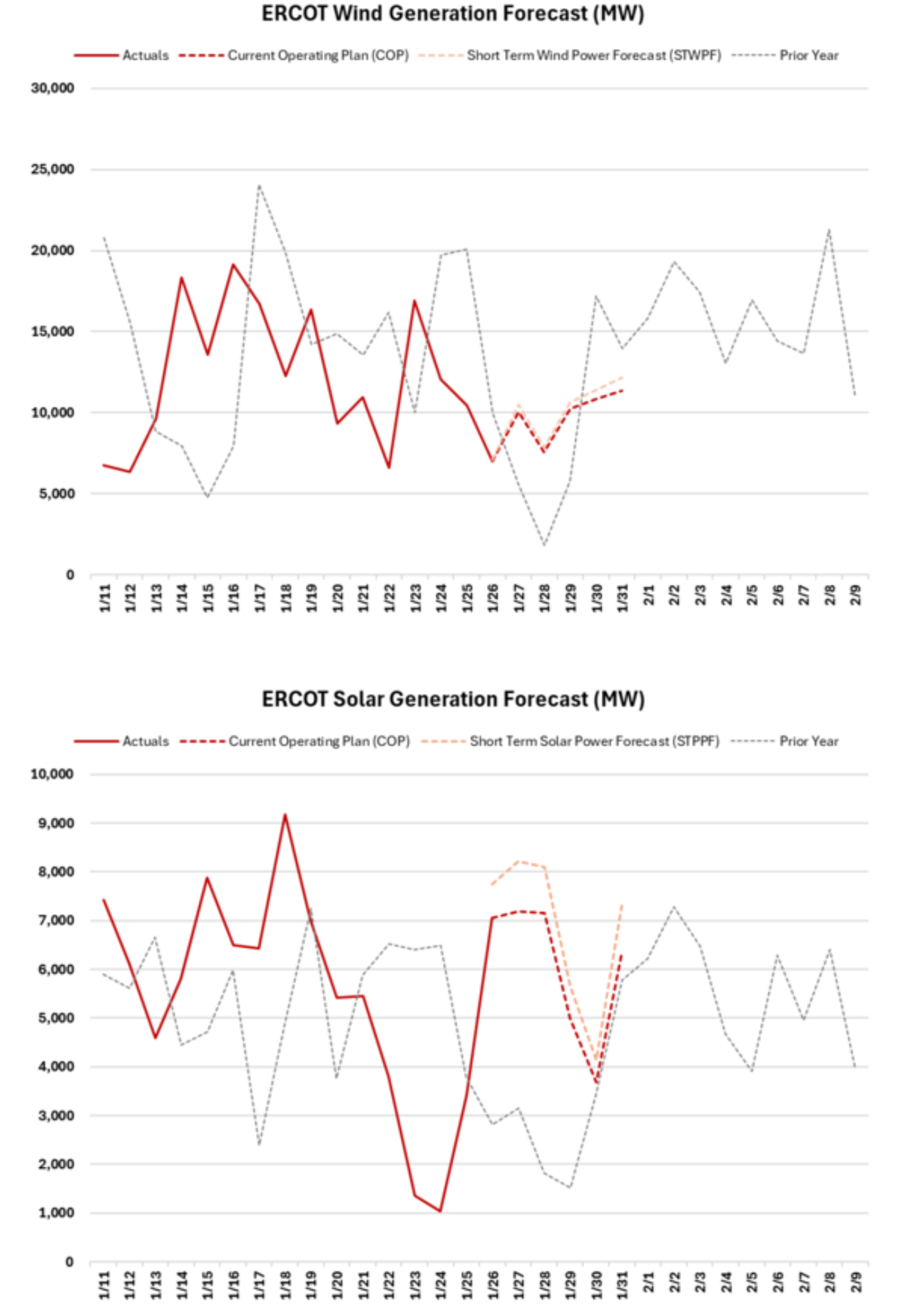
ERCOT wind and solar underperformed, falling well below the levels seen earlier this month.
Forward Implications
The grid maintained an adequate supply-demand balance during this event due to existing thermal generation capacity. However, with data center load growth adding demand equivalent to major metropolitan areas and accelerating thermal retirements, winter reserve margins face increasing pressure in several regions.
The event highlights the case for incremental natural gas generation builds. With coal retirements reducing fuel-secure capacity and intermittent resources providing limited contribution during winter peaks, new gas-fired capacity will be essential to maintain reliability. Current interconnection queues show significant gas generation projects, but lead times for permitting and construction suggest a multi-year timeline to address emerging capacity deficits in key regions.
* * *
A message from West Virginia coal miners…
Sleep tight America. We got this. Thousands of coal miners, truck drivers, railroaders, river boat workers and power plant employees will make sure that you stay warm and safe on a cold winter night. Fuel Satisfaction. Affordable Power. Grid Reliability. All from American Coal. pic.twitter.com/io0dzRD6vu
— WV Coal Association (@WV_coal1) January 27, 2026
“Affordable Power. Grid Reliability. All from American Coal,” WV Coal Association wrote on X.
Tyler Durden
Mon, 01/26/2026 – 21:45
Winter Storm Fern To Lower Q1 GDP By 0.5% To 1.5%
Winter Storm Fern To Lower Q1 GDP By 0.5% To 1.5%
Winter storm Fern is mostly over, its resulting damage, however, will linger for a long time.
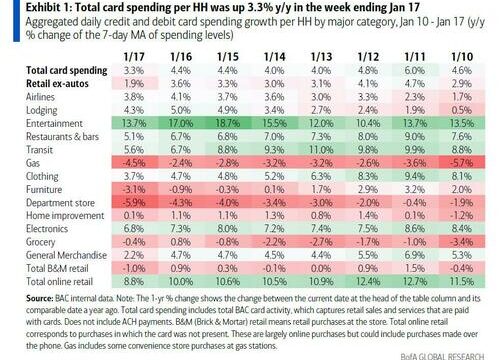
To assess the economic impact of the brutal winter storm, BofA chief economist Aditya Bhave looked back at Winter Storm Viola, which hit the US in February 2021. Both storms put roughly half the country under a winter weather advisory. Consumer spending fell by 0.9% m/m in February 2021, after a 1.3% increase in January. However, this swing probably wasn’t entirely due to Viola: January 2021 spending was also boosted by the passage of the CAA in December 2020, and favorable seasonal adjustments.
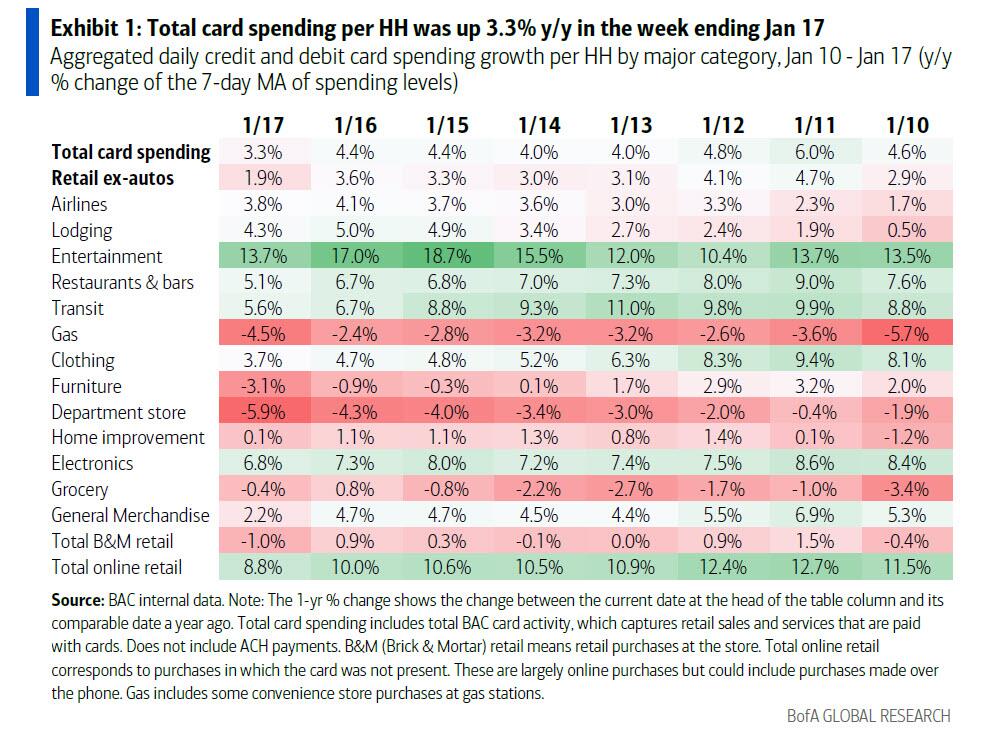
In his analysis Bhave used the latest BofA aggregated credit and debit card data (report available to pro subs) to zoom in on the effect of Viola. Total card spending was down 3.7% y/y in the week ending February 19, 2021, compared to a trend of about +6% y/y in prior weeks.
Accounting for a pickup in card spending growth in the weeks after the storm, the BofA economist estimates that at least 0.6% of spending was lost over a one-month period due to Viola. That’s a little more than a quarter of the Jan-Feb swing in total consumer spending, and works out to about a 0.5% drag on Q1 2021 GDP growth.
The slowdown in total spending due to Viola might have been larger than the impact on BAC card spending, because cash transactions would most likely have taken a bigger hit. Moreover, some of the rebound in spending growth after Viola might have happened for other reasons. Finally, the bank’s estimate above only looks at spending: other components of GDP would also have been affected by Viola.
Accounting for these factors, Bank of America thinks the headwind to Q1 2021 GDP growth from Viola might have been as large as 1.5%, which means that with strategist consensus expecting a roughly 1.5%-2% growth in Q1 before the winter storm, the US economy may be stagnant in the first quarter.
That said, the analogy isn’t perfect as Viola caused significant damage in the South, with extended disruptions to the power grid in Texas. It now appears that Winter Storm Fern won’t be as disruptive, partly because the region is now better prepared. But Fern has resulted in a lot more snowfall in the Northeast, which has a larger concentration of higher-income HHs. So it isn’t clear whether Fern will cause more or less economic damage than Viola.
In any case, BofA’s initial estimate is that the drag on Q1 2026 growth will be in the range of 0.5-1.5%.
The good news is that the bank does not expect any lasting impact on the trajectory of the economy. This means there is as much upside to 2Q GDP growth as there is downside to 1Q.
Tyler Durden
Mon, 01/26/2026 – 21:20
https://www.zerohedge.com/economics/winter-storm-fern-lower-q1-gdp-05-15