Category: News

Naperville Police Arrests for Jan. 20-22
The following items were taken from Naperville police reports and press releases. An arrest does not constitute a finding of guilt:
A 22-year-old man from Shorewood was arrested on charges of driving under the influence of alcohol, transportation or possession of open alcohol by a driver, unlawful possession of cannabis by a driver and battery at 4:27 p.m. Jan. 20 at the police station, 1350 Aurora Ave.
A 66-year-old woman from Naperville was arrested on a warrant at 7:14 p.m. Jan. 20 in the 200 block of South Main Street.
A 42-year-old woman from Naperville was arrested on two warrants at 11:15 p.m. Jan. 20 in the 1600 block of Brookdale Road.
A 61-year-old woman from Naperville was arrested on charges of failure to yield while turning left and driving under the influence of alcohol at 4:38 p.m. Jan. 21 at West Franklin Avenue and North Mill Street.
A 25-year-old man from Naperville was arrested on charges of driving on a revoked license, driving without insurance and driving with a canceled, suspended or revoked registration at 8:59 p.m. Jan. 21 at Iroquois Avenue and East Ogden Avenue.
A 33-year-old man from Bolingbrook was arrested on charges of driving on a revoked license and driving without insurance at 11:16 p.m. Jan. 21 at South Route 59 and Ogden Avenue.
A 23-year-old man from Aurora was arrested on a warrant and on charges of disobeying a stop sign, child abandonment and driving on a revoked license at 1:10 a.m. Jan. 22 at North Route 59 and West Diehl Road.
A 26-year-old woman from Chicago was arrested on charges of driving under the influence and driving without a valid license at 2:21 a.m. Jan. 22 in the 1000 block of West Ogden Avenue.
A 33-year-old man from Bolingbrook was arrested on three counts of disorderly conduct and two counts of battery at 5:38 p.m. Jan. 22 at the police station, 1350 Aurora Ave.
A 22-year-old man from Aurora was arrested on a warrant at 9:46 p.m. Jan. 22 in the 700 block of Royal St. George Drive.
https://www.chicagotribune.com/2026/01/27/naperville-police-arrests-blotter-january-8/
Minnesota killing produces backlash against Trump administration from Second Amendment advocates
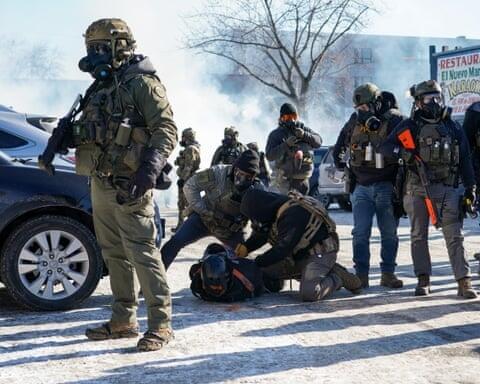
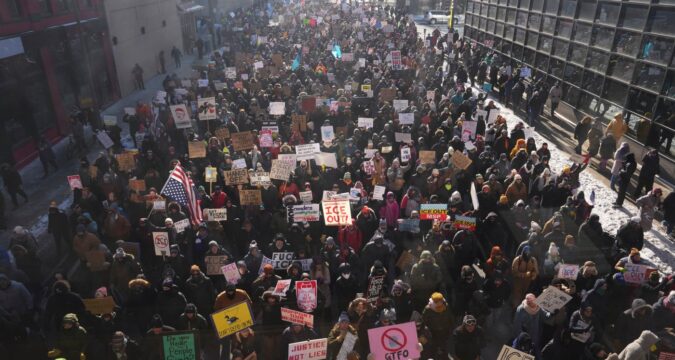
Prominent Republicans and gun rights advocates helped elicit a White House turnabout this week after bristling over the administration’s characterization of Alex Pretti, the second person killed this month by a federal officer in Minneapolis, as responsible for his own death because he lawfully possessed a weapon.
The death produced no clear shifts in U.S. gun politics or policies, even as President Donald Trump shuffles the lieutenants in charge of his militarized immigration crackdown. But important voices in Trump’s coalition have called for a thorough investigation of Pretti’s death while also criticizing inconsistencies in some Republicans’ Second Amendment stances.
If the dynamic persists, it could give Republicans problems as Trump heads into a midterm election year with voters already growing skeptical of his overall immigration approach. The concern is acute enough that Trump’s top spokeswoman sought Monday to reassert his brand as a staunch gun rights supporter.
“The president supports the Second Amendment rights of law-abiding American citizens, absolutely,” White House press secretary Karoline Leavitt told reporters.
Leavitt qualified that “when you are bearing arms and confronted by law enforcement, you are raising … the risk of force being used against you.”
Videos contradict early statements from administration
That still marked a retreat from the administration’s previous messages about the shooting of Pretti. It came the same day the president dispatched border czar Tom Homan to Minnesota, seemingly elevating him over Homeland Security Secretary Kristi Noem and Border Patrol chief Greg Bovino, who had been in charge in Minneapolis.
Within hours of Pretti’s death on Saturday, Bovino suggested Pretti “wanted to … massacre law enforcement,” and Noem said Pretti was “brandishing” a weapon and acted “violently” toward officers.
“I don’t know of any peaceful protester that shows up with a gun and ammunition rather than a sign,” Noem said.
White House deputy chief of staff Stephen Miller, an architect of Trump’s mass deportation effort, went further on X, declaring Pretti “an assassin.”
Bystander videos contradicted each claim, instead showing Pretti holding a cellphone and helping a woman who had been pepper sprayed by a federal officer. Within seconds, Pretti was sprayed, too, and taken to the ground by multiple officers. No video disclosed thus far has shown him unholstering his concealed weapon -– which he had a Minnesota permit to carry. It appeared that one officer took Pretti’s gun and walked away with it just before shots began.
As multiple videos went viral online and on television, Vice President JD Vance reposted Miller’s assessment, while Trump shared an alleged photo of “the gunman’s gun, loaded (with two additional full magazines!).”
Swift reactions from gun rights advocates
The National Rifle Association, which has backed Trump three times, released a statement that began by casting blame on Minnesota Democrats it accused of stoking protests. But the group lashed out after a federal prosecutor in California said on X that, “If you approach law enforcement with a gun, there is a high likelihood they will be legally justified in shooting you.”
That analysis, the NRA said, is “dangerous and wrong.”
FBI Director Kash Patel magnified the blowback Sunday on Fox News’ “Sunday Morning Futures With Maria Bartiromo.” No one, Patel said, can “bring a firearm, loaded, with multiple magazines to any sort of protest that you want. It’s that simple.”
Erich Pratt, vice president of Gun Owners of America, was incredulous.
“I have attended protest rallies while armed, and no one got injured,” he said on CNN.
Conservative officials around the country made the same connection between the First and Second amendments.
“Showing up at a protest is very American. Showing up with a weapon is very American,” state Rep. Jeremy Faison, who leads the GOP caucus in Tennessee, said on X.
Trump’s first-term vice president, Mike Pence, called for “full and transparent investigation of this officer involved shooting.”
A different response from the past
Liberals, conservatives and nonpartisan experts noted how the administration’s response differed from past conservative positions involving protests and weapons.
Multiple Trump supporters were found to have weapons during the Jan. 6, 2021, attack on the U.S. Capitol. Trump issued blanket pardons to all of them.
Republicans were critical in 2020 when Mark and Patricia McCloskey had to pay fines after pointing guns at protesters who marched through their St. Louis neighborhood after the police killing of George Floyd in Minneapolis. And then there’s Kyle Rittenhouse, a counter-protester acquitted after fatally shooting two men and injuring another in Kenosha, Wisconsin, during the post-Floyd protests.
“You remember Kyle Rittenhouse and how he was made a hero on the right,” Trey Gowdy, a Republican former congressman and attorney for Trump during one of his first-term impeachments. “Alex Pretti’s firearm was being lawfully carried. … He never brandished it.”
Adam Winkler, a UCLA law professor who has studied the history of the gun debate, said the fallout “shows how tribal we’ve become.” Republicans spent years talking about the Second Amendment as a means to fight government tyranny, he said.
“The moment someone who’s thought to be from the left, they abandon that principled stance,” Winkler said.
Meanwhile, Democrats who have criticized open and concealed carry laws for years, Winkler added, are not amplifying that position after Pretti’s death.
Uncertain effects in an election year
The blowback against the administration from core Trump supporters comes as Republicans are trying to protect their threadbare majority in the U.S. House and face several competitive Senate races.
Perhaps reflecting the stakes, GOP staff and campaign aides were reticent Monday to talk about the issue at all.
The House Republican campaign chairman, Rep. Richard Hudson of North Carolina, is sponsoring the GOP’s most significant gun legislation of this congressional term, a proposal to make state concealed-carry permits reciprocal across all states.
The bill cleared the House Judiciary Committee last fall. Asked Monday whether Pretti’s death and the Minneapolis protests might affect debate, an aide to Speaker Mike Johnson did not offer any update on the bill’s prospects.
Gun rights advocates have notched many legislative victories in Republican-controlled statehouses in recent decades, from rolling back gun-free zones around schools and churches to expanding gun possession rights in schools, on university campuses and in other public spaces.
William Sack, legal director of the Second Amendment Foundation, said he was surprised and disappointed by the administration’s initial statements following the Pretti shooting. Trump’s vacillating, he said, is “very likely to cost them dearly with the core of a constituency they count on.”
Associated Press writer Kimberlee Kruesi in Providence, Rhode Island, contributed to this report.
https://www.chicagotribune.com/2026/01/27/minnesota-killing-backlash-second-amendment-advocates/
Gregory Bovino: What to know about Border Patrol chief and commander of Trump’s immigration crackdown
The commander of President Donald Trump’s immigration crackdown in Minneapolis is leaving the city after federal agents fatally shot two people in less than three weeks.
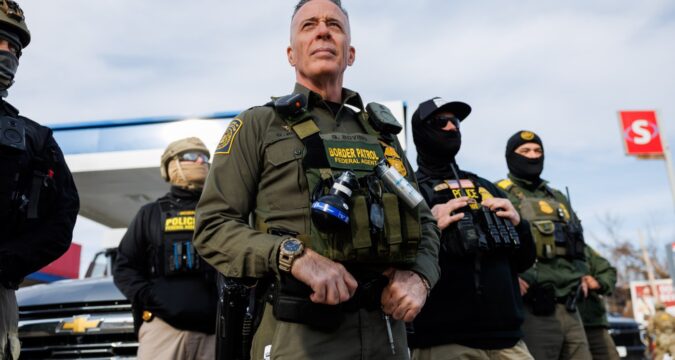
Gregory Bovino had been the go-to architect for the large-scale immigration crackdowns ordered by Trump and the public face of his administration’s city-by-city sweeps. The Border Patrol chief led agents in Los Angeles, Chicago and New Orleans before he headed to Minnesota in December for what the Department of Homeland Security called its largest-ever immigration enforcement operation.
What to know about immigration enforcement raids in Chicago
He’s also been heavily criticized for his norm-breaking tactics.
Here’s what to know about Bovino’s career, methods and approach.
Smashing car windows
Bovino revels in breaking norms. Agents have smashed car windows, blown open a door to a house and patrolled the fabled MacArthur Park in Los Angeles on horseback.
Smashing windows when a driver refuses to open and is subject to arrest is “a safer tactic than letting someone drive away and then getting in a high-speed pursuit,” he said.
Blasting the door off a home in Huntington Park, California, to search for a man accused of ramming a Border Patrol vehicle days earlier was a “very, very prudent, thoughtful application of tactics,” said Bovino, who joined that early-morning raid. “I don’t want to surround a house for hours and hours and hours and then create another riot.”
Bovino often appears in tactical gear, as he did outside California Gov. Gavin Newsom’s news conference on congressional redistricting in August.
Agents rappel from helicopter in Chicago
In Chicago, agents stormed an apartment complex by helicopter, deploying chemical agents near a public school and handcuffed a Chicago City Council member at a hospital.
Agents rappelled down to the apartment building from a Black Hawk helicopter. Authorities said they were targeting the Venezuelan gang Tren de Aragua, but only two of the 37 immigrants arrested were gang members. The others were in the country illegally, they said, including some with criminal histories. One U.S. citizen was arrested on an outstanding narcotics warrant.
They were already living in one of Chicago’s worst apartment buildings. Then came the ICE raid.
Activists, residents and leaders said the combative tactics sparked violence and fueled neighborhood tensions in the nation’s third-largest city.
Bovino also drew a rare public rebuke from a federal judge who said he misled the court about the threats posed by protesters and deployed tear gas and pepper balls without justification during a chaotic confrontation downtown.
Immigration agents’ poor tactics in Chicago made for needless safety risks, experts say
Nearly 1,900 immigrants were detained during the first half of Operation Midway Blitz. Most had no criminal record.
Rioters? Agitators? Immigration agents’ claims against US citizens mostly fall apart in court.
Border Patrol’s strong-arm tactics are the new norm in Chicago as Trump moves to sideline ICE leadership
64 days in Chicago: The story of Operation Midway Blitz
Chicago activists share blueprint for resisting Border Patrol: ‘Chicago clearly is front and center’
Cost of Operation Midway Blitz: $59M and counting
Vowing a ‘turn and burn’ approach
U.S. Immigration and Customs Enforcement, the agency primarily responsible for interior immigration enforcement since its was created in 2003, has historically made arrests in the streets after lengthy investigations of individual targets, including surveillance that an official once likened to watching paint dry. Officials rarely have judicial warrants to enter a home, causing them to wait outside.
It is not a pace that will lead to the mass deportations Trump has promised.
“We’re going to turn and burn to that next target and the next and the next and the next, and we’re not going to stop,” he said in an interview in a seventh-floor conference room of the federal building in West Los Angeles, where an unused office wing serves as a sparsely furnished temporary base.
Almost forced to retire in 2023
Bovino was one of 20 regional Border Patrol chiefs around the country when he was relieved of his command leading leading the agency’s sector in El Centro, California.
He blamed an online profile picture of him posing with an M4 assault rifle; social media posts that were considered inappropriate; and sworn congressional testimony that he and other sector chiefs gave on the state of the border during a record surge of migrants.
Thirty minutes after his second congressional hearing, Bovino said, he was removed from his position and asked, “Are you going to retire now?”
He didn’t retire. The change in administration from President Joe Biden to Trump in 2025 turned Bovino into a MAGA-world hero. The profile photo with the assault rifle was back online and by the summer, he was leading immigration enforcement in Los Angeles, where the Trump administration launched its first sustained blitz of a U.S. city.
Deporting people who ‘skip the line’
Bovino joined the Border Patrol in 1996 and is nearing the agency’s mandatory retirement age of 57. He eventually plans to return home to North Carolina to harvest apples.
He served as Border Patrol chief in El Centro, California, long a relatively quiet part of the southern border that has become even quieter as illegal crossings have plummeted to their lowest levels in six decades.
His media savvy is on display each summer when Border Patrol sector chiefs hold news conferences to warn against illegal crossings. In 2021, Bovino led journalists in swimming across the All-American Canal, whose deceptively swift current and smooth concrete lining result in migrant deaths every year. In 2023, he locked reporters in a vehicle trunk, saying he wanted them to appreciate the dangers firsthand.
While administration officials like to say they are deporting the “worst of the worst,” Bovino embraces arrests of hard-working people with deep roots in the country. He said they “skip the line” ahead of people waiting to enter the country legally.
“The folks undercutting American businesses, is that right?” he said. “Absolutely not. That’s why we have immigration laws in the first place, and that’s why I’m here.”
‘Not afraid to push the envelope’
ICE has led interior immigration enforcement since it was created in 2003, but the Border Patrol has been around much longer. Bovino’s sense of mission never strayed from the Border Patrol’s roots. When assigned to lead a station in Blythe, California, he pitched his boss, Paul Beeson, on raiding the airport and bus stations in Las Vegas.
The 2010 operation was supposed to last three days but got called off after the first hour yielded dozens of arrests and unleashed a furious reaction from then-Senate Majority Leader Harry Reid, a Nevada Democrat.
“He’s not afraid to push the envelope, very articulate, leads from the front,” said Beeson, who, as a sector chief, selected Bovino to lead stations in Blythe and in Imperial Beach, California.
https://www.chicagotribune.com/2026/01/27/who-is-gregory-bovino-border-patrol/
Trump Admin Wins Appeal Of ICE Injunction In Minnesota
Trump Admin Wins Appeal Of ICE Injunction In Minnesota
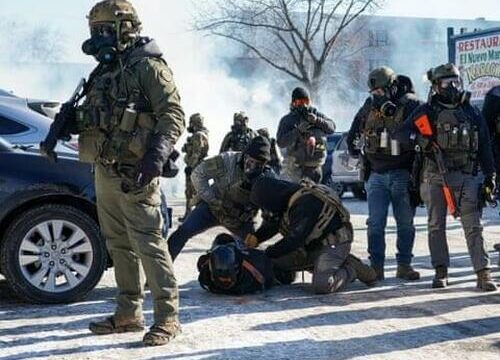
In a significant victory for the Trump Administration, a panel of the United States Court of Appeals for the Eighth Circuit lifted the injunction of U.S. District Judge Katherin Menendez, who prevented officers from arresting, detaining, pepper-spraying or retaliating against protesters in Minneapolis without probable cause.
In her Jan. 16 decision, Judge Menendez (a Biden appointee and former public defender) ruled in favor of the protesters suing the Department of Homeland Security (DHS) and ICE. She found the plaintiffs were likely to succeed on claims that federal agents violated their First and Fourth Amendment rights.
The Eighth Circuit first flagged how Menendez ignored the fact that the record shows a wide range of conduct raising different conditions for law enforcement:
“We accessed and viewed the same videos the district court did. … What they show is observers and protestors engaging in a wide range of conduct, some of it peaceful but much of it not. They also show federal agents responding in various ways. Even the named plaintiffs’ claims involve different conduct, by different officers, at different times, in different places, in response to different behavior. These differences mean that there are no “questions of law or fact common to the class,” Fed. R. Civ. P. 23(a)(2), that would allow the court to decide all their claims in “one stroke.”
The panel also found Judge Menendez’s order unacceptably vague:
“Second, in addition to being too broad, the injunction is too vague.
…Even the provision that singles out the use of “pepper-spray or similar nonlethal munitions and crowd dispersal tools” requires federal agents to predict what the district court would consider “peaceful and unobstructive protest activity.” The videos underscore how difficult it would be for them to decide who has crossed the line: they show a fast-changing mix of peaceful and obstructive conduct, with many protestors getting in officers’ faces and blocking their vehicles as they conduct their activities, only for some of them to then rejoin the crowd and intermix with others who were merely recording and observing the scene.”
The panel found that Judge Menendez’s order left federal authorities in a dangerous position of not knowing when they could use these crowd control measures: “to the extent the injunction’s breadth and vagueness cause federal agents to hesitate in performing their lawful duties, it threatens to irreparably harm the government and undermine the public interest.”
Notably, Judge Menendez is the same judge reviewing an even more sweeping motion for an injunction to enjoin ICE operations, a filing from Minnesota Attorney General Keith Ellison that I have criticized as constitutionally meritless.
Here is the opinion: Tincher v. Noem
Tyler Durden
Tue, 01/27/2026 – 09:45
https://www.zerohedge.com/political/trump-admin-wins-appeal-ice-injunction-minnesota

Bobby Narang’s high school girls basketball rankings and player of the week for Lake County
Vernon Hills, Wauconda and Grayslake Central, led by player of the week Peyton Hoffmann, move up in the rankings.
TOP 10
With records through Monday and previous rankings in parentheses.
1. Libertyville 18-4 (1)
Volleyball standout Elle Knight makes a difference on the basketball court with 10 points, 11 rebounds and three steals in the North Suburban Conference leader’s win over Stevenson.
2. Carmel 18-7 (2)
Playing more and more minutes, freshman Ada Lindal posts seven points, five rebounds, four assists, eight deflections and four steals in the Corsairs’ win over Joliet Catholic.
3. Lake Zurich 16-8 (3)
Avary Eckman is making an impact off the bench for the Bears with quality defense and clutch shooting.
4. Vernon Hills 17-5 (5)
Emma Jocson scores a team-high 18 points in the Central Suburban North leader’s nonconference win over Grant.
5. Wauconda 19-1 (6)
Shutdown defender Kelsey Funkhouser limits Stetson recruit Heidi Rathmann to 11 points in the Northern Lake County Conference leader’s win over Antioch.
6. Mundelein 16-10 (4)
Anahya Castro’s rebounds and deflections have been important for the Mustangs’ defense.
7. Waukegan 14-8 (7)
Another volleyball standout, Hadassah Brown is averaging a double-double with 16.4 points and 11.0 rebounds, both team highs for the Bulldogs.
8. Grayslake Central 13-9 (9)
Ava Henne averages 7.5 points, 2.0 rebounds, 2.0 assists and 2.0 steals as the Rams win three in a row.
9. Highland Park 12-8 (8)
Defensive stalwart Emily Calub continues to score points for the Giants.
10. Lake Forest 11-10 (10)
Improving each week, Annie Acello leads the Scouts in rebounding and is their second-leading scorer.
PLAYER OF THE WEEK
Grayslake Central junior guard/forward Peyton Hoffmann averages 24.5 points, 9.0 rebounds, 3.5 assists, 4.0 steals and 2.5 blocks in Northern Lake Country Conference wins over Grayslake North and Round Lake.
Bobby Narang is a freelance reporter.

Oswego may impose $750 fee on drivers who flee from police
Oswego trustees as a committee of the whole recently discussed instituting a $750 administrative fee on drivers who flee or attempt to elude police as a way to improve safety on the roads and recover the costs associated with these types of violations.
The Oswego Police Department has seen a rise in the number of drivers who flee or attempt to elude police officers since 2020, Oswego Police Chief Jason Bastin said.
“This is not unique to Oswego,” Bastin said.
He said the increase in drivers who flee or attempt to elude police has been documented in the region, across the state and nationally.
The number of high-speed chases seems to have increased as police agencies have adopted a more restrictive policy concerning pursuits intended to ensure the safety of the public, he said.
“I am not saying the two are directly related, but there is a strong correlation between adoption of these policies and a rise in the number of vehicles that flee or attempt to elude police,” Bastin said. “We turn on our lights, and the person takes off. I think the idea may be in the public’s mindset now that there’s a good chance police will not chase them.”
There have been 33 instances in which a motorist has fled from Oswego police since 2020, he said.
The Oswego Police Department in 2024 had 12 incidents where drivers took off after police officers tried to get them to stop, he said. However, in 2025 the number dropped to four.
“I don’t expect it to stay that low but it’s an issue that needs to be addressed,” Bastin said.
The $750 administrative fee would help to offset the financial impact these incidents place on the village and deter dangerous behavior, he said. The amount of the fee is based on the time and resources required to prosecute these cases.
“Besides the financial impact, if there is a mindset that there are no repercussions now when you run from police, we want to add as many repercussions as possible,” he said.
Naperville has adopted a similar policy, Bastin said.
Linda Girardi is a freelance reporter for The Beacon-News.
https://www.chicagotribune.com/2026/01/27/oswego-may-impose-750-fee-on-drivers-who-flee-from-police/

From Bad To Worse: UnitedHealth Posts First Annual Revenue Drop In Three Decades
From Bad To Worse: UnitedHealth Posts First Annual Revenue Drop In Three Decades
Things have gone from bad to worse for UnitedHealth Group since late Monday.
First, the Trump administration’s plan to keep Medicare Advantage rates roughly flat next year (read the report) sent shares tumbling during the after-hours session on Monday evening.
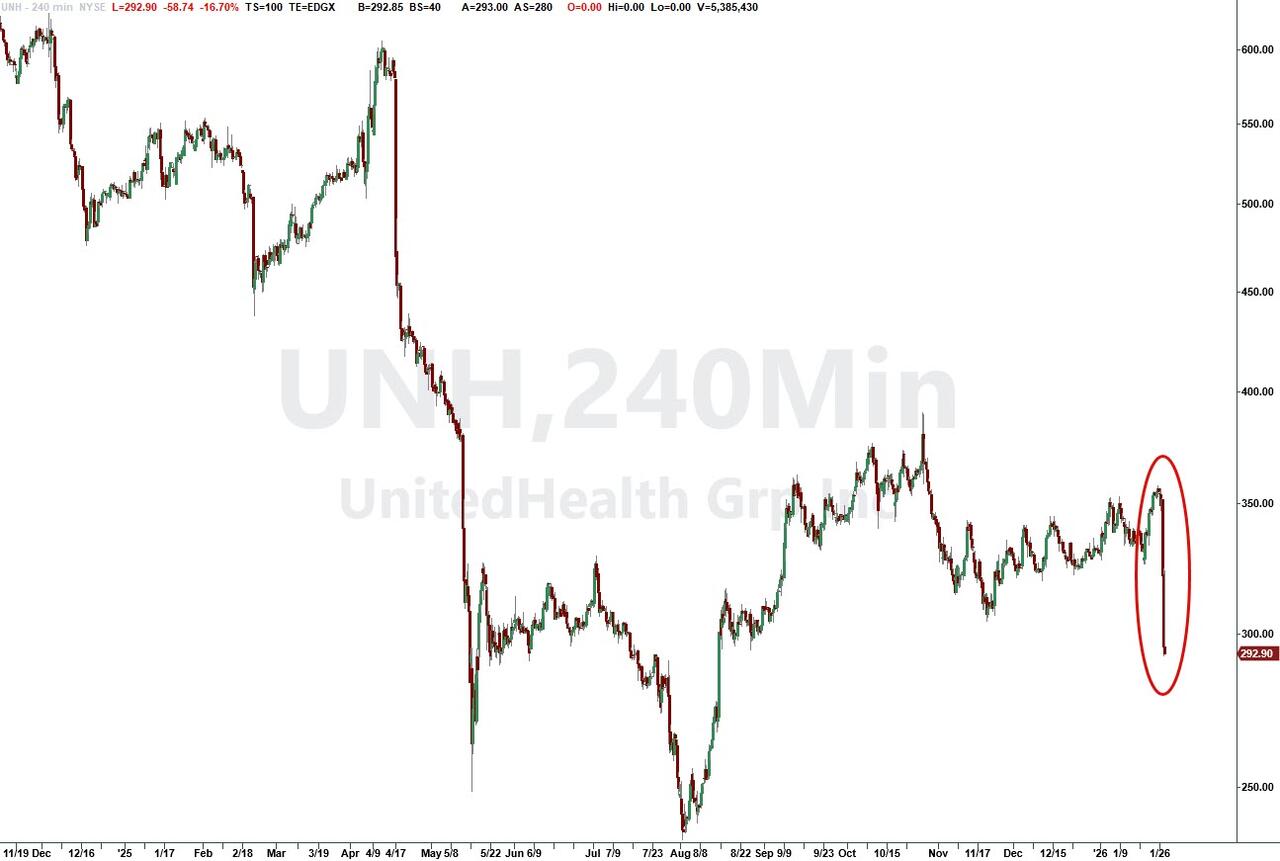
The selloff intensified in premarket trading after the 2026 outlook and quarterly earnings disappointment. The stock plunged as much as 17% ahead of the cash opening in New York.
UNITEDHEALTH SINKS MORE THAN 9% ON MEDICARE RATES REPORT
WHITE HOUSE PLANS FLAT RATES FOR MEDICARE INSURERS IN 2027: WSJ
Good sale Kevin Hern, who sits on the House Subcommittee on Health https://t.co/D2dSoBf8ul
— zerohedge (@zerohedge) January 26, 2026
UNH shares were already down about 8% heading into the earnings release. Shares extended losses after the insurer forecasted a decline in 2026 revenue, marking its first annual contraction in more than three decades.
Summary of the 2026 Outlook:
Adjusted EPS: Guided above $17.75, modestly ahead of the $17.69 Bloomberg Consensus.
Revenue: Forecast above $439B, well below the $455B Bloomberg Consensus, signaling top-line pressure.
Operating cash flow: Expected above $18B, trailing the $19.7B estimate.
The takeaway from this year’s outlook: Profit guidance is slightly better than expected, but the revenue and cash flow outlooks underwhelm analysts’ estimates tracked by Bloomberg.
For the fourth quarter, UnitedHealth posted adjusted earnings of $2.11 per share, while revenue climbed 12% year over year to $113.22 billion. Wall Street analysts tracked by Bloomberg had been expecting $2.10 per share on revenue of $113.87 billion.
Summary of the 4Q24 Earnings:
Earnings: Adjusted EPS of $2.11 beat estimates by a cent but fell from $6.81 y/y. Reported EPS was $0.1 vs. $5.98 y/y.
Revenue: $113.22B, up 12% y/y, but missed Bloomberg Consensus of $113.87B.
Segment performance
UnitedHealthcare: $87.11B, +18% y/y, above expectations.
Optum total: $70.33B, +8% y/y, ahead of estimates.
OptumRx: $41.46B, +16% y/y, beat estimates.
OptumHealth: $25.54B, -0.5% y/y, roughly in line.
OptumInsight: $5.04B, +5.5% y/y, modest beat.
Margins and costs:
Medical care ratio: 92.4%, worse than the 92.1% estimate.
Operating margin: 0.3%, sharply down from 7.7% y/y and well below the 2.9% estimate.
Enrollment: 49.76M members, below the 51.13M consensus.
The combination of the Trump administration’s plan to keep Medicare Advantage rates roughly flat and the first annual revenue drop in three decades disappoints investors, with shares down 17% in premarket trading. This is the largest intraday decline since the May 13, 2025, 17.8% decline.
“We confronted challenges directly and finished 2025 as a much stronger company, giving us the momentum to better serve those who count on us and continue to improve our core performance,” UNH CEO Stephen Hemsley wrote in a statement.
Tyler Durden
Tue, 01/27/2026 – 09:30
The Grid Will Hold – Maybe – But The Bill Will Rise
The Grid Will Hold – Maybe – But The Bill Will Rise
Authored by Terry L. Headley via RealClearEnergy,
Americans are about to pay a lot more for electricity anyway — not because the grid fails, but because of how we now power it.
As another deep winter cold snap presses across much of the eastern United States, grid operators are doing what they always do in these moments: watching reserve margins, issuing conservation guidance, leaning on dispatchable generation, and quietly hoping nothing large trips offline at the wrong hour.
If history is a guide, the system will muddle through. It usually does. But survival isn’t the same thing as success. And it’s certainly not the same thing as affordability.
Even if there is no blackout, no emergency load shedding, and no headline-grabbing crisis, this weather event will still deliver a financial shock — one that will show up first in gas markets, then in wholesale power prices, and finally, months later, in the electric bills of households and businesses. That downstream billing impact is not accidental. It is structural. And it tells us far more about the state of the modern grid than any press release ever will.
Yes, the system will probably muddle through through this time. But one day in the not-too-distant future it won’t.
Counting the Cost of High Electric Bills
The modern American electric grid has become adept at avoiding disaster. Operators have more tools than ever: demand response, emergency imports, market signaling, conservation messaging, and sophisticated forecasting. What they do not have — at least not in sufficient quantity — is inexpensive, fuel-secure generation that can run whenever it is needed, regardless of weather.
In winter, the grid’s vulnerability is not generation capacity on paper. It is fuel deliverability in the real world.
Natural gas now sits at the center of that vulnerability. It dominates the marginal price of electricity across large portions of the country, particularly in regions like PJM Interconnection, which spans much of the Mid-Atlantic and Midwest. When gas is abundant and cheap, markets hum along. When it is constrained by cold weather, competing heating demand, pipeline limits, or freeze-offs, prices rise sharply — even if no generator actually fails.
Gas does not have to break to become expensive. It only has to be needed.
That is exactly what happens during prolonged cold snaps. Residential heating takes priority. Storage withdrawals accelerate. Pipelines run near their limits. Power generators bid defensively to secure fuel. The result is predictable: spot gas prices spike at constrained hubs, wholesale electric prices follow, and utilities quietly rack up higher procurement costs.
No blackout. No drama. Just higher bills.
And high electric bills extract a quiet but relentless toll. They are not merely an inconvenience; they function as a regressive tax on households least able to absorb them and a hidden drag on the broader economy.
For families, higher electric bills mean hard tradeoffs. Money spent keeping the lights on is money not spent on groceries, prescriptions, school supplies, or savings. For seniors on fixed incomes, a volatile power bill can force choices between heat and healthcare. For working households, it turns routine weather events into financial stress tests.
For businesses, especially manufacturers and small employers, high electricity costs erode margins, discourage expansion, and quietly kill jobs. Energy-intensive operations either scale back, pass costs along to consumers, or relocate to regions with more stable and affordable power. Over time, this hollowing-out effect weakens local tax bases and strains public services.
For communities, persistently high power costs accelerate decline. Retail districts dim. Investment slows. Population loss follows opportunity. Utility shutoffs rise, charitable assistance is stretched thin, and local governments face growing pressure to subsidize basic services that were once affordable.
And for the grid itself, high bills often signal deeper structural problems—overreliance on volatile fuels, premature retirement of reliable generation, or policy-driven distortions that shift costs from balance sheets to ratepayers. The bill arrives monthly, but the damage accumulates quietly, year after year.
In the end, high electric bills cost more than dollars. They cost stability, competitiveness, and confidence—exactly the things a healthy economy and a secure society require.
The Renewable Mirage in Winter
Renewable advocates often argue that wind and solar will insulate consumers from fossil-fuel volatility. Winter stress events expose the weakness of that claim.
Solar output is minimal during winter peak hours. Wind can help — or not — depending on meteorological luck. Batteries can shave peaks for minutes or a few hours, but they can’t carry a grid through multi-day cold events. When the weather turns hostile, renewables become supplements, not solutions.
That doesn’t mean renewables are useless. It means they are conditional. And conditional resources cannot set the reliability floor of a winter grid.
Yet they increasingly shape the cost structure of the system. Renewable mandates, tax credits, and priority dispatch suppress energy prices when conditions are favorable, discouraging investment in dispatchable generation. But when conditions are unfavorable — when cold sets in and demand spikes — those same policies leave the grid leaning heavily on gas, with fewer alternatives available to keep prices in check.
The irony is hard to ignore: policies sold as a hedge against volatility often amplify it.
The Quiet Role of Coal
This is where coal enters the discussion — not as a political symbol, but as an economic stabilizer.
When coal still dominated the grid, winter pricing behaved differently. Coal plants stored months of fuel on site. They did not compete with residential heating for delivery. They did not depend on pipeline pressure or wellhead performance. When cold arrived, they simply ran.
That mattered.
Coal-heavy systems were not immune to outages or price swings, but they were insulated from the kind of fuel-driven volatility that now defines winter power markets. Coal did not set the marginal price every hour, but it capped how high that price could go. It acted as ballast — heavy, unglamorous, and stabilizing.
Consider the role played by plants like John E. Amos Power Plant in West Virginia. Facilities like this are not interchangeable widgets. They anchor voltage, reduce transmission stress, and provide firm megawatts precisely when they are most valuable. When they run, they suppress scarcity pricing across wide swaths of the grid. When they retire, that suppression disappears — and consumers pay the difference.
If Coal Still Dominated the Grid, This Cold Snap Would Barely Register
It is worth asking a simple, uncomfortable question: If coal still dominated the electric grid the way it once did, would this cold snap even matter?
From a consumer perspective, the answer is largely no.
In a coal-dominated system, winter cold was an operational issue, not a pricing crisis. Load went up, coal units ran harder, operators adjusted dispatch, and the system absorbed the stress. What did not happen — at least not routinely — were sharp fuel price spikes, emergency conservation messaging, or springtime bill surprises blamed on “market conditions.”
The reason was structural.
Coal plants carried weeks — sometimes months — of fuel on site. That fuel was already purchased, already delivered, and already insulated from real-time weather events. Coal did not compete with residential heating demand. It did not depend on pipeline pressure, compressor stations, or wellhead performance. When the temperature dropped, coal plants did not enter a bidding war with homeowners for survival. They simply ran.
That mattered because coal often sat at or near the margin during winter peaks. And when coal is the marginal fuel, prices behave differently. They move modestly. They reflect cost, not fear. They do not explode because of perceived scarcity three states away.
Contrast that with today’s system. Natural gas now sets the price in much of the country. Gas does not need to fail to become expensive; it only needs to be stressed. Cold weather alone is enough. Add pipeline congestion, freeze-offs, or even the risk of nonperformance, and markets immediately inject a scarcity premium. Wholesale electric prices spike — even if every generator shows up and no emergency is declared.
That volatility then works its way downstream. Utilities absorb higher procurement costs. Fuel adjustment clauses kick in months later. Consumers see higher electric bills long after the weather has passed and are told, vaguely, that it was “because of winter.”
Under a coal-dominated grid, that chain reaction was muted or absent. Gas prices might still rise for home heating, but electricity did not compound the pain. Households were not hit twice — once for gas, and again for gas-driven power prices. Industrial customers did not face the same level of real-time exposure. Regulators were not forced to explain why nothing went wrong yet bills still went up.
None of this means coal eliminated winter stress. It did something more valuable: it absorbed it. Coal acted as ballast — heavy, unfashionable, and quietly stabilizing. By removing that ballast without replacing its function, we did not make the grid more fragile in obvious ways. We made it more expensive in subtle, recurring ones.
That is why today’s cold snap will show up on electric bills even if the grid performs flawlessly. And that is why, when coal still dominated, it would have passed with little more than a footnote in an operator’s log.
The lights stayed on then, too.
The difference is that the bill did not quietly grow teeth afterward.
How the Bill Really Shows Up
Consumers rarely connect winter reliability events to their electric bills, because the impact is delayed and obscured.
Here is how it actually works:
Renewables go MIA.
Cold weather tightens reserves
Gas prices spike at regional hubs
Wholesale power prices rise during peak hours
Utilities absorb higher procurement costs
Fuel adjustment clauses catch up months later
By spring, customers open their bills and wonder why rates are higher, even though “nothing happened.” Utilities point to weather. Regulators nod. The underlying structural cause goes largely unexamined.
Industrial customers feel it immediately through real-time pricing and demand charges. Residential customers feel it later, but more painfully, as higher energy bills stack on top of already elevated heating costs.
This is not a one-off phenomenon. It is now a recurring feature of winter.
We Chose This…
None of this is accidental. We made policy choices that traded fuel security for market efficiency, and market efficiency for political aesthetics. We shifted the grid toward just-in-time fuel delivery. We retired on-site fuel without replacing its stabilizing function. We assumed markets would solve problems that are, at their core, physical.
Markets are excellent at pricing scarcity. They are less effective at preventing it.
The result is a grid that survives winter stress events — but at a higher and more volatile cost. We have optimized for avoiding blackouts, not for protecting consumers from price shocks.
The Bottom Line
The grid will likely get through this winter storm. Operators are competent. Procedures are in place. The system will bend, not break.
But bending has a price.
Renewables will be MIA. Gas prices will rise. Wholesale electric prices will spike. Retail bills will follow. And once again, consumers will pay for a system that values politics over reliability.
Coal’s continued presence on the grid does not eliminate these costs — but its absence guarantees they will be higher.
If we want affordable electricity in winter, we must stop designing a grid that depends on perfect conditions to keep prices low.
And the bill always comes due.
Tyler Durden
Tue, 01/27/2026 – 09:15
https://www.zerohedge.com/energy/grid-will-hold-maybe-bill-will-rise
US Home Prices Surged In November As Mortgage Rates Tumble
US Home Prices Surged In November As Mortgage Rates Tumble
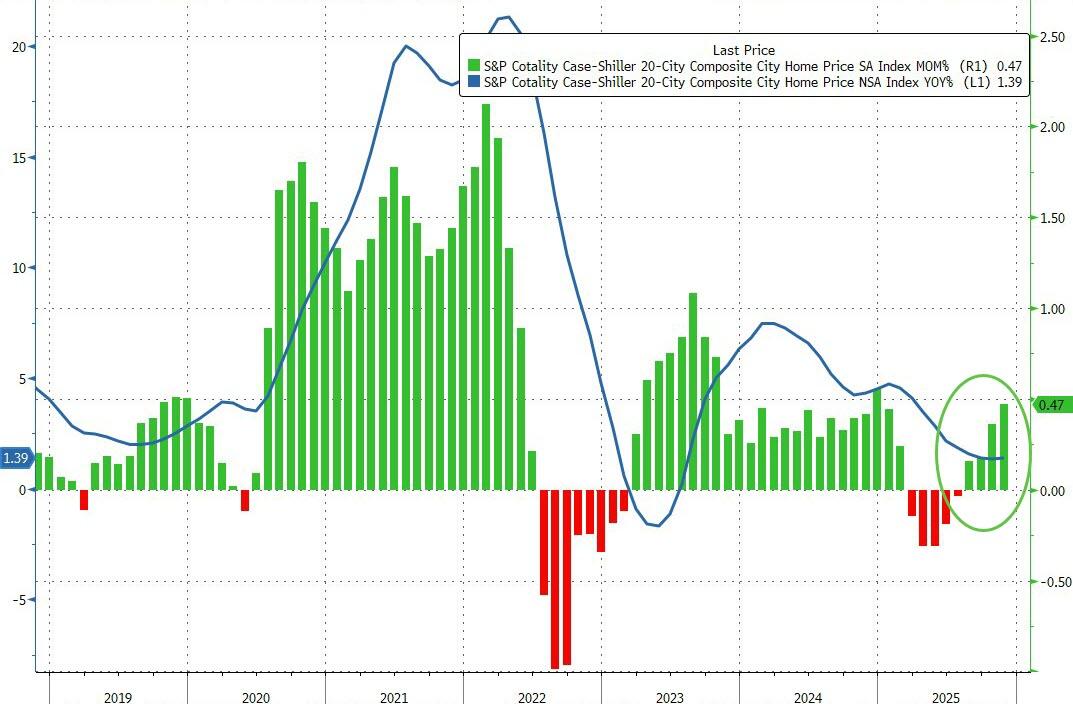
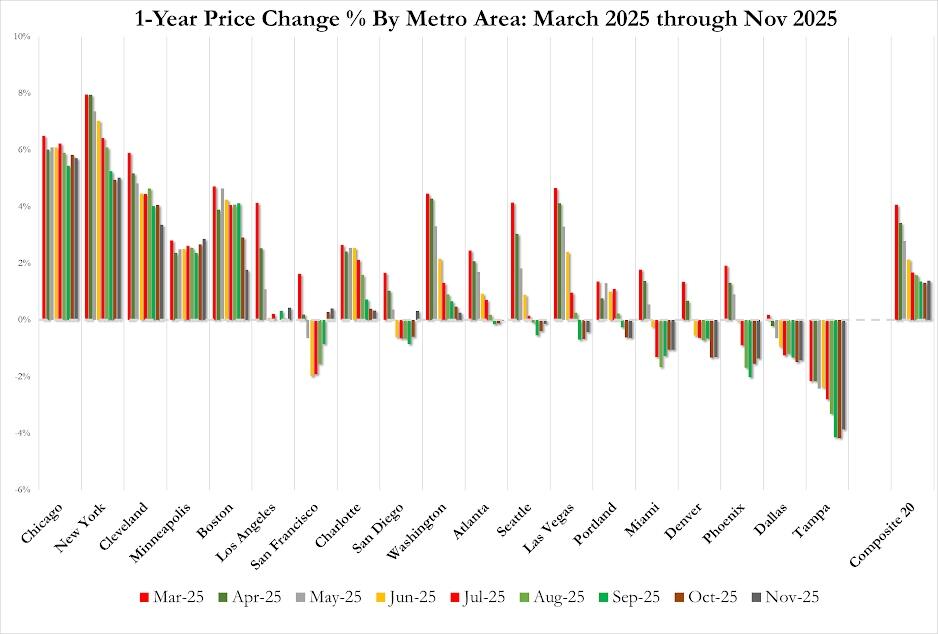
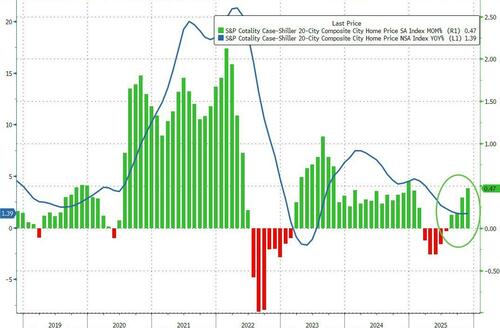
For the fourth straight month, US home prices rose on a MoM basis in November (according to the admittedly lagged and smoothed Case-Shiller data released today). The 0.47% MoM rise is the hottest since Dec 2024
Source: Bloomberg
On a year-over-year basis, there is a very modest inflection higher in the price appreciation (up from +1.32% to +1.39%).
“November’s results confirm that the housing market has entered a period of tepid growth,” said Nicholas Godec, CFA, CAIA, CIPM, Head of Fixed Income Tradables & Commodities at S&P Dow Jones Indices.
Regional patterns continue to illustrate a stark divergence.
Chicago leads all cities for a second consecutive month with a 5.7% year-over-year price increase, followed by New York at 5.0% and Cleveland at 3.4%.
These historically steady Midwestern and Northeastern markets have maintained respectable gains even as overall conditions cool.
By contrast, Tampa home prices are 3.9% lower than a year ago – the steepest decline among the 20 cities, extending that market’s 13-month streak of annual drops.
Other Sun Belt boomtowns remain under pressure as well: Phoenix (-1.4%), Dallas (-1.4%), and Miami (-1.0%) each continue to see year-over-year declines, a dramatic turnaround from their pandemic-era strength.
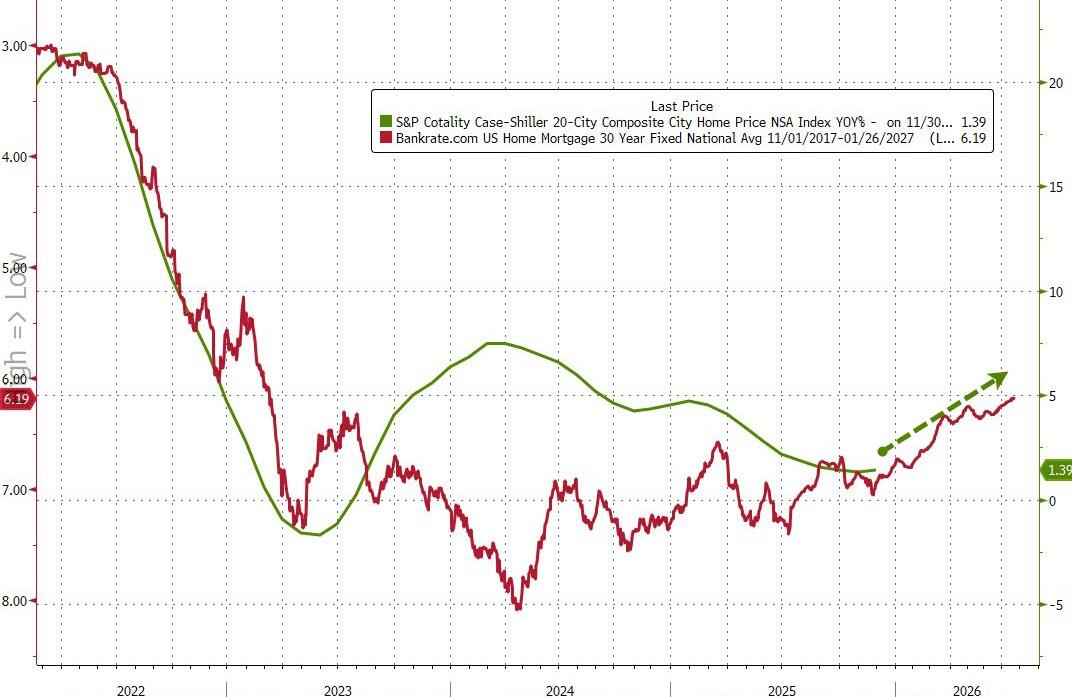
Declining mortgage rates suggest the rebound in aggregate prices could be about to explode…
Source: Bloomberg
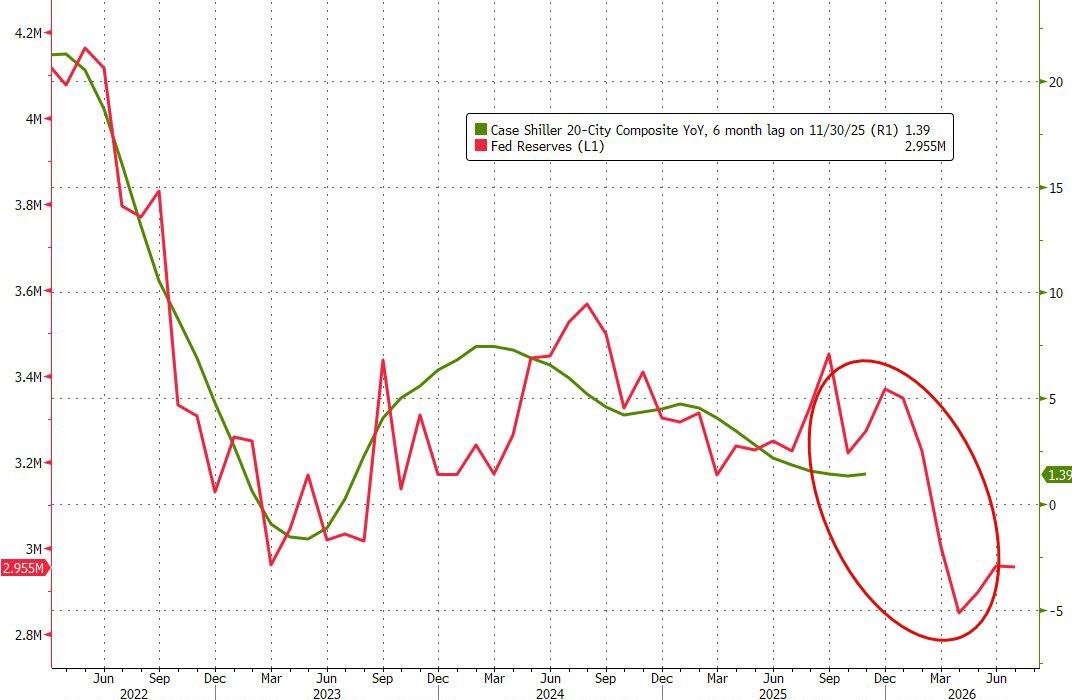
However, home price appreciation does seem to track very closely with bank reserves at The Fed (6mo lag), which implies prices are going continue to lag for the next few months…
Source: Bloomberg
Still, November’s data is not exactly what President Trump is looking for from ‘lower rates’ helping his ‘affordability’ message.
Tyler Durden
Tue, 01/27/2026 – 09:05
https://www.zerohedge.com/personal-finance/us-home-prices-surged-november-mortgage-rates-tumble

CCL holder opens fire on robbers on Northwest side, 2 in custody
Two people were arrested overnight after a conceal carry license holder wounded one of them during an attempt robbery overnight in the Belmont Cragin neighborhood, Chicago police said.
About 2:40 a.m., a 39-year-old man was exiting his vehicle in the 5200 block of West Montana Street when two males approached on foot with a firearm and demanded his property, police said.
The victim, a conceal and carry license holder, drew his weapon and opened fire, striking one of the robbers multiple times to the leg. When officers arrived at the scene, they placed the robbers into custody. A 23-year-old man was taken to Advocate Illinois Masonic Medical Center in good condition, police said.
Detectives were investigating the shooting.
https://www.chicagotribune.com/2026/01/27/robbery-belmont-cragin/