
Category: News

Sterling Elliott: War on drugs never has been, nor will it be, the answer
With news of multimillion-dollar lawsuits arising from President Donald Trump administration’s military incursion to apprehend Venezuelan leader Nicolás Maduro, America’s drug problem remains front and center. The White House demonstrated it believes a military campaign against alleged drug trafficking from Venezuela is central to protecting Americans. I won’t decry that effort. Reining in the supply of illegal drugs will always be crucial, but it’s not the principal solution.
In the 1970s, beginning with Richard Nixon’s White House, crushing the supply line was the focus of U.S. strategic policy. But that changed early this decade when it became clear this was an ineffective primary approach — something the Trump administration would do well to acknowledge.
In the ’70s and ’80s, the drug trade was a thriving business with all the hallmarks. Sales were booming. Innovation was a strategic priority with new products emerging. The cartels found unique ways to get the products into the U.S. and to their consumers. Today, the digital-age explosion sees the cartel wholesalers and the local dealer leveraging the internet, smartphones and cashless payment systems to create an entirely digital marketplace. Throughout these different snapshots in time, we’ve seen sectors evolve, all while the so-called war on drugs has been in full force. But the war on drugs is not the key solution.
So what is the path forward if trouncing the supply lines won’t produce results? As a pharmacist-scientist at a prominent institution who has researched new ways to curb opioid addiction, I’ve thought long and hard about the best direction. The reality is that America needs to refocus its energy on driving down the demand. The American street drug trade is a steamrolling business engine. Let’s treat it that way. Suppliers operating in a thriving market will always rise to meet the demand, and they’ll exit the market when it’s no longer profitable to stay in the game. I’m urging my fellow citizens to join me in the call to curb the demand.
The drug problem is fueled by a deadly trend of rising demand. Someone who’s facing that daunting battle is fighting against a very powerful force. Substance use disorders are the result of ever-growing demand for dopamine stimulation in patients’ brains. Sadly, opioid disorders are the standard-bearers for this problem. Millions of American families know all too well the power of that driving force. Maddeningly, the cartels and dealers know just how to capitalize on that overpowering reality of the human condition. They’re harnessing it to drive sales.
With that in mind, consider this a call to action. We need a full commitment from Americans on the street, and our leaders, to help those battling addiction and misuse disorders gain control over the dopamine driving force. When we do that, we’ll regain control over the recently declining death toll by reining in the predominant market force.
Controlling the demand takes a community effort. We need to invest time, energy and money into unique solutions that give people the ability to change the course of their addictions and recover by effectively integrating back into their communities. The budgeting process needs to fund federal and state programs to treat substance abuse.
We need to support efforts to bring effective treatments to patients suffering from daily pain. Plenty of Americans suffer injuries and have surgery every day. Programs to teach patients how to manage their pain and focus on recovering from injuries or surgery are an untapped resource.
For instance, I’m co-leading a group that’s studying a program that teaches patients to treat pain based on answers to questions about their functional abilities. The idea is if patients can stick to over-the-counter drugs such as ibuprofen and acetaminophen to treat their pain, they’ll rely less on opioids. Surgery and injury recovery are significant entry points to the river of despair that becomes opioid use disorders and addiction. As an example, a 2021 study in the Journal of the American Medical Association found nearly 7% of people continue using an opioid one year after surgery when they’d never used them prior to surgery. That’s never the intent when we give patients opioid pain medication. If we can make this commitment, we’ll make an impact far greater than a forceful attack on the supply lines.
We’re at an inflection point. In the last two years, America has seen great strides in causing the opioid death toll to plummet. It’s a source of great pride, and we need to harness it. The reality is that the battle to help our families, friends, co-workers and neighbors win this fight means we need to press forward with this momentum. We need to be vocal and challenge our leaders in Washington, D.C., and at home to prioritize efforts to promote healing and healthy behaviors.
When we do this, we’ll shrink the demand for products and create a business with less profitability. In the end, reining in demand will be more powerful than attacking the supply. The war on drugs is not the principal solution, because it never has been, and it never will be.
Sterling Elliott is a faculty member and researcher in the Department of Orthopaedic Surgery at Northwestern University Feinberg School of Medicine in Chicago.
Submit a letter, of no more than 400 words, to the editor here or email letters@chicagotribune.com.

Search out shrub, trees that resist disease
Some trees and shrubs have a bad reputation for being susceptible to diseases: lilacs to powdery
mildew, junipers to juniper tip blight, flowering crabapples to apple scab, elms to Dutch elm disease.
“If you choose carefully, you can still have these plants,” said Sharon Yiesla, plant knowledge specialist at The Morton Arboretum in Lisle. “You just have to seek out disease-resistant varieties.”
Flowering crab apples, for example, are useful small ornamental trees that offer lovely red, pink or white flowers in late spring and autumn fruits that feed wildlife. Dozens of cultivars, or cultivated varieties, of crab apple trees grow at The Morton Arboretum. Yet many homeowners avoid them because older varieties are prone to a number of diseases, including apple scab, cedar apple rust, fire blight and powdery mildew.
“Newer cultivars have been bred to be resistant to one or more of these diseases,” Yiesla said. A number of them can be found if you search for “crab apple” on the Arboretum website at mortonarb.org/search-trees-and-plants.
For example, the Prairifire crab apple (Malus ‘Prairifire’), a 20-foot-tall tree with red flowers, and the Adirondack crab apple (Malus ‘Adirondack’), a narrow, upright cultivar with white blooms, both have excellent resistance to apple scab, fire blight, rust and powdery mildew.
There are also juniper cultivars, such as Iowa, that are resistant to juniper tip blight, as well as lilacs such as Charles Joly and Old Glory that have good resistance to powdery mildew.
“Many of these diseases have been around for a long time, so the word has gotten around to avoid the plants that are affected by them,” Yiesla said. “But plant breeders have also had time to develop resistant cultivars.”
Not all new cultivars are available in every region. Once you have figured out what to ask for in terms of disease resistance, check with local nurseries to see which cultivars they have.
Even elm trees, notorious victims of Dutch elm disease, aren’t out of the question. Although the native species of American elm (Ulmus Americana) is extremely susceptible, some cultivars of the species have been selected with some resistance. They are not available everywhere, so it is also worth considering other Asian elm species with natural resistance.
Two widely planted elm cultivars that were developed at the Arboretum are the Triumph elm (Ulmus ‘Morton Glossy’) and the Accolade elm (Ulmus davidiana var. japonica ‘Morton’).
Another approach is to choose a species that is naturally problem-free. “Some kinds of trees just don’t seem to be bothered by pests and diseases very much, if at all,” Yiesla said.
For example, there’s a good reason that sites along streets are often planted with hackberry (Celtis occidentalis), a handsome native tree; gingko (Ginkgo biloba), an Asian species known for its golden-yellow fall color; and bald cypress (Taxodium distichum), a deciduous conifer. “These species are all tough, resilient, easy-care plants,” she said.
Disease resistance is one of the many reasons it’s worthwhile to invest some time in researching a plant before you buy it. “It will pay off in the long run,” Yiesla said, “because a disease-resistant tree is a lower-maintenance tree.”
For tree and plant advice, see the online resources of The Morton Arboretum at mortonarb.org/plant-care, or submit your questions online at mortonarb.org/plant-clinic or by email to plantclinic@mortonarb.org. Beth Botts is a staff writer at the Arboretum.
https://www.chicagotribune.com/2026/02/01/shrub-trees-disease-garden/

Clarence Page: The information war rages amid Donald Trump’s immigration chaos
There’s something uncomfortably familiar about President Donald Trump’s jackboot approach to the immigration debate.
It brings to mind a memorable off-the-cuff stumble by Chicago’s legendary Mayor Richard J. Daley when he was asked about allegations of excessive force by city police officers.
“The policeman isn’t there to create disorder,” he said. “The policeman is there to preserve disorder.”
Say, what?
Well, as Earl Bush, the mayor’s press secretary for 18 years, memorably advised reporters on another occasion, “Don’t write what the mayor says; write what he means.”
A variant of that advice resurfaced in 2016, when Donald Trump, a candidate known for shocking, even extreme, rhetoric started seeming to be the likely next president. Here’s how it was phrased this time: Take Trump seriously, not literally.
This was repeated by journalists and advisers, among others. And in retrospect, we should have been taking Trump more seriously — as well as literally. Especially as he taunted the press as “fake news,” and as he urged supporters to get violent with protesters who showed up at his campaign events. “Knock the crap out of ’em,” he said at an Iowa rally. “I promise you, I’ll pay for the legal fees.”
Barely into his first administration, Trump began referring to the media as the opposition party and the “enemy of the American people.” Meanwhile, fact-checking the president became a preoccupation of major media outlets, leading one deep thinker of the Fourth Estate to use the term “Trump’s Firehose of Falsehood.”
By the end of his first, chaotic term, Trump’s messages on Twitter became so out of bounds that the social media platform censored him. After losing the 2020 election, he launched a failed legal campaign to overturn it and exhorted his followers to “Stop the Steal.” After thousands of those followers stormed the U.S. Capitol on Jan. 6, 2021, even many Republicans were ready to be through with Trump’s chaos.
Yet now we find ourselves back in it. Those on the ground in areas where Immigration and Customs Enforcement or U.S. Border Patrol agents mount their raids describe feelings of terror. People shelter in their homes and avoid public places — even those who are in this country legally.
Related Articles
Clarence Page: ICE has been accused of profiling Native Americans. What a cruel irony.
Clarence Page: Guess who fears impeachment? A guy who’s been through it twice.
Clarence Page: It’s hard to hide the dysfunction of the Trump White House
Clarence Page: President Donald Trump’s obsession with Somali immigrants takes a sinister turn
Clarence Page: Border Patrol decamps from Chicago to create disorder elsewhere
The feeling for the rest of us is disorientation. Why is this happening? Indeed, what is happening?
The jackboots are only part of the chaos, of course. Another key element is the Trump administration’s communications strategy, which really should be termed an information war.
Early on in the Department of Homeland Security’s operations, ICE and the Border Patrol made all sorts of perp walks into videos and memes optimized for social media. As violence escalated, a sort of disinformation pattern became established. An administration official would make a claim about what happened, and later evidence would find these contentions to be misleading.
A shifting series of explanations would be provided for the missions or individual incidents, with no apparent urgency to be accurate or consistent. As litigation commenced and DHS officials were called to testify, judges became frustrated at the rampant false testimony and disobedience of the government.
To many Americans, it seems as if the various authorities of DHS and the Justice Department can no longer be trusted to tell the truth. And that is terrifying.
To take this back to Daley for a moment, after the “police riot,” as the chaos on the streets in 1968 was labeled by a special investigative commission later, governors, big city mayors, police chiefs and community leaders learned a lot and took to heart the need to reform.
Police departments and academies have set clear rules about use of force and other issues. Courts have done a decent job of enforcing them.
By contrast, the immigration agents Trump has unleashed on select American cities have invited more disasters because they do not seem bound by such protocols.
In Minneapolis, we see a large-scale escalation over earlier operations in Chicago, New York, Washington and other cities. A truckload of video has been generated showing roving squads of masked federal agents in military gear snatching people out of cars, releasing canisters of tear gas into crowds and visibly ignoring basic human rights as they target Minnesotans, especially targeting Somali, Latino and other minority communities.
It’s possible there would be much more widespread support for Trump’s immigration crackdown if it corresponded more closely to the stated aim of taking violent criminals off the street.
Unfortunately, that correspondence is wholly lacking. We see violence. We read deeply reported accounts and find credible evidence that constitutional rights are being violated. And we also hear lies.
On Thursday, border czar Tom Homan seemed to suggest that a drawdown of the ICE-Border Patrol operation in Minnesota was imminent. That would be a blessing, but I’ll believe it when I see it. Meanwhile, expect the information war to continue.
Email Clarence Page at cptimee@gmail.com.
Sign up to receive Clarence Page’s column in your inbox each week.
Submit a letter, of no more than 400 words, to the editor here or email letters@chicagotribune.com.
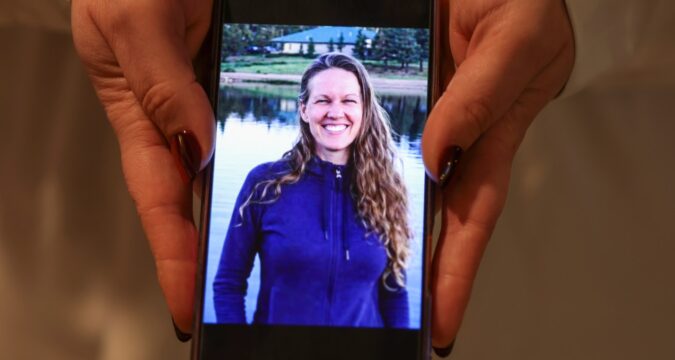
‘Oh god, what do we even do?’: Family of Linda Brown to launch missing person advocacy program
Jen Rivera was used to chasing open cases. For years, the southwest suburban mother of four has poured herself into true crime investigative podcasting, working directly with families to shed new light on their stories in the hopes that renewed attention would yield closure.
But when Rivera’s aunt Linda Brown went missing last month, she couldn’t wrap her head around her family having a case of their own.
“I realized — OK, this is my family member,” Rivera recalled. “This is our Linda.”
Now, with her work turned personal, Rivera is taking her advocacy a step further as she sets her sights on launching a new program to ensure other families faced with missing person cases have the best chance at bringing their loved ones — their Linda — home.
“How can we take (our) experience,” Rivera said in a recent interview, “and help other families?”
Brown was reported missing on Jan. 3, but just over a week later, her body was pulled from Lake Michigan. The Cook County medical examiner’s office ruled that Brown drowned in a suicide. She was 53.
From news reports to posts on social media, word spread quickly that Brown, a special education teacher at Robert Healy Elementary School on Chicago’s South Side, had gone missing. Police, in their initial missing person report for Brown, said she was last seen in the Bronzeville neighborhood, near where she lived with her husband. Days later, police updated the alert saying she was seen about half a mile away from where her body was ultimately recovered.
Authorities at the time said Brown may have required immediate medical attention.
Every year, Chicago police receive thousands of missing person reports. Last year, police logged just over 8,300 reports, according to police data. Of those, people were located within 72 hours in 1,580 — or about 19% — of cases, data shows, though police note that number is very likely higher, as not every missing person report may have been updated right when someone was found.
A police spokesperson in a statement said the department “takes every missing person case seriously and investigates everyone consistently,” with the hope of reuniting loved ones.
“Locating missing persons is an effort that CPD Detectives prioritize,” the statement said.
Still, when it comes to bringing attention to a case, it’s often up to families and friends to be their loved ones’ champions, whether that’s through posting flyers or launching a foot search.
“(But) there’s no rule book,” Wendy Davis, who’s been searching for her missing father in the south suburbs for the past two months, told the Tribune. “We were thrown straight into it. We were like, ‘Oh god, what do we even do?’”
That’s a question Rivera is hoping her new program can answer, by using lessons learned in her family’s own search and insight she’s gained from years spent working as an advocate.
‘I know what to do’
A native of Chicago’s South Side, Rivera started delving into advocacy more than a decade ago after a sexual assault she survived when she was a teenager drove her to start mentoring women in her mid-20s. The work introduced her to podcasting, initially to share women’s stories like her own, but Rivera found herself going further and further into the true crime space.
Around five years ago, she and a friend started a true crime podcast looking at unsolved missing person and murder cases with the intent of finding affected families and partnering with them on episodes, an approach Rivera calls “ethical true crime podcasting.” She’s since grown the venture into a full-blown nonprofit, dubbed the Reignited Project.
Jen Rivera in her recording studio on Jan. 21, 2026, a week after the body of her aunt, Linda Brown, a Chicago Public Schools special ed teacher, was pulled from Lake Michigan. After her aunt went missing, Rivera’s experience speaking with families of missing people through her work on her true crime podcasts and her nonprofit, the Reignited Project, turned personal. Rivera and other family and friends are launching a program to give guidance to families dealing with missing person cases. (Eileen T. Meslar/Chicago Tribune)
“(It’s) not for entertainment purposes,” Rivera said, sitting down with the Tribune at her home podcast studio in Plainfield. “But genuinely (for) … spreading awareness, so hopefully they can get answers.”
Rivera says she’s worked with several families navigating missing person cases. Most are still searching.
It’s that background that had Rivera devising a plan as soon as Brown went missing. When the surreal understanding that her aunt had disappeared set in, a switch in her head flipped — bringing her out of her shock — and Rivera said to herself: “I know what to do.”
Her family started by calling area health facilities. Before she vanished, Brown had been grappling with her mental health. It’s something Brown managed throughout her life, but her struggles, according to Rivera, had been mounting leading up to her disappearance, giving way to near-daily panic attacks and prompting Brown to take a medical leave from teaching. Still, Brown had sought help and was receiving treatment.
Rivera, who is Brown’s niece through marriage, recalled the first time she met Brown. It was about 20 years ago, back when she and her husband first started dating, and the introduction came through a laugh — a loud, obnoxiously silly laugh that Rivera said she heard before she knew it was Brown’s. Over the years, they grew close, frequently working on puzzles together and going on summer cabin trips to Michigan with her husband’s side of the family. Rivera never knew Brown to disappear.
“I took it seriously right away,” Rivera said. With no news from the health facilities, they alerted police, then took action. Rivera and her husband heard that Brown was missing early in the morning on Jan. 4. A day later, there were news reports about her disappearance.
For the next week, they put out calls for help on social media, circulated flyers, made public pleas in media interviews and retraced Brown’s last known steps.
“I (knew) that we (needed) to keep moving forward,” Rivera said.
She’s held onto the sentiment since Brown was found dead on Jan. 12. While it’s been difficult in a way Rivera doesn’t know how to describe, she knew she couldn’t sit idly in her grief. So she started thinking about the next family, and how she could help. That’s been the key, she says, to “not falling apart completely.”
The protocol
The Linda Brown Advocacy Protocol has four pillars: preparedness; early-stage family guidance; ethical advocacy, media and search education; and collaboration and systems-level growth.
The idea is to provide a step-by-step framework families can follow if a loved one goes missing. For instance, guidance implores that families put together a “digital preparedness folder,” composed of recent photos, medical information and emergency contacts. Other steps include what to do — and what not to do — in the first 24 to 72 hours, how to navigate and speak with the media and how to safely organize community searches.
Sam Farley, whose daughter went missing from their Far South Side home in 2024, said he could see a guide for families being “invaluable.” Farley, noting that his daughter was found after a monthslong disappearance, said he had to rely on friends and neighbors who knew to put up flyers and get the word out via social media to bring her home. Without them, he said, he would have been at a loss.
And without the attention they brought to his daughter’s case, he ventures his daughter “would have just been a little Black girl lost up in the system,” a situation that’s all too familiar for families of Black and brown women and girls in the city. Over the past two decades, Black people have accounted for about two-thirds of missing person cases in Chicago, a 2023 Pulitzer Prize-winning report from the Indivisible Institute and City Bureau found.
Farley said exposure, and knowing how to get it, is essential. He said he could also imagine guidance grounding loved ones as they wade through their grief.
“It’s kind of like when … somebody close to you dies, but yet you still gotta prepare for a funeral,” he said.
With her protocol, Rivera hopes to “bridge the gap” between families, advocates, media and law enforcement. Though the program is still in development, she’s aiming to launch, at least in part, over the next three to six months.
Alongside the missing persons framework, Rivera plans to eventually expand the program to include mental health awareness and crisis intervention. She also means to create an initiative for helping teachers reintegrate back into the classroom after they’ve been away on medical leave. That change had been stirring a lot of stress and anxiety in her aunt, Rivera said, exacerbating what she was already struggling with. Rivera wants to ease the transition.
Initially, though, the missing persons framework will be the first to roll out.
“It’s gonna be amazing … for people in the future that have to go through this,” said Wendy Davis, the south suburban woman searching for her missing dad. When she started looking for her father, Daniel Davis, after he disappeared in late November, it was a “mad, mad goose chase.”
She said she wishes she had had something like the Linda Brown Advocacy Protocol to follow back then. In the months since, Wendy Davis has amassed a vast network of resources through her search, from a social media following offering words of advice from other states and even other countries to accruing cellphone data and working with rescue teams. She wants to see other families have that same support.
“It seems like a rare scenario for you to go through, having a missing loved one, but countless people go through it,” she said.
When her dad is found, Wendy Davis said she’s inspired to do something — to find a way to help — like Brown’s family.
“The less time you spend just running around chasing ghosts,” she said, “the better.”
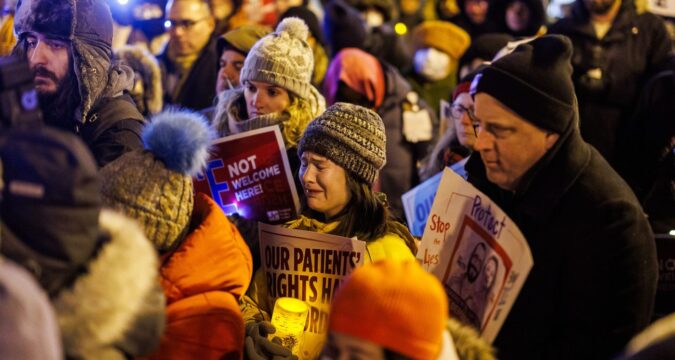
Still reeling from Operation Midway Blitz, Chicago casts wary eye toward Minneapolis
Like many Chicago-area residents, Katie Bunt watched in horror as federal agents conducted Operation Midway Blitz in Chicago, and did what she could to push back on the immigration raids as they swept through the city and suburbs.
She hadn’t anticipated that immigration enforcement eventually would escalate further than it did here.
“Every big action ICE and DHS are taking is a clue to the next place that it could be worse,” Bunt said. “I did not expect it to be worse in another city.”
But on a frigid Tuesday night in Albany Park, Bunt was dropping off bundles of hand warmers at a last-minute supply drive for protesters in Minneapolis, which along with St. Paul has found itself in the crosshairs of the federal government as it carries out its latest, stepped-up enforcement surge against immigrants without legal status, wreaking much of the same chaos there as agents did here in the fall during Operation Midway Blitz.
Though federal operations in Minnesota have taken place on a different scale than they did here, with thousands more agents overtaking much smaller cities in pursuit of different immigrant populations, the raids there in many ways parallel the blitz in Chicago. There are sights familiar to so many Chicagoans: parents in reflective vests outside schools, cars left abandoned with their doors open and drivers missing, dark SUVs screaming through red lights, locked restaurant doors and miniature recessions in the hardest-hit neighborhoods.
Both places have seen lethal and near-lethal violence against both citizens and immigrants at the hands of agents, and responded. People in both states have pointed out how protest tactics developed and scaled up in Chicago have made their way to the Twin Cities as federal forces bore down.
As the Trump administration shakes up leadership of the roving raids, replacing U.S. Border Patrol Cmdr. Gregory Bovino with “border czar” Tom Homan amid public backlash to the killings of two U.S. citizens in Minneapolis, there’s no indication if the feds will return to Chicago. Nor is there much information about how such an operation might mirror or depart from what’s taken place in the Twin Cities, where Homan recently spoke of a “drawdown.”
Flyers and 3D-printed whistles at Pilsen Arts & Community House in Chicago are readied to be mailed out, Jan. 27, 2026, to activists against the federal government’s immigration crackdown. (Terrence Antonio James/Chicago Tribune)
Many citizens, immigrants and advocates in Chicago now find themselves casting around for ways to support Minnesota residents — and wondering what events there might mean for the city come spring, even as a smaller number of agents continue to make arrests in the city and suburbs and Department of Homeland Security officials declare that they “never left.”
Bunt, 38, knew a couple of sets of hand warmers wasn’t much. But it was something small she could do.
She still carries her black whistle with her keys everywhere she goes, and plans to keep following the news out of Minnesota and other cities where the feds may train their focus next. She’ll keep looking for ways to help protesters. And she said she would try to spread reliable information about what to do if federal agents return in greater numbers to Chicago and its suburbs.
“It feels like there’s not a lot we can do other than prepare for something a little bit worse,” said Bunt, who works in industrial sewing.
Kevin Fee, legal director of the Illinois chapter of the ACLU, said that unless there was a “major change” in federal enforcement strategy, he feared events like the killing of Silverio Villegas-Gonzalez just outside Chicago, or Renee Good and Alex Pretti in Minneapolis, would occur “over and over again.”
“We hope that the feds are serious about de-escalating the situation in Minnesota, given the tragic events that have unfolded there,” he said. “But if they continue along the current path and reappear in Chicago, we expect that their actions will continue to be abusive and excessive and unconstitutional.”
Chicago and Minneapolis
If Chicago’s blitz was characterized by floods of agents in one neighborhood or suburb at a time, “Operation Metro Surge” in Minnesota has been more of a saturation.
“It’s kind of everywhere all the time,” Minneapolis resident Doug Mack said. “My understanding is that they have even more agents here, and it’s a smaller place (than Chicago).”
The federal government says it sent about 3,000 agents to Minnesota for Operation Metro Surge. Minneapolis, the larger of the Twin Cities, is home to just under 430,000 people, according to 2024 U.S. census numbers. About 307,000 more reside in St. Paul.
The number of agents in the region dwarfs the two cities’ police departments combined. And it’s about 10 times the number of agents that were sent to metro Chicago, with its population of roughly 9 million.
Those differences in scale have led to what Mack, 44, described as a “more dispersed but more widespread presence” of agents around the metro area. Some have reported that more agents are wearing plainclothes like jeans, parkas and baseball hats in an apparent effort to blend in more on city streets, rather than the fatigues that were so often seen on the streets of Chicago and its suburbs.
Amanda Kimber said there had been plenty of news about raids striking different big-box stores or commercial strips, but that she and her neighbors had also witnessed agents casing streets without arresting anyone, apparently scoping out future targets.
“It feels like they have a lot of people who are doing day-to-day enforcement — just targeting a COSTCO parking lot — but then they are also doing, like, reconnaissance on people,” said Kimber, 40. “Because they have enough bodies, they can do both.”
All of that has led to her sense that “no neighborhood is really free of them.”
Federal agents pin a protester to the ground and spray a chemical irritant into his face at 28th and Blaisdell Avenue South in Minneapolis on Jan. 21, 2026. (Richard Tsong-Taatarii/The Minnesota Star Tribune)
Besides the scale of the raids, who the victims were also made a difference in the broader reception of their deadliest moments, experts said. Advocates and activists have pointed out that while the killing of Villegas-Gonzalez, a Mexican immigrant and father of two, in Franklin Park, got significant attention, it didn’t garner the same national backlash as the deaths of two white citizens in Minnesota.
Rey Wences, co-founder of Organized Communities Against Deportations, saw the Minneapolis killings as an escalation of a trend that began in Chicago with the shooting of Marimar Martinez, the citizen who survived being shot five times in Brighton Park while protesting Midway Blitz — where people who aren’t candidates for arrest and deportation need to think about serious risks when interacting with immigration agents.
“What I saw being inflicted on (Villegas-Gonzalez) was consistent with the type of violence that I have seen being inflicted on other undocumented immigrants that are caught in the system,” Wences said. “Now … it feels like anyone is a target if you do not agree with the way that immigration enforcement is being carried out in this country.”
The availability of video footage has also been a significant contributing factor in the resulting public backlash against the two killings in Minnesota, experts said.
Nail salon surveillance video offers the most complete look at the shooting of Villegas-Gonzalez, and Martinez’s attorneys are still fighting to get Border Patrol Agent Charles Exum’s body-worn camera footage released to the public.
But closer-range video of the shootings that killed Good and Pretti has reverberated through social media feeds and news outlets around the country, creating what Northwestern University professor Kevin Boyle referred to as a new “Kent State moment.”
“You saw it, you watched it happen,” Boyle said. “That’s one of the most powerful things in terms of the responses people can have.”
A similar response
While there are factors that set Chicago’s “blitz” and the Twin Cities’ “surge” apart, Boyle said, “the similarities are stronger than the differences.” Both places have strong traditions of activism, he noted: “networks in place that can mobilize protests that not every city has.”
Mack, of Minneapolis, noted that everyone he sees carries a whistle to alert others of agents’ presence — ”we are very grateful to Chicago for the whistles,” he said. And while every city seems to react to federal presence in its own way, he said, “in broad strokes, it’s all the same.”
“If somebody can’t go to work, you do what you can to help them make rent, buy groceries, buy diapers,” he said. “I think that’s kind of universal.”
Federal agents take a person who was standing in a Minneapolis neighborhood into custody after he was unable to produce citizenship documentation on Jan. 12, 2026. (Scott Olson/Getty)
On the federal side, former Customs and Border Patrol Commissioner Gil Kerlikowske saw almost no difference between agents’ strategies in Minnesota versus Chicago, where their use of force in both places has prompted federal judges to issue restraining orders.
“The tactics, walking down the street, going to a car wash or a Home Depot lot, are kind of the same,” he said. “I saw them pick up people and throw them to the ground. I’ve seen this widespread use of pepper spray. I don’t see a great deal of distinction.”
Fee, of the ACLU, said the feds have taken a mostly consistent approach across every city they’ve raided: “An escalation of conflict rather than de-escalation, agents seeming to sort of delight in conflict with protesters and crowds and crucially, for fairly high-ranking officials, misrepresenting facts relating to those conflicts.”
“It all got its start even before Chicago,” he said. “We’ve seen very similar tactics used in each of the cities with an expansion in scope and volume of agents.”
As for the way in which the raids’ outcomes in Minnesota seem to now be diverging from Chicago on the national stage, Fee chalked it up to a “nearly inevitable” consequence of a greater number of “largely untrained, highly unprofessional, seemingly conflict-driven bands of federal law enforcement roaming cities with near-impunity.”
“The increase in volume itself … is going to increase the opportunities for tragic violence,” he said. “You just have more flash points.”
Future for Chicago?
When Tom Homan spoke to reporters Thursday, he seemed to be signaling at least a superficial retreat from the hyper-militarized, freewheeling approach that Bovino and his men relied on throughout their time in Chicago, the Twin Cities and elsewhere.
Dressed in a civilian suit instead of the green fatigues that Bovino favored throughout his time leading the raids, Homan’s talk of “targeted strategic enforcement operations” seemed to mark a turn away from the roving, go-fish style of arrests that Bovino and his men were carrying out for much of the fall as they circled neighborhoods, jumping out of their convoys to question people they encountered on the street
“We’re going to hit the street and we’re going to know exactly who we’re looking for,” Homan said.
He did not address the shootings of Good or Pretti, only saying that he did “not want to hear that everything that’s been done here has been perfect,” and hinted that the feds may pull some of their agents out of the state. But even that prospect was murky, tied to cooperation of state and local officials, and Chicago was not specifically mentioned.
“If ICE comes back in the spring, of course, they’re carrying with them the weight of what happened in Minneapolis,” said Boyle, the Northwestern professor.
Immigrants, advocates and civic leaders have looked at the escalations in Minneapolis as a possible bellwether.
Marty Castro, a former chair of the U.S. Commission on Civil Rights during President Barack Obama’s era, described Minnesota as “a preview of what could come here” at a news conference Thursday.
The fear and uncertainty remain widespread among Chicago’s immigrant communities, both undocumented residents and those with legal status, saying their concern has deepened after witnessing what unfolded in Minnesota.
But Castro, whose group Allies United has been in close contact with civic leaders and advocates in Minnesota, said that despite that alarm, people would keep opposing the raids.
“A lot of us are going to get hurt and some of us may even get killed but we will continue the fight and win,” he said.
Rosemarie Dominguez is worried that people who choose to be on the scene during immigration raids and their aftermath will be putting themselves in “life-and-death situations” if the feds step their activity back up around the city.
At the same time, Dominguez, an activist and member of the Ogden District Police Council who was briefly detained last fall while protesting the crackdown, said she was channeling those emotions into trying to prepare for what could come next.
“We’re still going to continue to show up,” she said. “I’m angry and I’m frustrated, but channeling that (into) ‘how much more prepared can I be come March?’”
For some in Chicago, there has been a measure of relief in the removal of Bovino. But that relief is tempered by uncertainty over what his departure actually means.
Dolores Castañeda, a longtime community leader in the Little Village neighborhood of Chicago, distributes flyers along West 26th Street on Aug. 31, 2025, to alert residents of the potential immigration raids and steps they can take to protect themselves. (Brian Cassella/Chicago Tribune)
“Bovino may be gone, but people are still wondering what comes next,” said Dolores Castañeda, a lifelong resident of Little Village. ”Trump is still president.”
She said concerns had been building long before agents left Chicago, but escalated sharply after the scale and severity of the Minnesota operations became clear.
“We didn’t think they would kill someone so blatantly, so openly. They don’t care about humanity,” she said. “So if that’s what they do to citizens, people recording them or standing up for their rights, what do they do to the immigrants they detain?”
Castañeda, who has become a community leader by helping street vendors and connecting residents with resources, said the fear has had real consequences.
Some people were able to survive for a time without working, she said. Many are still hiding. Others were taken during enforcement actions, and those losses continue to ripple through families and neighborhoods.
Mel Trujillo has witnessed some of that loss and disruption up close: she has co-workers who have spent the last several months afraid to leave their homes, she said.
Volunteers gather at Pilsen Arts & Community House in Chicago on Jan. 27, 2026, to fold flyers to be distributed with whistles for use in the face of a federal immigration raid. (Terrence Antonio James/Chicago Tribune)
Seeing their fear was part of what brought Trujillo, 25, to gather around a worktable inside the Pilsen Arts & Community House on a freezing weekday night, where about 30 people were cutting and folding sheet after sheet of paper printed with information about how to use whistles in the face of a federal immigration raid. Grimes blasted over the rustling as people moved in and out, clutching rubber-banded stacks of whistle manuals in pink and green.
Trujillo and Gabe Rivera, 24, saw the raids, protests and killings in Minnesota as a “call to action.” They’d come to put their rage and hopelessness to some use.
And while Rivera said that they, like many others, had been taken by surprise during the first round of raids, “we’re just going to be more prepared when they do come back.”
“It’s one more reason why we’re here now,” Trujillo said, slipping another zine into her table’s box. “To make sure our presence is loud and we’re not small.”
Mostly-stuffed boxes, each holding about 3,000 “zines,” sat in the middle of every table, waiting to be shipped. Almost all of that week’s set was headed to Minneapolis.
Today in History: John S. Rock admitted to the bar
Today is Sunday, Feb. 1, the 32nd day of 2026. There are 333 days left in the year.
Today in history:
On Feb. 1, 1865, abolitionist John S. Rock became the first Black lawyer admitted to the bar of the U.S. Supreme Court.
Also on this date:
In 1943, during World War II, one of America’s most highly decorated military units, the 442nd Regimental Combat Team, made up almost exclusively of Japanese Americans, was activated.
In 1960, four Black college students began a sit-in protest at a Woolworth’s lunch counter in Greensboro, North Carolina, where they had been refused service.
In 1979, Iranian religious leader Ayatollah Ruhollah Khomeini was welcomed home by millions in Tehran as he ended nearly 15 years of exile.
In 1991, an arriving USAir jetliner crashed atop a commuter plane on a runway at Los Angeles International Airport, resulting in 35 deaths.
In 1994, Jeff Gillooly, Tonya Harding’s ex-husband, pleaded guilty in Portland, Oregon, to racketeering for his part in the attack on figure skater Nancy Kerrigan in exchange for a 24-month sentence and a $100,000 fine.
In 2002, Wall Street Journal journalist Daniel Pearl was killed by Islamist militants in Pakistan after being kidnapped nine days earlier.
In 2003, the space shuttle Columbia broke apart as it re-entered the Earth’s atmosphere, killing all seven crew members: commander Rick Husband; pilot William McCool; payload commander Michael Anderson; mission specialists Kalpana Chawla, David Brown and Laurel Clark; and payload specialist Ilan Ramon.
In 2016, the World Health Organization declared a global emergency over the explosive spread of the Zika virus, which was linked to birth defects in the Americas.
Related Articles
Home and studio of R. Harold Zook, ‘Hinsdale’s Frank Lloyd Wright,’ gets funding boost for preservation
Today in History: Doug Williams named Super Bowl MVP
Today in Chicago History: Thousands — including Mayor Daley and Sammy Davis Jr. — say goodbye to Mahalia Jackson
Polly Cooper, an Oneida woman who helped save Washington’s army, is honored on $1 coin
Willie Round’s ‘Lawndale King’ recounts the history that MLK made in North Lawndale
In 2021, the army in Myanmar overthrew the elected government of the Southeast Asian country. (Armed resistance arose after the army used lethal force to crush nonviolent protests against its takeover, and an ensuing civil war left more than 3.6 million people displaced in the country, according to the U.N.)
Today’s birthdays: Actor Garrett Morris is 89. Political commentator Fred Barnes is 83. Princess Stephanie of Monaco is 61. Actor Sherilyn Fenn is 61. U.S. Soccer Hall of Famer Michelle Akers is 60. Comedian-actor Pauly Shore is 58. Actor Michael C. Hall is 55. Rapper Big Boi (Outkast) is 51. Singer-songwriter Jason Isbell is 47. TV personality Lauren Conrad is 40. Mixed martial artist Ronda Rousey is 39. Actor Julia Garner is 32. Singer-actor Harry Styles is 32. Singer Jessica Baio is 24.
https://www.chicagotribune.com/2026/02/01/today-in-history-john-s-rock-lawyer/
Today in Chicago History: Morton Grove enacts nation’s first handgun ban
Here’s a look back at what happened in the Chicago area on Feb. 1, according to the Tribune’s archives.
Is an important event missing from this date? Email us.
(Business) front page flashback: Feb. 1, 2006
United Airlines emerged from bankruptcy in February 2006. (Chicago Tribune)
2006: United Airlines emerged from bankruptcy for the first time in more than three years.
Weather records (from the National Weather Service, Chicago)
High temperature: 56 degrees (1968)
Low temperature: Minus 14 degrees (1985)
Precipitation: 0.87 inches (2015)
Snowfall: 16.2 inches (2015)
Ada Everleigh, left, and her sister Minna Everleigh owned the infamous Chicago brothel, the Everleigh Club. (Chicago Tribune archive)
1900: The Everleigh sisters opened their carriage trade brothel, the opulent Everleigh Club, 2131 S. Dearborn St. It was shut down in 1911 by Mayor Carter Harrison. That’s when Ada and Minna Everleigh moved to New York.
More than 9,000 fans gathered at the International Amphitheatre in Chicago on Feb. 1, 1981 to watch first-seed Martina Navratilova defeat 18-year-old Hanna Mandlikova 6-4, 6-2 to claim the Avon Championships of Chicago. Matches were played on carpet courts (Carl Hugare/Chicago Tribune)
1981: Martina Navratilova took two checks, one for $35,000 and another for $6,000, as well as two fur jackets out of Chicago as her prizes for winning the singles and doubles titles in the Avon tournament at the International Amphitheatre.
Navratilova also left something in Chicago that night — advice for the Chicago Bears, who were negotiating with Walter Payton at the time.
“Give Walter Payton whatever he wants,” said Navratilova, a Dallas Cowboys fan. “Give him $1 million a year. Payton is the franchise.”
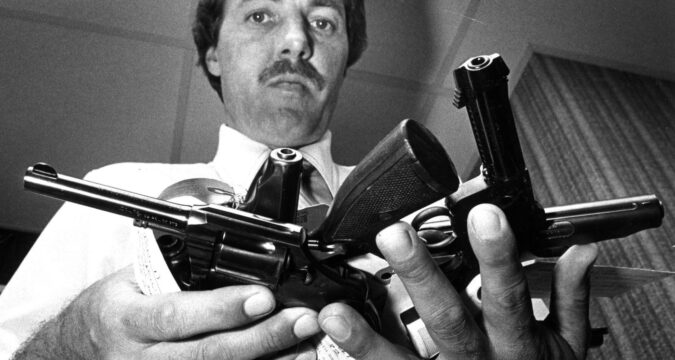
“On Monday, more reporters, photographers and television cameramen went to the Morton Grove Village Hall and police station than did residents” surrendering weapons, the Tribune reported when Morton Grove became the first municipality in the U.S. to enact a handgun ban that went into effect Feb. 1, 1982. (Chicago Tribune)
1982: In the first of its kind in the U.S., Morton Grove began enforcement of a controversial ordinance banning the possession of handguns. Residents turned in five guns to police on the first day. The ordinance also banned possession of automatic weapons, overriding a newly effective state law that allowed it.
The measure triggered a storm of publicity and a nationwide debate over the merits of using local ordinances to control gun ownership, but was upheld in 1984 by the Illinois Supreme Court. The ordinance was repealed in July 2008.
Movie critics Gene Siskel, right, and Roger Ebert speak at an event renaming Erie Street at McClurg Court in their honor on Feb. 1, 1995, in Chicago. (Chris Walker/Chicago Tribune)
1995: Two thumbs up. Mayor Richard M. Daley dedicated Erie Street between Fairbanks and McClurg courts to film critics Gene Siskel, of the Chicago Tribune, and Roger Ebert, of the Chicago Sun-Times.
The honorarily named Siskel & Ebert Way commemorates the WBBM-TV studios where they taped their show.
Charles Tillman, of the Chicago Bears, reacts as he accepts the Walter Payton NFL Man of the Year award at the 3rd annual NFL Honors at Radio City Music Hall on Feb. 1, 2014, in New York. (Evan Agostini/Invision for NFL)
2014: Charles “Peanut” Tillman announced as NFL’s Walter Payton Man of the Year.
Chicago’s Chinatown, including Won Kow and House of Fong restaurants, circa 1977. (Frank Hanes/Chicago Tribune)
2018: Won Kow — then Chinatown’s oldest restaurant — closed.
Won Kow was built in 1928 by a restaurateur named Moy, according to Tribune archives. The restaurant was frequented by both people from the neighborhood, as well as Jewish families from the North and South sides, It served Chinese-American favorites such as orange chicken, chow mein, chop suey, dim sum and fresh seafood.
Want more vintage Chicago?
Subscribe to the free Vintage Chicago Tribune newsletter, join our Chicagoland history Facebook group, stay current with Today in Chicago History and follow us on Instagram for more from Chicago’s past.
Have an idea for Vintage Chicago Tribune? Share it with Kori Rumore and Marianne Mather at krumore@chicagotribune.com and mmather@chicagotribune.com
https://www.chicagotribune.com/2026/02/01/february-1-chicago-history/
El líder supremo de Irán advierte a EEUU que “si empiezan una guerra, esta vez será una guerra regional”
DUBÁI, Emiratos Árabes Unidos (AP) — El líder supremo de Irán advierte a EEUU que “si empiezan una guerra, esta vez será una guerra regional.”

El cruce fronterizo de Gaza se prepara para reabrir tras años de cierre casi total
Por SAMY MAGDY
EL CAIRO (AP) — El cruce fronterizo de Rafah que conecta Gaza con Egipto mostraba signos de actividad el domingo, después de que Israel anunciara que se reanudarán parcialmente los desplazamientos hacia y desde el territorio después de años de aislamiento casi completo. La reapertura del cruce fronterizo es un paso clave a medida que avanza el alto el fuego entre Israel y Hamás.
Israel anunció el domingo que el cruce se había abierto a modo de prueba. COGAT, la agencia militar israelí que controla la ayuda a Gaza, dijo en un comunicado que el cruce se estaba preparando activamente para una operación más completa, y agregó que los residentes de Gaza comenzarían a pasar por el cruce una vez que se completaran los preparativos.
Oficiales de seguridad palestinos pasaron por la puerta egipcia del cruce y se dirigieron hacia la puerta palestina para unirse a una misión de la UE que supervisará la salida y entrada, dijo un funcionario egipcio, quien habló bajo condición de anonimato porque no estaba autorizado a hablar con los medios. Las ambulancias también cruzaron por la puerta egipcia, agregó el funcionario.
El jefe del nuevo comité administrativo palestino que gobierna los asuntos diarios de Gaza ha dicho que el tráfico en ambas direcciones comenzará el lunes.
Rafah, que los palestinos ven como su puerta al mundo, ha estado mayormente cerrado desde que fue tomado por Israel en mayo de 2024.
Al principio se permitirá el paso a pocas personas, y no habrá cruce de mercancías. Alrededor de 20.000 niños y adultos palestinos que necesitan atención médica esperan salir de la devastada Gaza por allí, y miles de otros palestinos fuera del territorio esperan regresar a casa.
Zaher al-Wahidi, jefe del departamento de documentación del Ministerio de Salud en Gaza, dijo a The Associated Press que el ministerio aún no ha sido informado sobre el inicio de las evacuaciones médicas.
El primer ministro israelí, Benjamin Netanyahu, ha dicho que Israel permitirá la salida de 50 pacientes al día. Un funcionario involucrado en las conversaciones, que habló bajo condición de anonimato para discutir las conversaciones diplomáticas, dijo que a cada paciente se le permitiría viajar con dos familiares, mientras que cada día se permitiría regresar a unas 50 personas que salieron de Gaza durante la guerra.
Israel ha dicho que tanto ellos como Egipto evaluarán a las personas para la salida y entrada a través del cruce, que será supervisado por agentes de patrulla fronteriza de la Unión Europea. Se espera que el número de viajeros aumente con el tiempo si el sistema tiene éxito.
Las tropas israelíes tomaron y cerraron el cruce de Rafah en mayo de 2024, un movimiento que describieron como parte de los esfuerzos para combatir el contrabando de armas de Hamás. El cruce se abrió brevemente para la evacuación de pacientes médicos durante un alto el fuego a principios de 2025. Israel se había resistido a reabrir el cruce de Rafah, pero la recuperación de los restos del último rehén en Gaza la semana pasada despejó el camino para avanzar.
La reapertura es un paso clave a medida que el acuerdo de alto el fuego mediado por Estados Unidos el año pasado, que entró en vigor el 10 de octubre, avanza a su segunda fase.
Antes de la guerra, Rafah era el principal cruce para las personas que se movían dentro y fuera de Gaza. Aunque Gaza tiene otros cuatro cruces fronterizos, estos son compartidos con Israel. Según los términos del alto el fuego, el ejército israelí controla el área entre el cruce de Rafah y la zona donde vive la mayoría de los palestinos.
Temiendo que Israel pudiera usar el cruce para empujar a los palestinos fuera del enclave, Egipto ha dicho repetidamente que debe estar abierto tanto para la entrada como para la salida de Gaza. Históricamente, Israel y Egipto han evaluado a los palestinos que solicitan cruzar.
El actual alto el fuego detuvo más de dos años de guerra entre Israel y Hamás que comenzó con un ataque liderado por Hamás en el sur de Israel el 7 de octubre de 2023. La primera fase de la tregua pedía el intercambio de todos los rehenes retenidos en Gaza por cientos de palestinos detenidos por Israel, un aumento en la muy necesaria ayuda humanitaria y una retirada parcial de las tropas israelíes.
La segunda fase es más complicada. Llama a la instauración de un nuevo comité palestino para gobernar Gaza, el despliegue de una fuerza de seguridad internacional, el desarme de Hamás y la toma de medidas para comenzar la reconstrucción.
___
Esta historia fue traducida del inglés por un editor de AP con la ayuda de una herramienta de inteligencia artificial generativa.
Israel anuncia que el paso de Rafah ha abierto a modo de prueba antes de permitir el paso limitado de palestinos
Associated Press
JERUSALÉN (AP) — Israel anuncia que el paso de Rafah ha abierto a modo de prueba antes de permitir el paso limitado de palestinos.


