Category: News
US Military Still Not Prepared For Major Attack On Iran, Only ‘Limited’ Strikes
US Military Still Not Prepared For Major Attack On Iran, Only ‘Limited’ Strikes
President Trump has acknowledged that he has a plan for Iran, but naturally isn’t going to make it public. “Well, we can’t tell them the plan,” Trump said Saturday. “If I told them the plan, it would be almost as bad as telling you the plan – it could be worse, actually.” Several Gulf allies have meanwhile complained of being “in the dark” on what the US might do next.
Fresh quotes from US officials in The Wall Street Journal suggest major military action is not imminent, but ‘limited’ strikes might be. The Pentagon is worried its troops and bases in the region are too exposed, given Tehran has vowed all-out war if it gets hit.
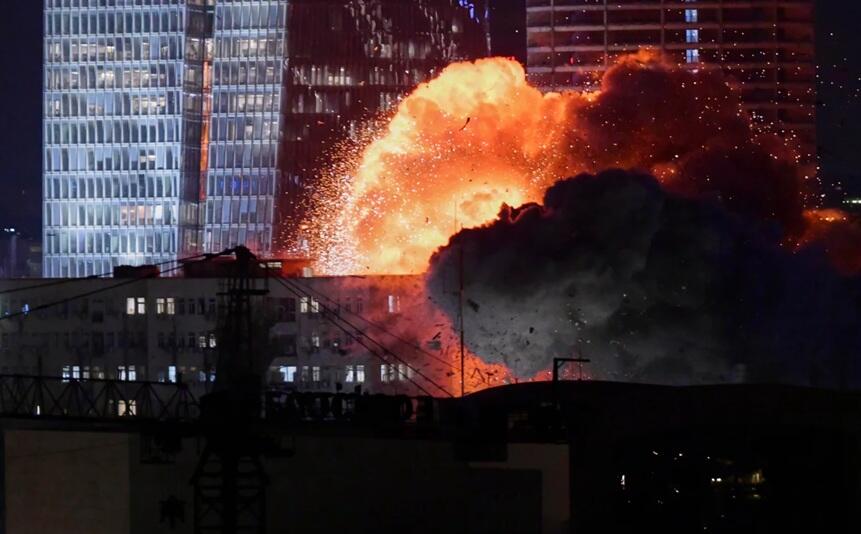
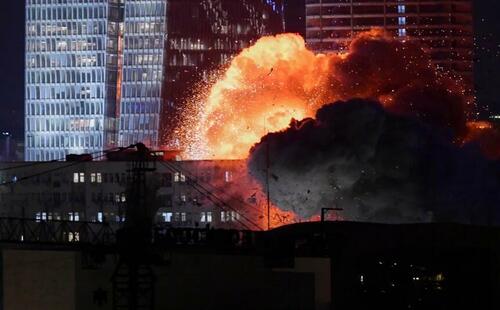
Explosion during a missile attack in Tel Aviv, Israel, Friday, June 13, 2025. via Associated Press
“Trump has yet to say whether and how he might use force,” the WSJ writes. “But American airstrikes on Iran aren’t imminent, U.S. officials say, because the Pentagon is moving in additional air defenses to better protect Israel, Arab allies and American forces in the event of a retaliation by Iran and a potential prolonged conflict.”
“The U.S. military could conduct limited airstrikes on Iran if the president were to order an attack today, U.S. officials say,” the report continues. “But the kind of decisive attack that Trump has asked the military to prepare would likely prompt a proportional response from Iran, requiring the U.S. to have robust air defenses in place to protect Israel as well as American troops, the officials say.”
Again, Iranian officials have repeatedly said its own response will not be limited – that it will unleash its significant ballistic missile arsenal on American assets in the region and Isarel, much of which can be launched from well-protected underground bunkers and tunnels.
This is why the Pentagon is rushing to get more THAAD, Patriots, and other anti-air measures to the region. These systems have already likely been beefed up in Qatar, home to a major US base outside Doha.
The WSJ details further:
The military already has air defenses in the region, including destroyers capable of shooting down aerial threats. But the Pentagon is deploying an additional Thaad battery and Patriot air defenses to bases where U.S. troops are stationed across the Middle East, including Jordan, Kuwait, Bahrain, Saudi Arabia and Qatar, according to defense officials, flight tracking data and satellite imagery.
High on the minds of US and Israeli officials is Iran’s response during the 12-day June war. The below commentary is worth revisiting…
Statements by Ali Shamkhani, adviser to Iran’s Supreme Leader, threatening to strike the heart of Tel Aviv and those supporting it, provide an insight into Tehran’s evolving strategic calculus.
Unlike the previous 12-day conflict, during which Iran conducted limited… https://t.co/x5OSi3QFLx pic.twitter.com/8D01iGFEsF
— Talha Ahmad (@talhaahmad967) January 30, 2026
The country’s ballistic missiles, drones, and even hypersonic projectiles that rained down on Tel Aviv and elsewhere was significant – and likely caused much more damage than what Israel publicly acknowledged.
Tyler Durden
Sun, 02/01/2026 – 11:05
Ejército nigeriano abate a comandante y 10 milicianos de Boko Haram
Por DYEPKAZAH SHIBAYAN
ABUYA, Nigeria (AP) — El ejército nigeriano afirmó el domingo que mató a un alto comandante de Boko Haram y a 10 miembros del grupo extremista islámico en una incursión nocturna en la parte noreste del país.
Abu Khalid, un comandante de Boko Haram en el Bosque de Sambisa en el estado de Borno, era una figura clave dentro de “la jerarquía terrorista, coordinando operaciones y logística en el eje de Sambisa”, dijo el portavoz del ejército Sani Uba en un comunicado.
Los soldados atacaron a los milicianos de Boko Haram el sábado por la noche en el área de Kodunga del estado de Borno, añadió Uba, señalando que se recuperaron armas, alimentos y suministros médicos de los milicianos.
El anuncio se produce luego que milicianos de Boko Haram mataron a decenas de personas en dos ataques separados en un sitio de construcción y una base militar en el estado del noreste a principios de esta semana.
Boko Haram, los yihadistas autóctonos de Nigeria, tomaron las armas en 2009 para combatir contra la educación occidental e imponer su versión radical de la ley islámica.
La insurgencia ahora incluye una rama del grupo Estado Islámico conocida como la Provincia de África Occidental del Estado Islámico. Se ha extendido a los vecinos del norte de Nigeria, incluyendo Níger, matando a unas 35.000 personas y desplazando a más de dos millones, según Naciones Unidas.
Taiwo Adebayo, un investigador especializado en Boko Haram en el Instituto de Estudios de Seguridad, afirmó que el ejército comenzó una ofensiva el mes pasado, dirigiéndose proactivamente hacia escondites para enfrentar a los insurgentes. Esto marcó “un cambio respecto a la postura reactiva habitual bajo la cual el ejército sufrió decenas de incursiones en sus campamentos el año pasado”.
Adebayo dijo que Estados Unidos ha realizado vuelos de recopilación de inteligencia sobre Borno desde noviembre pasado, ayudando al ejército nigeriano a llevar a cabo incursiones contra grupos armados.
Nigeria está en medio de una compleja crisis de seguridad, con una insurgencia de milicianos islámicos en el noreste junto a un aumento de secuestros para pedir rescate por parte de hombres armados en las regiones del noroeste y centro-norte en los últimos meses.
En diciembre, Estados Unidos lanzó ataques aéreos en el norte de Nigeria, apuntando a combatientes del Estado Islámico, tras acusaciones de que el país de África Occidental no logró controlar los ataques cometidos contra cristianos.
___
Esta historia fue traducida del inglés por un editor de AP con la ayuda de una herramienta de inteligencia artificial generativa.
Con máscaras de payaso, aficionados del Man United protestan contra los dueños del club
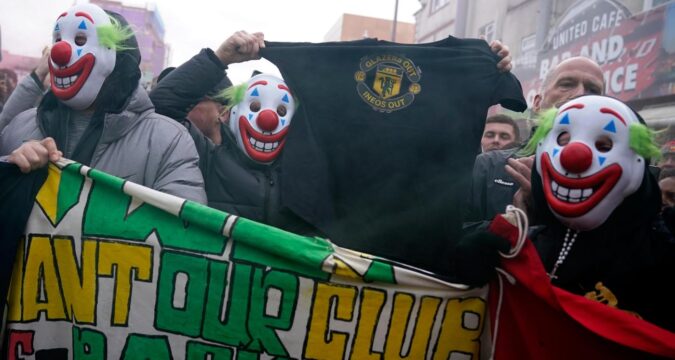
MANCHESTER, Inglaterra (AP) — Algunos manifestantes portaron máscaras de payaso mientras los descontentos aficionados del Manchester United marchaban hacia Old Trafford el domingo para expresar su enojo con los dueños del club.
El grupo 1958 —que organizó la marcha— ha sido un crítico vocal de la familia Glazer, que tomó el control del United en 2005, y del multimillonario británico Jim Ratcliffe, el propietario del gigante petroquímico INEOS que asumió el control de las operaciones de fútbol del club en 2024.
La última manifestación contra la propiedad tuvo lugar antes del partido del United en la Liga Premier contra el Fulham.
Los aficionados corearon consignas contra los propietarios y sostuvieron pancartas mientras el humo de las bengalas llenaba el aire durante la marcha por la avenida Sir Matt Busby Way hasta la explanada del estadio.
La Policía del Gran Manchester indicó que había entre 500 y 600 manifestantes y no hubo arrestos.
El grupo 1958 se ha quejado de la “propiedad disfuncional e inepta” del 20 veces campeón de la liga inglesa, cuyo último título de liga fue en 2013.
Los Glazer han sido impopulares entre los aficionados desde que adquirieron al equipo hace 21 años. Había esperanza de que Ratcliffe —un aficionado del United desde la infancia— trajera de vuelta los buenos tiempos, pero su propiedad minoritaria hasta ahora ha estado marcada por contrataciones y despidos de alto perfil, aumentos en los precios de las entradas y recortes de costos drásticos.
___
Deportes AP: https://apnews.com/hub/deportes

SWAT active in South Shore, Chicago police confirm
Police officers were on the scene of an incident involving Special Weapons And Tactics Sunday morning in South Shore, Chicago police said.
The situation occurred at around 5:02 am on the 2700 block of East 76th Street, according to police, and was listed as ongoing.
This story is developing. Check back for updates.
https://www.chicagotribune.com/2026/02/01/swat-active-south-shore/
Bears Are An Endangered Species
Bears Are An Endangered Species
Authored by Lance Roberts via RealInvestmentAdvice.com,
🏛️ Market Brief – Market Volatility Returns
Markets ended the week mixed as investors processed the Federal Reserve’s latest policy decision, rising geopolitical tensions, and the early results of the S&P 500 earnings season. The Fed held the federal funds rate steady at 3.50–3.75 percent, as expected. Chair Jerome Powell maintained a neutral stance, noting that inflation is moving toward the target, but the labor market remains tight enough to avoid immediate policy shifts. There was no indication of a near-term rate cut, but Powell left the door open for adjustments later in the year if inflation continues to ease and economic activity slows.
The most notable event this week was President Trump’s nomination of Kevin Warsh to succeed Jerome Powell as Federal Reserve Chair. Warsh is viewed as more hawkish, favoring a tighter monetary stance. That nomination led to the most striking market development this past week as precious metals prices collapsed. Silver futures dove over 30% on Friday to settle near $84.63 an ounce, marking one of the largest one‑day drops since the early 1980s. Gold also tumbled, reversing the January rally. Analysts and traders attributed the metal selloff to a rapid reassessment of inflation and monetary expectations after the Warsh nomination, which boosted the U.S. dollar and undercut the “debasement trade” that had driven safe‑haven flows into precious metals.
We forewarned of this risk and have written several articles discussing that the parabolic run in silver was “driven by narrative and speculative positioning,” and cautioned that such extensions often end in “violent mean reversion” once sentiment shifts and liquidity is withdrawn. Specifically, we noted that “when price is driven more by psychology than fundamentals, reversal becomes inevitable.” Such is particularly the case in markets as thin and sentiment‑driven as precious metals. That warning proved prophetic as leveraged long positions unwound en masse.
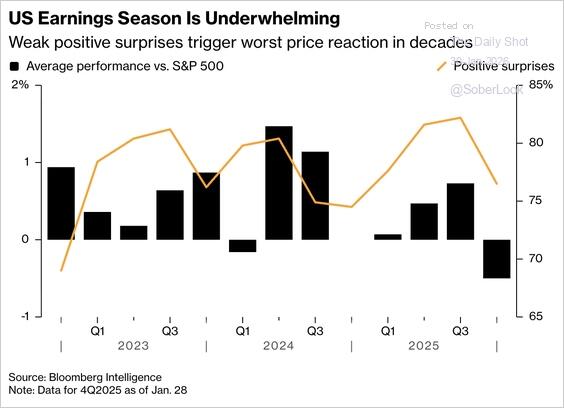
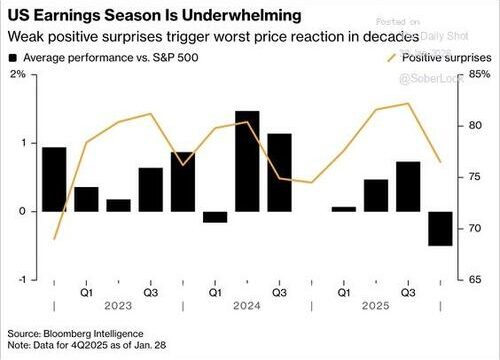
Turning to the S&P 500, there were signs of strain as the largest tech names reported earnings. Microsoft, one of the first of the “Magnificent 7” to report, posted strong results in cloud and AI-driven services. Revenues from Azure and enterprise subscriptions outpaced expectations, but investors sold into strength amid conservative guidance. Tesla disappointed with weaker deliveries and margin compression, but the stock rallied as investors focused on $20 billion in spending on transformational initiatives. Apple also reported strong results with a surprise surge in iPhone sales from China; however, the stock traded mostly flat following the announcement. Meta surged 10% after stellar results combined with strong guidance.
Alphabet and Amazon are set to report next week, but early signs point to a bifurcation in tech performance. Strong fundamentals are not being rewarded uniformly, and valuations are beginning to face resistance. The market remains highly concentrated in a small number of large-cap tech names, leading to outsized earnings reactions. That leaves index-level performance vulnerable to disappointing results, even if the broader economy is stable.
Elsewhere, economic data came in stronger than expected. GDP growth remains robust, driven by resilient consumer spending and a boost in exports. Initial jobless claims remained near historic lows, and continuing claims declined. Inflation readings showed progress, with core PCE in line with the Fed’s target path. These data points reinforce the “soft landing” narrative but don’t yet warrant a shift to easing policy.
With Fed policy steady, earnings mixed, and geopolitical risks rising, markets remain in flux. Next week will be pivotal. Heavyweight earnings and additional labor data will determine if the recent consolidation holds or if risk appetite recedes further.
Which brings us to the market.
📈Technical Backdrop – Bulls Remain In Control
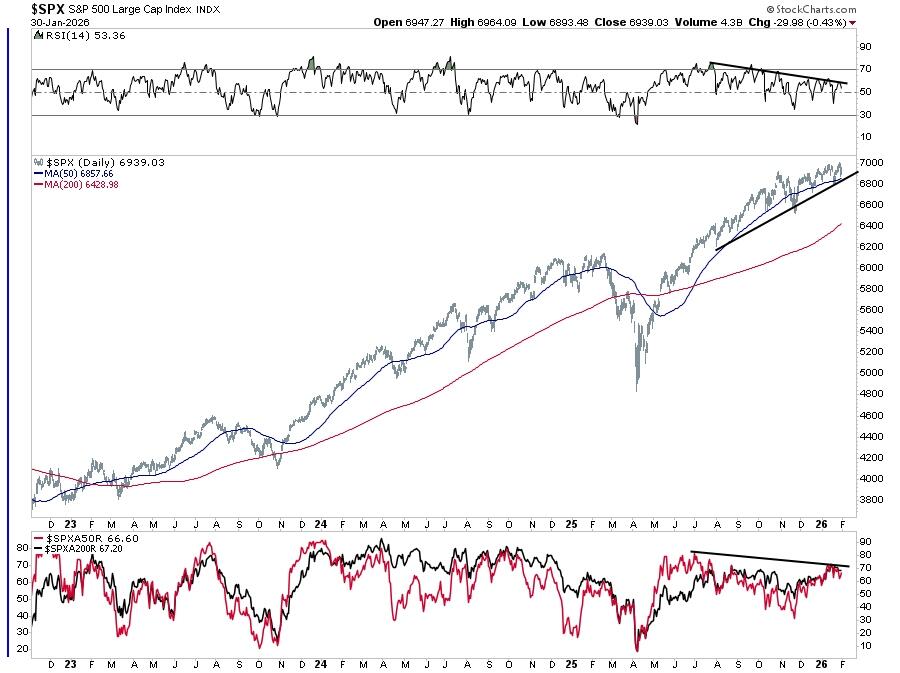
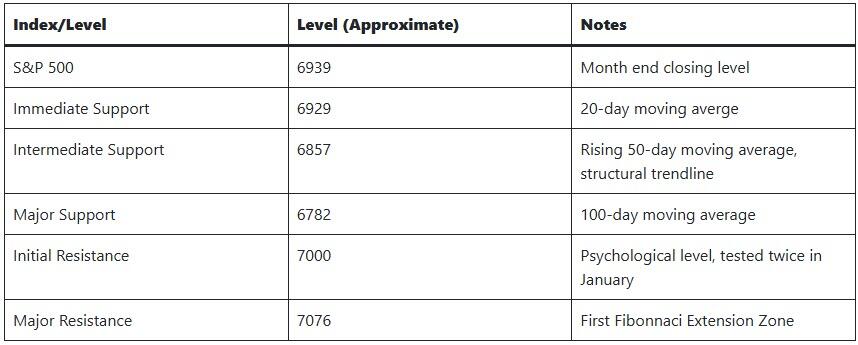
The S&P 500 closed the week at 6939, pulling back slightly from the highs it tested earlier in January. Price action remains constructive and in a bullish uptrend. However, recent sessions reflect continued resistance at all-time highs. Furthermore, market internals have softened, with relative strength negatively diverging from the bullish market trend. Such divergences typically precede weaker market outcomes, particularly when leadership has narrowed as earnings reactions from large-cap names have turned more mixed. While the index still holds above its key moving averages, the slope has flattened.
We are also closely monitoring market momentum, which has cooled in recent days, and breadth weakened under the surface. The percentage of S&P 500 stocks trading above their 50-day moving average declined over the past two weeks, while relative strength indexes are trending lower.
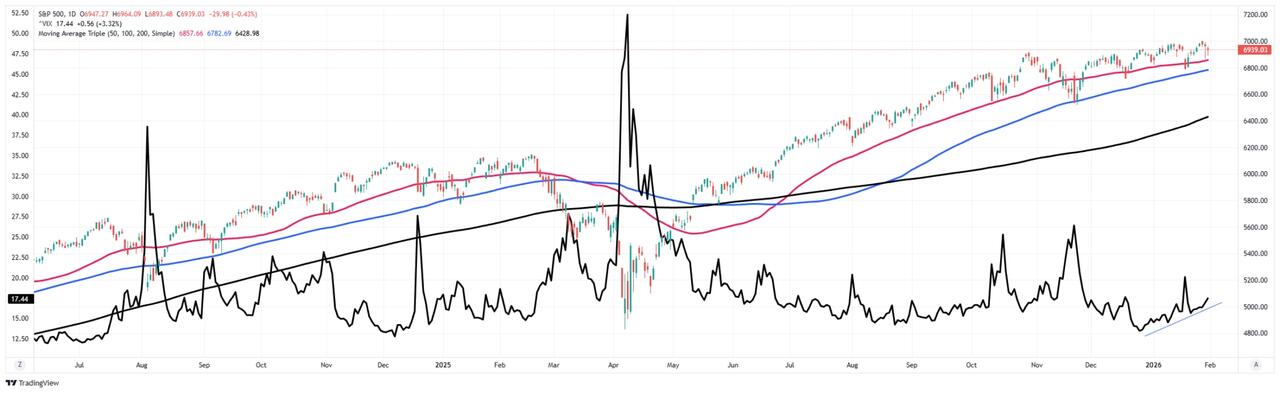
Volatility picked up last week, with daily intraday swings widening. The VIX remains suppressed, but skew has risen, suggesting investors are hedging downside risk. Options markets show increased demand for protection heading into this coming Friday’s January Employment Report. Technical support now sits near 6857, the 20-day moving average. A decisive break below would shift the short-term bias from neutral to defensive. Resistance remains firm at 7000. That range has rejected the price twice this month. A close above that level would suggest renewed upside momentum, especially if supported by strong earnings and macro data.
For now, the market is range-bound, waiting for confirmation. We have a lot of earnings reports this coming week, which could shift market sentiment. However, weak guidance or a hot jobs number could tilt sentiment more defensive. Positioning remains cautious, and until breadth improves, rallies may struggle for follow-through.
🔑 Key Catalysts Next Week
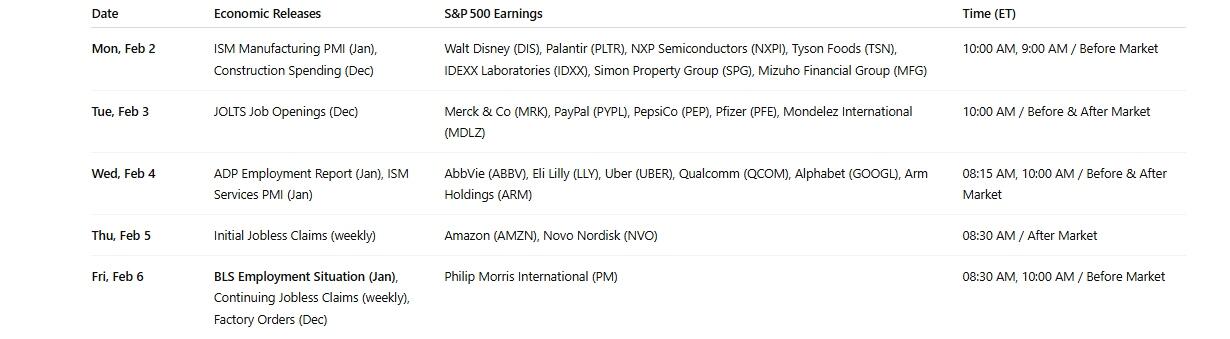
This week brings several critical economic reports that will shape expectations for growth, inflation, and labor market strength. Monday kicks off with the ISM Manufacturing PMI and Construction Spending data. These releases will help clarify whether factory activity is stabilizing after recent softness and whether the housing and commercial sectors are holding up amid tighter financial conditions. By Wednesday, attention shifts to the ISM Services PMI and the ADP Employment Report, both of which will provide a clearer picture of broader economic momentum heading into Q2. Services account for the majority of U.S. economic activity, so any slowdown here would raise concerns about the durability of the expansion. Initial jobless claims and the January employment report round out the week.
In addition to economic data, markets will be watching for any movement on the political and geopolitical front. President Trump’s nomination of Kevin Warsh to succeed Jerome Powell as Federal Reserve Chair introduces uncertainty around future monetary policy direction. Warsh is seen as more hawkish, which could shift expectations for rate cuts in the second half of the year. Meanwhile, global investors remain alert to any escalation in Middle East tensions following last week’s rise in crude oil prices. Disruption in energy markets would renew inflation concerns and complicate the Fed’s path forward. There are no scheduled central bank meetings next week, but speeches from Fed officials could still move bond yields and risk assets if they reinforce or challenge the current pause narrative.
With markets already reacting to a heavy earnings season, these data points and events could amplify volatility, especially if they diverge from soft-landing expectations.
💰 Bears Are An Endangered Species
Just recently, my colleague, Doug Kass, published an interesting note suggesting that “bears are now an endangered species.” As he notes:
“Equities continued to advance on Monday — and that ascent continues in the futures market this morning. The northerly move seems uninterested and oblivious to uninspiring market breadth.”
“Nor is the market concerned about fatuous/feckless policy (erratic tariffs, absence of fiscal discipline et al), uncooperative and highly partisan politicians in Washington, D.C. (likely leading to a government shutdown in February), very expensive valuations, a equity risk premium that has become an equity risk discount, parabolic moves in precious metals, a breakout (to the upside) in other commodities (leading, in part, to sticky inflation), evidence of rising levels of speculation, investor complacency, a narrowing in the internals, rising JGB yields, the precarious state of AI capital spending vs. projected returns (on that investment) and a host of other headwinds (often mentioned in my Diary).
Bears are going the way of the flightless and extinct dodo bird – rapidly becoming an endangered species:”
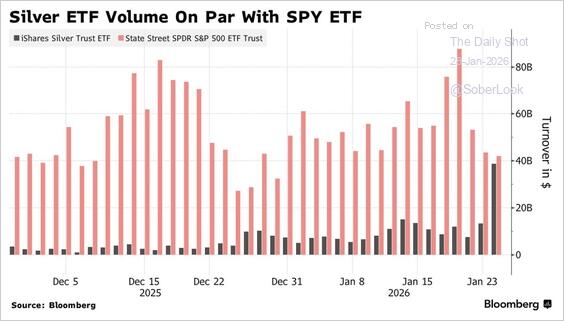
The shift in market tone is hard to ignore. Bullish sentiment has overwhelmed any bearish concern. Retail investors are back in force, chasing the hottest assets. Just like in 2021, when retail investors were chasing GameStop and AMC, they are now chasing silver. As shown, Silver’s parabolic rally has driven the trading volume of iShares Silver ETF to nearly match that of the SPDR S&P 500 ETF.
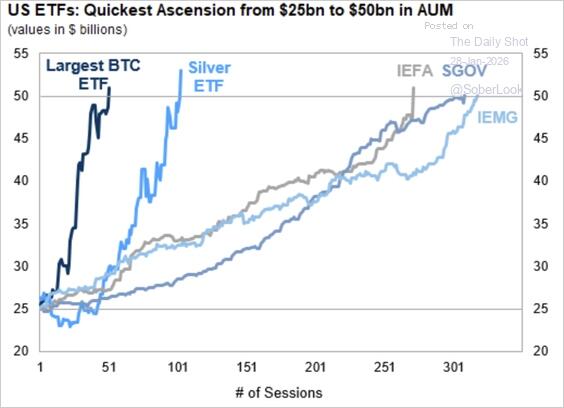
Furthermore, the rush to gain exposure to silver pushed the ETF’s AUM past $50 billion, with the majority of its growth occurring in the last 100 trading days. Unfortunately, as seen on Friday, those parabolic advances can reverse quickly. While I would expect to see a bounce in metals prices, as narratives are very hard to kill, Friday’s price action should serve as a solid reminder of the perils of chasing risk assets.
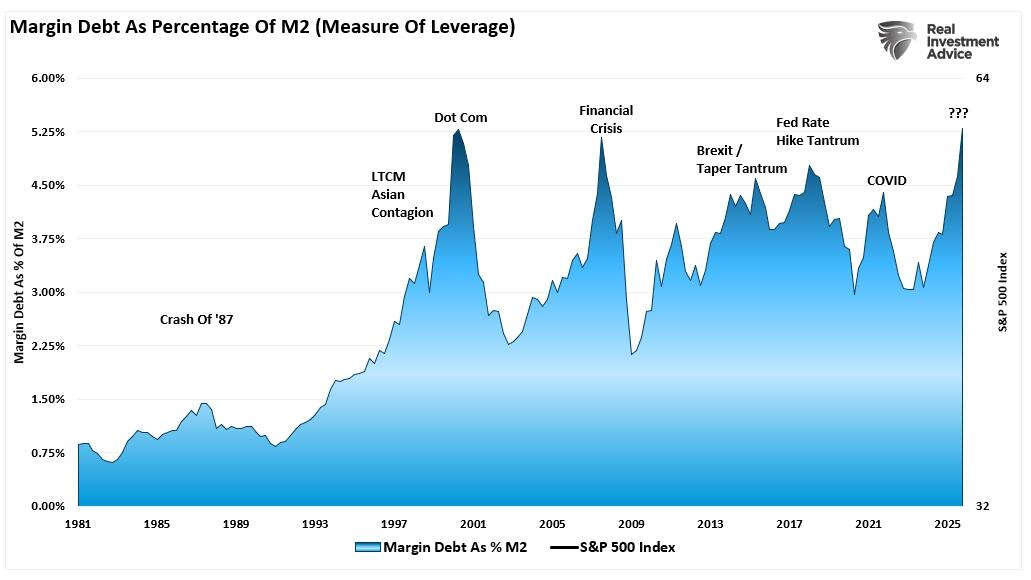
Lastly, margin debt has surged as the demand for leverage has increased. As shown, margin debt as a percentage of the money supply has surged to levels not seen since the “Dot.com” crisis.
However, it isn’t just the leverage levels; it is also retail investors buying leveraged ETFs or options on leverage to further expand that leverage. In 2025, the U.S. ETF market saw a record-breaking year for both new launches and the adoption of high-risk strategies. Approximately 200 to 340 new leveraged ETFs were launched, representing a significant portion of the 1,110 to 1,167 total new ETFs introduced in the U.S.
Unsurprisingly, since virtually every risk asset class continues to move higher, Doug is correct in saying that bears have become an endangered species. This isn’t a footnote. It is an important view that shapes risk, valuation, and capital allocation. To make sound decisions, investors need to understand where sentiment stands, why it’s occurring, what history tells us, and how to manage risk when optimism becomes the rule.
No Bears Here
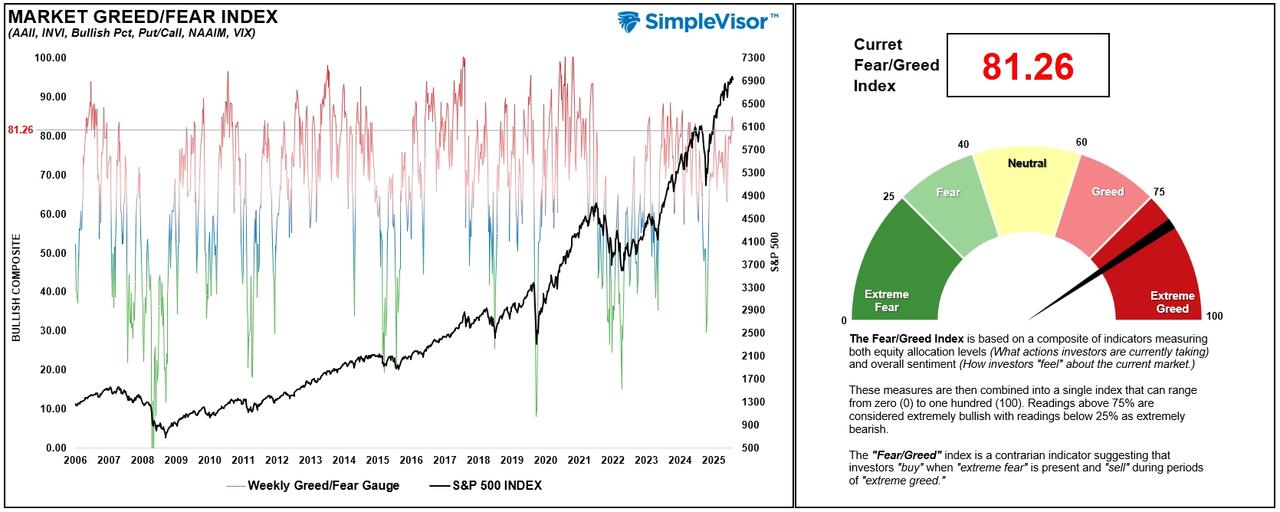
Currently, investor sentiment is very bullish on various levels, from positioning to raw sentiment. Our Fear/Greed index is currently in extreme greed territory and is a good proxy not only for how investors feel, but also for how they are allocating their investment dollars.
Survey data from individual investors shows optimism above long-term averages. Furthermore, weekly sentiment readings recently neared 50 percent bullish, while bearish views fell well below historic norms. Professional sentiment has followed a similar arc.
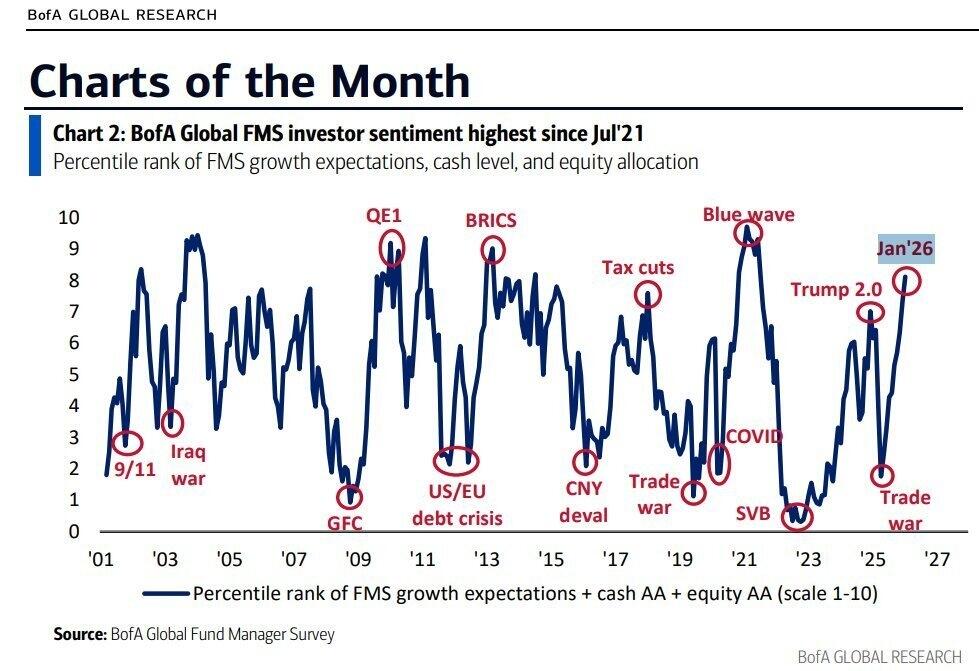
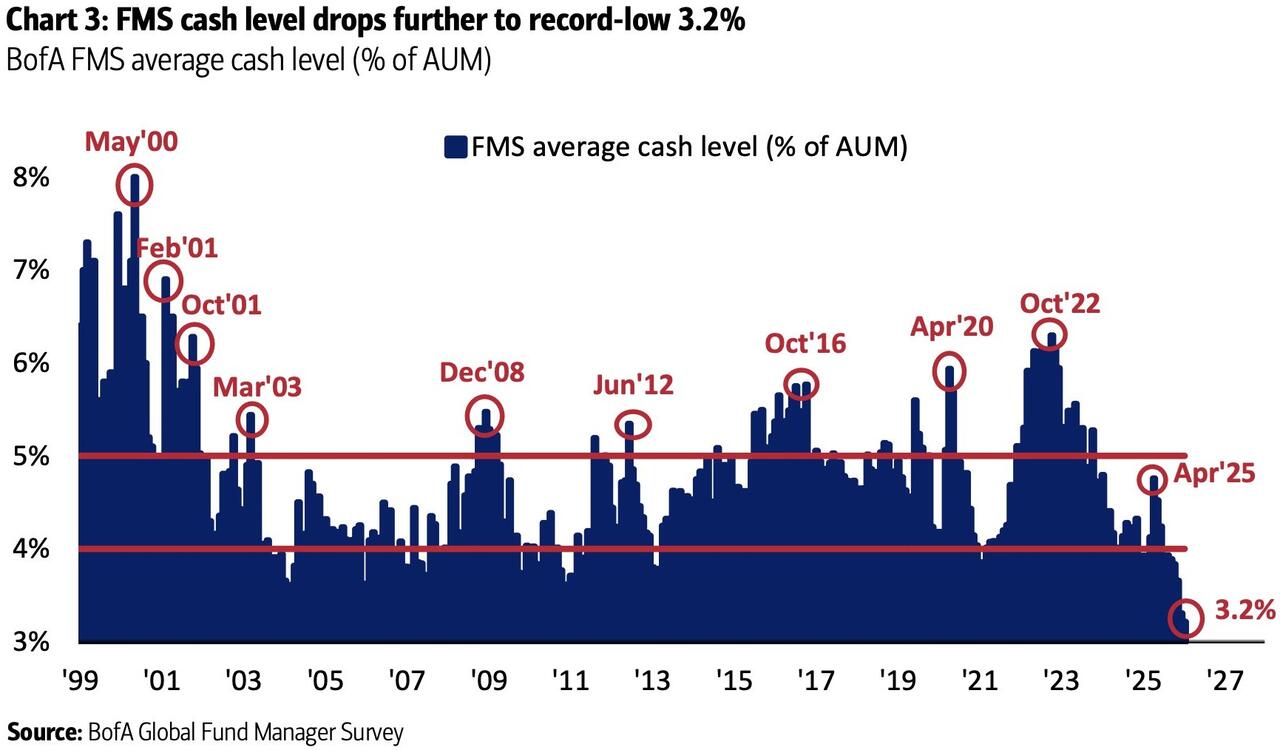
Furthermore, fund managers have ramped up equity exposure while cash levels have dropped near record lows. Clearly, there are no bears in that group.
Retail flows have played a significant role in the current market rally, as daily trading activity on retail platforms has surged. Option volumes, particularly in zero-day contracts, have also risen sharply, comprising more than 60% of all option contract trading. These short-term bets often reflect a speculative outlook rather than long-term investing, which is why, as shown above, margin debt has reached new highs, now exceeding $1.23 trillion.
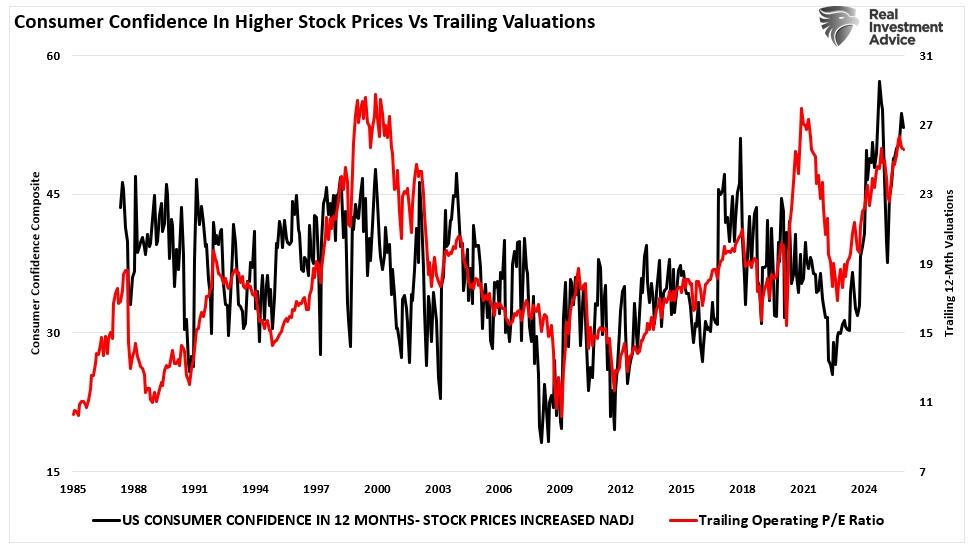
This broad wave of bullish behavior isn’t isolated to sentiment surveys. Positioning data, equity fund inflows, and trading behavior confirm the lack of bears in the market. Markets are rising not because of strong earnings or economic acceleration, but because of optimism about future prices. In this environment, price momentum drives buying, not fundamentals. We see that in the overlay of consumer sentiment about higher prices versus valuations. Simply, investors are willing to overpay on expectations that things will continue to improve.
Of course, this is happening because of the collision between fiscal and monetary stimulus, and the ease of market access through trading apps has increased participation. Furthermore, social media narratives and a rising belief that “markets only go up” and to “buy every dip” continue to fuel market momentum. Stories of fast gains spread quickly through websites like Reddit and social media apps like TikTok. Then, as price momentum continues, retail investors mimic what works, and what has worked is betting on upside.
Professional money managers have also been sucked into the frenzy. “Career Risk” is a real and present danger for portfolio managers who lag their benchmark index. That pressure to keep pace with benchmark returns has increased funds’ risk profiles, prompting managers to step outside normal boundaries to add exposure to higher-risk assets. When markets rally, and peers remain fully invested, holding cash becomes a career risk. That herding behavior reinforces the bullish cycle: as sentiment improves, more capital flows in, driving prices higher.
Psychologically, this is a textbook feedback loop.
Rising prices validate optimism.
Optimism attracts more buyers.
More buying pushes prices even higher.
Few question the rally when accounts are in the green.
However, as Bob Farrell once noted, “when everyone agrees, something else tends to happen.”
The lack of bears in the market is not a sign of safety. It’s a warning.
What History Tells Us About Euphoria
History has shown that elevated sentiment and valuations precede poor forward returns. Bullish sentiment above two standard deviations from the mean has often resulted in weak 6- to 12-month performance. This doesn’t mean a bear market crash is imminent. But it does mean risks are skewed, particularly when the market decouples from underlying earnings.
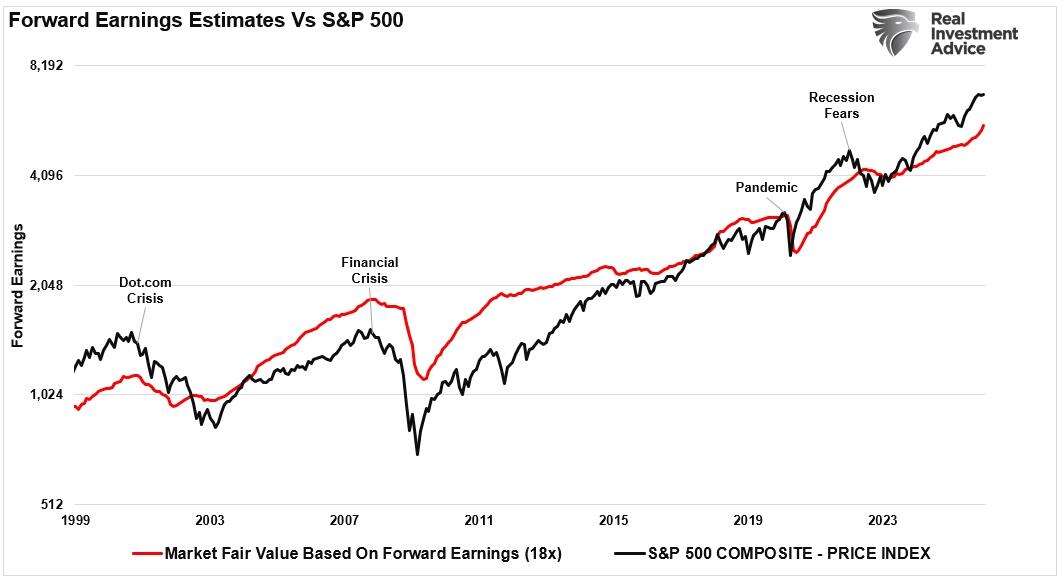
In the late 1990s, tech stocks decoupled from earnings as the Dot.com mania roared. Retail investors, who believed they were “smarter than the market,” drove prices based on stories rather than fundamentals, pushing valuations to more extreme levels. The same occurred in 2020, as the stimulus-fueled market surged well above “fair market value,” leading to disappointing outcomes in 2022. During those periods, there was also a lack of bears.
Today is the same: valuations are stretched, sentiment is excessively bullish, and fundamentals are ignored for the sake of narratives. The new crop of “young investors” adamantly believes that this time is different, and the lack of bears is notable. When the narratives previously cracked, the decline was swift and deep, particularly for those “long on confidence and short on experience.”
The common thread is that extreme optimism often signals rising investment risk. Such conditions do not necessarily mean a “crash” is imminent, but it doesn’t rule one out either. A market that is overvalued, overleveraged, and excessively bullish has all the ingredients for a mean-reversion. All that is lacking for a bear market is a catalyst, which can range from credit-related events to earnings misses, economic weakness, or rate shocks. Whatever the catalyst that sparks a bear-market reversion, sellers will be in the driver’s seat.
The lesson is clear. When “bears are on the endangered list,” the risk of adverse market outcomes increases. Sometimes slowly, sometimes violently, but the outcome is never gentle for those who chased euphoria without a plan.
Portfolio Tactics When Everyone Is Bullish
Therefore, if bear market risks are rising, what should you do? In such an environment, investors must focus on defense. That doesn’t mean selling everything; it just means tightening discipline.
Start with diversification. Concentrated bets in high-beta stocks expose portfolios to sudden drawdowns. Broaden exposure across sectors, asset classes, and geographies. Add bonds or cash to reduce volatility.
Position sizing is critical. If your portfolio depends on one theme working out, you’re taking too much risk. Size positions based on downside risk, not upside hopes. Have predefined exit points. Stick to them.
Use hedges where appropriate. Protective puts or inverse ETFs carry costs but can cushion downside in sharp corrections. They are insurance policies. When markets are smooth, you won’t need them. When volatility returns, you’ll be glad you paid the premium.
Watch liquidity. Avoid tying up capital in assets that can’t be quickly exited. Hold cash to take advantage of future dislocations. When speculative excess cools, bargains emerge. But only for those with cash and patience.
Focus on quality. In speculative rallies, low-quality stocks lead. But when the tide turns, these same names drop the hardest. Companies with strong balance sheets, consistent earnings, and real cash flow survive downturns. Own them.
Finally, tune out noise. Social media and short-term headlines often exaggerate trends.
While sentiment can’t tell you what markets will do tomorrow, it does tell you how much risk is being ignored. Your job isn’t to follow the crowd. It’s to stay solvent when the crowd runs off a cliff, and when bears are hard to find, the cliff may be closer than you think.
Trade accordingly.
Tyler Durden
Sun, 02/01/2026 – 10:30
https://www.zerohedge.com/markets/bears-are-endangered-species
Devastada por la guerra, capital de Sudán recibe segundo vuelo comercial desde inicio del conflicto
Associated Press
EL CAIRO (AP) — Un vuelo comercial aterrizó el domingo en la capital de Sudán por segunda vez desde que estalló una devastadora guerra en el país del noreste de África hace casi tres años.
El vuelo nacional, operado por la aerolínea de bandera nacional SUDANAIR, llegó al Aeropuerto Internacional de Jartum el domingo por la tarde, reportó la agencia de noticias estatal SUNA.
El avión despegó el domingo por la mañana desde la ciudad oriental de Puerto Sudán, en el Mar Rojo, que había servido como sede provisional del gobierno hasta que éste regresó a Jartum a principios de este año, según SUNA.
La reapertura del Aeropuerto Internacional de Jartum fue un paso crucial en los esfuerzos del gobierno por normalizar la vida en la capital, que ha sido devastada durante la guerra en curso entre el ejército y las poderosas Fuerzas de Apoyo Rápido (FAR) paramilitares.
El avión comercial del domingo fue el segundo en llegar a Jartum desde que un vuelo operado por la aerolínea privada Badr Airlines aterrizó en el aeropuerto en octubre del año pasado. En ese momento, las FAR lanzaron drones al aeropuerto para interrumpir los esfuerzos del gobierno por reabrir la instalación. El ejército retomó Jartum de las FAR a principios del año pasado.
La guerra en Sudán estalló en abril de 2023 cuando una lucha de poder entre el ejército y las FAR se desató en enfrentamientos abiertos en Jartum y en otras partes del país. El aeropuerto resultó seriamente dañado en las primeras semanas de la guerra.
La devastadora guerra ha matado a más de 40.000 personas, según cifras de la ONU, pero los grupos de ayuda afirman que esa cifra es un subregistro y que el número real podría ser muchas veces mayor.
Ha creado la mayor crisis humanitaria del mundo, con más de 14 millones de personas obligadas a abandonar sus hogares. Ha avivado brotes de enfermedades y ha empujado a partes del país hacia la hambruna. ___
Esta historia fue traducida del inglés por un editor de AP con la ayuda de una herramienta de inteligencia artificial generativa.
Former Prince Andrew can’t escape Jeffrey Epstein’s shadow as new documents reveal details about friendship
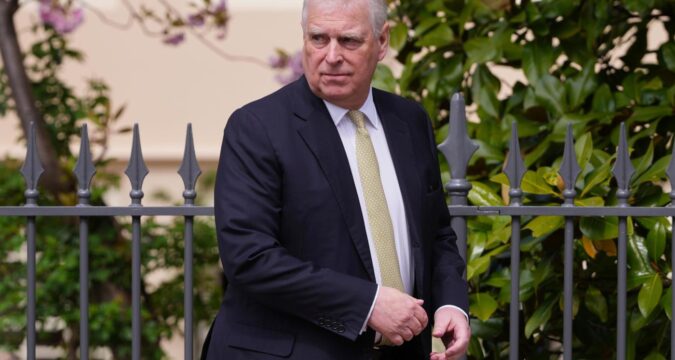
LONDON — Britain’s royal family is facing a fresh round of embarrassment after the latest release of documents from the U.S. investigation into Jeffrey Epstein revealed unsavory details about the relationship between the convicted sex offender and a correspondent who appears to be the man formerly known as Prince Andrew.
Emails released by the U.S. Justice Department include an invitation for Epstein to dine at Buckingham Palace, Epstein’s offer to introduce his correspondent to a 26-year-old Russian woman, and photos that appear to show Andrew kneeling over an unidentified person who is lying on the floor.
The revelations come three months after King Charles III stripped Andrew of his royal titles, including the right to be called a prince, as he tried to insulate the monarchy from a steady stream of stories about his younger brother’s relationship with Epstein that has tarnished the royal family for more than a decade. The former prince is now known simply as Andrew Mountbatten-Windsor.
A tarnished figure
As a result of that move, the damage from the latest emails is likely to be limited to Mountbatten-Windsor, said Craig Prescott, an expert on constitutional law and the monarchy at Royal Holloway, University of London.
The documents show that “they had to do something to separate Andrew from the rest of the family, and the nuclear option was the clearest way of doing it,” Prescott said. “And as more comes out, then you do feel that they have been justified.”
The documents raise serious questions about Andrew’s judgment, while offering a rare look at how some of the world’s super elite behave behind closed doors, Prescott said.
“It’s sort of the things they do behind some of the most gilded doors in New York or London or wherever,” he said. “It’s the sort of things that on some occasions seem to be going on. And I think most people just think, wow, that’s all very extraordinary.’’
The disclosures have revived questions about whether Mountbatten-Windsor should cooperate with U.S. authorities investigating Epstein and his links to powerful individuals around the world.
British Prime Minister Keir Starmer on Saturday suggested Mountbatten-Windsor should tell American investigators whatever he knows about Epstein’s activities.
“In terms of testifying, I’ve always said anybody who’s got information should be prepared to share that information in whatever form they’re asked to do that, because you can’t be victim-centered if you’re not prepared to do that,” Starmer said as he arrived in Japan to meet with the country’s leaders.
Mountbatten-Windsor said in late 2019 that he was willing to help any appropriate law enforcement agency with its investigation into Epstein. However, previous documents released by the Justice Department show that in 10 months of emails and conference calls, Mountbatten-Windsor’s lawyers rejected proposals for their client to be directly interviewed by federal prosecutors either in person or by video.
Instead, his lawyers asked that he be allowed to answer questions in writing, something they said would be permitted in British courts. Finally, on Sept. 23, 2020, prosecutors gave up on securing a voluntary interview and said they planned to ask the British courts to compel Andrew’s testimony. There is no indication that Mountbatten-Windsor has ever provided such testimony.
The House Oversight Committee, which is investigating Epstein, in November asked Andrew to sit for a transcribed interview.
A relationship under fire
Mountbatten-Windsor has been dogged by his relationship with Epstein ever since 2008, when the wealthy financier pleaded guilty to soliciting a minor for prostitution. In 2011, the late Virginia Giuffre alleged that she had been trafficked by Epstein and forced to have sex with Andrew when she was 17.
He tried to stifle the controversy in a 2019 interview with the BBC, but the appearance only fueled the scandal when he was criticized for offering unbelievable explanations of his behavior and failing to show empathy for Epstein’s victims.
The former prince has repeatedly denied committing any crimes and has rejected Giuffre’s allegations. An email seeking comment on the latest document release was not answered. The presence of anyone’s name or images in the investigative files isn’t proof of wrongdoing.
The emails released on Friday include an August 2010 exchange between Epstein and an account labeled “The Duke” that occurred soon after the financier was released from home detention following his earlier conviction. Before he was barred from using the title, Mountbatten-Windsor was the Duke of York.
“I have a friend who I think you might enjoy having dinner with,” Epstein writes.
“The Duke” replies: “Of course. I am in Geneva until the morning of 22nd but would be delighted to see her. Will she be bringing a message from you? Please give her my contact details to get in touch.”
The email is signed “A.”
In response to a redacted email, “The Duke” then writes, “Great. Any other information you might know about her that might be useful to know? Like what have you told her about me and have you given her my email as well?”
Epstein, whose emails often contain typographical errors, responds: “She 26, russian, clevere beautiful, trustworthy and yes she has your email.”
“That was quick!” The Duke replies. “How are you? Good to be free?”
“Great to be free of many things,” Epstein says.
The exchange elicited shock from former BBC royal correspondent Jennie Bond, who pointed out that it would be highly unusual for a royal to meet with someone they knew so little about.
“I mean, what was he thinking?” Bond told the BBC. “What was he thinking when Epstein offered him a 26-year-old Russian very beautiful lady to have dinner with? I mean, was there no red light saying, ’Oh my goodness, you know, is this a security risk? Could she be a spy? Should I do this?’ Nah. He says, ‘That would be absolutely lovely.’’’
Damaging emails
In another exchange in September 2010, Epstein said he was in London.
“I am just departing Scotland should be down by 1800,” “The Duke” replied in an email signed with the initial A. “I’ll ring you when I get down if you can give me a number to ring.
“Alternatively we could have dinner at Buckingham Palace and lots of privacy.”
“bp please,” Epstein responds.
Also included in the release are three photographs that show someone who looks like Mountbatten-Windsor kneeling over an unidentified person whose face is redacted.
In one photo the man, wearing blue jeans and a polo shirt, looks into the camera. In the others he appears to be talking to the unidentified person with his hand on their abdomen. There is no caption and no indication of when or where the photos were taken.
As unseemly as the revelations are, there isn’t much else the palace can do to sanction him, Prescott said.
“In terms of Andrew’s reputation, that has totally gone,” he said.
https://www.chicagotribune.com/2026/02/01/prince-andrew-jeffrey-epstein-documents/

Dog Show 101: What to know about the 150th Westminster show
NEW YORK — It’s go time for thousands of America’s most dogged competitors.
Big or small, sleek or shaggy, imposing or impish, they’re all trying for the top prize at the Westminster Kennel Club Dog Show in its milestone 150th year.
Might Comet the shih tzu snag the trophy after coming close the last two years? What about Neal the bichon frisé, another 2025 finalist who’s competing again? Could this be the year for Zaida the Afghan hound, who has twice won the World Dog Show, a major international showcase, but has yet to make the finals at Westminster?
Or will the prize go to another well-known contender — or a dark horse?
Here’s what to know about the United States’ most prestigious canine competition.
When is the Westminster dog show?
The breed-by-breed judging — officially called “conformation” — happens Monday and Tuesday, at a combination of the Javits Center convention hall and Madison Square Garden. Best in show is awarded at the Garden around 11 p.m. EST Tuesday.
For fans who can’t be there in person, Fox Sports is showing the event’s various components on FS1 and FS2 and its various streaming platforms. Westminster is streaming some, as well.
How many dogs are there?
Some 2,500 dogs from 212 breeds and varieties (subsets of breeds) are signed up to compete. (No doodles, though. These popular poodle mixes aren’t recognized as distinct breeds by the American Kennel Club, the governing body for Westminster and many other U.S. dog shows.) There are contestants from every U.S. state and 18 other countries.
A few hundred more dogs, including mixed-breed ones, competed Saturday in Westminster’s agility and flyball contests.
Who are some dogs to watch?
Besides Comet, Neal and Zaida, entrants include Soleil, a Belgian sheepdog who won the National Dog Show televised last Thanksgiving Day, and a Lhasa apso called JJ, who triumphed at the huge AKC National Championship that aired in late December. The runners-up from those shows — George, an American foxhound, and a Gordon setter named River — also are due at Westminster.
And keep an eye out for Baby Joe, a miniature schnauzer who topped national dog show standings for 2025. Don’t forget Penny the Doberman pinscher, who’s been climbing the rankings since her crowd-pleasing turn in last year’s Westminster semifinals. There’s also a high-ranking Chesapeake Bay retriever, a prominent papillon and many other buzzy contenders.
But anything can happen at Westminster, a champions-only show where every contestant is a proven winner. Cognoscenti often say victory goes to “the dog on the day,” meaning the one that has the performance of a lifetime.
Whichever dog the judge chooses, others sometimes run away with the audience’s heart.
A 2020 crowd fave, Daniel the golden retriever, is among eight past finalists or winners set to return for a special presentation Monday night. So are some other 2020 finalists, Bono the Havanese, Wilma the boxer — and Siba, the standard poodle who defeated them all to claim that year’s best in show award. Do show dogs hold grudges? We shall see.
What makes a dog best in show?
First, dogs are judged against others of their breed. Then each breed winner goes up against others in its “group,” such as terriers or herding dogs. In the final round, the seven group winners compete for best in show.
At each level, judges decide which dog best matches the ideal, or “standard,” for its own breed.
What breeds win most?
Wire fox terriers (15 wins), followed by poodles of various sizes (11).
Many breeds haven’t won yet, including such favorites as Labrador and golden retrievers. But never say never: Last year’s winner, Monty, was the first giant schnauzer chosen as best in show. He then retired from showing but is expected to join Monday’s special tribute to Westminster “legends.”
What do winners get?
Bragging rights, ribbons and trophies. There are no cash prizes, though the agility winner gets to direct a $5,000 Westminster donation to a training club or to the American Kennel Club Humane Fund.
Why are there protests?
Animal welfare activists routinely protest the Westminster show. They see it as an irresponsible canine beauty contest that overlooks shelter dogs’ predicament and some purebreds’ health problems.
For Westminster’s milestone show this year, PETA plans to demonstrate outside the show and has erected billboards nearby with such messages as “flat-faced dogs struggle to breathe,” echoing aspects of the animal rights group’s ongoing lawsuit against the American Kennel Club. The AKC has called the case frivolous and is trying to get it dismissed.
The Westminster club notes that it donates to rescue groups, veterinary scholarships and other endeavors that help dogs. Club President Donald Sturz says that “shows an overarching commitment to responsible dog ownership and responsible dog breeding.”
https://www.chicagotribune.com/2026/02/01/150th-westminster-dog-show/

Demond Wilson, who played Lamont on ‘Sanford and Son,’ dies at 79
Demond Wilson, who found fame in the 1970s playing Lamont on “Sanford and Son” and went on to become a minister, has died. He was 79.
Mark Goldman, a publicist for Wilson, confirmed to The Associated Press that he died following complications from cancer on Friday.
“A devoted father, actor, author, and minister, Demond lived a life rooted in faith, service, and compassion. Through his work on screen, his writing, and his ministry, he sought to uplift others and leave a meaningful impact on the communities he served,” Goldman said in an emailed statement.
Wilson was best known as the son of Redd Foxx’s comically cantankerous Fred Sanford character in a sitcom that was among the first to feature a mostly Black cast when it began airing in 1972.
The thoughtful Lamont had to put up with his junkyard owner father’s schemes, bigotry and insults — most famously, and repeatedly, “You big dummy!”
The show was a hit for its six seasons on NBC but ended when ABC offered Foxx a variety show.
Wilson was born in Valdosta, Georgia, and grew up in the Harlem section of Manhattan, according to the biography on his website.
He served in the U.S. Army in Vietnam and was wounded there, and he returned to New York and acted on stage before heading to Hollywood.
A guest appearance on “All in the Family” in 1971 led to his best-known role. Norman Lear produced both shows.
Wilson told AP in 2022 that he got the role over comedian Richard Pryor.
“I said, ‘C’mon, you can’t put a comedian with a comedian. You’ve got to have a straight man,’” he said he told the producers.
After “Sanford and Son” ended, Wilson starred in the shorter-lived comedies “Baby I’m Back” and “The New Odd Couple.” He later appeared in four episodes of the show “Girlfriends” in the 2000s, along with a handful of movie roles.
Though he returned to the screen at times, he told the Los Angeles Times in 1986 that the acting life was not for him: “It wasn’t challenging. And it was emotionally exhausting because I had to make it appear that I was excited about what I was doing.”
Wilson became a minister in the 1980s.
He is survived by his wife, Cicely Wilson, and their six children.
https://www.chicagotribune.com/2026/02/01/demond-wilson-lamont-sanford-and-son-obit/
Incendio en bar alpino suizo cobra su víctima 41: un suizo de 18 años
Associated Press
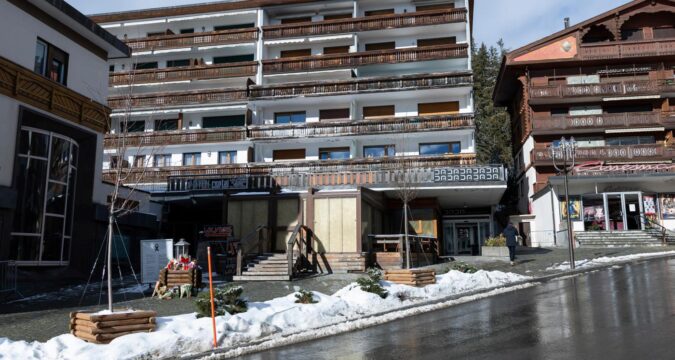
ZÚRICH (AP) — Un ciudadano suizo de 18 años falleció en un hospital de Zúrich debido a las heridas sufridas en un incendio ocurrido en un bar de los Alpes suizos, elevando el número de muertos a 41 un mes después de la tragedia.
El adolescente murió el sábado, según el fiscal público suizo, que el domingo indicó en un comunicado que no proporcionará más información sobre la indagación en curso.
Los investigadores han señalado que creen que las bengalas chispeantes sobre las botellas de champán provocaron el incendio cuando se acercaron demasiado al techo en el abarrotado bar Le Constellation en la estación de esquí de Crans-Montana, menos de dos horas después de la medianoche del 1 de enero.
Las autoridades investigan si el material de insonorización en el techo cumplía con las regulaciones y si las bengalas estaban permitidas para su uso en el bar. No se habían realizado inspecciones de seguridad contra incendios desde 2019.
Los fiscales suizos han abierto una pesquisa penal contra los propietarios —la pareja francesa Jacques y Jessica Moretti— bajo sospecha de homicidio negligente, lesiones corporales negligentes y causar un incendio por negligencia. La corte de medidas coercitivas en la región suroeste de Valais ordenó el 12 de enero tres meses de detención preventiva para Jacques Moretti, pero el 23 de enero ordenó su liberación bajo fianza.
Con pistas de esquí de gran altitud que se elevan alrededor de 3.000 metros (casi 9.850 pies) en el corazón de la región de Valais, Crans-Montana es un destino importante para las competiciones internacionales de esquí alpino. ___
Esta historia fue traducida del inglés por un editor de AP con la ayuda de una herramienta de inteligencia artificial generativa.