Category: News
Pandemic? Trump Remains Confident Hantavirus Situation Under Control
Pandemic? Trump Remains Confident Hantavirus Situation Under Control
Authored by Kimberley Hayek via The Epoch Times,
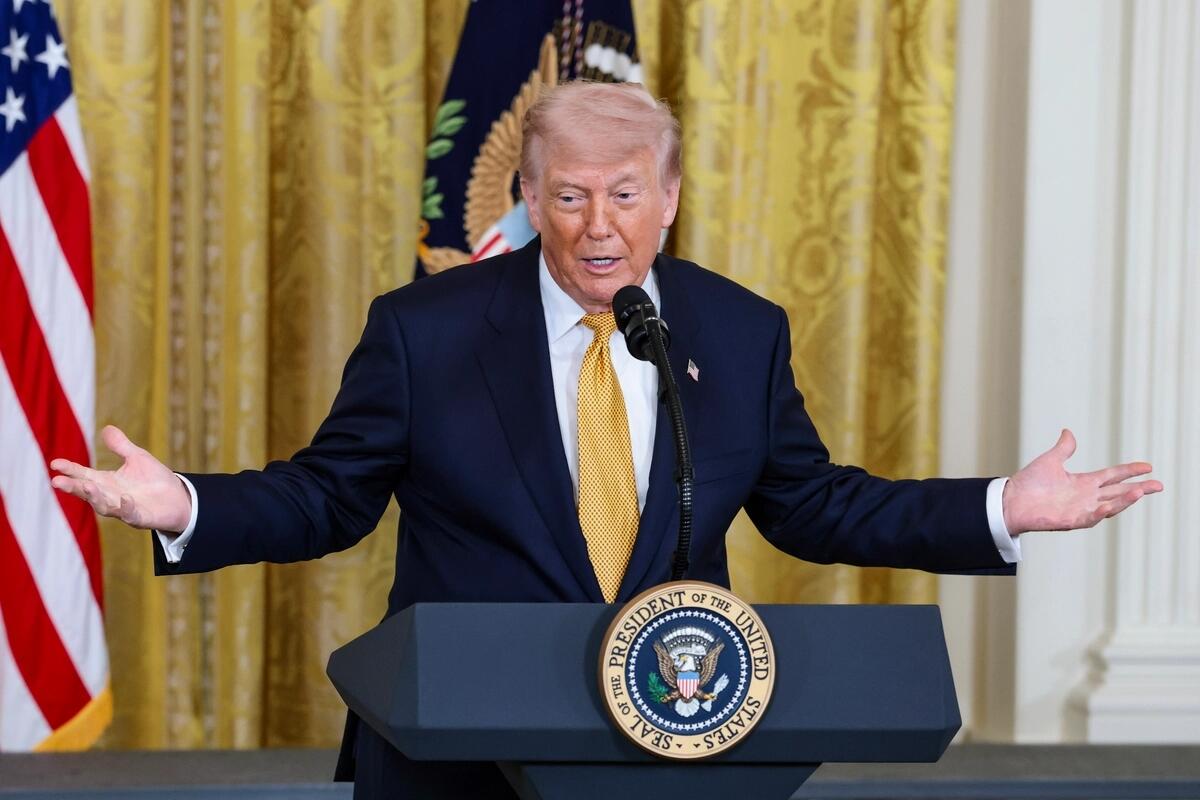
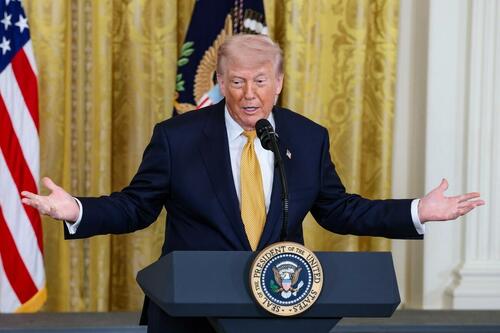
President Donald Trump said on May 7 that he had been briefed on a hantavirus cluster tied to a cruise ship and that he was hopeful that the situation was still contained, as federal health authorities track the American passengers who returned home. The president also said he expected more information on Friday.
Trump offered his assessment to reporters regarding the outbreak aboard the MV Hondius, which had passengers from multiple countries, including the United States. The vessel was traveling from Ushuaia, Argentina, through Antarctic waters and made various stops before reports of severe respiratory illnesses began to emerge.
“It’s very much, we hope, under control,” Trump told a reporter from ABC News.
“It was the ship. And I think we’re going to make a full report about it tomorrow. We have a lot of great people studying it. It should be fine, we hope.”
Trump was then further pressed by the reporter on whether Americans should be concerned.
“I hope not,” he said. “We’ll do the best we can.”
The president noted that officials planned further announcements on the matter. Public documents from the Centers for Disease Control and Prevention affirmed the U.S. government is following the situation closely with U.S. travelers aboard the ship. The State Department is leading a coordinated response, including contact with passengers and engagement with domestic and international partners.
“We have a lot of people—a lot of great people are studying it,” Trump said.
According to CDC statements, the risk to the American public is described as extremely low. Health officials in at least several states are monitoring individuals who disembarked from the affected vessel. No widespread transmission among the general population has been seen, according to available public health updates.
Hantavirus infections, generally tied to rodent exposure, can cause serious respiratory issues. The World Health Organization (WHO) has reported cases related to the ship, such as confirmed infections and fatalities among passengers of various nationalities.
The CDC notes on its website ongoing technical cooperation with international partners on the outbreak.
The CDC has gathered experts on the specific hantavirus strain in question, revealed by the South African Ministry of Health on May 5 to be the Andes variant, which is understood to be capable of person-to-person transmission under limited circumstances.
Hantavirus has a history in the Americas.
The CDC has noted hundreds of cases in the United States over decades, particularly linked to rural rodent contact, not travel clusters.
This ship-associated outbreak stands out for its scale and setting, leading to rodent control reviews and sanitation assessments per international ship health guidelines.
The WHO said on May 7 that there are eight cases linked to the cruise ship, including the three individuals who died amid the outbreak. Five of the cases have been confirmed to be Hantavirus.
Tyler Durden
Fri, 05/08/2026 – 08:40
Futures Rebound, Trade At All Time Highs On, What Else: Tech And Iran Optimism
Futures Rebound, Trade At All Time Highs On, What Else: Tech And Iran Optimism
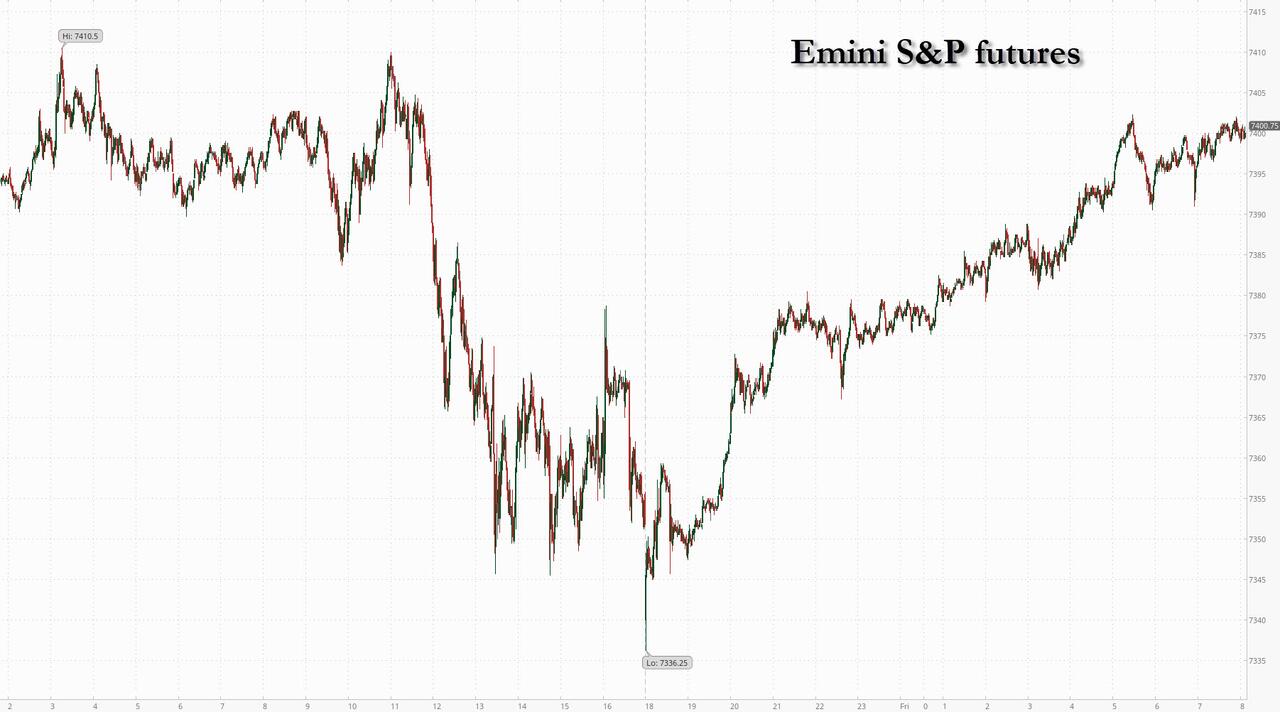
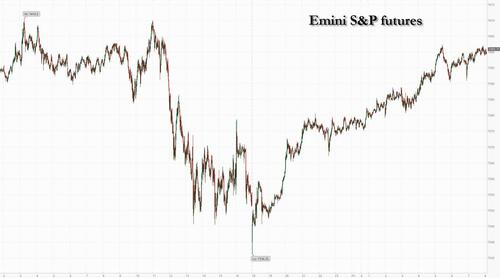
US equity futures are higher and just shy of a new record, with technology names leading futures higher ahead of April jobs report, after Trump’s assertion that the Iran ceasefire is still holding despite an exchange of weapons between the US and Iran overnight, and a deep weekly loss for oil help futures regain positive momentum. Markets are higher ahead of NFP data later this morning following yesterday’s very ‘unwindy’ session (High Beta Momo -7.96%, Software vs Semis +5.83%, Power -3.44%, HF VIP Longs -1.36%). As of 8:00am ET, S&P futures rise 0.5% and are back over 7,400 while Nasdaq futures gain 0.7%. Pre-market, Mag 7 are all higher led by NVDA +0.9% and TSLA +0.9%.Sentiment reversed from Thursday’s drop after Trump last night said the recent US strikes on Iranian military facility does not affect the ceasefire status. This morning there are reports that Iran seized an oil tanker for violations (one which was carrying Iranian oil). The Ocean Koi tanker attempted to “disrupt oil exports and the interests of the Iranian nation.” (Tasnim) Trump’s 10% global tariff under the Section 122 was found unlawful by the US Court of International Trade, but the outcome was mostly irrelevant. A busy night with AI headlines: (i) NVDA and IREN announce strategic partnership on AI infra; (ii) CoreWeave fell on weak revenue guidance and higher spending forecast; (iii) SK Hynix reported that they have received offers to invest in chip production lines. (iv) TSMC posted 17.5% growth in April sales, slowest in six months. Oil (WTI Crude) is unchanged at $94.80; bond yields are 1-3bp lower the 10Y yield at 4.38%; The dollar headed for a second straight week of losses. precious metals erased earlier gains with ags all higher. Today’s economic data slate includes April jobs report (8:30am), May preliminary University of Michigan sentiment and March wholesale trade sales (10am).
In premarket trading, all Mag 7 stocks are higher (Tesla +1.4%, Alphabet +0.05%, Nvidia +0.9%, Microsoft +0.03%, Amazon +0.3%, Meta Platforms +0.3%, Apple +0.8%)
Akamai (AKAM) rises 25% after the company announced that a leading frontier AI model provider had committed to $1.8 billion over seven years for its Cloud Infrastructure Services. The company also reported its first-quarter results and gave an outlook.
Block (XYZ) gains 7% after the digital payments company forecast adjusted operating income for the second quarter that beat the average analyst estimate.
Expedia (EXPE) drops 7% after the online travel company forecast tepid gross bookings for the second quarter, with analysts pointing to macroeconomic pressures weighing on guidance.
Fluence Energy (FLNC) rises 23% as Roth analyst Justin Clare raised the recommendation to buy on growing orders.
Forward Air (FWRD) plunges 45% after the transportation services firm said it received no actionable proposals for a sale.
JFrog (FROG) rises 14% after the software company reported first-quarter results that beat expectations and gave an outlook that is seen as conservative. Analysts highlighted an acceleration in cloud revenue growth as a highlight.
Innodata (INOD) climbs 39% after the professional services company boosted its revenue forecast for the full year.
Monster Beverage (MNST) rises 7% after the drinks company reported first-quarter adjusted earnings per share that beat the average analyst estimate. JPMorgan raised its price target.
NLight shares (LASR) rise 13% after the maker of semiconductor laser products reported adjusted earnings per share for the first quarter that beat the average analyst estimate.
Rocket Lab (RKLB) climbs 7% as the space company reported revenue for the first quarter that beat the average analyst estimate.
Trade Desk (TTD) falls 12% after the advertising-technology company reported adjusted first-quarter earnings that missed expectations.
Wendy’s (WEN) rises 4% after the fast-food chain reported adjusted earnings per share for the first quarter that beat the average analyst estimate.
In AI-related news, TSMC posted its slowest pace of monthly revenue expansion since October, highlighting the potential challenges of sustaining a torrid AI-fueled pace of growth. AI data center operator CoreWeave gave a disappointing forecast for the current quarter, sparking concerns about slowing growth at a time when the company is spending heavily to bolster its operations. SoftBank Group has downsized plans for a $10 billion margin loan backed by its OpenAI stake after facing hesitation from some creditors, people familiar with the matter said. And a key company behind Thailand’s national AI effort is suspected of helping to smuggle billions of dollars worth of Super Micro Computer servers containing advanced Nvidia chips to China, with Alibaba one of multiple end customers. In other corporate news, Toyota Motor forecast an abrupt drop in operating profit due to higher raw material costs from disruptions stemming from the Iran war. Citigroup is expanding its foreign-exchange business with hedge fund and private-equity clients as global trading volumes rise
US stocks rose at the end of a week in which optimism that the conflict is nearing an end and blowout earnings from major tech firms drove the S&P 500 to a succession of records. Hopes that oil flows would soon resume through the Strait of Hormuz also eased inflation worries, even as uncertainty remains over how soon the US and Iran can reach an agreement. US markets were the standout performers on a tough day for stocks elsewhere as clashes in the Middle East risked undermining efforts to secure a permanent end to the war. Stock indexes in Europe and Asia fell. Brent advanced as much as 2.9% before trimming the move to trade just above $100 a barrel. Treasuries rose ahead of April’s payroll numbers, with the two-year yield falling one basis point to 3.90%. UK government bonds advance, led by longer-dated maturities after UK Prime Minister Keir Starmer said he had no plans to step aside as Labour leader after early results in local elections showed losses for his party.
“For now, investor sentiment remains strong as the equity market is looking through high oil prices,” said Marija Veitmane, head of equity research at State Street Global Markets. “We continue to stress that the strength of earnings is heavily concentrated in IT sectors. These sectors are also the least exposed to physical supply chains and commodity pass-through.”
In the latest developments in the Middle East, Iran said it seized a tanker that appeared to be a sanctioned vessel carrying its own oil. Meanwhile, US forces targeted missile and drone launch sites and other military assets in Iran that they said were responsible for attacking US warships transiting the strait. The clashes came as the US awaited a response from Iran on a proposed deal to open Hormuz and end the war. President Donald Trump threatened more intense strikes if Iran refuses his terms.
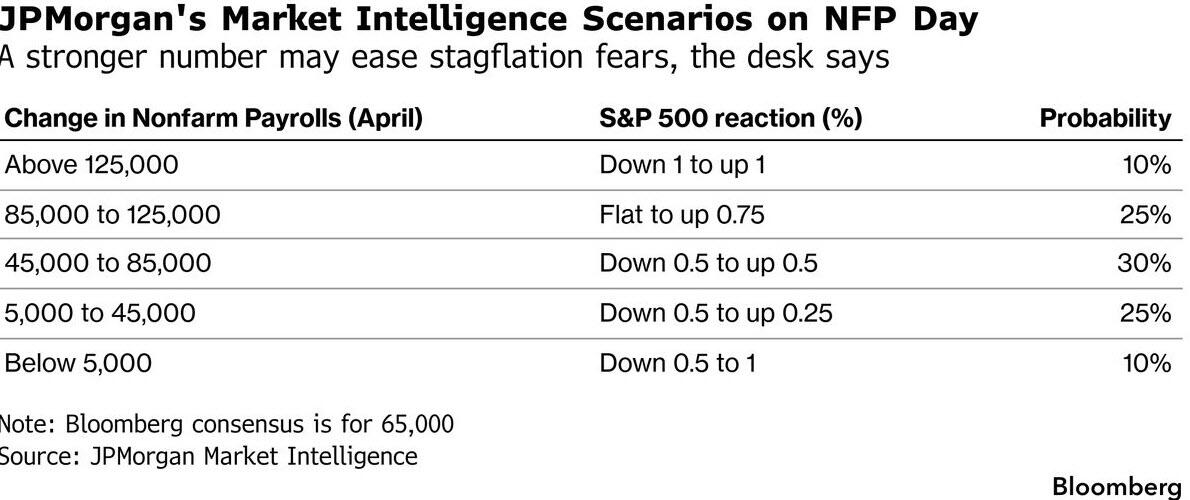
A pause in worrying headlines out of the Middle East would allow markets and the Fed to focus on nonfarm payrolls at 8:30 a.m. New York for fresh clues about US economic resilience. Bloomberg Economics expects 57,000 jobs were added in April, slightly below sellside consensus for 65,000, while the “whisper” number is 71,000. Options pricing around the print continues to drift lower, with S&P 500 options implying only about a 0.6% move on the release (our full preview is here).
“I would expect a stronger-than-expected set of figures to keep Fed hawks in charge, without necessarily taming equity appetite,” wrote Ipek Ozkardeskaya, senior analyst at Swissquote. Softer-than-expected figures “could revive dovish Fed expectations and provide further support to equity valuations, provided that war headlines leave some room for reaction.”
Jobs are a hot topic in more ways than one this Friday. Block offered a sunnier outlook for profits and growth after orchestrating layoffs linked to AI that executives said were painful but necessary. Cybersecurity firm Cloudflare plans to cut one-fifth of workers as it accelerates its shift to an agentic AI-first operating model. Upwork intends to reduce its workforce by about 24%, while Fidelity is overhauling its tech and product teams. In all cases “the increased adoption of AI tools is a huge factor,” Vital Knowledge founder Adam Crisafulli said on the recent bout of job cuts. He cautioned “this type of behaviour tends to be contagious.”
Meanwhile, investors flocked to cash and bonds last week and emerging market stocks saw their biggest outflows since January, according to Bank of America. The US had its sixth week of equity inflows at $9.3 billion, BofA’s Michael Hartnett said. Elsewhere, aggregate retail investor equity flows on Citadel Securities’ platform surged back to elevated levels last week. In other investing news, 43% of large cap active funds are outperforming their benchmarks, according to a BofA analysis of US mutual fund performance, better than the 29% that outperformed last year. Separately, some hedge fund categories, such as macro funds, appear to still have room to increase their equity exposures, according to JPMorgan strategists.
A pillar of support for equities may not be quite what it seems, according to Bloomberg Macro Strategist Simon White. Buyback announcements are surging this year. However, the risk of disappointment is rising as actual repurchases heavily lag the original commitments made, Simon writes.
Jeffrey Gundlach said he was repositioning some of DoubleLine Capital’s funds for the scenario that the US government could restructure its debt in response to a potential future recession. A publicly-traded private credit fund managed by Goldman Sachs put two additional companies on non-accrual status in the first quarter, as the industry grapples with mounting concerns over exposure to businesses vulnerable to AI-driven disruption.
With earnings season in its tail end, of the 425 S&P 500 companies to have reported thus far, 84% have beaten analysts’ estimates, while 11% have missed.
In Europe, the Stoxx 600 falls 0.5%, led by declines in insurance and travel stocks while media and energy outperformed. Here are the biggest movers Friday:
Bechtle rises as much as 6.9% following its first-quarter results as Jefferies says the IT services provider’s positive momentum has continued
Brembo shares rise as much as 8.5% and are set for a record weekly gain after robust first-quarter results that prompted Banca Akros to raise its recommendation on the Italian auto parts firm
Ferrovial rises as much as 3.6%, the most in a month, after the infrastructure group beats first-quarter expectations, with US managed lanes driving performance and construction also seen as solid
Pirelli advances as much as 3.4% after delivering an in-line performance in the first quarter and slightly boosting its revenue guidance for the full year
Rheinmetall shares fall 2.7% on Tradegate versus Germany’s Thursday close after JPMorgan cut its rating to neutral from overweight and slashed its price target by almost 30%
Deutsche Lufthansa falls as much as 2.7% after Barclays downgraded the airline to underweight from equal-weight, saying tailwinds from routes typically served via Gulf hubs are likely to fade as capacity returns
Commerzbank falls as much as 2.4% after its latest earnings. Analysts say the lender’s upgraded targets are ambitious, but also viewed with some skepticism as the bank steps up its defense against a hostile takeover attempt by UniCredit
Intertek shares fall as much as 7.9%, the most in two months, as the testing and inspection company rejects EQT’s latest takeover proposal of £58.00 per share in cash
Earlier, Asian stocks fell to trim weekly gains as renewed tensions in the Middle East weighed on sentiment. The MSCI Asia Pacific Index dropped as much as 1.6% following a two-day rally as some investors took profit ahead of Iran’s response to a US peace proposal. Samsung Electronics, TSMC and SoftBank weighed the most on the regional decline. Still, the index has risen more than 5% for the week and was poised for its longest winning streak since January, driven largely by a sustained tech rally. The MSCI AC Asia Pacific Information Technology Index has surged over 13%, its best week since late 2022. Across the region, markets saw renewed risk-off sentiment on Friday after the US struck military targets in Iran in response to attacks on three Navy destroyers in the Strait of Hormuz. Australia, Indonesia and Hong Kong were among the hardest hit.
In FX, the pound gains 0.4% after PM Keir Starmer said he had no plans to step aside as Labour leader after early results in local elections showed losses for his party; the dollar falls across the board. The Norwegian krone is leading gains among the G-10 currencies, rising 1.2%.
In rates, treasuries hold small gains in early US session, led by front-end and belly sectors as oil prices stabilize. Oil prices partially unwind Thursday’s rebound despite escalation of Middle East war, with US and Iran clashing near the Strait of Hormuz. US yields richer by 1bp-2bp in belly of the curve with 5s30s spread steeper by about 1bp; 10-year near 4.37% is down 1bp with UK counterpart outperforming by around 5bp. Gilts outperform as UK Prime Minister Starmer vows to stay on despite election setback. Gilts rallied over early London session after Starmer said he’d remain as Labour leader despite the party’s election losses
In commodities, oil prices are little changed with Brent crude futures near $100 a barrel. Precious metals rise with spot silver up almost 3% and on course for a fourth day of gains. Bitcoin rises 0.5%.
Today’s economic data slate includes April jobs report (8:30am), May preliminary University of Michigan sentiment and March wholesale trade sales (10am). Fed speaker slate includes Goolsbee (11:05am and 2:20pm). Waller, Bowman, Daly and Goolsbee are panelists at Hoover Institution Monetary Policy Conference (7:30pm)
Market Snapshot
S&P 500 mini +0.5%
Nasdaq 100 mini +0.7%
Russell 2000 mini +0.4%
Stoxx Europe 600 -0.5%
DAX -0.7%
CAC 40 -0.6%
10-year Treasury yield -2 basis points at 4.37%
VIX -0.1 points at 17.03
Bloomberg Dollar Index -0.2% at 1188.44
euro +0.4% at $1.1769
WTI crude -0.8% at $94.08/barrel
Top Overnight News
President Donald Trump said Thursday that attacks on Iran after it targeted U.S. destroyers in the Strait of Hormuz were a “love tap,” and said the ceasefire between the two countries is still in effect. ABC
Iran is ramping up trade with China via rail to blunt the impact of a US blockade of its ports. The number of cargo trains going from Xi’an to Tehran has risen to one every three or four days from around one per week before the conflict BBG
US prosecutors suspect a Thai AI company of helping smuggle Nvidia chips to China, with Alibaba one of multiple end customers, people familiar said. BBG
The White House has invited a scaled-back CEO delegation to accompany President Donald Trump to Beijing next week, reflecting divisions in the administration on economic policy toward China and limited expectations for the summit. RTRS
Sir Keir Starmer has refused to quit after a disastrous night for Labour at the polls, insisting: “I’m not going to walk away . . . and plunge the country into chaos.” With the first results in, Labour is heading for the worst local election results by any party this century. FT
A federal trade court ruled that President Trump didn’t have the authority to impose new global tariffs after a previous set of levies was struck down by the Supreme Court in February. The decision on Thursday from the Court of International Trade invalidated Trump’s attempt to impose a new 10% tariff on goods from virtually every nation by invoking authority under Section 122 of the Trade Act. WSJ
Big Tech’s record $725bn AI investment strategy is beginning to strain the resources of America’s largest companies, leaving them with less cash left over this year than at any point in the past decade. The combined free cash flow of the four “hyperscalers” — Amazon, Alphabet, Microsoft and Meta — is expected to fall to roughly $4bn in the third quarter, according to Wall Street’s forecasts, down from an average of $45bn in each quarter since the Covid-19 pandemic six years ago. FT
Anthropic is weighing raising tens of billions of dollars this summer to fund a vast expansion in computing capacity, in a move that would catapult it past rival OpenAI to a valuation of almost $1tn. FT
Ukrainian President Zelensky said Russian forces struck Ukrainian positions during the night and shows no attempt to hold the cease fire.
US VP Vance expressed concern to tech CEOs over new AI models which can autonomously find software vulnerabilities. The White House is considering an executive order to create a formal oversight process for advanced AI models and has asked Anthropic to limit access to Mythos for organisations managing critical digital infrastructure: WSJ
Increased hyperscaler capex has come at the expense of buybacks, which fell by 64% year/year for the group during 1Q. The hyperscalers now allocate 20% of total spending to buybacks and dividends compared with an average of 34% from 2017-2022. We expect minimal hyperscaler buyback growth through 2027. Consensus estimates show hyperscaler capex amounting to 100% of cash flows from operations this year, which in turn leaves little room to return cash to shareholders without a sharp deceleration in capex growth, a large drawdown of cash balances, or a major increase in debt. Some of the buyback headwind from the hyperscalers will likely be offset by increased buyback activity among the beneficiaries of that capex, such as semiconductor firms: Goldman Sachs
Iran Latest: Reports surrounding a potential deal:
Iran is reviewing the US response to the 14-point proposal and is expected to formally respond on Friday, according to CCTV citing Pakistani sources.
Any agreement with Iran would be bad for Israel, even if it includes an agreement to eliminate enriched uranium, Israeli press reported citing an official.
Iran and the US are discussing a one-page plan for both sides to reopen the Strait of Hormuz and end hostilities for 30 days while they try to reach a comprehensive deal, NYT reported. Three senior Iranian officials say Tehran and the United States are discussing a one-page plan for both sides to reopen the Strait of Hormuz and end hostilities for 30 days while they try to reach a comprehensive deal. The talks over a short-term agreement are continuing, the officials said, with negotiators trading proposals over how to describe the framework for a potential permanent deal. The three Iranian officials said a key obstacle was the US demand for commitments in advance on the fate of Iran’s nuclear program and its stockpile of highly enriched uranium.
“A diplomatic source told Al Arabiya: Ensuring the safe passage of ships through the Strait of Hormuz is imminent.”, Al Arabiya reports.
Iran Latest: Commentary following the US-Iran strikes:
Iran’s Top Joint Military Command said US violated the ceasefire by targeting Iranian oil tanker and another ship entering the Strait of Hormuz; Iran will respond powerfully and without the slightest hesitation to any attack.
US President Trump said the Iran ceasefire is still on and that the US is negotiating with the Iranians; Pakistan asked the US not to do Project Freedom during the negotiations. On energy, said we do not need to export curbs on oil and fuel.
US President Trump posted that there was no damage done to the three US destroyers that came under fire; states that Iran is led by lunatics and that the US will knock out Iran more violently if no deal is signed fast.
US President Trump tells ABC that the retaliatory strikes against Iranian targets are just a ‘love tap’ and the ceasefire continues to be in effect.
US military said US forces intercepted Iranian attacks and responded with self-defence strikes on Iranian military facilities; Iranian attacks were unprovoked but no US assets were hit; do not seek escalation.
The situation on Iranian islands and coastal cities by the Strait of Hormuz is back to normal, according to Press TV.
Saudi Arabia has not permitted the use of its airspace to support offensive military operations, Al Arabiya reported citing sources.
There is a high state of alert in anticipation of retaliatory attacks from Hezbollah following the assassination of the Radwan Force Commander, Israeli Channel 12 reported citing sources.
Saudi Arabia has imposed restrictions on some aspects of US activity related to military operations in the region due to fears of possible Iranian attacks without direct US support or response, ISNA reported citing a i24 sources report.
Iran Latest: Reports of overnight strikes:
“US military attacked Iranian targets in the Strait of Hormuz, an American official told me. The American official claimed that the attacks do not constitute a renewal of the war with Iran”, Axios’ Ravid posted.
A massive fire at the site of Iran’s attacks last night; large fire previously detected in the Strait of Hormuz, Musandam province, has moved; another big fire has been detected 30km west of Lark Island, Tasnim reported.
UAE announces that air defence systems are responding to a missile threat.
Hearing explosions in Abu Dhabi and Dubai, ISNA reported.
Reactivation of air defence in western areas of Tehran, Mehr News reported.
Several explosions were heard in Abu Dhabi, IRIB News reported.
Explosion was heard in Abu Dhabi, Fars News reported citing Arab sources.
Three American destroyers were attacked by the Iranian Navy near the Strait of Hormuz, Tasnim sources say.
An explosion was heard in Minab, SNN reported.
Further explosions heard in Bandar Abbas, Mehr news reported.
Air defences have been activated in West Tehran, Mehr News reported.
Air defences shot down two hostile drones over Bandar Abbas and Qeshm, Mehr News reported.
Explosions heard in Qeshm due to the confrontation of defences with small birds, ISNA reported.
A more detailed look at global markets courtesy of Newsquawk
Asia-Pac stocks traded entirely in the red as geopolitical tensions rose, with the US Military and the Iranian Navy exchanging fire. Despite US President Trump announcing that the ceasefire remains in place, bourses failed to see any positivity. ASX 200 opened on the softer side and extended lower, nearly wiping out the gains seen in the past 2 sessions. Real estate and Financials weighed on the index, with Macquarie being dragged down despite reporting FY earnings that beat estimates. Nikkei 225 pulled back from the ATH formed in Thursday’s session amid the negative risk tone. SoftBank has dragged the Nikkei lower after ARM tumbled on smartphone market weakness and AI chip supply concerns. Sony reported FY25/26 earnings, with operating income missing estimates, however announced a JPY 500bln share buyback programme. KOSPI slipped, as investors profit-take following the recent strength in the index, primarily driven by Samsung Electronics and SK Hynix.Shanghai Comp. and Hang Seng followed the broader risk-off tone, as Shanghai Comp. outperformed its Asia-Pac peers with only modest losses.
Top Asian News
Japan intervened in the FX market during the May holidays, according to sources.
Singapore is to implement new curbs on executive condos, making them fully privatised after 15 years, CNA reported.
China’s Finance Ministry conducts issuance of CNY 45.8bln to support the development of pre-school education, CCTV reported.
Japanese S&P Global Composite PMI Final (Apr) 52.20 (Prev. 53.0).
European bourses (STOXX -0.7%) are almost entirely in the red, with sentiment today pressured by recent flare-ups between US-Iran, whereby US struck Iranian ports which led to retaliatory attempts from the Iranian side. Though, indices are attempting to clamber off lows, with markets focusing on President Trump downplaying the attacks, calling them nothing but a “love tap”, noting that the ceasefire remains in place. European sectors are entirely in the red, display a market fearful of the current geopolitical environment; with cyclical sectors (Travel & Leisure/Consumer Products) residing at the foot of the list, whilst Energy is amongst the top performers. As for key movers this morning: Commerzbank (-0.5%, in-line metrics, raised targets and plans to cut 3k jobs), IAG (-2.7%, strong metrics but cut FY26 capacity outlook; sees strong demand), Intertek (-3%, rejects EQT’s GBP 9bln offer) US equity futures are broadly modestly firmer this morning, in contrast to the downbeat mood in Europe. In terms of key pre-market movers: CoreWeave (-6.6%, Q1 profit miss, Q2 revenue guidance missed expectations, and it raised capex forecasts), Gilead (-0.8%, mixed guidance, despite beating Q1 sales expectations).
Top European News
UK PM Starmer said he will not be walking away and will be PM into the next general election.
UK PM Starmer said results do not weaken his resolve, and takes responsibility for outcome.
Labour may end up losing less than 1500 council seats in England, which may come as some relief for No.10, Journalist Schofield writes citing a poll guru.
Reform UK Leader Farage said his party is so far exceeding his election results predictions.
UK’s Milliband reportedly told PM Starmer he should consider setting out a timeline for his departure, via Times. The sources said Miliband made the suggestion during a private meeting with the prime minister about a fortnight ago.
FX
DXY is on a softer footing after gaining in the prior session as geopolitics heated up. To recap. US and Iran had a brief skirmish, although the US later downplayed it and suggested the ceasefire is not broken, whilst Iran said the US broke the ceasefire, but said the situation around the islands has gone back to normal, although commentary from Iran has been somewhat sparse vs the US. Ahead, participants will be on the lookout for further geopolitical update, and then the US jobs report (full preview available in the Research Suite) and with a few central bankers on the docket, including Fed’s Cook, Waller, Goolsbee and Bowman. DXY resides towards the bottom of a 97.90-98.27 range.
GBP benefits from a softer USD and digests the initial results from the Local Election. The initial readout from the UK local elections is not as bad as some feared for Labour, potentially providing limited/temporary respite to PM Starmer. Reminder, numerous key councils are yet to report. GBP/USD towards the top end of a 1.3543-1.3622 range.
EUR/USD is firmer and trades towards the upper end of a 1.1721-1.17736 range, underpinned by the softer Buck. In trade, President Trump said the EU had promised to deliver its side of the deal and cut tariffs to zero, adding the bloc has until July 4th or tariffs would immediately rise to higher levels.
JPY is flat intraday vs the USD in a narrow 156.63-156.99 band following another volatile week, although the pair remains under its 100 DMA at 157.33. The pair consolidates in a tight range just shy of the 157.00 handle, as talks of FX intervention calmed, with Japanese markets looking ahead to US Treasury Secretary Bessent’s visit to Japan.
Antipodeans post modest gains amid high-beta properties, a rebound in commodities, although gains are capped by the cautious tone across markets awaiting clarity on the US-Iran situation.
Fixed Income
USTs began the European day near-enough flat. Since, as energy wanes a touch, the benchmark has lifted more convincingly into the green. However, the current 110-22 high is someway shy of Thursday’s 111-03+ peak. For the US, the day is dominated by NFP, but of course, geopolitics remains in focus and we await an update on yesterday’s activity which, according to the US, did not violate the ceasefire.
Bunds spent the morning lower by around 20 ticks, as the residual global energy bid, Dutch TTF gains and the potential for elevated US tariffs from July kept yields modestly elevated. However, as above, the magnitude of this has waned across the morning thus far, with around half of that downside trimming, to a 125.72 high. But, as with USTs, still someway shy of Thursday’s 126.14 best.
Gilts initially opened with losses of 15 ticks and then slipped to a 87.21 low, down by 33 ticks at most but just above Thursday’s 87.13 base and by extension comfortably clear of 86.52 and then 85.76 from earlier in the week. Initial pressure in reaction to the late-Thursday geopolitical escalation, and as the UK local elections show a shift from Labour to Reform, alongside marked Conservative losses and a significant but somewhat less-than-expected move toward the Green Party (though, we await key London areas for more data). Note, we still have a lot of the count to go, with key areas reporting from 12:30BST onward; however, the scale of Labour losses is not as bad as feared and will likely provide PM Starmer with some respite.
A point which, alongside Starmer confirming he will not resign and intends to lead the UK into the next general election, has allowed Gilts to move into the green and actually outperform peers with gains of nearly 40 ticks to a new WTD high of 87.89. Strength spurred by the market’s preference for stability. However, we await the Manchester numbers around 12:30BST which could be a momentum for Burnham to set out his case. Followed by key councils from 16:00BST onward, including Starmer’s own Camden council around 18:00BST, in addition to the Senedd and Holyrood. As such, the modest Gilt strength we are seeing and the easing of UK yields may yet prove fleeting in the days/weeks ahead.
Australia sold AUD 1.0bln 1.25% 2032 AGBs: b/c 4.01x, average yield 4.7406%.
Commodities
In geopolitics, US and Iranian forces exchanged major attacks near the Strait of Hormuz after Iran allegedly targeted three US Navy destroyers with missiles, drones, and fast boats; the US said it intercepted all threats and retaliated with strikes on Iranian military sites. The US military carried out strikes in Iran’s Qeshm port and Bandar Abbas, according to Fox News, citing a US official. The official said it was not a restart of the war or the end of the ceasefire. The UAE was simultaneously hit by renewed Iranian missile and drone attacks, most were intercepted by air defences, though several injuries and disruptions were reported. Despite the escalation, President Trump said the April ceasefire still stands, while warning that failure to reach a broader deal with Iran could lead to much heavier bombing and further regional instability. Meanwhile, Iran’s Press TV said conditions on Iranian islands and coastal cities near the Strait of Hormuz had returned to normal. Seemingly the lack of continued attacks seen as “more positive than feared”, with energy initially gapping higher at the resumption of trade before gradually waning as attacks stopped.
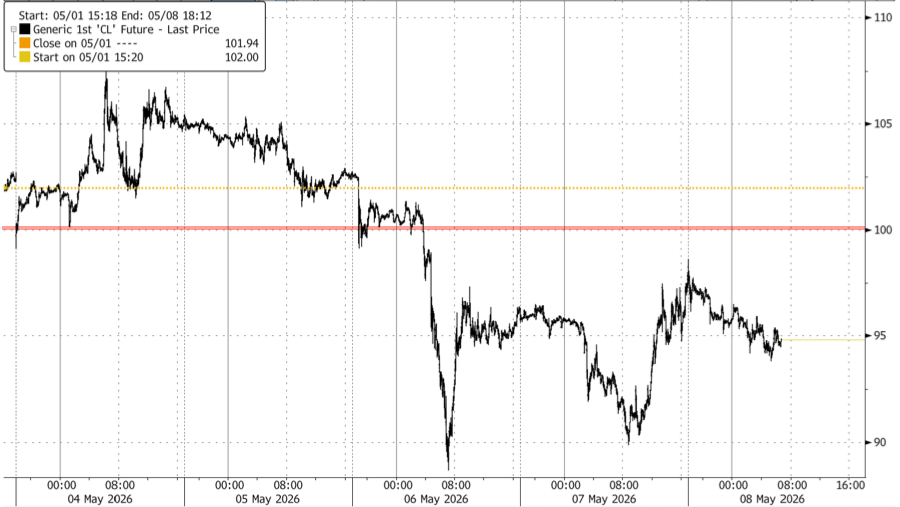
WTI and Brent futures waned from overnight highs, and now post incremental losses. WTI currently trades at the lower end of a USD 93.82-98.64/bbl range, with Brent hovering around USD 99.60/bbl, within a USD 99.55-102.92/bbl range.
Dutch TTF has fallen back towards EUR 44/MWh from earlier prices north of EUR 45/MWh. Traders are on the lookout for clarity from the Iranian side on whether the ceasefire still stands and whether diplomacy will continue.
Spot gold is firmer as the DXY eases with oil. The bullion trades towards the top end of USD 4,673-4,734.90/oz parameters, off yesterday’s USD 4,775/oz. Gold also sees underlying support on renewed buying interest after the PBoC’s purchases, with China raising gold reserves for an 18th straight month in April, adding 260k ounces.
Base metals are mostly firmer and benefit from the broader losses in the USD amid a lack of further US-Iran escalation following the initial skirmish. 3M LME copper resides towards the top end of USD 13,273.60-13,616.70/t.
China to raise retail diesel and gasoline prices by CNY 310/Mt and CNY 320/Mt respectively from May 9th; part of regular price review, CCTV reported.
Freeport Indonesia (FCX) has pushed back the full restart of its Grasberg copper mine by a year.
Taiwan is reportedly finalising a 25-year US LNG deal valued at USD 15bln with Cheniere Energy (LNG).
Marathon Petroleum’s Galveston Bay refinery (630k BPD) has returned to normal operations, according to reported.
Trade/Tariffs
China and US are in communication on US President Trump’s visit, according to Chinese Foreign Ministry spokesperson.
US reportedly suspects that a Thai firm smuggled chips to Alibaba (BABA) , Bloomberg reported.
The US and South Africa have started preliminary discussions over potential resources deals including bilateral investments in mining, energy and infrastructure, FT reported citing sources.
The US Trade Court has ruled against President Trump’s 10% global tariffs.
US Event Calendar
8:30 am: United States Apr Change in Nonfarm Payrolls, est. 65k, prior 178k
8:30 am: United States Apr Change in Manufact. Payrolls, est. 2.5k, prior 15k
8:30 am: United States Apr Unemployment Rate, est. 4.3%, prior 4.3%
10:00 am: United States May P U. of Mich. Sentiment, est. 49.5, prior 49.8
10:00 am: United States Mar F Wholesale Inventories MoM, est. 1.4%, prior 1.4%
Central Bank Speakers
11:05 am: United States Fed’s Goolsbee on CNBC
2:20 pm: United States Fed’s Goolsbee on Bloomberg TV
7:30 pm: United States Fed’s Waller, Bowman, Daly and Goolsbee on Panel
DB’s Jim Reid concludes the overnight wrap
As we go to press this morning, markets have slipped back thanks to questions about whether the US-Iran ceasefire is holding. Indeed, there’s been a clear escalation in the last few hours, with the US striking targets in Iran after they fired on three US warships in the Strait of Hormuz. And in turn, Trump posted that “we’ll knock them out a lot harder, and a lot more violently, in the future, if they don’t get their Deal signed, FAST!” So Brent crude is back up +1.58% this morning to $101.64/bbl, having been beneath $100/bbl for a good chunk of yesterday’s session. However, markets still aren’t pricing in the worst-case scenario, as Trump told ABC News that “the ceasefire is going. It’s in effect”, referring to the US strikes as a “love tap”.
Questions around the ceasefire have already had a market impact in Asia overnight, where all the major equity indices have lost ground. That includes the Nikkei (-0.69%), the KOSPI (-0.73%), Hang Seng (-1.17%), CSI 300 (-0.90%) and the Shanghai Comp (-0.43%). Moreover, European equity futures are down, with those on the FTSE 100 (-0.70%) and the DAX (-0.87%) both lower, although US futures have picked up a bit after yesterday’s losses, with S&P 500 futures up +0.21%.
Prior to all that, Brent crude (-1.19%) had posted a modest decline yesterday to $100.06/bbl, but that was a decent recovery from the intra-day lows of $96/bbl given there were no obvious signs of progress towards a deal. Moreover, as reports of explosions in Iran came through, that pushed oil prices even higher, so whilst Brent crude spent much of the day beneath $100/bbl, it was just above that mark by the close.
These more negative headlines weighed on broader risk sentiment, leading the S&P 500 (-0.38%) to pull back from its record high. And on top of the geopolitical headlines, we also had a hawkish batch of US data, with numbers on the labour market and inflation both surprising on the upside. For instance, the NY Fed’s latest survey showed 1yr inflation expectations up to 3.64% in April (vs. 3.5% expected), which is the highest since September 2023. So that raised expectations about a more hawkish response from the Fed. And that came on top of strong labour market data, with the weekly initial jobless claims at 200k in the week ending May 2 (vs. 205k expected), which took the 4-week moving average down to a two-year low of 203.25k.
That hawkish newsflow continued with various Fed speakers. In particular, Boston Fed President Collins (a non-voter this year) said she agreed with the hawkish dissenters who didn’t want to include the easing bias in the statement. So that added to the sense there was wider scepticism around further rate cuts. We also heard from two of the hawkish dissenters. Cleveland Fed President Hammack said her own outlook was that “interest rates will be on hold for quite some time.” And Minneapolis President Kashkari said that “if the Strait of Hormuz is closed for an extended period of time, it may well be that the next move might need to be up in interest rates.” So investors priced in a more hawkish outlook, with markets pricing a 38% chance of a rate hike by March 2027 at the close, up from 21% the previous day. And in turn, Treasury yields rose across the curve, with the 2yr yield (+4.6bps) up to 3.91%, whilst the 10yr yield (+3.8bps) rose to 4.39%.
This backdrop meant it was a tough one for equities as well, with the S&P 500 (-0.38%) falling back from its Wednesday record. Indeed, the losses would have been even bigger were it not for the Mag 7 (+0.71%) reaching another record. So the equal-weighted S&P 500 (-0.67%) saw its largest decline in almost four weeks, whilst the small-cap Russell 2000 (-1.63%) struggled even more. And over in Europe, there were also broad declines, with the STOXX 600 (-1.10%) posting its biggest decline in over a month, alongside losses for the DAX (-1.02%), the CAC 40 (-1.17%) and the FTSE 100 (-1.55%).
Looking forward, we’ll get more data today with the US jobs report for April. That’s an important one, as Fed pricing has already shifted in a hawkish direction given the energy shock, and last month’s payrolls were at a 15-month high of +178k. This time round, our US economists are looking for payrolls to come in at +50k, which would actually mark the first back-to-back positive reading since May last year. Meanwhile, they see the unemployment rate steady at 4.3%.
Elsewhere today, the UK will be in focus, as we’ve just started to get the results from the local elections overnight. We’ve only got a few results so far, but the governing Labour Party have suffered heavy losses in the seats they were defending, whilst Nigel Farage’s Reform UK party has seen major gains. Today, it’ll be important to watch what Labour MPs and cabinet ministers are saying, as gilt markets are focused on whether PM Keir Starmer will remain in post following the results. That’s because of expectations that a new Labour leader might ease the fiscal rules and raise gilt issuance, so when Starmer’s position has come into question, that’s coincided with selloffs for gilts.
Before all that, sovereign bonds were fairly steady across Europe yesterday, with the 10yr bund yield (+0.1bps) remaining at 3.00%. There had been more of a rally earlier in the session, but that unwound as oil prices moved higher again, with yields tracking those moves. So yields on 10yr gilts (+0.9bps) and OATs (+0.4bps) also saw a modest increase, although those on BTPs (-0.6bps) came down slightly. Otherwise, investor expectations of an ECB rate hike in June were also steady yesterday, with markets pricing in an 80% chance of a hike by the close, up from 79% on Wednesday.
Finally, there were a couple of noteworthy headlines on US trade yesterday. First, the 10% global tariff currently in place was found to be unlawful by the US Court of International Trade. That’s the one the administration had imposed under the Trade Act of 1974, after the Supreme Court ruled against the previous IEEPA tariffs earlier this year. But for now, at least, the Court of International Trade only blocked them from enforcing it against the companies that sued and Washington State. The second story was that Trump set a deadline of July 4 for the EU to “deliver their side of the Deal”, or tariffs would be raised.
Looking at the day ahead, data releases include the US jobs report for April, the University of Michigan’s preliminary consumer sentiment index for May, and German industrial production for March. Central bank speakers include ECB President Lagarde, ECB Vice President de Guindos, the ECB’s Nagel, the Fed’s Cook, Waller, Bowman, Daly and Goolsbee, BoE Governor Bailey, and BoE Deputy Governor Breeden.
Tyler Durden
Fri, 05/08/2026 – 08:23

Megadrought: We Just Experienced The Driest First Three Months Of A Year In US History
Megadrought: We Just Experienced The Driest First Three Months Of A Year In US History
Authored by Michael Snyder via The Economic Collapse blog,
January, February and March were insanely dry. In fact, in all of U.S. history conditions have never been so dry during the first three months of the year. Just think about that for a moment. Not even during the Dust Bowl days of the 1930s were conditions this dry. Many were hoping that 2026 would be the year when our multi-year drought would finally break. Needless to say, that hasn’t happened. Scientists are telling us that the southwestern U.S. is in the midst of the worst multi-year drought in at least 1,200 years. We really are experiencing a “megadrought”, and this is something that experts such as Steve Quayle and Dane Wigington have been talking about for a long time. Unfortunately, it appears that our seemingly endless “megadrought” has gone to an entirely new level in 2026.
If it simply doesn’t rain, there is not much that farmers and ranchers can do.
Right now approximately 63 percent of the continental United States is experiencing at least some level of drought, and the first quarter of this year was one for the record books…
Winter wheat is dying in Kansas fields that should be green by now. Ranchers in New Mexico are selling cattle they cannot afford to feed. Reservoir levels along the Colorado River system are dropping weeks ahead of the season when mountain snowmelt is supposed to refill them. Across roughly 63% of the contiguous United States, drought rated moderate to exceptional on the federal scale has taken hold, and the first three months of 2026 were the driest the nation has recorded in 131 years of continuous measurement.
This isn’t just a crisis.
This is catastrophic.
It appears that the winter wheat crop in the U.S. is going to be a disaster.
At this stage, more than 81 percent of the Southern Plains is experiencing drought…
Heading into the harvesting season for the key winter wheat crop, much of the western side of the U.S. Plains are locked in drought. Over 81% of Southern Plains is experiencing some form of drought, according to the latest data from the U.S. Drought Monitor. Nearly 20% of the region is experiencing either “extreme” or “exceptional” drought.
Only 30% of U.S. winter wheat is in either good or excellent condition as of the start of this week, according to the most recent weekly Crop Progress report from the Department of Agriculture. By comparison, 49% of the crop was good-or-excellent at this point last year.
The situation is particularly dire in the state of Oklahoma.
Last year, the state produced 101.1 million bushels of red winter wheat.
Thanks to the drought, it is being projected that the state will produce less than half of that total this year…
At the 2026 Oklahoma Grain and Feed Association meeting, crop scouts, extension specialists, and grain elevator representatives painted a sobering picture of this year’s hard red winter wheat crop. Their estimates say the 2026 crop is roughly half the size of the previous two years, with production projected at 48.9 million bushels compared to 101.1 million bushels in 2025. The outlook is based on an average yield of 23.93 bushels per acre across an expected 2.043 million harvested acres, highlighting the significant downturn facing Oklahoma wheat producers.
When there is a lot less wheat to go around, prices will go up.
It is simply a matter of supply and demand.
One farmer that grows winter wheat in Kansas is saying that his farm has only had a quarter of an inch of precipitation since last fall…
Southwest Kansas farmer Gary Millershaski says his area has only received a quarter-of-an-inch of precipitation since last fall. “For us to get a 30-bushel crop, you’ve really got to be optimistic and believe in prayer. That’s a fact.”
He has done everything right, but the sky has been silent.
What is he supposed to do?
So far in 2026, Chicago wheat futures are up about 30 percent…
Chicago wheat futures have gained nearly 30% since the start of the year — the biggest gain among row crop futures — due to the combination of U.S. drought, global fertilizer shortages and a looming El Niño.
If this crisis in the Middle East is not resolved, this will only be just the beginning.
Once upon a time, the U.S. was absolutely swimming in wheat, but now we are moving into a time when it will be considered a “luxury grain”.
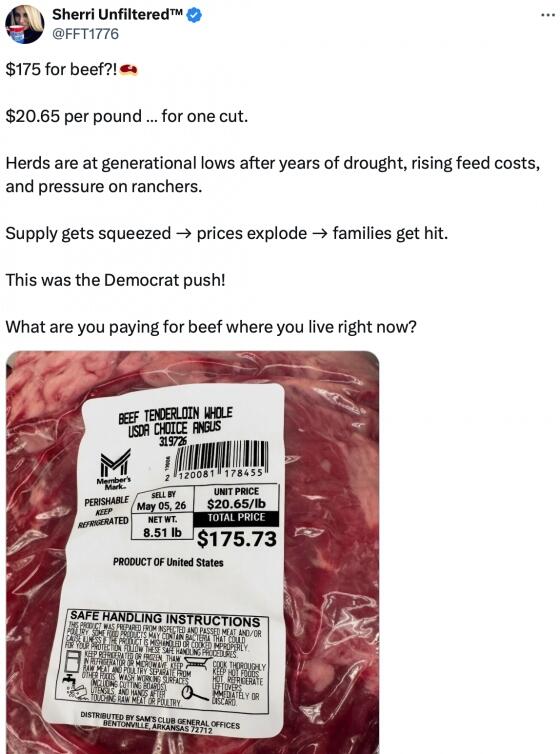
Of course beef is already considered to be a “luxury meat”.
When I was growing up, my mother would feed us beef constantly because it was so inexpensive.
But now beef prices have skyrocketed, and some of the prices that we are seeing at the meat counters in our grocery stores are absolutely absurd…
I never thought that I would see beef prices get this high.
But this is the reality that we are living in now.
And it appears that beef prices will continue to remain elevated because the size of the U.S. cattle herd is the smallest that it has been since 1951…
The US cattle herd remained the smallest since 1951 at the start of the year, in the latest signal that consumer beef prices will remain near records.
There were about 86.2 million cattle and calves in the US as of Jan. 1, the US Department of Agriculture said in a Friday report. The tally is nearly unchanged from 2025, providing no relief to the ongoing cattle shortage.
The lack of improvement comes as ranchers keep selling animals to slaughter amid high beef demand, rather than retaining the animals to grow their herds. The downsizing — which began years prior when ranchers shrunk their herds due to high production costs and droughts — has sent consumer beef prices to all-time highs.
It is really hard to feed cattle when conditions are bone dry.
Sadly, they could get even drier in the months ahead…
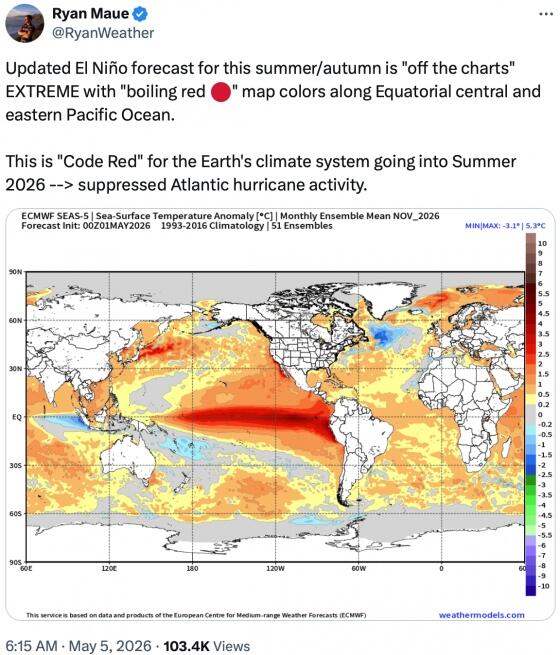
Meanwhile, there’s a 62% chance of the world’s climate shifting from neutral to El Niño between June and August, according to NOAA’s Climate Prediction Center forecast. The European Center for Medium-Range Weather Forecasts said that this El Niño could be the strongest on record, with peak intensity hitting in October.
El Niño typically results in hot and dry weather in many growing areas, including the U.S. Corn Belt and in Australia. With fertilizer supplies thin, this may further compound production losses for world wheat.
We are being told that we could soon be experiencing a “super El Niño”, and meteorologist Ryan Maue is warning that the long-term forecast for the second half of this year is “off the charts”…
I have been repeatedly warning my readers that global weather patterns are going nuts, and I was not exaggerating one bit.
We really are facing a historic long-term crisis with no end in sight.
As I discussed last week, for the upcoming season U.S. farmers are planting the fewest acres of wheat that we have seen since records began in 1919.
In 1919, there were 104 million people living in the United States.
Today, there are 341 million people living in the United States.
It doesn’t take a genius to figure out that we have a major problem on our hands.
Many of us have been warning about this crisis for years, and now we really have reached a breaking point.
Michael’s new book entitled “10 Prophetic Events That Are Coming Next” is available in paperback and for the Kindle on Amazon.com, and you can subscribe to his Substack newsletter at michaeltsnyder.substack.com.
Tyler Durden
Fri, 05/08/2026 – 07:45
Iranian Army Commandos Seize Oil Tanker Over Export Disruption Claims
Iranian Army Commandos Seize Oil Tanker Over Export Disruption Claims
The semi-official Tasnim news agency reported that Iran has seized an oil tanker, accusing it of “attempting to disrupt oil exports and the interests of the Iranian nation.”
Tasnim did not elaborate on the seizure, but Iran’s official state news agency, the Islamic Republic News Agency (IRNA), stated that the Iranian military directed the tanker to Iran’s southern coast. The report noted that the tanker was carrying Iranian crude oil.
“Army commandos seized this violating oil tanker carrying a cargo of the Islamic Republic of Iran’s oil, which was trying to harm and disrupt oil exports and the interests of the Iranian nation by exploiting regional conditions,” IRNA stated.
IRAN STATE TV SAYS FORCES SEIZED TANKER IN GULF OF OMAN
— zerohedge (@zerohedge) May 8, 2026
Earlier, US forces struck Iranian missile and drone launch sites and other military assets after CENTCOM reported that Iranian forces launched a missile and a one-way attack drone barrage at three US warships transiting the Homruz chokepoint. No US warships were hit.
Press TV reported overnight that Tehran said US forces targeted two of its oil tankers in the Hormuz area. The outlet also said the US hit civilian areas along its southern coast and on Qeshm Island “with the cooperation of some regional countries.”
‘Iranian Forces seized the offending tanker OCEAN KOI (new name JIN LI) transporting oil cargo from the Iran, which was exploiting the conditions in the region to harm and disrupt oil exports and the interests of the Iranian nation.’
Likely happened 5-6 May night. https://t.co/AjLMcorDIt pic.twitter.com/xvTH80ieLH
— MenchOsint (@MenchOsint) May 8, 2026
The United Arab Emirates, which has been hit hard by Iran’s retaliatory strikes, said earlier that its air defenses were intercepting missiles and drones targeting the country.
President Trump stated overnight that the month-long ceasefire remains in effect, but warned Tehran that future airstrikes would be harder and more violent if it does not quickly accept a peace deal to end the war and reopen the Hormuz chokepoint.
Polymarket:
Strait of Hormuz traffic returns to normal by end of May?
Yes 28% · No 73%
View full market & trade on Polymarket
Overnight geopolitical wrap:
UBS analyst Dominic Ellis provided a summary of the UBS Energy Research team’s call with Amena Bakr, head of Kpler’s Middle East and OPEC+ Research, about the UAE and OPEC:
While the UAE’s exit from OPEC erodes the group’s ability to control the oil price in the longer term (UAE is around 30% of spare capacity), there is limited risk of the group splintering, according to an expert speaking to UBS. The speaker said the Iran conflict is likely to lead to significant investment in new pipeline (and perhaps export) capacity to bypass the Strait of Hormuz, but it will take 2-3 years at least for meaningful developments. The ability to return production to pre-war levels varies significantly: Saudi Arabia and the UAE can get there within weeks, but Iraq and Kuwait might take up to 6 months given the less orderly shutdown processes they were forced into by the conflict. The speaker estimates that the UAE has capacity close to 5mb/d, versus the current 2.1mb/d, but will likely ramp up only gradually to avoid a price war with Saudi.
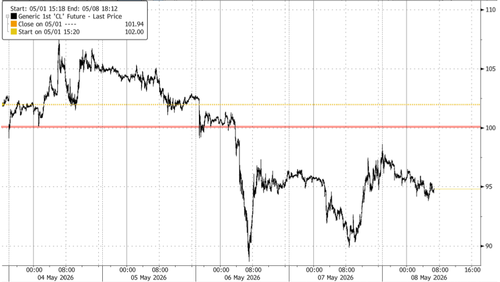
In markets, Brent crude futures are trading around $100 a barrel, while WTI futures are trading around $94 a barrel.
*Developing…
Tyler Durden
Fri, 05/08/2026 – 07:20
“Thermal Event” Triggers Service Disruptions At Amazon AWS Cloud Hub In Northern Virginia
“Thermal Event” Triggers Service Disruptions At Amazon AWS Cloud Hub In Northern Virginia
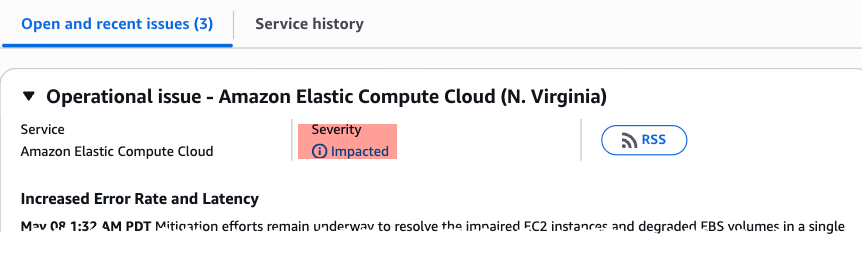
Amazon Web Services said that recovery efforts are still underway after a “loss of power during a thermal event” disrupted a Northern Virginia data center on Thursday evening.
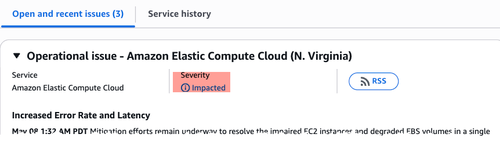
“Mitigation efforts remain underway to resolve the impaired EC2 instances and degraded EBS volumes in a single Availability Zone (use1-az4) in the US-EAST-1 Region,” AWS wrote on its Service Health page, indicating that its operational issue for “Amazon Elastic Compute Cloud (N. Virginia)” remained “impacted” as of early Friday morning.
AWS shifted traffic away from the affected zone for most services and told customers to use other Availability Zones in US-EAST-1, noting that data centers in other zones were unaffected.
“The work to bring additional cooling system capacity online, which will enable us to recover the remaining affected infrastructure in a controlled and safe manner, is taking longer than we had initially anticipated,” AWS stated.
The AWS disruption in Northern Virginia caused Coinbase’s services to be affected overnight.
On May 7th Coinbase experienced service disruptions. Here’s a quick summary of what happened:
→ Around 8PM ET, Coinbase systems flagged high error rates across multiple services.
→ We traced these errors to amazon failures in Availability Zone (use1-az4) in the AWS US-EAST-1…
— Coinbase Support (@CoinbaseSupport) May 8, 2026
AWS did not provide details about what caused the “thermal event” at one of its data centers in Northern Virginia.
Tyler Durden
Fri, 05/08/2026 – 06:55

The World’s Biggest Fusion Reactor Just Hit A Milestone
The World’s Biggest Fusion Reactor Just Hit A Milestone
Authored by Haley Zaremba via OilPrice.com,
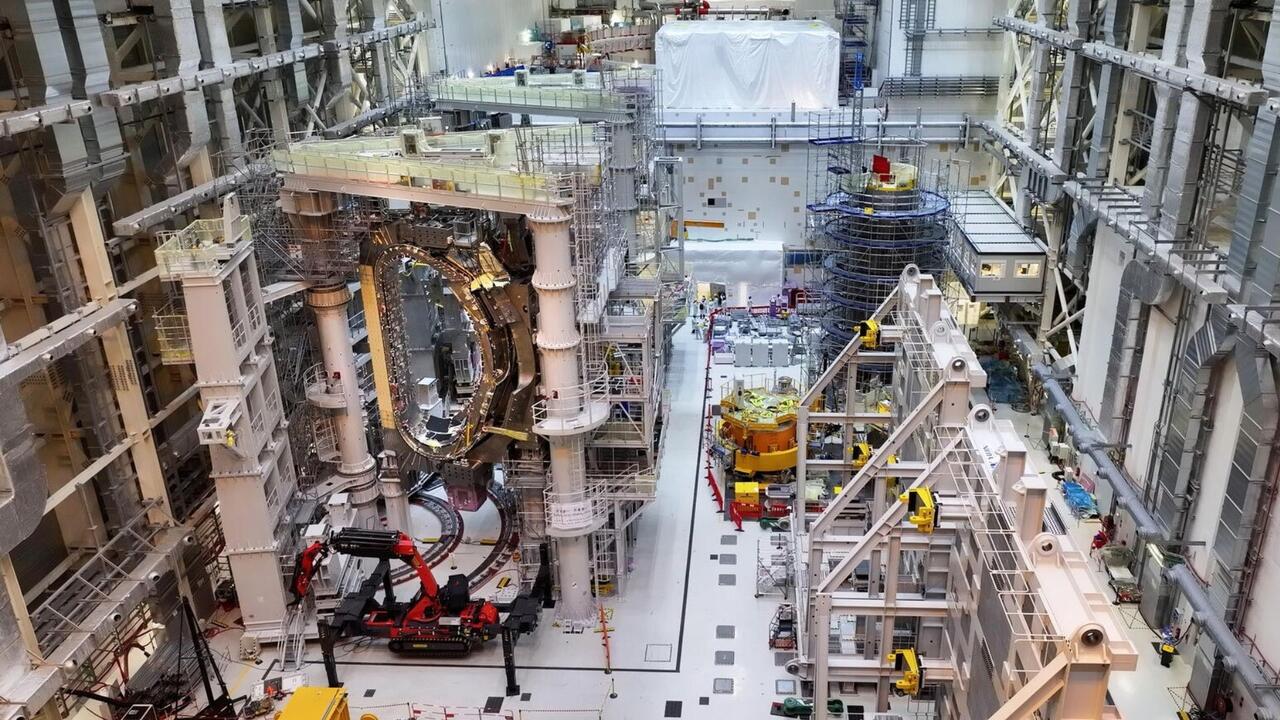
The final components of ITER’s central solenoid magnet — a 59-foot, 3,000-tonne superconducting system 15 years in the making — have arrived in France, clearing a major path toward first plasma.
ITER will never supply electricity to the grid; it exists purely as a research tool, and at €22 billion and counting, it’s still years from achieving its primary milestone.
A wave of well-funded private fusion startups is on track to hit the same technical benchmarks as ITER faster and more cheaply — raising real questions about the megaproject’s relevance even as it celebrates progress.
The world’s biggest nuclear fusion experiment just got one huge step closer to completion. The International Thermonuclear Experimental Reactor (ITER) in Cadarache, France just received the final shipment of necessary components to assemble the giant magnet at the heart of the reactor. The central solenoid magnet, developed in the United States at the Oak Ridge National Laboratory, is a critical component of the massive experimental site, which is cooperatively funded and operated by a coalition of seven major world economies: China, the European Union (EU), India, Japan, Russia, South Korea and the United States.
The central solenoid is awe-inspiring in its size as well as its capabilities.
“The central solenoid is 18 meters (59 feet) tall and 4.25 meters (14 feet) wide, composed of six individual modules,” Interesting Engineering reported earlier this week.
“Each module weighs more than 122.5 tonnes (135 tons) and is wound from 6 kilometers (3.7 miles) of niobium-tin superconducting cable.”
And this is just one component of a jaw-droppingly massive apparatus that represents “the grandest scientific experiment in the world“. ITER’s tokamak (the donut-shaped device designed to confine plasma with ultra-powerful magnets) measures a kilometer in length. The solenoid magnet as its core is therefore almost inconceivably powerful, and it’s just one part of a much bigger and more impressive system. “This component belongs to a magnetic system weighing 3,000 tonnes (3,300 tons) that interacts with nine vacuum vessel sectors,” Interesting Engineering goes on to say.
This beating heat of ITER has been 15 years in the making, with each individual module requiring a two-year process for fabrication and testing. ITER will never produce power to supply to the energy grid, but will serve as one of the most important – if not the most important – research projects on Earth to solve the puzzle of creating commercial nuclear fusion, the holy grail of clean energy. Nuclear fusion is the energetic process that powers our own sun. Replicating that process here on Earth could essentially provide limitless clean energy. It’s a potentially long-lasting, ultra-efficient energy source that leaves behind zero greenhouse gases and zero hazardous radioactive waste, unlike nuclear fission.
But the scale of ITER, and the unprecedented nature of its goals, has led to increasingly long timelines and a ballooning budget for the slow-moving megaproject. While the delivery of the solenoid marks a major milestone, ITER is still years away from achieving first plasma, around €22 billion and nearly two decades after breaking ground.
ITER is still relevant, and will hopefully bring us invaluable scientific findings that would be impossible without its grand scale and budget. But the megaproject is facing increasing competition from smaller and more dexterous fusion ventures. Various other projects are on track to beat ITER to its mapped goalposts, and much more inexpensively.
The race for nuclear fusion is increasingly going private as investors start to recognize the technology as a matter of when, and not if. Interest from the tech sector is also ramping up as Silicon Valley scrambles to find a panacea to the energy monster that the AI boom has unleashed. As a result, a lot of deep-pocketed entities are now focused on fusion like never before.
“If you know how to build a fusion power plant, you can have unlimited energy anywhere and forever. It’s hard to overstate what a big deal that will be,” Bill Gates wrote in an October essay.
“The availability and affordability of electricity is a huge limiting factor for virtually every sector of the economy today. Removing those limits could be as transformative as the invention of the steam engine before the Industrial Revolution.”
A new rush of Wall Street-backed fusion startups is already answering this call to arms, rapidly changing the scientific and economic landscape for nuclear fusion research everywhere. But ITER’s backers argue that its looming obsolescence is a sign of the project’s success rather than its failure, indicating that its achievements and high profile have inspired the current flood of private investing dollars into fusion research and development. And, if nothing else, ITER now stands as a vanishingly rare symbol of international cooperation for global interests, rather than nationalized and protectionist energy agendas.
Tyler Durden
Fri, 05/08/2026 – 06:30
https://www.zerohedge.com/markets/worlds-biggest-fusion-reactor-just-hit-milestone

Political Warfare? Advocacy Group With Ties To Lefty Unions Targets SpaceX IPO
Political Warfare? Advocacy Group With Ties To Lefty Unions Targets SpaceX IPO
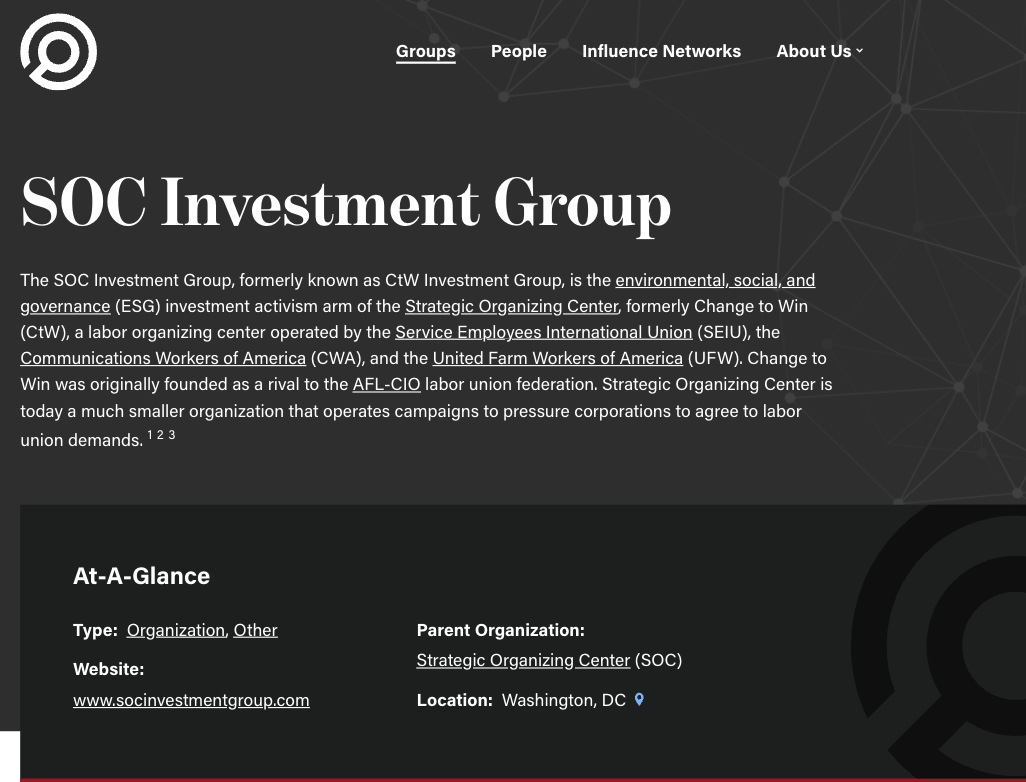
The SOC Investment Group is a union-aligned shareholder advocacy organization formerly known as CtW Investment Group. It works with union-sponsored pension funds to mount pressure campaigns against public companies.
SOC’s latest pressure campaign appears to target Elon Musk’s SpaceX in an attempt to delay or derail the upcoming IPO.
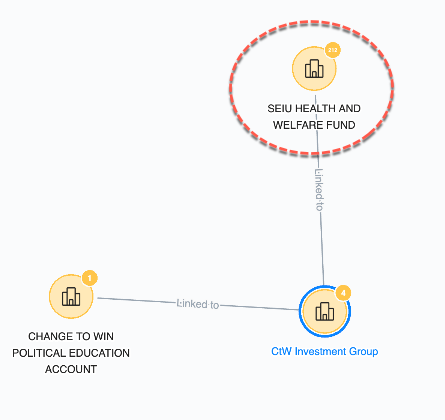
The union-affiliated pension fund adviser, linked to the Service Employees International Union (SEIU) – a labor union that has supported the left-wing, billionaire-funded “No Kings” protest against President Trump…
… has asked regulators to review the accuracy and reliability of SpaceX’s financials, ensure auditor independence, and examine accounting around transactions with other Elon Musk-linked companies, including xAI and Tesla.
The InfluenceWatch database via Capital Research Center shows SOC’s ties with lefty unions…
To note, SOC is weirdly obsessed with unhinged globalist ESG investment activism that damaged the U.S. economy during the Biden-Harris regime years.
SOC warned that investors could be exposed to SpaceX, whose valuation may decline once its financial disclosures are independently reviewed. Oddly enough, SOC is not a SpaceX shareholder but has previously pushed governance pressure campaigns at major companies, including Tesla.
“We are specifically concerned that SpaceX’s IPO will expose numerous investors, many unwillingly, to a company whose value may decline once its financial disclosures can be independently assessed and verified,” the letter said.
SpaceX is preparing to go public in less than two months, and SOC’s letter to regulators appears intended to create regulatory friction with the SEC over what could become the largest IPO in history. The timing is very notable.
A successful SpaceX IPO at a multi-trillion-dollar valuation could dramatically expand Elon Musk’s wealth and power, potentially transforming him into the world’s first trillionaire.
From an information and political warfare lens, SOC’s pressure campaign should be viewed less as a SpaceX governance issue and more as part of a broader left-wing operation against Musk’s corporate empire.
Tyler Durden
Fri, 05/08/2026 – 05:45
https://www.zerohedge.com/markets/political-warfare-advocacy-group-ties-lefty-unions-flags-spacex

UK Nurseries Urged To Report ‘Racist’ Toddlers To Police In £1.3M Scheme
UK Nurseries Urged To Report ‘Racist’ Toddlers To Police In £1.3M Scheme
Authored by Steve Watson via Modernity.news,
Childcare workers across Wales are being trained to spot and report “racist incidents” by toddlers under fresh guidance endorsed by government ministers and bankrolled with taxpayer cash.
The push, which includes lessons on “white privilege,” turns playgroups and nurseries into surveillance hubs for the state’s ‘anti-racism’ agenda — even when the alleged offenders are barely out of nappies.
The initiative has received over £1.3 million in taxpayer funding via the Welsh Government.
🔴 Welsh nurseries have been advised to report children for “racist incidents” in hate crime guidance backed by the Labour government.
The taxpayer-funded guidance has been circulated in order to make nurseries, play groups, and childminders “anti-racist” environments.
🔗:… pic.twitter.com/FcL6M0Jw3n
— The Telegraph (@Telegraph) May 5, 2026
The guidance comes from Diversity and Anti-Racist Professional Learning (DARPL), based at Cardiff Metropolitan University.
It has been circulated to more than 300 nurseries, playgroups and childminders.
Staff are ludicrously told to assess whether a child’s behaviour could amount to a hate crime and, if so, contact police on 999 or 101.
Welsh nurseries told to report ‘racist’ toddlers to POLICE under Labour-backed guidancehttps://t.co/Mfkhj0TayO
— GB News (@GBNEWS) May 6, 2026
The document also pushes workers to audit their resources for “diversity,” discuss skin colour and race with very young children, and create “anti-racist” environments from the cradle.
The toolkit explicitly frames even child-to-child incidents in toddlers as potential “racist incidents” requiring formal logging and possible police involvement.
Critics rightly call it Orwellian madness — toddlers lack the cognitive development to hold racist beliefs, yet the state now demands they be policed as miniature thought criminals.
This latest outrage fits a clear and disturbing pattern of UK authorities targeting children with woke, pro-migration and Islam-compliant ideology while stamping down on any pushback.
Here are just some of the recent examples:
Local authorities warned schools that kids’ artwork risked violating Islamic blasphemy rules — a staggering concession to foreign religious law over British freedom of expression.
State schools are feeding children propaganda that frames illegal Channel crossings as something to celebrate rather than challenge.
The government instructed teachers to monitor and report any “anti-Muslim hostility,” turning classrooms into surveillance states for wrongthink.
A taxpayer-funded Prevent-style game literally flags children who question open borders as potential extremists.
Parents of a child who questioned why he had to celebrate Ramadan in school when he is not a Muslim were sent a letter informing them of the ‘racist’ incident.
Together these stories paint a grim picture: British children are being systematically stripped of innocence, taught to view their own heritage and skin colour as problematic, and conditioned to accept mass migration, Islam’s sensitivities and woke dogmas without question.
Questioning any of it risks being labelled a bigot, an extremist or, in the case of toddlers, a “racist” warranting a police report.
This is not education. It is ideological grooming funded by your taxes and enforced by a Labour government that has lost touch with reality — and with the British public.
Parents are right to be furious. The only answer is to push back hard before an entire generation is lost to this madness. Childhood should be about play, wonder and discovery — not state-mandated guilt sessions and police reports for playground squabbles.
Your support is crucial in helping us defeat mass censorship. Please consider donating via Locals or check out our unique merch. Follow us on X @ModernityNews.
Tyler Durden
Fri, 05/08/2026 – 05:00
https://www.zerohedge.com/political/uk-nurseries-urged-report-racist-toddlers-police-ps13m-scheme
Baltic States Warn Of Unfunded Debt Surge For Europe’s Defense Splurge
Baltic States Warn Of Unfunded Debt Surge For Europe’s Defense Splurge
In a rare outbreak of sanity from the continent that perfected kicking the can, officials on NATO’s eastern front are openly admitting what Brussels and Frankfurt have spent years denying: you can’t fund a permanent war footing with infinite borrowing and hope the bond market never notices.
Estonia’s outgoing ECB rate hawk Madis Muller dropped the red pill in parliament Thursday, bluntly telling lawmakers that jacking up budget deficits to pay for the defense surge is no long-term solution. “These higher defense expenditures are not temporary,” he warned. The message: the party is ending, and the tab is about to get ugly.
Next door in Latvia, Finance Minister Arvils Aseradens echoed the warning, calling for “every possible instrument” to secure sustainable funding. He even threw support behind Canadian PM Mark Carney’s pet idea of a multilateral defense bank, because nothing says fiscal responsibility like creating yet another supranational borrowing vehicle to paper over the cracks.
Both Baltic states, sitting on the razor’s edge with Moscow, not to mention sharing a border with the Russian bear, have massively ramped up military outlays in recent years. Their spending has exploded even as existing social welfare commitments continue to balloon budgets already teetering under the weight of Europe’s sacred model. Welcome to the European conundrum in 2026: you need guns to deter Russia, but the welfare state can’t be touched, and nobody wants to tell voters the truth about taxes.
The broader picture across the continent is grim. European nations are scrambling to square exploding public debt with an unfunded defense boom while somehow still pretending they can keep the lights on for Ukraine’s war effort. The math simply does not add up.
Estonia’s Debt Trajectory: From Poster Child to Problem Child
Estonia, the euro-area’s former fiscal hawk with just 1.3 million people, now finds itself in the crosshairs. Its debt-to-GDP ratio remains a relatively modest 24%, but that’s changing fast. Public debt is projected to more than double: from €10 billion ($11.8 billion) in 2025 to €21 billion by 2030. The IMF has already raised concerns, and Fitch downgraded the country’s sovereign rating back in 2023 as investors began pricing in geopolitical risk and demanding higher yields.
On Thursday, Estonia’s central bank doubled down on its earlier warnings: act now while you still have the luxury of being one of the EU’s least indebted nations. Because that window is closing fast.
Tallinn’s much-touted “defense tax” introduced in 2024? Already watered down and nowhere near enough to cover the actual sums required.
This is the inevitable endpoint of Europe’s post-2022 panic: politicians who spent decades hollowing out defense budgets in favor of green deals, migration costs, and generous entitlements suddenly discover they need actual military capability. Rather than make hard choices — cut elsewhere, raise taxes transparently, or rethink open-ended commitments — the default instinct is to borrow more and hope the ECB or some new “defense bank” magically makes the numbers work.
Spoiler: it won’t.
The Baltics are simply saying out loud what markets have been whispering for months. Permanent defense hikes require permanent revenue, not more creative accounting and supranational debt vehicles. Europe’s eastern flank is learning the hard way that you cannot deter Russia with PowerPoint slides and growing interest payments.
The real question now isn’t whether Europe will boost defense spending, it will and will then quietly shuffle most of the funds into various green (and not so green) grifts under the guise of an “existential threat.” It’s who ultimately pays – and whether the bond vigilantes will wait patiently for the answer. Given the trajectory, the real question is when does the emperor’s nudity finally get confirmed.
Tyler Durden
Fri, 05/08/2026 – 04:15
https://www.zerohedge.com/markets/baltic-states-warn-unfunded-debt-surge-europes-defense-splurge
Hungary Returns Ukrainian Bank Cash & Gold Seized During Election Campaign
Hungary Returns Ukrainian Bank Cash & Gold Seized During Election Campaign
Authored by Thomas Brooke via Remix News,
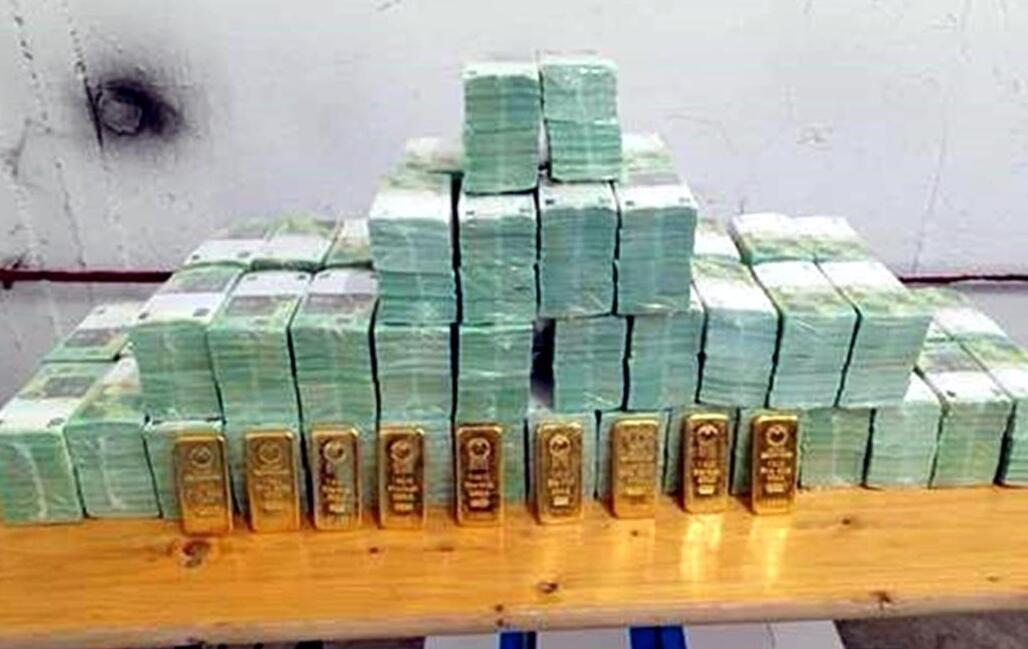
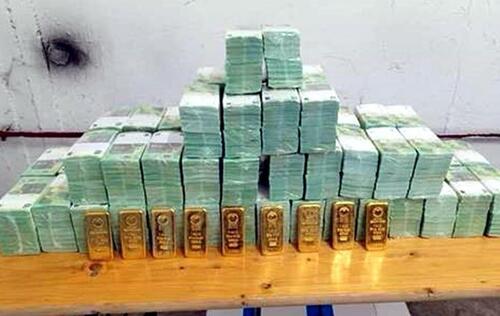
Hungary has returned money and valuables belonging to Ukrainian state-owned bank Oschadbank after authorities seized the shipment earlier this year while it was being transported from Austria to Ukraine.
Ukrainian President Volodymyr Zelensky announced the return on Telegram on Wednesday, saying the assets had been seized by Hungarian special services in March, a move he claimed had been unjustified.
“Today, the funds and valuables of Oschadbank, seized by Hungarian special services in March of this year, were returned,” Zelensky wrote.
“I thank Hungary for the constructive and civilized step,” he added.
The shipment, which reportedly included cash and gold belonging to Oschadbank’s Ukrainian branch, was stopped by Hungarian authorities during a period of high tension between Budapest and Kyiv.
Hungarian officials said at the time that the bank workers involved were suspected of money laundering.
The Ukrainians were later released, but the authorities retained the seized assets until now.
The incident occurred during Hungary’s parliamentary election campaign last month, when Prime Minister Viktor Orbán had made criticism of Ukraine a central part of his political messaging.
His government was also locked in a dispute with Kyiv over the interruption of Russian oil supplies through Ukraine to Hungary via the Druzhba pipeline.
Orbán, who had long clashed with Ukraine and its European backers over sanctions, aid, and energy policy, was defeated in April’s election.
Péter Magyar, the leader of the Tisza party, will now succeed him, and the new Hungarian parliament is expected to be sworn in on Saturday.
The return of the Oschadbank assets follows a broader easing of tensions between Budapest and Kyiv.
Despite multiple claims from Ukraine during the election campaign that the Druzhba pipeline could not simply resume due to damage inflicted by Russian shelling, Kyiv promptly resumed the flow of oil to Hungary and Slovakia shortly after Orbán’s election defeat.
At the same time, Budapest stopped blocking final approval of a €90 billion European Union loan to Ukraine.
Tyler Durden
Fri, 05/08/2026 – 03:30