Category: News
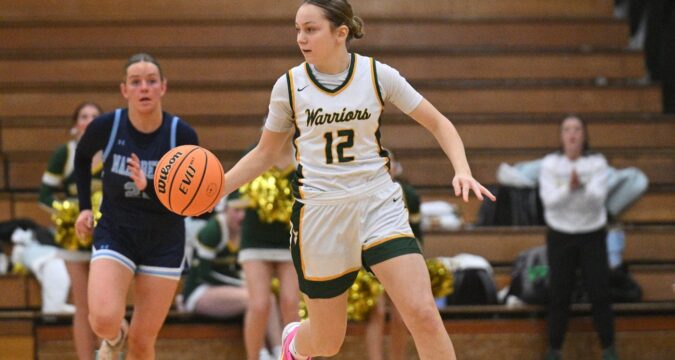
Even on bench, Waubonsie Valley’s Elliana Morris is ‘ready no matter what.’ She proves that in supersectional.
Waubonsie Valley senior forward Elliana Morris was disappointed when coach Brett Love gave her the news on the even of the playoffs two weeks ago.
Love told Morris, who had started every game after senior guard Maya Cobb suffered a torn ACL early in the season, that junior guard Syncere Williams was replacing her in the starting lineup.
“I’m always honest with her, and we’re a family,” Love said. “Whoever is needed at the time, that’s who steps up.”
Love made the move because Williams had played well off the bench since being cleared to play in January, eight months after she had ACL surgery.
Morris accepted the change.
“I got my starting spot taken away, but Syncere is a great defender, and she was doing a great job of scoring, and I was just not doing that at a point,” Morris said. “I remember in our group chat, coach Love sent a reel, and I was talking about ‘always be ready no matter what.’
“I watched that, and I took that to heart and really used that because you never know when your name is going to get called. When it is called, you have to be ready to step up.”
Love called on Morris when senior guard Arie Garcia-Evans picked up her second foul with 1:20 left in the first quarter of the Class 4A Lyons Supersectional on Monday night. The Warriors trailed Nazareth 14-3 and appeared in danger of getting blown out.
But Morris, a Lewis soccer commit, began the second quarter by making a steal and hit three consecutive 3-pointers. Illinois State-bound senior guard Danyella Mporokoso, who entered the game with 2,970 career points, assisted on two of those baskets and then scored on a baseline jumper to give the Warriors a 19-17 lead.
Nazareth eventually pulled away late to win 54-42, but not before Morris and junior guard Maya Pereda, who each scored 12 points, gave them a tough battle. Morris also had a team-high five rebounds and four steals.
“We weren’t going to let Danyella beat us, so we had to give up something,” Nazareth coach Eddie Stritzel said. “We knew (Morris) was a good shooter. We didn’t know she was going to be that good.
“But our goal was to not let Danyella beat us. I thought for the most part we did that. We held Waubonsie to their season low in points, so we’re thrilled about that.”
Mporokoso was limited to 10 shots and finished with nine points, four rebounds and four assists in the final game of her illustrious career for Waubonsie Valley (32-4). Her 2,979 points established school and DuPage County scoring records.
While the Roadrunners (33-3) succeeded in slowing Mporokoso, they were in a fight well into the fourth quarter. The Warriors led 29-25 on a jumper by Williams at the 6:36 mark of the third.
Waubonsie Valley’s Elliana Morris follows through on a 3-point shot against Nazareth during the Class 4A Lyons Supersectional in La Grange on Monday, March 2, 2026. (Steve Johnston / Naperville Sun)
Like Mporokoso, Nazareth star senior forward Stella Sakalas, a BYU recruit, was held to nine points, although she led all players with 11 rebounds and eight assists. Her jumper gave the Roadrunners a three-point lead, but Morris drove and converted a three-point play to tie the game at 37-37 with 6:46 left in the fourth quarter.
“She was ready to play this game,” Love said of Morris. “She stepped up and hit some big shots.”
Morris said doing so gave her a great feeling. But after Nazareth answered her last basket with a decisive 17-3 run, she was left a little empty.
“I had never been in an environment like this before, and so it was really cool to experience that,” Morris said. “But looking back, it wasn’t enough.
“At the end of the game, when I looked up at the scoreboard and we lost. … I would rather win then be able to experience that (individual success).”
Waubonsie Valley’s Maya Pereda (0) puts up a 3-point shot against Nazareth during the Class 4A Lyons Supersectional in La Grange on Monday, March 2, 2026. (Steve Johnston / Naperville Sun)
That attitude didn’t go unnoticed by Morris’ teammates.
“I’m honestly just so proud of Eli and all the work that she has put in,” Pereda said. “Soccer is her main sport, and then being able to come play basketball with us and the competitive team and the goals we have and be able to positively improve that and contribute to that, I’m so proud of her, especially being able to come into a tough game today.”
Pereda said Morris and the other seniors were great role models.
“I’m just so fortunate to have the senior class that we have now,” Pereda said. “They’ve taught me so many lessons on how to be a scorer in different ways but also how to be a leader on the team.”
Matt Le Cren is a freelance reporter.
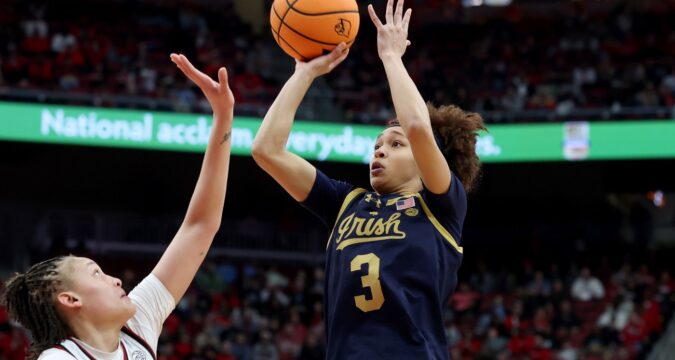
Chicago basketball report: Hannah Hidalgo, Notre Dame gain steam for tourney — and WNBA players wary of strike
The Chicago Bulls went winless in February after a tumultuous trade deadline. Meanwhile, the Sky could finally receive a timetable for WNBA free agency as the players’ union and the league near a March 10 deadline for a new collective bargaining agreement.
Every Tuesday, Tribune writers will provide an update on what happened — and what’s ahead — for the Bulls, Sky and local college basketball teams.
Want the latest sports news? Subscribe to the Chicago Tribune to read it all — and sign up for our Chicago sports newsletter.
Irish gaining steam
Hannah Hidalgo of Notre Dame Fighting Irish celebrates in the second half against the Louisville Cardinals at KFC YUM! Center on March 1, 2026, in Louisville, Ky. (Andy Lyons/Getty Images)
After some rough spots this season, the Notre Dame women rose up down the stretch to win their final five games of the regular season to secure a No. 5 seed and a first-round bye in the ACC Tournament.
The Irish topped Syracuse and No. 10 Louisville last week. Guard Hannah Hidalgo averaged 28.5 points, six steals, nine rebounds and seven assists in the two games on the way to being named the ACC player of the week for a league-record seventh time this season.
She broke her own single-season steals record against Louisville, moving to 162 this season.
“One word I would say is phenomenal and consistent,” Notre Dame coach Niele Ivey said of Hidalgo. “She’s been like this since she stepped on the campus at Notre Dame. She plays with her heart and soul every time she steps on the floor and in practice. … She’s our engine, and we go as she goes. I feel like this year she has really done a fantastic job of being a leader as well. She has a lot of pressure on her, a lot of weight, and the way she plays is contagious with our team.”
The Irish play Thursday in Duluth, Ga., against the winner of the Stanford-Miami game.
WNBA players voice strike reticence as deadline looms
Los Angeles Sparks guard Kelsey Plum dribbles during the first half of a WNBA game against the Indiana Fever on Friday, Aug. 29, 2025, in Los Angeles. (AP Photo/Kyusung Gong)
The players of the WNBA appear to be cooling on the concept of a strike as the March 10 deadline for a final collective bargaining agreement draws near.
The league and the WNBA players’ association have exchanged a series of counteroffers in recent weeks. Urgency clearly picked up for both sides with the season set to start in May — and a final deadline set that would require a work stoppage to be triggered by either party without an agreement.
Players voiced encouragement about the latest concessions made by the league, which include compromises on requirements for player housing provisions, heightened salaries across all player experience levels and a fast track for All-Rookie players to advance to maximum deals. But the league has not budged on one key issue: revenue sharing.
The WNBA has only made offers that pull revenue sharing from the net revenue, which is the total sum of revenue after expenses are deducted. The players have pushed hard to set a standard of receiving their cut from gross revenue, which is calculated before expenses. According to an ESPN report, the league’s latest offer included 70% of net revenue; the players, meanwhile, are pushing for 26% of gross revenue. The issue comes down to a basic calculation — is it better to take home a larger slice of a smaller pie? Or to set a standard of taking a smaller share out of the much larger pot?
While revenue sharing has been a sticking point for the players in recent months, union leadership began to signal this week that acquiescence might be necessary to avoid a truncation of the WNBA season.
“I want to play and players want to play,” WNBPA vice president Kelsey Plum told reporters Monday. “We’re going to continue to negotiate and do everything we possibly can to get this done in a timely fashion, but obviously a strike would be the worst thing for both sides.”
If the two sides come to an agreement before March 10, there will still be plenty of steps left to complete to successfully start the season on the intended opening date of May 8. The Associated Press reported that a possible outline for the remaining preseason would include an expansion draft that could take place between April 1-6, followed by a two-day period for free-agent qualifying offer negotiations and a three-day free-agency window before deals were signed by April 18. Even with this sprint to finalize contracts — which would be particularly hectic with more than 80% of the league in free agency in anticipation of the CBA — this timetable would give teams about three weeks with their rosters before opening day.
This would be a challenge for teams like the Sky, who have only four players (Angel Reese, Kamilla Cardoso, Hailey Van Lith and Maddy Westbeld) under contract for the 2026 season. Veteran Courtney Vandersloot is expected to re-sign with the team and at least two more roster spots will be filled by the addition of Ajša Sivka (from Europe) and a lottery draft pick. Still, general manager Jeff Pagliocca would have to fill more than half the roster in an 18-day window as the Sky attempt to improve their position as a free-agent destination.
Mid-major tournament watch
Valparaiso head coach Roger Powell Jr. directs his team during the first half of an NCAA college basketball game against Kentucky in Lexington, Ky., Friday, Nov. 7, 2025. (AP Photo/James Crisp)
While major conference men’s teams are finishing out the regular season, the Missouri Valley Conference opens its tournament Thursday.
Belmont received the top seed after finishing the regular season 26-5 and 16-4 in the MVC. But three Illinois teams are seeded in the top five and will receive first-round byes. Bradley, led by Milwaukee native Jaquan Johnson’s 17.4 points per game, is seeded second. Illinois State and UIC are seeded third and fifth.
Valparaiso, coached by former Joliet West and Illinois player Roger Powell Jr., is the No. 7 seed and is hoping to make a run in St. Louis.
Valpo won six of its last eight games, including beating Drake on a winning 3-pointer from Bolingbrook grad JT Pettigrew in the final seconds, to improve to 17-14, 11-9. That’s a significant climb from Powell’s first two seasons at the school, when the Beacons totaled nine conference wins, and Valpo’s best conference record since joining the MVC in 2017-18.
Number of the week: 11
Chicago Bulls guard Josh Giddey reacts in the second half of a game against the Portland Trail Blazers at the United Center in Chicago on Feb. 26, 2026. (Josh Boland/Chicago Tribune)
The Bulls lost all 11 of their games in the month of February, marking the worst month in the history of the franchise. This was not the longest losing streak the Bulls have ever suffered — that still belongs to the 2000-01 team, which went 16 games without a win — but it will stand as an important piece of history for this iteration of the organization.
Other teams have fared worse in terms of winless months, but no team has ever recorded back-to-back months without a win. The Detroit Pistons almost went two full calendar months without a win during their record-breaking 2023-24 season, but logged a win on Dec. 30 to escape a two-month drought.
The Bulls started March on a better note with a blowout 120-97 win over the Milwaukee Bucks
Week ahead: Bulls
Tuesday: vs. Thunder, 7 p.m., CHSN
Thursday: @ Suns, 8 p.m., CHSN
Sunday: @ Kings, 8 p.m., CHSN+
Week ahead: Best college basketball games
Illinois guard Kylan Boswell dribbles as Michigan forward Yaxel Lendeborg defends in the second half at State Farm Center on Feb. 27, 2026, in Champaign. (John J. Kim/Chicago Tribune)
Tuesday: Oregon men at No. 11 Illinois, 8 p.m., NBCSN and Peacock
Wednesday: Illinois women vs. Wisconsin at Big Ten Tournament, 5 p.m., Big Ten Network
Wednesday: Villanova men at DePaul, 7 p.m., Peacock
Wednesday: No. 15 Purdue men at Northwestern, 7:30 p.m., Big Ten Network
Thursday: Notre Dame women vs. Stanford/Miami at ACC Tournament, 12:30 p.m., ACC Network
Sunday: No. 11 Illinois men at Maryland, 2 p.m., FOX
Illinois and Northwestern will have two memorable players to honor on senior night.
Against Oregon, the Illini will honor Champaign native Kylan Boswell, who has spent the last two seasons as their leader and defensive stalwart. When Northwestern hosts Purdue, the Wildcats will honor Big Ten scoring leader Nick Martinelli.
The Illinois and Notre Dame women open conference tournament play with an eye on supplementing their NCAA Tournament resumes.
What we’re reading today
Column: Chicago Bulls say good riddance to February, while sports fans welcome the madness of March
Big Ten Tournament: Illinois women are seeded 10th and will open vs. 15th-seeded Wisconsin on Wednesday
Morez Johnson Jr. ignores noise to help No. 3 Michigan beat No. 10 Illinois 84-70 and clinch Big Ten title
Anfernee Simons’ wrist fracture is the latest injury concern for a Chicago Bulls trade-deadline acquisition
Coby White won’t dwell on ‘what could have been’ with Bulls as he returns to Chicago with Charlotte Hornets
Quote of the week
“That physicality, that nastiness, that grit, that fight, that’s on me. That’s not on them. That’s on me. I’ve got to do a much better job getting us much nastier in those situations. We scrimmaged Florida, and we had way more fight against them than we did tonight. … That’s because we’ve gotten a little bit, maybe, content. That’s on me.” — Illinois coach Brad Underwood on what his team needs ahead of the NCAA Tournament after a loss to No. 3 Michigan
https://www.chicagotribune.com/2026/03/03/chicago-basketball-report-wnba-college-notre-dame/

Nick Martinelli feels ‘grateful’ — while eyeing a few more wins — as his record Northwestern career winds down
Nick Martinelli is trying to live in the moment in the last weeks of his Northwestern career.
Senior night against Purdue on Wednesday at Welsh-Ryan Arena. Regular-season finale Saturday at Minnesota. Big Ten Tournament next week at the United Center.
And then? Well, the 6-foot-7 forward admits that question does come with “a little bit of angst.”
For four years, Martinelli has called Northwestern home, rising from a freshman reserve on the first of back-to-back NCAA Tournament teams in 2023 to become one of the best scorers in program history. It’s a career arc that is becoming rarer in the transfer-portal era but one Martinelli, a Glenview native, said he didn’t often question.
“I kind of always have known that I was going to be back here the last four years, so it’s definitely a surreal feeling,” Martinelli said of closing out his NU career. “I’m just trying to enjoy it as much as I can, take each day and just living with as much gratitude as possible.”
Martinelli used the word “grateful” several times when describing his Northwestern experience — even when talking about this season, as the Wildcats have had their ups and downs with a young, transfer-heavy team.
The Wildcats (13-16, 5-13 Big Ten) have won three straight games, including upsetting Indiana on the road last week and beating Oregon on Martinelli’s lefty hook shot with 1.8 seconds to play Saturday. They’re trying to finish the season with renewed energy after losing five straight games twice this season, most recently during a rugged stretch that included three games against teams ranked in the top 10 at the time: Illinois, Michigan and Nebraska.
Martinelli, who developed on two of the best teams in NU history as a freshman and sophomore, said it has been “super difficult” navigating the trials while being one of the nation’s top scorers.
He leads the Big Ten for the second straight season with 22.5 points per game — ranked sixth in Division I — to go with 6.3 rebounds per game. He went through a shooting slump in early February during the Wildcats’ second five-game losing streak that included four straight games of shooting 33% or worse from the field. But he broke out of it in the last three wins, scoring 29 points against Maryland, 28 against Indiana — an NCAA Tournament bubble team — and 22 against Oregon.
As he approaches his last stretch of games — and his uncertain future — he hopes that he and his teammates can continue their groove for a few more wins.
“The thing that hurts the most (about the earlier stretches) is we have such a good camaraderie here, and I’ve been a part of winning and I know how fun that is,” Martinelli told the Tribune in an interview early last week. “And not allowing my teammates to experience that — because we’ve (gone) through so many struggles, so many losses — that obviously hurts.”
‘A great college scorer’
Northwestern coach Chris Collins, center, and his team celebrate after being announced as a No. 7 seed in the NCAA Tournament during a Selection Sunday watch party at Welsh-Ryan Arena on March 12, 2023, in Evanston. (John J. Kim/Chicago Tribune)
When Martinelli thinks back over the many practices, games and laughs in his career, he zeroes in on one favorite: when the Wildcats went to the second round of the NCAA Tournament in his freshman season. It was “a dream,” he said.
“I was trying to slap myself in the face, like, ‘Oh, I’ve got to wake up,’” Martinelli said.
Martinelli averaged 2.6 points over 20 games that season but said he was “probably a cocky little freshman who believed he could take over the world one day.”
“I definitely would be proud of where I’ve come,” he said before the Indiana game, then added: “But I’d ask myself why I can’t get a dang win.”
Excelling with a unique midrange game, Martinelli emerged as a junior last season to set the NU single-season scoring record with 676 points on 251 made field goals, averaging a Big Ten-best 20.5 points for an injury-plagued team that finished 17-16, 7-13.
He has 631 points this season, joining John Shurna as the only Wildcats to top 600 points in two seasons.
Even with his early February struggles, which coach Chris Collins thought were due to getting worn down during a tough stretch against the Big Ten’s best teams, Martinelli has raised his field-goal percentage this season to 50.2% and has a career-high 38 3-pointers on 42.2% shooting.
He’s doing it while defenses are keyed in on stopping him. Only two other Northwestern players — Arrinten Page and Jayden Reid — are averaging more than eight points.
Northwestern forward Nick Martinelli rises for a shot over Oregon guard Drew Carter on Saturday, Feb. 28, 2026, at Welsh-Ryan Arena in Evanston. (Josh Boland/Chicago Tribune)
“I wouldn’t say it’s the easiest thing in the world, but it’s definitely all attributed to my coaches and my teammates,” Martinelli said. “As much as I score the ball, I shoot the ball a ton. … We run a lot of plays for me to get me open, to get me away from the help defense, to give me shots.
“And that’s what we need to do to win. I understand that. I have to score in order for us to win in most cases. So I’m just doing my job as well as I could do it.”
Martinelli had 21 points in the second half of the 72-68 win over Indiana last Tuesday, adjusting his game to pull up over the Hoosiers guards when they switched onto him rather than trying to attack them on the dribble.
Collins called him “just a great college scorer” after the game, which gave the Wildcats their first back-to-back wins in the Big Ten this season.
“Last year he didn’t shoot the 3 as well,” Collins said at his postgame news conference. “Now his ability to make 3s really puts teams in a little bit of a bind about what do you want to do with him. Do you want to put a bigger guy on him and try to match him with physicality? Or do you want to put smaller guys on him and try to send help and double teams?
“He’s one of the best players in the league. Every coach will tell you that. He’s one of the hardest guys to match up with. He’s playing with a bunch of young guys, so many new guys that haven’t even played at this level. And the way he carried our team tonight was pretty admirable.”
Martinelli followed up that performance with the winning shot on a day Northwestern gave out his own bobblehead.
With the Wildcats trailing Oregon by one with 8.6 seconds to play, he took an inbounds pass on the left side of the lane, drove to his right, then spun through two Oregon defenders to get off what Collins called “his patented flipper, flipperdoodle — whatever, everybody kind of has a name for it.”
The ball hung on the back of the rim for what Collins said felt like three seconds before falling in. Oregon missed a last-second attempt, and NU won 63-62.
Northwestern guard Jake West, forward Tyler Kropp and forward Nick Martinelli celebrate with Willie the Wildcat after defeating Oregon on Saturday, Feb. 28, 2026, at Welsh-Ryan Arena in Evanston. (Josh Boland/Chicago Tribune)
“He’s got an incredible will to win, to succeed,” Collins said at his news conference. “Special guy, man. He’s one of these guys, he’s not going to be denied. He works so hard. Never coached a player who works any harder than he does and puts any more into being a good player than he does. You love to see that rewarded.
“For him, this has been a tough go. It’s his senior year. He so desperately wanted to lead our team back to the NCAA Tournament and have a great season. We had our struggles, and for him to hang in there and not just play out the string but continue to compete and fight and be a great big brother to some of these young kids, what an amazing thing.”
Martinelli lamented that he didn’t do more earlier in the season to lift the Wildcats, who have three transfers and two freshmen among their top seven scorers. Northwestern lost its most influential leaders from last season to graduation, and it has been on Martinelli to lead.
“There’s things that I obviously didn’t do to the best of my ability to help lead this team,” he said. “I’ll definitely learn from it. I’m grateful for the opportunity to be able to learn from it. There’s so much love in that building. My teammates are just amazing. And, yeah, I should have been able to lead that team a lot better than what I have done.”
But, he noted, there’s still a little time left to do it.
What’s to come
Northwestern forward Nick Martinelli makes a move against Oregon guard Drew Carter on Saturday, Feb. 28, 2026, at Welsh-Ryan Arena in Evanston. (Josh Boland/Chicago Tribune)
Martinelli declared for the NBA draft last spring while maintaining his college eligibility and eventually returned to Northwestern. In the fall, he called his draft exploration “humbling” and “motivating,” saying he didn’t feel like teams took him seriously.
His return to Evanston put him in rare company in the Big Ten.
Of the top 12 conference scorers through Sunday, only four had played at one school their entire careers: Martinelli, Ohio State senior Bruce Thornton, Wisconsin junior John Blackwell and Illinois freshman Keaton Wagler.
Martinelli, whose only high-major offer out of Glenbrook South was Northwestern, said he never envisioned his college experience at multiple places.
“When I committed to a school, I committed there for four years, not for one year,” he said. “I never really thought much into doing anything else. The coaches always have my back.
“Obviously we know the landscape now, but truly, it had been such a blessing from day one. I struggled a ton my first couple of years here, but they continue to push me and have my back. And now, just being in the position I am today, it’s just grateful.”
Martinelli called himself “skinny and frail” when he got to Northwestern and said his body and strength are among his biggest improvements. He also worked hard in the offseason to improve his shooting and has been more efficient this season.
Whether he gains traction as an NBA prospect, given his unorthodox game, remains to be seen. Martinelli ranked No. 86 on ESPN’s top 100 draft prospects in mid-February.
“Obviously I don’t know what’s to come,” he said. “I could just be a 9-to-5er next year. You never know what’s going to happen. I’m going to work my butt off and whatever happens, whatever opportunities showcase themselves for me, that’s between me and God. And whatever happens, I’m just grateful for it.
“But hopefully I did enough. That’s obviously my dream to play in the NBA, but if not, I’m just going with the punches.”
As for his last run with Northwestern, Martinelli expects senior night against Purdue to be emotional as he celebrates with family members who have been nearby for his entire career.
“I’m looking forward to it, but at the same time, we’ve got to focus on the games we have in front of us,” he said. “And hopefully we could be playing for something at that point, whether it be the NIT, the (College Basketball) Crown, March Madness, whatever it be. I’m going to play it just like every other game, as hard as I possibly can, as well as I possibly can.”
Collins pointed to that mindset when asked after the Oregon game about Martinelli’s legacy. He said Martinelli will be considered one of the all-time Northwestern greats just by virtue of his scoring ability — he’s eighth in career points (1,659) and needs 31 to move into sixth. But there’s more to it than that.
“The legacy he’s leaving is who he is,” Collins said. “How he carries himself, how hard he works, his approach to the game, his will to win, the kind of teammate he is.”
https://www.chicagotribune.com/2026/03/03/nick-martinelli-northwestern-basketball/

‘DEPART NOW’: US Tells Citizens To Flee Middle East, But Most Airspace Closed
‘DEPART NOW’: US Tells Citizens To Flee Middle East, But Most Airspace Closed
As Iran’s response to Israeli and US warfare causes havoc across the Middle East, the US government is urging its citizens to immediately evacuate if they’re in any of 14 countries in the region —something far easier said than done.
“The [State Department] urges Americans to DEPART NOW…using available commercial transportation, due to serious safety risks,” wrote Assistant Secretary of State Mora Namdar on X. Nearly the entire Middle East has been deemed too dangerous to stay in: Bahrain, Egypt, Iran, Iraq, Israel, the West Bank, Gaza, Jordan, Kuwait, Lebanon, Oman, Qatar, Saudi Arabia, Syria, UAE and Yemen. Namdar encouraged those who are abroad and need assistance to call the State Department at +1-202-501-4444, and to enroll in the Smart Traveler Enrollment Program (STEP), which promises to deliver “the latest messages and updates from your nearest US Embassy or Consulate.”
A plume of smoke rises above a UAE airport after an Iranian strike on March 1 (from AP video)
For Americans in the region, four words in the State Department warning are certain to cause resentment: “using available commercial transportation.” Bahrain, Kuwait, Qatar, Iraq, Iran, Syria and Israel have all closed their airspace, and other airline flights have been affected. That leaves some Americans feeling like they’re unable to heed the warning, and wishing for an airlift. Speaking from Dubai, retired Maj. Gen Randy Manner (who notably makes recurring, Trump-critical appearances on CNN) told Erin Barnett:
“As Americans we feel abandoned. I’ve talked to two embassy personnel at two different embassies — they are in survival mode, quite frankly because, as we know, the administration State Department reduced their budget by almost one half over the past year.”
Local embassies and consulates may be of little help. Not only has their staffing been reduced due to the war on Iran, but some of them have been beset by angry mobs infuriated over the Israeli-US murder of the Ayatollah Khamenei and his family, while others have come under fire. Over Monday night, the US embassy in Riyadh, Saudi Arabia was reportedly hit by two drones. Early Tuesday morning, the American embassy in Kuwait announced it was “closed until further notice.”
Oliver Sims, a 24-year-old trying to return to Texas from a friend’s wedding in India, got stuck in Doha and found the embassy there was overwhelmed with requests for help. “They had so many emergency calls coming in so they had to hang up on me,” he told NBC News. A call to Texas Sen John Cornyn’s office didn’t do much either. “They said they’ll let me know of any plans to extract U.S. citizens,” Sims said.
The UAE on Monday announced that it has resumed aviation operations at Dubai International Airport — the world’s busiest for international flyers — and Dubai World Central Airport. However, it said only a “small number” of flights had been authorized thus far. The airport had been evacuated after Iranian drone strikes.
Video shows damage inside Dubai International Airport’s passenger terminal after an Iranian drone attack injured four people.
Dubai Airports’ media office says emergency teams were immediately activated in coordination with relevant authorities. pic.twitter.com/J6e4Oy08K3
— Al Jazeera English (@AJEnglish) February 28, 2026
As Iran pursues a strategy of punishing every country that facilitates the US military presence in the region, there’s no reason to think there will be abundant “commercial transportation” options anytime soon. The effects will even be felt by those who aren’t traveling in the Middle East. “An Iran-conflict-driven disruption is typically more geographically concentrated, but it can still be severe, because it affects some of the world’s most important east-west corridors and creates rapid knock-on effects,” Tony Stanton, consultant director of Strategic Air in Australia, told Al Jazeera.
Even where it’s possible, anyone contemplating air travel in the sprawling war zone should pause to contemplate two past incidents, both of which involved Iran:
On July 3, 1988, a US Navy cruiser shot down Iran Air Flight 655 over the Persian Gulf, killing all 290 people on board. The incident happened as the Iraq-Iran war raged, with sailors mistaking the jet for a US F-14.
On Jan 8, 2020, the Iranian military shot down Ukraine International Airlines Flight 752 just after it took off from Tehran. That disaster happened five days after the United States killed Iranian General Qasem Soleimani in a drone strike at Baghdad’s airport. An Iranian mistook the jet for a cruise missile.
Underscoring the peril in a different way, one can also look to this week’s shootdown of three US F-15s, which has officially been attributed to friendly fire from Kuwaitis manning a Patriot interceptor system, though some observers wonder if that’s a cover story meant to conceal a major Iranian success. The Pentagon says all crew members survived.
Three U.S. jet fighters were mistakenly shot down in Kuwait, U.S. Central Command said. The six crew safely ejected from the F-15s and are in stable condition, said Centcom, which oversees U.S. military operations in the Middle East.
Read more: 🔗 https://t.co/6dxaNhuPWl pic.twitter.com/SORtVRAMtG
— The Wall Street Journal (@WSJ) March 2, 2026
Tyler Durden
Tue, 03/03/2026 – 06:55

Yorkville council OKs contracts with engineering firm, acoustical consultant for proposed data center projects
As resident pushback continues, the Yorkville City Council approved two more measures related to evaluating the data center projects proposed for the city.
At its Feb. 24 meeting, the City Council approved contracts with an engineering firm and an acoustical consultant, as the city continues to move forward with plans for several different data centers to one day set up in Yorkville.
Yorkville has become a sort of hub for data center projects, in part due to the area’s proximity to a ComEd substation. Several projects at varying stages of approval are under consideration in Yorkville, forming what may one day be a sort of corridor of data center campuses in the northeast quadrant of Eldamain Road and Route 34.
But with these proposed developments has come significant resident opposition, with concerns ranging from residents’ health to noise to energy usage and costs.
The city has also begun to standardize how it evaluates and proceeds with data center projects as they crop up.
Last June, for example, Yorkville approved an amendment to a portion of its Unified Development Ordinance, seeking to establish regulations specific to data centers, according to documents from the city. It includes requirements related to things like landscape buffering, maximum height, noise mitigation and appearance standards. Any future development plans have to comply with these standards.
Now, the city has approved two consulting services contracts as it prepares for the future data center developments.
The first contract approved at the recent City Council meeting was with Chicago-based Sargent & Lundy, LLC, for electrical engineering consulting services.
The contract is for the CyrusOne data center substation project in the city, and costs from the contract are set to come in at no more than $149,600, a city memo notes. The costs are a “pass-through expense” to the developer, and therefore will not have an impact on the city’s general fund.
One CyrusOne data center site was approved by the city in 2024, and another CyrusOne campus has been proposed nearby. CyrusOne also has a data center property nearby on Aurora’s far East Side.
The services the city expects to receive from Sargent & Lundy include things like plan review and commissioning support, the memo notes. The city memo indicates that the scope of the services are “narrowly tailored to the high-risk, highly technical components of the project.” Other inspection and review services will continue to be done by city staff.
The other contract approved by the council is with Soundscape Engineering, for acoustic consulting services for the city.
This contract would essentially enable the city to receive acoustic consulting services on an on-call basis, the memo says, and would provide things like peer review of developers’ noise studies as well as field inspections, sound measurements and compliance verification.
At the meeting, City Administrator Bart Olson said that Yorkville has used the sound engineer’s services in the past for project-specific reviews of the proposed Project Cardinal and Project Steel data center developments. This contract would include any review the city does beyond project-specific studies, like a cumulative noise study that the city has authorized.
There is no set cost with the agreement, as the city will only incur costs when task orders for particular projects are issued, the memo notes.
Also at the meeting, during which several residents spoke critically of the data centers proposed for Yorkville, Olson addressed some of the questions that have been arising with regards to the city’s data center plans.
Olson noted, for example, that the city is limiting diesel generator testing to during weekdays, and said that the city is requiring several stages of noise studies for each project, paid for by the developer and conducted by the city.
And he reiterated that the data center developers are responsible for paying for water and sewer extensions and roadways that touch the respective properties.
Olson also discussed whether data centers are expected to impact property values, and noted the possibility of the area school districts getting in-advance property tax payments from the data center developers, which would then be abated later on by the school districts.
As far as transparency, Olson said that there are city webpages for each data center proposal being considered in Yorkville, and said that the idea of having annual public reporting on different issues related to data centers is under review by the city. He said there are currently no plans from the city to create a community oversight committee, but indicated that the City Council could discuss the idea and potentially pursue it.
mmorrow@chicagotribune.com

Persian Gulf Goes Dark For Container Shipping And There’s No Detour Left
Persian Gulf Goes Dark For Container Shipping And There’s No Detour Left
By Stuart Chris of FreightWaves
Ocean lines flee Strait of Hormuz as Iran targets Persian Gulf ports
While tanker vessels came under fire in the Strait of Hormuz, container lines were suspending operations to Persian Gulf ports following the joint Israel-U.S. attack on Iran.
Media reports said ports in the United Arab Emirates and Dubai’s port of Jebel Ali were hit by Iranian missiles, and that Tehran had attacked at least three tankers in the strait. A fire began at Jebel Ali after an incoming drone was intercepted.
While the strait has not been officially closed, several liner operators suspended operations to the Persian Gulf, and ordered their vessels to seek shelter.
Hormuz is the gateway for Persian Gulf energy transport, with about 20% of the world’s crude oil supply passing through its waters. While futures prices ticked up late Sunday, analysts note that 80% of Iran’s oil is sold to China, so it’s unclear what the extended effect could be on global markets.
The United Kingdom Maritime Trade Operations Centre, which monitors maritime security in the Middle East and Indian Ocean region, reported a number of attacks against vessels on Sunday.
Shipping was caught in the crossfire after Tehran responded following Saturday’s Epic Fury attack that killed Iran’s leader, Ayatollah Ali Khamenei, and other high-ranking government and military officials.
US Central Command on Sunday denied Iranian claims that it hit the carrier USS Abraham Lincoln with a ballistic missile.
Maersk, CMA CGM and Mediterranean Shipping Co. suspended or shifted vessel services to the region.
CMA CGM also announced an Emergency Conflict Surcharge of $2,000 for 20-foot, $3,000 per 40-foot and $4,000 per refrigerated container. The surcharge covers all Red Sea ports in Saudi Arabia, Egypt, Jordan, Djibouti, Sudan and Eritrea, as well as Persian Gulf destinations.
Maersk prior to the outbreak of hostilities said the deteriorating security situation led it to divert the MECL service to the United States and ME11 to North Europe away from the Suez Canal route and around Africa. The carrier had only recently restarted regular rotations through the Red Sea.
Iran-sponsored Houthi rebels in Yemen warned they would resume attacks that all but shut down Suez transits for the largest container carriers since late 2023.
“There is no viable alternative to getting containers in or out of ports such as Jebel Ali by ocean if the Persian Gulf is off limits,” said Xeneta analyst Peter Sand, in an email to FreightWaves. “Carriers will instead omit these calls on east-west services and drop boxes at a least-worst alternative port for onward transportation by road. This will cause severe disruption and port congestion at a regional level, but will not have a major impact on a global scale when compared to the seismic influence of conflict in the Red Sea.”
Sand noted ex-Asia container rates had ticked up since Feb. 15 as the US massed forces near the Gulf.
Tyler Durden
Tue, 03/03/2026 – 06:30
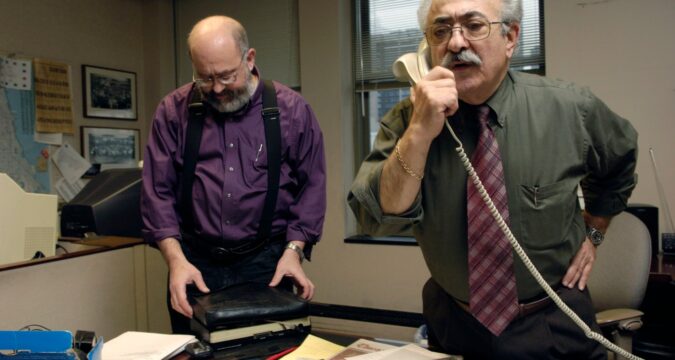
Column: ‘Sirens in the Loop’ book give us City News Bureau in all its raucous glory
Many of their names helped define Chicago journalism and many of their names mean nothing to you and many of their names are lost to yellowing newsprint.
They worked for a place called the City News Bureau and you have nevertheless benefited from the work done by its thousands of mostly young and eager people, combing the city for generations to gather news both good and bad, bloody and mundane.
It started in 1890 as a collective to provide a number of Chicago newspapers with 24-hour-a-day coverage of local breaking news, gathered by aspiring journalists (and others) who did not mind the low pay, tough bosses and brutal schedules.
It’s gone now, meeting its end two decades ago after 115 years. It died with a whimper, but during its raucous and frenetic heyday, it was the breeding ground for journalists, less a finishing school than a military boot camp.
A new book, “Sirens in the Loop: A History of the City News Bureau of Chicago,” gives you that story. It has the feel of a massive high school yearbook, peppered with the names of kids-who-made-good, such as, first and foremost, Mike Royko, but also such journalists as Seymour Hersh (subject of the currently available documentary “Cover-Up”), Pam Zekman and Charles MacArthur, co-author (with Ben Hecht) of the play “The Front Page.”
Chicago Tribune reporter Pam Zekman works in the newsroom in the 1970s. A native South Sider and competitive ice skater, she started her journalism career at the City News Bureau. When on staff at the Tribune, she became part of its investigative team which would win two Pulitzer Prizes. (Chicago Tribune historical photo)
Chicago Tribune reporter, columnist and City News Bureau alum Anne Keegan works at her desk in the Tribune Tower in the 1970s. (Chicago Tribune historical photo)
As Hersch once put it, “The basics you learn at City News are the basics of the business. I’d argue that you could learn much better there than in journalism school.”
The book tells of the big stories, old and relatively recent. There’s the Iroquois Theatre fire and the sinking of the Eastland. There’s Richard Speck and the bombing of Pearl Harbor, the kidnapping and murder of young Suzanne Degnan, the Tylenol murders and Our Lady of the Angels fire, John Wayne Gacy.
Most CNB alums did go on to careers in journalism. Some became politicians’ spokesfolk or academics and a few thrived in such fields as acting (Melvyn Douglas), novel writing (Kurt Vonnegut) and art (Claes Oldenburg). Most all retained vivid memories of their time on the city’s streets. As Vonnegut once said, “I’m proud of the work I did there. It was just like being a soldier.”
The book was written by James Elsener and mostly by Paul Zimbrakos, who worked for CNB for more than 40 years, and was a comparatively gentle man compared to some of the rough-and-barking bosses of the CNB’s early years, most of that time as its city editor (i.e. boss). He had begun what would become this book in the late 1990s, reaching out to alums for their memories, anecdotes, and, in many cases, their thanks.
“Sirens in the Loop: A History of the City News Bureau of Chicago,” by Paul Zimbrakos and James Elsener. (Eckhartz Press)
In the wake of Zimbrakos’ death, the materials he had gathered were rescued by a former City News Bureau kid (early 1970s) and Tribune vet Elsener.
He writes, with admirable humility, “When I started working on this book, I thought the writing task would be overwhelming. … I discovered that another reporter had already written a story that surpassed anything I could have authored. … My task was to organize the information and edit the manuscript.”
He’s done a fine and terrifically entertaining job, though by focusing on the 1950s onward, he misses any tales of my father Herman Kogan’s time there, which took place in the late 1930s. That’s understandable, as is not mentioning my awkward late-1960s flirtation with CNB that would end with me working as a cab driver.
But it was a delight reading about good friends, colleagues and such CNB alums as Royko, Anne Keegan, Bob Billings, Susan Kuczka, Bernie Judge, Maury Possley and many others. There is even a chapter devoted to the Billy Goat Tavern.
As Elsener writes, “Paul’s vision was for this book to serve as a text for journalism students. I didn’t see it that way. City News Bureau existed because of the vitality of a growing and prosperous Chicago. CNB recorded a daily history of the city and its residents, in partnership with the daily newspapers. … I’m sure journalism educators and students can gather value from the City News story, but the media world has changed too dramatically for it to serve as anything other than a testament to the history of a great city and its distinctive brand of journalism.”
This is not at all a textbook, but rather an intimate look at a time long gone. It overlaps a bit with the only other such book, 1983’s “Behind the Front Page,” by longtime CNB boss Arnold “Dorny” Dornfeld, who is credited with the immortal line in journalism quarters, “If your mother says she loves you, check it out.”
City News Bureau Editor Arnold “Dorny” Dornfeld, left, talks with columnist Mike Royko at Dornfeld’s retirement party in 1970. Dornfeld, who died in 1991 at 84, had worked there since 1926. (Charles Osgood/Chicago Tribune)
Royko wrote the introduction to that book, in which he said of its author, ”The first thing you noticed was the eye. I don’t recall if it was the left or the right eye, but it appeared to be much bigger than the other one… The eye had the effect of a harsh, blinding lamp that cops used to shine in the face of a suspect they were questioning. You wanted to confess, admit your sins, plead guilty-anything to make that unblinking eye turn away.”
This book captures a truly remarkable place, one that once compelled Time Magazine to write, “(City News) is probably the most successful school of practical journalism in the U.S., and its alumni are as well-known as (it) is obscure.”
Many of us in the newspaper business (especially those of us with graying hair) tend to romanticize the past, embellish the stories we covered, and aggrandize people we knew. This fine book does some of that too, and no one need complain.
rkogan@chicagotribune.com
https://www.chicagotribune.com/2026/03/03/sirens-in-the-loop-city-news/
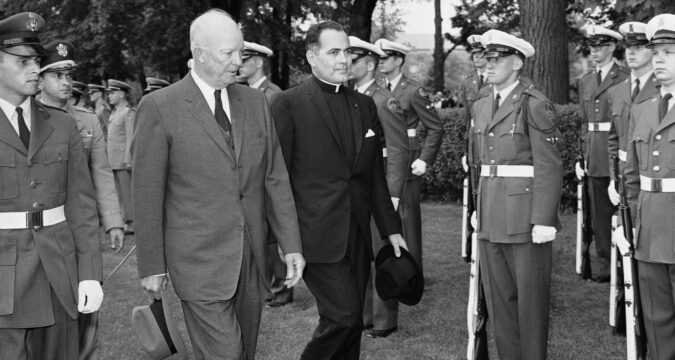
James T. Harris: University presidents face a ‘Star Trek’-like Kobayashi Maru moment
Should university presidents publicly weigh in on the most pressing societal issues of our times? In some academic circles, especially at public universities, it is now common for presidents to adopt a policy of neutrality. For presidents of faith-based universities, taking a position of neutrality can be problematic since the religious order that sponsors your institution believes that attacks on human dignity are not political matters but rather moral ones.
In the fictional world of “Star Trek,” all Starfleet Academy cadets must participate in a command simulation called Kobayashi Maru, named for a civilian space freighter that sends a distress call to a Starfleet ship. The situation is hardwired to be unwinnable. The test is not a measurement of the cadet’s ability to command a starship but rather a psychological exam to see how the cadet handles a moral dilemma.
Higher education leaders in America are currently facing their own Kobayashi Maru moment — defend social justice on their campus or openly criticize the actions of the federal government and put the federal funding vital to their students and the institutions they serve at risk. Alternatively, they could choose to remain silent and avoid the wrath of the federal administration, but then risk losing their moral authority.
As president of a Catholic university, I understand the church’s teachings on such matters as racism and antisemitism, and its stance on violence against immigrants and refugees is clear. Not only does the church condemn these acts, but it also states that silence in the face of injustice is complicity.
The Catholic Church is not alone. Several other faith communities have spoken out on recent immigration crackdowns and the increase in racist tropes and hate crimes against marginalized groups across our country.
The question is: With so many faith communities speaking out against injustice, how can we explain the current silence from college presidents? One could argue that silence is understandable given the certain retribution that would follow.
As “Star Trek” storytelling reveals, Starfleet commander Capt. James T. Kirk decides he cannot accept the no-win situation of the Kobayashi Maru. He breaks into the simulation and rewrites the program so that it is possible to win.
So, how should faith-based higher education leaders proceed? Perhaps we should follow the lead of Kirk and not accept this. We could reprogram our situation by collectively speaking out and working together to refocus on the public good, which has been the hallmark of faith-based higher education for centuries.
There are plenty of examples in history when faith-based institutions took the moral high ground and served as catalysts for debate that stimulated action on the compelling issues of the times. From the anti-slavery campaigns and the Civil Rights Movement, to condemning the death penalty and protecting the environment, faith-based institutions have been leaders on addressing issues that are at the core of a healthy society, support our democracy and promote the public good.
How do we reprogram higher education? We can begin with our local communities. The late U.S. House Speaker Tip O’Neill Jr. used to say that “all politics are local.” Unfortunately, so many of us have focused on being global institutions we have forgotten to first be a good neighbor.
We need to win back the support of our local communities, and we can accomplish this by doing what we do best. We can host open public forums to discuss critical issues and invite local community members. We can organize voter registration drives. We can also encourage members of our campus community to show up for those who are marginalized in society and accompany those in need. We can advocate for those populations in our own neighborhoods and use our expertise to seek justice by creating clinics that provide services and advice to local citizens. These actions speak louder than words, but on occasion, university presidents must also speak out.
As presidents of faith-based colleges and universities, we must band together so that if one is attacked for taking a moral stand based on a faith tradition, we all will publicly support their right to do so.
If we need an example of a faith-based leader who faced their own Kobayashi Maru moment, then we only need to remember the late Rev. Theodore Hesburgh of Notre Dame.
When Hesburgh was approached by President Dwight Eisenhower to lead the Federal Civil Rights Commission, he knew he would upset some elected officials, alumni and donors if he supported the Civil Rights Movement. If he turned down the offer to lead, he would lose his moral authority as a leader. Thankfully, he accepted the challenge.
I cannot imagine a university president in America who would not publicly condemn an attack on human dignity or an act of racism on their own campus. So, why wouldn’t we also speak out collectively when we see such injustice in our country?
College students need role models, and we must lead by example. As leaders of faith-based institutions, let’s embrace our own Kobayashi Maru moment by encouraging public debate on our campuses, becoming more engaged in our local communities and personally standing up for human dignity.
James T. Harris III is president of the University of San Diego.
Submit a letter, of no more than 400 words, to the editor here or email letters@chicagotribune.com.
Review: ‘Morning, Noon, and Night’ taps into anxieties born of the COVID era
At the height of the pandemic, we wondered what artists would have to say about that disconcerting era, once it was finally over and people could gather again in theaters. Many of us expected a great contextualizing flood of plays and films about isolation and lockdowns and Zooms and the other detritus of the era.
We were wrong. In reality, there have been very few such shows and movies.
Why not? Simple. Studios, producers and other gatekeepers rapidly figured out that people did not want to go back there. At times, one can be struck by how much those two years or so, and what they did to us, have been confined to an Orwellian memory hole.
Take Kirsten Greenidge’s “Morning, Noon, and Night,” a domestic comedy about life during the pandemic, first seen in early 2024 and now receiving its Midwest premiere via Shattered Globe Theatre at Theater Wit. Even when she first opened the play in a small East Coast theater, Greenidge insisted to interviewers that this was not a COVID play, even though COVID forms the backdrop and is the cause of many of the characters’ problems.
Greenidge also looks forward here to what is very much the most drastic of the post-COVID issues born of that time — the coming of artificial intelligence as a means for solving our problems, and what is looking more and more like a blurring of reality and simulacra.
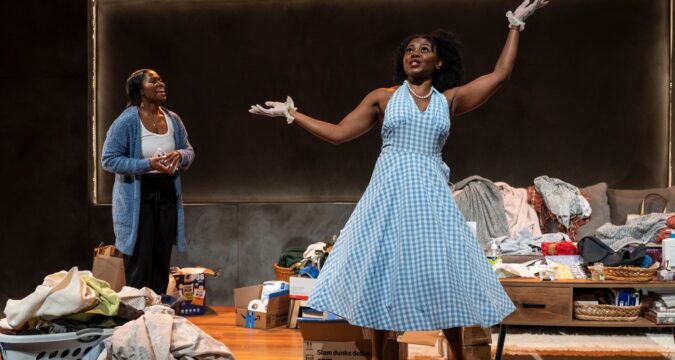
Greenidge weaves her morality play, warning of the dangers of social media and lamenting the changes in human communication, into a family setting that’s economically stressed from the pandemic fallout. Events are centered on the chaotic Mia (Kristin E. Ellis), whose cluttered house is emblematic of the messiness of her life as she tries to navigate her difficult relationship with daughters Alex (estranged and unseen) and Dailyn (very much seen and heard and played here by Emefa Dzodzomenyo), a teen whose modes of conversation and ideas are altogether too influenced by online seductions.
Mia is planning a hopeful birthday party for Alex and Dailyn has her ideas about what that should and should not be. Mia is clearly the author’s main concern here and the center of the play’s POV, especially when her fraught party plans are upended by the arrival of Miss Candice (Leslie Ann Sheppard), a kind of Mary Poppins who may or may not be of our carbon-based world, and whose ministrations may or not be family friendly, at least in the long-term sense of that word.
I think the main point that Greenidge is making is that the impact of COVID on families lingered long beyond lockdown, especially given how much time we spent with screens. Indeed, this feels to me very much like a play a writer would write after being stuck for months in a house with teens, aching to live their lives and sometimes seeing their loving parents as captors, even as moms and dads just tried to hold their lives together.
That’s a valid point, for sure and “Morning, Noon, and Night” is an empathetic and intelligent play, as is typical with this writer. But it’s unwieldy in places, and once Miss Candice enters the fray, we move from social commentary into science fiction and that stresses out the structure. I kept thinking how well written the individual scenes were (they are well-acted, too, in director AmBer Montgomery’s lively production) but somehow that never quite translates to a cohesive experience.
Emefa Dzodzomenyo plays Dailyn in Shattered Globe Theatre’s “Morning, Noon, and Night” at Theater Wit. (Michael Brosilow)
Plays about technology, especially plays that are anti-technology, are very difficult to pull off in the live theater, due, I think, to the difficult of really representing tech developments, or even tech impacts, truthfully. The best of the genre allow for more complexity than this one and don’t try quite so hard to shoehorn so much into 90 minutes. Montgomery’s production also gets trapped at times in the characters, the scenes and the high-style departures from reality, when it needed to focus more on the kinds of honest and recognizable truths that build both dramatic tension and an audience’s belief and empathy.
But while this hardly is a fully satisfying show, I still think you’ll likely enjoy the acting from Ellis and Dzodzomenyo, both excellent as mother and daughter, navigating the push and pull of life in a time so quickly forgotten.
Chris Jones is a Tribune critic
cjones5@chicagotribune.com
Review: “Morning, Noon, and Night” (3 stars)
When: Through March 28
Where: Shattered Globe at Theater Wit, 1229 W. Belmont Ave.
Running time: 1 hour, 30 minutes
Tickets: $40-60 at 773-975-8150 and shatteredglobe.org
https://www.chicagotribune.com/2026/03/03/review-morning-noon-shattered-globe/
Muslim students at Northwestern University carve out a homey Ramadan with iftars and free meals program
One thing Inaaya Firoz, a freshman at Northwestern University, misses the most about Ramadan at home is the sounds of her mother’s footsteps as she races around the house to wake everyone up for suhoor.
The clanking of cereal bowls, the rolling of rotis and her dad whipping up eggs while offering an assist before the early-morning meal: “Utho!” Or, “wake up,” in Urdu.
Other than the pangs of nostalgia, the 18-year-old journalism major and Tampa, Florida, native said spending her first Ramadan away from family has been surprisingly comfortable. But her food intake has taken a hit, Firoz joked.
“Some people (in the dorms) have been making eggs and actual food for sehri, but honestly, when it’s me doing it, I don’t have the energy — I’ll just grab a yogurt, or a croissant, whatever’s quick,” Firoz said.
Though the emphasis of Ramadan is on discipline, gratitude and a spiritual recharge that comes with fasting, a significant amount of time is also spent thinking about food and planning for meals. The other day for suhoor (or sehri, as commonly referred to in Urdu and Persian languages), Firoz had an acai bowl from Shake Smart, leftover from the night before. Iftar, the meal marking the end of the fast, has been a lot easier food-wise, she said.
The last few years have seen broad changes in the Muslim student experience at Northwestern, specifically during the month of Ramadan, when observing students are fasting from dawn to dusk. Each of the dining halls on the Evanston campus will offer a halal food choice until Ramadan ends March 19, guaranteeing at least one high-protein option after a day’s fast. And a free meals program allows fasting students to swipe their dining cards twice daily — one to have iftar in the halls and another to pack up food in take-out containers for suhoor. The two meals per day are provided via the student’s Wildcard.
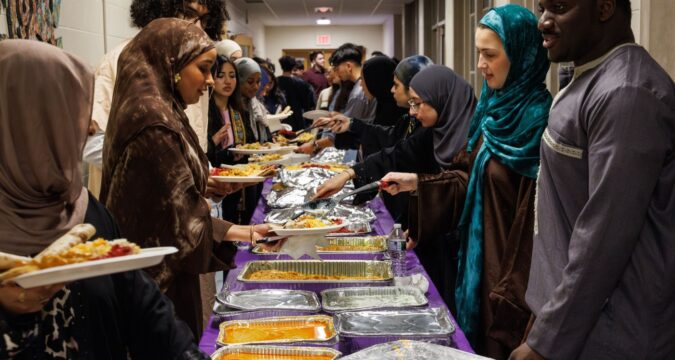
Muhammad Hussain, center, eats with other students while observing Ramadan at a community iftar hosted by the Muslim-cultural Student Association at Northwestern University on Feb. 23, 2026, in Evanston. (Armando L. Sanchez/Chicago Tribune)
Tabitha Wiggins, assistant vice president for campus inclusion and community at Northwestern, said the program is most useful for students who don’t already have an active meal plan. As of Feb. 25, 250 students had signed up for the program, she said.
“They can just sign up for it during Ramadan to be able to break their fast with their peers in the dining halls,” Wiggins said. “It’s completely free. (The university) eats the cost of it for the whole month.”
It’s especially helpful for upper class students like Jannah Issa, who aren’t required to enroll in a meal program and therefore usually fend for themselves.
On a recent Tuesday, after waking up around 4 a.m. for breakfast and early-morning prayers, a full day of classes and housekeeping for Northwestern’s Muslim-cultural Student Association, Issa had chicken and rice at the Foster-Walker dining hall for iftar.
Muslims generally break their fast with a date and water, have a snack or two, and then perform the early-evening prayer known as Maghrib before a more extended dinner. Some might combine the two meals, while others graze on whatever’s handy.
“It’s been really nice, me and some of my friends will just text in our group chat every day now, ‘Like, OK, which dining hall should we go to?’ It’s giving us a point to have that community and meeting space,” Issa said.
Issa, an executive board member for the campus’ undergraduate McSA, has been advocating for more support for Muslim students during Ramadan since her freshman year. Now a senior, she said it’s nice to see that advocacy pay off.
“This year they’ve gotten better at labeling what is halal and what’s not, and they’re making sure that things are clean and separated,” Issa said. “For a while, there was a running joke that (the dining hall) would have pepperoni pizza and it would say ‘halal.’ But getting it right is a necessity and it’s something we’ve been talking about.”
Muhammad Hussain, center, eats with other students while observing Ramadan at a community iftar hosted by the Muslim-cultural Student Association at Northwestern University on Feb. 23, 2026, in Evanston. (Armando L. Sanchez/Chicago Tribune)
In 2024, McSA raised concerns about mislabeling in dining halls after several students noticed things like bacon being offered as halal for breakfast and pork being placed directly next to halal chicken. Issa said servers using the same gloves when directly touching halal and nonhalal meat was a common practice that has since improved.
Food service workers at Foster-Walker, also known as the Plex, told the Tribune last week that the chicken served across campus dining halls is halal year-round, but during Ramadan, they make some notable improvements.
A representative from Northwestern’s contracted food service provider, Compass Group, said they made full-scale modifications to Foster-Walker dining hall to ensure that it is appropriate for students to dine during Ramadan, including a dedicated station that was recently certified halal by the Islamic Food and Nutrition Council of America. An IFANCA certification means students following halal guidelines can eat freely year-round without fear of cross-contamination.
Compass Group also serves a Ramadan menu in a separate corner at each of the five dining halls on campus, with options like chicken vindaloo, Moroccan spiced beef and chicken tinga tacos.
So far, several students told the Tribune that observing Ramadan has been without a fuss, thanks also to the smaller details. One of Issa’s favorite features of Ramadan on campus has been the dates students receive as they’re checking into Foster-Walker.
“(My friends and I) had already bought a bunch of dates, but the first day when we went to Plex, they were handing them out at the counter — it was really thoughtful,” she said.
Wiggins, who oversees five departments as part of her efforts to enhance campus culture, said the Ramadan Meals program has been operational for seven years, but recent changes, like the dates, have enhanced the overall experience for students.
Zara Ahmar, 19, from left, Amani Yousuf, 20, and Sabrina El-Gamal, 20, talk while eating during a community iftar hosted by the Muslim-cultural Student Association at Northwestern University on Feb. 23, 2026, in Evanston. (Armando L. Sanchez/Chicago Tribune)
Additionally, a small room at the back of Foster-Walker has been doubling as a space for Maghrib prayer during Ramadan. Wiggins said other halls are making similar spaces available each night for students who want to pray.
After dinner, students can check out a reusable takeaway container for suhoor the next day. Issa said some students will fill their boxes with dinner leftovers, adding in a few extra servings of protein or grain, but many of them opt for granola, yogurt and fruit for a lighter breakfast.
On the first Monday of Ramadan, Issa was at Parkes Hall setting up for a community iftar hosted by Northwestern’s McSA, an event that had to be capped at 110 students following an influx of RSVPs.
The group catered food from Tawakkul, an Indian-Pakistani restaurant on Devon Avenue in Rogers Park.
After making rounds around the room, Rayan Lahlou-Nabil, a Northwestern sophomore studying neuroscience and global health, was filling his plate with biryani and a strikingly red-colored dish known as Chicken 65.
McSA plans to host more events before Ramadan ends. He said they’ll likely rotate cuisines, as the Muslim student body represents a multitude of ethnicities.
“I believe we have Arab food for our next iftar, inshallah, we had Thai food last year. We really like to spice it up and change it up a little bit,” Lahlou-Nabil said. “The only constraint is, it has to be halal, which is why we commonly have desi because many more of those restaurants are halal.”
As the first McSA director of alumni relations, Lahlou-Nabil works with alumni and parents to collect sponsorships to help fund suhoors and iftars, which are also paid for through the office of Campus Inclusion & Community.
He goes home every weekend to Elmwood Park, where it’s just his immediate family of five. Everyone else in his extended family still lives in Morocco.
“We’re very close so I go as often as I can,” Lahlou-Nabil said. When he’s home, his mom makes his favorite Moroccan fare — couscous, a layered and crispy flatbread called msemmen, harsha (similar to a griddle cake or English muffin) and fish bastilla.
Students pray before breaking their fast during Ramadan at a community iftar hosted by the Muslim-cultural Student Association at Northwestern University on Feb. 23, 2026, in Evanston. (Armando L. Sanchez/Chicago Tribune)
Right before dinner was served at the community iftar, students stood in the front of the room for prayers. They’d gather again for Taraweeh prayers later at night — another accommodation worked out with the administration for Ramadan.
“The whole (McSA) board works hand in hand with the administration and they’ve been very accommodating. Leading up to everything we’re seeing now, we had a lot of meetings and we voiced our needs, our opinions, our concerns,” Lahlou-Nabil said. “A lot of us advocate for what we need, and we’re able to say things like, we need iftar to be available until this time or we need these spaces open until this late (for prayer).”
On Feb. 28, the annual Wildcat Iftar Banquet hosted 250 students, faculty and local community members for an evening that crossed cultures and religions. Many students who attended were not Muslim, but broke fast with dates.
Sophomore Amani Yousuf, who is part Indigenous and part Pakistani and Iranian, said coming to Northwestern after growing up in a more demographically homogenous Lake Forest has been freeing. Good food and good company have been a defining characteristic of Ramadan so far, she said. And soon, a classic early-morning IHOP run with her friends — a Ramadan-rite-of-passage for 20-somethings.
“It sounds like so much fun, but I actually think I’ll definitely eat a more nutritious meal beforehand because I don’t know how well pancakes will settle in the stomach the whole day,” Yousuf laughed. “Suhoor in general when it’s with a group of people, and iftar too — just the concept of coming together for something bigger than yourself is really empowering.”
https://www.chicagotribune.com/2026/03/03/northwestern-university-ramadan/