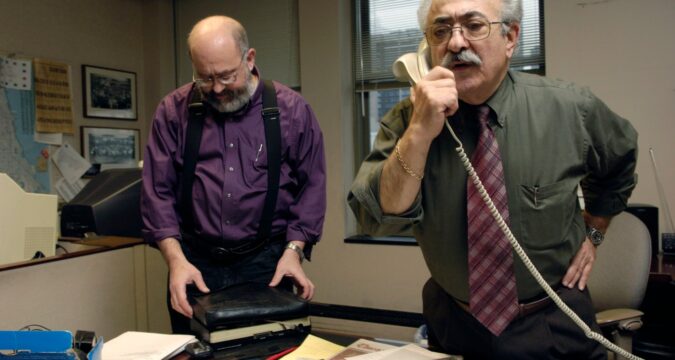
Many of their names helped define Chicago journalism and many of their names mean nothing to you and many of their names are lost to yellowing newsprint.
They worked for a place called the City News Bureau and you have nevertheless benefited from the work done by its thousands of mostly young and eager people, combing the city for generations to gather news both good and bad, bloody and mundane.
It started in 1890 as a collective to provide a number of Chicago newspapers with 24-hour-a-day coverage of local breaking news, gathered by aspiring journalists (and others) who did not mind the low pay, tough bosses and brutal schedules.
It’s gone now, meeting its end two decades ago after 115 years. It died with a whimper, but during its raucous and frenetic heyday, it was the breeding ground for journalists, less a finishing school than a military boot camp.
A new book, “Sirens in the Loop: A History of the City News Bureau of Chicago,” gives you that story. It has the feel of a massive high school yearbook, peppered with the names of kids-who-made-good, such as, first and foremost, Mike Royko, but also such journalists as Seymour Hersh (subject of the currently available documentary “Cover-Up”), Pam Zekman and Charles MacArthur, co-author (with Ben Hecht) of the play “The Front Page.”
Chicago Tribune reporter Pam Zekman works in the newsroom in the 1970s. A native South Sider and competitive ice skater, she started her journalism career at the City News Bureau. When on staff at the Tribune, she became part of its investigative team which would win two Pulitzer Prizes. (Chicago Tribune historical photo)
Chicago Tribune reporter, columnist and City News Bureau alum Anne Keegan works at her desk in the Tribune Tower in the 1970s. (Chicago Tribune historical photo)
As Hersch once put it, “The basics you learn at City News are the basics of the business. I’d argue that you could learn much better there than in journalism school.”
The book tells of the big stories, old and relatively recent. There’s the Iroquois Theatre fire and the sinking of the Eastland. There’s Richard Speck and the bombing of Pearl Harbor, the kidnapping and murder of young Suzanne Degnan, the Tylenol murders and Our Lady of the Angels fire, John Wayne Gacy.
Most CNB alums did go on to careers in journalism. Some became politicians’ spokesfolk or academics and a few thrived in such fields as acting (Melvyn Douglas), novel writing (Kurt Vonnegut) and art (Claes Oldenburg). Most all retained vivid memories of their time on the city’s streets. As Vonnegut once said, “I’m proud of the work I did there. It was just like being a soldier.”
The book was written by James Elsener and mostly by Paul Zimbrakos, who worked for CNB for more than 40 years, and was a comparatively gentle man compared to some of the rough-and-barking bosses of the CNB’s early years, most of that time as its city editor (i.e. boss). He had begun what would become this book in the late 1990s, reaching out to alums for their memories, anecdotes, and, in many cases, their thanks.
“Sirens in the Loop: A History of the City News Bureau of Chicago,” by Paul Zimbrakos and James Elsener. (Eckhartz Press)
In the wake of Zimbrakos’ death, the materials he had gathered were rescued by a former City News Bureau kid (early 1970s) and Tribune vet Elsener.
He writes, with admirable humility, “When I started working on this book, I thought the writing task would be overwhelming. … I discovered that another reporter had already written a story that surpassed anything I could have authored. … My task was to organize the information and edit the manuscript.”
He’s done a fine and terrifically entertaining job, though by focusing on the 1950s onward, he misses any tales of my father Herman Kogan’s time there, which took place in the late 1930s. That’s understandable, as is not mentioning my awkward late-1960s flirtation with CNB that would end with me working as a cab driver.
But it was a delight reading about good friends, colleagues and such CNB alums as Royko, Anne Keegan, Bob Billings, Susan Kuczka, Bernie Judge, Maury Possley and many others. There is even a chapter devoted to the Billy Goat Tavern.
As Elsener writes, “Paul’s vision was for this book to serve as a text for journalism students. I didn’t see it that way. City News Bureau existed because of the vitality of a growing and prosperous Chicago. CNB recorded a daily history of the city and its residents, in partnership with the daily newspapers. … I’m sure journalism educators and students can gather value from the City News story, but the media world has changed too dramatically for it to serve as anything other than a testament to the history of a great city and its distinctive brand of journalism.”
This is not at all a textbook, but rather an intimate look at a time long gone. It overlaps a bit with the only other such book, 1983’s “Behind the Front Page,” by longtime CNB boss Arnold “Dorny” Dornfeld, who is credited with the immortal line in journalism quarters, “If your mother says she loves you, check it out.”
City News Bureau Editor Arnold “Dorny” Dornfeld, left, talks with columnist Mike Royko at Dornfeld’s retirement party in 1970. Dornfeld, who died in 1991 at 84, had worked there since 1926. (Charles Osgood/Chicago Tribune)
Royko wrote the introduction to that book, in which he said of its author, ”The first thing you noticed was the eye. I don’t recall if it was the left or the right eye, but it appeared to be much bigger than the other one… The eye had the effect of a harsh, blinding lamp that cops used to shine in the face of a suspect they were questioning. You wanted to confess, admit your sins, plead guilty-anything to make that unblinking eye turn away.”
This book captures a truly remarkable place, one that once compelled Time Magazine to write, “(City News) is probably the most successful school of practical journalism in the U.S., and its alumni are as well-known as (it) is obscure.”
Many of us in the newspaper business (especially those of us with graying hair) tend to romanticize the past, embellish the stories we covered, and aggrandize people we knew. This fine book does some of that too, and no one need complain.
rkogan@chicagotribune.com
https://www.chicagotribune.com/2026/03/03/sirens-in-the-loop-city-news/


