One thing Inaaya Firoz, a freshman at Northwestern University, misses the most about Ramadan at home is the sounds of her mother’s footsteps as she races around the house to wake everyone up for suhoor.
The clanking of cereal bowls, the rolling of rotis and her dad whipping up eggs while offering an assist before the early-morning meal: “Utho!” Or, “wake up,” in Urdu.
Other than the pangs of nostalgia, the 18-year-old journalism major and Tampa, Florida, native said spending her first Ramadan away from family has been surprisingly comfortable. But her food intake has taken a hit, Firoz joked.
“Some people (in the dorms) have been making eggs and actual food for sehri, but honestly, when it’s me doing it, I don’t have the energy — I’ll just grab a yogurt, or a croissant, whatever’s quick,” Firoz said.
Though the emphasis of Ramadan is on discipline, gratitude and a spiritual recharge that comes with fasting, a significant amount of time is also spent thinking about food and planning for meals. The other day for suhoor (or sehri, as commonly referred to in Urdu and Persian languages), Firoz had an acai bowl from Shake Smart, leftover from the night before. Iftar, the meal marking the end of the fast, has been a lot easier food-wise, she said.
The last few years have seen broad changes in the Muslim student experience at Northwestern, specifically during the month of Ramadan, when observing students are fasting from dawn to dusk. Each of the dining halls on the Evanston campus will offer a halal food choice until Ramadan ends March 19, guaranteeing at least one high-protein option after a day’s fast. And a free meals program allows fasting students to swipe their dining cards twice daily — one to have iftar in the halls and another to pack up food in take-out containers for suhoor. The two meals per day are provided via the student’s Wildcard.
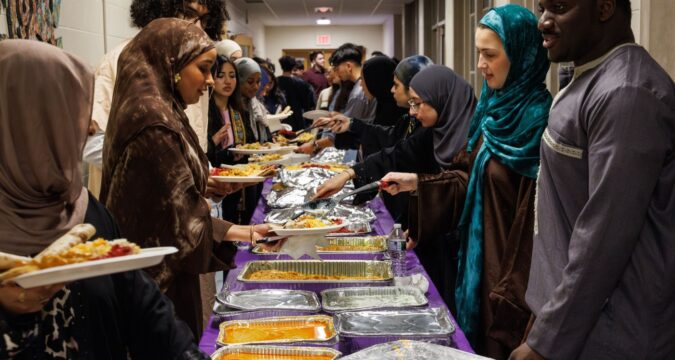
Muhammad Hussain, center, eats with other students while observing Ramadan at a community iftar hosted by the Muslim-cultural Student Association at Northwestern University on Feb. 23, 2026, in Evanston. (Armando L. Sanchez/Chicago Tribune)
Tabitha Wiggins, assistant vice president for campus inclusion and community at Northwestern, said the program is most useful for students who don’t already have an active meal plan. As of Feb. 25, 250 students had signed up for the program, she said.
“They can just sign up for it during Ramadan to be able to break their fast with their peers in the dining halls,” Wiggins said. “It’s completely free. (The university) eats the cost of it for the whole month.”
It’s especially helpful for upper class students like Jannah Issa, who aren’t required to enroll in a meal program and therefore usually fend for themselves.
On a recent Tuesday, after waking up around 4 a.m. for breakfast and early-morning prayers, a full day of classes and housekeeping for Northwestern’s Muslim-cultural Student Association, Issa had chicken and rice at the Foster-Walker dining hall for iftar.
Muslims generally break their fast with a date and water, have a snack or two, and then perform the early-evening prayer known as Maghrib before a more extended dinner. Some might combine the two meals, while others graze on whatever’s handy.
“It’s been really nice, me and some of my friends will just text in our group chat every day now, ‘Like, OK, which dining hall should we go to?’ It’s giving us a point to have that community and meeting space,” Issa said.
Issa, an executive board member for the campus’ undergraduate McSA, has been advocating for more support for Muslim students during Ramadan since her freshman year. Now a senior, she said it’s nice to see that advocacy pay off.
“This year they’ve gotten better at labeling what is halal and what’s not, and they’re making sure that things are clean and separated,” Issa said. “For a while, there was a running joke that (the dining hall) would have pepperoni pizza and it would say ‘halal.’ But getting it right is a necessity and it’s something we’ve been talking about.”
Muhammad Hussain, center, eats with other students while observing Ramadan at a community iftar hosted by the Muslim-cultural Student Association at Northwestern University on Feb. 23, 2026, in Evanston. (Armando L. Sanchez/Chicago Tribune)
In 2024, McSA raised concerns about mislabeling in dining halls after several students noticed things like bacon being offered as halal for breakfast and pork being placed directly next to halal chicken. Issa said servers using the same gloves when directly touching halal and nonhalal meat was a common practice that has since improved.
Food service workers at Foster-Walker, also known as the Plex, told the Tribune last week that the chicken served across campus dining halls is halal year-round, but during Ramadan, they make some notable improvements.
A representative from Northwestern’s contracted food service provider, Compass Group, said they made full-scale modifications to Foster-Walker dining hall to ensure that it is appropriate for students to dine during Ramadan, including a dedicated station that was recently certified halal by the Islamic Food and Nutrition Council of America. An IFANCA certification means students following halal guidelines can eat freely year-round without fear of cross-contamination.
Compass Group also serves a Ramadan menu in a separate corner at each of the five dining halls on campus, with options like chicken vindaloo, Moroccan spiced beef and chicken tinga tacos.
So far, several students told the Tribune that observing Ramadan has been without a fuss, thanks also to the smaller details. One of Issa’s favorite features of Ramadan on campus has been the dates students receive as they’re checking into Foster-Walker.
“(My friends and I) had already bought a bunch of dates, but the first day when we went to Plex, they were handing them out at the counter — it was really thoughtful,” she said.
Wiggins, who oversees five departments as part of her efforts to enhance campus culture, said the Ramadan Meals program has been operational for seven years, but recent changes, like the dates, have enhanced the overall experience for students.
Zara Ahmar, 19, from left, Amani Yousuf, 20, and Sabrina El-Gamal, 20, talk while eating during a community iftar hosted by the Muslim-cultural Student Association at Northwestern University on Feb. 23, 2026, in Evanston. (Armando L. Sanchez/Chicago Tribune)
Additionally, a small room at the back of Foster-Walker has been doubling as a space for Maghrib prayer during Ramadan. Wiggins said other halls are making similar spaces available each night for students who want to pray.
After dinner, students can check out a reusable takeaway container for suhoor the next day. Issa said some students will fill their boxes with dinner leftovers, adding in a few extra servings of protein or grain, but many of them opt for granola, yogurt and fruit for a lighter breakfast.
On the first Monday of Ramadan, Issa was at Parkes Hall setting up for a community iftar hosted by Northwestern’s McSA, an event that had to be capped at 110 students following an influx of RSVPs.
The group catered food from Tawakkul, an Indian-Pakistani restaurant on Devon Avenue in Rogers Park.
After making rounds around the room, Rayan Lahlou-Nabil, a Northwestern sophomore studying neuroscience and global health, was filling his plate with biryani and a strikingly red-colored dish known as Chicken 65.
McSA plans to host more events before Ramadan ends. He said they’ll likely rotate cuisines, as the Muslim student body represents a multitude of ethnicities.
“I believe we have Arab food for our next iftar, inshallah, we had Thai food last year. We really like to spice it up and change it up a little bit,” Lahlou-Nabil said. “The only constraint is, it has to be halal, which is why we commonly have desi because many more of those restaurants are halal.”
As the first McSA director of alumni relations, Lahlou-Nabil works with alumni and parents to collect sponsorships to help fund suhoors and iftars, which are also paid for through the office of Campus Inclusion & Community.
He goes home every weekend to Elmwood Park, where it’s just his immediate family of five. Everyone else in his extended family still lives in Morocco.
“We’re very close so I go as often as I can,” Lahlou-Nabil said. When he’s home, his mom makes his favorite Moroccan fare — couscous, a layered and crispy flatbread called msemmen, harsha (similar to a griddle cake or English muffin) and fish bastilla.
Students pray before breaking their fast during Ramadan at a community iftar hosted by the Muslim-cultural Student Association at Northwestern University on Feb. 23, 2026, in Evanston. (Armando L. Sanchez/Chicago Tribune)
Right before dinner was served at the community iftar, students stood in the front of the room for prayers. They’d gather again for Taraweeh prayers later at night — another accommodation worked out with the administration for Ramadan.
“The whole (McSA) board works hand in hand with the administration and they’ve been very accommodating. Leading up to everything we’re seeing now, we had a lot of meetings and we voiced our needs, our opinions, our concerns,” Lahlou-Nabil said. “A lot of us advocate for what we need, and we’re able to say things like, we need iftar to be available until this time or we need these spaces open until this late (for prayer).”
On Feb. 28, the annual Wildcat Iftar Banquet hosted 250 students, faculty and local community members for an evening that crossed cultures and religions. Many students who attended were not Muslim, but broke fast with dates.
Sophomore Amani Yousuf, who is part Indigenous and part Pakistani and Iranian, said coming to Northwestern after growing up in a more demographically homogenous Lake Forest has been freeing. Good food and good company have been a defining characteristic of Ramadan so far, she said. And soon, a classic early-morning IHOP run with her friends — a Ramadan-rite-of-passage for 20-somethings.
“It sounds like so much fun, but I actually think I’ll definitely eat a more nutritious meal beforehand because I don’t know how well pancakes will settle in the stomach the whole day,” Yousuf laughed. “Suhoor in general when it’s with a group of people, and iftar too — just the concept of coming together for something bigger than yourself is really empowering.”
https://www.chicagotribune.com/2026/03/03/northwestern-university-ramadan/


