Category: News

U. of C. finance professor lists Italianate-style, 5-bedroom home in Hyde Park for $3.2M
University of Chicago Booth School of Business finance professor Luigi Zingales and his wife, Jill, on Feb. 10 listed their five-bedroom, 5,000-square-foot, vintage Italianate-style brick home in Hyde Park for $3.2 million.
An expert on corporate governance and financial development, Zingales, 63, has taught at U. of C. for more than 30 years.
In Hyde Park, Zingales and his wife paid $1.1 million in 2010 to buy the house, which was just a few doors away from his previous home.
Built in the late 1860s or early 1870s and renovated by the couple, the house has many of its original features, including 15-foot ceilings on the first floor, four original marble fireplaces, a sweeping staircase to the second floor and oversized windows and doors.
Other features include a contemporary kitchen, new windows and a new roof. Outside on the 0.16-acre property are a deck and yard.
A lengthy 1951 Tribune article profiled the home’s owner at the time, Lenore Wood, who reportedly bought it to house her extensive collection of furniture and treasures.
In the article, Wood, a physical education instructor at Herzl Junior College, the predecessor to Malcolm X College, is reported to have named the home’s rooms.
Names included Martingale for the kitchen, Cheshire Cheese for the dining room, Golden Temple for a guest bedroom and Bibliotheque for the north sitting room. The story noted that she had named the home Woodhaven.
Later longtime owners of the home were Judith Getzels and her husband, Jacob, a professor of education and psychology at the U. of C. who died in 2001.
Zingales and his wife bought the home from the Getzels family.
Listing agent Robert Sullivan declined to comment on the property beyond what is in published listing remarks.
The house had a $34,913 property tax bill in the 2024 tax year.
Goldsborough is a freelance reporter.
https://www.chicagotribune.com/2026/03/03/elite-street-hyde-park-zingales/

Barrington 5-bedroom home with wine cellar and tasting room: $2.4M
Address: 1520 Macalpin Circle, Barrington
Price: $2,350,000
Listing date: Jan. 13, 2026
This five-bedroom home has six full bathrooms, two half baths, a two-story foyer and three levels served by an elevator. The great room features a floor-to-ceiling stone fireplace, a custom wet bar and built-in bookcases. The kitchen offers custom cabinetry, granite and walnut countertops, a walk-in pantry and a five-burner Dacor cooktop with a custom commercial hood. The main-level primary suite has a tray ceiling, a dressing room, a coffee and juice bar and a private deck overlooking the water. A second primary suite is located on the second floor, along with three other bedrooms. The walk-out lower level has a library with cherry floors and a wine cellar and tasting room. This home has professionally landscaped grounds with pond views, a tiered stone patio, a deck and a three-season porch. A circular paver drive, billiard and craft rooms and a three-car garage complete this home.
(Meg Berger)
(Meg Berger)
(Meg Berger)
(Meg Berger)
(Meg Berger)
(Meg Berger)
(Meg Berger)
(Meg Berger)
(Meg Berger)
(Meg Berger)
Listing agent: Heidi Seagren, Compass, 847- 306-0600
Some listing photos are “virtually staged,” meaning they have been digitally altered to represent different furnishing or decorating options.
To feature your luxury listing of $1,000,000 or more in Chicago Tribune’s Dream Homes, send listing information and high-res photos to ctc-realestate@chicagotribune.com.
https://www.chicagotribune.com/2026/03/03/barrington-home-wine-cellar-tasting-room/

Daniel DePetris: Donald Trump’s pitiful case for going to war with Iran
As President Donald Trump tells it, the United States had no other option than to launch a large-scale bombing operation against Iran. The threat the Iranians posed to the United States was simply too high; Iran’s history of mayhem inside the Middle East was too long to ignore; and Iranian negotiators weren’t serious about striking a deal on Tehran’s nuclear program. “They’ve rejected every opportunity to renounce their nuclear ambitions, and we can’t take it anymore,” Trump told the nation an hour after the U.S. military operation began on Saturday.
The Trump administration’s argument for war rests on two pillars. First, Iran is an imminent national security threat to U.S. interests in the Middle East. And second, Iran never wanted to find a diplomatic route out of the nuclear crisis that has bedeviled U.S.-Iran relations for more than two decades.
Trump’s case, however, is flat-out wrong. This conflict, which has spread to other countries in the region and is affecting energy prices, didn’t need to happen.
Following the operation, Trump, Defense Secretary Pete Hegseth and Gen. Dan Caine, chairman of the Joint Chiefs of Staff, have pointed to Iran’s stockpile of ballistic missiles as one reason the United States needed to take military action. Some administration officials have claimed that Iran was preparing to strike U.S. bases in the region in a preemptive attack so the U.S. military had no choice but to take action. But this claim was about as truthful as then-National Security Adviser Condoleezza Rice’s assertion that there could be a “mushroom cloud” over an American city if Saddam Hussein wasn’t stopped in Iraq. In other words, it wasn’t true at all.
Sure, Iran’s missiles pose a threat. Ask Saudi Arabia, which was on the receiving end of a volley of Iranian cruise missiles in September 2019, forcing Riyadh to cut about half of its crude oil production for a few days. Or ask Israel, which was the target of Iranian missile attacks in April and October 2024 and last June before the most recent hostilities. And yes, Iran’s short-range missiles can reach a good chunk of Washington’s military infrastructure in the region, as we’re currently seeing.
But it’s not like this is a new development. The Iranians have been investing significant funds in their missile program because Tehran’s conventional military capability — its air force, navy and army — is antiquated, unimpressive and inexperienced. Iranian fighter jets might as well be displayed in a museum somewhere; a good portion of them can be traced back to the era of the shah. Iran’s navy, or what’s left of it after the U.S. took out several ships over the weekend, relies on small fast-attack boats suited more for pestering civilian tankers than actually fighting destroyers on the high seas.
Iranian ground forces, meanwhile, haven’t fought a war since the 1980s. So it’s no wonder Tehran is betting its defense strategy on missiles — missiles, by the way, that the United States wouldn’t have to worry about at all if U.S presidents from both parties didn’t stubbornly cling to the notion that we needed tens of thousands of troops based in the Middle East at any given time.
What about Iran’s nuclear program? Surely the Iranians are making a dash to the bomb, right?
Wrong. Before the first Trump administration stupidly withdrew from the 2015 nuclear deal, Tehran’s nuclear apparatus was essentially under lock and key. Iranian enrichment had been curtailed, its stockpile of enriched materiel capped well below what it needed for a bomb and international nuclear inspectors examining the entirety of Iran’s nuclear infrastructure. After Trump withdrew the U.S. from President Barack Obama’s negotiated nuclear deal, the Iranians increased the quality of their centrifuges, churned out more enriched uranium at higher grades and built up a sizable stockpile of enriched materiel. Yet the U.S. intelligence community still assessed that Iranian Supreme Leader Ayatollah Ali Khamenei had not yet made the decision to actually acquire nuclear weapons.
Bombing Iran to stave off a hypothetical Iranian nuclear bomb is even less convincing today than it was back then. Despite what U.S. officials are telling the public, there is no evidence whatsoever that Tehran’s nuclear program was close to a bomb. The Iranians have yet to recover from the U.S. military operation last June, which severely damaged their three major nuclear facilities and likely destroyed a large portion of their centrifuges. The 400 kilograms of highly enriched uranium Iran possessed at the time is now buried deep underground in one of those damaged facilities, and as far as we know, the Iranians haven’t bothered to dig it out. The only work Iran has done on its nuclear program since June is to fortify what’s left of it in preparation for additional U.S. strikes.
Then there’s the issue of the negotiations. Trump has repeatedly stated that Tehran wasn’t committed to a diplomatic resolution. However, the problem wasn’t Iran’s willingness to compromise — it was Trump’s willingness to accept the fact that any nuclear deal he struck wasn’t going to result in everything he wanted. Unfortunately, this is something Trump was unable to come to terms with. The U.S. position throughout the monthlong talks was maximalist to the core: Iran must give up all of its enriched uranium, stop enriching for eternity and, after all that’s agreed to, negotiate its ballistic missile arsenal away. Of course, none of this was going to happen, and we must question whether the Trump administration actually believed those goals could be accomplished.
When all is said and done, Trump opted to fight a war of choice without a rationale that was even semi-convincing. And just as bad, he didn’t bother to explain it all to the American people beforehand.
Daniel DePetris is a fellow at Defense Priorities and a foreign affairs columnist for the Chicago Tribune.
Submit a letter, of no more than 400 words, to the editor here or email letters@chicagotribune.com.
https://www.chicagotribune.com/2026/03/03/column-iran-war-donald-trump-depetris/

Editorial: Illinois’ youngest victims deserve more than silence
We’re a society obsessed with kids — how best to educate them, when to introduce technology into their lives, how they eat, sleep and dress. Many of our elected officials are encouraging us to have more of them.
We must also be willing to confront the violence that some of Illinois’ youngest children face.
A data-driven analysis from Northwestern University released late last month examined 121 incidents between 2015 and 2022 in which children under age 10 died from violent force inflicted by a caregiver. It tells a very specific story about violent deaths of young children that investigators classified as fatal abuse.
Namely, that this is overwhelmingly a very young child problem.
Children aged three and under accounted for 60% of deaths in the report.
Let that sink in: Toddlers.
This report is a grim read. The nature of these deaths is cruel and brutal, often “hands-on” violence, not rare freak events. Blunt force injuries account for nearly half of fatalities, meaning a person beat a young child to death. Other times, deaths include multiple injuries, gunshot wounds, suffocation, burns or shaking.
Where circumstances were documented, crying and fussiness was the most commonly reported situation preceding the fatal injury. In other words, completely normal developmental behavior triggered lethal violence.
We wanted to look for patterns to help diagnose the problem, and they’re certainly there. Geography and poverty matter. Fatalities were concentrated in higher-poverty census tracts but they occurred across income levels and in communities throughout the state. This is not a problem confined to any single ZIP code. What we take from this information is that child protection policies should target high-poverty concentrations and also avoid assuming “this can’t happen here.”
One of the most frightening things we read was that most of these victims weren’t “known to the system” beforehand. Just 8.3% had a prior Child Protective Services report before the fatal incident. When the relationship was known, the suspect was most often a biological parent. In other cases, it was a mother’s boyfriend, a babysitter or a step-parent. These crimes unfolded inside the child’s closest circle, not at the hands of strangers.
What does this mean?
It means we can’t hope a bureaucratic system will fix this, for starters. It also suggests how isolated some families become. When parents are overwhelmed and children are hidden from view, warning signs are easier to miss.
Keeping in mind that the system only knew about a fraction of these cases beforehand, beefing up investigations alone won’t fix the problem.
These deaths are rarely preceded by a thick paper trail. They often emerge at the intersection of fragile children and overwhelmed adults.
Policy can reduce risk, especially in the earliest years of life, but it cannot replace watchful adults. A good start would be universal hospital-based education on coping with crying and safe soothing, along with routine pediatric screening for caregiver stress and domestic instability. And, frankly, we need to do a better job with mothers, postpartum. Too many mothers still experience a postpartum model that consists of discharge, a six-week visit and little else. When we know that crying and fussiness often precede fatal injuries, leaving exhausted parents largely on their own in those early weeks is a gap Illinois should confront.
Still, the heaviest lifting must come from those in a child’s inner circles.
Check on the new parents in your life. Bring food. Offer an hour of child care. Ask how they’re really doing. And if you see signs a child isn’t thriving, such as unexplained injuries, extreme withdrawal or chronic distress, don’t ignore them.
Support the parents, but err on the side of the child. Paying attention is an act of protection.
Submit a letter, of no more than 400 words, to the editor here or email letters@chicagotribune.com.

Big money and national issues collide in ‘quarter-century opportunity’ to succeed U.S. Rep. Jan Schakowsky
In 1998, when Illinois’ 9th Congressional District last held an open-seat primary after nearly a half-century of representation by Sidney Yates, it was a three-way Democratic fight. Jan Schakowsky prevailed, and the guy who came in last was a young heir to a hotel fortune named JB Pritzker.
Nearly 30 years later, the contrast is stark. With Schakowsky retiring, 15 Democrats are vying for the nomination, a crowded race that is among the most closely watched House primaries in the country. It’s a contest that encapsulates how much the Democratic Party has transformed in the Trump era, the growing influence of outside money in safe-blue districts and the generational shift in a seat long anchored by Chicago’s liberal Jewish political tradition.
Ninth Congressional District candidates JB Pritzker, left, state Sen. Howard Carroll and state Rep. Jan Schakowsky wait for their cue to step onto a stage at the beginning of a debate on Jan. 25, 1998, at the Ezra Habonim Synagogue in Skokie. (John Lee/Chicago Tribune)
What might once have been a largely local affair has become a fight about the political party’s direction as much as constituent issues in the district that represents parts of Chicago’s North Side as well as many north and northwest suburbs.
The March 17 primary is all but certain to determine the district’s next member of Congress. The question for voters is not whether to send a Democrat to Washington, D.C., but what kind.
Schakowsky, a stalwart progressive, became a national voice on abortion rights, consumer protection and opposition to the Iraq War. The slate to replace her is diverse, reflecting the broader region, as both longtime politicians and a handful of outsiders have proven competitive.
Evanston Mayor Daniel Biss, state Sen. Laura Fine of Glenview and political commentator Kat Abughazaleh led fundraising at the latest reporting deadline last month. Narrowly, the race between the three of them is a fight over who has the most solid grounding among two established local officials in core suburban parts of the district and a young, newly established Chicagoan looking to push the conversation to the left.
9th Congressional District candidates Evanston Mayor Daniel Biss, from left, state Sen. Laura Fine and political commentator Kat Abughazaleh participate in a debate moderated by Paris Schutz, right, at WFLD-Ch. 32 in Chicago, Feb. 25, 2026. (Chris Sweda/Chicago Tribune)
9th Congressional District candidates state Sen. Mike Simmons, from left, Skokie school board member Bushra Amiwala and former FBI agent Phil Andrew participate in a debate at WFLD-Ch. 32 in Chicago, Feb. 25, 2026. (Chris Sweda/Chicago Tribune)
But the rest of the field — including former FBI agent and shooting survivor Phil Andrew, Gen Z Skokie school board member Bushra Amiwala, state Sen. Mike Simmons of Chicago and state Rep. Hoan Huynh of Chicago — is knocking doors and chatting in donor living rooms from Uptown to Wilmette and Crystal Lake, searching for a path toward an upset.
If there is a single through line, it is the nationalization of what was once more local business.
President Donald Trump’s aggressive immigration enforcement in the Chicago region looms over candidate forums. While their visions for how to best resist ICE differ, the leading candidates have said the agency can’t continue in its current form. And in a lightning round of questions at a recent forum in Evanston, all six participating candidates, those listed above except Huynh, shared other points of consensus, backing a transition to universal health care and opposing federal legislation to ban gender-affirming care for children.
For the past several weeks, though, the most heated exchanges have centered not on policy differences but on money — most prominently, the role of donors aligned with the pro-Israel lobbying group American Israel Public Affairs Committee, who have benefited Fine’s campaign.
Moving forward, that debate could extend to the U.S. and Israel’s attacks on Iran this past weekend and the ensuing spiral of war in the Middle East.
Biss, Fine and Abughazaleh each released statements on the strikes: Abughazaleh referred to an earlier statement that she wouldn’t support a vote to attack Iran and believed it was just part Trump’s efforts to assert power; Fine said Trump needed to be reined in and impeached; and Biss criticized both Trump and Israeli Prime Minister Benjamin Netanyahu for pushing “another reckless and illegal regime change war.”
The Evanston panel discussion hosted last month by a group called Pink Poster Club quickly turned into a debate about the outside groups that have now dumped more than $5.1 million into the race, mostly to support or oppose Biss or Fine and six figures to oppose Abughazaleh, according to filings from the Federal Election Commission.
And there are other signs of influence. An analysis of contribution records shows a substantial share of Fine’s most recent fundraising — close to $1 million last quarter out of $1.3 million raised — came from contributors who matched the names and zip codes of those who previously gave to AIPAC or an affiliated super PAC, United Democracy Project. And of the $5.1 million in independent expenditures for the entire race as of Monday, a newly formed super PAC, Elect Chicago Women, accounted for all but about $1 million — funding television ads, mailers and phone outreach either supporting Fine or opposing Biss.
Fine has said she did not solicit AIPAC’s endorsement and that donors backed her because of her legislative record. As a supporter of Israel and a Jewish woman, she said she’s not surprised to have the support of those who also contribute to AIPAC.
The clash mirrors a broader fight within the Democratic Party, as progressive candidates push for a more confrontational stance toward Israel’s government and more moderate lawmakers warn against alienating pro-Israel voters and donors.
“It’s okay to just admit that AIPAC is supporting you because they agree with your position on military aid to Israel, but own that,” Biss said to Fine on the Evanston forum stage. “Nobody who says they’re tough enough to go to Washington and fight against Donald Trump and the authoritarian nightmare should be too scared to tell their own constituents about who’s donating and why.”
In addition to the AIPAC issue, Biss and Fine have each tried a guilt-by-Republican-donation tactic, pointing to the other accepting money from people who have in the past contributed to GOP candidates and committees — Biss homing in on donors to Fine who previously supported Trump and Fine accusing Biss of not telling voters about Republicans on his own donor rolls.
Pressed about outside spending, Fine has called for overturning the Supreme Court’s Citizens United decision and on the debate stage described herself as a “punching bag” for rivals unable to assail her legislative work.
Fine’s husband, Michael, lost an arm after a car crash in 2010, setting off her years-long work on health care legislation. Recently, she introduced state legislation that would ban people hired as ICE agents during the Trump administration from later becoming law enforcement officers.
“There are many candidates out there that are attacking me, but they can’t attack my record,” she said in an interview.
Biss’ outside support is primarily split between the Congressional Progressive Caucus and 314 Action, a fundraising committee.
Abughazaleh, who is Palestinian on her father’s side and whose massive online audience came from her work criticizing the far right, also has a “red box”-style page on her website outlining talking points, suggesting she’s seeking outside funding, though FEC reports don’t reflect any spending in support of her as of this week. Among her most recent endorsers is a new group called PAL PAC, which says it supports candidates who oppose human rights abuses by Israel against Palestinians.
Electing her would represent not only a progressive vote in Congress but an insurgency in the district.
Shortly after moving to Chicago from out of state, Abughazaleh initially launched her campaign as a primary challenge to Schakowsky, only for the congresswoman to announce her retirement weeks later.
Having never held public office, she has embraced an unconventional political approach, combining dropping f-bombs and fundraising on live streams with hosting mutual aid events as she has sought to channel the energy of younger voters impatient with incrementalism.
Abughazaleh is also dealing with a different kind of political challenge: she and five others have been indicted by the Trump administration, accused of conspiring to impede immigration agents during protest activity at the federal immigration processing center in west suburban Broadview. A jury trial in the case is scheduled to start in late May, several weeks after the primary.
Abughazaleh has cast the charges as political retaliation and an attack on free speech by the Trump administration and said voters have shown they want a new generation of leadership over “a quote-unquote ‘more moderate’ candidate.”
“For me, ‘the center’ is, everyone has equal rights. For me and pretty much every American, it’s that you and your loved ones can live a safe, happy life without begging for scraps or being exploited by billionaires. And so, these ideas that have been touted as moderation instead have been hurting us,” she said.
Biss, another Broadview protester who was not indicted, has made the case in interviews and across the campaign trail that he’s a progressive who can work both inside and outside government. He’s a former assistant math professor at the University of Chicago and previously ran unsuccessfully for governor in 2018 against Pritzker.
“The basic attitude we oughta have, when the level of emergency is what it is, is any tool that we can find, we use, and that’s the approach that I’ve taken as mayor of Evanston,” Biss said, asked about how he would work in Congress at a debate last week televised on Fox 32.
Fault lines have also developed over the national Democrats’ current leadership. During a yes-no round of questions at the Evanston forum, Fine and Simmons indicated support for current House Democratic leader Hakeem Jeffries to become House speaker, though Simmons’ campaign later said he’d wait to hear from contenders to make a final decision. Amiwala and Abughazaleh held up “NO” paddles, and Andrew and Biss didn’t appear to answer.
Andrew, who survived a 1988 school shooting and later built a career in crisis negotiation at the FBI, has campaigned against what he calls “petty corruption” in Illinois politics and pledged to serve no more than 10 years. He recently received endorsements from Steve Kerr, the former Chicago Bulls guard and Golden State Warriors coach whose father was assassinated in 1984, and from former Evanston Mayor Steve Hagerty.
And Andrew has repeatedly attacked both Fine and Biss for exploiting a loophole that allows them to spend state campaign cash on ads and mailers that effectively benefit their federal races by running for both Congress and for Democratic Party state central committee posts.
“Will we continue with the broken politics of the past and do something bold and courageous and really lead in a moment of crisis? Or will the sort of inertia of political machinery win?” Andrew said.
Amiwala, first elected to the Skokie school board at 21, has also fought her way to the top of the crowded field, despite not following the traditional path in Illinois politics. Focused on boosting turnout in Skokie, Lincolnwood, parts of Evanston and other parts of the congressional district where she has built a base, she has argued that the district can send a signal about the party’s direction.
Given Illinois’ relatively early primary, Amiwala said, the “type of Democrat we elect in this district will send the message and signal of, good is not good enough, right? We deserve elected officials, candidates and representatives who understand the communities they’re seeking to represent, who are not scared to take bold ideas and stances.”
Simmons, the first Black person to represent his district and the state Senate’s only openly LGBTQ member, has often said that he doesn’t look like a typical member of Congress — and last last month, according to a video and news release from his campaign, a woman called the police on him while he sought to talk to constituents in an apartment building, an incident he called “canvassing while Black.”
“I would expect more from my neighbors. But you take care,” Simmons says in the video.
Simmons, who grew up in Lincoln Square, has emphasized his roots throughout the campaign and his efforts to push colleagues to take difficult votes, including in support of transgender residents.
He said he thinks people are looking for “new blood, a new generation of people with real roots here, as I have, and people who have shown they can get this work done.”
State Rep. Hoan Huynh, candidate for Illinois’ 9th Congressional District, answers questions after a press conference at his campaign office in Uptown, Jan. 29, 2026. (Eileen T. Meslar/Chicago Tribune)
Huynh has noticeably stayed out of some of the intraparty skirmishes and tried to campaign primarily on the tax-the-rich-type economic plan he’s introduced in Springfield. It would charge one-fifth-of-a-cent on investment transactions at multibillion-dollar hedge funds, which Huynh argues could pay for property tax rollbacks, transit and schools.
The plan appears on Huynh’s website more prominently than any other information about his candidacy or his life background as a refugee from Vietnam.
“We’ve been very laser-focused,” Huynh said. “That’s how we’re going to win this race, is providing a very clear solution to addressing affordability.”
Early voting began last month.
“It’s a quarter-century opportunity,” Simmons said — important “not just because of how long it’s been since we had an open primary, but also because of what’s going on in our country, and the fascism that Donald Trump has unleashed.”
https://www.chicagotribune.com/2026/03/03/illinois-9th-congressional-big-money/
Letters: By going to war with Iran, President Donald Trump isn’t simply doing Israel’s bidding
The Tribune Editorial Board rightly points out the risks facing the United States and the world surrounding President Donald Trump’s decision to strike Iran (“We won’t miss the Supreme Leader of Iran. But does Donald Trump have a real plan?” March 2). Opening the path to a different Iran and stability in the Middle East is something everyone on the planet should be wishing for, but this operation has enormous risks. Well said.
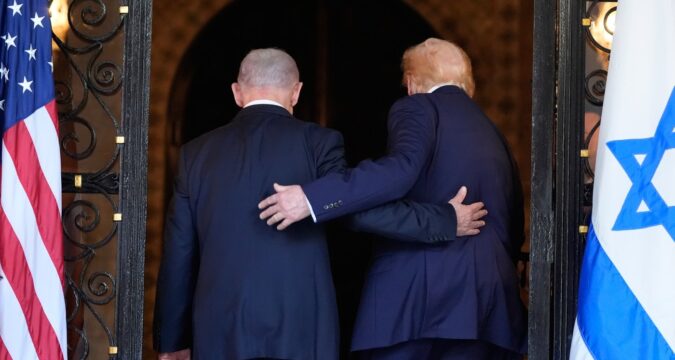
Unfortunately, the editorial board can’t help itself. It writes that leaders who shoot from the hip and operate on hunches, as Trump is often seen doing, “are always vulnerable to outside manipulation,” then the board states that “in the era of Prime Minister Benjamin Netanyahu, Israeli and U.S. interests are not always the same.” The clear implication is that Israel is pulling the strings and Trump is being manipulated.
That sort of characterization (often found in crazed rants on social media) completely misses what is going on here. Israel surely wants regime change in Iran. Under the supreme leader, Iran would have wiped Israel off the map if it had the ability to do so.
So yes, Israel fully supported not just limiting Iran’s ability to develop a nuclear weapon but also, if possible, creating regime change. Jews and Persians have a long, vibrant and positive history together since biblical times, and only since 1979, the Iranian Revolution, has this relationship soured. The brutal Iranian regime posed a threat to Israel’s existence, and Israel is merely acting as any nation-state would — to protect itself and its citizens.
But to think that Donald Trump is a mere puppet of Israel and its supporters misses the bigger picture involving the United States and the region. Iran provides weapons to Russia and supports its war machine in Ukraine. It also provides oil to China in violation of the sanctions we imposed. The relationships Russia and China have with Iran have allowed them to gain a stronger geopolitical foothold in the Middle East, which challenges American influence in the region.
You may not think these issues are worth starting a war over, but there are plenty of smart people in Washington who do.
So yes, Israel is happy to see the Iranian leadership taken down in order to better protect itself, but U.S. interests in the region are broader. To suggest Trump is merely doing Netanyahu’s bidding really misses the mark.
— Dean Gerber, Chicago
Breeding instability
The United States and Israel launched airstrikes on Iran reportedly to prevent it from developing nuclear weapons. President Donald Trump asserted that in his statement on the attacks: “To the great proud people of Iran, I say tonight that the hour of your freedom is at hand. Stay sheltered. … When we are finished, take over your government. It will be yours to take. This will be probably your only chance for generations.”
Notably, the United States and the CIA carried out a coup in Iran in 1953 that overthrew popular Prime Minister Mohammad Mosaddegh to protect British and U.S. oil interests. With approval of the Iranian parliament, Mossadegh had nationalized the Iranian oil industry. Iranian oil had been controlled by the British Anglo-Iranian Oil Co. (later known as BP).
After the shah, Mohammad Reza Pahlavi, was reinstated as authoritarian ruler, he signed over significant portions of Iran’s oil fields to U.S. companies.
The coup ended Iran’s first experiment with democracy and ushered in over two decades of dictatorship under the shah. His regime was notorious for human rights abuses conducted by the secret police (SAVAK), which was trained by the CIA and Israel’s Mossad.
In the words of Mosaddegh: “Yes, my sin … is that I nationalized Iran’s oil industry and discarded the system of political and economic exploitation by the world’s greatest empire.”
Until the U.S. confronts its record of overthrowing other nations’ governments, its claims to defend freedom will ring hollow. It cannot expect to gain the world’s trust, and its wars will keep breeding the very instability it claims to prevent.
— Terry Hansen, Grafton, Wisconsin
So that wasn’t the case?
Oh, so President Donald Trump lied to us (again) when he told us in June that we had destroyed Iran’s nuclear facilities?
— Dorothy Grossman, Chicago
Foresight and fortitude
Iran has often chanted “death to America.” In that respect, President Donald Trump is putting America first and will continue to put America first.
Meeting the goals of Operation Epic Fury (destroying Iran’s nuclear program and dismantling its army, missile and drone capabilities) will put the Middle East on the cusp of historic change. And America as well as the rest of the world will be safer.
Amen to peace through strength. No other U.S. president would have the foresight and fortitude to embark on such a dangerous mission in efforts to bring about regime change.
— JoAnn Lee Frank, Clearwater, Florida
A win for good guys
The death of Ayatollah Ali Khamenei is a win for the good guys.
— Bruce R. Hovanec, Chicago
Where is Congress?
One of the Founding Fathers’ greatest fears was the concentration of too much power in any single branch of our government. Today, that fear is clear in the failure of Congress to make any effort to rein in the seemingly endless power grab by President Donald Trump.
Even the U.S. Supreme Court recognized the power play by Trump when it chided Congress for not doing its job. So where are our elected officials? Little has been heard from Congress in the face of Trump’s declaring war on Iran. Trump’s behavior is that of a dictator. He has no regard for the will of the American people and is quick to push ahead with an agenda that is his alone.
Topping his megalomania are reports that he is considering using his executive power to control the upcoming midterm elections and pressure Congress to go along with him. We who love America and know that our true strength is found in the will of all the people can’t let that happen. No matter what political party we belong to, we must demand that our representatives in Congress speak up and take back the job the Congress was created to do.
If they don’t, it is our obligation to vote them out of office.
— Linda Kravitz, Chicago
Is this a diversion?
Why are we worried about Iran’s nuclear powers? According to President Donald Trump, eight months ago, Iran’s nuclear capabilities were “obliterated” (his word) by bunker-busting bombs. And yet the U.S. has started another confrontation with this country.
It is sickening that this draft dodger is in charge of the most powerful military in the world. It couldn’t be a diversion to keep people from wanting information about Trump’s involvement with Jeffrey Epstein, could it? Imagine that. It couldn’t be because he is mentioned more than 1,000 times in the Epstein files that were released. And it is amazing that files have gone missing that are pertinent to Trump.
This administration will go down in history as one of the most corrupt. Trump has gained at least $1 billion just in the last year. That is against the law per the Emoluments Clauses. I will never understand how fools think this person is a great leader when what he is is a great liar.
I hope this country can take three more years of this traitor.
— Ron Morgucz, Willow Springs
Submit a letter, of no more than 400 words, to the editor here or email letters@chicagotribune.com.
https://www.chicagotribune.com/2026/03/03/letters-030326-iran-war/

Will Soaring War Risk Send Civilian Ammunition Prices Higher?
Will Soaring War Risk Send Civilian Ammunition Prices Higher?
President Trump signaled on Sunday that Operation Epic Fury could extend for four weeks, shifting our focus beyond the likely decline of certain air-delivered munition stockpiles to the question of whether a prolonged conflict begins tightening small-arms ammunition supplies and spilling over into civilian markets.
“It’s always been a four-week process. We figured it would be four weeks or so. It’s always been about a four-week process so – as strong as it is, it’s a big country, it’ll take four weeks – or less,” Daily Mail newspaper quoted Trump as saying.
War risk fears and the massive scale of Operation Epic Fury are set to drain critical missile stockpiles used by the THAAD, Patriot, and SM-3 systems. As we noted earlier on Sunday, this suggests the U.S. military may have to draw down on critical missile and bomb stockpiles.
Beyond missiles and bombs, the possibility of a four-week conflict may spark governments into a buying frenzy of small-arms ammunition, rebuilding stockpiles, and funding allies, thereby tightening the consumer market. Then there is retail: whenever there is a risk of war, riots, or Democrats trying to take away their guns, some consumers always go into a buying panic of ammo and guns.
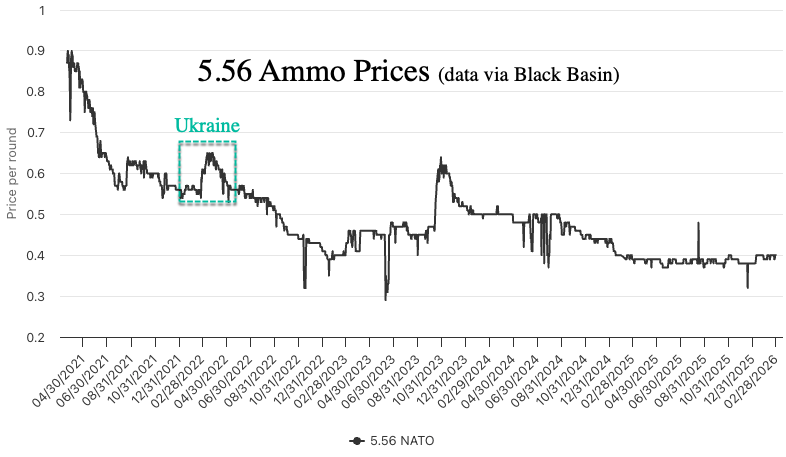
At the start of the Russia-Ukraine war in early 2022, demand for 5.56×45mm NATO ammunition, commonly used in the AR-15 and M4/M16 platforms, surged, briefly pushing prices higher in the early days of the conflict. Prices then trended lower despite the war due to expanded manufacturing capacity and shrinking demand from retail post-Covid boom.
With 5.56 ammo prices now hovering around .40 cents per round after roughly 18 months of supply-demand rebalancing, the key question is whether conflict in the Middle East will drive military demand higher and tighten the end market.
5.56 Ammo Price Index via BlackBasin (online ammo price aggregator):
.40 cents per round certaintly seems like a floor.
Tyler Durden
Tue, 03/03/2026 – 05:45
https://www.zerohedge.com/markets/will-soaring-war-risk-send-civilian-ammunition-prices-higher

Netanyahu hace una apuesta sobre el apoyo de Estados Unidos a Israel con la guerra contra Irán
Por TIA GOLDENBERG
A lo largo de su carrera política, el primer ministro israelí, Benjamin Netanyahu, ha guiado a su país sobre dos pilares de política exterior: una alianza inquebrantable con Estados Unidos y una batalla diplomática y encubierta implacable contra los gobernantes de la República Islámica de Irán.
Ahora, con Israel y Estados Unidos en una guerra conjunta contra el liderazgo de Irán, esas dos rutas estratégicas corren el riesgo de chocar entre sí. Al sumar a Estados Unidos a lo que considera la batalla existencial de Israel contra Irán, Netanyahu está haciendo una apuesta que podría someter la relación bilateral a la tensión de una guerra con consecuencias de gran alcance.
Desde luego, convencer al presidente de Estados Unidos, Donald Trump, de sumarse a la guerra fue un golpe maestro para Netanyahu y pone de relieve los fuertes lazos entre ambos líderes. Si tienen éxito, podrían concretar rápidamente su objetivo compartido de derrocar al gobierno iraní y evitarle a la región un conflicto prolongado.
Pero si la guerra se alarga, los vínculos entre los dos aliados podrían volver a ponerse a prueba.
“Una gran parte del público estadounidense lo verá como que la cola israelí mueve al perro estadounidense y que está arrastrando a Estados Unidos a una guerra en Oriente Medio que no es suya”, explicó Ofer Shelah, investigador del Instituto de Estudios de Seguridad Nacional, un centro de análisis con sede en Tel Aviv, Israel. La caída del apoyo público que eso podría desatar “será muy perjudicial para Israel a mediano y largo plazo”, agregó.
Sin embargo, añadió en una alusión a las ambiciones políticas del líder israelí: “A Netanyahu no le interesa el mediano y largo plazo”.
La opinión pública en Estados Unidos ha ido evolucionando
Para Netanyahu, lograr convencer a Trump de atacar a Irán juntos es el punto culminante de décadas de cercanía entre el líder israelí y Washington. Netanyahu, el dirigente que más tiempo ha permanecido en el poder en Israel, habla un inglés impecable tras haber pasado parte de su juventud en Estados Unidos y siempre se ha presentado como el puente de Israel hacia Estados Unidos.
Aunque presume de sus estrechas relaciones con múltiples presidentes estadounidenses y con miembros del Congreso, Netanyahu ha visto en los últimos dos años cómo el apoyo a Israel entre el público estadounidense ha disminuido. Según sondeos de Gallup, las simpatías estadounidenses en Oriente Medio se han desplazado de forma drástica hacia los palestinos.
Ese cambio de sentimiento ha sido impulsado en gran medida por los demócratas. Pero algunos republicanos, e incluso partidarios del propio Trump, se han mostrado más críticos con el apoyo diplomático y financiero que Estados Unidos ha seguido otorgando a Israel durante los últimos dos años y medio, periodo en el que ha estado inmerso en una guerra en múltiples frentes desencadenada por los ataques de Hamás del 7 de octubre de 2023. Las imágenes devastadoras de la guerra en Gaza profundizaron el aislamiento internacional de Israel.
Con una nueva guerra contra Irán —la segunda en menos de un año—, Netanyahu se enfrenta a un enemigo que él y muchos israelíes consideran una amenaza existencial, citando su apoyo a milicias antiisraelíes en toda la región, su arsenal de misiles balísticos y su programa nuclear. Ha encabezado la cruzada contra Irán en el escenario mundial durante gran parte de su carrera.
Netanyahu señaló el domingo en un comunicado que la participación de Estados Unidos “nos permite hacer lo que he esperado hacer durante 40 años: asestar un golpe aplastante al régimen terrorista”. La oficina de Netanyahu no respondió de inmediato a una solicitud de comentarios de The Associated Press.
El conflicto podría descontrolarse
A pocos días de iniciada la guerra, Israel y el ejército de Estados Unidos parecen estar trabajando codo con codo para atacar objetivos: desde el ataque inicial que mató a altos dirigentes iraníes, incluido el líder supremo, el ayatolá Alí Jamenei, hasta los bombardeos que permitieron a las fuerzas operar con total libertad en los cielos iraníes.
Pero el conflicto ya ha provocado ondas expansivas que podrían repercutir en el corazón de Estados Unidos. Al menos seis soldados de Estados Unidos han muerto. Los viajes se vieron interrumpidos en toda la región, dejando a cientos de miles de pasajeros varados. Los precios del petróleo se dispararon, lo que plantea la posibilidad de gasolina más cara para los conductores en Estados Unidos, así como aumentos de precios de otros productos en un momento en que la gente ha resentido el alza del costo de vida.
Persisten las preguntas sobre el rumbo y el objetivo de la guerra. No está claro si la potencia aérea será suficiente para derrocar al liderazgo de Irán, quién o qué debería reemplazar a ese liderazgo y qué papel tendrán Israel o Estados Unidos en cualquiera de los dos escenarios. Cada día presenta nuevos escollos posibles.
“Mucha gente culpará a Israel si las cosas salen terriblemente mal”, escribió Nadav Eyal, comentarista del diario israelí Yediot Ahronoth. “Israel no puede permitirse perder el apoyo del público estadounidense bajo ninguna circunstancia. Eso es más importante que atacar cualquier instalación militar concreta”.
Aun así, Aaron David Miller, quien se desempeñó durante dos décadas como asesor en asuntos de Oriente Medio para gobiernos demócratas y republicanos, dijo que Netanyahu tiene poco que perder con la guerra.
Con elecciones programadas para el otoño, Netanyahu puede usar la guerra en Irán para desviar la atención de los fracasos de los ataques del 7 de octubre de 2023, los peores en la historia de Israel. En cambio, Netanyahu puede presentarse como un valiente líder en tiempos de guerra que cumplió una promesa que ha hecho durante gran parte de su vida: confrontar a Irán.
Puede decir que lo hizo con el respaldo del presidente estadounidense, quien, según Miller, puede frenar la guerra cuando le plazca.
“Si Trump siente que la situación va cuesta abajo, encontrará una manera de desescalar”, afirmó, “y su buen amigo Benjamin Netanyahu lo seguirá”.
___
Esta historia fue traducida del inglés por un editor de AP con la ayuda de una herramienta de inteligencia artificial generativa.

Today in History: Florida becomes a state
Today is Tuesday, March 3, the 62nd day of 2026. There are 303 days left in the year.
Today in history:
On March 3, 1845, Florida became a U.S. state.
Also on this date:
In 1849, Congress established the U.S. Department of the Interior.
In 1863, President Abraham Lincoln signed the act creating the National Academy of Sciences.
In 1931, President Herbert Hoover signed a bill making “The Star-Spangled Banner” the national anthem of the United States.
In 1943, in London’s East End, 173 people died in a crush of bodies at the Bethnal Green Tube station, which was being used as a wartime air raid shelter.
In 1945, Allied troops fully secured the Philippine capital of Manila from Japanese forces during World War II after a monthlong battle that destroyed much of the city.
In 1969, Apollo 9 blasted off from Cape Kennedy on a mission to test NASA’s lunar module.
In 1991, motorist Rodney King was severely beaten by Los Angeles police officers after a high-speed chase in a scene captured on amateur video that sparked public outrage. (The subsequent acquittal of four officers of felony assault and other charges in April 1992 triggered days of rioting and dozens of deaths in Los Angeles.)
In 2005, millionaire adventurer Steve Fossett became the first person to fly a plane around the world solo without stopping or refueling, landing in Salina, Kansas, where he took off 67 hours earlier.
Related Articles
South Carolina honors native son the Rev. Jesse Jackson
Clarendon Hills Historical Society weighs in on downtown plan
Chicago weather: How our 2025-26 seasonal snowfall compares with previous years
Today in Chicago History: Former Illinois House Speaker Michael Madigan indicted on federal racketeering charges
Today in History: Claudette Colvin refuses to give up her seat on a public bus
In 2022, OxyContin maker Purdue Pharma reached a nationwide settlement over its role in the opioid crisis, with the Sackler family members who own the company boosting their cash contribution to as much as $6 billion in a deal intended to stanch a flood of lawsuits.
Today’s birthdays: Filmmaker George Miller is 81. Singer Jennifer Warnes is 79. Author Ron Chernow is 77. Football Hall of Famer Randy Gradishar is 74. Musician Robyn Hitchcock is 73. Actor Miranda Richardson is 68. Radio personality Ira Glass is 67. Olympic track and field gold medalist Jackie Joyner-Kersee is 64. Rapper-actor Tone Loc is 60. Hockey Hall of Famer Brian Leetch is 58. Actor Julie Bowen is 56. Actor David Faustino is 52. Actor Jessica Biel is 44. Singer Camila Cabello is 29. NBA forward Jayson Tatum is 28.
https://www.chicagotribune.com/2026/03/03/today-in-history-florida-becomes-a-state/

Today in Chicago History: Chester Weger convicted of Starved Rock murder
Here’s a look back at what happened in the Chicago area on March 3, according to the Tribune’s archives.
Is an important event missing from March 3? Email us.
Front page flashback: March 4, 1934
John Dillinger fled from an “escape proof” county jail in Crown Point, Indiana on March 3, 1934 after he whittled a gun out of wood, according to the FBI. (Chicago Tribune)
1934: Gangster John Dillinger broke out of jail in Crown Point, Indiana.
“It was a thorough job of jail breaking that Dillinger did with his little pistol; so thorough that he locked up a total of 33 persons and left them stewing behind bars,” the Tribune reported. “Outsiders had to go into the jail and release the dozen or so locked in guards, who begged from the jail windows for help.”
Vintage Chicago Tribune: John Dillinger’s final days — and the ‘Lady in red’ who helped trap him
Weather records (from the National Weather Service, Chicago)
High temperature: 80 degrees (1974)
Low temperature: Minus 6 degrees (1873)
Precipitation: 1.21 inches (1966)
Snowfall: 3.9 inches (1960)
Frances Murphy, from left, Mildred Lindquist and Lillian Oetting were killed at Starved Rock State Park in March 1960. (Chicago Tribune)
1961: Chester Weger was convicted on his 22nd birthday of killing Lillian Oetting, 50, at Starved Rock State Park in Utica. The bodies of Oetting and friends Mildred Lindquist, 50, and Frances Murphy, 47, of Riverside were found on March 16, 1960, in a cave at the state park. They were bound, partially nude and bludgeoned to death, each having injuries consistent with suffering more than 100 blows.
The jury — made up of seven women and five men — fixed Weger’s punishment at life imprisonment. Two jurors become dismayed upon learning that Weger could be eligible for parole in 20 years. As he was led out of court, two sheriff’s deputies reported hearing Weger say, “You’ll never hold me.”
Weger was granted parole on his 24th try, in a 9-4 vote in November 2019. He was released from Pinckneyville Correctional Center in February 2020 and died of cancer in Kansas City in June 2025.
A U.S. Navy T-39 Sabreliner crashed on approach to Glenview Naval Air Station on March 3, 1991. The three-member, New Orleans-based crew was killed. (Chicago Tribune)
1991: A three-person crew was killed when their U.S. Navy T-39 Sabreliner transport plane crashed into a residential area along Dewes Street on approach to Glenview Naval Air Station. No one on the ground was injured.
City worker Chuck Pinson removes graffiti from rocks on the lakefront in Chicago on Dec. 27, 1995. The graffiti is blasted with baking soda to help with its removal. (Charles Bennett/AP)
1995: U.S. Supreme Court Judge John Paul Stevens refused an emergency appeal by paint manufacturers and retailers to order a stay of enforcement of the 1992 Chicago ordinance that banned the sale and possession of spray paint.
Stanley Wrice, left, holds a news conference with his daughter Gail Lewis after being released from the Pontiac Correctional Center in Pontiac, Illinois, on Dec. 11, 2013. (Michael Tercha/Chicago Tribune)
2020: A jury awarded $5.2 million to Stanley Wrice, who spent more than three decades in prison for a Sept. 9, 1982, gang rape after being tortured into a confession by the “midnight crew” of cops under former police Cmdr. Jon Burge.
Want more vintage Chicago?
Subscribe to the free Vintage Chicago Tribune newsletter, join our Chicagoland history Facebook group, stay current with Today in Chicago History and follow us on Instagram for more from Chicago’s past.
Have an idea for Vintage Chicago Tribune? Share it with Kori Rumore and Marianne Mather at krumore@chicagotribune.com and mmather@chicagotribune.com
https://www.chicagotribune.com/2026/03/03/march-3-chicago-history/