Category: News

New SNAP Work Requirement Rules To Start Feb. 1 In Multiple States
New SNAP Work Requirement Rules To Start Feb. 1 In Multiple States
Authored by Naveen Athrappully via The Epcoh Times,
The new work requirements to gain or continue eligibility for the federal Supplemental Nutrition Assistance Program (SNAP) will start being implemented in several U.S. states beginning Feb. 1.
The One Big Beautiful Bill Act, signed into law by President Donald Trump in July, instituted new work requirements for SNAP beneficiaries to continue receiving benefits, targeting able-bodied adults without dependents.
People ages 18 to 54 are required to meet these conditions to receive SNAP benefits for more than three months in a three-year period, according to the Food and Nutrition Service (FNS).
Able-bodied adults without dependents (ABAWD) must meet any of the following conditions—work at least 80 hours a month, participate in a work program for this duration, take part in a combination of work and work program hours for 80 hours a month at a minimum, or remain in a workfare for the required number of hours assigned each month, FNS said.
Millions of ABAWDs use SNAP benefits despite being able to work, compromising the true goal of the program, which is to provide financial support for vulnerable people who need help.
Some people are exempt from the work requirements, such as individuals who are unable to work due to mental or physical limitations, veterans, homeless people, and pregnant women, the agency said.
Individuals who meet the criteria but fail to fulfill work requirements will lose SNAP benefits after three months.
“To get SNAP again, you must meet the ABAWD work requirement for a 30-day period or become excused. Otherwise, you need to wait until the end of your three-year period, when you’ll get another three months under the time limit,” according to the agency.
The implementation dates of the SNAP work requirements vary from state to state.
In some states, people could lose benefits as soon as Feb. 1, if they can’t show they’re working. But many people have a month or more before their benefits are at risk.
Texas started its requirement in October, so people there could have exhausted their three months of benefits by Jan. 1 and already been removed from the rolls.
Several states started the three-month clock in November, opening the possibility of people losing benefits in the coming days. Among them are Alaska, Colorado, Georgia, and Hawaii.
The requirements take effect Sunday in other states, including Illinois and Ohio. In those places, people could lose benefits in May. Ohio says people will have to show proof of work starting in March.
Some states have exemptions because of relatively high unemployment rates, either statewide or in certain regions, that let them delay implementation, but most of those have ended or will soon. California’s waiver is scheduled to be in place until January 2027. For most of New York, the work requirement is to start in March.
Roughly 42 million Americans make use of the SNAP program and receive $177 per month on average, according to the Department of Agriculture.
Debate Over New Policy
The new work requirements for ABAWDs have faced criticism.
In an Oct. 21 statement, the advocacy group National Skills Coalition argued that the measure undermines workers.
Such requirements punish people for “systemic barriers outside their control,” it said. Losing out on SNAP benefits can make it harder for people to focus on their training or show up to work.
“Moreover, enforcing work requirements places a heavy administrative burden on states and workers. Human services agencies must notify recipients of the new requirements, verify work hours, track compliance, and process exemptions. In each of these activities there is room for error that can have devastating consequences for workers,” the National Skills Coalition said.
The group called on states to expand access to skill-building programs that connect SNAP beneficiaries with training and other supportive services, calling it a “better path forward” than enforcing punitive work rules.
In a May 15 statement published at the Centers for Medicare and Medicaid Services (CMS), Robert F. Kennedy Jr., Health and Human Services secretary; Dr. Mehmet Oz, administrator of the CMS; Brooke Rollins, secretary of Agriculture; and Scott Turner, secretary of Housing and Urban Development, said the need for work requirements is justified.
Over the past decade, millions of able-bodied adults have been added to the SNAP program. Some of them do not work at all or work inconsistently throughout the year, the officials wrote.
The higher share of welfare spending taken by able-bodied individuals of working age disrupts the true goal of programs like SNAP—to help people in need.
“For able-bodied adults, welfare should be a short-term hand-up, not a lifetime handout. But too many able-bodied adults on welfare are not working at all,” they wrote.
“Establishing universal work requirements for able-bodied adults across the welfare programs we manage will prioritize the vulnerable, empower able-bodied individuals, help rebuild thriving communities and protect the taxpayers.”
Tyler Durden
Sat, 01/31/2026 – 18:40

A chatbot entirely powered by humans, not artificial intelligence? This Chilean community shows why.
About 50 residents of a community outside Chile’s capital spent Saturday trying their best to power an entirely human-operated chatbot that could answer questions and make silly pictures on command, in a message to highlight the environmental toll of artificial intelligence data centers in the region.
Organizers say the 12-hour project fielded more than 25,000 requests from around the world.
Asking the Quili.AI website to generate an image of a “sloth playing in the snow” didn’t instantly produce an output, as ChatGPT or Google’s Gemini would. Instead, someone responded in Spanish to wait a few moments and reminded the user that a human was responding.
Then came a drawing about 10 minutes later: a penciled sketch of a cute and cartoonish sloth in a pile of snowballs, with its claws clutching one and about to throw it.
“The goal is to highlight the hidden water footprint behind AI prompting and encourage more responsible use,” said a statement from organizer Lorena Antiman of the environmental group Corporación NGEN.
The answers came from a rotating crew of volunteers working on laptops in a community center in Quilicura, a municipality at the urban edge of Santiago that has become a data center hub. Asked by an Associated Press reporter for the identity of who made the sloth drawing, the website responded that it was a local youth who’s helping with illustrations.
The website responded quickly to questions that drew on residents’ cultural knowledge, like how to make Chilean sopaipillas, a fried pastry. When they didn’t know the answer, they walked around the room to see if someone else did.
“Quili.AI isn’t about always having an instant answer. It’s about recognizing that not every question needs one,” Antiman said. “When residents don’t know something, they can say so, share perspective, or respond with curiosity rather than certainty.”
She said it’s not designed to reject the “incredibly valuable” uses of AI but to think more about the impacts of so much “casual prompting” on water-stressed places like Quilicura.
The backdrop behind the campaign is a debate, in Chile and elsewhere, about the heavy costs of AI usage. Data center computer chips running AI systems require huge amounts of electricity and some also use large volumes of water for cooling, with usage varying depending on location and type of equipment.
Cloud computing giants Amazon, Google and Microsoft are among a number of companies that have built or planned data centers in the Santiago region.
Google has argued that the Quilicura data center it switched on in 2015 is the “most energy efficient in Latin America” and has highlighted its investment in wetlands restoration and irrigation projects in the surrounding Maipo River basin. But it faced a court challenge over another project near Santiago over water usage concerns.
Chile has faced a decade of severe drought, which experts say contributed to the spread of recent deadly wildfires.
https://www.chicagotribune.com/2026/01/31/human-powered-chatbot-artificial-intelligence-chile/

DePaul lets 18-point 2nd-half lead slip away and falls to Xavier 68-66 on buzzer-beater
CINCINNATI — Tre Carroll led Xavier with 21 points and Filip Borovicanin hit the game-winning shot at the buzzer as the Musketeers defeated DePaul 68-66 on Saturday.
Blue Demons guard CJ Gunn tied the game with a 3-pointer — his fifth of the game — with six seconds to play before Borovicanin’s turnaround jumper as time expired won it. Borovicanin had 16 points and six rebounds, and Malik Messina-Moore finished with 13 points for the Musketeers (12-10, 4-7 Big East).
Gunn finished with 19 points, NJ Benson added 14 points and eight rebounds, Layden Blocker scored 11 and RJ Smith had a career-high eight assists for DePaul (12-10, 4-7), which has lost three of four.
Leading by five at intermission, the Blue Demons opened the second half with a 22-9 run, capped by a Benson dunk with 13:35 left to extend the advantage to 57-39. Xavier answered with a 27-6 stretch to take a 66-63 lead on Borovicanin’s 20-foot jumper with 16 seconds left.
The Associated Press created this story using technology provided by Data Skrive and data from Sportradar. Tribune news services contributed.
How coach Chris Holtmann is attacking the challenge of ‘overcoming the perception’ at DePaul
https://www.chicagotribune.com/2026/01/31/depaul-xavier-big-east/

Huge Verdict Could Destroy ‘Gender Transition For Minors’ Industry
Huge Verdict Could Destroy ‘Gender Transition For Minors’ Industry
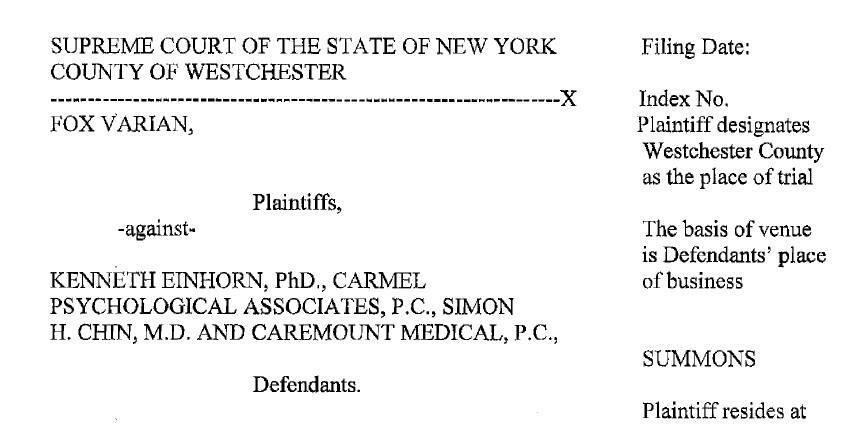
A jury on Friday found a psychologist and a surgeon liable for malpractice after they convinced a 16-year-old girl to lop off her breasts. This marks the first medical malpractice case involving a detransitioner to reach a verdict – and it has huge implications.
Fox Varian, who identified as transgender at the time, was awarded $2 million in damages – which includes $1.6 million for past and future pain and suffering, and $400,000 for future medical expenses. Now 22, Varian identifies as a woman.
The January 30 decision at Westchester County Courthouse in White Plains, New York, found both Dr. Kenneth Einhorn, a psychologist, and Dr. Simon Chin, a surgeon, liable for failing to meet standards of care before performing irreversible surgery on Fox Varian, as they had skipped over important steps while evaluating whether she should move forward with the surgery, and failed to adequately communicate with each other in a “departure from the standard of care.”
BREAKING: 1st Detransitioner to Take a Medical-Malpractice Lawsuit to Trial Wins $2 Million Judgement
Fox Varian sued her Westchester, NY, area psychologist and plastic surgeon for the gender-transition mastectomy she got at 16.
I was the only reporter to attend the entire… pic.twitter.com/4e89PSgGDg
— Benjamin Ryan (@benryanwriter) January 31, 2026
In closing arguments, Varian’s attorney Adam Deutsch asked the jury for $8 million in damages, citing Varian’s reaction to seeing her post-surgical chest scars.
“I immediately had a thought that this was wrong, and it couldn’t be true,” she said, adding that the surgery left her with ‘searing hot’ nerve pain that were ‘ripping sensations across my chest.’
“Shame. I felt shame,” she added. “It’s hard to face that you are disfigured for life.”
The case centered on a referral letter Einhorn sent Chin in October 2019, roughly two months before the procedure. Deutsch argued the letter contained inaccuracies and omissions that left the surgeon without a complete picture of Varian’s psychological state.
Even more tragic is the way that Varian felt pressured into her decision and the doctors never figured it out.
Elon Musk referred to the doctors as “modern day Mengeles.”
There will be thousands of court cases of children who were mutilated by evil doctors, modern day Mengeles.
The schools, psychologists/psychiatrists and state officials who facilitated this will pay dearly too. https://t.co/1FrB6M50Tj
— Elon Musk (@elonmusk) January 31, 2026
The Free Press reported last year, “gender doctors acknowledge they perform life-altering procedures on vulnerable youth with no supportive evidence—and they are proud of it.” One clinician even admitted, “We’re all just winging it, you know? And which is okay, you’re winging it too. But maybe we can just, like, wing it together.”
The defense also claimed that Varian expressed no regret about the surgery until she filed her lawsuit in 2023. But Varian explained her earlier positive statements reflected cognitive dissonance as she tried to maintain a brave face despite inner turmoil.
Varian’s mother, Claire Deacon, testified she opposed the surgery but consented because she feared her daughter would commit suicide without it. This is a common occurrence with young people suffering from gender dysphoria. In 2024, the New York Times reported how parents of confused children are often emotionally blackmailed into consenting to these procedures when doctors tell them ‘Do you want a dead son or a live daughter?’
Parents are routinely warned that to pursue any path outside of agreeing with a child’s self-declared gender identity is to put a gender dysphoric youth at risk for suicide, which feels to many people like emotional blackmail. Proponents of the gender-affirming model have cited studies showing an association between that standard of care and a lower risk of suicide. But those studies were found to have methodological flaws or have been deemed not entirely conclusive.
As the Epoch Times continues, Varian wept and hugged her mother and attorney following the verdict, which concluded a three-week civil trial at the state Supreme Court in Westchester County.
“A jury of everyday Americans sent a clear message: justice will be served for vulnerable individuals who were misled into gender-transition procedures without appropriate safeguards,” said Josh Payne of the firm Campbell Miller Payne, who was not involved in the case but was in court observing Friday’s proceedings. His firm was founded three years ago to represent plaintiffs in cases similar to Varian’s.
The decision came after the young woman regretted the 2019 surgery and sued psychologist Dr. Kenneth Einhorn, surgeon Dr. Simon Chin, and their respective employers.
The six-member jury was not asked whether gender-related surgical procedures are appropriate for minors. The question was whether the therapist and doctor took the appropriate steps before the surgery was performed.
Varian’s attorney argued the healthcare professionals did not correctly diagnose and treat her for gender dysphoria—distress and anguish caused by a mismatch between one’s physical sex and their internal perception of their gender.
Chin and Einhorn’s attorneys argued that Varian did not express regret for the surgery until years later, when she filed the suit in 2023. They noted that she told Einhorn, Chin, and her mother that she was “happy” with the results, and continued to live as either male or non-binary for years after the procedure.
Neil Kornfeld, who represented Einhorn, read from an essay Varian wrote 10 months after the surgery to back up their claim.
“It’s such an immense relief to wake up and not feel at odds with my body,” she said at that time. On the witness stand, Varian said such comments came from “cognitive dissonance” as she tried to put on a brave face about her inner turmoil.
In October 2019, Einhorn wrote a referral letter to Chin supporting Varian’s decision to have the chest surgery; she had first brought up the idea to him in March that same year. Varian’s attorneys said that since the letter contained some omissions and inaccuracies, Chin didn’t have a clear picture of his patient’s psychological history.
Trial evidence showed that Einhorn didn’t have the full picture either.
Before the surgery, Varian had told staff at the Albany Pride Center that she felt she “felt pressure to decide” on a male identity or a female identity “by family, friends, and culture.” She also said she continued to question her gender identity, but was afraid she might “lose credibility” if she brought it up with her mother.
Einhorn said he might not have written the letter had he known; Chin also testified that had he known Varian was unsure of her gender identity, he would not have performed the surgery.
Deutsch said Einhorn should have reached out to Albany Pride Center for records of her time there; he also said Chin and Einhorn should have communicated with each other, at least once, by phone call.
He began the trial by suggesting that Einhorn “drove the train” and had been “putting ideas in Fox’s head” during attempts to change her gender.
But defense attorneys argued that Varian, not Einhorn, had spurred decisions like using “he/him” pronouns, cutting her hair short, and changing her name from Isabelle to Gabriel, then Rowan, then Fox. They said the decision to wear a chest binder, and later the breast removal, were also her idea.
Deutsch, in his closing statements, said that was the problem, describing Einhorn’s attitude as “Whatever the kid wants, the kid gets.”
Tyler Durden
Sat, 01/31/2026 – 18:05

Trump negocia con los demócratas para evitar un cierre del gobierno
Por JOEY CAPPELLETTI y STEPHEN GROVES
WASHINGTON (AP) — El presidente Donald Trump actuó rápidamente esta semana para negociar con los demócratas y tratar de evitar un prolongado cierre del gobierno por la financiación del Departamento de Seguridad Nacional (DHS, por sus siglas en inglés), un cambio drástico respecto al enfrentamiento récord del año pasado, cuando se negó a ceder durante semanas.
Algunos republicanos se sienten frustrados con el acuerdo, lo que aumenta la posibilidad de una prolongada lucha por el cierre cuando la Cámara regrese el lunes para votar sobre el paquete de financiación. Pero la influencia de Trump sobre el Partido Republicano sigue siendo considerable, y ha dejado clara su postura en un momento de creciente tensión política.
“Lo único que puede frenar a nuestro país es otro largo y dañino cierre del gobierno”, escribió en las redes sociales el jueves por la noche.
La urgencia marcó un claro cambio respecto a la postura de Trump durante el cierre de 43 días ocurrido a finales del año pasado, cuando se opuso públicamente a los líderes demócratas y su equipo se burló de ellos en las redes sociales. Esta vez, con la creciente ira por los tiroteos en Minneapolis y después de que el anuncio de mitad de período del Partido Republicano sobre recortes de impuestos quedara ahogado por la controversia, el mandatario actuó rápidamente para llegar a un acuerdo con el líder demócrata del Senado, Chuck Schumer.
“Trump y los republicanos saben que este es un tema en el que están del lado equivocado del pueblo estadounidense y eso realmente importa”, dijo Schumer a los periodistas el viernes, después de la aprobación en el Senado del acuerdo de financiación del gobierno.
La crisis causada por los tiroteos en Minneapolis
Los senadores regresaron al trabajo esta semana lidiando con las consecuencias de la muerte a tiros del enfermero de cuidados intensivos, Alex Pretti, en Minneapolis, a manos de agentes federales de inmigración, así como la muerte de Renee Good en la ciudad semanas antes.
Los republicanos se hallaban lejos de estar unificados en su respuesta. Algunos pidieron el despido de altos funcionarios de la administración, como la secretaria de Seguridad Nacional Kristi Noem, y Stephen Miller, subjefe de despacho de la Casa Blanca para políticas. La mayoría de los senadores republicanos intentaron encontrar un equilibrio, pidiendo una investigación exhaustiva sobre el asesinato de Pretti mientras respaldaban el enfoque de línea dura contra la inmigración, que es un elemento central de la presidencia de Trump.
Pero muchos coincidieron en que los tiroteos amenazaban el apoyo del público a la agenda de inmigración de Trump.
“Nunca he visto a un partido político que tome su mejor tema y lo convierta en su peor tema en el período de tiempo en que ha ocurrido en las últimas semanas”, dijo el senador republicano John Kennedy. “Algunas cosas tienen que cambiar”.
Los demócratas se unieron rápidamente en torno a sus demandas clave.
El senador demócrata Chris Coons dijo que “había unanimidad” en torno a principios fundamentales de hacer cumplir un código de conducta para los funcionarios y agentes de inmigración, poner fin a las “patrullas itinerantes” para realizar acciones de aplicación de las leyes migratorias y coordinarse con las fuerzas del orden locales en los arrestos de inmigración.
Resultó útil que el propio Trump buscara formas de desescalar en Minneapolis.
“El mundo ha visto los videos de esos horribles abusos por parte del DHS y operaciones descontroladas atrapando a personas inocentes, y hay una repulsión al respecto”, dijo el senador demócrata Tim Kaine.
“La Casa Blanca está pidiendo una escalera para bajar de la cornisa”, agregó.
Evitar la dolorosa política de un cierre
Los republicanos también tratan de promover sus logros en el cargo mientras se preparan para las elecciones de noviembre y la difícil tarea de retener el control de ambas cámaras del Congreso.
Pero la perspectiva de un cierre prolongado desvió la atención de su ley de recortes de impuestos y gastos de 4,5 billones de dólares, la pieza central de su agenda. Los republicanos esperaban que el comienzo de la temporada de impuestos de este año, que tendrá lugar el lunes, proporcionara un impulso político a medida que los votantes comenzaran a ver mayores reembolsos de impuestos.
Los republicanos también son conscientes del daño político del cierre del año pasado, cuando los estadounidenses les asignaron una porción ligeramente mayor de la culpa que a los demócratas, según una encuesta de The Associated Press-NORC Center for Public Affairs Research.
“El cierre fue un gran factor negativo para los republicanos”, dijo Trump en noviembre a los senadores de su partido en la Casa Blanca.
En el ámbito práctico, este enfrentamiento por la financiación amenazaba con destruir meses de trabajo bipartidista, incluidas largas horas durante el receso festivo, para elaborar los 12 proyectos de ley de gastos que financian al gobierno y muchas prioridades en casa.
“Vimos lo que sucedió en el último cierre del gobierno en cuanto a cómo perjudicó a los estadounidenses reales y trabajadores”, dijo la senadora republicana Katie Britt, miembro del Comité de Asignaciones del Senado. “No quiero que eso vuelva a suceder”.
Comienza una batalla de financiación de dos semanas
Si es aprobado por la Cámara, el acuerdo alcanzado esta semana, evitaría un cierre prolongado y financiaría casi todos los departamentos federales hasta el final del año fiscal en septiembre. Pero no resolvería uno de los problemas más difíciles para el Congreso y la Casa Blanca: la financiación del Departamento de Seguridad Nacional.
En lugar de un acuerdo de todo un año, la financiación para el departamento se extendió solo por dos semanas, dando a los legisladores poco tiempo para cerrar las profundas divisiones sobre la aplicación de la ley de inmigración.
Los demócratas presionan para lograr cambios que, en su opinión, son necesarios para prevenir futuros abusos, como la exigencia de que los agentes de inmigración usen cámaras corporales, lleven una identificación clara, pongan fin a las patrullas itinerantes en las ciudades y se coordinen más estrechamente con las fuerzas del orden locales al hacer arrestos. Muchos demócratas también quieren reglas más estrictas sobre órdenes judiciales y mecanismos de responsabilidad para los agentes en el campo.
Esas exigencias han encontrado una fuerte resistencia de los republicanos. Algunos se oponen a negociar con los demócratas en absoluto.
“Los republicanos controlan la Casa Blanca, el Senado y la Cámara. ¿Por qué estamos cediendo un centímetro a los demócratas?” escribió en las redes sociales el senador republicano Tommy Tuberville.
Los senadores republicanos dijeron que llevarían la lucha a los demócratas al presentar sus propios proyectos de ley, incluidas restricciones a las “ciudades santuario”, para mostrar su apoyo a las políticas de Trump. Ese término generalmente se aplica a los gobiernos estatales y locales que limitan la cooperación con las autoridades federales de inmigración.
“Hemos dejado que el tema se nos escape. No estamos liderando. Tratamos de evitar perder en lugar de ganar”, dijo el senador republicano Lindsey Graham, quien detuvo los proyectos de ley de gastos hasta que el líder de la mayoría del Senado, el demócrata John Thune, acordó darle una votación sobre su proyecto de ley de ciudades santuario en una fecha posterior.
Thune reconoció la dificultad de las próximas dos semanas, diciendo que hay “algunas opiniones y sentimientos bastante significativos”.
“Mantendremos la esperanza”, dijo Thune a los periodistas sobre la próxima lucha del DHS. “Pero hay algunas diferencias de opinión bastante significativas”.
___
Los periodistas de The Associated Press Lisa Mascaro y Kevin Freking contribuyeron a este despacho.
___
Esta historia fue traducida del inglés por un editor de AP con la ayuda de una herramienta de inteligencia artificial generativa.

Police: Woman, 70, among 3 hurt in Austin shooting
A 70-year-old woman was among three people who were shot Saturday afternoon on an Austin neighborhood street, according to Chicago police.
The woman was standing in the 5300 block of West Madison Street with two men, aged 33 and 64, just before 2:30 p.m., when gunshots suddenly rang out and each was struck, police said.
The woman was struck in the foot and taken to Mount Sinai Hospital in good condition, police said. The other two victims each suffered wounds to the leg and were taken to area hospitals, also in good condition, police said.
Police had no information on the shooter as an investigation by Harrison Area detectives was underway. No arrests had been made.
https://www.chicagotribune.com/2026/01/31/woman-70-among-3-hurt-in-austin-shooting/

Illinois advances in bid to move up 2028 Democratic presidential primary date, but hurdles remain
Illinois and 11 other states vying to become an early primary nominating state for the 2028 Democratic presidential campaign — a move that could boost a potential White House bid by Gov. JB Pritzker — advanced to the next round of the selection process Saturday at a meeting of the Democratic National Committee’s Rules and Bylaws panel.
In essence, the Rules and Bylaws Committee chose to advance all 12 states that applied to be one of up to five states in the early, pre-Super Tuesday window of the primary process. The states will now make in-person presentations to panel members this spring to make the case for their selection.
Formally, the panel is judging the states on three criteria: rigorousness in testing the viability of the candidates, efficiency in being able to have a state legislature and governor agree to enact a new primary date and fairness in how effectively candidates can present their message.
Illinois, with Democrats controlling the governor’s office and the General Assembly, would meet the efficiency standard and Pritzker, House Speaker Emanuel “Chris” Welch and Senate President Don Harmon all supported the state’s application for an early primary date.
But Illinois, with a costly Chicago media market that covers the region where most of the state’s voters reside, might struggle with the fairness standard aimed at allowing smaller, lesser-funded candidates a chance to present their case.
In making their application to the DNC on Jan. 16, state leaders stressed the rigorousness aspect, focusing on Illinois’ diversity.
“Illinois is a cross-section of urban, suburban and rural America, a national beacon for labor rights, equality and reproductive justice, and the heart of the Democratic Party in the Midwest,” said state Rep. Lisa Hernández, who chairs the Illinois Democratic Party.
“From Cairo to Champaign, up from the Quad Cities to Chicago and everywhere in between, Illinois offers candidates ample opportunities to reach voters of all backgrounds,” she said in announcing the application. “We are a microcosm of America and the perfect analog to test a potential nominee’s capabilities on the national stage.”
Illinois, with Chicago hosting the Democratic National Convention, unsuccessfully sought early primary window status for 2024 after then-President Joe Biden altered the traditional kickoff Democrats shared with Republicans, which had been Iowa and New Hampshire, following Iowa Democrats’ botched 2020 caucus operation.
Biden opted to make South Carolina the Democrats’ first-in-the-nation primary state, advancing Nevada and Michigan in the schedule while dropping Iowa and demoting New Hampshire.
But with an open-seat presidential contest, the battle for early primary dates is also open. Iowa and New Hampshire are seeking a return, South Carolina, Michigan and Nevada are back, with Illinois, Delaware, Georgia, New Mexico, North Carolina, Tennessee and Virginia also vying for an early spot on the primary calendar.
“Undoubtedly, Illinois voters will take seriously the task to help select a nominee who will work to push far-right extremists out of power,” Hernández said of the Illinois application. “Whoever emerges from the primary will do so by building a coalition across race, class, gender and geography with the momentum needed to win back the White House.”
While Pritzker has not formally said he is considering a 2028 presidential bid, the governor, who is currently seeking a third term, has sought to increase his national stature by vehemently opposing President Donald Trump.
When home-state candidate Barack Obama ran for the presidency in 2008, Illinois moved up its traditional March primary date to February to assist his successful bid for the Democratic nomination.
In addition to seeking an early primary date, Illinois Democrats also have offered Chicago to play host for the Democratic National Convention in 2028 and 2032 in a separate site-selection contest. But Mayor Brandon Johnson and Pritzker have raised questions about the Trump administration’s willingness to provide adequate federal law enforcement support for a 2028 Democratic convention in Chicago.
https://www.chicagotribune.com/2026/01/31/illinois-2028-democratic-presidential-primary/

Mainstream Expectations: Hope Vs. Potential Risk
Mainstream Expectations: Hope Vs. Potential Risk
Authored by Lance Roberts via RealInvestmentAdvice.com,
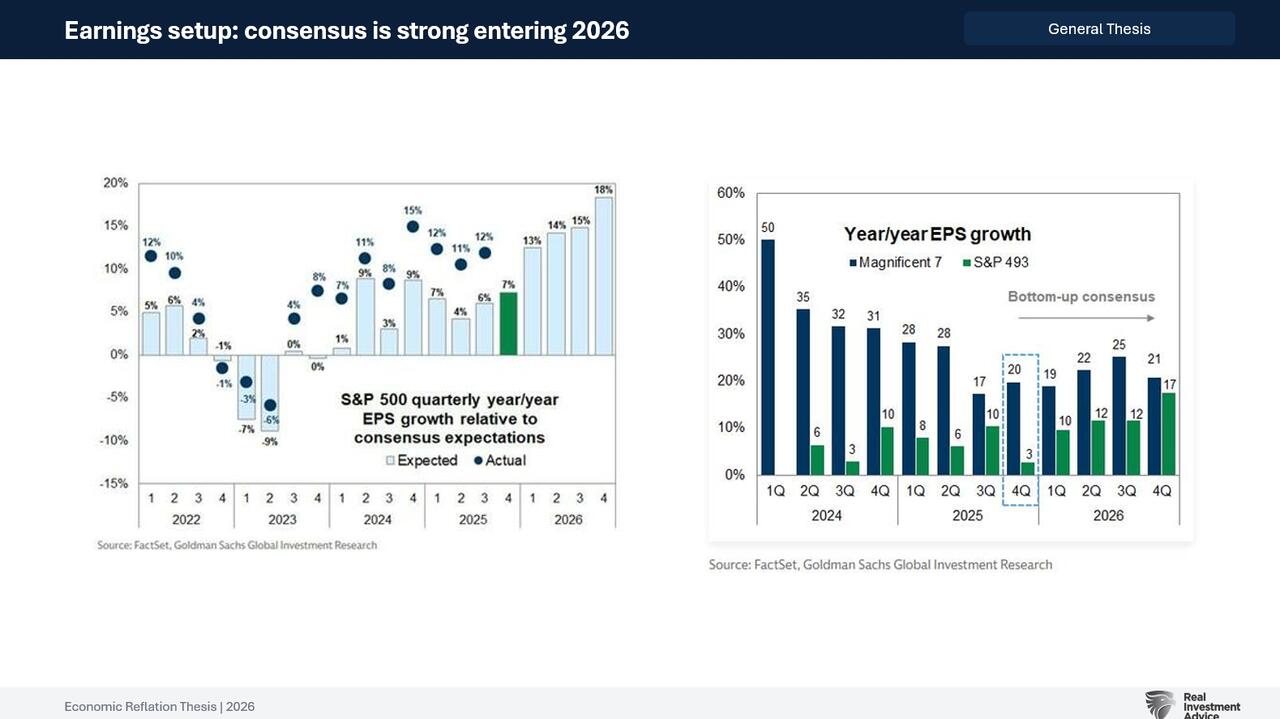
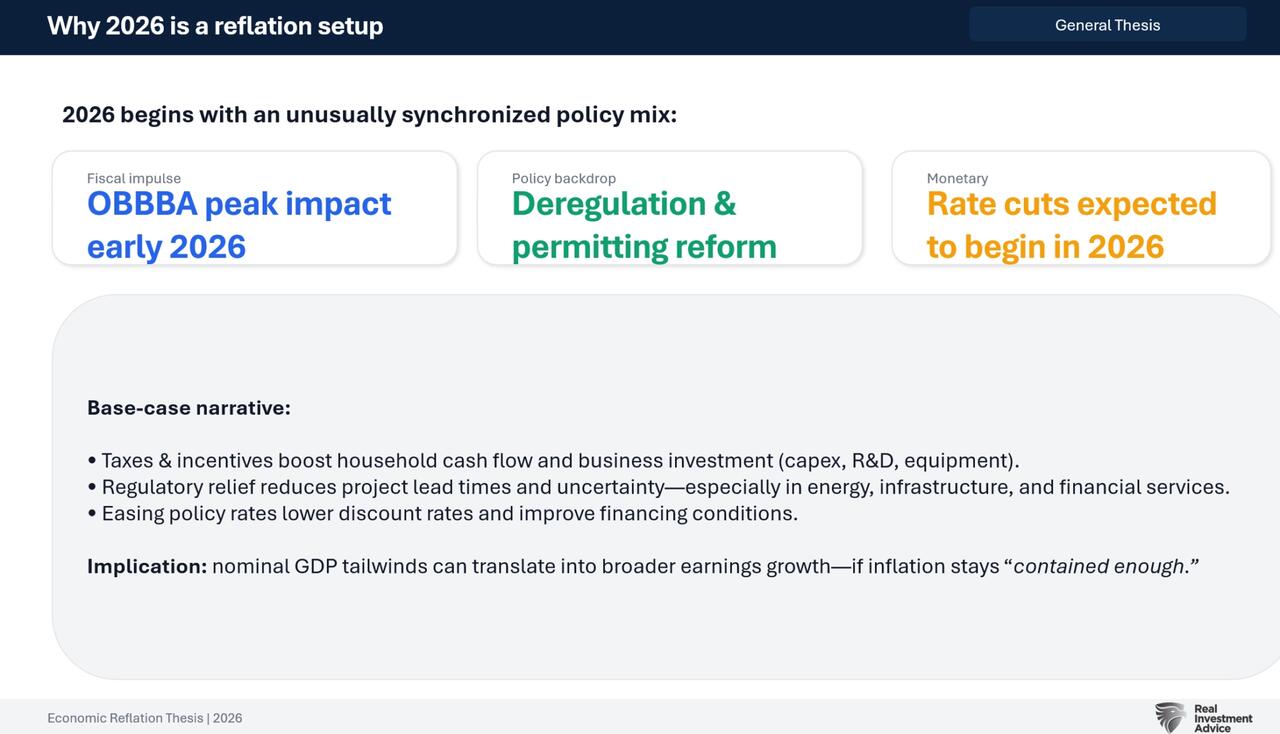
Mainstream expectations, those from Wall Street, economists, and corporate strategists, have congealed around a bullish economic outlook for 2026. Most forecasts project stronger economic growth, with contained inflation, and continued investment in technology and capital expenditure. As such, many institutional investors interpret this as a year of opportunity for markets and corporate earnings.That was a point we discussed at this year’s Investment Summit with the following slide.
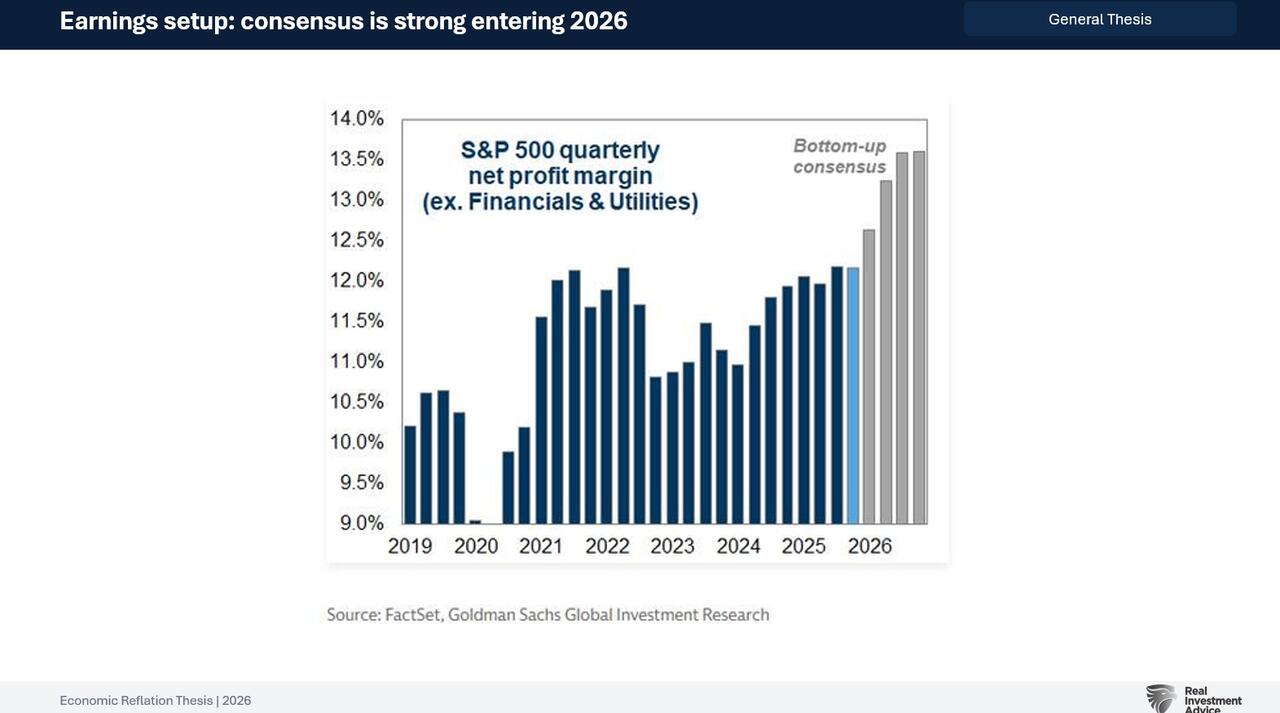
But it isn’t just earnings that are expected to rise, but due to productivity increases (AI = Less Employment) corporate profit margins are expected swell to historic records.
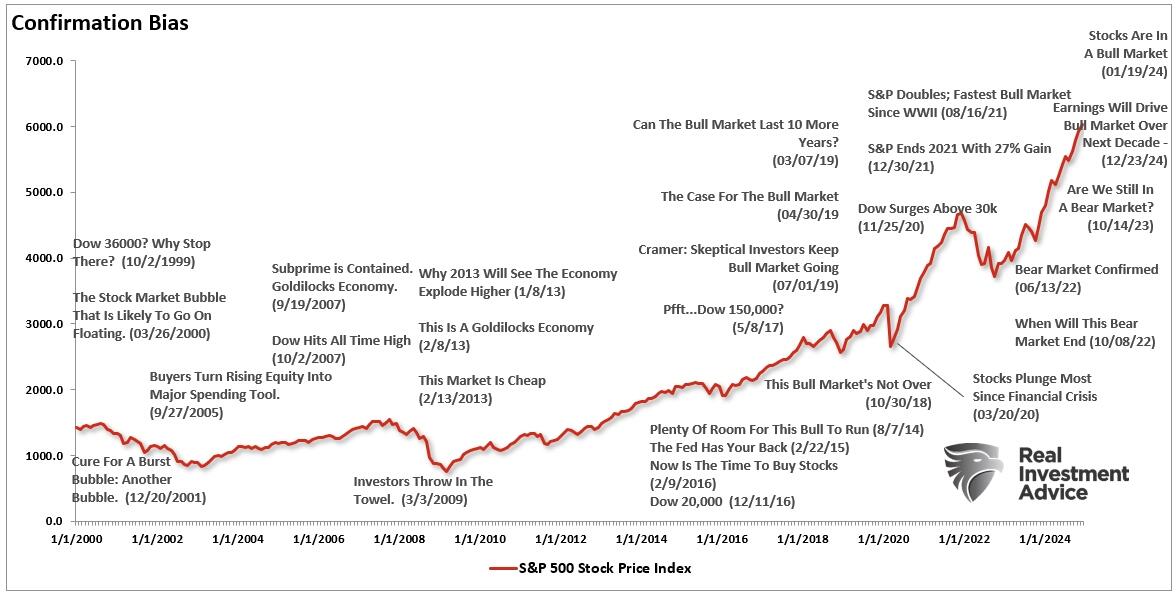
However, whenever I see Wall Street becoming universally bullish, the contrarian investor in me is always reminded of Bob Farrell’s Rule #9:
“When all experts agree, something else will happen.”
As I noted in that linked article:
“Excesses are built by everyone on the same side of the trade. Ultimately, when the shift in sentiment occurs – the reversion is exacerbated by the stampede going in the opposite direction.”
Yet the broader risk landscape is significant as consensus optimism obscures important vulnerabilities. When investors anchor on expected outcomes and overlook low‑probability but high‑impact risks, those risks become amplified. History shows that markets rarely transition smoothly from one year to the next without shocks to inflation, monetary policy, geopolitics, or credit conditions. For example, on January 1st, no one expected President Trump to slap additional tariffs on Europe over the potential purchase of Greenland.
But it happened.
So with that, let’s review mainstream expectations for 2026, and detail the “low probability, high impact risks,” that could derail the complacent expectations of investors.
US Economic Growth: Resilience or Fragile Expansion?
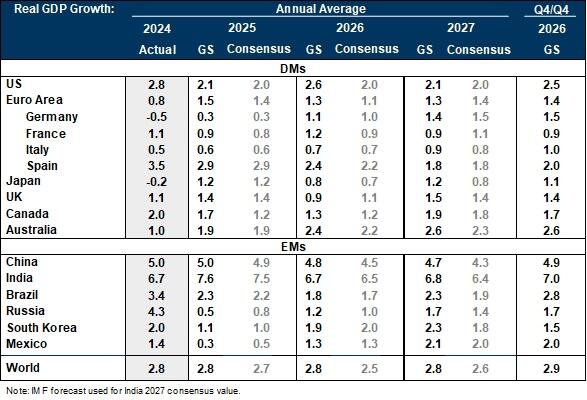
Mainstream Expectation: Most economists expect the US economy to grow above trend in 2026. Goldman Sachs forecasts U.S. GDP expanding about 2.6% year‑over‑year in 2026 compared to consensus estimates of roughly 2.0%. Their team sees above‑consensus growth and a strong rebound from 2025.
Other analysts and institutions, including PwC and RSM US, forecast similar growth in the 2.1% – 2.5% range, driven by consumer spending, corporate investment, and broader economic resilience.
Risk to That View: Growth forecasts assume stability in consumer demand, labor markets, and capital spending. But several risks could undermine this:
Labor market fragility: Employment growth has slowed sharply in late 2025, and with a declining working‑age population due to lower immigration, net job creation may stay weak. Early data shows average monthly employment growth collapsing to levels historically consistent with labor market stress.
Tariff and trade uncertainty: The recent threat of higher tariffs on Europe, and continued trade tensions that emerged in 2025, introduce volatility in production and pricing in supply chains. Increased tariffs across major trading partners historically correlate with lower output.
Global headwinds: The World Bank warns that while global growth remains resilient, fading dynamism and policy uncertainty could reduce demand for U.S. exports.
Our view is that the most critical risk on 2026 is further weakness in the labor market or trade disruptions worsen which could cause growth to fall short of expectations.
Inflation and Monetary Policy: Tame or Sticky?
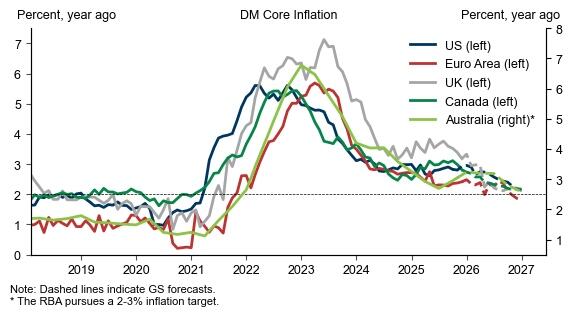
Mainstream Expectation: Consensus forecasts generally expect inflation to moderate through 2026, with core measures heading toward the Federal Reserve’s 2% target. Goldman Sachs projects core inflation close to 2.1% by the end of 2026.
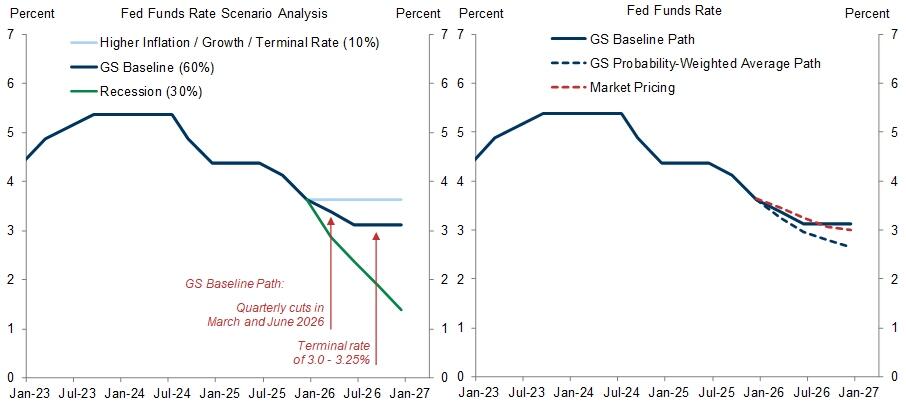
Some money managers expect the Fed to cut rates one or two times in 2026, assuming inflation continues its downward trend and consumer spending remains resilient.
Risk to That View: Given that inflation is a function of economic supply and demand, a “run it hot economy” could keep inflation “sticky” or slightly higher.
Sticky core inflation: Some forecasts warn that core inflation may stay above target due to tariff pass‑through, wage pressures, or service inflation. Vanguard’s model suggests core inflation could remain above 2.5% if tariffs and labor tightness persist.
Monetary policy divergence: J.P. Morgan’s economist predicts the Fed may actually hold rates steady or even raise them in 2027, due to sticky inflation and labor market strength despite market expectations for cuts.
Fed independence risks: Intensified concerns over central bank autonomy could cause further disruptions and uncertainty over future monetary policy direction.
If inflation proves more persistent than expected or if policy credibility erodes, interest rates may stay elevated weighing on valuations and economic activity.
AI and Corporate Investment: Growth Catalyst or Market Excess?
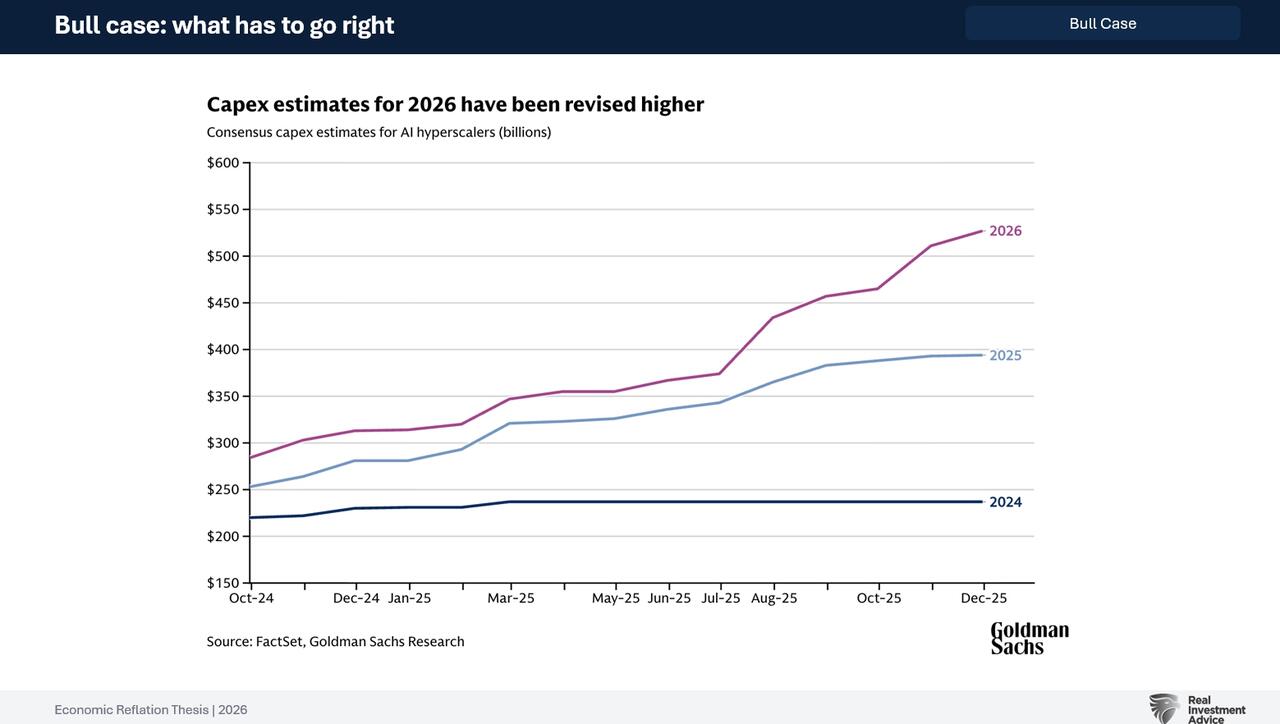
Mainstream Expectation: Most forecasts see continued strong investment in artificial intelligence and related infrastructure as a driver of both corporate capex and productivity. Most analysts highlight AI’s role in lifting corporate spending and supporting economic expansion.
U.S. corporate bond issuance is also projected to surge, much of it to fund AI data centers, advanced computing infrastructure, and next‑generation platforms.
Risk to That View: The growth from AI investment is uneven and concentrated:
Concentration of benefits: A relatively small group of mega‑cap firms capture most of the AI investment gains, which can create sector concentration risk in markets and overstate the breadth of economic benefit.
Corporate debt buildup: Higher bond issuance tied to capex, especially for large tech projects, increases leverage risk, especially if growth slows or credit markets retrench.
Market pricing risk: A strong investment narrative can inflate asset prices beyond fundamentals, meaning corrections may be abrupt if earnings disappoint.
AI spending is real, but it is not a universal engine for all sectors. Most critically, the overreliance on it for aggregate growth forecasts underestimates broader economic weak spots.
Consumer Spending: Supported or Overstated?
Mainstream Expectation: Analysts expect consumer resilience to remain a backbone of 2026 growth. Strong household balance sheets, robust savings for certain income groups, and wage gains support consumption forecasts. These assumptions pervade GDP models showing above‑trend expansion.
Risk to That View: Consumer dynamics can shift suddenly:
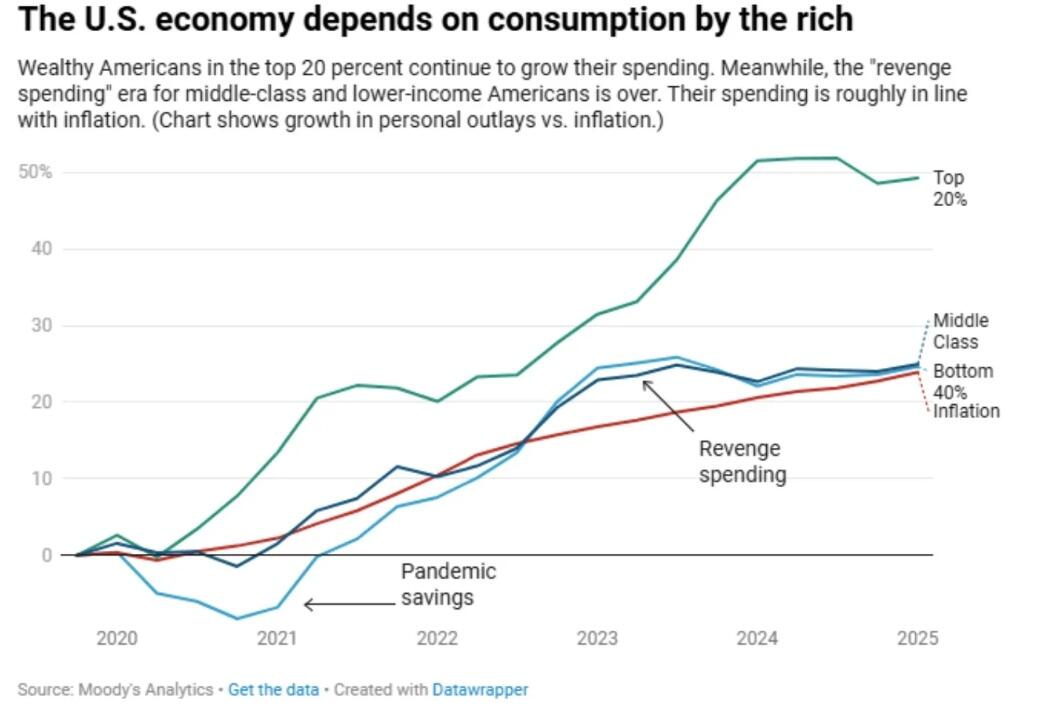
Wealth inequality in consumption: Wealth effects are most pronounced among higher‑income households. Median consumers without significant asset holdings may reduce spending if jobs or real income weaken.
Debt and credit stress: Higher interest rates increase borrowing costs for households which could depress discretionary spending.
Consumer spending may remain resilient on average, but broad‑based weakness could emerge quietly before appearing in headline data.
The Dollar and Foreign Exchange: Weakening or Volatile?
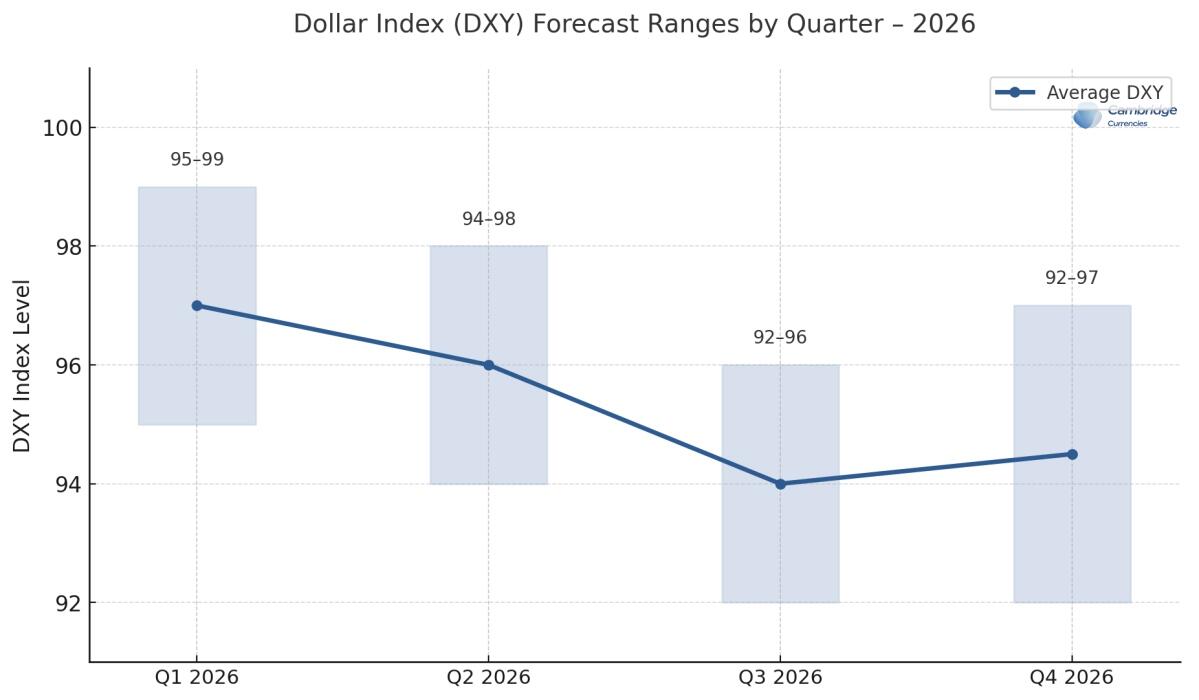
Mainstream Expectation: Many strategists anticipate a modest depreciation of the U.S. dollar in 2026. As such, a weaker dollar would boosts export competitiveness and corporate earnings abroad.
Risk to That View: Currency markets are driven by relative risk and capital flows, not just growth differentials:
Growth risk: Stronger economic growth will attract foreign inflows into dollar-denominated assets for higher yields and relative safety.
Safe‑haven demand: In times of geopolitical tension or financial stress, the dollar strengthens due to its liquidity and safety. Such would potentially hurt U.S. export competitiveness.
A dollar that strengthens through risk aversion or economic growth would undercut the export growth assumptions embedded in current forecasts.
Tax Policy and Fiscal Stimulus: The Reflation Narrative
Mainstream Expectation: New tax measures, including expanded investment credits and incentives, are expected to boost consumer incomes and corporate spending in 2026. Forecasts incorporate these fiscal tailwinds into growth and profitability models.
Risk to That View: Tax benefits often provide short‑lived effects:
Timing and bias: Households may smooth additional tax savings into future consumption rather than immediately spend them. Corporations might repatriate savings or use them for share repurchases rather than investing.
Dependence Risk: The outlook for increased capex, spending, and earnings are all dependent on economic growth strengthening into 2026. However, as discussed, there are many risks to that view.
Tax incentives are supportive, but they should be viewed as marginal boosts rather than transformational drivers of long‑term growth.
Portfolio Tactics for Investors in 2026
The purpose of this article is not to suggests that Wall Street analysts, and market participants, are wrong. The purpose is to suggest there are risks to investor portfolios when “everyone is bullish on everything all at once.”
Therefore, given the range of possible outcomes, investors should employ adaptive, risk‑aware strategies. Rather than assuming a base‑case forecast will materialize, use portfolio tactics to help navigate uncertainty:
Diversification Beyond Tech and Growth: Hold a mix of sectors including value, energy, and financials to reduce concentration risk. Consider allocations to fixed income to offset volatility risks.
Inflation and Rate Risk Hedging: Maintain allocations to short‑duration bonds to reduce sensitivity to potential rate volatility.
Dollar and Currency Exposure Management: Hedge currency risk for international holdings. A stronger dollar could undermine international growth outlooks.
Energy and Commodity Positions: Commodities are subject to economic growth. If growth slows, commodities become a higher risk asset.
Quality and Balance Sheet Strength: Tilt toward companies with strong balance sheets and stable free cash flow to weather cyclical shocks. Favor dividends and cash returns in uncertain environments.
Liquidity Reserves: Maintain higher levels of cash or cash equivalents to capitalize on market dislocations. Liquid reserves provide flexibility should growth disappoint.
Tactical Hedging Strategies: Use options or inverse instruments selectively to protect portfolios against sharp downturns. Volatility may rise unpredictably; structured hedges can provide protection without full market timing.
Monitoring Macro Signals Actively: Track inflation metrics, labor market data, and Fed communications closely. Be ready to adjust strategies in response to shifts in inflation, policy, or geopolitical developments.
The mainstream outlook for 2026 is cautiously optimistic, grounded in forecasts of steady growth, stable inflation, and continued technology‑led investment. Those expectations are reasonable as base cases. However, investors should not mistake forecasts for outcomes. Each major economic assumption carries material risks. Persistent inflation, monetary policy uncertainty, geopolitical shocks, and uneven growth dynamics could all lead to outcomes well outside consensus expectations.
Prudent investors will build portfolios that protect capital first, anticipate volatility, and adapt rapidly to changing economic realities. The probability distribution of 2026 outcomes is wide, and mistakes can be costly when “all the experts agree.”
Tyler Durden
Sat, 01/31/2026 – 17:30
https://www.zerohedge.com/markets/mainstream-expectations-hope-vs-potential-risk

Mayor Brandon Johnson directs police to investigate federal immigration agents for possible felony charges
Mayor Brandon Johnson signed an executive order Saturday directing Chicago police to collect evidence, investigate and potentially refer for felony prosecution criminal charges against federal immigration agents accused of misconduct.
Johnson’s decree — dubbed the “ICE on Notice” order — also states that any Chicago Police Department recommendations for felony charges against agents will be made through his office.
The announcement comes days after Johnson, during a speech at the National Press Club in Washington, said he would prepare the city for the future prosecution of federal agents and marks what the mayor says is a major escalation in the city’s response to President Donald Trump’s controversial, aggressive deportation efforts. The mayor touted the order as a first-of-its-kind effort to “set the groundwork to prosecute ICE and Border Patrol agents.”
“These rogue federal agents are taking us backwards as a city,” Johnson said as he signed the order in his wood-paneled ceremonial office. “The people of Chicago asked me to do more, so I’ve done more.”
Mayor Brandon Johnson listens to speakers at an opening ceremony for the Iftar Bazaar, a pre-Ramadan fair with commerce booths, food and performances, at the Donald E. Stephens Convention Center, Jan. 31, 2026, in Rosemont. (John J. Kim/Chicago Tribune)
But Johnson’s celebration was quickly complicated by pushback from Cook County State’s Attorney Eileen O’Neill Burke, whose office would actually be responsible for filing any charges against federal immigration agents. Johnson told reporters Burke was in “complete support” of the measure, but she wrote in a statement that her office had not reviewed it and called Johnson’s description “not true.”
“The CCSAO did not receive the Executive Order until it was released to the public. We do not provide legal approval of any matter until we’ve reviewed it,” she wrote in a post on X, the social media site. “On such a critical issue, it’s important we get it right.”
The order is one of several efforts by Johnson in recent months to push back against Trump via executive decree. Past orders have made it illegal for immigration agents to stage on city property and directed city agencies, including the police department, not to cooperate on immigration enforcement with Trump’s administration.
The mayor has defended those efforts as major acts of resistance, even as some appeared largely symbolic steps by a city government that has little, if any, ability to counter the federal agencies’ actions.
Even as Johnson has punched back at Trump with forceful rhetoric and calls for agents who break laws to be prosecuted, he has largely danced around questions about how such legal action would unfold.
But he argued his order Saturday — issued months after major federal deportation raids hit Chicago and the suburbs but in the wake of two recent fatal shootings by federal agents of protesters in Minneapolis — gave an answer.
The order also notably places the power to at least spark these prosecutions squarely in his own hands. It directs police to recommend felony charges against agents to Burke “at the direction of the Mayor’s Office.” The clause means Johnson would get a final sign-off before any felony referral is made.
Johnson said his team worked on the order alongside Burke’s office, one of the claims Burke later said on X was not true. Neither Burke nor police Superintendent Larry Snelling attended the press conference, though roughly three dozen supporters — aldermen, activists and staffers — crowded behind Johnson’s desk as he signed the order Saturday morning.
“Her office has said repeatedly, the reason why she has not moved forward with prosecution is because no evidence has been provided to her,” Johnson said of Burke.
Before Burke on X more directly challenged Johnson’s account, Burke’s office had issued a tempered response in a statement Saturday that did not express clear support for the measure.
“We look forward to reviewing the Mayor’s Executive Order now that we have received it,” the statement said.
Burke’s stance will ultimately prove critical in any efforts to prosecute federal agents since only her office, and not Johnson’s, has the power to file charges, even if police and the mayor’s team recommend them.
Asked if he would pressure Burke to file charges should a disagreement arise, Johnson said he would “use the pulpit of the community.”
“It’s not just on the mayor of Chicago. This is a nationwide effort to hold an authoritarian effort, to hold an authoritarian regime,” he said before directing his comments directly about Trump, who has repeatedly insulted Johnson.
“Listen,” the mayor said, “if this was just about me, I would have beat him a long time ago.”
The order would apply to all federal immigration agents, including those from U.S. Immigration and Customs Enforcement as well as Border Patrol.
Johnson defended his decision to implement the new order only now, months after the Trump administration’s Operation Midway Blitz wound down following more than two months of intense raids and deportation sweeps. His office is “constantly evolving” in “this unprecedented moment,” he said.
He also echoed many at City Hall who have warned that a flood of federal agents is likely to return to Chicago in the near future, making it critical to bolster the city’s response.
“We have learned, and now, as we have learned, we are putting forth this executive order at the very time as we prepare for what could be a surge in the spring,” he said.
In addition to its felony referral process, the executive order directs police to verify the names and badge numbers of immigration agents in leadership roles when responding to the scene of immigration enforcement actions. If federal agents do not comply, police should capture that denial with their body cameras, the order states.
It also orders police to preserve and document body-camera footage, notify supervisors if people on site allege immigration agents broke the law and complete more reports that Johnson’s team says would build a foundation for prosecution.
The order would apply to past cases, meaning it could clear the way for prosecution of alleged misconduct that occurred during Operation Midway Blitz, Johnson said. Asked if there was a specific case he wanted to see prosecuted, the mayor said, “there are too many to count.”
“The evidence, I believe, is very clear, not just in Chicago, but across this country,” he said. “The expectation is that this is one more step closer to justice for families.”
Johnson’s strategy chief, Sheila Bedi, shot back at the Trump administration’s claim that federal agents have broad immunity to prosecution for their actions.
“That’s not the law,” said Bedi, a civil rights attorney. “What the law says is that federal agents can be held accountable for state and local crimes if their actions were not necessary to further their federal obligations.”
Bedi said the mayor’s final say on felony charge referrals would not be influenced by politics, but “based on the facts.” The mayor’s administration will begin meeting on Sunday to discuss implementing the policy, she added.
“There’s all this evidence that CPD has,” Bedi said. “There’s going to be somewhat of a process to pull that all together, but we don’t anticipate it being, you know, a six-month process.”
Encargada de negocios de EEUU llega a Caracas para reapertura de misión tras 7 años de ruptura
Associated Press
CARACAS (AP) — Casi un mes después de la acción militar estadounidense que depuso al expresidente venezolano Nicolás Maduro, la encargada de negocios para Venezuela, Laura Dogu, arribó el sábado a Caracas para la reapertura de la misión diplomática de Estados Unidos en el país sudamericano, marcando un hito en la recuperación paulatina de las relaciones bilaterales rotas siete años atrás.
“Acabo de llegar a Venezuela. Mi equipo y yo estamos listos para trabajar”, confirmó en un mensaje en X de la embajada estadounidense en Caracas y adjuntó fotografías de la diplomática al descender del avión en el aeropuerto de Maiquetía.
Caracas y Washington rompieron relaciones bilaterales en febrero de 2019 por decisión de Maduro y cerraron sus embajadas luego que el presidente Donald Trump apoyó al líder opositor Juan Guaidó, entonces titular de la Asamblea Nacional, quien en enero de ese año se declaró presidente interino de Venezuela.
El canciller venezolano Yván Gil precisó en su cuenta de Telegram que recibieron a la enviada de Estados Unidos en el marco de la agenda conjunta “orientada a marcar una hoja de ruta de trabajo en asuntos de interés bilateral, así como, abordar y resolver las diferencias existentes por la vía del diálogo diplomático y sobre la base del respeto mutuo y del Derecho Internacional”.
El paso previo en el deshielo de las relaciones bilaterales fue la visita el 9 de enero de una delegación del gobierno de Trump a Caracas que evaluó condiciones “técnicas y logísticas” relacionadas al cumplimiento de funciones diplomáticas.
El ministro del Interior, Diosdado Cabello, considerado el hombre más poderoso de Venezuela después del depuesto mandatario y vicepresidente del gobernante Partido Socialista Unido de Venezuela (PSUV), dijo anteriormente que la reapertura de embajadas “nos va a permitir tener representación consular para que puedan estar velando por la seguridad y la tranquilidad de nuestro presidente Nicolás Maduro”.
Dogu, quien ha sido embajadora en países como Nicaragua y Honduras, llegó a la capital venezolana un día después que la presidenta interina Delcy Rodríguez anunció un proyecto de ley de amnistía para la liberación masiva de presos por motivos políticos. Dicha ley había sido una de las principales exigencias de la oposición venezolana, respaldada por Estados Unidos.
“Que sea una ley que sirva para reparar las heridas que ha dejado la confrontación política desde la violencia, desde el extremismo”, dijo Rodríguez.
Días después de la intervención militar estadounidense, el gobierno de Rodríguez había ofrecido la liberación de un número importante de presos como gesto para consolidar la paz. Sin embargo, el proceso ha enfrentado críticas de familiares y organizaciones civiles por falta de celeridad e información de las excarcelaciones.
El Foro Penal, una de las organizaciones civiles que monitorea la situación de los presos en Venezuela, indicó que hasta el miércoles 302 personas habían sido excarceladas y 711 permanecen detenidas por razones políticas. Pero el gobierno señala más de 600 liberaciones.
El oficialismo no admite que existan “presos políticos”, pues acusa a los detenidos de conspirar para desestabilizar al gobierno.
El viernes, poco después del anuncio sobre la ley de amnistía, Estados Unidos confirmó a través del canal de X de su embajada, la liberación de “todos los ciudadanos estadounidenses —de los que se tenía conocimiento— que se encontraban detenidos en Venezuela”.