
Category: News
Emiratos Árabes Unidos dice que Irán ha lanzado 16 misiles balísticos y 117 drones en nuevas andanadas
DUBÁI, Emiratos Árabes Unidos (AP) — Emiratos Árabes Unidos dice que Irán ha lanzado 16 misiles balísticos y 117 drones en nuevas andanadas.
Blue Island expects revenue, jobs from OmniTRAX development agreement
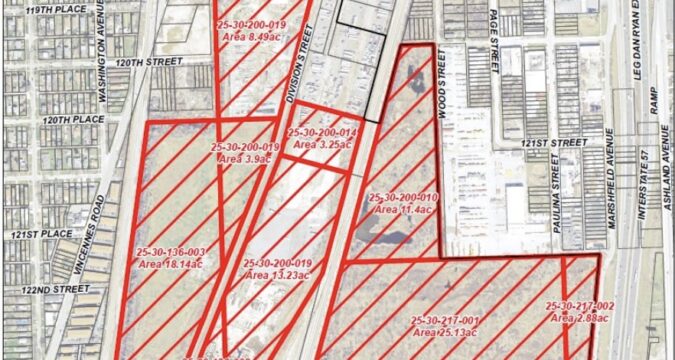
Blue Island city officials approved a lease agreement with OmniTRAX, a private railroad transportation company, to create city revenue and jobs on 90 acres of city-owned land near 119th & Division streets that has remained vacant for decades.
The company agreed to share 8% of its net revenue generated from the property each year with the city and to pay $200,000 in rent every year for the first five years. If the lease extends beyond that, the rent would increase to $207,000 for the next five years and continue increasing every five years, according to the lease agreement.
The property is located South of 119th Street and Division Street and southeast of 119th Street and Vincennes Avenue.
The site will feature bulk commodity rail to truck transloading, secure truck and trailer storage and secure container storage, according to an OmniTRAX news release.
Blue Island Mayor Fred Bilotto said in a statement Friday the property sat idle and generated no tax revenue for decades, contributing “nothing to the local economy.” He said turning around sites like this are a major priority.
The logistics hub, he said, will bring in revenue, create jobs, attract new business activity and strengthen the city’s regional transportation network.
“This project represents exactly the kind of economic development our community needs — taking land that produced nothing for generations and putting it back to work for our residents and taxpayers,” Bilotto said. “That kind of transformation doesn’t happen by accident; it happens through persistence, partnership, and a commitment to growing Blue Island’s economy.”
Blue Island City Administrator Thomas Wogan said the land had been unused for decades due to environmental conditions that limited land use. He said it was difficult to find a use for the land because a warehouse could not be built on the property, but that OmniTRAX can use the land as storage for their clientele who are moving a variety of goods around the country.
Wogan said the company expects to build out the property and complete environmental remediations by the end of 2026.
Wogan said company officials told him they are eager to get moving on the project, with the property property undergoing a due diligence period. Initial discussions for the property began in 2024, Wogan said.
“This is an extremely rare rail-served industrial site in the heart Chicago that offers unparalleled market access,” OmniTRAX Senior Vice President Chris Tecu said in a news release.
OmniTRAX affiliate Chicago Rail Link has operated in Blue Island since 1992.
OmniTRAX is affiliated with The Broe Group, a Denver-based private, multi-billion dollar investment firm. The Broe Group attempted to negotiate a deal with the Illinois International Port District to privatize the Port of Chicago in 2013, but that fell through.
awright@chicagotribune.com
https://www.chicagotribune.com/2026/03/08/blue-island-revenue-jobs-omnitrax-development/

Wolf Lake’s future is uncertain with Chicago Bears stadium proposal
Lisa Vallee is a self-proclaimed “diehard” Chicago Bears fan.
But, as a Wolf Lake neighbor, she has no interest in the stadium moving to Hammond.
Wolf Lake Memorial Park, which is visible from Lost Marsh Golf Course, is preferred site for a proposed Chicago Bears stadium in Hammond, seen on Feb. 19, 2026. (Kyle Telechan/for the Post-Tribune)
“I’m just down the road from the proposed site where the stadium would be built along Wolf Lake,” said Vallee, who lives in Hammond’s Robertsdale neighborhood. “I often go there to birdwatch or to walk. … I was immediately concerned when I heard that the Hammond mayor was proposing the Bears build their next stadium in Hammond.”
Vallee is one of several nearby residents who are concerned about the impact of a Bears stadium on Hammond and what it means for local wildlife and the future of urban green spaces.
Hammond Mayor Tom McDermott was unable to immediately respond to a request for comment about the residents’ concerns.
The Indiana legislature approved Senate Bill 27 this session, which would have created a framework to build a stadium near the Wolf Lake area, according to Post-Tribune archives. The Bears would invest more than $2 billion in the stadium, and Indiana will invest $1 billion through various taxes.
Just Transition canvassing coordinator Lisa Vallee speaks during a community conversation at the Hammond Public Library on the proposed BP CO2 pipeline on Wednesday, Aug. 21, 2024. (Kyle Telechan/for the Post-Tribune)
Residents are also concerned with funding for the stadium, particularly the use of taxes. Indiana will issue a bond for the stadium’s construction, which will be repaid through a Hammond 12% admissions tax and a Professional Sports Development Area specialized tax district.
Lake and Porter counties have also been asked to adopt a 1% food and beverage tax, and Lake County has been asked to pass a 5% innkeepers tax. The state will also renegotiate its lease with the Indiana Toll Road.
Gov. Mike Braun signed the bill into law within an hour of its final approval on Feb. 26. Braun and state officials will handle the remaining negotiations with the Bears and the team’s proposal for Hammond, according to Post-Tribune archives.
McDermott has been adamant in his support for the Bears in Hammond, telling the Indiana House that it’s a “once-in-a-generation opportunity,” according to Post-Tribune archives.
Paul Botts, president and executive director of the Wetland Initiative, looks out on the landscape Feb. 2, 2026, at Harborside Marsh Pond on Chicago’s Far South Side. The wetlands alongside a golf course, frozen in the winter, will be restored after past use by industry. (Brian Cassella/Chicago Tribune)
The Bears could still choose to build a stadium in the Arlington Heights area. Specific construction plans for Hammond have not yet been revealed, but McDermott said the proposal would include a practice facility.
Paul Botts, president and executive director of the Wetlands Initiative, said it’s difficult to know the environmental impact of a stadium without knowing specifics.
“The answer depends enormously on exactly where they propose to build (the stadium),” Botts said. “I looked, and to my knowledge, there are no such specifics. Clearly, they need a couple hundred acres to do this.”
Wolf Lake is a “significant conservation area,” Botts said. On its Illinois side, it’s a state wildlife area and part of the state park system, and in Indiana, it’s a significant open water area that offers wetlands.
The Lost Marsh restaurant and pro shop sits atop a hill on the course across from Wolf Lake Memorial Park, part of an area that may be designated to build a potential Chicago Bears stadium in Hammond, Ind. on Feb. 19, 2026. (Kyle Telechan/for the Post-Tribune)
The lake is also near Lake George, a smaller body of water to the east, which has received proposals to improve and restore. Lost Marsh Golf Course, which is on the south side of Lake George, would likely be lost as part of the stadium project’s footprint, McDermott confirmed last month, and a Superfund site that used to house the Federated Metals smelting plant is located on the northeast side of the lake.
“They’re both … very much still part of the natural processes and natural beauty of Northwest Indiana,” Botts said. “It’s very hard for me to picture building a stadium right up close to one of these bodies of water.”
Wolf Lake’s water levels go up and down throughout the year and seasons, Botts said, and he doesn’t know how that might be impacted by the stadium’s construction or if the area will be more prone to flooding. Botts also said it isn’t clear if the wetlands surrounding Wolf Lake will be legally protected if the stadium is built.
“I don’t know if they’re building the football stadium up close enough to Wolf Lake to actually start to fill in any of its wetlands,” Botts said. “There’s all these kinds of questions, none of which are clear in the law right now.”
A sign at the former Federated Metals smelting plant in Whiting warns visitors to not trespass on an area of the property that is heavily contaminated with lead and other toxic chemicals. The U.S. Environmental Protection Agency put the site on the Superfund National Priorities List, a list of sites where releases of contamination pose significant human health and environmental risks, in 2023. (Christin Nance Lazerus / Post-Tribune)
Wolf Lake is one of Hammond’s few remaining natural spaces, Vallee said, and it’s an important stop for birds’ migratory paths as they pass through Northwest Indiana and along Lake Michigan’s shoreline.
“During migration, there are thousands of birds that stop by this particular area along their long migration,” she added. “We always have tons of egrets, great blue herons and other types of waterfowl that are constantly in the lake and around the lake.”
Botts also mentioned that the lake is an important part of the pathway for migratory birds. Whenever the stadium is used, it’ll be “very disruptive” to the local birds, Botts said, including wetlands birds.
Vallee is also concerned about what would happen to the local ecosystem if the wetlands near Wolf Lake are destroyed, saying it’s essential for birds, other wildlife, insects and plants.
Whiting resident Carolyn Marsh, admin of the BP Whiting Watch Facebook page, speaks with BP employees during the BP Whiting Refinery community night event on Thursday, June 20, 2024. (Kyle Telechan/for the Post-Tribune)
“They’re a huge trap of carbon in a very industrial area,” Vallee said. “There are many, many reasons why the community should be concerned about the environmental impact.”
Related Articles
Gov. JB Pritzker and Chicago Mayor Brandon Johnson keep up Bears stadium pitches
Some Indiana taxpayers not as thrilled by Chicago Bears stadium plan as lawmakers
Landmarks: Potential Chicago Bears stadium near Wolf Lake just the latest story for a place that’s always changing
Indiana governor signs Chicago Bears stadium bill into law as Illinois inches closer to a tax deal
Chicago Bears stadium news: Indiana bill that outlines financial structure passes House
Carolyn Marsh, a Whiting resident, lives about a five-minute drive away from Wolf Lake.
Marsh was shocked to see the area touted as an excellent location for the Bears, she said. She believes that local and state politicians should aim to protect the wetlands around Wolf Lake.
“That’s a natural area in Hammond that should be used as an attraction and not any kind of stadium,” Marsh said. “It’s not going to be the kind of economic development that’s going to help the community because the community needs to be cleaned up. It doesn’t need to be covered up with a stadium.”
If the stadium has a retractable roof, Marsh is concerned about drainage when the roof is open and it’s raining, she said, because it would hit turf. She’s still concerned about drainage when the roof is closed, saying it will “be a nightmare” for the surrounding area because she doesn’t know if the nearby rivers can handle more rainwater, which could lead to flooding.
Marsh is also concerned with how crowds, loud noises and bright lights could impact animals nearby.
“It seems like they don’t care about the best asset that Hammond could have,” Marsh said. “They seem to never have been able to appreciate it and to market it as a natural area and protect the wildlife that call it home.”
TJ Gaertig, a Hammond resident, said it’s hard to know the full environmental effect of a Bears stadium without knowing specifics. However, there’s still cause for concern, he said.
“This really just falls into a pattern of the mayor really pushing development faster than residents are ready for,” Gaertig said. “His attitude towards development is that development is good no matter what, regardless of how residents feel about it and certainly regardless of any environmental impact.”
If the Bears select Hammond as their next home, Gaertig will be curious to see what environmental protections are in place for Wolf Lake, especially with its biodiversity and wildlife that rely on the area.
Residents also enjoy using Wolf Lake recreationally, Gaertig said, and he thinks a stadium would take away from the greenspace that people enjoy. He also worries about the impact it will have on other areas of the city.
Gaertig also believes that if the stadium development goes through, it will draw more people to Northwest Indiana and could set a precedent for other communities to reduce their urban greenspaces.
“Building a Bears stadium in Hammond will inevitably create a higher demand for housing in the city,” Gaertig said. “That will just put more pressure on the city and threaten them to develop even more of our remaining greenspaces.”
https://www.chicagotribune.com/2026/03/08/wolf-lake-chicago-bears-stadium-proposal/

Illinois 2026 GOP primary for governor features four candidates and one familiar face but big donors sit out
Four years ago, the six-way Republican primary for governor was impossible to miss. More than $100 million was spent largely on TV ads, including $35 million from Democratic Gov. JB Pritzker, who not-so-subtly steered GOP voters toward the candidate he deemed easiest to defeat that fall: Darren Bailey.
A downstate farmer and former state lawmaker who leaned heavily on his evangelical Christian faith, Bailey won that primary — then lost to Pritzker in November by nearly 13 percentage points. Now, he’s back, seeking a general election rematch in a GOP primary field of four.
Almost nothing else from 2022 has returned with him.
Gone are the multimillion-dollar budgets, such as the $50 million Citadel founder Ken Griffin poured into the campaign of then-Aurora Mayor Richard Irvin, who finished third in the primary and then lost reelection for his municipal office a year later. Shortly before Irvin’s collapse at the ballot box, Griffin announced he and Citadel were packing up and leaving Illinois for Florida.
Gone, too, is the $18 million ultra-conservative megadonor Richard Uihlein, founder of the Uline office supply business, directed toward Bailey’s effort and into an allied political action committee that opposed Irvin in the primary. This cycle, Uihlein has contributed a comparatively modest $250,000 to one of Bailey’s rivals, Ted Dabrowski, a right-wing policy analyst.
And Pritzker, seeking a third term, hasn’t seen the need to meddle in the GOP primary. He didn’t air his first reelection ad of the 2026 campaign until 19 days before the March 17 primary, while the businessman and heir to the Hyatt Hotels fortune devoted millions of dollars to help his lieutenant governor, Juliana Stratton, try to win a U.S. Senate seat.
The result is a race between Bailey, Dabrowski, real estate developer and video gambling firm owner Rick Heidner and DuPage County Sheriff James Mendrick that is a largely low-key, low-budget affair as the candidates have been forced to seek out voters through GOP gatherings such as downstate Lincoln Day dinners and social media videos rather than television.
All four pledge their allegiance to Republican President Donald Trump despite his continued unpopularity in Illinois, though none can claim his endorsement.
Heidner of Barrington Hills initially billed himself as the “Trump Republican for Governor,” and said he was aligned with the president on business and economic growth. Mendrick of Woodridge cites Trump’s support for law enforcement, saying “Trump may say things that alarm people sometimes, but he’s saying what we’re all thinking.”
Dabrowski of Wilmette credits the president for closing the southern border and backing private schools but breaks with him on tariffs. And Bailey of downstate Xenia, who actively courted and won Trump’s endorsement in 2022, has tried to create some distance this time around, telling voters: “I am Darren Bailey and I am running for governor of Illinois alone, without any outside influence other than what exists here within this state.”
Dabrowski, who is the former president of the conservative Wirepoints activist organization, has framed the dynamic similarly.
“We have to rely on Trump to do those big things out there,” he said, “but we have to fix our own problems.”
Immigration a key issue
All four candidates support Trump’s immigrant deportation efforts and blame the aggressive actions of federal Immigration and Customs Enforcement and Customs and Border Protection agents on the state’s sanctuary status, and they contend protesters have been provoked by Pritzker’s rhetoric. In addition to pushing back against Trump’s deportation actions and efforts to deploy National Guard troops onto public streets, Pritzker has been a staunch supporter of the state law — formally known as the TRUST Act — that prevents state and local law enforcement from cooperating with federal immigration agents who lack judicial warrants. The TRUST Act was approved by Pritzker’s Republican predecessor, one-term Gov. Bruce Rauner.
Heidner contended that had state and local law enforcement been allowed to cooperate with federal immigration enforcement agents during Operation Midway Blitz in “six to eight weeks, they would have been out of here.”
“What do you think about the two people that died in Minnesota? What about all those people who died because of these criminals?” Heidner said at a recent rally, alluding to the deaths of Renee Good and Alex Pretti, two U.S. citizens who were shot and killed in Minneapolis by federal immigration agents in January.
“You’re talking about highly trained ICE agents, right? But you keep pushing and pushing and prodding and spitting, you know, and throwing ice and throwing bricks, what do you think’s eventually” going to happen, Heidner asked, despite national reports that the newest immigration agents are undergoing lax training on standards, including for the lethal use of force.
The four candidates also vow to seek to repeal the TRUST Act, even though the U.S. Constitution assigns immigration enforcement to the federal government.
Republican gubernatorial candidate Ted Dabrowski speaks in Chicago on Feb. 2, 2026. (Antonio Perez/Chicago Tribune)
Dabrowski has gone the furthest, saying he would use executive orders declaring an “emergency” to revoke both the TRUST Act and the SAFE-T Act, which eliminated cash bail — a legally dubious promise given that previous emergency declarations have addressed acute public health crises.
Citing Pritzker’s use of “emergency” declarations in dealing with COVID-19, Dabrowski said, “We’re going to do the same thing for crime and for illegal immigrant crimes. We’re going to work to get rid of the SAFE-T Act. We’re going to work to get rid of the sanctuary state, and we’re going to for safety.”
Bailey has taken a more measured approach, emphasizing that the public needs to understand the TRUST Act and the immigration process as part of a larger effort to build legislative support to overturn the law.
“I would venture to say most people in Illinois don’t understand it is a law that state and local people can’t work with federal law enforcement” on immigration, Bailey said. “So maybe educating people and explaining how and why that is — and I’ll be doing that on day one.”
He has also said that “whatever we can do to help people become naturalized citizens” should be pursued. And Heidner said he differs with Trump by wanting to see a path to citizenship “for illegal immigrants that have been here a long time and been good citizens and have homes and pay taxes and have kids in school.”
James Mendrick answers a question during a candidate forum hosted by the Tazewell County Republican Party in downstate Washington, Jan. 15, 2026. (Troy Stolt/for the Chicago Tribune)
Mendrick’s rhetoric on immigration has been the most combustible. At times, he has echoed the debunked white nationalist “Great Replacement” conspiracy theory.
“We are being replaced,” he said after a recent debate, though he maintained his comments had “nothing to do with whites. This has a thing to do with citizens and non-citizens.”
In becoming the first GOP candidate to announce for governor in February of last year, Mendrick sounded the replacement warning, saying, “Our culture is being eliminated by senseless laws created by our current government that persecutes cops and empowers criminals. I’m here to stop the bleed.”
Speaking to supporters at an East Dundee gun shop on Jan. 19, Mendrick said, “Think about this, folks, we’re being washed out,” contending hundreds of thousands of illegal immigrants coming into the state have made up for citizens leaving Illinois.
“Then we’re replaced. ‘You’ve got to come through me. These are my people.’ Those are Pritzker’s words,” the DuPage County sheriff said. “Well, guess what, folks, you’re my people. The state of Illinois citizens. It’s the citizens that are important. We are being run over.”
Mendrick also has said he supports eliminating the SAFE-T Act, formally known as the Safety, Accountability, Fairness and Equity-Today law, because it imposes new restrictions on law enforcement. But he said he supports its cashless bail provision.
“I don’t think a rich guy should be able to buy their way out of jail and a poor person has to stay,” he said.
Tax plans still mostly TBD
Like immigration, property taxes have united all four candidates as a campaign issue — though none has offered a fully funded plan to cap or reduce taxes without affecting the local grade and high school funding that makes up the bulk of residential property tax bills.
Bailey, for example, proposed an annual cap on property tax rates linked to a taxpayer’s mortgage rate, with increased state funding for schools to help reduce real estate taxes. But he has not specified where the additional state funding would come from. He also has proposed creating a state Department of Government Efficiency modeled loosely on Trump’s much-ballyhooed federal version that failed to achieve its cost-savings objectives, though he said it would not focus on job eliminations.
Dabrowski has called for a 1% percent cap on property taxes and criticized state mandates on local governments, including pension and collective bargaining requirements, that he says drive up costs. He has floated using artificial intelligence to replace municipal office workers and proposed consolidating administrative functions across the state’s nearly 900 school districts, though he said district mergers should remain local decisions.
“With this AI, with all this technology coming on, can you imagine the consolidation of all the back offices of all these units of government? Save tons of money, lower property taxes,” he told a group of supporters.
Heidner supports taxpayer incentives to retain and lure businesses and said that could lead to lower taxes.
“We don’t have to raise any taxes with the tax base we have. By creating more business, we naturally get more taxes. So, we get more taxes, we lower the bills,” Heidner said.
Mendrick’s position on taxes was slightly different.
He has criticized Pritzker’s reductions in the portion of state income taxes that go to local governments and also the diversion of road fund dollars for other transportation purposes. But at a dinner for the legislature’s far-right Illinois Freedom Caucus in February, Mendrick went further, threatening to use the state police against Pritzker if elected, citing the governor’s actions on taxes.
“I’ll be in charge of the state police, and they’re all going to jail,” he said, alleging without evidence that the governor had illegally diverted fuel tax and local government revenue. “He will go to jail for sweeping the local tax.”
Mendrick also has said he would not enforce the state’s ban on certain high-powered semiautomatic weapons — a stance associated with the fringe “constitutional sheriffs” movement, which holds that county sheriffs are the ultimate authority in determining a law’s constitutionality. The movement was co-founded by an Oath Keepers co-founder. Mendrick said he does not consider himself a member of the constitutional sheriffs movement, while acknowledging: “I don’t know what, ultimately, my legal authority is.”
A member of the DuPage County sheriff’s department for 30 years and serving as county sheriff since 2018, Mendrick has touted his efforts to reduce recidivism in the jail while operating his office without overspending his budget. But in May of last year, DuPage County and Mendrick reached an $11 million settlement in a federal lawsuit brought by the estate of a 50-year-old mother who died in June 2023 after being held in the county jail for 85 days while awaiting transfer to a state-run mental health center.
‘I have zero ties to organized crime’
Heidner’s background has drawn scrutiny of its own.
The owner of Heidner Properties, a real estate development group that owns and manages commercial properties across the country, Heidner also owns Gold Rush Gaming, a video gambling operator, and Ricky Rockets Fuel Centers.
Gubernatorial candidate Rick Heidner speaks after attending a debate at WFLD-Ch. 32, Feb. 24, 2026, in Chicago. (Armando L. Sanchez/Chicago Tribune)
A 2019 Tribune investigation found that while Heidner was asking the state for permission to build a southwest suburban horse track and casino, he also had long-standing business ties to a banking family whose financial involvement with mob figures helped sink a Rosemont casino. Heidner also had a similar real estate partnership with convicted bookmaker Dominic Buttitta, where they owned a building in Elgin that was leased to a bar using Gold Rush machines. Buttitta pleaded guilty in 2012 to federal charges of running an illegal sportsbook from the South Elgin strip club he controlled.
Following the Tribune investigation, Pritzker scuttled Heidner’s plans to build the horse racing track and casino on state-owned land in Tinley Park. Heidner and state gaming regulators later reached a settlement in 2021 after the state withdrew allegations that he had offered an illegal $5 million inducement to purchase a rival video gambling chain.
“I have zero ties to organized crime,” Heidner said at a recent debate. “Shady ties? Where’s the shady ties? Where’s the shady ties? You know, people want to say shady ties. … I was totally vindicated.”
Asked by a reporter after the debate whether his gubernatorial bid was partly driven by grievances against Pritzker, Heidner didn’t hesitate.
“Absolutely not. Do I like what happened to me? Was it fair? Absolutely not. Did it hurt me and my family tremendously? Absolutely,” he said.
Heidner has also given campaign contributions to prominent Democrats, including $2,500 to former Cook County State’s Attorney Kim Foxx and $25,000 to Chicago Mayor Brandon Johnson. He acknowledged at a debate that he had wanted to discuss bringing video gambling to Chicago with Johnson. Dabrowski called the donations “pay-to-play politics.”
Dabrowski had an inauspicious launch of his campaign in September, speaking for less than nine minutes in front of his home and taking no questions from reporters.
In addition to serving as president of Wirepoints, he previously worked as the senior vice president at the conservative-aligned Illinois Policy Institute.
His campaign has gained the backing of controversial right-wing radio host and political operative Dan Proft of Naples, Florida, as well as far-right former legislator Jeanne Ives, now a member of the Republican State Central Committee. Proft had unsuccessfully sought to use Uihlein’s money to take control of Bailey’s 2022 gubernatorial bid.
Darren Bailey, returning GOP gubernatorial candidate, greets people outside the Illinois State Capitol in Springfield on Feb. 18, 2026, after Gov. JB Pritzker delivered his annual State of the State and budget address. (Brian Cassella/Chicago Tribune)
Bailey 2.0 seeks to become a humbled, chastened alternative to the original version, as he called Chicago a “hellhole” based on his southern Illinois perspective of the state.
“I realized calling Chicago a ‘hellhole,’ carrying the message that I carried the last time, trying to do that doesn’t work for Illinois. I respect that and I appreciate that,” Bailey said.
“I probably acted like a bull in a china cabinet the first time and I realized that it’s got to be different because people aren’t going to talk to you or with you when you’re in that frame of mind,” he said.
With a vastly smaller campaign fund than what he had four years ago, Bailey is relying on name recognition from his first run for governor, along with social media and local GOP events, to promote his candidacy.
“Illinois is different, and that’s why I’m different,” he said, comparing his campaign to the one four years ago. “The people know that I’m sincere, I’m genuine. This isn’t a fake. This isn’t a fake to win. This is who I am.”
Talla Mountjoy: The first places I’ll visit when Iran is free, if Iran is free
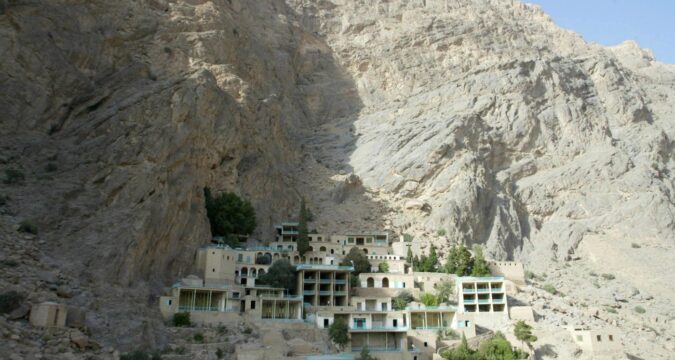
We were on a bus to visit the beautiful city of Masuleh. And like any trip in Iran, the journey was just as much fun as the destination.
Our tour guide sat at the front of the bus with a tombak (drum) and started singing: “Fahtee, Fahtee, Fahtee, Fahtee, Fahtee, az esghet kardam gharo ghaty. Fahtee joon,”
Fahtee is a woman’s name. Translated, he was singing: “Fahtee, my love for you makes me crazy. Fahtee, my soul.”
He repeated the verse multiple times, changing his accent; we had to guess what part of Iran he was singing from. It was joyful because it celebrated the diversity of Iran.
Iran is richly diverse by region, ethnicity, religion and culture.
My favorite accent is the Isfahani accent. It sounds like a song, and I can see the musical notes in the air as the octave and tone changes. Whenever Isfahanis finish their sentence, I just want to shout, “Encore!”
The people of Shiraz are sheereen (sweet). They are known for their incredible kindness and hospitality, which says a lot given the centrality of hospitality to Iranian culture more broadly.
Some of our most well-known artists outside of Iran are Azeri, like Jafar Panahi and Googoosh.
Our Assyrian friends always had the best underground sources to help us find wine and charcuterie.
As a child, I would wear traditional Kurdish tulle and satin dresses — adorned with beautiful coins and vibrant colors.
“I’ll be right back, bacheha (kids),” my grandma would say to answer the Islamic call to prayer. Before she went, she would tell us what she’d pray harder for that day. These days, she has the same prayer every day; that we all return to Iran.
Every region, religion and ethnicity celebrates the 3,000-year-old holiday of Nowruz, the Iranian New Year that’s rooted in Zoroastrianism and celebrated on the first day of spring.
We’re all Iranian.
I once visited the Tomb of Esther and Mordechai in Hamadan, an important pilgrimage site for Jews. It was such a surreal experience. The tomb was right there in front of me. But then I looked around — where is everyone? My family was the only one at the site. There should have been lines of tourists up and down the street. Instead, the caretaker looked surprised to see us there and that anyone had visited at all.
The older I got, the more my heart broke at Iran’s shuttered tourism industry. Takht-e Jamshid, or Persepolis, the capital of the Achaemenid Empire, was empty. The epic Naqsh-e-Jahan, “Map of the World,” in Isfahan should have been packed with foreigners. In Iran, there are historical sites on top of historical sites. The north’s lushness is just as beautiful as the south’s deserts. Each town and city have their own culinary specialty — where are the foodies? Kerman’s kolompeh (date-filled pastry) and Rasht’s mirza ghasemi (smoky eggplant dip) are heavenly.
When we weren’t singing on the long bus rides, we would be dancing. We’d close all the curtains, women who wanted to remove their hijabs would, and the bus driver would turn on the latest hit Iranian song. As soon as the bus driver turned off the music, we knew we were arriving at a security checkpoint. Time for the dancing to stop, to put on the hijab and to take our seat, quietly.
I’ve long waited for the day, the possibility, the dream to build Iran’s tourism industry. Do I include that “dancing on moving buses comes at your own risk” in a waiver? Even thinking through the legal details brings me such joy, and I get filled with such hope.
The first place I’ll visit when Iran is free, if Iran is free, is Yazd. I never got a chance to see Yazd.
Seeing pictures of the damage to Kakh Golestan from the recent bombings is heartbreaking. I remember visiting the palace vividly as a child. The title of one of its most epic rooms, “hall of mirrors,” does not do its true beauty justice. Mirrors within mirrors within mirrors. Mirrors, that have now been shattered.
I never have and never will get tired of seeing Iran’s historical sites. What will be left when this war is done? Who will be left when this war is done? And will Iran still be Iran?
All these elements — culture, diversity and history — bond Iranians together under one national identity. We are all Iran.
For 47 years, Iranians have been subject to a regime that seeks to divide them, isolate them, oppress them, torture them and dispose of them.
Yet the only element the regime has not managed to steal is the people’s love for their Iran. My Iran. Our Iran. That is something they can never do.
Iran, Iran, Iran, Iran, Iran, az esghet kardam gharo ghaty. Iran joon.
Talla Mountjoy is senior director of programs for the Forum for Free Inquiry and Expression at the University of Chicago.
Submit a letter, of no more than 400 words, to the editor here or email letters@chicagotribune.com.

Column: Hankes Road Bridge in need of solution to decades-long dispute
Those darn bridges. Why is it that things tend to get confusing when it comes to who and what is supposed to take care of them?
I recall a column from about 20 years ago when no one could figure out who was responsible for plowing the Ashland Avenue Bridge. It was truly a standoff between the village of Montgomery, the city of Aurora and Aurora Township, and even when the Illinois Department of Transportation got involved, it seemed to add to the confusion.
Only when it became a serious safety issue – drivers were spinning around on the neglected thing – did the city step in to clear the bridge. And that only added to the confusion because Aurora officials still insisted it was not their responsibility and that maintaining it could make them legally responsible from that point on.
It was enough to send heads spinning as well.
This time the angst has been over the Hankes Road Bridge over Route 56 in Sugar Grove. And as was the case with the Ashland structure, when asked who is responsible for maintenance over the years, replies seem to come straight from a children’s book: “Not I,” says the village of Sugar Grove. “Not I,” says Sugar Grove Township or its road district. “Not I,” says the Illinois Department of Transportation.
Turns out the narrative goes back to 1965 when IDOT built the bridge. Because this was prior to the development of Bliss Creek Golf Course or Prestbury and only Sugar Grove Township roads existed, an agreement was signed with the township to maintain the bridge’s road surface. And all was well until 1988 when the village annexed the golf course, which caused a “three-way dispute over jurisdiction that has gone on for 37 years,” said current Sugar Grove Village President Sue Stillwell.
In other words, for nearly four decades officials at the state and local level have all been declaring “Not I” when it comes to who is responsible for the road surface of the bridge.
As the story continues, around the same time a lawsuit by the village to distance itself from jurisdiction was dismissed, an agreement in 2016 between the village and Sugar Grove Township Road District split the responsibility of maintenance. But township officials contend the village did not uphold its end of the bargain, and that it is using this past aid against the township and road district to bolster the village’s denial of responsibility.
Making matters trickier, IDOT needs permission from Sugar Grove, which it considers owners of the road surface, “before (the state) can go ahead with a $2.9 million plan in 2027 to replace the bridge,” noted 70th District State Rep. Jeff Keicher.
In an email response on Friday, IDOT stated “we have made several attempts to reconstruct the bridge and the road at no cost to Sugar Grove. But the village has been unwilling to acknowledge jurisdiction and agree to the maintenance needs on Hankes Road going forward.”
All of which has turned “the bridge into a piece of crap,” declared Ron Barbel, president of one of eight homeowners association organizations in Prestbury, a community of more than 940 homes that uses this road as its main thoroughfare.
After a trip on Wednesday to see for myself, I wholeheartedly agree – as does the driver, no doubt, whose hubcap was lying against the concrete wall. The entire structure – including substructure, culvert and guard rails – is in need of an overhaul. But the immediate safety concerns are the many gaping potholes that, as Prestbury resident Bob Scanlan described it, “are so big you could sink a basketball into them.”
Fortunately, a stalemate was broken that same day, albeit a temporary one.
According to Stillwell, “I attempted for nearly two hours to compromise on a long-term maintenance agreement. If our village board approved, I would accept jurisdiction from that date forward, not because we agree that it is our jurisdiction but to work out a compromise” so the village, township and road district “would share maintenance costs moving forward.”
The village of Sugar Grove and Sugar Grove Township/Road District partnered on Thursday, March 5, 2026, to fix the many deep potholes on Hankes Road Bridge that were causing safety issues. (Bill Collins)
That 60-day partnership resulted in those asphalt craters getting filled on Thursday. As a few residents pointed out, the patch job isn’t pretty but at least it will keep someone from losing a front axle, or worse, a motorcyclist fatally hitting a pothole. Even Sugar Grove Township Supervisor Tom Rowe calls it a “Band-Aid” fix that does not solve the long-term problem of who owns the bridge’s road surface.
In a statement posted on its website Friday, township officials insist they are trying to stay out of the dispute that “is between IDOT as the owner of the bridge and the village as the owner of the road over the bridge,” adding that the township receives no money, tax dollars or otherwise, “for the village’s road.”
All three governmental entities – as well as some residents – expressed appreciation for the co-op patchwork and are hopeful a permanent solution can be reached at some point, even if it has to be in front of a judge.
But as more than a few pointed out to me, “the can is getting kicked down the road” yet again, with a good chance it will see more potholes on its way.
dcrosby@tribpub.com

Add pizzazz to your garden this winter
On a late-winter day, take a moment to appreciate subtle beauties: shades of green in evergreen needles, interesting peeling bark, dried grasses that sway in a breeze, red berries or crab apples that cling to branches, flower heads that catch snow. Then think about how you can plant this spring for more interest in your garden next winter.
“You don’t have to give your garden five months off every year,” said Sharon Yiesla, plant knowledge specialist in the Plant Clinic at The Morton Arboretum in Lisle. “With some planning, you can make it more attractive even in January and February.”
March is a good time to make those plans. The new season’s growth hasn’t started, so you can still assess your garden’s winter appearance, but planting time is only a couple of months away.
Here are some tips for thinking about how you might give your garden some more winter oomph.
Assess your space. Without the distraction of leaves on the trees and shrubs, it’s easier to see the yard’s basic structure. You may see that it falls into natural sections or spot a place for a winter focal point to attract the eye. Look through your phone for pictures taken during the growing season to help you visualize where there may be space for something new.
Consider your conditions. When it’s time to choose plants, you’ll need to know about the soil type and sun conditions you can offer them, in summer as well as winter.
Plan for all seasons. Look for plants that have something to offer all through the year. For example, oakleaf hydrangea (Hydrangea quercifolia) has coppery peeling bark that catches the eye in winter, but it also has summer flowers and leaves that turn burgundy in fall.
Think about wildlife. Nothing brightens a garden like the presence of birds and other wildlife, so invite them in. Evergreens offer them shelter and nesting sites. Food sources can include berry-bearing shrubs such as winterberry (Ilex verticillata) and ornamental crab apples that keep their fruit, as well as native grasses and perennials whose seed and flower heads you leave standing. Don’t forget a source of water, such as a birdbath with a heater.
Seek out interesting bark. When leaves are gone, bark stands out. Some shrubs, such as red-osier dogwood (Cornus sericea) have red or yellow bark. River birch (Betula nigra) is a small to medium-sized tree with peeling bark. American hornbeam (Carpinus caroliniana) is a medium-sized tree that develops sinewy curves under its smooth bark, giving it the common name of musclewood. These are all native plants, but there are also non-native options such as paperbark maple (Acer griseum), with coppery bark that peels decoratively.
Look for variety in evergreens. Green is welcome in winter, which is why so many yards include evergreen shrubs or trees. Most of those shrubs are of just a few kinds — standard varieties of yew, boxwood, juniper and arborvitae. For more winter interest, seek out cultivated varieties with different shapes and shades of green, perhaps blue-tinged or touched with gold. “There are many cultivars available,” Yiesla said. “Just be sure to read the label carefully to make sure the mature size of the shrub will fit in your space.”
Let dried plants stand. Instead of cutting everything back neatly in fall, leave some dried plants standing for winter interest. Stalks of grasses will wave in the winds, bringing motion to the yard. Seed heads and flower heads on shrubs such as hydrangeas and on perennials such as coneflower will collect snow, adding to the charm of a snowfall. “You can always bundle up and cut them back later in the winter if they start to look tattered,” she said.
For tree and plant advice, see the online resources of The Morton Arboretum at mortonarb.org/plant-care, or submit your questions online at mortonarb.org/plant-clinic or by email to plantclinic@mortonarb.org. Beth Botts is a staff writer at the Arboretum.
https://www.chicagotribune.com/2026/03/08/add-interest-winter-garden/

Letters: Citing ‘Imminent threat’ and ‘national security’ is not a substitute for evidence when pursuing war
As a retired judge, I was trained to weigh evidence carefully and to match the burden of proof to the stakes involved. In civil cases, we apply a preponderance of the evidence. In criminal matters, where liberty is at stake, we require proof beyond a reasonable doubt. War, it seems to me, should demand at least that level of moral and factual certainty.
What troubles many Americans today is not simply the possibility of conflict, but the sense that conclusions are being announced without the underlying proof being publicly tested. Imminent threat and national security are powerful phrases, but they are not substitutes for evidence. If sustained military action is contemplated, the American people deserve a clear articulation of objectives, the factual basis for urgency, the anticipated costs and the exit strategy. That does not require exposing sensitive intelligence, but it does require more than assertion.
The Constitution deliberately places the power to declare war in Congress. That was not accidental. The framers intended friction, open debate, shared accountability and recorded votes before committing the nation to bloodshed. Over time, that responsibility has eroded through open-ended authorizations and political convenience. When Congress avoids a formal declaration or meaningful authorization, it is not merely yielding power to the executive branch. It is avoiding ownership of the decision itself.
Sanctions, diplomatic pressure and economic tools may operate under lower evidentiary thresholds because they are reversible and incremental. War is neither. It reshapes families, budgets, foreign policy and generations. It should never rest on slogans or incomplete disclosures.
Before we ask young Americans to risk their lives, the case should be made clearly, publicly and convincingly.
The standard for war should not be political expedience. It should be proof worthy of the sacrifice required.
— F. Keith Brown, retired chief judge, Elgin
Stuck in leftist mindset
Steve Chapman writes that the Iran war will not be a political winner for President Donald Trump (“For Trump, the war against Iran will not be a political winner,” March 4). The true definitive measure will be domestic politics, which of course dwarf anything we might achieve in Iran. But in my view, if Trump’s war in Iran succeeds, it will be a great win for America. Should Trump let Iran build nuclear weapons and intercontinental missiles?
An intellectual life fully lived in the leftist political bunker.
— Neil Gaffney, Chicago
Employing Christianity
There are people in President Donald Trump’s administration and among the top military brass who proclaim that Trump was anointed by God to carry out these latest attacks on Iran. Do they also believe that when Jesus said “suffer the little children .. to come unto me,” he meant in body bags?
— Pamela Harrison, Chicago
Let’s neuter Iran now
I think you have to answer one question in order to determine your point of view regarding the U.S. attacks on Iran: Do you believe an armed conflict with Iran is inevitable in the next five years? If your answer is yes, would you rather address the situation today or in five years against a nuclear-armed Iran?
The Iranians are never going to negotiate away their desire to have a nuclear arsenal. The Iranians have not been negotiating; they have been delaying substantial progress in order to get to their finish line: nuclear capabilities.
Of all today’s troubles, my biggest fear is nuclear devices in the hands of a regime that openly sponsors terrorism as a means to spread its will and hatred. Imagine today’s military activity if nuclear devices were available.
It is better to neuter Iran now than allow them to keep inching forward toward nuclear capability.
— Randy Noble, Rockford
Don’t hang banner yet
Regarding reader Lloyd Litwak’s letter “Justification not debatable” (March 5): I watched the entire Iraq War debacle unfold, and I think we have some compelling evidence to suggest that regime changes of this nature may, in fact, not make the world “a safer place.” To declare confidently that this one has succeeded mere days into the operation, when many others have failed, is, well …
I admire Litwak’s optimism, if not his grasp of recent (or even ancient) history.
I’ll not sit here and say with certainty that the benefits won’t eventually outweigh the drawbacks of this operation; I think it’s stupid, but I’ll let time be the judge of that.
I’d suggest, however, to those who declare with confidence “Mission Accomplished” shouldn’t hang the banner just yet.
— James Ross, West Chicago
Support Trump’s actions
President Donald Trump did not choose to go to war with Iran due to a trade dispute or an environmental or women’s rights issue. Rather, Iran has been pursuing nuclear weapons and has been targeting and killing Americans directly or through proxies for over 40 years. Have we forgotten the over 200 Marines killed in Beirut in 1983 by an Iranian proxy?
Trump has seen previous presidents either kick the can down the road or naively believe that the current Iranian regime could be trusted.
The Iranians have chosen to build their nuclear weapons program underground. Why do you think that is? To be transparent about its intentions?
Trump has chosen to be realistic. He is correcting the inaction and bad policy of previous administrations. He tried negotiations, but when it became obvious that that was a dead end, he took action.
Had Adolf Hitler been stopped in the mid-1930s when he should have been, the cost would have been minimal. Waiting until he attacked Poland ended up costing over 70 million lives. Imagine what the cost of a nuclear war with Iran would be.
A government ruled by clerics believes that a higher power has imbued them with the authority to impose their will on others. It is not a political disagreement that the Iranian regime has with us. It is religious. One cannot negotiate with this kind of thinking. It’s no longer the opinion of one policy against another but rather of infidels against the word of God.
Trump should be supported in doing the right thing for our country and our allies.
— David Tessler, Chicago
Congress ceding its power
If a Democratic president had directed the American attack on Iran, you can be sure that Republicans in Congress would be condemning the attack.
Especially in light of the American military members killed in action, Republicans would be calling on a Democratic president to resign or to be impeached and removed from office.
Instead, because the president is Donald Trump, Republicans are supporting his actions. They are not even demanding a declaration of war voted on by Congress.
This is blatant hypocrisy for Republicans to demonstrate. Why are they willing to cede their legislative powers to the president?
— Dodd Mohr, Barrington
Submit a letter, of no more than 400 words, to the editor here or email letters@chicagotribune.com.
https://www.chicagotribune.com/2026/03/08/letters-030826-iran-war/
Gary Diocese moves to decrease number of parishes in North Lake County
As the number of Catholic parishes continues to shrink in Northwest Indiana, church leaders said faith in the future remains strong among their congregations following an announcement of more consolidations to come.
The Diocese of Gary’s North Lake area will transition to a three-parish model with two additional worship sites, said Bishop Robert J. McClory in a Feb. 28th letter to the community.
St. Francis Xavier Church in Lake Station and St. Bridget Roman Catholic Church in Hobart have been identified as anchor parishes that will remain open in the North Lake area, which currently consists of seven total parishes.
“In Gary, the Cathedral of the Holy Angels, St. Joseph the Worker and St. Mary of the Lake will continue to work together under shared leadership for the foreseeable future,” said the Rev. Jeff Burton, dean of the North Lake Deanery and pastor. “Sts. Monica and Luke in Gary will join the other congregations in Gary, and at some time in the future celebrate a final Mass.”
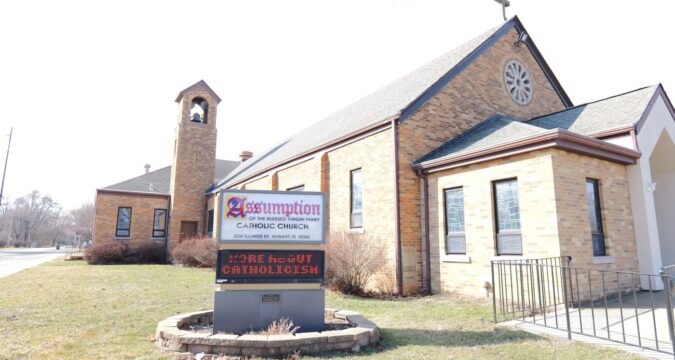
Burton said eventually Assumption of the Blessed Virgin Mary in New Chicago will join with St. Bridget Roman Catholic Church, ceasing ministry at the New Chicago campus.
“This is part of an ongoing process,” Burton said. “Plans were previously developed for parishes in Merrillville, Michigan City, Hammond, Whiting and East Chicago. This now involves the remaining communities in the Diocese that had not yet been engaged.”
A statue of Mary is displayed at the Assumption of the Blessed Virgin Mary in New Chicago. (Anna Ortiz/for the Post-Tribune)
Burton currently serves St. John Bosco and St. Joseph in Hammond and St. Stanislaus in East Chicago. He said that he is also losing a church that he calls home.
“It’s OK to feel that sense of loss,” Burton said. “I’m feeling the sense of loss myself. The parish where I was baptized, where I received all my sacraments, where I was received as a candidate for holy orders, is scheduled to close. And so, we love our parishes.
“They are those places where we first came in contact with and came to know the divine. It’s where relationships were forged. It was where we were able to be our full and complete selves, and that’s a loss. There’s no way around it. At the same time, we have the limited resources that we have. And we have to place our priests strategically in order to best serve the needs.”
In 2024, McClory commissioned a steering committee of the clergy and lay key leaders from 14 Catholic parishes in East Chicago, Hammond and Whiting to “assess the current situation and develop a recommendation for the future.”
Since then, church leaders have shepherded the unification process throughout the rest of the four counties, in which parish numbers are reduced and congregations and ministries are combined.
Lupita Anaya, of Whiting, has attended Sacred Heart Catholic Church in Whiting since she was 6 years old. Sacred Heart is one of the churches that closed under a past phase of the Diocese’s reorganization.
“Our parish will continue to fight and pray that our voices are heard,” Anaya said. “If you attend any of our masses or social events, you will find a congregation full of families, both English and Spanish speaking. The Diocese really needs to ask themselves if they are making the right move and saving the right church. Destroying such a successful congregation like ours is something they need to make sure is going to really be worth it in the end.
“I also believe that those who attend church only on special occasions, or a handful amount of times a year, better ask themselves how they are going to feel the day that the last church has closed its doors. We need to do better and support these places of worship if we want a holy altar to exist where we can walk our children down the aisle or mourn our loved ones before we lay them to rest. If we don’t get our families back in church, this will all be gone forever someday.”
St. Bridget Roman Catholic Church in Hobart has been identified as an anchor parish that will remain open in the North Lake area. (Anna Ortiz/for the Post-Tribune)
Now the process has come to the last territory, North Lake County. The Diocese of Gary serves Lake, Porter, LaPorte and Starke counties, and currently has 44 parishes.
“Last year, I commissioned a steering committee to work with the clergy and key lay leaders from the seven Catholic parishes in the North Lake planning area to assess the current situation and develop a recommendation for the future,” McClory said. “Each parish possesses unique strengths and strongly committed parishioners and clergy. While acknowledging some isolated signs of growth, an overall analysis of data revealed a multi-year downward trend in key metrics, such as mass attendance, and participation in the sacraments, as well as a decrease in ministry.”
Ultimately, the committee’s recommendation was to unify their Catholic communities and reduce the number of parishes.
Burton said today’s main challenges include having a limited number of priests, as well as church-owned properties with longstanding maintenance needs. In addition, shifting population hubs in Northwest Indiana have resulted in low-use facilities, he added.
Like many of today’s clergy members, Burton juggles the responsibilities of multiple parishes, stating that in the past, 11 priests were assigned to the tasks that he now takes on by himself.
“A significant majority of our priests are aged 60-plus, meaning we have a retirement bubble that we are currently dealing with, and will deal with for at least another five years,” Burton said. “When facing this hard truth, and other trends such as population shifts, the bishop recognized that we needed to start planning for the future.”
A stained glass window depiction of Jesus is displayed at the St. Bridget Roman Catholic Church in Hobart. (Anna Ortiz/for the Post-Tribune)
The costs of operating a church or school building can be mountainous, coupled with inflation. Burton said the bill for three months of gas use alone at one facility equaled around $20,000, or roughly $7,000 per month – not including water or electricity costs.
The Rev. Father Michael Surufka has been a leader at Ss. Monica and Luke Church in Gary for seven years. After the church doors shut, he said the parish members will join another congregation’s pews.
“ When a church closes, there’s a sadness, you know, it’s a kind of a death of sorts. But at the same time, it’s not surprising,” Surufka said. “The congregation is diminished, finances are tight, and the building is in need of significant repairs. Those are things you just can’t get around. So the congregation, I think, has been prepared for this for some time. I think they saw it coming and were just wondering at what point in the process we are at.”
Diana Moreno, 54, began attending Ss. Monica and Luke Church when she was 17 years old. Wherever the parish and its people go, she said she will follow.
“This is like my home,” Moreno said. “The people here are great. This is one of the only black Catholic churches around here, you know? I would hope that whichever church, whoever they combine with, that they would continue the richness of it, because it is so rich. I mean, the music, the everything — it touches your heart. It has enhanced me as a person. It enhanced my life a lot. I hope everything continues, wherever they may consolidate to.”
The current church was once two separate churches, St. Monica and St. Luke. They merged in 1982, church staff said.
“It’s sad it’s closing but things happen like that, older people are gone and things change, but we have to go with the change. Consolidating is a fact of life,” Moreno said. “It has to be done. I’ll follow wherever they go; I’ll be there in some capacity. I have known most of them for over 30 years.”
While the church’s people will be accounted for among their fellow parish’s aisles, the physical remnants will be salvaged, too. If a church building closes, artwork, devotional items and other mementos are first offered to a neighboring parish and then to any parish in the Diocese.
“A few years ago, when St. Catherine of Siena in Hammond closed, some of the statuary went to Our Lady of Perpetual Help and some to Bishop Noll,” Burton said. “I have a chalice and vestments from Siena that I use at St. John Bosco. The chairs went to the chapel at Camp Lawrence in Valparaiso. The crucifix hangs over Holy Spirit in Winfield. We make a serious effort to ensure everything finds a home. In terms of the building itself, the assets and liabilities go to the receiving anchor parish.”
And while the closing of churches does invoke feelings of loss, there is also gain, church leaders said. Congregations will find new neighbors in their pews and fresh faces in their ministries and volunteer groups, Burton said.
“In the case of Gary, its churches had been consolidated in leadership in some sense for more than 25 years, and so this is a continuation of that model,” he said. “We don’t quite know yet what the future holds of the terms of our footprint in Gary.”
Another curveball came from an order of friars. After a decade of service in Gary, the Franciscan friars have been recalled by their religious order from the city. Like the church clergy, friars and monks have also experienced dwindling numbers and resources.
“We’re called to be a hopeful people, and while we face challenges, we are assured of God’s guidance and provision,” Burton said. “We can be encouraged by the examples in Merrillville and Michigan City, where we can see the vibrancy that is possible when we come together.”
Lit candles burn at a place of prayer inside St. Bridget Roman Catholic Church in Hobart. (Anna Ortiz/for the Post-Tribune)
“There are bright spots in all of this,” Burton said. “We’re bringing in more adults into the church this Easter than we have in almost two decades. So, in a lot of areas, the faith is expanding, the church is growing. But we just have to be realistic about our footprint.”
McCory said this transition is planned to take place in phases over the next year or so.
“I recognize this announcement will affect people differently,” McClory wrote. “Some will experience feelings of loss or anger. Other people may see this model as a new beginning, creating opportunities for growth. And vital for the Catholic presence in this area.…
“Please know that I am committed to supporting you in this process. We are all seeking the Lord’s guidance, wisdom, and strength so that the Catholic Church in North Lake County will always be a vibrant and discipline-driven community. You can be confident of my abiding prayers for all the members of the parishes during this time of transition. ”
Anna Ortiz is a freelance reporter for the Post-Tribune.
https://www.chicagotribune.com/2026/03/08/gary-diocese-decrease-parishes-lake-county/
Clarence Page: ‘ICE Barbie’ is gone, but will immigration policy improve?
The worst of Homeland Security Secretary Kristi Noem’s many terrible moments in last week’s congressional hearings on immigration control probably came when she admitted to being unfamiliar with the shockingly appalling case of Marimar Martinez.
She is the Chicago woman who managed to survive being shot five times by Border Patrol agents in October, leaving her with nerve damage in her right hand.
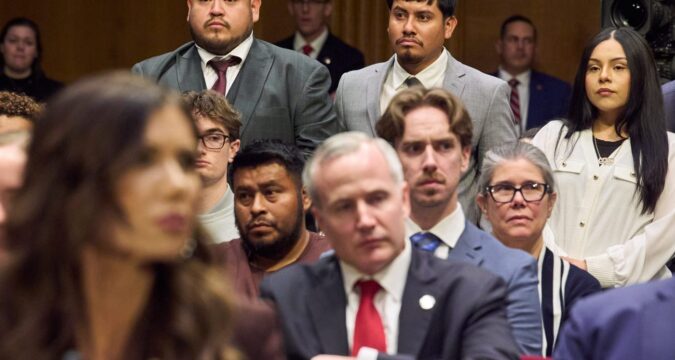
Yet, as Noem, dubbed “ICE Barbie” by some for her love of posturing in front of media cameras, was pushed by U.S. Sen. Richard Blumenthal, a Connecticut Democrat, to acknowledge that the shooting was “wrong” during a heated Senate Judiciary Committee hearing Tuesday, ignorance was her defense.
“Sir, I don’t know that situation or the case,” Noem replied. “I’ll look into it to ensure that all procedures were followed properly.”
How likely is it that Noem had not looked into the case surrounding Martinez’s shooting last Oct. 4, especially in light of the embarrassing details that came to light as the U.S. Justice Department attempted to prosecute the victim?
Some of those details were in evidence in the Senate hearing room, including posters bearing the text messages exchanged by Martinez’s shooter, Border Patrol Agent Charles Exum, bragging: “I fired 5 rounds and she had 7 holes. Put that in your book, boys.”
Got that, “boys”? Sounds like the government’s immigration enforcers have been going after anyone who looks as though they might, just might, be an undocumented newcomer, whether they happen to be here illegally or not. And the boss isn’t going to check your work.
In her 13 months leading the Department of Homeland Security, Noem managed to cut quite a media figure. In May, just months into the job, she visited an infamous prison in El Salvador to which her department had deported Venezuelan immigrants. Posing with flowing locks and perfect makeup in front of caged gang members clad only in their underwear, Noem sent a message that would be hard to decode as anything other than a taste for authoritarian kink.
DHS agents under her authority would go on to conduct brutal and legally dubious roundups of immigrants (and Americans who look like them) in a succession of U.S. cities. They would shoot and kill at least four U.S. citizens, including two in Minnesota, one in California and one in Texas. Others, like Martinez, would be lucky to survive their wounds.
Noem’s minions would defy and frustrate federal judges seeking basic information from DHS about the department’s compliance with court orders.
As DHS operations inspired mass political protest, and tanked President Donald Trump’s polling numbers, Noem faithfully parroted the administration’s talking points, continually characterizing immigrants as dangerous and protesters as terrorists, and Trump stood by her.
Related Articles
Clarence Page: The ripple effects of the Rev. Jesse Jackson’s vision of Black economic power
Clarence Page: The Rev. Jesse Jackson never lost hope in human redemption, and neither should we
Clarence Page: Attorney General Pam Bondi shows loyalty to her audience of one
Clarence Page: The information war rages amid Donald Trump’s immigration chaos
Clarence Page: ICE has been accused of profiling Native Americans. What a cruel irony.
Yet their relationship came crashing down Thursday when Trump unceremoniously fired her. Or, rather, demoted her to United States Special Envoy for The Shield of the Americas, whatever that is.
Noem had been caught in a lie in testifying about $220 million of taxpayer money she spent on TV advertising. On Tuesday before the Senate Judiciary Committee, she claimed the contract for the ads — some of which ended up going to a company run by the husband of her erstwhile press aide, Tricia McLaughlin — had been submitted for competitive bids. However, on Wednesday, in front of the House, she admitted it was a no-bid arrangement.
Worse, she claimed that Trump had blessed the affair.
Bye, bye, Madam Secretary.
Lying, corruption, illegal deportation and even taking innocent life seemingly are no bar to a seat in Trump’s Cabinet. But implicate him in your shenanigans, and you’re likely to end up “as dead as fried chicken,” as the colorful Republican Sen. John Kennedy of Louisiana put it.
In other words, Noem’s career at the Homeland Security Department was cooked, and happiness over her imminent departure did not seem to be limited to only one party, although the usual suspects expressed loudest delight.
They included a possible Democratic presidential hopeful, Illinois Gov. JB Pritzker, who seemed to take a line from a Chicago bluesman with: “Hey, Kristi Noem, don’t let the door hit you on the way out. Now that you’re gone, don’t think you get to just walk away. I guarantee you you will still be held accountable.”
Chicago Mayor Brandon Johnson noted, in part, that Noem “weaponized fear to undermine trust between communities and local law enforcement. … Kristi Noem’s tenure will be remembered by her brazen corruption, reckless exploitation of vulnerable families to advance a far-right agenda and willingness to put the president’s interests over those of the American people.”
I agree. We need good border security, not an excuse to impose a police state.
I hope that Trump’s apparent nominee to be her replacement, Republican Sen. Markwayne Mullen of Oklahoma, will do a better job, if he gets confirmed.
But first leaders from both parties need to talk seriously about what is needed to protect our borders without endangering the rights and freedoms that make this country so attractive in the first place.
Email Clarence Page at cptimee@gmail.com.
Sign up to receive Clarence Page’s column in your inbox each week.
Submit a letter, of no more than 400 words, to the editor here or email letters@chicagotribune.com.


