As the number of Catholic parishes continues to shrink in Northwest Indiana, church leaders said faith in the future remains strong among their congregations following an announcement of more consolidations to come.
The Diocese of Gary’s North Lake area will transition to a three-parish model with two additional worship sites, said Bishop Robert J. McClory in a Feb. 28th letter to the community.
St. Francis Xavier Church in Lake Station and St. Bridget Roman Catholic Church in Hobart have been identified as anchor parishes that will remain open in the North Lake area, which currently consists of seven total parishes.
“In Gary, the Cathedral of the Holy Angels, St. Joseph the Worker and St. Mary of the Lake will continue to work together under shared leadership for the foreseeable future,” said the Rev. Jeff Burton, dean of the North Lake Deanery and pastor. “Sts. Monica and Luke in Gary will join the other congregations in Gary, and at some time in the future celebrate a final Mass.”
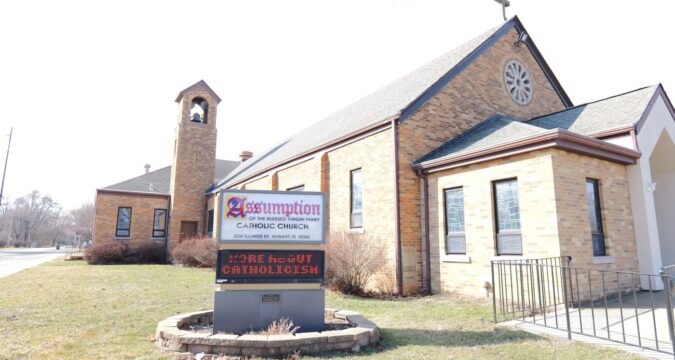
Burton said eventually Assumption of the Blessed Virgin Mary in New Chicago will join with St. Bridget Roman Catholic Church, ceasing ministry at the New Chicago campus.
“This is part of an ongoing process,” Burton said. “Plans were previously developed for parishes in Merrillville, Michigan City, Hammond, Whiting and East Chicago. This now involves the remaining communities in the Diocese that had not yet been engaged.”
A statue of Mary is displayed at the Assumption of the Blessed Virgin Mary in New Chicago. (Anna Ortiz/for the Post-Tribune)
Burton currently serves St. John Bosco and St. Joseph in Hammond and St. Stanislaus in East Chicago. He said that he is also losing a church that he calls home.
“It’s OK to feel that sense of loss,” Burton said. “I’m feeling the sense of loss myself. The parish where I was baptized, where I received all my sacraments, where I was received as a candidate for holy orders, is scheduled to close. And so, we love our parishes.
“They are those places where we first came in contact with and came to know the divine. It’s where relationships were forged. It was where we were able to be our full and complete selves, and that’s a loss. There’s no way around it. At the same time, we have the limited resources that we have. And we have to place our priests strategically in order to best serve the needs.”
In 2024, McClory commissioned a steering committee of the clergy and lay key leaders from 14 Catholic parishes in East Chicago, Hammond and Whiting to “assess the current situation and develop a recommendation for the future.”
Since then, church leaders have shepherded the unification process throughout the rest of the four counties, in which parish numbers are reduced and congregations and ministries are combined.
Lupita Anaya, of Whiting, has attended Sacred Heart Catholic Church in Whiting since she was 6 years old. Sacred Heart is one of the churches that closed under a past phase of the Diocese’s reorganization.
“Our parish will continue to fight and pray that our voices are heard,” Anaya said. “If you attend any of our masses or social events, you will find a congregation full of families, both English and Spanish speaking. The Diocese really needs to ask themselves if they are making the right move and saving the right church. Destroying such a successful congregation like ours is something they need to make sure is going to really be worth it in the end.
“I also believe that those who attend church only on special occasions, or a handful amount of times a year, better ask themselves how they are going to feel the day that the last church has closed its doors. We need to do better and support these places of worship if we want a holy altar to exist where we can walk our children down the aisle or mourn our loved ones before we lay them to rest. If we don’t get our families back in church, this will all be gone forever someday.”
St. Bridget Roman Catholic Church in Hobart has been identified as an anchor parish that will remain open in the North Lake area. (Anna Ortiz/for the Post-Tribune)
Now the process has come to the last territory, North Lake County. The Diocese of Gary serves Lake, Porter, LaPorte and Starke counties, and currently has 44 parishes.
“Last year, I commissioned a steering committee to work with the clergy and key lay leaders from the seven Catholic parishes in the North Lake planning area to assess the current situation and develop a recommendation for the future,” McClory said. “Each parish possesses unique strengths and strongly committed parishioners and clergy. While acknowledging some isolated signs of growth, an overall analysis of data revealed a multi-year downward trend in key metrics, such as mass attendance, and participation in the sacraments, as well as a decrease in ministry.”
Ultimately, the committee’s recommendation was to unify their Catholic communities and reduce the number of parishes.
Burton said today’s main challenges include having a limited number of priests, as well as church-owned properties with longstanding maintenance needs. In addition, shifting population hubs in Northwest Indiana have resulted in low-use facilities, he added.
Like many of today’s clergy members, Burton juggles the responsibilities of multiple parishes, stating that in the past, 11 priests were assigned to the tasks that he now takes on by himself.
“A significant majority of our priests are aged 60-plus, meaning we have a retirement bubble that we are currently dealing with, and will deal with for at least another five years,” Burton said. “When facing this hard truth, and other trends such as population shifts, the bishop recognized that we needed to start planning for the future.”
A stained glass window depiction of Jesus is displayed at the St. Bridget Roman Catholic Church in Hobart. (Anna Ortiz/for the Post-Tribune)
The costs of operating a church or school building can be mountainous, coupled with inflation. Burton said the bill for three months of gas use alone at one facility equaled around $20,000, or roughly $7,000 per month – not including water or electricity costs.
The Rev. Father Michael Surufka has been a leader at Ss. Monica and Luke Church in Gary for seven years. After the church doors shut, he said the parish members will join another congregation’s pews.
“ When a church closes, there’s a sadness, you know, it’s a kind of a death of sorts. But at the same time, it’s not surprising,” Surufka said. “The congregation is diminished, finances are tight, and the building is in need of significant repairs. Those are things you just can’t get around. So the congregation, I think, has been prepared for this for some time. I think they saw it coming and were just wondering at what point in the process we are at.”
Diana Moreno, 54, began attending Ss. Monica and Luke Church when she was 17 years old. Wherever the parish and its people go, she said she will follow.
“This is like my home,” Moreno said. “The people here are great. This is one of the only black Catholic churches around here, you know? I would hope that whichever church, whoever they combine with, that they would continue the richness of it, because it is so rich. I mean, the music, the everything — it touches your heart. It has enhanced me as a person. It enhanced my life a lot. I hope everything continues, wherever they may consolidate to.”
The current church was once two separate churches, St. Monica and St. Luke. They merged in 1982, church staff said.
“It’s sad it’s closing but things happen like that, older people are gone and things change, but we have to go with the change. Consolidating is a fact of life,” Moreno said. “It has to be done. I’ll follow wherever they go; I’ll be there in some capacity. I have known most of them for over 30 years.”
While the church’s people will be accounted for among their fellow parish’s aisles, the physical remnants will be salvaged, too. If a church building closes, artwork, devotional items and other mementos are first offered to a neighboring parish and then to any parish in the Diocese.
“A few years ago, when St. Catherine of Siena in Hammond closed, some of the statuary went to Our Lady of Perpetual Help and some to Bishop Noll,” Burton said. “I have a chalice and vestments from Siena that I use at St. John Bosco. The chairs went to the chapel at Camp Lawrence in Valparaiso. The crucifix hangs over Holy Spirit in Winfield. We make a serious effort to ensure everything finds a home. In terms of the building itself, the assets and liabilities go to the receiving anchor parish.”
And while the closing of churches does invoke feelings of loss, there is also gain, church leaders said. Congregations will find new neighbors in their pews and fresh faces in their ministries and volunteer groups, Burton said.
“In the case of Gary, its churches had been consolidated in leadership in some sense for more than 25 years, and so this is a continuation of that model,” he said. “We don’t quite know yet what the future holds of the terms of our footprint in Gary.”
Another curveball came from an order of friars. After a decade of service in Gary, the Franciscan friars have been recalled by their religious order from the city. Like the church clergy, friars and monks have also experienced dwindling numbers and resources.
“We’re called to be a hopeful people, and while we face challenges, we are assured of God’s guidance and provision,” Burton said. “We can be encouraged by the examples in Merrillville and Michigan City, where we can see the vibrancy that is possible when we come together.”
Lit candles burn at a place of prayer inside St. Bridget Roman Catholic Church in Hobart. (Anna Ortiz/for the Post-Tribune)
“There are bright spots in all of this,” Burton said. “We’re bringing in more adults into the church this Easter than we have in almost two decades. So, in a lot of areas, the faith is expanding, the church is growing. But we just have to be realistic about our footprint.”
McCory said this transition is planned to take place in phases over the next year or so.
“I recognize this announcement will affect people differently,” McClory wrote. “Some will experience feelings of loss or anger. Other people may see this model as a new beginning, creating opportunities for growth. And vital for the Catholic presence in this area.…
“Please know that I am committed to supporting you in this process. We are all seeking the Lord’s guidance, wisdom, and strength so that the Catholic Church in North Lake County will always be a vibrant and discipline-driven community. You can be confident of my abiding prayers for all the members of the parishes during this time of transition. ”
Anna Ortiz is a freelance reporter for the Post-Tribune.
https://www.chicagotribune.com/2026/03/08/gary-diocese-decrease-parishes-lake-county/


