Category: News

And Then The World Changed…
And Then The World Changed…
Authored by James Howard Kunstler,
“Europe’s own regulatory architecture turned off Europe’s own energy supply. And America. . . on the other side of the Atlantic with a full tank of gas, watched it happen.”
– Jeff Childers
Let’s pause for a moment amid all the excitement to address an abiding mystery of these times: why does the news media seem to be rooting for American failure in the Iran operation? Or more generally, how did the media become handmaiden to the Lefty-left and all its ancillaries? How were they lured into their Cloward-Piven bunker of crypto-Marxian “resistance”?
It’s unlikely that the network executives, news producers, and editors are communists outright. That would take you into a simpleminded John Birch Society fantasyland. Or did they just read too much Antonio Gramsci on campus back in the day?
If they’re merely whores pandering to an audience, it’s a dwindling one as the Woke mass formation dissolves and the insanity of its agenda stands naked.
(Why not pander to the growing demographic that yearns for a restoration of normality?)
Is the news controlled by the so-called Deep State? Do cadres in the CIA send headlines to the Washington Post newsroom?
Many think so. I don’t pretend to know one way or the other.
The problem with lying, of course, is that you have to keep lying to protect your previous lies.
Does the rise of alt-news across the Internet provoke them to lie harder in the face of better narratives?
Or is it just plain old group-think, fear of stepping out-of-sync with tribal certainties and shibboleths?
Which is to say, are they merely cowards and cads?
Do they really believe in the totalizing bad faith of the Democratic Party in its naked racketeering and power-seeking?
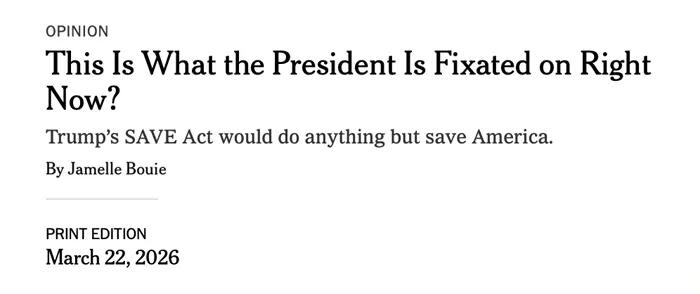
That’s a sinking ship — the party that is now battling to obstruct simple straightforward election reform in the US Senate. Here’s a headline from today’s New York Times:
What will The New York Times do when bona fide, convincing evidence from material seized in recent FBI raids in Georgia and Arizona shows that recent elections were arrantly and knowingly rigged?
It’s going to happen, you know.
And if the procedural delays in the Senate drag out for weeks over the SAVE Act, the truth is likely to emerge while the bill is still in process, and will slam the whole country in the face, like thirty inches of re-bar.
Will the newspaper print an apology to its readers?
We’re in a season of whacking great change in global and national affairs.
“Epic Fury” in Iran will neutralize a regime dedicated to terrorizing the region and reorder the world’s energy flows to the disadvantage of America’s adversaries.
China will lose its deep discount on imported Iranian oil just as in Venezuela a month ago. It already lost control of the Panama Canal as well.
All its inroads around the western hemisphere have been nullified in this first year of Trump 2.0. China has to play nicer with America now.
The crisis has demonstrated that the US can’t depend on its NATO allies — who either refused to send ships to assist, or dawdled over it — which can allow the US to step away from the enormous expense that NATO imposes on us, and also from the tarbaby known as Ukraine. The truth is, we are ideologically more aligned with post-Soviet Russia than we are with France, Germany, and the UK under their current regimes. Ironically, the Russians, with Hungary, Poland, and the Czechs, are the last earnest defenders of Western Civ. Europe has apparently elected to go medieval, anyway. They like to pretend that they can maintain a high standard of living without oil or natgas, a formula so obdurately stupid that only the most awful hardship might avail to change their policies.
This month, the US leaped to create a maritime insurance alternative to Lloyd’s of London, meaning the UK banks can no longer impose a 20-percent cost premium on Persian Gulf oil, which thunders through the global system and affects everyone. We’ve already stepped away from the UN-backed international Net Zero carbon pricing scam on tanker and container ships.
The economics of oil are going through a quick and decisive readjustment.
With an end to Iran’s threats to world peace, the US can eventually leave policing of the Persian Gulf to the nations that depend on its oil (we do not).
Meanwhile, the US will continue pounding Iran until it can’t launch so much as a distress flare. They will have no nukes, no navy or air force, no more missiles and drones and payloads, and no ability to manufacture any more of them. And if they try, we will blow them up again.
That’s real politics, not performative diplomatic jive.
Sooner or later, the Revolutionary Guard regime will disintegrate and someone else will have to step up.
The Iranian people deserve a chance to live in the sunlight after what they’ve been through for a half century.
But it’s really up to them to make it happen.
It’s pretty obvious that the American President and his people understand that.
Tyler Durden
Fri, 03/20/2026 – 16:25

Putin Reportedly Offers To Cut Iran Intel-Sharing If US Does Same In Ukraine
Putin Reportedly Offers To Cut Iran Intel-Sharing If US Does Same In Ukraine
Moscow has been accused by top officials in the White House and in Congress of expanding its intelligence-sharing with Iran amid the now three-week-long war involving the US and Israel. Russia has even been accused of handing over targeting information, allegedly assisting in Iranian ballistic missile attacks on US bases and radar sites as well as sensitive assets in the region.
Russia hasn’t confirmed that it is doing this, and has issued a meager official denial – but it also hasn’t taken serious steps to convince Washington otherwise. The Kremlin is perhaps relishing in the idea of doing to the US in Iran precisely what the US is doing to Russia in Ukraine – making the operation harder, more costly, and setting up for potential quagmire.
On Friday Politico is reporting on a possible quid pro quo offer: “Moscow proposed a quid pro quo to the U.S. under which the Kremlin would stop sharing intelligence information with Iran, such as the precise coordinates of U.S. military assets in the Middle East, if Washington ceased supplying Ukraine with intel about Russia.”
“Two people familiar with the U.S.-Russia negotiations said that such a proposal was made by Russian envoy Kirill Dmitriev to Trump administration envoys Steve Witkoff and Jared Kushner during their meeting last week in Miami,” the report continues.
The sources indicated the US side rejected the offer. Of course, the US has long been very deep into the Ukraine crisis, and significant intel-sharing has stretched back for many years into the Biden administration and even before, in connection with the Donbass conflict of 2014.
Politico underscores, “Nevertheless, the sheer existence of such a proposal has sparked concern among European diplomats, who worry Moscow is trying to drive a wedge between Europe and the U.S. at a critical moment for transatlantic relations.”
Assuming the fresh report is accurate, it raises some serious questions regarding US policy at this very sensitive moment of two major raging wars.
The sources here are “two people familiar with the U.S.-Russia negotiations.” That could also mean two people familiar with leaking propaganda. https://t.co/Q29DmlQIHT
— Aaron Maté (@aaronjmate) March 20, 2026
For starters, much of Trump’s base of support has already long been skeptical of Ukraine policy. There is a segment also not happy about the US launching another ‘war of choice’ in the Middle East, contrary to Trump’s pledges on the campaign trail. There are also issues of ‘overreach’ and overextension in terms of American involvement in no less than two huge global hotspots – one of which Washington is the direct initiator (alongside Israel).
If Trump did actually cease intel-sharing with Kiev, there would be many Republicans which would be quite OK with this. Even J.D. Vance and Pete Hegseth have appeared cold on the idea of too much support for Ukraine.
KING: Can you update us on Russian intelligence sharing with Iran?
GABBARD: If it’s going on, that answer would be appropriate for a closed session
KING: It’s been in the press. Is it occurring?
GABBARD: What I can tell you is that according to the Dept of War, any support… pic.twitter.com/zR5GibrDmT
— Aaron Rupar (@atrupar) March 18, 2026
Whether the alleged offer from Moscow will remain on the table or not is another question. But it seems clear Russia is ready to leverage events in Iran to its advantage related to Ukraine – even at a moment peace talks are clearly on indefinite pause.
Tyler Durden
Fri, 03/20/2026 – 15:45

‘TRUMP AMERICA AI Act’ Repeals Section 230, Expands Liability, & Establishes Centralized Federal Control Over AI Systems
‘TRUMP AMERICA AI Act’ Repeals Section 230, Expands Liability, & Establishes Centralized Federal Control Over AI Systems
Authored by Jon Fleetwood via JonFleetwood.com,
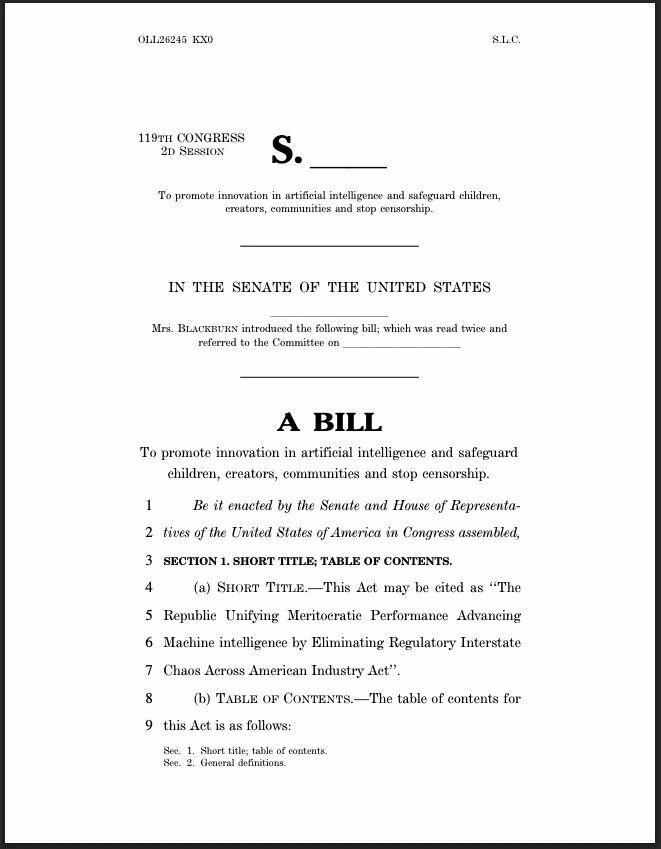
U.S. Senator Marsha Blackburn has released a 291-page legislative framework that would repeal Section 230, expand liability across the artificial intelligence ecosystem, and establish a unified federal rulebook governing how AI systems are built, deployed, and controlled in the United States.
U.S. President Donald J. Trump (left) and Senator Marsha Blackburn (R-TN; right)
The proposal—titled the TRUMP AMERICA AI Act—is being presented as a pro-innovation, pro-safety measure designed to “protect children, creators, conservatives, and communities” while ensuring U.S. dominance in the global AI race.
But the actual structure of the bill reveals a comprehensive system that centralizes regulatory authority, expands legal exposure for platforms, and creates new mechanisms for controlling AI outputs and digital information flows.
For independent journalists and publishers operating on platforms like Substack, the repeal of Section 230 shifts the risk upstream.
Platforms would no longer be shielded from liability tied to user-generated content, meaning they must evaluate whether hosting certain reporting could expose them to lawsuits.
In practice, that creates pressure to restrict or deprioritize content that could be framed as causing harm—particularly reporting on public health, government programs, or other high-stakes issues—regardless of whether it is sourced or accurate.
Section 230 Repeal Removes Core Liability Shield
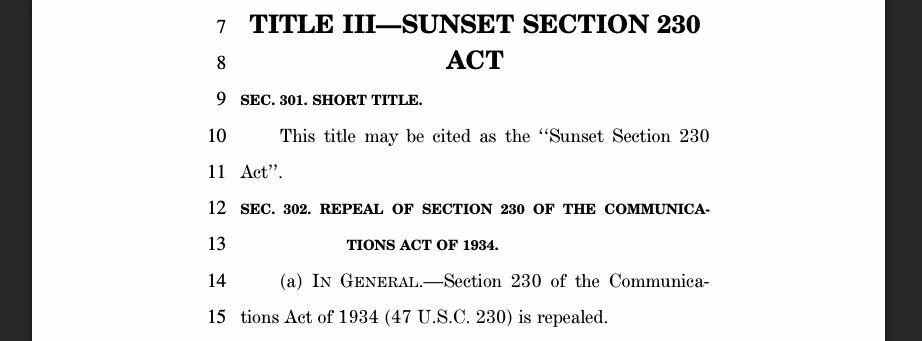
At the center of the bill is the full repeal of Section 230 of the Communications Act—long considered the legal foundation of the modern internet.
Section 230 protects online platforms like Substack from being treated as the publisher of user-generated content, shielding them from most civil liability over what users post.
The Blackburn framework would eliminate that protection by repealing Section 230 entirely.
In its place, the bill creates multiple new avenues for liability, allowing enforcement not just by federal regulators, but by state attorneys general and private actors.
Platforms and AI developers could face legal action for “defective design,” “failure to warn,” or producing systems deemed “unreasonably dangerous.”
The practical effect is that once liability protections are removed, platforms are no longer free to host content neutrally.
They must actively manage and restrict content—or risk being sued.
‘Duty of Care’ Standard Introduces Subjective Enforcement Trigger
The bill imposes a “duty of care” requirement on AI developers, mandating that they prevent “reasonably foreseeable harms” arising from their systems.
That language is broad and undefined.
What qualifies as “harm,” what is “foreseeable,” and when an AI system is considered a “contributing factor” are not fixed standards.
They are determined after the fact by regulators, courts, and litigants.
This creates a retroactive enforcement model where AI outputs can be judged unlawful based on evolving interpretations, forcing companies to preemptively restrict what their systems are allowed to generate.
Federal ‘One Rulebook’ Replaces State-Level Variation
Blackburn’s framework repeatedly emphasizes the need to eliminate what she calls a “patchwork of state laws” and replace it with a single national standard.
That shift consolidates authority at the federal level, empowering agencies such as the Federal Trade Commission, Department of Justice, National Institute of Standards and Technology (NIST), and Department of Energy to define and enforce AI rules across the country.
Rather than multiple local jurisdictions experimenting with different approaches, the bill establishes a centralized governance model for AI systems.
Algorithmic Systems & Content Delivery Brought Under Regulation
Under the “Protecting Children” provisions, the bill directly targets the design features of digital platforms, including:
Personalized recommendation systems
Infinite scrolling and autoplay
Notifications and engagement incentives
Platforms would be required to modify or restrict these features to prevent harms such as anxiety, depression, and “compulsive usage.”
This is not limited to content moderation.
It regulates how information is ranked, delivered, and amplified—placing core algorithmic systems under federal oversight.
Watermarking & Content Provenance Standards Introduced
The bill directs NIST to develop national standards for:
Content provenance (tracking origin of digital content)
Watermarking of AI-generated media
Detection of synthetic or modified content
It also requires AI providers to allow content owners to attach provenance data and prohibits its removal.
These provisions create a technical infrastructure for identifying and tracking the origin and authenticity of digital content across platforms.
New Copyright & Likeness Liability for AI Training and Outputs
The framework explicitly states that using copyrighted material to train AI models does not qualify as fair use, opening the door for widespread litigation against AI developers.
It also establishes liability for the unauthorized use of an individual’s voice or likeness in AI-generated content, and extends that liability to platforms that host such material if they are aware it was not authorized.
Together, these provisions expand legal exposure across both the training and deployment phases of AI systems.
Mandatory Workforce Surveillance & AI Risk Monitoring
The bill requires companies to report quarterly data on AI-related job impacts, including layoffs, hiring shifts, and positions eliminated due to automation.
It also establishes a federal “Advanced Artificial Intelligence Evaluation Program” to monitor risks such as:
Loss-of-control scenarios
Weaponization of AI systems
These measures create ongoing federal visibility into both the economic and operational effects of AI deployment.
National AI Infrastructure & Public-Private Control Systems
The proposal includes the creation of the National Artificial Intelligence Research Resource (NAIRR), a shared infrastructure providing:
Compute power
Large datasets
Research tools
This system would be governed through a public-private structure, combining federal agencies and private sector contributors.
Control over compute, data access, and infrastructure places the direction of AI development within a centralized framework.
Structural Shift: Liability as the Enforcement Mechanism
While the bill is framed as reducing regulatory complexity, its core enforcement mechanism is not deregulation but liability expansion.
By removing Section 230 and introducing broad legal exposure, the framework creates a system where platforms and AI developers must continuously assess legal risk tied to content, outputs, and system behavior.
That shifts enforcement away from direct government censorship and toward a model where companies self-regulate under constant threat of litigation.
Bottom Line
Blackburn’s AI framework restructures the legal conditions under which information is allowed to exist online.
By removing Section 230 and expanding liability across platforms, the bill shifts risk away from the speaker and onto the infrastructure that distributes their work.
That means companies like Substack are no longer simply hosting content—they are legally exposed to it.
In that environment, the question is no longer whether reporting is accurate or sourced, but whether hosting it could trigger legal risk.
The predictable result is preemptive restriction: platforms limiting reach, tightening policies, or removing content that could be framed as harmful—especially reporting on public health, government programs, or other high-stakes issues.
For independent journalists, the pressure point is distribution.
The bill creates a system where controversial or high-impact reporting does not need to be banned outright.
It only needs to become too risky for platforms to carry.
In effect, control over liability becomes control over visibility.
Tyler Durden
Fri, 03/20/2026 – 14:45

Will Chinese Robot Maker Unitree’s Shanghai IPO Spark A Humanoid-Investing Bubble
Will Chinese Robot Maker Unitree’s Shanghai IPO Spark A Humanoid-Investing Bubble
Unitree Robotics, one of China’s top robot makers – spanning robo-dogs to humanoid robots – has filed for a Shanghai STAR Board IPO, according to Bloomberg. The planned listing suggests that the humanoid robotics industry is entering a more accelerated commercialization phase in 2026, with a broader pipeline of public offerings likely to emerge alongside rising private capital flows across Asia and the US.
The report states that Unitree plans to raise $610 million on the STAR Board, part of the Shanghai Stock Exchange, with proceeds expected to fund AI models and develop new robots.
🤯Absolutely insane. Unitree’s humanoid robot team’s performance at the 2026 Spring Festival Gala
The significance of the humanoid robot’s performance lies in letting 1.4 billion Chinese people know where the future lies. pic.twitter.com/6vXIX2MfWM
— CyberRobo (@CyberRobooo) February 16, 2026
Unitree reported revenue of 1.71 billion yuan last year and net profit of 287.6 million yuan, more than double the prior year. Humanoid robots accounted for over 51% of revenue in the first nine months of 2025.
We have outlined a number of institutional notes this year that provide a framework suggesting that AI’s next frontier is physical, as humanoid robots begin moving onto factory floors and beyond.
The Shanghai Morning Post recently pointed out that “robot brains” for humanoid robotics have arrived. As we noted, this suggests that dual-use fears are mounting.
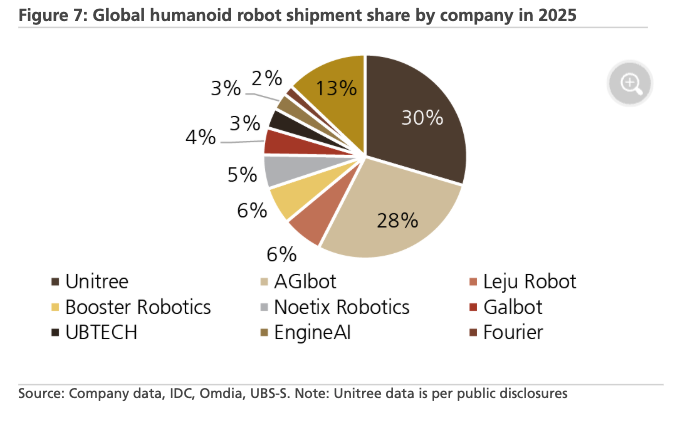
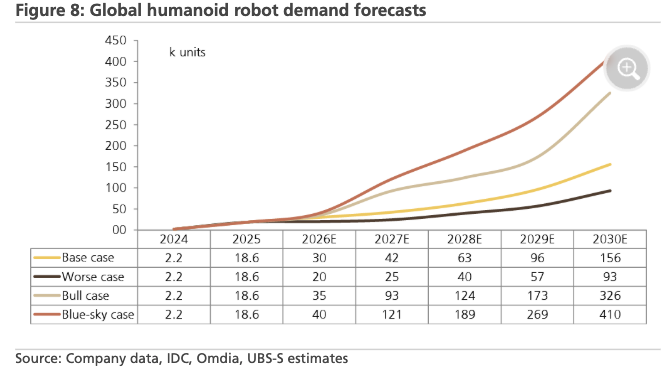
UBS analysts led by Phyllis Wang noted last month that Unitree was the leader in global humanoid robot shipments in 2025.
2025 Shipments by company
Wang marked 2026 as the year humanoid robot shipments begin to ramp up. The real surge comes in the 2027-28 timeframe.
Foundation Robotics cofounder Mike LeBlanc told us, “We didn’t get to the moon by being cautious. When the U.S. sees a strategic race, it funds its way to the front. Robotics is the new race.” He’s implying that the US humanoid robotics space is about to heat up.
LeBlanc prepares to hand a shotgun to a PhantomMattia Balsamini for TIME. Source: TIME
LeBlanc’s Phantom MK1 robots were recently sent to Ukraine for testing. His company holds government research contracts worth $24 million with the U.S. Army, Navy, and Air Force, and is a military-approved vendor, implying these robots are moving beyond factory floors to dual-use security applications.
Any Unitree IPO will provide bullish tailwinds for US robotics startups, as investors realize the next bubble will be in the humanoid space. The IPO is also bullish for “war unicorns,” as the Department of War’s DOGE resets its procurement program and directs more funding toward defense startups. Follow the money: DoW is searching for bankers to deploy $200 billion in private equity over three years into defense companies.
Tyler Durden
Fri, 03/20/2026 – 14:25

John Fetterman Reveals Who’s Really The Leader Of His Party
John Fetterman Reveals Who’s Really The Leader Of His Party
Sen. John Fetterman (D-Pa.) sat down for an interview on the “All-In Podcast” this week and made a telling admission about the Democratic Party.
When co-host David Friedberg asked Fetterman point-blank, “Who do you think leads the Democratic Party today?” the Pennsylvania senator didn’t flinch. “Oh, we don’t have one,” he said. “I think the TDS, that’s the leader right now. You know, right now our party is governed by the TDS.”
Fetterman then described what that governance actually looks like in practice – a kind of loyalty test that runs in reverse. Opposition to Trump has become the organizing principle, the ideological north star. Agree with anything the other side does and you face consequences. “It’s made it virtually impossible, without being punished, as a Democrat, to agree something’s good, or ‘I agree with the other side,'” he said.
He then cited Operation Epic Fury – the U.S. military campaign against Iran – as the latest illustration of the problem. Fetterman said he is “literally the only Democrat […] in Congress, that I’ve come across that’s saying, ‘I think it’s a great thing to break and destroy the Iranian regime.’ I think it’s entirely appropriate to hold them accountable.”
Fetterman correctly pointed out that this is not a fringe or even partisan position, historically. Every Democrat who ran for president in recent memory vowed Iran would never get a nuclear weapon. Now that it’s actually happening, the party’s response has been mostly blind criticism of President Trump for finally taking action.
🚨NEW: @friedberg: “Who do you think leads the Democratic party today?”
JOHN FETTERMAN: “We don’t have one … Right now our party is governed by the TDS.”
@DailyCaller pic.twitter.com/Mr2Z4bVRs5
— Jason Cohen 🇺🇸 (@JasonJournoDC) March 18, 2026
Fetterman previously accused Democrats of refusing to put “country over party” over the Iran strikes.
“The last two professional candidates for the Democratic Party all agreed that we can never allow Iran to acquire nuclear bombs, and that’s made that possible now. I think we can say, ‘Hey, that’s a great thing. That makes the world more safe, more secure and holds Iran accountable,’” he told Fox News’s Sean Hannity earlier this month, after 53 House Democrats voted against a resolution declaring that Iran is a state sponsor of terrorism — something which isn’t remotely in doubt. “That’s almost 25% of Democrats in the House that can’t just call Iran the world’s biggest terrorism underwriter,” Fetterman added.
“Virtually every Democrat that I’m aware of says we can never allow Iran to acquire a nuclear bomb, and they were a significant risk to America,” Fetterman continued. “I know why they [Democrats] don’t say that now because I’m aware that it is very damaging as a Democrat to just happen to agree with the president on anything. But, for me, that’s easy — country over party.”
This week, veteran Democratic strategist James Carville blasted Fetterman, accusing him of always being wrong.
“Can I say a public prayer?” Carville began. “John Fetterman, whatever you do, keep your position. Don’t change. We don’t want you. Stay right where you are. Because you’ve been wrong about every goddam thing that you’ve ever said, and we don’t want you to break your streak.”
He continued, “And can I assure you that the fact that you think it’s a good idea is not going to matter one wit to any Democrat,” and went on to say that Fetterman’s support for the war in Iran was more likely to make Democrats oppose it anyway.
“It might get your name in the paper more,” Carville added. “Fucking asshole.”
Carville’s criticism isn’t likely to sway Fetterman either. In fact, recent polling suggests that while Americans are skeptical of the war in Iran, opposition is waning. According to a new Washington Post survey, 42% now support the U.S. military campaign against Iran, while 40% oppose it. That marks a dramatic shift from just days earlier, when the Post’s flash poll showed 52% opposed and only 39% in favor.
Tyler Durden
Fri, 03/20/2026 – 13:45
https://www.zerohedge.com/political/john-fetterman-reveals-whos-really-leader-his-party

Dr. Oz Says He’s Eyeing Florida In Medicaid Fraud Crackdown
Dr. Oz Says He’s Eyeing Florida In Medicaid Fraud Crackdown
Authored by Jack Phillips via The Epoch Times,
The administrator of the Centers for Medicare and Medicaid Services (CMS) confirmed this week that his office is eyeing Florida for instances of potential health care fraud.
Dr. Mehmet Oz, also known as Dr. Oz, wrote on March 17 on X that what he saw in Florida “around durable medical equipment fraud was horrifying” and indicated that Florida and Gov. Ron DeSantis, a Republican, are “next up” in his fraud investigation.
“The scale is out of control—and not just limited to these schemes,” he said in the post.
“The reality is that fraud in our government health programs is widespread, sophisticated, and deeply entrenched.”
The announcement appears to signal that Florida is the first GOP-controlled state to be targeted by CMS in a crackdown on health care fraud. Previously, New York, Minnesota, and California were the states that Oz had focused on.
DeSantis’s office did not respond to a request for comment by publication time.
Authorities in Florida suggested that they would work with the Trump administration in rooting out fraud in health programs.
Jason Weida, chief of staff for the Florida governor, responded that the state is working with Oz and CMS to discover any criminal activity.
“We have zero tolerance for waste, fraud, and abuse—and we will aggressively deploy every resource necessary to root it out at any level in our state,” he wrote in a post on X.
Florida Attorney General James Uthmeier, a Republican, said in a post, “The Medicaid system is overwhelmed with fraud and abuse, and we look forward to working with Dr. Oz on these issues!”
He provided an example in which his office prosecuted a man who allegedly stole Medicaid funding that was meant for transportation services for disabled children in the state.
Since taking office last year, the Trump administration has prioritized rooting out fraud, waste, and abuse within the federal government. A task force, the Department of Government Efficiency, was also established by President Donald Trump to help with the removal of wasteful or fraudulent programs.
It comes as Trump signed an order on March 16 creating an anti-fraud task force led by Vice President JD Vance to look into fraud allegations across the country. Trump specifically singled out California during his remarks on March 16 and said that fraud allegations were higher in Democrat-led states than in Republican-led states.
Vance, who appeared with Trump in the Oval Office during the announcement, said the order would force the federal government to “stop the fraud of the American taxpayer and make sure that the benefits that ought by right go to American citizens, go to American citizens, and not to fraudsters.”
The vice president last month criticized Minnesota Gov. Tim Walz, a Democrat who was presidential candidate Kamala Harris’s running mate in 2024, over his efforts to combat fraud. Walz had criticized the Trump administration for what he described as a “campaign of retribution” against him.
Responding to the Trump administration’s allegations of fraud in his state, the office of California Gov. Gavin Newsom, a Democrat, criticized the president and said his administration has arrested numerous criminals who allegedly engaged in fraudulent activities.
In a post on X, Newsom’s office wrote, “If Trump is serious about fraud, great—he’s got a partner in California in wanting to tackle it.”
Tyler Durden
Fri, 03/20/2026 – 13:25
https://www.zerohedge.com/political/dr-oz-says-hes-eyeing-florida-medicaid-fraud-crackdown

CBS News Announces Fresh Round Of Layoffs As Bari Weiss Buzzsaw Continues
CBS News Announces Fresh Round Of Layoffs As Bari Weiss Buzzsaw Continues
After paying Bari Weiss $150 million for The Free Press and hiring her to run their newsroom, CBS News announced a fresh round of layoffs on Friday which will affect over 60 jobs, or 6% of the news division, according to the NY Times.
“Certain parts of this newsroom need to get smaller in order for us to make room for the things that we need to build to remain competitive in the future,” said Weiss, who entered the scene last October, during a Friday newsroom-wide conference call.
The move follows roughly 100 layoffs last year, while ratings have continued to plummet under Weiss.
Today’s round includes the entirety of CBS News Radio – a century-old division that “served as the foundation for everything we have built since 1927,” said network president Tom Cibrowski in a memo.
CBS came under the control of David Ellison, a billionaire tech heir, after his Hollywood studio Skydance absorbed the media giant Paramount last year. The Trump administration approved Mr. Ellison’s purchase after Paramount paid $16 million to settle a suit brought by President Trump against “60 Minutes.”
Mr. Ellison said he wanted CBS News to appeal to a centrist audience, and he installed Ms. Weiss, an opinion journalist and critic of the mainstream news media, as its new leader. –NYT
According to Weiss and Cibrowski, “it’s no secret that the news business is changing radically, and that we need to change along with it.”
“New audiences are burgeoning in new places, and we are pressing forward with ambitious plans to grow and invest so that we can be there for them,” the memo continues.
Weiss told employees that today’s layoffs had “absolutely nothing to do with the quality of your work and the way you have poured your heart and soul into this organization,” and “simply has everything to do with the times we’re living in.”
Of course, not that we’re shedding a tear – but that $150 million would have kept the 160 employees employed for something like a decade.
Tyler Durden
Fri, 03/20/2026 – 12:45

These Seven Allies Concocted A ‘Hormuz Coalition’ Statement To Placate Trump, Which Failed
These Seven Allies Concocted A ‘Hormuz Coalition’ Statement To Placate Trump, Which Failed
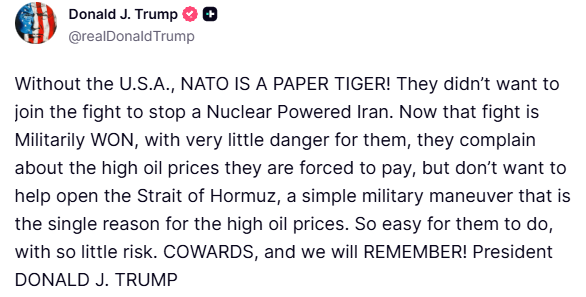
We reported earlier that President Trump has again expressed his extreme frustration at lack of direct NATO participation in a plan to open up the Strait of Hormuz. He declared the US has “militarily WON” – and lambasted lack of allied interest in a “simple military maneuver” to open the Strait of Hormuz, calling NATO a “Paper Tiger” without the US.
And so clearly Trump himself is unconvinced after on Thursday seven allied nations signed a statement expressing a readiness to contribute to efforts to reopen the Strait of Hormuz. The statement included no pledge to commit warships or any kind of military or even logistical help, and so is somewhat of a facade and pure PR spectacle.
Royal Thai Navy/AFP via Getty Images
These countries are: UK, France, Germany, Italy, the Netherlands, Japan, and Canada. But again there’s no military role here: “We express our readiness to contribute to appropriate efforts to ensure safe passage through the strait,” the close US allies announced.
The joint statement did of course condemn Iran, and seemed generally supportive of Trump’s actions, even as individual leaders like Germany’s Merz have expressed they would have been against starting a war with Iran in the first place.
It further denounces ongoing Iranian attacks commercial vessels and energy infrastructure, citing “the de facto closure of the Strait of Hormuz by Iranian forces,” and calls on Tehran to “cease immediately its threats, laying of mines, drone and missile attacks and other attempts to block the strait.”
One reporter writing for Axios views the statement as “largely a gesture to placate Trump, who has railed against allies for declining to help secure the strait and warned that a failure to do so could undermine the future of NATO.”
Italian Prime Minister Giorgia Meloni has made clear that no EU state is at moment considering “a military mission to forcibly break the Iranian blockade,” adding the EU favors “diplomacy and de-escalation.”
Other EU countries like Spain, Greece, and Switzerland have also made it clear they won’t join the war. Washington has meanwhile put a lot of pressure on the UK for some tangible assistance, but this too has been a disappointment for the White House who appears to be ‘going it alone’.
As for a total list of countries individually called on by Washington, these have issued formal refusals:
Here are some of the countries that have rejected Trump’s request to help re-open the Strait of Hormuz:
🇦🇺 Australia
🇫🇮 Finland
🇫🇷 France
🇩🇪 Germany
🇬🇷 Greece
🇮🇹 Italy
🇯🇵 Japan
🇳🇱 Netherlands
🇪🇸 Spain
🇬🇧 United Kingdom
— Middle East Eye (@MiddleEastEye) March 16, 2026
But the US and Israel seem to be getting pulled deeper into the war in the Persian Gulf and near Kharg Island in particular, with thousands of US Marines en route to the region. What they will ultimately do when they get there remains anyone’s guess – though reports say Trump is mulling a takeover of Kharg.
As a reminder, Trump has claimed an operation would include “so little risk”…
Such a plan might prove bloody and difficult, which is perhaps why so many US allies are content to stay on the sidelines, fearing they too could soon join another Middle East quagmire.
Tyler Durden
Fri, 03/20/2026 – 12:20

‘Radical’ Biden Judge Reverses RFK Jr. On Trans-Child Surgeries, Other Procedures
‘Radical’ Biden Judge Reverses RFK Jr. On Trans-Child Surgeries, Other Procedures
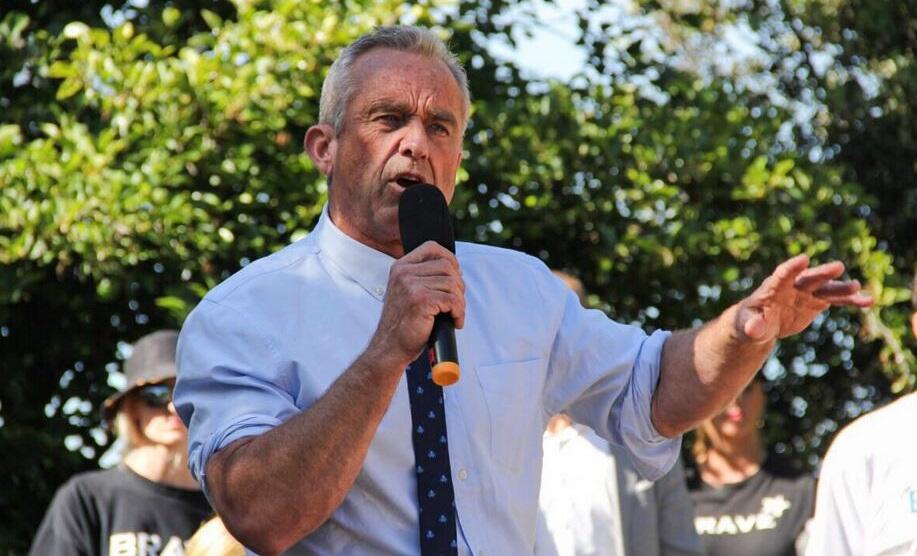
A federal judge deemed ‘too radical‘ by GOP lawmakers during his confirmation hearings said on Thursday that he will grant a motion by blue states to vacate (reverse) a declaration by HHS Director Robert F. Kennedy Jr. blocking breast removal and other procedures for youths with gender dysphoria.
Oregon US District Judge Mustafa Kasubhai, who was appointed by Biden in late 2024 and only confirmed after Senate Democrats invoked cloture on his nomination by a 51-43 vote, said during a hearing that he would soon issue a formal written opinion and an order denying the government’s bid to dismiss the states’ case, and granting the states’ motion for summary judgement, according to court records.
Kennedy issued a declaration in late 2025 that “ex-rejecting procedures for children and adolescents are neither safe nor effective as a treatment modality for gender dysphoria, gender incongruence, or other related disorders in minors, and therefore, fail to meet professional recognized standards of health care.”
This was based on a report by the Department of Health and Human Services which looked at procedures and treatments available for gender dysphoria, and concluded that many of them risk infertility. The Trump administration said that health care providers who perform breast removal and other procedures would be out of compliance with updated standards, while officials also moved to bar hospitals that participate in Medicare or Medicaid from performing the procedures on children.
New York and 18 other states immediately sued, claiming that the new rules were illegal, and “amounts to an end-run around the free choice of provider statute because it effectively bars Medicaid beneficiaries from choosing providers that are otherwise qualified, simply because they furnish gender-affirming care to children or adolescents,” the states said in their motion for summary judgement.
New York Attorney General Letitia James, one of the plaintiffs, said the forthcoming ruling siding with the states showed Kennedy “cannot unilaterally change medical standards by posting a document online, and no one should lose access to medically necessary health care because their federal government tried to interfere in decisions that belong in doctors’ offices.” –Epoch Times
At least 17 hospitals or health centers have been referred for possible punitive action for violating the HHS declaration, they said.
Government lawyers argued in a brief that the declaration reflected Kennedy’s “non-binding policy position on the safety and efficacy of certain pediatric and adolescent treatment modalities,” and that the HHS report was one of many pieces of information officials considered in their decision.
The admin also asked the court to dismiss the case over a lack of jurisdiction.
* * * Top selling supplements (in stock)
Brain Rescue (on sale!)
Iodine Fortify (are you deficient?)
Resveratrol (potent antioxidant for healthy aging)
Tyler Durden
Fri, 03/20/2026 – 11:40
JPMorgan Activates BTC & ETH As Institutional Collateral
JPMorgan Activates BTC & ETH As Institutional Collateral
JPMorgan has officially bridged the gap between “Digital Gold” and “Wholesale Credit.”
The activation of direct BTC and ETH collateralization allows institutional giants to finally turn their dormant holdings into immediate USD liquidity without selling a single satoshi.
Operating through the Kinexys (formerly Onyx) digital financing platform, the bank now allows institutional clients like hedge funds and corporate treasuries to pledge BTC and ETH for USD-denominated liquidity.
Unlike previous years where only ETF-wrapped products were supported, this move enables borrowers to leverage their direct on-chain holdings without triggering the capital gains taxes associated with liquidation.
The quantitative framework for these loans is defined by a rigorous risk-weighted haircut model.
Under the current policy, JPMorgan applies a 30% to 50% haircut on BTC and ETH, effectively setting the maximum Loan-to-Value (LTV) ratio at 50% to 70% depending on 90-day volatility metrics.
This structure is designed to buffer against the “cascade risk” inherent in crypto markets, where a 15% intraday drop could otherwise trigger systemic liquidations. By treating BTC and ETH as Tier-1 collateral, JPMorgan is effectively putting them on the same playing field as high-quality corporate bonds.
Tri-Party Custody: Assets are not held on the bank’s balance sheet but are secured via qualified third-party custodians like Coinbase Custody and Anchorage Digital. This ensures that the bank facilitates the credit while the assets remain in high-security, audit-ready vaults.
Atomic Settlement: By utilizing the Kinexys blockchain, JPMorgan has reduced the time to move collateral from T+2 days to under 120 seconds. This allows for real-time margin adjustments and prevents the “lag” that often causes over-collateralization in traditional banking.
Tax-Efficiency: Because the institution is borrowing against the asset rather than selling it, they avoid triggering capital gains taxes. This makes crypto-backed credit the most tax-efficient way for “whales” to access their wealth.
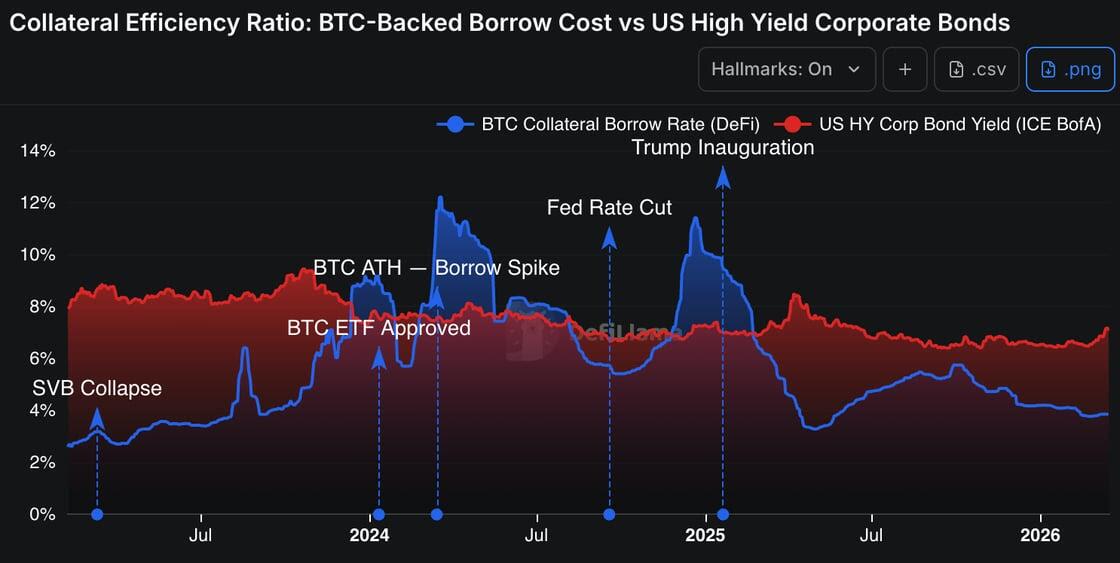
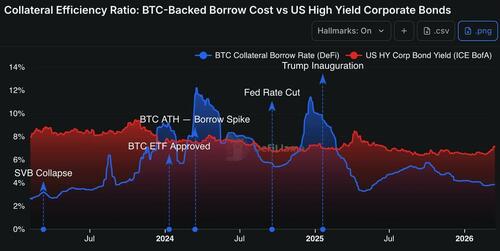
The chart clearly shows that BTC collateralized borrowing rates are consistently trending below US high-yield corporate bond yields, even though BTC remains a more volatile asset.
Source: DeFiLlama
While there are occasional spikes during periods of market stress, reflecting short-term liquidity demand and volatility shocks, the overall cost of borrowing against BTC remains structurally lower. This suggests that the market is increasingly valuing BTC’s deep liquidity and global trading nature over its volatility, allowing it to function as efficient collateral. JPMorgan’s activation reinforces the trend by enabling institutions to unlock USD liquidity against BTC and ETH at lower rates, improving capital efficiency while accepting manageable volatility driven fluctuations.
The broader implication for DeFi is the emergence of a hybrid credit market. By recognizing BTC and ETH as “pristine collateral” alongside gold and Treasuries, JPMorgan is effectively lowering the cost of capital across the system.
This brings in significant liquidity, but it also concentrates risk, since these structures rely on a small set of regulated custodians to hold assets.
More broadly, this marks a shift in how balance sheets are used. Assets are no longer just held for exposure, they are actively used to generate liquidity and improve capital efficiency.
Tyler Durden
Fri, 03/20/2026 – 11:25
https://www.zerohedge.com/crypto/jpmorgan-activates-btc-eth-institutional-collateral