Category: News

How To Transport Next-Gen Nuclear Fuel Safely? NANO Nuclear Hits Key Milestone
How To Transport Next-Gen Nuclear Fuel Safely? NANO Nuclear Hits Key Milestone
Authored by Prabhat Ranjan Mishra via Interesting Engineering,
A New York-based company has taken a significant step to develop a proprietary, optimized transportation solution for High-Assay Low-Enriched Uranium (HALEU) fuel.
NANO Nuclear Energy achieved the conceptual design milestone for an advanced, proprietary HALEU transport package supporting next-generation nuclear reactors.
World-class nuclear transportation expertise
“HALEU fuel logistics will be one of the foundational pillars of the advanced nuclear industry,” said Jay Yu, founder and chairman of NANO Nuclear.
“Our collaboration with Gesellschaft für Nuklear-Service mbH (GNS) has brought together world-class nuclear transportation expertise with NANO Nuclear’s proprietary fuel basket technology. Achieving this early design milestone represents an important step toward building the infrastructure needed to support the deployment of advanced reactors across the United States and globally.”
The project leverages NANO Nuclear’s exclusively licensed nuclear fuel transportation basket design, developed with the technical support of GNS Gesellschaft für Nuklear-Service mbH (GNS), one of the world’s foremost specialists in the treatment, packaging, and transportation of radioactive materials. GNS is globally recognized for its expertise in transport and storage cask design, licensing, and manufacturing, as well as advanced technologies for nuclear waste processing and facility decommissioning, according to a press release.
Nuclear fuel transportation package
The company highlighted that the HALEU transportation package currently under development is designed to support the transport of multiple advanced nuclear fuel types. It includes transportation of uranium oxide fuels, TRISO particle fuels, uranium-zirconium hydride fuels, uranium mononitride fuels, and molten salt reactor fuels.
This broad compatibility ensures that the transportation system can serve the diverse fuel requirements of emerging microreactor, small modular reactor (SMR), and advanced reactor technologies, according to NANO Nuclear.
The company also pointed out that working in close collaboration with GNS, NANO Nuclear has completed several major early-stage engineering milestones for the project. It includes the development of conceptual designs for two optimized fuel payload baskets capable of transporting HALEU materials in multiple fuel forms and completing a preliminary design for the transport package overpack, which will house the payload baskets during shipment.
Importantly, this work was performed under a formal Nuclear Regulatory Commission (NRC) Quality Assurance program, ensuring that all engineering and design processes align with the rigorous safety and documentation standards required for nuclear transportation systems, according to NANO Nuclear.
With these foundational design milestones completed, NANO Nuclear intends to continue advancing the fuel transport package through the next phases of development, including further engineering validation and regulatory engagement. The company plans to formally engage with the NRC to pursue certification of the transport package, an essential step toward enabling reliable commercial transportation of HALEU fuels across the United States.
The company also underlined that reliable transportation infrastructure for HALEU fuel is widely recognized as one of the most critical enablers of the next generation of nuclear energy technologies. As microreactors and advanced reactors move toward regulatory licensing and ultimate commercialization, the ability to safely transport advanced fuels will be essential to establishing a fully operational nuclear fuel supply chain.
Tyler Durden
Fri, 03/20/2026 – 06:30

‘Explosives And Extra Blood’: Denmark Planned To Blow Up Greenland’s Runways If US Invaded
‘Explosives And Extra Blood’: Denmark Planned To Blow Up Greenland’s Runways If US Invaded
In January 2026, amid escalating tensions with U.S. President Donald Trump over his renewed push to acquire control of Greenland, Denmark’s military deployed explosives and blood supplies to the Arctic island as part of contingency plans to counter a potential American attack.
The preparations were revealed in a report by Denmark’s public broadcaster DR, which cited multiple high-level sources from the Danish government, military, and intelligence services, as well as officials in France and Germany.
Danish troops sent to Greenland early in the year carried sufficient explosives to demolish key runways – near the capital Nuuk and at the former air base in Kangerlussuaq – to prevent U.S. aircraft from landing in the event of an invasion. Blood supplies from Danish hospitals were also transported to treat potential casualties in combat scenarios.
Two European officials confirmed the DR reporting on Thursday, noting that Denmark aimed to dramatically increase the costs and risks of any forceful U.S. takeover. France and Germany supported Copenhagen’s strategy, with one official highlighting France’s immediate and significant assistance in developing defensive plans.
One European official expressed deep concern at the time, stating they feared “this was going to go really wrong” given Trump’s repeated threats during January.
These measures reflected the grave view taken across Europe of Trump’s rhetoric toward a fellow NATO ally. Danish Prime Minister Mette Frederiksen described the situation as “the worst foreign policy crisis since the Second World War,” crediting improved conditions to strong European cooperation.
The crisis eased after NATO Secretary-General Mark Rutte, leveraging his experience as a seasoned European leader, persuaded Trump during a meeting at the World Economic Forum in Davos to accept the framework of a potential “future deal” with Denmark regarding Greenland.
Frederiksen indicated that senior-level talks with the U.S. continue, seeking a compromise that upholds Denmark’s and Greenland’s sovereignty red lines. She expressed hope for an agreement but cautioned that Trump’s interest in controlling Greenland persists.
In January, Denmark – along with allies including France, Germany, and other Nordic countries – deployed troops to Greenland under the guise of a scheduled military exercise, which Copenhagen had formally notified to the U.S. Department of Defense. However, DR reported the true purpose was to ready defenses against a possible U.S. assault and to guarantee any takeover would require overt hostility.
“The French were incredibly helpful,” one European official told DR. “They understood straight away that we needed a plan.”
Fresh from the U.S. intervention in Venezuela that ousted President Nicolás Maduro, Trump reacted sharply to the European deployments, threatening additional tariffs on Denmark and the involved nations.
One European official remarked that after Venezuela, some in Washington seemed to believe they could act with impunity. While the immediate fear has lessened, it has not vanished entirely.
DR interviewed 12 senior officials from Denmark, France, and Germany about the heightened preparations following the Venezuela operation.
A former Danish minister summed it up: “Greenland has not gone away. It’s only sleeping.”
Tyler Durden
Fri, 03/20/2026 – 05:45

NASA’s Curiosity Rover Finds Evidence Of Underground Water On Mars ‘That Could Have Supported Life’
NASA’s Curiosity Rover Finds Evidence Of Underground Water On Mars ‘That Could Have Supported Life’
Authored by Jill McLaughlin via The Epoch Times (emphasis ours),
NASA’s Curiosity Rover has discovered evidence on Mars that suggests underground water once existed in a region of the planet later than scientists first believed, the agency reported March 15.
“Our findings show that Mars didn’t simply go from wet to dry,” said Dimitra Atri, group leader of the Mars Research Group at New York University. “Even after its lakes and rivers disappeared, small amounts of water continued to move underground, creating protected environments that could have supported microscopic life.”
Curiosity, an SUV-size vehicle weighing about one ton, spent six months investigating an area filled with geological formations known as boxwork, which are low-crisscrossing ridges about three to six feet tall.
The features look like giant spiderweb patters when viewed from space, according to NASA.
“Seeing boxwork this far up the mountain suggests the groundwater table had to be pretty high,” said Tina Seeger of Rice University in Houston, one of the mission scientists. “And that means the water needed for sustaining life could have lasted much longer than we thought looking from orbit.”
Scientists say they think the boxwork formed when groundwater traveled through cracks in the bedrock, leaving behind minerals.
The minerals hardened and reinforced the fractures over time, forming ridges, NASA said, and the surrounding rock was worn away by wind, leaving behind the web-like structures.
Until now, scientists have only had images taken from space of the formations. The same boxwork features exist on Earth, but are much smaller. The ones on Mars are larger and more widespread.
Engineers steer the rover remotely from NASA’s Jet Propulsion Laboratory in Southern California, guiding it over ridges that are barely wider than the vehicle.
“It almost feels like a highway we can drive on. But then we have to go down into the hollows, where you need to be mindful of Curiosity’s wheels slipping or having trouble turning in the sand,” said operation systems engineer Ashley Stroupe at NASA Jet Propulsion Laboratory. “There’s always a solution. It just takes trying different paths.”
NASA said researchers were also trying to understand how the network of ridges formed on a 3-mile-tall mountain that Curiosity is climbing.
The terrain increasingly shows signs that water gradually disappeared over time, although there were occasional periods when the rivers and lakes briefly returned, according to the agency.
The rover is serving as a mobile science lab, collecting and analyzing rock samples with a drill mounted on its robotic arm. The drill turns rock into powder, which is then delivered to instruments for more study, according to NASA.
Using X-rays and a high-temperature oven last year, scientists identified clay minerals in the ridge sample and carbonate minerals in the hollow that offered more clues about how the features formed.
The rover is expected to leave the boxwork region sometime this month. The area is part of a layer that contains sulfate minerals, which formed as water gradually disappeared from the planet.
Tyler Durden
Fri, 03/20/2026 – 05:00

RT Reporter Injured During ‘On Air’ Segment By Israeli Strike, Angering Moscow
RT Reporter Injured During ‘On Air’ Segment By Israeli Strike, Angering Moscow
The Kremlin and state media outlet Russia Today (RT) are outraged after its reporter and cameraman narrowly missed being blown up in an Israeli airstrike, while receiving wounds.
Reporter Steve Sweeney and his Lebanese cameraman, Ali Rida, were injured by shrapnel during a live shot from southern Lebanon on Thursday. Sweeney is a British national who works for RT. Both are said to be conscious and are receiving treatment at a Lebanese hospital in the wake of the close-call. The footage, caught live, is harrowing and going viral. Watch:
🚨 WATCH: The moment an Israeli airstrike, targeting the al-Qasmiya Bridge, hits near RT reporter Steve Sweeney while reporting in southern Lebanon. Lebanon’s state news agency reports the two journalists were lightly injured.
— Breaking911 (@Breaking911) March 19, 2026
Later, the reporter published video of doctors removing shrapnel from his arm. It seems they were able to walk away from the very close-call incident.
Russian state media is heavily featuring the video across platforms, while demanding answers from Israel, alleging a targeted strike on a marked press team:
They said an Israeli aircraft fired a missile at their filming position near Al-Qasmiya Bridge, not far from a local military base.
Rida said Israeli forces “deliberately attacked” the crew despite their wearing uniforms displaying their press credentials.
Rida’s camera captured the moment of the strike as he filmed Sweeney’s report. The footage shows the missile hitting less than ten meters behind Sweeney as he ducks for cover.
Lebanon has been scene of a ‘second front’ Israel has opened amid the ongoing Iran war, in order to root out Hezbollah and its missile capability. Hezbollah has been launching rockets on northern Israel once again – after the Gaza related truce earlier collapsed. A ground war is now emerging, also as Beirut gets bombarded from the air.
RT has written that its “journalists have frequently been injured while covering major conflicts, particularly in Ukraine, including, most recently, correspondents Igor Zhdanov and Roman Kosarev, who were wounded in drone and artillery strikes while embedded with frontline units.”
Tyler Durden
Fri, 03/20/2026 – 04:15

UK Teacher Banned For Saying Migrants Should ‘Respect Our Laws Or Leave’
UK Teacher Banned For Saying Migrants Should ‘Respect Our Laws Or Leave’
Authored by Steve Watson via Modernity.news,
A British Physical Education teacher has been indefinitely banned from the classroom after daring to state that migrants should respect Britain’s laws, culture, and way of life — or leave.
Sam Everett taught at Haughton Academy in Darlington for two years. Someone identified his X account, reported him to the school, and triggered an investigation into his political views.
The independent Teaching Regulation Agency panel that heard the case cleared him of racism and sexism, praised his unblemished teaching record, noted colleague endorsements, and recommended he keep his job. Publication of the findings alone would suffice as punishment, they ruled.
PE teacher who told migrants to ‘respect our laws or leave’ banned from classroom despite being cleared of racism and it being recommended that he keep his job https://t.co/hkIEUzB91Q
— Daily Mail (@DailyMail) March 18, 2026
However, the Department for Education stepped in anyway and overruled the panel, claiming it had “failed to give sufficient weight” to the seriousness of his conduct.
Everett is now banned from teaching for life — or at least two years before he can even apply to be reinstated, with no guarantee of success. He lost his job at the academy in June 2024.
The posts that sparked the witch hunt were hardly fringe. In one, Everett wrote: “Completely agree, if you don’t respect our laws, culture and way of life you should leave, nobody is forcing you to stay. We don’t go to other peoples countries and tell them they’re wrong for how they go about things.”
Responding to a claim that “The law of Allah is superior to your laws,” he replied: “Sick of hearing rubbish being spouted by these idiots. They can live in societies where their values are accepted, it isn’t here. Leave. You won’t be missed.”
On a Britain First post about “illegal migrant invaders” in small boats approaching British shores, Everett simply wrote: “Deploy the navy.”
He added: “There’s not an Islamist problem in our country according to some. How many times do we get called racists for being English? These people come from the most intolerable and barbaric places you can imagine and think they have more rights than us. Bore off.”
Other comments included the observation that anyone who uses the word “comrade” deserves to be shipped to Russia, and “Feel like ordering 20 nuggets every time I see these idiots” about pro-Palestine protesters picketing McDonald’s. When asked whether transgender comedian Eddie Izzard should be allowed in women-only toilets and changing rooms, he replied simply: “No.”
The panel found several posts ‘offensive’ and concluded Everett had shown a lack of tolerance. Yet it explicitly rejected any finding of racism or sexism.
Colleagues spoke highly of him. A subsequent employer who knew the full details said he would rehire him without hesitation. Everett had shown “insight and remorse,” deleted the posts, and closed his accounts. The panel ruled there was “no significant ongoing risk of repetition.”
The panel report itself noted: “Mr Everett had, by his own admission, failed to successfully apply the necessary privacy controls and he was identifiable as a teacher on his profile. Although the school was not referred to, there was plainly enough information available to enable someone to email the school to express concerns about Mr Everett’s posts.”
None of that mattered to the Secretary of State’s decision-maker, who decided a mere published finding would not “satisfy the public interest requirement concerning public confidence in the profession.”
This thought crime machinery is regularly being deployed within education in the UK. As we previously reported, a veteran teacher was branded a terrorist threat and referred to the government anti-terror body Prevent for showing basic Trump campaign and inauguration videos in a U.S. politics class.
Students claimed they were “emotionally disturbed” and the Local Authority Designated Officer warned the views “could constitute a hate crime” and amount to “radicalisation.”
The UK government itself funded a video game called Pathways through the Home Office’s Prevent program that warns 11- to 18-year-olds they risk being flagged as terrorists for researching immigration statistics, blaming migrants for job competition, or protesting the erosion of British values.
And counter-terror police released an ad showing a white teenager having his devices seized and facing a criminal record simply for sharing a link he thought was “funny” but was later deemed “terrorist content.”
The pattern is unmistakable: express mainstream concern about unchecked migration, cultural erosion, or basic law and order, and the state labels you a threat. Meanwhile the small boats keep coming, integration failures mount, and the public is told to stay silent or face professional destruction.
Everett’s case proves the open-borders lobby cannot tolerate even polite pushback. The very existence of these views threatens the narrative that mass migration is an unqualified success requiring zero assimilation.
Britain’s educators are now expected to parrot the approved line or be purged. Free speech and common sense have fallen — and the public’s confidence in the profession is the last thing the Department for Education seems concerned about.
Your support is crucial in helping us defeat mass censorship. Please consider donating via Locals or check out our unique merch. Follow us on X @ModernityNews.
Tyler Durden
Fri, 03/20/2026 – 03:30
Orban Announces Will Block All EU Measures For Ukraine Until Oil Transit Restored
Orban Announces Will Block All EU Measures For Ukraine Until Oil Transit Restored
Hungary remains one of the lone Ukraine-skeptic EU/NATO members which actually has a lot of leverage, resulting in bolder and bolder pronouncements being issued by Hungarian Prime Minister Viktor Orbán of late.
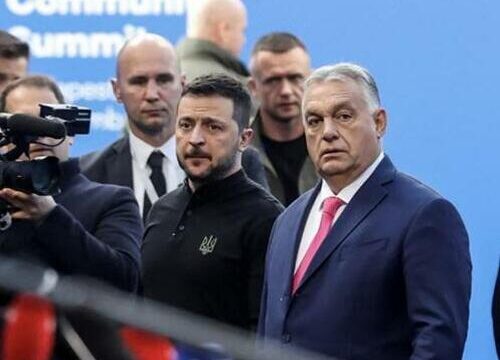
He has newly made clear this week that Hungary will block all EU summit decisions in Ukraine’s favor until oil Russian flows resume. There’s ongoing controversy centered on the contested Druzhba pipeline and the central European nation’s vital flows from Russia.
“We would like to get the oil, which is ours, from the Ukrainians, which is now blocked by the Ukrainians, I did not support any kind of decision here, which is in favor of Ukraine … [as long as] the Hungarians are not able to get the oil which belong to us,” Orbán stated.
Obran has already blocked a proposed €90 billion ($103 billion) loan for Ukraine as well as efforts to slap new sanctions on Moscow, despite the pleadings, pressure, and interventions from other EU leaders.
“I will never support any kind of decision here which is in favor of Ukraine,” Orbán made clear at an EU meeting Thursday. “The Hungarian position is very simple. We are ready to support Ukraine when we get our oil, which is blocked by them,” Orbán underscored further.
Budapest has accused Ukraine of intentionally leaving the pipeline in a state of disrepair after Kiev alleged that Russia struck it. Ukraine has been charged with seeking to indirectly punish Hungary and squeeze its energy supplies.
But Orbán has accused the Zelensky government of playing ‘games’:
According to EU officials, Ukraine has recently accepted technical and financial assistance from the EU to repair the pipeline. Kiev however said that the necessary repairs would take another month and a half.
“Without getting that oil, all the households and Hungarian companies will go [into] bankruptcy,” Orbán said. “It’s not a joke. It’s not a political game.”
Russian oil shipments to Hungary and Slovakia via Druzhba were first halted after the Jan. 27 airstrike in question on equipment and infrastructure in western Ukraine. But in the wake of this, Ukrainian media and officials have positively boasted of recent actions which harm the two EU members Hungary and Slovakia.
For example, one Ukrainian official in late February described on a drone attack on Russian energy infrastructure, “long-range SBU drones caused a ‘bavovna’ (explosion) at the main oil pumping station ‘Kaleykino’ near Almetyevsk in Tatarstan. It receives oil from Western Siberia and the Volga region and mixes it before sending it for export. The station is a key hub for supplying raw materials to the ‘Druzhba’ oil pipeline.”
Tyler Durden
Fri, 03/20/2026 – 02:45
Russia Benefiting From US-Iran War While Impacts On China Are ‘Complicated’: Analysts
Russia Benefiting From US-Iran War While Impacts On China Are ‘Complicated’: Analysts
Authored by John Haughey via The Epoch Times,
Operation Epic Fury presents Russia and China with a “mixed bag” of potential opportunities, but neither appear poised to take advantage of the United States’ “distraction” with Iran, according to analysts with the Center for Strategic and International Studies (CSIS).
That, however, could change if the United States cannot quickly degrade the Iranian Revolutionary Guard Corps’ (IRGC) stranglehold on the Strait of Hormuz to allow commercial shipping to resume, and secure with Israel a convincing victory in decimating Iran’s capacity to develop nuclear weapons, they concurred.
“Ultimately, this comes back to … the duration of the war being key,” CSIS Geopolitics and Foreign Policy Department Chief of Staff Will Todman said during a March 16 “State of Play” presentation in Washington, summarizing views from Russia expert Maria Snegovaya and China Power Project Director Bonny Lin.
Snegovaya said while Russia has accrued short-term benefits from the U.S.-Israeli attack on Iran, a battlefield advantage against Ukraine is not among them.
“Ukraine has passed through the worst, hopefully, this winter,” she said. “It’s spring now, so it’s a little bit easier for them to survive Russian attacks. Also, Russian attacks have similarly slowed down somewhat in the recent weeks, although it doesn’t mean that they will not resume at high intensity quickly.”
President Donald Trump lifted sanctions on Russian oil when he issued a 30-day waiver on March 12. Moscow has pocketed more than $7 billion in increased oil sales since, Snegovaya said.
But that’s hardly “a game-changer” for Russia considering it has a $50 billion deficit in its 2026 budget and is still moving forward with plans to cut at least $25 billion from its annual spending plan, she said, an indication that “Russian officials do not really anticipate this to radically alter its economic situation” unless the strait remains hazardous for an extended time.
Snegovaya said it would take weeks, if not months, for Russia to boost oil production to truly profit from sanctions being lifted and noted banks in India, for instance, are hesitant to “make payments” for Russian oil that may not be delivered once the 30-day waiver expires.
Iran’s value to Russia, she said, is serving as a disruptive force against U.S. interests in the Middle East and, while it is providing intelligence to Iran, Russian President Vladimir Putin could threaten to send sophisticated weapons to Tehran as leverage in dealing with the Trump administration in extending the sanctions waiver or in sustaining support for Ukraine.
Snegovaya noted Russia, along with China, abstained from voting in the March 11 U.N. Security Council condemning Iran for attacking its Gulf state neighbors, adopted in a 13–0 vote.
But unlike China, Russia opted to participate in planned naval exercises earlier this year, she said, noting there are reports that newly minted Ayatollah Mojtaba Khamenei, named to succeed his father—killed in the Feb. 28 decapitation strike that kicked off Operation Epic Fury—as Iran’s “supreme leader,” is convalescing from wounds in Moscow.
“I think it was a Kuwaiti paper that said that, and—maybe I shouldn’t say this—but they’re not always extremely driven by facts,” Todman said.
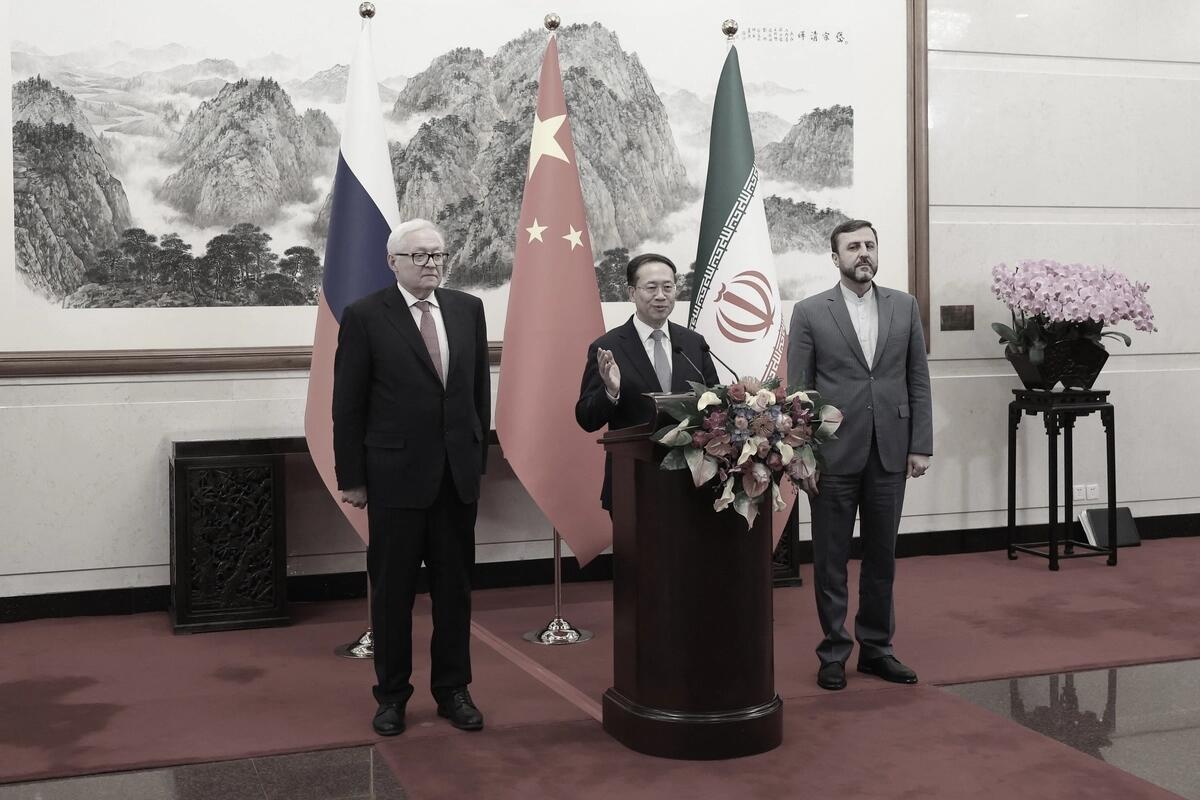
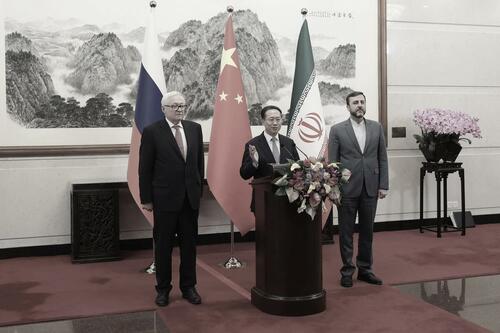
Chinese Foreign Minister Wang Yi with Djibouti’s Minister of Foreign Affairs and International Cooperation Mahamoud Ali Youssouf upon his arrival at the diplomatic institute in Djibouti on Jan. 9, 2020. -/AFP via Getty Images
China: It’s ‘Complicated’
Lin, who heads the CSIS China Power Project, said how the war affects China is “complicated” since it receives 25 percent of its crude oil imports from Iran, but she dismissed fears it will seize the moment to invade Taiwan while the United States remains in conflict with Iran.
“I think, usually, pundits are too quick to link whatever the United States does to Taiwan,” she said. “There is a link, but it’s important to remember China has its own set of calculations for Taiwan that isn’t just based off whether the United States can defend Taiwan or not.”
Lin said the planned late-March meeting between Trump and Chinese leader Xi Jinping is far more important to China than Iran. Trump said on March 16 that he’s requested the meeting be delayed “a month or so.”
“So I think the reason why China has not directly engaged with the United States on Iran is, I think, they want to keep these issues separate,” she said.
China has more at stake in the region than oil imports, Lin said, noting that “since 2019, it has invested nearly $90 billion in LNG facilities, ports, various different projects, power grids, petrochemical projects” across the region. Its exports to the Middle East grew nearly twice as fast as its exports to the rest of the world in 2025, according to the Institute for Energy Research.
“So as Iran is retaliating” in attacking Gulf state energy infrastructure, “it’s also impacting China’s overall investment in the region,” she said.
But it’s unlikely to send warships to aid a U.S.-led effort to shield commercial ships from attack in the strait, Lin said. Even though it has two destroyers stationed in Djibouti on the Bab el-Mandeb Strait linking the Red Sea and Gulf of Aden, and is building a “dual-use” port in Gwadar on Pakistan’s Arabian Sea coast.
There are several reasons for this, she said, noting China has avoided formal defense commitments to Iran, has been “distancing itself” from the regime in Tehran, and continues to purchase 90 percent of the discounted, sanctioned oil Iran produces with Chinese flagged or contracted tankers still moving up to 12 million barrels of crude through the strait a day.
She said in analyzing internal Chinese commentary on the war, contrary to being pleased to see the United States expending expensive air-defense munitions such as THAAD anti-ballistic missile systems and Patriot air-defense systems to knock down Iranian drones, many are “suspicious” that the Trump administration is sending Beijing a message.
“For example,” Lin said, “I’m seeing Chinese experts write, ‘Well, why did the United States and Israel have to [use] so many advanced capabilities against a medium-sized power like Iran? Well, maybe because the United States wants to exercise the capability so they can … demonstrate a real world exercise of it, so they can use it later against China.’”
Lin said other analysts in China are “saying, ‘This is the second major operation the United States has conducted this year, first against Venezuela, second against Iran. And for both of these countries, they are critical suppliers of oil to China.’ So, yes, it is not directly against China right now, but it could be used to indirectly contain China.”
From China’s perspective, “I don’t think they’re seeing these conflicts as completely separate. And as a result, I don’t think the first thing that comes to China’s mind, or leading Chinese experts’ minds, is, ‘How do we take advantage of the situation?’ It’s more of, ‘To what extent is this situation going to negatively impact China?’”
Tyler Durden
Fri, 03/20/2026 – 02:00
Out Of The BDC, Into The CLO: World’s Largest Private Credit Fund Repacking Loans As Bonds Hoping To Find New Investors
Out Of The BDC, Into The CLO: World’s Largest Private Credit Fund Repacking Loans As Bonds Hoping To Find New Investors
When a motley crew of private credit loans (mostly to software companies) are all mixed in and thrown together into a messy melange known as a Business Development Company, then quietly all go sour and spark a redemption run, what’s the frazzled investor to do? Why take them out of the melange, put them into a different wrapper, changing nothing except the name and pretending everything is now somehow different.
That’s what Blackstone is about to do. According to Bloomberg, the firm’s flagship private credit fund is planning to sell bonds backed by a broad swathe of its $82.5 billion of assets.
BCRED, the world’s largest business development company, is looking to finalize the collateralized loan obligation (CLO) deal early next week, the Bloomberg sources said. Proceeds will be used to repay some existing debt, they added which the company desperately needs at it was recently flooded with redemption requests which amounted to a whopping 7.9% of its flagship private credit fund, more than the statutory limit of 7%.
Regular readers are of course familiar with BCRED: the Blackstone fund earlier this month took the unusual step of asking some of its senior leaders to pitch in $150 million to help fund elevated redemption requests rather than cap investor withdrawals like some of its private credit peers. Still, BCRED is a regular CLO issuer, and the latest sale was planned months ago, one of the people said.
The transaction highlights an increasingly popular option for BDCs to raise debt from Wall Street investors. Last year, at least three BDCs issued private credit CLOs for the first time, including Apollo Debt Solutions BDC, Morgan Stanley Direct Lending Fund and Kohlberg & Co LLC.
CLOs package up corporate loans into bonds of varying size and risk. The biggest bond in the BCRED deal, rated AAA, is expected to price at an interest rate premium of 1.3 percentage points, the people said. That’s a similar level to deals BCRED issued last year.
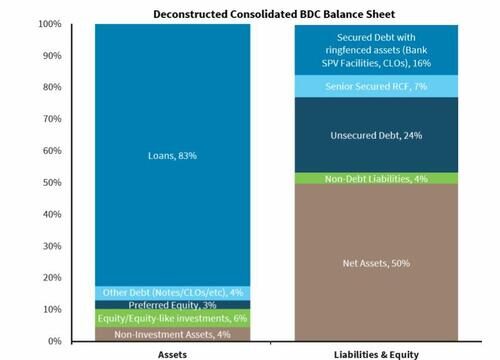
Of course, whether one calls it a BDC or a CLO, the assets are identical – in both cases private loans, many of which have been mismarked and/or gone source – and the only different is what are the liabilities wrapping them.
And since the appears to be lots of confusion, we will write a detailed primer on the topic this weekend.
Tyler Durden
Fri, 03/20/2026 – 00:55

The Ultimate Race Hoax
The Ultimate Race Hoax
Authored by Scott Greer via American Greatness,
It was a case that captured the nation’s attention 20 years ago. In March of 2006, a black stripper accused three members of Duke University’s nearly all-white lacrosse team of rape. The only evidence for the crime was her own testimony, which changed repeatedly. It didn’t matter that every other eyewitness disputed the rape claim. An opportunistic district attorney, a vengeful cop, a feminist nurse, and a ravenous media were all ready to believe the Duke lacrosse rape, and that was enough to make it “truth” in the public eye for much of 2006.
The Duke lacrosse hoax offered a preview of America’s coming social conflicts in the age of woke. Imagined racial grievance, feminism, and belief in “white privilege” all fueled this story. The media was all too eager to buy it. Journalists wanted to believe it was true to show that white men are the real menace to society. It was a story too “good” to pass up. It was also a story too “good” to be true.
No lessons were learned from the Duke lacrosse case. We would see similar lies play out with Trayvon Martin, Michael Brown, and Rolling Stone’s infamous “A Rape on Campus” story. While District Attorney Mike Nifong paid a high price for his reckless pursuit of the case, the media and activists who aided him suffered no real consequences. Hate hoaxes would flourish as a result.
The story is best explained by the 2007 book, Until Proven Innocent: Political Correctness and the Shameful Injustices of the Duke Lacrosse Rape Case by Stuart Taylor Jr. and K. C. Johnson.
The tale begins with a bored group of youth looking to entertain themselves while stuck on campus during spring break. The lacrosse team, unlike other Duke students, couldn’t vacation with the time off. They had games and practice during the holiday, leaving them in Durham. To blow off steam, the team decided to hire strippers for a party. Too many of their teammates were underage and couldn’t go to a strip club, so they decided to bring the entertainment to a house where a bunch of lacrosse players lived. They requested two strippers, one of whom was Crystal Mangum.
Mangum was a disturbed woman with a rap sheet and a history of mental illness and substance abuse. She had even made up a gang rape allegation in the past. On the night of March 13, 2006, she showed up severely inebriated after a weekend of having sex with multiple men. She and the other stripper didn’t perform their duties well. The lacrosse men quickly became disgusted with their antics and regretted the $800 they had spent on the night’s entertainment. The guys argued with the other stripper, Kim Roberts, over what was happening. Tempers flared, and Roberts decided to leave with Mangum, who could barely stand on her own. Roberts called the lacrosse guys “short-dicked white boys,” which prompted one of them to call her the n-word. That action would be used to establish the entire lacrosse team as deranged racists.
Roberts would call the police on the lacrosse team over the slur, claiming she was just passing by the house when they began calling her names. She drove away with Mangum, who was too intoxicated to communicate properly. Roberts took her passenger to a local grocery store and got security to call 911 on the disturbed Mangum. When taken to the hospital, Mangum faced the possibility of being involuntarily committed. But she found her opportunity to avoid that fate when she was asked by a nurse if she had been raped. She replied yes, which gave her a ticket out of involuntary commitment.
Thus began the rape hoax. The examining nurse was a feminist activist who fully believed Mangum’s story and found enough evidence to support the theory due to evidence of sexual activity. However, there was no evidence of physical harm done to her. Her word, supported by the feminist nurse, was enough to get police involved. The case was taken up by Durham police sergeant Mark Gottlieb, an officer with a notorious reputation for going hard on Duke students. Administrators had even requested that Gottlieb be reassigned due to his harsh crusade against students.
But this would be the man who investigated the case, and he was committed to proving these privileged lacrosse players had committed an unspeakable crime. Gottlieb was even willing to rig the evidence to fit the picture he wanted to paint. He would later write “supplemental case notes” months after the event took place to make them seem like they were taken right at the beginning of the investigation. This is just one example of his dubious practices that would be used to crucify the lacrosse players.
Gottlieb’s behavior, however, looks like that of an Eagle Scout compared to DA Mike Nifong. Nifong is the true villain in this story. He was the interim Durham County DA in 2006, filling out the rest of the term of the previous officeholder who had been appointed to the North Carolina Supreme Court. He was given that appointment under the assumption he would not run for a full term. He instead decided to run for a full term anyway. Things did not look good for Nifong’s chances to keep the job in early March 2006. The Duke lacrosse case offered him a lifeline. The racially charged case allowed the white lawyer to win over black voters in the diverse district. He tied his political survival to Mangum’s tall tale. It would help him win the election, but at the price of his disbarment and removal from office in the following year.
Nifong immediately condemned the Duke lacrosse team in public, calling them a “bunch of hooligans” and saying it was his mission to prevent Durham from being known as a place where “a bunch of lacrosse players from Duke rap[ed] a black girl.” His over-the-top comments were taken as scripture by the press, which incited a frenzy to declare these young men guilty of rape. Nancy Grace was one of the worst offenders. Night after night, Grace and other cable news hosts would insist these lacrosse players committed an evil, racist act against an innocent black girl. Mangum went from a mentally ill, drug-addled criminal to a hardworking mom and model college student in the media.
There was a strong desire to believe that preppy white boys were out raping innocent black women. It’s a case one would find depicted regularly on Law & Order and other popular movies and TV shows. The myth mattered more than reality.
Several Duke professors and left-wing students embraced the story. In an ad in the student newspaper, 88 professors endorsed a message that claimed the elite university was a hotbed of racial and sexual violence. Many of these professors would go on to punish lacrosse players in their classes with bad grades and insulting comments. Faculty were at the forefront of decrying the “white privilege” and “systemic racism” that allegedly emboldened these white men to rape a black woman. Virtually none of these professors would apologize for their rush to judgment after the case fell apart.
Mangum’s story was fishy from the beginning. Roberts, her fellow stripper, called the story a “crock” when initially questioned by police. Mangum showed no signs of bruising and was only alone by herself in the house for a few minutes. Her description of her attackers didn’t match anyone on the lacrosse team. She claimed three short, chubby men assaulted her. The three who were eventually charged did not match her descriptions. Her story imagined the event was a bachelor party, complete with her assailants referencing a wedding the next day. None of that was true. She also kept changing the story, adding more participants, alleging more physical force on her, and other new details each time she retold the story. It was obvious she couldn’t keep her story straight. But Nifong, Durham’s black community, and the national media chose to believe her anyway.
Mangum could not even consistently identify the three suspects in photo lineups. The three charged players—David Evans, Collin Finnerty, and Reade Seligmann—were basically chosen at random. Seligmann and Finnerty had alibis putting them outside of the house when the alleged rape could have occurred. That didn’t matter. They were still charged with the bogus crime.
Durham’s black community was incensed by the rape allegation. Numerous threats of violence were issued against Duke students, with even a few assaults occurring against white students by local blacks. One of the accused, Reade Seligmann, had to drive away from a local car wash after attendees recognized him and began violent gestures at him. Some local activists didn’t even care whether the players were innocent or not. They felt they should go to prison anyway as payback for all the allegedly innocent black men who went to jail. The NAACP was heavily involved in the case and pressured the judges to issue gag orders to prevent the truth from coming out about the players’ innocence.
But the truth finally did come out, slowly but surely. 60 Minutes, in contrast to much of the media, conducted a thorough investigation of the case in the fall of 2006, including interviewing the accused. The CBS show discovered that the case was filled with holes, and it was likely a hoax. But it still took months for the accused to be absolved. North Carolina Attorney General Roy Cooper eventually dismissed the case and declared the lacrosse players innocent in April of 2007.
While the players were accused of stonewalling investigators, they in fact did the opposite. Ever since the criminal investigation was launched, players fully cooperated, provided DNA, and even were willing to subject themselves to polygraph tests. Their story remained consistent and clear throughout the ordeal, unlike Crystal Mangum’s. But due to the motivations of others, it still took over a year to definitively rule that the players were innocent.
Fortunately, Nifong’s career was ruined by the case, and he even spent a short time in jail for his behavior. Mangum avoided charges of filing a false police report due to her mental illness, but would later serve a lengthy jail sentence for murdering a boyfriend. She was released from prison earlier this month. In 2024, she finally admitted she made up the whole thing.
The damage was already done when three innocent men were falsely accused and charged with a crime. The truth coming out only prevented further injustice. It didn’t wipe away what had already been done.
The worst part is how this story kept being repeated over the coming years. America bought the lie about Trayvon Martin and how he was an innocent black boy shot in the back. We experienced riots over the Michael Brown lie, with millions falsely believing he had his hands up when he was shot. Countless numbers of young men had their lives ruined during the 2010s campus rape hysteria, most notably culminating in Rolling Stone’s libelous “A Rape on Campus.” Our whole country was torn apart by the mythology surrounding George Floyd’s death.
Sometimes the truth emerged in these cases, just like it did with the Duke lacrosse hoax. But many still chose to believe the lies over the truth. The former supported their prejudices about our society, while the latter undermined them. It’s why hate hoaxes kept being perpetuated and believed. The Left and the media wanted to believe that evil white racists are doing terrible things to minorities on a regular basis. The demand for these cases far outstripped the supply of actual occurrences.
Thanks to social media and the decline of the establishment media, it’s harder for such a hoax to go unchallenged. But the desire to believe such nonsense is still present within our society. Belief in white privilege and systemic racism is much more mainstream than it was in 2006. We will still see hoaxes promoted to demonize middle America and support calls for change.
It’s up to conservatives to ensure these hoaxes are quickly debunked. We can’t trust the mainstream media to do the job.
Tyler Durden
Thu, 03/19/2026 – 23:30

Pakistan Outraged At Being Called An Emerging Missile Threat To US By DNI Gabbard
Pakistan Outraged At Being Called An Emerging Missile Threat To US By DNI Gabbard
The US declared Pakistan a major non-NATO ally all the way back in 2004, but relations have soured at various points since then. But given Pakistan does indeed remain a close regional ally, which is also nuclear-armed, the country is outraged at Wednesday’s Senate Intelligence hearing wherein Director of National Intelligence (DNI) Tulsi Gabbard raised some eyebrows over a new ‘missile threat’.
She for the first named the South Asian country along with Russia and others in the 2026 Annual Threat Assessment Report, citing that Pakistan’s missile program could be a future threat to the Untied States.
“Russia, China, North Korea, Iran, and Pakistan have been researching and developing an array of novel, advanced, or traditional missile delivery systems with nuclear and conventional payloads, that put our homeland within range,” Gabbard told the intelligence committee.
She then specified: “Pakistan’s long-range ballistic missile development potentially could include ICBMs with the range capable of striking the homeland.”
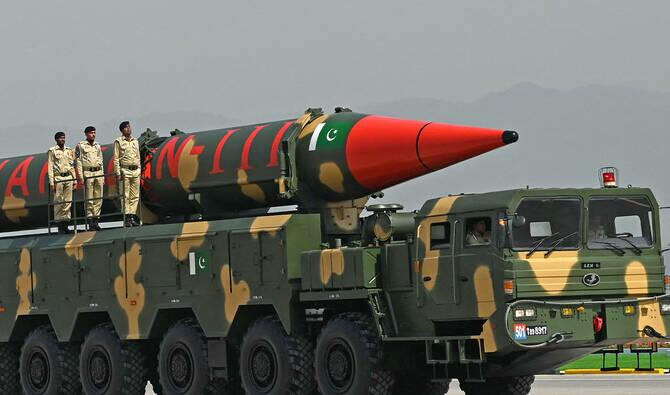
Pakistan ballistic missile, file image/Arab News
While other countries listed – especially Iran and North Korea have long been named by US officials as ‘rogue’ actors or else part of an ‘axis of evil’ (going back to the Bush era) – this appears to be the first time Pakistan was openly named in such a high-level annual briefing before Congress. Perhaps Washington is thinking that the conservative Islamic country is just ‘one coup away’ from becoming highly dangerous.
Gabbard also described more broadly the South Asian region as a place of “enduring security challenges” – warning that India-Pakistan relations “remain a risk for nuclear conflict.” At the moment, Pakistan and neighboring Afghanistan under the Taliban are in a state of active hot war, though there have been reports of a shaky ceasefire.
Pakistan is angry at being singled out, and has communicated its objections to Washington:
On Thursday, Tahir Andrabi, spokesman for Pakistan’s Ministry of Foreign Affairs, said: “Pakistan categorically rejects the recent assertion by a United States official alleging a potential threat from Pakistan’s missile capabilities.”
Pakistan’s strategic capabilities are “exclusively defensive” in nature, he said, and are “aimed at safeguarding national sovereignty and maintaining peace and stability in South Asia.”
The foreign ministry official further explained, “Pakistan’s missile program, which remains well below intercontinental range, is firmly rooted in the doctrine of credible minimum deterrence vis-a-vis India. In contrast, India’s development of missile capabilities exceeding 12,000 kilometres [7,460 miles] reflects a trajectory that extends beyond regional security considerations and is certainly a cause of concern for the neighborhood and beyond.”
At times in the last couple decades, the US has accused Pakistan of cooperating with terrorists, and for failing to reign in ISIS-type operatives in its restive northwest province – a region which has long proven a headache for the whole region.
Tyler Durden
Thu, 03/19/2026 – 23:05