Category: News

“I’d Like To Pay Their Salaries”: Elon Musk Offers Lifeline To TSA Agents As Democrats Hold Paychecks Hostage In Shutdown
“I’d Like To Pay Their Salaries”: Elon Musk Offers Lifeline To TSA Agents As Democrats Hold Paychecks Hostage In Shutdown
The Department of Homeland Security shutdown entered its 36th day on Saturday after Senate Democrats blocked yet another funding bill for Immigration and Customs Enforcement, the Transportation Security Administration, and other federal agencies, triggering weeks of chaos at airports nationwide, including long TSA checkpoint lines during the peak of the spring break travel season.
Early Saturday morning, Elon Musk, closely tracking the DHS funding lapse, wrote on X that he would personally pay the salaries of TSA agents to get them back to airports and help avert further chaos.
“I would like to offer to pay the salaries of TSA personnel during this funding impasse that is negatively affecting the lives of so many Americans at airports throughout the country,” Musk said.
I would like to offer to pay the salaries of TSA personnel during this funding impasse that is negatively affecting the lives of so many Americans at airports throughout the country
— Elon Musk (@elonmusk) March 21, 2026
On Friday, a motion to advance a funding bill failed 47-37, falling short of the 60 votes needed to overcome a Democratic filibuster. John Fetterman (Pa.) was the only Democrat to vote “yes” on the DHS funding bill. Sixteen senators from both parties were absent for the vote. This marks the fifth time Democrats have blocked the Homeland Security Appropriations bill since DHS funding ended in mid-February.
Democrats have been absolutely furious over any funding bill for ICE and Customs and Border Protection (CBP) that does not include reforms to immigration enforcement operations. That is mostly because they are watching President Trump erode their political power by deporting the very illegal aliens their party allowed to invade the nation under the Biden-Harris regime. Remember, these illegals are the future voting bloc of the Democratic Party, meant to seize political control by disenfranchising citizens.
Senate Democratic Leader Chuck Schumer (N.Y.) is planning to force a vote sometime today on a proposal to fund the TSA.
“The chaos at TSA is reaching a boiling point. We need to reopen it as quickly as possible. That is what Senate Democrats are intent on doing,” Schumer said.
Related:
“Problem Is Solvable”: Airline CEOs Urge Congress To End Shutdown, Pay TSA Workers
By the end of the week, 10% of all TSA workers did not show up for work – just below the record 10.22% absentee rate set at the start of the week. Nearly 400 agents have quit so far in the months-long shutdown, according to DHS. These workers have been without pay since mid-last month, when the Democratic Party began using these agents as political pawns.
The severity of the government shutdown this time has not yet reached the crisis level of travel disruption seen during the 43-day shutdown late last year, when air traffic controllers were used as leverage in political disputes, disrupting air travel nationwide. To prevent such issues in the future, perhaps privatization talks for these agencies should begin.
Is it possible that an unhinged, left-wing judge might try to block Musk from offering to pay TSA agents’ salaries during the funding lapse?
Tyler Durden
Sat, 03/21/2026 – 08:45

Britain Once Led The World. What Happened?
Britain Once Led The World. What Happened?
Authored by Damian Pudner via the Foundation for Economic Education,
An unsettling look at the economic settlement that the UK now seems willing to accept can be found in the latest fiscal forecast, published on March 3.
By the end of the forecast period, borrowing will have decreased from 5.2 percent of gross domestic product (GDP) in 2024–2025 to about 1.6 percent. Public debt stabilizes at roughly 95 percent of national income. At those levels, even small shifts in interest rates matter: The Office for Budget Responsibility (OBR) estimates that a sustained 1-percentage-point move in the Bank Rate changes government borrowing costs by about 15 billion pounds (about $20 billion).
In the later years of the forecast, economic growth limps along at about 1.5 percent, while unemployment is expected to peak at 5.33 percent. Meanwhile, the tax burden approaches an unprecedented 38 percent of GDP, the highest sustained level in the postwar era, as public spending remains significantly higher than its pre-COVID-19-pandemic share of the economy.
Taken together, these forecasts describe an economy settling into a comfortable equilibrium of high taxation, high debt, and chronically modest growth. Expectations are quietly lowered and economic underperformance is being normalized.
There is no ambition here. Nothing is reset. Nothing is reimagined. Nothing really changes.
There is something unmistakably Starmerite about the entire outlook. Prime Minister Keir Starmer’s political persona is built on reassurance and managerial competence. The chaos will stop. The adults are back. Nothing dramatic will happen on his watch. Chancellor of the Exchequer Rachel Reeves is no different.
But countries do not restore economic dynamism through managerial composure alone.
The UK was once the workshop of the world. Later it became one of the most open and dynamic economies in Europe. When the postwar economic model began to falter in the 1970s, the country eventually recognized that incremental tweaks would not suffice. Structural reform became unavoidable.
What followed was neither cautious nor gradual. The reforms of the 1980s dismantled large parts of the existing economic model and replaced them with something far more competitive. Nowhere was that clearer than in the financial sector. The Big Bang of 1986 swept away restrictive practices, opened London’s markets, and helped turn the city into one of the world’s dominant financial centers.
Whether one applauds or criticizes those reforms, their ambition is undeniable. That sense of ambition is strikingly absent from the UK’s economic debate today.
Instead, the state is not being structurally rethought. It is simply being financed more heavily. The clearest example is the continued freeze in income tax thresholds. According to earlier OBR analysis, this policy alone will be raising roughly 67 billion pounds (about $89 billion) per year by the end of the decade.
By 2030–2031, about 1 million more people will be brought into paying income tax, and roughly 1.6 million people will pay the 45 percent rate, a level originally introduced to target the “super-rich.” At the same time, another 1 million pensioners will be drawn into paying income tax. This is both unsustainable and politically corrosive.
As Prime Minister Margaret Thatcher reminded us, “You cannot tax a country into prosperity.”
The broader economic outlook is equally modest. Productivity growth is expected to recover only slowly, reaching roughly 1 percent annually in the medium term. That supports GDP growth of about 1.6 percent. Such growth may just about stabilize the debt ratio, but it is nowhere near the pace required to transform living standards or expand the country’s economic capacity.
Even the recent improvement in government revenues owes something to favorable financial conditions rather than deep structural change. Stronger equity markets have lifted receipts from capital gains and corporation taxes. Yet the same fiscal projections warn how vulnerable this is to reversal. A sharp fall in equity prices would quickly worsen the public finances. The OBR warns that a 35 percent correction in UK and global equity markets could widen the current budget deficit by about 26 billion pounds (about $34 billion) in 2027–2028. Even a more limited scenario—in which UK equities fall by 15 percent—still adds about 15 billion pounds (about $20 billion) to borrowing.
In other words, the strategy works provided growth improves modestly and financial markets remain cooperative. That is not a robust foundation for long-term prosperity.
Downing Street’s rhetoric is “growth, growth, growth.” The figures point to something more akin to steady, steady, steady or, perhaps more accurately, dull, dull, dull.
Growth is not being unleashed as much as carefully managed.
The economic horizon contains little in the way of bold reform or institutional redesign. For a country with the UK’s economic history, that is a strikingly modest ambition.
The UK deserves something more.
It cannot tax its way back to economic leadership. Nor can it rely on rising asset prices or modest productivity gains to do the work.
Increasing the economy’s potential for production would be the main goal of a more serious agenda: a tax system that rewards enterprise and investment rather than subtly expanding the middle-class tax base, planning reform that actually increases the supply of housing, and regulatory frameworks that promote innovation rather than administrative caution.
In short, something with the seriousness and disruptive intent of the Big Bang.
Political bravery will be needed for that. It will necessitate a government that is willing to pursue reform even if it goes against long-standing interests. Above all, it will necessitate a political elite that is prepared to acknowledge that cautious maintenance of the status quo is not a viable approach to national renewal.
The UK once set the pace of the global economy. Today, it risks settling for the careful management of mediocrity. And that, more than anything else in the fiscal forecasts, should concern us all.
Tyler Durden
Sat, 03/21/2026 – 08:10
https://www.zerohedge.com/political/britain-once-led-world-what-happened

Switzerland Halts Military Exports To US, Citing Iran War Neutrality
Switzerland Halts Military Exports To US, Citing Iran War Neutrality
Switzerland on Friday announced it is halting all military and defense exports to the United States, citing its neutrality, coming as the Iran war reaches the three week mark.
“Exports of war materiel to the US cannot currently be authorized,” the government said, as quoted in Bloomberg. The statement specifically referenced Washington’s “international armed conflict” in the Middle East.
Source: screengrab via Johnny Harris/YouTube
The announcement might not be a surprise, given similar past stances by Switzerland; however it comes at a sensitive moment where President Trump has been expressing frustration at Europe and NATO for not stepping up to help open the Strait of Hormuz.
There were signs of this coming:
Last weekend, the Swiss government said it had rejected two US flyover requests on Iran-related war flights but permitted three others, also citing Switzerland’s neutrality law.
Following the US-led invasion of Iraq in 2003, Switzerland imposed bans on flights over Swiss airspace and weapons exports to countries involved in the war. It later lifted them.
As for data on past American purchases of Swiss defense items, it’s not significant enough to put any kind of dent in Pentagon preparedness, but it remains of a highly symbolic and political snub – at least that’s how the White House will likely see it
According to figures in Trading Economics:
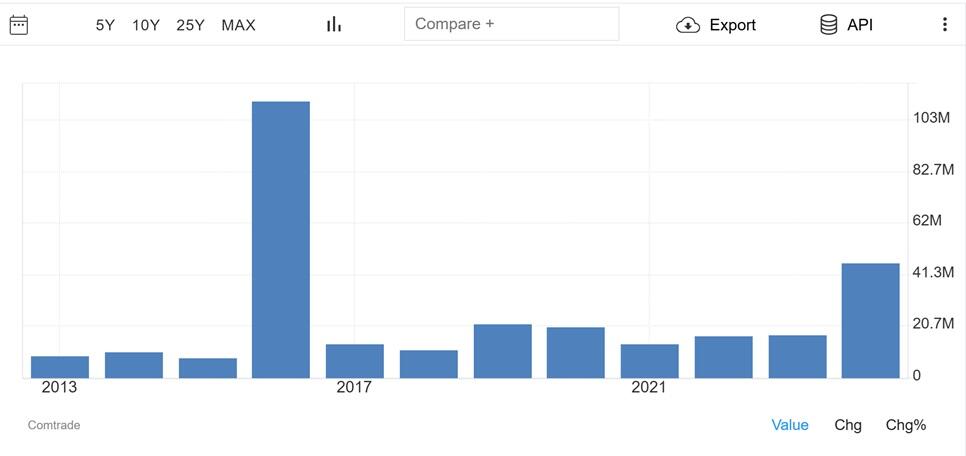
Switzerland Imports from United States of Arms and ammunition, parts and accessories was US$46.18 Million during 2024, according to the United Nations COMTRADE database on international trade.
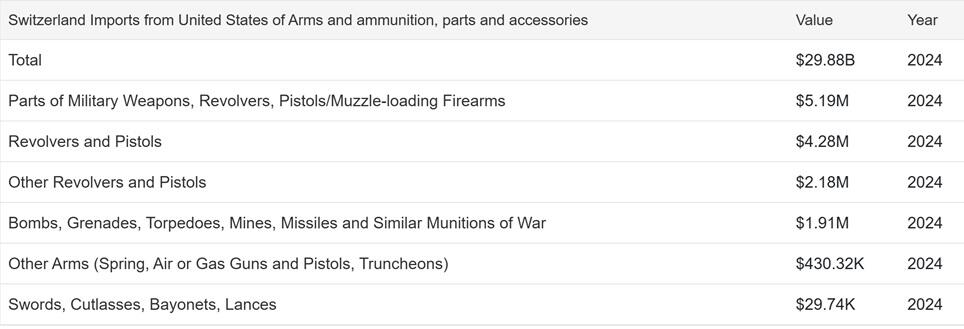
Switzerland Imports from United States of Arms and ammunition, parts and accessories: But an important distinction is that the move only impacts official defense and military-use items.
According to more figures via Tradining Economics:
Much skepticism toward Washington and Tel Aviv’s Iran adventure has been expressed this week from Europe. Iran “is not our war,” said German Defense Minister Boris Pistorius. Also European Union foreign policy chief Kaja Kallas similarly echoed: “This is not Europe’s war.”
Tyler Durden
Sat, 03/21/2026 – 07:35

You Won’t Believe What The UK Green Party Wants To Teach Children…
You Won’t Believe What The UK Green Party Wants To Teach Children…
Authored by Steve Watson via Modernity.news,
Radical leftists want a new Department of Migration to push open borders propaganda in schools and fast-track voting rights, free housing and citizenship for illegals.
A leaked Green Party dossier has blown the lid off plans to brainwash British schoolchildren into believing they have a ‘moral duty’ to embrace endless immigration.
The document, hidden behind a password-locked policy archive normally only accessible to party members, calls for a new Department of Migration to work hand in glove with education chiefs. Its stated goal is to “disseminate knowledge” about immigrants directly into classrooms.
🚨 A LEAKED Green Party dossier reveals radical plans to teach children they have a ‘MORAL OBLIGATION’ to accept immigrants pic.twitter.com/Vzjt0qG89R
— WeGotitBack 🏴🇬🇧🇺🇸 (@NotFarLeftAtAll) March 19, 2026
Children would be taught they have a “moral obligation” to accept immigrants under these radical plans.
The exact wording from the leaked dossier states the new department would educate pupils on “the situations from which those seeking asylum and resettling refugees are fleeing, and the need for and moral obligation of asylum and humanitarian protection.”
It goes further, declaring the party “seeks not only to provide asylum to those forced from their homes but to work towards a world in which no one has to flee their home.”
Additional proposals include free legal advice and support to illegal immigrants to “regularise their status without penalty for being undocumented,” granting settled status to those who have been in the UK for at least five years — complete with welfare benefits, voting rights and a pathway to citizenship — and opening borders wider for those from countries with “seriously disturbing public order” or claiming persecution under equality laws.
In short, the Greens want to hand illegals free housing, votes and passports while telling British kids it’s their moral duty to cheer it on.
They also want to be SOFTER on terrorist suspects.
🚨NEW: The Green Party wants to weaken the police’s ability to tackle terrorism by cutting the maximum detention period for terror suspects from 14 days to 4.
We now live in a country where appealing to jihadis is a sizable vote winner.https://t.co/soJD5lrqUZ
— The Mercian (@TheMercianNews) March 19, 2026
This all comes at a time when the UK is already buckling under the weight of mass migration, with migrants set to swallow 40% of new homes by 2030.
This fits a disturbing pattern. The same political class has already turned schools into surveillance hubs, urging them to snitch on “anti-Muslim hostility.”
Counter-terror police run ads warning teens that sharing funny content could be terrorism, and a government video game literally teaches kids they’re terrorists for questioning mass migration.
A recent caller perfectly encapsulated how most British people feel about the invasion overwhelming their country.
Yet instead of listening, the elites double down on indoctrination.
Meanwhile, a surging new force offers the exact opposite vision. Restore Britain has vowed to deport millions of migrants and outlaw incompatible cultural and religious practices.
As the party’s campaigns director Charlie Downes put it, “We are going to deport all illegal and burdensome migrants. If that means millions go, so be it.” He added, “We are going to outlaw incompatible cultural and religious practices. If that means those who refuse to integrate no longer feel welcome, so be it.” And on the most serious crimes: “We are going to execute pedophiles, rapists, and murderers if that is what the British people want.”
The contrast could not be starker. One side wants to flood Britain with more arrivals and guilt-trip the next generation into accepting it. The other side wants to put British people first, restore order and end the madness.
The leaked Green plans are nothing short of open-border radicalisation aimed at the young, pushed from behind closed doors. They reveal a party completely detached from the housing crisis, the grooming scandals, the cultural erosion and the public’s breaking point.
They’re also the party with a leader who believes women can have penises.
Britain doesn’t need more propaganda in classrooms. It needs leaders willing to secure the borders, protect the native population and put the country first.
Your support is crucial in helping us defeat mass censorship. Please consider donating via Locals or check out our unique merch. Follow us on X @ModernityNews.
Tyler Durden
Sat, 03/21/2026 – 07:00
https://www.zerohedge.com/political/you-wont-believe-what-uk-green-party-wants-teach-children

Smith: The Political Left, Multiculturalism, & The Dark Alliance With Islam
Smith: The Political Left, Multiculturalism, & The Dark Alliance With Islam
Authored by Brandon Smith via Alt-Market.us
For 15 years the FBI was engaged in a landmark investigation into the largest Islamic-based charity in the United States, called The Holy Land Foundation. The organization was operating as a front for Muslim terror groups, funneling cash from western countries to Hamas and the Muslim Brotherhood, until they were finally put on trial in 2008.
Convicted leaders were known as the “Holy Land Five,” and included Shukri Abu Baker, Ghassan Elashi, Mufid Abdulqader, Abdulrahman Odeh, and Mohammad El-Mezain. Among the documents seized from these individuals during the investigation was a strategic paper drafted by senior Muslim Brotherhood operative Mohamed Akram in 1991.
The paper was titled: “Explanatory Memorandum on the General Strategic Goal for the Group in North America”. It outlined an agenda called the “Civilization-Jihadist Process”, also known as “Stealth Jihad”.
The memorandum gave detailed methods for establishing Islam as a “civilization alternative” in the West and a “grand Jihad” for eliminating and destroying the Western civilization from within. It called for the ‘sabotaging’ of the west and its “miserable house” by domestic hands AND the hands of the believers so that the west is eliminated and “God’s religion is made victorious over all other religions.”
The plan explicitly referred to using western society’s own people, institutions, laws, and unwitting allies (progressive groups and NGOs, media, politicians, academics, or civil-rights organizations) to advance the Islamic agenda.
Tactics included infiltration of education, media, government, finance, and alliances with non-Islamic actors “when tactically beneficial” while maintaining ideological separation. This is also called “long-term settlement” (tamkeen); a form of demographic or cultural subversion rather than direct conquest. It is often mentioned in the paper as “the settlement mission”.
A related 1982 Muslim Brotherhood document (called “The Project”) outlines a 100-year global plan with similar elements: building parallel societies, exploiting Western freedoms, and forming pragmatic coalitions.
One problem the Muslims wrestled with was the need for foreign alliances and western “advocates” to make immigration and the integration of Islam into target countries more “official”. Twenty-five years ago, this was considered all but impossible in the US and in Europe. However, since around 2014, the Sharia fundamentalists found a willing and ready ally in the new “woke” left.
Today, the notion of even discussing the agenda of “Stealth Jihad” in a public venue in 2026 is labeled “racist” by progressive activists and left wing politicians (even though Islam is not a race). If you were to go back in time around 15 years ago and explain to people what is happening today in terms of third-world immigration, they would probably laugh in your face and call you a conspiracy theorist.
In 2026 in Europe the plan is nearly complete and in the US the plan is well underway. The change in how our society views Islam as an untouchable subject is largely due to a dark and convenient political alliance between the woke left and the Stealth Jihad.
Only recently has the problem of Muslim immigration risen to the forefront of media coverage, but only because of the work of citizen journalists like Nick Shirley who are exposing widespread fraud among migrants. The majority of this fraud, whether it is in Minnesota or California, is connected to Somali Muslim immigrants and is perpetrated with the help of leftist NGOs and politicians.
Coming from a country with an average IQ of 67, these people are not capable of instituting such a plan on their own. They had help and it is clear that Democrats are deeply involved in these operations, perhaps in exchange for financial kick-backs, but certainly in exchange for votes (Somali migrants in Minnesota voted 80% in favor of Democrats in 2024).
It’s not surprising, but there are a lot of similarities between progressives in the west and third world Islamic migrants from the east.
The political left has long held an agenda similar to Stealth Jihad. In Marxism it is referred to as “cultural hegemony” or “the long march through the institutions”. It is associated with the work of Antonio Gramsci, the founder of the Italian Communist Party. Interestingly, his ideas of cultural hegemony are often studied as a means of better understanding the agenda of Stealth Jihad.
Gramsci’s approach (developed in his Prison Notebooks in the 1920s–1930s) argued that in advanced capitalist societies the “ruling class” maintains power through cultural hegemony. To overthrow this, he asserted that revolutionaries must wage a “war of position” rather than a frontal assault.
This meant infiltrating and capturing key institutions (schools, universities, media, churches, judiciary, government bureaucracies) to erode cultural norms, reshape public consciousness, and create counter-hegemony until socialism/communism becomes the new ideological norm. We have witnessed this nightmare in vivid color with the woke movement of the past decade. For the longest time the agenda was dismissed as “conspiracy.”
I would also point out that the general attitudes of third world migrants and leftists are essentially the same when it comes to production and survival: Both groups view producers as targets for piracy. Why would they integrate into western society, work hard and build for the future when they can feed off the production of others? Why create their own wealth when it is so much easier to pillage the wealth of people who innovate, construct and save?
But this partnership goes far beyond easy cash and socialized living into the realm of ideological and religious warfare. As noted, Stealth Jihad is about the exploitation of western freedoms and open systems as a means to invade and drive out the native religions (Christianity).
The Christian belief system is essential to western civilization. Whether or not a person living in the west believes in it doesn’t matter; they still benefit from the inherent Christian drive to build, structure and maintain a moral and ordered society based on rules for EVERYONE.
You would think that a partnership between Islam and the woke cult would be completely antithetical. After all, Muslim societies are defined by the rule of dominance, tribalism and brutal theocracy. There is zero tolerance in Islamic society for feminism, homosexuality, transgender theory or atheism. The Marxist world is rooted in atheism and moral relativism – The deconstruction of societal norms and the idea that unchecked hedonism is the ultimate form of freedom.
However, each group is beneficial to the other; they serve each other’s purposes. They also have the same primary enemy (Christianity). This intersection of benefits and shared hatred is where we find “Multiculturalism” – The agenda to wipe out the west using third-world immigration as a bulldozer.
Multiculturalism is simply an updated version of Gramsci’s Marxist cultural hegemony strategy, combined with third world notions of ethnic supremacy or religious supremacy. If you want to understand what is happening in places like the EU or the UK; if you want to know why these governments are completely ignoring the will of the public and blatantly aiding an Islamic invasion, this is why.
These are leftist governments with a clear objective to eliminate competing western and Christian ideals in order to establish a new cultural hegemony, and they are doing it subversively by using liberal values as a cudgel. Modern Europeans, fearful of ever being accused of “bigotry”, refuse to admit that they are committing high-minded suicide. Blind acceptance of immigration and the inability to discriminate logically is setting Europe on the path of total collapse.
This is what the Marxists want, and this is what the Muslims want. It’s much easier to pirate and enslave a population in the midst of social and economic crisis.
In the US we see a similar plan, though, leftists are working much harder to present Muslim migrants as ideologically aligned with liberalism. When conservatives see groups like “Queers for Palestine”, or we see New York Mayor Zohran Mamdani hiring transgenders for his administration while holding Muslim dinners on the floor of his office, what we are witnessing is the theatrical facade of “inclusivity.”
At bottom, these people do not share viewpoints that can truly “intersect”, but their short term goals are the same. Leftists hate conservatives and Christians because we represent a rules based order that stands in the way of their vision of pure hedonism. Muslims see conservatives and Christians as an obstacle to global Islam.
If the conservative west was theoretically defeated and we disappeared, the left and the Muslims would certainly turn on each other. Each group probably thinks they can control the other group when the time comes.
As the war in Iran moves forward, I have little doubt that we will see an exploding insurgency from leftists and Muslims in the US which will force us to question our foundational concepts of a “free and open society”. We will be forced to acknowledge that these exalted ideas cannot be applied to everyone. Specifically, they cannot be applied to people who want to destroy us. At bottom, the “rights” of people waging war upon us do not matter.
The question is, can we survive such a war and come out the other side with a constitutional republic intact? I think we can, but such a system would have to parse out and separate from ideological groups that see the west as a target (the Founding Fathers would NEVER have tolerated an anti-west invasion). We must accept, finally, that we cannot coexist in freedom with such people.
Views expressed in this article are opinions of the author and do not necessarily reflect the views of ZeroHedge.
Tyler Durden
Fri, 03/20/2026 – 23:05
https://www.zerohedge.com/political/political-left-multiculturalism-and-dark-alliance-islam

Watch: China Claims Cyborg Breakthrough To Build An “Army Of Centaurs”
Watch: China Claims Cyborg Breakthrough To Build An “Army Of Centaurs”
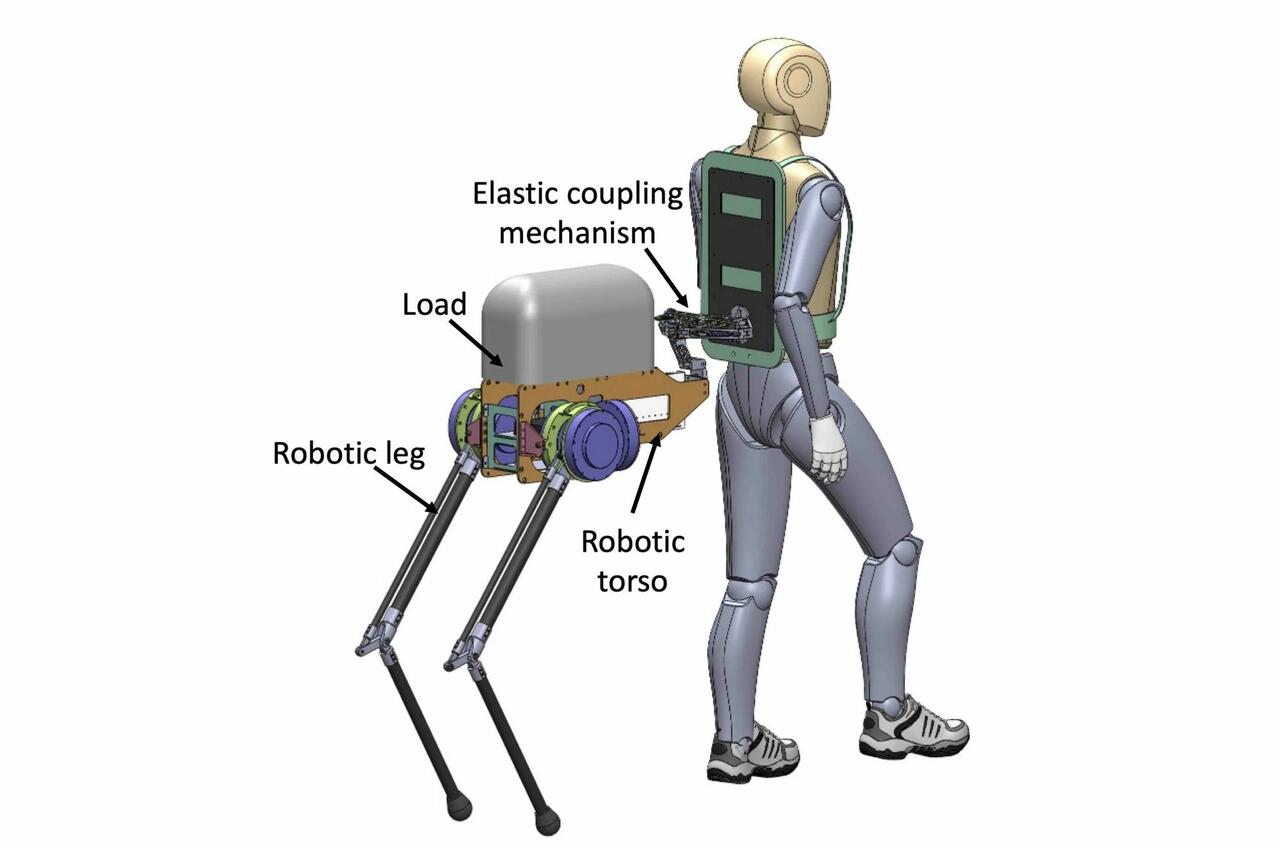
Researchers at Southern University of Science and Technology in Shenzhen have unveiled a wearable robotic system that adds a pair of independent mechanical legs and a torso framework to a human wearer, forming a four-legged hybrid to assist with carrying heavy loads across difficult terrain such as stairs, ramps, and uneven ground, according to the South China Morning Post.
Led by Chenglong Fu, the team of scientists designed the device to combine human cognitive advantages in path planning and decision-making with robotic capabilities for load-bearing and endurance in environments too hazardous or complex for fully autonomous systems. An elastic coupling mechanism synchronizes the robotic legs with the user’s movements, allowing the hybrid to share more than half the payload weight while preserving natural gait and balance.
In tests, the system cut the wearer’s net metabolic cost of walking while carrying a 44-pound load by 35% compared with a conventional backpack and reduced peak plantar pressure by 52%, fueling media speculation in China that the technology could serve as the foundation for a large-scale “army of centaurs” to augment the Asian superpower’s military personnel.
Cyber-centaurs are here: Chinese engineers unveil a clip-on “robot butt”
Chinese engineers have presented an exoskeleton that attaches to the waist and hips to help carry heavy backpacks. The device can take on 30–50% of the load, assisting with up to 15–30 kg of weight.
The… pic.twitter.com/RlC3ryf6xx
— NEXTA (@nexta_tv) March 10, 2026
The Chinese military’s ongoing investment in exoskeleton technologies to boost troop stamina suggests potential military applications for these human-augmented systems, though the device’s bizarre appearance has prompted criticism and mockery, reports the SCMP.
The breakthrough comes amid the escalating rivalry in robotics between the United States and China. Recently, executives from Boston Dynamics and Scale AI testified before a House Homeland Security subcommittee, warning that China’s progress in humanoid robots presents national-security concerns. Witnesses advocated for coordinated federal measures, such as broader export controls on AI chips and restrictions on government procurement of Chinese robotic technologies, to safeguard U.S. leadership.
As we previously reported, broader anxiety over China’s manufacturing dominance extends beyond robotics.
Following a trip to China last fall, Greg Jackson, CEO of the British energy company Octopus, recounted touring a near-autonomous “dark factory” producing mobile phones with minimal human oversight.
“We visited a dark factory producing some astronomical number of mobile phones,” Jackson told The Telegraph at the time.
“The process was so heavily automated that there were no workers on the manufacturing side, just a small number who were there to ensure the plant was working. You get this sense of a change, where China’s competitiveness has gone from being about government subsidies and low wages to a tremendous number of highly skilled, educated engineers who are innovating like mad.”
Australian mining magnate Andrew Forrest abandoned plans to develop electric-vehicle powertrains in-house after witnessing China’s fully robotic assembly lines where machines emerge from the floor to build trucks with zero human intervention over long conveyors.
Morgan Stanley analysts project the humanoid robotics sector could swell to a $5 trillion market by 2050, encompassing sales, supply chains, maintenance, and support networks, with potentially over 1 billion units deployed globally by mid-century.
Tyler Durden
Fri, 03/20/2026 – 22:40
https://www.zerohedge.com/technology/watch-china-claims-cyborg-breakthrough-build-army-centaurs

Inside Iran’s Internet Access Black Market Amid 3-Week Wartime Blackout
Inside Iran’s Internet Access Black Market Amid 3-Week Wartime Blackout
Since the start of the US-Israeli war on Iran, Iranian authorities have sharply restricted access to the internet. According to NetBlocks, a group that monitors internet access worldwide, Iran has experienced a near-total blackout for 20 consecutive days. Connectivity has dropped to less than one percent.
For those trying to access the internet, options are limited. Some rely on Starlink, which is not widely used. The equipment is expensive and difficult to import. Iranians also believe is easier for the authorities to detect. Others turn to VPNs (virtual private networks) and custom configurations that can be installed on their phones to mask traffic and bypass censorship.
Elaheh, who like all Iranians spoke to Middle East Eye using a pseudonym for security reasons, has managed to get online with difficulty. She says she bought access through the black market.
“There are people on Telegram who sell VPNs and configurations,” she says. “You have to be lucky. Usually, someone you know has to introduce you.”
She explains how it works in simple terms: “They don’t really sell a normal VPN. They give you a configuration. You put it into your phone settings, and then use apps like OpenVPN to connect.”
Telegram remains one of the most widely used apps in Iran. People use it for news, communication and everyday life. Now, it has also become a place where VPN sellers advertise their services. But not all of them can be trusted.
High prices and scams
Maryam says she was one of the unlucky ones. She found a seller through a friend. He offered her a one-week unlimited VPN for 70m rials – roughly $45-$50.
“I paid the money,” she says. “But after that, he told me all the connection routes had been blocked by the government, and that it wasn’t possible to connect.”
Days later, she is still waiting. The seller keeps making excuses. He has not provided access and has not returned her money. Stories like hers are becoming more common, but there are plenty of trustworthy sellers on the black market too.
Alireza, 32, studied computer engineering and now sells VPN access. He agreed to explain how the system works, though he is clearly worried about the risks.
“When the internet is restricted in Iran, usually one of two things happens,” he says. “Either certain websites are blocked, or the connection to the global internet becomes slow or limited.”
He says the system is not completely shut down. “It’s controlled and filtered,” he says. “That’s why we can still find ways to provide access.”
⚠️ Update: #Iran is entering Nowruz, the Persian New Year, in digital darkness, as the internet blackout continues into day 21 after 480 hours.
With international connectivity cut and domestic service limited, many families are unable to contact loved ones when it’s most needed. pic.twitter.com/IP1Io8G3IB
— NetBlocks (@netblocks) March 20, 2026
According to Alireza, users buy a technical setup, not just a simple app. “We give them a configuration,” he says. “It includes the server address, port, protocol, and encryption key.”
Users then connect through tools like OpenVPN or V2Ray, which route their traffic through servers outside Iran. “In simple terms, it looks like they are connecting from another country,” he says.
Warnings and risks
Using these tools is not without risk. Arman, a VPN user, says the connection is unstable and often cuts out. But what worries him more are the warnings. “I’ve received several text messages,” he says. “They said security agencies know I’ve been connecting to the global internet.”
The messages warned that if he continued, he could face consequences. Since the start of the war, Iranian security and law enforcement officials have repeatedly announced that they have arrested people accused of selling VPNs and other tools that help users bypass internet restrictions.
Alireza says the situation has become more serious than before. “This is no longer just about selling VPNs,” he says. “It has become a security issue.” Sellers are now much more careful. “We prefer to deal only with people we already know,” he says. “Even a phone call or a message could be from security forces.”
Prices keep rising
As the blackout continues, prices are rising fast. Pegah, 29, says she has had internet access since the early days of the war – but it has become more expensive each week.
“At first, I bought a one-week package for 10m rials,” she says. “I didn’t trust the seller enough to buy more.”
A week later, the price jumped. “It went up to 30 million,” she says. “And when I wanted to buy for a friend, the seller said it had increased again – to 50 million per week.”
She says she was lucky. Her connection works. Others have not been so fortunate. “One of my friends paid 100m rials,” she says. “And most of the time, the connection didn’t even work.”
Access to the internet has become expensive, unreliable and uncertain. But it’s a familiar pattern. In recent years, cutting internet access has become a common response by authorities during times of crisis – whether protests or external conflict. Elaheh says the impact is immediate.
“They always take it out on ordinary people first,” she says. “This kind of shutdown just creates more anger.” She pauses, then adds: “I really don’t know what goes through the minds of those making these decisions. It feels like all they know is how to make people more frustrated.”
Tyler Durden
Fri, 03/20/2026 – 22:15

First-Ever Look At America’s Classified RQ-180 Stealth Drone?
First-Ever Look At America’s Classified RQ-180 Stealth Drone?
The world is seemingly at war. With multi-front conflicts raging in Eastern Europe and intensifying in the Middle East, this period of elevated World War III risk has coincided with the emergence of some of America’s most advanced stealth aircraft.
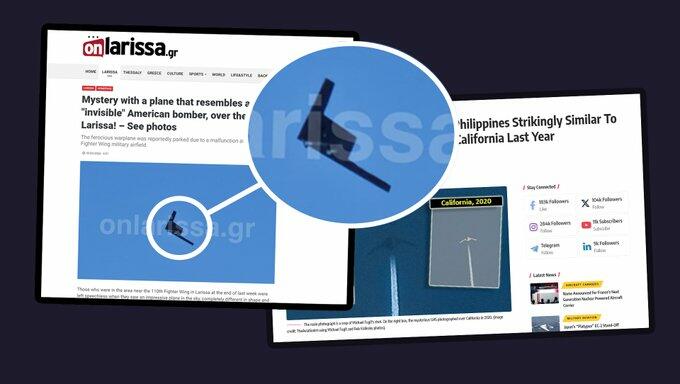
The latest sighting comes from the Greek news website OnLarissa, which reports that a planespotter captured a “mysterious” stealth-bomber-like aircraft operating near Larissa, Greece, near the Hellenic Air Force (HAF) base.
The local outlet stated, “The ferocious warplane was reportedly parked due to a malfunction at the 110th Fighter Wing military airfield,” adding that the plane was likely an “American superweapon, the Northrop Grumman B-2 Spirit.”
However, well-seasoned US-based journalists who specialize in aviation and military coverage at The Aviationist disagree with OnLarissa’s assessment that the plane is the B-2 Spirit. In fact, they suggest this could be the first-ever glimpse of the highly classified, next-generation stealth surveillance drone, the RQ-180, developed by Northrop Grumman.
“The closest match we can find, corroborated by anonymous sources with some familiarity with the clandestine jet, is with the famous (yet still classified) intelligence, surveillance, and reconnaissance UAV operated by the U.S. Air Force that we have come to know as the RQ-180,” The Aviationist reporter Kai Greet wrote in a note.
Greet pointed out, “Larissa is no stranger to a U.S. military presence, and has hosted MQ-9 Reaper detachments on an ongoing basis. It does remain unclear, though, if these images genuinely depict an RQ-180.”
Across the Atlantic and over the Mojave Desert, a planespotter captured what he believed was the USAF testing the B-21 Raider stealth bomber earlier this week (view here).
Tyler Durden
Fri, 03/20/2026 – 21:50
https://www.zerohedge.com/military/first-ever-look-classified-rq-180-stealth-drone

Tax Season Will Bring Record Refunds. Use Them Wisely
Tax Season Will Bring Record Refunds. Use Them Wisely
Authored by Marc Cadin via RealClearMarkets,
Affordability is the defining economic challenge for millions of Americans. A recent poll found that 70% of Americans report that the cost of living is no longer affordable where they live, a concern that was highlighted in the most recent elections. From rising housing costs to the grocery aisle to the electricity bill, families are struggling to stay afloat.
This year, however, many households will finally get relief thanks to a new federal policy.
Signed into law this summer, the Working Families Tax Cut will deliver one of the largest tax refunds on record. According to early estimates, the average tax filer will receive more than $3,700, a roughly $1000 increase from previous years. Military families are expected to receive an additional $1,776.
At a time when families’ budgets are stretched thin, this policy is putting real cash into their wallets.
There will be plenty of headlines this spring about the large refunds Americans will receive. But the success of this policy shouldn’t be measured by the dollars distributed this year. The larger question is whether American families will be more financially secure in the decades to come.
For many households, this will be a financial inflection point. These refund checks can make a pivotal difference in creating an emergency fund, preparing for retirement, and saving for college tuition.
When the large refund hits a checking account, however, the easiest decision is often the fastest one. Immediate needs and flashy purchases compete for our attention, while building savings requires an attention to detail that can be difficult in the moment.
Americans want to build a strong economic future, but personal finance continues to challenge us. More than 60% of Americans don’t have a written financial plan, and nearly two-thirds couldn’t pass a financial literacy test.
These financial illiteracy gaps come at a real cost. On average, Americans lose $1,000 per year due to a lack of financial knowledge. Without the right tools and guidance, historic tax refunds may fail to improve long-term financial security.
This policy won’t guarantee financial health alone. The real test is whether these refunds translate into long-term financial well-being.
Some families may take advantage of existing savings incentives. From 529 college plans to the Trump Savings Accounts, there are plenty of already established government programs that allow Americans to stretch today’s dollars into tomorrow’s security.
Others will invest in low-risk, high-yield options. These accounts may lack the flash of crypto, but compound interest gives families the ability to build stability. A high-yield savings account typically returns around 4% annually, and the S&P 500 returns around 10%. These accounts require minimal maintenance and will create the savings necessary for long-term savings. If you continuously put your money away there, decades down the road, you will see your money expand.
Many families will consult experts. In every community, financial professionals can advise on how to create a portfolio that makes sense for a family and their future. Financial planning is like going to the dentist. If you stay on top of your annual check-ups, your financial health will improve.
The Working Families Tax Cut provides millions of Americans with a rare chance to reset their finances. Whether it becomes a fleeting windfall or the foundation of a lasting fiscal health will depend on what families do next.
Marc Cadin is the CEO of Finseca, an organization of more than 6000 financial security professionals dedicated to helping people protect and enhance their financial well-being. Finseca stands for Financial Security for All.
Tyler Durden
Fri, 03/20/2026 – 21:25
https://www.zerohedge.com/personal-finance/tax-season-will-bring-record-refunds-use-them-wisely

IDF Iron Dome Operator Arrested, Charged With Spying For Iran
IDF Iron Dome Operator Arrested, Charged With Spying For Iran
There’s quite obviously been Israeli intelligence inroads into Iran, which at times US and Israeli officials themselves have boasted about, with Tehran recently announcing efforts to round up and arrest “traitors” – and there’s even in some cases been executions of the accused.
Inside Israel, there are also fears of locals spying for Israel – but the phenomenon remains much less common (as far as anyone knows). That’s why the latest headlines are likely a shock to the Israeli establishment. On Friday an Israeli reservist tied to the country’s missile defense network has been charged with serious security offenses after allegedly working with Iranian intelligence.
Police have identified Raz Cohen, a 26-year-old from Jerusalem, who served in the Iron Dome unit, as the alleged culprit. It’s been revealed he was arrested March 1, merely one day after the joint US-Israel war on Iran kicked off. “These included passing sensitive security information to the Iranian agent during December 2025, including details about how Iron Dome works, locations of Israeli Air Force bases, and the locations of Iron Dome batteries,” writes Times of Israel.
As for the period of time in which the alleged spying took place, authorities indicate it took place several months before the outbreak of the current war, and that Cohen knew exactly who he was communicating with, but is believed to have merely received $1000 in cryptocurrency.
Israeli law designates that assisting the enemy during wartime carries a maximum sentence of life imprisonment; but in some exceptional cases the death penalty can be handed down.
Prosecutors say he was in contact for months with Iranian handlers, who tasked him with carrying out “a variety of security missions” – including passing along sensitive defense information he accessed during his service.
According to some observations in The Telegraph:
A police statement announcing the charges warned citizens against having contact with agents from enemy countries, and pointed out the particular risk of agents making contact via social media.
Israel itself is thought to make widespread use of social media to approach and recruit agents in Iran.
According to intelligence sources speaking before the current campaign, many Iranians who end up passing information to Mossad, Israel’s intelligence agency, never realize they are working for Israel.
These fresh reports of the Raz Cohen are huge, given Israel’s air defenses have been immensely strained by the sustained Iranian ballistic missile and drone attacks which have been ongoing, and ebbing and flowing, since Iran was attacked by the US and Israel three weeks ago.
We are starting to see why Hezbollah has had such success in bypassing Iron Dome. Raz Cohen, a reserve soldier in the Iron Dome unit, has been arrested for providing Iran with classified information. This had been going on for months, in return for financial renumeration when he…
— Shaiel Ben-Ephraim (@academic_la) March 20, 2026
There are also reports that portions of the Israeli citizenry are angry and frustrated, many now living their lives in underground bomb shelters, as casualties mount. The Netanyahu government has come under accusations of underestimating the Iranian missile threat, and giving false assurances to the public. Did Iran have an advantage by utilizing spies in Israel who had access to key elements of defensive systems, exposing weaknesses? It appears so, the Cohen case suggests, at least to some degree.
Tyler Durden
Fri, 03/20/2026 – 21:00
https://www.zerohedge.com/geopolitical/idf-iron-dome-operator-arrested-charged-spying-iran