Category: News

This Is What You Get When Commies Are Running NYC…
This Is What You Get When Commies Are Running NYC…
Authored by Steve Watson via Modernity.news,
New York City, already reeling from crime under years of radical leftist rule, now faces a proposal that sounds ripped straight from a communist energy-rationing handbook: mandatory blackouts every night.
Manhattan Assemblywoman Deborah Glick is sponsoring the “Dark Skies Protection Act,” which would require businesses and residents to turn off non-essential lighting between 11 p.m. and 5 a.m.
Critics are blasting it as a criminal’s dream come true in a city that already struggles with safety after dark.
New York City is proposing a World Economic Forum inspired law that would require a blackout to be put in place to save the energy grid.
Known as the “Dark Skies Protection Act,” it would require businesses and residents to turn off non essential lighting between 11 p.m. and 5… pic.twitter.com/cf6tFXRJvY
— Shadow of Ezra (@ShadowofEzra) March 28, 2026
The bill itself spells out its goals in the legislation: “preserve and enhance the state’s dark sky while promoting safety for people, birds and other wildlife, conserving energy and reducing our carbon footprint, and preserving the aesthetic qualities of the night sky.”
It adds: “Our ancestors were able to experience a night sky full of stars, but now 80% of Americans can no longer see the Milky Way and experience its profound beauty.”
The full pitch on light pollution reads: “Light pollution has many negative impacts, including the disruption of the natural patterns of wildlife, wasted energy and increased output of carbon dioxide and greenhouse gases, interruption of human sleep and other adverse health impacts, and the loss of the aesthetic qualities and cultural significance of the night sky.”
On birds, it states: “70% of bird species migrate each year. And of those birds, 80% migrate at night, using the night sky to help them navigate to and from their breeding grounds. However, as they pass over big cities on their way, they can become disoriented by bright artificial lights, often causing them to collide with buildings or windows.”
No bright idea! Lawmaker wants to force NYC to go dark after 11 p.m. – and critics say it’s a criminal’s dream bill https://t.co/iA55mpypfo pic.twitter.com/mo3pHA9QNA
— New York Post (@nypost) March 26, 2026
That’s all well and good, but there is an ongoing rampant crime epidemic in New York City. Is the safety of birds more important in than the safety of people?
Lights used for travel would be exempt, but the bill is already drawing fire.
One observer on X put it bluntly: “Criminal gangs approve this message.”
Another wrote sarcastically: “Good then criminals can maraud the populace under cover of darkness as intended!”
“What could go wrong?” a third asked.
A fourth added: “I’m all for seeing the stars but New York is not exactly a safe place.”
NYS Conservative Party chairman Gerard Kassar summed it up: “I guess Glick wants to push one last ridiculous idea before she retires.”
The idiotic cherry on top of this maniac idea comes with Times Square getting spared while the rest of the city is plunged into darkness.
This isn’t environmentalism. It’s control dressed up as virtue. In a city where crime already spikes at night and leftist policies have made streets less secure, mandating a nightly blackout is an open invitation for chaos.
This is the exact kind of thing you’d expect to see in a communist hellhole, the inevitable result of that ideology—failing grids, forced darkness, and everyday people paying the price while the system pretends it’s for the greater good.
The same pattern played out in Cuba, where communist mismanagement triggered repeated total grid collapses, leaving millions without power for days and exposing the rot at the core of that system.
New Yorkers wouldn’t be getting safer skies or saved birds—they’d be experiencing rationed freedom while the real problems go unaddressed.
This bill may not pass, but the mindset behind it reveals everything about who’s steering the ship in blue-city America.
Your support is crucial in helping us defeat mass censorship. Please consider donating via Locals or check out our unique merch. Follow us on X @ModernityNews.
Tyler Durden
Sun, 03/29/2026 – 18:40
https://www.zerohedge.com/political/what-you-get-when-commies-are-running-nyc
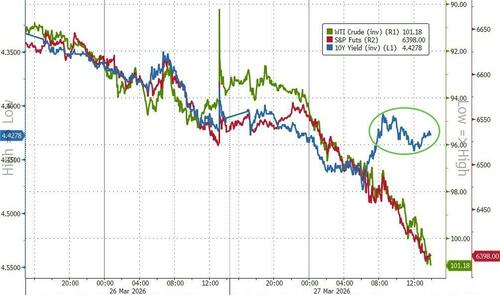
“Green-Dot Sunday” Is Non-Negotiable: Oil Up, Stocks Down As War Begins 2nd Month
“Green-Dot Sunday” Is Non-Negotiable: Oil Up, Stocks Down As War Begins 2nd Month
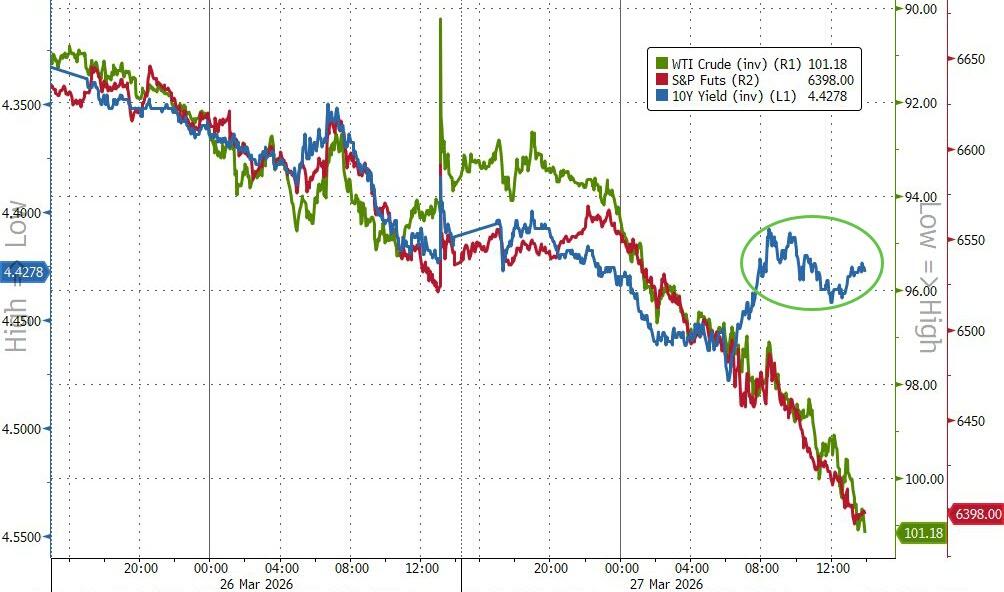
As last week wore on, it felt increasingly like the market was transitioning from pricing inflation risk (from a ‘brief’ energy supply shock) to weighing a demand-shock-driven growth scare (from a longer lasting disruption) as bonds rallied in the face of higher oil and lower stocks (stagflation).
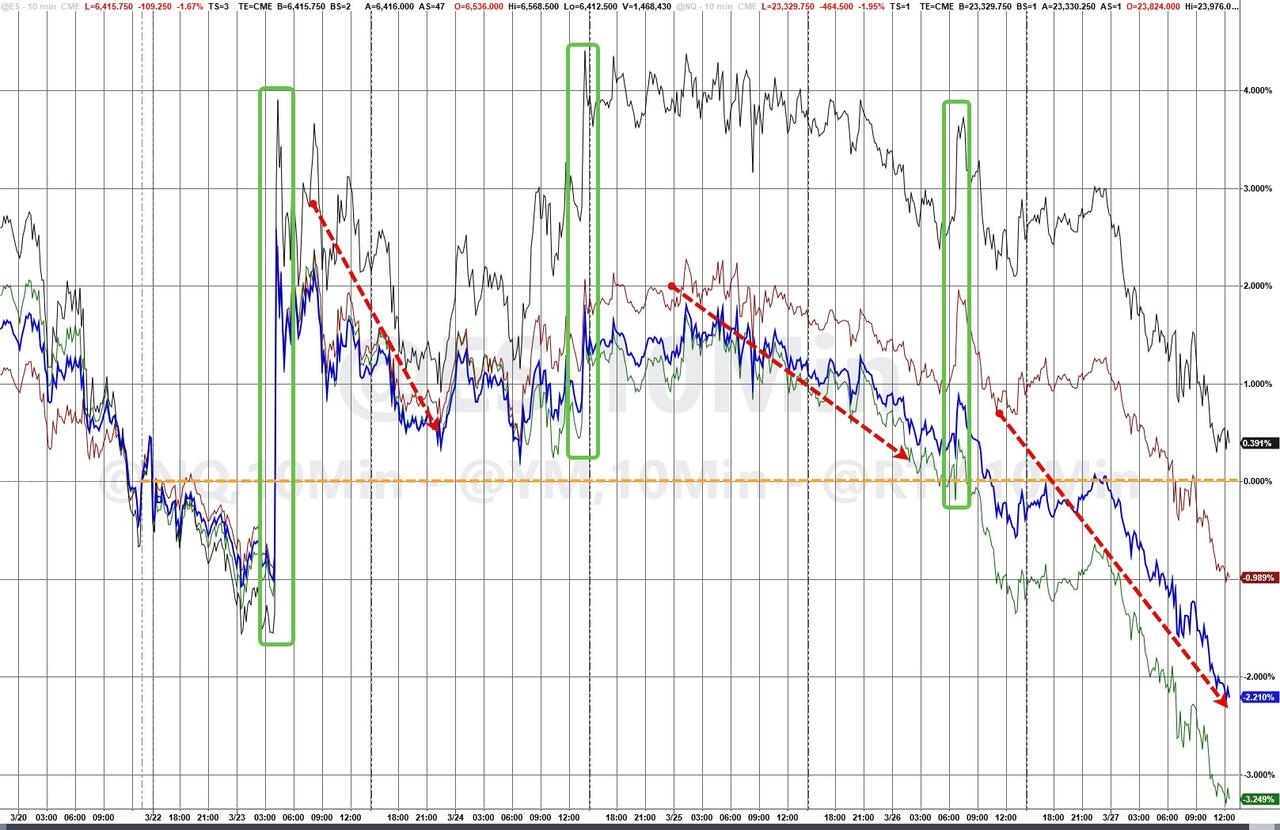
Last week saw three attempts at unilateral de-escalation (5-day delay, ‘ceasefire’ proposal, 10-day delay) met with even more supply as the apparent ‘Trump Put’ or ‘TACO’ trade is losing its power.
Simply put, as Goldman’s Shreeti Kapa noted last week, the answer to everything depends on one binary variable: the duration of the war.
That in turn depends if there will be safe transit of oil vessels through the Strait of Hormuz.
Even if the strait is opened, would we be able to restore oil flows to pre-conflict levels?
What is the guarantee for safe passage?
Can any ceasefire be trusted?
For how long would that hold?
This weekend gave us no answers to those questions but did suggest, as top Goldman trader, Brian Garrett, described: the situation is fluid.
Iran says electricity facilities were attacked in Tehran
IDF says currently striking Iran targets across Tehran
Foreign ministers of regional countries seeking peace & offramp in Pakistan meeting on Sunday.
Iran destroyed US AWACS jet at Saudi Airbase
Report says Pentagon has been weeks in preparing ground operations as initial Marines arrive in region (WaPo).
Fluid indeed…
Here’s how Garrett started his “weekend” prep note:
“the quotation marks around weekend are intentional…
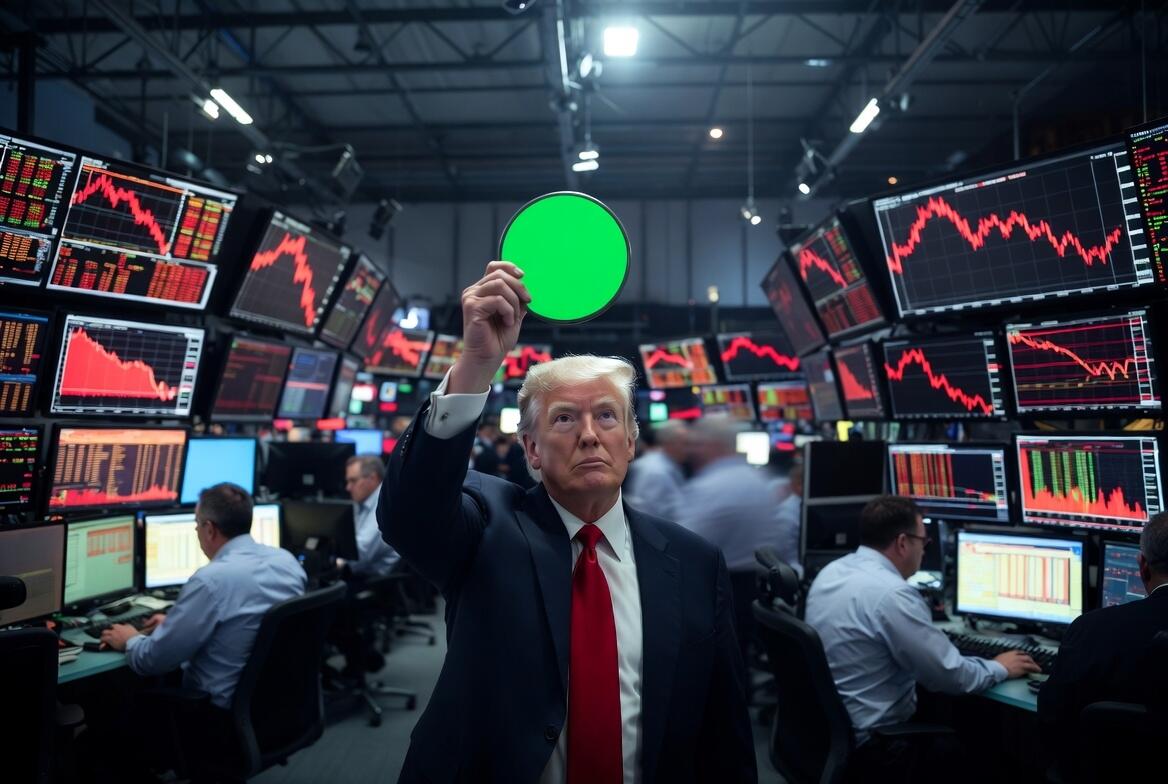
…investors and traders have not had a break in months, with “Green Dot Sunday” turning from a one-off into a 2026 non-negotiable…
…the forthcoming three day “weekend” for US markets is almost unwelcome as the market holiday just means another news/headline session coupled with zero price discovery and zero liquidity.”
The feedback from various market participants suggests that Brian hit the nail on the head – headline fatigue is real.
Here’s a few things on Garrett’s radar…
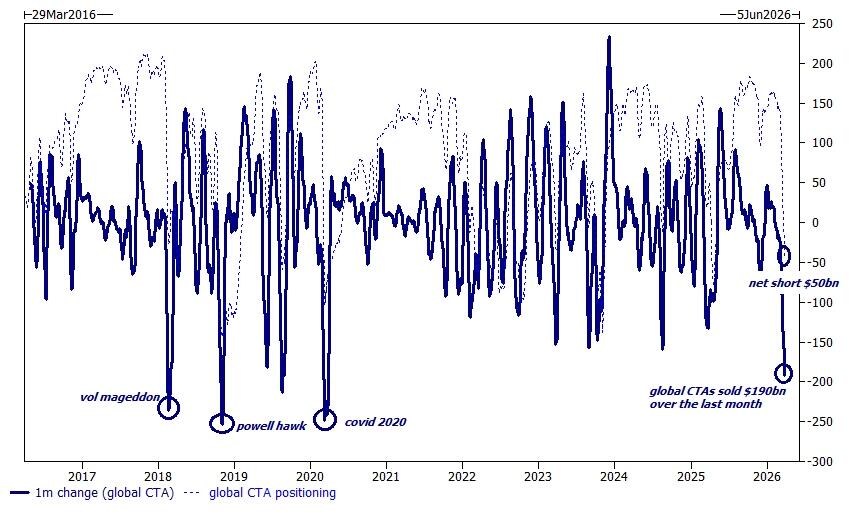
1/ CTAs have sold even more global equities…
They are quickly approaching max short levels … at a minimum that pressure is abating
2/ Main Street is finally noticing…
The texts from college friends and family members is showing some panic… “bg, what did you do to the market”
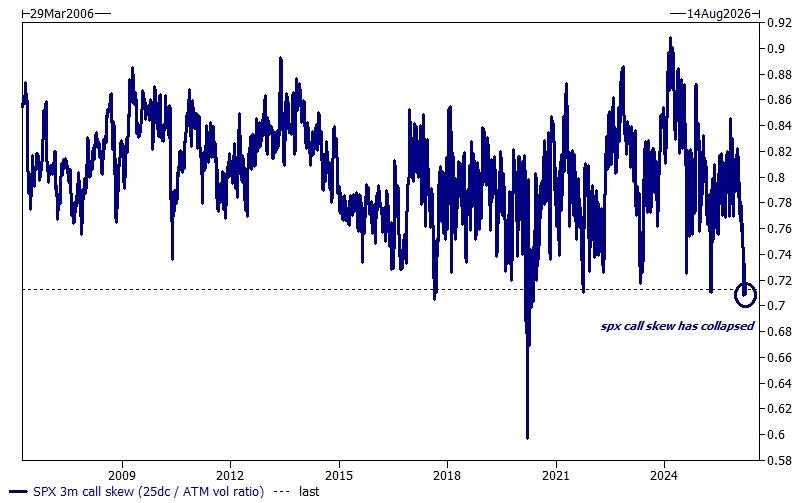
3/ SPX Call Skew is collapsing…
The hope for a quick rebound is diminishing… this is reflected in the cost of an OTM upside strike…
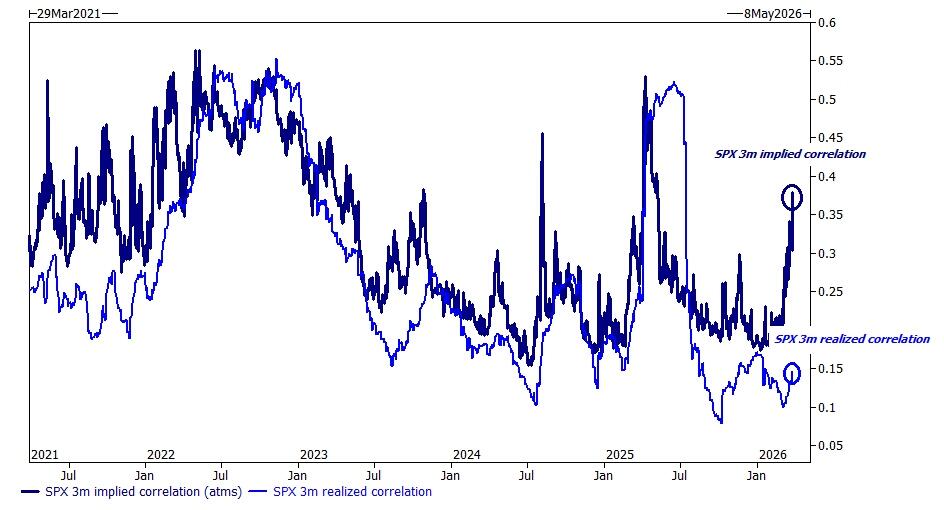
4/ SPX realized correlation remains extremely low for the size of this drawdown…
Desk continues to like sector ETFs or custom basket options for those looking to express trades in convexity
And in case you needed to hear from another ‘expert’, here’s Iran’s de factor leader offering some day-trading advice:
Iran’s defecto head now pitching premarket trades https://t.co/T6qy3fOPMW
— zerohedge (@zerohedge) March 29, 2026
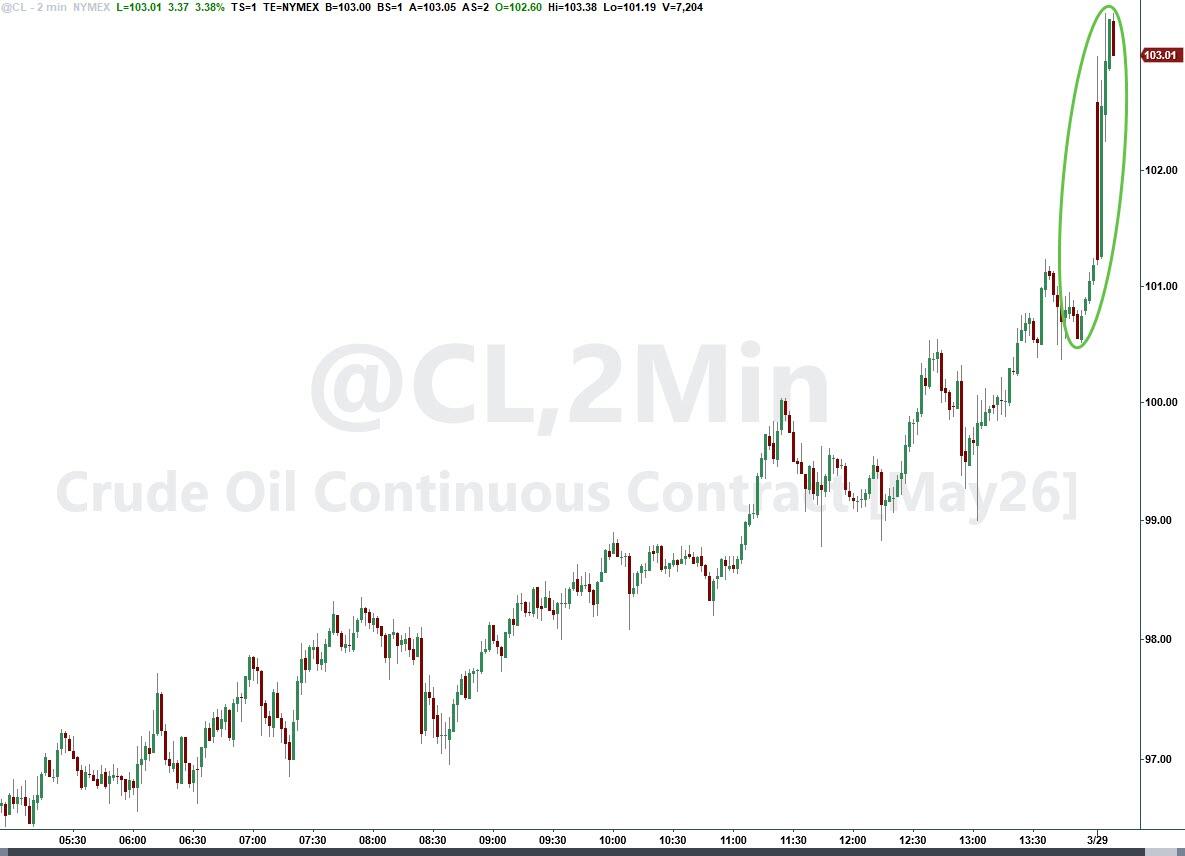
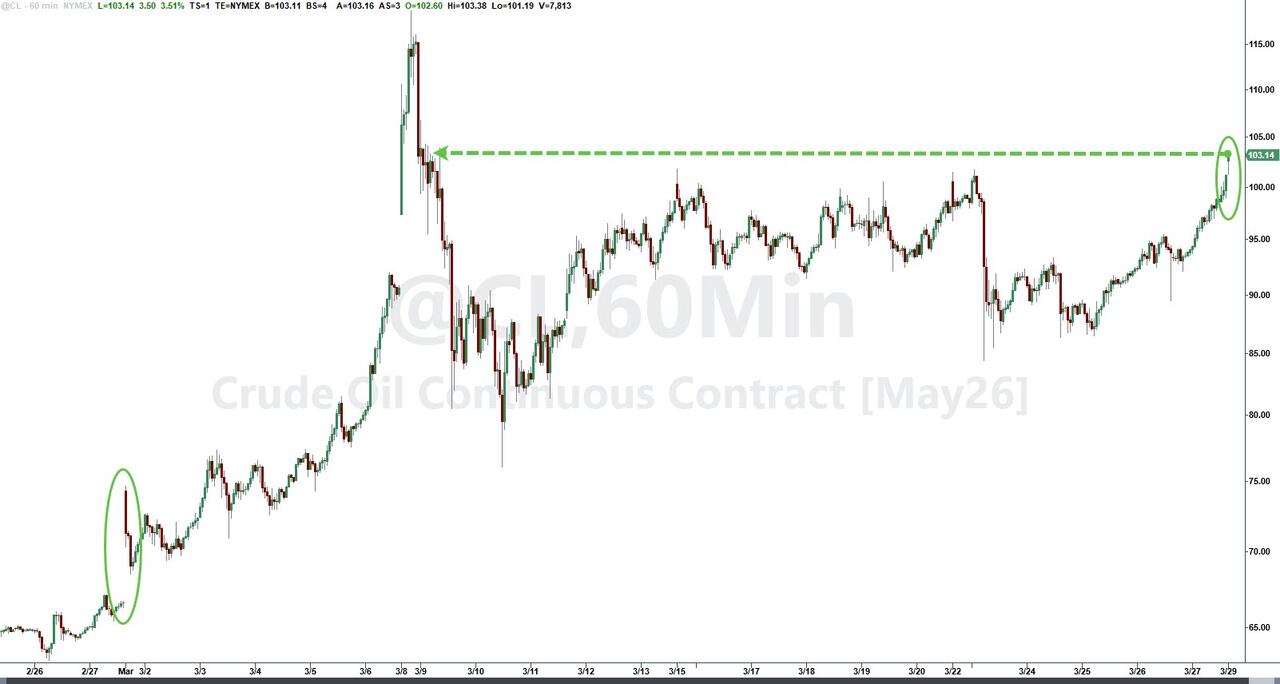
So, Sunday night, dots are green… and oil futures open higher with WTI testing up to $103…
Up to 3-week highs…
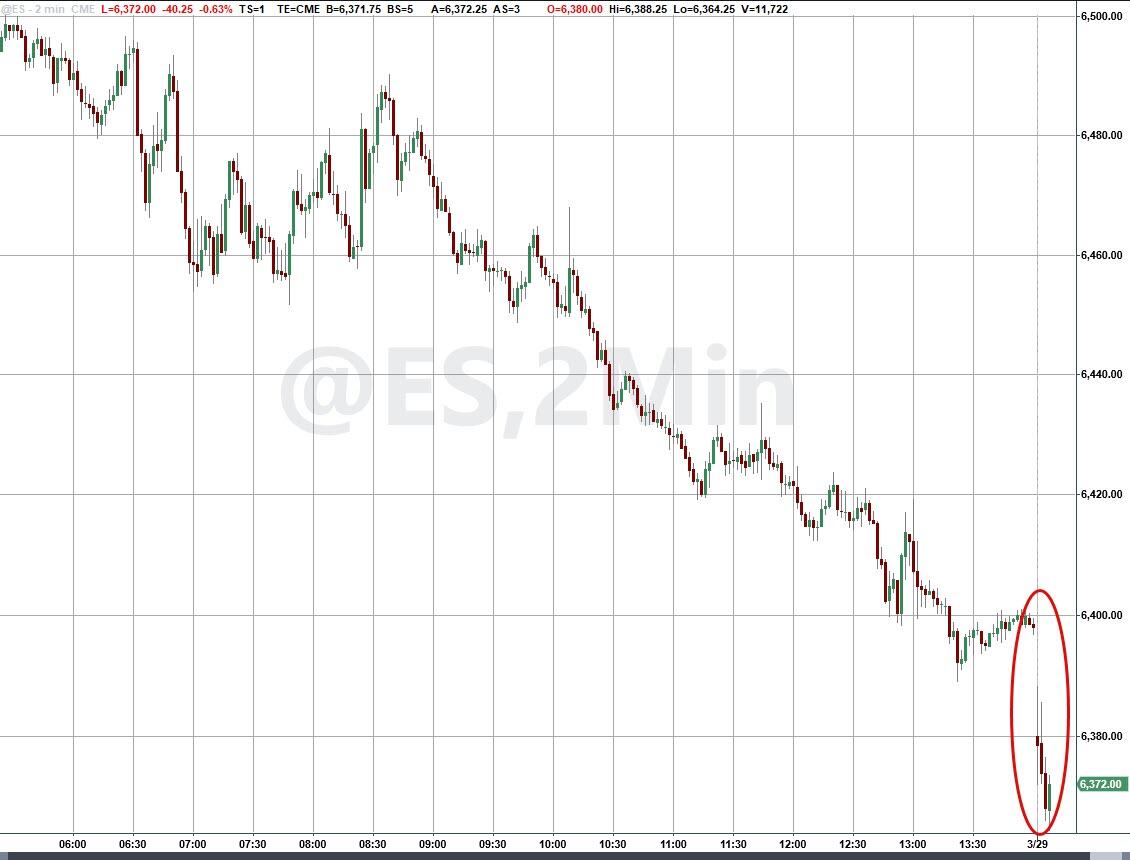
S&P futures are down almost 1%…
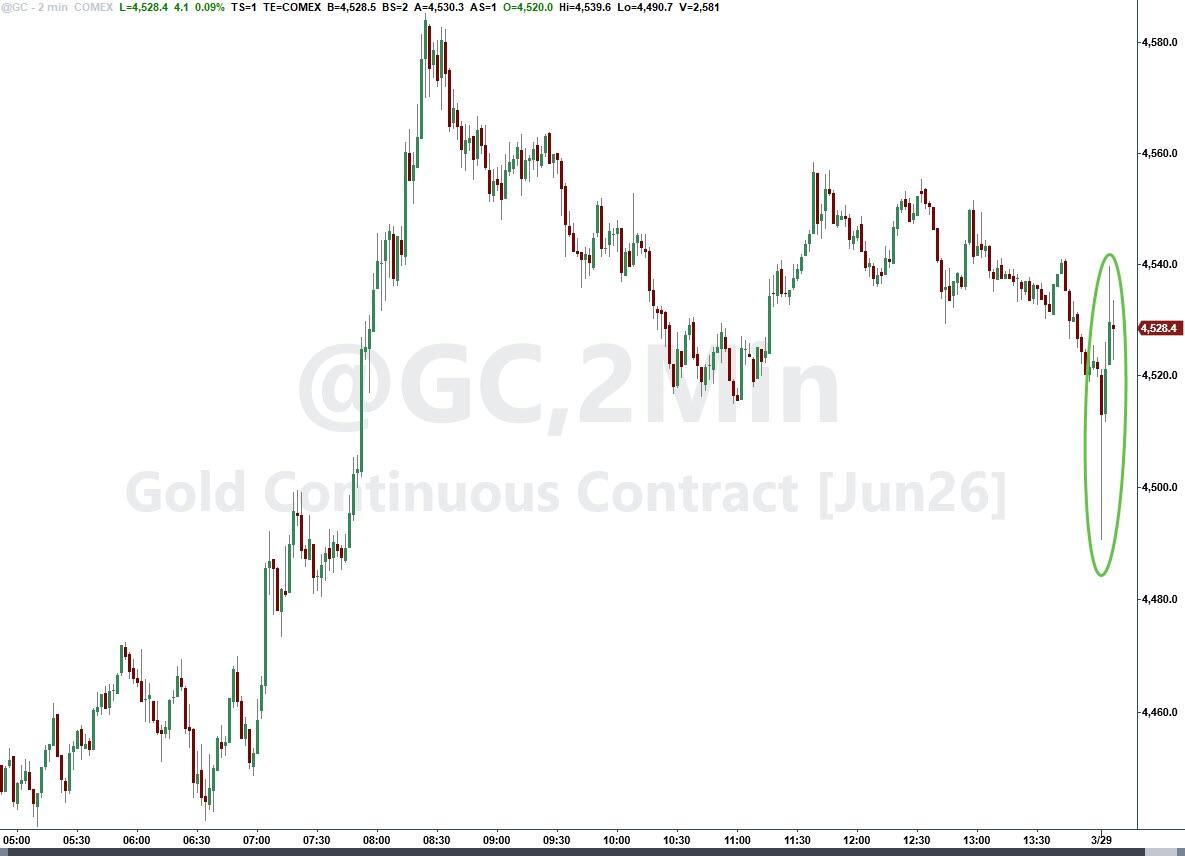
The dollar is lower (against the JPY) out of the gate and Gold is up modestly, bouncing from a lower open…
How long will this opening kneejerk hold?
Finally, we given the last words before another busy (if shortened) week to Goldman’s Garrett: a silver lining?
What is good news is that prices are finally reflecting the issues at hand and the correction has at least started (h/t NDX officially -10% from the highs)… feels like we’re closer to an end than the beginning but also feels like we’re playing a game that doesn’t have “innings” in the classic sense (ie : no one can give you a timeline)… many parties need to want to de-escalate and that’s not evident (yet).
Here’s the trades Garrett likes:
Continue to think receiver (or just simply lower yield) trades make sense
Long emerging market equities that benefit from higher commodity prices
Short credit (only asset yet to flinch)
SPX ratio call spreads, long the 2-3x (pitched last week, still like it and we got traction)
Long gold (this one is gaining followership)
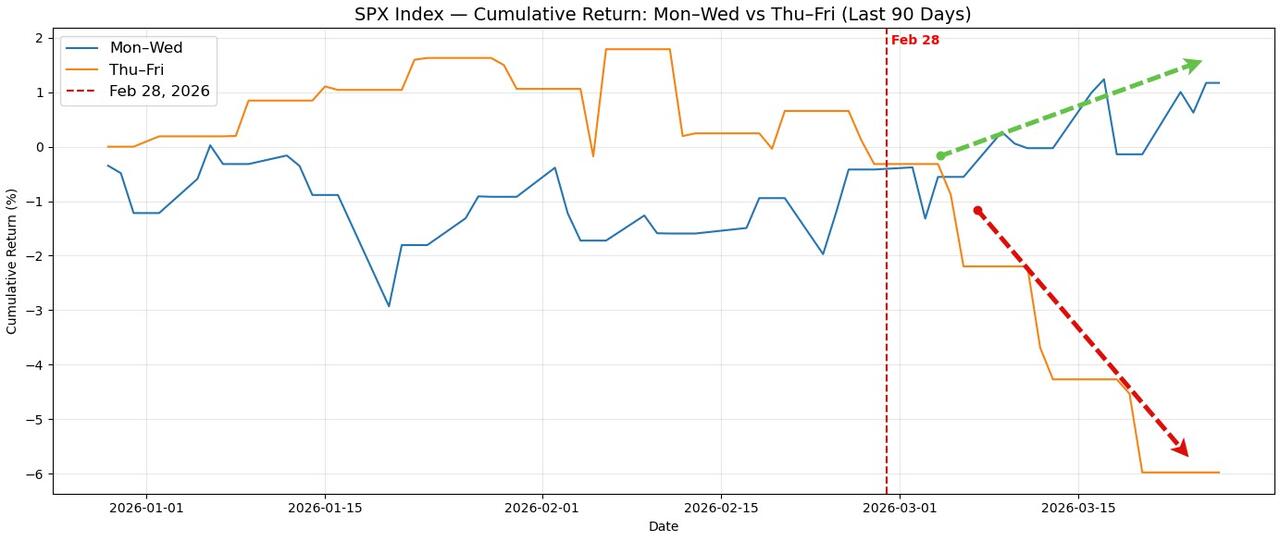
And don’t forget: buy the Monday/Tuesday…
…sell the Thursday/Friday (or Weds/Thurs this week?)
Professional subscribers can read Brian Garrett’s full “Weekend Prep” note here at our new Marketdesk.ai portal
Tyler Durden
Sun, 03/29/2026 – 18:05

Sophisticated Drone Swarms Disrupt Operations At Barksdale Air Force Base
Sophisticated Drone Swarms Disrupt Operations At Barksdale Air Force Base
Earlier this month, Barksdale Air Force Base in Bossier Parish, Louisiana, faced an unprecedented threat from sophisticated drone swarms. These drones, operating in waves of 12 to 15 units each, loitered over the base for approximately four hours daily, disrupting critical operations and forcing the Air Force to halt activities and shelter personnel.
This marked the first time a U.S. air base was temporarily taken out of operation in wartime, a scenario that had never occurred even during World War II.
“Barksdale is the headquarters of the Air Force’s Global Strike Command, which is responsible for the nation’s nuclear intercontinental ballistic missiles and strategic bomber forces, including B2, B1, and B52 aircraft,” explains The National Interest. “The base is home to the 2nd Bomb Wing B52s and is the central hub of communications and logistical support for coordinating and directing those forces.”
It’s hard to overstate just how alarming this is. Potentially hostile drones were able to operate over a critical military installation for days with what looks like total impunity. And making matters worse, the disruption caused by the drone swarms impacted B-52H aircraft launches for Operation Epic Fury against Iran, delaying critical missions and potentially compromising the effectiveness of the operation.
According to a report from Asia Times, “the drones that operated over Barksdale were far more sophisticated than anything seen in Ukraine, where drones are used heavily, and well beyond Iranian capabilities.”
The drone waves lasted around four hours each day, an extraordinarily long loiter time for a drone. It is not known if the drones were fixed wing or quadcopter types, or how they were powered (liquid fuel or electrical). Each wave consisted of 12 to 15 drones, and the drones flew with their lights on, intentionally making them visible.
Barksdale AFB does not have air defenses, nor does it have fighter jets that can take down drones.
The airbase does have some electronic countermeasures that were designed to disable GPS and the datalinks between the drones and their remote operators. The electronic countermeasures failed to work.
In fact, their ability to resist broad-spectrum jamming and operate using non-commercial signal characteristics made them particularly challenging to detect and neutralize. The drones also employed varied ingress and egress routes and dispersed patterns, complicating efforts to trace their origins.
Despite the base’s electronic countermeasures designed to disable GPS and datalinks, they failed to disable the sophisticated drones.
At the very least, the incident exposed a major gap in U.S. air defenses, especially at bases like Barksdale that don’t have systems in place to stop this kind of threat. Even more concerning, these drones could potentially carry heavy weapons or conduct surveillance over sensitive nuclear facilities—raising serious national security alarms.
It’s not known where the drones came from, but China is believed to be a likely source, given the drones’ advanced capabilities, which appear to outmatch much of the U.S. arsenal. The activity could be retaliation for the 2023 shootdown of Chinese spy balloons, which Joe Biden delayed until after they had already surveilled multiple U.S. military sites. The operation’s persistence and precision point to trained operators who likely smuggled the equipment into the country.
This incident makes one thing clear: it’s time for a serious reassessment of domestic air defense, especially as drones become a growing threat. The problem is, the United States is still years away from having effective domestic counter-drone capabilities.
* * * Order by midnight! Now with cheaper shipping
Tyler Durden
Sun, 03/29/2026 – 16:55

Bigger Isn’t Better: A Case For Downsizing The Federal Reserve
Bigger Isn’t Better: A Case For Downsizing The Federal Reserve
Authored by via Paul Mueller via the American Institute for Economic Research (AIER),
President Trump’s conflicts with Federal Reserve Chairman Jerome Powell and with Board of Governors member Lisa Cook have obscured real shortcomings at the Federal Reserve and brought little useful change. These conflicts tend to focus on whether the Fed’s target interest rate is too high or too low. Meanwhile, institutional problems at the Fed have been largely overlooked.
But there is an opportunity here with Trump’s nominee for Fed chair, Kevin Warsh. His first task will be navigating a hostile Senate. But should he be confirmed, Warsh’s time would be best spent cleaning up the Federal Reserve system: its personnel, spending, and data.
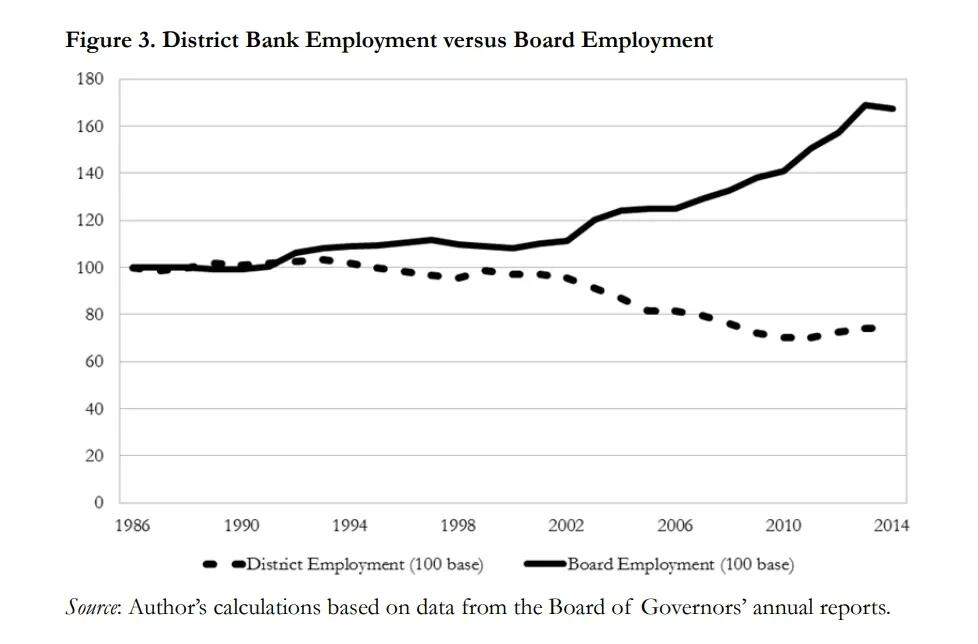
The Federal Reserve System employs 24,000 people. The Board of Governors has about 3,000 employees, while the 12 district banks employ the remaining 21,000. That figure includes 800 to 1,000 professional economists. While the Fed has recently announced plans to reduce its workforce by 10 percent, that would still leave it with more than 21,000 employees. But why shouldn’t the Fed cut headcount by 20 percent to 30 percent, or even more?
Does the Fed really need that many employees? After all, this isn’t the 1960s or 1970s when many things had to be done by hand. Not only have there been significant technological improvements and greater automation over the past 50 years, the development of artificial intelligence will also accelerate this trend. As such, the new Fed chair should reevaluate whether the Fed needs so many employees.
Besides being wasteful, the high number of economists employed by the Fed has likely influenced the profession to unduly favor the status quo. Those who criticize the Fed or question whether it should even exist find themselves in the wilderness of monetary economics. Employing fewer economists will reduce the Federal Reserve’s gravitational pull on the economics profession.
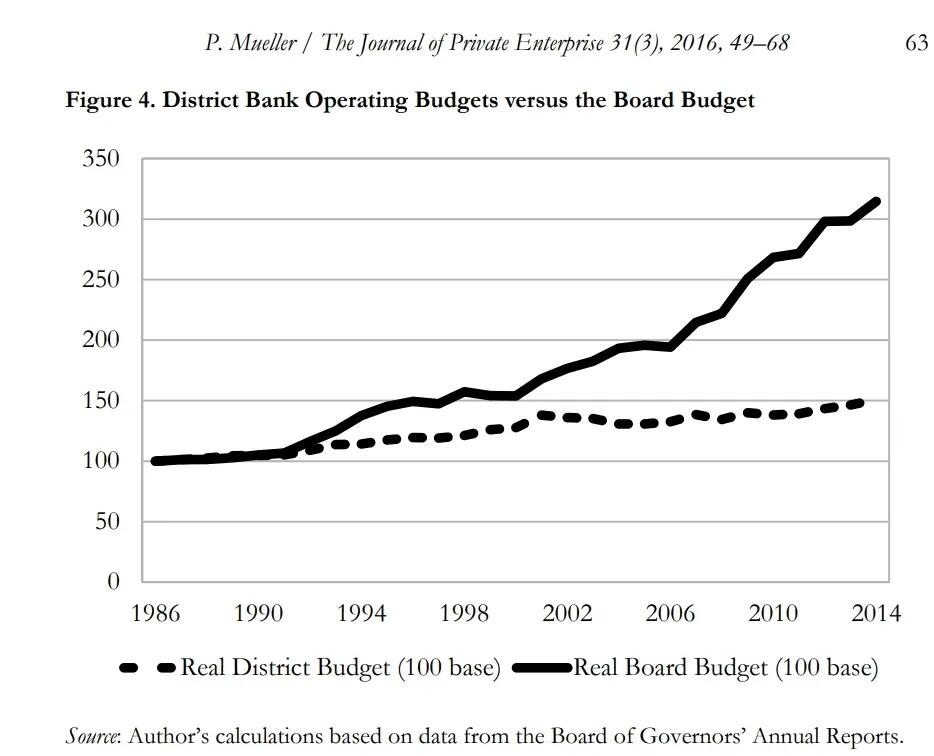
Along with reducing headcount through reorganization and consolidation, the Federal Reserve is ripe for an audit of its spending. Ron Paul popularized the idea of auditing the Fed in 2008. The Federal Reserve is unique in that it can literally create money, and in that it sets its budget independent of Congress. What would you expect the budget trend to be for a fully self-funding organization that can print money? If you said up and to the right, collect your prize.
The budget of the Board of Governors of the Fed has grown more consistently than the Federal budget for decades. In fact, why would any office or department at the Fed ever voluntarily reduce its spending? As such, we don’t see examples of significant retrenchment or budget cuts across the Board of Governors.
District banks, on the other hand, operate with private-sector participation through their member-bank stockholders, yet they still suffer from bureaucratic bloat because of limited market competition.
By restructuring staff, streamlining operations, and auditing Fed spending, the new Fed chair can couch all of this change in terms of modernizing the institution. The Fed has largely failed to keep abreast of technological change when it comes to data, metrics, and execution. It still relies heavily on surveys and anecdotal conversations when it has access to millions of data points, nearly in real-time.
Consider the following key indicators that the Fed officials rely on:
They measure their key inflation target using the personal consumption expenditures price index, as well as the consumer price index and the producer price index. Yet these numbers come out only once a month. Rather than calling on business leaders to get a read on economic conditions, they could use real-time measures from sources such as the Adobe Digital Price Index or Truflation that use millions of transactions to assess economic activity.
Similarly, most of the key indicators that the Fed uses for assessing the strength of the labor market (the unemployment rate, nonfarm payrolls, labor force participation rate, and various measures of underemployment) tend to be released monthly as well.
The important measure of economic growth, the gross domestic product (GDP), comes out only quarterly—although there are frequent estimates. Furthermore, the measures of GDP tend to be revised often, too. The Atlanta Fed produces a “GDPNow” number—but it also relies primarily on estimates rather than real-time data. Indicators such as industrial production, retail sales, and business investment are not much better.
One area in which the Fed does make use of real-time data is in financial market conditions. Interest rates (e.g., federal funds rate, Treasury yields), credit spreads, and asset prices change in real time and can be used to assess financial stability and the effectiveness of monetary policy.
In addition to the delays, most of these core metrics, particularly GDP and the unemployment rate, are lagging indicators. They reflect past economic performance rather than provide real-time insights into current or future trends. In a rapidly evolving global economy, relying heavily on backward-looking data can lead to policy decisions that address emerging challenges too slowly or exacerbate existing ones.
The Federal Open Market Committee’s framework often emphasizes aggregate demand management, assuming that inflation is primarily a demand-side phenomenon. But recent economic shocks (supply chain disruptions, energy price spikes) highlight the critical role of supply-side factors. Over-reliance on demand-side metrics can lead to inappropriate policy responses.
In fact, many economists argue that the Fed should be less reactive in general. Economist Milton Friedman noted that there were “long and variable lags” between the implementation of monetary policy and its effects. Following predictable monetary rules will likely generate more stability and more growth in the long run.
Monetary policy (in terms of target interest rates) matters, but so does operational efficiency, utilization of technology, and access to good information. Institutional reform may also help the Fed rebuild public trust by reassuring people that its decisions reflect reality today rather than reality months ago—or not at all. Cleaning up the Federal Reserve will be a monumental task, but it will also be a legacy. Let’s hope that Warsh is up for the challenge.
Tyler Durden
Sun, 03/29/2026 – 16:20
https://www.zerohedge.com/political/bigger-isnt-better-case-downsizing-federal-reserve

Iran Allowing 20 More Ships Through Strait Of Hormuz, Pakistan Says
Iran Allowing 20 More Ships Through Strait Of Hormuz, Pakistan Says
Authored by Ryan Morgan via The Epoch Times,
Iran has agreed to allow 20 Pakistani-flagged ships to pass through the Strait of Hormuz unharmed, Foreign Minister Ishaq Dar announced on March 28.
Dar presented the announcement as a sign of good faith from Tehran, as Iranian forces continue to threaten commercial shipping in the Strait of Hormuz. Iran has actively targeted shipping in the region as part of its retaliation for U.S. and Israeli attacks on the leadership and military of the Islamic regime for its nuclear program, which have continued since Feb. 28.
“I am pleased to share a great news that the Government of Iran has agreed to allow 20 more ships under the Pakistani flag to pass through the Strait of Hormuz,” Dar said in an X post on Saturday.
The Pakistani foreign minister said two ships will be permitted to leave through the narrow maritime passage daily.
Oil tanker carrying Saudi crude to Pakistan.
Map frm @Kpler pic.twitter.com/qSUSTca7k1
— Anas Alhajji (@anasalhajji) March 29, 2026
In recent days, the Pakistani government has stepped forward as a potential intermediary for communications and further peace talks between Washington and Tehran.
Dar said Tehran’s decision to allow these 20 ships through the Strait of Hormuz marks “a meaningful step toward peace and will strengthen our collective efforts in that direction.”
The move came two days after President Donald Trump announced that Iran had let 10 oil tankers through the key Middle East waterway.
“Dialogue, diplomacy, and such confidence-building measures are the only way forward,” Dar wrote on X.
Trump has recently cited progress in negotiations with Tehran to end the war, but Iranian officials have downplayed the significance of the communications.
In a statement shared by Iranian state media, Iranian Foreign Minister Abbas Araghchi said Tehran had received messages from Washington by way of intermediaries but said, “this is not considered a negotiation.”
Iranian President Masoud Pezeshkian spoke by phone with Pakistani Prime Minister Shehbaz Sharif on Saturday. According to the Pakistani prime minister’s office, Pezeshkian said trust is needed in order to advance talks with Washington.
During a cabinet meeting earlier this week, Trump said that Iranian officials have, in private, been far more adamant about negotiating an end to the ongoing conflict.
“They say, ‘Oh, we’re not talking’ … They are begging to work out a deal,” Trump said.
Last week, Trump threatened to destroy Iranian energy sites if the Strait of Hormuz was not fully reopened to shipping within 48 hours.
In response, Iran’s Islamic Revolutionary Guard Corps threatened to completely close down access to the Strait of Hormuz and target energy facilities in Middle Eastern countries that host U.S. forces, along with other critical infrastructure like water desalination plants.
Trump has since postponed his strike deadline to April 6.
Tyler Durden
Sun, 03/29/2026 – 15:10

Gamer Backlash Hits Sony After PlayStation Price Hike: “Older Stuff Should Get Cheaper, Not Expensive”
Gamer Backlash Hits Sony After PlayStation Price Hike: “Older Stuff Should Get Cheaper, Not Expensive”
Gamers, already upset over rising memory, CPU, and GPU prices, woke up to more bad news this morning. This time, Sony posted a new entry on the PlayStation Blog announcing price hikes for the PS5, PS5 Pro, and PlayStation Portal, blaming “continued pressures in the global economic landscape.”
“We know that price changes impact our community, and after careful evaluation, we found this was a necessary step to ensure we can continue delivering innovative, high-quality gaming experiences to players worldwide,” Isabelle Tomatis, Vice President of Global Marketing at Sony Interactive Entertainment, said in the blog post.
In the U.S., that means the base PlayStation 5 (disc version) will see its recommended retail price rise from around $499 to $649, an increase of about $150.
What Sony meant by “continued pressures in the global economic landscape” to justify the console price hike was not defined. There was also no mention of whether the memory shortage influenced the price increase.
Backlash on X was instant:
Hot take but I think things should get cheaper the more old that they are, crazy idea!
— Synth Potato🥔 (@SynthPotato) March 27, 2026
My PS5 is now worth $200 more than when I bought it. That’s nuts.
— Wesley ✨ (@wesleytypes) March 27, 2026
Wow… at this point it’s easier to just build a full PC than buy this piece of hardware. pic.twitter.com/e9DBAGWnaP
— Mike (@mikeindiee) March 27, 2026
Not fucking really pic.twitter.com/1PUNlEiwOz
— Gavin Roberts (@GavinLee5001) March 27, 2026
We told readers in late January: “If you want to buy any consumer goods, PCs, or smartphones … do it now, as it is for sure all the prices will be increased. Take an average PC, for example. The ratio of memory chips in the BoM [bill of materials] cost has increased from some 15% to almost 40%.”
* * * Now with cheaper 2-day shipping!
Tyler Durden
Sun, 03/29/2026 – 14:35
From Market Economist To Military Strategist
From Market Economist To Military Strategist
By Peter Tchir of Academy Securities
Technically I’m not an economist, I just play one on TV (CNBC and Bloomberg TV from last Monday).
While I am not a military strategist, everyone in the market and corporate America is being forced to be one, to some extent. Academy is in a unique position to offer unbiased, nonpolitical assessments of the conflict with our Geopolitical Intelligence Group (“GIG”). I’ve lost track of how many conversations I’ve had with our retired Generals, Admirals, and Intelligence officers this past week, let alone since the start of the conflict. We cover a lot of topics during our conversations with clients, with Iran being at the forefront.
Today I will do my best to provide an assessment of the most pressing concerns. The Geopolitical Intelligence Group has a range of opinions, but I think this is a fair assessment of the current consensus view. It is an honor and a privilege to work with the GIG (as well as a competitive advantage in this environment) and all our veterans. Any mistakes or misrepresentations are my own.
That is the same set of conditions that applied to Ceasefire?, which we published earlier this week. That piece remains a useful framework for examining the conditions likely required to reach a deal. However, it was interesting that the President started trying to frame something along the lines of “the regime has changed so much, that it is like regime change.”
After a “manic” week like this week, it is sometimes difficult to go back and review what we published last weekend – Another Manic Monday, but that too is worth re-reading.
Finally, before jumping into today’s report, Academy’s Around the World Report and Around the World Podcast (with General (ret.) Evans and Admiral (ret.) Buss) were both released this week.
Normalizing Tanker Traffic Through the Strait of Hormuz
We will try not to use the words “closed” or “open” in this report, because that doesn’t reflect the real issue. It isn’t about “opening” the Strait, it is about convincing the captains (and owners) of ships that they can transit the Strait just like they used to.
This is an important distinction, from much of what you might hear or read.
From a military standpoint:
There is little evidence that the Strait has been extensively mined. Ships are making it through. It is possible they “know” where the mines are, but it is also possible (and likely) that there are relatively few mines. To the extent there are mines, addressing this threat is precisely what the Littoral Combat Ships assigned to 5th Fleet (with mine countermeasures capabilities and helicopter support) are designed to do.
The main threats remain rockets, missiles, and drones. Especially those fired close to the shore. The time we have from launch, to detection, to interception is crucial to the success of our defenses. The closer the weapon is at the time of launch, the less time we have to hit it.
The U.S. Navy is designed for situations like this. The AEGIS Combat System is specifically designed to defend U.S. ships against such attacks.
Mines, mine layers, small ships packed with weapons, and unmanned surface ships (the naval equivalent of a drone) also pose a threat.
Why haven’t we seen the Navy patrol the Strait? That is the question, as it has become clear that getting shipping back to normal would reduce the leverage Iran has on the global economy. While it is impossible to know (we are not getting all of the information available), here are some of the themes that come up when discussing this crucial question (it really is the $100 or $150 per barrel question).
In all combat situations, there is always a balance between risk and reward. What are the risks of patrolling the Strait today versus striking other targets in Iran? What is the trade-off in risk to U.S. sailors, Marines, pilots, and even the ships today versus what they might be in a day or a week from now? Getting oil (and everything else flowing through the Strait) is a primary economic, and maybe even political concern, but should not drive military decisions.
The caution may be because we have real concerns about how many weapons the Iranians are able to train on the Strait. It may be a function of some elements required to patrol the Strait being engaged elsewhere (we are sending more Marines, 82nd Airborne Division paratroopers, and ships to the region). Some of it might be adapting strategy to the asymmetric warfare threat (more on this later).
The assessment of the GIG is we will get to the point of patrolling or routinely transiting the Strait, maybe in days, maybe longer, but only once the risk vs reward has been justified.
What does it take to convince commercial vessels to go through? In theory, we could set up a “convoy” and send out a naval force (with air cover) and escort ships through the Strait. That is probably what will happen “eventually.” The decision for the Navy to sail in the Strait is very different than that of merchant vessels. The Navy is prepared for this, built for this, trained for this, and it is what those in service signed up to do.
The “realistic” assessment from the GIG that I buy into, is it will take days of demonstrating the Navy’s ability to sail in the Strait without getting attacked before most merchant vessels will even think about trying to do it. Take this job and shove it, comes to mind. This is “just a job” to most of the merchant crews (and even the captain) and they are probably getting paid extra time to wait to cross, so it isn’t like they feel the urgency the market might feel. The insurance plan that the President ordered to be put in place will help (more with the owners than the crew), but I haven’t been able to find out much about the status of the U.S. government-backed plan (Chubb is the carrier being used to provide it according to the reports I’ve read).
The merchant vessels might not even be comfortable if the Navy is getting shot at. This would be another reason for delaying the attempt until there is more certainty that Iran’s capability to attack the Strait is minimal.
Finally, many of the cargo ships are likely going to need to go to port soon. 30 days of eating, and moving around the gulf, take a toll on supplies. The ports they are sailing to, may also not be able to handle them all at once (in the unlikely event they all try to go at once), further limiting how quickly the traffic through the Strait can be normalized.
A lot to think about, but I think that is a realistic assessment of the thought process going on. What is against us, how much safer can we make it, and how do we convince commercial vessels to follow suit.
Asymmetric Warfare
The “concept” is simple – small, cheap weapons, maneuverable, easy to hide, against large expensive systems. Ukraine, first with a plant in the U.K. and now apparently a deal in the Gulf to supply drones, shows how much they have learned in 3 years of war with Russia. Much of which has devolved (or evolved) into drone warfare.
Let’s list the “problems” first:
Shooting down things that cost in the thousands with things that cost in the millions is a very expensive endeavor. It is far from ideal, but not the biggest problem.
Production and replenishment is a more important issue. Have we used a year’s worth of production of some missile systems already? Maybe more. Ships in particular set sail with a limited amount weapons. If we were prepared for a “peer” battle, we were probably expecting to face ships and systems similarly equipped (not as good as the U.S. ones, but similar in concept, cost, etc.). But you cannot just let a “cheap” but effective drone hit you, you need to defend against it. Hopefully, in many cases, other weapons systems that aren’t as costly manage to take out the target. But this need to potentially replenish faster than expected can hamper some efforts.
Really difficult to eradicate. Ballistic missile launches are relatively easy to detect. Ballistic missile launchers are often plodding. Mobile, yes, but not like driving a race car. The launchers are vulnerable after they launch, especially when the U.S. and Israel have Air Superiority (better than Supremacy). Step out of a cave, launch, run back into the cave or through some tunnel system. The fact of the matter is it is difficult to completely stop this threat “without boots on the ground.” This type of enemy is not easy to defeat with range weapons, and is likely why we are hearing more and more about the possibility of landing troops not just on one of the islands, but possibly on the coast where they can more thoroughly clear out the enemy positions (no official decision has been made yet regarding using troops in Iran).
There are some “good” things:
The U.S. military has had drones and has been developing drones for years. That development increased in intensity during the Russia/Ukraine war. It only ramped up further with this new administration. General (ret.) Tata, before starting the confirmation process to be an Undersecretary of War, was very focused on drones. There is no shortage of signals from this administration that they see the need for drones. While a “peacetime” military may be slow to adopt new strategies, that can change abruptly during conflict. Something that might struggle to get acceptance, that might be difficult to fund as it has to come at the expense of other projects, might struggle to get the attention it deserves in “normal” times. This is not normal times, so expect rapid advances in the number and capabilities of U.S. drones in the region. Separately, as discussed last week, if I was Europe I’d set up a drone consortium and start making them as fast as possible, bypassing the expensive military hardware for now. Drones don’t require as much sophistication to produce, so everyone can convert factories and ramp up production relatively quickly.
The U.S. may not want to reveal “everything” we have. China is watching the U.S. military closely. They will be learning how our equipment works in the real world (not just in theory). How much damage does a certain missile do? How deep do the bunker busters go? What sort of things are we defending against easily and what is not working? No need to expose your best stuff, if you don’t think you need to. We might see more deployments of new systems.
My working assumption is Asymmetric FOR NOW.
The U.S. should be closing the gap on asymmetric warfare. Again, is that in time to keep the global economy (especially Asia) from tumbling into recession? I don’t know.
While asymmetric warfare is a distinct topic from getting commercial vessels to sail through the Strait, it is highly correlated, and I’m cautiously optimistic this is being addressed at lightning speed.
Other Risks
The Houthis, until this weekend, had been quiet. Their involvement could open up more shipping problems as they can control a choke point around the Red Sea. It will also cause the U.S. and Gulf Countries to spread their military around.
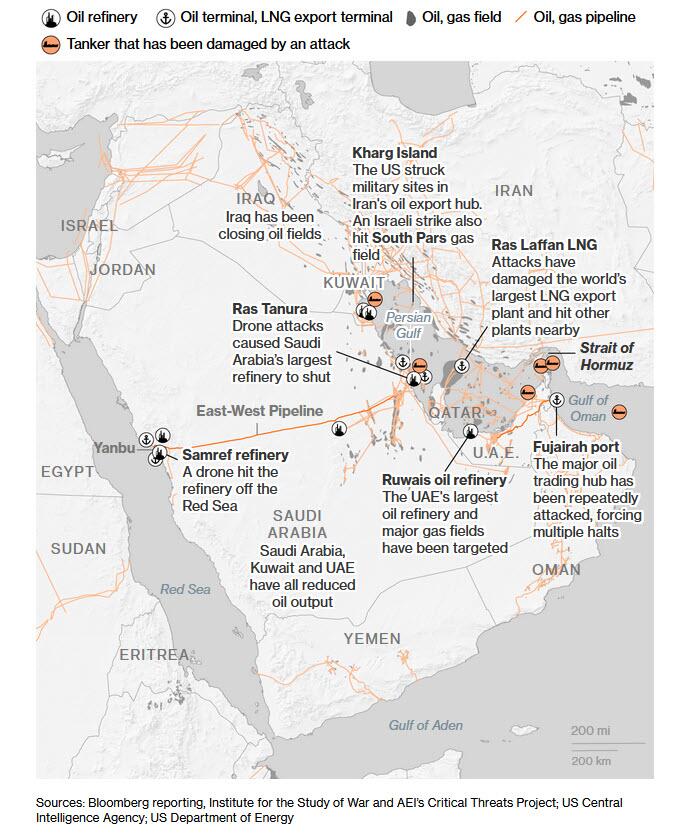
The Saudi pipeline is extremely helpful, but very vulnerable. While Iran (and the Houthis) might not want to attack production facilities or ships at sea, a pipeline like this might be too tempting to pass up.
Little evidence of cyber-attacks. Maybe they weren’t as good as people thought? Maybe we hit their computer centers early in the war?
Maybe our defenses are that good and we’ve hardened our critical infrastructure? If it is any of the above, it is a solid win for the U.S.
Terrorist activity has not really occurred. Similar to cyber, maybe we have done a great job of identifying and destroying their “sleeper” cells. This has also been a positive and is one form of potential Iranian response we haven’t seen (and hope never to see again).
Humanitarian Relief?
At some point there will be humanitarian issues that need to be addressed in the region. Much of the region imports food. Iran imports food. It is unclear if much is getting through.
This may provide a new “twist” to what is going on there. Who will allow what? Will China get involved? (They did make one statement about possibly being involved in humanitarian missions, but no statement about helping to open the Strait). At least not that I’ve seen.
Strategic Move to Hurt China by Restricting Access to Oil?
This comes up periodically. Was Venezuelan oil first, Iranian oil second, and Russian oil possibly third, all targeted in an attempt to hit China on energy? A way to push back on their control over processed and refined rare earths and critical minerals?
There are some parts of what is going on that fit that narrative well. I’m not sure I buy into it.
If it is true, it does mean the U.S. will need to see this conflict carried out until there really is a change in Iran regarding how they deal with the rest of the world. It does fit with my view that the administration would like U.S. companies to get some access to Iran’s energy business (and would frame that as helping change the regime over time).
Declare Some Form of Victory and Move On
The GIG has talked about shifting from the old model where “if we broke it, we fixed it” to one where “if we broke it, we might come back and break it again.”
It would leave the region in a confusing state. But some of the messaging (from the President and the Vice President) does have the tone – that we are setting up to declare some sort of victory and move on.
Still seems low probability, but it is still possible.
Economic Fragility, Affordability, and Recession Risk
This will be a separate report in its own right, but nothing that we haven’t been writing about. Supply chain, and economic fragility is real, expect to see cracks soon.
Affordability is an issue across the globe, not just domestically. Affordability has only gotten worse. The “working poor” concept is getting some discussion as it would be the start of a very different type of recession. Job loss recessions, we have a playbook for. People with “good” jobs who cannot afford a reasonable lifestyle is new. Not good.
Is recession for Asia (ex-China) and Europe my base case? Not quite, but possibly only because I haven’t had the time to think about it.
I don’t see a recession for the U.S. (or China), but it is certainly something we should be admitting is a possibility as not only does the conflict continue, but also the willingness to target energy, refiners, smelters, etc., is increasing and will take a toll even if we come to a resolution in the coming weeks. A world where the resolution is ideal or suboptimal won’t even make a difference as the damage is done and permeates throughout the global economy.
Bottom Line
Expect bond yields to start acting “normally” in a risk-off environment. Friday morning may have been peak unwind/capitulation and peak inflation fear. Friday afternoon might have been the market deciding to at least think about recession and economic slowdown risks.
Very cautious on risk here.
Could we miss a big relief rally? Possibly, but I think this time (unlike last Monday/Tuesday) the relief rally will require credible evidence that a resolution is coming.
Because of that, we will have time to adjust our positioning. Until then, be cautious on risk, add some duration.
Credit did feel weak on Friday, which would be a new thing to worry about (credit, not just private credit). Spreads were leaking.
So far the equity sell-off hasn’t required much help from credit, but if credit were to turn more negative, we have some serious downside risk for equities. From our Is Credit Whispering or Screaming? and Credit – A Little Louder Now – we’ve identified how we see a path to credit widening. It hasn’t been a primary concern, but we need to revisit that “complacency” as the risks of an economic downturn are increasing.
I think I ended sounding gloomier than I feel, but this is a very tricky environment, and military and politics will drive the next 5% on stocks.
Hopefully that 5% will be to the upside as ships start sailing through the Strait sooner than the market is expecting! (There, I did finish with some optimism, even if it isn’t how I’m positioned).
Tyler Durden
Sun, 03/29/2026 – 14:00
https://www.zerohedge.com/geopolitical/market-economist-military-strategist

Beyond Muscle: New Research Shows Creatine Powers The Brain – Fast
Beyond Muscle: New Research Shows Creatine Powers The Brain – Fast
Creatine is an amazing compound that our bodies make naturally. Long used in the gym for peak muscle performance, a flood of recent research shows that it has profound effects on brain metabolism, cognitive performance under stress (including sleep deprivation), memory, attention, and even mood support. It’s also extremely safe for the vast majority of people.
Most people need 2-3 grams/day as a baseline – with our bodies making roughly 1g/day from amino acids in the liver, kidneys, and pancreas. According to new studies, boosting creatine intake beyond baseline is extremely good for your brain in everyday healthy adults. One 2024 systematic review and meta-analysis (Frontiers) of 16 randomized controlled trials found that regular creatine supplementation led to improvements in memory and gains in attention and processing speed. These benefits showed up across adults (including healthy individuals). Another review highlighted particularly noticeable memory gains in healthy older adults.
And if you’re elbow-crawling at work after a night of insomnia, a big dose can have significant effects and kick in fast (within a couple of hours). In one double-blind, randomized study (Nature), participants running on fumes after 21 hours of sleep deprivation experienced a 10.3% boost in word memory performance (plus 17.7% faster processing) and 16–29% gains in processing speed for language, logic, and numeric tasks.
But before we get into the science…
Let’s get this out of the way; you probably know we sell creatine, so this is obviously an ad. But whether you buy it from us or not, you should take note of what these studies have found and consider taking it as part of your daily stack.
Long story short, it works well, we use it, and the stuff we sell is high-grade, pure micronized creatine (5g/scoop). The jar it comes in is pretty big and it lasts a while. Support yourself & support the site – buy some here. And if you don’t buy ours, just check it out.
Actual product:
And now for the studies
Gym rats have known this for decades about Creatine, it increases strength, muscle mass, and training capacity by rapidly regenerating the body’s cellular fuel, ATP.
The latest research suggests that this molecule may be less a niche performance enhancer and more a universal energy buffer for human life.
Brain Benefits in Healthy Adults
A 2024 systematic review and meta-analysis in Frontiers in Nutrition looked at 16 randomized controlled trials involving 492 adults. Creatine supplementation showed positive effects on memory, attention time, and processing speed. A separate 2023 meta-analysis in Nutrition Reviews focused specifically on memory in healthy individuals and found overall improvements, with particularly noticeable gains in older adults.
The two studies found;
Better overall memory performance with creatine supplementation
Faster attention and quicker thinking/processing speed
Particularly noticeable memory improvements in healthy older adults (ages 66–76)
Stronger benefits often seen in women and people aged 18–60
Improvements showed up in both healthy adults and those under various types of stress
Fast-Acting Support When Sleep-Deprived
When you’re running on empty after little or no sleep, brain energy systems take a hit. The 2024 Scientific Reports (Nature) study tested whether a single high dose could help.
Fifteen healthy adults went through 21 hours of sleep deprivation twice. They received either a large dose of creatine monohydrate (0.35 g/kg body weight – roughly 20–30 grams for most people) or a placebo.
Brain scans showed better preservation of energy metabolites, and cognitive testing revealed real improvements: a 10.3% boost in word memory (with 17.7% faster processing) and 16–29% gains in processing speed on language, logic, and numeric tasks. Effects started showing within about 3 hours.
This doesn’t replace sleep, but it suggests creatine can act as a quick buffer when you’re seriously short on rest.
Short-Term Loading Improves Sleep and Cognition
A December 2025 randomized, double-blind trial in Nutrients tested a practical 7-day loading protocol in 14 physically active men (20 g/day, split into 4 × 5 g doses).
After loading, participants reported significantly better subjective sleep quality and went to bed earlier. They also showed improved performance on a cognitive attention test and reduced muscle soreness, plus better output in high-intensity exercise.
This adds to the picture: even in normal training life, short-term higher dosing can help how you feel and perform when sleep isn’t perfect.
Safety: One of the Best Profiles Out There
Creatine monohydrate has been studied extensively for decades. A comprehensive 2025 review in Frontiers in Nutrition analyzed over 680 clinical trials involving more than 12,800 participants (with doses up to 30 g/day and use lasting up to 14 years). No clinical adverse events were linked to creatine, and minor side effects were no different from placebo. Worldwide adverse event reporting over 50 years also shows creatine mentioned in an extremely small fraction of cases despite billions of doses consumed.
It remains one of the safest and most researched supplements available for healthy people.
Practical Takeaways for Most People
Daily maintenance: 3–5 grams per day (one scoop of our product = 5g). Simple, effective, and what most long-term users stick with for brain and body support.
Short loading phase: 20 g/day (split into 4 doses) for 5–7 days if you want faster saturation, then drop back to 3–5 g.
Occasional high-dose rescue: Around 20–30 g (body-weight adjusted) when you know sleep will be terrible. Hydrate well and don’t make it a habit — it’s for occasional use.
Vegetarians and vegans often notice bigger effects since they get almost none from diet. Women and adults in the broader 18–60+ range also tend to show good responses in the studies.
Creatine won’t turn you into a genius or fix chronic sleep debt, but the growing evidence shows it can be a cheap, convenient daily tool to help your brain’s energy systems work better – whether you’re grinding through work, training, aging, or just trying to stay sharp.
We take it every day. If you’re ready to add it to your stack, grab a jar here. Or pick up any high-quality micronized creatine monohydrate – the research is what matters most.
This is for informational purposes only and not medical advice. Consult your doctor before starting any supplement, especially if you have kidney concerns or other health conditions.
Tyler Durden
Sun, 03/29/2026 – 13:25
https://www.zerohedge.com/medical/beyond-muscle-new-research-shows-creatine-powers-brain-fast

DHS Shutdown Now The Longest In US History
DHS Shutdown Now The Longest In US History
Authored by Jacki Thrapp via The Epoch Times,
The partial shutdown of the Department of Homeland Security (DHS) became the longest in U.S. history on March 29.
The DHS shutdown reached its 44th day on Sunday, breaking the previous record set during the U.S. government shutdown in the fall of 2025.
Republican and Democratic lawmakers on Capitol Hill have blamed each other for the standstill while tossing a dizzying array of proposals through the halls of Congress that have not successfully moved forward.
Republicans criticized Democrats for not advancing their DHS spending bills as Democrats said they will not approve the funding bill until they are guaranteed to see an overhaul in how immigration operations are handled.
The House passed a stopgap plan to fund the DHS for 60 days on March 27 with a 213–203 vote.
The bill was sent to the Senate, which just went on a two-week recess.
Sen. Mike Lee (R-Utah) has urged his colleagues to return to Washington and end the DHS shutdown.
“If you don’t want to fight fires, don’t become a firefighter,” Lee said during an interview on Fox News.
“If you don’t want to take grueling votes at difficult hours and sometimes have to work longer than you want to, maybe you shouldn’t become a United States senator.”
The short-term bill to fund the entire DHS passed the House after Speaker Mike Johnson (R-La.) rejected the Senate’s measure that would have funded most of the department, aside from its immigration enforcement operations.
“We hope that someday Democrats finally come to their senses again and put the safety of American citizens first but we’re not holding our breath,” Johnson said during a press conference on Saturday.
Senate Minority Leader Chuck Schumer (D-N.Y.) said he would not support the House’s bill that passed on Friday night.
“A 60 day CR that locks in the status quo is dead on arrival in the Senate, and Republicans know it,” Schumer wrote in an X post.
“We’ve been clear from day one: Democrats will fund critical Homeland Security functions—but we will not give a blank check to Trump’s lawless and deadly immigration militia without reforms.”
The shutdown has caused extremely long lines at airports, as many Transportation Security Administration (TSA) agents—who have not received a check since mid-February—have not shown up at work.
Nearly 500 TSA agents have quit since the shutdown started because they weren’t able to pay for costs such as gas, groceries, or their mortgages, the DHS said.
TSA agents are expected to receive their long-delayed paychecks as soon as March 30, after President Donald Trump signed an executive order.
Tyler Durden
Sun, 03/29/2026 – 12:50
https://www.zerohedge.com/political/dhs-shutdown-now-longest-us-history
I’m Sorry, But The Fed Has Run Out Of Road
I’m Sorry, But The Fed Has Run Out Of Road
Submitted by QTR’s Fringe Finance
There is a special kind of denial that only financial markets can sustain. It is the quiet insistence that everything is fine because the S&P is only down about 10%, as if that number alone captures the health of an entire financial system. It is the belief that until equities are in full free fall, nothing truly serious can be happening underneath.
But as we know, underneath, things are already starting to break.
That is the part people are not fully appreciating. If a modest correction is enough to expose fragility in private credit that is already spilling over to counterparties and sectors like real estate, what exactly happens when there is a real downturn, the kind that actually forces price discovery instead of delaying it?
It does not stop at private credit. Private credit flows into private equity, which depends on leverage to generate returns. Private equity flows into commercial real estate, which is already dealing with structural problems that have nothing to do with interest rates and everything to do with demand. Commercial real estate flows into regional banks, which hold the debt and rely on valuations that have not fully adjusted.
It is a chain reaction waiting for a trigger. We knew this heading into 2026.
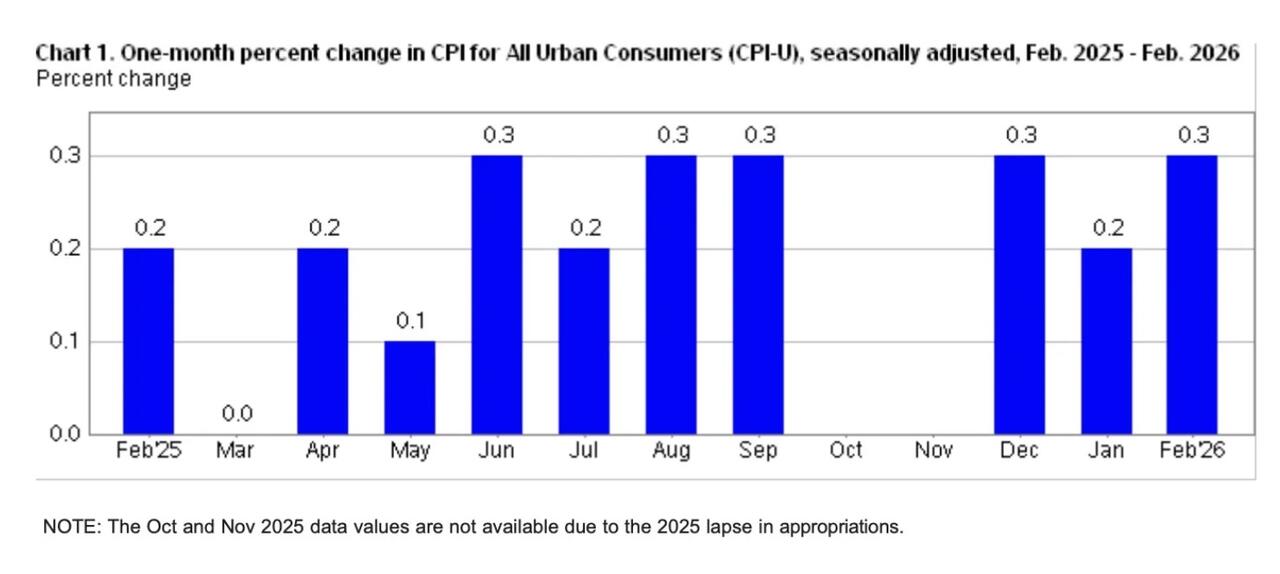
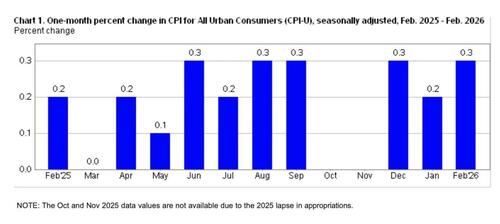
At the same time, inflation has refused to cooperate with the Federal Reserve’s plan. U.S. CPI is holding at 2.4% year over year as of February 2026, and core inflation is at 2.5%. That is not an emergency level, but it is also not the 2% target the Fed has spent years insisting is non negotiable.
Central banking is not about being approximately correct. It is about maintaining credibility, and credibility does not come from saying close enough.
So the Fed is staring at a system where financial stress is building and inflation is still above target, as I’ve been writing they would face for years now. That combination removes the easy answers, and all of a sudden the Fed runs out of road.
The next phase of this cycle is almost certainly deleveraging. Not the slow and orderly kind that policymakers like to describe in speeches, but the forced kind. The kind where lenders pull back, refinancing becomes difficult, and assets that were priced for perfection suddenly have to reflect reality. When that process begins in earnest, it tends to accelerate because falling prices create more pressure, which creates more selling, which creates more falling prices. Then, like we are seeing in private credit, psychology eventually breaks and the blame game starts. Who could have seen this coming?
🔥 50% OFF FOR LIFE: Using this coupon entitles you to 50% off an annual subscription to Fringe Finance for life: Get 50% off forever
Once that process starts, there are only two broad paths. The first path is to let it happen. Credit contracts, defaults rise, asset prices fall, and the system works through its excesses the old fashioned way. The problem is that the amount of leverage in the system today is enormous, and it has been built during a period of unusually low rates. When you combine high debt levels with higher interest costs, the math becomes unforgiving very quickly. That kind of deleveraging does not look like a mild recession. It starts to resemble something much more severe, potentially deflationary, potentially prolonged.
The second path is intervention. The Fed steps in (stop me if you’ve heard this one before), provides liquidity, and expands its balance sheet aggressively. Quantitative easing returns, possibly at a scale that makes previous rounds look restrained. Asset prices stabilize, credit markets function again, and the immediate crisis is contained. This is what my friend Larry Lepard refers to as “the big print”.
But here is where the situation becomes genuinely problematic. The Fed cannot cleanly choose the second option, though I think it’s the way they will head.
They cannot do it with inflation still running above target without major inflationary consequences. Injecting massive liquidity into a system that has not fully extinguished inflationary pressure risks reigniting it. Not gently, not in a controlled way, but in a way that forces a much harsher response later. The entire credibility of the central bank rests on the idea that it will not tolerate persistent inflation above its target. If it abandons that stance in order to stabilize markets, it risks unanchoring expectations in a way that is very difficult to reverse.
Watch the below clip at 50:02 until 52:47 if you want a 2 minute explanation of the direction we will keep heading if we go the inflation route.
It’s a trap, in essence. For years, critics have warned about some version of this outcome. They have argued that excessive debt and repeated interventions would eventually leave policymakers with no good options. Those arguments have been easy to dismiss because, historically, the Fed has always managed to navigate crises. Somehow inflation stayed low. The Fed cut rates, it expanded the balance sheet, it restored stability, and the system moved forward.
But the current setup is different in a way that matters.
We have never had this level of systemic leverage at the same time as a large, opaque private credit market that sits outside traditional banking channels. We have never had an environment where so much of the financial system depends on continued access to cheap or at least predictable financing. And we have never faced the prospect of needing extremely large scale intervention while inflation is still running above target.
Each of those factors on its own would be manageable. Together, they create a situation that does not have a clean historical precedent, so what happens next is unlikely to be neat and orderly, though fucked if I know exactly how the chaos or reset it going to play out.
The Fed is not in control of a stable system that just needs minor adjustments. It is managing a complex, highly leveraged structure where each decision carries significant tradeoffs. What seems increasingly unlikely is a smooth resolution where the Fed threads the needle perfectly and everything stabilizes without meaningful damage. There is no painless option left. There’s no more road.
The more realistic expectation is a policy response that looks inconsistent, reactive, and at times contradictory, because it will be attempting to balance objectives that are no longer fully compatible. And when that happens, it will not feel like a controlled process. It will feel like the system is being managed in real time, with no clear roadmap, and no guarantee that the chosen path leads anywhere good.
Now read:
A Veteran Investor Sees The System Breaking
My Bear Market Stock Shopping List
Private Credit Cracks Reach Real Estate
The Private Credit Snowball Accelerates
Ron Paul: Just Get Out! Now!
The Mistaken Identity of Prediction Markets
Bigger Isn’t Better: A Case for Downsizing the Federal Reserve
I’ve Reached Peak Lobotomized Consumer
QTR’s Disclaimer: Please read my full legal disclaimer on my About page here. This post represents my opinions only. In addition, please understand I am an idiot and often get things wrong and lose money. I may own or transact in any names mentioned in this piece at any time without warning. Contributor posts and aggregated posts have been hand selected by me, have not been fact checked and are the opinions of their authors. They are either submitted to QTR by their author, reprinted under a Creative Commons license with my best effort to uphold what the license asks, or with the permission of the author.
This is not a recommendation to buy or sell any stocks or securities, just my opinions. I often lose money on positions I trade/invest in. I may add any name mentioned in this article and sell any name mentioned in this piece at any time, without further warning. None of this is a solicitation to buy or sell securities. I may or may not own names I write about and are watching. Sometimes I’m bullish without owning things, sometimes I’m bearish and do own things. Just assume my positions could be exactly the opposite of what you think they are just in case. If I’m long I could quickly be short and vice versa. I won’t update my positions. All positions can change immediately as soon as I publish this, with or without notice and at any point I can be long, short or neutral on any position. You are on your own. Do not make decisions based on my blog. I exist on the fringe. If you see numbers and calculations of any sort, assume they are wrong and double check them. I failed Algebra in 8th grade and topped off my high school math accolades by getting a D- in remedial Calculus my senior year, before becoming an English major in college so I could bullshit my way through things easier.
The publisher does not guarantee the accuracy or completeness of the information provided in this page. These are not the opinions of any of my employers, partners, or associates. I did my best to be honest about my disclosures but can’t guarantee I am right; I write these posts after a couple beers sometimes. I edit after my posts are published because I’m impatient and lazy, so if you see a typo, check back in a half hour. Also, I just straight up get shit wrong a lot. I mention it twice because it’s that important.
Tyler Durden
Sun, 03/29/2026 – 11:40
https://www.zerohedge.com/markets/im-sorry-fed-has-run-out-road