Category: News

Pakistan & Afghanistan Exchange Heavy Fire After Short-Lived Truce
Pakistan & Afghanistan Exchange Heavy Fire After Short-Lived Truce
The prior truce between warring neighbors Pakistan and Afghanistan has been breaking down since last week. Some analysts are calling it a ceasefire in name only.
The globe’s attention has been on the Iran conflict, but heavy AfPak fighting has been on for almost the exact same length of time as Trump’s Operation Epic Fury against Iran. But it hasn’t received much attention in international headlines.
Earlier this month a short-lived truce had been announced by the two sides just ahead of the Muslim holiday of Eid al-Fitr, which was on March 20.
But clashes erupted Sunday between Kunar Province and Bajaur District, with both sides reportedly deploying heavy weapons and artillery, amid international reports of at least one dead and 16 wounded – mostly women and children – per Afghan Taliban officials.
Islamabad is downplaying the flare-up in fighting, however. “Some minor violations took place from the Afghan side and we responded to it in the same sector,” a Pakistan government official has said. These statements have suggested a mere exchange of border shelling.
In late February Pakistan declared “open war” against Afghanistan, launching drone and missile strikes not just on Taliban border positions, but on Kabul itself, amid accusations that the Taliban has been sponsoring terror attacks against Pakistan cities and even mosques.
The single deadliest incident came from an alleged Pakistani airstrike on a drug treatment center and civilian hub:
Kabul said more than 400 people were killed in a Pakistani air strike on a drug rehabilitation center in the Afghan capital this month before the neighbors suspended fighting.
Pakistan rejected the Taliban’s statements about the strike, saying it had “precisely targeted military installations and terrorist support infrastructure”.
Somewhat ironically, Islamabad is currently playing host to peace talks among regional powers which are trying to get Washington and Tehran to the same negotiating table.
At least 400 people were killed and 250 injured in an air strike by Pakistan on a drug users rehabilitation hospital in Kabul, a spokesman of the Afghan Taliban government said on Tuesday, a sharp escalation in the conflict between the neighbours. pic.twitter.com/m7U54J6SnB
— Reuters (@Reuters) March 17, 2026
Any further destabilization inside Afghanistan could have further negative repercussions in the country’s neighbor to the West, Iran. The Islamic Republic already plays host to an estimated more than 3 million Afghan refugees. This crisis could soon grow worse, as now Tehran struggles under US-Israeli bombs.
Tyler Durden
Mon, 03/30/2026 – 10:05
The Market Is Grappling With Two Major Unknowns
The Market Is Grappling With Two Major Unknowns
By Stefan Koopman, Senior Macro Strategist at Rabobank
President Trump began this week’s Monday‑morning jawboning ahead of schedule. Speaking to reporters aboard Air Force One on Sunday evening as he returned to Washington DC, he talked up the negotiations with Iran, said that Iran’s new leadership already constitutes “regime change” and praised the “deal” with Iranian speaker Ghalibaf to allow up to 20 Pakistan-flagged oil tankers to pass through the Strait of Hormuz under Iranian (!) escort.
Markets have already brushed aside Trump’s comments, preferring instead the trading wisdom offered by Ghalibaf, who posted on X: “If they pump it, short it. If they dump it, go long.”
Heads-up: Pre-market so-called “news” or “Truth” is often just a setup for profit-taking. Basically, it’s a reverse indicator.
Do the opposite: If they pump it, short it. If they dump it, go long.
See something tomorrow? You know the drill.
— محمدباقر قالیباف | MB Ghalibaf (@mb_ghalibaf) March 29, 2026
If the Iranian speaker wants to unsettle markets a bit more, he might consider writing a long Substack titled “The 2028 Global Intelligence Crisis,” describing a future in which AI sweeps through white-collar professions, upends business models, and helps trigger a stock market correction followed by a consumer‑led recession. Those were the days when we still had the luxury of worrying about this.
Instead, the market is grappling with two major unknowns that feed directly into each other:
when oil flows through the Strait will resume in meaningful volumes, and
at what price level oil switches from an inflation story to a recession story.
Brent climbed this morning to 115 dollars, up 2% from Friday’s close and about 11 dollars above the low reached after Trump extended the talks until April 6. This came as President Trump told the Financial Times that he wants to “take the oil in Iran” and is considering seizing Kharg Island, Iran’s main export hub. Riffing off the Venezuelan model, he boasted that the United States could control oil there “indefinitely”.
Of course, seizing Kharg Island would not mean “taking Iran’s oil.” It would simply choke off large parts of Iran’s export capacity, leaving the barrels in Iranian ownership while pushing global prices higher unless those volumes find their way back to the market. If Trump truly intends to seize Iran’s oil, he would have to capture thousands of wells spread across a vast country, which can’t happen without a much larger military footprint or genuine regime change.
US media reported over the weekend that the Pentagon is preparing for “weeks” of ground operations in Iran, with thousands of soldiers and Marines moving into the Middle East. The deployment gives Washington more leverage and optionality in the negotiations, and it could produce tactical gains if used. Yet it remains unclear what an escalation with “boots on the ground” is meant to accomplish in Iran from a strategic perspective.
BREAKING: 🇺🇸🇮🇷 The U.S. Central Command confirms an amphibious warship carrying troops has entered its area of responsibility, signaling a potential escalation as forces position closer to the conflict zone. pic.twitter.com/fo1V0tQDp3
— War Radar (@War_Radar2) March 28, 2026
If the objective is to reopen the Strait, and if that succeeds, the immediate question becomes what follows. At some point US forces will leave, and Iran will know it can close the Strait again whenever it chooses. Keeping it open would therefore require some sort of permanent occupation of part of Iran rather than a few weeks of operations. A reopened Strait might also be used to hasten a peace agreement on US terms. But for such an agreement to stick long-term, the United States would again need to keep troops in Iran indefinitely.
The only exit strategy for a ground war that could even remotely work is to topple the regime and install a puppet government, as in Venezuela. But Iran is not Venezuela. It would instead require fighting a long counterinsurgency campaign with heavy casualties and widespread destruction, including damage to Gulf energy and water infrastructure for as long as Iran maintains its ability to fire missiles. Iran would also mine the Strait. A ground war is a recipe for a disaster far larger than the one already unfolding.
And then there are the Houthis. The Iranian-backed group had been relatively quiet in recent weeks, but on Saturday they entered the conflict by firing missiles at Israel. Their involvement raises the risk of further disruption to oil flows. Around five million barrels of Saudi crude are diverted each day through the pipeline to Yanbu on the Red Sea coast, with shipments to Asia then sailing south through the 29‑kilometre‑wide Bab al‑Mandeb chokepoint off Yemen. All the Houthis would need to do is fire at a few passing tankers, and shipping through the Red Sea would come to an immediate halt. Even at 115 dollars per barrel and Asian stocks now under heavy selling pressure, the market is not priced for that.
Tyler Durden
Mon, 03/30/2026 – 09:45
https://www.zerohedge.com/markets/market-grappling-two-major-unknowns

NATO Member Spain Closes Airspace To US Planes Involved In Iran Operations
NATO Member Spain Closes Airspace To US Planes Involved In Iran Operations
Given worsening US-Spanish relations over Washington’s pro-Israel policies, this is a big step which is not entirely surprising – Spain has fully shuttered its airspace to US planes involved in attacks on Iran.
This is an action significantly beyond its prior controversial policy to deny US use of jointly-operated military bases, and what has also been a long-running ban on ships transferring arms and ammo to Israel.
Spain’s Defense Minister Margarita Robles announced on Monday, “We don’t authorize either the use of military bases or the use of airspace for actions related to the war in Iran.”
Prime Minister Pedro Sánchez has also confirmed, “We have denied the United States the use of the Rota and Morón bases for this illegal war. All flight plans involving operations in Iran have been rejected. All of them, including those for refueling aircraft.” Apparently an exception will be made for emergency landings. But in essence this means no US flyovers by tanker aircraft or bombers will be approved.
Crucially, El Pais – which first broke the news – has also made clear that the airspace ban applies to US aircraft coming from UK and French bases which are involved in the Iran theatre.
“Not only is it prohibiting the use of the military bases in Rota (Cádiz) and Morón de la Frontera (Seville) by fighter jets or in-flight refueling aircraft participating in the attack; it is also denying airspace access to U.S. aircraft stationed in third countries, such as the United Kingdom or France, according to military sources,” the Spanish publication says.
Economy Minister Carlos Cuerpo has articulate the government’s justification for the move as follows: “This decision is part of the decision already made by the Spanish government not to participate in or contribute to a war which was initiated unilaterally and against international law.”
Another important exception is for American warplanes or transport aircraft supporting purely European operations. These planes which are not directly involved in the Middle East operation will be allowed to continue to use Spanish bases.
According to a report from the AP, Spain has closed its airspace to U.S. aircraft on a mission to strike Iran. This follows Spain’s decision to disallow the U.S. to use bases at Moron or Rota in support of strikes a few weeks ago. pic.twitter.com/OcYZI6VND8
— OSINTdefender (@sentdefender) March 30, 2026
But ultimately this constitutes a huge inter-NATO rift. It means that American planes are forced to bypass the significant territory of NATO member Spain en route to their targets in the Middle East. President Trump has repeatedly threatened to cut trade with Spain, amid other punitive measures.
Much of Europe sees Trump’s Iran operation as fundamentally ‘not our war’ with the potential to become another endless quagmire like the Iraq and Afghan wars. Many European nations have also viewed Trump’s rhetoric and rationale for the war as confusing and lacking clear strategic vision, which could be a recipe for no endpoint.
Tyler Durden
Mon, 03/30/2026 – 09:25

Border Czar: ICE To Assist At Airports Until They Are 100%, TSA Pay Coming This Week
Border Czar: ICE To Assist At Airports Until They Are 100%, TSA Pay Coming This Week
Authored by Tom Gantert via The Epoch Times (emphasis ours),
White House border czar Tom Homan said on March 29 that ICE agents will be used to help out at airports as long as necessary and noted that Transportation Security Administration (TSA) agents should receive a paycheck by March 30 or March 31.
Jason Henry for The New York Times
Homan said U.S. Immigration and Customs Enforcement agents would help with security until airports feel they are back at 100 percent.
“We’ll be there as long as they need us, until they get back to normal operations and feel like those airports are secure,” Homan said in a CBS interview.
He confirmed an earlier statement by the Department of Homeland Security (DHS) that TSA agents would be paid, possibly as soon as March 30.
“It’s good news because these TSA officers are struggling; they can’t feed their families or pay their rent,” Homan told CNN. “We’re talking about the Department of Homeland Security in a time we have a heightened threat posture in this country because of what is going on in the world. This should be the last thing they are fighting over funding for.”
CNN’s Jake Tapper tried to force Tom Homan into committing whether ICE agents would leave airports now that TSA has been ordered to be paid.
Homan refused to take the bait — instead, he laid out exactly how ICE is keeping airports secure.
TAPPER: “Once TSA agents start getting… pic.twitter.com/IZIful2SZa
— Overton (@overton_news) March 29, 2026
The partial shutdown of the DHS began Feb. 14, which is when funding stopped.
The White House rapid response account on X stated on March 18 that some small airports could close due to the shutdown. The White House stated that more than 30 percent of the TSA workers in New Orleans, Atlanta, Houston, and New York City had called in sick.
Media reports have shown long lines at airports across the country. CNN reported mid-afternoon on March 29 that there were three airports with wait times of 40 minutes or longer, but none longer than 47 minutes.
The DHS stated on March 27 on X that TSA agents would get paid as early as March 30.
“TSA officers are now losing their homes and cars, struggling to put food on the table, and are experiencing all-around financial catastrophe because of this extended shutdown,” the DHS said in a post on X. “Travelers are facing record breaking wait times stretching hours and hours long causing missed flights, unnecessary delays, and booking headaches.”
Congress failed to pass a new funding bill for the DHS because Republicans and Democrats disagreed over limits on ICE funding and operations.
Each major political party is blaming the other for the shutdown.
“This crisis is a direct result of chaos unleashed on the American people by Democrats in Congress,” the DHS stated.
Senate Majority Leader Chuck Schumer (D-N.Y.) said Republicans are tying DHS funding to immigration enforcement demands.
“Today, for the TENTH TIME, Democrats will go to the floor to demand that we pay TSA immediately. And for the TENTH TIME, Republicans will have a chance to join us. I’m not holding my breath,” Schumer said in a March 25 post on X.
On March 20, the White House rapid response account on X posted that a food bank had been set up at Pittsburgh International Airport for TSA officers who hadn’t been paid in weeks.
TSA annual base salaries range from $74,547 to $92,683, according to government website USAJobs.gov.
Tyler Durden
Mon, 03/30/2026 – 09:05
Futures, Gold Jump As Yields Fall Despite Surging Oil As Recession Fears Surpass Inflation Concerns
Futures, Gold Jump As Yields Fall Despite Surging Oil As Recession Fears Surpass Inflation Concerns
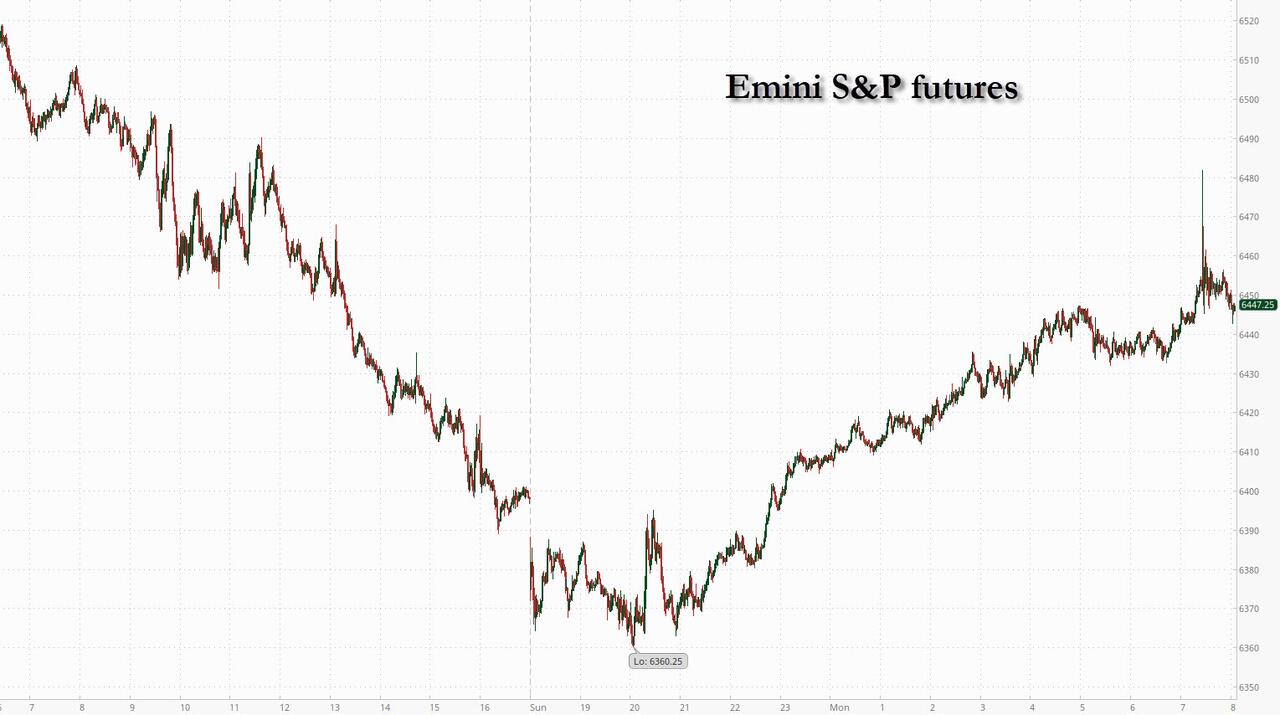
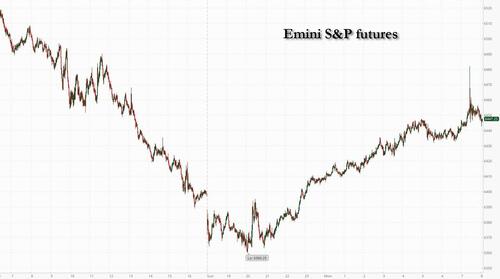
Futures are higher despite continued Iran war escalation which pushed Brent higher by around 2% after Iran-backed Houthi militants in Yemen joining the war on Iran’s said, bouncing from overnight lows which may be driven by positioning, but also by a major shift in the regime with oil now rising instead of falling on higher oil prices as the market pivots to price in not inflation but recession (and look at the spike in gold/bitcoin this morning as the next stimmy starts getting priced in). As of 8:00am ET, S&P futures are at session highs, rising 0.6% after the benchmark slumped to an August low at the end of last week, and reversing an early overnight loss; Nasdaq futures rise 0.7% with all Mag7 names higher premarket, boosting Semis, as Cyclicals (incl Energy) are leading Defensives ex-healthcare. The moves in Energy and healthcare are also breaking recent trends suggesting investors may be shifting portfolios to cash flow heavy names as they consider oil prices remaining elevated for longer. The most notable move overnight is that after weeks of rising, US yields fell across the curve after money markets cut the odds of a Federal Reserve rate hike in 2026 to about 20%, from around 35% on Friday. The rate on two-year Treasuries dropped five basis points to 3.87% while 10Y yields are down 7bps to 4.36% The dollar was little changed. Commodities are stronger as WTI moves above $100/bbl. Gold/precious and bitcoin are all higher despite USD strength, breaking the recent trend, as they start pricing in the looming stimulus to offset the next recession. Today’s US economic data calendar includes the March Dallas Fed manufacturing activity at 10:30am. Ahead this week are consumer confidence, JOLTS job openings, retail sales, ISM manufacturing and – in an abbreviated session on Friday – March jobs report
In premarket trading, Mag 7 stocks are all higher: Meta +1%, Nvidia +0.6%, Microsoft +0.9%, Amazon +0.6%, Tesla +0.8%, Alphabet +0.4%, Apple +0.2%
Aluminum stocks, including Alcoa (AA), rise after a rally in the metal price following Iran’s attacks on Middle Eastern aluminum facilities. Alcoa (AA) gains 9%.
Expedia (EXPE) gains 2% and Instacart (CART) rises 1% after Jefferies upgraded both to buy, saying a pullback in internet stocks on concerns about artificial intelligence disruptions has created buying opportunities.
IQiyi ADRs (IQ) gain 12% after the Chinese streaming platform said it’s planning a listing in Hong Kong and announced a $100 million buyback program.
Spire Inc. (SR) gains 4% after agreeing to sell its gas marketing business to Boardwalk Pipelines for $215 million in cash.
Sysco (SYY) falls 4% after the US food distributor agreed to buy privately held Jetro Restaurant Depot LLC for $29.1 billion including debt.
Viridian Therapeutics (VRDN) tumbles 40% after announcing topline results from a clinical trial in active thyroid eye disease.
WTI crude surged above $100 after the arrival of a US amphibious assault group and the entry of Iran-backed Houthi forces into the conflict heightened fears of escalation as the war entered its second month. Trump told the Financial Times that he wants to “take the oil in Iran” and could seize the export hub of Kharg Island, a move that could trigger significant retaliation from Tehran.
While traders have so far largely focused on the inflationary shock from rising oil prices, sending the Treasury market toward its deepest monthly loss since October 2024, some of Wall Street’s biggest bond-fund managers said yields will slide as the war’s impact on growth becomes more apparent.
“The slight recovery in the bond markets is only temporary,” said Guillermo Hernandez Sampere, head of trading at asset manager MPPM. “The impact on inflation is not yet fully priced in, and potential interest rate hikes would negatively affect the already gloomy economic outlook.”
“While inflation remains a concern, the potential drag on growth and confidence should start to act as an offset, limiting further upside in yields,” said Francisco Simón, European head of strategy at Santander Asset Management. “Together with oil, we think the bond market is currently one of the clearest expressions of how markets are pricing the impact of the conflict on the macro outlook.”
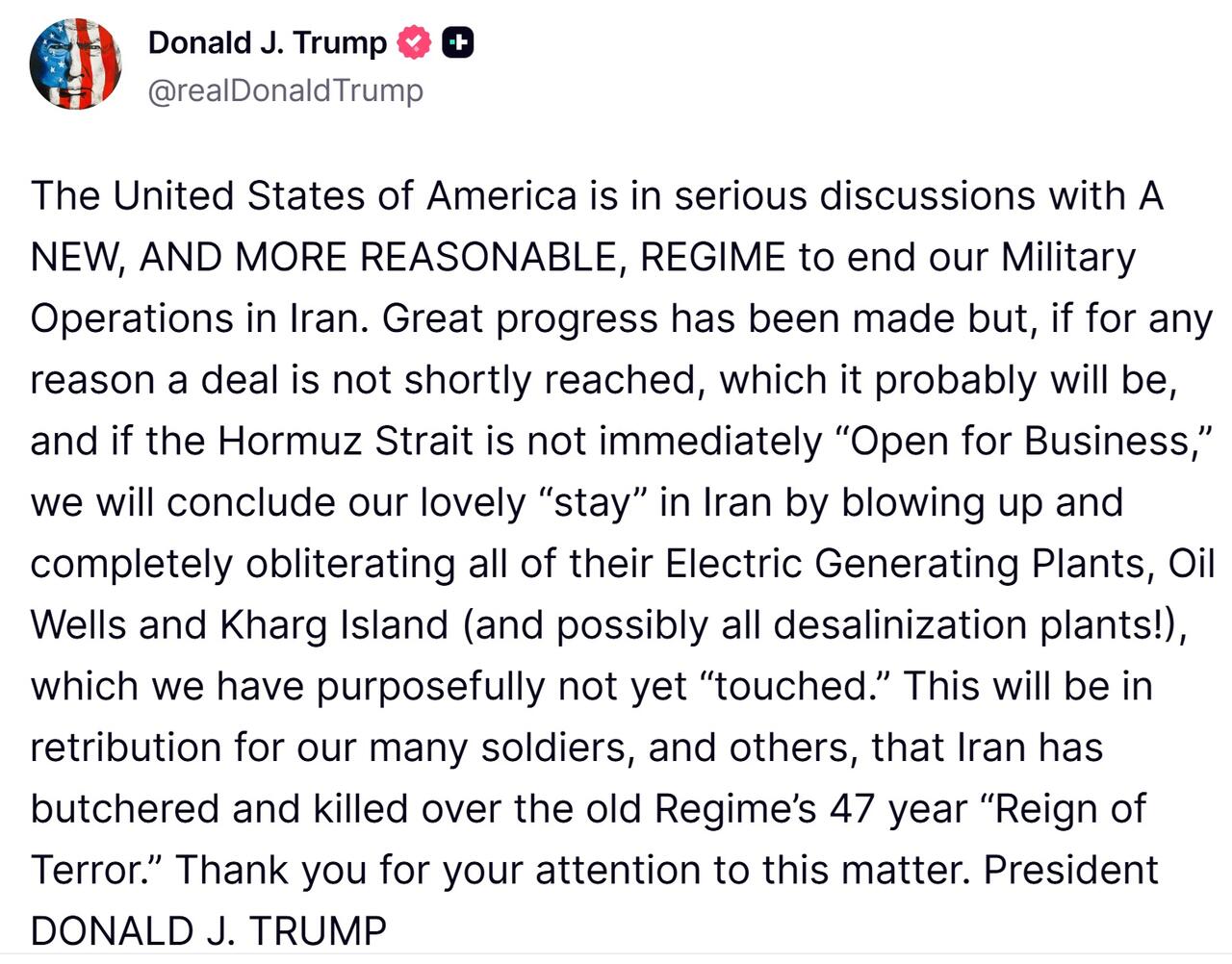
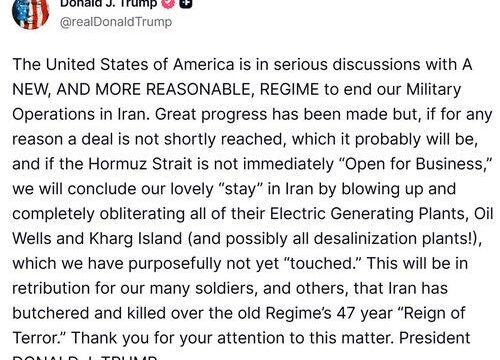
Over the weekend, the Houthis entered the conflict putting additional pressure on supply via a chokepoint in the Red Sea (although they have not yet indicated they will halt the key chokepoint). JPM estimates the impact is ~5mm bpd which could add another $20/bbl to oil prices. Trump states that Iran has agreed to most of the 15-point plan while Iran’s Foreign Minister says that there have been no direction talks, called US demands excessive / illogical, and that Iran did not participate in diplomatic meetings in Pakistan over the weekend. This morning Trump said on TS that there had been “great progress” in talks with Iran, and warned that if a deal with Iran is not “shortly reached,” and the Hormuz Strait is not immediately open, “we will conclude our lovely ‘stay’ in Iran by blowing up and completely obliterating all of their Electric Generating Plants, Oil Wells and Kharg Island.”
With two sessions left, the S&P 500 has tumbled 7.0% this quarter – its worst performance since the rate-hike selloff four years ago. Still, that 2Q 2022 slump was more than twice as severe.
“Some signs of capitulation are starting to emerge,” Goldman Sachs’ Prime Trading desk said in a note on hedge funds’ US exposure. On a trailing six-week basis, US net selling ranked third-largest over the past decade. In a separate note, GS traders noted that heavy short sales by hedge funds and disposals by systematic investors have increased the potential for a sharp swing higher for stocks in the event of a de-escalation in the conflict.
Elsewhere, Morgan Stanley’s Michael Wilson noted that the S&P 500 correction is nearing its final stage even as the Iran war continues — although the risk of Federal Reserve interest-rate hikes still poses a threat. “We think the equity market is less complacent on growth risks than consensus believes,” he said.
Oil may hit a record $200 a barrel if the Iran war drags on until June, with the Strait of Hormuz remaining shut, Macquarie Group Ltd. warned. A conflict that stretches through the second quarter would result in historically high real prices, analysts including Vikas Dwivedi said in a note, outlining a scenario with odds of 40%.
Later on Monday, Fed Chair Jerome Powell will participate later Monday in a moderated discussion at Harvard University, where he may offer clues on how he sees the war affecting the balance of risks to inflation and employment.
European stocks trimmed their advance with the Stoxx 600 now up only 0.2%; utilities and mining shares are leading gains, while travel, leisure and automobile stocks are the biggest laggards. Here are the biggest movers:
European mining shares are the best-performers on the Stoxx 600 benchmark after weekend strikes by Iran on aluminum plants in the UAE and Bahrain
Warsaw’s WIG-Energy index rises as much as 6.9% after power utility Tauron proposed its first dividend since 2015, signaling that the industry is prepared to share its 2025 profits with shareholders after a multi-year pause
Nokia climbs as much as 3% on a Goldman Sachs upgrade to neutral from sell. The broker sees 17% upside thanks to growth opportunities in Optical and IP Networks divisions
Sodexo rises as much as 4.4% following an upgrade to buy at Jefferies, which says the contract caterer’s upcoming results and CMD provide an opportunity to reset investor expectations, before building momentum
Mildef gains as much as 13%, the most since February, after a Dagens Industri column identifies upside factors for the Swedish military equipment maker following share declines
Boohoo Group shares gain as much as 6.7% after the online fashion retailer said it comfortably beat its earnings guidance in FY26 and said it aims to grow them by a double-digit percentage in FY27
Alleima shares decline as much as 6.1%, the most since January, as Danske Bank reiterated its sell rating on the Swedish specialty metals firm
Electrolux shares fall as much as 7.3%, the most since mid-February, after Bank of America cut its recommendation on the Swedish home appliances firm to underperform from buy
Kinnevik falls as much as 5.4%, the most since March 9, after SEB cut its recommendation on the Swedish investment group to hold from buy and nearly halved its price target
Hexatronic slumps as much as 11%, the most since July 2025, after SEB Equities cut its rating on the Swedish fiber optic cable manufacturer to hold from buy
SUSS MicroTec shares pare losses after dropping as much as 19%, the most in five months, following disappointing margin guidance from the German chip equipment company, according to analysts
Earlier, Asian stocks tumbled as investors turned skittish after weekend missile strikes and an expanded US military presence stoked fears of a wider Middle East conflict. The MSCI Asia Pacific Index dropped as much as 2.9%, heading for a third day of declines, as Japan and South Korea led regional losses. Chipmakers TSMC, Samsung Electronics and SK Hynix weighed among the most on the benchmark. Investor mood was dampened after Iran-backed Houthi militants fired missiles at Israel over the weekend. Iran has rejected the US 15-point proposal and disputed Trump’s claims about negotiations, insisting on war reparations in its own five-point plan. China remained a relative haven with the CSI 300 Index closing down 0.2%, while the Shanghai Composite Index ended the day in positive territory.
“I think China A-shares could get more strategic preference compared to rest markets given its increasing stability and resilience in economic policy,” Anna Wu, a cross-asset strategist at VanEck Associates Corp. in Sydney said. “China has successfully built itself as the world’s largest renewable energy factory.”
In FX, the Bloomberg Dollar Spot Index edges higher. The yen is the clear G-10 outperformer, rising 0.4% against the greenback after more jawboning from Japanese authorities. The kiwi is the weakest. Precious metals rise with spot silver up 1.5%. Bitcoin adds 1%.
In rates, treasury futures are near session highs in early US session, tracking stocks closely, with yields lower by as much as 7bp in belly of the curve, as investors weigh the inflationary effects of the war in the Middle East against a their potential to cause an economic slowdown. Yields fall even as oil prices continue to rise as US and Israeli forces press ahead with attacks on Iran. US yields are 3bp to 6bp richer across the curve with belly-led gains steepening 5s30s spread by around 3bp on the day. 10-year near 4.37% outperforms German and UK counterparts. Focal points of US session include comments by Fed Chair Powell at Harvard University. European government bonds surrendered earlier upside with UK and German two-year yields now slightly higher on the day. The turnaround came as traders went from reducing bets on interest-rate hikes by the Bank of England and European Central Bank this year to adding to them. Traders may have been reacting to data that showed euro-area inflation expectations surged in March.
In commodities, brent crude futures are up around 2.7% near $115.60 a barrel while European natural gas futures also rise 2%.
Today’s US economic data calendar includes March Dallas Fed manufacturing activity at 10:30am. Ahead this week are consumer confidence, JOLTS job openings, retail sales, ISM manufacturing and — in an abbreviated session on Friday — March jobs report. Fed speaker slate includes Powell in a moderated discussion at Harvard (no text release, Q&A expected) at 10:30am and New York Fed President Williams (4pm)
Market Snapshot
S&P 500 mini +0.6%,
Nasdaq 100 mini +0.6%,
Russell 2000 mini +0.6%
Stoxx Europe 600 +0.3%,
DAX little changed,
CAC 40 +0.2%
10-year Treasury yield -7 basis points at 4.37%
VIX -0.2 points at 30.84
Bloomberg Dollar Index +0.1% at 1220.43, euro -0.1% at $1.1492
WTI crude +1.9% at $101.56/barrel
Top Overnight News
The Pentagon is preparing for weeks of ground operations in Iran, though potential raids would stop short of an invasion. Trump is weighing an operation to extract about 1,000 pounds of uranium from Iran. WaPo, BBG
President Donald Trump said that Iran “gave” the US most of the 15 demands it issued to Tehran to end the war, even as it remains unclear whether either side is negotiating. Publicly, Iran has rejected the US’s 15-point list of ceasefire terms delivered by the Trump administration via intermediaries in Pakistan, and has countered with five conditions of its own — including maintaining sovereignty over the Strait of Hormuz. BBG
Oil climbed, with Brent heading for a record monthly gain, as renewed Middle East strikes and a buildup of US troops heightened concerns. The Iran-backed Houthis launched ballistic missiles at Israel over the weekend. Donald Trump said he’s ready to make a deal with Tehran, but he also told the FT he wants to “take the oil” in Iran. Iran’s control of Hormuz is increasing — 80% of tankers exiting the strait have Tehran’s nod. BBG
Aluminum jumped as Iran’s weekend strikes on smelters in Abu Dhabi and Bahrain threatened a supply crisis. And the energy industry is warning that the biggest supply shock in history is only just beginning. BBG
US Treasury is to meet with domestic and international insurance regulators in coming weeks to discuss recent developments in private credit markets.
The yen and the rupee rose on Monday as Japan stepped up its verbal intervention and India forced banks to unwind positions in the foreign exchange markets. The yen strengthened by 0.4 per cent against the US dollar to trade close to ¥159.7. The rupee jumped at the open, climbing more than 1.4 per cent, but gave up almost all of its gains to trade around 94.6 to the dollar. FT
One BOJ member hinted at the possibility of having to respond to the Mideast war with a bigger rate hike than those recently undertaken, according to a summary of the March 18-19 meeting. BBG
India’s curbs on FX speculation gave the rupee a brief boost before gains faded. BBG
Investors who specialize in scooping up distressed assets at bargain prices have identified a downturn in private credit as their best opportunity since the 2008 financial crisis. These funds, which typically invest in companies with bad balance sheets but viable underlying businesses, have been largely sidelined for a decade as markets surged but are now betting on making money from strains in private credit. FT
The Senate Banking Committee is planning to hold its hearing on the nomination of Kevin Warsh as chair of the Federal Reserve as soon as the week of April 13. Political resistance has held up Warsh’s nomination in the Senate, with Fed Chair Jerome Powell remaining in place even as President Donald Trump presses for a successor willing to cut interest rates faster. RTRS
Some signs of capitulation re starting to emerge in Goldman’s PB data. Last week HFs net sold US equities for a 6th straight week and at the fastest pace since Apr ‘25 (-1.6 SDs 1-year), driven by short-and-long sales in Single Stocks and to a lesser extent short sales in Macro Products. On a trailing 6-week basis, the recent US net selling by hedge funds is the 3rd largest over the past decade and starting to approach the levels seen in Apr-May ’20 during Covid and (to a lesser extent) into Liberation Day. GSPB
A more detailed look at global markets courtesy of Newsquawk
APAC stocks were pressured following the geopolitical escalation over the weekend, in which Yemeni Houthis launched missiles towards Israel to enter the conflict for the first time, while the US and Israel also conducted strikes on Iran’s largest steel plants and some energy-related facilities. Furthermore, there were some mixed comments from US President Trump, who said the US could take oil in Iran and could take Kharg Island ‘very easily’, but also stated that they had good negotiations with Iran and claimed Iran responded to the 15-point plan and gave them most points, without providing further details. ASX 200 declined with the downside led by underperformance in tech and financials, although losses were somewhat cushioned by resilience in the energy, defensives and commodity-related sectors. Nikkei 225 suffered with intraday losses of more than 2000 points amid pressure from higher oil prices and jawboning by Japanese officials, while the Summary of Opinions continued to show a hawkish bias, and money markets are currently pricing in a near coin flip between a hike and a hold at the next BoJ meeting in April. Hang Seng and Shanghai Comp were mixed as participants digested a deluge of earnings, including from ICBC, China Construction Bank, BoCom, PetroChina and BYD, while it was also reported late last week that China began probes on US trade practices in retaliation for the US Section 301 investigations.a
Top Asian News
Japan’s top FX diplomat Mimura said bold action may be needed if the situation in the Middle East continues, adds hearing that speculative activity is increasing and targeting all fronts in market for action.
Japanese Government spokesperson says closely watching market moves with a extremely high sense of urgency. Currently seeing large volatility in financial markets.
S&P affirms Japan at “A+/A-1”; outlook stable.
European bourses (STOXX 600 +0.3%) are mixed, rebounding from losses seen pre-cash open. The FTSE 100 outperforms, helped by gains in miners as aluminium surged following attacks on producing plants in the Middle East. On the other hand, the DAX 40 remains the laggard. Complex is off best levels after the Iranian Foreign Ministry denied direct negotiations with the US, which slightly hit sentiment. European sectors are mixed. Basic Resources and Utilities top the sector pile, while Travel and Leisure and Banks underperform.
Top European News
German North Rhine Westphalia CPI MoM (Mar) M/M 1.2% (Prev. 0.2%).
German North Rhine Westphalia CPI YoY (Mar) Y/Y 2.7% (Prev. 1.8%).
EU Consumer Inflation Expectations (Mar) 43.4 (Prev. 25.8)
EU Consumer Confidence Final (Mar) -16.3 vs. Exp. -16.3 (Prev. -12.2)
FX
DXY is currently trading within a 100.05-100.34 range, with very mild gains, as the geopolitical situation continues to keep the Dollar stronger. Near-term upside could see the index retest the Monday 16 high at 100.48. The geopolitical situation remains tense, with the weekend events seemingly showing no signs of near-term peace. The Iran-backed Houthis entered the war for the first time, whilst President Trump suggested that the US could take Kharg Island “very easily”. Most recently, an Iranian Foreign Ministry spokesperson says Iran has not had any direct negotiations with America, adding that they did not partake in Pakistan-led meetings. Now attention turns to Fed Chair Powell later.
Given the USD strength, G10s are weaker across the board (ex-JPY). The Antipodeans lag, given the risk-tone and after the PBoC set a weaker yuan fix. The EUR slipped below the 1.1500 soon after the European cash open, and was ultimately little moved to the release of several German State CPI metrics, whereby key areas such as Bavaria and North Rhine Westphalia rose more than what is expected for the Nationwide figure, due at 13:00 BST. As it stands, EUR/USD holds towards the lower end of a 1.1487-1.1521 range.
JPY remains the only currency firmer against the USD this morning. Initially USD/JPY broke above the 160.00 mark (peak 160.46), before reversing back below the mark following hawkish BoJ SOO and continued verbal intervention from Japanese officials. One suggested that they are watching market moves with an “extremely high sense of urgency”.
Central Banks
BoJ Governor Ueda said BoJ will guide policy appropriately by scrutinising how FX moves could affect the likelihood of achieving growth and price forecasts as well as risks. FX is a factor that makes big impacts on the economy and prices, adds will be closely monitoring the FX market.
BoJ Summary of Opinions from March meeting stated that a member said it is appropriate to continue raising interest rates if the economic and price forecasts materialise. Conditions remain accommodative even after rate hikes. Member said the BoJ can keep rates steady for now due to Middle East uncertainty. Need to monitor Middle East developments and wages for rate decisions. Member said future rate hike timing depends on Middle East impact, as well as wages, inflation and financial conditions.
BoJ said that if recent price rises in food prices were to persist, they could exert a sustained upward impact on overall consumer prices. Increases in energy can affect underlying inflation in both directions. Need to pay attention to the possibility that upward price pressures from rising crude may have strengthened as firms become more proactive in hiking prices and wages. Given changes in firms’ price-setting behaviour, prices may now be more susceptible to JPY depreciation.
ECB’s Stournaras said a longer conflict could mean that the baseline no longer holds.
ECB’s Lane said there will be no paralysis on potential rate moves, nor any kind of pre-emption; said this is not a like-for-like situation to 2022.
ECB’s Villeroy said ECB is ready to act, but too early to discuss dates for possible rate hikes. Some over-interpretation on markets recently. Sees no risk of banking crisis in Europe.
Fixed Income
Despite crude still being firmer, fixed income has managed to benefit from crude easing off best levels, with both energy and debt benchmarks in the green, departing from the recent inverse correlation. Worth noting that a recent denial of US-Iran talks via the Iranian Foreign Ministry, has led to some mild pressure in the fixed income complex.
USTs gains. Hit a 110-04 trough, lower by two ticks at worst. Since, USTs have rebounded to a 110-17+ peak. Ahead, the docket is headlined by Fed Chair Powell, who is scheduled to speak at Harvard University. Commentary that will be scrutinised for which side of the dual-mandate the Fed is currently most concerned about, and any hints as to whether action should be expected in the near-term.
Bunds hit a 124.48 low early doors, matching Friday’s close. Since, the benchmark has been gradually but notably making its way higher, to a 124.88 peak with gains of 40 ticks at best. Though, a short-lived bout of pressure was seen as German State CPIs lifted from the prior, as indicated by mainland consensus; figures due at 13:00BST. More recently, no move to a jump in consumer and selling price expectations.
As is typically the case, Gilts are directionally following peers, but magnitudes are slightly larger. To an 87.60 peak with gains of nearly 50 ticks at best. Specifics for the UK light, awaiting to see what action the government and/or BoE may take to deal with the energy shock.
Commodities
WTI and Brent are stronger this morning. Over the weekend, the Houthis launched their first attacks on Israel since the war began, marking an expansion in the war, while strikes were reported across the region over the weekend. Trump said talks with Iran were progressing, though he also floated seizing Kharg Island, according to the FT.
Most recently, an Iranian Foreign Ministry spokesperson says Iran has not had any direct negotiations with America, adding that they did not partake in Pakistan-led meetings. This spurred some modest strength in crude benchmarks at the time. Brent Jun’26 currently towards the upper end of a USD 106.33-109.46/bbl range.
Spot gold prices are firmer despite a resilient dollar, possibly with some haven appeal returning to the yellow metal and as no signs of an imminent wind down can be seen. Spot gold trades in a USD 4,420-4,550/oz range at the time of writing vs Friday’s USD 4,555/oz peak.
Elsewhere in metals, aluminium rose after Iran struck two production sites in the Middle East, with LME aluminium outpacing peers. Peers, however, are lifted in tandem despite the resilient USD and cautious sentiment across markets. 3M LME copper resides in a USD 12,019.00- 12,259.88/t range at the time of writing.
EU Energy Ministers are to discuss on Tuesday, the coordination of the EU response on energy to the Middle East situation; said energy supply remains relatively protected at this stage. EU needs to take measures to address high energy prices, whilst maintaining functioning of EU electricity market. EU faces no immediate supply shortages, but tightening in diesel and jet fuel market.
A Russian tanker carrying a humanitarian shipment of 100k tonnes of crude oil has arrived in Cuba, IFX reported.
Two China-linked ships, owned by Cosco Shipping (601919 CN), appear to attempt to cross the Strait of Hormuz.
SocGen sees a growing likelihood of Brent topping USD 150/bbl amid the Iran war; said Brent may average USD 125/bbl in April amid the Middle East situation.
Geopolitics
Iranian Foreign Ministry spokesperson says Iran has not had any direct negotiations with America. “What has been discussed are the messages we received through intermediaries that the US wants to negotiate.”, Tasnim reports. The materials that were conveyed to us were excessive and unreasonable requests. The meetings held by Pakistan are a framework that they established and we did not participate.
US President Trump said the US could take oil in Iran and could take Kharg Island ‘very easily’, according to FT. Trump also stated that indirect talks with emissaries are progressing well and a deal could be made fairly quickly.
US President Trump said there were good negotiations with Iran on Sunday, and the US destroyed many targets that day, while they are negotiating directly and indirectly with Iran. Trump said regarding Hormuz that Iran gave them 20 boats of oil to pass through, and he thinks they will make a deal pretty soon, but also said it’s possible that they won’t. Trump said Iran responded to the 15-point plan and agreed to most points but provided no further details when asked if Iran had responded. He also claimed that Middle East countries are fighting back against Iran.
US President Trump reportedly weighs a military operation to extract Iran’s uranium, although the President hasn’t made a decision on the operation, according to US officials cited by WSJ.
US President Trump claimed Middle East countries are fighting back against Iran.
Yemen’s Houthis fired missiles at Israel on Saturday morning, marking the first time it has been involved in the war. Houthis said they will continue operations until strikes on Iran and its proxy military groups, such as Hezbollah, stop.
Iranian Parliament’s National Security member Borujerdi said the time has come for Iran to withdraw from the Nuclear Non-Proliferation Treaty and the permanent monitoring of the Strait of Hormuz, IRNA reported. According to the plan prepared by the Islamic Council and will be approved as soon as possible, a new system will rule the Strait of Hormuz and traffic will not be possible without the permission of the Islamic Republic of Iran.
Iran’s acting Defence Minister told the Turkish counterpart that Tehran will continue to punish aggressors, create deterrence and ensure war will not repeat itself, via IRNA.
In meetings between the commander of the US Central Command in Israel, with the Chief of Staff and senior IDF officials, “the path forward was planned and outlined – for the continuation of the operation.”, i24News sources say. “According to the source, the visit was “successful, and the successes so far in the war were also summarized.”.
Tehran has agreed to UN’s request for safe passage of ships carrying humanitarian aid through Strait of Hormuz, according to IRNA.
The start of firing a new wave of Iranian missiles towards Israel; reported of missiles from Lebanon to Israel also reported.
Local accounts report at least 20 explosions near the oil refinery and petrochemical complex in Abadan, Iran.
Iranian petrochemical facility was targeted in northwestern Tabriz, Iran according to state media. The fire in Iran’s Tabris Petrochem was extinguished.
Iraq’s Defence Ministry said the Mohamad Alaa air base was attacked by a rocket. An aircraft was destroyed but no injuries reported; Iraq said “We will not hesitate to pursue anyone who dares to harm Iraq’s security and sovereignty”.
Iranian attack on one service building in a power and water desalination plant in Kuwait caused serious damage.
Media sources report simultaneous explosions and attacks on American positions in several countries, including Bahrain, Saudi Arabia, UAE, Kuwait, and Iraq, according to ISNA.
Successive explosions in American facilities in Kuwait, SNN reported. “According to some sources, the explosions in Kuwait were so formidable and powerful that their sound was clearly heard in the border areas of Iraq.”.
Explosions and plumes of smoke rising at the American Victory Base in Iraq’s capital of Baghdad.
Ukrainian President Zelensky says Ukraine is ready for a potential Easter ceasefire with Russia, believes there is no deadlock in talks and that Ukraine has received signals from allies on scaling back strikes on Russia’s oil sector.
US President Trump said Cuba is going to be next and within a short period of time, Cuba is going to fail.
Chinese President Xi invites Taiwan opposition leader for first visit to the mainland in a decade.
US Event Calendar
10:30 am: United States Mar Dallas Fed Manf. Activity, est. 1.5, prior 0.2
10:30 am: United States Fed’s Powell in Moderated Discussion
4:00 pm: United States Fed’s Williams Speaks on the Economy
DB’s Jim Reid concludes the overnight wrap
Oil prices have continued to climb as we start a new week, with Brent crude up another +2.47% this morning to $115.35/bbl. Several factors have contributed, but the Iran-backed Houthi militants joined the conflict over the weekend, launching strikes at Israel and raising fears about a new front in the war. Moreover, the Wall Street Journal have also reported this morning that Trump is weighing a military operation to extract Iran’s uranium. And in an FT interview that’s also been released, Trump openly suggested the US could take the Kharg Island export hub. So there’s still no sign of a clear end to the conflict, and given the various headlines, investors remain fearful about a fresh escalation.
With everything that’s happened, the market impact is becoming increasingly serious. Indeed, the S&P 500 is now down for 5 consecutive weeks for the first time since 2022, back when the global economy was facing a similar stagflationary shock. Moreover, the NASDAQ fell over -3% last week, marking its worst weekly performance since the Liberation Day announcements last year. And this morning, Asian equity markets are also seeing sharp declines for the most part, with the Nikkei (-3.31%), the KOSPI (-2.88%), the Hang Seng (-0.90%) and the CSI 300 (-0.15%) all losing ground as investors price in a more protracted conflict.
Those fears about a longer conflict are evident from the energy futures curve. For instance, 3-month Brent crude futures are up another +1.79% this morning to $100.50/bbl, which would be their highest closing level since the conflict began. So it’s becoming clear that markets are expecting an extended period of high oil prices, with stagflationary implications for the global economy. Interestingly though, the primary concern this morning has shifted back to the growth side rather than inflation. So markets are pricing out the likelihood of imminent hikes and sovereign bond yields have fallen. In fact, overnight index swaps for the next ECB meeting in April currently see a 47% chance of a hike, which is the first time in over a week that’s been below 50%, whilst US 10yr Treasury yields (-4.0bps) are back at 4.39% overnight, coming down from their 8-month high on Friday. Meanwhile for equities, US futures are stable this morning, with those on the S&P 500 unchanged, but they’re more negative in Europe, with DAX futures down -0.65%.
The latest moves come as there’s no obvious sign of a peace deal being reached. Admittedly, there have been ongoing efforts at mediation from other countries, with Iran’s President Pezeshkian speaking with Pakistan’s PM Sharif on Saturday morning. That was then followed by comments from Pakistan’s foreign minister yesterday, who said “Pakistan is very happy that both Iran and the US have expressed their confidence in Pakistan to facilitate the talks.” According to Trump yesterday, he said they were “doing extremely well in that negotiation”. But Trump also said in the FT interview that his “preference would be to take the oil”, so that pointed towards an escalation. And in a separate Washington Post report over the weekend, it said the Pentagon was preparing for weeks of ground operations in Iran. That article suggested it wouldn’t be a full-scale invasion, but could involve raids by a mixture of Special Operations forces and conventional infantry. So for markets, there’s still a huge amount of uncertainty as to what happens next.
Away from the Middle East, we’ve also seen the Japanese yen strengthen overnight, moving up +0.34% against the US Dollar to 159.76. That comes after Japan’s top currency official, Atsushi Mimura, said that they were hearing about speculative activity picking up in FX markets, and that if it continued, “we believe decisive action may soon be necessary.” In addition, the Bank of Japan’s Summary of Opinions from their recent meeting had hawkish elements. For example, there was even a comment they should “pay attention to whether it is necessary to accelerate the pace of policy interest rate hikes beyond previous projections and shift toward neutral or restrictive financial conditions, if tension over the situation in the Middle East were to become prolonged.”
Looking at the week ahead, we should start to learn about the economic consequences of the conflict, as several data releases for March are out which cover the period since the strikes began on February 28. In the US, that includes the monthly jobs report on Friday, where our US economists expect nonfarm payrolls to have risen by +50k in March. As a reminder, US payrolls have been pretty choppy in recent months, and on the current series of revisions they’ve been oscillating between positive and negative readings for every month since May. Last month they were down -92k, but as our economists point out, some of that weakness was a function of a strike at a major healthcare company that’s since ended, along with severe weather that may have temporarily depressed February’s payrolls. So they’re expecting a positive payrolls print for March, although they think the unemployment rate will round up to 4.5% given how close it was last month (4.44%).
Otherwise in the US, the focus will be on whether higher oil prices have started to impact business sentiment and inflation in a meaningful way. So the ISM manufacturing will be in the spotlight, including the prices paid component for whether the inflationary impact has started to filter through. Before that, we’ll also get the Conference Board’s consumer confidence reading tomorrow.
Speaking of inflation, the main highlight in Europe will be tomorrow’s flash CPI print for the Euro Area, which is an important one as the ECB work out what to do. To be fair, the flash print from Spain last Friday was weaker than expected, at +3.3% (vs. +3.8% expected), so that’s slightly eased fears about a very strong print tomorrow. Nevertheless, even with the Spanish number, our European economists are still tracking the Euro Area CPI print at +2.53% year-on-year, up from +1.89% in February. See their weekly preview for more here.
Elsewhere this week, there isn’t too much on the calendar of events as we move towards Easter. Indeed, markets will be closed in several countries at the end of the week for Good Friday. However, we will hear from a few central bankers, including Fed Chair Powell later today, who’s speaking in a discussion at Harvard University.
Finally, to recap last week in more depth, markets fluctuated back and forth amidst varying headlines on the Middle East. Initially there was huge optimism, driven by Trump’s statement last Monday that he’d be postponing military strikes against Iran’s power plants and energy infrastructure for 5 days. So that caused Brent crude oil to fall -10.92% on Monday, closing back at $99.94/bbl. But as the week went on, fears mounted again about a protracted conflict, leaving Brent crude back up at $112.57/bbl, its highest close since July 2022 and narrowly up +0.34% on the week.
With no sign of oil prices falling back, equities took another hit last week for the most part, with the S&P 500 down -2.12% to a 7-month low. That marked its 5th consecutive weekly decline, as well as its biggest weekly loss since October. And the VIX index closed at 31.05pts, its highest since the Liberation Day turmoil last April. Matters weren’t helped by some weaker-than-expected data around the world, with the March flash PMIs generally coming in softer than expected. So the Euro Area composite PMI was down to a 10-month low of 50.5, and the US composite PMI hit an 11-month low of 51.4. Moreover, they also pointed to growing price pressures, which helped push yields on 10yr Treasuries up +4.8bps last week to 4.43%, whilst 10yr bund yields rose +5.1bps to a post-2011 high of 3.09%. That said, central bank pricing did turn marginally more dovish over the week as a whole. So for the Fed, a rate hike by the December meeting was down to a 24% probability, having been at 29% the week before. And for the ECB, a rate hike at the next meeting in April came down from an 80% probability to 52%.
For equities, tech stocks struggled in particular, with the NASDAQ down -3.23% last week, marking its worst week since Liberation Day last year. Indeed, software stocks were a big driver, with that component of the S&P 500 down -7.00% last week as concerns about AI disruption resurfaced. Private credit fears also returned, particularly after Ares Management and Apollo both announced they were limiting withdrawals, which hit the shares of some of the companies in the space. To be fair, the European equity performance wasn’t so bad last week, with the STOXX 600 up +0.35%. But in credit the performance was more negative again, with US HY (+19bps) and Euro HY (+9bps) spreads both widening, whilst US IG (+2bps) and Euro IG (+4bps) spreads also rose.
Tyler Durden
Mon, 03/30/2026 – 08:37
Trump Cites Progress In Dealing With ‘More Reasonable Regime’ – While Mulling Ground Operation To Seize Uranium
Trump Cites Progress In Dealing With ‘More Reasonable Regime’ – While Mulling Ground Operation To Seize Uranium
Summary
Iran rejects ‘excessive, illogical’ US demands while Trump mentions ‘progress’ with a ‘more reasonable regime’. Trump again threatens to destroy Iran energy sites and Kharg Island.
White House seriously considering ground operation to seize Iran’s enriched uranium stockpile but also wants Tehran to negotiate handing it over willingly.
Bazan oil refinery in Israel’s northern city of Haifa is on fire after a second apparent Iranian missile strike of the war.
Iran accuses Israel of more ‘false flags’ – after Kuwait water desalination plant hit.
Iran Again Rejects ‘Excessive’ Demands
Iran has once again stated that it has rejected the latest “US demands” as “excessive and illogical” according to state Tasnim, also confirming that it did not participate in the weekend Pakistan-hosted summit attended by the foreign ministers of Turkey, Pakistan, Saudi Arabia and Egypt.
“We have never had any direct negotiations with the United States. What has been raised are messages received through intermediaries indicating the US desire to negotiate,” Foreign Ministry Spokesman Esmail Baghaei said in a press conference Monday. Meanwhile Pakistan’s Foreign Minister Ishaq Dar is expected in China on Tuesday for talks with his Chinese counterpart, after Beijing made clear it is ready to back a Pakistan-mediated peace effort.
Egypt’s President Abdel Fattah el-Sisi has urged President Trump to end the war, saying Washington holds the key here to stopping a worse spiral. “I tell President Trump: Nobody can stop the war in our region in the Gulf but you,” Sisi stated at the opening of the country’s Egypes energy conference. Still, despite Tehran’s latest statement of rejection, Trump put out of a fresh Monday Truth Social Post displaying some optimism toward dealing with a “more reasonable regime” and mentioned “great progress” – but coupled with the usual ‘or else’ type threats. For example, Trump again has threatened to destroy Iran energy sites and Kharg Island.
Plan For Uranium Seizure
With more Marines and reportedly Airborne troops en route to the region, among Trump’s ‘options’ is the seizure of Iran’s enriched uranium. A fresh Wall Street Journal report says Monday, “President Trump is weighing a military operation to extract nearly 1,000 pounds of uranium from Iran, according to U.S. officials, a complex and risky mission that would likely put American forces inside the country for days or longer.”
No decision has been made, the report makes clear, and the White House is said to be considering the danger to US troops. On this question, the likelihood for something to ‘go wrong’ – or some kind of mass casualty event for American forces, would be high. This would also open the possibility of forces getting bogged down for at least weeks, months, or longer – and not just ‘days’ of an operation.
“It’s the job of the Pentagon to make preparations in order to give the commander-in-chief maximum optionality. It does not mean the president has made a decision,” White House press secretary Karoline Leavitt has sought to clarify of plans.
Unbelievable video
filmed by a resident from Tehran shows the reality of life under Israeli/US strikes
— Fazel Hawramy (@FazelHawramy) March 29, 2026
One key part of the WSJ report gives a window into where future negotiations would focus: “The president has also encouraged his advisers to press Iran to agree to surrender the material as a condition for ending the war, according to a person familiar with Trump’s thinking,” the report says. “Trump has been clear in conversations with political allies that the Iranians can’t keep the material, and he has discussed seizing it by force if Iran won’t give it up at the negotiating table.” But already Tehran sees itself in an existential war for survival, and so isn’t going to be very open to just giving up its enriched stockpiles.
Israeli Oil Refinery on Fire
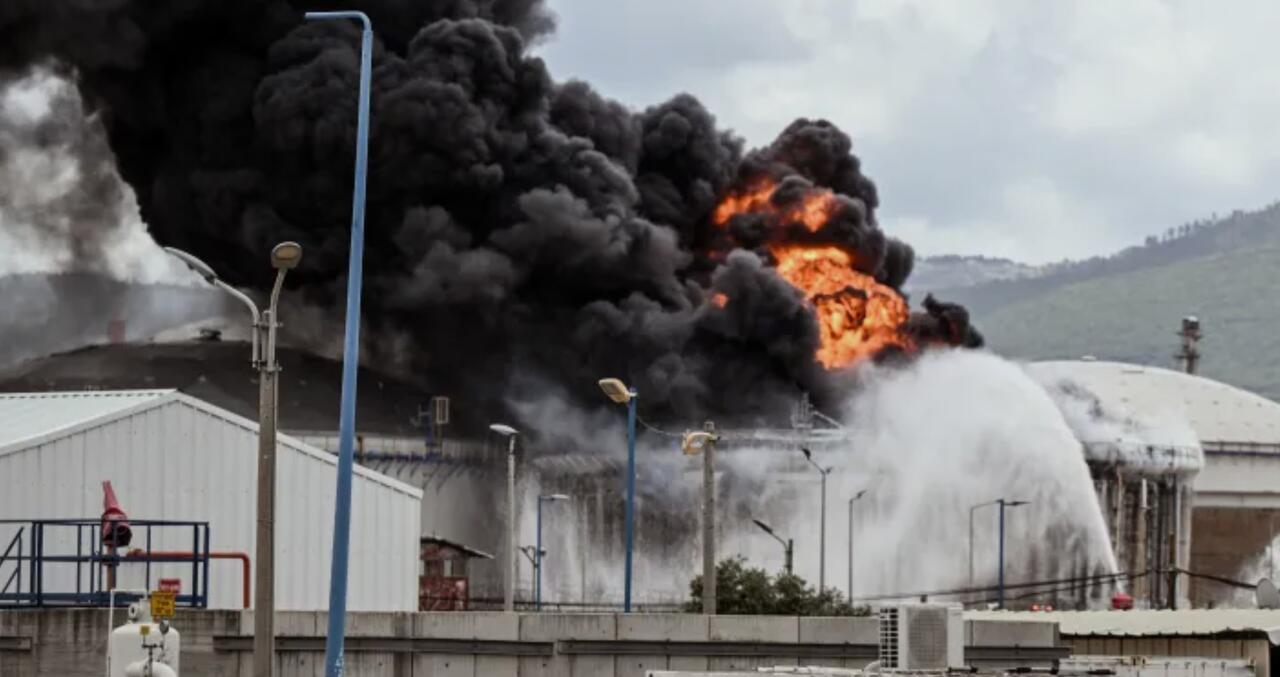
Huge fires have been observed at the Bazan oil refinery in Israel’s northern city of Haifa, after another apparent Iranian attack, which marks the second such hit on the site since the war started.
Israeli television channels have reported the attack and emergency response at the scene. “Search and rescue forces, both reserve and regular forces, are on their way to a site in northern Israel where reports of impact have been received,” the IDF said in a statement.
Area residents are being asked to stay inside and shelter in place, with Jerusalem Post reporting “The Environmental Protection Ministry told Ma’ariv that a gasoline tank is burning in the refinery complex, producing thick smoke, but with no risk to the population in the area from a hazardous materials incident.”
Smoke rising from Haifa’s Petrochemical complex following reported Iranian missile strike.
BREAKING:
Smoke rising from Haifa’s Petrochemical complex following reported Iranian missile strike. pic.twitter.com/iXlQn41Ohp
— Iran News 24 (@IRanMediaco) March 30, 2026
Iran Claims Some Attacks as Israeli False Flags
There’s been another interesting accusation that Israel is conducing false flags to make any potential ceasefire deal much harder. It’s remained an open question whether things will escalate toward an all-out exchange of fire on infrastructure, such as energy sites and water plants.
Iran’s military has newly accused Israel of attacking Kuwait’s desalination plant, according to Al Jazeera. The Iranian statement, featured in semi-official Tasnim agency, said the “Zionist regime’s brutal attack on Kuwait’s desalination plant, under the pretext of accusing the Islamic Republic of Iran, which took place in the past few hours, is a sign of the vileness and baseness of the Zionist occupiers.”
Indian worker killed in attack on Kuwait plant…
Kuwait says an Indian worker has been killed in an Iranian attack on a power and desalination plant, as Gulf states report intercepting drones and missiles.
Al Jazeera’s Zein Basravi reports from Dubai. pic.twitter.com/hCgettyBSf
— Al Jazeera English (@AJEnglish) March 30, 2026
“We declare that American bases and military personnel, their interests in the region, and the military, security, and economic infrastructure and facilities of the Zionist regime will continue to be our powerful targets,” it said. There’s also a lingering threat against American university branch campuses in the region, after over the weekend two Iranian campuses in Tehran came under attack. Iran had earlier said the long-range attacks (which failed) against the UK’s remote Diego Garcia base was also a false flag.
Tyler Durden
Mon, 03/30/2026 – 08:15

Voter ID Vindicated By Obama Judge
Voter ID Vindicated By Obama Judge
It took seven years, one reversed injunction, and an Obama-appointed judge to settle what most Americans already believed: requiring a photo to vote is not a civil rights violation.
This week, U.S. District Judge Loretta Biggs dropped a 134-page ruling upholding North Carolina’s photo voter ID law and dismissing claims by the state NAACP and other left-wing civil rights organizations that Republicans designed the 2018 requirement to discriminate against black and Latino voters.
The decision is a huge victory for Republican legislative leaders, who have been litigating this question since the law passed, and it comes at a critical time, as the SAVE America Act is being obstructed by Democrats in the U.S. Senate.
“It is important that this Court begins by recognizing what this case is, and what it is not,” Biggs wrote in her order. “This case is not about whether North Carolina law will require that voters show photo identification when they go to the polls. That question was settled on November 6, 2018, when approximately 55% of North Carolina’s registered voters enshrined a photo voter identification requirement in the State Constitution.”
“Thus, there will be photo voter ID in the State of North Carolina,” Biggs continued. “In our democratic system of government, we must accept the will of the majority of voters on this issue unless or until the people of North Carolina decide otherwise.”
Despite her ruling, Biggs noted that North Carolina has an “undisputed history of extensive official discrimination against African Americans,” and even claimed that the law places measurable burdens on black and Latino voters, even though there is no evidence that minority voters face any institutional roadblocks in acquiring photo ID. However, she based her ruling on a controlling precedent, which compelled her to reach a different conclusion. Higher court rulings since the original lawsuit was filed left Biggs with one legally defensible path: defer to legislative good faith and apply established standards. The evidence, as she wrote, simply did not establish discriminatory intent under the legal framework she was bound to follow.
In fact, the law was designed to remove any possible roadblocks to obtaining a photo ID, including making IDs free at county election offices and the DMV, and expanding the acceptable forms of identification to include not just a driver’s license but also a military ID or a U.S. passport. Voters who show up without a qualifying ID can still cast a provisional ballot by using an exception form or by presenting their ID to election officials before certification.
Despite all these safeguards, it took seven years to finally end the battle.
Back in December 2019, Biggs had issued a preliminary injunction blocking the law for the 2020 election cycle, citing North Carolina’s history of voter suppression and finding parts of the statute impermissibly motivated by discriminatory intent. The 4th U.S. Circuit Court of Appeals unanimously reversed her. Now, after a full non-jury trial in spring 2024, she arrived at the same destination the appellate court had pointed her toward years earlier. The State Supreme Court also upheld the law in a separate case.
Sen. Phil Berger, the North Carolina Senate’s Republican leader, was thrilled that the issue is finally settled.
“Finally. After seven years, we can put to rest any doubt that our state’s Voter ID law is constitutional,” he said. Seven years is a long time to wait for a court to affirm something 55% of North Carolina voters already decided at the ballot box in 2018 — by constitutional amendment, no less.
President Trump has made the SAVE America Act, which would mandate a photo ID to vote and proof of citizenship to register to vote, a central part of his agenda this year. Biggs’s ruling now undercuts the opposition from Democratic leaders Hakeem Jeffries and Chuck Schumer, who oppose the SAVE Act despite consistent bipartisan polling in its favor.
Tyler Durden
Mon, 03/30/2026 – 07:45
https://www.zerohedge.com/political/voter-id-vindicated-obama-judge

China Flexes Robot Wolves With Machine Guns And A “Collective Brain”
China Flexes Robot Wolves With Machine Guns And A “Collective Brain”
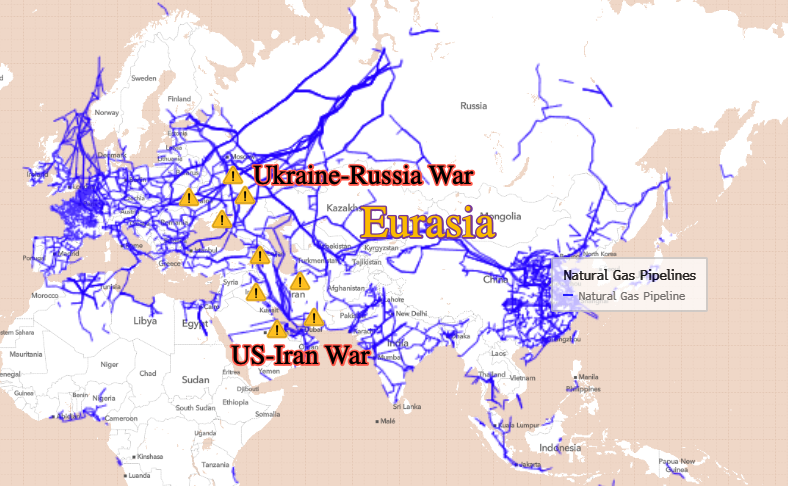
Four years of hyperdevelopment, battlefield testing, and deployment of FPVs, ground robots, AI-enabled kill chains, and soon humanoid robots have permanently altered the course of the modern battlefield, as war technologies once viewed as 2030s-era weapons are being pulled forward into the present day and are now proliferating across battlefields stretching from the Eastern European theater to the Gulf theater, as Eurasia appears to be at war.
The latest reminder is that, regardless of the battlefield across Eurasia, there will increasingly be large swaths of land, miles deep, effectively forming a new kind of no-man’s-land controlled by FPVs and ground robots operating with AI kill chains. In Ukraine, that no-go zone stretches 15 miles wide and already means a quick death for any biological soldier, with FPVs able to detect, track, and strike.
A new form of attritional warfare is emerging in which FPVs and robots are cheap and disposable, while soldiers are mainly exposed only when they have to hold, clear, or occupy terrain.
China occasionally likes to flex its dual-use robotic ground systems, with the latest footage showing quadruped machines that act as “robot wolves” with machine guns mounted on top, being trained for street battles.
X account “Sinical” posted the viral footage, viewed 2 million times in just a few short days, that shows several new developments in China’s race to weaponize robot dogs:
Heavier loadouts: can be equipped with micro-missiles, grenade launchers, and more
Strong mobility: carries up to 25 kg and clears 30 cm obstacles with ease
“collective brain”: real-time data sharing enables them to coordinate, decide, and act together
First footage just dropped: China’s robot wolves have been put through a simulated street battle.
You might remember their debut at China’s V-Day parade last year. It seems that they are no longer a showpiece.
Here’s what’s new:
• Heavier loadouts: can be equipped with… pic.twitter.com/TUFtPTJ93a
— Sinical (@Sinical_C) March 27, 2026
Sinical continued in a linking post:
The system comes from the Southwest Automation Institute, an organization with longstanding People’s Liberation Army ties. Developers call it 100% indigenously designed and 100% domestically produced. What’s interesting is that, the institute is openly listing a “non-military version” on http://JD.com—one of China’s biggest e-commerce platforms—for $73.5k. However, how closely it matches the military-grade model is unclear.
Here’s the counterintuitive fact: on tomorrow’s battlefields, war robots may not be the ultimate killing machines—they could actually reduce casualties. They spare human troops the need to storm positions directly, pushing more engagements into “drone v.s. robot” territory. And unlike two groups of soldiers grinding each other down in brutal close-quarters fighting, troops facing robots know the machines cannot be outfought. A handful of robots can clear and secure an entire street in minutes. The clash ends fast, and both sides bleed far less.
The real battlefield is far more complex than any training exercise. The ultimate test for these Machine Wolves will be whether they can reliably distinguish friendly troops from enemy forces—and, most critically, identify civilians who suddenly appear in the chaos.
To sum it all up, the battlefields across Eurasia are becoming machine-on-machine conflicts, with humans operating farther back on second and or third lines (or maybe even remotely overseas), if at all.
Tyler Durden
Mon, 03/30/2026 – 06:55
https://www.zerohedge.com/technology/china-flexes-robot-wolves-machine-guns-and-collective-brain

US Office-To-Apartment Conversions Hit New Record: Report
US Office-To-Apartment Conversions Hit New Record: Report
Authored by Mary Prenon via The Epoch Times,
This year is another record year for the conversion of office buildings into residential apartments in the United States, according to a recent RentCafe report.
At the beginning of 2026, 90,300 apartments were in the process of conversion across America—a 28 percent increase from 70,600 last year, according to the March 24 report.
At 47 percent, office conversions now comprise almost half of all adaptive reuse projects nationwide, with the New York metro area leading the way with 16,358 conversions in the pipeline. Washington, D.C., placed second with 8,479 conversions and Chicago third, with 4,360.
“The imbalance in the office sector didn’t emerge overnight,” Yardi research director Peter Kolaczynski said in the report.
“COVID-19 is to the office market what eCommerce was to retail. As a result, there is simply too much office space in the market right now.”
Yardi Matrix is a sister company to RentCafe and provides market research and data for the residential and commercial real estate markets.
Office-to-apartment conversions have expanded rapidly since 2022, when just 23,100 units nationwide were created from former commercial buildings. That number nearly doubled to 45,200 conversions in 2024, and rose to 55,300 in 2024.
In early 2025, the report indicated 70,700 conversions were on tap, as the national office vacancy rate was close to 20 percent. Meanwhile, physical occupancy in many buildings remained between only 50 percent and 55 percent, leaving millions of square feet underused.
Doug Ressler, senior analyst with Yardi Matrix, noted that financial pressure and government-backed incentives are also escalating conversions this year. Nearly one-third of U.S. office loans are set to mature in 2027, and many owners are facing pressure to take action on any underperforming properties.
“A massive amount of office building loans—over $213 billion—are coming due by the end of 2026. When loans mature, borrowers need to either pay them off or refinance them,” he said in the report.
“The problem is that many of these office buildings have lost significant value largely due to remote work trends reducing demand.”
Still, these types of conversions often take several years to complete, as the process can be slowed by structural issues, high construction costs, financing needs, or local regulations.
Ressler said nearly 66,500 projects started in 2025 are still moving forward in 2026. When combined with newly proposed projects, the total number is up by 19,600 units year over year.
Nationwide, office buildings account for the largest share of reuse, at 47 percent, followed by hotel conversions at 18 percent, industrial properties at 16 percent, and a mixed bag of properties—including former schools, retail centers, health care facilities, and government buildings, at 19 percent.
Nationally, more than 1.9 billion square feet of office space—24 percent of total inventory—is considered suitable for conversion, according to the conversion feasibility index from CommercialEdge.
“Age matters, but so do footprint and structural layout,” Kolaczynski added.
“ If a building is functionally obsolete as an office but has the right bones, it can be a strong conversion candidate.”
Other key ingredients for conversion consideration are proximity to mass transit and walkability to stores, restaurants, and parks.
Tyler Durden
Mon, 03/30/2026 – 06:30
https://www.zerohedge.com/personal-finance/us-office-apartment-conversions-hit-new-record-report
How Gas Prices Compare Around The World
How Gas Prices Compare Around The World
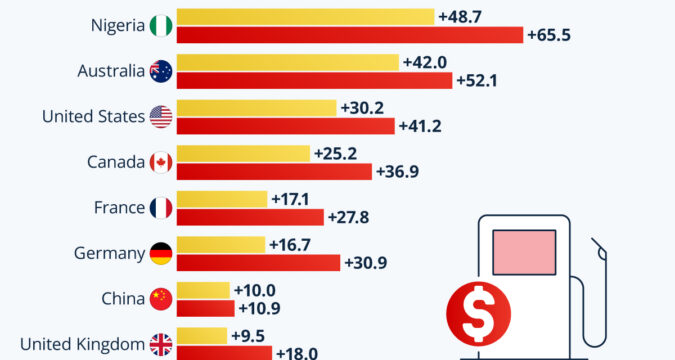
The war in Iran has driven up oil prices in many countries, with gasoline prices turning into a topic of discussion around the world.
The increases have been particularly pronounced in emerging markets, with gasoline prices jumping by more than 50 percent in the Philippines and nearly as much in Nigeria (around 49 percent), with diesel rising even more steeply.
Advanced economies have also seen notable increases, with gasoline prices climbing by roughly 25 to 30 percent in the United States and Canada over the period, and diesel prices up by around 40 percent in both countries.
Across Europe, price hikes have been more moderate but still significant, with gasoline rising by around 17 percent in France and Germany, while diesel (more directly linked to global trade and transport) saw stronger increases of up to 30 percent.
In Asia, the picture is more mixed, with relatively limited increases in China, South Korea and Japan (from 2.5 to 10 percent for gasoline), reflecting in part the use of price controls and other government measures to cushion the impact of rising global oil prices.
You will find more infographics at Statista
However, as taxes are making up a big chunk of the gas price in the majority of industrialized nations, countries taxing gasoline at lower rates will still see lower gas prices in comparison.
One example of this is the United States.
As Statista’s Katharina Buchholz points out, even at a gas price of around $4.29 per gallon on average, Americans are still paying much less to fill up their cars than people in many industrialized nations, including other car-based economies like Australia or Canada.
According to website Global Petrol Prices, these two nations were already paying between $5.47 and $5.91 for a gallon.
You will find more infographics at Statista
Europe has some of the highest gasoline prices in the world. Most of Western Europe was paying upwards of $7.00 for a gallon of gas as of March 23, with some of the highest prices being charged in Norway, Denmark and the Netherlands.
Germany was the most expensive major European economy in terms of gas prices most recently, as a gallon was going for $9.07. Norway is an outlier among oil producing countries as it taxes gasoline at a premium. The country bases a lot of its wealth on oil but has for many years pursued a plan to make its own economy independent of the fossil fuel.
Other oil producers have gone the opposite route, offering gasoline to its citizens for less than the price of bottled water.
The most drastic examples for this are Venezuela, Libya and Iran itself, where gasoline only costs a couple of cents per gallon.
The most expensive gallon of gas included in the ranking, however, was being sold in Hong Kong at $15.37, which would typically cause filling up even a small car to break the $100 barrier. Eastern Asia was the priciest part of the world for gas after Europe, with prices high in China, South Korea, the Philippines, Cambodia, Laos and Thailand – all of which are major oil consumers, but not producers. Deep pockets are also needed in a few countries where weak government or trade structures have led to a hike in prices, like in the Central African Republic, Zimbabwe and Malawi.
World regions with cheap gas prices included North Africa and the Middle East as well as in Central Asia and Russia. In Algeria, for example, gas costs only around $1.34 per gallon, while in Russia, the price was approximately $3.16.
Tyler Durden
Mon, 03/30/2026 – 05:45
https://www.zerohedge.com/energy/how-gas-prices-compare-around-world