Category: News

US ‘Only Certain Of Having Destroyed A Third’ Of Iran’s Missiles
US ‘Only Certain Of Having Destroyed A Third’ Of Iran’s Missiles
The US is only certain it has destroyed around a third of Iran’s missiles, despite comments from President Donald Trump boasting of military success. According to five people familiar with the US intelligence who spoke to Reuters, the status of around another third is less clear. However, US-Israeli strikes have likely damaged, destroyed or buried those missiles in underground tunnels and bunkers.
Iran’s drone capability has also likely been reduced by a third, another source said. The assessment, which comes one month after the beginning of the US-Israeli assault on Iran, suggests Tehran still retains substantial missile capability and its ability to retaliate is far from eliminated. At a cabinet meeting on Thursday, Trump said – while discussing options to open the Straits of Hormuz – that 99 percent of Iran’s missiles had been destroyed.
“The problem with the straits is this: let’s say we do a great job. We say we got 99 percent [of its missiles]. 1 percent is unacceptable, because 1 percent is a missile going into the hull of a ship that cost a billion dollars,” he said.
US Central Command has so far declined to specify how much of Iran’s missile or drone capability has been destroyed in its attacks. According to Israeli military officials, Iran had 2,500 ballistic missiles capable of reaching Israel prior to the war.
So far, over 335 missile launchers have been “neutralized”, representing 70 percent of Iran’s launch capacity, a senior Israeli military official told Reuters.
Meanwhile, officials have warned that the US and Israel are “burning through” their supply of Tomahawk and interceptor missiles.
According to officials speaking to The Washington Post, the US has fired more than 850 Tomahawk cruise missiles in the four weeks of its war with Iran.
Only a few hundred of the cruise missiles are manufactured each year. While the Pentagon does not publicly disclose its stockpile, one official told the news outlet the number of Tomahawks left in the Middle East is “alarmingly low”.
Despite dwindling resources, a report by Axios on Thursday said the US Department of Defense was drafting plans for a “final blow” against Iran that includes ground troops and a massive bombing campaign. The first is invading or blockading Kharg Island, from which Iran exports roughly 90 percent of its oil. The US could also seize Larak, a small island next to Iran’s heavily fortified Qeshm Island. Iran has redirected vessels transiting the Strait of Hormuz to Larak, reportedly for security screening.
Signs Iran may be holding its best missiles in reserve.
FT: Highest-tech missiles not yet used, “possibly because they have been destroyed, possibly because they are not yet operational, or possibly because they will only be used when adversaries run short of interceptors.”👇 https://t.co/gIgu8DRAnf
— Rosemary Kelanic (@RKelanic) March 27, 2026
The US is also weighing the seizure of Abu Musa and two smaller islands. The former shah of Iran occupied Abu Musa in 1971, days before the establishment of the United Arab Emirates. Abu Dhabi stakes a claim to Abu Musa and two other islands close by: Greater Tunb and Lesser Tunb. In addition, the US has considered seizing ships exporting Iranian oil through the Strait of Hormuz.
Tyler Durden
Sat, 03/28/2026 – 15:10
https://www.zerohedge.com/military/us-only-certain-having-destroyed-third-irans-missiles

‘No Kings’ Rallies Erupt Nationwide
‘No Kings’ Rallies Erupt Nationwide
Latest developments:
Crowds are described as “massive” in St. Paul, with live video showing thousands filling the capitol grounds and surrounding streets in cold weather.
Confirmed speakers at the St. Paul flagship event include Minnesota Gov. Tim Walz, U.S. Sen. Bernie Sanders, Rep. Ilhan Omar, Jane Fonda, Joan Baez, and singer Maggie Rogers.
Bruce Springsteen is scheduled to perform his January 2026 protest anthem “Streets of Minneapolis,” written after the fatal shootings of Minnesotans Renee Good and Alex Pretti during federal immigration enforcement operations earlier this year.
Parallel marches and rallies are underway or forming in Washington, D.C. (marching toward White House area), Philadelphia (Ben Franklin Parkway), Atlanta, Charlotte, New York City, Southern California, San Antonio/Austin, and hundreds of smaller towns — two-thirds of today’s events are in communities under 50,000 people.
More than 3,100 “No Kings” protests are underway across every state and territory of the United States today, marking the third massive national mobilization against President Donald Trump since he took office as the 47th president in January 2025. Organizers describe the day as a “sustained national resistance to tyranny,” with projected turnout rivaling or exceeding the record-breaking crowds of June and October 2025.
Minnesota is once again the movement’s flagship. In St. Paul, tens of thousands have already packed the state capitol grounds and surrounding streets despite cold, overcast weather, with organizers estimating 100,000–150,000 attendees by evening.
St. Paul, Minnesota showing up to protest!
No Kings! pic.twitter.com/t8cklzoEO9
— Art Candee 🍿🥤 (@ArtCandee) March 28, 2026
Philadelphia:
#WATCH: Aerial footage shows a massive crowd gathering for the ‘No Kings’ march in Philadelphia. pic.twitter.com/Hm93AMUdQs
— OSINT Spectator (@osintspectator) March 28, 2026
Washington DC:
Many costumes in the crowd. I’ve seen people dressed as inflatable animals and a man in full camo military fatigues. Marchers and bystanders flocking to take photos of “ICE LICE” costumes.
— Ashley Murray (@ashleymurray.bsky.social) March 28, 2026 at 8:52 AM
NYC:
A Movement That Began as Defiance and Became National Infrastructure
What started in June 2025 as a single day of defiance – drawing an estimated 5 million participants according to ACLU tallies – has evolved into a rolling series of coordinated actions. The October 2025 wave reportedly mobilized nearly 7 million people.
The Trump administration has brushed off the demonstrations. White House spokesperson Abigail Jackson released a statement to multiple outlets: “The only people who care about these Trump Derangement Therapy Sessions are the reporters who are paid to cover them.” Officials continue to attribute the protests to “leftist funding networks” rather than organic grassroots anger.
Tyler Durden
Sat, 03/28/2026 – 14:35
https://www.zerohedge.com/political/nationwide-no-kings-rallies-erupt-nationwide

Fannie Mae Set To Accept Crypto As Collateral For Home Loans For First Time
Fannie Mae Set To Accept Crypto As Collateral For Home Loans For First Time
Fannie Mae, the giant government-backed mortgage securitizer, is preparing to accept cryptocurrency as collateral for home loans for the first time, marking a further step in the integration of digital assets into traditional U.S. housing finance, according to the Wall Street Journal.
Mortgage lender Better Home & Finance Holding Co. and crypto exchange Coinbase are teaming up to allow home buyers to pledge Bitcoin or the USDC stablecoin to secure a down payment on a Fannie Mae-conforming mortgage.
While crypto-backed mortgages have existed in limited forms, Fannie Mae’s involvement—through loans it will purchase and guarantee—could bring such arrangements into the mainstream of the $12 trillion U.S. mortgage market.
The Journal has more details:
The new mortgage product works like this: A home buyer gets a traditional 15- or 30-year Fannie-backed mortgage from Better. Instead of making a cash down payment, the buyer gets a separate loan, backed by either bitcoin or USDC, a popular stablecoin.
Paying interest on a second loan instead of making a cash down payment can increase the overall cost of homeownership significantly. The interest rate on both loans would range from comparable to typical Fannie Mae mortgages to 1.5 percentage points higher.
“A lot of those crypto owners and investors have not been able to become homeowners,” because they don’t want to sell their crypto investments, said Max Branzburg, Coinbase’s head of consumer and business products. “We haven’t really had the best way to service that need.”
The development comes as the Trump administration moves to enact regulation aimed at establishing the United States as the number one destination for building crypto companies.
Speaking in January at the World Economic Forum, President Trump said he helped secure America’s place as the “crypto capital of the world” by backing legislation aimed at boosting the digital asset industry.
Trump touted his signing of a “landmark GENIUS Act” last year, focused on stablecoins, partly to gain political support and partly to keep China from leading the space.
“China wanted that market too,” the president told attendees. “We have to make it so that China doesn’t get the hold of it. It’s just like they want the AI, and we’ve got that market, I think, pretty well locked up.“
Tyler Durden
Sat, 03/28/2026 – 14:00
https://www.zerohedge.com/crypto/fannie-mae-set-accept-crypto-collateral-home-loans-first-time

How To Convert Your 401(k) Into A Reliable Monthly Paycheck
How To Convert Your 401(k) Into A Reliable Monthly Paycheck
Authored by Adam H. Douglas via The Epoch Times (emphasis ours),
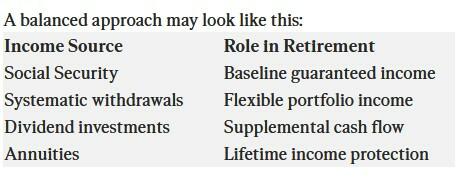
Yes, you can turn your 401(k) into a predictable monthly paycheck in retirement. The key is to move from the accumulation phase to a structured distribution strategy. Many retirees combine systematic withdrawals, dividend-producing investments, and guaranteed income sources such as annuities.
Smart planning can turn your 401(k) balance into a predictable cash flow. Ladanifer/Shutterstock
By balancing these tools and managing withdrawal rates carefully, you can convert a fluctuating retirement account balance into a steady income stream that helps cover monthly living expenses throughout retirement.
Why the Distribution Phase Matters
During your working years, your focus is simple: build the largest retirement account balance possible. Contributions, employer matches, and market growth drive the accumulation phase.
Once you stop working, your 401(k) must shift from a growth vehicle into an income engine. Instead of asking, “How big is my account balance?” the better question becomes, “How much income can this generate each month?”
Without a clear strategy, withdrawals can become inconsistent and risky. Market downturns early in retirement may reduce your portfolio faster than expected.
To help you before you retire, here’s a structured income framework.
Creating a Retirement Paycheck From a 401(k)
Step 1: Estimate Your Monthly Retirement Income Needs
Before converting your 401(k) into income, start with a clear picture of your retirement spending.
Most retirees separate expenses into two categories:
Essential expenses
housing costs
utilities
food and transportation
health insurance and medical care
Discretionary spending
travel
hobbies
dining and entertainment
A common guideline suggests retirees aim to replace 70–80 percent of their pre-retirement income, though the exact number varies based on lifestyle and debt levels.
Once you determine your monthly income goal, you can begin designing a withdrawal strategy that supports it.
Step 2: Use a Systematic Withdrawal Strategy
One of the simplest ways to create a retirement paycheck is through systematic withdrawals: taking out a set amount from your retirement account each month or quarter.
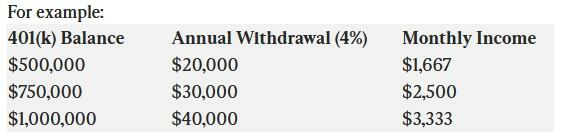
One guideline is the 4 percent rule. You withdraw roughly 4 percent of your retirement portfolio during the first year of retirement and adjust amounts annually for inflation.
The rule is meant to help portfolios last about 30 years under historical market conditions. However, it works best when combined with a diversified portfolio and flexibility during volatile markets.
Many retirement plans allow you to set automatic monthly distributions, which can mimic the feel of receiving a paycheck.
Step 3: Add Dividend-Producing Investments
Another way to generate consistent retirement income is through dividend-paying assets.
Dividend stocks and income-focused exchange-traded funds (ETFs) distribute cash payments to investors regularly, often quarterly.
These payments can supplement your systematic withdrawals.
Potential dividend sources include:
dividend-paying blue-chip stocks
dividend-focused ETFs
real estate investment trusts (REITs)
high-quality corporate bonds
For example, a portfolio producing a 3 percent dividend yield on a $600,000 investment could generate about $18,000 annually, or $1,500 per month before taxes.
Dividend income may help reduce how much you need to sell during market downturns, which can help protect your portfolio from sequence-of-returns risk.
Step 4: Consider Guaranteed Income Options
Some retirees prefer adding income sources that resemble traditional pensions.
Annuities are insurance products that convert a lump sum into guaranteed payments for a fixed period or for life.
Common types include:
Immediate annuities: Begin paying income shortly after purchase.
Deferred income annuities: Start payments later in retirement.
Longevity annuities: Designed to protect against the risk of outliving your savings.
For example, converting a portion of your 401(k) into an immediate annuity may produce monthly payments that continue regardless of market conditions.
While annuities provide stability, they typically limit flexibility and may involve fees, so many retirees use them only for part of their retirement savings.
Step 5: Manage Taxes and Required Minimum Distributions
Withdrawals from traditional 401(k) accounts are typically taxed as ordinary income.
After age 73, the Internal Revenue Service also requires minimum distributions (RMDs), which mandate that retirees withdraw a certain percentage of their retirement accounts each year.
Tax planning strategies may include:
gradual withdrawals before RMD age
Roth IRA conversions during lower-income years
coordinating withdrawals with Social Security income
Managing these factors carefully can help reduce taxes and preserve more of your retirement income.
Step 6: Build a Balanced Retirement Income Plan
The most resilient retirement paycheck strategies combine several income sources.
Diversifying income streams can reduce reliance on any single source and provide greater financial stability throughout retirement.
Keep in Mind
Market volatility can affect withdrawal sustainability if downturns occur early in retirement.
Inflation reduces purchasing power over time, especially during long retirements.
Longevity risk means your income plan may need to support 25–30 years or more.
Adjusting withdrawals during weak market years and maintaining a diversified portfolio can help your retirement income last longer.
Frequently Asked Questions About Turning a 401(k) Into Monthly Income
How Much Monthly Income Can a 401(k) Provide?
The amount of income a 401(k) can generate depends on your account balance, withdrawal rate, and investment returns. Withdrawing about 4 percent annually is a common guideline. For example, a $750,000 retirement account could generate roughly $30,000 per year, or about $2,500 per month. However, retirees often supplement withdrawals with Social Security benefits, dividend income, or annuities. Retirement spending needs, health care costs, and expected lifespan should all be considered when estimating how much monthly income your 401(k) can support.
Can You Set Up Automatic Monthly Payments From a 401(k)?
Yes, most retirement plan providers allow you to schedule automatic distributions from your account. These systematic withdrawals can be set up monthly, quarterly, or annually, depending on your preference. Many retirees choose monthly payments to create a predictable “retirement paycheck.” Distribution amounts can often be adjusted over time to account for inflation, investment performance, or changes in spending needs. Automatic withdrawals may help budget discipline and avoid large lump-sum withdrawals that could disrupt long-term portfolio sustainability.
What Is the Biggest Risk When Withdrawing From a 401(k)?
Sequence-of-returns risk, which occurs when major market losses happen early in retirement while you are withdrawing funds, is one of the biggest. Early losses can permanently reduce your portfolio and shorten lifespans. Retirees often manage this risk by holding diversified investments, maintaining a cash buffer, and adjusting withdrawals during market downturns. Strategies such as dividend income and annuities may also reduce the need to sell investments during periods of market stress, helping preserve long-term retirement income stability.
The Epoch Times copyright © 2026. The views and opinions expressed are those of the authors. They are meant for general informational purposes only and should not be construed or interpreted as a recommendation or solicitation. The Epoch Times does not provide investment, tax, legal, financial planning, estate planning, or any other personal finance advice. The Epoch Times holds no liability for the accuracy or timeliness of the information provided.
* * * Top Supplements
Tyler Durden
Sat, 03/28/2026 – 12:50
https://www.zerohedge.com/personal-finance/how-convert-your-401k-reliable-monthly-paycheck
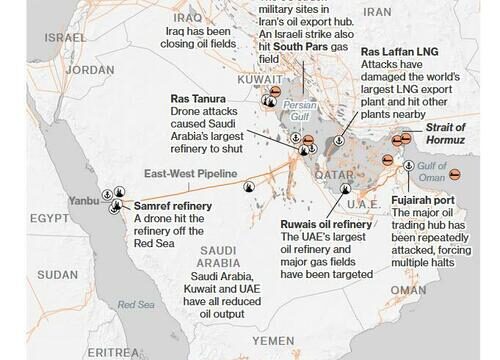
Hormuz Bypasses Maxed Out: Saudi East-West Pipeline Hits Record 7 MMb/d, As UAE Fujairah Crude Loadings Reach Capacity
Hormuz Bypasses Maxed Out: Saudi East-West Pipeline Hits Record 7 MMb/d, As UAE Fujairah Crude Loadings Reach Capacity
The ramp up in Saudi Arabia’s Hormuz-bypassing East-West pipeline has been nothing short of remarkable.
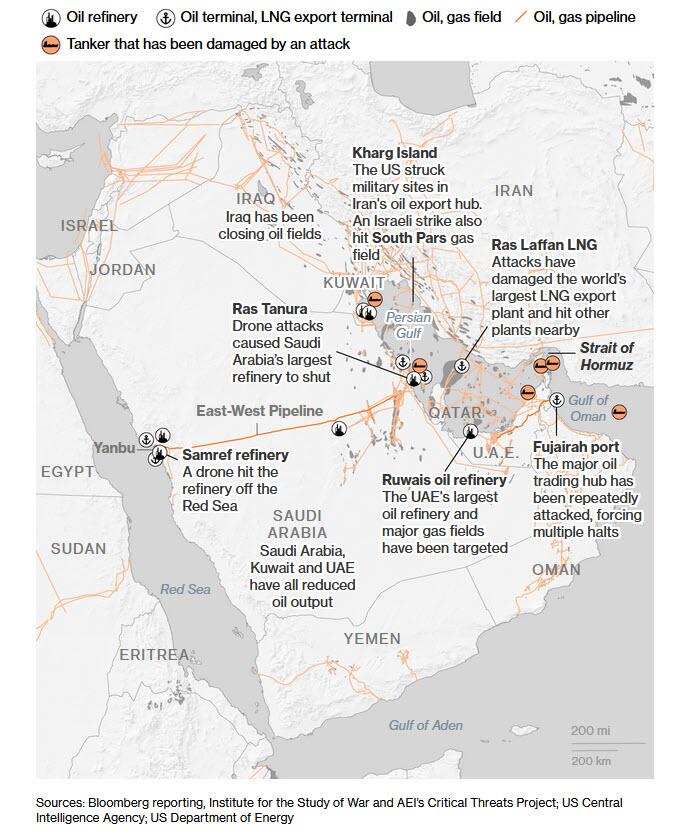
Two days after we reported that flow through the pipeline which crosses Saudi Arabia east to west for oil flows (hence the name) and is also known as the Abqaiq-Yanbu pipeline for nat gas flows had doubled from roughly 1.5 million before the war, today Bloomberg updates on the latest flow numbers and it now appears that the crucial East-West pipeline is pumping oil at its full capacity of 7 million barrels a day.
Crude exports via Yanbu have now reached about 5 million barrels a day and the kingdom is also exporting 700,000 to 900,000 barrels a day of refined products, according to the Bloomberg source familiar with the Saudi oil industry. Of the 7 million barrels a day that go through the pipeline, 2 million are destined for Saudi refineries.
This remarkable achievement, which many experts predicted would take weeks longer to achieve, is the culmination of the kingdom’s longstanding contingency plan for keeping its oil flowing after the effective closure of their main export route. Meanwhile, the Red Sea next to the Saudi port terminal of Yanbu is becoming a bit of a tanker parking lot as flotillas of tankers patiently await to collect the oil, providing an important lifeline for global supply.
As reported previously, Saudi Arabia has been preparing for decades for the worst-case scenario of Hormuz closing. It put its contingency plan to work within hours of the first US and Israeli strikes on Iran, and has been ramping up east-west shipments ever since. Running the breadth of the Arabian Peninsula from the massive oil fields in the east of the country to the industrial port city of Yanbu, the pipeline is more than 1,000 kilometers (620 miles) long. It’s a by-product of a previous conflict – the 1980s Iran-Iraq war – which saw attacks on ships in the Strait, but nothing like the unprecedented near-closure the current conflict has caused.
Despite the record flow, the Yanbu route still only partly offsets the hit to supply from shutting Hormuz, through which about 15 million barrels a day of crude shipments passed before the war. But the bypass is one reason oil prices haven’t reached the crisis-level highs of previous supply shocks.
However, with Yemen’s Houthis now saying they are entering the war, the concern for oil markets will be that the Red Sea becomes a new front in the conflict. While the Houthis have not given any indication they would attack tankers going through the Red Sea and Bab El-Mandeb strait, they have previously threatened shipping in the area with drones and missiles.
UAE’s Fujairah Nears Capacity
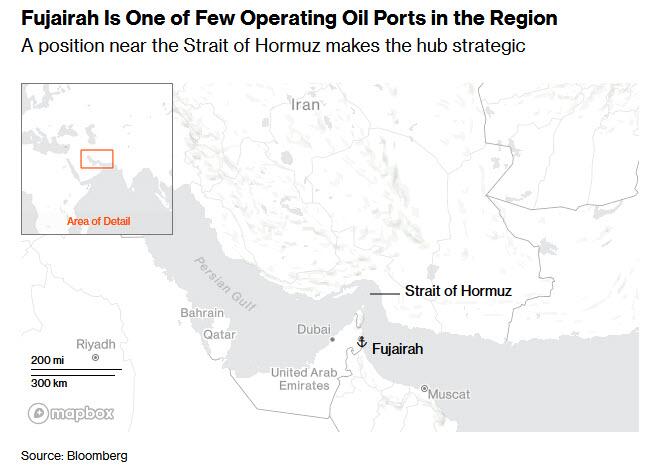
It’s not just Saudi Arabia that has been ramping up its options to bypass the Strait: the United Arab Emirates has also maxed out oil exports from a vital port that lies outside the Strait of Hormuz, after some of the biggest crude loading infrastructure resumed operations following Iranian drone strikes earlier this month.
The largest crude operations by Abu Dhabi National Oil Co (ADNOC) in Fujairah are picking up after they had halted March 14. The port in the UAE’s east coast has a critical role as an outlet for oil bypassing the all-but shut Hormuz waterway, making it among the energy sites most frequently targeted by Tehran. After Saudi Arabia’s Red Sea port of Yanbu, it’s the biggest exit point for Persian Gulf crude circumventing the maritime chokepoint.
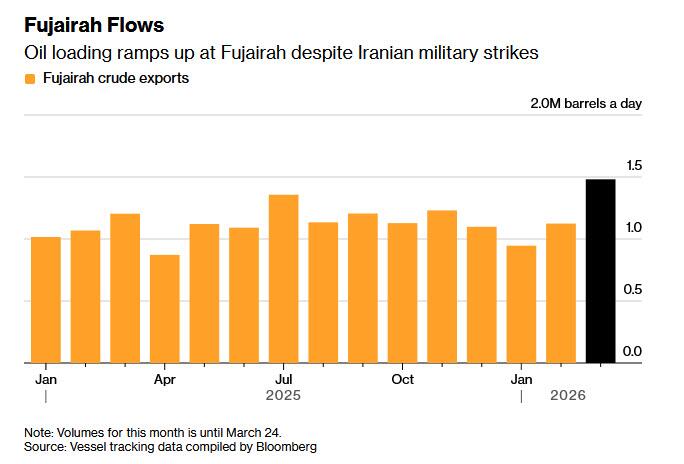
As Bloomberg reports, the return of much of Adnoc’s operations helped push up crude loading to about 1.9 million barrels a day over the March 20-24 period. That’s up 57% from the average flows of about 1.21 million barrels a day over the past year, as the UAE pushes to get more cargoes out through the route with Hormuz still mostly blocked.
The latest crude oil export figures suggest a 252-mile (406-kilometer) Adnoc-owned pipeline – linking Habshan, the collection point for Abu Dhabi’s onshore fields, to the port – is operating close to its capacity.
The uptick compares with an average of 1.48 million barrels a day for the month through March 24. More recent exports still need to be verified as electronic jamming is widely blocking the transmission of satellite signals that allow tracking in the region.
Fujairah’s proximity to Iran – it’s about 80 miles (130 kilometers) south of Hormuz, nestled in the shadow of the Al Hajar mountains – makes it more vulnerable than Yanbu. Over the past four weeks, Tehran has attacked Fujairah at least seven times, destroying storage tanks and causing fires in a petrochemicals complex.
Besides crude oil, Fujairah also has large fuel-loading operations. Part of that system is still out of commission, after a key manifold was damaged in a strike more than three weeks ago. Most fuel is currently being loaded via an older section of the port, which connects directly to the ship berths without going via the manifold, according to people with knowledge of the situation. Refineries, including one run by a unit of Vitol Group, are still halted.
Fujairah — which became a refueling port for tankers during the Iran-Iraq war of the 1980s, before the construction of storage tanks at the turn of the century — exported its first crude in 2012.
“It took foresight to build a pipeline that bypasses the strait and was an effort to reduce dependence on a single chokepoint,” said Ben Cahill, director for energy markets and policy at the University of Texas at Austin’s center for energy. “At this point, every barrel matters.”
Still, Iranian attacks have deterred some shippers from calling at Fujairah, while loading systems and storage tanks — especially at the port’s product terminals — have been damaged. More importantly, those initial strikes damaged systems in the port, known as the Matrix Manifolds, which manage the flow of oil from each of the tank farms. Refined products are pumped through a complex web of piping arriving at a single point where the flows are then directed to any of more than a dozen ship berths.
A tank farm run by companies including Royal Vopak of the Netherlands and Dubai’s Emirates National Oil Co. halted loadings when the initial strikes crippled the manifolds, according to the people who asked not to be identified discussing operational issues. Loading from the Vopak Horizon terminal restarted late this week, according to a March 26 report from Inchchape Shipping Services.
Now Fujairah is working to restore full export capacity for refined products from a vast network of storage tanks that can store up to 70 million barrels. Fujairah has also developed into one of the top three ports for bunker fuel — the propellant used by ships — although the effective closure of Hormuz has curbed demand.
According to Bloomberg, traders took a net 404,000 barrels of fuel out of Fujairah’s tanks in the week through March 23, representing a 2.8% decline in stocks, according to data from the Fujairah Oil Industry Zone and compiled by Platts, a unit of S&P Global Inc. While some terminal operators are trying to empty their tanks to reduce fire risks, others have been reluctant to load for fear that would make them a target, according to people familiar with the operations.
Finally, taking a look at the Hormuz closure, which remains Iran’s only remaining Trump card and which Tehran has now played, increasingly more ships are now crossing: in addition to China and India, traditionally the biggest export clients of gulf oil, Japan has also reportedly reached a deal with Iran to be allowed passage. This morning, Thailand Prime Minister Anutin Charnvirakul said his country had negotiated an agreement with Iran to allow the safe passage of Thai oil tankers through the Strait of Hormuz.
Anutin said the agreement would ease some concerns about Thailand’s oil supply. The Thai Ministry of Foreign Affairs said this week it had successfully secured the passage through the strait of a tanker owned by the Bangchak Corporation, a Thai energy conglomerate. Earlier this month Iran said its forces fired on a Thai-flagged cargo ship, Mayuree Naree, which caught fire north of Oman after being hit by an unknown projectile. Three crew members went missing and another 20 were rescued.
Also on Saturday morning, ship tracking services reported that two LPG tankers and two bulk carriers exited the Gulf, with all four ships following a northern route that passes through the narrow gap between the two Iranian islands of Larak and Qeshm which many speculate the US will seek to take over with a marine invasion due to their critical importance in halting strait traffic.
Two LPG tankers and two bulk carriers exited the Gulf on Saturday morning. All four ships followed a northerly route that passes through a narrow gap between the two Iranian islands of Larak and Qeshm: BBG pic.twitter.com/wuNzRxLvFJ
— zerohedge (@zerohedge) March 28, 2026
Tyler Durden
Sat, 03/28/2026 – 12:15

Audits Spotlight Unusual Trends In Medicaid Spending For Autism Care
Audits Spotlight Unusual Trends In Medicaid Spending For Autism Care
Authored by Sylvia Xu via The Epoch Times,
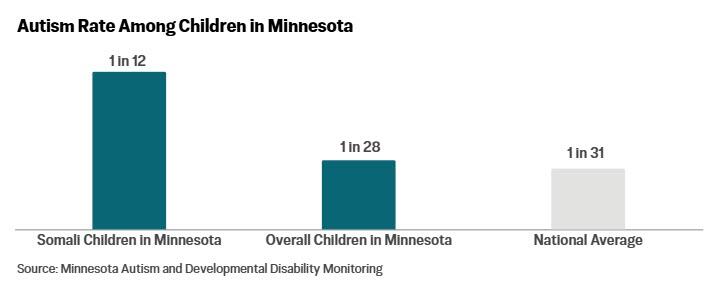
One in 31 U.S. children has an autism diagnosis. Among Minnesota’s Somali community, that number jumps to one in 12.
That discrepancy made headlines last fall when the Department of Justice charged a Somali woman with netting millions in fraudulent autism services.
Now, state and federal investigators are putting autism spending in the spotlight.
The September 2025 federal indictment alleged that a therapy center—run by 28-year-old Asha Farhan Hassan—recruited Somali children for an autism services program that was then reimbursed by Medicaid.
The White House pointed to the indictment on March 16 in an executive order announcing the creation of a federal task force to eliminate fraud.
“The staggering fraud and waste in Minnesota alone is a case in point,” the order reads.
“There is also strong reason to believe that similar problems exist in other States, including California, Illinois, New York, Maine, and Colorado.”
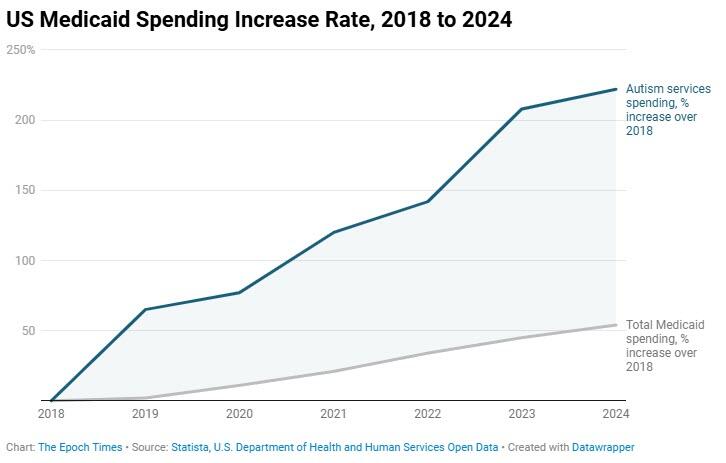
Nationwide, Medicaid spending for autism therapy services increased by over 200 percent between 2018 and 2024—nearly four times the rate of overall Medicaid spending. In some states, the increase was much higher.
The surge is linked to what Health and Human Services Secretary Robert F. Kennedy Jr. has called an autism epidemic, including “an alarming escalation in case severity, and increasingly stark disparities across racial and ethnic groups.”
However, investigators say the rise in spending can’t be explained by the increase in diagnoses or escalation in severity alone.
Meanwhile, a series of federal audits has drawn attention to four states where auditors found millions in “improper” or incorrectly billed payments for Medicaid-funded autism services.
Here is a look at states that have uncovered higher-than-usual Medicaid spending for autism services.
Minnesota
Since 2018, Minnesota has spent more than $18 billion on 14 Medicaid programs considered “high risk” for fraud, Assistant U.S. Attorney Joe Thompson said in December.
More than $9 billion of that money went to fraud, Thompson estimated, announcing another autism related indictment.
The state’s Early Intensive Developmental and Behavioral Intervention program, which treats children under 21 with autism spectrum disorder, is under particular scrutiny.
It’s the coverage framework for services like applied behavior analysis, a major part of the program.
Applied behavior analysis is a widely used behavior therapy, primarily used with children who have been diagnosed with autism or other developmental disorders. It can include teaching children to follow directions or practicing communication or social skills. Registered behavior technicians usually administer the therapy, supervised by more highly trained behavior analysts.
On March 17, Minnesota released the results of its own audit investigating allegations of kickbacks in the state’s autism services program.
For over 30 years, the report said, the state’s definition of “fraud” has not included kickbacks.
“While DHS could have acted at any time to revise its rules, it has permitted the error to stand since 1995, limiting its authority to address kickbacks,” the report said.
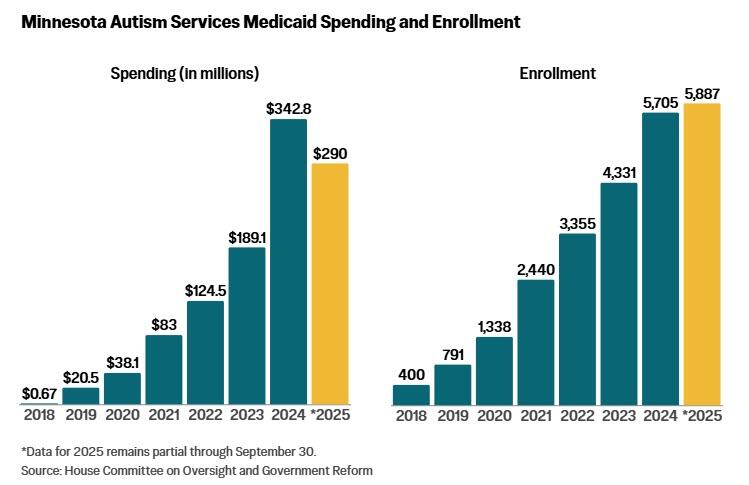
Meanwhile, the cost of the state’s autism early intervention service increased nearly 1,600 percent from 2019 to 2024, according to a March report from the House Committee on Oversight and Government Reform.
Enrollment ballooned by more than 620 percent during those years.
A state-commissioned report from United Health Group’s Optum division found Minnesota could have saved more than $1 billion in autism early intervention costs between January 2022 and October 2025, if officials had clarified ambiguous policies. An addendum to the January report revised that number to $703 million.
An investigation revealed patterns of claims that didn’t match clear policies or procedures.
“If the pre-payment system being developed now had been in place at the time, these items would have been flagged for further review and payments paused, until additional investigation was completed,” John Connolly, deputy human services commissioner and state Medicaid director, said in February.
“This is not a measure of fraud, waste and abuse, but it shows us where we need to do more work to understand why these claims are raising red flags,” Connolly said in a statement.
Nebraska
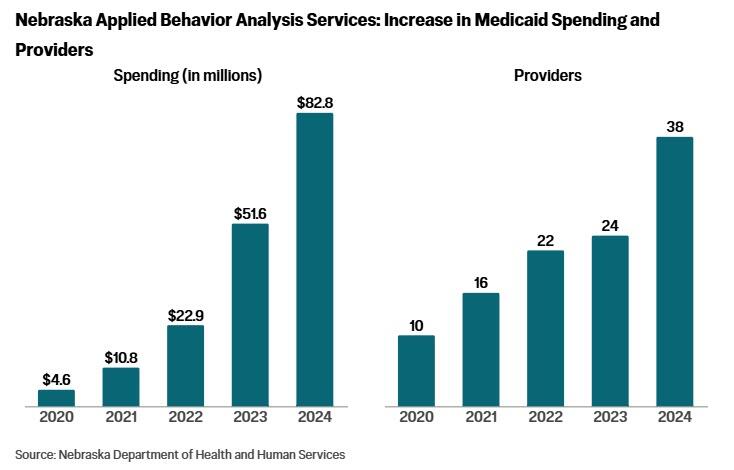
Nebraska’s Medicaid spending for applied behavior analysis increased notably over a similar time period. It grew by 1,700 percent from 2020 to 2024, according to a report last fall from the state’s Health and Human Services department.
The number of companies providing applied behavior analysis services nearly quadrupled, growing from 10 to 38 over the four years.
The number of behavior analysts and technicians billing for autism services in the Cornhusker State rose by 761 percent from 2019 to 2024—higher than Minnesota’s rate of growth in that area, which was 646 percent, according to a December report from Trilliant Health, a health care analytics company.
The payment rates in Nebraska were the highest in the nation, according to the Nebraska Department of Health and Human Services.
“We found that Nebraska’s rates for these services have been significantly higher, some more than twice as high, as those of other state Medicaid programs,” said Drew Gonshorowski, Medicaid and long-term care division director for the department.
A behavior technician in Nebraska earned $36.11 per 15-minute unit in 2024. That’s slightly more than $144 an hour, and 130 percent higher than the national average.
Behavior technicians typically undergo 40 hours of training and must have a minimum of a high school diploma.
In August 2025, the state agency reduced Medicaid payment for a behavior technician by 48 percent, bringing the rate from $36.11 to $18.70 per 15-minute unit, or $74.80 per hour.
North Carolina
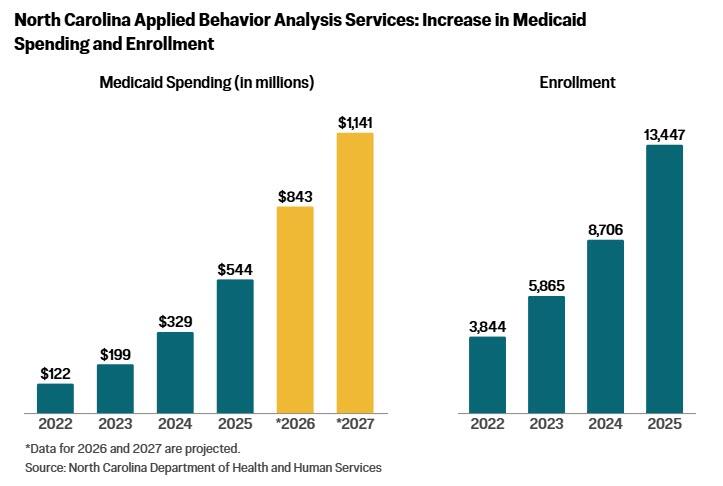
In North Carolina, spending on autism therapy is projected to exceed $1 billion over the next two years.
Medicaid spending on applied behavior analysis in the state grew by 347 percent from 2022 to 2025, North Carolina Medicaid deputy secretary Melanie Bush reported in a joint legislative oversight committee meeting March 10.
“Nothing here can answer the question of where that growth rate is coming from,” state Sen. Ralph Hise said during the meeting.
Spending growth was concentrated among a small number of providers and far outpaced growth in new provider enrollment, according to a report from the North Carolina Department of Health and Human Services.
Utilization growth also increased faster than the autism diagnoses, the report said.
While total Medicaid enrollees receiving applied behavior analysis services grew by 249 percent over the four years, the number of 15-minute service increments increased even more, by 305 percent.
“Utilization growth far outpaces increases in Autism Spectrum Disorder (ASD) diagnosis,” the report said, adding that it’s “unlikely that this level of growth can be explained by increased access alone.”
Massachusetts
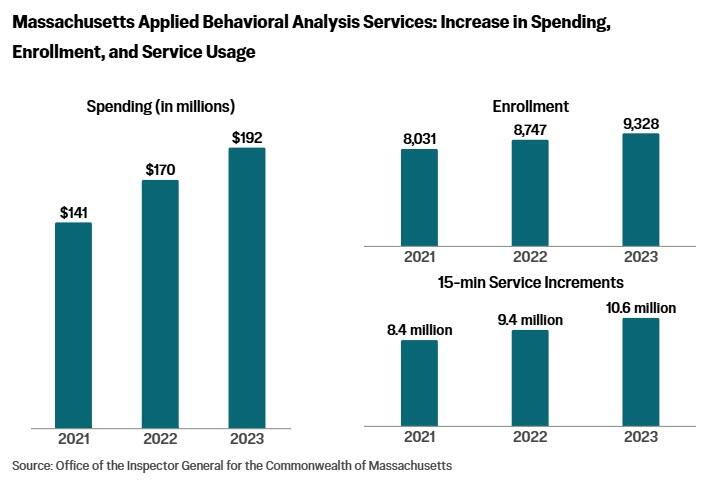
MassHealth, the Medicaid and children’s health insurance program for Massachusetts, overpaid autism service providers $17.3 million in 2024, according to an audit report from the state’s Office of the Inspector General.
The state’s spending on autism services rose 36 percent between 2021 and 2023, according to the 2024 report.
State rules require that a licensed applied behavior analyst provide at least one hour of supervision for every 10 hours of therapy given by a technician.
Nearly $16.8 million was overpaid because the therapy provided was over that ratio and should not have been billed, the audit found.
Further, from 2018 to 2022, behavior technician roles in the state grew at twice the pace of licensed supervisor positions, at 129 percent and 52 percent, respectively.
When applied behavior analysis is not properly supervised, it undermines the quality of care for vulnerable children and results in the waste of public funds, the audit concluded.
Federal Audits
At the federal level, the HHS Office of Inspector General is investigating services and billing patterns for Medicaid applied behavior analysis services provided to children with autism.
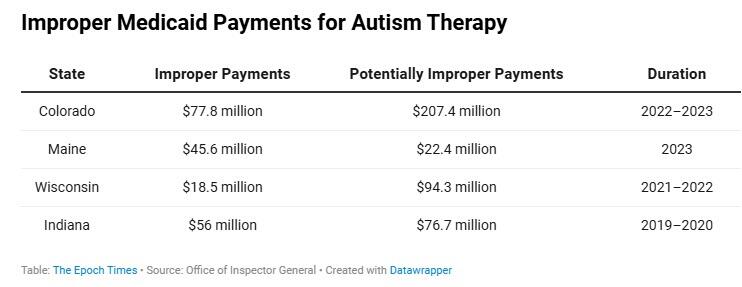
The audits, which began in 2022, have been completed for four states: Colorado, Indiana, Wisconsin, and Maine. Three other audits remain in progress.
The federal agency estimated nearly $200 million in improper payments and more than $400 million in potential improper payments for these states.
The completed audits found payments that were improper or potentially improper in 100 percent of reviewed claims. That was often due to inadequate records, such as missing progress notes, lack of supervision logs, or billing issues.
However, the audits also uncovered problems that could affect the quality and safety of care, such as criminal convictions for weapons offenses, assault or driving under the influence.
Tyler Durden
Sat, 03/28/2026 – 11:40
https://www.zerohedge.com/political/audits-spotlight-unusual-trends-medicaid-spending-autism-care

French Police Foil Overnight Terror Plot: Suspect Caught Trying To Ignite Bomb Outside BofA Headquarters In Paris
French Police Foil Overnight Terror Plot: Suspect Caught Trying To Ignite Bomb Outside BofA Headquarters In Paris
French anti-terrorism authorities thwarted an attempted attack early Saturday morning when police arrested a suspect as he tried to ignite an explosive device directly in front of the Bank of America headquarters in Paris.
The incident unfolded around 3:25-3:30 a.m. when officers from the Paris police’s BAC (Brigade Anti-Criminalité) unit, already on heightened patrol near the building due to prior threats, spotted the individual attempting to set fire to the device with a lighter. The device consisted of a 5-liter transparent jerrycan filled with an unidentified flammable liquid (reportedly a hydrocarbon such as gasoline) attached to a mortar-style tube or large firecracker containing approximately 650 grams of explosive powder. No detonation occurred, and there were no injuries or damage.
A second individual, believed to have been acting as a lookout, fled the scene on foot. The arrested suspect, a 17-year-old minor born in Senegal and residing in a Paris suburb, was taken into custody. During initial questioning, he reportedly claimed he had been dropped off at the location by a driver and was recruited via the social media app Snapchat for a payment of €600 to carry out the act.
According to Le Monde, France’s Parquet National Antiterroriste (PNAT), the national anti-terrorism prosecutor’s office, immediately opened a formal investigation. The probe is being conducted in flagrante delicto on charges including:
Attempted degradation by fire or dangerous means in connection with a terrorist undertaking
Manufacturing, possession, and transport of an incendiary or explosive device in a terrorist context
Participation in a terrorist criminal association
The Paris judicial police’s anti-terrorism section and France’s domestic intelligence agency, the DGSI, are leading the inquiry alongside judicial police units. The device was secured and sent for analysis by the Paris police prefecture’s central laboratory.
Interior Minister Laurent Nuñez praised the officers’ swift action on social media, stating: “Bravo to the rapid intervention of a Paris prefecture crew that allowed thwarting a violent action of a terrorist nature this night in Paris. Vigilance remains more than ever at a high level.”
Bravo à l’intervention rapide d’un équipage de la préfecture de police qui a permis de déjouer une action violente à caractère terroriste cette nuit à Paris
L’enquête se poursuit, sous l’autorité du PNAT et a été confiée à Direction de de la police judiciaire de la préfecture… https://t.co/w20kAYqpjq
— Laurent Nuñez (@NunezLaurent) March 28, 2026
A spokeswoman for Bank of America confirmed the company was “aware of the situation” and is cooperating with French authorities. The building had reportedly been under increased surveillance due to previous threats, including a recent video from a pro-Iran group that singled out the bank as a target linked to “Zionist and Israeli interests.”
This foiled plot occurs against a backdrop of heightened terrorist threat levels in France and Europe, with authorities maintaining elevated vigilance amid ongoing international tensions. The investigation continues, with efforts focused on identifying any broader network or accomplices. No further arrests have been reported as of Saturday afternoon.
The suspect remains in police custody, and authorities have not yet released additional details about his background or possible motives. Updates are expected as the probe advances.
Tyler Durden
Sat, 03/28/2026 – 11:30

Russia Warns Situation At Bushehr Nuclear Plant Deteriorating After 3rd Airstrike In Ten Days
Russia Warns Situation At Bushehr Nuclear Plant Deteriorating After 3rd Airstrike In Ten Days
On Friday Iran informed the International Atomic Energy Agency that Bushehr nuclear power plant was struck by US-Israeli attacks for the third time since the start of the war.
At the same time, the head of Russia’s state nuclear corporation Rosatom has confirmed that the situation continues to deteriorate; however, there’s as yet been no damage to the operating reactor and no release of radiation reported. It was the third strike in just ten days.
The Kremlin has newly accused Washington and Israel of putting the whole region in danger, and further of harming the cause of nuclear non-proliferation globally.
Russian Foreign Ministry spokeswoman Maria Zakharova has issued a fresh statement: “The drama of the situation is aggravated by the fact that countries attacking peaceful nuclear facilities in Iran are effectively undermining the NPT, the IAEA’s verification mechanisms, nuclear and physical security conventions, as well as the agency’s relevant regulations,” according to the ministry’s website.
“Carefully crafted and internationally agreed solutions are not taken seriously by these states and can be discarded at any moment in favor of their selfish interests and geopolitical considerations,” the spokeswoman added.
Zakharova further communicated that atrocities in Iran must cease, and nuclear sites must be safeguarded, referencing the latest attacks in the past days on the complex in Khondab, the factory in Ardakan, and the strikes near the Bushehr nuclear power plant.
“The aggressors continue to raise the stakes in their war in the Middle East, ignoring all associated risks, including the danger of widespread radioactive contamination,” Zakharova said.
She further chastised UN and international bodies for not stepping up to loudly condemn the US-Israeli operation.
Russia has a direct interest in Iran’s nuclear sites, given hundreds of Russian experts and technicians have long helped operate them, and support the Islamic Republic’s domestic nuclear power generation for its electricity needs. Reuters reported this week:
Russia’s state nuclear corporation Rosatom evacuated a further 163 of its staff from Iran’s Bushehr nuclear power plant on Wednesday, the state-run RIA news agency reported.
It cited Rosatom chief Alexei Likhachev as saying about 300 of the company’s staff remained at Bushehr, but more would be leaving.
Some 500 to 1,000 Russian staff are there during normal operations, and presumably many more are at other sites throughout the country. Russia helped construct many of these very complexes many years ago.
Tyler Durden
Sat, 03/28/2026 – 11:05

Maersk Slaps Emergency Fuel Surcharge As War Upends Marine Supply Chains
Maersk Slaps Emergency Fuel Surcharge As War Upends Marine Supply Chains
Submitted by Michael Kern of OilPrice.com,
The war in the Middle East has upended shipping fuel markets with prices of marine fuels skyrocketing and regions running low on supply, pushing some traders to forgo cargo and ship additional fuel volumes to key bunkering ports outside the Middle East.
The price of fuel oil has surged this month as the stalled tanker traffic at the Strait of Hormuz is tightening supplies of the fuel in Asia, the key bunkering hub for fuel oil used in ships.
The Middle East is a major global supplier of fuel oil, especially of high-sulfur fuel oil (HSFO). But the Iran war has all but halted traffic via the Strait of Hormuz, stranding supplies for Asia and its key bunkering hub of Singapore.
Yet, stocks in Singapore have increased this month as shipping owners and operators have refrained from buying the too expensive fuel. These, however, could soon start to deplete, fast, because vessels are becoming desperate to refuel, according to a Financial Times analysis.
One trader told the publication that their firm had to forgo cargo in order to deliver additional fuel volumes between major ports, mostly between the United States and Singapore.
With the Middle East’s key bunkering port of Fujairah mostly offline by the end of March due to Iranian attacks earlier this month, the marine fuel market is in chaos.
Shipping giant Maersk warned in its latest Middle East advisory this week that “To preserve network stability, we have undertaken significant redistribution of fuels to offset shortages in the Middle East, and are securing alternative sources from different locations, suppliers, and at increased premiums.”
Maersk also introduced as of March 25 an Emergency Bunker Surcharge (EBS), “in response to notable fluctuations in fuel supply and the additional costs of distribution.”
Maersk’s chief commercial officer Karsten Kildahl said earlier this month that “There is currently sufficient fuel globally, but it is unevenly distributed. As a result, we are making changes to our fuel supply chain and begin moving fuel to ensure our vessels can continue to bunker where needed – and protect the flow of trade.”
Tyler Durden
Sat, 03/28/2026 – 10:30

Apple Forces British iPhone Users To Prove Age With ID Or Lose Unrestricted Internet Access
Apple Forces British iPhone Users To Prove Age With ID Or Lose Unrestricted Internet Access
Authored by Steve Watson via Modernity.news,
UK iPhone and iPad owners updating to the latest iOS 26.4 are now confronted with a stark choice: verify you are an adult by providing a credit card or scanning your ID, or accept automatic web content filters that restrict access.
The message users see states clearly: “UK law requires you to confirm you are an adult to change content restrictions.”
Those who do not confirm their age – or are found to be underage – have web content filters turned on automatically.
🚨NEWS: UK iPhone users must now prove their age or lose full internet access
“It is absolutely outrageous that, overnight, Apple has put a chokehold on Britons’ freedom to search the internet, access information and use apps unless they provide sensitive ID documents.
This… pic.twitter.com/GNuCsihcDD
— Big Brother Watch (@BigBrotherWatch) March 25, 2026
The government appointed communications watchdog Ofcom welcomed the development, calling it “a real win for children and families” and noting the UK would be “one of the first countries in the world to receive such restrictions on their devices.”
Silkie Carlo, director of Big Brother Watch, hit back hard. In the organisation’s statement she said Apple had put a “chokehold on Britons’ freedom to search the internet, access information and use apps unless they provide sensitive ID documents.”
She continued: “This means 35 million Brits who have paid hundreds or even thousands of pounds for Apple tech suddenly now have a child’s device unless they comply with invasive demands for personal information that go far beyond what UK law requires.”
“Apple has crossed the Rubicon with this software update which is more like ransomware, holding customers hostage to ID demands that are invasive, exclusionary and unnecessary,” Carlo added.
She further urged, “Children’s online safety is vital but requires better parental controls and thoughtful tech responsibility – not sweeping, draconian, shock demands by foreign companies for all of our IDs and credit cards.”
This is digital ID enforcement by the back door. The same government apparatus that has already advanced newborn baby digital IDs, mandatory digital ID schemes and biometric tracking is now outsourcing age verification to tech giants at the device level – creating the perfect infrastructure for ongoing surveillance and control.
We have previously outlined that broader Orwellian mandatory digital ID and biometric push by the British government, which has claimed that the mandatory ID, based on the UK One Login system, will help to stop “illegal” immigrants from crossing the channel by denying them access to work.
This also ties into the WHO-Gates blueprint for global digital ID, AI-driven surveillance and lifelong vaccine tracking:
Social Media Ban For Under-16s: The Age Verification Trojan Horse
The Apple rollout coincides with government moves toward banning social media for under-16s, including trials on 300 teens that test disabling apps, overnight blocks or strict one-hour limits.
Hundreds of teenagers to undergo social media ban, time limits or overnight curfews in Government trial to see effects on sleep and schoolwork https://t.co/cia7XF2Ndx
— Daily Mail (@DailyMail) March 24, 2026
Critics see this as the gradual normalisation of universal age verification. Once demanding ID to use your own phone becomes routine, expanding that system to every platform and service is a small step.
Beyond blocking illegal or sexually explicit material, the deeper question remains: why should the State have the authority to decide what our kids can and can’t access? In a free society, that responsibility belongs to parents – not to bureaucrats in Westminster or executives in Cupertino acting as their enforcers.
The Real Indoctrination Happening Inside British Schools
While ministers lecture about protecting children online, the same system is busy shaping young minds through official channels.
The Green Party has pushed to teach children a “moral obligation” to accept mass immigration:
Government guidance urges schools to report “anti-Muslim hostility” in an Orwellian snitch culture:
Counter-terror police ran adverts warning teenagers that sharing “funny content” could amount to terrorism:
A government-funded video game literally labels kids as potential terrorists for questioning mass migration:
The pattern is clear. Restrict open access to the internet while pumping state-approved ideology into schools. Challenge the narrative and you risk being flagged. Want unfiltered information for your children? First hand over your documents.
Britain is rapidly sliding toward a surveillance society where every search, every post and every opinion can be monitored, filtered and scored.
Freedom is not preserved by surrendering control to “safety” pretexts. It is defended by rejecting the machinery of permanent oversight before it locks in place for good.
Your support is crucial in helping us defeat mass censorship. Please consider donating via Locals or check out our unique merch. Follow us on X @ModernityNews.
Tyler Durden
Sat, 03/28/2026 – 09:55