Category: News
Pentagon Eyes ‘Weeks’ Of Ground Operations In Iran As IRGC Threatens Tit-For-Tat Strikes On Universities
Pentagon Eyes ‘Weeks’ Of Ground Operations In Iran As IRGC Threatens Tit-For-Tat Strikes On Universities
Summary
Report says Pentagon has been weeks in preparing ground operations as initial Marines arrive in region (WaPo).
Foreign ministers of regional countries seeking peace & offramp in Pakistan meeting on Sunday.
After two Iranian university campuses struck by attacks, IRGC issues warning for American university campuses in Middle East.
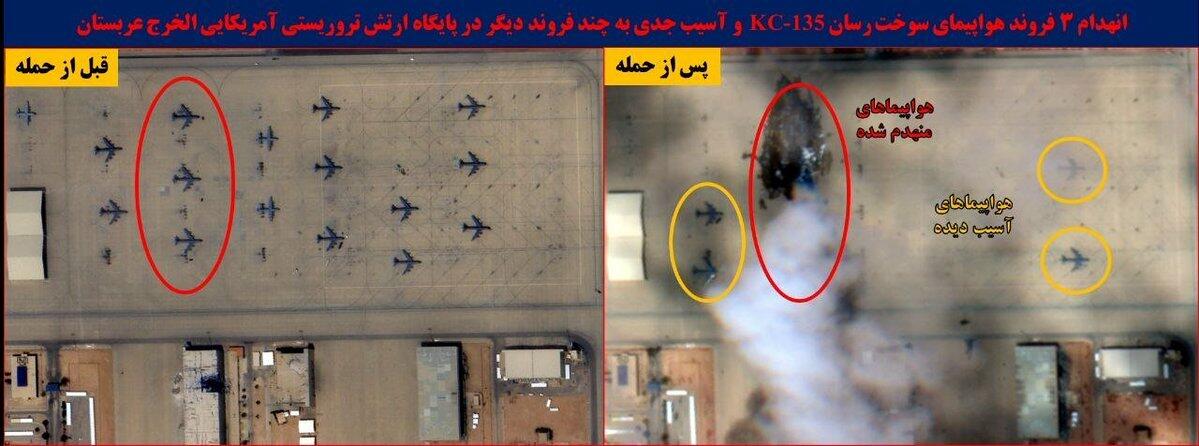
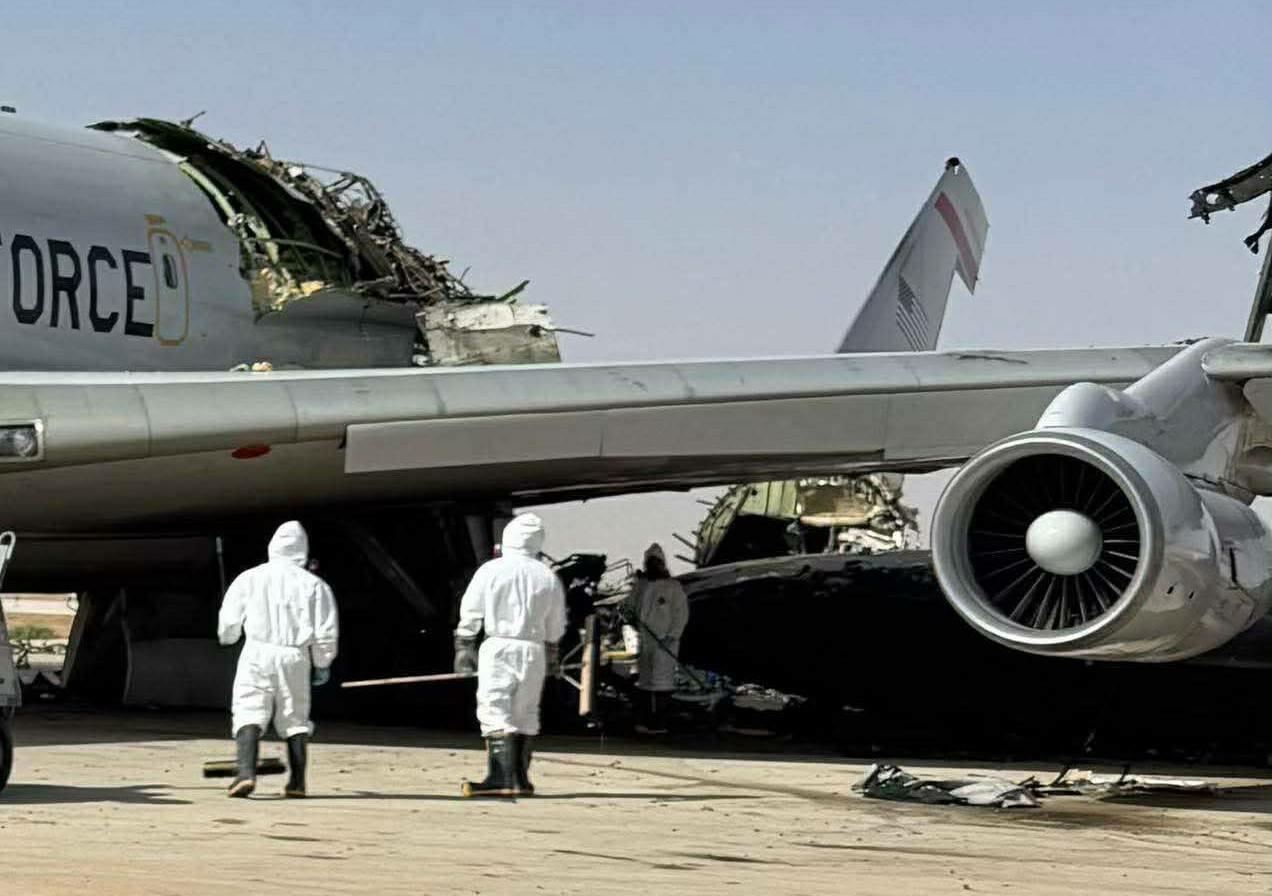
Not just ‘damaged’ but obliterated: images show destroyed US AWACS jet at Saudi Airbase.
* * *
‘Weeks’ of Ground Ops Under Preparation: WaPo
Iran’s parliament speaker Mohammad Bagher Ghalibaf, the man who many believe is de facto running the country during wartime, has said United States is busy plotting a ground attack despite publicly engaging in diplomatic efforts aimed at finding a ceasefire.
Fresh reporting in The Washington Post suggests he could be right: “The Pentagon is preparing for weeks of ground operations in Iran, U.S. officials said, as thousands of American soldiers and Marines arrive in the Middle East for what could become a dangerous new phase of the war should President Donald Trump choose to escalate,” the Saturday night report indicated. WaPo further says the plans have been at least weeks in development, writing “Any potential ground operation would fall short of a full-scale invasion and could instead involve raids by a mixture of Special Operations forces and conventional infantry troops, said the officials. All spoke on the condition of anonymity to discuss highly sensitive military plans that have been in development for weeks.”
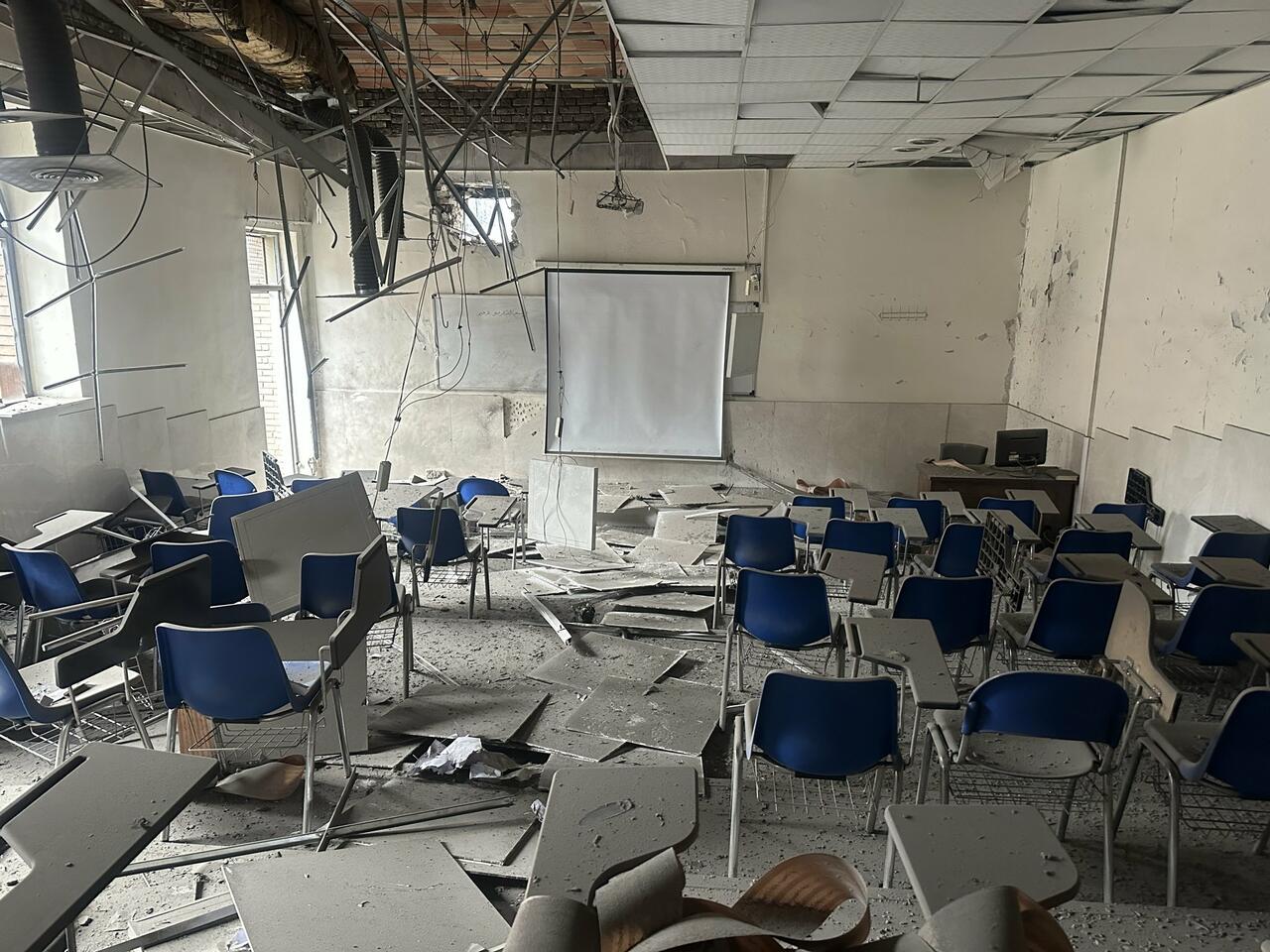
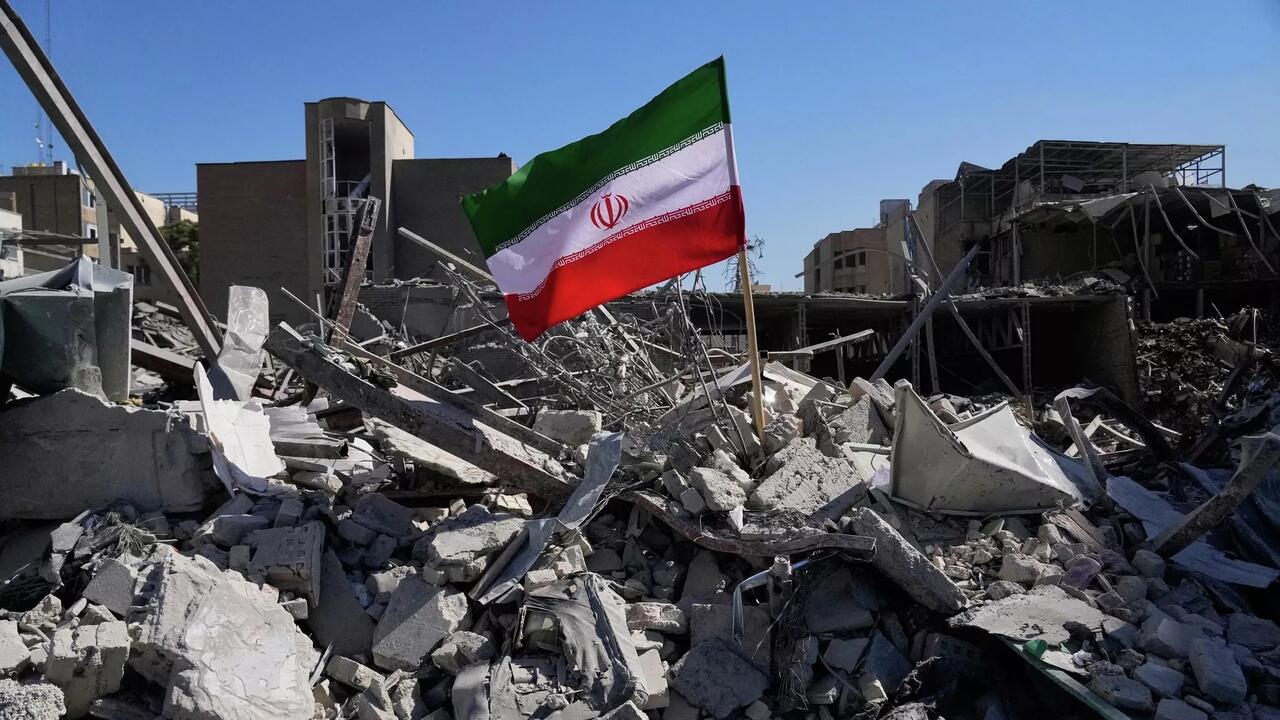
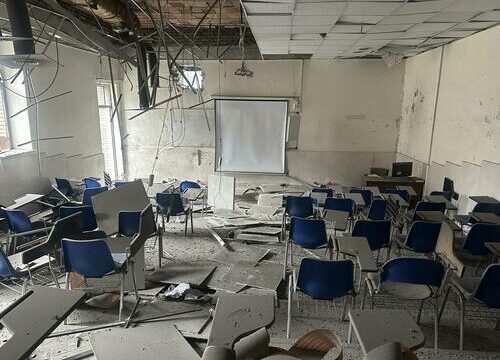
Bombed-out classroom of Iran’s University of Science and Technology, via @Helyeh_Doutaghi
It should be obvious to all what an ultra high-risk gambit this would be, and geography certainly isn’t in US forces’ favor. The report continues, “Such a mission could expose U.S. personnel to an array of threats, including Iranian drones and missiles, ground fire and improvised explosives. It was unclear Saturday whether Trump would approve all, some or none of the Pentagon’s plans.”
Scramble to Find Offramp: Summit in Islamabad
Several regional countries are meeting in Islamabad to try and forge a path toward ceasefire and peace. The four foreign ministers representing Pakistan, Turkey, Egypt, and Saudi Arabia began consultations Sunday.
The Pakistani government said over the weekend that its prime minister Muhammad Shehbaz Sharif is working to “create a conducive environment” for peace negotiations and direct talks between Tehran and Washington as the war reaches one month. Iranian President Masoud Pezeshkian is being kept abreast of developments in communications with Pakistan. Some progress emerging?…
Iran has agreed to allow 20 Pakistani-flagged ships to pass through the Strait of Hormuz unharmed, Foreign Minister Ishaq Dar announced Saturday.
Oil tanker carrying Saudi crude to Pakistan.
Map frm @Kpler pic.twitter.com/qSUSTca7k1
— Anas Alhajji (@anasalhajji) March 29, 2026
Pezeshkian told PM Sharif in a Saturday call that “Attacks on infrastructure and assassinations by aggressors show they cannot be trusted.”
As for the Sunday summit in Pakistan, one question that must be asked is where are the US negotiators? Days ago there was chatter that VP J.D. Vance or perhaps Witkoff or Kushner might be in Pakistan, working on the sidelines, but it’s unclear what Washington’s posture on diplomacy is at this point.
The Consultations among the Foreign Ministers of Pakistan, Saudi Arabia, Türkiye, and Egypt have commenced in Islamabad on 29 March 2026.
Convened at the invitation of Deputy Prime Minister / Foreign Minister Senator Mohammad Ishaq Dar @MIshaqDar50, the Foreign Ministers during… pic.twitter.com/5capTCXUNO
— Ministry of Foreign Affairs – Pakistan (@ForeignOfficePk) March 29, 2026
Attacks on Universities, Infrastructure
The last 48 hours saw new US-Israeli attacks on Iran’s university of science and technology in the northeast of the capital. Buildings were severely damaged – but reports of casualties have not emerged.
Israel has made it clear it is going after an array of targets, including civilian infrastructure in Iran. Iran has over the weekend retaliated in kind, sending more missiles on Israel. Iran’s Islamic Revolutionary Guard Corps (IRGC) is now warning that American university campuses in the Middle East are now fair game. The statement said this is because two Iranian universities have been struck. The IRGC says American universities are now “legitimate targets” unless the US officially condemns the attacks on Iranian schools by noon on Monday, according to Fars.
Tit-for-tat attacks on infrastructure escalating:
⚡️BREAKING
An Iranian missile has just struck Israel’s crucial Rotem Chemicals Plant
The plant produces sapphire domes for defence missiles and also helps Israel’s nuclear weapons program pic.twitter.com/VuAikqH6ws
— Iran Observer (@IranObserver0) March 29, 2026
The IRGC has gone so far as to release a statement urging staff, faculty, and students to vacate and stay away from theses campuses. Some notable American university branches in the Gulf (among dozens) include Texas A&M University in Qatar and New York University in the United Arab Emirates.
Not Just ‘Damaged’ but Obliterated: Images of US AWACS Jet At Saudi Airbase
Images have emerged revealing that the Wall Street Journal’s initial report that the half-billion-dollar aircraft was merely “damaged” was an enormous understatement. Rather, a large portion of the fuselage has been obliterated, along with the distinctive 30-foot-diameter, 6-foot-thick rotating radar dome that’s mounted atop AWACS aircraft. We took a closer look at the photo set here.
The images of the destroyed E-3 Sentry were first posted on the Air Force amn/nco/snco Facebook page:
“The loss of this E-3 is incredibly problematic, given how crucial these battle managers are to everything from airspace deconfliction, aircraft deconfliction, targeting, and providing other lethal effects that the entire force needs for the battle space,” Heather Penney, a former F-16 pilot and director of studies and research at AFA’s Mitchell Institute for Aerospace Studies, told Air & Space Forces Magazine. If this has been carefully kept under wraps until now, what else is the White House and Pentagon not telling the public?
Tyler Durden
Sun, 03/29/2026 – 11:05
Subprime Crisis 2.0: Will Private Credit Be The Trigger?
Subprime Crisis 2.0: Will Private Credit Be The Trigger?
We have recently tackled the rising stress in the Private Credit markets. Here are a few of our previous warnings:
Fitzpatrick: Soros CEO & CIO Warns of a Reckoning
Private Credit Stress: Will The Fed Backstop Exuberance Again? – RIA
Is Private Equity A Wolf In Sheep’s Clothing?
After 30 years of watching credit cycles expand, distort, and collapse, I’ve learned one reliable rule:
“When enough people start drawing comparisons to 2008, it’s worth stopping to check whether the analogy holds up — or whether fear is doing the analytical work for them.”
Right now, judging by the amount of commentary on social media, the stress in the private credit market has everyone’s attention. Most of the commentary being generated makes the immediate jump from private credit firms “gating” exits to the onset of the next subprime crisis in the financial system. Those claims are certainly alarming and generate many clicks and views, but the question is whether those claims are based on facts rather than opinions.
Just recently, Goldman Sachs CEO David Solomon flagged the risk of private credit in his annual shareholder letter. Lloyd Blankfein, who piloted Goldman through the Global Financial Crisis, warned publicly that the financial system appears to be “inching toward another potential catastrophe.” Meanwhile, Goldman’s own research arm published a note concluding that private credit stress is “unlikely to generate large macroeconomic spillovers on its own.”
So which is it? A repeat of the subprime crisis of 2008, or a painful but contained credit cycle? The honest answer most likely sits somewhere in between, and understanding exactly where private credit differs from subprime tells you a great deal about how worried you should actually be.
Let’s revisit 2008.
What Made The Subprime Crisis So Catastrophic
It is hard to believe that we are rapidly approaching the 20-year anniversary of the “Great Financial Crisis” that nearly destroyed the financial system as we knew it. There are many investors and commentators in the markets today who only know about the event from reading history books. Having lived through it, it is a different reality.
Crucially, the 2008 subprime crisis wasn’t simply a mortgage problem. It was a leverage-and-derivatives problem that started in mortgages. That distinction matters enormously when you’re sizing up today’s private credit stress.
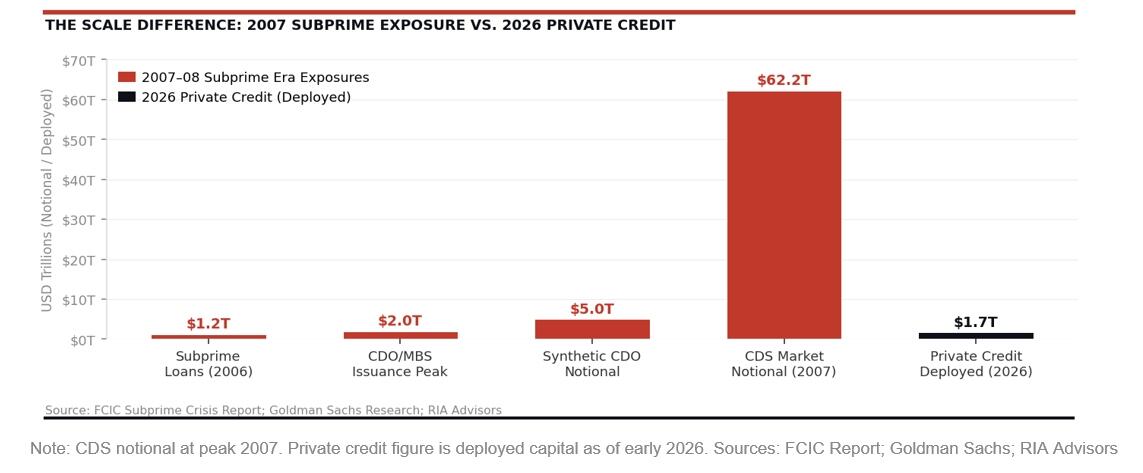
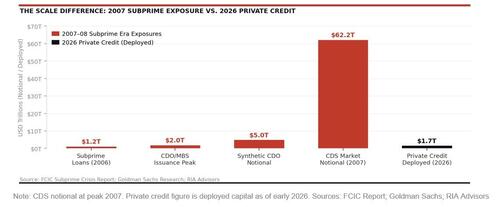
At the heart of the crisis was a product called the collateralized debt obligation, or CDO. Banks packaged pools of subprime mortgages into tranches, which were rated by agencies using flawed models. Those CDOs were then re-sliced into “CDO squared” structures, layering additional complexity and opacity on top of already opaque assets. The real acceleration came when synthetic CDOs entered the picture. Unlike cash CDOs, which required actual mortgages, synthetic CDOs referenced mortgages through credit default swaps. Journalist Gregory Zuckerman found that while roughly $1.2 trillion in subprime loans existed in 2006, synthetic structures created more than $5 trillion in exposure referencing those same loans. The CDS market alone reached a peak notional value of $62.2 trillion by year-end 2007. That is not a typo.
But the derivatives machine required raw material to function, and Wall Street’s insatiable hunger for collateral triggered what historians of the crisis now call the “race to the bottom” in mortgage underwriting. To keep the CDO assembly line running, originators needed volume. That demand for volume led to a collapse in underwriting standards. By 2006, no-money-down mortgages were commonplace.
NINJA loans, “No Income, No Job, No Assets,” were extended to borrowers who could not remotely service the debt once introductory teaser rates reset.
Stated-income loans, in which borrowers self-reported earnings with no verification, became the industry norm rather than the exception.
Adjustable-rate mortgages were sold to buyers who qualified only at the teaser rate and had no capacity to absorb resets of 3 to 4 percentage points two years later.
The Mortgage Bankers Association later estimated that subprime originations reached $600 billion in 2006 alone, up from roughly $160 billion in 2001. Most importantly, the loans were designed to be sold, not held. In other words, the originator of the loan bore no long-term risk and had every incentive to close as many transactions as possible, regardless of quality.
That single misalignment of incentives was the original sin of the entire subprime crisis.
What compounded the damage beyond even that was systematic, institutionalized fraud at the origination and securitization level. The Financial Crisis Inquiry Commission documented widespread “robo-signing,” where bank employees executed thousands of mortgage documents per day without reviewing them. They affixed signatures and notarizations to paperwork they had never read. Countrywide Financial, Washington Mutual, and others were found to have misrepresented loan quality in the representations and warranties they made to investors purchasing MBS tranches, fraudulently inflating the apparent collateral quality of the pools they sold.
Appraisers faced pressure, and in many cases direct financial incentive, to hit predetermined valuations that supported loan amounts the underlying properties could never justify. The FBI reported that mortgage fraud suspicious activity reports increased by more than 1,400% between 2000 and 2007. When losses eventually surfaced, investors discovered they had purchased securities backed not just by bad loans, but by fraudulently documented ones. That distinction made recovery values nearly impossible to model and turned settlement litigation into an industry unto itself for a decade afterward. JPMorgan alone paid $13 billion in 2013 to resolve government claims over mortgage securities, and that figure represented only a fraction of industry-wide settlements.
When housing prices began falling, that entire structure detonated in both directions simultaneously. Banks that held CDO tranches faced mark-to-market losses. Banks that sold CDS protection, AIG being the most famous, faced collateral calls they couldn’t meet. Here is the most crucial point. These instruments traded freely in liquid markets, so price discovery occurred in real time, compressing the panic into a matter of weeks. The interconnection was total. Twelve of the thirteen largest U.S. financial institutions were at risk of failure, according to then-Fed Chair Ben Bernanke.
That’s what systemic risk actually looks like.
Private Credit Stress Is A Different Animal
The private credit market now stands at roughly $1.7 to $2 trillion in deployed capital, a figure that has grown rapidly since banks retreated from middle-market lending after the Global Financial Crisis. That growth is precisely what generated the current stress. Redemption requests have surged across major platforms. Blackstone’s BCRED fund saw record redemptions of $3.8 billion in Q1 2026, exceeding its 5% quarterly buyback limit. Apollo, Blue Owl, and Morgan Stanley’s North Haven fund have all imposed withdrawal restrictions. That gating of withdrawals led to an obvious decline in inflows across retail private credit funds. Those inflows fell to roughly half their 2025 pace, according to Goldman Sachs estimates.
So far, the catalyst is concentrated in software companies, which represent an estimated 15% to 25% of many private credit portfolios. They are under pressure as AI disruption fears potentially erode their earnings power and their ability to service debt. The headline default rate sits around 2% as of 2025, but Goldman Sachs Asset Management’s own research acknowledges that figure understates the true level of stress. When you include liability management exercises and distressed exchanges, the real rate approaches 4% to 5%. That’s meaningful deterioration. It’s not catastrophic, but it’s real.
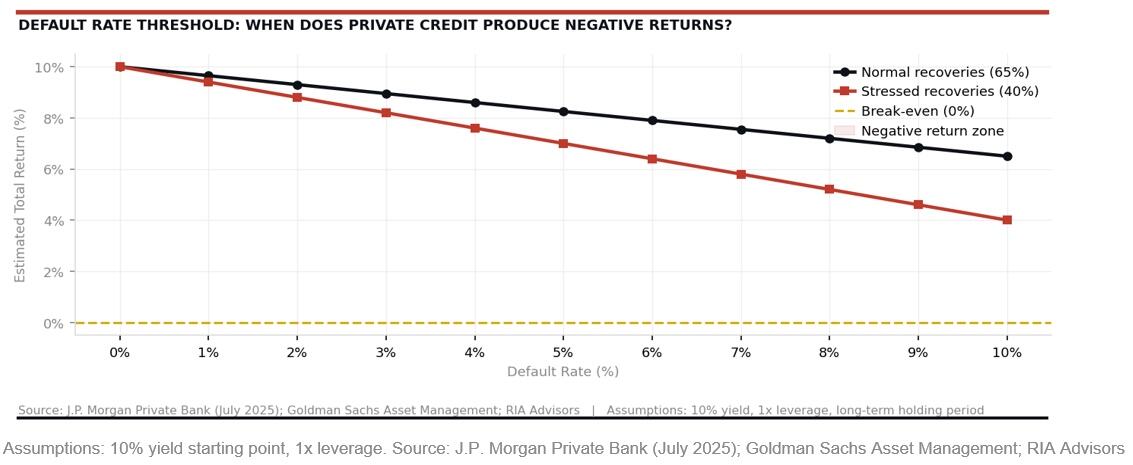
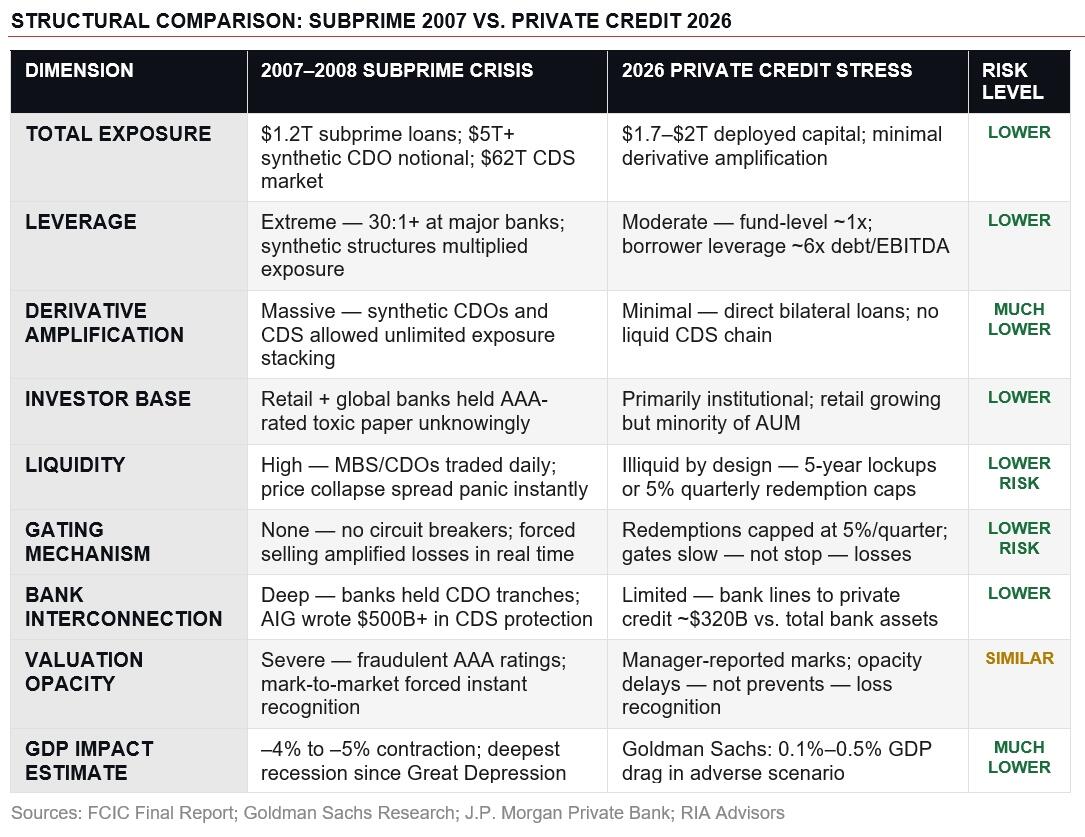
J.P. Morgan’s analysis showed that for senior direct lending to produce negative total returns, default rates would need to exceed 6% while recovery rates would collapse below 40% simultaneously. Those numbers have historically appeared only during COVID and the Global Financial Crisis itself. That’s a high bar — but it’s not an impossible one. However, that would require a deterioration in macroeconomic conditions, a continuation of the Iran conflict oil shocks, and a contraction of consumer spending, which could certainly amplify risks. As shown below, the current structural comparison between the subprime crisis and the private credit sector today is markedly different.
The Importance of the Gating System
The most structurally significant difference between 2008 and today is also the one that generates the most debate. Unlike the subprime crisis, private credit funds can gate their exits. When Blackstone caps BCRED redemptions at 5% per quarter, it’s not a failure of the fund; it’s the mechanism working as designed. In 2008, there was no such circuit breaker. MBS and CDOs traded continuously in secondary markets, meaning every forced seller found a bid at a lower price, triggering more mark-to-market losses, which in turn triggered more forced selling. The feedback loop was instantaneous and brutal.
Gating slows that process considerably. LPL Research noted that while gating makes for terrible headlines, it prevents the forced liquidation that accelerated subprime losses. Goldman Sachs estimates that retail private credit inflows will remain in net outflow throughout 2026 and likely into 2027, a slow bleed, not a cliff. That’s a very different contagion profile.
That said, gating is not a cure. It transfers the problem in time, not away from investors. Those sitting in redemption queues face a multi-year wait to exit positions that may continue to deteriorate. The opacity of private credit portfolios and manager-reported valuations means stress can accumulate invisibly until it can’t.
“The key risk in private credit is not what is visible, but what remains hidden.” – The Daily Economy
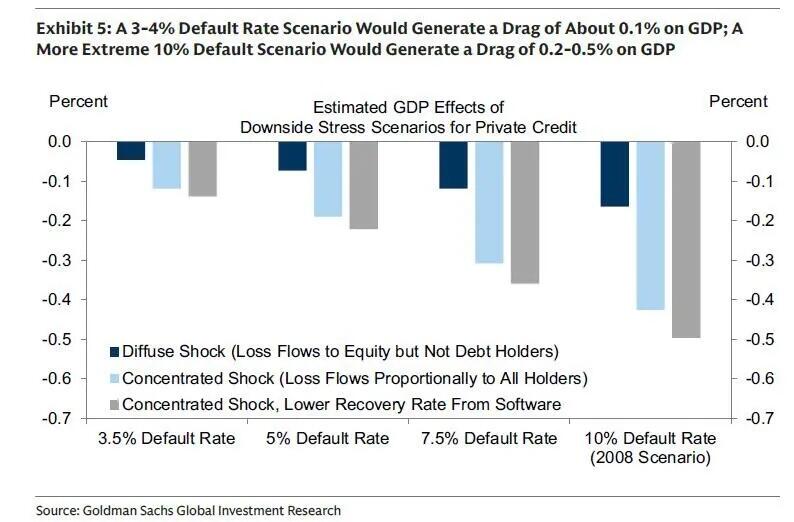
Goldman Sachs economist Manuel Abecasis concluded that, even in an adverse scenario, private credit stress would only drag on GDP by 0.2% to 0.5%. His reasoning is straightforward: the private credit sector holds about $1.7 trillion in levered loans, or roughly 4% of all credit to the private non-financial sector. That’s is not nothing, but it’s not the $62 trillion CDS market either. Goldman also notes that bank lending to businesses has actually accelerated recently, providing a partial offset if private credit tightens.
Blankfein’s view carries different weight precisely because he’s been through the real thing. He warned that private credit assets “can be hard to analyze, may feature hidden leverage, and can become tough to sell.” He’s right that opacity and illiquidity create conditions where problems compound before they surface. The question is whether those conditions, combined with a still-manageable scale, produce systemic contagion or simply painful losses for a subset of investors.
“Private credit stress is unlikely to generate large macroeconomic spillovers on its own.” — Goldman Sachs Economist Manuel Abecasis, March 2026
I’m inclined to side with Goldman’s macro conclusion. However, with a caveat that matters. The base case holds only so long as private credit problems don’t compound with a broader recession, a sustained oil shock from the Iran conflict, and a sharper-than-expected deterioration in software company cash flows. Any two of those three conditions occurring simultaneously change the calculus. Goldman’s own research acknowledges this. The bigger risk isn’t private credit alone. It’s private credit stress coinciding with the wider tightening of financial conditions.
What Investors Should Pay Attention To
The structural differences between today and the subprime crisis are real and important. There’s no synthetic subprime CDO chain multiplying private credit losses to a $5 trillion notional exposure. Most critically, the investor base is primarily institutional, not retail money market funds holding fraudulently rated paper. Fund-level leverage is modest, and the gating mechanism, whatever its imperfections, prevents the instantaneous price cascade that made the subprime crisis so destructive.
What this most closely resembles is a normal credit cycle playing out in an untested asset class. Not a systemic collapse, but not a benign correction either. Goldman Sachs Asset Management’s own European research found that “stress events are likely to remain elevated relative to the last decade,” concentrated in smaller companies and cyclical sectors. That pattern will probably hold in the U.S. as well.
Three things would change my view and warrant genuine alarm.
First, if default rates push past 8% in tech-heavy private credit portfolios as AI disruption accelerates.
Second, if bank credit facilities to private credit managers get pulled at scale, triggering forced asset sales.
Third, retail penetration of private credit grows, as institutional investors sell, leaving less-sophisticated money to hold the bag.
None of those conditions is inevitable. All of them are possible.
The subprime crisis analogy fails on the specifics. But the lesson from the subprime crisis isn’t about CDOs. It’s about what happens when credit markets expand rapidly, underwriting discipline erodes under competitive pressure, and opacity masks deteriorating loan quality. On those broader conditions, the warning is more relevant than the Goldman bulls would like to admit.
That is why we continue to underweight risk for now until we have better clarity about the future.
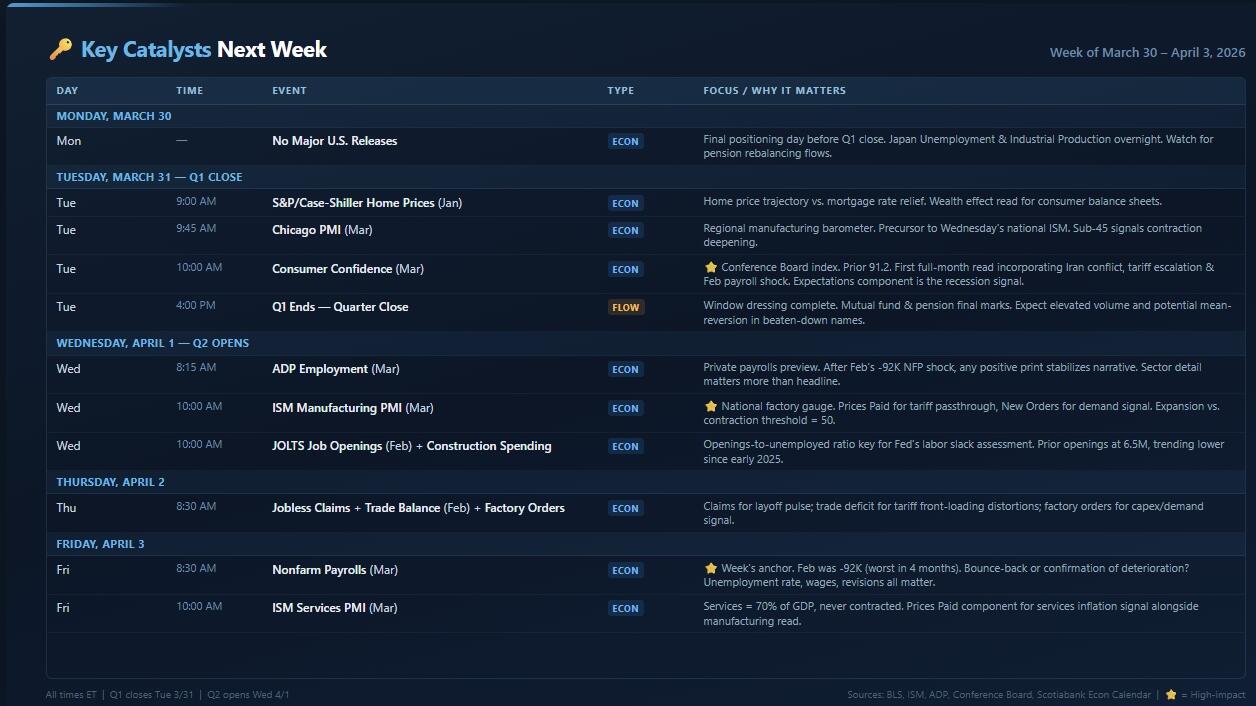
Key Catalysts Next Week
This is the most structurally loaded week of the quarter. The calendar stacks a Q1 close, a Q2 open, and a full employment gauntlet into five sessions, with markets still metabolizing whatever the Fed just delivered..
Tuesday is the pivot. Consumer Confidence is the marquee release, and it’s the first full-month reading that captures the Iran conflict, the tariff widening, and February’s payroll shock in a single survey. The prior print of 91.2 was already soft. The Expectations component, which the Conference Board flags as a recession signal below 80, is the number to watch. A sharp drop would validate the stagflation fears the Fed just tried to navigate around. Chicago PMI and Case-Shiller Home Prices round out the morning, and then Q1 closes at the bell. Expect elevated volume as pension funds and mutual funds finalize window dressing and mark final positions, totaling roughly $62 billion on the buy side.
Wednesday flips the calendar to Q2 and immediately delivers a triple shot: ADP private payrolls, ISM Manufacturing, and JOLTS. After February’s -92,000 NFP shock, the ADP print will either stabilize the labor narrative or accelerate the deterioration thesis. ISM Manufacturing is the tariff passthrough read, the Prices Paid subindex will tell us whether producers are eating costs or passing them through, while New Orders reveal whether demand is contracting under policy uncertainty. JOLTS completes the picture with the openings-to-unemployed ratio that the Fed uses to assess labor market slack.
Friday is the week’s anchor: March Nonfarm Payrolls. February was distorted by a Kaiser Permanente strike and severe weather, giving bulls a one-month excuse. If March payrolls bounce back above 100,000, the “transitory weakness” camp wins. If they print flat or negative again, the labor market deterioration becomes undeniable, and the pressure on the Fed to act, despite sticky inflation, becomes immense. ISM Services PMI that morning adds the services-sector inflation read alongside Wednesday’s manufacturing data.
Tyler Durden
Sun, 03/29/2026 – 10:30
https://www.zerohedge.com/markets/subprime-crisis-20-will-private-credit-be-trigger

Map Shows Homebuilders Pulling Back Nationwide “Given Limited Visibility To Demand”
Map Shows Homebuilders Pulling Back Nationwide “Given Limited Visibility To Demand”
Even as homebuilders offer mortgage-rate buydowns, closing-cost incentives, and upgraded amenities to attract buyers on the sidelines, clouds of uncertainty continue to build over the housing market. New U.S. single-family permit activity fell again in January, highlighting yet more caution among builders ahead of the spring selling season as they respond to softer demand.
Goldman analysts, led by Susan Maklari, provided clients on Friday with a snapshot of homebuilders across America and a housing heat map suggesting continued sluggishness across the industry.
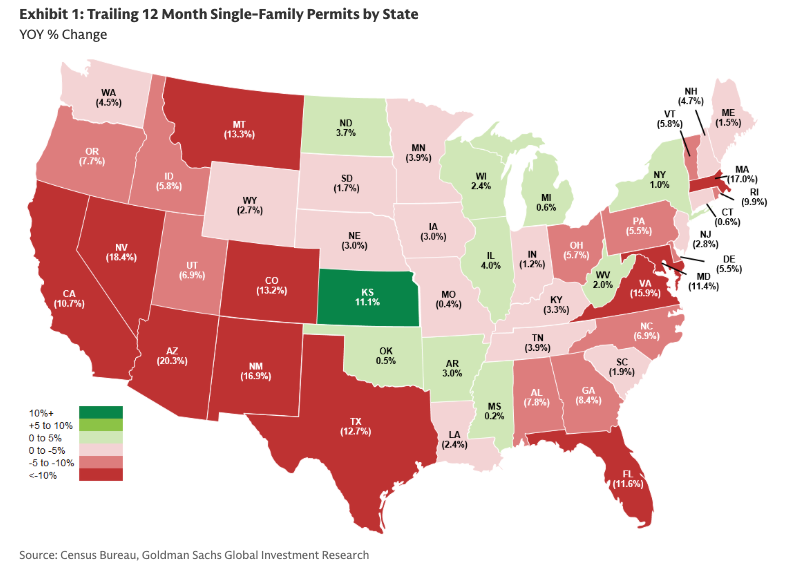
On a trailing 12-month basis, single-family permits fell 8% in January, versus 7% in the previous month, and were up 6% in December 2025.
Maklari said, “Ongoing moderation comes as builders look to limit unsold inventory given limited visibility to demand.”
Some of the January weakness stemmed from severe winter weather and dangerously cold temperatures, which delayed permits and construction in parts of the eastern U.S., including major homebuilding markets such as Texas, Florida, and the Southeast. However, the snow and sub-zero temperatures are only one part of the slowdown story.
The analyst added that builders are dealing with a challenging macroeconomic environment for buyers, noting that sales traffic improved earlier in the year but vanished in March, according to the latest industry checks, as consumers “react to the effects of the Middle East conflict.”
At the same time, mortgage rates have jumped about 40 basis points over the last month, making monthly payments even less affordable as the housing market is stuck in the worst affordability crisis in a generation, a leftover gift from the Biden-Harris era.
The slowdown is most visible in some of the biggest new-home states:
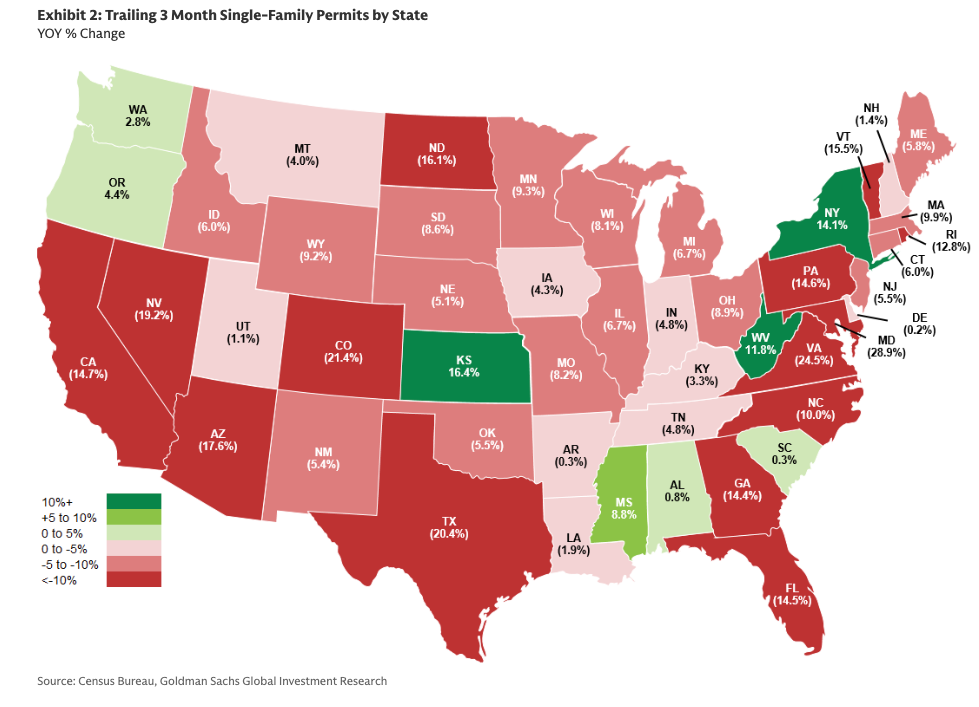
Single-family permits for the 3-months ended January fell 11% YOY, compared to -9% in December, and -1% a year ago. That said, they were up 7% vs the comparable pre-pandemic period. Looking at the largest new home markets, the deceleration was led by Colorado (-21%), Texas (-20%), and Nevada (-19%) while the Northeast and Pacific Northwest outperformed. Nationally, we note 8 states were flat to up vs 11 in December. This comes as builders continue to align starts to demand while focusing on profitability and cash generation. As such, we expect permits will remain under pressure in the near-term.
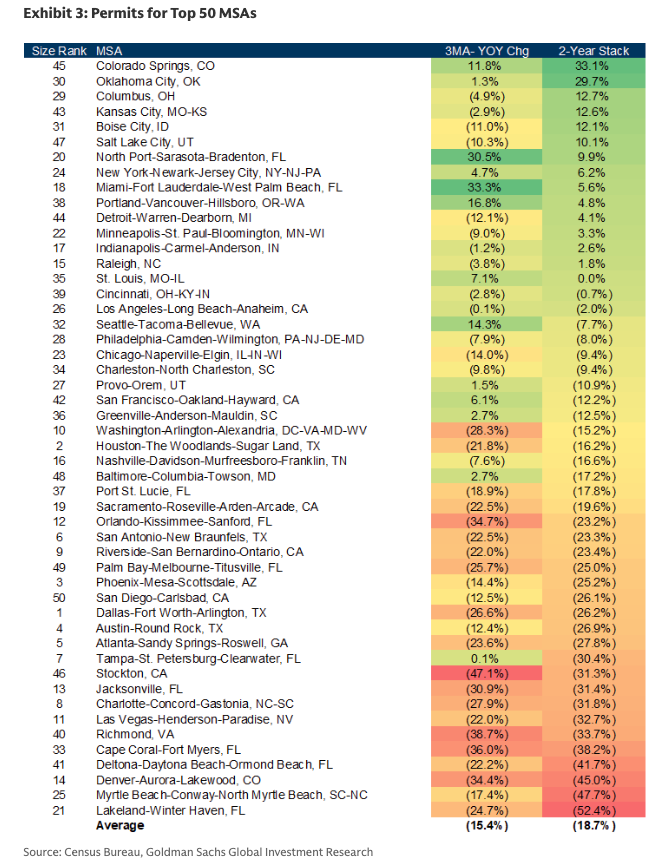
At the metro level, the permit picture is deteriorating across the top 50 metro areas, with permits down 15% from one year ago, and some of the sharpest declines are in places such as Stockton, Richmond, and Cape Coral.
Permits in the top 50 MSAs declined 15% YOY for the 3 months ended December vs -13% in December and -4% in January 2025. On a YOY basis, Miami, FL (+33%), North Port, FL (+31%), and Portland, OR (+17%) showed the greatest gains while Stockton, CA (-47%), Richmond, VA (-39%), and Cape-Coral, FL (-36%) lagged. On a 2-year stack, growth was led by Colorado Springs, CO (+33%), Oklahoma City, OK (+30%), and Columbus, OH (+13%) while Lakeland-Winter Haven, FL (-52%), Myrtle Beach, SC-NC (-48%), and Denver, CO (-45%) had the largest losses.
Trailing 12 Month Single-Family Permits by State
Trailing 3 Month Single-Family Permits by State
Permits for Top 50 MSAs
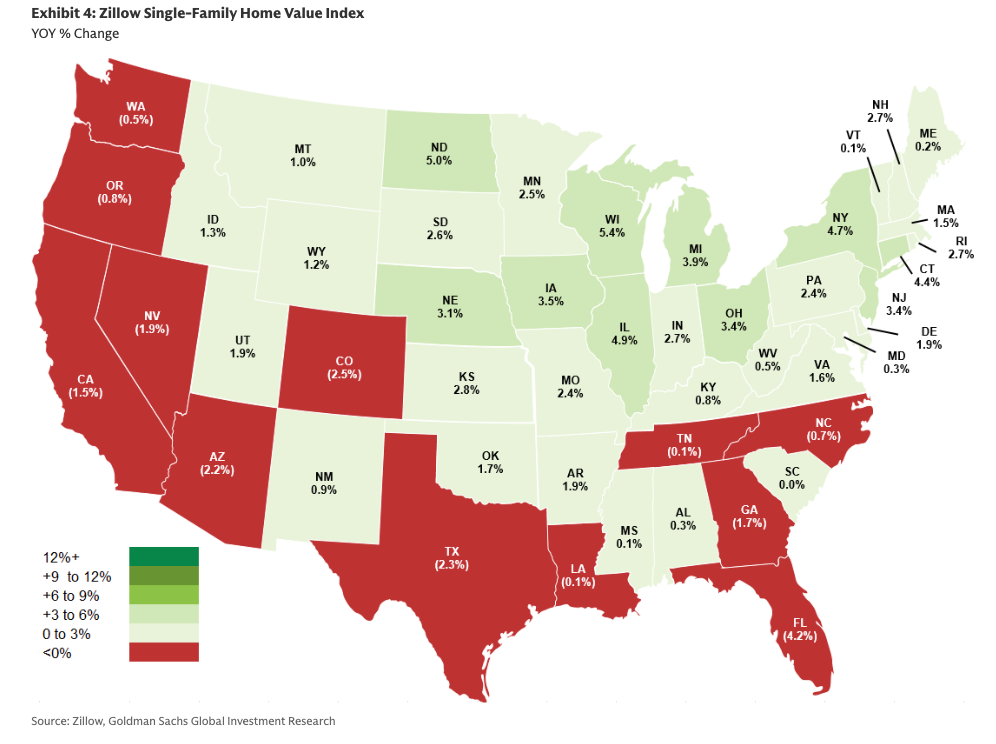
A look at home prices shows the market is still rising nationally, but momentum has cooled.
Zillow’s single-family home value index showed prices were modestly higher in February versus one year ago, in line with January and below the 3% annual gain seen a year ago. The data shows that home values remain up 55% since February 2019.
Regionally, home price strength was concentrated in the Midwest and parts of the Northeast, with Wisconsin, North Dakota, Illinois, and New York each posting 5% annual increases, while Connecticut, Michigan, and Iowa rose 4%. Sun Belt weakness persisted due to oversupply concerns, led by a decline in Florida, while Colorado, Texas, Arizona, Nevada, and Georgia were down around 2%.
The slowdown in permits suggests the spring selling season may be weaker than expected. Builders remain wary of demand, and with mortgage rates moving higher and uncertainty growing due to the US-Iran conflict, the housing market as a whole appears to be in continued paralysis.
Professional subscribers can read the full “Americas Building” note at our new Marketdesk.ai portal
Tyler Durden
Sun, 03/29/2026 – 09:55
Trump Asks Congress To Pass Clean Reauthorization Of FISA Spy Powers
Trump Asks Congress To Pass Clean Reauthorization Of FISA Spy Powers
Authored by Joseph Lord and Nathan Worcester via The Epoch Times,
President Donald Trump asked Congress this week to pass a clean reauthorization of a critical—but controversial—spying authority as the U.S. military operation in Iran continues.
“I have called for a clean 18-month extension,” Trump wrote in a post on Truth Social, noting that Senate Majority Leader John Thune (R-S.D.) and House Speaker Mike Johnson (R-La.) are working toward passing such a bill.
Specifically, Trump is asking Congress to extend the authorities in Section 702 of the Foreign Intelligence Surveillance Act (FISA), a sweeping War on Terror-era spying authority that has seen wide abuse by federal intelligence agencies in the past.
Section 702 targets intelligence from foreign nationals thought to be outside the United States. Yet, it also enables intelligence agencies to gather information from Americans who are in contact with targeted non-U.S. persons—all without a warrant. The controversial authority was at the center of National Security Agency whistleblower Edward Snowden’s 2014 disclosures.
Although intelligence officials must obtain a warrant to access Americans’ data, Section 702 has long caused bipartisan discomfort on Capitol Hill and beyond.
Trump noted in the post that he himself had been on the receiving end of what he described as “the worst and most illegal abuse of FISA in our Nation’s History,” referencing disclosures that revealed that the FBI had used Section 702 of FISA to spy on Trump’s 2016 presidential campaign as part of the Crossfire Hurricane operation.
Nevertheless, Trump said, “When used properly, FISA is an effective tool to keep Americans safe.”
“For these reasons, I have called for a clean 18-month extension, HOWEVER, the Critical and Common Sense Reforms that were made in the last Reauthorization of FISA must remain intact to protect the American People from abuses.”
In an extension of the authority passed last year, Congress imposed new training requirements for those with access to the FISA Section 702 database, stricter requirements for justifying queries into the database, requiring high-level approval to query the information of politically-sensitive individuals, and mandatory consequences for willful abuse of the program.
“Since the first day … my Administration has worked tirelessly to ensure these Reforms are being aggressively executed at every level of the Executive Branch to keep Americans safe, while protecting their sacred Civil Liberties guaranteed by our Great Constitution,” Trump wrote.
The president said that permitting the program to continue was crucial in view of the ongoing hostilities with Iran.
“The fact is, whether you like FISA or not, it is extremely important to our Military. I have spoken to many Generals about this, and they consider it vital. Not one said, even tacitly, that they can do without it—especially right now with our brilliant Military Operation in Iran,” Trump wrote.
Bipartisan Skepticism
However, bipartisan doubts about the extensive program remain, despite efforts among supporters of Section 702 to amplify the reductions in abuse brought about in the wake of the reforms.
Reps. Thomas Massie (R-Ky.) and Lauren Boebert (R-Colo.) signaled opposition on March 17 in posts on X. That same day, Rep. Anna Paulina Luna (R-Fla.) endorsed reforms to the law in a conversation with reporters.
Rep. Andy Harris (R-Md.), who chairs the House Freedom Caucus, told reporters on March 18 that 18 months is too long.
“I hope there’s some room for negotiating a couple of smaller reforms into it to show good faith, that they know there are problems,” he said.
Meanwhile, House Judiciary Committee Chair Jim Jordan (R-Ohio)—like Trump, a past critic of FISA—has backed its renewal.
Ahead of a March 18 briefing, he told reporters that the FBI has boosted compliance with Section 702’s querying procedures—guardrails to shield Americans from FISA wiretapping.
A review of FBI Section 702 compliance from the Department of Justice’s Office of the Inspector General identified more than 60,000 noncompliant queries in 2021 alone.
During a March 19 press conference, House Minority Leader Hakeem Jeffries (D-N.Y.) said, “It’s clear that FISA reforms are necessary.”
“Every single Democrat will oppose the rule,” Jeffries said, referring to a procedural step that Johnson could take to advance the extension that would come ahead of a final vote.
Tyler Durden
Sun, 03/29/2026 – 09:20
https://www.zerohedge.com/political/trump-asks-congress-pass-clean-reauthorization-fisa-spy-powers

‘Incredibly Problematic’ – Iran Destroys US AWACS Jet At Saudi Airbase
‘Incredibly Problematic’ – Iran Destroys US AWACS Jet At Saudi Airbase
In a major feat that comes weeks after the White House claimed that Iran’s ballistic missile capability had been “functionally destroyed,” Iran has laid waste to one of only 16 American E-3 Sentry Airborne Warning and Control System (AWACS) aircraft in the world, sending $500 million worth of technology up in smoke and crimping the US military’s ability to maintain situational awareness. The same attack also “damaged” several aerial refueling tankers and added a dozen service members to the tally of more than 300 who’ve been wounded in the month-long US-Israeli war on Iran. Thirteen have been killed.
In recent days, foreign satellite images showed what appeared to be major damage at Prince Sultan Air Base, a U.S. military base located in Al Kharj, Saudi Arabia.
The images show damage on the base’s main apron, which holds high-value aircraft.
While high-resolution commercial satellite imagery of the region from U.S.-based geospatial companies will be delayed for days, if not weeks, new ground-level photos apparently show the aftermath of Iranian drone and missile strikes.
Images have emerged revealing that the Wall Street Journal’s initial report that the half-billion-dollar aircraft was merely “damaged” was an enormous understatement. Rather, a large portion of the fuselage has been obliterated, along with the distinctive 30-foot-diameter, 6-foot-thick rotating radar dome that’s mounted atop AWACS aircraft.
The images of the destroyed E-3 Sentry were first posted on the Air Force amn/nco/snco Facebook page:
According to military aviation aficionados, the identifier “OK 81-0005” — visible on the severed tail — confirms this particular aircraft was an E-3G named “Captain Planet,” which deployed to the Middle East theater from Oklahoma’s Tinker Air Force Base. It’s not clear if any of the recently-wounded service members were associated with the aircraft, which was destroyed in a missile-and-drone attack on PSAB.
“The loss of this E-3 is incredibly problematic, given how crucial these battle managers are to everything from airspace deconfliction, aircraft deconfliction, targeting, and providing other lethal effects that the entire force needs for the battle space,” Heather Penney, a former F-16 pilot and director of studies and research at AFA’s Mitchell Institute for Aerospace Studies, told Air & Space Forces Magazine.
The now-destroyed “Captain Planet” E-3G on a better day (via entxuncutt)
The destroyed E-3 was one of six stationed at the Saudi base and only 16 active craft in the entire Pentagon inventory — and all of them can’t even be counted on, on any given day:
The E-3 is aging, and its capabilities are falling behind those of some major adversaries. The Air Force’s E-3 fleet has dwindled down to 16 as the service retires less-capable planes. In fiscal 2024, E-3s had a mission-capable rate of about 56 percent, meaning a little more than half were able to fly and carry out their missions at any given time. — Air & Space Forces
Despite its B-list status, earlier Iranian successes have elevated the E-3 Sentry’s importance. Iran reportedly damaged a $1.1 billion AN/FPS-132 radar at Al Udeid Air Base in Qatar — one of just six in the world — and blew up a nearly $500 million AN/TPY-2 THAAD radar at Muwaffaq Salti Air Base in Jordan. There’s reason to believe other radars suffered similar fates, thwarting US detection and response to incoming fire. The radars take years to replace. In the ultimate example of financially-asymmetric warfare, Iran may have used drones that cost between $10,000 to $30,000 each to inflict some or all of that damage.
The AN/FPS-132 phased-array radar in Qatar was damaged by Iran.
Satellite imagery shows debris from the damaged radar face scattered across the roof of the main building, along with visible water runoff from firefighting efforts. pic.twitter.com/HvPEIwF4la
— The Cradle (@TheCradleMedia) March 4, 2026
AWACS have figured in every major US military engagement since their debut in the 1970s. Speaking of history…at a time when people like recently-resigned Counterterrorism Center director Joe Kent are calling for President Trump to stand up to Israel and chart a new America-first course in this war and in the future, note that the AWACS played a central role in one of the few times an American president has rebuffed Israel’s attempts to steer US foreign policy.
In 1981, Israel and the powerful American Israel Public Affairs Committee (AIPAC) mounted a fierce campaign to thwart an arms deal with Saudi Arabia, because it included AWACS. Israel and its US-based backers argued that the move would erode Israel’s military superiority in the region. President Reagan stood firm against the Israel/AIPAC backlash, calling a press conference in which he declared:
“While we must always take into account the vital interests of our allies, American security interests must remain our internal responsibility. It is not the business of other nations to make American foreign policy.”
Reagan’s aggressive lobbying of legislators pushed the deal across the finish line. However, in an exasperating postscript, we must note that Reagan felt compelled to promise Israel another F-15 squadron and $600 million in credits to smooth things over. Alas, even when Israel was rebuffed, the conveyor belt that ceaselessly redistributes wealth from America to Israel ran only harder.
The takeaway is that the Iranian strike on PSAB, which may have eliminated one E-3 from the USAF’s already tiny fleet, exposed weaknesses in U.S. counter-drone and counter-missile defenses, as well as broader battlespace awareness.
* * * Lot going on lately. Try IQ whole bean fortified coffee. Contains:
MCT Oil
Alpha-GPC
L-Theanine
Ashwagandha
Snag some here.
Tyler Durden
Sun, 03/29/2026 – 08:45

North Sea Oil Fight Escalates As Starmer Cites Legal Limits
North Sea Oil Fight Escalates As Starmer Cites Legal Limits
Authored by Mauricio Alencar via City A.M.,
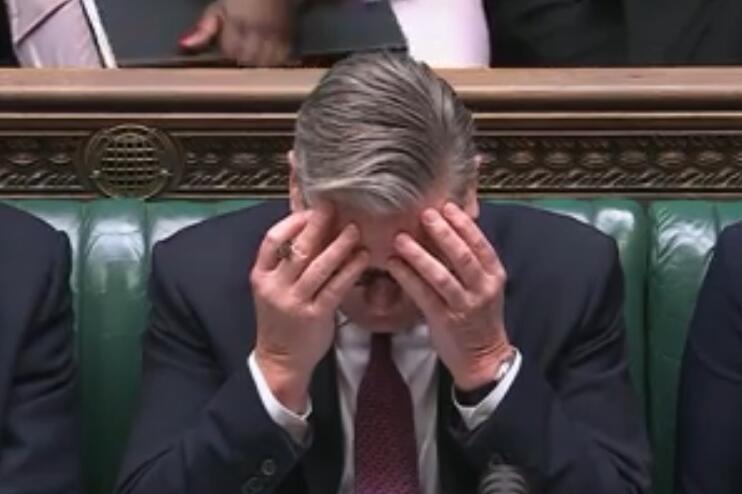
Sir Keir Starmer has said he doesn’t hold legal powers to approve fresh exploration of North Sea oil and gas fields, with the decision falling in the hands of net zero secretary Ed Miliband.
Starmer said current legislation determined that a quasi-judicial decision relating to cases for more gas extraction at Shell’s Jackdaw site and Equinor’s Rosebank oil field was left to Miliband.
The Prime Minister reiterated the government’s commitment to expanding renewable energy. He said the introduction of fresh legislation would “slow the process down” and accused the leader of the opposition, Kemi Badenoch, of failing to know about the law before raising questions in Parliament.
“Its absolutely clear that the quasi judicial [process] lies with secretary of state,” Starmer said.
“In the last four weeks, because we are on a fossil fuel rollercoaster, everyone is being held to ransom.”
He added: “The most important thing to get energy security is to make sure we de-escalate the war.”
Starmer backed by Davey
Scottish courts ruled government approvals for more extraction at each field as unlawful on environmental grounds.
The power now falls on the energy secretary to make a decision while considering economic and environmental reasons for projects.
Badenoch accused Starmer of “hiding behind legal process every time” though Liberal Democrat leader Ed Davey, who served as the energy secretary in the coalition government, said he agreed with the Prime Minister.
The Tory leader heckled Davey to “stop sucking up”. She also shouted out “you can change the law” and repeated the word “weak” several times.
Starmer is facing growing pressure to remove restrictions on North Sea oil and gas projects from officials working across clean energy.
Jurgen Maier, who oversees Great British Energy, the publicly owned investment company, said in a post on LinkedIn that more drilling in the region would support a “managed energy transition”, slow job losses and improve tax receipts.
However, he said that energy costs would not be brought down and later emphasised he was “fully supportive” of the government’s position to use existing fields for further exploration.
Prime Minister’s Questions also came just a day after the lobby group Offshore Energies UK (OEUK) called on the government to “urgently” allow new drilling projects to take place.
Its annual report said much as half of the UK’s liquified natural gas (LNG) will come from international suppliers by 2035.
David Whitehouse, chief executive of OEUK, said:
“As demand rises and electricity use accelerates, weakening domestic supply would only increase our reliance on imported LNG, leaving consumers more exposed to global volatility and higher emissions.”
Tyler Durden
Sun, 03/29/2026 – 08:20
https://www.zerohedge.com/energy/north-sea-oil-fight-escalates-starmer-cites-legal-limits

Watch: Trump Arms Control Official Refuses To Confirm Israel Has Nukes
Watch: Trump Arms Control Official Refuses To Confirm Israel Has Nukes
In the latest indication of America’s deteriorating relationship with the State of Israel, a federal legislator used a Capitol Hill hearing to ask a simple but long-forbidden question of America’s top arms control official: “Does Israel have nuclear weapons?”
The official repeatedly refused to say what everyone knows — that Israel has hundreds of nuclear weapons. Worse, straining credulity, he told his interrogator, Texas Democratic Rep. Joaquin Castro, that “it would be outside of my purview as the arms control and arms proliferation under secretary to discuss that specific question.” Castro replied, “Sir, that is a dereliction of duty.”
The exchange took place in a House Foreign Affairs Committee hearing on Wednesday, with Castro grilling Under Secretary of State for Arms Control Thomas G. DiNanno. Castro persisted through DiNanno’s repeated dodging of the question. “The consequences, as you know, are grave. This war continues to escalate,” said Castro. DiNanno also refused to say if he himself knew the answer but was not allowed to say so.
We are four weeks into a war where both sides have targeted each other’s nuclear facilities.
We risk nuclear disaster. Yet the main Trump official on arms control refused to answer my question on Israel’s nuclear capabilities and told me to ask the Israeli government. pic.twitter.com/Sxnru3EIrl
— Joaquin Castro (@JoaquinCastrotx) March 25, 2026
“Tell us something — as Congress, as the oversight body — what is Israel’s nuclear capability in terms of weapons?” asked Castro. In reply, DiNanno didn’t refer Castro to US intelligence agencies, but — compounding the insult to the committees’ intelligence — told Castro to ask “the Israeli government.”
“You’re the main person in charge of knowing this and understanding it,” said Castro. “I don’t understand why this issue is so taboo, when it’s a basic question, and we’re in a war alongside Israel against Iran, we’re dealing with the potential for nuclear fallout, and you won’t answer this basic question.”
A big reason why it’s taboo went unmentioned during the hearing. Because Israel is not a member of the Nuclear Non-Proliferation Treaty and also has nuclear weapons, every dollar of aid to Israel breaks American law. Beyond that, the feigned official ignorance about Israel’s nuclear arsenal is meant to obscure the sheer hypocrisy of nuclear-armed Israel — a country with a government increasingly dominated by expansionist and religious zealots — decrying Iran’s enrichment of uranium, particularly given the US intelligence community has repeatedly assessed that Iran stopped its initial pursuit of such weapons 23 years ago.
As Brian McGlinchey explains at Stark Realities, US officials’ refusal to talk about Israel’s nuclear arsenal isn’t a mere unwritten understanding:
Perversely, U.S. government employees who dare discuss or release information about Israel’s nuclear weapons program—and thus illuminate the ongoing criminality of U.S. aid to Israel—would themselves be subject to prosecution, thanks to a secret classification directive issued by the Obama administration.
The two-page gag order was released in 2015 in response to a Freedom of Information Act request. Other than the title—“Guidance on Release of Information Relating to the Potential for an Israeli Nuclear Capability”—nearly every word has been redacted.
Castro is just one of many legislators who have enjoyed the financial backing of the powerful American Israel Public Affairs Committee (AIPAC), but who is now going astray. Over his political career, Castro has received $115,000 from the pro-Israel lobby and its backers, according to TrackAIPAC, whose entry on Castro suggests he’s been straying from the lobby’s directives.
Castro’s grooming by Israel and AIPAC goes all the way back to at least 2008. When he was merely a 33-year-old, up-and-coming member of the Texas legislature, the Israeli government hosted him and 19 other Latino politicians on a two-week trip to Israel. In an obscure video of a 2012 AIPAC luncheon in San Antonio, an unidentified speaker enthused over the AIPAC-groomed Castro’s pending election to a reliably Democratic US House seat, and what that meant for the pro-Israel cause: “He has tremendous opportunity to…ascend into some very strong committees, because…he basically has the opportunity to be there as long as he wants to be there.”
This week, Castro was able to grill DiNanno thanks to Castro’s membership on the “very strong” House Foreign Relations Committee. How do you like your guy now, AIPAC?
Tyler Durden
Sun, 03/29/2026 – 07:35

UK’s Ofcom To Investigate Complaints Of Climate-Change Denial
UK’s Ofcom To Investigate Complaints Of Climate-Change Denial
Authored by Paul Homewood via notalotofpeopleknowthat blog,
This is frightening. Indeed it is truly Orwellian…
From the Guardian:
A U-turn by the UK’s broadcasting regulator Ofcom means it will investigate complaints of climate change denial on television and radio for the first time since 2017. The move marks a victory for campaigners who have accused the regulator of allowing some broadcasters “to spout dangerous climate lies” and “flout” rules on accuracy and impartiality.
Complaints about programmes on TalkTV and TalkRadio were assessed by Ofcom, which then decided not to investigate, the same result as more than 1,000 other climate complaints since 2020. However, after a letter from the Good Law Project (GLP) in January, requesting an explanation for the rejections, Ofcom said it had withdrawn its original decision and would “consider afresh” the complaints.
One complaint was about comments from a Talk guest who said in November that climate change “was a deliberate effort to create fake anxiety … out of something that is false”. In the second case, also in November, another guest said the Labour government’s energy policies were “suicidal”, “driven by pseudoscience in many cases” and “a kind of cultish behaviour”.
A reassessment led Ofcom to conclude its approach to “due impartiality” in the broadcasts “required reconsideration”, with the results of the investigations to be published in due course. Ofcom stuck by its decision to not investigate three other climate complaints.
“Rightwing channels have been allowed to spout dangerous climate lies, unchecked, for too long,” said a GLP spokesperson. “We’re glad Ofcom is finally listening and await the conclusion of the investigations. Should it fail to take action against Talk’s misinformation, we will not hesitate to hold them to account.”
An Ofcom spokesperson said: “In re-examining the programmes, we concluded that they raise potentially substantive issues under the broadcasting code which warrant investigation. We have, therefore, opened investigations [on] whether they breached our rules on due impartiality and material misleadingness.” Ofcom said it had also opened another climate-related investigation after a viewer complaint about another TalkTV programme.
A spokesperson for Talk said: “We, as we always would, will cooperate with Ofcom in these matters.”
Full story here.
The first point to make is that there are already rules in place to address factually inaccurate news reporting. But this is not what is at issue here.
OFCOM, it appears, now want to police free speech. Both of these new complaints concern the views of guests, not the journalists or presenters.
Guests on these sort of shows make all sorts of outlandish, and sometimes patently false, comments about all sorts of topics. That is their right. We still have something called freedom of speech in this country.
OFCOM does not get involved in these other cases, so why should they intervene when the topic is climate change?
This decision to intervene in free speech by OFCOM opens a whole new barrel of worms.
What will happen in future if somebody challenges the establishment line on, say, hurricanes?
There is a wide variety of scientific opinion on most climate topics. Will OFCOM be the new arbiter of which version is “correct”?
Will they ban anybody who dares offer a different opinion, or, heaven forbid, dare to quote some facts?
Maybe OFCOM will also ban all use of fraudulent weather attribution models, but I somehow doubt it!
This is a chilling suppression of free speech. “Truth” is fine, but who decides what is true and what is not? OFCOM? The Government? BBC? UN?
And it won’t stop with climate change. How long before we are not allowed to call Starmer the worst PM ever? Or dare to criticise his Government?
We will end up with George Orwell’s Ministry of Truth, where the Government decides what is right and what is wrong.
“The Party told you to reject the evidence of your eyes and ears. It was their final, most essential command”
Tyler Durden
Sun, 03/29/2026 – 07:00
https://www.zerohedge.com/geopolitical/uks-ofcom-investigate-complaints-climate-change-denial
Escobar: The Long And Winding Petro-Gold Road
Escobar: The Long And Winding Petro-Gold Road
Authored by Pepe Escobar,
The 15-point plan that Team Trump presented to Iran is already D.O.A.
It’s an imposed capitulation: a surrender document disguised as “negotiation”.
The non-plan plan – imposing demands while begging for a one-month ceasefire – includes zero uranium enrichment on Iranian soil; full dismantlement of Natanz, Isfahan and Fordow installations; all enriched uranium out of Iran; the missile program extremely restricted; no funding for Hezbollah, Ansarallah and Iraqi militias; the Strait of Hormuz totally opened.
All that in exchange for a vague “cancelling the threat of reimposing sanctions”.
The only realistic Iranian response to this accumulated wishful thinking might be Mr. Khorramshahr-4 showering his business card across selected targets – consistent with leveraging economic and military deterrence to dictate the real terms.
And the real terms are harsh:
Closure of ALL US military bases in the Gulf; guarantee of no more wars; end of the war on Hezbollah; lifting of ALL sanctions; war damage reparations; a new order in the Strait of Hormuz (already in effect: collecting fees just like Egypt in Suez); missile program intact.
Conclusion: the infernal escalation machine keeps rolling.
A Member’s Club With an Entrance Fee in Petroyuan
Meanwhile, oil and gas prices are mired in a kaleidoscope of volatility, affecting currencies, equities, commodities, supply chains, inflation scares. This is already an out-of-control global economic shock with devastating consequences in progress.
Before the war, Iran was producing a little less of 1.1 million barrels of oil a day, sold at $65 a barrel with a $18 discount: thus, in practice only $47. Now, Iran has increased production to 1.5 million barrels a day, selling at $110 (and counting), mostly to China, with a maximum $4 discount.
And that does not even include petrochemical sales: on the up and up, and for an array of extra customers. To round it all up, all payments are conducted via alternative mechanisms. Which brings us to a startling fact: for all practical purposes, this is sanctions relief in effect.
Now for the Holy Grail in the war: the Strait of Hormuz. It is de facto open, but with a toll booth controlled by the IRGC.
A toll booth with a twist: veto power over the guest list. Like entering an exclusive private club.
To get the IRGC clearance, a tanker needs to pay the toll: $2 million per vessel.
This is how it works.
You contact an IRGC-linked broker. The broker relays to the IRGC the essential info: vessel ownership, national flag, cargo manifest, destination, crew list, and AIS transponder data.
The IRGC runs background checks. If you are not US-linked, not shipping any Israel-linked cargo, and your flag is not part of “aggressor states”, you’re in. Japan and South Korea, for instance, still have not been cleared.
Then you pay the toll. In cash – whatever currency you have – but preferably in yuan. Or in crypto.
It’s a complex mechanism. The IRGC uses multiple addresses; cross-chain bridges to other networks; over-the-counter desks in jurisdictions way beyond American reach; and integration with all sorts of yuan settlement channels.
After the toll is paid, the IRGC issues a VHF radio clearance – complete with a specific time window linked to a narrow 5-mile nautical corridor through Iranian territorial waters, between Qeshm and little Larak island, where the IRGC Navy can visually identify your vessel. You’re free to go. No need for an escort ship.
All of the above applies, for now, to tankers from China, India, Pakistan, Turkiye, Malaysia, Iraq, Bangladesh, Russia. Some don’t need to pay the full toll. Some get exemptions – on government-to-government basis (as in Sri Lanka and Thailand, both described as “friendly nations”). And some don’t pay anything.
So welcome to a member’s club with an entrance fee mostly in petroyuan. It took a single move from Iran to achieve what endless global summits could not: establishing an alternative settlement system – under fire, tested under supreme stress, and on top of it applied in the most consequential chokepoint on the planet.
Each toll paid in petroyuan bypasses the petrodollar, SWIFT and US sanctions – all in one go. The Iranian parliament will approve legislation institutionalizing the toll booth as “security compensation.” No one saw this coming – and so fast: legalized chokepoint monetization. Without firing a shot. This is what de-dollarization trade is really all about.
The problem is what is not transiting Hormuz: fertilizers. Over 49% of urea for export comes from the Persian Gulf. Ammonia needs natural gas; but Qatar declared Force Majeure after the Epstein Syndicate attack on South Pars and the Iranian counter-strikes. The IRGC is focused on oil because oil finances the tool booth and long term, is at the heart of the post-dollar energy settlement system, fully supported by the Russia-China strategic partnership.
So it’s no wonder the Empire of Chaos and Plunder has gone bonkers. In a flash, in three weeks, we have the petroyuan ruling over the – de facto privatized – most important naval connectivity corridor on the planet. So CENTCOM will go all out Terminator to demolish the tool booth, attempting everything from bombing IRGC installations along the coast and setting up naval escorts for allied tankers to a tsunami of sanctions on toll booth brokers.
What CENTCOM cannot bomb is the precedent of the petroyuan in effect. The whole Global South is watching and doing the math. The whole demented war is actually helping a new payment infrastructure to come to light. The war’s financial dimension is even more crucial than missile breakthroughs.
What Awaits the GCC
Qatar warned Trump 2.0, over and over again, that attacking Iran’s energy infrastructure would destroy Doha’s own energy infrastructure. That’s exactly what happened. Qatar’s energy minister al-Kaabi revealed that he warned the US Secretary of Energy, Chris Wright, as well as executives at ExxonMobil and ConocoPhillips day after day.
To no avail. Qatar ended up losing 17% of its LNG capacity: $20 billion in lost revenue, and as many as 5 years to fix it. Al-Kaabi: oil could hit $150 a barrel, and this war could “bring down the economies of the world.”
We reach absurdist territory when it’s clear that striking Iran’s South Pars generated less than zero strategic advantage. On the contrary: the counterpunch hit the Persian Gulf energy sector. Yet perversity actually rules. Who ultimately benefitted? American gas companies.
Iran is betting – and that is immensely ambitious – that the Gulf monarchies will eventually do the math. It’s as if Tehran is making it quite clear: if you learn to do business with us, we will let you continue to do your own business.
The new rules include everything from the GCC bypassing the petrodollar to getting rid of US data centers. And if the GCC wants a new security arrangement, better talk to China. All that while the GCC also has to learn how to deal with this oil shock permanently repricing the risk premium on their energy supply. Structural reset does not even begin to describe it.
As it stands, there’s only one certainty: the GCC will be instrumental in the international financial system implosion as it gets ready to pull at least $5 trillion out of the US market so they may be able to fund their survival.
The Long and Winding Petro-Gold Road
To sum it all up: after the attack on the South Pars gas field – the largest on the planet – and the toll booth in the Strait of Hormuz, it’s yuan-gold settlements, all across the spectrum, that are giving the Russia-China strategic partnership an upper hand unthinkable only a few weeks ago.
The strategic partnership is locking in no less than a new, rising global settlement mechanism, where petroyuan trades flow straight into physical gold.
As Russia sells massive volumes of oil and gas not touched by the war on its ally Iran, China as the top refiner buys Russian energy while at the same time trying to support its Southeast Asian partners outside of the US dollar.
Russia is converting yuan payments into physical gold at the Shanghai Stock Exchange. Iran is accumulating yuan payments in Hormuz – boosting yuan oil contracts that are convertible to gold. And China is building overseas gold vaults and corridors. The new Primakov triangle, RIC (Russia-Iran-China) is in control via real physical energy and gold.
So this is the major take away of the Epstein Syndicate war on Iran. Russia-China reach the Holy Grail: energy dominance and a gold-backed yuan settlement that bypasses the petrodollar to Kingdom Come.
For all practical purposes, the architecture set up by the “indispensable nation” since the 1990s is showing structural cracks for everyone to see, with global markets updating every possible model variation in real time.
It’s as if the Persians had reinterpreted Sun Tzu, Clausewitz and Kutuzov (the conqueror of Napoleon) into a whole new hybrid. And as a bonus, accomplishing in only three weeks what years’ worth of summits could not.
The petrodollar is on the way out. Alternative payment systems are up and running. And the Global South is watching in real time how the Empire of Endless Bombing can be brought to a standstill by a decentralized war of attrition engineered by a sovereign nation with one-fiftieth of the imperial defense budget.
Multipolarity won’t be born by suits reading papers in executive rooms. Multipolarity will be born in the battlefield, under fire, against all odds.
You will see why it matters so much:
“Pointed threats, they bluff with scorn
Suicide remarks are torn
From the fool’s gold mouthpiece the hollow horn
Plays wasted words, proves to warn
That he not busy being born is busy dying”
Bob Dylan
It’s Alright, Ma (I’m Only Bleeding)
* * *
Views expressed in this article are opinions of the author and do not necessarily reflect the views of ZeroHedge.
Tyler Durden
Sat, 03/28/2026 – 23:20
https://www.zerohedge.com/geopolitical/escobar-long-and-winding-petro-gold-road

Trump Ready To Take US Arms For Ukraine & Divert Them To Middle East
Trump Ready To Take US Arms For Ukraine & Divert Them To Middle East
The Iran war has been bad for Ukraine, and President Zelensky knows it. He’s frequently been warning partners not to let the global focus on the latest Middle East war distract from supporting Kiev.
But President Trump himself made fresh remarks highlighting just this situation, signaling he’s willing to reroute arms originally tied to Ukraine toward the Middle East theater against Iran, reinforcing the obvious and growing pivot in US priorities.
Reporter: Is the U.S. diverting some munitions that were meant for Ukraine to the Middle East?
Trump: We do that all the time. We have a lot of munitions. Sometimes we take from one and use for another. pic.twitter.com/yxxCB7TlLb
— Clash Report (@clashreport) March 26, 2026
Pressed on reports that shipments were being redirected on Thursday, Trump shrugged it off as standard practice: “We do that all the time. We have a lot of munitions. Sometimes we take from one and use for another.”
He added Washington is no longer directly supplying the Ukrainian government and armed forces, but is instead “selling” weapons to NATO states that then pass them along. This has for many months been the White House’s stated plan.
According to The Washington Post, officials say the Pentagon is weighing whether to divert missile interceptors initially intended for NATO purchase for Ukraine and send them to the Middle East.
While a final decision hasn’t been made, or has at least not been publicly declared, this would be reasonable given how much US bases in the region have struggled to intercept Iran’s inbound missiles and drones.
On Friday Prince Sultan airbase in Saudi Arabia was hit, wounding at least a dozen US troops, with reports of several in serious condition. Expensive US Air Force planes were also hit.
Clearly the US needs more interceptors, and yet Ukraine has for months been raising the alarm over its need for more Patriots and other air defense systems. Russia’s assault on Ukrainian cities has not waned, but has been consistent and devastating.
In early March, Zelensky stated that “We understand that a long war–if it is long–and the intensity of the military actions will affect the amount of air defense we receive.” He emphasized: “Everyone understands that, for us, this is a matter of life.“
* * *
Make sure your protein stack is dialed in… Go with peptides.
Tyler Durden
Sat, 03/28/2026 – 22:45