Category: News

White House Intervenes After Israel Closed Church Of The Holy Sepulchre Ahead Of Easter
White House Intervenes After Israel Closed Church Of The Holy Sepulchre Ahead Of Easter
Jerusalem’s Church of the Holy Sepulchre was closed by Israeli authorities earlier this month after Iranian missile fragments hit Jerusalem, with restrictions also being placed on who can enter the walled old city – home to all of the most sacred religious sites.
This has resulted in outrage among Christians, however, Israeli officials have said that Al Aqsa Mosque was also closed, and limitations were placed numbers of people visiting the Western Wall – and claimed that all of this was being done as a safety precaution.
But closure of the Holy Sepulchre for Lent and Easter is basically unprecedented in recent history, and Church leaders say it violates the church’s historic autonomy under an arrangement called the ‘status quo’.
Things have come to a head after on Palm Sunday, two Catholic leaders were prevented from praying at the Holy Sepulchre by Israeli police. The Vatican was quick to rebuke the police decision as “a manifestly unreasonable and grossly disproportionate measure.”
Cardinal Pierbattista Pizzaballa was the top official kept from entering the church, and his name has previously been in the news over the course of the Gaza war, where he called out Israel’s military for shelling Christian sites, including a couple of deadly airstrikes on Palestinian churches.
Somewhat surprisingly, the Trump White House has gotten involved, exerting some rare direct pressure on the Israeli government over the church closure.
“We did express our concerns with Israel with respect to these holy sites being shut down,” White House press secretary Karoline Leavitt says during a briefing – as cited in Israeli press reports.
“We want worshipers to be able to access these holy sites. Of course, safety is a top priority, but we understand Israel is working on the security measures to reopen the sites throughout Holy Week, and that’s something that we’re appreciative of,” she added.
It seems the White House intervention may have worked, with Times of Israel reporting that “Catholic officials in Jerusalem announced that prayer arrangements for Holy Week, which culminates with Easter on Sunday, April 5, had been resolved with Israeli authorities, ending a diplomatic spat over the issue.”
The majority local church in the Holy Land, among Palestinians and Greeks, is the Orthodox Church of Jerusalem – part of the worldwide Eastern Orthodox communion. There are typically large throngs of Orthodox Christians descending on Jerusalem during this period. While the Western confessions – or rather the Roman Catholic and Protestant churches – will celebrate Easter on April 5, Orthodox Easter, also known as Pascha, takes place on April 16 this year.
JERUSALEM — Israeli authorities announced on March 29, 2026, a special plan allowing Christian leaders to resume services at the Church of the Holy Sepulchre, following international backlash over the obstruction of Catholic clergy on Palm Sunday.
The decision by the office of… pic.twitter.com/iW0G6ZgtuX
— UOJ – America (@UOJ_America) March 30, 2026
It’s as yet unclear the degree to which Israeli police and military will actually allow Christians to access the Church of the Holy Sephulchre before and during these dates. And the reality is that it is unlikely that the crowds will be huge or overwhelming this year, given the ongoing war and current difficulty of travel in the region.
Tyler Durden
Mon, 03/30/2026 – 22:40

Zelensky Calls For Easter Truce Amid Nightly Russian Drone Assaults
Zelensky Calls For Easter Truce Amid Nightly Russian Drone Assaults
Ukrainian President Volodymyr Zelensky is urging for an Easter holiday ceasefire with Russia, at a moment each side has sent daily and nightly drones and missiles across the border.
“We’re ready for a ceasefire during the Easter holidays,” Zelensky told reporters, describing that “normal people who respect life” would seek a permanent ceasefire. “But we’re ready for any compromises, except those involving our dignity and sovereignty,” he added.
The vast majority of both the Russian & Ukrainian populations are Orthodox Christians.
Both countries have predominantly Eastern Orthodox Christian populations, and Orthodox Easter, also known as Pascha, takes place on April 16 this year. The West, or rather the Roman Catholic and Protestant churches, will celebrate on April 5.
While full ceasefires, even short ones, have not had much success in the past more than four years of war, the two sides have previously agreed to days or even weeks of pauses on attacking energy sites. This limited truce does hold some potential.
“If Russia is ready to stop hitting Ukrainian energy facilities, we will not respond against their energy sector,” Zelensky said.
Last year saw an effort to put in place a Pascha ceasefire, called for by President Putin – however, there were widespread accusations of violations.
Putin himself attends the long Orthodox Pascha vigil each year, while Zelensky is Jewish. He became the first Jewish president of Ukraine after being elected in 2019, and has since faced accusations of persecuting Ukrainian Orthodox who maintain spiritual ties with the Moscow patriarchate.
Currently, drone attacks on mutual energy sites are continuing at rapid pace. We detailed that last week Russia set a record for the largest single-day drone assault on Ukraine of the war.
At least seven people were killed in Ukraine last Tuesday after Russia launched the truly massive drone. Counting both drones and cruise missiles, 979 warheads poured into Ukrainian airspace as diplomatic efforts at ending the war remain stalled and the world’s attention focused almost entirely on the US-Israeli war on Iran.
If some kind of Easter truce could actually hold later next month, it would constitute a significant breakthrough regarding broader diplomatic efforts toward peace, at a moment the US-mediated talks have stalled amid the Iran war in the Middle East, and removal of some sanctions on Russian oil.
Tyler Durden
Mon, 03/30/2026 – 21:50

US Firm Boosts Production Of Precision Anti-Drone Systems
US Firm Boosts Production Of Precision Anti-Drone Systems
Authored by Prabhat Ranjan Mishra via Interesting Engineering,
A Florida-based company is accelerating production of powerful systems that can counter small drone threats. VAMPIRE counter-unmanned systems (C-UxS) deliver precision strike capabilities against drones.
The system has proved its efficacy on the frontline.
Developed by L3Harris Technologies, the system is a self-contained platform that delivers advanced reconnaissance and can conduct operations against remotely piloted aircraft.
VAMPIRE counter-unmanned system installed on vehicle
L3Harris Technologies recently installed its VAMPIRE counter-unmanned system aboard a GM Defense Infantry Squad Vehicle (ISV), demonstrating a mobile solution to take out drone threats.
The facility features a flexible assembly, testing and installation area to integrate VAMPIRE onto ground vehicles and containerized weapon systems. The production line can adjust and increase volume as demand evolves.
“Deploying VAMPIRE on GM Defense’s ISV is a great example of how quickly and seamlessly this system can be used by our Army customer to defeat the rapidly growing threat of small, hostile drones,” said Tom Kirkland, vice president and general manager, Targeting and Sensor Systems, L3Harris.
“Working together, we have swiftly responded to the urgent need to defeat small unmanned autonomous systems accurately and affordably while allowing ground forces to stay tactically mobile.”
Highly adaptable to meet diverse mission
The company claims that the GM Defense ISV is uniquely engineered to fulfill U.S. Army requirements for rapid deployment. With robust off-road capabilities, the ISV significantly improves tactical mobility across a range of military operations. The vehicle is easily maintainable and highly adaptable to meet diverse mission and operational needs, according to a press release.
GM Defense partners with companies like L3Harris to design and produce diverse kits to support the broad range of mission requirements for a variety of general purpose and special operations forces. Incorporating a Counter-small UAS system like VAMPIRE adds new capability to protect operators from hostile drone attacks, as per the release.
“The versatility of the ISV is one of its core strengths, and integrating a critical counter-UAS capability like VAMPIRE showcases our ability to rapidly adapt the vehicle to meet evolving threats,” said John ‘JD’ Johnson, Vice President of Government Solutions and Strategy, GM Defense.
“This successful integration highlights how the ISV’s modular design and commercial-based architecture can quickly incorporate next-generation technologies to deliver immediate value and enhanced protection to our warfighters.”
The company also highlighted that the completely self-contained, low-cost, multi-mission, precision-guided weapons platform effectively engaged in combat operations since 2023, safeguarding personnel and critical infrastructure against hostile unmanned systems and ground threats.
The affordable, compact ISR and counter-unmanned weapons system designed to deploy on nearly any platform, vehicle or vessel, according to L3 Harris. This all-in-one system excels in Counter-small Unmanned Airborne System (C-sUAS) operations, delivering precision strike capabilities with customizable sensors and weapons, significantly reducing the cost-per-effect and overall cost of ownership, according to the company.
Tyler Durden
Mon, 03/30/2026 – 21:25
https://www.zerohedge.com/military/us-firm-boosts-production-anti-drone-systems

‘Project Hail Mary’ Writer Credits Not Going Woke For Film’s Success
‘Project Hail Mary’ Writer Credits Not Going Woke For Film’s Success
With an $80.6 million domestic opening weekend, a 95% critics’ score on Rotten Tomatoes, and a 96% audience score, Project Hail Mary is an undeniable blockbuster hit. By its second weekend, the movie crossed $300 million worldwide and dethroned Avatar: Fire and Ash as the top-grossing Hollywood film of 2026 in North America. It’s become the second-biggest non-franchise opening over the past decade, after Oppenheimer.
The Hollywood Reporter published a piece titled “Project Hail Mary: 4 Lessons Hollywood Won’t Learn From Its Success,” pointing to smart storytelling, sincerity, patience, and practical effects as the pillars behind the film’s blockbuster performance. That’s a solid four. But, it predictably missed the fifth, and arguably most important point: Don’t go woke.
In the movie, Ryan Gosling plays Ryland Grace, a science teacher and biologist who wakes up alone on a deep-space mission to figure out how to stop a microorganism from dimming the sun. He eventually makes contact with an alien on the same mission, and the two team up to save their respective worlds from extinction. The premise could have easily become a vehicle for climate allegory and geopolitical moralizing, but it didn’t.
Andy Weir, the author of the novel, sat down with Will Jordan – better known online as The Critical Drinker – on Jordan’s YouTube channel shortly after the film’s release.
“For me, it’s a great example of what you can do now with movies,” Jordan said. “If you’re faithful to the source material and you don’t insult the intelligence of your audience, and give them something really interesting to grapple with, and you know, dare I say it, [don’t] try and shove, like, crappy identity politics into it, you end up with a goddam good movie at the end of it that the people just want to watch.“
Weir’s response was immediate and unambiguous. “I think you and me are kind of on the same wavelength there when it comes to fiction writing,” he said. “I never put any politics or messaging in any of my stories at all. There’s no deeper meaning; there isn’t even any symbolism, even non-political. There’s just no symbolism at all. My books are just purely to entertain.”
Weir added. “You don’t have to worry about the message.”
This is why Andy Weir will always be one of my favorite authors. His goal is to entertain, not lecture. pic.twitter.com/5KmvOvf8c4
— Lily* (@300mirrors) March 24, 2026
That’s a best-selling author of two major Hollywood adaptations – The Martian and now Project Hail Mary – telling an audience of millions that the secret ingredient is the absence of an agenda. Not diversity hires. Not carefully calibrated representation metrics. Not a third-act monologue about social justice. Just a story, told well, about humans trying to survive.
The contrast with HBO Max’s upcoming Harry Potter series couldn’t be clearer. Last week, the teaser trailer for the first season dropped, and the internet promptly caught fire over the casting of Paapa Essiedu – a black actor – as Severus Snape. The show had been pitched as a more faithful adaptation of J.K. Rowling’s novels than the original eight films were able to be. But upon the announcement of Essiedu’s casting, fans quickly pointed to original illustrations and decades of book descriptions of Snape, and realized this was not going to be a faithful adaptation of the novels.
Following the release of the trailer, social media has been flooded with “Black Snape” memes, AI-generated edits, and videos, many lamenting how certain Harry Potter storylines and character dynamics will land differently because of the race swap. The conversation about the new series has become almost entirely about casting politics and DEI, rather than storytelling.
That’s exactly what Project Hail Mary avoided. Directors Phil Lord and Chris Miller, and a production that respected its source material, delivered a film people actually wanted to see.
Hollywood has a template now. It’s not complicated. Serve the audience, not the agenda. The question isn’t whether the lesson is available. It’s whether Hollywood is willing to hear it.
Tyler Durden
Mon, 03/30/2026 – 21:00
https://www.zerohedge.com/political/project-hail-mary-writer-credits-not-going-woke-films-success

China’s Breakthrough Lithium Battery Could Double EV Range To 600+ Miles, Survive -94°F Temp
China’s Breakthrough Lithium Battery Could Double EV Range To 600+ Miles, Survive -94°F Temp
Authored by Bojan Stojkovski via Interesting Engineering,
A team of researchers in China has unveiled an all-weather electrolyte designed to boost the performance of lithium batteries across a wide range of conditions. Scientists based in Shanghai and Tianjin report that batteries built with the new hydrofluorocarbon-based electrolyte delivered more than twice the energy density of conventional designs when tested at room temperature.
Fluorine-based electrolyte could improve EV and drone battery efficiency.
Beyond efficiency gains, the team says the chemistry remains stable in extreme environments, with batteries continuing to operate effectively at temperatures as low as minus 94 degrees Fahrenheit.
The development points to a potential path for longer-lasting, more resilient batteries suited for EVs and other demanding applications, where both energy density and reliability under stress are critical.
Batteries can store up to three times more energy
In a study published last month in the journal Nature, researchers outlined how hydrofluorocarbon-based electrolytes could help overcome long-standing limits in battery power and energy density.
The team found that, for the same battery mass, energy storage capacity at room temperature could increase by two to three times compared to conventional designs. In turn, this suggests a viable route toward significantly more efficient lithium batteries, with implications for EVs, grid storage, and other high-demand applications, the South China Morning Post reported.
The advance could significantly extend electric vehicle range, potentially increasing it from roughly 310–370 miles to about 620 miles on a single charge, the scientists noted. Beyond EVs, the technology may also enhance the performance of devices such as smartphones, drones, robots, and even spacecraft, particularly in extremely cold environments where conventional batteries tend to struggle.
At the core of any battery is the electrolyte, a chemical medium that allows ions to move between the positive and negative electrodes. For decades, most lithium battery electrolytes have relied on oxygen- and nitrogen-based compounds because they effectively dissolve lithium salts. However, these materials have limits – they don’t transfer charge as efficiently under stress, which can slow down charging, reduce performance in cold conditions, and in some cases, raise safety concerns.
New electrolyte powers lithium-metal cells in extreme temperatures
The team, part of Nankai University and the Shanghai Institute of Space Power-Sources (SISP) under the China Aerospace Science and Technology Corporation, developed fluorine-based electrolytes for lithium-metal batteries that offer lower viscosity, improved stability, and enhanced performance in cold conditions.
Using one of their hydrogen-, fluorine-, and carbon-based electrolytes, the researchers produced lithium-metal pouch cells with an energy density exceeding 700 Wh per pound at room temperature and around 400 Wh per pound at minus 58 °F.
By comparison, conventional lithium batteries reach about 136 Wh per pound at room temperature, dropping to roughly 68 Wh per pound at minus 4 °F. The researchers reported that even at minus 94 °F, their fluorine-based electrolyte maintained high efficiency and stable charge-discharge cycles.
Even with strong performance at both room and extremely low temperatures, the team noted that the electrolyte’s high-temperature stability still needs improvement. Raising the boiling point of the electrolytes could open the door to true all-climate applications, making the technology viable across a wider range of environments.
Tyler Durden
Mon, 03/30/2026 – 20:35

Even Erik Prince Warns Iran Will “Burn It Down” – Boots On The Ground Could Mean “Burning American Warships”
Even Erik Prince Warns Iran Will “Burn It Down” – Boots On The Ground Could Mean “Burning American Warships”
Even Erik Prince is warning the Trump administration to exercise extreme caution in Iran – particularly when it comes to boots on the ground.
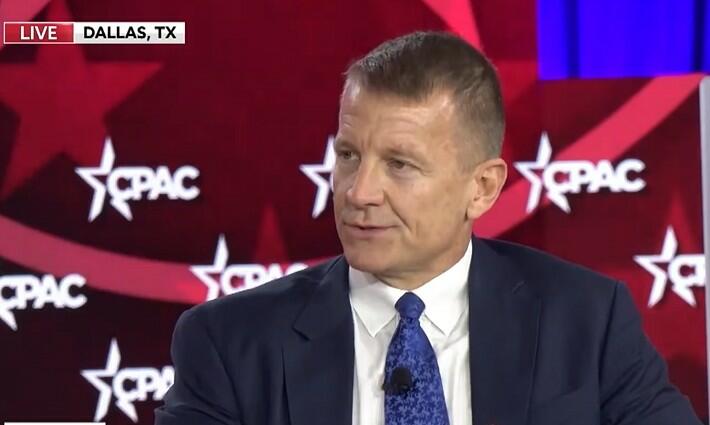
The founder of Blackwater, whose private military contractors became synonymous with the U.S. quagmire in Iraq, is pushing back hard on current U.S. strategy toward Iran. Prince issued a sobering warning at CPAC last week. Speaking on the “Breaking Stuff and Killing Bad Guys” panel, Prince expressed deep skepticism about the current trajectory of U.S. involvement in Iran:
“I don’t share the optimism of the administration that there’s going to be a peaceful stop to this. They will burn it down.”
He then highlighted the particular dangers of committing ground forces:
“And my real concern is that if they try to put boots on the ground and force the Strait of Hormuz, you will see imagery of burning American warships in the next couple of weeks. And I don’t think people are really prepared for that.”
Prince is “extremely concerned” about the escalation and noted that Iran’s leadership has been preparing for conflict with the U.S. for decades.
Echoes of Earlier Warnings
Prince cautioned strongly against any US ground commitment nearly a month ago in a March 1 appearance on Steve Bannon’s War Room.
“Don’t ever contemplate ground troops in Iran,” he said. “I don’t think a regime has ever been changed by air power alone. It’s wishful thinking.”
Erik Prince’s Advice To President Trump: “Don’t Ever Contemplate Ground Troops In Iran” @realErikDPrince pic.twitter.com/uSGgQJOBNp
— Bannon’s WarRoom (@Bannons_WarRoom) March 1, 2026
He was equally skeptical of relying on airpower for regime change:
“Airpower alone is not going to get that done.”
ERIK PRINCE: If there are negotiations with the mullahs for some kind of transition, give them the city of Mashhad almost like a Vatican where they can go and be super Islamic and strict while the rest of Iran breathes free.
Ultimately, it’s the Iranian people’s opportunity to… pic.twitter.com/9JqkM5IGo2
— Bannon’s WarRoom (@Bannons_WarRoom) March 2, 2026
The Kharg Island and Strait of Hormuz
Prince’s warnings arrive as discussions continue in Washington about Iran’s critical oil infrastructure, including Kharg Island (which handles the vast majority of Iran’s crude exports) and control of the Strait of Hormuz. Prince described a potential airborne assault on Kharg Island as “mighty thin” and “pretty sporty” due to dense missile defenses and Iran’s effective use of FPV drones down to the squad level.
At CPAC, he reinforced that Iran is no easy target and would respond aggressively to any attempt to seize or blockade key maritime chokepoints.
* * * STOCK UP AT A DISCOUNT
Tyler Durden
Mon, 03/30/2026 – 20:10

Biden-Appointed Judge Tosses DOJ Lawsuit Challenging Minnesota’s In-State Tuition For Illegal Immigrants
Biden-Appointed Judge Tosses DOJ Lawsuit Challenging Minnesota’s In-State Tuition For Illegal Immigrants
Authored by Jill McLaughlin via The Epoch Times,
A district court judge tossed out the Trump administration’s lawsuit on March 27 against Minnesota laws that allow illegal immigrants to pay in-state tuition rates, or in some cases waive tuition, for college and university classes, ruling that the state law doesn’t violate federal law.
United States District Judge Katherine Menendez, appointed in 2021 by President Biden, granted the state’s motion to dismiss the Department of Justice’s (DOJ) lawsuit, filed on June 25, 2025, finding Minnesota’s in-state tuition rules didn’t discriminate against citizens.
“As Defendants point out, there are multiple ways a student could qualify for Resident Tuition without residing in Minnesota, such as attending a Minnesota high school while living in a neighboring state, or by attending a Minnesota high school while living in a neighboring state, or by attending a Minnesota boarding school,” Menendez wrote in the decision.
The federal government sued Minnesota’s Gov. Tim Walz and other state officials over the state’s laws that allow foreign nationals to receive lower or free tuition for college.
Minnesota law states that any student, other than a non-immigrant alien, can qualify for a resident tuition rate at state universities and colleges if they attend high school in the state for at least three years and graduate from a state high school or get a high school equivalent degree.
The law also states an illegal immigrant must give the state proof they have complied with federal selective service registration requirements, filed to obtain lawful immigration status, and provide documents showing they have tried to get lawful immigration status to qualify for in-state tuition.
Menendez also agreed with Walz and Minnesota’s Attorney General Keith Ellison, who argued they should not have been included in the lawsuit by the DOJ because “none of the Minnesota statutes mention either official, and nowhere in the Complaint does the United States allege specific actions of involvement by either official.”
The judge dismissed the case with prejudice, meaning it stands as the final judgment and can’t be refiled.
Students paying in-state tuition pay half the cost of those paying out-of-state tuition. For the 2024–2025 school year, the average out-of-state tuition in Minnesota was $26,700, while in-state tuition was about $12,900, according to the Federation for American Immigration Reform.
In addition to the in-state tuition law, Minnesota passed the North Star Promise Program, signed by Walz in 2023, which gives illegal immigrants who attend high school for three years in the state the ability to qualify for free tuition, scholarships, grants, and stipends if their families make less than $80,000.
The DOJ’s lawsuit concerned the interpretation of federal immigration law that limits eligibility and preferential treatment of immigrants not lawfully present in the United States.
The law states immigrants who are not lawfully present in the country “shall not be eligible on the basis of residence within a state for any postsecondary education benefit unless a citizen or national of the United States is eligible for such a benefit without regard to whether the citizen or national is such a resident.”
In the lawsuit, the DOJ alleged the state’s policy to provide reduced and free tuition for illegal immigrants unlawfully discriminated against U.S. citizens.
The Diana E. Murphy U.S. Courthouse in Minneapolis on June 13, 2024. Michael Goldberg/AP Photo
“No state can be allowed to treat Americans like second-class citizens in their own country by offering financial benefits to illegal aliens,” U.S. Attorney General Pam Bondi said at the time of the lawsuit filing.
Federal law prohibits higher-learning institutions from providing postsecondary education benefits to immigrants that are not offered to U.S. citizens, according to the DOJ.
The DOJ, Walz, and Ellison’s offices did not immediately return requests for comment about the decision.
Tyler Durden
Mon, 03/30/2026 – 19:45
China’s EV Giant BYD Misses Earnings, Enters Brutal New Phase Of Competition
China’s EV Giant BYD Misses Earnings, Enters Brutal New Phase Of Competition
BYD is entering a tougher phase after releasing weaker-than-expected financial results and signaling growing pressure in China’s electric vehicle market, according to Bloomberg. Chairman Wang Chuanfu described the current environment as having “reached a fever pitch, and is undergoing a brutal ‘knockout stage.’”
The company’s stock fell at the opening of trading in Hong Kong, reflecting investor concerns. Its latest quarterly results showed a sharp drop in profitability, with earnings and revenue both missing forecasts. This downturn followed a challenging year overall, marked by declining annual profits despite BYD maintaining strong global sales and even surpassing Tesla in volume.
At home, the company is losing momentum. Demand in China has softened, and competition—especially from newer, technology-driven entrants like Xiaomi—is intensifying. Although revenue still grew slightly over the past year, profit margins narrowed and overall earnings declined, pointing to rising costs and pricing pressure.
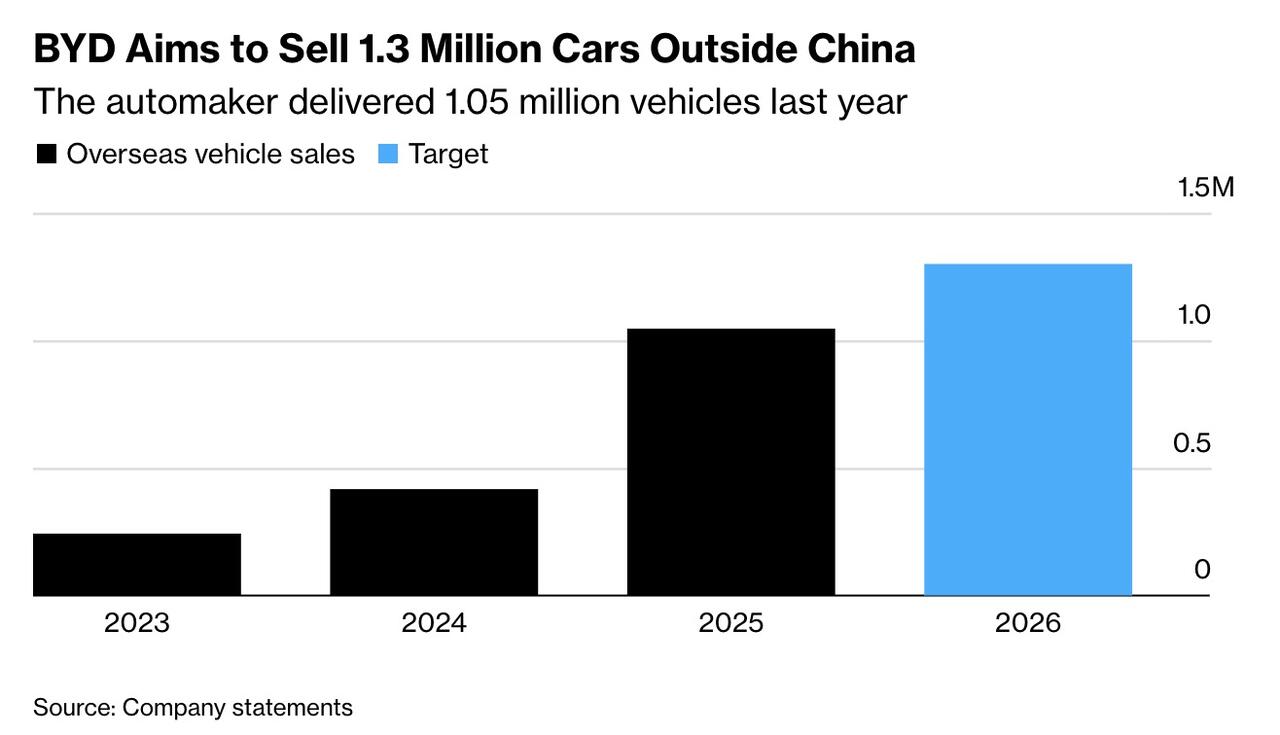
The beginning of 2026 has not reversed this trend. Domestic sales have continued to weaken, and BYD has been overtaken by Geely in the Chinese market. To offset this, the company is focusing more on international expansion, where demand remains stronger and profit per vehicle is higher. Its goal of selling over a million cars abroad highlights how critical overseas markets have become, even though building factories outside China requires significant investment.
Bloomberg writes that financial pressures are also increasing. Analysts suggest that BYD’s domestic car business could soon become unprofitable, leaving exports as the primary source of earnings. While higher oil prices may temporarily push more consumers toward EVs, sustained growth will depend on improving charging infrastructure and broader industry support.
Some of BYD’s difficulties are tied to its own strategic choices. Its “God’s Eye” driver-assistance system, once promoted as a major competitive advantage, has drawn complaints from users. The company had aimed to make this advanced feature standard across its lineup, but the rollout has exposed technical shortcomings and the risks of scaling new technology too quickly.
In response, BYD appears to be adjusting its priorities. Instead of emphasizing advanced software features, it is shifting toward practical improvements like battery efficiency and faster charging. Its latest battery technology can recharge from 10% to 70% in just minutes, signaling a move toward solving real-world concerns such as range and convenience rather than focusing solely on high-tech driving capabilities.
Tyler Durden
Mon, 03/30/2026 – 19:20
China’s EV Giant BYD Misses Earnings, Enters Brutal New Phase Of Competition
China’s EV Giant BYD Misses Earnings, Enters Brutal New Phase Of Competition
BYD is entering a tougher phase after releasing weaker-than-expected financial results and signaling growing pressure in China’s electric vehicle market, according to Bloomberg. Chairman Wang Chuanfu described the current environment as having “reached a fever pitch, and is undergoing a brutal ‘knockout stage.’”
The company’s stock fell at the opening of trading in Hong Kong, reflecting investor concerns. Its latest quarterly results showed a sharp drop in profitability, with earnings and revenue both missing forecasts. This downturn followed a challenging year overall, marked by declining annual profits despite BYD maintaining strong global sales and even surpassing Tesla in volume.
At home, the company is losing momentum. Demand in China has softened, and competition—especially from newer, technology-driven entrants like Xiaomi—is intensifying. Although revenue still grew slightly over the past year, profit margins narrowed and overall earnings declined, pointing to rising costs and pricing pressure.
The beginning of 2026 has not reversed this trend. Domestic sales have continued to weaken, and BYD has been overtaken by Geely in the Chinese market. To offset this, the company is focusing more on international expansion, where demand remains stronger and profit per vehicle is higher. Its goal of selling over a million cars abroad highlights how critical overseas markets have become, even though building factories outside China requires significant investment.
Bloomberg writes that financial pressures are also increasing. Analysts suggest that BYD’s domestic car business could soon become unprofitable, leaving exports as the primary source of earnings. While higher oil prices may temporarily push more consumers toward EVs, sustained growth will depend on improving charging infrastructure and broader industry support.
Some of BYD’s difficulties are tied to its own strategic choices. Its “God’s Eye” driver-assistance system, once promoted as a major competitive advantage, has drawn complaints from users. The company had aimed to make this advanced feature standard across its lineup, but the rollout has exposed technical shortcomings and the risks of scaling new technology too quickly.
In response, BYD appears to be adjusting its priorities. Instead of emphasizing advanced software features, it is shifting toward practical improvements like battery efficiency and faster charging. Its latest battery technology can recharge from 10% to 70% in just minutes, signaling a move toward solving real-world concerns such as range and convenience rather than focusing solely on high-tech driving capabilities.
Tyler Durden
Mon, 03/30/2026 – 19:20

An Aspirational Tech Right–Populist Right Alliance
An Aspirational Tech Right–Populist Right Alliance
Authored by Nate Fischer via American Intelligence,
The relationship between the tech right and the populist right is a central question of our day.
After an initial alliance in the lead-up to the 2024 campaign, fissures quickly appeared. The first prominent one was the Christmas H-1B fight. Others followed, both in and out of the administration. In many ways, the divide has been growing — with Bannon leading tech critiques, and Republican politicians like DeSantis staking out tech-skeptical stances. Trump has managed to keep things together, but the future is unclear.
I believe an alliance is necessary both for America’s success and for the right to have the power to dislodge the entrenched establishment left.
The simplest approach would be a pragmatic alliance of necessity — both factions push distinct priorities, and compromise where necessary to form a political coalition.
But I think we should aim for more — for an alliance between the tech right and the populist (or cultural) right that gives each group a crucial, or even heroic, role in a shared vision for America. I believe such a vision can center on (1) an appreciation for the conditions — and the people — that ultimately drive tech-enabled prosperity, and (2) an appreciation for how disruptive technology can structurally favor right-aligned constituencies and address central priorities of the cultural right.
Populists need tech:
The populist right needs tech. It may not need specific tech elites, or even anywhere close to a majority of current Silicon Valley figures, but it needs a positive vision for technology and it needs people who can master technology. Two factors drive this:
First, Americans have always been favorably inclined to technology. I believe if the parties split on technology, the pro-tech party will have a significant structural advantage with the electorate. This inclination is not new: In 1840, Tocqueville noted how Americans happily built ships that would last only a few years because of their enthusiasm for new innovations that would quickly obsolesce them. In the mid-to-late nineteenth century, Americans broadly embraced the power of technologies from the revolver to the railroad to conquer and settle the West. And America’s embrace of technology was certainly apparent in the broad popularity of the tech industry for much of the last half-century. It’s possible a tech-skeptical party can succeed in other countries, but I suspect that in America any party capable of real wins must present a positive vision for the use and mastery of technology.
Second, whether we like it or not, technology will shape the future. This has always been true to varying extents; people and groups who mastered major new technologies usually gained outsized influence, and often came to rule new regimes. In the case of major transitions like the shift to the digital age, the stakes are particularly high. Opposing technologies like AI may be a little like opposing gunpowder in the fifteenth century: many may not have liked its impact on the world, but the world was shaped by those who mastered it.
Tech needs populists:
The tech right also needs populist support. Entrenched legacy leftist interest groups retain tremendous power, and without strong opposition, will simultaneously try to stifle new technologies and squeeze technologists for the money needed to fund their ever-more-bloated programs. Populists represent large factions deeply skeptical of this legacy regime, and are capable of bringing tremendous political energy to any opposing coalition.
A populist right aligns with tech on more than just opposition to legacy elites. Right-leaning Americans are among the only people on earth broadly supportive of the free market policies and rule of law that allow Silicon Valley to thrive. While populism can create tensions with free-market and rule-of-law idealists, the broad populist right goal of cultural preservation includes restoration of the conditions necessary to preserve these norms.
Deeper alignment:
Finally, I believe the tech right and populist right need each other — not just to politically partner against common enemies, but to achieve the technological dynamism technologists pursue, and the restored status and opportunity populists seek.
This symbiosis reflects the particular character of the American people in a time of technological disruption: Americans are uniquely suited to mastering technology.
Americans are good for tech innovators–multiplying the impact of new technologies by acting not just as consumers but as creative and productive users of technology. This is not limited to a few exceptional entrepreneurs in Silicon Valley; rather, millions of Americans in companies across the country have a particular drive (relative to many other cultures globally) to find new sources of leverage and better ways to do things. These are the people who jump on new technologies that can solve such problems, embracing the change this entails. A country of such people is a country ripe for innovations that would find far smaller markets in more conservative or less resourceful societies. This particular character opens the aperture for technological innovation, and plays a key role in America’s technological dynamism.
By the same token, technologists can be good for the American people. While many tech innovations theoretically spread rapidly around the globe, in practice, Americans will often be the biggest beneficiaries of them because of this particular facility with technology–advancing the relative position of the American people in a time of global and cultural competition. This is especially true for core constituencies of the populist right, such as independent executives and skilled physical-world workers, who stand to benefit from technologies like AI – in contrast with core opposing constituencies like bureaucrats, who are ripe for replacement with AI.
Call to action:
Thus, the tech right should champion not just the free markets widely recognized as enabling Silicon Valley’s success, but also the people and culture that make America such a fertile place for technological innovation and development. Practically this means embracing both product and policy decisions that strengthen rather than undermine this culture. This means building products that solve critical problems and serve as platforms for broader productive application, and avoiding products that contribute to vice or addiction. And it means supporting immigration and trade policies that first and foremost strengthen the American people, rather than optimizing for those that serve the most immediate desires of tech companies.
The populist right should embrace technological innovation. This means encouraging Americans at all levels to master new technologies, recognizing the potential of such technologies to advance America’s position versus geopolitical rivals and the position of core populist right constituencies domestically. And it means politically supporting tech leaders who accept their responsibility to the American people – supporting policies that allow continued innovation, and protecting successful innovators from the confiscatory efforts of the left.
The alliance I propose is aspirational: Today, many in Silicon Valley – even many who would see themselves on the right – have little regard for the priorities of the populist or cultural right. And many populists more easily see the immediate threats that social media poses to families and that AI poses to jobs, and they remember with distrust the degree to which tech companies embraced censorship and deplatforming. But I believe the need for political alliance is clear, and the potential alignment toward a shared vision far deeper than many recognize. One of the great opportunities for statesmanship in coming years is the forging of such an alliance.
Tyler Durden
Mon, 03/30/2026 – 18:55
https://www.zerohedge.com/political/aspirational-tech-right-populist-right-alliance