Category: News
Oracle Firing Tens Of Thousands As CDS Explodes To Financial Crisis Record
Oracle Firing Tens Of Thousands As CDS Explodes To Financial Crisis Record
Two months ago, when ORCL announced it would raise $50 billion in a combination of stock and bonds to ease market fears about its soaring funding costs and lack of actual revenues and “to build additional capacity to meet the contracted demand from the company’s largest cloud customers, including Advanced Micro Devices, Meta Platforms, Nvidia, OpenAI, TikTok and xAI” we said that this latest example of financial engineering, which perhaps most importantly was meant to push its soaring Credit Default Swap lower, was doomed to fail.
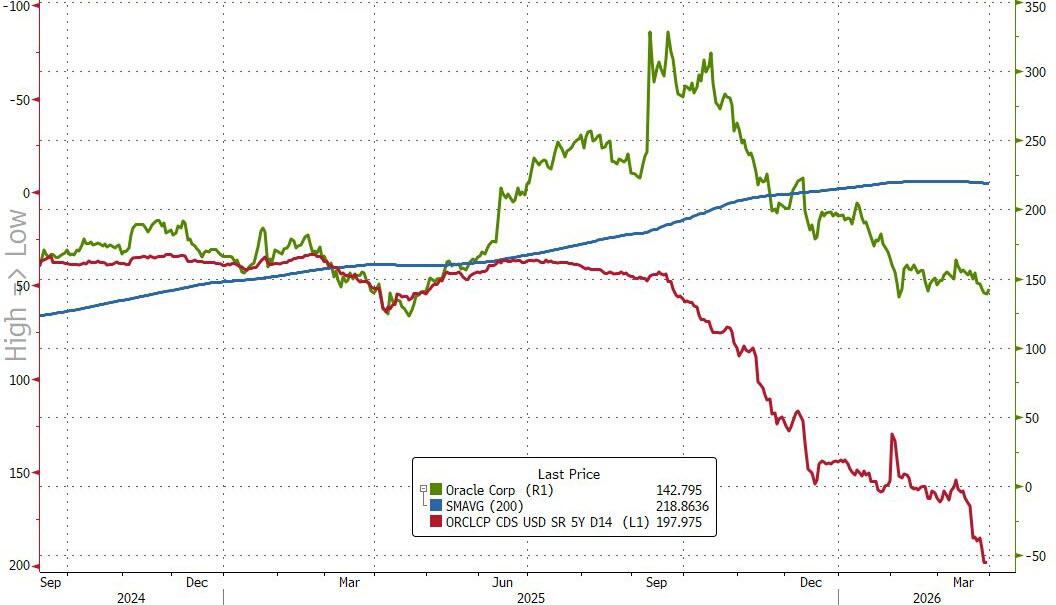
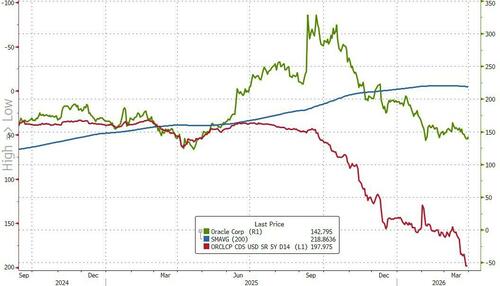
We didnt have long to wait: since the Feb 1 announcement, the stock has tumbled to fresh multi year lows…
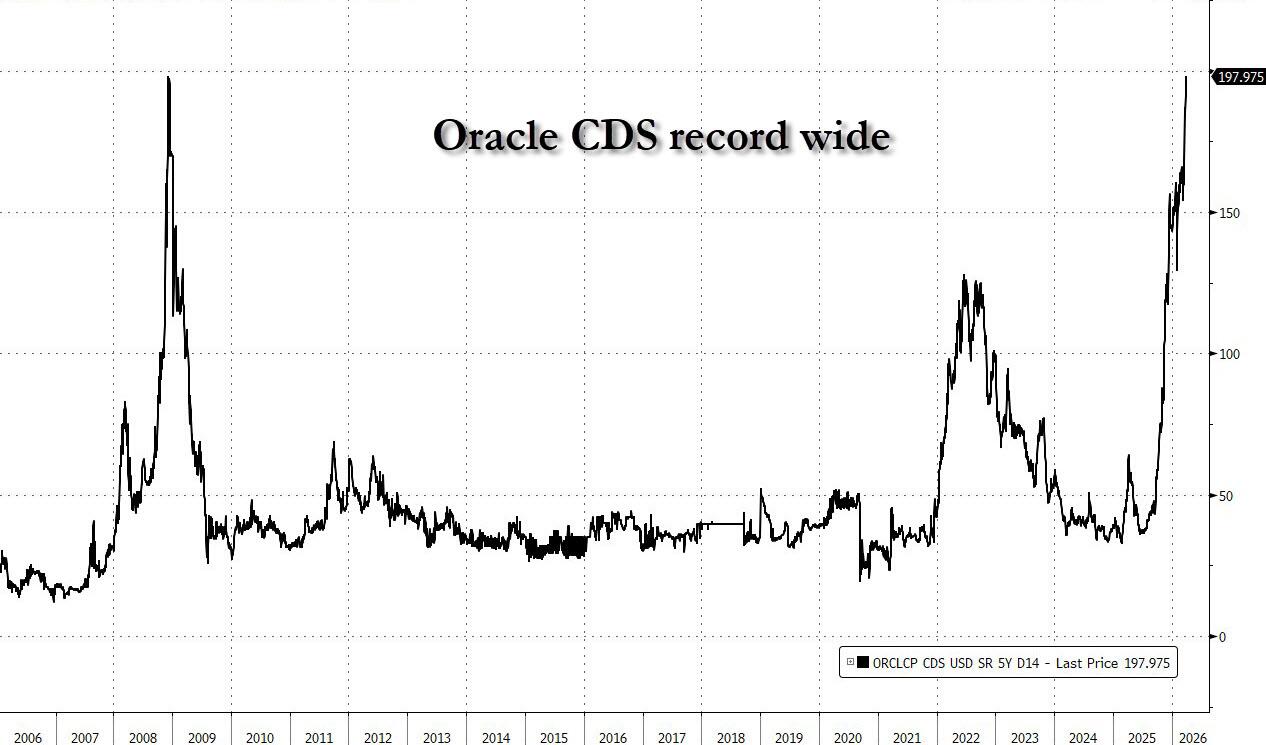
… but the big risk is that despite the company’s best equity-diluting intentions, ORCL 5 Year CDS just hit the widest on record, a level first (and only) seen during the global financial crisis.
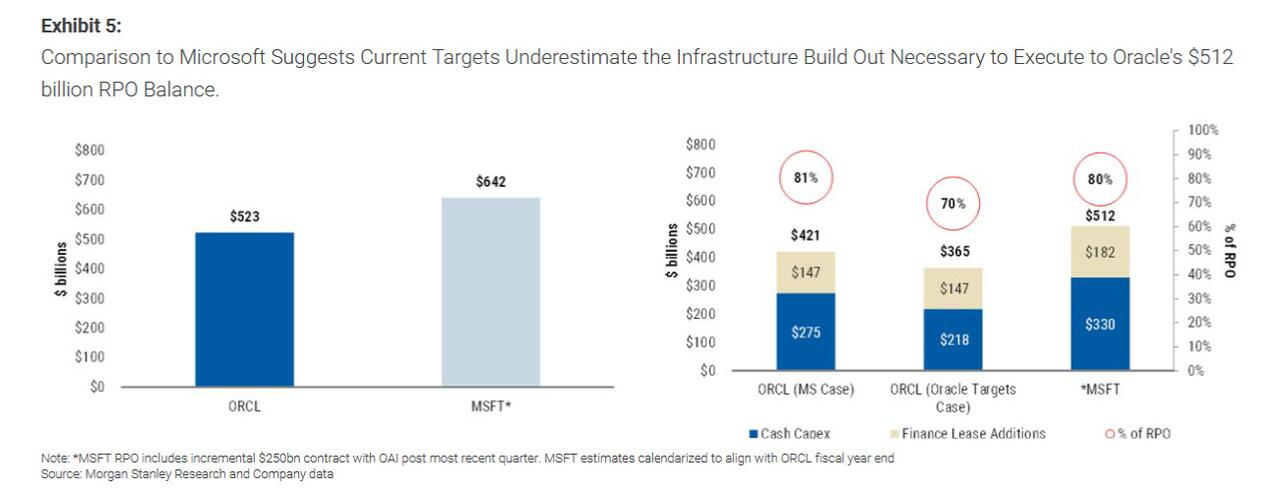
This is a problem because despite Larry Ellison’s best efforts to convince the market that Oracle has more than enough projected revenue – and a massive enough backlog – to grow into its bloated balance sheet, which is approaching $200 billion including off-balance sheet exposure, and refute such claims such as the following from Barclays which warned two months ago that the market “Underestimates the Infrastructure Build Out Necessary to Execute to Oracle’s $512 billion RPO Balance”…
Source: Barclays, available to pro subs
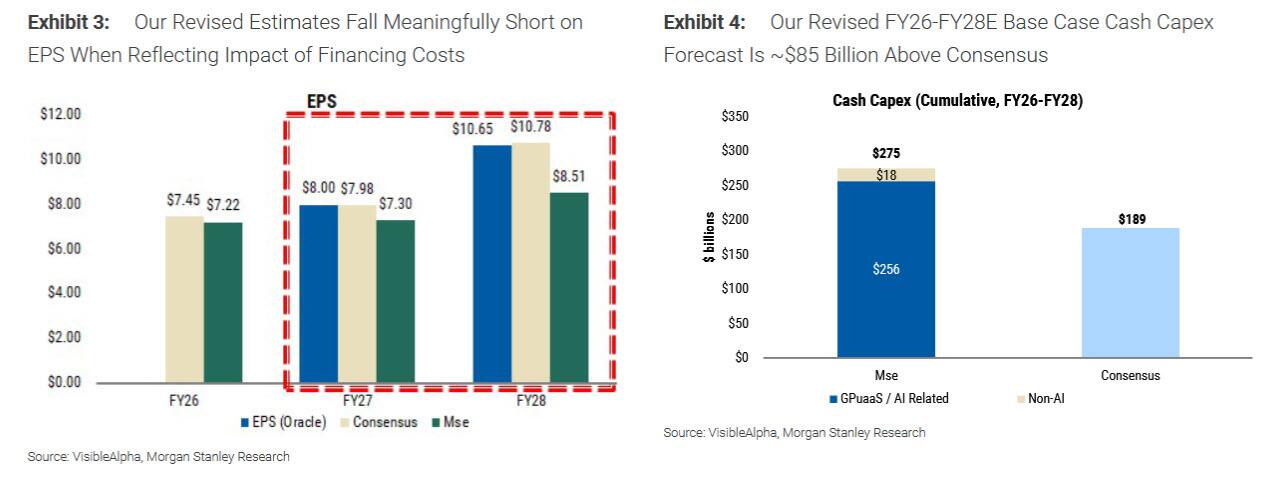
… and that the company will badly miss estimates, as it is forced to fund a much higher capex (some $275 billion) than consensus projects…
Source: Barclays, available to pro subs
… the market simply is not buying it. Literally.
So what is Oracle to do? Well, it is literally going down the list of what Barclays proposed two months ago would be “next steps” as the cold hard reality slams Oracle’s publicly traded securities, the first of which was…
RIF of 20-30K employees which could drive ~$8-10B of incremental free cash flow,
And sure enough, this morning Oracle told employees that it’s conducting a major round of layoffs.
According to CNBC “the layoffs were in the thousands” although with the company employing some 162,000 people, to make an actual dent in free cash flow (which ORCL does not have), it will have to fire tens of thousands.
Layoff emails began landing in inboxes around 6:00 a.m. EST, informing recipients that their roles had been “eliminated” and that the day of notification would be their last working day — with no prior discussion or HR outreach.
“We are sharing some difficult news regarding your position. After careful consideration of Oracle’s current business needs, we have made the decision to eliminate your role as part of a broader organizational change. As a result, today is your last working day. We are grateful for your dedication, hard work, and the impact you have made during your time with us,” the email read.
Industry sources estimate that between 20,000 and 30,000 positions have been impacted, potentially affecting up to 18% of Oracle’s global workforce of roughly 162,000.
Employees reported that the automated mass emails were their only notification, with system access revoked shortly thereafter and instructions to provide personal email addresses to receive severance paperwork.
With Oracle slashing overhead, it will use the funds to invest in CapEx instead. Here is CNBC “While continuing to push its flagship database for storing and serving up corporate information, Oracle has ratcheted up its capital expenditures as it builds data center infrastructure that can handle AI workloads.”
Needless to say, this process has been anything but smooth for the most indebted tech giant, and the company many view as the first canary in the AI bubble coalmine.
While Oracle disclosed that its remaining performance obligations (basically backlog) jumped 359% to $455 billion following an agreement with OpenAI worth over $300 billion, the market refused to reward the company for the circular financing number, and weeks later, Oracle picked executives Mike Sicilia and Clay Magouyrk to replace its CEO, Safra Catz.
As for ORCL’s employees, while tens of thousands are about to be fired, expect many more to leave the company if Barclays is right and the company’s CapEx spending ends up being some $85 billion above the current consensus of $189 billion…
More in the full Barclays report available to pro subs.
Tyler Durden
Tue, 03/31/2026 – 13:00
https://www.zerohedge.com/markets/oracle-firing-tens-thousands-cds-explodes-financial-crisis-record

Pentagon Weighs Anti-Drone Laser Weapon Deployment In DC To Fortify Airspace
Pentagon Weighs Anti-Drone Laser Weapon Deployment In DC To Fortify Airspace
We outlined a glaring security gap in U.S. counter-drone defenses well before the U.S.-Iran conflict erupted one month ago.
At the time, we specifically pointed out that data centers are largely unprepared for drone threats. We believe the Gulf conflict – after Iran bombed multiple data centers and military bases – has likely pushed the federal government into panic mode, accelerating efforts to deploy counter-drone systems around high-value targets across the homeland, whether military bases or civilian infrastructure.
This brings us to a New York Times report from Tuesday morning outlining how the Department of War is considering deploying anti-drone laser weapons near Fort McNair in Washington, DC, where Defense Secretary Pete Hegseth and Secretary of State Marco Rubio reside, following recent reports of suspicious activity and ongoing concerns about drone attacks on the homeland.
The report cited sources who “requested anonymity” and said the Army is discussing deploying laser weapons that would add an extra layer of security to some of the world’s most secure airspace across the Washington-Baltimore region.
The Federal Aviation Administration and the DoW are reportedly moving closer to a broader agreement on laser weapons, which offer a low-cost solution for defeating drone threats at scale, especially in an era when cheap kamikaze drones and swarms can quickly exhaust even the most sophisticated air defenses.
On Sunday, Heather Chairez, a spokeswoman for an Army-led joint task force in the DC area, said she was “aware of the reported drone sightings near Fort McNair and the surrounding areas.” She noted there was no credible threat in the recent incident, yet the task force had increased its counter-drone activities “to keep our service members and civilians who work and live on Fort McNair safe.”
An FAA spokeswoman, Hannah Walden, said the heads of her agency are prepared to work with the DoW and other agencies “to protect the homeland while ensuring the safety of the national airspace system.”
Security gaps in America’s airspace regarding cheap drones are alarming, and it is not just military installations that need protection. Data centers, ports, refineries, and power infrastructure are also vulnerable. The list is endless.
With battlefields raging across Eurasia, from Russia and Ukraine to the Gulf, one thing is clear: using expensive missile interceptors against $20,000 drones is not sustainable in the economics of war. In fact, low-cost lasers could be part of the answer, though low-cost interceptor drones have also proven valuable in places like Ukraine.
One of the first known instances of the U.S. military using laser weapons against a “foreign object” occurred last month in El Paso, though it actually turned out to be party balloons.
NYT did not identify the laser power class for the DC region, but the most likely option for counter-drone deployment would be around 50 to 60 kilowatts, which aligns with systems the U.S. military is already fielding and developing for air-defense missions.
Tyler Durden
Tue, 03/31/2026 – 12:40

Treasury Unveils Whistleblower Portal To Combat Transnational Medicare, Medicaid Fraud Rings
Treasury Unveils Whistleblower Portal To Combat Transnational Medicare, Medicaid Fraud Rings
Authored by Kimberly Hayek via The Epoch Times (emphasis ours),
Whistleblowers are encouraged to report abuse of Medicare, Medicaid, and other government health benefit programs, the Department of the Treasury announced on March 30, while warning that sophisticated fraud schemes are siphoning billions from them.
In an advisory, the Treasury detailed the way in which transnational criminal organizations—working with domestic fraudsters and organized crime groups—create fake health care providers, employ cover people to pose as owners who are not U.S. residents, and steal the personal data of actual beneficiaries to submit false claims for care that was never provided or was not needed. Proceeds are then laundered through wire transfers, digital assets, and culpable bank co-conspirators before being transferred overseas.
The department said its Financial Crimes Enforcement Network (FinCEN) has published a proposed rule to fully implement a whistleblower program that would reward 10–30 percent of penalties collected in successful enforcement in fraud and money laundering cases, as well as sanctions violations. Payments would be taken from penalties obtained under the Bank Secrecy Act and other laws already in place.
“The regulation proposed today, when finalized, will fully implement these statutes,” FinCEN said. “Whistleblowers are encouraged to submit information as soon as possible and to provide detailed, specific documentation to support their claims.”
In the meantime, FinCEN said it “recently launched a portal” for whistleblowers to begin making reports.
Financial institutions reported a 20 percent increase in suspicious activity linked to health care fraud in 2025 over the previous year, according to the advisory. Officials, however, suspect the filings reveal only a small part of the fraud.
“President Trump has been clear that Americans have a right to know that their tax dollars are not being used to commit fraud,” Treasury Secretary Scott Bessent said in a statement. “Under President Trump’s leadership, Treasury will continue to find and disrupt fraud schemes wherever they exist, and we will work with our law enforcement partners to hold perpetrators to account.”
The department’s Financial Crimes Enforcement Network advisory comes as the Trump administration works to undermine waste and abuse in federal spending.
The advisory was released in collaboration with the FBI and the Health and Human Services Department’s Office of Inspector General. It aligns with an executive order targeting fraud across federal payments.
Treasury officials said the advisory and proposed regulation are in line with administration actions to protect taxpayer dollars and protect the financial system against illicit activity, and that financial institutions are requested to file suspicious activity reports and to inform law enforcement immediately upon encountering suspicious transactions.
In February, Bessent described efforts to combat fraud in federal spending.
“We are encouraging whistleblowers who know about fraud, people who are stealing from the American taxpayer, to come forward at Treasury,” he said. “We will be giving rewards up to 10 percent to 30 percent of the fines that we levy.”
Bessent added that these efforts represent a great way to ferret out waste, fraud, and abuse.
The Trump administration has also flagged fraud concerns in New York.
Federal investigators there have homed in on the state’s Medicaid program. In March, Centers for Medicare and Medicaid Services Administrator Dr. Mehmet Oz, tasked with spearheading a federal review of Medicaid spending, cited abnormal job growth in home health and personal care aides as showing signs of possible abuse.
“Heart surgeons are trained to look at the numbers,” the cardiothoracic surgeon said. “When something doesn’t add up, you don’t ignore it; you investigate.”
In a specific New York case, eight people were indicted in a $68 million Medicaid fraud scheme revolving around Brooklyn adult day care centers that allegedly entailed bribes and inflated claims.
Tyler Durden
Tue, 03/31/2026 – 12:20

Ukraine’s Backers Want Reduction In Long-Range Strikes On Russian Oil, Zelensky Says
Ukraine’s Backers Want Reduction In Long-Range Strikes On Russian Oil, Zelensky Says
We’ve been highlighting the significant impact of the Iran war on developments in Ukraine, where the over four-year long war is showing no end in sight. Ukraine’s President Zelensky has made clear his view that the current global focus on the Iran conflict has put Kiev in a weakened position.
Already, Ukraine’s international partners are ‘primarily’ sending their anti-ballistic missile systems to the Middle East – with Ukraine ‘forgotten’ – Zelensky has recently said. But there’s more, as the hits keep coming: Zelensky revealed Monday that some of Ukraine’s backers have sent “signals” to scale back long-range strikes on Russia’s oil sector as global energy prices have soared.
“Recently, following such a severe global energy crisis, we have indeed received signals from some of our partners about how to reduce our responses in the oil sector and the energy sector of the Russian Federation,” Zelensky told journalists in a WhatsApp briefing, reported by Reuters.
This is perhaps what’s behind his calling for an Easter holiday truce with Russia. He had on the same day that he told journalists about a potential pause on long-range attacks on Russian energy stated: “If Russia is ready to stop hitting Ukrainian energy facilities, we will not respond against their energy sector.”
Zelensky just came off a tour of Middle East Gulf states, even amid Iran’s ongoing retaliation in the region, while seeking Ukrainian security assistance. In recent days he met with the leaders of Saudi Arabia, the UAE, Qatar and Jordan.
Reuters notes of this, “Fresh from a four-day visit to the Middle East, Zelenskiy said that he had reached agreement with some countries in the region to provide energy support to Ukraine.”
“Zelenskiy said at the weekend during his Middle East tour that he had reached a deal on diesel deliveries for a year to Ukraine, without providing further details,” the report continues. “Diesel is vital for the functioning of the Ukrainian armed forces and the country’s agricultural sector, the bedrock of the economy.”
So indeed any new pause in tit-for-tat assaults on energy infrastructure would be a welcome reprieve for Ukraine as well.
One interesting aspect to the Reuters report is that while the US side hasn’t commented, one unnamed source tries to inject that the ‘signaling’ on reducing or halting long-range strikes on energy is actually coming from Moscow:
A source familiar with the situation said U.S. officials had conveyed this message to their Ukrainian counterparts as part of their regular conversations, adding that the initial “signals” appeared to have come from Moscow.
And yet, even as Zelensky himself admits, Trump’s easing of Russian oil sanctions has put the Kremlin in the driver’s seat, in terms of energy leverage, at this crucial moment – also as the peace process and talks between Moscow and Keiv are non-existent.
In the meantime, amid waning support from the Trump administration, Zelensky has set his sights on greatly improving ties with the wealthy oil and gas monarchies in the Gulf.
Tyler Durden
Tue, 03/31/2026 – 12:00
Google’s New Quantum Research Reignites Push To Harden Bitcoin
Google’s New Quantum Research Reignites Push To Harden Bitcoin
Authored by Micah Zimmerman via BitcoinMagazine.com,
A new research paper from Google has intensified debate over whether Bitcoin can adapt in time to withstand advances in quantum computing, pushing developers and investors to confront a risk long treated as theoretical.
Google’s quantum division said this week in a new whitepaper that future machines could break widely used encryption far more efficiently than previously estimated, including the elliptic curve cryptography that underpins Bitcoin wallets.
The research suggests attacks that once appeared decades away may arrive sooner, with some scenarios modeling the ability to crack encryption in minutes under advanced conditions.
The findings do not imply an immediate threat.
Today’s quantum computers remain far below the scale required to break modern cryptographic systems.
But the paper reduces the estimated resources needed, narrowing the gap between theory and practice and shifting attention toward preparation rather than dismissal.
Google has already set a 2029 target to transition its own systems to post-quantum cryptography, reflecting a broader shift among large technology firms and governments toward defensive planning.
Is Bitcoin under threat?
For Bitcoin, the implications are specific and structural. The network relies on digital signatures that could, in principle, be reversed by a sufficiently powerful quantum computer. Roughly one-third of the total Bitcoin supply sits in addresses where public keys have been exposed, creating a defined set of targets under certain attack models.
Separate analyses cited in the research estimate that about 6.7 million Bitcoin may be exposed to varying degrees under quantum attack scenarios, including coins held in older address formats where public keys remain permanently visible on-chain.
More immediate concerns focus on transaction windows. When a Bitcoin transaction is broadcast, its public key becomes visible before confirmation. Google’s research suggests a theoretical attacker could exploit that gap, solving for the private key within the same time frame it takes for a block to be mined.
That has shifted the conversation among developers from abstract risk to engineering timelines.
Binance founder Changpeng Zhao pushed back on what he described as exaggerated concerns, arguing that most cryptographic systems, including Bitcoin, can migrate to quantum-resistant algorithms without destabilizing the network.
He noted, however, that execution remains a constraint. Coordinating upgrades across a decentralized ecosystem could lead to competing proposals, software fragmentation and potential forks, while users holding assets in self-custody would need to actively migrate funds to new wallet structures.
The Bitcoin ecosystem has begun early-stage work on quantum resistance. A recent proposal, known as BIP 360, introduces new transaction formats designed to remove or reduce exposure to vulnerable cryptographic assumptions. The proposal remains in draft form, but test implementations are already running in experimental environments, allowing developers to evaluate quantum-safe signatures in practice.
Even proponents describe the effort as a starting point rather than a solution. Any upgrade would require broad coordination across a decentralized network, a process that can take years to reach consensus and deploy.
That timeline is central to the emerging debate. Estimates suggest a full migration to quantum-resistant cryptography in Bitcoin could take the better part of a decade, depending on adoption and coordination across wallets, exchanges and infrastructure providers.
The risk, developers say, is not only technological but organizational. Bitcoin has no central authority to mandate upgrades, and changes to its core protocol require agreement among a global set of participants with differing incentives.
Developers are currently working on a Bitcoin Improvement Proposal to strengthen Bitcoin against quantum, with a test net already deployed 👀 👏 pic.twitter.com/bFVgkCDvuS
— Bitcoin Magazine (@BitcoinMagazine) March 31, 2026
Banking, traditional finance at risk as well
The issue also extends beyond cryptocurrency. The same class of cryptography secures banking systems, government communications and large parts of the internet.
In theory, the same cryptographic systems that secure Bitcoin also underpin global banking infrastructure, payment networks and government communications.
Google and cybersecurity agencies warned that attackers may already be collecting encrypted data today in anticipation of future quantum capabilities, a strategy known as “store now, decrypt later.”
Any viable quantum attack would not be isolated to crypto markets, but would extend across financial institutions and critical systems that rely on public-key encryption. Bitcoin is not uniquely vulnerable, but it is uniquely transparent. Its ledger makes exposure visible, and its open-source development model makes its response observable in real time.
Market reaction has remained muted so far, with prices largely unaffected by the latest research.
Tyler Durden
Tue, 03/31/2026 – 11:45
https://www.zerohedge.com/crypto/googles-new-quantum-research-reignites-push-harden-bitcoin

Supreme Court Sides With Christian Counselor, Strikes Down Colorado ‘Conversion Therapy’ Ban
Supreme Court Sides With Christian Counselor, Strikes Down Colorado ‘Conversion Therapy’ Ban
In a landmark 8-1 decision issued today, the Supreme Court sided with a Christian mental health counselor – ruling that Colorado’s law banning “conversion therapy” violates the First Amendment.
The majority held that Colorado’s 2019 law unconstitutionally discriminates on the basis of viewpoint by allowing counselors to affirm and support clients exploring gender transition or identity while prohibiting any talk-therapy efforts to help clients reduce unwanted same-sex attractions, change sexual behaviors, or align their gender identity with their biological sex.
The solo dissent being (drumroll…) Ketanji Brown Jackson.
BREAKING: In an 8-1 ruling, the Supreme Court announced this morning that Colorado’s ban on so-called conversion therapy violates First Amendment free speech rights. Gorsuch wrote the majority opinion. Jackson was the lone dissent.
“The First Amendment stands as a bulwark… pic.twitter.com/roTX2k7NkB
— Sean Davis (@seanmdav) March 31, 2026
Writing for the majority, Justice Neil Gorsuch declared that Colorado’s statute “regulates speech based on viewpoint” by permitting counselors to affirm clients’ gender transitions or identity exploration while prohibiting any efforts to help clients reduce same-sex attractions, change sexual behaviors, or align their gender identity with their biological sex. The decision reverses the U.S. Court of Appeals for the Tenth Circuit and remands the case for further proceedings consistent with rigorous First Amendment scrutiny.
“Colorado’s law permits her to express acceptance and support for clients exploring their identity or undergoing gender transition,” Gorsuch wrote. “but forbids her from saying anything that attempts to change a client’s ‘sexual orientation or gender identity,’ including efforts to change ‘behaviors,’ ‘gender expressions,’ or ‘romantic attraction[s].’”
He emphasized that speech does not lose constitutional protection merely because the government labels it “treatment” or “therapeutic modality.” “The First Amendment is no word game,” the opinion states, citing NAACP v. Button (1963).
Jackson, meanwhile, wrote that the decision “opens a dangerous can of worms” that “threatens to impair states’ ability to regulate the provision of medical care in any respect.”
“In the worst-case scenario, our medical system unravels as various licensed healthcare professionals — talk therapists, psychiatrists, and presumably anyone else who claims to utilize speech when administering treatments to patients — start broadly wielding their new-found constitutional right to provide substandard medical care.”
Unsurprisingly, Axios agrees with Jackson – writing that the decision “has implications beyond the Colorado therapy sessions by setting precedent that therapists’ conversations with patients are regarded as a form of constitutionally protected speech and rolling back protections for LGBTQ+ youth.”
Background
Chiles is a licensed professional counselor in Colorado Springs and a practicing Christian. She holds a master’s degree in clinical mental health and provides exclusively talk therapy—no medications, physical interventions, or coercive techniques. As described in the case, she does not approach sessions with predetermined outcomes. Instead, she listens to clients, including minors, as they articulate their own goals and works with them to pursue those objectives while respecting their autonomy.
Many clients seek her out specifically for her faith-integrated approach. Chiles has said she believes people flourish when they live in alignment with God’s design, including their biological sex. Some clients want support affirming their current identity, while others seek help reducing unwanted same-sex attractions, changing behaviors, or finding greater alignment with their bodies.
In 2019, Colorado enacted a law prohibiting licensed counselors from engaging in “conversion therapy” with minors. The statute broadly bans practices aimed at changing a minor’s sexual orientation or gender identity, including efforts to alter behaviors, gender expression, or reduce same-sex attractions. At the same time, it expressly allows counselors to provide “acceptance, support, and understanding” for identity exploration and to assist individuals undergoing gender transition.
Chiles filed suit in federal court in 2022, seeking a preliminary injunction limited to her talk-therapy practice. Both the district court and the Tenth Circuit found she had Article III standing but denied relief, ruling that the law regulated professional conduct and only incidentally burdened speech, so it needed only rational-basis review. Judge Harris Hartz dissented in the Tenth Circuit. The Supreme Court granted certiorari to resolve the circuit split, heard argument on October 7, 2025, and issued its 8-1 decision today
Tyler Durden
Tue, 03/31/2026 – 11:30
European Inflation Jumps Most Since 2022 On Soaring Energy Prices Even As Core CPI Unexpectedly Shrinks
European Inflation Jumps Most Since 2022 On Soaring Energy Prices Even As Core CPI Unexpectedly Shrinks
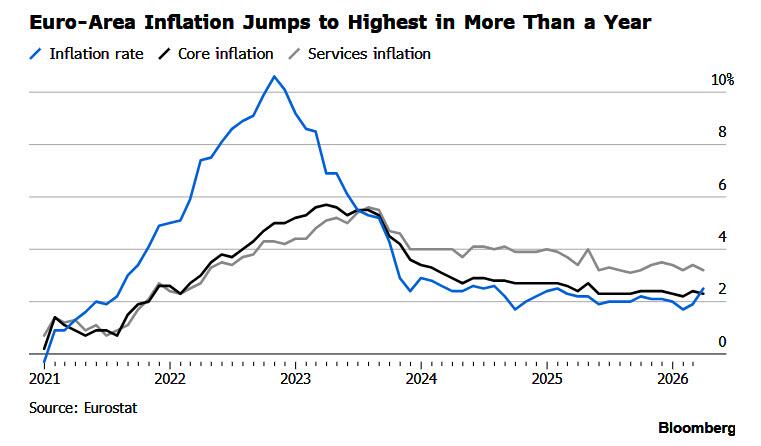
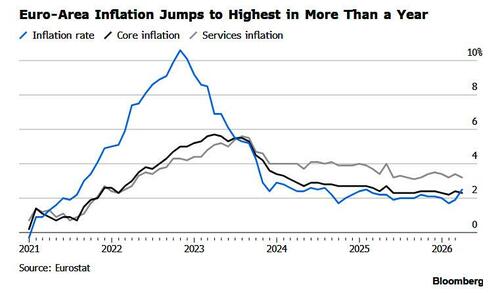
In an early preview of the coming inflation spike, the euro area saw its steepest jump in inflation since 2022 as the Iran war pushed energy costs sharply higher, backing expectations that the ECB will have to raise interest rates.
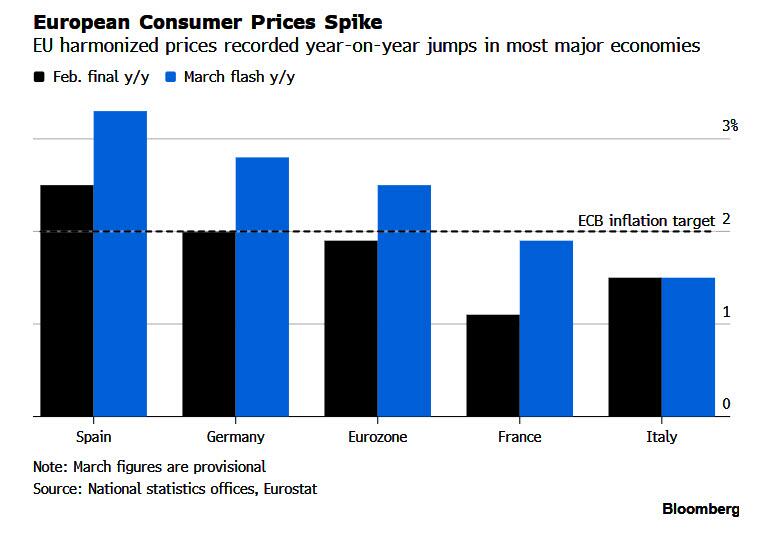
In March, European consumer prices rose 2.5% from a year ago in March – and up a whopping 1.9% from the previous month – to the highest since January 2025. The silver lining: the median estimate was for an even higher 2.6% print.
Yet while headline inflation soared, demand destruction appears to have depressed other purchases, and core inflation, which excludes volatile items like food and energy, unexpectedly slowed to 2.3%, while the closely watched services gauge also eased, Eurostat said Tuesday.
Some more details from Goldman:
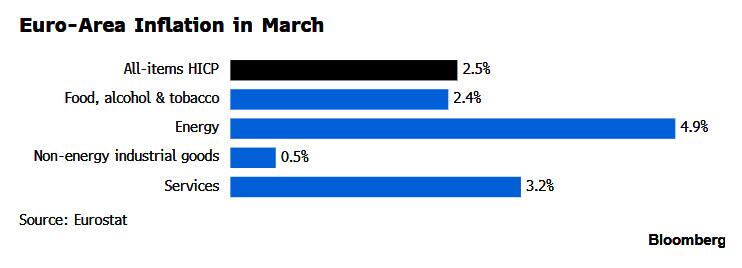
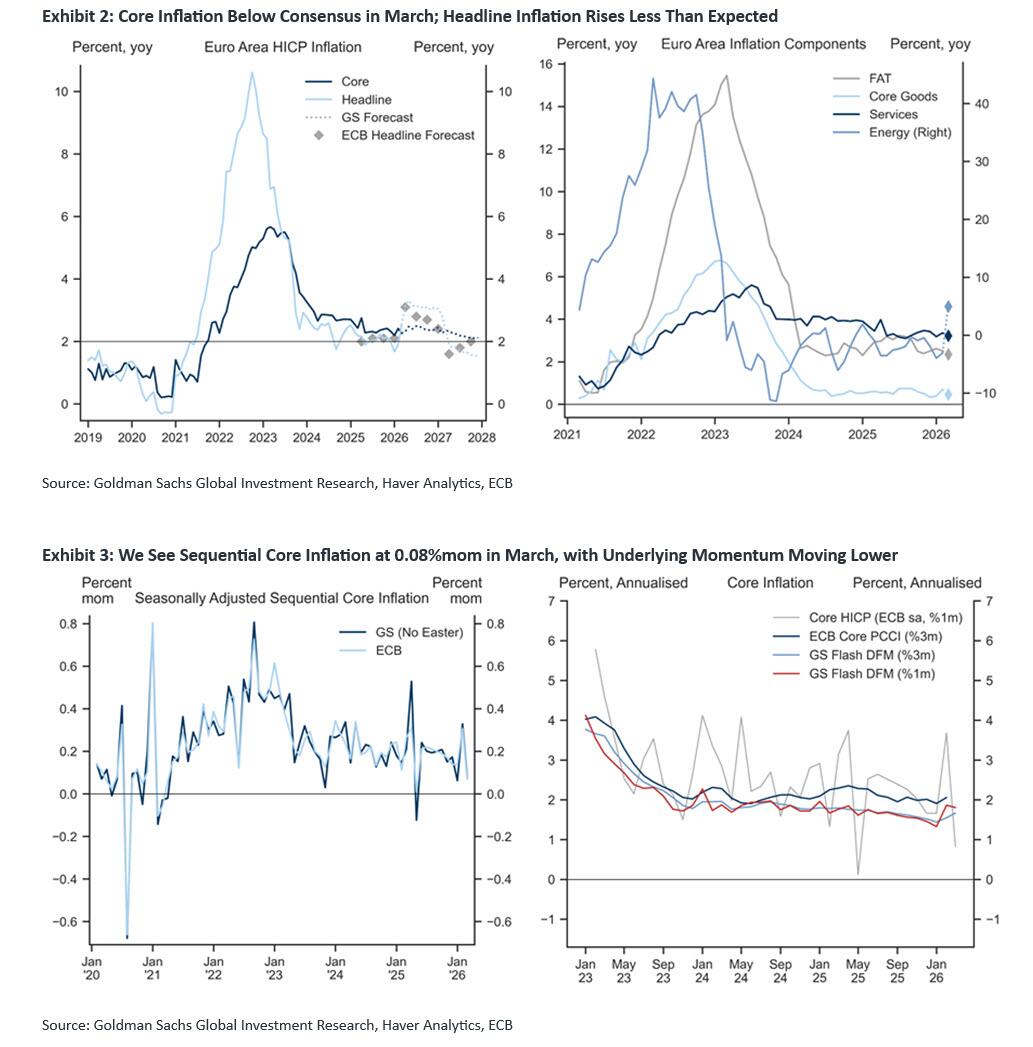
Euro area headline HICP inflation increased by 0.63pp to 2.52%yoy in March, below our tracking and consensus of 2.6%yoy. Core HICP inflation, excluding energy, food, alcohol and tobacco, went down 15bp to 2.26%yoy, broadly in line with our latest tracking estimate but below consensus expectations of 2.4%yoy.
The breakdown by main expenditure categories showed services inflation declining to 3.23%yoy, with part of the decline likely driven by Olympics-induced tourism and hospitality-related components payback in Italy, while non-energy industrial goods inflation went down to 0.47%yoy, surprising our latest tracking estimate to the downside. Of the non-core components, energy inflation increased to 4.9%yoy, close to our latest tracking but lower than we initially expected, while food, alcohol and tobacco inflation decline to 2.35%yoy, weaker than we expected.
Using our seasonal adjustment methodology, aimed to closely replicate the ECB’s, and removing the Easter adjustment for the whole services basket, we estimate that seasonally adjusted sequential core inflation was 0.08%mom in March, down from 0.33%mom in the February reading (Exhibit 3). Within core inflation, we estimate that seasonally adjusted sequential core goods inflation went down to -0.13%mom in March, while sequential services inflation declined to 0.19%mom from 0.38%mom in February. This compares to the ECB’s estimates of 0.07%mom, -0.17%mom and 0.20%mom for core, goods and services inflation respectively.
Our flash measure of underlying inflation moved down from 0.154%mom to 0.149%mom in March.
Incorporating the March flash release into the Euro area inflation path, our medium-term path continues to show core inflation at 2.4%yoy in 2026, peaking at 2.5%yoy in Q3 and then falling to 2.4%yoy by end-2026 and to 2.1% by end-2027, somewhat above the ECB staff March projections in the medium term. As for headline inflation, we continue to see it notably above target this year. We see it averaging 2.9%yoy in 2026, peaking at 3.2%yoy in Q2, and at 2.0%yoy in 2027, using our commodities team’s latest baseline path for gas and oil prices.
With the conflict in the Middle East now extending beyond a month, its effects are increasingly being felt in Europe, where not only inflation but expectations on where prices are headed are picking up markedly.
As Bloomberg notes, individual countries saw mixed inflation results for March. In Italy, there was no uptick at all, with the reading unexpectedly coming in unchanged at 1.5%. French inflation quickened, but didn’t quite reach 2%. Germany and Spain, which reported numbers earlier, recorded more rapid price increases, of 2.8% and 3.3%. Further accelerations are expected and will only add to pressure on the ECB.
“The longer the war in Iran lasts and the more destructive it becomes, the greater the risk of inflation will be,” Slovakia’s Peter Kazimir said. “Consequently, the sooner and more decisively we’ll have to respond.”
Governments and central banks in Europe are also slashing their projections for economic growth, while firms are bracing for a hit to demand among their customers.
The ECB says it won’t to allow a repeat of the inflation spike that followed Russia’s invasion of Ukraine in 2022, vowing to act quickly and decisively as needed. But with no clarity on when the fighting will end, officials are still assessing the toll. Elevated oil and natural gas prices are already casting doubt on the ECB’s baseline outlook for inflation to average 2.6% this year. Under a more extreme outcome, price gains could peak at as high as 6.3% in 2027.
“Today we can say that the base-case scenario — for which assumptions were locked in on March 11 — can probably be considered to be the optimistic scenario,” Estonian central-bank chief Madis Muller said Tuesday in Tallinn. “We certainly can’t rule out changes in interest rates already in April if energy prices remain at a high level for a long time.”
Powerless to prevent the gyrations in energy markets, the ECB is instead focused on avoiding second-round effects including excessive increases in wages and selling prices. It’s also worried about knock-on effects to things like fertilizer and food prices that help shape households’ perceptions.
A survey published Monday showed consumers’ inflation expectations surged in March, while firms also anticipate marking up their prices sharply. Market-based indicators have also already reacted. Long-dated inflation swaps jumped in the early days of the war, before paring much of the move as traders started to price rate hikes.
Croatian central-bank chief Boris Vujcic said views of faster inflation were “what we have expected,” while his Italian counterpart Fabio Panetta said it’s “essential to monitor expectations closely and to prevent a wage-price spiral, while ensuring that monetary-policy action remains proportionate.”
Their Bulgarian colleague Dimitar Radev argued that past inflation shocks have left a “durable imprint” on European consumers and highlighted that “developments that were previously perceived as external shocks are now feeding directly into inflation expectations, energy prices, financing conditions and broader confidence.”
In a speech text published Tuesday, he said risks to the inflation outlook “are not only elevated” but also “asymmetric and closely linked to geopolitical developments.”
Tyler Durden
Tue, 03/31/2026 – 11:20

France, Italy Are Latest NATO Allies To Break Ranks, Block US Military Flights For Iran War
France, Italy Are Latest NATO Allies To Break Ranks, Block US Military Flights For Iran War
First Spain, now France and Italy… France has blocked the United States from using its airspace to transport American weapons to be used in the war against Iran, a Western diplomat and two additional sources told Reuters Tuesday.
“The sources said the refusal, which happened at the weekend, was the first time France had done this since the start of the conflict in Iran,” Reuters has underscored.
On the same day reports are emerging that Italy has denied the US military use of an airbase in Sicily – another rare first, though the Italian government is saying it’s primarily a matter of the Pentagon not following through on required authorization protocol.
A statement from Prime Minister Giorgia Meloni sought to calm the situation with Washington, denying that “critical issues or frictions” with international partners were unfolding, and saying that relations with the US remain “solid and based on full and loyal cooperation”.
Still, France and Spain are feeling Trump’s wrath, who issued the following in a Tuesday morning Truth Social post:
Italian Defense Minister Guido Crosetto has confirmed that “some US bombers” were denied landing at Sigonella – one of seven US navy bases in Italy. The complaint is that the US didn’t follow required permission protocol, and requested landing only while in the air and already en route to Sicily.
The statement from Meloni’s office had also alluded to matters of procedure, stating that Italy is “acting in full compliance with existing international agreements” – while underscoring that each request must be “carefully examined on a case-by-case basis, as has always been the case in the past.”
But the truth also is that American hegemonic action in the Middle East, and the Iran conflict in particular, is deeply unpopular among the Italian population, which has long had a strongly anti-war bent especially among the youth.
The Guardian writes, “The unpopularity of Trump in Italy has also started to erode the popularity of Meloni, who is ideologically in tune with the US president and has established good working relations with him.” However, she’s lately sought to distance her government from the war, having told parliament earlier this month there’s a growing dangerous trend of interventions “outside the scope of international law.”
🇪🇸🇮🇹🇨🇭🇫🇷 Spain, Switzerland, Italy and now France have closed either fully or partially their airspace to American military aircraft that are being used in the 3rd Gulf War, a sign displaying the growing rift between Europe and the U.S.
If countries in Central Europe start… pic.twitter.com/lFDxN7RgX9
— IowaGirl30🐺 (@LoneAlphaWolf) March 31, 2026
Bilateral defense agreements and NATO’s base sharing framework allows US access to key strategic hubs for US operations in the Mediterranean – however, Italian law and the aforementioned treaty requires parliamentary approval for anything outside that scope. This has provided a political ‘out’ for Meloni to be able to say the government is just following the law in denying certain US plane landings.
Tyler Durden
Tue, 03/31/2026 – 11:05
Solar Stocks Surge As Energy Shock Revives Renewables Trade
Solar Stocks Surge As Energy Shock Revives Renewables Trade
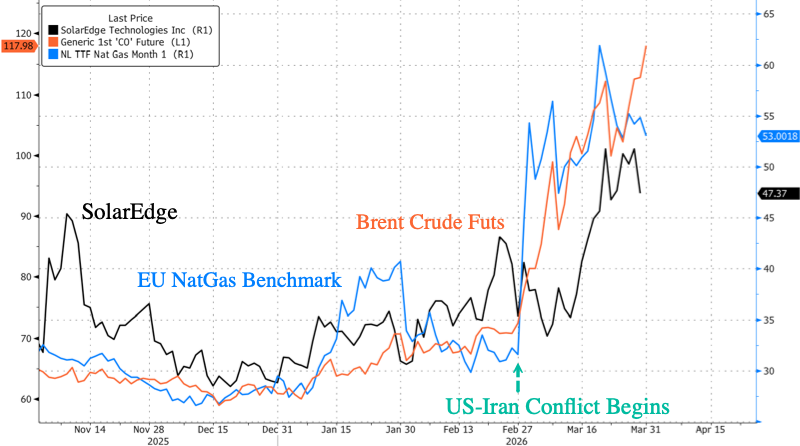
Goldman analyst Adam Wijaya asked clients whether this year’s surge in SolarEdge, Enphase Energy, and other solar stocks is reviving a familiar trade: higher crude oil and natural gas prices in Europe and globally, strengthening the case for renewables as the energy shock sparks a return to coal switching.
“Are we back to running the 2022 playbook?” Wijaya asked in a note published Monday.
Wijaya said, “Certainly seems that way based on recent px action in residential solar.”
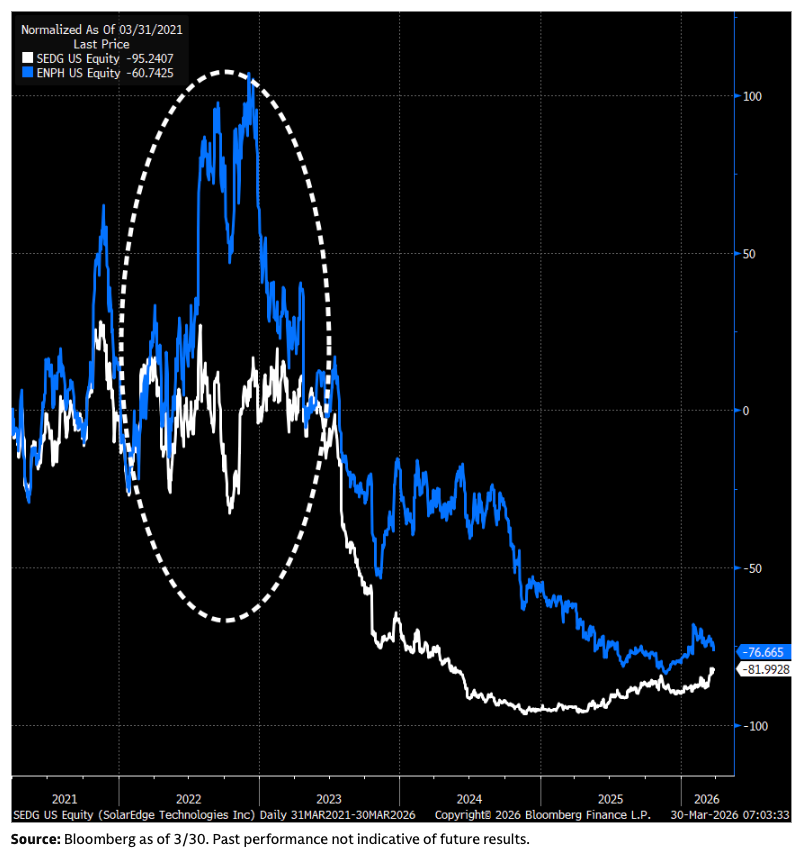
“SEDG is +79% YTD vs ENPH +18% and RUN -32%… oil + gas prices moving higher in Europe/globally + coal switching coming into the equation begs the question ‘do we start to see more renewables adoption in the EU given demand needs?'”.
SolarEdge shares are up 64% year to date, broadly tracking Brent crude and the European natural gas benchmark. The logic behind the trade is that higher fossil fuel prices improve the economics of alternative energy.
“As we start getting closer to midterm elections – some specialists asking questions around the ‘blue playbook’… ie which single stocks could have leverage to a policy shift in Energy focused on solar/wind/renewables.”
Potentially stronger demand for renewables comes as the Hormuz crisis forces countries to rethink energy security. With some power grid operators likely to switch to coal to keep the lights on, the shock is also reviving the conversation around adding more solar and wind to diversify grid mix.
Tyler Durden
Tue, 03/31/2026 – 10:55
https://www.zerohedge.com/markets/solar-stocks-surge-energy-shock-revives-renewables-trade

“Price Collapse” Hits Memory Sticks As Hoarded Inventory Floods Market After Google’s DeepSeek Moment
“Price Collapse” Hits Memory Sticks As Hoarded Inventory Floods Market After Google’s DeepSeek Moment
Following our “Google’s DeepSeek Moment” report last week, which detailed how TurboQuant, a compression algorithm for large language models and vector search engines, could sharply reduce AI memory requirements and sparked a selloff in top memory stocks, a Taiwanese financial outlet is now reporting a plunge in memory stick prices this week.
Taiwan-based Economic Daily News reports that DDR5 memory stick prices have dropped by 15% to 30%, marking the first major price correction after a rally that began in early fall, as AI data center demand for memory ramped up. The correction comes as the market expects lower memory demand following the unveiling of Google’s TurboQuant.
In the U.S., Amazon listings showed steep declines in DDR5 pricing. In mainland China, retailers described the move as a “price collapse,” with 16GB DDR5 modules falling from about $145 to $101 and 32GB modules dropping from about $435 to $319, based on current exchange rates. Distributors said the price drop was driven by sellers dumping previously hoarded inventory.
Reporters Li Mengshan and Xie Shouzhen posted an infographic on price drops by region, which we have translated here:
United States
Amazon Micron 32GB 6400MHz DDR5 module fell from a high of $490 to $379.99, a correction of nearly 30%.
16GB 5200MHz DDR5 module fell from $260 to $219.99, a decline of more than 15%.
Mainland China
Local channel data shows mainstream 16GB DDR5 module prices recently fell to around RMB 700, a drop of about 30%.
32GB DDR5 module prices fell from RMB 3,000 to around RMB 2,200, a decline of about 27%.
Prices for DDR4 and DDR5 on secondhand platforms have also fallen in tandem.
Taiwan manufacturers’ view
The DRAM uptrend has not yet peaked.
Overall pricing momentum is still continuing.
Original factory contract prices have not declined at all.
“There is simply no need to worry.”
“Industry insiders point out that this is the first significant price drop in recent months, and the simultaneous price adjustments across multiple platforms indicate that end-user demand is becoming more conservative under the pressure of high prices,” the reporters said.
The report continued: “Industry insiders say that the current ‘visible price drop’ reflects a short-term correction in supply and demand and market sentiment, rather than a reversal in the industry’s fundamentals.”
There’s growing speculation that OpenAI’s Sam Altman soaked up the entire memory market with non-binding orders.
But now…
So Sam Altman blew up the memory market with non-binding DRAM orders of 40% of global supply and then changed his mind because Stargate can’t get off the ground? $MU pic.twitter.com/ioe6PZN0S8
— investingLive (@investingLive_) March 30, 2026
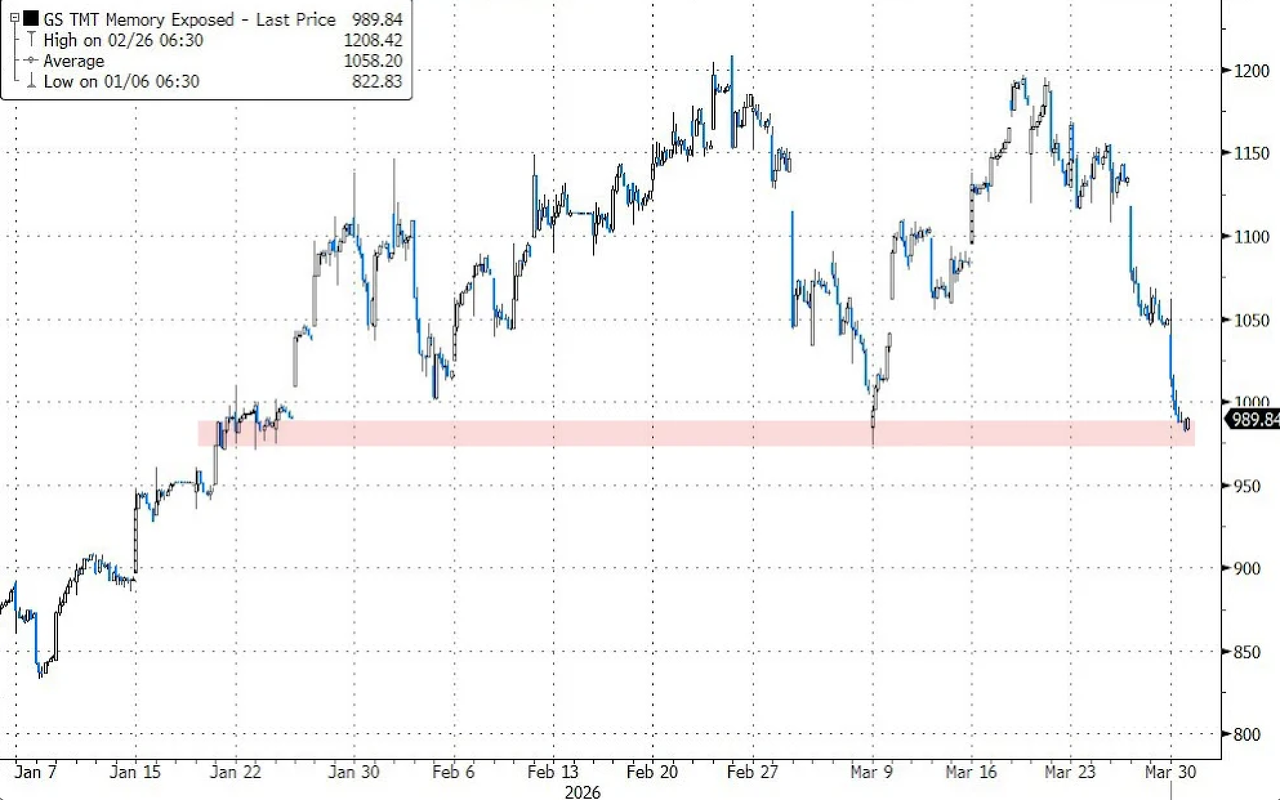
Given the emerging theme of sliding memory stick prices, driven by TurboQuant and growing doubts that Altman’s Stargate will get off the ground, memory stocks are now hovering near critical support and trading at levels not seen since earlier this month and mid-January levels.
“On the memory side, what did not help were weekend datapoints pointing to DDR5 prices dropping, in some cases by as much as 30%, after the Google TurboQuant news. U.S. prices for 32GB 6400MHz DDR5 modules and China prices for mainstream 16GB DDR5 modules have both fallen around 30% from their peaks,” a Goldman analyst wrote earlier today.
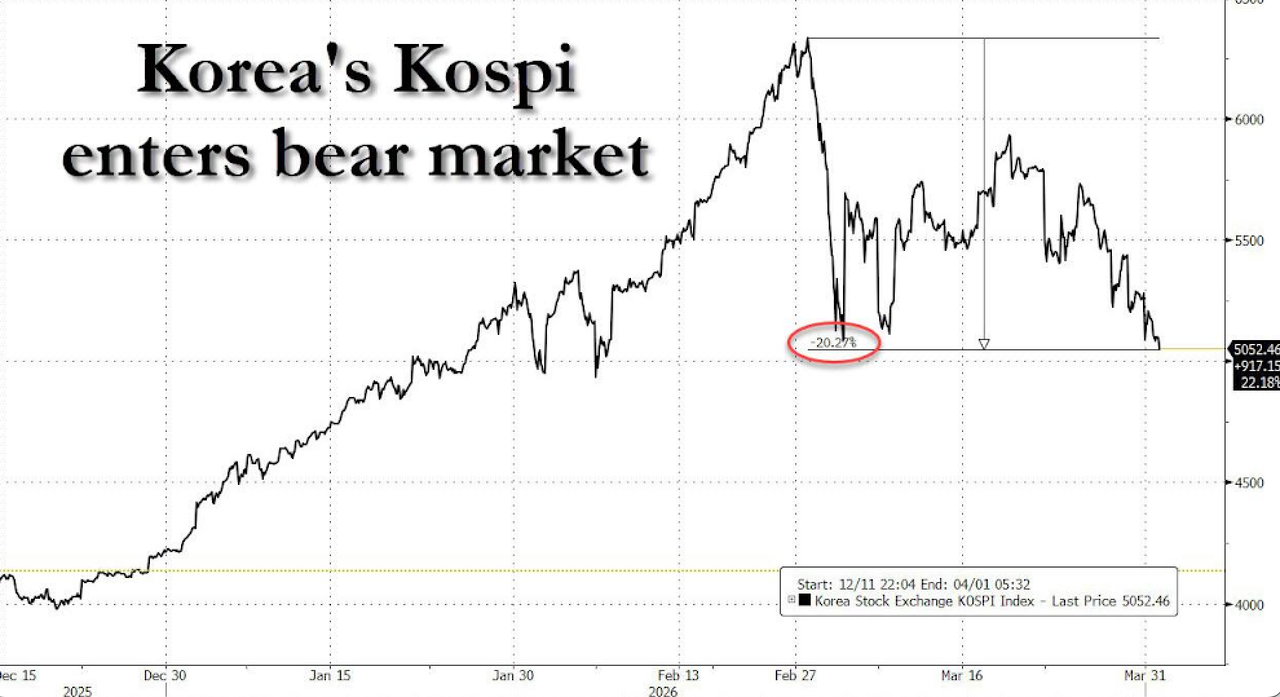
And remember, Korea’s Kospi has already slipped into a bear market amid the downdraft in memory names. It is all linked.
More on memory stock charts via our technicians at The Market Ear (chartpack here).
Tyler Durden
Tue, 03/31/2026 – 10:40