Category: News

No. 9 Notre Dame needs a win over Stanford in regular-season finale to stay in the playoff hunt
STANFORD, Calif. — Notre Dame has one last chance to impress the playoff selection committee.
The ninth-ranked Irish (9-2) wrap up the regular season Saturday night when they visit Stanford (4-7), knowing a loss would end any hopes of returning to the College Football Playoff.
Notre Dame has spent most of the last two seasons in must-win mode. The Irish recovered from a Week 2 loss last season to Northern Illinois to run off 13 straight wins — including three in the playoff — before losing the title game to Ohio State.
They dropped their first two games this season to Miami and Texas A&M, once again leaving no margin for error.
“It’s hard to remember what it was like in the moment. Like right now, we’re in the middle of the game and it’s high pressure,” Notre Dame coach Marcus Freeman said, reflecting on the series of must-win games they had to win to reach last year’s playoff. “In the moment, you’re just so entrenched on this opportunity right in front of you, and that’s what’s most important.
“That’s enough pressure, right? You start thinking about this big picture and what’s happening, an uncertain future, and that’s added pressure that you don’t need. This is the Super Bowl. Saturday is the Super Bowl.”
The Cardinal are hoping to pull off the upset in their final game under interim coach Frank Reich, who took over in April after Troy Taylor was fired.
Stanford has shown signs of improvement this season and is coming off a big win in the Big Game against California. But this might be the toughest test in a season that has included three other games against teams in the running for a playoff spot.
“We want to finish strong,” Reich said. “So we’re going to prepare to win, prepare to play to win. I know this: We’ve played a very tough schedule this year. We played a lot of really good football teams. This is just going to be the next one, and so we are not going to get too caught up in their tradition and who they are.”
The rivalry
When college football fans think of rivalry week, Notre Dame-Stanford might not be the first game that comes to mind. But at a storied program that features annual matchups against USC and Navy and has had long-standing rivalries with Michigan and Purdue, Freeman thinks the Irish-Cardinal game is every bit as special.
And, like the USC game, he would like to keep the series going.
“We’ve got to do everything in our power to try to keep this thing,” Freeman said. “It’s a rivalry game. That’s what’s most important. We’ve got to respect our opponent. We’ve got to respect the history and tradition of this game.”
Love bites
Stanford didn’t have a lot of footage to study from running back Jeremiyah Love’s most recent performance. The Cardinal still saw what they needed.
Despite logging only eight carries in last week’s 70-7 rout over Syracuse, Love produced one of his most dominating performances with 171 rushing yards, three scores and five first downs.
And Saturday will be his final chance to impress Heisman Trophy voters that he should be the one to extend the streak of a running back winning college football’s most prestigious award in every year that ends in a five. The last three running backs to win the award were Derrick Henry in 2015, Mark Ingram in 2009 and Reggie Bush in 2005.
“You look at Jeremiyah Love and you say, ‘OK, every time he gets the ball, there’s a chance he can go all the way,’” Freeman said. “And, yes, not going to get the carries maybe all the other runners in the country get, but what he does when he does get the carries is tremendous.”
Reich’s impact
First-year Stanford general manager Andrew Luck brought Reich out of retirement after he fired Taylor in hopes he would start the process of restoring a winning tradition. Reich has enjoyed the college experience after spending most of the past four decades in the NFL and has made the impact Luck wanted.
“He’s been amazing as a head coach,” linebacker Jahsiah Galvan said. “I’ve never been around a leader like him. To have him in the program and see the energy that he brings on a daily basis, he truly pours out for everyone on the team and everyone involved with the program.
“It’s just a blessing that he’s here. He’s been a big part of getting this program in the direction that it wants to go.”
AP’s Michael Marot contributed.
https://www.chicagotribune.com/2025/11/29/notre-dame-stanford-football-preview/

German Christmas Market Installs ‘Anti-Tank’ Barriers; Public Cheers ‘Creative’ Solution
German Christmas Market Installs ‘Anti-Tank’ Barriers; Public Cheers ‘Creative’ Solution
The German town of Külsheim is dealing with the soaring costs of terror-proofing German Christmas markets with a very festive solution: anti-tank barriers.
The German public media reporting this news does not even blink about how absurd the situation has become, but instead actually praises the “creative solution” of the anti-tank barriers. For skeptics, the anti-tank barriers may serve as a comical or tragic illustration of German Christmas markets moving beyond a mere police state and right into something resembling a militarized zone.
The Christmas market in Külsheim, which has a population of approximately 5,000 and is located in the southern state of Baden-Württemberg, has announced it is saving money by recycling anti-tank barriers for its Christmas market.
Located in the Main-Tauber district, Tageschau notes that “four disused concrete anti-tank barriers with a diameter of 1.4 meters were converted for the Christmas market.”
The barriers were painted with white and red paint, and were produced at the cost of €1,000 per anti-tank barrier when paint and working time are considered.
The city notes it saved €30,000 by repurposing the anti-tank barriers for its Christmas market.
Notably, across Germany, cities are spending millions on bollards, moveable barriers, and other security measures for Christmas markets, which is why the cost of Christmas markets is becoming more and more expensive.
According to Simone Hickl-Seitz, head of the city of Külsheim, protective bollards used to cost only €800, but he says that manufacturers now charge ten times as much.
“They know exactly that all cities need this. But the coffers are empty,” said Hickl-Seitz. The four anti-tank barriers were acquired from former Bundeswehr barracks, and each weigh several tons.
Their previous purpose was to prevent the movement of tanks, presumably from invading territory in Germany.
🇩🇪🎄 German police are now confiscating pocket knives from elderly women at Christmas markets.
Exploding knife crime in Germany, which the police openly says is tied to mass immigration, has led to a security state at German Christmas markets. pic.twitter.com/nRTQRIOr2d
— Remix News & Views (@RMXnews) December 17, 2024
German public media outlet SWR also included the Külsheim measure as a “cost-effective” and “creative” solution.
Just last year, Saudi national Taleb al-Abdulmohsen allegedly drove a vehicle at high speeds into the Magdeburg Christmas market, killing six people and injuring hundreds. The former doctor, who became a doctor despite years of fraud, abuse, and threats to kill Germans, is standing trial for his crimes. However, his actions, and other Christmas market attacks, have led to a crisis, with spiraling security concerns spread across the country.
🇩🇪🔥 Saudi doctor Taleb al-Abdulmohsen is now on trial for allegedly killing 6 people during a deadly car-ramming terror attack on a German Christmas market last year.
The 51-year-old suspect faces 6 counts of murder and hundreds of counts of attempted murder and bodily harm for… pic.twitter.com/HRsaqF9kE6
— Remix News & Views (@RMXnews) November 11, 2025
In Magdeburg, there were fears that the entire market would be canceled due to the stringent and costly security measures being required of organizers.
In response, Alternative for Germany (AfD) politician Ulrich Siegmund, chairman of the AfD’s parliamentary group in Saxony-Anhalt, visited the market and lamented that countries like Poland and the Czech Republic, that have so far managed to avoid mass immigration, do not have these issues.
“There was a terrible attack here a year ago. That was right here, where I’m standing right now. Of course, you have to learn from these experiences and do better. But the question must be, not how do you protect Christmas markets? But why do we need to protect Christmas markets?” he asked. “Go to the Czech Republic, go to Poland, go to other countries that have not opened their borders, that have not sold their own security for anything here. No, the CDU’s policies at state and federal level have brought us exactly to this point. We are losing our freedom bit by bit. We are giving up our way of life. And for what? That is the question.”
While the left will mock Germans for saying they want their “old” country back, the reality of a police state at swimming pools in the summer and a police state at Christmas markets in the winter, or even anti-tank barriers, is leaving many Germans longing for a previous era.
Pointing to an old picture of the market, Siegmund says, “Have a look at this, I just discovered it here. It used to be a perfect world, that’s exactly how I knew it. That’s exactly how I want it back… I want our old country back. I want every one of you here to be able to walk peacefully through a Christmas market like this and enjoy your lives. We don’t deserve this, our country doesn’t deserve this. Our children do not deserve this.”
🇩🇪🎄The German Christmas market in Magdeburg has been suspended over security concerns, sparking a nationwide debate.
The question: Why are Christmas markets in Germany being canceled while countries like 🇵🇱Poland and the 🇨🇿Czech Republic have no serious terror threats at their… pic.twitter.com/MUW5fofh5w
— Remix News & Views (@RMXnews) November 12, 2025
Although the Magdeburg Christmas market has since announced it will open, the costs for security remain sky-high and worries remain about another deadly terror attack.
Last week, Gerold Leppa, chairman of the German Federal Association for City and City Marketing (BCSD), said that the costs for organizers are exploding, rising a whopping 44 percent in the last three years. Of course, it is not just security but also personnel and even music licensing, but as Remix News noted yesterday, cities are spending millions more to ensure proper security.
While it is true that only a small handful of Christmas markets have been canceled due to security costs, such as in Overath, there is no denying that German cities — already facing major debt crises in large part due to mass immigration — are having to shoulder extremely expensive security solutions at their own Christmas markets.
Tyler Durden
Sat, 11/29/2025 – 07:00

Aerolíneas trabajan para solucionar fallo de software en el A320; hubo algunos vuelos afectados
Por AUDREY McAVOY
Aerolíneas de todo el mundo reportaron interrupciones de corto plazo al inicio del fin de semana mientras corregían el software de un modelo de avión ampliamente utilizado, después de que un análisis encontró que el código informático pudo ser el causante de una caída repentina en la altitud de un avión de JetBlue el mes pasado.
Airbus dijo el viernes que un análisis del incidente de JetBlue reveló que la intensa radiación solar podría corromper datos primordiales para el funcionamiento de los controles de vuelo en la familia de aviones A320.
La Administración Federal de Aviación de Estados Unidos (FAA) y la Agencia de la Unión Europea para la Seguridad Aérea exigieron a las aerolíneas que abordaran el problema actualizando el software. Más de 500 aviones registrados en Estados Unidos se verán afectados.
La agencia europea dijo que esto podría causar “interrupciones a corto plazo” en los horarios de vuelo. El problema fue introducido por una actualización de software en las computadoras a bordo del avión, según la agencia.
Afectaciones en el Día de Acción de Gracias en EEUU
En Japón, All Nippon Airways, que opera más de 30 aviones, canceló 65 vuelos nacionales para el sábado. Dijo que eran posibles cancelaciones adicionales el domingo.
El cambio de software se produce mientras los pasajeros en Estados Unidos comenzaban a regresar a casa después del feriado por el Día de Acción de Gracias, que es el momento de más viajes en el país.
American Airlines tiene alrededor de 480 aviones de la familia A320, de los cuales 209 están afectados. La solución debería tomar alrededor de dos horas para muchos aviones y se espera que las actualizaciones se completen para la gran mayoría el viernes, dijo la aerolínea. Unos pocos se terminarán el sábado.
American esperaba algunos retrasos, pero dijo que se enfocaba en limitar las cancelaciones. Afirmó que la seguridad sería su prioridad.
Air India dijo en X que sus ingenieros estaban trabajando en la solución y completaron el reinicio en más del 40% de los aviones que lo necesitan. No hubo cancelaciones, afirmó.
Delta esperaba que el problema afectara a menos de 50 de sus aviones A321neo. United dijo que seis aviones en su flota están afectados y espera interrupciones menores en algunos vuelos. Hawaiian Airlines dijo que no se vio afectada.
Vuelos europeos vuelven a la normalidad
En Francia, el ministro de Transporte, Philippe Tabarot, dijo que la situación se ha estabilizado ya que varias actualizaciones de software ya se habían instalado. Señaló que el impacto fue limitado en el país con un “casi completo retorno a la normalidad en los aeropuertos franceses”.
En el Reino Unido, la interrupción también fue mínima. British Airways, por ejemplo, dijo que solo tres de sus aviones requerían la actualización, mientras que EasyJet indicó que podría haber cambios en su horario de vuelos como resultado de la actualización, en cuyo caso se informará a los pasajeros.
La alemana Lufthansa de dio a conocer que la mayoría de las actualizaciones de software se completaron durante la noche y la mañana del sábado. No se espera que se cancelen vuelos de Lufthansa Group Airlines debido a la situación actual, pero podría haber retrasos menores durante el fin de semana, afirmó.
La escandinava SAS dijo que sus vuelos operaban con normalidad el sábado, ya que sus equipos trabajaron durante la noche para instalar el software requerido.
Mike Stengel, socio de la consultora de la industria aeroespacial AeroDynamic Advisory, dijo que la solución podría abordarse entre vuelos o en revisiones nocturnas de los aviones.
“Definitivamente no es ideal que esto esté sucediendo en un avión tan ubicuo en un fin de semana tan ajetreado”, comentó Stengel desde Ann Arbor, Michigan. “Aunque, nuevamente, el lado positivo es que solo debería tomar unas pocas horas actualizar el software”.
Al menos 15 pasajeros de JetBlue resultaron heridos y fueron llevados al hospital después del incidente del 30 de octubre a bordo del vuelo que iba de Cancún, México, a Newark, Nueva Jersey. El avión fue desviado a Tampa, Florida.
Airbus, que está registrado en Holanda, pero tiene su sede principal en Francia y es uno de los mayores fabricantes de aviones del mundo, junto con la estadounidense Boeing.
El A320 es el principal competidor del 737 de Boeing, dijo Stengel. Airbus actualizó su motor a mediados de la década de 2010, y los aviones en esta categoría se llaman A320neo.
El A320 es la familia de aviones de pasillo único más vendida del mundo, según el sitio web de Airbus.
____
Mari Yamaguchi en Tokio, Jennifer Kelleher en Honolulu, Geir Moulson en Berlín y Pan Pylas en Londres contribuyeron a este informe.
____
Esta historia fue traducida del inglés por un editor de AP con la ayuda de una herramienta de inteligencia artificial generativa.

Almost 20 years after he was first shorn, Andrew grad Tom Serratore is helping lead St. Baldrick’s charge
Tom Serratore is looking for the next Tom Serratore.
Back in 2007, the Tinley Park native was a freshman soccer and baseball player at Andrew High School, where he took part in a St. Baldrick’s event. At the time, St. Baldrick’s was new in the Chicago area and becoming wildly popular.
The idea is simple. People raise money for childhood cancer research by getting their heads shaved at events usually held around St. Patrick’s Day. Serratore and nine others lost their hair at an assembly at the Thunderbolts’ athletic field.
“I grew my hair out to be pretty bushy,” Serratore recalled. “It was pretty long. It was windy and my hair was blowing all over the place. I felt really proud that as a freshman, I was one of the top 10 fundraisers for this.
“All of my friends and peers got to watch me do this. Of course, everyone wants to touch your head and those are the core memories that I have.”
And it hasn’t stopped. Although St. Baldrick’s events are not as huge in the Chicago area as they were back then, they are still happening across the world. Over the span of 18 years, Serratore has not only gotten 20 head shaves, he has helped start up St. Baldrick’s events in various cities in the United States.
In mid-November, Serratore was named to the St. Baldrick’s Foundation board of directors. Now the Texas Christian University women’s soccer associate head coach, he said he hopes to use the platform to get young men and women involved with St. Baldrick’s events and share the same passion he has had over the years.
“How do we get the next generation of me?” Serratore said. “I started as a freshman in high school and I have been doing it for almost 20 years. Where is the next group of the kids who are already in high school or college now who are going to want to do this for 20 years?
“Hopefully we can try to inspire kids like that. That is probably my No. 1 major goal. How do we find the young kids and the next generation to put in the time and effort and help spread the word about St. Baldrick’s?”
District 230 Superintendent Robert Nolting has no doubts that Serratore can spread that word. Nolting was the principal at Andrew when Serratore was in school, and was impressed with not only his love for St. Baldrick’s but for other causes including the Make-A-Wish Foundation.
“He’s one of the best,” Nolting said. “He was a great leader at Andrew. When I first met him, it was like he was 10 years ahead of his time. He had an ability to articulate what was important to him. He had an ability to influence other kids to do things for others that they wouldn’t necessarily think of doing.”
“He’s always willing to help people with unfortunate circumstances.”
Serratore has nothing but praise for his time at Andrew and said the school made him what he is today.
But some of his best work for the foundation came after he left the school.
He played soccer at Valparaiso University and was all ready for his dome to get shaved again, but there was a problem.
“There was no event there, and I really wanted to keep doing it,” he said. “I went to the coaches on the soccer team and asked them if it was something we could do. They said yes, and we organized an event at a local barber shop.”
Tinley Park native Tom Serratore shows off his shaved head earlier this year during a St. Baldrick’s fundraiser in Fort Worth, Texas. (Melissa Triebwasser)
Serratore said 30 people participated and the first event raised a few thousand dollars. By the time he moved on, it blossomed to more than 100 participants raising $90,000.
He has organized events in Eugene, Oregon, and his current home, Fort Worth, Texas.
“Every place I’ve gone, I have continually started events at those places,” he said. “Some of those places, St. Baldrick’s hadn’t been known.”
And his crusade all started at Andrew.
“I heard about this crazy head-shaving event and I thought it would be the cool thing to do,” Serratore said. “One of my friends at the time had leukemia so this was a way to honor him at the time.
“I was playing soccer. I was playing baseball. I was doing all of the activities. It wasn’t like I could go to the hospital every single day so this was one way I could honor him and at Andrew it was a very big deal.”
To him, it still is.
“I’m obviously thrilled to be a part of it and to help the foundation at another level,” Serratore said. “I have a lot of experience in creating events and finding young people to get excited about raising money and doing things for child cancer research.”
Jeff Vorva is a freelance reporter for the Daily Southtown.

McHenry County takes on an old client in court: ICE
While activists have been fighting arrests by U.S. Immigration and Customs Enforcement on the streets of Chicago, another unlikely party has been facing off against the agency in court.
McHenry County has filed suit against ICE, trying to get the federal government to pay for potential liability for allegedly making immigrant detainees do forced labor.
The court battle pits conservative McHenry County, which once fought in court for the ability to hold accused immigrants in the U.S. without legal permission in its jail, against the agency that once paid it millions of dollars every year to do so. Both county and federal officials have denied liability.
The case comes as the U.S. Supreme Court is considering whether private prisons can immediately appeal their claim of immunity against a rash of similar lawsuits across the nation.
Northwestern University professor Jacqueline Stevens, founding director of the Deportation Research Clinic at the Buffett Institute for Global Affairs, said the Supreme Court seemed skeptical of Geo Group’s claims regarding a prison it runs in Colorado. That might not bode well for a public jail like McHenry County as well.
But McHenry County Assistant State’s Attorney Troy Owens, who manages civil litigation for the county, said the lawsuit against the county should be dismissed.
“This is an absurd lawsuit,” Owens said. “The Trafficking Victims Protection Act is being grotesquely misused.”
County attorneys have argued in court that the courts have established housekeeping duties as an exception to the 13th Amendment prohibition against slavery. Prosecutors also argue that the county is immune from such lawsuits because no court has found that a government-run detention facility violates the law by requiring detainees to perform housekeeping.
“It’s not asking too much to ask them to clean up their cells and common areas,” Owens said.
About a dozen class-action lawsuits have been filed nationwide, including in Colorado, Georgia and New York, against ICE and its contractors, such as CoreCivic and the GEO Group, which run private prisons. Geo Group reported revenue of $2.4 billion last year, 41% of it from ICE contracts.
The suits generally claim that inmates were forced to clean, do maintenance and perform kitchen duties for little or no pay, in violation of minimum wage laws or the Trafficking Victims Protection Act.
The Supreme Court recently took GEO Group’s case, in which it claims it should have “derivative sovereign immunity,” similar to immunity that protects the government from certain liability, because it had a contract to work for the government.
The McHenry County state’s attorney’s office also is arguing that ICE, acting through its contractor, The Nakamoto Group, should cover any liability in the case because the jail was merely following ICE guidelines.
While the McHenry case, filed in 2022, remains in the early stage of gathering evidence to determine its scope, other such cases have involved millions of dollars. In Tacoma, Washington, a jury awarded plaintiffs $17 million in back wages, and GEO was ordered to pay the state nearly $6 million in unfair compensation, known as unjust enrichment. They pay detainees as little as $1 a day for duties that could otherwise be done at normal wages by public workers or private employees.
“My takeaway is that the kind of get-rich schemes some entities might have through mass detention might not work out as well as they planned,” Stevens said.
McHenry County’s detention of noncitizens for ICE while their cases were decided had been a point of contention for years. Activists had pressured the county to stop the practice, but the county board voted in 2021 to continue, saying it generated revenue and kept detainees closer to home. ICE paid the county $95 per day per detainee, for an average of 240 inmates a day from 2016 to 2021, which the suit stated generated more than $41 million.
But effective in 2021, Illinois lawmakers prohibited detention contracts with local authorities. McHenry County appealed in court but lost. Since then immigrant detainees have been held in facilities out of state or at the ICE processing facility in west suburban Broadview, where federal immigration agents recently clashed with protesters over its arrests of hundreds of immigrants during the Trump administration’s Operation Midway Blitz.
Aleksey Ruderman in 2022 near his home in Milwaukee. While held at McHenry County Jail on civil immigration charges from 2016 to 2019, he said he swept and mopped the floors, wiped tables and cleaned the showers and toilets, all without being paid. (Armando L. Sanchez/Chicago Tribune)
In 2022, six detainees filed suit against McHenry, claiming they were forced to clean and maintain the jail without pay or face discipline. Some of the plaintiffs were released, while others returned to the countries they left. While convicted felons can be forced to do work as part of their punishment, immigrant civil detainees waiting for a hearing cannot. McHenry officials said detainees weren’t forced to work, but were responsible for keeping their own cells and day areas clean.
Ultimately, the courts must decide whether entities operating under the direction of the federal government receive governmental immunity from litigation, or whether the federal government assumes liability.
McHenry County officials declined to comment on the litigation, but told the Tribune that before the state prohibited its ICE contract, it was receiving nearly $10 million a year for housing ICE detainees. While the county has temporarily contracted with neighboring counties to house their inmates, the agreements generate about half as much revenue as the ICE contract.
The Trump administration’s solicitor general argued in the Supreme Court case that if an agency delegates authority to perform an unlawful action, the contractor is still liable. The administration has also requested a record $45 billion over the next two years to expand immigrant detention capacity to more than 100,000 people, much of it through private prisons, which are prohibited in Illinois.
In other words, Stevens said, if ICE misinterprets laws Congress passes, its contractors are not immune from lawsuits.
https://www.chicagotribune.com/2025/11/29/mchenry-county-court-ice-lawsuit/

Bruce Goff is having a moment
People who saw the strangely shaped house being built in Aurora — its red curved steel ribs, a black coal wall dotted with marbles and glass cullet — had different names for it, Life magazine reported in 1951. Some called it a “birdcage.” “Big apple.” “Dome.” “Hangar.”
Their comments were enough for its owners, Chicago Academy of Fine Arts director Ruth Van Sickle Ford and her husband, Albert, to put a sign outside that read: “We don’t like your house either.”
Nearly eight decades after it was built, the Ford House continues to be one of the best examples of the ingenuity that sprang from the mind of architect Bruce Goff — and the mixed reaction that creative wellspring could elicit.
The Kansas native has been called an “outsider” and a “rebel,” the best architect the public’s never heard of, a master of organic architecture and a prodigious talent whose relentless desire to never copy himself or anyone else is one reason he’s often not mentioned in the same breath as Frank Lloyd Wright, Louis Sullivan or Ludwig Mies van der Rohe.
Goff designed more than 500 buildings in a career that started at 12 and ended with his death 66 years later. Most were set in middle America. The Ford House is one of eight he built in Illinois, including two in Chicago, where pre-World War II, he established a private practice in Rogers Park and taught at Ford’s academy.
Goff’s eclectic designs — at times angular, curvy, futuristic, Seussian — and innovative use of nontraditional embellishments — glass ashtrays, feathers, sequins, coal — mirror the kinds of quirky attractions that have become synonymous with Route 66. (Architectural historian and writer Charles Jencks once dubbed him “the Michelangelo of kitsch,” a description Goff reportedly bristled at.)
And like the famed roadway, which celebrates its centennial next year, Goff is in the midst of a cultural resurgence of sorts.
In 2018, T: The New York Times Style Magazine profiled Goff in an article titled, “The Man Who Made Wildly Imaginative, Gloriously Disobedient Buildings.” Three years later, the city where he got his start in architecture, Tulsa, Oklahoma, played host to the first of what’s become an annual celebration called Goff Fest, co-created by a local filmmaker whose documentary about his life and work is scheduled for a wider release this winter.
A 1962 photograph shows architect Bruce Goff in his studio with his cat, Chiaroscuro. Goff was daringly inventive and often used unconventional materials in designs. (Art Institute of Chicago)
Starting in December, the Art Institute of Chicago will hold an exhibition titled “Bruce Goff: Material Worlds,” which will feature more than 200 of his drawings, models and paintings taken from the museum’s extensive Goff collection and archive, donated in 1990, eight years after his death.
One of the show’s goals is to introduce Goff to the broader public, co-curator Alison Fisher said.
“He just really isn’t in the mainstream of most people’s architectural history education, and the people I know who’ve heard of him just had a really enterprising professor who loved him,” she said. “So, I think we’re really excited about trying to bring him more into the canon, because without people like Goff, the profile looks pretty flat for midcentury architecture.”
‘Out in the hinterland’
Goff was born in 1904 in Alton, Kansas, a tiny town in the north-central part of the state. His family eventually settled in Tulsa, where he took inspiration from the natural world and the Native American tribes who lived there.
“When you’re out in the hinterland, as they say, you’re not supposed to have any culture,” he told a British Broadcasting Corporation television crew in 1981, a year before his death. “And there isn’t a whole lot of it around except what’s native to the area.”
He described his entry to architecture as an accident. “I had never heard of the word architecture or the word architect,” he told the BBC. His family saw Goff had artistic talent in the homes, castles and cathedrals the boy drew on scraps of wallpaper or wrapping paper.
One day, he said, his father came home — having “had a little too much to drink” — and told him to put on his hat and coat. They went to East Fourth Street and South Main Street in the heart of Tulsa’s downtown. Goff’s father stopped a stranger and asked, who’s the best architect in town?
Rush, Endacott & Rush, the man answered. Goff and his father walked to the firm’s office, where his dad requested they make him into an architect.
The Guaranty Laundry building on 11th Street, Route 66, in Tulsa, Oklahoma, on June 17 2025, which is now the Page Storage warehouse. It was designed by Bruce Goff in 1928 when he worked with the firm Rush, Endacott & Rush. (E. Jason Wambsgans/Chicago Tribune)
Goff started as an apprentice. Two years later, he was designing homes. His early drawings were compared to Wright, though he was unfamiliar with the famed architect and his work. He would eventually correspond with Wright and another of his heroes, Sullivan, once writing both men to ask whether he should pursue a formal education in architecture.
In response, Sullivan told him he’d spent his life trying to live down the education Goff was considering. Wright’s reply was shorter: “If you want to lose Bruce Goff, go to school.”
He took their advice, opting instead to continue learning on the job.
Goff is credited with at least a dozen buildings in Tulsa during the 1920s. In 1925, he designed a home and studio for his high school art teacher, Adah Robinson, steps from Route 66. The studio includes what’s said to be among the first uses of a sunken conversation pit. “I just think Bruce was wildly ahead of the game and just a true master at his craft,” said Justice Quinn, a Tulsa-based interior designer who in recent years helped restore the studio.
Around the same time her studio was being built, Robinson had been asked by friends at the Boston Avenue United Methodist Church in Tulsa to design a new building. She suggested the church hire Rush, Endacott & Rush and its young architect, Goff, to assist with the plans.
Part Gothic cathedral, part art deco skyscraper, the church features a striking central tower of vertical windows between columns of Indiana limestone that rises 250 feet to a spire of glass and copper sculpted to evoke hands raised in prayer.
With a semicircle sanctuary inspired by Sullivan’s design for a Methodist church in Iowa, the Tulsa church was hailed by author and critic Sheldon Cheney as “the most provocative American example of different church building.”
Adah Robinson, Bruce Goff’s art teacher, who the Boston Avenue United Methodist Church by Goff in Tulsa credits with the design of the church, on June 14, 2025. Her portrait hangs prominently in its center hall. (E. Jason Wambsgans/Chicago Tribune)
For Robinson and Goff, it should have been cause for celebration. Instead, it apparently caused a bitter rift between the two over who was responsible for its creation. The church credits Robinson as its designer; her portrait hangs prominently in its center hall. Goff’s close friend and fellow architect Bart Prince says the building is clearly Goff’s.
“He was shocked by it,” Prince said of Goff’s reaction to the controversy. “He felt he was really being cheated.”
‘The champion of the everyday’
Flush with oil money, the 1920s were a boom time for Tulsa. Then the stock market crashed, and the country plunged into the Great Depression. Hundreds of thousands of Dust Bowl refugees fled Oklahoma on Route 66, heading west for California and the promise of work on farms so fertile, it was said, that fruit fell from the trees.
Goff, true to form, did not follow the trend. Instead, he moved to Chicago in 1934. He first worked with artist, sculptor and designer Alfonso Ianelli, then at the Libbey-Owens-Ford glass company (he designed their Chicago showroom) and as a teacher at Ruth Ford’s fine arts academy.
The home Bruce Goff designed for Chicago artist Charles Turzak in the Edison Park neighborhood, on Oct. 22, 2025. (E. Jason Wambsgans/Chicago Tribune)
In 1948 Bruce Goff remodeled an existing wood house from 1889 in the Uptown neighborhood into a home and recording studio for recording engineer Myron Bachman. Shown Oct. 22, 2025. (E. Jason Wambsgans/Chicago Tribune)
He designed homes in suburban Park Ridge and Glenview and in Chicago’s Edison Park neighborhood. That home, built for artist Charles Turzak, is one of two Goff homes in the city. The other, for recording engineer Myron Bachman, is in Uptown and boasts sheets of corrugated aluminum angled to evoke a prism.
“Goff is really the champion of the everyday,” Fisher said. “A lot of times, architecture is seen as something that’s for the elite.” But Goff, she continued, “just was picking materials that were so commonplace. A lot of things he actually just got at five-and-dime shops, and he built at every single price point. He built houses that are super simple and then things that are extremely luxurious. And so that makes him different. He listened to his clients.”
Goff remained in Chicago until the onset of World War II, when he enlisted in the U.S. Navy’s construction force, the Seabees. He stayed in California briefly after the war and then returned to Oklahoma. In 1947, with only a high school education, he took a faculty job at the University of Oklahoma’s architecture department. A year later, he was named department chair. Quickly, he raised the school’s national and international reputation.
He did the same with his own profile, producing a staggering collection of homes that many consider to be among the best in his career.
Goff’s work caught the attention of the venerable Life magazine. A 1948 story titled “Consternation and Bewilderment in Oklahoma” mentions that a crowd of 14,500 people gathered to look at a home he built in Norman for the Ledbetter family.
Three years later, Life profiled the Ford House in Aurora, and began with the line: “Architect Bruce Goff, one of the few U.S. architects whom Frank Lloyd Wright considers creative, scorns houses that are ‘boxes with little holes.’”
Another Life article in 1955 featured the Goff-designed Bavinger House, also in Norman. Instead of rooms, it featured saucer-like suspended platforms. The roof spirals like a helix around a central mast to which it is connected with cables.
Bruce Goff’s Eugene and Nancy Bavinger House in Norman, Oklahoma, was razed in 2016. (Art Institute of Chicago)
“In architecture now, it’s very easy to copy and paste these easy and cheap buildings, and unfortunately, a lot of the cities in the U.S. are being built into these box-like structures,” said Britni Harris, Goff Fest co-founder and director of the documentary “GOFF.” “And I think that Bruce Goff was not only an architect, he was an artist. He thought about your environment and how that impacts you. I think that he wanted people to grow and be inspired in his buildings.”
The Bavinger House is gone, razed in 2016. Another iconic Goff home, Shin’en Kan in Bartlesville, Oklahoma, was destroyed in a 1996 fire.
A photograph of architect Bruce Goff inside the Ford House, designed by Goff in Aurora and built in 1949–50. (E. Jason Wambsgans/Chicago Tribune)
The Ford House, meanwhile, still stands. In 2019, its owner, architect and professor Sidney K. Robinson, received a stewardship award from the nonprofit Landmarks Illinois for his restoration and preservation of the house. Two years later, Robinson shared his thoughts on the home, and Goff, with the nonprofit MAS Context:
“I was one of those doubters having known about Goff’s architecture only through photographs. In the two-dimensional representation, patterns and textures and colors collided. It was just too much, excessive to the point of vulgarity. But now having lived in a Goff house for thirty years—what happened? I have visited a number of Goff buildings and the Ford House is the only one I would want to live in. Walking into this locally notorious house on an August Saturday morning in 1986 instantly overcame my previous doubts. As I have remarked before: like Saul on the road to Damascus, I was changed! What did I see in that flash of discovery? I saw intense sensory stimulation and clear order at the same time. As I have come to understand, this house is simultaneously exciting and calming. That is extraordinary.”
‘All parts of the story’
The six-paragraph story ran on Page 22 of The Tulsa Tribune’s Nov. 29, 1955, edition, under the headline: “Bruce Goff, Ex-Tulsan, Quits OU’s School of Architecture.”
His resignation, the article reads, was due to “poor health,” which made it “impossible to carry on his private practice as an architect and his university work.”
Days later, new details surfaced. He had been charged with a misdemeanor count of contributing to the delinquency of a minor. News reports at the time quote a criminal complaint alleging that Goff, while on campus, “caused a (14-year-old) boy ‘to expose his person in a private place in such a manner as to be offensive to decency’ and ‘did excite vicious and lewd thoughts’ in the boy’s mind.” He initially pleaded not guilty but eventually switched it to guilty and was fined $500.
Goff, who was gay, did not hide his sexuality. But it wasn’t something he widely discussed either.
“He was kind of a quiet, ordinary person,” Prince said. “People have written articles saying he was flamboyant. That just wasn’t true. He would wear a loud shirt occasionally and somehow they think that means flamboyant. He was quiet. He was very conservative.”
A prevailing narrative around his departure from OU is that the allegation against him was likely false, the result of him being a gay man in the 1950s in a deeply conservative state.
Even now, Goff’s personal life can be a thorny subject.
“When you talk about those things, there are some people in the architecture world who are like, what’s private is private, we should only talk about the work,” said Goff Fest co-creator Karl Jones. “And part of it is the closet. Part of it’s determinism — we don’t want to relegate him to being a gay architect. I understand it all. But I just think we can be post-determinist and post-queer and celebrate all parts of the story.”
‘They couldn’t understand it’
In the fall of 1968, Arizona State University asked Goff to speak to architecture students. Several faculty members were upset at the invitation. They vowed not to attend and encouraged students to do the same.
One of those students was 21-year-old Bart Prince.
Bruce Goff, left, and Bart Prince at Prince’s parents’ house in Albuquerque, New Mexico, just before Christmas in December 1969. The two architects and friends were heading to Chicago on Route 66 later that day. (Bart Prince photo)
Prince remembered how one instructor took him aside and told him he should skip Goff’s lecture, that it would be nothing the young student would want to see.
“Goff’s work was really controversial anyway, but especially in the schools because a lot of them thought: It isn’t architecture. It isn’t serious,” said Prince, 78. “They couldn’t understand it … to them, Goff’s work was just kind of fantasy. I never quite understood … because to me, it was really beautiful work.”
Defiantly undeterred, Prince attended Goff’s speech. By then, the 64-year-old had weathered the scandal of his resignation and criminal case and continued his prolific output of home designs. After OU, he moved to Bartlesville and opened an office in Price Tower, the only skyscraper built by Wright — Goff was originally asked to design the building, Prince said, but being too busy, suggested Wright take the job instead. He then relocated to Kansas City before eventually settling in Tyler, Texas.
Prince and Goff became fast friends. “He was very low key,” Prince said. “His voice was low. He walked like a cat, padding along.”
Prince spoke fondly of Goff’s humor and love of puns, how he discreetly stashed raw fish in his pocket at a sushi restaurant in Japan so as to not offend the staff by refusing to eat it, or how he initially rejected television until his mother got him hooked on it, and then he took to carrying around a TV Guide in his pocket so he wouldn’t miss an episode of “Star Trek.”
Bruce Goff’s Glen Luetta Harder House, Mountain Lake, Minnesota. (Julius Shulman photography archive/Getty Research Institute/Art Institute of Chicago)
The pair’s friendship turned to collaboration. Prince did drawings for a Goff-designed home for the Harder family, turkey farmers in southwestern Minnesota. Built in 1970, the home featured a trio of chimneys made of local boulders and a roof covered in bright-orange outdoor carpeting.
The Bruce Goff-designed Pavilion for Japanese Art at the Los Angeles County Museum of Art, on Oct. 10, 2025. (E. Jason Wambsgans/Chicago Tribune)
“A lot of architects seem to try to get around what their clients want,” Prince said. “They think their clients don’t know. Goff was the other way. He never went to try to get a client, which makes him different than a lot of architects. They had to seek him out. He wanted to know about the site, what they liked, what they didn’t like, and then he worked from there (and) developed a design specifically for them. That was the case in every case. So when he talked about his work, each building represented a client for him.”
Goff died on Aug. 4, 1982, in Tyler. Two posthumous projects he designed, the Los Angeles County Museum of Art’s Pavilion for Japanese Art and the Al Struckus House in LA, were completed by Prince.
His cremains were interred at Chicago’s Graceland Cemetery, the final resting place of architectural giants Louis Sullivan, John Root, Daniel Burnham and Ludwig Mies van der Rohe, whose simple black granite rectangular marker is in the plot adjacent to Goff.
Goff’s headstone, with its rounded pyramid shape and single chunk of glass cullet — salvaged from Shin’en Kan — looks like none of the others.
https://www.chicagotribune.com/2025/11/29/bruce-goff-architecture-chicago-art/
Biblioracle: What to give the book lover in your life
Any sensible person would agree that books make great holiday gifts, but not everyone is wholly confident selecting books for others, even others who they know are readers.
Not me. I’m happy to tell everyone what they should be reading. And if you want a handy expert local to you, check with your friendly independent bookseller to help you pick out a title targeted to the important gift-receiving people in your life.
But maybe you want a gift for the book lover in your life that’s a little extra special, the kind of gift that will endure past the pleasure of reading a book. Here’s some suggestions for the season.
A nice coffee table book
There’s no shortage of these in the world, but let me suggest a few recent and enduring favorites of mine.
“The Work of Art: How Something Comes from Nothing” by Adam Moss has had a permanent spot on my coffee table since its 2024 release. A series of essays and interviews, gorgeously illustrated and annotated, explore how creative people — playwrights, painters, musicians, sculptors, etc. — make the things that move us.
You’d need to be a classic rock fan for “Fleetwood Mac All the Songs: The Story Behind Every Track” by Olivier Roubin and Romuald Ollivier to appeal, but for the right person, this would be a great gift that would significantly enhance their enjoyment of the group.
David David Macauley’s classic illustrated books, “Cathedral,” “Pyramid” and “Castle,” in which he tells the story of how these monuments were built and impacted the lives of the people in and around them, may be 50 years old, but they are enduring pleasures for all ages.
A collectable book
This is a gift I get myself once a year, where I choose a particular favorite book and then buy a first edition copy, signed if the cost isn’t prohibitive. Depending on the author and age of the book, this can range from very affordable to not so affordable. There’s a first edition of Flannery O’Connor’s “Wise Blood” that’ll run you over $5,000 that I’ve had my eye on for years in case I win the lottery. If first editions are hard to come by, consider a foreign edition with a unique or special cover.
Online used book marketplaces like AbeBooks are great places to poke around, as are actual used bookstores, where you never know what you might find.
The USPS Literary Arts stamp series
From 1979 to 2024, the United States Postal Service issued a series of stamps honoring literary figures like John Steinbeck, Edith Wharton, Ursula K. Le Guin, Dorothy Parker and dozens of others. The most recent stamp is Chicago’s own Saul Bellow. Each stamp features original artwork representing the author. The entire set can be found for reasonable prices at stamp dealers or online sellers such as eBay.
Literary quotation clock
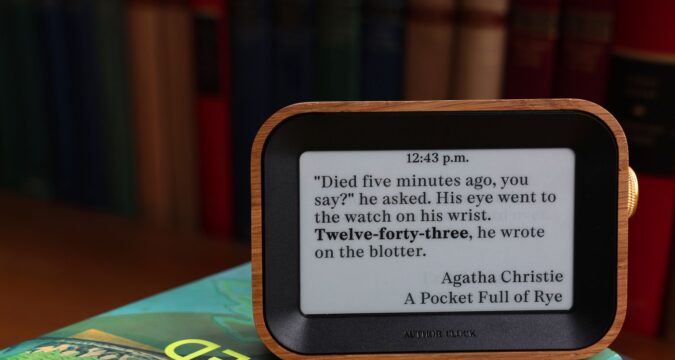
Okay, true confession, I’m borrowing this from The New York Times Wirecutter suggestions because once I saw it, I thought it was the coolest thing, and I want it, so I figure putting it here may cause it to manifest itself under the tree. The Author Clock is an e-ink display that tells you the time each minute of the day using a literary quotation that contains that exact time, as in this quote from Donna Tartt’s “The Secret History,” “I had meant to sleep only a few hours, but I woke with a start the next morning to find sunlight pouring in and the clock reading, five of nine.”
Apparently, it also updates when new examples are available. I don’t know how they figured this out, but I want it.
Do you hear that, loved ones? I want it!
John Warner is the author of books including “More Than Words: How to Think About Writing in the Age of AI.” You can find him at biblioracle.com.
Book recommendations from the Biblioracle
John Warner tells you what to read based on the last five books you’ve read.
1. “Mark Twain” by Ron Chernow
2. “The First Gentleman” by James Patterson and Bill Clinton
3. “JFK: Public, Private, Secret” by J. Randy Taraborrelli
4. “Jesus Wept: Seven Popes and The Battle for the Soul of the Catholic Church” by Philip Shenon
5. “Songs in Ordinary Time” by Mary McGarry Morris
— Tom F., Chicago
For Tom, I’m recommending a book that’s stuck with me for a long time, “Jewel” by Bret Lott.
1. “James” by Percival Everett
2. “The Trees” by Percival Everett
3. “Trust” by Hernán Díaz
4. “Hard Times” by Charles Dickens
5. “Say Nothing” by Patrick Radden Keefe
— Nicholas P., Chicago
Maybe something a bit less heavy than this list, but still has the qualities that I think will appeal to Nicholas: “Brooklyn” by Colm Tóibín.
1. “The Amazing Adventures of Kavalier & Clay” by Michael Chabon
2. “The Secret History” by Donna Tartt
3. “10:04” by Ben Lerner
4. “Olive, Again” by Elizabeth Strout
5. “Hello Beautiful” by Ann Napolitano
— Ellen P., Northfield
I’m going with a recently reviewed book that I’ve been continuing to recommend widely, “The Ten Year Affair” by Erin Somers.
Get a reading from the Biblioracle
Send a list of the last five books you’ve read and your hometown to biblioracle@gmail.com.
https://www.chicagotribune.com/2025/11/29/biblioracle-book-gift-guide/

Kelly McKinney: Thoughts on ‘Frankenstein,’ AI and the perils of our unfinished creation
We are nearing a tipping point with artificial intelligence. Scientists call it the singularity — the moment when machine intelligence surpasses our own. Some experts warn that it could come as soon as next year. AI already writes our code, drives our cars and designs our weapons — yet no one truly controls it.
In Guillermo del Toro’s haunting “Frankenstein” film, recently released on Netflix, Dr. Victor Frankenstein’s tragedy is not that he conjures life from death. It’s that he abandons it. Horrified by what he has made, he recoils, refusing to claim responsibility for what he’s unleashed. The result is a catastrophe: a creature who, desperate for understanding and belonging, becomes a monster.
Some two centuries after British author Mary Shelley penned her dark masterpiece, we are once again standing in Dr. Frankenstein’s laboratory. Only this time, the creation isn’t a creature stitched together from corpses — it’s intelligence itself. Similar to Dr. Frankenstein, we have discovered how to animate something in our own image, and yet we refuse to own its consequences. Only government regulation, transparency and stronger safeguards can ensure that this power serves humanity rather than destroys it.
When Shelley published “Frankenstein” in 1818, she called it “The Modern Prometheus.” Her novel is not just a Gothic fantasy about a mad scientist — it is a warning about what happens when human ambition outpaces human wisdom. In the Greek myth, Prometheus steals fire from the gods to benefit humanity and suffers eternally for it. In Shelley’s story, Dr. Frankenstein captures lightning to give life — and then runs away from his own creation. Shelley’s genius was to see that the real horror is not in the creature’s deformity but in its creator’s abandonment.
That abandonment feels all too familiar today. Across the world, nations and corporations are racing to capture the promise of AI: the efficiencies, the profits, the competitive edge. Governments are pouring billions into research, while tech giants sprint to release ever more powerful models.
AI has become the new fire — the lightning that illuminates and empowers us. But amid the excitement, we are failing to confront its darker side: its capacity to deceive, displace and perhaps even destroy us.
The warnings are not speculative. AI pioneers such as Geoffrey Hinton and Yoshua Bengio caution that the technology is advancing so rapidly that it will soon spiral beyond human control. Investor Paul Tudor Jones warns that AI poses an existential threat to humanity and calls for urgent global action. Yet there is no binding international treaty or global authority on AI. Instead of a Geneva Convention for algorithms, we have an arms race.
Del Toro’s film reminds us that Shelley’s story has always been about accountability. Dr. Frankenstein’s creation, rejected and isolated, becomes the very monster its creator fears. We have built something that reflects our intelligence and ambition but also our biases, our blind spots and our hubris. If we turn away from it now — if we fail to shape its purpose and limits — it will evolve without us.
It is not too late. Humanity has faced such moments before — from nuclear weapons to atomic power — and each time, conscience caught up to capability.
AI demands the same. Two hundred years later, Shelley’s vision feels less like fiction and more like prophecy. If we fail to heed her warning — if we continue to race ahead without responsibility — then the tragedy of Dr. Frankenstein will play out in our own world, a catastrophe of our own making.
Kelly McKinney is vice president of emergency management and enterprise resilience at NYU Langone Health and former deputy commissioner at the New York City Office of Emergency Management.
Submit a letter, of no more than 400 words, to the editor here or email letters@chicagotribune.com.

Consider Tillandsia for unique plant gift
A friend of mine who is a gardening fanatic has just moved nearby and I want to give a unique plant as a housewarming gift. Do you have suggestions?
— Angel Montoya, Highwood
Consider a plant from the Tillandsia genus as a unique gift for your friend. I find this group of plants to be very interesting. Gardeners should appreciate this plant along with its ease of care. They are commonly known as air plants and can be found in the jungle, rain forest and arid desert environments from sea level to high mountain regions. Most species of Tillandsia use their root systems to attach to trees or rocks and absorb moisture and nutrients through their leaves. This classifies them as epiphytes. The plants absorb water through small scales on their leaves, which give many air plants their silvery or gray appearance. There is a large variety of sizes, shapes, textures, blooms and colors, so you should be able to find something that you will enjoy gifting. Many of these plants undergo a dramatic color change as they flower. Tillandsia are relatively inexpensive, adaptable plants that tolerate a wide range of environmental conditions and require minimal care.
Tillandsia grow differently from most other houseplants, so they can be a bit confusing at first to new gardeners. Don’t pot them up into a container with growing medium. Instead, use glue, wire, fishing line, twisty ties, nails and staples to attach them to a support such as driftwood pieces and metal frames or put them into a container filled with glass spheres or pea gravel without any growing medium. The plant will eventually attach roots that anchor it to the mount. If the plant has a large enough root system, a heavy staple gun can be used to staple the roots directly to the mount. Nails and staples can only be used on plants with a good root system or woody stolon. Use waterproof glue and let the glue cool briefly before attaching plants if you are using a hot glue gun. Don’t use super glue or copper wire to avoid damaging or killing the plants. Air plants should not be put in containers that hold water (since they need to dry out). If you do place your plant in something that holds water, empty out the excess water after watering your plant. The same thing applies when mounting your plant. Do not surround the plant with moss that holds water and can eventually cause the plant to rot. Spanish moss works well, however, to camouflage the roots and plant attachments since it is open and airy and does not hold water.
Position Tillandsia so that they receive bright, filtered light while avoiding direct sun. In general, the higher the humidity in your space, the more light the plants can tolerate. The silvery-leafed varieties can usually be grown in full sun outdoors during the summer. If the air in your home is dry, submerge the plant in water for two to three hours every two weeks or so. If this is not feasible, use a soaking mist two to three times a week — more often in a hot, dry situation and less often in a cool, humid one. Do not use distilled or softened water on the plants. Filtered water, tap water that has sat long enough for chlorine to dissipate, bottled water or reverse osmosis water is best. Many people do not water these plants enough. The leaves will develop an exaggerated curl or roll if they are kept too dry. Ideally, your plants will be given enough air circulation and light to dry in less than three hours after watering. Spray misting can be beneficial between regular watering. In a very sunny spot indoors, they may need daily misting or weekly soaking, depending on which method you prefer. Provided the atmosphere is not too dry (as in an air-conditioned home), they can survive with water misting and the occasional soaking. It is better to water in the morning than at night, since air plants absorb carbon dioxide from the air at night rather than during the day. This process is impeded when the plant foliage is wet. You can purchase fertilizer that is formulated for air plants, as they absorb nutrients through their leaves. Fertilizers for orchids or bromeliads will also work well, but remember to apply these at one-quarter to one-half strength.
For more plant advice, contact the Plant Information Service at the Chicago Botanic Garden at plantinfo@chicagobotanic.org. Tim Johnson is senior director of horticulture at the Chicago Botanic Garden.
https://www.chicagotribune.com/2025/11/29/tillandsia-plant-gift-easy/

Letters: Why we need a fully funded Chicago Public Library
As a shy child, I cherished trips to my local library. From “The Giver” by Lois Lowry to “Their Eyes Were Watching God” by Zora Neale Hurston, I was transported to different worlds and time periods from the comfort of the library. Now, as a Chicago Public Schools English teacher, I want my students to be as enthralled by their library as I was at their age — and still am!
I’m glad that Mayor Brandon Johnson’s proposed budget directs $552 million to Chicago Public Schools, which will protect my students and school staff. However, I am concerned about the proposed cuts to Chicago Public Library staffing. That’s why I’m urging Chicagoans to write their alderperson, the mayor’s office and Library Commissioner Chris Brown. Tell these officials how much you love the library and want it to be fully funded and fully staffed.
According to a CPL staff member who responded to AFSCME Local 1215’s call for comment: “A teen who I have known for a few years has been coming to my branch more lately, and has started to feel very comfortable chatting with me about his life. … This teen is actively expressing interest in a safe afterschool activity that I have not been able to help him access because I am covering gaps in our staffing.” As a high school teacher, I want my teenage students to have a safe space at their fully staffed library and be able to participate in a wide range of after-school activities.
Public schools and libraries are public goods, and both should be invested in for the benefit of everyone. Another CPL staff member explained that “the current understaffing at my library forces us to turn away patrons who need one-on-one assistance with job applications, finding housing, or accessing reliable information.”
Johnson’s proposed budget would eliminate 89 CPL positions after a loss of 78 positions last year. With the two years of cuts combined, it’s the equivalent of each library branch losing two staff members.
Progressive revenue solutions, such as taxing the rich, should fully fund both CPS and CPL. Investing in education and libraries protects Chicago’s most vulnerable and helps build a better city for everyone, not just for the ultra-rich.
— Bridget Greenfield, Chicago
Citizens can drive change
Thank you to Andy Shaw and the Tribune for Shaw’s inspirational op-ed “The paradox of billionaire philanthropists” (Nov. 18). It reminded me that there are still creative thinkers invested in seeing Chicago thrive. Now, if only our leadership would listen.
The first letter I had published in the Tribune, just after moving here in 1991, was very similar. At that time, there was an ongoing issue about the cleanliness and upkeep of the CTA stations. I offered the idea of volunteers “adopting” stations to take on the necessary maintenance.
Although the idea never materialized as a policy, I was subsequently elected president of the Transit Riders’ Authority for a two-year term following the letter. As citizens, we were able to work directly with the CTA on our concerns.
For instance, current riders may not recall, but the trains used to run as A or B trains, neither of which stopped at every station. It was a system that required riders to get off an A train to wait for a B train, which would then let them off at their stop. If that sounds convoluted or unnecessary, it was. A significant accomplishment of the Transit Riders’ Authority was persuading the CTA to adopt the all-stops system we have today.
My point is that creative thinking and citizen involvement can be a practical approach to solving our city’s problems. Shaw has put forward an innovative, admittedly ambitious, proposal.
Yet, it’s entirely realistic, if tackled by people who are capable and willing to work on his suggestion of finding five of the most critical initiatives. Or, how about just starting with one program that needs funding for which a donor or group of contributors could receive acknowledgment?
I have often wondered whether Chicago citizens could even start GoFundMe campaigns to help lift our city from this economic crisis in some way. The more fortunate among us live in a city that the world admires for a reason. Besides complaining about taxes, how can we keep it that way?
Shaw identifies himself as an “inveterate dreamer.” I belong to a group called the “Idealists of the World.” Perhaps he and I need to organize the “Chicago Dreamers and Idealists Society for Economic Growth.”
— Linda Finley Belan, Chicago
Kindness of Chicagoans
My family recently visited Chicago to celebrate my daughter’s birthday. She has Rett syndrome and is handicapped; that day, she wore a birthday crown. We spent the afternoon on State Street and Lake Shore Drive, enjoying lunch at The Walnut Room and shopping along the way. What we experienced throughout the city deserves to be recognized.
At a time when so many conversations focus on what is wrong with Chicago, we were met with everything that is right. Strangers along State Street, in the Walnut Room and even as we walked along Lake Shore Drive greeted her with genuine warmth. People smiled at her crown, held doors, wished/sang her happy birthday and treated her with a kindness that stayed with us long after we left.
My daughter is nonverbal, but she felt every bit of that joy. As a mother, witnessing Chicagoans welcome her so openly meant more than I can express. It reminded us compassion is still alive and well, often found in the small, everyday gestures of ordinary people.
Thank you to the people of Chicago who made her birthday so special. At a time when the city is so often painted in a negative light, our experience showed the opposite.
Chicago’s heart is still very much alive.
— Shannon Folk, Pontiac, Illinois
Submit a letter, of no more than 400 words, to the editor here or email letters@chicagotribune.com.
https://www.chicagotribune.com/2025/11/29/letters-112925-chicago-public-library/