Category: News

Illinois Democratic Senate primary race has started slow. But contrasts emerge in bid to replace Dick Durbin.
The top-of-the-ticket Illinois Democratic primary race for the state’s open U.S. Senate seat has lurched along in slow motion through much of the fall, its major candidates eclipsed largely by a turbulent political backdrop even as they seek support for a contest less than 90 days away.
Related Articles
Illinois’ US Senate primary race shows candidates still must court shrinking downstate Democratic base
Illinois AFL-CIO withholds primary endorsements for Senate, comptroller and most open-seat races for Congress
US Rep. Raja Krishnamoorthi continues blazing fundraising pace in US Senate race
But as the March 17 election moves closer, signs of chippiness have emerged among the contenders as they look to move beyond well-worn campaign rhetoric and seek to draw sharper contrasts for voters.
The race to replace retiring U.S. Sen. Dick Durbin has struggled to break through a crowded news cycle. A tumultuous fall — punctuated by aggressive immigration enforcement raids in the Chicago area under Republican President Donald Trump and a bruising fight over the city budget — has dominated political attention, leaving the candidates to build momentum primarily on their own.
So far, U.S. Reps. Raja Krishnamoorthi of Schaumburg, Robin Kelly of Lynwood and Lt. Gov. Juliana Stratton of Chicago have focused on similar public themes — affordability, health care and opposition to Trump — while shying away from direct criticism of one another in early public forums.
They’ve also worked on fundraising and building support, seeking backing from individual labor unions after none of them could get the two-thirds support from delegates needed to win the Illinois AFL-CIO’s endorsement.
At the same time, the campaigns have begun taking shots at each other on more political issues, focusing on campaign finances rather than policy, to try to dust up the rival contenders.
Already, a complaint has been filed against Stratton, alleging her Senate campaign misused an email fundraising list from her state campaign, something her Senate campaign dismisses as “frivolous.”
The complaint, filed by a family member associated with a Krishnamoorthi supporter, contends that in the month before Stratton announced her Senate bid, her state campaign fund spent more than $100,000 on a firm to increase her digital presence and grow an email list, then effectively transferred that asset to her federal campaign without properly disclosing it, in violation of federal campaign law.
The complaint cites a person who said they signed up for Stratton’s state campaign emails and subsequently received campaign emails from Stratton’s Senate campaign account after she announced her bid for federal office.
Stratton’s campaign disputes the characterization. Despite heavy state spending to help curate a state email list, her Senate campaign said it is not using the state list and has instead built its own new list while using the same digital vendor.
The same firm is also sending emails. But the Stratton Senate campaign said email addresses used in campaign solicitations come from a variety of sources. Those receiving a federal solicitation were the result of being on the separate Senate list, not the state email list, according to the Stratton Senate campaign.
“It’s the same digital vendor, but it’s not the same mailing list,” a Stratton spokeswoman said. “There’s a lot of ways that you end up on different mailing lists that you didn’t directly sign up for.”
As the complaint plays out, Stratton has been hitting back at Krishnamoorthi, the race’s dominant fundraiser. Through September, Krishnamoorthi raised $24.9 million compared with Stratton’s nearly $2.1 million and Kelly’s $2.7 million.
The clash intensified when federal immigration agents resumed enforcement activity in Chicago and the suburbs on Dec. 16. Krishnamoorthi posted publicly that conducting raids during the holidays was not about public safety but “about fear and intimidation.”
U.S. Rep. Raja Krishnamoorthi high-fives paradegoers during the 96th annual Bud Billiken Parade on Aug. 9, 2025, in Chicago’s Bronzeville neighborhood. (Dominic Di Palermo/Chicago Tribune)
“I will use every oversight and legislative tool available to confront these abuses, defend due process and hold federal agencies and their leaders accountable,” he pledged.
Stratton quickly fired back, attacking Krishnamoorthi for having accepted $29,300 since 2015 from Shyam Sankar, chief technology officer at Palantir, which has a $30 million contract with U.S. Immigration and Customs Enforcement through the Department of Homeland Security. After the contribution was reported in the Chicago Sun-Times, Krishnamoorthi’s campaign said it donated the funds to unnamed immigrant rights groups.
“With all due respect, Congressman, you had no issue accepting tens of thousands of dollars from the people profiting off of these raids. Accountability starts with you. You owe Illinoisans an explanation of where you donated the money and why you had to be pressured to return it,” Stratton posted on X.
She also questioned whether Krishnamoorthi prioritized fundraising over personal values.
A Krishnamoorthi spokesperson dismissed the criticism, saying the five-term congressman “is fighting tirelessly to hold Donald Trump, ICE, and DHS accountable” and that, as a “proud immigrant and a proven fighter … his record on these issues is crystal clear.”
Krishnamoorthi, whose fundraising has allowed him to air commercials nonstop since mid-July, and Stratton have each used the aggressive activities of ICE and Customs and Border Protection agents as a major campaign point to also rail against Trump.
On Dec. 19, Krishnamoorthi visited the ICE detention facility in Broadview after a federal court lifted restrictions on members of Congress conducting oversight visits. Authorities denied him entry twice in October.
Lt. Gov. Juliana Stratton speaks with activists during a rally to protest President Donald Trump on May 18, 2025, in the Little Village neighborhood of Chicago. (Armando L. Sanchez/Chicago Tribune)
Earlier that week, Stratton said she joined community organizers in the Back of the Yards neighborhood to warn residents of ICE activity. In a social media post, she taunted the chief border patrol agent, Greg Bovino, saying he “and his out-of-control agents should know that their authoritarian tactics are not welcome here.”
Railing against Operation Midwest Blitz underscores a shared imperative among the leading Democrats: to persuade primary voters they would be the most forceful check on Trump and his agenda.
“We’ve got to hold the Trump administration accountable. They are acting with impunity right now,” Krishnamoorthi said at a recent candidate forum hosted by the Northwest Suburbs Organizing for Action group and Indivisible Illinois.
“We need to constrain his powers. He can’t tariff the hell out of our prices so that people can’t afford their basic staples. We’ve got to make sure that people don’t lose their health care, and we have to repeal that large, lousy law. On top of that, we have to make sure that ICE, which is acting with impunity, is reined in,” he said.
“I’m going to hold Donald Trump accountable,” Stratton, the two-term lieutenant governor to Gov. JB Pritzker, told the forum. She added that she believed the president to be “a threat to United States’ national security.”
“You all have heard me day after day call him out on his nonsense, and I’m going to continue doing it when I get to the United States Senate,” she said.
U.S. Rep. Robin Kelly talks with a shopper at La Fruteria on Chicago’s South Commercial Avenue about grocery costs on Dec. 13, 2025. (John J. Kim/Chicago Tribune)
Kelly, in her 12th year in Congress, is less strident in her rhetoric and defends herself against Stratton’s efforts to position herself as an outsider against a “status quo” of two congressional rivals.
“Illinois needs someone who has worked in Congress, reached across the aisle in very challenging times, but still gotten the work, done. And I’m not afraid to stand up to any bully,” Kelly said. “I’ve stood up, shown up my entire life in government.”
https://www.chicagotribune.com/2025/12/26/illinois-us-senate-race-slow-start/

Michigan marijuana businesses, customers see hazy future with new tax
Metro Detroit cannabis dispensaries say sales have ticked up in recent weeks as customers stock up ahead of a new 24% tax set to take effect Jan. 1.
The increase in sales reflects a combination of the pending tax, holiday gift-giving and higher consumption around the end of the year, retailers say.
“We see people coming in, stocking up,” said Jerry Millen, owner of Greenhouse of Walled Lake. “There are people coming in from out of state. I think you see a lot of people just before Christmas, New Year. We’re starting to see it now.”
One thing looming over the industry is the new tax on adult-use cannabis, approved as part of the state’s road funding package that begins Jan. 1. The tax applies at the wholesale level, but some consumers worry it could lead to higher prices at the register.
“There’s probably some angst out there in the customer base regarding the road tax and its impact on pricing in 2026,” said Adam Saj, vice president of supply chain and support services for Lume Cannabis Co., which has 39 dispensaries in Michigan. “In late September when the news reports started coming out regarding House Bill 4951, we did see a notable uptick in October. As we approach the New Year, we do anticipate that’s going to occur again.”
The tax, built into the Comprehensive Road Funding Tax Act, applies when marijuana is first sold or transferred to a retailer and is separate from the current 10% excise tax on recreational marijuana and the 6% state sales tax consumers pay on purchases.
Lawmakers say the new tax is expected to generate $420 million each year for road and infrastructure repairs. Cannabis businesses and industry groups have opposed the tax, saying it will drive up prices for consumers and strain an industry already dealing with falling prices and consolidation. The Michigan Cannabis Industry Association, which represents about 400 licensed marijuana businesses, has challenged the matter in court, but so far the tax is expected to take effect as planned after a Michigan Court of Claims judge upheld its legality this month.
“We remain steadfast in our belief that when the Legislature imposed this 24% wholesale tax, it violated the will of the voters who approved the 2018 citizen ballot initiative,” said Rose Tantraphol, MiCIA spokesperson, in an email.
Tantraphol said the association is working with its attorneys to finalize an appeal of the ruling by Judge Sima Patel, who said the new wholesale tax bill was “consistent” with the ballot proposal’s text, which recognized “other taxes.”
Tantraphol said cannabis customers have said they feel their dollars are already stretched thin, and they aren’t willing to spend more.
“Businesses will close,” she said. “Our neighbors will lose jobs. The wholesale tax hasn’t kicked in yet, and already one cannabis operation in Webberville will be closing, another business has told us it will close soon, and one business in the Upper Peninsula permanently laid off 61 employees this week.”
How customers are responding
Maddie Fowler, 23, of Royal Oak, said she was concerned about the potential impact the tax could have on prices. She recently stopped by Lume in Berkley to purchase a weed cartridge and vape pen.
“Disappointment, mainly, too, because it was already a big battle to get it legalized …,” she said. “It’s just kind of like, all right, let’s make it more expensive. It was kind of frustrating to hear.”
Fowler said she didn’t have plans to bulk-buy ahead of the tax, but she plans to be more mindful of her purchases.
Saj, with Lume, said the company is aware of concerns over the new tax but is working to keep costs manageable for customers.
“Will prices go up in 2026? Yes, but not by this scary 24%,” he said. He added that Lume is dealing with vendors who are willing to absorb some of the cost, helping ensure that the increases are smaller than some consumers might expect.
Saj encouraged customers who are concerned to visit Lume stores before the end of the year if they want to stock up. He said there may be a few items that see little to no price increase in 2026. For example, a $10 item may increase by a dollar, he said.
Fowler said she’s encouraged that the price increases may not be as high as she expected, but she still worries about how dispensaries will manage.
“This is my favorite place to go, but that is a concern,” she said. “I was thinking, like a lot of dispensaries, I wonder if they do make enough money to begin with, or they could kind of cushion this cost.”
Duane Byers, 62, of Detroit said he plans to take things week by week. He recently stopped by Lume in Berkley for some prerolls.
“It hasn’t hit me yet because it hasn’t started yet,” he said. “So probably I’ll get a shock when I come in here next month and see how much additional it’s gonna be. I’ll probably make some changes, because if it’s gonna be a lot more, then I have to probably think about how I buy in a different way.”
Byers said even small increases can add up.
“When you buy $50 and $60 then now you’re looking at an additional $6 or $7,” he said. “It’s not that much when you buy a small item, but you buy a large item, then it’s gonna look more significant.”
Businesses gear up
In Walled Lake, Greenhouse plans to lean more on its medical marijuana license as it navigates the new 24% wholesale tax, which does not apply to medical cannabis. Millen said he expects some customers who let their medical licenses lapse to renew them to avoid higher prices on recreational products.
“It’s very hard to source medical products now, but we have quite an extensive collection of medical products,” Millen said. “And the nice thing about the way the Greenhouse is set up, I have two separate rooms. I have a recreational room and a medical room, so you don’t have to come wait in the line of 500 people on the rec side.”
To lessen the impact of the tax, Millen said earlier this year he purchased a cannabis grow operation and renewed both medical and recreational grow licenses, allowing Greenhouse to produce its own medical-grade flower.
Millen said he doesn’t plan to raise the prices of any of his products until he absolutely needs to.
“I’m trying not to raise prices for hopefully three, four or five months, I’m hoping,” he said. “That’s my hope. That’s why I spent all this money on flower to pass (savings) on to the consumer.”
Nick Hannawa, vice president and part-owner of Puff Cannabis, said customers are stocking up ahead of the new tax, and that the company has placed large orders to maintain low prices for the time being. The company has 13 dispensaries in Michigan.
Hannawa criticized the tax as well as the legislature’s rollout, calling it unclear and leaving more questions than answers about how the tax will be collected.
“This could be get very messy,” he said. “We asked the (Cannabis Regulatory Agency) for guidance. They’re trying to get us guidance.”
Hannawa said Michigan cannabis businesses already operate with thin margins and face stiff competition. He said larger operations like Puff may be able to weather the change, but smaller operators could be hit hard. It could also potentially drive more activity to the black market, he said.
“What Puff is going to do is we, along with our partners, we’re going to continue to fight for reform to get this overturned,” he said. “I’m sure this will go all the way to the Supreme Court. So we hope to continue to fight.”
Despite the issues, Millen said he expects the cannabis industry to continue in Michigan: “It’s not going to kill the industry. The industry will be fine. The consumer on the recreational side will have to pay a little bit more, but they will.”
Byers, the Lume customer, had the same sentiment.
“I don’t think anyone will be stopping,” he said. “Because most of the people that smoke gonna keep smoking.”
Caroline Shenkosky, a budtender at Lume Cannabis Co., hands an order to Jalius Hagan of Royal Oak on Dec. 17, 2025, at the cannabis store in Berkley, Michigan. (Katy Kildee/The Detroit News)
Caroline Shenkosky, a budtender at Lume Cannabis Co., right, assists a customer on Dec. 17, 2025, at the store in Berkley, Michigan. Adam Saj, vice president of supply chain and support services for Lume, says the company is working to keep its consumers from being hit with the full 24% wholesale marijuana tax that takes effect Jan. 1. (Katy Kildee/The Detroit News)
https://www.chicagotribune.com/2025/12/26/michigan-marijuana-businesses-new-tax/

2025 in review: A look back at the impact of the Trump administration through op-eds
President Donald Trump promised during his inaugural speech that his second term would usher in a “golden age,” and he promptly signed a flurry of executive orders in his first 100 days, more than any other U.S. president.
The changes that came in subsequent months have left many Americans reeling. The administration eliminated an agency — the U.S. Agency for International Development — and promised to get rid of others, issued baseline tariffs on nearly every country in the world and cut around 300,000 government jobs, all while attempting to broker peace in several conflicts abroad.
The contributors to our commentary section have examined what this new age of executive power means and how it is affecting Americans and people around the world. Review the administration’s first year with some of our best op-eds.
Feb. 13: Paul Vallas, “What would it mean if the US Department of Education is abolished?”
In 1980, Ronald Reagan ran for president vowing to abolish the U.S. Department of Education, but there was little support among congressional Republicans for doing so — until Donald Trump reignited the push for its dismantling. The DOE is the smallest Cabinet department with around 4,100 employees.
At first glance, the department’s future might seem uncertain, given Trump’s repeated promises to eliminate it and reports that he plans to sign an executive order to that effect — similar to his efforts to shut down the U.S. Agency for International Development. However, unlike USAID, the DOE is explicitly authorized by Congress and cannot be dismantled without congressional approval.
A U.S. Department of Education employee leaves the building with their belongings on March 20, 2025, in Washington ahead of President Donald Trump’s signing of an executive order to dissolve the Education Department. (Win McNamee/Getty Images)
Democrats are claiming that closing the DOE would mean eliminating Title I and the Individuals with Disabilities Education Act programs and other grant programs that, according to the National Center for Education Statistics, amount to around $30 billion in annual grants. While that is a significant amount, it equals less than 6% of what state and local governments themselves spend. Democrats also claim that Pell Grants, federal student loans, loan repayment and loan forgiveness programs administered by the DOE would also be abolished.
There is no indication that Trump intends to eliminate these programs. Even if he did, like any effort to dismantle the DOE, such actions would require congressional approval.
March 25: Gavi Rosenthal, “I worked for USAID for 16 years. I saw the profound difference it made.”
Barbara Singer, of Bethesda, Maryland, who says she worked for the U.S. Agency for International Development as a contractor until being let go in February, holds up a sign in support of USAID on Feb. 28, 2025, in Washington. “It’s a great agency that benefits all of us,” Singer said. “Americans and people worldwide.” (Jacquelyn Martin/AP)
Since Jan. 20, USAID has been painted as wasteful and excessive. Here’s the truth: What USAID does is actually the minimum. USAID’s humanitarian bureau lets people know they aren’t alone during their worst moments, helps them survive and helps them fare better the next time disaster strikes. Remember the worst time in your life: Did you lose your home, or a family member, or survive a flood or a fire? Do you remember what helped? Maybe it was someone giving you a place to stay until you could get back on your feet or a neighbor bringing food so you didn’t have to cook in your grief. Or maybe it was someone offering a gift card for the grocery store, someone saying, “Your kids are safe,” while you went to find work or shelter, or someone feeding your kids because what you could afford wouldn’t be enough to go around.
Have you done these kindnesses for someone else? Of course you have. That’s what USAID does; it’s that basic. USAID says, “The American people are with you and are here to help,” and then USAID helps communities to help each other. It cannot be said enough how little this costs, how universal and human this is.
I’ve been privileged to represent the U.S. at its best, to work alongside the smartest, most compassionate, most professional people I’ve ever met, all trying to make life a little less difficult for their fellow humans. My team supported public health workers coordinating across conflict lines in the middle of a civil war to vaccinate Syrian kids against polio, reaching every kid when everyone thought it was impossible. I found myself close to tears watching trucks of food cross the border into Syria, knowing the months and layers of delicate negotiations required to allow such a simple delivery of food to people in need. I met Ukrainians fleeing across the border into Slovakia in the first days after Russia’s full-scale invasion, and the hundreds of strangers mobilized to support and welcome them. I met families who fled the eruption of Mount Mayon in the Philippines, who survived because they had enough warning to make it to safety before the volcano erupted, because of the support that my office had provided for early warning technology.
April 16: George F. Galland Jr., “Kirkland & Ellis and others have made a deal with the devil”
These firms are too addicted to big money to behave well in a crisis such as the one now engulfing the country. So when Trump decided to capture them, it was a snap. He ordered his lackeys to start bogus “investigations” of “discrimination” and threatened to cut off security clearances. This was unconstitutional, but he couldn’t care less. He knew, as he put it, they’d come on bended knee. One after another, they’ve made “deals” with him, the basic, unstated term of which can only be: If you help anyone challenge me in court, you risk me going after you again.
It’s not hard to guess why these firms caved to Trump. Paul, Weiss, the first firm to make a deal, essentially said so. It knew that if it resisted Trump’s pressure, other comparable firms probably wouldn’t. That could lead to losing clients and making less money. Think of it — having to make, on average, less than $9.25 million a year. Horrors!
But Kirkland & Ellis could at least have refrained from trying to explain why it did what it did. A statement from its “Firm Committee” to its “Firmwide All Personnel” could be used, in my opinion, by Poison Control units to induce you know what: “We made this decision to pursue this solution because at our very core our mission is to protect and support our people and our clients, and this agreement does both. It is also consistent with the values that underpin our firm and cement us together, including our culture that prioritizes ability and opportunity, not politics.” I would have put it differently: “By bowing to the president’s demands, we became complicit in what he is doing to the country.”
July 6: Richard C. Longworth, “Donald Trump will be remembered as a great leader — but not a good one”
President Donald Trump speaks to the media before walking across the South Lawn of the White House to board Marine One en route to Florida on July 1, 2025, in Washington. (Mark Schiefelbein/AP)
It is time to acknowledge that Donald Trump is a great man, and that’s not good.
This is a hard concept for both Trump’s fans and foes and requires definitions, of “greatness” and “goodness.” But Trump is making history by the day, and we need to understand where he fits in this history.
I’d argue that a great leader is one who, by sheer force of intellect or will, shapes the history of his time. Most leaders merely react to the events of their day or cope with crises, big and small, or try to make progress bit by bit, happy to leave their societies a little bit better than they found them. In this sense, history shapes their legacies by limiting what they can do. If they keep us out of war or depression or civil strife, that’s no bad legacy.
This modest competence doesn’t satisfy the great man, not at all. He wants to dominate history and change the world. Propelled by ideology or a sheer lust for power, he intends to break the rules of society and uproot the social order he inherited. Too often, he succeeds.
Sept. 3: Steve Chapman, “Donald Trump pioneers a strange policy: Republican socialism”
President Donald Trump, left, shakes hands with Nvidia CEO Jensen Huang after Huang spoke in the Cross Hall of the White House during an event on “Investing in America” on April 30, 2025, in Washington. (Andrew Harnik/Getty)
Socialism used to be the antithesis of Republican principles. “Socialism only works in two places — heaven, where they don’t need it, and hell, where they already have it,” Ronald Reagan quipped.
It was not just outright nationalization of industries that conservatives rejected; it was almost any sort of federal interference with private markets to achieve social or economic goals. Barack Obama’s Affordable Care Act preserved the role of private insurers, but GOP Rep. Michele Bachmann expressed a right-wing consensus when she told the 2011 Conservative Political Action Conference it was nothing less than “the crown jewel of socialism.”
But Trump has outdone anything Obama ever dreamed of, mounting a brazen government invasion of the private sector. He interfered with the sale of U.S. Steel to Nippon Steel, forcing the Japanese giant to grant Washington a “golden share,” which will give him a major role in company decisions.
Chip manufacturer Intel had to agree to give the U.S. government an ownership stake — making it the company’s biggest shareholder. “I said, ‘I think you should pay us 10% of the company,’ and they said yes,” Trump crowed. It was an offer Intel couldn’t refuse.
He imposed terms on chipmakers Nvidia and AMD, forcing them to hand over 15% of the money from their sales in China. He announced a deal requiring the Japanese government to invest $550 billion in the U.S. — which will be carried out “at President Trump’s direction.”
These are only the beginning. “I will make deals like that for our Country all day long,” Trump posted about the Intel shakedown.
Nov. 28: Elizabeth Shackelford, “Donald Trump’s Black Friday approach to foreign policy”
The world order established in the wake of World War II reflects a Giving Tuesday take on foreign policy. Countries came together to establish the United Nations to promote global cooperation for collective benefit. That approach sees a world of sociopolitical integration, in which the security and prosperity of individual countries depend and rely on the security and prosperity of others. It recognizes our interconnectivity and compels us to manage it effectively, not just for our own individual gain. In this world order, humanitarian aid and development and the allies to promote them are not altruistic but essential.
Another kind of foreign policy is the Black Friday kind: selfish, transactional and short-term. It might benefit a country on a brief political cycle, but it doesn’t provide long-term solutions or stability. Its quick answers can lead to long conflicts. This was the type of world order that set the stage for two World Wars and that the post-WWII order was designed to end. And yet, this is the kind of world that the Trump administration is seeking to return to.
`The Russian “peace deal” that the administration just tried to force on Kyiv offers a clear example, though widespread pushback from members of Congress and our allies thankfully forced a return to the negotiating table. The original 28-point plan, and President Donald Trump’s framing of it as an ultimatum, would have given the United States some shallow, short-term gains, such as reconstruction profits and investment opportunities. But it would have done so at the cost of Europe’s future peace, since it would have rewarded Russia’s aggression with even more territory than it already stole and left Ukraine incapable of defending itself in the future. From trade to security partnerships, Europe’s stability affects us at home, so that would have cost us in the long run too.
Submit a letter, of no more than 400 words, to the editor here or email letters@chicagotribune.com.

Faith leaders: 2025 was a year of setbacks and celebration
The end of a calendar year is always a good time to reflect on the time that has passed. We’d like to share our reflections on the 12 months of messages we have been privileged to share with you through the pulpit of the opinion pages.
We begin with the obvious: 2025 was a year of major setbacks.
Following the inauguration of a new administration, we realized that faith leaders committed to the religion of creation — one that exalts the common good — would need to lead the resistance against the reigning powers seeking to privilege the few. The religion of empire stands in opposition to the religion of creation. As we framed it in a column early this year: “The religion of America’s empire forsakes the whole for the sake of the few.” Our warning then proved instructive for the fight ahead: The religion of empire “is a human invention used to justify and legitimatize attitudes and behaviors that provide blessing and abundance for some at the expense of others.”
America’s “empire” mentality dominated the year. It is based on blatant mistruths that poison our society, such as the insidious “great replacement” conspiracy theory, as “racist, anti-immigrant, misogynistic and antisemitic as it is untrue.” We decried the stoking of fear by our national leaders that heterosexual white people who embrace traditional gender norms — sometimes, the less overtly racist and sexist term “Western civilization” is used instead — are being replaced by a diverse society that seeks the equity of all people. Since we wrote those words in February, the Department of Homeland Security has elevated the asylum status of white Afrikaners while terminating temporary protected status for refugees from Ethiopia and Afghanistan. By June, we we forced to call readers’ attention to steps the administration has undertaken that threaten civil liberties, an essential democratic safeguard for religious, racial and other minority communities.
Furthermore, that mentality of “empire” remains entrenched in our federal government: Recently, Republican lawmakers called for the mass expulsion of Muslims from America. Throughout the year, we have seen a shocking normalization of white Christian nationalism. By September, the movement had become so widespread and centralized that we were compelled to pen a strong indictment: “We must clearly state that white Christian nationalism has co-opted Christianity in an attempt to sanctify an ungodly movement. In rejecting love for all and replacing it with hate for many, white Christian nationalism is, literally, anti-Christ.”
Strong words are required for our national debate, but also in our home city.
Deacon LeRoy Gill delivers a homily during a sunrise Mass to pray for the healing of families, schools, communities and the safety of children Aug. 23, 2025, at Oakwood Beach in Chicago. Gill spoke about a young parishioner in his parish who was killed by gun violence. (Dominic Di Palermo/ Chicago Tribune)
As clergy committed to our city of Chicago, our focus did not waver this year from our fundamental commitment to mitigating the plague of gun violence. We spoke about the need for continued investment in community violence intervention programs and also of the important role each of us can play in the lives of young people to steer them away from gun culture.
The hunger and food insecurity crisis also escalated in our city. Three of us witnessed a rise in the number of people visiting the food pantries run by our institutions, so we sounded the alarm for all Chicagoans, not only to share their time and money with organizations that address hunger but also to advocate with elected officials to mitigate the cuts to Supplemental Nutrition Assistance Program benefits.
And, of course, the deployment of federal forces in our city, which have disappeared our residents, shot chemical munitions at our clergy, tear-gassed our journalists and effectively trampled on our constitutional rights, has weighed on us. We spoke of the need for mass protests across the nation and for standing in solidarity across lines of class and faith in Chicago. In the face of the oppression imposed by the immigration raids and deportations, we remain proud that our city of broad shoulders has built a broad coalition that stands with immigrant and refugees communities.
Importantly, this year was not without its moments of celebration. The four of us were downright joyful at the General Assembly passage of the Clean Slate Act; we spoke of the legislation’s vital importance in March and October. We are so grateful to Rep. Jehan-Gordon Booth and Sen. Elgie Sims for championing the bill and also to Gov. JB Pritzker for signing it into law. The Clean Slate Act is about more than redemption. It’s about restoring the right to work and the freedom to live.
Throughout this year, we have focused on the power of speaking up in protest and through our actions. We began the year with a call to you all to lift up your voices: “We cannot afford the luxury of remaining silent, or remaining isolated from each other. Instead, standing together, we can counter that sickness, we can defeat the isolating cold and we can usher in a new era of embracing warmth.”
When the summer heat arrived, we again extended the invitation to speak up and to speak out, together: “Let voices of care ring out of every pulpit, speak from every heart and be extended with kind acts from every hand. May nonviolence rule our lawless time. May your voice and your hands join together with ours.”
And we conclude this year with the same exhortation: May 2026 bring us peace and blessings, and may we continue to stand together. May we live up to the higher angels of our nature and the loftiest values of our traditions. May we not let lines of faith or class or race divide us; rather, may we unite against the forces of empire that seek to subdue us, so that we might be able to create a city that honors all creatures and all creation.
Chicago faith leaders Rabbi Seth Limmer, the Rev. Otis Moss III, the Rev. Ciera Bates-Chamberlain and the Rev. Michael Pfleger joined the Tribune’s opinion section in summer 2022 for a series of columns on potential solutions to Chicago’s chronic gun violence problem. The column continues on an occasional basis.
Submit a letter, of no more than 400 words, to the editor here or email letters@chicagotribune.com.
https://www.chicagotribune.com/2025/12/26/opinion-2025-donald-trump-faith-leaders/

With island prices rising, Chicagoan from Puerto Rico must delay dream of moving back
When Daphne Labault left her home in San Juan, Puerto Rico, after Hurricane Maria blew her windows out, her dream was to go back someday.
“Returning had always been our north, our goal,” said Labault, 33, who came to Chicago with her partner about two months after the September 2017 hurricane and now lives in Edgewater.
In 2024 she launched Plena Mercancia, a Puerto Rican coffee shop in Humboldt Park named for its plena, or plain, locally sourced sugar and artisanal goods. Labault wanted to create a space for people to chat over coffee, like they do in Puerto Rico.
“I’ve been able to create this little piece of Puerto Rico outside of Puerto Rico but always with the wish of wanting to go back,” she said. Her hope is to raise enough money to buy a house and move back in the next few years.
But her dream was pushed back once already. Her five-year goal to raise enough money for a house in Puerto Rico turned into eight years. The island’s high cost of living, fueled by a wave of tourism, led her to invest the money intended for a house in Puerto Rico — years’ worth of savings — into her cafe.
Rising costs on the island that were exacerbated by the hurricane and fueled by a new wave of tourism have led to gentrification and the displacement of many islanders.
Labault is one of about 200,000 Puerto Ricans who left the island after Hurricane Maria swept the 3,500-square-mile archipelago, killing nearly 3,000 people and leaving lasting infrastructure damage.
She described the Category 4 hurricane in one word: thirst.
Basic necessities such as drinkable water, food and gasoline were scarce. With no refrigeration, people were drinking hot soda to stay hydrated, Labault said. After waiting in line for five hours to pick up ice, much of which melted on the way home, she and her partner decided to leave for Chicago.
Her move to the city was meant to be temporary and she diligently set money aside for a house in Puerto Rico. But the price of a three-bedroom, one-bathroom home there went from about $195,000 before the pandemic to over $300,000 today, she said.
Some real estate agents wouldn’t even pick up the phone, Labault said. If they see a Puerto Rican area code from the caller, they don’t answer, she said, giving preference to U.S. buyers, who are perceived as wealthier.
With time, her dream of moving back to the island keeps getting pushed back.
About 100,000 Puerto Ricans live in Chicago. About 3,000 Puerto Ricans came to Chicago after the 2017 hurricane, with some staying temporarily, according to In Our Nature, a student magazine at Northwestern University.
Like Labault, many Puerto Ricans find home prices unaffordable in the territory.
Last year, she took her savings and launched Plena Mercancia, her cafe along the Paseo Boricua cultural corridor on Division Street. The sun-lit space feels like an islander’s living room, with its forest green walls and butter yellow chairs that face each other.
Customers she knows by name linger around the wooden coffee bar where she prepares pour-over coffees with a consistency that took her a long time to perfect.
“This was like my compromise,” she said of the cafe. “I don’t have the island, but I can create my own space that feels as much as home as possible.”
Inside the cafe is a showroom filled with accessories, T-shirts and other artisan goods from the island. There is a T-shirt featuring the famous coqui frog species of Puerto Rico popularized by rapper Bad Bunny, and painted postcards that read “Isla del Encanto,” or “island of enchantment.”
In this way, Labault said she can give back to the Caribbean island and contribute to its economy, even if she’s far away.
Bad Bunny performs during his first show of his 30-date concert residency at the Coliseo de Puerto Rico Jose Miguel Agrelot, in San Juan, Puerto Rico, July 11, 2025. (Alejandro Granadillo/AP)
In January, Bad Bunny, who is Puerto Rican, launched the album “DeBÍ TiRAR MáS FOToS” (“I Should Have Taken More Photos”). It tackles themes of exile and gentrification on the island, featuring local rhythms such as salsa and plena.
The album’s Sapo Concho, an endangered crested frog, is a motif for those displaced. In a short film for the album, an aging Puerto Rican looks at old photos of the island with the animated Sapo Concho, remembering the home he left behind.
Bad Bunny topped Spotify charts as 2025’s most-played artist in the world with over 19.8 billion streams this year. His “DTMF” album was Spotify’s top global album of the year and won a Latin Grammy for Album of the Year. His residency “No me quiero ir de aqui” (“I don’t want to leave here”) last summer hosted 31 concerts exclusively in Puerto Rico, with his last concert coinciding with Hurricane Maria’s eighth anniversary on Sept. 20, according to USA Today.
When Labault first heard the album, she said it was tough to listen to. “It was a really strong album, because it’s what we all feel; it’s like he’s the voice,” she said. But groups in the diaspora experienced it differently than native islanders, who lived through Puerto Rico’s harder moments, she said.
Daphne Labault in her Puerto Rican-inspired cafe and handicrafts store Plena Mercancia on Dec. 23, 2025. (Terrence Antonio James/Chicago Tribune)
A group of friends from Puerto Rico sat around Labault’s cafe bar one day to listen to the album together. They reflected on Puerto Rico’s colonial status as an unincorporated U.S. territory, and whether it would end up like Hawaii — a tropical paradise for rich Americans, she said.
“When I heard it, I understood that the space that I once occupied is now being occupied by (some) North American, by someone who doesn’t appreciate our island, and I was shaken by that,” Labault said.
In 2019 Puerto Rico rolled out Act 60, a new version of an incentive that encouraged wealthy investors to relocate to Puerto Rico by offering tax breaks. The incentive, meant to create jobs on the island, has contributed to rising property costs, experts said.
Wealthy investors often relocate to the island but conduct their primary business elsewhere, leading to mainly low wage job creation, said Jose Atiles, associate professor of sociology at University of Illinois Urbana-Champaign.
Additionally, the money coming in from the incentive is not enough to be significantly reinvested in social welfare for the island, he said.
It has also attracted crypto investors who buy up property and wait to sell it for a higher profit margin later, which raises real estate prices.
“That has limited the amount of real estate available for people,” Atiles said.
Tourism also spurred many buyers in the short-term rental market and in the hotel industry, particularly in popular areas like San Juan, the capital, making it more expensive for locals to buy property, Atiles said.
“It’s like a race between people my age who don’t own property to buy one,” Labault said. If foreigners buy most of the property, there won’t be much left for locals, she said.
She tells her father, who owns property in Cabo Rojo, not to sell. “No matter how much money they give you,” she said.
Years of rising debt and corruption in Puerto Rico had precipitated a financial crisis in 2016, with the island having over $70 billion in debt.
Prices rose fast, and a year later Hurricane Maria hit, said Antonio Sotomayor, an associate professor and librarian of Latin American and Caribbean studies at the University of Illinois Urbana-Champaign.
It was the island’s deadliest hurricane since 1899. “That was the last straw,” said Sotomayor, who came to Illinois from Puerto Rico in 2001. He called the hurricane’s aftermath a war zone.
Now, high tourism and tax incentives have given Puerto Rico the image of a “Caribbean paradise for the ultrarich,” he said.
The hurricane also exposed the fragile nature of the island’s power grid, ushering the world’s second-longest blackout. Earlier this month, the island’s energy provider since 2021, LUMA, was sued by the Puerto Rican government for its failure to improve the power grid, with the island facing continual outages and high electric bills.
Labault said she experienced depression and anxiety after moving. She feels as though she abandoned her native land and people, and hopes to buy a property in Puerto Rico before getting priced out.
In Puerto Rico there is a saying: To be big, you have to grow your profession abroad, she said.
But not a day goes by in Chicago that Labault doesn’t feel like a stranger.
“Everyday, I feel like a tourist,” she said.
On most days, you can find her at the cafe making Coffeequito, a twist on a traditional Puerto Rican Christmas drink made with coconut cream and coffee, or warming up snacks for her 6-year-old son.
She is still saving up to buy her home in Puerto Rico.
https://www.chicagotribune.com/2025/12/26/puerto-rican-chicago-bad-bunny/
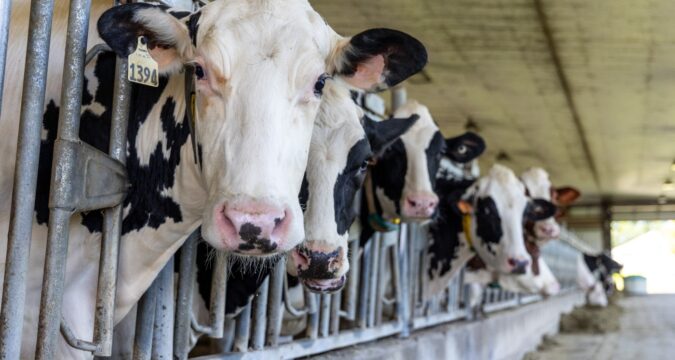
These Illinois dairy and beef farms make raising methane-belching cows part of the climate solution
Illinois is a top agricultural state, generating billions of dollars annually, but even where stalks of corn and acres of soybean vastly outnumber its 400,000 head of cattle, cows raised for beef and dairy account for an outsize portion of the industry’s methane emissions.
A single cow raised for meat produces between 154 and 264 pounds of methane per year, according to the U.S. Environmental Protection Agency, meaning 333,000 beef cattle in Illinois last year could have released between 51 million and 88 million pounds of methane into the atmosphere. This is equivalent to emissions from 151,000 to 260,700 gasoline-powered cars driven in one year.
Cattle produce this powerful, heat-trapping gas through a digestive process called enteric fermentation, which represents over 25% of greenhouse gas emissions from the agricultural sector. As climate change from human activities intensifies, experts say addressing this source of emissions by implementing sustainable and innovative practices — from diet additives to regenerative grazing — can offer quick wins in the fight against global rising temperatures, which is already presenting new challenges to raising cattle.
Cows can spend over eight hours a day regurgitating their partially digested meals to chew again. As bacteria break down food in a specialized stomach, the process releases methane, which cows then belch into the air. It’s part of a natural cycle as the gas is returned to the ground by plants when it converts back into carbon dioxide after 12 years in the atmosphere.
This means the greenhouse gas is “created, and destroyed or absorbed, at kind of a relatively similar rate,” said Josh McCann, associate professor of animal sciences at the University of Illinois Urbana-Champaign, who leads research into nutrition for beef cattle. “And yet, our environmental, atmospheric methane is not going down. It’s increasing pretty rapidly.”
“That cycle doesn’t exist in a bubble. And what we know is that other sources of methane have significantly increased,” said John Tauzel, associate vice president of global agriculture methane at the nonprofit Environmental Defense Fund. These other sources include fossil fuels such as natural gas, oil wells and coal mines, as well as waste from landfills and water treatment.
An often-used analogy equates methane being released into the atmosphere to water running from a faucet into a bathtub, Tauzel said, which people use to argue: “As long as the methane coming into the atmosphere is equal to the methane going out of the atmosphere — into the bathtub, out of the bathtub — we’re all set, the world is fine.”
“The problem is, we don’t have one faucet from cow (methane) coming into the world, into the bathtub. We have multiple faucets now, and we’re turning those up, actually,” he said. “So that the global budget, the global outcome of methane, is now overflowing. We have way too much.”
Atmospheric methane concentrations have more than doubled over the last two centuries, contributing to up to a third of global temperature increases since the Industrial Revolution. Most methane comes from human activities, of which 40% is from agriculture, 35% from oil and gas production and 20% from landfill waste.
President Donald Trump’s U.S. Environmental Protection Agency announced in late November it would delay Biden-era deadlines for the oil and gas industry to limit methane emissions. Earlier in September, the agency proposed a new rule to end the greenhouse gas reporting program for large emitters, including landfills, even as population growth has led to more waste.
At a time when the federal government is loosening regulations across methane-emitting industries, addressing agricultural methane can present quick wins in climate mitigation.
It’s not that cows are the issue, McCann said. But they offer an opportunity to address a greenhouse gas that is 80 times more potent than carbon dioxide over 20 years and reduce its immediate impact, thus slowing the rate of climate change.
Overall, livestock production has only become more efficient in the United States in recent decades, which keeps methane emissions in check. Improved genetics and nutrition mean fewer cows are needed to meet demand: for instance, from 130 million head of cattle in the 1970s to 94 million nowadays.
“We have about 28 million beef cows in the U.S., which is the least amount of cows we’ve had in a very long time since 1951,” McCann said. “So our beef cow herd is relatively small in terms of numbers of cows — and yet we’re producing almost as much beef as we’ve ever produced.”
This means fewer animals are emitting methane for the same production value.
According to the Illinois Farm Bureau, cattle farmers are producing 60% more beef with 40% fewer carbon emissions than 50 years ago, and each gallon of milk produced by dairy farmers creates 63% fewer carbon emissions than in 1944. The United States produces the most sustainable beef globally, according to several industry groups, with the lowest greenhouse gas emissions per pound of beef in the world over the last few decades.
“From a methane standpoint, we don’t have more cows, we have less cows, and those cows are more efficient. We’re doing more with less, and yet, in the same time period, atmospheric methane is a very different kind of story,” McCann said. “Now, at the same time, it doesn’t mean we shouldn’t do anything. There are ways that we can reduce methane in the agriculture and livestock sectors. And so I’m all game to help make cows part of the solution.”
To significantly reduce the impacts of methane, the industry doesn’t even need to become zero-emissions like climate goals that are specific to carbon dioxide, Tauzel said.
A global pledge to reduce methane emissions from livestock by at least 30% from 2020 levels over the next five years, experts say, can limit global warming to 2.7 degrees Fahrenheit — which is the aim of carbon neutrality — and even reduce warming by over 0.36 degrees by 2050.
“We can’t reach our goals of reducing methane if we don’t also include agriculture in the solution set,” Tauzel said.
Some dairy and beef producers are finding that committing to more sustainable practices that reduce methane or capture carbon offer additional benefits: Managing their manure differently to use as fertilizer on their land, rotating cattle on pastures and offering diverse diets are tried-and-true ways to enhance their land’s productivity and make their animals happier.
For instance, a rotational grazing method offers Doug Hanson’s cows a variety of feed throughout the year. A fourth-generation beef producer located in Danforth, 85 miles south of downtown Chicago, Hanson has been employing this method for 20 years. It earned him the Illinois Beef Association’s 2025 Environmental Steward of the Year award.
A cow grazes in a permanent pasture of grasses on the Hanson Land and Cattle farm in Danforth on Nov. 3, 2025. (Eileen T. Meslar/Chicago Tribune)
On a recent weekday, his herd quietly grazed on a paddock of permanent pasture, covered in a variety of grasses such as fescue, orchard grass and perennial rye, as well as white and red clover. Across the 70-acre property, pastures like it are interspersed with seasonal ones that have cover crops. The cattle get moved between pastures to let the plants and soil breathe and regenerate.
“As we move through them, you’ll see that they are all different,” he said, driving a utility vehicle past a pasture planted mostly with alfalfa. Two calves looked longingly into the locked paddock.
Related Articles
Time to go vegetarian? Cost of chicken and ground beef hit record highs.
Trump EPA moves to eliminate landmark scientific rule that’s the basis for climate regulations
Instead of feeding the animals grains to bulk the cows up to market weight faster, the rotational grazing allows the family to take its time and produce high-quality meat, which Hanson’s daughter Maddie later sells out of Hanson Family Meats in Gilman, 6 miles south.
“I’ve had a lot of customers like, ‘This is the best meat we’ve ever had. We like that you slow-grow them on pasture,’” she said.
Hanson also spreads his cattle’s manure as fertilizer. Alongside the cover crops and the rotation in grazing, it has improved the soil’s health and nutrient availability across all his pastures compared with that of tilled, single-crop farmland or overgrazed, eroded grassland.
“You can get more of what Mother Nature already put in that ground,” he said.
By nature, cows are going to do what they’re going to do: ruminate, burp and release methane. But approaches like Hanson’s can lock carbon in the ground, offsetting that environmental impact — and benefiting pastures by letting soil health and biology regenerate in between feedings, which improves fertility and water retention.
To make agriculture part of the solution to greenhouse gases, experts say, industry and government need to invest in this kind of win-win strategy for dairy and beef producers.
Fighting methane with food and poop
At a state-of-the-art dairy farm in St. Charles, 40 miles west of Chicago, Sarah Lenkaitis jokes that her cows eat “way better” than she does.
As is industry standard by now, the Lenkaitis family works closely with a nutritionist who visits the farm every month to ensure the best, most efficient diet for the animals. It mainly includes dry hay, a protein mix, haylage and ground corn, and is complemented by palm fat and byproducts from other industries like corn gluten, roasted soybean meal, wheat middlings and cereal grain. In contrast, beef cows tend to graze on pastures for most of their lives. In Illinois, that is complemented by hay during winter when the ground is frozen.
“It’s a very delicate dance; everything’s gotta work just right,” Lenkaitis said. “And it’s a very methodically formulated ration.”
Maddie Buckley, owner of Hanson Family Meats, holds a handful of soybean hull pellets and corn on her farm in Gilman on Nov. 3, 2025. She feeds a mixture of soybean pellet hulls and corn as well as hay to the cattle. (Eileen T. Meslar/Chicago Tribune)
The farm is currently milking 75 registered Holstein cows, making it average-sized for Illinois and putting their operations on the smaller side for the country, where the average dairy herd size is about 350 cows. Each of their cows produces about 8 to 9 gallons of milk a day.
Even as dairy cow diets have been fine-tuned significantly to improve productivity, thus limiting the industry’s overall emissions, nutrition still offers promising innovations that can even reduce the activity of methane-producing bacteria in cow guts.
For instance, Bovaer is a U.S.-approved feed additive that significantly reduces cattle’s enteric methane emissions by suppressing an enzyme involved in methane production inside the cow’s specialized stomach or rumen. It can most easily be added to the food of dairy cows, which have very controlled diets. Delivering the additive to grazing beef cows can be more challenging, Tauzel said.
“Can we get that Bovaer but in a salt block, for example?” he said, referring to a dietary supplement that cows get for deficiencies of sodium chloride. “Or another way that we can deliver that product without the cow having to take a bite, getting a bite at every meal, because they’re (eating at) pasture, not that casserole.”
However, it’s been challenging to persuade cattle growers to incorporate the food additives, since there is no additional benefit to the cows or the milk or beef they produce.
“It has a cost, but if it doesn’t elicit a production benefit,” McCann said, “how can you ask the producer to pay for something like that?”
Boo feeds on a mixture of ground corn, corn gluten, wheat middlings, cereal grains and other ingredients at Lenkaitis Holsteins Dairy Farm in Campton Hills on Aug. 28, 2025. The Lenakaitis’ 80 Holstein cows are housed in a state-of-the-art barn with technology that ensures productivity and sustainability for both the business and its environmental impact. (Dominic Di Palermo/Chicago Tribune)
Another diet supplement solution is seaweed. Specifically, red marine algae that, added even in small proportions to a cow’s daily feed, can reduce their methane emissions by as much as 80% to 90%, according to some studies. Some companies are beginning to explore ways that producers can obtain carbon offset benefits to reward the adoption of these practices.
Other related emissions from cattle come from the management of their manure.
At dairy farms like the Lenkaitis’ Holsteins, most methane likely comes from cow burps, and the rest from liquid manure systems, Tauzel said. In fact, the industry has continued to increase its methane as it has moved to store more liquid manure in pits or lagoons, he said, instead of depositing it in pastures where it would decompose with oxygen.
It’s another consideration for dairy producers who want to limit the environmental impact of their operations, like the Lenkaitis operation, where each cow produces some 15 to 20 gallons of manure a day.
Liquid manure leads to conditions without oxygen, where bacteria increase methane production, according to the EPA. Beef cows don’t have as much protein in their diets as dairy cows, so their manure is often more solid and dries quickly after falling to the ground — limiting methane emissions.
An automatic manure scraper makes its way through an aisle of the barn at Lenkaitis Holsteins Dairy Farm in Campton Hills on Aug. 28, 2025. The manure is scraped and deposited into a system where it is separated into dry bits used for the cows’ bedding while the wet manure is stored and used for crop fertilizer. (Dominic Di Palermo/ Chicago Tribune)
A few times a day at the Lenkaitis farm, an automated alley scraper slowly moves down the middle of the barn, pulled by a cable, collecting manure and pushing it into a pit. The manure is then pumped through a $100,000 setup that separates the liquids and solids from the manure by processing it through a series of roll presses to squeeze out the fiber that the cows were unable to digest.
“They’ve invested probably more than most farms have done so far in manure systems,” said Tauzel, who visited the operation in St. Charles over the summer. “That’s more capital-intensive for the farmer to implement, and so creating more incentives or better financing, better manure management programs and grants to help farmers — those are key ways to help us solve that methane that we can do, today, in dairy systems.”
After the liquid is separated from the solid fibers, the fibers are dried out, losing any bad odor and can be used as bedding for the cows, so the couple doesn’t need to purchase shavings or sand.
The liquid portion can also be used as nutrient-rich fertilizer that Andrew Lenkaitis said is easier to apply in the fields for the farm’s corn, wheat, hay, soybean and rye crops.
“I make about 75% of the fertilizer that I need,” he said. That, in turn, reduces their reliance on nitrogen fertilizers, which release another potent greenhouse gas, nitrous oxide.
Land use: A problem turned solution
Beef cows are often pastured before being moved to feedlots, but leaving them in a single spot for a long time can lead to overgrazing the land, which degrades the soil.
But grazing cattle doesn’t have to present a problem for soil health and biodiversity; if it’s well-managed, it can be a long-term solution to restore the land and even increase its productivity.
It’s a successful approach that Doug Hanson says he can attest to.
“This could be corn, soybean,” he said, gesturing to the grazing pastures at Hanson Land and Cattle in Danforth. “Most people don’t do this; they don’t take highly productive ground out of production.”
Cows move to a different pasture on the Hanson Land and Cattle farm, run by Doug Hanson, in Danforth on Nov. 3, 2025. (Eileen T. Meslar/Chicago Tribune)
The land is productive in other ways, however. Hanson raises 50 mature cows and their calves on the farm’s 70 acres, which are divided into 16 paddocks of 4 to 5 acres each. Some of them are permanent pastures, over 20 years old. In others, summer feed is planted in the spring and winter feed is planted in the fall.
The cows get rotated between the permanent and seasonal pastures, allowing the grass and plants to rest and rebuild roots. Hanson further divides up each paddock with nylon wire on a portable reel for temporary fencing.
“They get this half for two days, they get that half for two days,” Hanson said, mimicking a diagonal split. Sometimes, they can go as small as separating it into quarters of 1 acre or so each. “Once we’ve moved through all four (sections), then you start right back at the beginning.”
Doug Hanson, owner of Hanson Land and Cattle, and his daughter Maddie Buckley, owner of Hanson Family Meats, at the Hanson Land and Cattle farm as cattle graze behind them in Danforth on Nov. 3, 2025. (Eileen T. Meslar/Chicago Tribune)
While the strategy doesn’t necessarily reduce methane emissions, it stimulates plant growth and deeper roots, which capture more carbon, essentially offering a way to offset the cows’ environmental impact.
The changes also break up the animals’ routine, which Hanson says they love.
“My wife taught third grade. It’s no different than taking care of kids when they’re hungry,” he said. “As soon as I open the next gate, then they’ll go nuts, just nuts over that. Because they know if we open that next gate, that they’re going to a new pasture.”
In the winter pastures, a 10-way mix of grazeable cover crops can include turnips, radishes and grains like oats, winter rye and barley; in the summer pastures, it can include rape, buckwheat, and sorghum-sudangrass.
“We feel that by giving these cows diversity, … that their rumen is happier,” he said.
Maddie Buckley calls to cows and their calves to corral them to a different pasture on the Hanson Land and Cattle farm, which her father, Doug Hanson, runs in Danforth on Nov. 3, 2025. (Eileen T. Meslar/Chicago Tribune)
And so is the fertile Midwestern soil.
Cover crops pull nutrients from below the surface of the ground back up top, increasing organic matter that has been historically depleted through tillage in the state, and ultimately improving fertility. Hanson also collects the manure, which he later spreads on the cover crops to help increase the soil’s fertility even more.
The manure and cover crops allow for water to more easily infiltrate the ground, preventing erosion and runoff of nutrients such as nitrogen, unlike in overgrazed, compacted land.
South of Hanson’s farm, across a ditch and a dirt road, he stands in front of a massive pile of manure — a year and some 80,000 tons’ worth — sitting on the property where his father-in-law was raised, and where the family will plant 80 acres of corn next year.
“That’s a lot of s—,” he said.
Feeling the heat
When it comes to climate change and agriculture, McCann said he thinks cows end up being the scapegoat “too many times.”
“Culturally, we’re not very good at choosing nuance and third views, right? We’d rather just point fingers,” he said.
Cows are often blamed for their contributions to climate change, but they are also being affected by it.
Illinois ranks 16th among states in the country vulnerable to extreme temperatures, specifically increases in the number of severely cold and severely hot days, according to the Climate Vulnerability Index, a tool developed by the Environmental Defense Fund and Texas A&M University. This means crops will struggle to maintain regular growing cycles, but it also poses dangers to the health and well-being of livestock during hotter, longer summers.
“Climate change is happening, and cows live in that natural system, and as climate changes, that impacts how we raise cows, too,” Tauzel said.
Health impacts from heat stress affect cattle productivity, as metabolic stress, reduced nutrient absorption and increased mortality in embryos and poor sperm quality lead to lower weight gain, milk yield, beef quality and fertility.
A 2022 study found that, under a scenario of high greenhouse gas emissions, global production losses of meat and milk from heat stress were estimated to be $39.9 billion per year by the end of the century. Under a scenario of low emissions, production losses would be $14.9 billion per year. This means a 3.7% to 9.8% reduction in beef production worldwide.
In beef cattle, heat stress impairs the reproductive performance of nursing cows, decreases growth rate and worsens meat quality.
A calf glances behind as it moves to a different pasture on the Hanson Land and Cattle farm that Doug Hanson runs in Danforth on Nov. 3, 2025. (Eileen T. Meslar/Chicago Tribune)
At Hanson Land and Cattle, the beauty of the winter feeding station — which was built with the help of a government grant — is that it works for different kinds of weather, said Maddie Hanson.
“When it’s really hot out, it gives (cows) still an open-faced barn,” she said, as the station is built like a pavilion. “They can still have shade, but then they can still be outside.”
Doug Hanson said some folks erroneously believe cows don’t need shade. “They do,” he said.
“They need shade,” his daughter interjected. “They have to have shade. It’s just like a person.”
Dairy cows, in particular, are sensitive to heat stress. The dairy sector has been estimated to bear over half of the costs of current heat stress to the livestock industry, according to the U.S. Department of Agriculture.
Impacts from climate change, such as drought, have also changed operations on Hanson’s farm — this year, dozens of acres of potential winter pastures won’t be grazed because a lack of rainfall has stunted plant growth.
Unusually dry weather like this forces beef farmers to begin feeding hay earlier than the usual start in January, increasing costs and reducing reserves for later months. It also delays plant regrowth in rotational grazing scenarios.
“The climate has changed, and it’s going to continue to change,” Hanson said. “So if we don’t change with it, then we’ll be like everyone else, we won’t have cattle here.”
https://www.chicagotribune.com/2025/12/26/illinois-cows-methane-climate-change/

2025 in review: Life in Chicagoland as told through Tribune editorials
Metra retires its 10-ride pass. Madigan jurors hear the sad ballad of Mike and Mike. A progressive cycling alderman tries and fails to change Chicago’s speed limit. A history of public ownership ends at Walgreens. JoAnn Fabrics hangs it up. Da Pope is a real headline. We lose Norm, but offer cheers to George Wendt. And we mourn the death of R. Bruce Dold, one of the giants of Chicago journalism and one of our own.
This holiday week, as is our recent tradition, the Tribune Editorial Board is looking back at the year through editorials covering life in Chicagoland, the annus horribilis of Mayor Brandon Johnson, the odious invasiveness of Operation Midway Blitz, and national and world affairs as aggressively reordered by one Donald Trump.
Here’s our first (and, alas, lightest) collection, focused on the little joys and big irritations of life in Chicagoland, 2025 edition.
Jan. 8. The CTA nixes its X account. Tribune Editorial Board laments the change.
As a Chicago commuter, there’s nothing worse than standing on a cold, blustery platform, staring down the track and seeing no sign of headlights. The wait is brutal and blistering, and while it builds the strength of character for which the residents of our great city are so famed, it’s also completely unnecessary. When it comes to transit, riders deserve as much communication as possible. That’s why the Chicago Transit Authority’s petulant decision to exit X (formerly Twitter) is especially galling, because it runs counter to the service it owes Chicagoans.
The 65-story skyscraper building at 311 S. Wacker, center, was sold.
This time of year, we often overlook the buildings that envelop us in the Loop as we trudge to work, shoulders bent against cruel winds and bitter cold. But we walk among giants, and that includes 311 S. Wacker Drive, the 65-story postmodern skyscraper that occupies the greater part of an entire block of prime real estate just across the street from Willis Tower. This skyscraper made news earlier this month as details emerged of a pending deal to sell the building for just $70 million. This is a big development, made even bigger by speculation about what might come next for 311. We could be witnessing Chicago’s transformation from the home of the world’s tallest building to the site of the world’s tallest teardown. If the deal goes through, the current owners will take a stunning loss, as the building sold for over $300 million just over a decade ago. That burns, and is a shockingly low price for a building of this magnitude, especially when you consider that a single luxury condo in the St. Regis sold for over $20 million not too long ago.
We generally support the so-called 1901 Project, the latest West Loop development hatched by the Reinsdorf and Wirtz families, which looks set to create a new, dynamic, walkable neighborhood out of what currently is a bleak sea of surface parking lots and extend the energy of hot restaurants, music venues such as the Salt Shed and the vibrant street life now visible in the West Loop even farther west. We admire the private financing and the relatively modest ask from taxpayers in infrastructure support. Moreover, we’ve long argued that a terrific (and oft-overlooked) tool of neighborhood regeneration is when the crucial urban core radiates out from the city’s center, adding private-sector housing and other assets.
But some balance is needed as the epicenter of Chicago’s vital entertainment and leisure sectors shifts palpably to the west via the rapid growth in the former meatpacking district. We can’t let the city’s traditional centers suffer as a result. This applies to the Loop, home of such huge, historic venues as the Chicago Theatre, Auditorium Theatre and the Lyric Opera House and also to the lakefront neighborhood of Uptown, once an entertainment locus to rival the Loop and still home to multiple historic music venues such as the Aragon Ballroom, Riviera Theatre and the Green Mill.
Jan. 28: Yuengling beer arrives in Illinois
The Yuengling Traditional Lager from Pennsylvania-based Yuengling available in Chicago starting Jan. 27, 2025. (John J. Kim/Chicago Tribune)
We can’t do much about the difficulty of drinking a Spotted Cow in Illinois, at least without breaking the law, but we can cheer the long-awaited Illinois arrival of Yuengling, an amber lager that is a good match for Chicago, given its superior taste to most mass-market beers, its 195-year history and its blue-collar bona fides as a historic beer brewed in Pennsylvania.
Its taste lingers pleasantly in the mouth like a microbrew or an import, but its fans don’t (usually) have to pay the typical premium for a more pretentious Euro choice like Stella Artois. Finally, Yuengling (and some brand extensions thereof) is now available in your better class of local Chicago tavern in draft form. Please drink only in moderation and leave your car at home.
A dog should be free to walk over a Chicago manhole cover or out its own front door without current shooting through its pores, traumatizing the dog’s owner, let alone the dog itself. And, in a city filled with dog lovers, this whole troubling business is worthy of some serious citywide examination and mitigation by Commonwealth Edison, the city of Chicago and private building owners. … Dogs are Chicagoans too. Imagine if they had lobbyists.
Back in the 1990s, Mayor Richard M. Daley would ride around town looking for vacant lots and insisting weeds be pulled and wrought-iron fences installed. One can only imagine what Daley would have thought about the current situation near the corners of Clark and West Ontario streets, where the Rainforest Cafe building, a themed structure replete with fanciful foliage and toadstools, has sat empty since 2020, and the Hard Rock Cafe, which closed permanently on March 29 after 40 years in business, has now joined the neighborhood carnage.
The monster guitar sign has disappeared over the last few days and, worse, prosaic plywood has been attached all over a rockin’ building that once was the epitome of an exurban teen’s exciting night out on the town.
May 19. Dust darkens Chicago’s skies. Editorial board reaches for “Grapes of Wrath” metaphors.
We associate such images with the Oklahoma of Woody Guthrie (“I am made out of this dust and out of this fast wind”), but on Friday, Chicagoland had its own encounter with a dust storm. Clouds of the stuff — what stuff? — darkened our sky, obscured our view as walked our dogs, blew through our high school graduation ceremonies, halted plane departures at Midway Airport and made freeway travel even more difficult than usual thanks to the sensation of driving into a great wall of dust. Fans of Beyoncé, slated to play Saturday night at Solider Field, fretted that their visibility would be limited by more than the cowboy hats on their heads. Chicagoans headed out from their homes to find a Friday dust cloud coming at them with the intensity of the raging infected souls in the dystopian TV show “The Last of Us.”
July 29. We mourn baseball great Ryne Sandberg, dead due to cancer.
Ryan Sandberg throws out the first pitch for Game 3 of the Cubs against the St Louis Cardinals in their National League Division Series playoff, Oct. 12, 2015 at Wrigley Field in Chicago. (Nuccio DiNuzzo/Chicago Tribune)
Ryne Sandberg — the Hall of Famer, one of the greatest Cubs of all time — found his voice when he stopped thrilling us on the diamond. We are all the better for it. Our deep condolences to the Sandberg family, which could be extended to fill Wrigley Field several times over.
The prevalence of tearing down perfectly sound old single-family homes in order to build often-gaudy new structures has led to proposals to incentivize keeping more of the old housing stock, using tax breaks and other means. Glencoe, for example, is in the midst of such a debate. We applaud those efforts especially the use of incentives rather than regulation to encourage such preservation, often of classic, midcentury architecture. Every community, from Chicago to old-line suburbs like Evanston and Oak Park to more far-flung and newer suburban communities, should have a contribution to make in offering shelter more people can afford to buy. We appreciate that the debate is fully engaged in most places.
Now let’s see more action. A Chicagoland where more people can live comfortably and within their means leads to an economically thriving, more dynamic region.
Oct. 9. Fame is hurting. Chicago’s public arts high school is important, the board argues.
When the Chicago High School for the Arts, widely known as ChiArts, opened its doors in 2009, it was the fulfillment of a long-held goal by many arts lovers in a city known for its cultural prowess. No longer was Chicago the only city with a population of over 1 million without a specialized public arts high school where students did not have to pay tuition. In the following years, Freedom Martin (’19) made it to Juilliard, Kyrie Courter (’13) went to Broadway in “Sweeney Todd” and Antoinette “Vi” Freeman (’13) performed with Rihanna in a Super Bowl halftime show. And in a city where many public schools are under-enrolled, ChiArts currently boasts over 500 artistically elite students, committed to getting both a scholarly and an artistic education. So the news last week that the ChiArts board had voted not to renew its contract with Chicago Public Schools caused understandable levels of distress, especially among parents and students.
Sister Jean Dolores Schmidt celebrates after the Loyola Ramblers beat the Kansas State Wildcats 78-62 in the Elite 8 game of the NCAA tournament at Philips Arena, March 24, 2018, in Atlanta. The Ramblers advanced to the Final 4 in San Antonio. (John J. Kim/Chicago Tribune)
Boston University has a term for those who make it to 100 years old without showing any outward sign of dementia or any other clinically demonstrable disease: “escapers.” It’s a reference to how, as one inevitably approaches the limit of the natural human lifespan, morbidity is something to be “escaped.” Sister Jean Dolores Schmidt, the beloved unofficial mascot of Loyola University and its basketball team who died Friday at the age of 106, was a veritable Houdini.
As fans of the TV series “The Bear” well know, it is tough to keep anything going at the same level on a long-term basis. Shiny newcomers nip at your heels. Those who throw rocks will try to break the windows of the establishment. One easily can become tired or fail to see new directions. Or one can just say to hell with that, and just carry on doing what one does. So, chin up, Mr. Achatz, say we. You’ve represented the pinnacle of Midwestern dining artistry for two decades. We don’t expect reservations at your place to suddenly get any easier. And if a city should praise its great resident artists at their peak, it should also have their back through a few of the inevitable valleys.
Submit a letter, of no more than 400 words, to the editor here or email letters@chicagotribune.com.

FCC Bans New Models Of China’s DJI Drones, Citing Security Risks
FCC Bans New Models Of China’s DJI Drones, Citing Security Risks
Authored by Frank Fang via The Epoch Times (emphasis ours),
The Federal Communications Commission (FCC) has announced that it will ban all new models of foreign-made drones due to national security concerns, a move that will shut out Chinese drone manufacturers DJI and Autel from the U.S. market.
The FCC said in a Dec. 22 public notice that its decision was made after obtaining results from an executive-branch interagency review convened by the White House, which concluded that foreign drones and related critical components pose “unacceptable risks to the national security of the United States and to the safety and security of U.S. persons.”
“I welcome this Executive Branch national security determination, and I am pleased that the FCC has now added foreign drones and related components, which pose an unacceptable national security risk, to the FCC’s Covered List,” FCC Chairman Brendan Carr said in a statement.
“Following President [Donald] Trump’s leadership, the FCC will work closely with U.S. drone makers to unleash American drone dominance.”
The determination warned that foreign-made drones are at risk of being used for “attacks and disruptions, unauthorized surveillance, sensitive data exfiltration, and other UAS [unmanned aircraft system] threats to the homeland.”
The FCC said addressing these risks is essential to restore U.S. “airspace sovereignty,” warning that “criminals, hostile foreign actors, and terrorists” using foreign-made drones could pose serious threats to upcoming major events in the United States, such as the 2026 FIFA World Cup, the America250 celebrations, and the 2028 Summer Olympics in Los Angeles.
The move would not prevent consumers from using drones they already own, the FCC said, nor would it ban retailers from selling or importing existing models previously authorized by the commission.
The addition to the blacklist means DJI and other drone companies will no longer be able to obtain the FCC approval required to sell new drone models or critical components in the United States.
The review said the Pentagon or the Department of Homeland Security could later determine that certain drones pose no risk and exempt them from the restrictions, according to the FCC.
DJI, a private company headquartered in the southern Chinese city of Shenzhen, said earlier this month that “more than 80% of the nation’s 1,800+ state and local law enforcement and emergency response agencies that operate drone programs use DJI technology.”
The Epoch Times contacted DJI and Autel for comment, but didn’t receive a response by publication time.
Response
In June, Trump signed an executive order intending to reduce U.S. dependence on China’s drone companies.
Sebastian Gorka, senior director of counterterrorism at the National Security Council, said the FCC’s latest action would ensure that drones are made in the United States.
“Drones are a large part of America’s future security,” Gorka wrote on X Monday.
Michael Kratsios, director of the White House Office of Science and Technology Policy, wrote on X that the FCC action “will enhance our public safety and ensure a strong and resilient drone industrial base.”
Michael Robbins, president and CEO of the Association for Uncrewed Vehicle Systems International, welcomed the FCC action, saying that it “will accelerate innovation, enhance system security, and ensure the U.S. drone industry expands rather than remaining under foreign control,” according to a statement.
“Recent history underscores why the United States must increase domestic drone production and secure its supply chains,” Robbins added, pointing to China’s willingness to reduce medical supplies during the COVID-19 pandemic and restrict the export of critical minerals needed for semiconductors.
In Beijing, the Chinese Communist Party’s (CCP’s) foreign ministry spokesperson, Lin Jian, accused the United States of making “discriminatory lists to go after Chinese companies,” when asked by reporters about the FCC action at a regular press briefing on Dec. 23.
Some lawmakers and the House Select Committee on China have endorsed the FCC action.
Rep. Rick Crawford (R-Ark.), chair of the House Intelligence Committee, said the use of Chinese-made drones “has been a counterintelligence nightmare for years,” given their access over the U.S. airspace.
“The CCP can leverage this technology to map out every square inch of our country, including our most critical assets, many of which impact a wide range of industries vital to Americans’ daily lives,” Crawford wrote on X.
Sen. Tom Cotton (R-Ark.), chairman of the Senate Select Committee on Intelligence, wrote on X that “ensuring that foreign-made drones don’t pose a threat to Americans is essential before granting them U.S. market access.”
In September, a U.S. district judge dismissed DJI’s lawsuit challenging its inclusion on the Pentagon’s blacklist of Chinese companies working with Beijing’s military.
Reuters contributed to this report.
Tyler Durden
Fri, 12/26/2025 – 06:00
https://www.zerohedge.com/geopolitical/fcc-bans-new-models-chinas-dji-drones-citing-security-risks
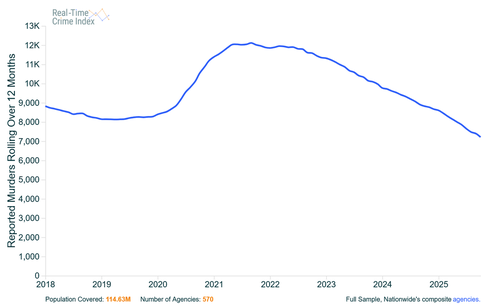
Murders In The USA Set For Largest One-Year Drop On Record
Murders In The USA Set For Largest One-Year Drop On Record
The number of murders in the US is on track for its largest one-year drop on record, according to an analysis by noted crime stats expert, Jeff Asher.
Using the Real-Time Crime Index that compares data from 570 law enforcement agencies, Asher reports a nearly 20% decline in murders in 2025 vs. the same period in 2024. The database excludes manslaughter, self-defense, negligence, or “accidental killings.”
As Asher notes on his Substack,
The drop in crime in 2025 continues a trend that began in 2023, accelerated in 2024, and likely became historic in 2025. A roughly 20 percent drop in murder in 2025, as is suggested by the current data, would be by far the largest decline ever recorded, eclipsing the decline in 2024 — currently pegged at -15 percent by the FBI but that’s subject to a likely upward revision next year.
Other types of crime are seeing large reported declines as well. These drops range from a nearly 23 percent decline in motor vehicle thefts in the RTCI to a smaller 9 and 8 percent drop in theft and aggravated assault respectively according to the RTCI. These numbers won’t be finalized for a while, but they paint the picture of large drops in crime even if the current numbers potentially overstate that drop by a small bit.
Other major crime categories tracked by the index were also down, including motor vehicle thefts (23.2%), aggravated assaults (7.5%) and robbery (18.3%).
When analyzed by major city using data from City Data, Birmingham, Albuquerque, Columbus, Baltimore and Chicago led the decline, while Milwaukee, Kansas City, and Los Angeles actually saw increases YTD.
Read the entire report here.
Tyler Durden
Fri, 12/26/2025 – 05:30
https://www.zerohedge.com/political/murders-usa-set-largest-one-year-drop-record

Today in Chicago History: Chicago resident Jack Johnson becomes first Black heavyweight boxing champ
Here’s a look back at what happened in the Chicago area on Dec. 26, according to the Tribune’s archives.
Is an important event missing from this date? Email us.
Weather records (from the National Weather Service, Chicago)
High temperature: 61 degrees (2019)
Low temperature: Minus 11 degrees (1983)
Precipitation: 0.98 inches (1888)
Snowfall: 5.6 inches (2009)
Boxing legend Jack Johnson in an undated photo. (Chicago Tribune historical photo)
1908: Jack Johnson — who lived in Chicago and owned a short-lived cafe in the Bronzeville neighborhood — became the first Black heavyweight boxing champion. Johnson defeated Tommy Burns in the 14th round by decision in Sydney, Australia, “when the police took a hand in the affair and stopped the uneven battle,” the Tribune reported.
Five years later, an all-white jury in Chicago convicted Johnson of traveling with his white girlfriend, Lucille Cameron, in violation of the Mann Act, which made it illegal to transport women across state lines for “immoral” purposes.
Boxing legend Jack Johnson and his wife Lucille in an undated photo. (Chicago Tribune historical photo)
The case would later be held up as a deplorable example of institutional racism in early 20th-century America. He was sentenced to a year and a day in prison in June 1913, but fled to Canada with Cameron, whom he married while free on bond. He remained a fugitive for seven years, traveling from Europe to Mexico, where he fought bulls and ran a bar called the Main Event.
Johnson returned to the United States in 1920 and turned himself in. He served about a year in federal prison in Leavenworth, Kansas, and was released in July 1921 — arriving back in Chicago a few days later to 35,000 people cheering him on. Johnson died on June 10, 1946, in an auto crash in North Carolina, after storming out of a diner where he’d been asked to sit in a rear section reserved for Blacks. He is buried in Graceland Cemetery.
How many presidential pardons or sentence commutations have been granted to people from Illinois?
President Donald Trump granted a rare posthumous pardon to Johnson on May 24, 2018, clearing Johnson’s name more than 100 years after what many see as his racist conviction. The case had been brought to Trump’s attention by “Rocky” star Sylvester Stallone.
“The Glass Menagerie” by Tennessee Williams debuted at the Civic Theatre in Chicago on Dec. 26, 1944, and received a rave review by the Tribune’s Claudia Cassidy. (Chicago Tribune)
1944: Tennessee Williams’ “The Glass Menagerie” — “which tells a worried mother’s problems in marrying off her crippled daughter,” the Tribune earlier reported — held its world premiere at the Civic Theatre in Chicago. The four-character play starred Eddie Dowling, Laurette Taylor, Julie Haydon and Robert Stevenson. The cost of the production was expected to be $40,000 (or roughly $728,000 in today’s dollars).
On Dec. 27, 1944, the feature pages of the Tribune offered a review of the new play. The headline read: “Fragile Drama Holds Theater in Tight Spell.” The reviewer was Claudia Cassidy.
Chicago Tribune theater critic Claudia Cassidy in the 1940s. (Chicago Tribune historical archive)
“Paradoxically, it is a dream in the dusk and a tough little play that knows people and how they tick,” Cassidy wrote in her review. “Etched in the shadows of a man’s memory, it comes alive in theater terms of words, motion, lighting, and music. If it is your play, as it is mine, it reaches out tentacles, first tentative, then gripping, and you are caught in its spell.”
1969: A gunman hijacked Chicago-bound United Airlines Flight 929 — a Boeing 727 with 32 people on board — and forced it to fly to Havana from New York City. Pilot Axel D. Paulsen was ordered, “Take this ship to Cuba — and no funny business.”
A spokesperson for the airline said Paulsen told dispatch: “The guy’s got a gun but he’s pretty cool.”
The plane touched down in Havana at 10:03 p.m. then flew to Miami at 1:23 a.m. Chicago time. It was the 33rd American plane hijacked that year.
Former Ald. Daniel Solis arrives at the Dirksen U.S. Courthouse, Nov. 25, 2024, to take the stand in the Michael Madigan corruption trial. (Antonio Perez/Chicago Tribune)
2018: Retiring Chicago Ald. Daniel Solis signed a secret agreement with federal prosecutors admitting to taking bribes from real estate developers in exchange for his help on zoning issues. The terms of the unprecedented, deferred prosecution agreement that Solis signed with the U.S. attorney’s office that day weren’t made public until April 2022. He became a government mole by wearing an undercover wire to help federal investigators build cases against 14th Ward Ald. Edward Burke and ex-House Speaker Michael Madigan.
The Dishonor Roll: Chicago officials
Solis entered into a deferred prosecution agreement with the U.S. attorney’s office, which agreed to drop bribery charges against him in 2025 if he continues to cooperate.
Want more vintage Chicago?
Subscribe to the free Vintage Chicago Tribune newsletter, join our Chicagoland history Facebook group, stay current with Today in Chicago History and follow us on Instagram for more from Chicago’s past.
Have an idea for Vintage Chicago Tribune? Share it with Kori Rumore and Marianne Mather at krumore@chicagotribune.com and mmather@chicagotribune.com
https://www.chicagotribune.com/2025/12/26/chicago-history-december-26/