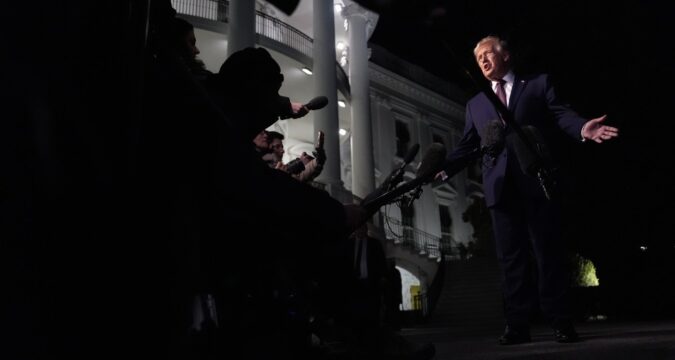
President Donald Trump promised during his inaugural speech that his second term would usher in a “golden age,” and he promptly signed a flurry of executive orders in his first 100 days, more than any other U.S. president.
The changes that came in subsequent months have left many Americans reeling. The administration eliminated an agency — the U.S. Agency for International Development — and promised to get rid of others, issued baseline tariffs on nearly every country in the world and cut around 300,000 government jobs, all while attempting to broker peace in several conflicts abroad.
The contributors to our commentary section have examined what this new age of executive power means and how it is affecting Americans and people around the world. Review the administration’s first year with some of our best op-eds.
Feb. 13: Paul Vallas, “What would it mean if the US Department of Education is abolished?”
In 1980, Ronald Reagan ran for president vowing to abolish the U.S. Department of Education, but there was little support among congressional Republicans for doing so — until Donald Trump reignited the push for its dismantling. The DOE is the smallest Cabinet department with around 4,100 employees.
At first glance, the department’s future might seem uncertain, given Trump’s repeated promises to eliminate it and reports that he plans to sign an executive order to that effect — similar to his efforts to shut down the U.S. Agency for International Development. However, unlike USAID, the DOE is explicitly authorized by Congress and cannot be dismantled without congressional approval.
A U.S. Department of Education employee leaves the building with their belongings on March 20, 2025, in Washington ahead of President Donald Trump’s signing of an executive order to dissolve the Education Department. (Win McNamee/Getty Images)
Democrats are claiming that closing the DOE would mean eliminating Title I and the Individuals with Disabilities Education Act programs and other grant programs that, according to the National Center for Education Statistics, amount to around $30 billion in annual grants. While that is a significant amount, it equals less than 6% of what state and local governments themselves spend. Democrats also claim that Pell Grants, federal student loans, loan repayment and loan forgiveness programs administered by the DOE would also be abolished.
There is no indication that Trump intends to eliminate these programs. Even if he did, like any effort to dismantle the DOE, such actions would require congressional approval.
March 25: Gavi Rosenthal, “I worked for USAID for 16 years. I saw the profound difference it made.”
Barbara Singer, of Bethesda, Maryland, who says she worked for the U.S. Agency for International Development as a contractor until being let go in February, holds up a sign in support of USAID on Feb. 28, 2025, in Washington. “It’s a great agency that benefits all of us,” Singer said. “Americans and people worldwide.” (Jacquelyn Martin/AP)
Since Jan. 20, USAID has been painted as wasteful and excessive. Here’s the truth: What USAID does is actually the minimum. USAID’s humanitarian bureau lets people know they aren’t alone during their worst moments, helps them survive and helps them fare better the next time disaster strikes. Remember the worst time in your life: Did you lose your home, or a family member, or survive a flood or a fire? Do you remember what helped? Maybe it was someone giving you a place to stay until you could get back on your feet or a neighbor bringing food so you didn’t have to cook in your grief. Or maybe it was someone offering a gift card for the grocery store, someone saying, “Your kids are safe,” while you went to find work or shelter, or someone feeding your kids because what you could afford wouldn’t be enough to go around.
Have you done these kindnesses for someone else? Of course you have. That’s what USAID does; it’s that basic. USAID says, “The American people are with you and are here to help,” and then USAID helps communities to help each other. It cannot be said enough how little this costs, how universal and human this is.
I’ve been privileged to represent the U.S. at its best, to work alongside the smartest, most compassionate, most professional people I’ve ever met, all trying to make life a little less difficult for their fellow humans. My team supported public health workers coordinating across conflict lines in the middle of a civil war to vaccinate Syrian kids against polio, reaching every kid when everyone thought it was impossible. I found myself close to tears watching trucks of food cross the border into Syria, knowing the months and layers of delicate negotiations required to allow such a simple delivery of food to people in need. I met Ukrainians fleeing across the border into Slovakia in the first days after Russia’s full-scale invasion, and the hundreds of strangers mobilized to support and welcome them. I met families who fled the eruption of Mount Mayon in the Philippines, who survived because they had enough warning to make it to safety before the volcano erupted, because of the support that my office had provided for early warning technology.
April 16: George F. Galland Jr., “Kirkland & Ellis and others have made a deal with the devil”
These firms are too addicted to big money to behave well in a crisis such as the one now engulfing the country. So when Trump decided to capture them, it was a snap. He ordered his lackeys to start bogus “investigations” of “discrimination” and threatened to cut off security clearances. This was unconstitutional, but he couldn’t care less. He knew, as he put it, they’d come on bended knee. One after another, they’ve made “deals” with him, the basic, unstated term of which can only be: If you help anyone challenge me in court, you risk me going after you again.
It’s not hard to guess why these firms caved to Trump. Paul, Weiss, the first firm to make a deal, essentially said so. It knew that if it resisted Trump’s pressure, other comparable firms probably wouldn’t. That could lead to losing clients and making less money. Think of it — having to make, on average, less than $9.25 million a year. Horrors!
But Kirkland & Ellis could at least have refrained from trying to explain why it did what it did. A statement from its “Firm Committee” to its “Firmwide All Personnel” could be used, in my opinion, by Poison Control units to induce you know what: “We made this decision to pursue this solution because at our very core our mission is to protect and support our people and our clients, and this agreement does both. It is also consistent with the values that underpin our firm and cement us together, including our culture that prioritizes ability and opportunity, not politics.” I would have put it differently: “By bowing to the president’s demands, we became complicit in what he is doing to the country.”
July 6: Richard C. Longworth, “Donald Trump will be remembered as a great leader — but not a good one”
President Donald Trump speaks to the media before walking across the South Lawn of the White House to board Marine One en route to Florida on July 1, 2025, in Washington. (Mark Schiefelbein/AP)
It is time to acknowledge that Donald Trump is a great man, and that’s not good.
This is a hard concept for both Trump’s fans and foes and requires definitions, of “greatness” and “goodness.” But Trump is making history by the day, and we need to understand where he fits in this history.
I’d argue that a great leader is one who, by sheer force of intellect or will, shapes the history of his time. Most leaders merely react to the events of their day or cope with crises, big and small, or try to make progress bit by bit, happy to leave their societies a little bit better than they found them. In this sense, history shapes their legacies by limiting what they can do. If they keep us out of war or depression or civil strife, that’s no bad legacy.
This modest competence doesn’t satisfy the great man, not at all. He wants to dominate history and change the world. Propelled by ideology or a sheer lust for power, he intends to break the rules of society and uproot the social order he inherited. Too often, he succeeds.
Sept. 3: Steve Chapman, “Donald Trump pioneers a strange policy: Republican socialism”
President Donald Trump, left, shakes hands with Nvidia CEO Jensen Huang after Huang spoke in the Cross Hall of the White House during an event on “Investing in America” on April 30, 2025, in Washington. (Andrew Harnik/Getty)
Socialism used to be the antithesis of Republican principles. “Socialism only works in two places — heaven, where they don’t need it, and hell, where they already have it,” Ronald Reagan quipped.
It was not just outright nationalization of industries that conservatives rejected; it was almost any sort of federal interference with private markets to achieve social or economic goals. Barack Obama’s Affordable Care Act preserved the role of private insurers, but GOP Rep. Michele Bachmann expressed a right-wing consensus when she told the 2011 Conservative Political Action Conference it was nothing less than “the crown jewel of socialism.”
But Trump has outdone anything Obama ever dreamed of, mounting a brazen government invasion of the private sector. He interfered with the sale of U.S. Steel to Nippon Steel, forcing the Japanese giant to grant Washington a “golden share,” which will give him a major role in company decisions.
Chip manufacturer Intel had to agree to give the U.S. government an ownership stake — making it the company’s biggest shareholder. “I said, ‘I think you should pay us 10% of the company,’ and they said yes,” Trump crowed. It was an offer Intel couldn’t refuse.
He imposed terms on chipmakers Nvidia and AMD, forcing them to hand over 15% of the money from their sales in China. He announced a deal requiring the Japanese government to invest $550 billion in the U.S. — which will be carried out “at President Trump’s direction.”
These are only the beginning. “I will make deals like that for our Country all day long,” Trump posted about the Intel shakedown.
Nov. 28: Elizabeth Shackelford, “Donald Trump’s Black Friday approach to foreign policy”
The world order established in the wake of World War II reflects a Giving Tuesday take on foreign policy. Countries came together to establish the United Nations to promote global cooperation for collective benefit. That approach sees a world of sociopolitical integration, in which the security and prosperity of individual countries depend and rely on the security and prosperity of others. It recognizes our interconnectivity and compels us to manage it effectively, not just for our own individual gain. In this world order, humanitarian aid and development and the allies to promote them are not altruistic but essential.
Another kind of foreign policy is the Black Friday kind: selfish, transactional and short-term. It might benefit a country on a brief political cycle, but it doesn’t provide long-term solutions or stability. Its quick answers can lead to long conflicts. This was the type of world order that set the stage for two World Wars and that the post-WWII order was designed to end. And yet, this is the kind of world that the Trump administration is seeking to return to.
`The Russian “peace deal” that the administration just tried to force on Kyiv offers a clear example, though widespread pushback from members of Congress and our allies thankfully forced a return to the negotiating table. The original 28-point plan, and President Donald Trump’s framing of it as an ultimatum, would have given the United States some shallow, short-term gains, such as reconstruction profits and investment opportunities. But it would have done so at the cost of Europe’s future peace, since it would have rewarded Russia’s aggression with even more territory than it already stole and left Ukraine incapable of defending itself in the future. From trade to security partnerships, Europe’s stability affects us at home, so that would have cost us in the long run too.
Submit a letter, of no more than 400 words, to the editor here or email letters@chicagotribune.com.


