Category: News
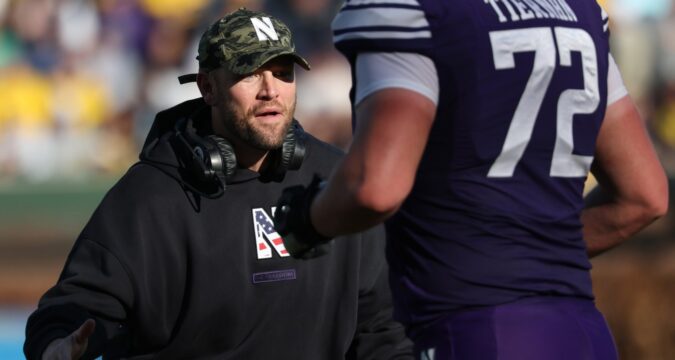
Northwestern and Central Michigan are heading for a defensive showdown in the GameAbove Sports Bowl
DETROIT — Christmas bowl games often turn into scoring bonanzas in which the first team to 40 points is the winner.
The GameAbove Sports Bowl might be the exception to that rule — 20 points could be more than enough.
Friday’s game pits Northwestern and Central Michigan, two Great Lakes schools that combine strong defenses with low-scoring offenses.
The Wildcats (6-6) are 34th in the country in scoring defense, allowing 20.9 points per game, but 103rd in scoring offense at 22.5 ppg. The Chippewas (7-5) are built along the same lines, ranking 50th in scoring defense (22.7 ppg) and 93rd in scoring offense (23.8 ppg).
“When we turned on the tape, it was like looking in the mirror,” Northwestern coach David Braun said. “Central Michigan is a team that is committed to running the ball and playing great defense. It is a team with great fundamentals and great technique and a great deal of physicality. Those are the same things we teach at Northwestern.”
Central Michigan coach Matt Drinkall had the same experience when he began preparations for the game.
“I chuckled when Coach Braun said that about looking in the mirror because we were like, ‘I already know what this film is going to look like before I turn it on,’” he said. “Then you turn it on and it reaffirms everything you want to see from a good football team.”
‘Home game’ for Caleb Tiernan
Northwestern’s Lawson Albright, right, celebrates a touchdown against Minnesota with teammate Caleb Tiernan on Nov. 22, 2025, at Wrigley Field. (Geoff Stellfox/Getty Images)
The Wildcats might focus on the defensive side of the ball, but their biggest star will be playing offense in front of home fans. Offensive tackle Caleb Tiernan was named to the All-Big Ten second team and is considered one of the best linemen in the country. Ford Field is located less than 20 miles from Detroit Country Day, where Tiernan played in high school.
His college career will end in the same stadium as his high school career: He finished his run at Detroit Country Day with a state championship won at Ford Field.
“In my junior year we lost there, so I wasn’t much of a fan of that place,” he said. “But I won in my senior year and the Lions have started to win, so my attitude has changed. I’m extremely excited to play there this year.”
Platoon-style quarterbacking
Central Michigan historically has built around running quarterbacks, but it helps if the Chippewas can throw a little. This season they’re getting that production by using two players at the position.
Joe Labas, who started his career at Iowa, is the passer. He has thrown for 1,676 yards and 12 touchdowns, completing 68.9% of his passes with only six interceptions. He is not a runner, though, having netted minus-4 yards on the ground with no touchdowns.
That’s where Angel Flores comes in. He is second on the team with 519 rushing yards and leads the Chippewas with eight touchdown runs. He is not a terrible passer, averaging 7.2 yards per attempt, but he averages fewer than four passes per game.
Fitzgerald leads the defense
Northwestern safety Robert Fitzgerald intercepted only one pass but led the Big Ten with 68 solo tackles and had six tackles for a loss.
He can’t be accused of padding his stats against the easiest teams on the Wildcats schedule: He had 10 solo tackles and an interception against Michigan, 13 total tackles against Tulane, 10 against Oregon and eight at USC.
Heldman key for Central
If the Chippewas have a chance at the Boxing Day upset (the Wildcats are favored by 10½ points), they will need a big day from defensive lineman Michael Heldman. The redshirt senior finished the season with 10½ sacks and 16½ tackles for a loss, including five sacks and 7½ tackles for a loss in the final three games.
Central Michigan won the first two of those games, beating Buffalo and Kent State to get to 7-4 before losing the finale to Toledo.
https://www.chicagotribune.com/2025/12/26/northwestern-central-michigan-gameabove-sports-bowl/
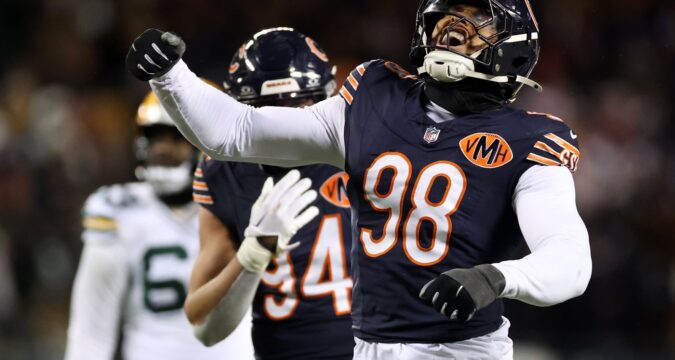
5 things to watch in Sunday night’s Chicago Bears-San Francisco 49ers game — plus our Week 17 predictions
The road to Santa Clara, Calif., starts in … well, Santa Clara.
If the Chicago Bears (11-4) can dare to dream of making it as far as Super Bowl LX, their most viable path begins with their first trip to host venue Levi’s Stadium, where they will face the San Francisco 49ers (11-4) on “Sunday Night Football” (7:20 p.m., NBC-5).
It’s two playoff-bound teams jockeying for position within not only the NFC, but also their own divisions.
With two games left in the regular season, the Bears need a win or a Green Bay Packers loss — or a tie by both — to lock down their first NFC North title since 2018. The longer shot would be securing the No. 1 seed, which earns a first-round bye and home-field advantage throughout the NFC playoffs.
With either outcome, the objective is the same: host as many playoff games as possible at Soldier Field.
Common sense says you always want to play on your turf, backed by your crowd, and the numbers underscore why it’s so important. Since the 2000 season, home teams have gone 169-91 in the playoffs (excluding Super Bowls), a .650 winning percentage, according to Elias Sports Bureau.
“Punching playoffs is cool and all, but we’ve still got work to do,” wide receiver Luther Burden III said. “We’ve got bigger goals, and we’re going to keep our head down and keep working.”
Defensive tackle Andrew Billings said the stakes have “been high since Week 1.”
“Every game was like that game,” he said. “When it comes to the playoffs, what we’re trying to do is prepare ourselves, approaching each week like a divisional game — like you win this and you get the No. 1 seed. And when you do get that … statistically it’s great.”
Here are five things to watch in the Bears-49ers matchup — plus our Week 17 predictions.
1. Pressing question: Can the Bears defense stop the 49ers on third down?
Bears defensive coordinator Dennis Allen heads to the locker room after a 28-21 loss to the Packers on Dec. 7, 2025, at Lambeau Field in Green Bay. (John J. Kim/Chicago Tribune)
Or in the red zone, for that matter. The 49ers are tough outs in both situations.
San Francisco’s offense ranks second in third-down efficiency at 50%, slightly behind the Packers’ 50.27%. Bears defensive coordinator Dennis Allen explained why the 49ers excel on third down.
“No. 1 is they do a really good job executing on first and second down,” he said. “They do a great job kind of staying ahead of the chains.
“And then they do a great job of getting to spots. The quarterback does a really good job of reading out the defense, throwing it to the open guy. Yeah, it’s tough to deal with.”
The Bears defense has been pretty good at stalling teams in the red zone — ranking ninth at 54.17% — and there was no better illustration of keeping opponents out of the end zone than Saturday, when the Packers went 0 for 5 in trips to the red zone.
But the 49ers convert 63.33% of their red-zone opportunities into touchdowns, which ranks eighth.
“Their ability to run the football down there in the red area helps them out a lot,” Allen said.
Both third-down and red-zone success draws from the same well.
“They’re extremely well-coached,” Allen said of ninth-year 49ers coach Kyle Shanahan. “How do you know when a team is really well-coached? You just watch the speed at which they operate … up front in the running game and how they get to their landmarks and how they get to their spots and how all the offensive linemen are working in unison in terms of how they run their routes.
“Each player will run a certain route, and no matter who the player is, it looks the same. And so that, to me, is the detail in the coaching, and that’s what makes it really tough to defend.”
Bears coach Ben Johnson said Shanahan runs a precise, detailed offense.
“They know how to attack coverages and it continues to morph and evolve,” he said. “Each year this Shanahan offense looks a little bit different. It’s got some different wrinkles.
“As defenses change, he’s been changing as well, and that’s enabled him to stay on the forefront of some of these concepts.”
2. Player in the spotlight: 49ers RB Christian McCaffrey
San Francisco 49ers running back Christian McCaffrey runs for a touchdown against the Colts on Monday, Dec. 22, 2025, in Indianapolis. (AP Photo/Zach Bolinger)
McCaffrey leads the NFL with 372 touches, according to NFL Pro’s Next Gen Stats. He has 26.9% of the team’s targets, which is ninth in the league regardless of position. Pittsburgh Steelers running back Kenneth Gainwell is the only non-wide receiver who receives a higher percentage of targets (29.3%).
That’s the 49ers’ M.O.: Shanahan keeps you guessing — and not just with McCaffrey.
The combination of McCaffrey and tight end George Kittle — both 2025 Pro Bowl selections — is enough to keep a defensive coordinator up at night.
“The backs and tight ends are really tough matchups on a defense,” Allen said. “There’s usually some things, if you have an outstanding receiver … you can do to try to take those guys away. It becomes more challenging inside at the tight end (or) running back position. It’s unique that they’re getting so much production from those two spots.
“Those two guys are as good as it comes in terms of playing the tight end position: Kittle as a blocker, Kittle as a receiver, the run-after-catch that he provides. It’s certainly a challenge.”
Kittle is fourth in the league in expected points added per target (plus-0.74), according to NFL Pro. His availability for Sunday is in question (more on that later).
Allen, the former New Orleans Saints defensive coordinator and head coach, saw a lot of McCaffrey when the latter was the star of the Carolina Panthers and led the NFL with 2,392 scrimmage yards in 2019.
“So I know exactly what type of challenge he presents,” Allen said.
A particularly good matchup will be McCaffrey versus the Bears linebackers in the passing game. According to NFL Pro, McCaffrey has run a route against a linebacker 260 times, 69 more than any other running back.
Bears weak-side linebacker Tremaine Edmunds is one of the best coverage linebackers in the league. He has four interceptions, third at his position, and has held opposing quarterbacks to a 62.2 passer rating, which ranks ninth among qualified linebackers — just behind San Francisco’s Fred Warner.
3. In the fourth quarter, ‘the spark becomes a fire.’
Bears quarterback Caleb Williams scrambles in the fourth quarter against the Packers on Dec. 20, 2025, at Soldier Field. (Chris Sweda/Chicago Tribune)
The Bears have scored 83 points in the fourth quarter and overtime over the last eight weeks, the most by any NFL team in that span. They have a league-best six fourth-quarter comebacks this season.
When trailing with four minutes or less to go, the Bears have six touchdowns (tied for first) and average 7.64 yards per play (second), according to Sports Reference’s Stathead.
Caleb Williams has thrown the most touchdown passes (four) and has the third-highest passer rating (115.5) when trailing with four minutes or less to go (minimum 30 plays).
“It’s really just us,” Williams said. “Realizing that it isn’t necessarily the other team that’s actually stopping us.
“We’ve played versus some of the best players in this league. I think that’s where it’s come from. The mindset just changes. A play happens and the spark becomes a fire, and we’re ignited at that point.”
Johnson said the Bears’ fourth-quarter success doesn’t necessarily come from the play-calling but the people.
“We have put a premium on guys that we feel like will be able to handle pressure,” he said. “The guys we look to bring in this building, we want to make sure that they can handle that type of stuff.
“And Caleb’s certainly built that way. I know for certain Colston Loveland’s built that way. We have a number of guys on this roster that are built that way.”
Related Articles
As Ozzy Trapilo follows his father’s legacy, is he the Chicago Bears’ left tackle of the future?
Minnesota Vikings force 6 turnovers to eliminate Detroit Lions — and put Green Bay Packers in playoffs
Lamar Jackson doubtful and Jordan Love questionable for Saturday’s Baltimore Ravens-Green Bay Packers game
What we learned from the Chicago Bears, including Luther Burden III returning to practice but not Rome Odunze
Chicago Bears DE Austin Booker says NFL fined him $5K apiece for 2 roughing-the-passer penalties on Jordan Love
Offensive coordinator Declan Doyle felt like the Bears did a better job against the Packers of getting off to a fast start, not just a strong finish. They moved 70 yards on their first possession before a botched snap caused them to turn the ball over on downs.
“When you look at it big picture, we didn’t score in the first half,” Doyle said. “The fourth-quarter piece has more to do with the players and them not flinching, them being comfortable in those situations, them feeling like all of their preparation is going to lead to a successful outcome and them just kind of staying with the process.”
Part of it is Williams’ processing seems to speed up and his improvisational skills come alive during gotta-have-it moments in the fourth quarter and overtime.
“His arm talent is elite,” 49ers defensive coordinator Robert Saleh said. “It feels like when he starts scrambling, he gets more accurate.”
Shanahan added: “Caleb is one of the best throwers, one of the most athletic quarterbacks I’ve ever seen in terms of his height, weight and speed. He makes some big-time throws, extremely scary on the perimeter, can hold on to the ball for a while — not in a bad way — but by creating stuff which makes coverages have to hold up forever.
“And when you have a talented guy like that who’s got the speed and the size, usually they get a run game, get some bootlegs and play actions off of it, you limit how many times you’ve got to drop back. It makes sense why he is playing at such a high level.”
4. By the numbers
San Francisco 49ers quarterback Brock Purdy walks off the field after fumbling against the Jaguars on Sept. 28, 2025, at Levi’s Stadium in Santa Clara, Calif. (Jose Carlos Fajardo/Bay Area News Group)
One thing to watch is the turnover battle. San Francisco quarterback Brock Purdy threw seven interceptions over his first four starts, including a three-pick game in a 20-9 victory against the Panthers on Nov. 24.
Purdy has been stingier with interceptions in three starts since then (one pick), but he has put the ball on the ground in each of the last two games, losing one of those fumbles.
The Bears lead the NFL with 31 takeaways and a plus-21 turnover differential. They have a takeaway in eight straight games, the longest active streak in the league.
5. Injury updates
Bears wide receivers Rome Odunze (15) and Luther Burden III (10) wait to take the field against the Steelers on Nov. 23, 2025, at Soldier Field. (John J. Kim/Chicago Tribune)
Like last week, the Bears will be monitoring the health of their wide receivers. Burden (ankle) returned to practice on a limited basis Wednesday, but Rome Odunze (foot) sat out again.
Down both Odunze — who missed a third straight game — and Burden against the Packers, the Bears leaned on DJ Moore, who has endured his own injury issues this season. Moore had a game-high 97 yards on five receptions, including the walk-off touchdown catch in overtime. He also had a 12-yard run.
“With each player you start to understand reliability and durability, obviously with DJ having to fight through stuff,” Doyle said. “DJ has done a great job of being dependable and just being consistent down-in and down-out.”
Rookie Jahdae Walker was stunned when he learned of Moore’s attendance record from coaches. Moore has missed only two games in his eight-year career — none since 2020 — and one was because he was on the league’s reserve/COVID-19 list.
“I’m like: ‘This dude, is he even mortal? Like, dang,’” Walker said. “He’s never injured. I’ve seen him battle through so many injuries and just keep working.
“Y’all don’t see a lot of stuff that he goes through, pain-wise. I see it from behind the scenes and it’s crazy. I don’t know how he gets up and walks every day. He’s been hurting for real.”
Four members of the secondary popped up on Wednesday’s injury report: Pro Bowl safety Kevin Byard III (ankle) and cornerbacks Nahshon Wright (hamstring), Nick McCloud (illness) and C.J. Gardner-Johnson (knee).
“I can’t speak for anybody else, but I practiced today,” Byard told the Tribune on Wednesday. “So if you ask if I’m going to play, I’m going to play.”
Meanwhile, the 49ers could face a significant setback if Kittle can’t go. He was a non-participant Wednesday because of an ankle injury.
“He’s got a chance, so we’re not ruling him out,” Shanahan said.
Predictions
Brad Biggs (11-4)
The winner will remain alive for the No. 1 seed in the NFC. While the Panthers (8-7) are the only team with a winning record that the 49ers have faced during their five-game winning streak, the closest of those games was 11 points and the average margin was 16.4. The Bears have won only two games by more than that all year: 31-14 over the Dallas Cowboys in Week 3 and 31-3 over the Cleveland Browns two weeks ago. Quarterback Brock Purdy is playing really well, and if the Bears sit in zone coverage, he’s capable of a big game. The status of tight end George Kittle (ankle) is a significant question. He’s pivotal to the passing and running games, and if he’s unable to go, I might flip my pick.
49ers 30, Bears 24
Sean Hammond (12-3)
It’s hard to pick against the Bears when so much has gone their way this season, but the 49ers are surging at the right time now that Purdy is healthy again. This looks like a scary team at the moment. It won’t be easy for the Bears to pull this one off on the road. If the 49ers can take care of the ball, I think they’ll take care of business.
49ers 30, Bears 27
Phil Thompson (10-5)
The bend-but-don’t break defensive strategy worked out surprisingly well against the Packers, who mostly settled for field goals. But Kyle Shanahan’s offense is too surgical for that. Yes, the 49ers have the league’s worst pass rush and an inconsistent run defense, but I can’t see the Bears winning a shootout at San Francisco.
49ers 31, Bears 27
https://www.chicagotribune.com/2025/12/26/chicago-bears-san-francisco-49ers-week-17-predictions/
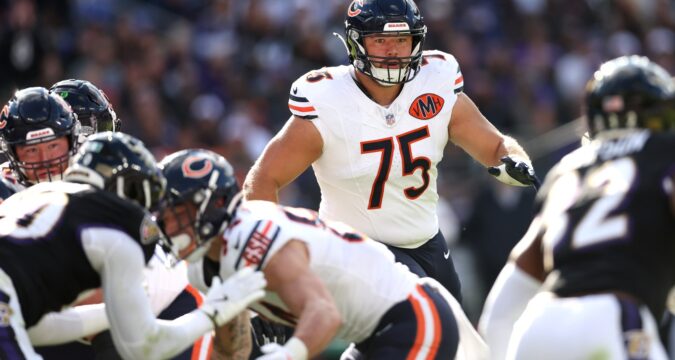
As Ozzy Trapilo follows his father’s legacy, is he the Chicago Bears’ left tackle of the future?
The thought was there when Ozzy Trapilo first stepped onto an NFL field for the Chicago Bears season opener against the Minnesota Vikings on Sept. 8.
“It’s always kind of in the back of my mind,” Trapilo said.
Growing up with his two older sisters in the Boston area, there was memorabilia all over his childhood home. Trapilo was nearing his third birthday when his father, Steve, died of a heart attack at age 39 in 2004. But there were memories all around him from his father’s time playing football at Boston College and in the NFL for the New Orleans Saints.
“So you kind of know,” Trapilo said. “As long as I can remember really. That was like a fundamental part of him.”
It’s now a fundamental part of Trapilo’s story too. Every step of the way he has followed in his father’s footsteps. First he went to Boston College High School, where his dad also played football. Then he followed Steve’s path down the road to Boston College.
Now he has followed his dad to the NFL too. Last spring the Bears made Trapilo a second-round selection (No. 56) in the NFL draft.
Trapilo doesn’t have any memories of his dad. He was too young when he died. But Steve’s memory lives on in the home.
“Growing up, that’s how I always knew him,” Trapilo said. “I knew he was a football player.”
‘It was nice to be home’
Every time Trapilo walked into the weight room at BC High, he saw his dad’s name. The room was named in honor of Steve, who donated a bunch of equipment in the mid-1990s.
Steve Trapilo played at the high school in the early ’80s before moving on to Boston College. In the famous clip of quarterback Doug Flutie’s Hail Mary against Miami in 1984, after throwing the 48-yard touchdown pass in the final seconds, Flutie jumps into the arms of one of his offensive linemen. That was Steve Trapilo.
Boston College offensive lineman Steve Trapilo lifts Doug Flutie after the quarterback completed a 48-yard Hail Mary touchdown pass that beat Miami as time expired on Nov. 23, 1984, in Miami. (Joe Rimkus Jr./Miami Herald)
“I don’t have many other words to describe it,” Ozzy Trapilo said of that clip. “It’s kind of surreal.”
The Saints drafted Steve in the fourth round in 1987, and he played six seasons for them. He briefly signed with the New England Patriots in 1993, but that marked the end of his playing days.
Afterward, Steve returned to BC High and became a volunteer assistant coach for the football team.
“That’s just the nature of Steve,” said Jon Bartlett, who coached with Steve Trapilo back then. “He was always looking to help BC High for what it did for him as a young man and making him the young man that he was. He credited everything to BC High and the BC High football program.”
Bartlett, now the athletic director at St. Sebastian’s School in the Boston area, coached Ozzy Trapilo at BC High when Ozzy was a sophomore. Ozzy was a “beanpole” back then, but he was tall and athletic.
He was a really good basketball player in those days too.
“You knew if Ozzy put on the weight and strength it was going to be a really impressive combination because seeing him on the court moving, running up and down the court, he was one of the fastest players on the basketball team,” Bartlett said. “Just his speed and getting up and down the court and his footwork in the post.”
That’s where the weight room came into play. Trapilo spent countless hours there, with his dad’s name on the wall providing “a little bit of extra motivation.”
When he was a junior, college football coaches who were recruiting Trapilo would show up at his basketball games to watch how he moved on the court, the lateral quickness and the speed in open space. Trapilo developed into a conference MVP basketball player.
“He was a big, strong kid who was agile,” BC High basketball coach Bill Loughnane said. “He picked up things like a sponge.”
Trapilo, of course, was an impressive football player too. His college decision was never really that difficult. As a top-100 recruit, he had offers from schools all over the country — but he never truly wanted to leave home.
“BC definitely had a leg up in that,” Trapilo said. “And alongside that, most of my family is around that area, so it was nice to be home. And everyone could come to all the games, which they did. I had a good crowd for every game. It was great.
“It’s cool sort of following the path (Steve) took, while also we’re different positions, different skill types. We’re on a different journey.”
A BC connection
Bears offensive tackle Ozzy Trapilo speaks with the media after rookie minicamp at Halas Hall on Friday, May 9, 2025, in Lake Forest. (Stacey Wescott/Chicago Tribune)
The Bears knew they needed to address the left tackle position over the offseason. Braxton Jones, who had started 40 games over the previous three seasons, was coming off ankle surgery, and questions remained about whether he was the long-term answer.
At the NFL scouting combine in February, general manager Ryan Poles promised competition at left tackle.
“That’s another spot where there’s going to be competition and you build the line with the best five guys,” Poles said at the time.
In March, the Bears made major changes on the offensive line, trading for guards Joe Thuney and Jonah Jackson and signing free-agent center Drew Dalman. But they didn’t bring in anyone at left tackle.
Their focus turned to the draft. Poles and director of player personnel Trey Koziol — former Boston College teammates themselves — found a tackle prospect they liked in a familiar place.
Trapilo was a 6-foot-8, 316-pound senior who spent his entire career at Boston College despite coaching changes and the ever-changing, transfer-crazy world of modern college football.
“Obviously (we) have a lot of touch points up there at BC,” Koziol said on draft night in April.
Bears guard Jonah Jackson (73), center Drew Dalman (52), guard Joe Thuney (62) and tackle Ozzy Trapilo (75) head to the line of scrimmage ahead of quarterback Caleb Williams (18) in the third quarter against the Packers on Dec. 7, 2025, at Lambeau Field in Green Bay. (John J. Kim/Chicago Tribune)
Poles and first-year coach Ben Johnson liked Trapilo’s combination of size, toughness and smarts. Poles, who played at Boston College from 2003-07, never met Steve Trapilo, but he certainly heard stories about him through other alumni.
“I know a lot of guys that played with him and knew him,” Poles said. “It was really cool to hear their appreciation for that connection. So just kind of one of those small-world things.”
Poles, an offensive lineman, went through training camp as an undrafted rookie with the Bears in 2008 but didn’t make the roster. He found himself in need of a job and wound up back at Boston College as a graduate assistant.
That kicked off a career that eventually would lead to his becoming Bears GM. In a strange coincidence, when Poles left Boston College for a scouting assistant job with the Kansas City Chiefs in 2009, Johnson took his old job as a BC graduate assistant for the 2009 season. Their paths were so close to crossing, yet that wouldn’t happen for another 16 years when Poles hired Johnson.
But back to 2025: Trapilo needed a little time to develop his game at the NFL level. He found himself in what became a four-way battle for the left tackle job during training camp. Jones won the starting job entering Week 1, but Johnson hinted that the decision wasn’t permanent. In October, the Bears moved to second-year tackle Theo Benedet.
Trapilo did what he always has done. He went back to work. The Bears worked him at both right and left tackle while sometimes utilizing him as a sixth offensive lineman.
“You saw his daily improvement, whether it was working left side or right side,” offensive line coach Dan Roushar said. “You just see him start to be more consistent in his play.”
‘He’s got to keep improving’
Bears left tackle Ozzy Trapilo blocks Browns defensive end Myles Garrett in the fourth quarter Sunday, Dec. 14, 2025, at Soldier Field. (Brian Cassella/Chicago Tribune)
The Bears offense stepped off the field after Cleveland Browns star pass rusher Myles Garrett sacked quarterback Caleb Williams on third down. It was Dec. 14, and the Bears were in the midst of a push for the playoffs.
Roushar took a look at the photos of the third-down play on his tablet from the team’s sideline. Trapilo had his hands on Garrett before the six-time All-Pro sneaked around him for the sack.
“Hey, you’re in good shape here. How’d you lose it?” Roushar asked Trapilo.
Before Trapilo could answer, Thuney, the veteran team captain with four Super Bowl rings, piped up.
“That’s Myles Garrett,” Thuney said.
He had a point.
“You know, I think I did OK,” Trapilo later said of his matchups against Garrett. “There’s always stuff you want back, obviously. There’s a couple plays that I look at the film and say I wish my technique was more like this.”
Garrett finished with 1½ sacks. The Bears have done a good job of not letting some of the star pass rushers on their schedule blow up games. Garrett and the Vikings’ Javon Hargrave in Week 1 are the only opponents to record more than one sack in a game.
“Ben does a really good job of understanding what we can and can’t do,” Roushar said.
Related Articles
5 things to watch in Sunday night’s Chicago Bears-San Francisco 49ers game — plus our Week 17 predictions
Minnesota Vikings force 6 turnovers to eliminate Detroit Lions — and put Green Bay Packers in playoffs
Lamar Jackson doubtful and Jordan Love questionable for Saturday’s Baltimore Ravens-Green Bay Packers game
What we learned from the Chicago Bears, including Luther Burden III returning to practice but not Rome Odunze
Chicago Bears DE Austin Booker says NFL fined him $5K apiece for 2 roughing-the-passer penalties on Jordan Love
That means not leaving your rookie left tackle on an island against a player of Garrett’s caliber very often. Roushar doesn’t beat around the bush. The veteran O-line coach tells it like it is, and that’s what his players like about him. Trapilo called him “demanding, but in a good way.”
Roushar, an Iowa native who played quarterback at Northern Illinois, worked under Sean Payton and Dennis Allen in New Orleans coaching the offensive line and tight ends. He then coached two seasons at Tulane and was set to retire before Johnson called him about the Bears offensive line job.
In the secretive world of the NFL, in which it sometimes can feel like everybody is walking on eggshells in front of the media, Roushar can be refreshingly candid. Asked about his rookie left tackle, he said there’s plenty of work to be done.
“He’s got to keep improving,” Roushar said of Trapilo. “He has to be a much better run blocker. He’s got to get more consistent in pass pro, get stronger and be more physical, on and on and on. And if he could just grow a little bit in every one of those areas, we’re going to have a better football player.”
The Bears were waiting all offseason for somebody to step up at left tackle. Before emerging as the starter, Trapilo served as the sixth lineman, often coming in for jumbo packages. Trapilo found that experience rewarding because it gave him chances to see the field and opportunities to practice on both sides of the formation.
“Just getting the 10 or whatever reps per game, going out there, whatever it is, pass, run,” Trapilo said. “We kind of covered everything with that. Even motions and stuff like that. Just getting in a rhythm.”
Bears offensive tackle Ozzy Trapilo (75) blocks Steelers linebacker Nick Herbig (51) during the first quarter Sunday, Nov. 23, 2025, at Soldier Field. (Eileen T. Meslar/Chicago Tribune)
When Benedet suffered a quadriceps injury ahead of a Week 12 matchup with the Pittsburgh Steelers, the Bears inserted Trapilo into the lineup at left tackle. He has held the job since then.
The Bears have stuck with Trapilo, but as Roushar noted, there’s plenty he needs to improve on.
“He’s not going to settle for where we are now,” Trapilo said of Roushar. “He knows, he can see how much greater we can be as a unit and me as a player. So he’s out there every day hounding little things, but in the end the little things make a big difference.”
Have the Bears solved their left tackle conundrum?
That’s a question for the offseason. Right now, they are winning games and have big goals in January. The rookie left tackle is a big part of what they’re doing.
“When the season ends, then we can attack all the things that he needs to address,” Roushar said.
https://www.chicagotribune.com/2025/12/26/chicago-bears-ozzy-trapilo-left-tackle/

Escobar: Europe’s Elites Pay For The Privilege Of Losing Conflict
Escobar: Europe’s Elites Pay For The Privilege Of Losing Conflict
When in doubt, Europeans should always re-read Tacitus. As a true Roman, he considered that sacrifice was only worthy if conducted at the service of the motherland. In his time, the Roman Empire. In our time, that would be civilization-state Italy.
Tacitus was a keen student of Resistance – reflecting on the worthiness of the heroic deaths of those condemned to suicide by Nero and Domitian. He followed all the legal battles, the condemnation of lay martyrs such as Seneca. He talks about them with veneration; but branded their sacrifice as sterile.
Tacitus refused the temptation of heroism – and asked himself if between the ardor of disdain and vile obsequiousness a path could be found exempt from vaingloriousness.
He certainly didn’t see this path in the future of Rome. He experienced life under absolute power – today that would be under the yoke of the European Union (EU) and European Commission (EC) – and noted that to exercise it or be submitted by it was equally degrading.
The questions he could not answer are eternal. Whether a people protagonist of History and enjoying domination is able to be worthy of it; whether it’s possible for those who govern to remain wise; and for those who are subjects, what to do to not humiliate themselves.
To History and politics, Tacitus posed only moral questions. For him, the only possible salvation will come via moral healing.
He quoted some verses of brilliant poet Lucan, who was also a victim of Nero – who wrote that considering “the most serious calamities” one “had proof that not towards our security are the gods solicitous, but of our punishment”.
All these questions apply now to Europeans being subjugated by appallingly mediocre warmongering elites – who are only speeding up a negative vortex way more serious than the decadence of Rome. While “the Gods” are Olympically oblivious of the punishment inflicted on mere – taxpaying – mortals.
Throwing Money Into a Black Void
Enter the latest European elite scam: the decision to hand over to the “criminal organization” in Kiev – President Putin’s terminology – a cool 90 billion euros joint loan for 2026-2027, at 0% interest rate. Hungary, Slovakia and the Czech Republic officially refused to be part of the scam.
This joint EU borrowing – funds that they don’t have in the first place – automatically turns into EU debt. The onus will be on EU-wide taxpayers. Not only they will be stripped of 90 billion euros of their hard earned income coupled with high taxes; they will pay European banks for the “privilege”. Everyone in the corridors of the EC in Brussels knows that only in interest, EU member-states will have to pay over 3 billion euros a year.
The imperative corollary: funds for health services, education and social rights will go even more down the drain than at present.
It’s key to be reminded that this sweet loan will only cover two years to keep the Kiev gang on life support. Afterwards, it will be yet another scam. And even the sweet loan won’t be enough for 2026-2027 – covering only two-thirds of the black hole in Kiev.
The conditions for the loan are mind-boggling. Kiev will repay it if – and the operative word is an impossible “if” – receives “full reparations” from Russia. The EC in Brussels has stipulated the total amount at over half a trillion euros.
It gets even juicier. Before the loan, the EC had previously declared Ukraine insolvent; and announced that it could not provide loans to Kiev. Still, they forced themselves to come up with this latest sweet loan: direct financing, a de facto grant.
According to Ukraine’s lead negotiator Rustem Umerov:
“there are two scenarios: 1 – if the conflict ends, the funds will go toward rebuilding the country; 2 – if aggression continues, Ukraine expects €40–45 billion annually for defense and security.”
Both scenarios are absurd. First: Moscow – as the victor in the conflict – will never agree to finance the rebuilding of Ukraine via its own sovereing wealth fund stolen by Europeans. Second: the Kiev gang is already positioning itself to be showered with more free money, as in “if aggression continues…”
This whole circus is in progress because the EU failed to steal the Russian sovereign wealth funds for good – no matter the tsunami of spin speculating on who finally “betrayed” who (arguably France’s Le Petit Roi dumped the German BlackRock chancellor at the final stage of the negotiations).
What matters in the end is that a few economists with an IQ above a Brussels room temperature warned their “leaders” that if the “robbery” (Putin’s terminology) of Russia would go on, nations holding sovereign wealth funds – from Asia to the Persian Gulf – would always regard them not as savings but as high risk investments, with catastrophic consequences.
There are no illusions in Moscow. Deputy Chairman of the Security Council Dmitri Medvedev noted that “Brussels thieves” have not ditched their plans. Additionally, the toxic Medusa in charge of the EC had already stated that Russian assets can be unblocked only by a qualified majority vote – as in, for instance, two-thirds or three-quarters of the total number of member-state voters.
Tacitus would have approved Putin’s lapidary evaluation of the EU: “They [the previous US administration] believed Russia could be easily broken up and dismantled. European ‘swine underlings’ immediately joined the efforts of that previous American administration, hoping to profit from our country’s collapse: to reclaim what had been lost in earlier historical periods and to exact a form of revenge. As has now become evident to all, every one of those attempts, every destructive design against Russia, has ended in complete and total failure”.
Watch Those European Bonds
The 90 billion euro sweet loan is just the top of a deep, deep iceberg. Add to it the – still non-existent – funds to keep weaponizing Kiev as well as buying gas, fuel and electric energy, as Ukraine is totally dependent on the EU. In parallel, the EU lost the Russian market: in 2021, before the start of the SMO, the EU was exporting 90 billion euros a year to Russia.
The burning question of how much will it take to rebuild Ukraine has now reached forest fire territory. A 2024 World Bank study placed it at 600 bilion euros – to be paid in full by an EU locked in a Forever War mindset.
Considering how Russia is now on a roll bombing key Ukrainian military infrastructure, the final cost of the European adventure – after Napoleon and Hitler, now it’s the EU/NATO Coalition of Hell’s turn – may easily reach and surpass 1 trillion euros, complete with European-wide de-industrialization; loss of global competitivity; loss of the Russian market; an array of US tariffs; and total vassalization imposed by the Empire of Chaos.
As if all this concentric black void was not enough, German finance experts warn that the yield on European bonds is rising fast. After all, no one in his right mind will lend money to these Forever Wars “elites” at a low interest rate.
So the name of the game now is high risk – at the systemic level. This includes: governments refinancing debt at higher rates; corporations refinancing on even worse terms; banks tightening lending standards.
In a nutshell: Capital is flowing out of weak balance sheets. And bonds always move first, because they assess cash flows, not European warmongering narratives.
Every serious crisis starts with rising interest rates. 0% for Ukraine does not even qualify as a fairy tale. What matters, for starters, is what bank sharks will charge on that sweet 90 billion grant.
Don’t count on an European axis of sanity suddenly stepping up to save the former apex of civilization. That may take generations. Meanwhile, Tacitus applies. The Gods seem to be totally relishing the punishment inflicted on mere – taxpaying – mortals.
Tyler Durden
Fri, 12/26/2025 – 07:00
https://www.zerohedge.com/geopolitical/escobar-europes-elites-pay-privilege-losing-conflict

Music-making brothers want their art to be a business venture, calling it Rich Off Creative Minds
“Sometimes you just got to take that leap of faith,” said Myron Nicholas. “And a lot of people, they shy away from it. But what I’ve noticed is the beginning of greatness happens after you take that risk and that leap in any facet of life.”
Nicholas is one half of the musical and creative duo Rich Off Creative Minds, a project he started with his brother, Davaughn Nicholas. Rooted in their love of music (the two are multi-instrumentalists, producers and rappers) and an entrepreneurial mindset, Rich Off Creative Minds is as much a business as it is an artistic pursuit.
At the core of their efforts is their app.rocminds.com site and downloadable app where fans can “invest” and subscribe to their creative endeavors and gain access to music, videos and other content. In an age where the algorithm is key and the music industry makes economic sustainability through the creation of art difficult, Rich Off Creative Minds provides an alternative for financial freedom.
Born in Long Island, New York, the two were primarily raised in Atlanta. Davaughn moved to Michigan to attend university, where he studied mechanical engineering. Myron later joined him. It was there that the two began to pursue music more seriously. Although they grew up in a musical household with many family members playing multiple instruments and a father who led the church choir groups, their interest in music was more habitual rather than instinctive. Myron cited wanting to play the drums but being led to play the saxophone as an example. But in Michigan, they were able to approach the creation of music from their own point of view, turning it into something that could reflect their unique mindsets and manifestation goals for abundance and success.
Moving to Chicago was a chance to tap into a bigger pool of opportunity. The two landed in the Austin neighborhood in 2019, right before the start of the COVID-19 pandemic. Now, the brothers split their time between the suburb of Warrenville and the Logan Square neighborhood. In the latter, they’ve partnered with the Logan Square Chamber of Commerce and the Hairpin Arts Center for their work and initiatives. Fans of the Logan Square Farmers Market can often find them there with a booth where they sell T-shirts and freestyle raps to curious marketgoers.
“We didn’t know the impact that we would have on the community just by being ourselves,” Myron added.
Part of their participation in the farmers market and other initiatives in the area stems from their approach to music. For Rich Off Creative Minds, music is business and business is music. They don’t just make art — they own the means of production, approaching the creation of their music like a small business. Rather than rely on social media platforms like YouTube and TikTok or streaming platforms like Spotify, the two have created their own online platform, findable through QR codes printed on their T-shirts.
While streaming platforms make their music universally accessible, they don’t provide financial sustainability. Small, independent artists may only get a handful of cents, if that, per stream on platforms like Spotify.
“It would be nice to use that money to buy coffee, but you can’t buy coffee for two cents,” Davaughn joked.
By creating and promoting their own product — both in music and in technology — they’re taking their future into their own hands.
The two cite their father, a contractor and entrepreneur, as a direct influence.
“It was kind of embedded in us without us even wanting to be in business and understanding that there was that side of independence, there was that side of being able to delegate certain tasks to certain people, and also the hustle and the struggle,” said Myron.
Yet while their efforts might seem new, they’re forged in the direct lineage of their hip hop elders. Hustle culture was fundamental for the hip hop community, and the Nicholases cite 50 Cent, among others, as a direct influence and comparison to their efforts.
“(50 Cent) was a really good mixtape seller, right? Around that era, they were able to do that. They were able to create, right? They were able to sell their CDs on the street, off the trunk, and do that kind of thing,” Davaughn noted. “But then technology came through and took that idea for a dive. The idea of selling CDs is just not even in people’s minds anymore.”
While they may not be selling CDs on the street, they are selling other things (like their QR-coded T-shirts) that bring production and a hustle mindset back to the pursuit of music. “That is a way that people can support, listen to the content, watch all the videos, and be in the ecosystem of Rich Off Creative Minds.”
Eventually, the two want to open up their platform to other artists, empowering them to take ownership over their own careers and “give creatives — or musicians — the ability to be back in those times where they can create wealth for themselves.” They also hope to expand their efforts and app beyond Chicago and the Midwest to other parts of the country like Atlanta, California, New York and Canada.
For the Nicholases, it all goes back to their creative philosophy: Be. Do. Have.
“If you be more, you’ll be able to do more, and eventually, you’ll be able to have more,” Myron explained. “And when you have more, you’re able to give more.”
Britt Julious is a freelance critic.
https://www.chicagotribune.com/2025/12/26/hip-hop-duo-rich-off-creative-minds/

Best of 2025: Top 10 performances on Chicago stages this year
Chicago theater justly is famed for the quality of its actors. But which performances were the best of 2025?
Here is our annual celebration of the top 10 performances of the year. Unlike our Top 10 Theater list, which is confined to productions that originated in Chicago, this separate yearly list also draws from tours, remounts and restagings. Here, in order, are one critic’s views of the best theatrical performances of the Chicago year.
1. Sondra Radvanovsky in “Medea” at Lyric Opera of Chicago
In the most magnificent performance of the year, Radvanovsky stunned Lyric Opera fans with her Medea, as staged by David McVicar. Drawing from the intersection of pain, pleading and panic — all part of Medea’s lot — the American-Canadian soprano seemed both in control of her emotions and their consequences and incapable of transcending them. Some Medeas seem to belong to another universe, not this one. Radvanovsky switched back and forth into conversational reality with all the force and fragility of a scorned lover. It was unforgettable.
Grant Carriker as Louis Ironson and Ryan Hake as Prior Walter in “Part One: Millennium Approaches” from “Angels in America” by Invictus Theatre Company at the Windy City Playhouse. (Aaron Reese Boseman)
2. Ryan Hake in “Angels in America” by Invictus Theatre
Prior Walter, the central figure in “Angels in America,” around whom all other characters revolve, can come off as sanctimonious in some productions — or so morally demanding as to seem like a scold. But that is not what playwright Tony Kushner intended, and Hake made that very clear in his rich and empathetic portrait of a man visited by both a plague and an angel and determined to survive the challenges of both. Hake’s beautifully realized work was enough to make those of us of a certain age remember those who died during the AIDS crisis, and also those who survived.
3. Danny Horn in “Sunny Afternoon” at Chicago Shakespeare
Playing the iconoclastic Ray Davies of the Kinks is no easy assignment but this lyrical British performer, the brooding star of the new musical “Sunny Afternoon,” not only nailed live the likes of “Waterloo Sunset,” “Lola,” and “This Time Tomorrow,” he caught the pleading paradoxes of the man, a bonafide working-class hero, a musical genius, an avant-garde artist and an incorrigible intellectual. All of that craft was there and so was the sense that you were watching a star performance making sense one of the most unlikely members of the musical galaxy.
Danny Horn as Ray Davies of the Kinks during a rehearsal of “Sunny Afternoon,” a new musical which opens soon at Chicago Shakespeare Theater at Navy Pier on March 18, 2025. (E. Jason Wambsgans/Chicago Tribune)
4. Bri Sudia in “Always… Patsy Cline” at Drury Lane Theatre
You’d think that to make this list for “Always… Patsy Cline,” you’d have to be playing, well, Patsy Cline. Nope. The incomparable Sudia, back in Chicago after a long stint on Broadway, actually played the Cline foil, superfan Louise, in director Scott Weinstein’s lively production of the very familiar Ted Swindley revue. Sudia filled the stage with her exuberant excitement and enthusiasm, an every-fan for sure, but she made sure we all knew that her Louise didn’t just love Patsy Cline, but could perform her entire repertoire. There was a touch of melancholy, too. This was a deep dive into just what it like to truly love a celebrity who may or may not love you back.
Bri Sudia in “Always … Patsy Cline” at Drury Lane Theatre. (Justin Barbin Photography)
5. Anne Trodden in “Angels in America” by Invictus Theatre
Trodden was magnificent in the role of Harper in the fine Invictus production of Kushner’s masterpiece, the young Mormon wanderer caught between a dogmatic religion and a husband who had betrayed her faith. This was a multi-faceted deep dive, right up there with the very best Harpers in the various in stage and film versions of this show, but also recognizably Chicago-style in its frankness, intimacy and gutsy determination. It was one of the central anchors in this superb revival; ironic, really, since Harper is so much at sea for much of the time.
Caroline Neff and Kate Arrington in “Mr. Wolf” at Steppenwolf Theatre. (Michael Brosilow)
6. Caroline Neff in “Mr. Wolf” at Steppenwolf Theatre
Playwright Rajiv Joseph’s play is centered on two now-divorced parents whose child was first abducted and then, years later, returned to them. But Neff, a longtime Chicago star, played the stepmother of the kid, meaning that her character not only had to navigate the grief of the situation with the husband but the question of what she actually had the right to feel. Neff showed us a cascade of emotions, from love to jealousy and back again, and took us inside the woman’s head, temporally speaking, as she worked away through a horrifying situation that did not have hers at the center. Fans of Neff saw her work in a more minimalist and controlled style — but, as ever, every moment felt authentic.
Kevin Earley (Captain von Trapp) and Cayleigh Capaldi (Maria Rainer) with the von Trapp children Ariana Ferch (Liesl, from left), Eli Vander Griend (Friedrich), Ava Davis (Louisa), Benjamin Stasiek (Kurt), Haddie Mac (Brigitta), Ruby Caramore (Marta) and Luciana VanDette (Gretl) in “The Sound of Music” at the Nederlander Theatre. (Jeremy Daniel)
7. Ariana Ferch in “The Sound of Music”
Liesl is usually a bland ingenue role in this famous sentimental musical, where Maria gets all the big songs and Gretel gets all the points for being cute. But Ferch threw away all of the usual preconceptions attached to “Sixteen Going on Seventeen” and forged a far more complicated Austrian teenager, using subtext to compensate for the relative lack of material her character has at her disposal. In the national tour, she drew attention all night at the Nederlander Theatre with her sad-eyed implication that life in the Von Trapp family had a layer of complexity far greater than most realize. Liesl a worrier? That’s what animated Ferch’s work; even during the signature dance around the gazebo, she clearly signaled that she knew this Rolf guy was going to break her heart.
Ava Lane Stovall, David Moreland and cast in “Jekyll & Hyde” by Kokandy Productions at the Chopin Theatre. (Evan Hanover)
8. Ava Lane Stovall in “Jekyll & Hyde” by Kokandy Productions
Stovall is young and not yet well-known in Chicago’s musical theater world. But she is a star in the making if ever there was one: her performance in the campy Frank Wildhorn tuner tore through the show’s signature power ballads, adding rich vulnerability to her thrilling collection of emotional songs, all sung in the middle of every note and belted out with a zest that you sure could hear on the other side of Ashland Avenue. More like Adele than Linda Eder, this bluesy balladeer was simply spectacular.
Evan C. Dolan, Jessie J. Potter, Alex Syiek, Sophie Grimm and cast in “White Christmas” at Paramount Theatre in Aurora. (Boris Martin)
9. Alex Syiek in “White Christmas” at Paramount Theatre
In the seasonal musical “White Christmas,” Bob Wallace is half of a double act that does the right thing for an old army general and gets tied up with a sister act on the way. Syiek, who plays that role in Aurora this Christmas, is following in the footsteps of no less than Bing Crosby, who played the likable character in the 1954 movie that spawned the live show. Syiek delivered the consummate baritone vocal performance, a booming yet warm sound that embodied the ethos of the show and that took those audience members of a senior age right back to the era of their youth. It was a truly lovely piece of acting and a rich treat for the ear.
Atra Asdou in “Iraq, But Funny” at Lookingglass Theatre. (Ricardo Adame)
10. Atra Asdou in “Iraq, But Funny” at Lookingglass Theatre
Here was a rare example of a highly energetic and creative performer with comedic experience at Second City moving into one of the city’s generally more serious theater companies. Asdou put that training to fabulous effect in a highly political satirical show she wrote herself; “Iraq, But Funny” essentially was a one-night history of the Middle East. Her narrating colonialist Brit, a Sgt. Pepper-like buffoon mixed up with some Monty Pythonesque nonsense, spluttered with pomposity and bombast in the most delicious of ways. Asdou, like most on this list, is a name to watch in 2026.
Ten more examples of excellence, in alphabetical oder: Isaiah Bailey in “The Phantom of the Opera“; Brianna Buckley in “Oak,” Raven Theatre; Chilina Kennedy in “Billie Jean,” Chicago Shakespeare Theater; Daniil Krimer in “Henry Johnson,” Victory Gardens; Olivia Lindsay in “Blackbird,” New Theatre Project; Tyler Meredith in “Translations,” Writers Theatre; Angela Morris in “Cygnus,” Gift Theatre; Keith Randolph Smith in “Bust,” Goodman Theatre; Raven Whitley in “Berlin,” Court Theatre; T.J. Wilkins in “44 — The Musical,” Studebaker Theater
Chris Jones is a Tribune critic.
cjones5@chicagotribune.com
https://www.chicagotribune.com/2025/12/26/best-performances-2025/

Man Vs AI: A Year-End Poetry Slam
Man Vs AI: A Year-End Poetry Slam
As Deutsche Bank’s Adrian Cox writes in his year-end DB Research Institute report, generative AI has come a long way in the past three years. But how well does it compare against a 20-watt organic brain in the classic sellside research exercise of a humorous end-of-year poem?
Cox put it to the test: he wrote a year-end poem, then got ChatGPT, running OpenAI’s new GPT 5.2 large language model, to write one of its own. Cox then got a second – unbiased judge – Google’s Gemini 2.5, to compare them in a blind test, decide which was which, and declare a winner.
The answer are after the poems… see if you agree.
AI in 2025: Poem 1
The year of 2025
Saw AI in deployment
Some bubble dread and one “code red”
But not much unemployment
First Stargate launched a race for space
Worth half a trillion dollars
For data centers costing more
Than man-to-moon Apollo
Then China’s DeepSeek drove a wave
That rippled ever deeper:
Why use a branded model
When open source is cheaper?
In March: all eyes on tariffs
And Liberation Day
With stocks down double digits
Now AI looked passé
The White House raised the pressure
With its AI Action Plan
For US chips and power grids
And tighter export bans
By August, things were back on track
The boom had reignited
And Altman said the markets were
Becoming too “excited”
Nvidia surged once again:
Investors made a packet
Who bet on Cuda, GPUs,
And Jensen’s leather jacket
Sam Altman said he needed power
For training bigger bots
As much as India in fact:
Two-fifty gigawatts
The critics say that scaling’s dead
And taking cash for burning,
But backers say there’s other ways
Like reinforcement learning
With rising valuations
The elephant in the room:
Do booms turn into bubbles
And do bubbles then go boom?
The worry spread as Burry said
We’re headed for disaster
He said the chips Nvidia ships
Depreciate much faster
November brought us Gemini
And Google fighting back
With models and a side of chips:
It helps to own the stack
With one billion weekly users
And reports it plans to float
OpenAI said, it’s our “code red”:
We’ll need a bigger moat
Now data centers face a test
12,000 built and counting
With rising debt and widening spreads
And public protests mounting
The focus at the top will shift
To inference from training
And ways to squeeze more value, like
Agentic model chaining
The most important acronym:
Not GPT but FOMO
For enterprises seeking change
Adoption goes in slow-mo
So is this all a bubble?
Likely not right now, we say,
The road is long, demand is strong,
AI is here to stay
AI in 2025: Poem 2
In ’25 the chatbots grew a spine, a badge, a brief,
From fluent interns spouting prose to agents chasing chief-of-staff relief.
Reasoning was packaged, metered, priced per thoughtful pause,
“Chain-of-thought” went off-menu; audits frowned at mental flaws.
Prompts gave way to workflows, tools replaced the clever nudge,
If it didn’t hit the ledger, it was labelled “demo sludge.”
Compute ate the CapEx pie; the crust was power and land,
GPUs went macro-sensitive—rate cuts shook the rack demand.
Nvidia crowned the cycle, shovels sparkling in the sun,
When everyone needs mining gear, the merchant wins the run.
Open weights found religion—sovereignty, control, and cost,
While enterprises learned that “free” still bills you what you lost.
Data centres met physics: grids said “queue,” permits said “no,”
The bottleneck wasn’t clever code, but volts that wouldn’t flow.
Europe brought the rulebook, stamped with August dates,
Model cards grew footnotes like mid-cap prospectus debates.
Across the pond, policy argued who should hold the pen,
States played checkers, feds played chess, and firms shipped anyway—then.
Inside companies, pilots faced the valley of the real,
Security, governance, change—turns out adoption’s a big deal.
By Q4 the question shifted, sharpened by the street:
Not “can it reason better?” but “can it close the month-end sheet?”
So ’26 peers over the ridge, less hype, more grind,
Agents everywhere, margins tight, and regulators close behind.
The outlook’s sober, bullish-ish, with caveats you can quote:
Show revenue per watt, per risk, per token—then you’re afloat.
Man (Poem 1) vs AI (Poem 2): who won?
The results were slightly unexpected.
Cox told dbLumina, Deutsche Bank’s proprietary AI model running on Google’s Gemini 2.5 Pro, that it was a literary critic with expertise in AI. He then asked it to “Give me a short comparison of these two humorous and analytical poems about AI in 2025, assessing content, tone etc.”
He then labelled the human version as “Poem 1” and the AI one as “Poem 2”.
“It is a pleasure to analyse these two remarkably insightful poems,” it begins. So far, so good. It adds: “Read together, they form a remarkably complete and complementary diptych of the state of AI today: [the AI version] depicting the engine room, and [the human version] the stock ticker.”
But things went rapidly downhill when the LLM was asked “Which is better?”.
“While both poems are exceptional snapshots of 2025, if I must make a judgement on which is ‘better’ from a critical standpoint, my vote goes with [the AI version].”
Why? The human version “is a better summary of the news in 2025. It’s more accessible and immediately entertaining for a casual observer”. But the AI version “is a better analysis of the industry in 2025.”
It then twists the knife: “As a critic, I value depth and enduring insight over topical summary. Therefore, [the AI version] stands out as the superior piece of analytical literature,” it says.
Which was which?
Could this just be home team advantage, with the AI cheering louder for its own side?
Apparently not – because when Cox then asked dbLumina to guess which one was which, it guessed that the (losing) human version was written by AI and that the (winning) AI version was written by a human.
The actual human version “exhibits several hallmarks of a highly sophisticated Large Language Model tasked with creating a summary of a topic in verse,” it writes. That includes producing a “brilliant synthesis” of publicly available data, adopting a “slightly generic voice” and ending with a “very balanced, reasonable and somewhat predictable conclusion”.
By contrast, the actual AI version reads “more like the world-weary reflection of an industry insider,” it writes. It has a “jargon-laden perspective” reflecting “perspective born from experience, not from scraping news articles”, as well as “killer insights” and a “unique, cynical tone” with “lived frustration and nuanced understanding that is incredibly difficult for an AI to fake convincingly”.
In conclusion, it says, the human version (which it thinks was written by AI) “is an outstanding work of synthesis”, while the AI version (which it thinks was written by a human) “is a powerful work of analysis and lived experience”.
It is hard to judge from this whether AI is much better than expected – or much worse.
But one message from the AI to this analyst is clear: stick to the day job.
Tyler Durden
Fri, 12/26/2025 – 06:30
https://www.zerohedge.com/technology/man-vs-ai-year-end-poetry-slam

Renovation at Tinley Park Public Library brings an ‘everybody-oriented space’
Valerie Zulevic, the youth services manager at the Tinley Park Public Library, said so many teenagers were in the library’s new teen area studying for finals this December that one day library staff ordered pizza for about 50 people.
Before the teen study space opened this year, Zulevic said teens never really had a “home” in the library, even though it offered teen services. She said their tendency to study in groups made them too noisy for some patrons in the general library area, but teenagers did not frequent the youth area, geared toward younger children, either.
The teen space is a part of the library’s $5.8 million renovation project that opened in July and includes spaces for teens, families and children, along with additional accessibility features — all with the aim to encourage people to stay and gather at the library.
Library Director Zach Musil said the staff has worked to accomplish this welcoming environment by offering an “everybody-oriented space.”
“Libraries are about relationships and really about serving people, so wanting to make sure that everyone in the community felt included was very important to us,” Musil said.
Discussions about the renovation project began in 2019, when library staff distributed surveys. Musil said the project was about $400,000 under budget and the largest renovation project in 20 years. The library used funds reserved specifically for capital improvement, without any additional cost to taxpayers, he said.
Zulevic said the teen space, which is sectioned off by a glass retractable wall, includes more collaborative tables for teens to study in groups and work on projects, along with chairs for videogaming.
Library staff also took feedback from the Youth Advisory Council. Zulevic said the teen group wanted to decorate the space with 1970s wallpapers and other retro items.
Renovations include a new carpet and furniture for the second floor, updated youth and teen program rooms, a dual-purpose room for nursing mothers and children with sensory needs, an interactive Lite-Brite wall, a 180-gallon saltwater fish tank, ADA-compliant restrooms and upgraded audio-visual equipment and assistive hearing devices in the meeting room.
A drive-up window will open in January for residents to pick up books they put on hold.
Zulevic said she has noticed moms becoming friends after story time events because instead of grabbing books and leaving, they now stay and let their children play in the new space for young children until lunch time.
Gabriella Palma talks with Charlotte Green while studying for exams Dec. 18 in the teen section at the Tinley Park Public Library. (Addison Wright/Daily Southtown)
“I just feel that everything is kind of all brought together and used the way it should be used, making things easier and encouraging people to stay,” Zulevic said.
Musil said even teens and adults stop by the youth area to play with the Lite-Brite wall.
The entire space for younger children, he said, is meant to mimic the natural world and encourage imagination. He said the staff worked with the architect to turn the I-beams in the play area into trees.
He said part of the play space reminds him of rolling hills, and the ceiling reminds him of a sky, which he said took gallons and gallons of paint.
“It really looks like you’re outside,” Musil said.
Two moms talk while their children play together Dec. 18 in Tinley Park Public Library’s renovated play space. (Addison Wright/Daily Southtown)
Sarah Schroeder, assistant director, said staff wanted to create a space to encourage children to use their imagination, which is why the space features so many interactive elements.
“At that age, those younger kids, play is such a big component of learning, we wanted to make sure we emphasized that,” Schroeder said.
She said she has noticed people staying longer in the area where families can bring snacks and gather with other families.
Besides the large saltwater tank, there is a separate tank for a new axolotl, named Dewey, in partnership with Rob’s Aquatics Fish Shop in Tinley Park, Schroeder said.
She said during the renovations, when parts of the library were closed, the staff livestreamed the library fish because so many children were worried about how they were doing.
Sarah Schroeder, Tinley Park Public Library assistant library director, Zach Musil, library director, Jessica Dyer, library marketing and public relations manager and Valerie Zulevic, youth services manager, in the updated youth program room. (Addison Wright/Daily Southtown)
Schroeder also said the new accessibility features, such as automatic doors and even footstools in the bathrooms for younger children, have been well received. Zulevic said she sees a lot of parents use the automatic doors for strollers.
The renovations also included a new single occupancy restroom on the lower level for older patrons who need assistance in the restroom, Musil said.
The renovations were completed by SMC Construction Services and Product Architecture and Design.
Musil said he hopes to open an outdoor space by this summer, titled Prairie Garden and StoryWalk. The space will be constructed by Electric One, Inc. and HMR Construction Company this spring.
Schroeder said nursery rhymes would be interspersed to encourage a love of literature. The area would also include a community garden, a meditative labyrinth, different play elements such as musical chimes and an outdoor play kitchen and space for outdoor programming, she said.
Musil said staff visited nearby libraries for ideas, gathered requests and feedback from residents and even took the time to sit in more than 50 chair options.
“I sat in so many chairs that I didn’t know which was which anymore, but just to see the functionality and knowing how our patrons are going to use it was important,” Zulevic said.
awright@chicagotribune.com
https://www.chicagotribune.com/2025/12/26/renovation-tinley-park-public-library/

Letters: Pope Leo is critical of Illinois’ medical aid in dying law. I wish he would respect choice.
I am sorry that Pope Leo XIV is “disappointed” that Illinois now has a medical aid in dying law. I respect his right to an opinion on the subject. If he wishes to suffer through his final agonies, no matter how horrific, that’s his choice and more power to him. Personally, I would like to have the option, if I am suffering at the end, of drinking something down and peacefully going to sleep. I wish Leo and the Catholic bishops would respect my choices and mind their own business. And I would have more respect for Leo’s opinion if he would announce that contraception is good, masturbation is not a sin, divorce is OK and women can be priests.
Medical aid in dying is now legal in Illinois, California, Oregon, Washington, Hawaii, New Mexico, Colorado, Maine, Vermont, New Jersey, Delaware and Washington, D.C., and soon will be in New York. It’s an option, a choice that terminally ill, mentally capable adults may make — never an obligation — and nobody qualifies because of age and disability. And despite the views of the Catholic hierarchy, polls consistently show support for medical aid in dying among rank-and-file Catholics.
Tribune readers might be interested to know that even in heavily Catholic Italy, medically assisted dying has been permissible since 2019; the Italian region of Tuscany approved a medical aid in dying law this year.
— Edward Gogol, Crystal Lake
Grateful for agency
I’m 87 years old and have prostate cancer. While my death is not imminent, I am likely to eventually die of this disease. Anyone who has watched a friend or loved one die from this cancer knows that, in spite of everything that doctors can do, it can be a prolonged and extremely unpleasant passing for the person who is ill as well as for family and friends. But now we finally have another option: medical aid in dying.
When the time comes, I will be able to gather family and friends to celebrate what has been a wonderful life together as I pass on to the next great adventure. This is simply a rational and humane way to deal with the inevitable end of this life that we all will face one day. I understand that many disapprove of this option. That is fine. They don’t have to choose it. But they have absolutely no right to demand that I not be able to choose it for myself.
The law contains strong safeguards for all who are involved. Doctors are not required to participate. The protections against any form of coercion, which is a felony, have proved to be successful in the states that have allowed MAID for years. I understand that choosing to end one’s life on one’s own terms is a pretty big leap for many people, but years of experience in MAID states have proved its value and benefits for thousands of people.
So, if you disapprove of MAID, for whatever reason, fine. But please don’t attempt to deny me my fundamental right to make my own choice about how my life will end when that time comes for me.
— Colin C. Campbell, Geneva
Church is exempted
As an Illinois transplant who has been here for almost a quarter of a century, it makes me sad that the state I thought would be liberal and open-minded seems to be controlled by the Catholic Church. My most recent source of consternation stems from the article “Some Illinois hospitals won’t participate in aid-in-dying” (Dec. 20), which details Catholic hospital systems that won’t be following the medical aid in dying law and helping people avoid suffering in the last few weeks or days of their life.
Approximately 24% of Illinois is Catholic. Yet where I live in Homewood, almost many health systems are owned by the Catholic church. The hospital we were sent to when my toddler had croup? Catholic. The only trauma center close to me? Catholic. My primary care physician? Affiliated with a Catholic system.
By taking control of all of the health care in my area, the Catholic Church can limit my choices as a non-Catholic to make the decisions that are best for me.
And this is not simply paranoia on my part. When my daughter was little, a fellow married Homewood mom with a small child was denied birth control by her primary care physician, simply because they were affiliated with a Catholic health system.
In my relatively short time in Illinois, time and again the Catholic Church has used its doctrine to discriminate and impose its views on non-Catholics. Let’s not forget that Catholic Charities received state money for placing foster kids and then refused to let same-sex couples be foster parents. Or that churches were the main opposition to same-sex marriage being recognized in Illinois.
We need to stop exempting the Catholic Church from following our secular laws, and we need more publicly funded hospitals so that everyone has the right to care that follows their own ethics, not that of the hospital offering treatment.
— Kate Sims-Drew, Homewood
What about choice?
I am wondering if the same people who object to medical aid in dying also support abortion? What happened to: “My body, my choice”?
— Ann DeFronzo, Woodridge
State insurance system
The recent editorial on homeowner’s insurance rate increases rightly acknowledges the financial pressure many Illinois families are facing (“Another steep homeowners insurance rate hike from Allstate. How should Springfield react?” Dec. 22). But it also risks mischaracterizing the very system that has kept our state’s insurance market competitive, affordable and responsive for decades.
Illinois insurers are already required to submit detailed actuarial documentation to justify any proposed rate increase. These filings undergo review by a state regulator to ensure rates reflect real risk, not arbitrary pricing. Every increase must be actuarially sound.
It’s also misleading to suggest that the Illinois Department of Insurance lacks oversight authority. The current framework balances transparency, flexibility and competition. Illinois has one of the most competitive insurance markets in the nation, with more than 200 companies offering homeowners coverage. That competition keeps prices in check. Our state’s average annual premium is $1,143, which is below the national average of $1,337, even though construction labor and building material costs have increased.
The editorial calls into question whether this model still serves consumers. But the alternative — HB3799’s rigid “prior approval” system — would impose lengthy delays and retroactive disapprovals that could destabilize the market. Independent analysis shows that shifting to this model could increase premiums by 20%, or roughly $230 per household.
This is the worst possible moment to advance legislation that would drive homeowner’s insurance premiums up by another 20%. Property taxes across Chicago are already soaring, and the burden is falling hardest on communities with the least room to absorb it. As the Tribune recently reported, many predominantly Black neighborhoods saw property tax bills jump by more than 50% compared with 2024, a staggering increase by any measure.
Calls for rate regulation may appear politically appealing, but they ignore the reality that rates reflect risk. Suppressing actuarially sound rates doesn’t protect consumers; it limits their choices and drives up costs in the long run.
That said, we agree with the Tribune Editorial Board that transparency matters. We welcome efforts to enhance public understanding of rate filings and insurer performance.
The Illinois Insurance Association and our member companies remain committed to working with lawmakers and regulators on thoughtful, balanced solutions that preserve our strong marketplace while making improvements that best serve Illinois consumers.
— Kevin Martin, executive director, Illinois Insurance Association, Springfield
Submit a letter, of no more than 400 words, to the editor here or email letters@chicagotribune.com.
https://www.chicagotribune.com/2025/12/26/letters-122625-medical-aid-in-dying/

No degree, no job? Tighter labor market leaves many with fewer options
Cheryl Wilson’s résumé is near perfect.
She has worked all her life, notching decades of experience at back-to-back corporate jobs that often tapped her to train new hires.
But after a software company laid her off two years ago, the 64-year-old has struggled to land a new job for the first time in her career.
Because for all her experience, there’s one missing element from Wilson’s résumé: a college degree.
The labor market slowed this year as economic uncertainty made employers hesitant to hire, a reversal from the worker-friendly Great Resignation period a few years ago. The loss of employee power has hit new college graduates hardest, with their unemployment rate now outpacing overall unemployment for the first time in decades.
Now, with year-end layoffs in full swing and the latest jobs reports showing continued sluggishness, jobseekers are facing even more competition.
“At this point in my life, I’m afraid I’m not going to ever get another job,” said Wilson, of Inver Grove Heights, Minnesota. “I know a lot of people are laid off. Everyone is looking for jobs.”
A recent survey found many Americans don’t believe a college degree is worth the cost yet the unemployment rate for college graduates as a whole remains lower than for those without a degree. And as employers tighten up hiring criteria in the loosening labor market, it’s becoming even harder for the roughly 60% of Americans without a degree to land a job.
“It feels like the landscape is incredibly competitive. It feels like individuals who have those degrees are applying for a wider variety of positions, including entry-level positions,” said Becca Lopez, vice president of career education and employment services at workforce nonprofit Avivo. “And so it can feel to our jobseekers like there maybe isn’t room for them in this labor market.”
The September jobs report, released Nov. 20 after a delay during the federal government shutdown, showed a 2.8% unemployment rate for degree-holders aged 25 and older. For high school graduates without a degree, that number was 4.2% — slightly under the national unemployment rate.
Faced with a historic worker shortage coming out of the COVID-19 pandemic, major employers across the country shifted to “skills-based hiring” that values experience rather than educational attainment.
Results have been limited: Less than 40% of employers that removed degree requirements in the past decade have significantly changed their hiring practices, according to a report last year from the Burning Glass Institute and Harvard Business School.
Though the college wage premium has stagnated in the past 20 years, according to research from the San Francisco Fed, college-educated workers still earn about 75% more than those without degrees.
“I think that for most higher-paying jobs, it’s still the case that a four-year degree is just the cutoff,” said Bill Baldus, career center director at Metropolitan State University. “Can people get great jobs without one? Absolutely. But you’re going to be a much stronger candidate with a degree.”
Students at the St. Paul university are either working or looking for work while pursuing their degree, Baldus said. The school offers resources including a course on navigating the job market in partnership with local employers.
Faculty have started to recognize the need to aid in closing the skills gap for students aiming to become “first-generation professionals,” said career counselor Rachel Nihart.
“There’s frustrations of, ‘I don’t have a degree. How do I get into this market?’ ” she said. “ ‘I don’t know what working with Microsoft Teams looks like. I don’t know what working with Excel looks like.’ ”
Nihart said more students are visiting her office as the job market tightens, and more are still in contact six months after their initial visit. Many are applying for jobs and not hearing back, she said.
Kila Seki, 23, has worked in retail and other customer-facing roles since she was a teenager. When she pursued higher-paying work, she said, she faced rejection after rejection.
This spring, Seki transferred from a community college to Metropolitan State University in St. Paul, Minnesota, and expects to graduate in about a year with a bachelor’s degree in marketing management.
“The turning point for me was that talent and hard work is not always going to win, so you need credentials,” she said. “I knew that I wanted a real opportunity.”
As a teenager in Alabama, Wilson was on track to study fashion and design. Then she got pregnant.
Her mother offered to care for the baby while she pursued her degree, but because she had already raised 10 children and one grandchild, Wilson said no.
“I said, ‘This is my responsibility, so I won’t. I can’t let you do that,’” she said.
Decades later, Wilson still wants to work full time. She’s taking an online computer skills course through Minneapolis-based nonprofit Hired and plans to seek help brushing up her résumé and practicing interviewing.
She hopes prospective employers can look past what’s missing from her résumé, and those of others without degrees, and see what’s there — experience, hard work, an eagerness to learn.
“College is really important, but that wasn’t in the cards for me,” Wilson said. “But I have worked. I’ve paid my taxes. Just give us a chance to prove ourselves.”