When Daphne Labault left her home in San Juan, Puerto Rico, after Hurricane Maria blew her windows out, her dream was to go back someday.
“Returning had always been our north, our goal,” said Labault, 33, who came to Chicago with her partner about two months after the September 2017 hurricane and now lives in Edgewater.
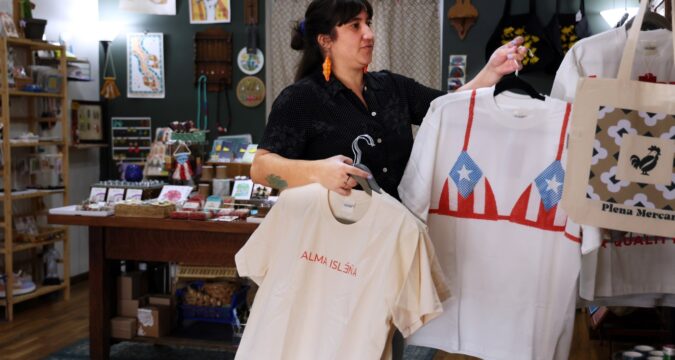
In 2024 she launched Plena Mercancia, a Puerto Rican coffee shop in Humboldt Park named for its plena, or plain, locally sourced sugar and artisanal goods. Labault wanted to create a space for people to chat over coffee, like they do in Puerto Rico.
“I’ve been able to create this little piece of Puerto Rico outside of Puerto Rico but always with the wish of wanting to go back,” she said. Her hope is to raise enough money to buy a house and move back in the next few years.
But her dream was pushed back once already. Her five-year goal to raise enough money for a house in Puerto Rico turned into eight years. The island’s high cost of living, fueled by a wave of tourism, led her to invest the money intended for a house in Puerto Rico — years’ worth of savings — into her cafe.
Rising costs on the island that were exacerbated by the hurricane and fueled by a new wave of tourism have led to gentrification and the displacement of many islanders.
Labault is one of about 200,000 Puerto Ricans who left the island after Hurricane Maria swept the 3,500-square-mile archipelago, killing nearly 3,000 people and leaving lasting infrastructure damage.
She described the Category 4 hurricane in one word: thirst.
Basic necessities such as drinkable water, food and gasoline were scarce. With no refrigeration, people were drinking hot soda to stay hydrated, Labault said. After waiting in line for five hours to pick up ice, much of which melted on the way home, she and her partner decided to leave for Chicago.
Her move to the city was meant to be temporary and she diligently set money aside for a house in Puerto Rico. But the price of a three-bedroom, one-bathroom home there went from about $195,000 before the pandemic to over $300,000 today, she said.
Some real estate agents wouldn’t even pick up the phone, Labault said. If they see a Puerto Rican area code from the caller, they don’t answer, she said, giving preference to U.S. buyers, who are perceived as wealthier.
With time, her dream of moving back to the island keeps getting pushed back.
About 100,000 Puerto Ricans live in Chicago. About 3,000 Puerto Ricans came to Chicago after the 2017 hurricane, with some staying temporarily, according to In Our Nature, a student magazine at Northwestern University.
Like Labault, many Puerto Ricans find home prices unaffordable in the territory.
Last year, she took her savings and launched Plena Mercancia, her cafe along the Paseo Boricua cultural corridor on Division Street. The sun-lit space feels like an islander’s living room, with its forest green walls and butter yellow chairs that face each other.
Customers she knows by name linger around the wooden coffee bar where she prepares pour-over coffees with a consistency that took her a long time to perfect.
“This was like my compromise,” she said of the cafe. “I don’t have the island, but I can create my own space that feels as much as home as possible.”
Inside the cafe is a showroom filled with accessories, T-shirts and other artisan goods from the island. There is a T-shirt featuring the famous coqui frog species of Puerto Rico popularized by rapper Bad Bunny, and painted postcards that read “Isla del Encanto,” or “island of enchantment.”
In this way, Labault said she can give back to the Caribbean island and contribute to its economy, even if she’s far away.
Bad Bunny performs during his first show of his 30-date concert residency at the Coliseo de Puerto Rico Jose Miguel Agrelot, in San Juan, Puerto Rico, July 11, 2025. (Alejandro Granadillo/AP)
In January, Bad Bunny, who is Puerto Rican, launched the album “DeBÍ TiRAR MáS FOToS” (“I Should Have Taken More Photos”). It tackles themes of exile and gentrification on the island, featuring local rhythms such as salsa and plena.
The album’s Sapo Concho, an endangered crested frog, is a motif for those displaced. In a short film for the album, an aging Puerto Rican looks at old photos of the island with the animated Sapo Concho, remembering the home he left behind.
Bad Bunny topped Spotify charts as 2025’s most-played artist in the world with over 19.8 billion streams this year. His “DTMF” album was Spotify’s top global album of the year and won a Latin Grammy for Album of the Year. His residency “No me quiero ir de aqui” (“I don’t want to leave here”) last summer hosted 31 concerts exclusively in Puerto Rico, with his last concert coinciding with Hurricane Maria’s eighth anniversary on Sept. 20, according to USA Today.
When Labault first heard the album, she said it was tough to listen to. “It was a really strong album, because it’s what we all feel; it’s like he’s the voice,” she said. But groups in the diaspora experienced it differently than native islanders, who lived through Puerto Rico’s harder moments, she said.
Daphne Labault in her Puerto Rican-inspired cafe and handicrafts store Plena Mercancia on Dec. 23, 2025. (Terrence Antonio James/Chicago Tribune)
A group of friends from Puerto Rico sat around Labault’s cafe bar one day to listen to the album together. They reflected on Puerto Rico’s colonial status as an unincorporated U.S. territory, and whether it would end up like Hawaii — a tropical paradise for rich Americans, she said.
“When I heard it, I understood that the space that I once occupied is now being occupied by (some) North American, by someone who doesn’t appreciate our island, and I was shaken by that,” Labault said.
In 2019 Puerto Rico rolled out Act 60, a new version of an incentive that encouraged wealthy investors to relocate to Puerto Rico by offering tax breaks. The incentive, meant to create jobs on the island, has contributed to rising property costs, experts said.
Wealthy investors often relocate to the island but conduct their primary business elsewhere, leading to mainly low wage job creation, said Jose Atiles, associate professor of sociology at University of Illinois Urbana-Champaign.
Additionally, the money coming in from the incentive is not enough to be significantly reinvested in social welfare for the island, he said.
It has also attracted crypto investors who buy up property and wait to sell it for a higher profit margin later, which raises real estate prices.
“That has limited the amount of real estate available for people,” Atiles said.
Tourism also spurred many buyers in the short-term rental market and in the hotel industry, particularly in popular areas like San Juan, the capital, making it more expensive for locals to buy property, Atiles said.
“It’s like a race between people my age who don’t own property to buy one,” Labault said. If foreigners buy most of the property, there won’t be much left for locals, she said.
She tells her father, who owns property in Cabo Rojo, not to sell. “No matter how much money they give you,” she said.
Years of rising debt and corruption in Puerto Rico had precipitated a financial crisis in 2016, with the island having over $70 billion in debt.
Prices rose fast, and a year later Hurricane Maria hit, said Antonio Sotomayor, an associate professor and librarian of Latin American and Caribbean studies at the University of Illinois Urbana-Champaign.
It was the island’s deadliest hurricane since 1899. “That was the last straw,” said Sotomayor, who came to Illinois from Puerto Rico in 2001. He called the hurricane’s aftermath a war zone.
Now, high tourism and tax incentives have given Puerto Rico the image of a “Caribbean paradise for the ultrarich,” he said.
The hurricane also exposed the fragile nature of the island’s power grid, ushering the world’s second-longest blackout. Earlier this month, the island’s energy provider since 2021, LUMA, was sued by the Puerto Rican government for its failure to improve the power grid, with the island facing continual outages and high electric bills.
Labault said she experienced depression and anxiety after moving. She feels as though she abandoned her native land and people, and hopes to buy a property in Puerto Rico before getting priced out.
In Puerto Rico there is a saying: To be big, you have to grow your profession abroad, she said.
But not a day goes by in Chicago that Labault doesn’t feel like a stranger.
“Everyday, I feel like a tourist,” she said.
On most days, you can find her at the cafe making Coffeequito, a twist on a traditional Puerto Rican Christmas drink made with coconut cream and coffee, or warming up snacks for her 6-year-old son.
She is still saving up to buy her home in Puerto Rico.
https://www.chicagotribune.com/2025/12/26/puerto-rican-chicago-bad-bunny/


