Metra retires its 10-ride pass. Madigan jurors hear the sad ballad of Mike and Mike. A progressive cycling alderman tries and fails to change Chicago’s speed limit. A history of public ownership ends at Walgreens. JoAnn Fabrics hangs it up. Da Pope is a real headline. We lose Norm, but offer cheers to George Wendt. And we mourn the death of R. Bruce Dold, one of the giants of Chicago journalism and one of our own.
This holiday week, as is our recent tradition, the Tribune Editorial Board is looking back at the year through editorials covering life in Chicagoland, the annus horribilis of Mayor Brandon Johnson, the odious invasiveness of Operation Midway Blitz, and national and world affairs as aggressively reordered by one Donald Trump.
Here’s our first (and, alas, lightest) collection, focused on the little joys and big irritations of life in Chicagoland, 2025 edition.
Jan. 8. The CTA nixes its X account. Tribune Editorial Board laments the change.
As a Chicago commuter, there’s nothing worse than standing on a cold, blustery platform, staring down the track and seeing no sign of headlights. The wait is brutal and blistering, and while it builds the strength of character for which the residents of our great city are so famed, it’s also completely unnecessary. When it comes to transit, riders deserve as much communication as possible. That’s why the Chicago Transit Authority’s petulant decision to exit X (formerly Twitter) is especially galling, because it runs counter to the service it owes Chicagoans.
The 65-story skyscraper building at 311 S. Wacker, center, was sold.
This time of year, we often overlook the buildings that envelop us in the Loop as we trudge to work, shoulders bent against cruel winds and bitter cold. But we walk among giants, and that includes 311 S. Wacker Drive, the 65-story postmodern skyscraper that occupies the greater part of an entire block of prime real estate just across the street from Willis Tower. This skyscraper made news earlier this month as details emerged of a pending deal to sell the building for just $70 million. This is a big development, made even bigger by speculation about what might come next for 311. We could be witnessing Chicago’s transformation from the home of the world’s tallest building to the site of the world’s tallest teardown. If the deal goes through, the current owners will take a stunning loss, as the building sold for over $300 million just over a decade ago. That burns, and is a shockingly low price for a building of this magnitude, especially when you consider that a single luxury condo in the St. Regis sold for over $20 million not too long ago.
We generally support the so-called 1901 Project, the latest West Loop development hatched by the Reinsdorf and Wirtz families, which looks set to create a new, dynamic, walkable neighborhood out of what currently is a bleak sea of surface parking lots and extend the energy of hot restaurants, music venues such as the Salt Shed and the vibrant street life now visible in the West Loop even farther west. We admire the private financing and the relatively modest ask from taxpayers in infrastructure support. Moreover, we’ve long argued that a terrific (and oft-overlooked) tool of neighborhood regeneration is when the crucial urban core radiates out from the city’s center, adding private-sector housing and other assets.
But some balance is needed as the epicenter of Chicago’s vital entertainment and leisure sectors shifts palpably to the west via the rapid growth in the former meatpacking district. We can’t let the city’s traditional centers suffer as a result. This applies to the Loop, home of such huge, historic venues as the Chicago Theatre, Auditorium Theatre and the Lyric Opera House and also to the lakefront neighborhood of Uptown, once an entertainment locus to rival the Loop and still home to multiple historic music venues such as the Aragon Ballroom, Riviera Theatre and the Green Mill.
Jan. 28: Yuengling beer arrives in Illinois
The Yuengling Traditional Lager from Pennsylvania-based Yuengling available in Chicago starting Jan. 27, 2025. (John J. Kim/Chicago Tribune)
We can’t do much about the difficulty of drinking a Spotted Cow in Illinois, at least without breaking the law, but we can cheer the long-awaited Illinois arrival of Yuengling, an amber lager that is a good match for Chicago, given its superior taste to most mass-market beers, its 195-year history and its blue-collar bona fides as a historic beer brewed in Pennsylvania.
Its taste lingers pleasantly in the mouth like a microbrew or an import, but its fans don’t (usually) have to pay the typical premium for a more pretentious Euro choice like Stella Artois. Finally, Yuengling (and some brand extensions thereof) is now available in your better class of local Chicago tavern in draft form. Please drink only in moderation and leave your car at home.
A dog should be free to walk over a Chicago manhole cover or out its own front door without current shooting through its pores, traumatizing the dog’s owner, let alone the dog itself. And, in a city filled with dog lovers, this whole troubling business is worthy of some serious citywide examination and mitigation by Commonwealth Edison, the city of Chicago and private building owners. … Dogs are Chicagoans too. Imagine if they had lobbyists.
Back in the 1990s, Mayor Richard M. Daley would ride around town looking for vacant lots and insisting weeds be pulled and wrought-iron fences installed. One can only imagine what Daley would have thought about the current situation near the corners of Clark and West Ontario streets, where the Rainforest Cafe building, a themed structure replete with fanciful foliage and toadstools, has sat empty since 2020, and the Hard Rock Cafe, which closed permanently on March 29 after 40 years in business, has now joined the neighborhood carnage.
The monster guitar sign has disappeared over the last few days and, worse, prosaic plywood has been attached all over a rockin’ building that once was the epitome of an exurban teen’s exciting night out on the town.
May 19. Dust darkens Chicago’s skies. Editorial board reaches for “Grapes of Wrath” metaphors.
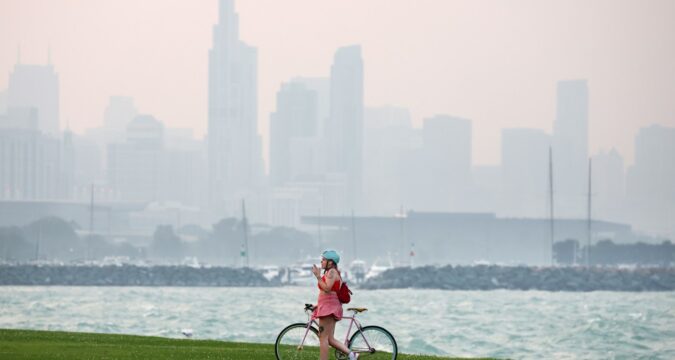
We associate such images with the Oklahoma of Woody Guthrie (“I am made out of this dust and out of this fast wind”), but on Friday, Chicagoland had its own encounter with a dust storm. Clouds of the stuff — what stuff? — darkened our sky, obscured our view as walked our dogs, blew through our high school graduation ceremonies, halted plane departures at Midway Airport and made freeway travel even more difficult than usual thanks to the sensation of driving into a great wall of dust. Fans of Beyoncé, slated to play Saturday night at Solider Field, fretted that their visibility would be limited by more than the cowboy hats on their heads. Chicagoans headed out from their homes to find a Friday dust cloud coming at them with the intensity of the raging infected souls in the dystopian TV show “The Last of Us.”
July 29. We mourn baseball great Ryne Sandberg, dead due to cancer.
Ryan Sandberg throws out the first pitch for Game 3 of the Cubs against the St Louis Cardinals in their National League Division Series playoff, Oct. 12, 2015 at Wrigley Field in Chicago. (Nuccio DiNuzzo/Chicago Tribune)
Ryne Sandberg — the Hall of Famer, one of the greatest Cubs of all time — found his voice when he stopped thrilling us on the diamond. We are all the better for it. Our deep condolences to the Sandberg family, which could be extended to fill Wrigley Field several times over.
The prevalence of tearing down perfectly sound old single-family homes in order to build often-gaudy new structures has led to proposals to incentivize keeping more of the old housing stock, using tax breaks and other means. Glencoe, for example, is in the midst of such a debate. We applaud those efforts especially the use of incentives rather than regulation to encourage such preservation, often of classic, midcentury architecture. Every community, from Chicago to old-line suburbs like Evanston and Oak Park to more far-flung and newer suburban communities, should have a contribution to make in offering shelter more people can afford to buy. We appreciate that the debate is fully engaged in most places.
Now let’s see more action. A Chicagoland where more people can live comfortably and within their means leads to an economically thriving, more dynamic region.
Oct. 9. Fame is hurting. Chicago’s public arts high school is important, the board argues.
When the Chicago High School for the Arts, widely known as ChiArts, opened its doors in 2009, it was the fulfillment of a long-held goal by many arts lovers in a city known for its cultural prowess. No longer was Chicago the only city with a population of over 1 million without a specialized public arts high school where students did not have to pay tuition. In the following years, Freedom Martin (’19) made it to Juilliard, Kyrie Courter (’13) went to Broadway in “Sweeney Todd” and Antoinette “Vi” Freeman (’13) performed with Rihanna in a Super Bowl halftime show. And in a city where many public schools are under-enrolled, ChiArts currently boasts over 500 artistically elite students, committed to getting both a scholarly and an artistic education. So the news last week that the ChiArts board had voted not to renew its contract with Chicago Public Schools caused understandable levels of distress, especially among parents and students.
Sister Jean Dolores Schmidt celebrates after the Loyola Ramblers beat the Kansas State Wildcats 78-62 in the Elite 8 game of the NCAA tournament at Philips Arena, March 24, 2018, in Atlanta. The Ramblers advanced to the Final 4 in San Antonio. (John J. Kim/Chicago Tribune)
Boston University has a term for those who make it to 100 years old without showing any outward sign of dementia or any other clinically demonstrable disease: “escapers.” It’s a reference to how, as one inevitably approaches the limit of the natural human lifespan, morbidity is something to be “escaped.” Sister Jean Dolores Schmidt, the beloved unofficial mascot of Loyola University and its basketball team who died Friday at the age of 106, was a veritable Houdini.
As fans of the TV series “The Bear” well know, it is tough to keep anything going at the same level on a long-term basis. Shiny newcomers nip at your heels. Those who throw rocks will try to break the windows of the establishment. One easily can become tired or fail to see new directions. Or one can just say to hell with that, and just carry on doing what one does. So, chin up, Mr. Achatz, say we. You’ve represented the pinnacle of Midwestern dining artistry for two decades. We don’t expect reservations at your place to suddenly get any easier. And if a city should praise its great resident artists at their peak, it should also have their back through a few of the inevitable valleys.
Submit a letter, of no more than 400 words, to the editor here or email letters@chicagotribune.com.


