Category: News

The Case Against Public-Sector Unions
The Case Against Public-Sector Unions
Authored by Aaron White via RealClearPolicy,
America’s public-sector unions have a problem they can’t explain away: Workers are leaving.
Ask a public employee when they joined their union and most couldn’t tell you. Because they didn’t join. The dues just started coming out of their check.
That’s not a membership, and for decades nobody told workers they could opt out.
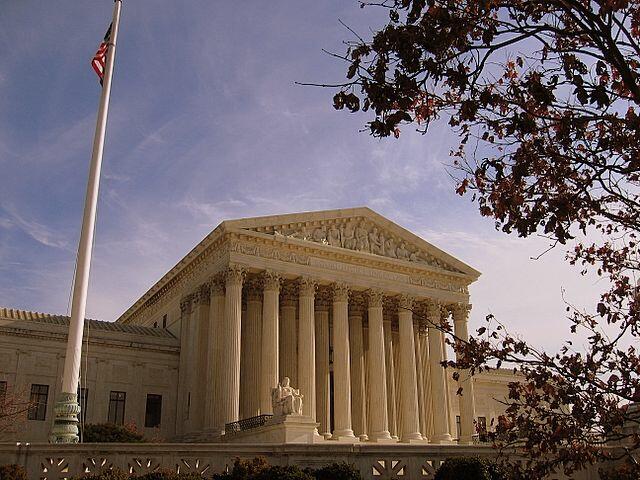
That changed in 2018, when the U.S. Supreme Court affirmed in Janus v. AFSCME that no government employee can be forced to join or pay dues to a labor union.
Hundreds of thousands opted out the moment they found out— the Freedom Foundation alone has helped more than 265,000 workers exercise their First Amendment rights since the ruling was issued.
Union leaders don’t talk about that number.
For decades, public-sector unions ran on automatic – automatic dues collection, automatic membership, automatic political spending – whether the worker wanted it or not.
The National Education Association confiscated $390 million in dues revenue during the most recent fiscal year from nearly 2.9 million members – most of it seized directly from taxpayer-funded paychecks before the workers could even see it.
In California alone, public education unions are estimated to collect more than $800 million per year. That money doesn’t come from convincing workers the union is worth it. It comes from a system designed so workers never had to be asked.
When the Supreme Court exposed their scheme in Janus, unions had to find other ways to keep the cash spigot open — including literally criminalizing their opposition.
Oregon, for example, effectively passed a law last year making it illegal to send public employees a mailer explaining their right to opt out. In theory, the law only bans marketing materials whose sender attempts to deceive the recipient into believing it was sent by their union. But in practice, the legislation is written so broadly that a left-leaning judge could easily construe nearly any outreach to union members as such an impersonation, subjecting the sender to potentially hundreds of thousands of dollars in fines.
To be clear, the law is specifically intended to thwart the Freedom Foundation, which has helped thousands of public-sector union members in Oregon opt out of their union. And other blue states are following suit.
New York lawmakers are currently considering an identical bill. In Hawaii, a similar measure has already cleared its second legislative committee.
The bills use the same language because the same people are writing them. Union-backed legislators, coordinating across state lines, are abusing their power to impose laws designed to prevent workers from understanding their First Amendment rights.
If you have to pass a law to stop people from finding out they can leave, you’ve already lost the argument.
This is Big Labor’s playbook. Unions are forging worker signatures on membership applications, signing people up without asking them, then taking dues from their paychecks. When workers try to resign, the union hands them documents they’d never seen, let alone signed.
Chaquan May, a California caregiver and mother, described what happened when she first encountered SEIU 2015 representatives at an orientation for newly hired in-home healthcare providers. “They locked us in a room,” she said. “One of the head union workers hovered over me at the table and stood there and told me, ‘What are you waiting for? Just sign it.’ I honestly felt scared and just went ahead and signed it out of fear.”
The Freedom Foundation has filed a class-action lawsuit against SEIU 2015 on behalf of May and a dozen other workers like her.
Meanwhile, the NEA’s president pulled in more than $514,000 in salary last year — a pay raise of $80,000 since she took office.
The union reported more than $51 million in disbursements for political activities and lobbying in the same period. The NEA and the American Federation of Teachers have together put $43.5 million into political organizations since 2022.
This is what the dues are for. Not the worker, the machine.
The reforms are commonsense:
make re-enrollment annual and affirmative — if a worker wants to belong, they sign up every year
end automatic payroll deductions so dues are a visible, conscious transaction
require unions to disclose political spending the same way corporations have to
These are exactly the kinds of reforms Oregon, New York and Hawaii are working to prevent — not by defeating them in debate, but by making it illegal to tell workers such options exist.
Unions that fight every one of those reforms are telling you the membership numbers don’t hold up if workers get a real vote. The hundreds of thousands of workers who left after Janus proved it.
The fight now is making sure that choice stays real, and that the people trying to take it away don’t succeed one forged signature, one locked room and one state legislature at a time.
Aaron Withe is the CEO of the Freedom Foundation, a nonprofit organization dedicated to protecting workers’ rights and advancing employee freedom across America.
Tyler Durden
Mon, 04/13/2026 – 18:25
https://www.zerohedge.com/political/case-against-public-sector-unions

YouTube Removes Pro-Iran Channel Producing Anti-Trump Videos
YouTube Removes Pro-Iran Channel Producing Anti-Trump Videos
Google, the owners of YouTube, has removed a channel on the platform belonging to a pro-Iran group producing Lego-themed videos mocking Donald Trump.
“Upon review, we’ve terminated the channel for violating our Spam, deceptive practices and scams policies,” a YouTube spokesperson told Middle East Eye. “YouTube doesn’t allow spam, scams, or other deceptive practices that take advantage of the YouTube community.”
Explosive Media’s content largely consists of animations ridiculing the US war effort against Iran and poking fun at the US president.
YouTube did not specify how the channel had violated its policies, but the company has previously been described as being “aligned with the Islamic Revolutionary Guard Corps”.
One of the group’s videos depicts Trump hurling a chair at US military figures, while Iranian generals press a red button with the label “Back to the Stone Age,” referencing a threat made by Secretary of War Pete Hegseth. Another depicts Trump with a flaming bottom, holding a sign that reads: “VICTORY! I am a loser.”
A number of videos reference Shia Islamic mythology, including depictions of Hussein ibn Ali, the grandson of the Prophet Muhammad, who is a key symbol of resistance and spiritual leadership for Shia Muslims.
Writing on X, Explosive Media hit out at Google for suspending its channel, saying it had been done because its content was “violent”. It wrote: “Seriously! Are our LEGO-style animations actually violent?”
Explosive Media, known in Persian as Akhbar Enfejari, has denied it is backed by the Iranian government and its videos have reached millions of viewers across a range of social media platforms.
Its most recent video prior to being suspended appeared to show Trump carrying out the war in Iran to distract from the Epstein files and at Israel’s behest.
It also implied that Epstein and his associates had engaged in cannibalism, for which there is no evidence. An earlier video referenced other victims of US violence through history, including Native Americans, the Vietnamese and the children of Gaza, Hiroshima and Nagasaki. It also quoted Malcolm X.
Content war
Social media has increasingly become a major platform for the war of words between the US, Israel, Iran and their various supporters and opponents.
Trump’s White House has also put out largely AI-generated imagery and videos that aggrandize the president and project American power. Earlier on Monday, Trump posted an image on his Truth Social network that appeared to present him as Jesus Christ.
Wake up babe, Iran just dropped a new Lego movie trolling Trump pic.twitter.com/YErfkJ6dHM
— Not Jerome Powell (@alifarhat79) April 12, 2026
Much of it will be lost on Iranians, however, as they are currently under the longest internet blackout in history, according to monitoring group NetBlocks.
The Islamic Republic regularly blocks internet access in Iran during periods of unrest. The government says the move is aimed at countering misinformation, but critics say it provides cover for violent state crackdowns. Some have been able to circumvent the block using alternative methods such as the Starlink satellite, while government allies have been granted exceptions.
Speaking to the BBC, the head of Explosive Media, who referred to himself as “Mr Explosive”, said his team consisted of fewer than 10 people and that the Iranian government was a “customer” of his company.
Tyler Durden
Mon, 04/13/2026 – 17:40
https://www.zerohedge.com/geopolitical/youtube-removes-pro-iran-channel-producing-anti-trump-videos
Pope Leo Says ‘I Am Not Afraid Of Trump’ – Amid War Of Words Over Iran Conflict
Pope Leo Says ‘I Am Not Afraid Of Trump’ – Amid War Of Words Over Iran Conflict
An open public clash between the Pope and President Trump was perhaps bound to happen given the Vatican’s increasingly vocal criticism and condemnation of US military action in the Middle East. The Vatican has been consistently anti-war especially going back to the Iraq invasion and US occupation under the Bush administration.
While recent years and decades have seen successive popes move a bit leftward on general matters of moral theology (particularly the last one, Pope Francis), the irony is that it now happens to be an American pope who is subject of immense criticism in Washington.
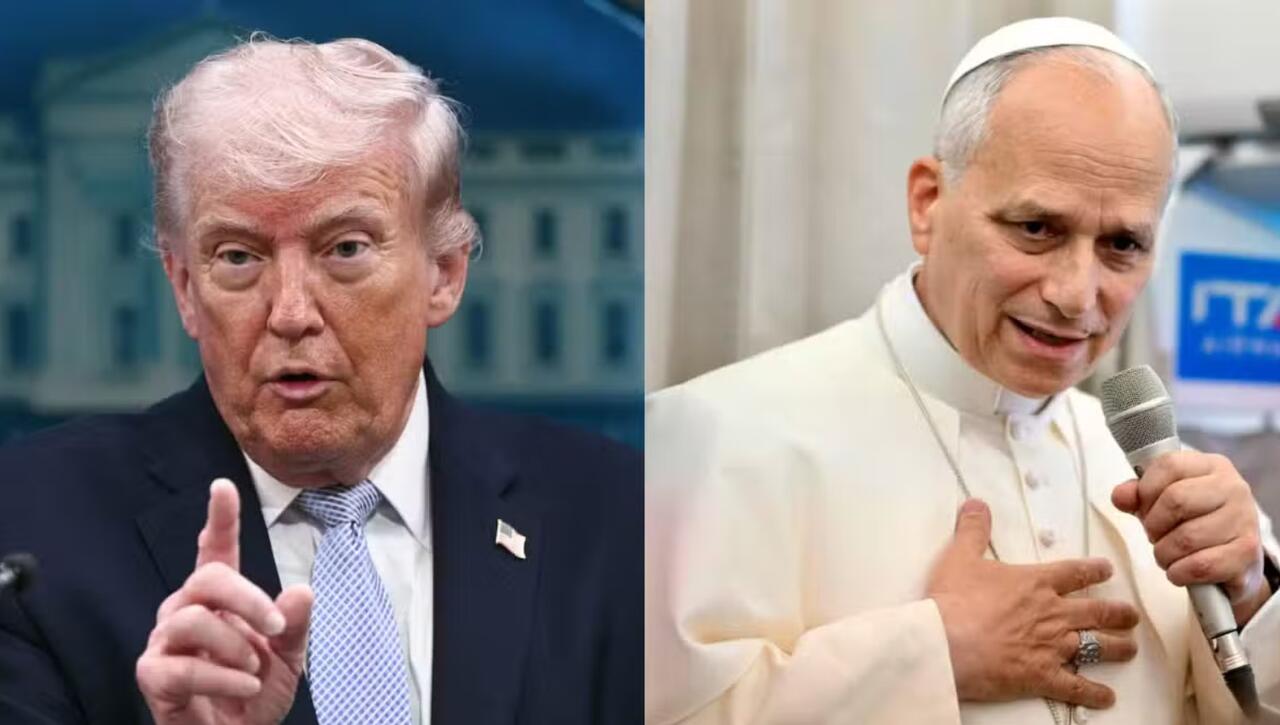
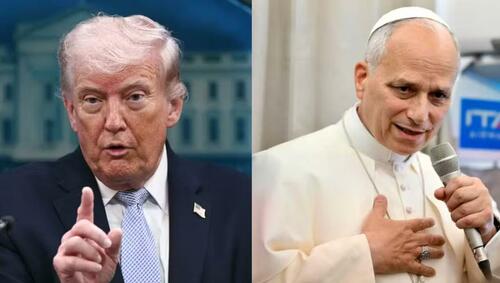
Trump had unleashed a tirade against Pope Leo XIV on Sunday night, calling him “WEAK on Crime, and terrible for Foreign Policy” and charging him with “catering to the Radical Left.”
The lengthy Truth Social post was issued by Trump one day after the Chicago-born pontiff stated during a prayer vigil for peace what he characterized as a “delusion of omnipotence” during the Iran war.
To review, here are the highlights of what Trump said:
Trump criticized the pope on matters including the Catholic Church’s stance during the COVID pandemic and said he likes Leo’s elder brother Louis Prevost “much better” than him because, he claimed, he’s “all MAGA.”
“I don’t want a Pope who thinks it’s terrible that America attacked Venezuela,” Trump wrote in an apparent reference to Leo’s January expression of concern for Venezuelans following the U.S. raid and ensuing capture of leader Nicolás Maduro in the South American country.
Trump doubled down in his criticism in comments to reporters late Wednesday, saying: “I’m not a big fan of Pope Leo. He’s a very liberal person.”
After this, Pope Leo XIV addressed reporters Monday aboard the papal plane en route to Algeria, and somewhat surprisingly decided to respond directly to the latest from Trump.
He made clear he does not view himself as a political actor and will not engage in a dispute with the US President, stating, “I think that the people who read will be able to draw their own conclusions.” He added, “I am not a politician, I have no intention of entering into a debate with him” – while emphasizing that his focus is on matters of faith and the Gospel, rather than politics.
“I do not think the message of the Gospel should be abused in the way some people are doing,” Leo said. This was clearly a veiled reference to Trump.
He reaffirmed his position on global conflict, declaring, “I will continue to speak out loudly against war,” and called for “multilateral dialogue between states” as the path to resolving crises. And then came one of the more interesting lines: “I am not afraid of the Trump administration,” the pope said.
Reaffirming his position, the pope said further, “The message of the Church is the message of the Gospel, blessed are the peacemakers.”
He concluded by highlighting human cost of ongoing conflicts, including the Iran war which was started by a US and Israeli surprise attack, stating, “Too many people are suffering in the world.” As for Trump, this probably won’t be the last time he goes after Leo XIV in public.
Tyler Durden
Mon, 04/13/2026 – 17:20

Welcome To The Theater Of The Absurd
Welcome To The Theater Of The Absurd
Authored by Charles Hugh Smith via OfTwoMinds blog,
The real world no longer matters, what matters is the performance on stage. Welcome to the Theater of the Absurd.
In the present era, all the world is a stage and everything is a performance on that stage: welcome to the Theater of the Absurd, a Hollywood set fabricated of cardboard and plaster made to look like gold leaf and marble columns, where the contraptions and ropes that do the magic are hidden behind purple velvet drapery.
Every detail has been designed to create the illusion of permanence and power to rivet our attention and distract us from noticing that behind this faux fabrication, the world is on fire.
Since the entire point of the theatrics is to cloak the decay of the status quo from serving shared interests to a craven scramble of self-enrichment, no expense is spared in the theatrics, for as the gulf between the reality of who’s getting richer and who’s losing ground and what the performers claim–this is the best of all possible worlds because of technology and Progress–widens, it becomes necessary to pour more resources into the performances, lest the losers catch on that the performance is the con that keeps the self-serving status quo from being revealed as an extractive, exploitive arrangement favoring the few.
As the audience is no longer entranced by mere performance, the theatrics must be ramped up to absurd heights. Leaders shout continually through the megaphone of social media, every pronouncement is exaggerated to self-parody, jokers prance around as Wall Street jugglers perform tricks, and faux trials run continuously in the background, exiling star performers as part of the enthralling theatrics.
The audience soon habituates to the exaggerations, and so the absurdity is notched higher. Every outrage is played out on stage, and soon the audience is no longer outraged by anything, for every aspect of the performance is now accepted as “normal.” In this jaded state, the audience becomes restive and starts booing the performers.
The Theater of the Absurd resorts to throwing money into the audience, creating frenzies as all those losing ground stampede to collect the coins as their last best change of getting rich enough to avoid the fires burning behind the stage.
While the money is being thrown into the increasingly agitated mob, audience members are invited onto the stage to perform their own theatrics. This taste of fame is electrifying, and soon the stage is a seething mass of onlookers seeking their moment in the spotlight, leaders claiming divine inspiration, and a crush of jugglers, clowns, and jokers pressing forward and being pushed off stage in the melee.
Since the performance is now the key to the survival of the status quo arrangement, nobody’s paying attention to the fires burning behind the stage set. The real world no longer matters, what matters is the performance on stage. Welcome to the Theater of the Absurd, where the performance is more real than the world burning behind the flimsy simulations and facsimiles of permanence and power.
Tyler Durden
Mon, 04/13/2026 – 17:00
https://www.zerohedge.com/geopolitical/welcome-theater-absurd

‘Door Is Not Closed’: Mediators Still Press For Iran Deal After US Demanded 20-Year Halt To Nuclear Program
‘Door Is Not Closed’: Mediators Still Press For Iran Deal After US Demanded 20-Year Halt To Nuclear Program
There’s currently some consensus among international reports that the weekend US-Iran peace talks in Pakistan fundamentally broke down over the nuclear issue. The question of Iran’s enriched uranium has at times over the course of the war taken a front seat and at other times a back seat when it comes to Washington’s evolving justifications and war aims in launching Operation Epic Fury.
On Monday a US official has been cited in Axios as saying Iran must halt its nuclear enrichment program for 20 years to end the war, scaling back from an earlier White House demand for a permanent end to enrichment. And that’s when sources say the Iranians countered with a shorter “single digit” period.
The unnamed sources explained that during talks in Islamabad the Iranian mediators countered with a proposal to halt enrichment for less than ten years.
Multiple Middle Eastern countries are still working to mediate a resolution, as both Washington and Tehran moved away from maximalist positions on enrichment. Before the talks, Trump demanded a permanent halt, while Iran pushed for a deal allowing a civilian nuclear program without additional restrictions.
Al Jazeera reports of where things stand in the following:
Pakistan, which spent weeks positioning itself as a mediator and succeeded in bringing both sides into the same room, emerged with its role intact. But officials acknowledge the harder phase now begins — getting American and Iranian negotiators back into talks before their differences explode into full-fledged war again.
“Pakistan has been and will continue to play its role to facilitate engagements and dialogue between the Islamic Republic of Iran and the United States of America in the days to come,” Pakistan’s Deputy Prime Minister and Foreign Minister Ishaq Dar said in a statement after the conclusion of the talks.
And Axios in a separate follow-up report also confirms:
Pakistani, Egyptian and Turkish mediators will continue talks with the U.S. and Iran in the coming days in an effort to bridge the remaining gaps and reach a deal to end the war, according to a regional source and a U.S. official.
All parties still believe a deal is possible. The mediators hope that narrowing the gaps could enable another round of negotiations before the ceasefire expires on April 21.
The two sides remain divided over Iran’s stockpile of 60% enriched uranium, with Tehran having offered to dilute the stockpile if US sanctions are lifted, while the US apparently required that Iran export all the material.
President Trump has even openly talked about possibly ordering a military raid to seize the stockpile – much of it believed buried deep underground – in what would be an extremely risky and daunting mission.
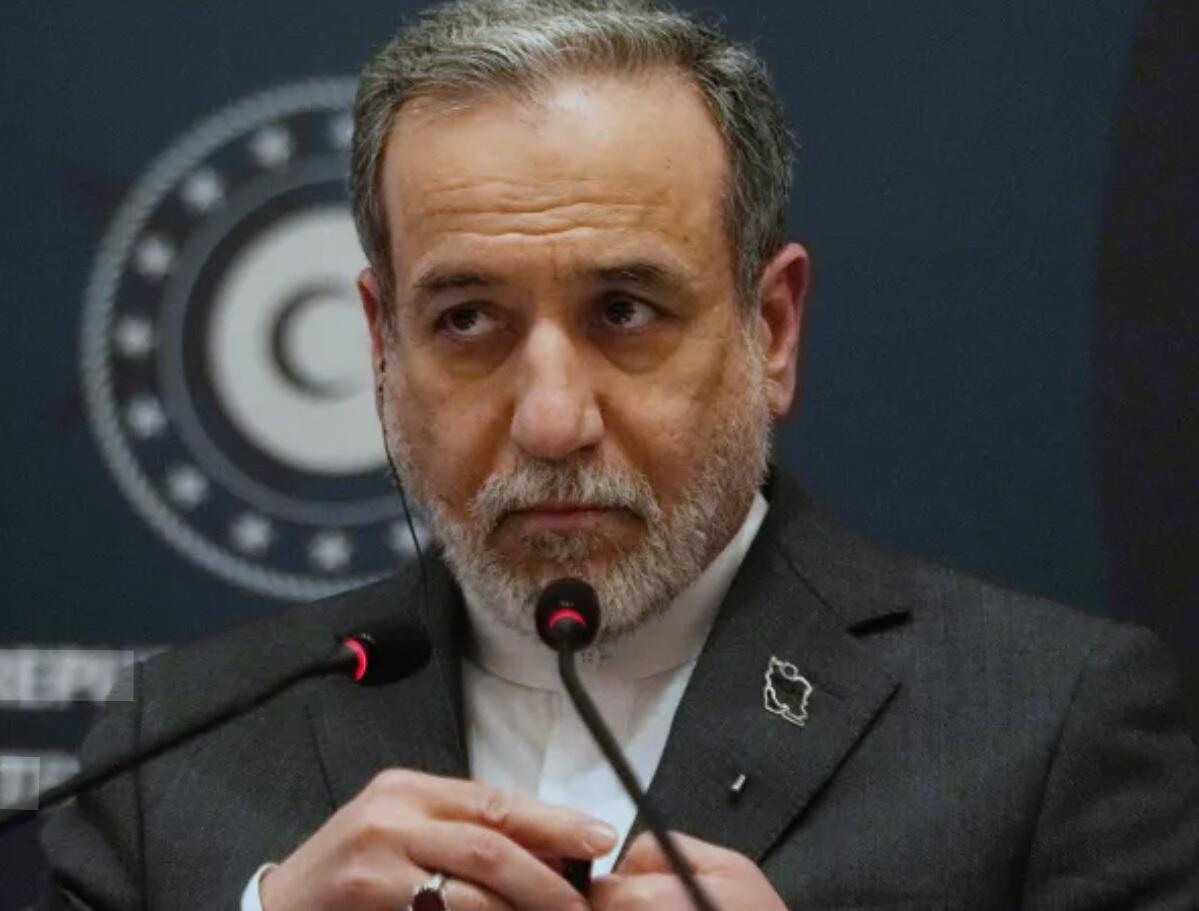
Tehran has meanwhile accused Washington of making “excessive demands” – with Foreign Minister Abbas Araghchi having alleged negotiations collapsed because the US changed its position late in the process.
“In intensive talks at the highest level in 47 years, Iran engaged with the US in good faith to end war,” he earlier wrote on X. He added: “But when just inches away from ‘Islamabad [Memorandum of Understanding],’ we encountered maximalism, shifting goalposts, and blockade. Zero lessons earned.”
Tyler Durden
Mon, 04/13/2026 – 16:40
As The Worms Turn…
As The Worms Turn…
Authored by James Howard Kunstler,
“They’re holed up in a bank demanding three large pizzas, a helicopter, and a personal phone call from Sydney Sweeney…”
– Greg Gutfeld on Iran’s negotiating position
The Russians have a phrase for it: negotiation-incapable (ne peregovorosposobny).
That is what the Iran delegation demonstrated during a long day of talks with the US team over the weekend in Islamabad. What part of “no nukes” didn’t they understand? All of it, apparently. The corollary question on the table — arguably more pressing for Iran — was: how much more punishment are you willing to suffer to sustain your dream of atomic bombs? You have no defenses left, no control of your air-space. Do you just want to sit in the dark for the next hundred years?
Such is the obduracy of the Shia death cult. They have no friends left in the world. Russia, you think? Not really. That relationship was pegged to geopolitical dynamics that are dead and gone. Russia is much better off normalizing relations with the USA so we can both be safe and secure in our spheres of influence. Europe is busy committing suicide. In this situation, China is little more than Iran’s very unhappy customer. Maybe Uncle Xi Pooh Bear can try talking some sense to whoever is left in-charge at the IRGC. . . give up your lunatic bomb dreams and just re-open the dingdang gas station! Pretty Please!
Anyway, why interfere with US operations in Hormuz? The USA is wresting control of the Persian Gulf from these maniacs who can’t be trusted to just stay open for business. Japan, the two Koreas, Indochina, India, also have to stand by with mounting frustration as these jihad-happy idiots starve Asia’s economies. A change in Iran’s attitude can’t happen soon enough and Mr. Trump is on the case. The blockade starts at 10a.m. today, Monday. Whatever’s left of Iran’s revenue stream goes out the window. Maybe they lob some rockets and drones at our ships. Maybe they hit something, maybe not. We’ll see where they launch from and that will be the end of X-number of remaining launch sites. Then there are the bridges, the power plants. FAFO mofos.
About those 1000 pounds of 60-percent enriched uranium (their precious bomb fixings)… You must imagine that it is either buried deeply under the rubble of Fordoz and Isfahan, or maybe distributed in many secret hidey-holes all over the place… or perhaps sitting booby-trapped somewhere.
In short, there are many reasons to think that no special forces operation will be able to get at it.
So, the only other conclusion is that Iran must be driven to a place where they will surrender the stuff willingly themselves.
That could be a harsh place.
While you stay tuned to events there, plenty more developments break elsewhere in this raucous world.
Viktor Orban was voted out in Hungary. How did that happen? Maybe genuine public sentiment (sixteen years of Viktor O enough?). Maybe a whole lot of Soros money involved, plus EU backstage ballot shenanigans. Mr. Orban conceded graciously in any case, patriot that he is. Expect a blizzard of narratives to follow.
The truth will be hard to sort out. And it remains to be seen whether the new president, Peter Magyar, will throw open Hungary’s borders, hoist the pride flags, and give up importing Russian oil and natgas — all per the EU’s policy regime.
Here in the homieland, the fabulously loathsome Rep. Eric Swalwell, lover of Fang-Fang and accused multiple rapist of his office girls, shameless serial liar, and all-around uber jerk-off, has lost his shot at bringing additional ruin as governor to the forlorn state of California.
Might even be ejected from his seat in Congress. Oh, happy day!
Rumored to be released this week by the House Intelligence Committee: the transcript of former Intel Community Inspector General Michael Atkinson’s testimony about events that led to Impeachment #1 of Donald Trump in 2019.
The transcript has been locked away in a vault since October, 2019. Tulsi Gabbard rooted it out. The shadowy Atkinson played a crucial role in positioning “whistleblower” Eric Ciaramella to spark off charges of the “Ukraine quid pro quo” phone call against the president. Ciaramella was then a CIA agent planted in the National Security Council. He may have been involved earlier in co-authoring the fake Intelligence Community Assessment (ICA) that kicked off the RussiaGate hoax in 2017. For Impeachment #1 Atkinson reportedly changed the whistleblower rules to allow Ciaramella to convey second-hand hearsay from sketchy NSC member Col. Alexander Vindman to Rep. Adam Schiff, then chairman of the House Intel Committee. The chain of actions suggests the impeachment was a CIA setup.
The CIA director at the time was Avril Haines.
Ms. Haines ran the London CIA field office during the period when former MI6 agent Christopher Steele was concocting the notorious Steele Dossier at the center of RussiaGate.
It has long been suspected that RussiaGate was a joint CIA / MI6 operation.
Isn’t it about time that Avril Haines sat for a deposition in these various matters?
It might be nice to know if our main Intel Agency was involved in serial schemes to overthrow the US government.
Views expressed in this article are opinions of the author and do not necessarily reflect the views of ZeroHedge.
Tyler Durden
Mon, 04/13/2026 – 16:20

The Strait Of Hormuz Crisis Exposes A Fatal Flaw In Economic Thinking
The Strait Of Hormuz Crisis Exposes A Fatal Flaw In Economic Thinking
Authored by Kurt Cobb via Resource Insights,
Even a 4–5% loss in global energy supply could translate into a comparable drop in economic activity due to energy’s central role in all production.
Disruptions in oil and LNG flows through the Strait of Hormuz are already removing a significant share of global energy, with cascading impacts across industries.
Rising energy costs trigger widespread knock-on effects—from food and travel to semiconductors—potentially leading to a severe global recession.
A priest, an engineer, and an economist are stranded on a desert island. The first order of business is to get some food. The priest suggests that they all pray. The practical-minded engineer suggests that the three men make a net to catch some fish. But where will they find the necessary materials? The priest and the engineer turn to the economist and ask him if he has any ideas. The economist replies, “Assume a fish.”
This well-worn economist joke summarizes one of the chief flaws in contemporary economic theory.
That theory almost completely ignores the role of physical resources, assuming they will always be available in the quantities we need at prices we can afford at the time we need them. When those resources aren’t available, that theory begrudgingly accepts that there will be some damage to economic activity, but tends to greatly underestimate the impact.
This conceptual flaw explains why economists in most financial institutions and governments, and thus investors, are not especially alarmed at the loss of energy resources, as stock market indices remain not too far from their recent highs.
For a good summary of how contemporary economic theory goes off the rails, Australian economist Steve Keen offers a mercifully brief and comprehensible explanation. Here I will relate one critical part of that explanation. About 5.7 percent of U.S. GDP is devoted to procuring and distributing energy. Most economists will tell you that a 10 percent decline in energy availability would have a small effect on the U.S. economy. They would take the percentage of the economy devoted to energy, in this case 5.7 percent, and multiply it by 10 percent to arrive at a 0.57 percent reduction in economic activity.
This conclusion is utter nonsense and not even close to what the effects would be.
The reason is that energy is the master resource. It cannot be treated like other resources. Energy is the resource that makes all other resources available. Nothing gets done without energy. The correlation between economic activity and energy use is 0.9 (where 1.0 represents a perfect correlation). This should come as no surprise. When the economy is growing, energy use grows with it as energy fuels the economic activity that pushes growth.
What this implies is that a 10 percent reduction in energy availability is much more likely to result in a decline in economic activity closer to 10 percent than to one-half percent. For comparison, the real GDP of the United States fell 4.3 percent during the Great Recession, which lasted from December 2007 through June 2009.
So, how much energy is currently being denied to the global economy by the closure of the Strait of Hormuz? No one knows for certain. We do know that liquefied natural gas (LNG) exports from Qatar were previously transiting through the strait. And, close to 20 percent of the world’s oil supply was also passing through the strait on a daily basis.
None of Qatar’s LNG exports are currently passing through the strait. Some estimates say 12 percent of the world’s oil is now prevented from leaving the Persian Gulf (though a key pipeline in Saudi Arabia that sends oil to the Red Sea has now been damaged and may add to the total outage). Some oil cargoes from Iran have left the Persian Gulf, and Iraq may soon also send cargoes. Some oil is now being diverted via pipeline to ports other than those on the Persian Gulf. Those pipelines may be attacked as the war continues, so the amount of oil previously exported via the Strait of Hormuz that is being diverted through them could decline.
Okay, here’s some math to help you sort out what this all means:
1. Natural gas exports coming from Qatar are no longer being shipped. According to the U.S. Energy Information Administration, in 2024, Qatar provided 3 percent of the world’s natural gas, primarily in the form of LNG. Since natural gas provides about 23.5 percent of the world’s energy, by multiplying 3 percent by 23.5 percent, we arrive at a loss of 0.7 percent of the world’s total energy. It doesn’t seem like much, except the effects are quite uneven. In the United States, we fuel our economy with pipeline natural gas and send the extra abroad both via pipeline and LNG freighters. But 42 percent of Taiwan’s electricity is generated using LNG imported primarily from the Persian Gulf. That’s a huge hit. And, lack of electricity spells trouble for industry, including the Taiwanese semiconductor industry, which supplies much of the world. Of course, Taiwan will seek out other sources of LNG. But will the country be able to find LNG in sufficient quantities? LNG is usually delivered under long-term contracts, and only a small fraction of it is available in what is called the spot market, which isn’t committed under long-term arrangements.
2. The situation with oil is much worse. Oil provides about 31.5 percent of total world energy. Losing 12 percent of it means that the world has lost about 3.8 percent of its energy supply. Again, it may not seem like much, but it is a commodity that has very broad and critical energy and non-energy uses in the economy, for example, as the basis for gasoline, diesel, heating oil, and jet fuel; as a feedstock for many petrochemicals, including plastics; and as a lubricant for countless machines and vehicles worldwide. That loss of oil availability has already had huge impacts—and has sent prices soaring because people and companies feel they cannot do without these oil products.
We must also keep in mind that the 12 percent estimate may be too small and that the loss is cumulative. Less oil is being delivered into the global economy every day the Strait is closed. As stored oil is depleted, the situation will get desperate, and prices will move much higher. Again, effects are uneven. Countries that rely on imports and aren’t wealthy will suffer the most.
3. So let’s put the loss of oil and natural gas together to arrive at a total loss of 4.5 percent of the world’s energy supply. Since economic activity and energy are closely correlated at 0.9, we can multiply 4.5 percent by 0.9 to get about 4 percent of economic activity potentially subtracted from the world economy every day that the Strait of Hormuz remains closed. As mentioned above, the Great Recession caused a 4.3 percent drop in economic activity in the United States. So, it would appear that we are on track for consequences almost as severe as those of the Great Recession if this energy loss continues for much longer.
But this seriously understates the case. The Great Recession was primarily a financial crash. Though oil prices were high, there was no abrupt cutoff of supply to the market. Now, however, loss of energy and related chemical feedstocks is having many knock-on effects on the world economy. For example, rising costs for plastics will tend to curtail the consumption of such products. Rising fuel costs will lead to more expensive air travel as airlines pass fuel costs on to passengers. That means there are likely to be fewer passengers as some choose to fly less often and others are simply priced out of the market altogether. And that means further knock-on effects as fewer hotel rooms are booked and fewer rental cars are rented. Rising diesel and fertilizer prices (nitrogen fertilizer is made primarily from natural gas) will mean higher crop production costs, which are passed on to food processors and ultimately to consumers.
In addition to the squeeze on energy and non-energy products derived from oil and natural gas, about one-third of the world’s helium (a co-product of natural gas reservoirs) is now unavailable. Helium is essential for the production of semiconductors. Manufacturers of semiconductors will have to pay much more for helium or curtail semiconductor production. If those manufacturers successfully purchase what they need, then other users such as hospitals (in MRI machines), university researchers, and welders (who use it as shielding gas to make strong welds) will have to go without.
In general, as consumers and businesses pull back on spending due to rising costs and economic uncertainty, demand for many products will fall and companies will be forced to cut back on production and ultimately on workers. As workers are laid off, this reduces overall demand further, which can lead to a cascade of shrinking economic activity.
Even more danger lies ahead. If the war continues and threats on both sides to destroy oil and natural gas infrastructure are carried out in part or in whole, the world could be denied even more oil and natural gas – not just for the duration of the war, but for years afterward, since it would take years to rebuild this infrastructure. Some losses might be permanent, for when underground reservoirs of oil and gas are closed in, they can be damaged for various reasons I won’t go into here.
It is not easy for the economy to adjust to such a shock, and the most likely outcome is a severe recession.
Widespread destruction of oil and natural gas infrastructure in the Persian Gulf could quickly lead to a worldwide depression from which it would be difficult to emerge.
We cannot, as the joke above states, just “assume a fish” or, in this case, assume that oil and natural gas deliveries will resume soon at the levels we require at the time we need them to at prices we can afford.
Rather, we are now obliged to take seriously the possibility that our energy-drenched lives will have to be curtailed in ways previously unthinkable.
The risks of a fossil-fuel dependent economy that runs on a just-in-time basis have now become manifest, and we have no choice but to adapt.
Tyler Durden
Mon, 04/13/2026 – 15:40
https://www.zerohedge.com/energy/strait-hormuz-crisis-exposes-fatal-flaw-economic-thinking

Bank Lobby Fires Back At White House, Saying Stablecoin Study Ignores Community Bank Threat
Bank Lobby Fires Back At White House, Saying Stablecoin Study Ignores Community Bank Threat
Authored by Micah Zimmerman via BitcoinMagazine.com,
The American Bankers Association is warning that the White House’s latest stablecoin study is asking the wrong question and underestimating the threat to community banks.
On April 8, the Council of Economic Advisers released a 21‑page paper modeling what happens if payment stablecoin issuers are barred from paying yield. The analysis, tied to the 2025 GENIUS Act’s prohibition on interest for payment stablecoins, finds that banning yield would raise bank lending by only about 2.1 billion dollars, or roughly 0.02% of a 12 trillion dollar loan book.
The report also estimates that consumers would forgo around 800 million dollars in returns, producing a cost‑benefit ratio of 6.6 in which lost yield outweighs gains from slightly lower borrowing costs.
In short, White House economists concluded that stablecoin yield, under current conditions, is unlikely to trigger the sweeping deposit flight some academic studies had projected.
ABA: the real risk is yield‑paying coins at scale
The American Bankers Association fired back today, arguing the CEA framed “the wrong question” by focusing on the effect of a prohibition rather than the impact of allowing yield as the market grows.
ABA chief economist Sayee Srinivasan and banking research VP Yikai Wang warned that yield‑paying payment stablecoins could accelerate deposit migration out of insured accounts, especially at community banks.
Their analysis points to a future market of 1 to 2 trillion dollars in payment stablecoins, where competitive yields on tokens backed by Treasuries and other safe assets become a direct rival to local deposits. In that scenario, they say, even single states could see multi‑billion‑dollar contractions in bank lending as cheap funding drains away.
Deposit stablecoin reshuffling vs. community bank pressure
The White House paper stresses that when consumers move cash into stablecoins, issuers reinvest reserves into Treasury bills, repos, and money‑market funds, sending most of the money back into the banking system.
That “reshuffling” means aggregate deposits stay largely flat, and, with banks currently holding over 1.1 trillion dollars in excess liquidity, the model finds little system‑wide constraint on lending.
The ABA response counters that this misses what happens at individual institutions when deposits walk out the door, forcing community banks to replace funding with higher‑cost wholesale borrowing or by raising deposit rates.
Those higher funding costs, they argue, translate into less local credit and higher loan rates for households, farmers, and small businesses that rely on relationship lenders.
The debate lands on top of the GENIUS Act, the 2025 law that created the first federal regime for payment stablecoins and hard‑coded a ban on issuers paying yield to holders.
That ban does not extend to third‑party platforms, leaving room for arrangements such as Coinbase’s USDC rewards, which share reserve income with users at rates similar to high‑yield savings accounts.
Some versions of the proposed CLARITY Act would close this channel by barring intermediaries from passing yield through, a move the CEA notes but does not fully evaluate. ABA’s authors say policymakers should treat a prohibition on yield as a “prudent safeguard” that keeps stablecoins in a payments role instead of letting them evolve into a high‑yield substitute for insured deposits.
Both sides touch on a deeper question: whether yield‑bearing stablecoins effectively create a form of narrow banking that siphons funds out of traditional credit intermediation. The CEA frames narrow‑bank‑like structures as potentially safer for payments, assuming reserves stay in Treasuries and other ultra‑safe assets, while downplaying near‑term lending losses.
The ABA warns that pushing activity into such models without a plan to preserve community‑bank lending ignores Congress’s reluctance to endorse central bank digital currencies for similar reasons.
With more than 80% of stablecoin activity already offshore and issuers holding Treasury portfolios larger than some sovereigns, the White House also flags global demand and U.S. borrowing costs as an underexplored part of the yield debate.
Tyler Durden
Mon, 04/13/2026 – 15:00
Navy’s Green Laundry Initiative Weakened A $15 Billion Carrier
Navy’s Green Laundry Initiative Weakened A $15 Billion Carrier
Authored by Mike Fredenburg via The Epoch Times,
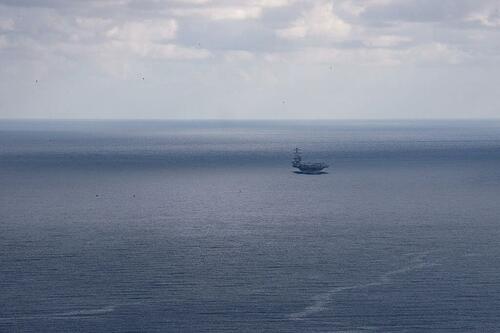
The $15 billion USS Ford was forced to cut short its deployment due to a 30-hour laundry fire that did millions of dollars in damage. And it has been revealed that even while it remained on station in the Gulf, Ford could not generate combat sorties for two days due to the raging 30-hour laundry fire that drove some 600 sailors out of their sleeping quarters. Thirty hours to get a laundry fire under control raises a couple of questions. Why would a laundry catch on fire, and why did it take the firefighters and damage-control personnel of the USS Ford so long to put out the laundry fire? Sadly, the answers can be found in some wrongheaded decisions the Navy made in its effort to be viewed as being “green.”
Design for the Ford-class carrier began in March 1996, and finally, more than $15 billion later, the USS Ford was fully certified for combat in April 2023. Due to a misguided green initiative, instead of installing inherently super energy-efficient steam-based laundries, the Ford-class carriers have standardized on more expensive, more complex, inherently fire-prone, ozone-based systems.
The green reason for these systems is that they supposedly save energy and water by being able to operate with cold water only, while also needing 30 percent less water than the steam-based systems the U.S. Navy has historically relied on. A Jan. 12, 2012, Navy memo made this revealing statement:
“Ozone technology is increasing the earth-friendly aspect of shipboard laundering and moving navy laundries towards a ‘greener’ process. Good for the sailor… good for the ship… good for the earth!”
This sure sounds wonderful, but just a bit of analysis shows that the ozone-based laundries, like so many of the U.S. military’s so-called green initiatives, actually weaken our military while costing more than the mechanically robust, battle-tested systems they replace.
First, it must be pointed out that when you look at the energy budget of a typical warship, including propulsion, less than 1 percent of the warship’s total energy budget is expended on freshwater production and laundry services, with the vast majority of energy being used for the ship’s propulsion and the rest of the systems described by the Expanded Ship Work Breakdown Structure for Navy ships.
What’s more, the annual cost for producing fresh water on our entire fleet of Navy ships is just $22 million, and the water for the laundry is a fraction of this. Further, every Navy ship can produce far more fresh water than it needs for its average daily use. For example, both Ford- and Nimitz-class carriers can produce double the average amount of water needed daily. Getting more specific, installing an ozone-based laundry on an Arleigh Burke destroyer, which uses gas turbines instead of steam turbines, does result in a 30 percent reduction in energy used by its laundry system, including the energy savings from reduced freshwater desalination. But with laundries consuming less than 1 percent of ships’ overall energy consumption (including propulsion), this would result in less than 0.3 percent energy savings. All other things equal, that might make sense, especially if the systems were built into the ship from the outset. But the ozone-based systems cost more, require more ongoing maintenance, are more dependent on expensive shore-based vendor support to keep them operational, and are built around a potent oxidizer—ozone.
Finally, the ozone-related laundries end up creating a much drier environment than the moist atmosphere created by steam-reliant systems. It was the drier environment that helped create the extremely dry lint that caused the Ford laundry room fire. And these high-tech laundries require very expensive, corrosion-resistant piping, fittings, and seals, along with 24/7 monitoring to ensure the highly corrosive, lung-irritating, fire-accelerating ozone does not find its way past the specialized, very expensive seals. So, even for ships that rely on gas turbines or marine diesels, such as our Navy’s destroyers and some of our larger warships, the case for ozone-based systems is highly debatable, to say the least.
But when it comes to ships like our carriers, submarines, and about 10 other large warships and support vessels whose prime movers are steam turbines, the ozone-based systems are a big, expensive step backward in pretty much every area, including the environment. This is the case because our ships’ high-pressure steam turbines naturally produce relatively low-pressure waste steam that can either be recondensed by using cold ocean water or used to heat water for a ship’s laundry and provide heat for the ship’s clothes dryers. In other words, this is nearly free energy. In contrast, the ozone-based laundry is 100 percent reliant on electricity from the ship’s generators. Thus, steam-reliant laundries are much more energy efficient or “green” than ozone-reliant ones. And while the gray water discharge from ozone-based systems is technically superior to that from steam-reliant systems, the sun and natural mechanisms in the ocean rapidly remediate all gray water discharges. Hence, from a practical environmental perspective, the gray water discharges are identical.
Sadly, not only does it seem as if the Navy wants to make ozone-based systems standard, but it has spent countless millions ripping out robust fire-resistant steam-based laundry systems on Nimitz-class carriers in order to install the expensive, high-tech, less reliable, more vendor-dependent ozone-based systems.
And there are still Nimitz-class carriers scheduled to undergo the “upgrade,” for which it would not at all be surprising to find costs of more than $10 million each to rip out the highly integrated steam-reliant laundries and replace them with ozone-reliant laundries.
Hopefully, the USS Ford fire will get the Navy, and maybe even Congress, to put a stop to the needless and arguably harmful green tech that provides no practical environmental benefits.
Hopefully, the U.S. military, under pressure from the Trump administration, will permanently move away from green virtue signaling and get back to investing in systems that provide the best possible lethality for the dollar, while maximizing the chances that our sailors, soldiers, airmen, and Marines return home safely.
Tyler Durden
Mon, 04/13/2026 – 14:20
https://www.zerohedge.com/political/navys-green-laundry-initiative-weakened-15-billion-carrier
Oil Tanker Going To China Forced To Reverse Course Before Crossing Hormuz Under US Blockade
Oil Tanker Going To China Forced To Reverse Course Before Crossing Hormuz Under US Blockade
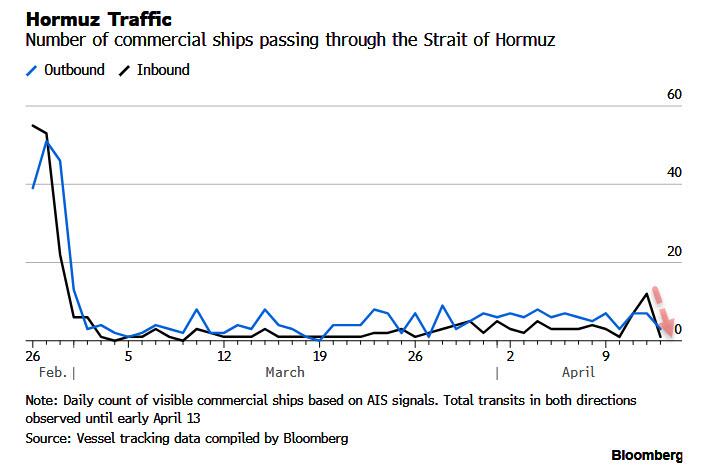
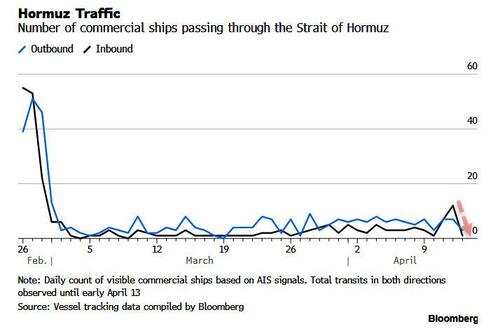
One day after a burst of traffic through the Strait of Hormuz, when according to Bloomberg 19 ships crossed in either direction while Trump said that as many as 34 ships crossed the waterway on Sunday, shipping through Hormuz slumped back down again Monday, reversing Sunday’s jump, as caution mounted ahead of a US naval blockade.
After 19 ships went through the Strait in either direction on Sunday – the most since the early stages of the war – the momentum reversed by Monday morning. Only four were observed passing on Monday: a single liquefied petroleum gas carrier was sighted entering the Gulf, and three small fuel tankers were raced to exit just hours before the blockade took effect at 10 a.m. New York time.
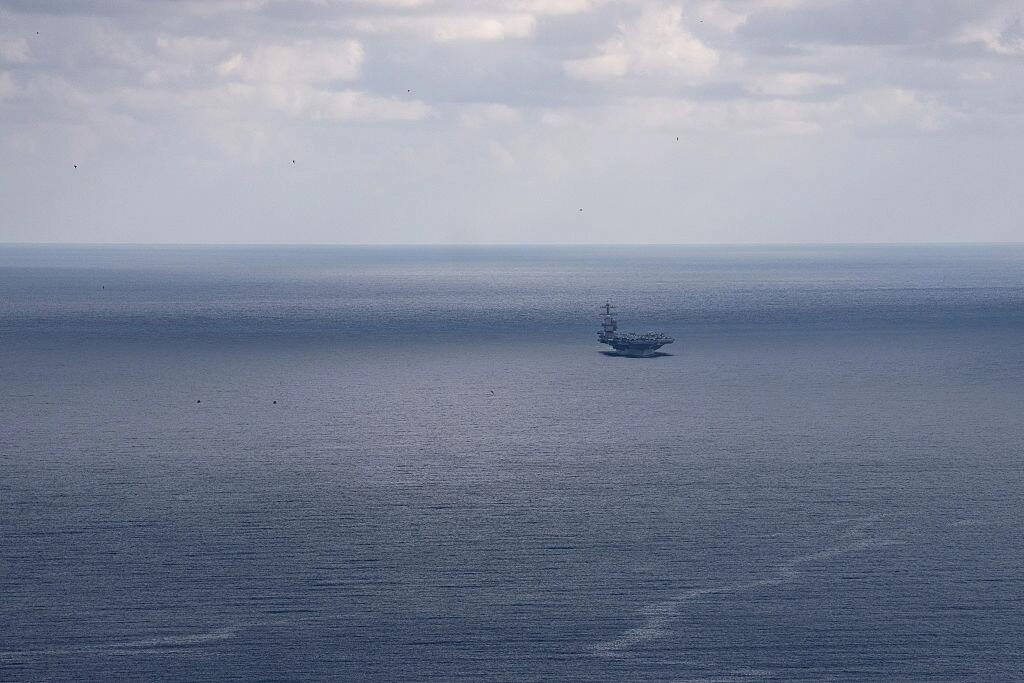
Earlier in the day, the WSJ reported that the US has deployed more than 15 ships – including an aircraft carrier, multiple guided-missile destroyers, an amphibious assault ship and several other warships in the Middle East – in place to support the blockade. These ships have the ability to launch helicopters that support boarding operations, and some are capable of marshalling commercial vessels to specific areas to hold them in place.
The warships would likely operate outside the Strait of Hormuz to avoid threats fired by Iran, according to retired Navy Vice Adm. Kevin Donegan. “There are lots of ways you can construct this, and there are a lot of boarding forces in the region now,” Donegan said. “Don’t expect it all to be started at once, this will build. Blockades take time to have an impact.”
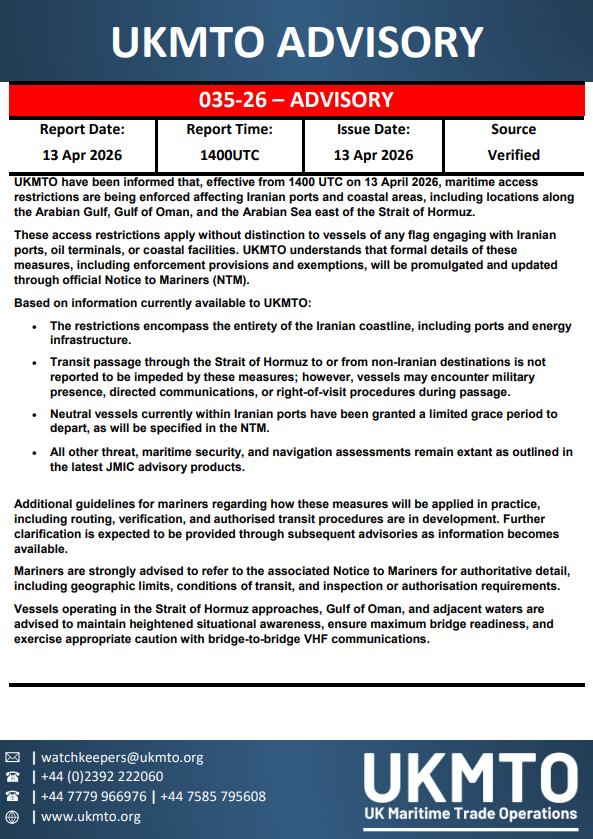
The UK Maritime Trade Operations also confirmed that the U.S. Navy is actively conducting enforcement operations as part of its blockade on Iranian ports and coastal areas.
Meanwhile, Marine Traffic reported that at least two tankers reversed course near the Strait of Hormuz shortly after the start of the US blockade, highlighting the immediate impact on vessel movements. They flag the 188-metre tanker Rich Starry, which turned back within minutes of approaching the chokepoint. The vessel had departed Sharjah Anchorage on 13 April and was sailing laden, with a reported draught of 11.3 metres, while signalling China as its destination. A second tanker, the 175-metre tanker Ostria, also reversed course after approaching the Strait.
Two tankers turn away from Strait of Hormuz after US blockade begins
At least two tankers reversed course near the Strait of Hormuz shortly after the start of the US blockade, highlighting the immediate impact on vessel movements. According to #MarineTraffic data, the 188-metre… pic.twitter.com/dRNi7yEgJI
— MarineTraffic (@MarineTraffic) April 13, 2026
The tanker U-turns follows unconfirmed reports that China has warned the US not to block/intercept Chinese ships/tankers, or face consequences that could potentially include military provocations.
China’s Defense Minister Dong Jun reportedly sent a message to the Trump administration and the U.S. Navy emphasizing Beijing’s intent to continue operating in the Strait of Hormuz and uphold its agreements with Iran. “Our ships are moving in and out of the waters of the Strait of Hormuz. We have trade and energy agreements with Iran. We will respect and honor those agreements and expect others not to interfere in our affairs” adding that “Iran controls the Strait of Hormuz and it is open for us.”
As of 2pm ET, this threat remains unconfirmed by official medial.
According to Bloomberg, the US blockade may prompt more ships to cut their tracking signals to avoid detection in high-risk shipping lanes, making it even harder to get an accurate picture of what’s going through. Sunday’s outbound movements included three containerships and three bulkers primarily tied to Tehran, as well as a China-linked fuel tanker, according to vessel-tracking data compiled by Bloomberg.
On Monday, departures so far included a US-sanctioned oil products tanker and a fuel tanker involved in recent Iranian loading operations. A small LPG carrier also left the Iranian island corridor Monday morning, following an inbound transit on Sunday and an overnight stop.
Meanwhile, two sanctioned supertankers loaded with Iranian crude have anchored off Indian ports, marking what could be the first such cargoes to arrive in the country in nearly seven years.
It’s unclear how the US blockade will affect waivers and existing purchases. It is also unclear if the US will extend or undo the waiver it granted for Iran oil sanctions, now that strategy has reversed to contain Iranian oil.
Tyler Durden
Mon, 04/13/2026 – 14:00