Category: News

ISIS Calls On Muslims To Murder UK’s Tommy Robinson
ISIS Calls On Muslims To Murder UK’s Tommy Robinson
Authored by Robert Spencer via PJMedia.com,
English freedom fighter Tommy Robinson on Friday posted on X an article from the Middle East Media Research Institute (MEMRI), detailing how the Islamic State (ISIS) wants him dead, and is calling upon Muslims to make sure he ends up that way quickly. And so it was just another day in the storied career of the celebrated religion of peace.
The Islamic State Pakistan Province (ISPP) issued the call in the inaugural issue of its glossy, slickly produced magazine, which is called, appropriately enough, Invade. The call to murder Tommy Robinson was, according to MEMRI, the beginning of a “major series called ‘Terrorize Them!’ – arguing that all non-Muslim nations can be terrorized by a single mujahid and gives the example of a ‘lone mujahid from Jerusalem who silently slaughtered a couple in their apartment.’”
Islamic State Pakistan Province (ISPP) Magazine Calls For Killing Anti-Islam British Activist Tommy Robinson ‘Unconditionally,’ Features Poster Listing Traits Of A Lone Wolf
On February 9, 2026, the Islamic State Pakistan Province (ISPP) published the first issue of its… pic.twitter.com/R8gR66VW8Z
— Tommy Robinson 🇬🇧 (@TRobinsonNewEra) April 10, 2026
Terrorize them? There those “extremists” go again, misunderstanding Islam, right? Well, not exactly. The Qur’an commands Muslims to “strike terror in the enemies of Allah and your enemies” (8:60), and even depicts Allah boasting about how he terrorized the unbelievers: “When your Lord inspired the angels, I am with you. So make those who believe stand firm. I will cast terror into the hearts of those who disbelieve. Then strike the necks and strike their fingertips.” (8:12)
If Allah is behaving that way, why shouldn’t his dutiful slaves?
The magazine includes a poster of Tommy Robinson, featuring a statement of the fourteenth-century Islamic theologian Ibn Taymiyya, whose writings remain popular and influential among many Muslims today. Ibn Taymiyya pronounces definitively that those who insult Muhammad should be killed: “The Quran, the Prophetic tradition, the unanimous consensus of the Prophet’s Companions, the generation that followed them, and the leading scholars of Islam all establish that: Whoever reviles or insults the Prophet Muhammad (Peace be upon him) has committed disbelief, and such a person is to be executed unconditionally, whether they claim to be Muslim or are a non-Muslim, and whether they later repent or do not repent.” The bold part here is bold on the poster.
Alongside the Ibn Taymiyya quote is an unflattering photo of Tommy Robinson, along with images of what appear to be X posts from Tommy, calling Muhammad a “nonce.” Not being all that familiar with the King’s English, as opposed to that of the good old U.S. of A., I had to look that word up, and found that it refers to “a stupid or despised person,” or alternatively, “a convicted or alleged sex offender, particularly those involved with children.” Islamic tradition holds that Muhammad had sexual relations with a nine-year-old girl, so that last one would apply, but ISIS was still insulted.
Counterterror “experts” inside and outside our intelligence and law enforcement agencies will dismiss this as more “extremism,” and assume that the vast majority of Muslims in the U.S. reject and abhor this point of view. Yet we know there are Muslims in the West who would be happy to kill Tommy Robinson; just as Hadi Matar was happy to try to murder Salman Rushdie, also for insulting Muhammad.
Yet not a single mosque in the U.S. teaches against the idea that someone should be killed for insulting Muhammad. Why don’t they? Because it isn’t an “extremist” idea; it’s mainstream Islam.
It’s not just Ibn Taymiyya; Islamic tradition tells these stories, among others:
A critic of the prophet of Islam, Ka’b bin Al-Ashraf, had mocked Muhammad in verse. Muhammad asked his followers: “Who is willing to kill Ka’b bin Al-Ashraf who has hurt Allah and His Apostle?” One of the Muslims, Muhammad bin Maslama answered, “O Allah’s Apostle! Would you like that I kill him?” When Muhammad said that he would, Muhammad bin Maslama said, “Then allow me to say a (false) thing (i.e. to deceive Kab).” Muhammad responded: “You may say it.” Muhammad bin Maslama duly lied to Ka’b, luring him into his trap, and murdered him. (Sahih Bukhari, volume 5, book 59, number 369)
Abu Afak, a centenarian poet who had mocked Muhammad, was killed in his sleep, in response to Muhammad’s question, “Who will avenge me on this scoundrel?” Similarly, Muhammad on another occasion cried out, “Will no one rid me of this daughter of Marwan?,” that is, Asma bint Marwan, yet another poet who ridiculed the prophet of Islam. One of his followers, Umayr ibn Adi, went to her house that night, where he found her sleeping next to her children. The youngest, a nursing babe, was in her arms. But that didn’t stop Umayr from murdering her and the baby as well. Muhammad commended him: “You have done a great service to Allah and His Messenger, Umayr!” (Ibn Ishaq, 674-676)
Yet Islamic apologists in the West routinely lie about all this and claim that Muhammad reacted with grace and tolerance in the face of impossible provocations, and the leftist establishment media does its part by smearing as an “Islamophobe” anyone who dares to point out the relevant facts.
Meanwhile, those who supposedly misunderstand Islam are baying for the blood of Tommy Robinson. Will anyone with any authority lift a finger to protect him?
Views expressed in this article are opinions of the author and do not necessarily reflect the views of ZeroHedge.
Tyler Durden
Mon, 04/13/2026 – 05:00
https://www.zerohedge.com/geopolitical/isis-calls-muslims-murder-uks-tommy-robinson

UK Bans Pretend “Stepsister” Porn Months After Actual Muslim Incest Protections
UK Bans Pretend “Stepsister” Porn Months After Actual Muslim Incest Protections
Authored by Steve Watson via modernity.news,
The British government has banned “step” porn, where the porn stars pretend to be related in a scripted format. Meanwhile, a bill earlier this year to ban first cousin marriage was rejected.
The crackdown targets consenting adults role-playing taboo family scenarios, including step-family tropes.
Offenders face prison time, and platforms must block UK access or face Ofcom fines. It’s sold as “protecting children” and aligning online rules with offline laws.
Ban on step incest porn and ‘barely legal’ content in government climbdownhttps://t.co/FrwZcknX8v
— Sky News (@SkyNews) April 10, 2026
Yet the same government draws a firm line at stopping the real thing when it involves actual blood relatives.
🚨 UK GOVERNMENT IS OFFICIALLY INSANE
The UK has just banned people from watching porn that features “step-family” members.
Yet the same government still refuses to ban actual cousin-on-cousin incest.
Let that sink in.
They’re more concerned about fictional step-relatives on… pic.twitter.com/uzDk4REppS
— British Intel (@TheBritishIntel) April 11, 2026
First-cousin marriage remains fully legal in the UK. A Tory MP’s bill to prohibit it was blocked. Successive governments, including the current one, have opted for “education” and genetic counselling instead of legislation.
An NHS report last year even highlighted supposed “benefits” of first-cousin marriage – stronger family networks and economic stability – before being quietly pulled after public backlash.
UK health agency cites ‘benefits’ of first-cousin marriage in bizarre report, unsurprisingly sparks outrage https://t.co/NrYLqX4BxE pic.twitter.com/r3zpJ7nW8N
— New York Post (@nypost) October 1, 2025
Critics have repeatedly pointed out that such unions are far more common in certain Muslim communities, particularly among British Pakistani groups where rates have historically hit 40-55 percent in places like Bradford.
Many argue that’s precisely why Westminster refuses to touch the issue with a bargepole – cultural sensitivity trumps public health data showing doubled risks of serious birth defects, genetic disorders, and long-term strain on the NHS.
🇬🇧 “They did a study in Bradford, UK where there’s a high propensity of Cousin marriage and they found – that first Cousin babies had doubled the chance of a recessive gene disorder”
“Higher infant mortality rates, kidney and liver problems, developmental disorders”
“Many… pic.twitter.com/adIz5lVY4l
— Concerned Citizen (@BGatesIsaPyscho) January 16, 2026
Meanwhile, the porn ban isn’t happening in a vacuum. It’s the latest incremental step in a broader push that funnels users through age-verification gateways. Those systems don’t stop at blocking “step” content or barely-legal role-play. They lay the groundwork for something far more permanent.
As we previously detailed, Apple is already forcing iPhone users in the U.K. to prove age with ID or lose unrestricted internet access:
Similar pressures are mounting on phones and devices across the board:
The UK government’s plans for newborn digital IDs show the endgame: cradle-to-grave tracking dressed up as child protection:
This is classic nanny-state sleight of hand. Ban the pretend taboo to justify scanning everyone’s ID at the digital door, while the real taboo that carries measurable human costs gets waved through for political reasons.
Fictional step-siblings on a screen? Criminal. Actual cousin marriages producing children with elevated health risks? Carry on, just don’t film it.
The message to the public is unmistakable: your private fantasies are the state’s business, but protecting future generations from documented genetic harm is not – especially if it risks offending key voting blocs.
Britain’s ruling class has its priorities exactly backwards. While they lecture the public on online harms and roll out surveillance-by-stealth, they leave untouched practices that clash with basic Western norms of family and child welfare.
Freedom isn’t protected by banning role-play; it’s eroded when governments pick and choose which realities to ignore for the sake of political convenience.
Your support is crucial in helping us defeat mass censorship. Please consider donating via Locals or check out our unique merch. Follow us on X @ModernityNews.
Tyler Durden
Mon, 04/13/2026 – 03:30

$92 Million In Banned AI Chips Went From Super Micro To Little Known Chinese Tech Company
$92 Million In Banned AI Chips Went From Super Micro To Little Known Chinese Tech Company
A little-known Chinese tech company saw its stock drop sharply after U.S. authorities charged a co-founder of Super Micro Computer with illegally smuggling advanced AI chips into China, according to Bloomberg.
The case is putting fresh focus on how restricted American technology may still be entering the country.
The company, Sharetronic Data Technology, quickly denied any connection to Super Micro and said it complies with all hardware purchasing regulations. However, newly surfaced records tell a more complicated story.
Those records suggest that Sharetronic procured hundreds of Super Micro systems containing high-end chips from Nvidia Corp.—technology that has been banned from being sold to or used within China without approval from Washington since 2022.
The documents point to shipments of servers equipped with Nvidia’s H100 and H200 processors, widely used for training and running advanced AI systems. Some of these systems were reportedly transferred between company entities, raising further questions about how they were obtained.
Bloomberg writes that although the overall scale is small compared to major tech giants, the situation highlights strong demand in China for restricted AI hardware. Companies like Sharetronic often rely on these systems to rent computing power to clients, making access especially valuable.
The case also underscores the difficulty of tracking where sensitive technology ends up. Both Nvidia and Super Micro have said they do not knowingly supply restricted products without proper authorization, yet the records suggest such equipment may still circulate.
As the U.S. continues tightening export controls, this situation highlights gaps in enforcement and leaves open bigger questions about whether current measures are enough to fully limit the global flow of advanced AI chips.
Back in March, Federal prosecutors charged a co-founder of Super Micro Computer Inc. and two associates with participating in a scheme to divert roughly $2.5 billion in advanced Nvidia chips to China. The charges marked a notable escalation in Washington’s effort to police the flow of high-end artificial-intelligence hardware, shifting focus from overseas resellers to individuals with direct ties to U.S. technology firms.
Now defunct short seller Hindenburg Research had identified the executive by name in a report they published earlier the year before.
$SMCI board member Wally Liaw and others were indicted today on allegations of export control violations, as we had alleged in detail in our August 2024 @HindenburgRes report.
Indictment link: https://t.co/dNIlfTpYJw
Hindenburg report link: https://t.co/jDDWeblHT2 pic.twitter.com/fqt3P628Ls
— Nate Anderson (@NateHindenburg) March 20, 2026
Tyler Durden
Mon, 04/13/2026 – 02:45

France’s Gig-Economy Built On Migrant Labor As 99% Of Surveyed Delivery-Riders Are Foreign-Born, Two-Thirds Are Illegal
France’s Gig-Economy Built On Migrant Labor As 99% Of Surveyed Delivery-Riders Are Foreign-Born, Two-Thirds Are Illegal
Authored by Thomas Brooke via Remix News,
A major new study has found that France’s food delivery sector is almost exclusively staffed by migrant workers, a majority of whom are living in France illegally.
The Enquête report, based on a survey of more than 1,000 riders in Paris and Bordeaux, reveals that 98.7 percent of delivery couriers were born outside France, with nearly two-thirds lacking legal residency status, highlighting the extent to which the platform economy depends on a highly vulnerable migrant labor force.
The workforce is dominated by recent arrivals from Africa, the majority of whom are not undertaking any other education or training in France.
A total of 55.2 percent of riders come from West Africa, making it by far the largest group. A further 17.4 percent are from North Africa, while 4.6 percent come from other African countries, meaning that over 77 percent of all riders are African-born. By comparison, 16.6 percent are from Asia, 4 percent from the Middle East, and fewer than 2 percent from France.
Most riders are new or relatively new arrivals. Some 98 percent of those surveyed had arrived in France after 2014, while 47.2 percent had arrived in the last five years.
🚴 « Ubérisation » et immigration clandestine
La quasi-totalité des livreurs de repas pour des plateformes numériques sont des immigrés récents.
➡️ Deux tiers des livreurs sont en situation irrégulière.
Les faits à retenir d’une étude inédite 🧶 pic.twitter.com/0U9r3VoC56
— Observatoire de l’immigration et de la démographie (@ObservatoireID) April 2, 2026
The vast majority do not have the right to work in France and are living there illegally — 64.4 percent of riders have no residence permit, meaning they are undocumented. Among the remainder, 12.4 percent hold a residence permit of at least one year, 9.7 percent have a permit of less than one year, and 13.3 percent have a 10-year residency card.
Many operate using accounts rented from third parties to circumvent work requirements, creating an additional layer of economic dependency.
The findings suggest that this structure helps explain the extreme working patterns documented in the report. Riders work an average of 63 hours per week, with most working six or seven days, often year-round. Despite this, average gross earnings were just €1,480 per month, with hourly pay equivalent to €5.83 before expenses.
Tyler Durden
Mon, 04/13/2026 – 02:00
Washington, D.C. Will Feel Like June Next Week. Cue MSM Climate Doom Propaganda
Washington, D.C. Will Feel Like June Next Week. Cue MSM Climate Doom Propaganda
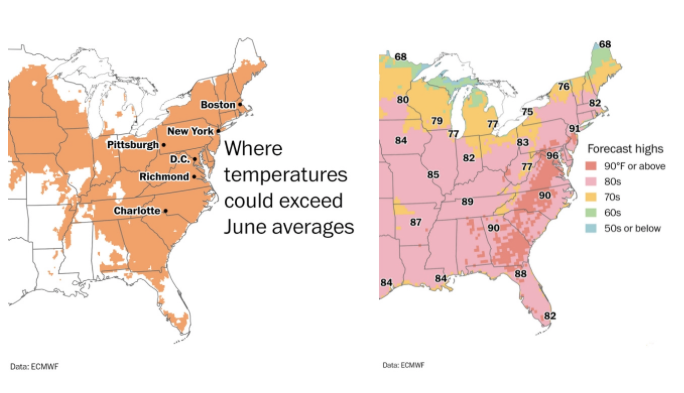
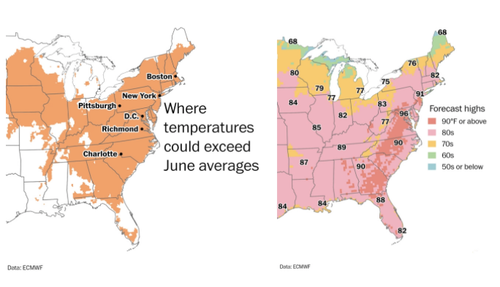
After a stretch of roller-coaster temperature swings across the Mid-Atlantic in March and early April, the midpoint of the month is now shaping up to be unusually warm, with highs that could exceed the region’s average for June. That kind of temperature anomaly could prompt left-wing corporate media outlets to kick off their seasonal global-warming doom news cycle as summer approaches.
“Temperatures will soar well into the 80s just a week later, and on Thursday, it will be near 90 degrees. That’s more like June or July,” meteorologist Ben Noll wrote in a weather note titled “Hello…summer?” while referring to the U.S. East Coast.
Noll continued, “That’s the type of variability that spring is known for, but a 70-degree temperature swing is more like whiplash. It will feel like summer up and down the East Coast this week as a big ridge of high-pressure flexes its muscles and sends sultry air northward.”
However, he noted, “It won’t last. Much cooler air from Canada will sweep in late next weekend or to start the week of April 20.”
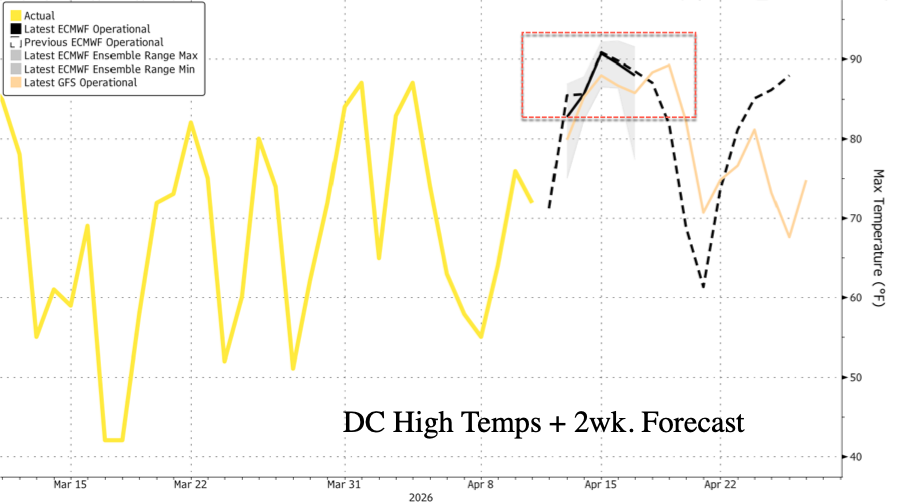
The latest data from Bloomberg shows highs in the Washington, DC area will trend near the 90s this week into Saturday, but expect a sharp drop in high temperatures late next weekend.
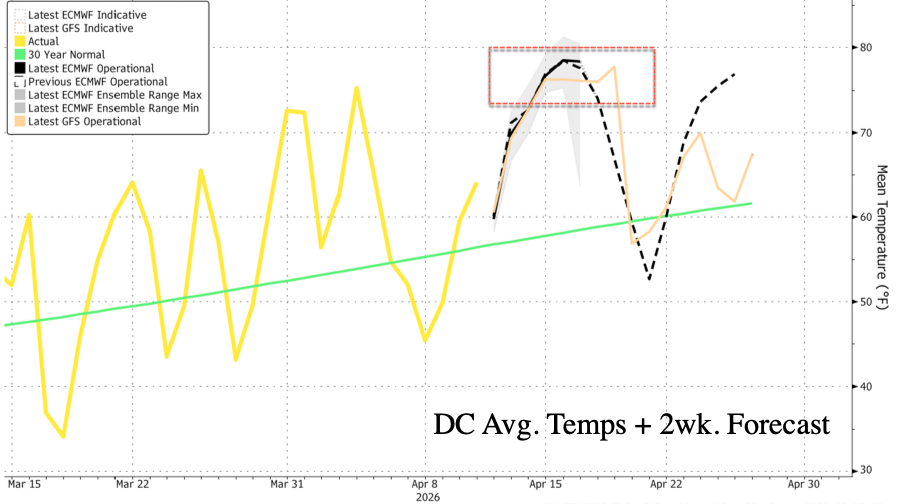
Average temperatures across the Capital Beltway will hover near 80F this coming week, well above the 30-year norm of around 57°F.
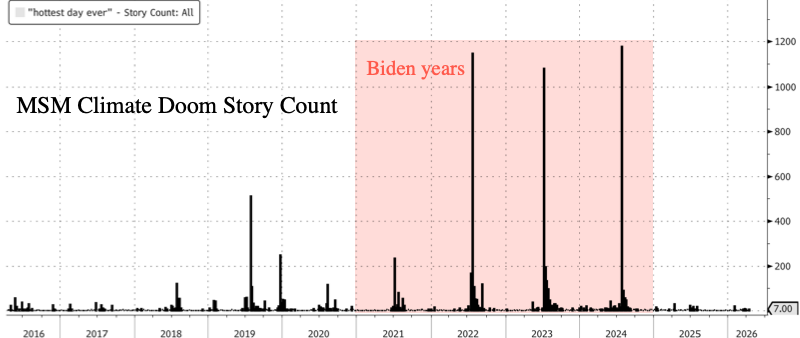
Like clockwork, the left-wing corporate media propaganda machine during the Biden-Harris regime years used global-warming headlines to mislead the public about an imaginary climate crisis so that green policies could get passed and climate NGOs could get funded – all to loot US taxpayers.
With President Trump back in power, left-wing MSM outlets dialed back the climate-fear propaganda in 2025.
The big question now is whether MSM will reactivate their climate crisis megaphone as the week’s unusual warmth spreads across the U.S. East.
There’s a war on your mind.
Related:
Meteorologists Warn About Super El Nino Event
Don’t count on Greta to comment on climate; she’s moved on to all things Palestine (probably because there is more activist money there).
Tyler Durden
Sun, 04/12/2026 – 23:15
Half Of US Data Centers Scheduled To Start In 2026, Will Be Canceled Or Delayed
Half Of US Data Centers Scheduled To Start In 2026, Will Be Canceled Or Delayed
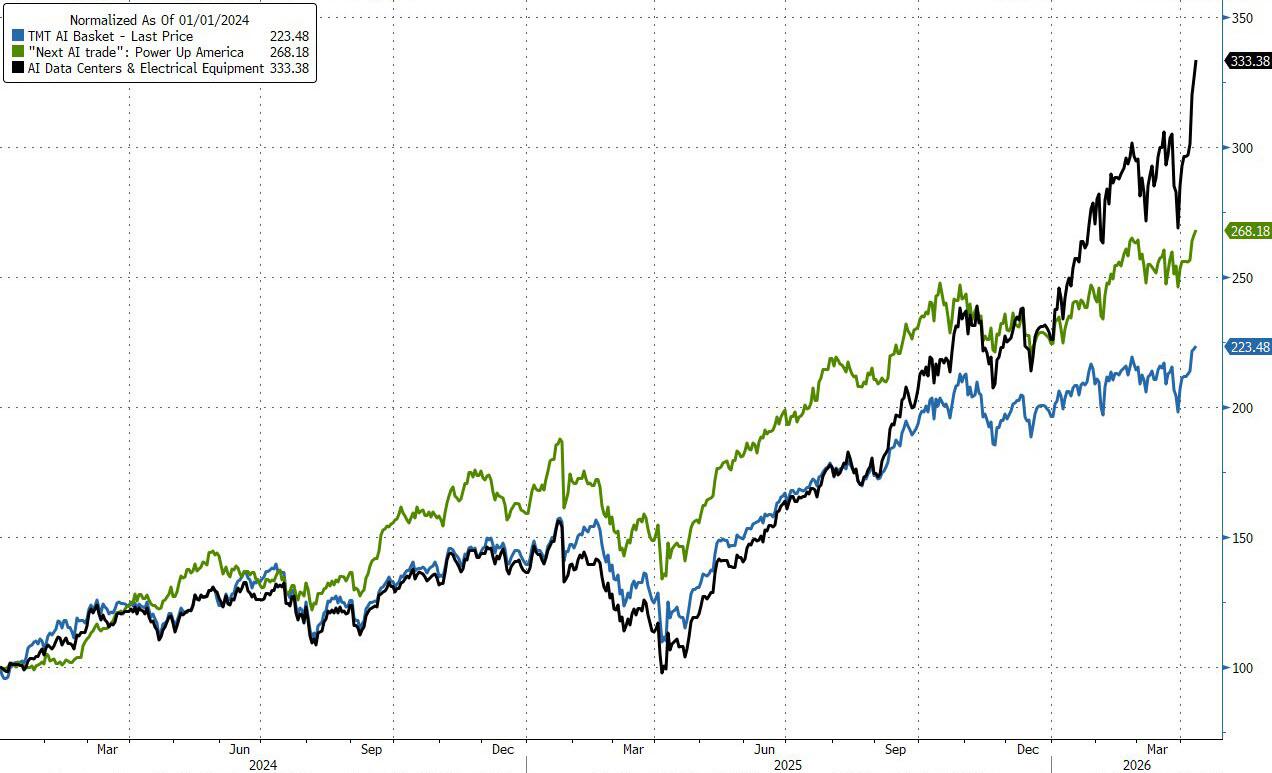
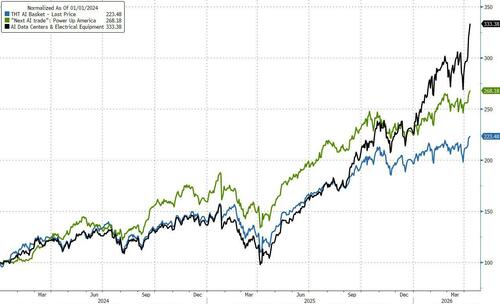
Just over two years ago, we first penned our views on “The Next AI Trade“, which looked beyond the hyperscalers and the data centers supporting the AI revolution, and instead focused on the energy and logistical needs that would be so very critical in allowing the US to dominate China in the existential race to first reach Artificial General Intelligence (which many have dubbed the next nuclear arms race due to its profound civilizational implications). It was here that we defined the “Power Up America” basket as the next AI trade.
Yet as one can see in the chart below, after outperforming the AI Data center and the TMT AI baskets in 2024 and much of 2025, the Power Up America trade has lagged and clearly underperformed, as some investors have started to express doubt that the US would ever be able to “grow” into its massive AI computing needs… with dire consequences for record AI capex budgets, something the market has yet to grasp.
And unfortunately, with every passing day, the outlook for the US AI revolution looks increasingly more dim.
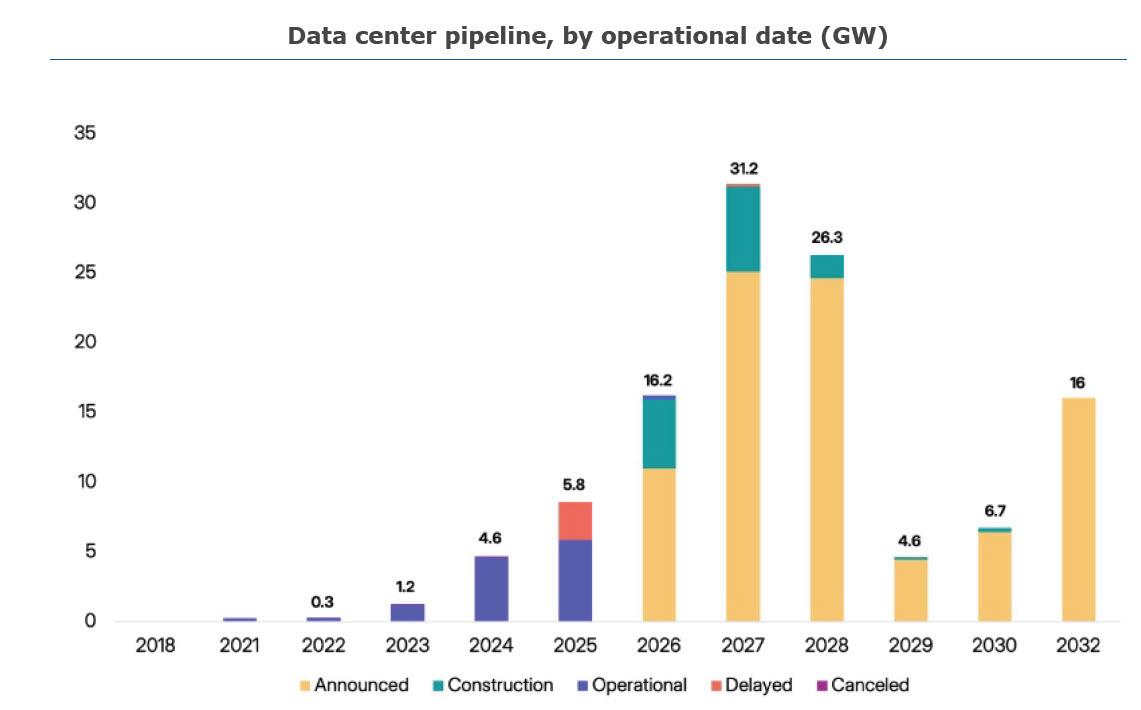
That’s because, as Canaccord Genuity analyst George Gianarikas writes, “the American data center boom is hitting a formidable wall of logistical friction.” He is referring to the latest outlook by Sightline Climate, which is also reinforced by recent articles from Bloomberg and others, and reveals a sobering reality for 2026: nearly half of the nation’s planned 16-gigawatt capacity faces cancellation or delay, with only 5 gigawatts currently under construction.
This inertia stems from a volatile mix of local permitting hurdles, community resistance, and a desperate reliance on overextended global supply chains for critical components like transformers and helium.
That’s right: half.
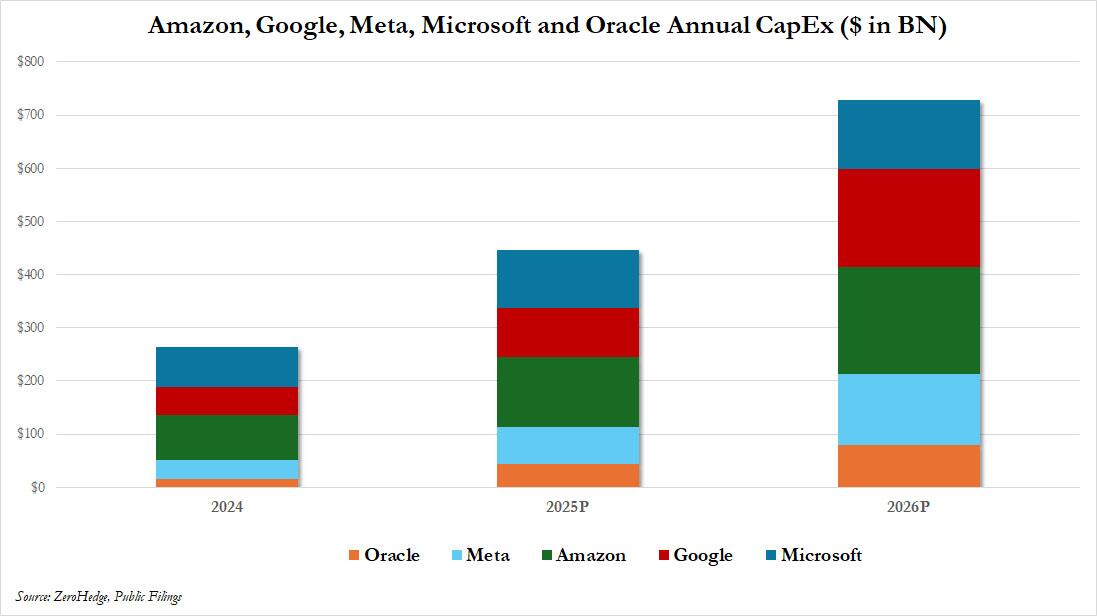
That’s right: despite $700BN+ of expected 2026 hyperscaler capex, nearly half of the data centers scheduled to begin operations in the US
in 2026 “will either face delays or outright cancellations.” The data, which comes from Sightline Climate’s 2026 Data Center Outlook, suggests that just 30% – 50% of the ~16 GW of planned US capacity for the year will face risks, with only ~5 GW currently under construction!
And the horizon only grows darker in the coming years. By 2027, the gap between ambition and reality widens further, as a mere fraction of the announced 21.5 gigawatts has actually broken ground. Worse, according to Futurism, data centers slated to open in 2027 are progressing far more slowly than anticipated. “Only about 6.3 gigawatts worth of computing infrastructure are actually under construction, compared to 21.5 announced gigawatts.”
And then visibility drops to virtually nothing beyond 2028 as uncertainty increases materially in the outer years. According to the article, “things get even dodgier in the coming years, with the vast majority of data centers planned for launch between 2028 and 2032 having yet to even break ground. There are a further 37 gigawatts of planned infrastructure which haven’t even received a firm completion date, only 4.5 [gigawatts] of which have actually begun work.”
This trend suggests an increasingly uncertain future for the industry, where power constraints and grid instability cast long shadows over projects slated through 2032.
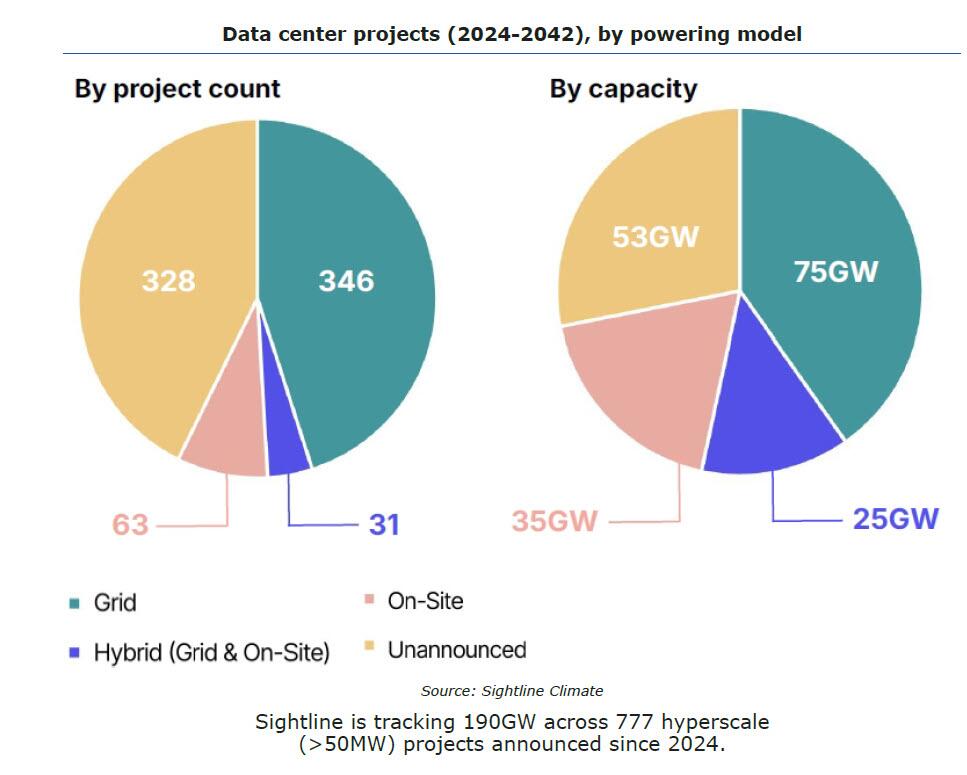
But while one can pretend the future is irrelevant, the same limitations are visible in the here and now: according to the SightLine report, “at least 16GW of data center capacity is slated to come online this year across 140 projects. 53% will be grid connected, 3% will be powered solely by on-site power, and 25% have not disclosed their powering strategies. We expect 30-50% of these projects to be delayed. Only 5GW is currently in construction.”
And the punchline:
“We expect 30-50% of 2026 projects to be delayed, driven by power constraints (25% of projects have not disclosed powering strategies), increasingly effective community opposition, and potential grid equipment shortages. 11GW of 2026 capacity remains in the announced stage with no signs of construction, despite typical build times of 12 to 18 months. Itʼs still possible for this capacity to come online, but it would need to dramatically accelerate.”
Which brings us to the question we raised more than two years ago: how will the US modernize its ancient power grid and build out the huge energy supply needed to power up the AI revolution. Here, too, it appears there has been little progress:
“On-site and hybrid power punch above their weight when measured by capacity. Grid-connected projects still lead at 40% of total capacity, but on-site generation and hybrid approaches together account for close to half of announced capacity, far exceeding their share by project count. A small number of gigascale, grid independent campuses account for this capacity, including New Era Energy & Digitalʼs 7GW project in Lea County, Homer Cityʼs 4.5 GW coal-to-gas redevelopment in Pennsylvania, and Crusoeʼs 1.8GW natural gas and renewables project in Cheyenne, Wyoming. These projects are large enough to require their own generation plant, and have the capital to fund it. Waiting for the grid to supply this level of capacity could take a decade.”
The problem, as Canaccord warns, is that “without a radical acceleration in domestic manufacturing and grid integration, the digital expansion of the late 2020s risks stalling into a series of unfulfilled promises.”
Others agree: in a note published over the weekend by Goldman Executive Direct Shreeti Kapa, she wrote that at a recent dinner with investors, the overwhelming consensus was that “there is simply not enough compute and every player is acutely compute constrained – bottlenecks from fabs to permitting for data-centers to power to memory to labor are real and are here to stay for some time to come. I wasn’t sure what to make of it – if its consensus is it peak, or is the imagination for scale of AI demand is so great among a very small sub-segment of investors & technologists here in the valley and the rest of the word is yet to catch-up?”
While imaginations may indeed by running wild, the hard limitations in the real world are indeed starting to catch up: we recently highlighted OpenAI’s decision to pause its UK Stargate project – a partnership with Nvidia and Nscale to deploy up to 31k GPUs – citing the UK’s prohibitive energy costs and regulatory hurdles. The project was to be based across several sites including Cobalt Park and a dedicated “AI Growth Zone”, enabling OpenAI’s models to provide local compute for critical public services and highly regulated industries including finance and national security.
UK energy prices represent a key bottleneck to AI infrastructure development. According to the report, UK’s industrial prices “are among the highest in the world” and have been a key gating factor delaying companies from building AI infrastructure. According to a spokesperson from OpenAI, “we continue to explore Stargate U.K. and will move forward when the right conditions such as regulation and the cost of energy enable long-term infrastructure investment.”
OpenAI and Nscale maintain plans to develop the project in the future. According to the OpenAI spokesperson, “We see huge potential for the U.K.’s AI future… London is home to our largest international research hub, and we support the Government’s ambition to be an AI leader. In the meantime, we are investing in talent and expanding our local presence, while also delivering on the commitments under our MOU with the government to adopt frontier AI in UK public services.”
Bloomberg also chimed in earlier this month, writing that “as the global AI race heats up, there is a huge rush to build data centers fast. There’s no lack of money chasing these projects, with tech giants Alphabet Inc., Amazon.com, Meta Platforms Inc. and Microsoft Corp. committed to spending more than $650 billion this year alone. Yet neither ambition nor capital is enough to materialize all the necessary components.”
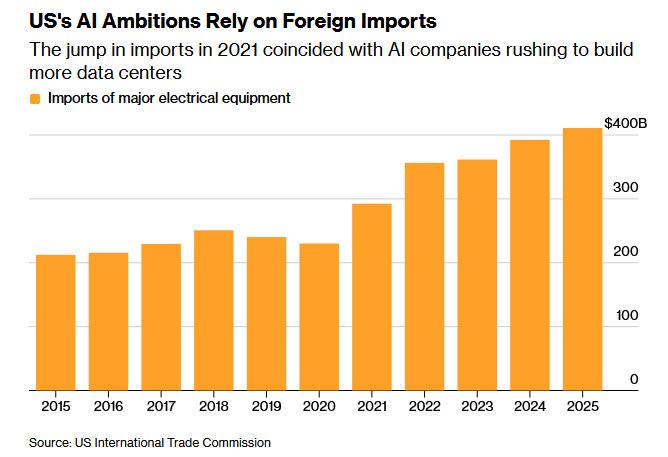
Here Bloomberg again quotes the Sightline data, noting that “almost half of the US data centers planned for this year are expected to be delayed or canceled” and as one big reason for the delay Bloomberg cites the shortage of electrical equipment, such as transformers, switchgear and batteries: “They are needed not just for powering AI, but also for building out the grid that is seeing increased consumption from electric cars and heat pumps. US manufacturing capacity for these devices cannot keep up with demand, and the scarcity has caused data center builders to rely on imports.”
At its core, the problem is the lack of domestic manufacturing which makes sense for a country that has outsourced much of its industrial base to China in the past century, and despite loud promises of reshoring, there are few tangible results.
Indeed, while over the past 10 years, the US government has tried a series of policies to reshore manufacturing, they haven’t yet yielded a significant boost to domestic capacity, forcing businesses to look to China regardless of the tariffs or the alleged national security risk. As a result, the US now finds itself in an absurd Catch 22: the US needs crucial parts from China to dominate it in the AI race, while China needs advanced chips from American companies to stay in the race.
The biggest bottlenecks, understandably, have been observed in the power space – the same space we aggressively pitched two years ago as enabling the AI revolution, hoping that whoever was in charge of the US would take America’s chronic energy deficiency seriously. It appears we may have been overly optimistic. One thing is clear: data centers have rapidly grown in size and now consume more electricity than their predecessors a decade ago. That demands bigger transformers, which safely pull electricity from the high-voltage grid to feed to tiny computer chips. Without the right transformers, there’s no way to make the data center work.
Before 2020, these high-power transformers typically arrived 24 to 30 months after an order was placed. Those timelines were “totally manageable in the old world” when data centers didn’t need such large transformers or at such short timelines, says Philippe Piron, chief executive officer of GE Vernova’s electrification division. But AI companies “want something typically in less than 18 months.”
The spike in demand from data centers and grid expansion have pushed up prices and extended delivery times to as much as five years. That is why some, like Crusoe, have even resorted to refurbishing old transformers from shuttered power plants as a stopgap measure.
Meanwhile, a far greater looming problem is where will the US source the dozens of Gigawatts needed to power up the AI revolution. So far Trump’s promises of a nuclear renaissance have remained just that, with virtually no new nuclear power plants breaking ground, while the push for small modular reactors – a ray of hope in an otherwise dreary landscape – is still years away from practical results, let alone scale.
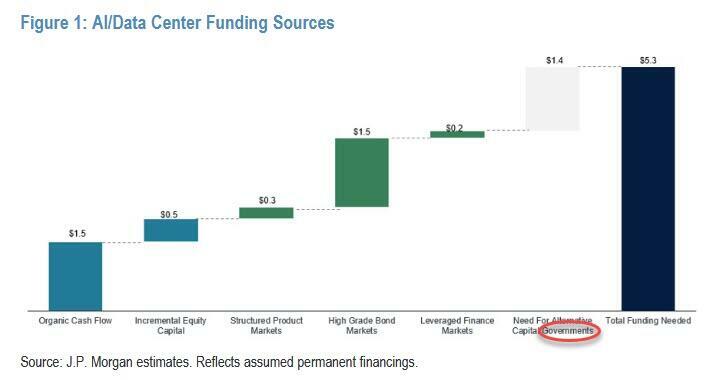
Oh, and there is the question of who pays for all this: by now everyone knows about the hundreds of billions in capex the hyperscalers will spend over the next few years.
What fewer people know is that this money won’t be enough. According to an analysis by JPMorgan, it will take no less than $5 trillion to fund the AI cycle, and even with the massive capex – and debt outlays – the US government will still be on the hook for over a trillion to close the funding gap.
It’s not just power: as Canaccord writes, beyond the power-related technicalities “lies a fraught sociopolitical reality”.
Consider the following: The Maine House of Representatives approved a moratorium on large-scale data centers until 2027. This pause allows a newly formed coordination council to weigh innovation against environmental and resource stewardship. The House passed the bill 82-62, advancing it to the Senate. The goal of the bill, according to state representatives, is not to fight innovation, but as a pause for planning to improve stewardship of the state’s resources and limit financial and environmental impacts on the state’s citizens. In addition to the moratorium, “the bill also creates the Maine Data Center Coordination Council, and instructs the council to provide strategic input, facilitate planning considerations and evaluate policy tools to address data center opportunities.”
Simultaneously, OpenAI faces mounting scrutiny as Florida’s Attorney General launched an investigation into the company following the release of safety-critical chat logs. And then there was last week’s firebomb attack on Sam Altman’s home: while the police are still investigating, and there are many reasons why someone may want to express their “displeasure” with the man behind ChatGPT, the reality is that, as we warned last August, “between exploding electricity bills and lack of jobs for grads, a new luddite revolution is coming – they will be burning down data centers within a year.”
between exploding electricity bills and lack of jobs for grads, a new luddite revolution is coming – they will be burning down data centers within a year
— zerohedge (@zerohedge) August 25, 2025
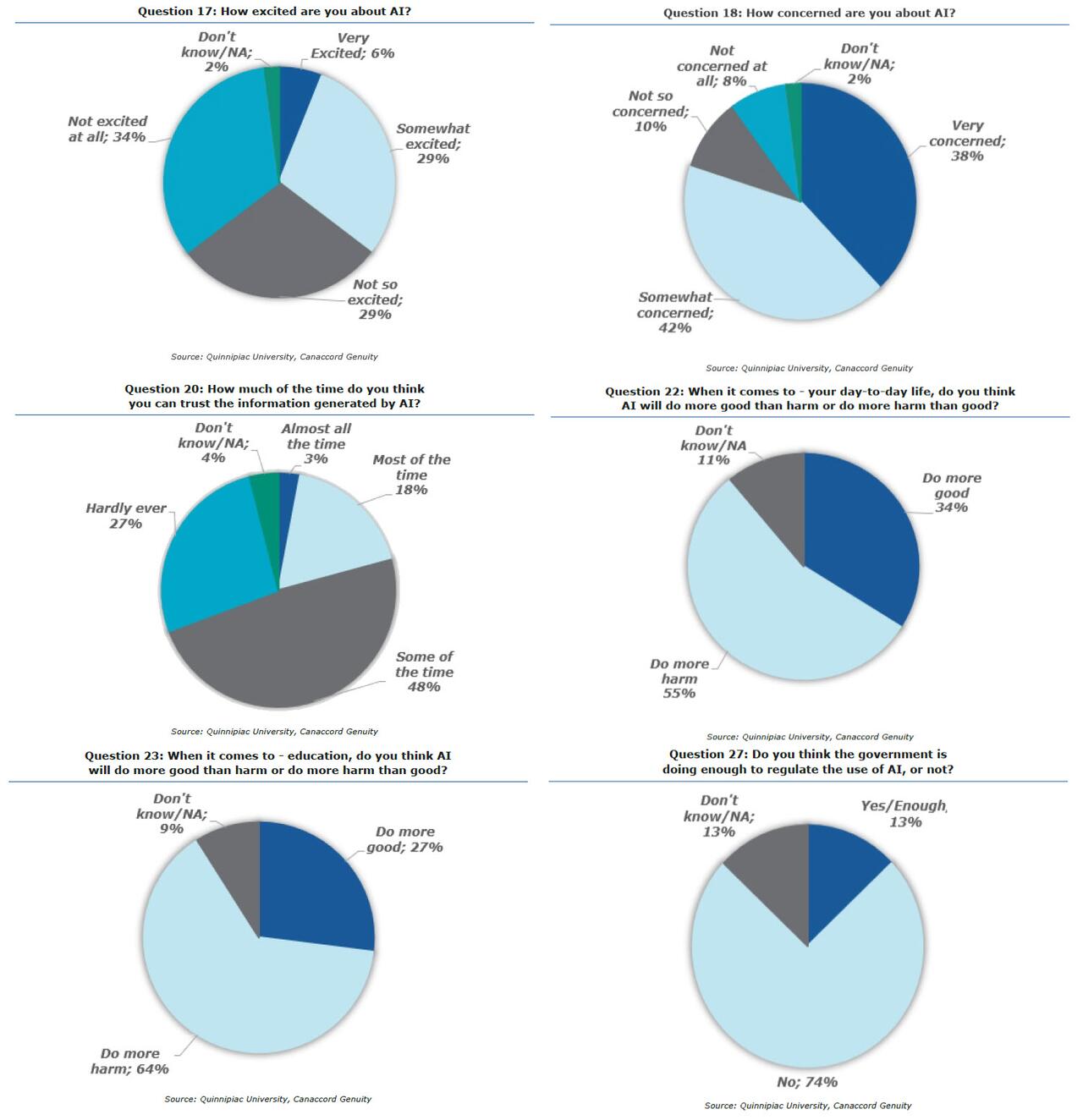
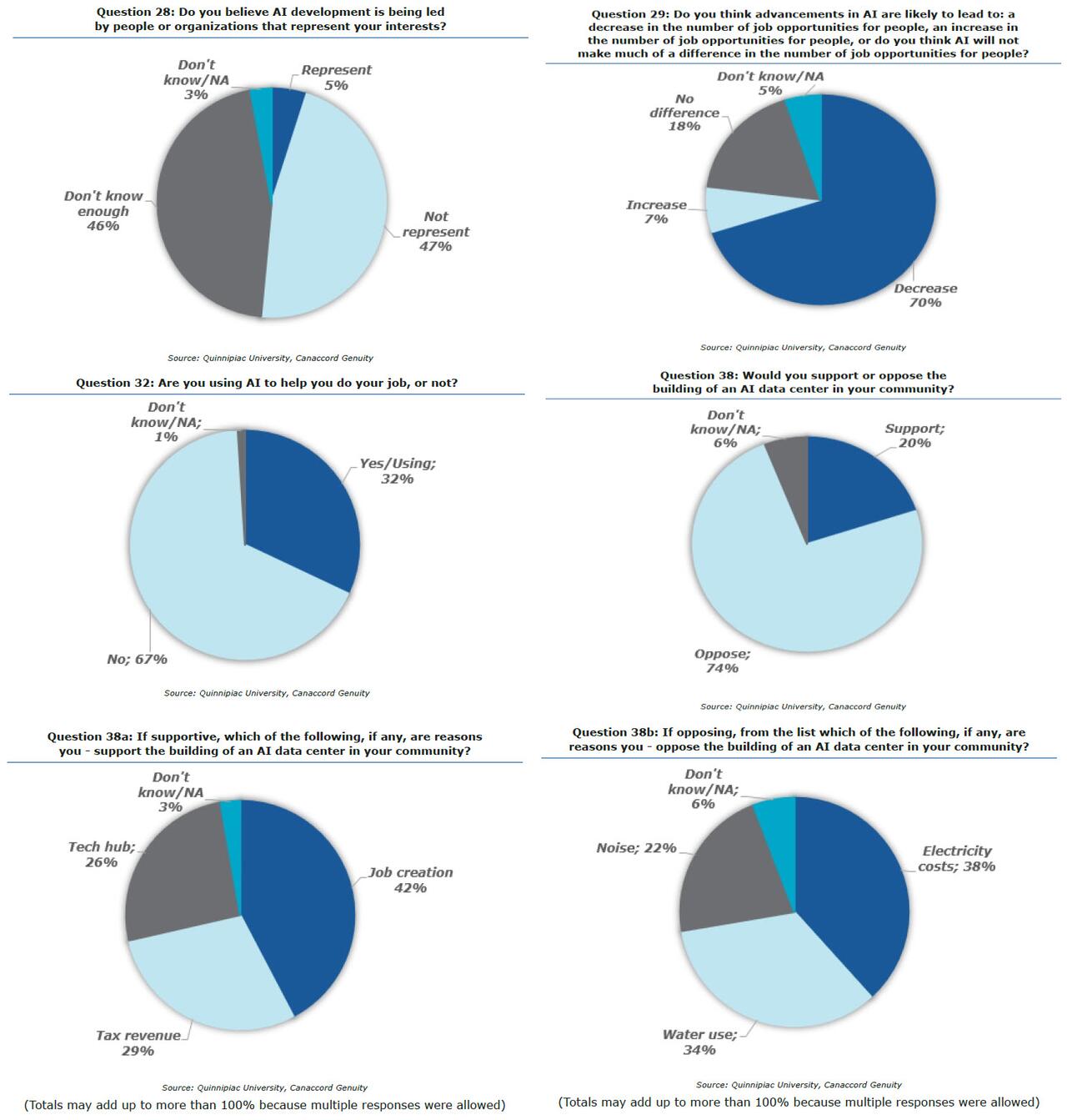
Sure enough, these institutional shifts arrive as a recent Quinnipiac University poll – which looked at AI use and its impacts on daily life, education and healthcare – confirmed the public is growing increasingly wary of AI’s deepening integration into healthcare, education, and daily life. Here are some of the findings showing just how rapidly public sentiment has turned against AI:
The bottom line is that the time for talk has long passed, and yet for all the posturing, the US government continues to act as if a victory against China in the AI race is a given. It is anything but, especially with America’s own society rapidly turning against the next industrial revolution.
As Canaccord concludes, “Not only are the energy constraints mounting, but so are the sociopolitical ones. Something’s got to give.“
Tyler Durden
Sun, 04/12/2026 – 22:38
https://www.zerohedge.com/technology/half-us-data-centers-are-set-be-canceled-or-delayed-2026

Pelosi’s Monster: The Creation And Destruction Of Eric Swalwell
Pelosi’s Monster: The Creation And Destruction Of Eric Swalwell
Authored by Jonathan Turley via jonathanturley.org,
In Mary Shelley’s famous work, Dr. Frankenstein is asked, “Accursed creator! Why did you form a monster so hideous that even you turned from me in disgust?”
This week, Rep. Eric Swalwell (D. Calif.), the leading Democratic candidate for California governor, may wish he could ask that of former Speaker Rep. Nancy Pelosi (D., Calif.). After sexual assault allegations were raised by former staff members, Pelosi, Sen. Adam Schiff (D., Calif.), and even his close friend (and former campaign chair) Sen. Ruben Gallego (D., Ariz.) have withdrawn their endorsements.
The fact, however, is that (regardless of the merits of these latest allegations), Swalwell was always a notorious figure in Washington who was constructed by Pelosi and others to serve their interests.
As Pelosi and his other allies now seek to destroy him, they cannot escape their hand in his creation.
Multiple women came forward this week to allege sexual assault and other potentially criminal acts by Swalwell. The first allegations came from a former staffer who said that she was raped twice by Swalwell, who had sex with her when she was too drunk to consent. Swalwell is denying the allegations.
Four women spoke to the Chronicle; one former staffer alleged that she tried to fight off Swalwell who left her bruised and bleeding after a rape. Even CNN, which eagerly featured Swalwell on programs as he attacked the Trump Administration, ran detailed accounts of another alleged assault in a hotel room. One of these accounts is from February of this year.
The accounts, if true, suggest that Swalwell is not just a sexual harasser but a sexual predator operating in plain view. One woman, Ally Sammarco, alleged that she (like other women) received nude photos of Swalwell as well as inappropriate social media messages.
Swalwell’s scandal is about as surprising in Washington as the return of the cicadas.
Swalwell was infamously accused of having an affair with an alleged Chinese spy named Fang Fang. His patron in Congress, then-Speaker Nancy Pelosi, immediately moved to protect him, declaring, “I don’t have any concern about Mr. Swalwell.”
Pelosi even blocked efforts to remove him from the House Intelligence Committee despite obvious concerns that he was susceptible to blackmail over his sexual trysts. She lashed out at those calling for his removal in the interests of national security, declaring “I do think that it is unfortunate that Mr. McCarthy is trying to make an issue of this.”
After sexual assault allegations were raised by former staff members, Pelosi, Sen. Adam Schiff and even his close friend (and former campaign chair) Sen. Ruben Gallego have withdrawn their endorsements.
What these women are describing is a politician who felt that he had a license to prey on female staffers. I wonder who gave him that impression?
For years, the Democratic establishment and the media ignored any rumors surrounding Swalwell because he was their useful monster, someone who was an attack dog always straining at the leash.
Swalwell was always the first to a mob. Indeed, he now hopes that voters will not apply the same standard he applied to figures like Justice Brett Kavanaugh. In his confirmation hearing, Kavanaugh faced an allegation of attempted rape from high school, and Swalwell had little patience for those of us arguing for a modicum of due process.
Swalwell said that Kavanaugh’s guilt was self-evident: “More and more cases that are separate and independent, that look the same, pretty soon a prosecutor starts to say to a jury … that the arrows are pointing in the same direction.”
On the Epstein matter, Swalwell demanded full disclosure and called legal concerns “bulls****” in a screaming match with FBI Director Kash Patel.
Recently, Swalwell took a different view on the release of his own FBI files from the Chinese spy scandal. In a cease and desist letter to prevent public disclosure, attorneys Norm Eisen and Sean Hecker warned Patel, “Your actions threaten to expose you, others at the FBI, and the FBI itself to significant legal liability.”
It is now a pile-on as Swalwell’s former enablers run for cover: even Gallego, who posed with Swalwell bare-chested on camels in Qatar. Notably, no one seemed concerned that the trade group US-Qatar Business Council spent more than $84,000 to fly Swalwell, Gallego, and their loved ones to Qatar for the luxurious trip.
The most obvious beneficiary of the scandal, Katie Porter, has denied any involvement with the woman who organized the disclosures against Swalwell. The irony is that Swalwell’s scandal will remove a candidate who has allegedly physically assaulted staffers in favor of a candidate who has verbally assaulted staffers.
The implosion of Eric Swalwell is raising questions about how so many close associates and friends could not have known about the rumors of his misconduct. Now, suddenly, Swalwell has no friends or allies after years of being praised by Pelosi and many in the media.
Mary Shelley made the point most vividly in Frankenstein that there is little difference between the creators and the monsters in such moments: “It is true, we shall be monsters, cut off from all the world; but on that account we shall be more attached to one another.”
Jonathan Turley is a law professor and the best-selling author of “Rage and the Republic: The Unfinished Story of the American Revolution.”
Tyler Durden
Sun, 04/12/2026 – 22:10
https://www.zerohedge.com/political/pelosis-monster-creation-and-destruction-eric-swalwell
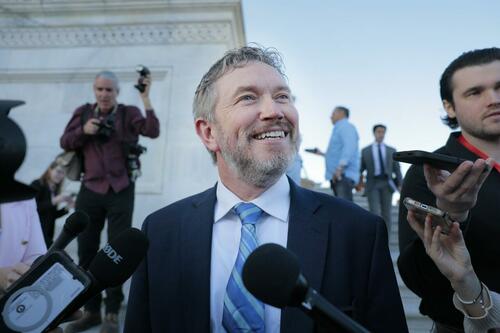
Massie For Governor? GOP’s Libertarian Firebrand Talks Political Future
Massie For Governor? GOP’s Libertarian Firebrand Talks Political Future
On Friday the Ron Paul Institute (RPI) has highlighted an important and fresh interview touching on the Republican Rep’s political future: Governor Thomas Massie? – RPI’s Adam Dick asks.
“A run for governor may be in the future for Rep. Thomas Massie (R-KY), but only if he first wins his May 19 Republican primary contest — the next step in his race for reelection to the United States House of Representatives,” the RPI report says.
But, “If Massie loses next month, the seven-term representative says he expects he will call it quits on working in government, stating he would consider the loss as “a sign from God or the people or both that I should go back to the farm.”
President Trump has on more than once occasion personally called out the Libertarian firebrand for vocally opposing the White House on various key issues, and especially most recently on the Iran war.
Massie has been one of the very view GOP members to join Dems in trying to force a Congressional vote to impose limits on Trump’s military actions in Iran. As a reminder:
Reps. Thomas Massie (R-Ky.) and Ro Khanna (D-Calif.) brought a war powers resolution on Iran to the House floor less than a week after Trump joined Israeli leaders in launching massive strikes against Iran in late February. It failed by a vote of 212-219, with four Democrats bucking their party to oppose it: Reps. Greg Landsman (Ohio), Jared Golden (Maine), Henry Cuellar (Texas) and Juan Vargas (Calif.).
He remains one of the few outspoken ‘non-interventionist’ Republican members of the House. On the Senate side, Rand Paul, also of Kentucky, is Libertarian-leaning and condemns foreign adventurism and ‘wars of choice’.
As for a potential future run for Governor of Kentucky, Massie hinted at it here.
If U.S. Rep. Thomas Massie loses his upcoming primary against a Republican opponent backed by President Donald Trump, you’ll see a whole lot less of him.
“If I lose on May 19, I am not doing any more government ever,” he told University of Louisville students April 6 at an event on campus. “… It’s a sign from God or the people or both that I should go back to the farm.”
But if he wins, Frankfort could be on the mind of the longtime congressman from Northern Kentucky, who’s emerged during Trump’s second term as one of Congress’ most consequential members.
During a question-and-answer portion of his forum, hosted by the school’s College Republicans group, an attendee asked Massie if he would ever consider running for governor. Gov. Andy Beshear is ineligible to run for a third time as he eyes a presidential campaign, leaving the seat open at the end of 2027.
And then came this:
Massie wouldn’t run for a U.S. Senate seat — “it’s the same circus with different clowns, and also they don’t have a discharge petition, which is kind of a neat thing to do” — but he sees the appeal of the governor’s mansion.
“If I do win (the upcoming primary), I would consider it,” responded Massie, who would be up for reelection in 2028 if he wins the 2026 race. He pointed to an old friend he’d served with in Congress for three terms as an example.
“His name was Ron DeSantis,” Massie said. “What I’ve seen him achieve in Florida is inspiring and a lot of people want to move to that state, so I do believe that you could make a difference.”
Grant County GOP put on a great Lincoln Day Dinner last night.
It was great to be among so many friends, including State Representative @SavannahLMaddox, in such a beautiful venue. pic.twitter.com/cb9gmSO4JR
— Thomas Massie for Congress (@MassieforKY) April 11, 2026
Massie would have a real shot, given he remains quite popular in Kentucky – but he has an uphill battle in terms of reelection to Congress given Trump’s political machine has turned against him.
Tyler Durden
Sun, 04/12/2026 – 21:00

Treasury, IRS Propose Rules For 1 Percent Remittance Tax On Some Money Sent To Foreign Countries
Treasury, IRS Propose Rules For 1 Percent Remittance Tax On Some Money Sent To Foreign Countries
Authored by Naveen Athrappully via The Epoch Times (emphasis ours),
The Internal Revenue Service and the Department of the Treasury proposed regulations on Friday regarding the new excise tax, established under the One Big Beautiful Bill Act, on certain remittances made abroad.
The Internal Revenue Service in Washington on March 10, 2025. Madalina Vasiliu/The Epoch Times
“Beginning Jan. 1, 2026, a 1 percent remittance transfer tax applies to remittances sent from the United States to recipients in foreign countries when the sender provides cash, a money order, a cashier’s check, or other similar physical instrument to the remittance transfer provider,” the IRS said in an April 10 statement.
“The sender is liable for the tax, and remittance transfer providers are required to collect the remittance transfer tax from certain senders, make semimonthly deposits, and file quarterly returns with the IRS. If the remittance transfer provider does not collect the tax from the sender, the tax becomes a liability of the remittance transfer provider.”
The proposed regulations clarify how the remittance transfer tax would be applied.
According to the notice of the proposed rule, the remittance tax is applicable to all eligible transfers irrespective of whether the amount is actually disbursed to the designated recipient.
In case a remittance transfer expires or is canceled and the remittance transfer provider refunds the amount to the sender, the sender can recoup the tax by filing a claim for refund with the IRS.
The tax does not apply to any remittance transfer in which the funds come from a credit or debit card issued in the United States. It is also inapplicable if the funds being sent are withdrawn from an account held in a financial institution.
Any amount that is ultimately transferred to a designated recipient will be taxed, the notice clarified.
The rules affect remittance transfer providers, such as credit unions, banks, and money services businesses, as well as their agents.
There are roughly 600 money services businesses licensed as money transmitters in the United States, out of which more than 200 operate through around 500,000 authorized agents, the IRS said, citing data from the Nationwide Multistate Licensing System.
Between 2019 and 2024, money transfers to domestic and foreign destinations via money services businesses increased from $1.3 to $4 trillion.
“Money transmitted to foreign destinations (remittance transfers) accounted for 9 to 25 percent of the total money transmissions, equaling $236 billion in 2019, growing to almost $1 trillion in 2021 and 2022, but decreasing to $365 billion in 2024,” the notice said.
“Over 2019–2024, annual remittance transfers to foreign destinations through [money service businesses] averaged $520 billion. The average individual money transfer size ranged from $290 to $740 over the same time period.”
The IRS said in its statement that remittance transfer providers must report the new remittance transfer tax via Form 720.
In an Oct. 7 statement, the IRS said that limited penalty relief will be available for remittance transfer providers who fail to deposit the collected remittance taxes in the first three quarters of this year.
“Treasury and the IRS understand there might be challenges implementing the new law and have determined it is in the interest of sound tax administration to provide limited penalty relief related to remittance transfer tax deposits,” the agency said.
Tax Impacts
In a July 1 report, the Center for Global Development said that even at 1 percent, the remittance tax would hit poor countries “hard.” The new tax not only raises costs by 1 percent but can also lead to a dip in remittances.
Mexico stands to lose the most due to the tax imposition, with the loss being more than $1.5 billion per year, the report said. Other nations majorly affected by the tax include India, China, Vietnam, Guatemala, the Dominican Republic, and El Salvador.
“Central American countries are projected to suffer the greatest loss relative to their gross national income (GNI), with El Salvador—a close ally of the Trump administration—projected to lose the equivalent of 0.6 percent of GNI,” the report said.
“Where the effects of the tax are significant relative to GNI, countries could experience lower household incomes, weaker consumer demand, and increased exchange rate pressures.”
The Federation for American Immigration Reform blamed remittances for causing the United States’ economy to lose at least $200 billion per year, according to a July 22 report.
This amount is more than enough to run the Department of Homeland Security and the State Department combined. It is also four times the amount spent on the Department of Justice.
“Remittances represent a substantial loss to the U.S. economy. The money that is sent out of the United States is money that is not spent on goods and services in the United States,” the report said.
“The loss of money remitted also means no benefits from the sales, excise, and restaurant taxes, etc. attached to those goods and services. Indeed, remittances carry a significant opportunity cost.”
Tyler Durden
Sun, 04/12/2026 – 19:50

All High Earners Need To Know About The Mega Backdoor Roth
All High Earners Need To Know About The Mega Backdoor Roth
Authored by Javier Simon via The Epoch Times (emphasis ours),
If done the right way, a mega backdoor Roth can allow investors to save in a workplace retirement plan such as a 401(k) beyond the typical contribution limits.
It also can allow investors to save in a Roth account when they otherwise would not have been able to do so because of certain restrictions.
So let’s take a closer look at this complex, but potentially beneficial strategy for high earners.
What Is a Mega Backdoor Roth?
The mega backdoor Roth is a strategy that involves making after-tax contributions to a 401(k) and then making a conversion of those contributions into either a Roth IRA or Roth 401(k).
Many people take the mega backdoor Roth approach because they can’t contribute to a Roth IRA due to income limits, or they’ve already maxed out their traditional 401(k) via salary deferrals and want to make additional contributions.
In 2026, you can’t contribute to a Roth IRA at all if your modified adjusted gross income (MAGI) is $168,000 as a single filer or $252,000 if married and filing jointly.
How Does a Mega Backdoor Roth Work?
If your plan administrator allows it, you can make after-tax contributions to your traditional 401(k) and then convert those contributions to a Roth IRA via an in-service distribution. Or, if the plan allows it, you can convert those after-tax contributions into a Roth 401(k) portion of the plan.
The key here is after-tax contributions.
After-tax 401(k) contributions are different from Roth 401(k) contributions and pretax contributions, which are associated with traditional 401(k)s.
But after-tax contributions may allow you to contribute to a workplace retirement plan like a 401(k) beyond the annual contribution limits for pretax and Roth contributions.
So let’s take a close look at these contribution limits for 2026.
You can contribute up to $24,500 in pretax and/or Roth contributions to your 401(k) if you’re under the age of 50.
Because of catch-up contributions, those aged 50 or older can contribute up to $32,500.
If your plan allows for super catch-up contributions, those between the ages of 60 and 63 can contribute up to $35,750.
But by factoring in after-tax contributions, those below age 50 may be able to save up to $72,000. Those between the ages of 50 to 59 or 64-plus can save up to $80,000. And those between the ages of 60 to 63 can save up to $83,250 if the plan allows super catch-up contributions.
But any employer contributions would count toward these limits.
Drawbacks to the Mega Backdoor Roth
Taking the mega backdoor Roth route can leave you with a hefty tax bill. This is because when you make qualified withdrawals in retirement, any investment earnings would be taxed as ordinary income.
And the earnings portion of the conversion into a Roth IRA would be subject to taxation at the time of the conversion.
In addition, your capacity to make after-tax contributions could be restricted by IRS nondiscrimination rules that affect highly compensated employees. These rules may limit how much highly compensated employees can contribute compared to non-highly compensated employees.
For 2026, you’re a highly-compensated employee if you made $160,000 or more in 2025 compensation, or if you owned more than 5 percent of the company at any time during the current or previous year.
And some plans don’t allow after-tax contributions to be eligible for employer matches.
And that brings us to one of the biggest downsides. Your plan administrator simply may not allow you to engage in the mega backdoor Roth strategy. Some employers won’t let you move money from the 401(k) and into a Roth IRA while you’re still employed by them. Or they may not allow you to transfer money from the after-tax portion of your plan into a Roth 401(k) part of the plan.
So you need to contact your plan administrator or human resources department to learn what their rules are.
The Bottom Line
Many high earners face some barriers when it comes to contributing to a Roth account. But this is when the mega backdoor Roth can come into play. This is a strategy involving making after-tax contributions to a traditional 401(k) and converting those contributions into a Roth IRA or a Roth 401(k) within the plan. But there are a few obstacles; not all companies let you take these steps within their 401(k) or other type of workplace retirement plan. There also may be some important tax implications, and the overall process could be highly complex. That’s why you need to be interested enough to brush up on your plan’s rules and take the backdoor route approach the right way. So it’s highly recommended you engage in this strategy with the guidance of a qualified tax professional.
The Epoch Times copyright © 2026. The views and opinions expressed are those of the authors. They are meant for general informational purposes only and should not be construed or interpreted as a recommendation or solicitation. The Epoch Times does not provide investment, tax, legal, financial planning, estate planning, or any other personal finance advice. The Epoch Times holds no liability for the accuracy or timeliness of the information provided.
Tyler Durden
Sun, 04/12/2026 – 18:40
https://www.zerohedge.com/personal-finance/all-high-earners-need-know-about-mega-backdoor-roth