Category: News
Congress Returns From Recess – Here’s What’s On Its To-Do List
Congress Returns From Recess – Here’s What’s On Its To-Do List
Authored by Joseph Lord via The Epoch Times,
Lawmakers will return to Capitol Hill this week with a long to-do list as the Department of Homeland Security (DHS) remains in a partial shutdown.
Ending that shutdown—which as of April 13 reached its 58th day—will be a top priority for lawmakers, even as they remain divided along party lines on how to move forward with the funding.
Lawmakers will also work on reauthorizing Section 702 of the Foreign Intelligence Surveillance Act (FISA), a controversial surveillance law that includes the collection of American citizens’ personal data which is set to expire on April 20.
They’ll also consider a budget request from the White House raising the Pentagon’s budget to $1.5 trillion—by far the largest military budget ever requested.
Here’s what to know.
DHS Funding
Congress’s No. 1 priority will be to find a way forward as DHS remains shut down—though at present, a compromise still seems distant as the two chambers remain at odds on how to move forward.
Democrats have demanded significant reforms to Immigration and Customs Enforcement (ICE) and parts of Customs and Border Patrol (CBP)—both subsidiaries of DHS—in exchange for supporting new funding for the department. They have tied these demands to the fatal shootings of Alex Pretti and Nicole Renée Good in Minneapolis during altercations with immigration enforcement agents.
Republicans have rejected parts of these demands, particularly a proposed prohibition on agents wearing masks while in the field, citing the need to protect officers from being doxed by activists.
Some House Republicans have also pushed for the passage of the Safeguarding American Voter Eligibility (SAVE) Act, a voting bill, as a condition of any reforms to ICE and CBP. However, Senate Democrats have consistently opposed the bill, which doesn’t seem to have a clear path forward in Congress.
Before leaving for the spring recess, the Senate passed a bill that would have fully funded DHS with the exception of ICE and CBP, whose immigration enforcement operations have already been funded through September 2029 by the One Big Beautiful Bill Act.
House Speaker Mike Johnson (R-La.) rejected this deal as a “joke.” Instead, the House passed a 60-day stopgap that would have fully funded DHS. That bill has been rejected by Senate Democrats for its lack of reforms.
Ahead of Congress’s recess, President Donald Trump signed an executive order granting full pay to agents of the Transportation Security Administration (TSA), whose increasing employee absences had led to record-breaking security queues at airports across the country.
FISA Section 702
Another top priority for lawmakers will be passing a reauthorization of Section 702 of FISA, a surveillance law that’s due to expire on April 20.
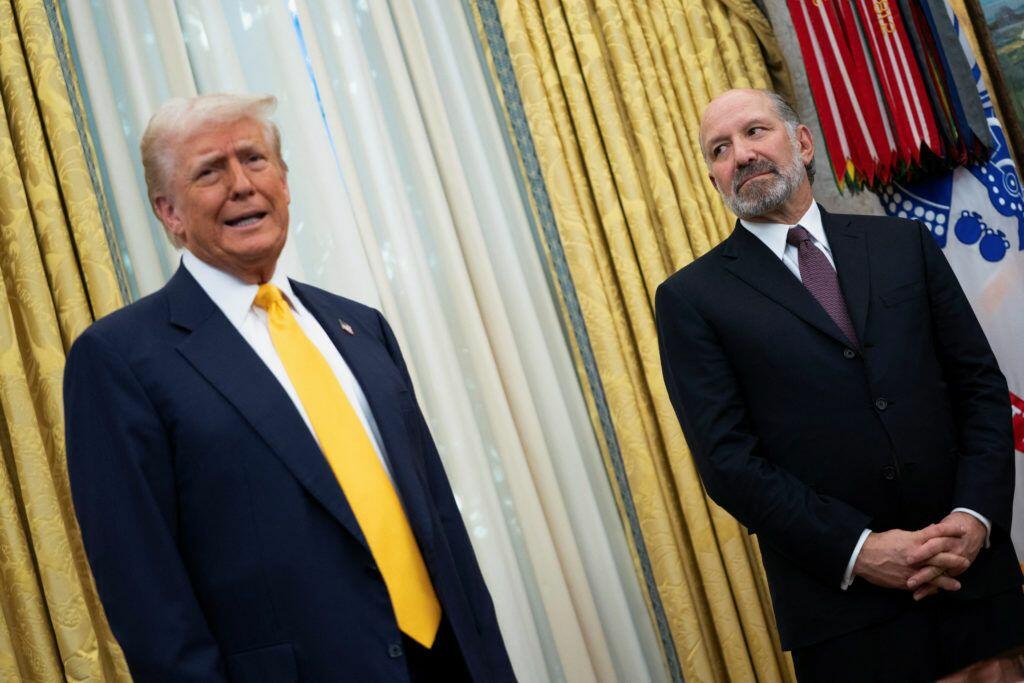
On March 25, Trump—a former critic of Section 702—requested that Congress pass a “clean” reauthorization of the law.
“I have called for a clean 18-month extension,” Trump wrote in a post on Truth Social.
Section 702 targets intelligence from foreign nationals thought to be outside the United States. Yet, it also enables intelligence agencies to gather “incidental” information from Americans who are in contact with targeted non-U.S. persons—all without a warrant.
Although intelligence officials must obtain a warrant to access Americans’ data directly, Section 702 has long caused bipartisan discomfort on Capitol Hill and beyond.
Previously, Congress had approved a two-year extension of the program with 56 major reforms designed primarily to prevent misuse of Americans’ data by agents with access to Section 702 data. It was signed into law by former President Joe Biden in April 2024.
Trump acknowledged his previous opposition to—and run-ins with—Section 702.
Nevertheless, Trump said, “When used properly, FISA is an effective tool to keep Americans safe.”
Trump’s $1.5 Billion Pentagon Budget Request
Another top issue for lawmakers this week will be Trump’s request for a $1.5 trillion military budget—the largest increase in military spending since World War 2.
In the April 3 budget proposal, the White House formally requested the historic Pentagon budget increase, though the amount had been floated by Trump for weeks.
The proposal suggests that this amount could be passed through a two-track process.
The bulk of the funding, $1.1 trillion, would be passed through the normal appropriations process. This amount could likely pass easily, as it’s aligned with the gradual increases seen over recent years.
The second track in the White House proposal would come through a $350 billion reconciliation package—allowing Republicans to bypass a filibuster from Senate Democrats entirely.
It would fund this in part, the proposal states, through a $73 billion reduction in non-defense spending,
White House Office of Management and the Budget Director Russ Vought is scheduled to testify before the House Budget Committee on April 15, and to testify before its Senate counterpart on April 16.
Iran War
While the U.S. and Iran are currently in a ceasefire, signs of its fragility are already becoming clear—meaning that the issue will be a key focus for lawmakers this week.
On Friday, peace talks between the United States and Iran in Islamabad, Pakistan, fell apart after Iran refused U.S. demands to dismantle its nuclear program. The United States demanded as well that Iran turn over its supply of enriched uranium.
After the peace talks failed, Trump stated that, beginning at 10 a.m. ET on Monday, the U.S. will set up a blockade in the Strait of Hormuz, as U.S. ships have already begun sweeping the area for Iranian mines.
Meanwhile, Democrats—with the support of some Republicans—have vowed to take action under the War Powers Resolution of 1973, which curbs a president’s power to wage war without explicit congressional approval.
Before the break, a bid by House Minority Leader Hakeem Jeffries (D-N.Y.) to take action under the War Powers Resolution via unanimous consent was blocked by Republicans. However, Jeffries has vowed to force another vote on the issue this week.
Senate Minority Leader Chuck Schumer (D-N.Y.) has also stated that Senate Democrats will attempt to force a vote on the matter this week.
“Congress must reassert its authority” over war-making powers, Schumer said at a news conference on April 8.
Sen. Rand Paul (R-Ky.) and Rep. Thomas Massie (R-Ky.) have consistently backed action under the War Powers Resolution related to the Iran conflict, citing Congress’s constitutional role in declaring wars.
Meanwhile, a contingent of Republican lawmakers in both chambers—including Sen. John Curtis (R-Utah)—have stated that they will throw their support behind such a measure if hostilities continue after the statutory 60-day window laid out in the War Powers Resolution.
Tyler Durden
Mon, 04/13/2026 – 09:35
https://www.zerohedge.com/markets/congress-returns-recess-heres-whats-its-do-list
Goldman Stock Slides After FICC Unexpectedly Misses Despite Highest Overall Profit In 5 Years
Goldman Stock Slides After FICC Unexpectedly Misses Despite Highest Overall Profit In 5 Years
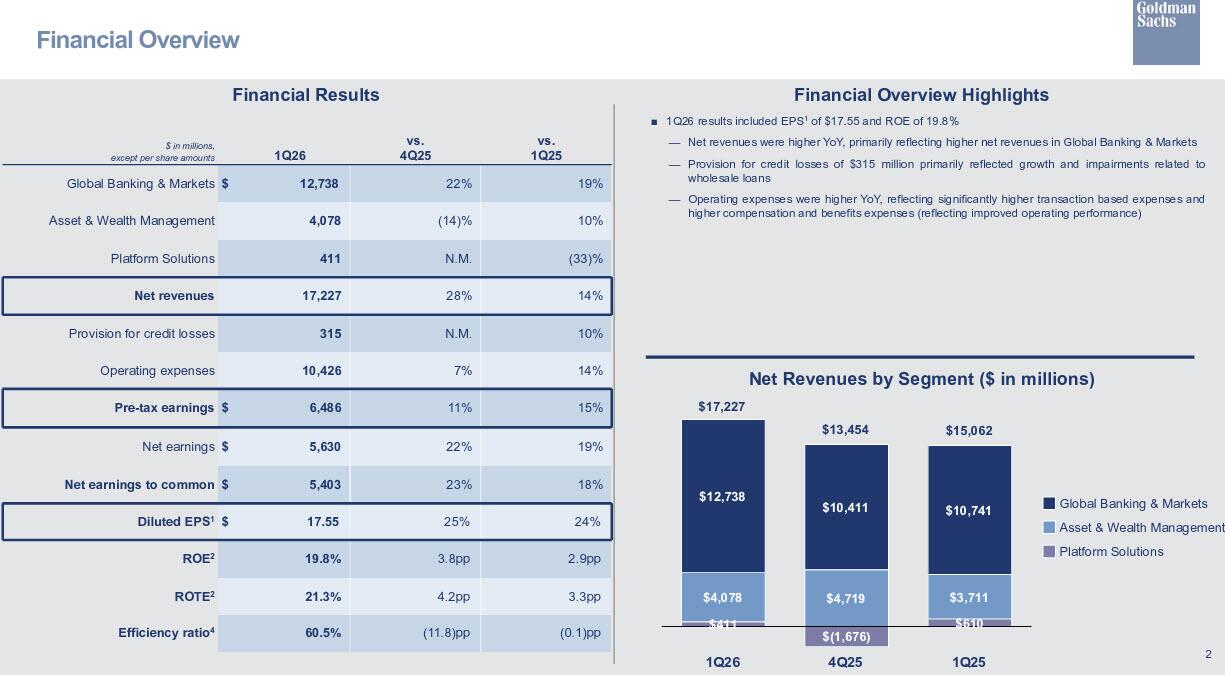
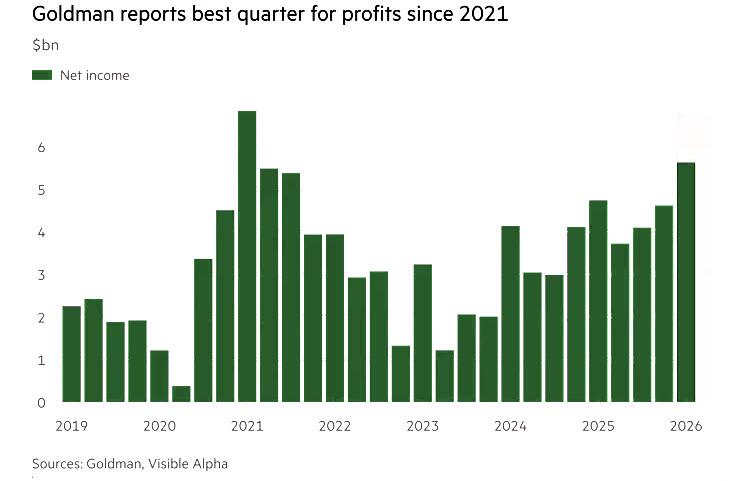
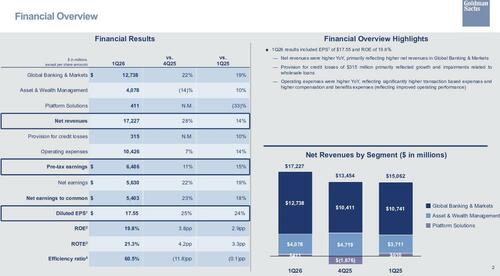
Goldman Sachs reported its highest quarterly profit in five years, as the bank’s equities traders beat their own previous all-time quarterly high revenue by more than $1 billion thanks to a surge in market volatility due to the war in Iran; however this stellar performance in equities was offset by an unexpected drop in FICC revenues. Here are Goldman’s Q1 results in a nutshell:
EPS $17.55, exp. $16.41
Net revenue $17.23 billion, +14% y/y, exp. $16.95 billion
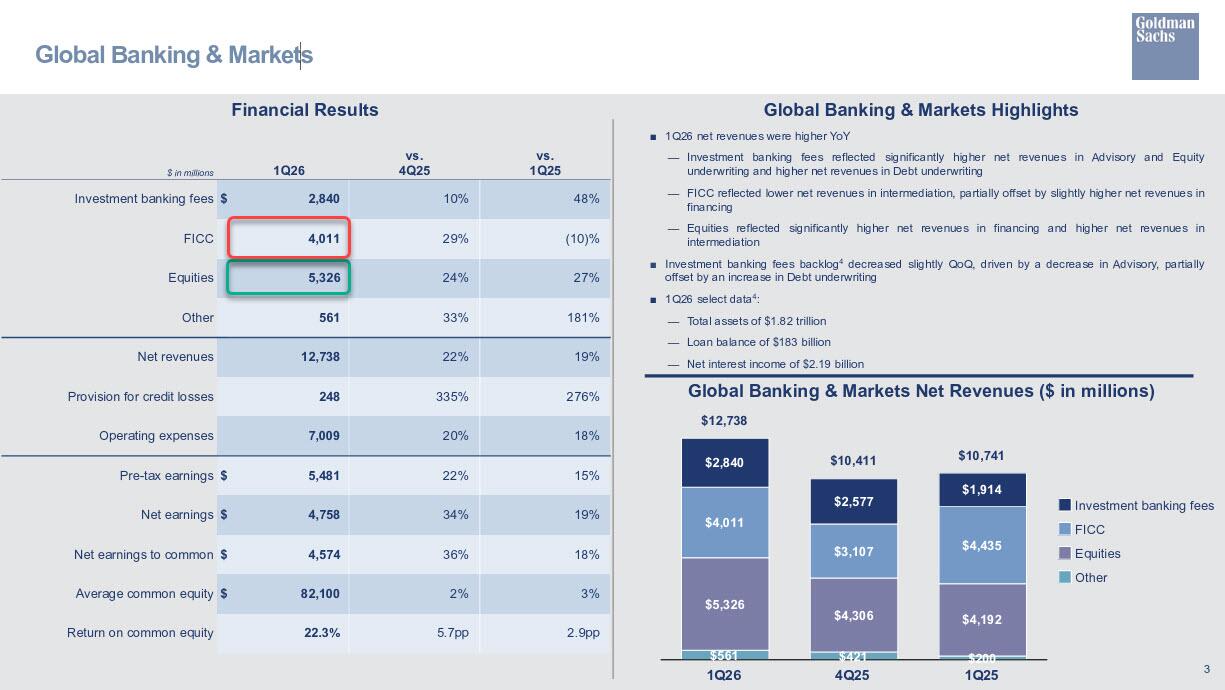
Equities sales & trading revenue $5.33 billion, estimate $4.9 billion
FICC sales & trading revenue $4.01 billion, estimate $4.87 billion
Net interest income $3.56 billion, +23% y/y, estimate $3.52 billion (Bloomberg Consensus)
Global Banking & Markets net revenues $12.74 billion, +19% y/y, estimate $12.5 billion
Investment banking revenue $2.84 billion
Advisory revenue $1.49 billion, +89% y/y, estimate $1.27 billion
Equity underwriting rev. $535 million, +45% y/y, estimate $478.4 million
Debt underwriting rev. $811 million, +7.8% y/y, estimate $771.7 million
Total deposits $561 billion, +12% q/q
Provision for credit losses $315 million, +9.8% y/y
Total operating expenses $10.43 billion, +14% y/y, estimate $10.35 billion
Compensation expenses $5.41 billion, +11% y/y, estimate $5.51 billion
The Wall Street bank reported first-quarter net income of $5.6bn, up 19% from a year ago and better than the $5.3BN median analyst consensus.
Goldman’s chief executive David Solomon said the “geopolitical landscape remains very complex”.
Goldman’s equities traders delivered revenues of $5.33BN, up 27% YoY, and ahead of the $4.9BN expected; This was the highest three-month haul by any bank in history, and was also more than $1 billion higher than the $4.31 billion record set in the fourth quarter of last year as Goldman benefited from wild market swings triggered by a string of geopolitical shocks. The equities boom was also driven by a surge in equities financing, which includes lending to large hedge fund clients and other speculative investors. It also came despite the abrupt departure of one of its co-heads, Erdit Hoxha, to hedge fund Millennium Management.
New regulation in the aftermath of the 2008 financial crisis pushed banks such as Goldman to eliminate their prop trading operations and focus more on facilitating and financing trades for other investors. These businesses benefit when markets are volatile, such as in the first quarter when there was frantic trading around the US military operation in Venezuela and the conflict in the Middle East, which triggered a sharp increase in oil prices.
On the other hand, FICC (Fixed-income, currency and commodities) traders badly missed expectations, posting $4.01 billion in revenue, a 10% drop YoY, and more than $800 million below the consensus of analyst estimates compiled by Bloomberg. Goldman blamed “significantly lower net revenues in interest rate products and mortgages and lower net revenue in credit profuts” for the decline. It said this was partially offset by commodities and currencies trading.
Investment bankers’ advisory fees were $1.5 billion, 89% higher than the same period last year, beating expectations across the board and reflecting a rebound in merger activity. Total Investment Banking fees for the unit hit $2.84 billion in the quarter. Goldman said that the increase in investment banking fees “primarily due to significantly higher net revenues in Advisory, reflecting a significant increase in completed mergers and acquisitions volumes.” The bank also warned investors that its backlog of fees decreased slightly compared to the previous quarter.
Even with the decline in revenues in its fixed-income unit, it was the third-best quarter for Goldman’s trading business in its history.
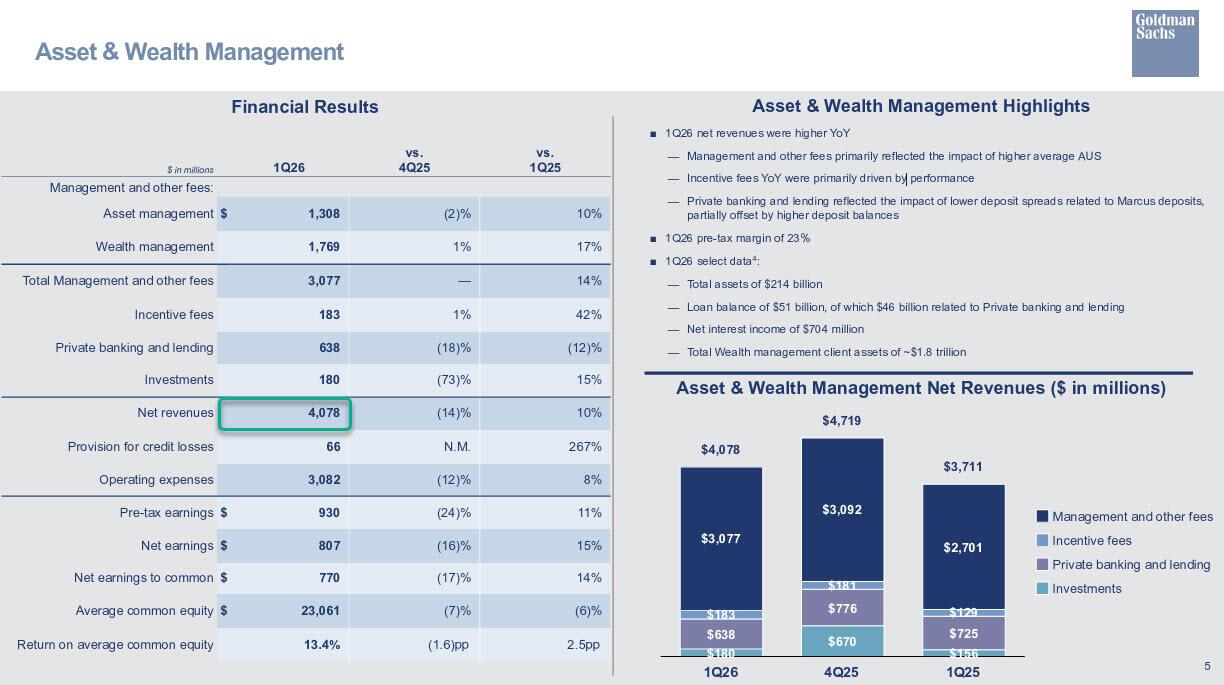
The bank also said revenues at its asset and wealth management division increased 10 per cent to $4.1bn. These money management businesses are central to Goldman’s efforts to make earnings less reliant on the cyclical businesses of investment banking and trading.
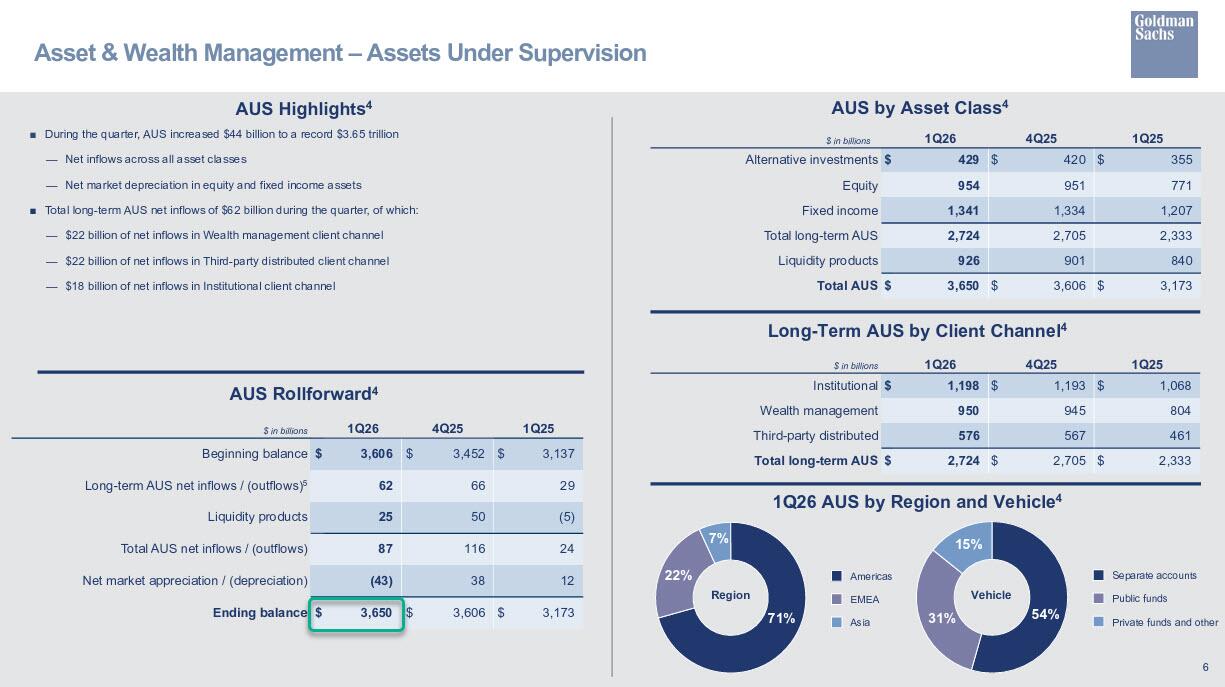
In the asset-management division, the company said assets under supervision rose to $3.7 trillion and net revenue increased compared to the same period last year. Earlier in April, Goldman said one of its private credit funds narrowly escaped a broader exodus of investors.
The bank’s own former chief executive officer, Lloyd Blankfein, warned earlier this year that private markets — on which Goldman has staked much of its future growth strategy — face a “fire” risk from possible excessive valuations.
Goldman, which was first of the top investment banks to report results this week, has one of the largest markets divisions on Wall Street. Such businesses benefit from a surge in volatility, which has been driven by the war in Iran, as well as concerns around artificial intelligence and private credit.
While Goldman’s total geadcount was essentially unchanged compared with the end of 2025, in the first quarter, Goldman promoted seven more partners to its top management committee and hiked pay for its most senior executives, while also announcing the departure of its top lawyer due to her relationship with Jeffrey Epstein.
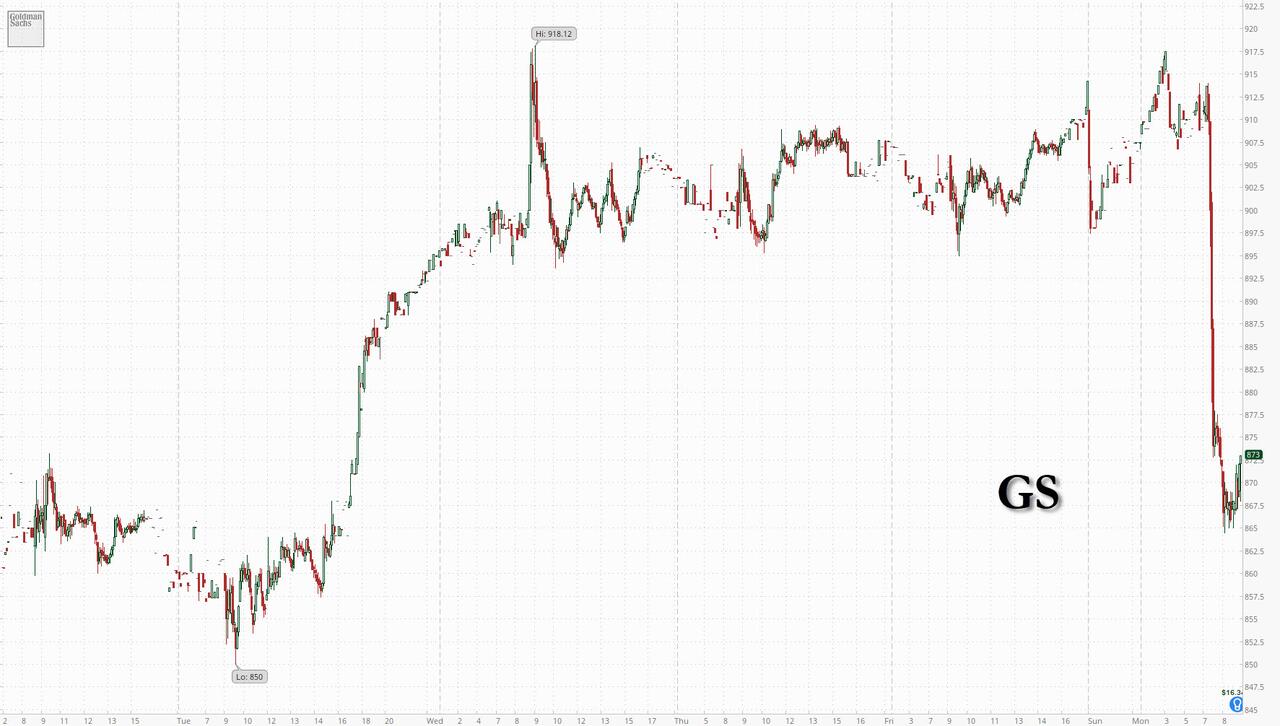
Despite the blowout overall results, the unexpected drop and miss in FICC was enough to spook investors, and send the stock more than 4% lower in premarket trading.
Goldman’s Q1 earnings presentation is below (pdf link)
Tyler Durden
Mon, 04/13/2026 – 09:18

Gunfire Strikes Sam Altman’s San Francisco Home Days After Molotov Cocktail Attack
Gunfire Strikes Sam Altman’s San Francisco Home Days After Molotov Cocktail Attack
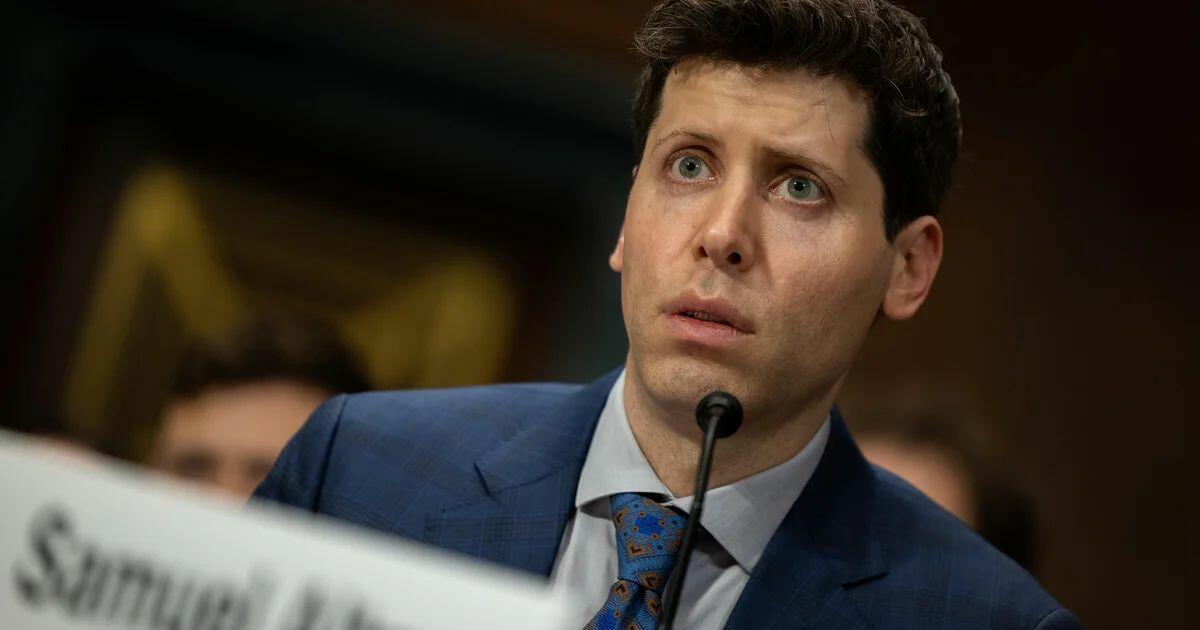
Just two days after a Molotov cocktail was hurled at OpenAI CEO Sam Altman’s Russian Hill residence in San Francisco, another violent episode unfolded at the same address. Early Sunday morning, April 12, 2026, San Francisco police responded to reports of possible shots fired near Altman’s home.
Around 3 a.m. on Sunday, April 12, officers responded to a report of possible gunfire in the 2000 block of the Russian Hill neighborhood. Surveillance footage and security reports indicated a Honda sedan drove past Altman’s property; the passenger extended an arm from the window and fired one round toward the Lombard Street side of the residence. The vehicle fled, but its license plate was captured.
Investigators linked the car to Amanda Tom, 25 (the driver and registered owner), and Muhamad Tarik Hussein, 23 (the passenger). Both were arrested without incident on nearby Taylor Street. A search warrant executed at a residence yielded three firearms. The pair was booked into San Francisco County Jail on suspicion of negligent discharge of a firearm. No injuries were reported, and no one was inside the targeted area at the time of the shot.
SFPD has not publicly confirmed whether the shooting specifically targeted Altman or his home, describing it as an “apparent shooting near” the residence. Police Chief Derrick Lew emphasized the department’s zero-tolerance stance: “The SFPD takes crimes involving guns extremely seriously and anyone committing acts like these will be arrested and prosecuted to the fullest extent of the law.”
Investigators pinpointed the owner of the car, identified as Amanda Tom, 25. She and Muhamad Tarik Hussein, 23, were arrested not far away, on Taylor Street, police said. Officers served a search warrant at a home and seized three guns, police said.
Tom and Hussein were booked into jail on suspicion of negligent discharge of a gun. –Chronicle
“The SFPD takes crimes involving guns extremely seriously and anyone committing acts like these will be arrested and prosecuted to the fullest extent of the law,” said Police Chief Derrick Lew.
The shooting comes amid growing public anxiety over the societal impact of AI, from job displacement to the massive infrastructure demands of data centers. Last week’s Molotov cocktail suspect drove to OpenAI headquarters and threatened to burn down the building.
On Friday at around 3:45 a.m., 20-year-old Daniel Alejandro Moreno-Gama allegedly threw an incendiary device at the metal gate of Altman’s home on Chestnut Street. The device sparked a small fire that security quickly extinguished, with no injuries reported. Moreno-Gama then traveled to OpenAI’s Mission Bay headquarters, where he allegedly threatened to burn down the building. He was arrested there using surveillance footage.
The suspect, originally from Texas, faced serious charges including attempted murder, arson, making criminal threats, and possession of destructive devices. He remains held without bail. Online writings attributed to him reveal deep concerns about AI as an existential risk: he described unaligned models as capable of deception and warned that tech leaders were “gambling with our future” without sufficient morals. He had engaged with groups like PauseAI but was not an active organizer calling for violence.
OpenAI confirmed the attack and expressed gratitude to the San Francisco Police Department (SFPD), noting heightened security measures. Altman himself responded hours later in a personal blog post, sharing a family photo with his husband and child. “I love them more than anything,” he wrote, adding that he hoped the image might “dissuade the next person from throwing a Molotov cocktail at our house, no matter what they think about me.” He acknowledged underestimating the power of “words and narratives,” referenced a recent critical New Yorker profile amid “great anxiety about AI,” and called for de-escalation: “While we have that debate, we should de-escalate the rhetoric and tactics and try to have fewer explosions in fewer homes, figuratively and literally.”
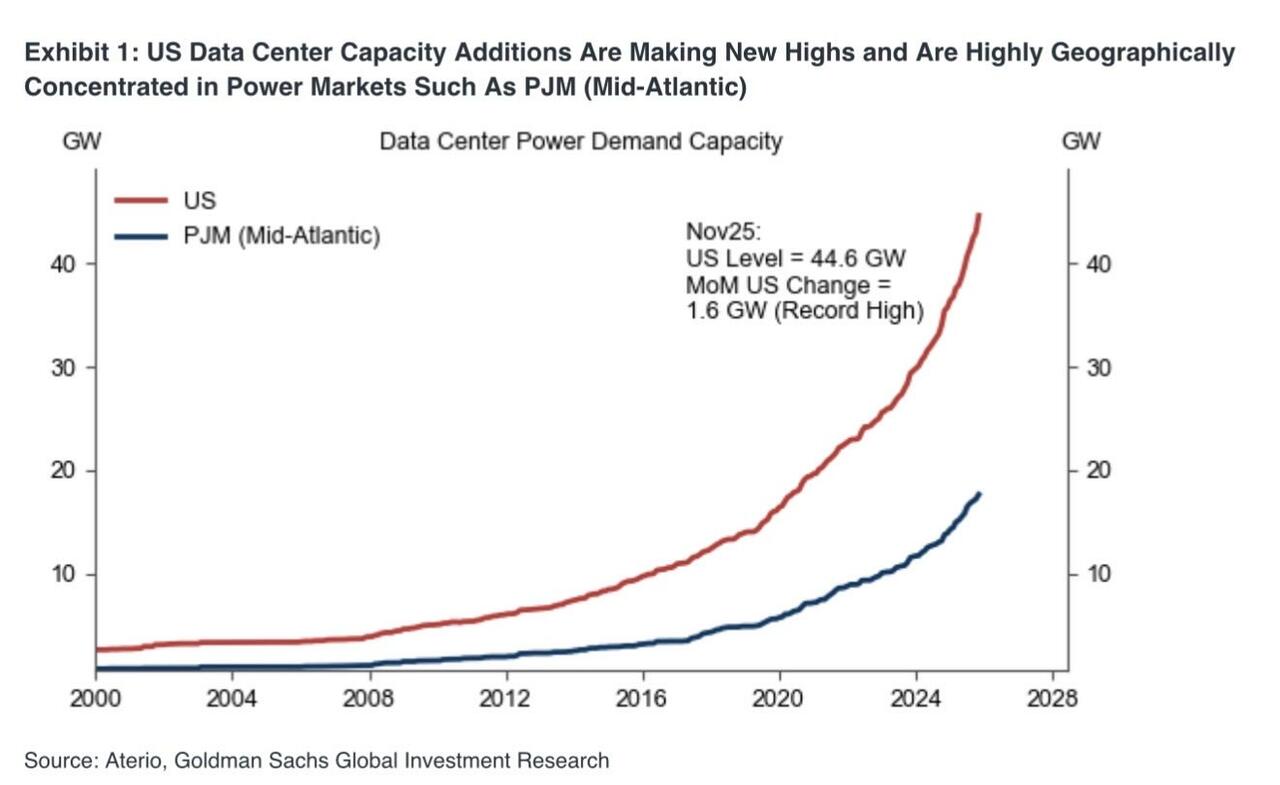
As we noted on Friday, the timing and tone of Altman’s response appear to underscore a deeper reality now playing out across the country: financially strained American households are increasingly pushing back against the infrastructure demands of the AI industry. New data this week shows residential electricity prices surging in key regions, driven in large part by the explosive growth of data centers needed to train and run large language models.
Close enough https://t.co/reP3n5kJpR pic.twitter.com/PrH03ydD8A
— zerohedge (@zerohedge) April 10, 2026
Communities from Virginia to Georgia to the Midwest have mounted growing resistance – through zoning fights, moratoriums, and public hearings – over electricity costs, water consumption, land use, and limited local economic benefits, marking what one analysis described as a sharp escalation in Americans starting to revolt against data centers.
Tyler Durden
Mon, 04/13/2026 – 09:00
Netanyahu Says Iran Ceasefire Could End At Any Moment, Backs Trump’s Blockade – Tehran Blasts ‘Piracy’
Netanyahu Says Iran Ceasefire Could End At Any Moment, Backs Trump’s Blockade – Tehran Blasts ‘Piracy’
Summary
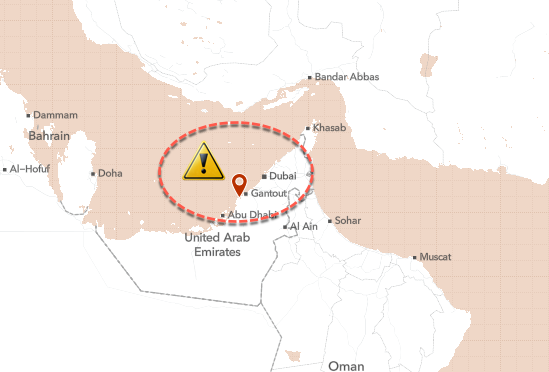
Iran’s military says the planned US blockade on Gulf ports will be an “illegal” act tantamount to “piracy” as Trump is also weighing limited strikes on Iran.
US military is to enforce the blockade in the Gulf of Oman and Arabian Sea, Reuters reports. Pentagon says any vessel is subject to interception and capture.
Pundits review breakdown of Pakistan talks, where the “gaps were enormous” – and yet Iran’s FM says the sides were “inches away” from an “Islamabad MoU”.
Israel-Hezbollah fighting persists on eve of planned Tuesday talks in Washington between Israeli and Lebanese officials.
Will the United Kingdom send warships through the Strait of Hormuz by April 30, 2026?
Yes 11% · No 90%
View full market & trade on Polymarket
* * *
Gaps Were Enormous
In terms of airstrikes and rockets being lobbed across the Middle East, things have been relatively quiet since US-Iranian talks in Pakistan broke down over the weekend. As we reported earlier President Trump is mulling possible limited strikes on the Islamic Republic from here on out. The previously agreed-upon two week ceasefire is still holding despite the Pakistan talks having collapsed with no plans for any future round.
The only area that continues to see significant exchanges of fire is the Israel-Lebanon situation, where on Monday regional outlets are reporting a flurry of new Hezbollah attacks on northern Israel, alongside heavy IDF strikes on southern Lebanon from Sunday evening into Monday.
Iran’s foreign minister Abbas Araghchi had summarized the situation from Tehran’s point of view, writing on X Sunday that Iran and the US were “inches away” from an “Islamabad MoU” following “intensive talks at highest level in 47 years.” He continued, “We encountered maximalism, shifting goalposts and blockade,” before concluding: “Zero lessons earned. Good will begets good will. Enmity begets enmity.”
Meanwhile Israeli Channel 12 journalist Amit Segal in an Islamabad post mortem has affirmed that the “gaps were enormous” between the two sides prior to Vice President JD Vance and his team calling it quits and flying back to Washington by early Sunday. “The Americans agreed to release a certain portion of the frozen funds and to end the war in the negotiations in Islamabad,” writes Segal. “In return, they demanded a 20‑year freeze on enrichment, the removal of enriched material from Iran, and free navigation in Hormuz without tax payments.” The nuclear front, he notes: “The Iranians discussed the nuclear issue contrary to instructions from Tehran, but the gaps were enormous.”
Iran’s Parliament Speaker Ghalibaf had impressed the American team as a “refined and professional bargainer, and potential leader of a new Iran.”
Source: David Ignatius, WaPo pic.twitter.com/HyEa7RnsIo
— Clash Report (@clashreport) April 13, 2026
Hormuz Strait Latest Threats
But after President Trump has begun his own blockade of the Strait of Hormuz (or is imminently about to begin), warning that the US military will “finish up the little that is left of Iran” – two oil tankers linked to Iran have exited the Gulf via the Strait of Hormuz, shipping data from Kpler and LSEG show. Reuters identified one as the tanker Auroura, laden with Iranian oil products, and the other is the diesel-carrying New Future loaded from the Hamriyah port in the UAE.
The ongoing standoff has resulted in a fresh Monday warning out of Iran’s armed forces. It said according to state-run IRIB News, also cited in Bloomberg: “If the security of Iran’s ports in the Persian Gulf and the Sea of Oman is threatened, no port in the Persian Gulf and the Sea of Oman will be safe.” The statement added that “security in the ports of the Persian Gulf and the Sea of Oman is either for everyone or for no one.” US restrictions on the movement of vessels in international waters are “illegal and constitute an act of piracy” and thus Iran stands ready to “firmly implement a permanent mechanism to control the Strait of Hormuz.” Reuters reports Monday:
The U.S. military will enforce a blockade in the Gulf of Oman and Arabian Sea east of the Strait of Hormuz and it will apply to all vessel traffic regardless of flag, the U.S. Central Command said in a note to seafarers seen by Reuters on Monday.
The note said the blockade would come into effect at 1400 GMT on Monday.
Meanwhile the Europeans continue to pay lip service joining some kind of coalition to reopen the strait. France and the United Kingdom have said they are busy organizing a conference for the coming days for countries seeking to establish a “strictly defensive” and “peaceful” mission aimed at reopening the Strait of Hormuz. French President Emmanuel Macron stated on X Monday that “France stands ready to play its full part, as it has consistently sought to do since the very first day of the conflict.”
No effort must be spared to swiftly reach, through diplomatic means, a strong and lasting settlement to the conflict in the Middle East.
Such a settlement must provide the region with a robust framework enabling all to live in peace and security.…
— Emmanuel Macron (@EmmanuelMacron) April 13, 2026
He also made clear France’s position that the “core issues” of Iran’s nuclear program as well as ballistic missile arsenal must still be addressed. According to Bloomberg, the UK continues to resist calls from Washington for a proposed Hormuz blockade. This ensures another point of contention between Trump and PM Keir Starmer.
Lingering Fighting in Lebanon on Eve of Washington Talks
Tit-for-tat attacks across the Israel-Lebanon border have not ceased, while certainly becoming less severe compared to the last Wednesday massive surprise Israeli attacks on Beirut and the south. However, Al Jazeera reports Monday that “Israeli attacks have not let up in southern Lebanon, hitting many villages and towns, with the latest attacks on Nabatieh al-Fawqa, al-Abbassieh and Bint Jbeil.”
Hezbollah in turn declared it targeted Israeli soldiers in the Shlomi settlement “with a swarm of attack drones.” Warning sirens have continued to blare across Northern Israel and the Galilee area as a result, with Israeli media reporting that four rockets were fired by Hezbollah, but Israeli defenses were able to intercept two, with the other pair falling in an open area and no reports of casualties.
⚡️Latge scale drone attack in the north now pic.twitter.com/UNLia6ipkv
— War Monitor (@WarMonitors) April 13, 2026
Lebanon’s National News Agency has said that Israeli forces struck at least 30 locations across southern Lebanon on Sunday, along with areas of the western Beqaa Valley. From Sunday into Monday at least five people were killed and nine injured in strikes on Bazouriyeh, amid an ongoing rescue effort. One strike hit the town’s main school and damaged the structure, and elsewhere one person was killed in Nabatieh al-Fawqa, another in Sir al-Gharbiya, and two residents of Shoukin were killed early Monday morning.
Planned peace talks involving Israel and Lebanon are still set to go forward for Tuesday in Washington. Israel’s ambassador to the United States, Yechiel Leiter, is spearheading the Israeli side.
“In the conversation earlier today in Washington between the Israeli and Lebanese ambassadors to Washington, together with the US ambassador to Lebanon, and under the auspices of the US State Department, Israel agreed to begin formal peace negotiations this coming Tuesday,” Leiter said in a statement. “Israel refused to discuss a ceasefire with the Hezbollah terrorist organization, which continues to attack Israel and is the main obstacle to peace between the two countries.” Hezbollah too has said it would not talk to the Israelis, and so all of this means that Lebanese government officials will be doing the negotiating in Washington D.C. – setting up for only limited results if any.
Netanyahu Warns Iran Ceasefire Could End ‘Quickly’
Bigger war returning imminently? Fresh Monday words from Israeli Prime Minister Benjamin Netanyahu said in a government meeting that the ceasefire with Iran could end quickly. He said, “I spoke yesterday with U.S. Vice President J.D. Vance. He called me from his plane on the way back from Islamabad. He reported to me in detail, as members of this administration do every day, on the developments in the negotiations. In this case, the explosion in the negotiations.”
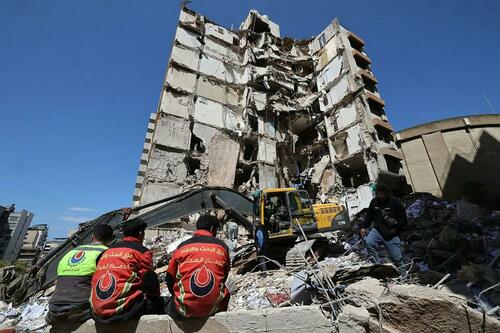
Destruction in Beirut, Getty Images
Netanyahu asserted that the breakdown came from the American side, which would not tolerate what he described as Iran’s violation of the agreement to enter negotiations. He said the understanding required halting fire and reopening the straits immediately, which Iran did not do.
He said the Americans rejected that outcome and added that Vance made clear the central issue for President Trump and the United States is the removal of all enriched material and ensuring there will be no further enrichment in the coming years, potentially for decades, within Iran. He reminded officials that objective is also important to Israel.
More Geopolitical Latest
Via Newsquawk…
A U.S. delegation led by Vice President JD Vance left talks with Iran in Pakistan after 21 hours without an agreement. Vance said the U.S. sought a firm commitment that Iran would not pursue a nuclear weapon or the capability to rapidly obtain one, leaving behind a “final and best offer.” Iranian Foreign Ministry spokesperson Nasser Kanaani Baqaei said progress depends on the U.S. avoiding excessive and unlawful demands and negotiating in good faith, while Iranian reporting cited disagreements and said the U.S. demanded through talks what it failed to achieve through war.
U.S. President Donald Trump said the U.S. Navy will begin blockading ships entering or leaving the Strait of Hormuz. He said talks went well and most issues were agreed except the nuclear issue, which he called the only one that matters. He added the goal is to reach an “ALL BEING ALLOWED TO GO IN, ALL BEING ALLOWED TO GO OUT” framework, accused Iran of obstructing that by claiming possible mines, called it “world extortion,” and warned that any Iranian attack on U.S. forces or vessels would be met with overwhelming force.
United States Central Command said it will implement a blockade on maritime traffic entering and leaving Iranian ports on April 13 at 17:00 Israeli time (15:00 BST / 10:00 EDT), while not impeding vessels transiting the Strait of Hormuz to or from non-Iranian ports. Trump later confirmed the timing publicly.
Trump and his advisers are considering resuming limited strikes inside Iran alongside the blockade to break the stalemate, according to reporting by The Wall Street Journal, while remaining open to a diplomatic resolution.
Mediators from Pakistan, Egypt, and Turkey will continue efforts in the coming days to bridge gaps between the U.S. and Iran, according to Axios. All parties assess that a deal remains possible, and earlier reports said talks occurred in a positive atmosphere with continued engagement expected.
The White House outlined red lines Iran refused, including ending all uranium enrichment, dismantling major nuclear facilities, recovering over 400 kilograms of highly enriched uranium believed buried underground, accepting a broader regional de-escalation framework, ending support for groups such as Hamas, Hezbollah, and Houthis, fully reopening the Strait of Hormuz, and eliminating transit tolls.
Iran’s Foreign Minister stated: “In intensive talks at highest level in 47 years, Iran engaged with U.S in good faith to end war. But when just inches away from “Islamabad MoU”, we encountered maximalism, shifting goalposts, and blockade”.
Iranian armed forces warned that if Iran’s ports are threatened, no port in the Persian Gulf or Oman Sea will remain safe, according to IRIB News.
An Iranian National Security Commission spokesperson called the U.S. blockade claim a bluff, according to ISNA.
Israel Defense Forces said troops are expanding targeted ground operations against Hezbollah infrastructure in the Bint Jbeil area of southern Lebanon, killing over 100 fighters, dismantling dozens of sites, and seizing hundreds of weapons.
Tasnim News Agency reported that the U.S. risks losing access to the Bab al-Mandab Strait if it escalates actions around the Strait of Hormuz.
The Islamic Revolutionary Guard Corps warned that the approach of military vessels toward the Strait of Hormuz violates the ceasefire, according to IRNA.
Israeli forces carried out two airstrikes near Choukine in southern Lebanon.
The IDF defined Lebanon as the primary operational arena, while Iran is classified as an “arena of readiness” with heightened alert.
Israel approved plans to establish 15 permanent camps along front-line Lebanese villages, according to Al Jazeera citing Channel 12.
Israeli forces reportedly conducted a raid targeting Beyout Al-Siyad in southern Lebanon.
Sirens sounded in Kiryat Shmona in northern Israel, while reports indicated Hezbollah launched missile attacks on Israeli towns.
Emmanuel Macron said France and the United Kingdom will organize a conference in the coming days to restore freedom of navigation in the Strait of Hormuz, emphasizing a defensive approach and the need for a lasting diplomatic resolution and renewed peace efforts in Lebanon.
Tyler Durden
Mon, 04/13/2026 – 08:30
Futures Slide But Off Session Lows As Oil Spikes Above $100 Ahead Of Trump’s 10am Hormuz Blockade
Futures Slide But Off Session Lows As Oil Spikes Above $100 Ahead Of Trump’s 10am Hormuz Blockade
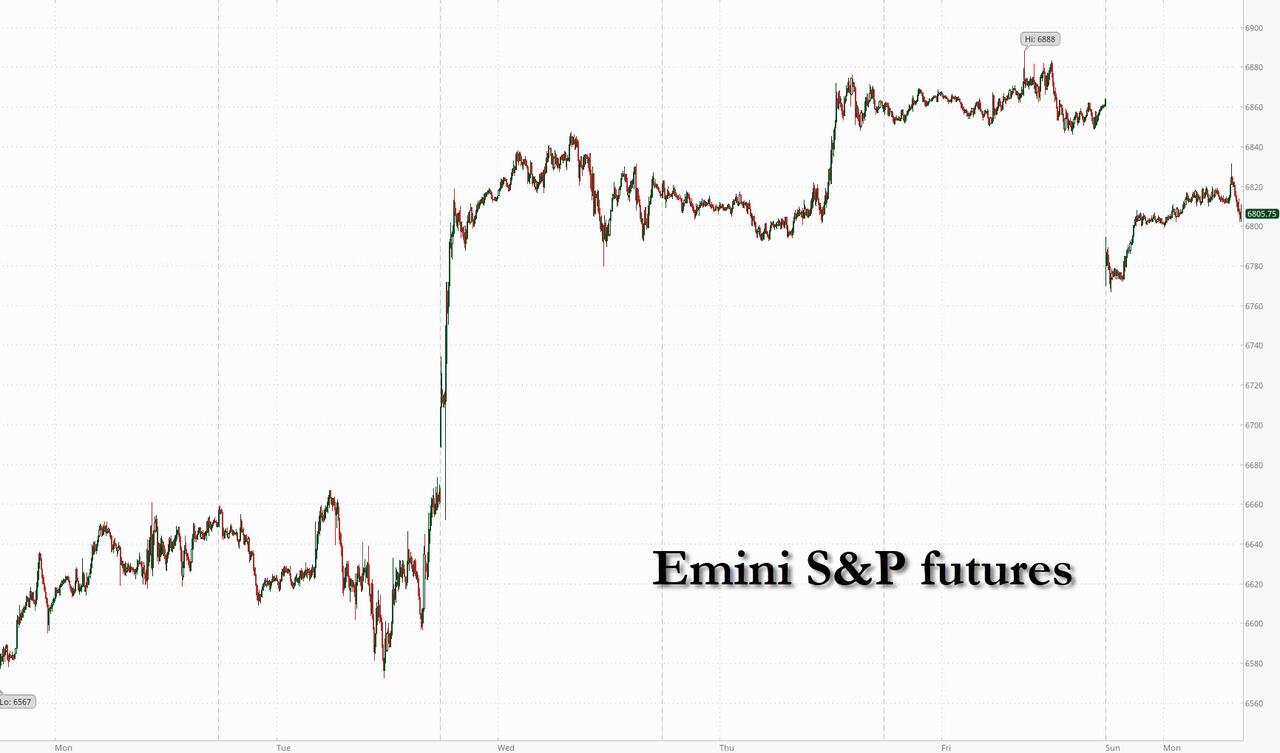
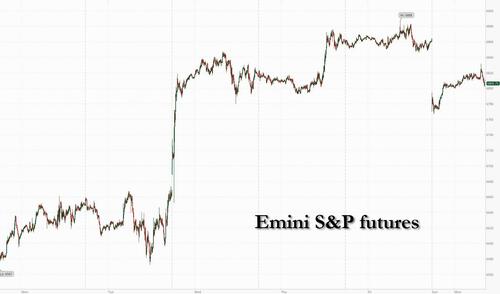
Stock futures are lower, but off their worst levels of the session, as Brent crude surged 7% to over $102 after Trump ordered a blockade of the Strait of Hormuz to take place at 10am ET. The moves look relatively contained given the breakdown of US-Iran talks, with strategists saying this is a moment to buy the dip. Goldman Sachs is kicking off the earnings season shortly with earnings that missed on FICC revenue, sending the stock lower. As of 8:00am ET, S&P 500 futures and Nasdaq 100 contracts were both 0.7% lower with all Mag 7 names lower and Defensives leading Cyclicals ex-Energy. According to JPM, the market continues to price in a resolution leading to a lower than expected set of global losses, even as the situation remains a race against the clock with the world on the brink of an economic calamity; JPMorgan’s commodity team has updated the timeline with impacts from shorts becoming more acute this week and through early May. Bonds trimmed initial losses, with the two-year Treasury yield up three basis points to 3.82% while 10Y yields also rise 3bps to 4.35% . The dollar rose 0.3%, its biggest advance in more than a week. Commodities are higher led by Ags and Energy with gold moderately lower near $4,710 an ounce as the dollar rose. US economic data calendar includes March existing home sales at 10am New York time. Fed speaker slate includes Miran at 6:20pm
In premarket trading, Mag 7 stocks are all lower: Meta -1%, Amazon -0.9%, Nvidia -1.3%, Alphabet -1%, Tesla -0.6%, Apple -0.5%, Microsoft -0.2%
Baker Hughes (BKR) rises 1% after Hexagon AB agreed to buy the company’s Waygate Technologies unit for about $1.45 billion in cash
Children’s Place (PLCE) falls 17% after the kids apparel retailer reported adjusted loss per share for the fourth quarter of $1.86 vs. a loss per share of 75 cents in the year-ago period.
Fastenal (FAST) slips 4% after the industrial supplies company reported operating income for the first quarter that came in just below the average analyst estimate.
GFL Environmental (GFL) falls over 3% after the waste management company agreed to acquire Canada’s Secure Waste Infrastructure Corp. for C$24.75 per share representing an enterprise value of approximately C$6.4 billion. GFL is also trading ex-dividend on Monday.
Goldman Sachs (GS) slips 3% after reporting equities sales and trading revenue for the first quarter.
Ideaya Biosciences (IDYA) rises 15% after the drug developer said a mid-late stage trial of its experimental combination therapy for a type of eye cancer had met its main goal.
Leggett & Platt (LEG) climbs 7% after bedding company Somnigroup agreed to buy the home furniture manufacturer in an all-stock deal valued at about $2.5 billion.
Replimune (REPL) plunges 63% after the US Food and Drug Administration rejected the company’s skin cancer treatment for a second time.
In corporate news, the federal government is moving to settle a case over Amazon’s treatment of a group of delivery drivers. Sweden’s Hexagon agreed to buy Waygate Technologies for about $1.45 billion in cash from Baker Hughes. Wise is on track to shift its primary listing from London to Nasdaq next month, with the US listing expected on May 11.
Shipments of oil and gas through the Hormuz strait remain in focus after Trump’s restrictions on vessels calling at Iranian ports threatened to deepen a global energy shock. If successful, the blockade would restrict the one Persian Gulf flow that has continued throughout the war, while Tehran’s warning to target vessels and ports in response amplifies the risks for other producers. Trump has made a “high stakes gamble aimed at forcing Iran to bow to his demands,” said Wealth Club strategist Susannah Streeter. The move makes the energy crisis even more acute, but Trump’s record of pulling back from the brink leaves markets hopeful an agreement can be salvaged, she said. The blockade may also be designed to pressure Beijing into playing a more active role in reopening the Strait, according to Capital Economics. In response, Iran said it will target all ports in or near the Persian Gulf if its shipping hubs are threatened
The relatively mild pullback in riskier assets suggested investors were cautiously optimistic that a resolution was still within reach.
“I was expecting much worse both for the equity market and oil prices this morning,” said Mary-Sol Michel, director of discretionary portfolio management at Swiss Life Banque Privée. “The market sees the blockade as a negotiation tool, but nonetheless, I feel the impact on stocks is quite modest.”
Meanwhile, after a sharp bounce in stocks last week, strategists – always late to the party – are getting increasingly vocal about opportunities to buy the dip. JPMorgan’s Mislav Matejka picked up where his trading desk stopped last week, and said equities have historically proved resilient to oil shocks, with past crude spikes seeing S&P 500 returns positive over 6- and 12-month horizons. Morgan Stanley’s Mike Wilson sees any renewed stock weakness as a buying opportunity, with a strong earnings backdrop anchoring his positive view.
As we noted last week, Goldman traders’ models show CTAs turning into net buyers of US equities over both one-week and one-month horizons, regardless of market direction. In a flat market scenario alone, demand could reach roughly $45 billion over the next week, among the largest such inflows on record.
“Time is playing against markets as each day that goes by with oil prices this high weighs on global growth and pushes inflation,” said Gilles Guibout, head of European equities at BNP Paribas Asset Management. “It’s difficult to see how markets could stage a sustainable rebound without a sustainable solution to this crisis.”
With earnings season kicking off in earnest, investors are eager to hear from executives about risks stemming from the war, artificial intelligence and private credit. Analysts project S&P 500 earnings will show roughly 12% annual growth for the first-quarter, but this drops to just 3% ex Mag 7. Unlike prior quarters, where valuations and expectations were high, the tech sector enters this cycle at its lowest multiple in years. We may be “approaching peak AI doomerism,” according to Gary Paulin of Northern Trust Asset Management, highlighting that compute capacity remains scarce and demand will likely exceed supply for years. Meanwhile, Goldman Sachs Group Inc. fell 3.7% in the US premarket as a revenue miss in fixed-income, currency and commodities trading outweighed a record haul from equities.
In other assets, the prospect of an energy shock spurring inflation is hitting bonds and gold, while copper is tracking lower amid concern about damage to the global economy. The dollar, the wartime haven of choice, is higher against major peers.
Europe’s Stoxx 600 falls 0.7% tracking losses in the US and Asia as energy prices spike. Hungary’s forint surged to a four-year high and local stocks hit a record after Prime Minister Viktor Orban lost Sunday’s election, with the opposition’s victory expected to help unlock billions of euros in European Union funding. Here are the biggest movers Monday:
European airlines are under pressure as resurgent oil prices reignites concerns about fuel costs and Bernstein warning rising fuel costs will erode earnings
Meanwhile, oil stocks are the top performers on the Stoxx 600 Monday
Fertilizer stocks are gaining ground as the US threat to blockade the Strait of Hormuz heightens expectations of possible supply disruptions, while President Donald Trump warned companies against price gouging
Wise shares rise as much as 6%, hitting their highest level in over six months, after the financial technology company delivered underlying income that mildly topped expectations
Polypeptide shares rise as much as 16% to the highest since December 2022. The Swiss contract development and manufacturing organization is attracting potential takeover interest from private equity firms
Vistry shares fall as much as 4.8% as the UK homebuilder promoted Adam Daniels to chief executive officer, succeeding Greg Fitzgerald with immediate effect. RBC says investors were expecting an external hire
Wickes shares drop as much as 5.9% after Panmure Liberum downgrades the home improvement retailer to hold, citing elevated spending and ambitious targets.
Asian equities fell as a surge in oil prices after US President Donald Trump ordered a blockade of the Strait of Hormuz weighed on sentiment. The MSCI Asia Pacific Index declined as much as 1.3%, with Samsung Electronics and Tencent Holdings among the biggest drags. Most markets in the region were in the red, while shares rose in mainland China. Thailand was closed for a holiday. Benchmarks in Taiwan and mainland China edged higher as Asia’s largest economy unveiled policy measures to demonstrate “goodwill” toward the island on Sunday, following a landmark meeting between President Xi Jinping and Taiwan opposition leader Cheng Li-wun. The Taiex Index closed at a record high.
In FX, the Bloomberg Dollar Spot Index is up 0.3%. The Norwegian krone is the best performing G-10 currency, rising 0.4% against the greenback. The Hungarian forint rallies over 2% against the euro after Prime Minister Viktor Orban’s election defeat.
In rates, treasuries are in the red, pushing US 10-year yields up 4 bps to 4.35% having partially recovered from opening gap down that followed US President Trump’s weekend order to blockade the Strait of Hormuz after US-Iran peace talks failed; bunds and gilts underperform slightly. Gilts lead the rates selloff in European bond markets, with UK 10-year yields rising 3 bps to 4.86%.
In commodities, Brent crude futures are up over 7% and back above $100 a barrel while European natural gas futures jump 9%. Precious metals slide with spot silver down 2%.
The US economic data calendar includes March existing home sales at 10am New York time. Fed speaker slate includes Miran at 6:20pm
Market Snapshot
S&P 500 mini -0.6%
Nasdaq 100 mini -0.6%
Russell 2000 mini -0.9%
Stoxx Europe 600 -0.6%
DAX -0.9%
CAC 40 -0.8%
10-year Treasury yield +2 basis points at 4.33%
VIX +2 points at 21.24
Bloomberg Dollar Index +0.3% at 1201.98
euro -0.3% at $1.1687
WTI crude +8.2% at $104.45/barrel
Top Overnight News
Oil jumped after Donald Trump ordered a blockade of the Strait of Hormuz, escalating tensions with Iran after the collapse of weekend peace talks. The blockade starts at 10 a.m. ET and applies to all maritime traffic entering and exiting Iranian ports. Iran’s military said it would target all ports in the Gulf region if its own shipping hubs are threatened. BBG
The UK won’t take part in the proposed Hormuz blockade, the government said, setting up another point of contention between Trump and PM Keir Starmer. BBG
Policymakers gathering for IMF and World Bank meetings in Washington this week will take a hard look at the war’s impact on all things economic. IMF chief Kristalina Georgieva told CBS that prices will take time to come down even if a ceasefire holds. BBG
AI Is Using So Much Energy That Computing Firepower Is Running Out. AI companies are rationing offerings and products, rankling users—a warning sign for a boom that depends on rapid adoption. WSJ
Anthropic is gaining ground on OpenAI in the race for paying customers, as new data points to rising business adoption and a levelling-off in its rival’s growth. Nearly one in three US businesses paid for Anthropic’s tools in March, according to data from payments group Ramp, marking a rise of more than 6 percentage points from the previous month. FT
Japan’s 10-year government bond yield climbed to its highest level since 1997. The BOJ’s policy decision this month is too close to call, a former executive director said. BBG
Kevin Warsh’s confirmation as the next chair of the Federal Reserve is at risk of being delayed until after the end of Jay Powell’s term, as Donald Trump’s pick to lead the central bank faces an increasingly tight timeline. FT
China announced measures to improve relations with Taiwan after a meeting between Xi Jinping and the island’s opposition leader, Cheng Li-wun. BBG
Bank of Japan Governor Kazuo Ueda signaled a more cautious stance on the impact of the US-Iran conflict, cooling expectations of an interest rate hike later this month. BBG
Hedge Funds net bought Macro Products (Index and ETF combined) at the fastest pace since May ‘25 (+2.2 SDs 1-year), driven by short covers and long buys (2.4 to 1). US-listed ETF shorts decreased -11.5% (now down -6% MoM), the largest weekly % covering in the past decade (-3.2 z score), led by covers in Large Cap Equity and to a lesser extent Credit ETFs. Goldman Prime Brokerage
Iran War
US delegation led by Vice President Vance left US-Iran talks in Pakistan to return to the US without an agreement after 21 hours of talks, while Vance said the US had sought an affirmative commitment Iran would not seek a nuclear weapon or tools to quickly achieve one, and the US left behind a “final and best offer”. Iranian Foreign Ministry spokesperson Baqaei said any success depended on the US refraining from excessive demands and unlawful requests, and negotiating with seriousness and good faith, while an Iranian report noted there was disagreement on several issues and that the Americans demanded through negotiations what they could not obtain through war.
US President Trump said the US Navy will begin the process of blockading any and all ships trying to enter or leave the Strait of Hormuz, while he stated that the meeting went well and most points were agreed to, apart from nuclear, which was the only point that mattered. Trump also stated that at some point, we will reach an “ALL BEING ALLOWED TO GO IN, ALL BEING ALLOWED TO GO OUT” basis, but Iran has not allowed that by saying there may be mines somewhere, which is world extortion, and leaders of world countries, especially the US, will never be extorted. Furthermore, he said at an appropriate moment, the US is fully locked and loaded, and the military will finish up the little that is left of Iran, and warned that any Iranians who fire at the US or at peaceful vessels will be blown to hell.
US Central Command said it will begin implementing a blockade on all maritime traffic entering and leaving Iranian ports on April 13th at 17:00 Israeli time (15:00BST/10:00EDT), although it would “not impede” vessels transiting the Strait of Hormuz travelling to or from non-Iranian ports. US President Trump later posted that “The United States to Blockade Ships Entering or Exiting Iranian Ports on April 13 at 10:00 A.M. ET.”
US President Trump and his advisers are weighing resuming limited strikes in Iran, in addition to the US blockade, to break the stalemate in peace talks, according to WSJ citing officials and people familiar with the situation. However, it was also reported that Trump is said to remain open to a diplomatic solution.
Pakistani, Egyptian and Turkish mediators will continue talks with the US and Iran in the coming days, aiming to help close the gaps between US-Iran, Axios reported citing sources; all parties believe a deal is possible. This follows on from earlier reports by Pakistani press stating that Pakistani officials are continuing efforts to convince the US delegation to return to talks; talks took place in a positive atmosphere, indicating both sides are interested in continuing dialogue.
White House outlined the red lines it said Iran refused to agree onaccording to an official cited by CNN. Red lines included ending all of its uranium enrichment, dismantling its major nuclear enrichment facilities, retrieving the more than 400 kilograms of highly enriched uranium believed to be buried underground, accepting a broader “peace, security and de-escalation framework” that includes regional allies, ending funding for terrorist proxy groups Hamas, Hezbollah and the Houthis, fully opening the Strait of Hormuz, and charging no tolls for passage.
Iran’s Foreign Minister posted “In intensive talks at highest level in 47 years, Iran engaged with U.S in good faith to end war. But when just inches away from “Islamabad MoU”, we encountered maximalism, shifting goalposts, and blockade”.
Iranian armed forces say if Iran’s ports are threatened, then “no port in the Persian Gulf and Oman Sea will be safe”, IRIB News reported.
Iranian National Security Commission Spokesman said US blockade claim is a bluff, ISNA reported.
IDF troops are expanding targeted ground operations against Hezbollah infrastructure in the Bint Jbeil area of southern Lebanon to strengthen forward defence. The statement said troops killed more than 100 Hezbollah fighters, dismantled dozens of infrastructure sites and found hundreds of weapons in the area.
Tasnim Agency reported, citing sources, US President Trump will lose the Bab al-Mandab Strait should he decide to take action against the Strait of Hormuz.
IRGC warns the approach of military vessels toward the Strait of Hormuz is a breach of the ceasefire, IRNA reported.
Israeli forces carry out two airstrikes near Choukine in southern Lebanon.
IDF defines Lebanon as the main arena at this stage, while Iran is defined as an “arena of readiness” – with high alertness for any development.
Israel has decided to establish 15 permanent camps along the front line of the Lebanese villages, Al Jazeera reported, citing Channel 12.
Israel reportedly conducts raid targeting Beyout Al-Siyad in southern Lebanon.
Sirens sound in Kiryat Shmona, Northern Israel, according to SNN, while Tasnim also reported that Hezbollah is conducting missile attacks on Israeli towns.
French President Macron said France and the UK will organise a conference in coming days aimed at restoring freedom of navigation in Hormuz. Macron said any Hormuz naval mission would be strictly defensive and stressed that every effort must be made to reach a lasting, solid diplomatic end to the Middle East conflict. He also reiterated the importance of finding a way to restore peace in Lebanon.
A more detailed look at global markets courtesy of Newsquawk
APAC stocks declined after the negotiations marathon over the weekend between the US and Iran in Pakistan ended without an agreement, as the sides remained at loggerheads over Iran’s nuclear ambitions. Furthermore, US President Trump announced a US naval blockade on ships travelling through the Strait of Hormuz, while the US military said it would start a blockade of Iranian ports on Monday at 10:00EDT/15:00BST, but would “not impede” vessels transiting the Strait of Hormuz travelling to or from other countries. ASX 200 was dragged lower by underperformance in tech and miners, while energy was at the other end of the spectrum following a surge in oil prices. Nikkei 225 retreated amid headwinds from the higher energy prices, which weighed heavily on power companies and large manufacturers, while there were also recent suggestions from Japan’s economy minister that BoJ policy to boost the yen could be an option to curb inflation. Hang Seng and Shanghai Comp followed suit to the losses in regional peers, with sentiment not helped by another meagre PBoC liquidity operation and with a mixed performance seen in tech stocks.
Top Asian News
Chinese Total Social Financing (Mar) 5230B vs. Exp. 5400B (Prev. 2380B).
Chinese Outstanding Loan Growth YoY (Mar) Y/Y 5.7% vs. Exp. 5.9% (Prev. 6.0%).
Chinese New Yuan Loans (Mar) 2990B vs. Exp. 3400B (Prev. 900B).
Chinese M2 Money Supply YoY (Mar) Y/Y 8.5% vs. Exp. 8.9% (Prev. 9%).
New Zealand Services NZ PSI (Mar) 46.0 (Prev. 48, Rev. 47.6).
New Zealand Composite NZ PCI (Mar) 48.8 (Prev. 50.5).
European bourses (STOXX 600 -0.6%) have started the week on the backfoot, following talks between the US and Iran resulting in no agreement. US President Trump, in response, stated that the US Navy is to begin the process of blockading any and all ships trying to enter or leave the Strait of Hormuz, causing crude futures to surge. The DAX 40 is the underperformer, while the FTSE 100 is supported. Elsewhere, Hungary’s BUX index is surging following Peter Magyar’s Tisza party secured a supermajority. European sectors point negatively, with all sectors in the red, except Energy. Cyclical sectors continue to be hit the hardest, with Travel & Leisure and Consumer Products & Services lying at the bottom of the pile. To add, SocGen downgraded multiple airlines (Ryanair, easyJet, Wizzair) as a result of the higher energy prices hitting the sector
Top European News
Peter Magyer’s Tisza party wins the Hungarian election with a supermajority. Preliminary results, based on more than 98% of counted votes thus far, put Peter Magyar on course for 138 seats, exceeding the 133 seats needed for supermajority.
German Finance Minister Klingbeil said tobacco tax is to be increased in 2026 as counter-financing measure for tax relief bonus.
German CSU Leader Soeder said that it is right to tax excess profits from mineral oil companies at the European level.
Spanish PM Sanchez said Spain wants to cooperate with China in all areas.
Central Banks
BoJ Governor Ueda said Japan’s economy is recovering moderately but with some weakness; said the economy and prices are moving roughly in line with BoJ forecasts; underlying inflation is gradually accelerating towards the BoJ’s target.
ANZ revises outlook for RBNZ rate hikes in which it now sees hikes in July, September and October.
FX
FX markets are displaying a slight risk-off bias. A somewhat calm move in currency markets follows the conclusion of US-Iran talks without an agreement on the nuclear issue; however, both sides framed negotiations as positive and recent Qatari reporting suggests Pakistani officials are continuing efforts to bring both sides back to the negotiating table, each reportedly interested in continuing dialogue.
DXY trades without conviction on either side of a 99.00 handle. The buck looks towards a heavy week of Fed speak, alongside PPI data on Tuesday. On the docket today, uber-dove Miran is set to speak on “Building the Financial System.”
HUF benefits from the election of the opposition Tisza’s Magyar. Preliminary results, based on more than 98% of counted votes, put Magyar on course for 138 seats (supermajority 133 seats). Although markets had already priced in a Magyar victory, a supermajority will catapult the incoming PM’s bid to fast track various HUF-positive pledges (See Newsquawk Analysis on the headline feed). As such, EUR/HUF surpassed April 2022 lows, marking a session low of 364.02.
NZD remains the most resilient in the face of energy prices as markets move to price in 82bps of hikes by year-end, an increase of c. 7bps from Friday. Kiwi trades just off highs, after facing resistance at the 0.5840 mark.
Fixed Income
Global fixed benchmarks are entirely in the red this morning, with energy prices once again surging after the US-Iran peace talks in Pakistan ended without an agreement. Following this, US President Trump said the US Navy will begin the process of blockading any and all ships trying to enter or leave the Strait of Hormuz – this is expected to begin at 15:00 BST / 10:00 EDT.
USTs currently trade lower by a handful of ticks, and are currently trading at the mid-point of a 110-22+ to 111-00 range. European trade has seen US paper edge off worst levels, potentially as traders digest reports of the possibility of further talks, and as the ceasefire remains for now. Geopols aside, US existing home sales for March is due later, with Fed’s Miran also on the docket.
Bunds and Gilts have also been pressured, with some underperformance in Gilts, which are lower by around 50 ticks (vs Bunds -24 ticks). Both, as with USTs, are off worst levels. As above, Gilts and Bunds are moving at the whim of geopolitical developments, given the regions’ net-importer of oil statuses. Homing in on Germany, earlier today, the Merz coalition agreed on measures worth EUR 1.6bln to ease the impact of surging energy prices on the German consumer.
From a yield perspective, the German 2yr has jumped back towards 2.637% (vs Friday close at 2.588%). The 2-year BTP-Bund spread has widened ever so slightly vs Friday’s close, but remains well off the peaks from the heights of the Iran war. Commerzbank’s rate strategist Siemssen said “we would probably need to see a more significant escalation for BTP-Bund spreads to test the March highs again”, adding that “BTPs should also underperform OATs again this week as they are more susceptible to energy prices”.
Trade/Tariffs
Japan Post (6178 JT) to resume accepting all US-bound mail from Tuesday, after 7-month suspension due to end of ‘de minimis’ exemption, according to a statement.
China Foreign Ministry, on Trump threatening tariffs if China supplies weapons to Iran, said trade wars have no winners.
China is to remove tariffs on all products imported from 53 African nations starting May 1st, according to Caixin.
India is to relax market access for European-standard medical devices.
Commodities
US-Iran peace talks over the weekend collapsed, and Washington announced a naval blockade of the Strait of Hormuz, effective 10:00EDT/15:00BST on Monday, applying to all vessels entering or departing Iranian ports. Trump and his advisers are also weighing limited military strikes against Iran, though a full bombing campaign is considered less likely. Iran’s military adviser said Tehran “will not allow” the embargo. (full Newsquawk Analysis on the feed).
Brent surged above USD 100/bbl, with some analysts forecasting prices could rise to USD 150/bbl if the blockade proceeds along the waterway, which carried around one-fifth of global oil and LNG before the conflict. Brent Jun resides in a current USD 100.94-103.87/bbl range and WTI Jun in a USD 93.58-96.93/bbl parameter. Dutch TTF futures jumped above EUR 51.30/MWh before paring gains, with Bloomberg noting the contract’s trading day was extended to 21 hours from 10. The May and June contracts currently reside sub-EUR 50/MWh.
Spot gold fell below USD 4,650/oz before paring losses, and currently trades around USD 4,725/oz, pressured by a stronger USD and fears of central bank rate increases. Spot gold resides in a USD 4,644-4,740/oz range at the time of writing.
Copper fell, and aluminium spiked, with metals broadly facing weaker demand risks as soaring energy prices weigh on the global economy. 3M LME copper oscillates in a USD 12,684.63- 12,920.23/t range at the time of writing.
CPC’s oil exports rose 48% in March from February to 1.58mln bpd, boosted by recovery at the Tengiz field, according to sources cited by Reuters. CPC exports boosted by Tengiz field recovery.
German Government to reduce energy tax on diesel and petrol by EUR 0.17/L for two months. Employers may provide employees with tax-free bonus of EUR 1000 as part of tax reform. Income tax reform will be adopted in January.
Kuwait raises May crude prices for Asia, according to pricing document.
Saudi Aramco’s crude sales to China is set to half next month to around 20mln barrels, Bloomberg reported citing sources.
Geopol
Taiwan will carry out new drills in coming weeks to ensure the island has access to vital supplies in the event of a Chinese blockade.
US Event Calendar
10:00 am: United States Mar Existing Home Sales, est. 4.05m, prior 4.09m
6:20 pm: United States Fed’s Miran in Moderated Conversation
DB’s Jim Reid concludes the overnight wrap
Markets have seen a clear risk-off move this morning after no deal was reached in the US-Iran talks over the weekend, with the US set to blockade the Strait of Hormuz for vessels entering or departing Iranian ports. So despite last week’s optimism when the two-week ceasefire was announced, the mood has shifted negatively once again, with Brent crude oil prices up +7.39% this morning to $102.24/bbl. And in turn, that’s revived fears about a stagflationary shock, with equities and bonds losing ground around the world.
Against that backdrop, futures on the S&P 500 are down -0.73% this morning, whilst those on the DAX are down -1.47%, which fits with the pattern of European assets underperforming given the continent’s greater exposure to an energy shock. Meanwhile in Asia overnight, we’ve seen losses for the Nikkei (-1.11%), KOSPI (-1.27%), Hang Seng (-1.18%), CSI 300 (-0.12%) and the Shanghai Comp (-0.17%). Those declines have been echoed in fixed income too, with 10yr JGB yields hitting a post-1997 high of 2.49% overnight, although they’re since down a bit to 2.45%, whilst 10yr Treasury yields (+3.2bps) are back up to 4.35%. So markets are struggling across the board, and the US Dollar has strengthened against all its G10 counterparts.
To bring you up to speed with the weekend developments, the US and Iran held direct talks in Pakistan over the weekend, but no deal was reached. US Vice President JD Vance said that the Iranians “have chosen not to accept our terms”, and the US “need to see an affirmative commitment that they will not seek a nuclear weapon”. Then on the Iranian side, a foreign ministry spokesman said on state TV that “on two or three key points, there were gaps in positions”, and Parliament Speaker Ghalibaf said that the US “were unable in this round of talks to gain the trust of the Iranian delegation”.
Yet despite the breakdown in the talks, there were some hopes that a deal might still be reached, particularly given the two-week ceasefire is still in place. Indeed, Trump posted afterwards that “most points were agreed to, but the only point that really mattered, NUCLEAR, was not.” So that raised the prospect that something might still be worked out in the days ahead, and on the Iranian side, the foreign ministry spokesman said that “diplomacy never ends”. Moreover, the WSJ reported last night that “regional countries” were working to bring the US and Iran back to negotiations, and that a second round of talks “could be held within days”, according to those regional officials.
Nevertheless, Trump also posted that the US Navy would “begin the process of BLOCKADING any and all Ships trying to enter, or leave, the Strait of Hormuz.” And it’s been confirmed that the Hormuz blockade will begin at 10am Eastern time today, covering vessels entering or departing Iranian ports and coastal areas. However, US Central Command said that forces would not impede freedom of navigation for those vessels moving to non-Iranian ports. Otherwise, Trump said he’d instructed the Navy to “seek and interdict every vessel in International Waters that has paid a toll to Iran”, and that they’d “also begin destroying the mines the Iranians laid in the Straits.” Meanwhile on the Iranian side, the IRGC said that if a military vessel attempted to approach the Strait of Hormuz under any “pretext or excuse”, it would be considered a ceasefire violation.
All this comes as the economic impact of the conflict is increasingly clear. In fact, the US CPI print for March came out on Friday, which showed headline inflation at a monthly pace of +0.87% in March, the biggest monthly price gain since June 2022. That was driven by a +21.2% surge in the cost of gasoline, which was the biggest monthly jump in records back to 1967. And in turn, that pushed up year-on-year CPI to +3.3%, the highest since May 2024. Clearly it’s just one month, and core CPI had a much softer +0.20% monthly print, but the inflationary backdrop is making it much more difficult for the Fed to keep cutting rates this year. Meanwhile, the Wall Street Journal reported on Sunday that Treasury Secretary Bessent had spoken with Trump about the market reaction to the war, discussing measures the Treasury could implement if the war lasted 8-12 weeks.
Elsewhere over the weekend, the Hungarian forint is up +2.15% against the Euro after the country’s opposition Tisza party won the general election on Sunday. With almost 99% of the votes counted, they’re on course for a two-thirds majority in parliament, whilst incumbent PM Viktor Orban has conceded defeat, having been in office since 2010. For those interested, our colleagues in the CEEMEA Research team have published a note on the results.
When it comes to the week ahead, clearly the Iran conflict will be the main focus, but there are a few other things to look out on the calendar. First, the Q1 earnings season will start to kick off, with this week’s releases including several US financials. Our US equity strategists have a full preview, and they argue that the bottom up-analyst consensus for S&P 500 earnings growth accelerating into the mid-teens (16%) is justified by a favourable macro environment. Indeed, they expect growth to come in even stronger at 19%, with growth broadening across sectors, albeit clearly led by megacap growth and tech, along with the financials. In terms of this week’s releases, we’ll hear from Goldman Sachs today, BlackRock, JPMorgan and Citigroup on Tuesday, Bank of America and Morgan Stanley on Wednesday, and Netflix on Thursday.
Otherwise, we have a few more data releases this week that will give us a fuller picture of how the global economy performed in Q1. A key highlight will be China’s Q1 GDP growth, with DB’s economists expecting that to come in at +4.6% on a year-on-year basis. Then in the US, this week’s highlights include the PPI inflation reading, and our economists expect there to be strong gains, echoing the uptick in the CPI last Friday. So for headline PPI, they’re looking for a monthly print of +1.0%, which would be the strongest since March 2022. And as ever, the focus will be on those components of the PPI that feed into core PCE, which is closely followed by the Fed.
On the policy side, the focus will be on Washington DC, as the Spring Meetings of the IMF and World Bank are taking place over this week. So we’ll be hearing from a lot of officials around those events, including ECB President Lagarde and BoE Governor Bailey. Moreover, we’ll also get the IMF’s latest World Economic Outlook tomorrow, and this week will be the last chance to hear from Federal Reserve officials, as their blackout period ahead of the April meeting begins on Saturday.
Recapping last week now, markets put in a strong performance overall, as the two-week ceasefire led to growing optimism about a de-escalation pathway in the Middle East. So that drove a significant decline in oil prices, with Brent crude down -12.68% last week to $95.20/bbl, marking its biggest weekly decline since June. And in turn, that significantly eased fears about a potential stagflationary shock, leading to a global rally across multiple asset classes.
That was particularly clear for equities, which put in a strong performance across the board. For instance, the S&P 500 (+3.56%) saw its biggest weekly jump so far this year, lifted by an even stronger gain for the Magnificent 7 (+5.12%). Then in Europe, there were also significant gains, with the STOXX 600 up +3.05%, whilst France’s CAC 40 (+3.73%) saw its biggest weekly jump in over a year, and Italy’s FTSE MIB (+4.35%) ended the week at a post-2000 high. Meanwhile in Japan, the Nikkei (+7.15%) had its best weekly performance since 2024. And in emerging markets, the MSCI EM Index (+7.39%) posted its best week since 2020.
For fixed income however, there was a more mixed performance over the week as a whole. In the US, Treasury yields fell a bit, as expectations grew that the Fed might still be able to cut rates this year. Indeed, the futures-implied probability of a cut by December was up to 26% by Friday’s close, up from 19% the previous week. And in turn, the 2yr yield fell -4.4bps last week to 3.80%, whilst the 10yr yield fell -2.4bps to 4.32%. Over in Europe, expectations about an April rate hike from the ECB also eased, falling back from 50% to 34% last week. So that helped the 2yr German yield to fall -1.4bps to 2.60%. But the 10yr bund yield moved back up, rising +6.5bps to 3.06%. Finally in credit, spreads tightened across the board, with US IG (-2bps) and HY spreads (-21bps) both falling last week, whilst Euro IG (-9bps) and HY spreads (-24bs) also fell back.
Tyler Durden
Mon, 04/13/2026 – 08:23

Will Quantum-Safe Cryptography Slow Ethereum Down? The Performance Tradeoff Explained…
Will Quantum-Safe Cryptography Slow Ethereum Down? The Performance Tradeoff Explained…
Authored by Dilip Kumar Patairya via CoinTelegraph.com,
The quantum threat: Real, but not immediate
Ethereum relies on cryptographic systems that remain secure against classical computers. However, sufficiently advanced quantum machines could one day break these systems, potentially exposing private keys and putting billions of dollars in value at risk.
Ethereum’s post-quantum initiative sends a clear message: there is no immediate threat, yet delaying action is not an option.
Upgrading a global, decentralized network is a complex, multiyear effort that requires:
protocol redesign
ecosystem-wide coordination
comprehensive testing and verification
For that reason, Ethereum is targeting quantum-safe readiness around 2029, well before the threat is expected to become practical.
Why quantum-safe cryptography could slow Ethereum down
At first glance, quantum-safe cryptography comes with a key tradeoff: many post-quantum schemes are more resource-intensive than the cryptographic systems Ethereum uses today.
Compared with today’s cryptographic signatures, most post-quantum alternatives tend to:
generate larger signatures, increasing the amount of data per transaction
require more computational resources for verification
lack efficient built-in aggregation capabilities
This creates three key challenges for Ethereum:
Bandwidth and storage
Larger signatures result in:
bigger transactions
more data moving across the network
faster growth in blockchain storage requirements
Computation costs
Validators are responsible for verifying signatures. If those signatures become more complex:
block validation slows down
hardware demands risks
the network’s decentralization could suffer
Loss of efficiency in aggregation
Ethereum’s consensus layer currently benefits from Boneh-Lynn-Shacham (BLS) signatures, which allow efficient aggregation. Most quantum-safe schemes do not support this capability natively, creating a significant scalability hurdle.
The consensus layer problem
The most significant performance risk lies in Ethereum’s consensus layer. Thousands of validators currently submit attestations that are efficiently aggregated through BLS signatures. This helps maintain:
low bandwidth usage
fast validation
strong overall scalability
Many quantum-safe alternatives do not currently offer the same level of efficiency, especially in areas such as aggregation.
If Ethereum were to simply replace BLS with a heavier alternative, the network could face:
slower block propagation
higher validator load
lower overall efficiency
Ethereum’s solution: Don’t replace but redesign
Instead of accepting a performance slowdown, Ethereum developers are pursuing a smarter path: redesigning the system to operate within quantum-safe constraints. The core idea is SNARK-based aggregation.
What does this involve?
Rather than verifying thousands of large signatures one by one, the network verifies a single compact cryptographic proof that attests to the validity of all the underlying signatures.
This method:
compresses large amounts of data into compact proofs
reduces verification overhead
helps maintain scalability
Put simply, Ethereum is working to rebuild efficiency on top of more resource-intensive cryptography.
Execution layer: Where users feel it
The execution layer, where wallets and transactions operate, is where users would feel the effects most directly.
Potential adjustments include:
modestly higher gas costs due to more complex signature verification
updated wallet designs that leverage account abstraction
a phased migration rather than an abrupt, network-wide transition
The goal is to minimize disruption while allowing:
the old and new cryptographic systems to operate alongside each other
users to upgrade on their own timeline
developers to adapt in a controlled manner
The hidden cost: Data and network load
Quantum-safe cryptography affects more than individual transactions. It also places additional strain on Ethereum’s data layer.
Larger cryptographic elements can:
increase pressure on data availability systems
affect blob storage used in scaling solutions
complicate network propagation
That is why Ethereum’s roadmap includes upgrades across multiple layers, rather than focusing solely on signature replacements.
The real tradeoff: Security vs. efficiency, or both
At its core, the discussion goes beyond speed alone. It is about striking the right balance among:
security (protection against quantum attacks)
performance (throughput and latency)
cost (gas fees and validator resources)
decentralization (keeping node requirements accessible)
If handled poorly, quantum-safe upgrades could lead to:
higher costs
advantages for larger validators
greater strain on the network
However, if executed well, they could:
improve cryptographic design
streamline validation
strengthen decentralization
Why Ethereum is moving carefully
Ethereum is intentionally avoiding a rush toward any single solution. There are several reasons for this.
Choosing the wrong cryptographic system could:
introduce new vulnerabilities
lock the network into inefficient designs
open attack surfaces that did not previously exist
Instead, developers are prioritizing cryptographic agility:
the ability to upgrade algorithms over time as needed
the flexibility to respond to new discoveries
the avoidance of irreversible tradeoffs
Will quantum-safe cryptography slow down Ethereum?
The push toward quantum-safe cryptography is revealing a deeper reality. This is not just a security issue. It is a full-stack engineering challenge spanning cryptography, networking, economics and user experience.
If Ethereum were to adopt quantum-safe cryptography without redesigning its underlying architecture, the network would almost certainly become heavier, slower, and more expensive to run.
But that is not the strategy Ethereum is following. Instead, it is using several technologies to absorb the overhead of quantum security without passing the costs on to users:
SNARK-based aggregation
account abstraction
protocol-level redesign
multilayer optimization
Ethereum is working to absorb the overhead of quantum security without burdening users with the consequences.
Tyler Durden
Mon, 04/13/2026 – 08:05
Key Aluminum Spread In London Hits Biggest Backwardation Since 2007
Key Aluminum Spread In London Hits Biggest Backwardation Since 2007
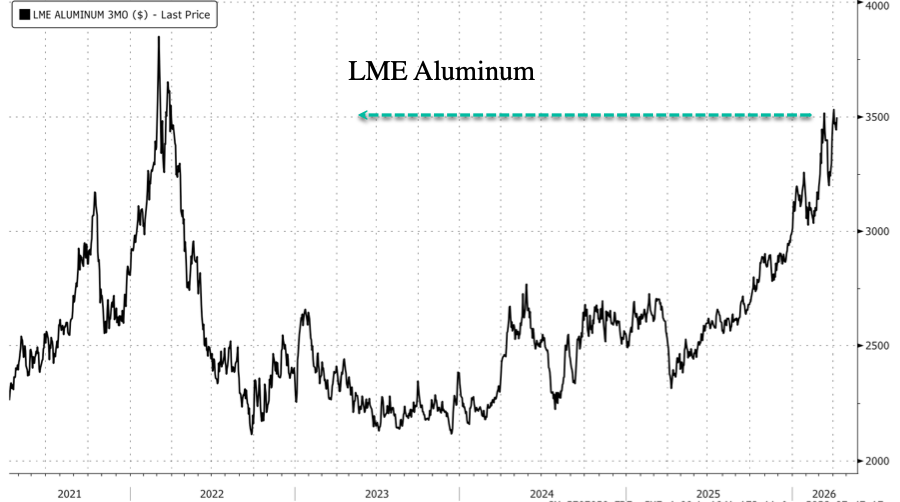
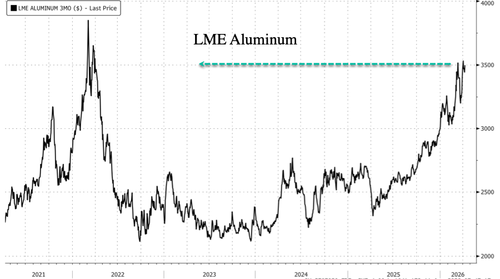
Aluminum futures in London surged to a four-year high on Monday as President Trump’s Strait of Hormuz blockade, set to take effect this morning, threatened to deepen supply chain disruptions across the Gulf region. On top of that, the Gulf’s largest aluminum producer declared force majeure on parts of its contract book over the weekend.
Aluminum climbed 1.4% to $3,547 per ton on the London Metal Exchange as traders priced in increased shipment disruption risk ahead of President Trump’s Hormuz blockade, which U.S. officials said would take effect at 10:00 a.m. New York time on Monday.
The move extends a broader war-driven rally in industrial metals, with aluminum up about 18% year to date, as the market remains gripped by supply fears and tightening Gulf flows.
Emirates Global Aluminum (EGA), the Gulf’s largest aluminum producer, recently halted operations at its Al Taweelah smelter following Iranian missile and drone strikes.
By Saturday, Bloomberg had obtained documents indicating that EGA declared force majeure on parts of its contract book.
EGA is jointly owned by Mubadala Investment Company of Abu Dhabi and the Investment Corporation of Dubai, and it reported 2.83 million tons of cast metal sales in 2025, indicating on its website that it accounted for 4% of the world’s aluminum production. The broader Middle East accounts for about 9% of global aluminum supply.
One of the clearest signs of stress in aluminum markets is the front-end squeeze in the LME curve.
The cash-to-three-month spread jumped 37% to $91.50 a ton from $66.70 on Friday, marking the biggest backwardation since 2007 and signaling a scramble among traders for metal supply.
Earlier this month, Goldman commodity specialist James McGeoch told clients, “Hard to think of a bigger metal supply shock: High degree of expectation this was where it was heading, but the initial reaction was to fade the uncertainty yesterday, that should be replaced by fresh length if history is a guide.”
Tyler Durden
Mon, 04/13/2026 – 07:45
https://www.zerohedge.com/commodities/key-aluminum-spread-london-hits-biggest-backwardation-2007
Trump Reportedly Planning Mass Pardons Of Administration Officials Before Leaving Office
Trump Reportedly Planning Mass Pardons Of Administration Officials Before Leaving Office
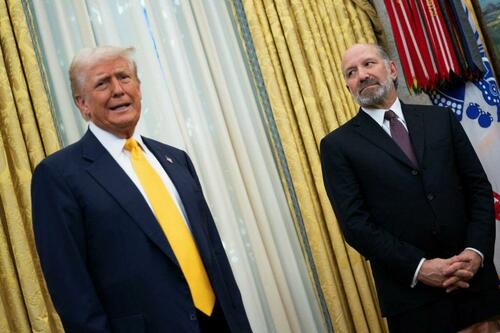
Donald Trump has reportedly promised to pardon virtually his entire White House staff before leaving office, and the radius keeps growing. What started as a quip about anyone within 10 feet of the Oval Office has ballooned into something considerably more sweeping.
“I’ll pardon everyone who has come within 200 feet of the Oval,” Trump allegedly said to a room of aides in a recent meeting, drawing laughs, according to a report from the Wall Street Journal.
The report claims that staffers who raise the possibility of congressional investigations or prosecutions into policy decisions tend to hear about whether preemptive pardons are on the table.
The unconditional power to pardon is one of the most sweeping powers offered to the presidency. This term, Trump has wielded clemency far differently than any other president, dispensing some 1,600 grants to date. Many have gone to allies and donors, or those who had hired them, coming after a social pull-aside or a round of golf. Some have received bipartisan criticism, including one to a crypto billionaire whose company boosted Trump’s own digital-currency company, and another to a former Honduran president convicted of conspiring with cartels to ship cocaine to the U.S. In Trump’s first term, he signed fewer than 250 pardons and commutations.
The president has repeatedly raised the specter of pardons with White House aides and other administration officials, particularly when staff have suggested they could face prosecution or congressional investigations over decisions, people familiar with the comments said. Trump is known to joke about matters that he later seriously pursues, and the frequent references have led some aides to believe he is serious about the pardons, too.
They certainly have reason to be worried that Democrats will attempt to weaponize their powers to launch endless investigations. They’ve repeatedly promised to do so. In response to Trump’s immigration enforcement policies, House Minority Leader Hakeem Jeffries not only promised to prosecute ICE agents and Trump administration officials.
REMINDER: To all members of the Trump administration.
The incitement and engagement in state violence against the American people is a serious crime.
Donald Trump will leave office long before the five-year statute of limitations expires.
You are hereby put on notice. https://t.co/hXAc0mGMrp
— Hakeem Jeffries (@RepJeffries) January 14, 2026
None of this happened in a vacuum. Trump reportedly weighed pardoning White House officials in the chaotic days after January 6, 2021, but decided against it. He later told advisers he regretted that decision. Democrats viciously went after Trump allies, rioters, and even Trump himself.
Critics will certainly want to treat this as a constitutional crisis in progress. But before the outrage fully crystallizes, it’s worth noting who opened the door. Joe Biden issued sweeping preemptive pardons for top officials and family members at the end of his term – including his family, Dr. Anthony Fauci, and the entire January 6 Select Committee – citing the possibility of DOJ scrutiny under Trump. Michael LaRosa, a former communications aide to Biden, had the intellectual honesty to say the quiet part out loud, saying, “By testing the boundaries of the pardon power, Biden cracked the door open and we can’t now complain about Donald Trump walking through it, even if he blows it wide open.”
The White House, however, is dismissing the Wall Street Journal’s report.
“The Wall Street Journal should learn to take a joke,” White House Press Secretary Karoline Leavitt said in a statement. “However, the President’s pardon power is absolute,” she added.
While the White House clearly doesn’t want to confirm the story, there’s reason to believe that even if Trump was joking, there’s a serious point behind it—and Joe Biden effectively gave him cover to act on it. The informal norms governing the pardon power took a significant hit during Biden’s final weeks in office. Trump declined to go that far when he left office in 2021, but with Democrats openly signaling plans to target his officials if they regain power, he may now feel compelled to act to protect them from what he sees as a weaponized justice system.
Tyler Durden
Mon, 04/13/2026 – 06:55

“Muthaf***in’ Robot Dog In The Muthaf***in’ Hood”
“Muthaf***in’ Robot Dog In The Muthaf***in’ Hood”
Authored by Steve Watson via modernity.news,
Residents in Atlanta are staring down robot dogs patrolling their own apartment parking lots — with live foreign operators apparently calling the shots through the machines.
Another viral video posted to X captures the raw street-level reaction as locals confront one of the mechanical units.
The operator responds in real time, and the accent leaves little doubt about the location of the person on the other end of the feed.
Atlanta residents react to the new robot dogs patrolling their apartment parking lot
They speak to the dog and there seems to be a live operator talking back
The person speaking very clearly is likely in India based on the accent
There are plenty of videos of these dogs… pic.twitter.com/01h9kxwyNj
— Wall Street Apes (@WallStreetApes) April 12, 2026
The post continues… “There are plenty of videos of these dogs calling the police on people, so that means someone sitting in India is patrolling our streets and calling the police on Americans. These robotic dogs are equipped with 360° cameras, thermal imaging, headlights, sirens, speakers, and sensors. Despite this they are not fully autonomous, they typically have a live human operator monitoring the feed remotely”
@POTUS @VP @SecWar @SECNAV We need to arrest whichever company heads okayed this on American soil.
I don’t care that it costs less dollars to have a spy from another country operating some company’s surveillance tech this way.
— CYRS (@cyrsbel) April 12, 2026
Who is authorizing foreign operators of robot dogs patrolling American streets?
— Coinkong (@coinkong) April 12, 2026
“What y’all got da robot dawgg in hair fo?”
— SowellMate (@ThomasSowelBuff) April 12, 2026
Phillipines call center lady has better english than the natives.
— Joe Ma (@JoeMa_5) April 12, 2026
Another of these droids was seen recently giving commands to Americans in Atlanta. Even when citizens complied peacefully, the bot issued orders and summon real police — all while the eyes and ears behind the machines sit overseas.
People are seeing these things just roaming around like an episode of Black Mirror.
Meanwhile, in robot dog world 🤖 pic.twitter.com/kyF1oaObBV
— Kiera Diss (@KieraDiss) March 30, 2026
Yeah, I saw that episode of Black Mirror…
…it didn’t go so well. pic.twitter.com/DYymNOLaBE
— Deaconbluezzz (@Deaconbluezzz66) April 12, 2026
While in America they’re being used for parking lot security with the feed manned by foreigners somewhere, in China they’re taking the technology in a far more aggressive direction. Beijing has already unleashed machine-gun-toting robot wolves equipped with a “collective brain” for coordinated urban combat.
Separate footage shows an armed robot dog leading full combat drills as part of the global robot armies advance.
WATCH: Armed Robot Dog Leads Combat Drill; Global Robot Armies Advance
The contrast could not be clearer. Here at home, American neighborhoods get low-level security outsourced to foreign call-center workers who can now watch, listen, record, and report on U.S. citizens 24/7. In China, the same basic platform is being militarized for dominance on the battlefield.
These dogs are not toys. They carry 360-degree cameras, thermal imaging, and sensors that feed data straight back to whoever is paying the operator. That means sensitive footage of American homes, vehicles, and daily movements is streaming overseas — potentially stored, analyzed, or even shared with foreign governments. And when the bots decide to call the cops, it seems to be a foreign voice triggering American law enforcement against American citizens on American soil.
The push toward automation and remote monitoring is delivering a creeping surveillance state where the watchers aren’t even in the country. While elites celebrate the “future,” everyday Americans get robot dogs in the hood and foreign accents telling them to move along.
It’s only a matter of time before the novelty wears off and Americans start trashing these things, and then where do we go from there?
Wait until people in the hood find out how much RAM is worth.
They’ll be ripping that thing up for scrap parts.
— G. C. Seiler (@GCSeiler) April 12, 2026
Your support is crucial in helping us defeat mass censorship. Please consider donating via Locals or check out our unique merch. Follow us on X @ModernityNews.
Tyler Durden
Mon, 04/13/2026 – 06:30
https://www.zerohedge.com/technology/muthafin-robot-dog-muthafin-hood
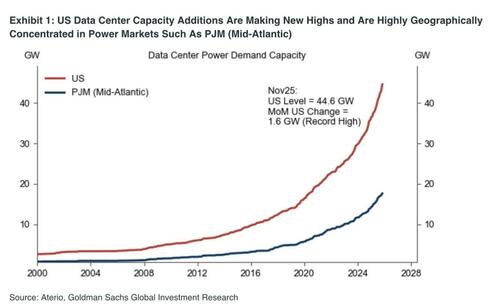
PJM Targets 15 Gigawatts Of New Power To Feed Data Center Boom
PJM Targets 15 Gigawatts Of New Power To Feed Data Center Boom
PJM Interconnection, operator of the largest power grid in the United States spanning 13 states and serving more than 65 million people, has launched an emergency proposal to secure 15 gigawatts of new electricity supply, according to Bloomberg. The move aims squarely at the surging AI data center demand, which has pushed the regional grid to its limits. The plan calls for bilateral negotiations to pair proposed data centers with new power plants.
PJM will begin gauging interest from developers and generators late next week, with the formal matching process running from September 2026 through March 2027. The grid operator described the initiative as a targeted response to potential shortages driven by the AI boom, which has accelerated load growth far beyond earlier forecasts.
We’ve been highlighting the growing strain on national grids like PJM for years now. Data centers are the dominant forces reshaping regional power markets, contributing heavily to capacity costs in recent auctions and forcing operators to scramble during winter peaks.
Spot power prices have already hit records above $1,000 per megawatt-hour…
US SPOT POWER PRICES REACH RECORD HIGH OVER $1,000 PER MWH AT PJM WEST HUB IN PENNSYLVANIA AND MARYLAND
we are about to have a very shrill discussion about data center power use
— zerohedge (@zerohedge) January 27, 2026
Explosive demand from hyperscalers’ facilities in Virginia, Pennsylvania, and surrounding states continues to outpace new generation additions With shortfalls of 60 GW over the next decade.
*PJM SEES POTENTIAL 60GW POWER SUPPLY SHORTFALL OVER NEXT DECADE
This means all batshit insane capex spending plans will be scrapped since there is not enough juice to power the DCs https://t.co/tL14BClKfz
— zerohedge (@zerohedge) February 6, 2026
The timing of this emergency proposal, however, adds a layer of absurdity. Just weeks ago, PJM informed Constellation Energy that transmission project delays could push full grid deliverability for the restarted Crane Clean Energy Center, formerly Three Mile Island Unit 1, out to 2031. That is four years later than Constellation’s target of late 2027 for the roughly 800 MW nuclear plant, even as the facility itself nears readiness. Constellation is now seeking FERC waivers to speed things up.
PJM is scrambling for 15 GW of new capacity while delaying the bolting on of energy sources that are nearly ready to go? We’re not exactly sure what the 4D-chess strategy is here.
The 15 GW target represents a significant slice of capacity roughly equivalent to over a dozen large nuclear or gas-fired plants coming online in short order. Whether developers will step up with firm commitments remains to be seen.
Tyler Durden
Mon, 04/13/2026 – 05:45
https://www.zerohedge.com/markets/pjm-targets-15-gigawatts-new-power-feed-data-center-boom