Category: News

FT Exposes The Literal Definition Of Ponzi-Scheming In Private Equity
FT Exposes The Literal Definition Of Ponzi-Scheming In Private Equity
In what can only be described as the financial industry’s most brazen act of self-dealing since the last crisis, private equity giants are now openly selling assets to themselves at record pace, propping up their crumbling empire with a tactic that reeks of pure Ponzi desperation.
According to the Financial Times, roughly one-fifth of all private equity exits this year involved firms raising fresh cash from new suckers investors to buy portfolio companies from their own aging funds.
That’s a sharp jump from the 12-13% seen in prior years, with Raymond James’ Sunaina Sinha Haldea predicting a staggering $107 billion in these incestuous transactions for 2025, blowing past last year’s $70 billion.
These so-called “continuation vehicles” let PE barons hand money back to restless limited partners in older funds while keeping control of the assets – and, crucially, resetting the clock on lucrative management fees and carried interest.
It’s the ultimate have-your-cake-and-eat-it-too scam: cash out the old money, lock in the new money, and keep milking the same cow indefinitely.
“This year is set to break all records,” Sinha Haldea crowed, calling it a “popular and effective win-win-win liquidity solution” in a market where real exits remain frozen.
Translation: when you can’t find a greater fool outside your own circle, just invent a new fund and pass the hot potato internally.
Jefferies’ Skip Fahrholz chimed in that global volume will hit close to $100 billion, confirming the feeding frenzy.
The FT reports the roster of perpetrators reads like a who’s-who of the buyout racket: PAI Partners flipped part of its stake in ice cream giant Froneri (think Häagen-Dazs) to a continuation vehicle for the second time in a €15 billion-valued deal. Vista Equity, New Mountain Capital, and Inflexion all deployed multibillion-dollar continuation funds to cling to their crown-jewel investments rather than face the harsh light of public markets or genuine third-party buyers.
Even EQT’s CEO Per Franzén, who hasn’t yet dipped into this particular trough, recently admitted he wants in – purely to generate extra fees on existing holdings, naturally.
But beneath the sanitized industry spin lie the glaring conflicts: the same PE firm sits on both sides of the trade, deciding the price at which assets move from one of its pockets to another.
Pension funds and other LPs are rightly furious, fearing managers low-ball valuations to screw departing investors while setting themselves up for fat future carry on the “new” fund.
The Abu Dhabi Investment Council just sued U.S. firm Energy & Minerals Group over exactly this alleged grift: EMG tried to undervalue gas driller Ascent Resources in a self-sale that would have boosted its ownership and restarted fee collection.
The deal collapsed amid the lawsuit, and now outside bidders are circling.
What was once a last-resort lifeboat for dogs nobody wanted has morphed into a preferred tool for hoarding winning assets, all while the broader exit environment remains a graveyard.
Bain & Co’s latest survey found nearly two-thirds of LPs still prefer old-fashioned exits—actual sales to outsiders or IPOs—over this circular money-shuffling charade.
Yet with no real buyers in sight, expect continuation vehicles to become the new normal: a glorified Ponzi mechanism dressed up in GP-LP alignment jargon, keeping the private equity bubble inflated just a little longer – until the music finally stops.
Tyler Durden
Sat, 01/03/2026 – 18:05
https://www.zerohedge.com/markets/ft-exposes-literal-definition-ponzi-scheming-private-equity

Chinese EV Exports Are Exploding, And The West Has No Way To Stop Them
Chinese EV Exports Are Exploding, And The West Has No Way To Stop Them
Authored by Michael Gauthier via carscoops.com,
Chinese EV exports are booming and were up 87% last month.
Mexico was the top export market in November with 19,344 units.
Over 600,000 Chinese EVs have been exported to Europe in 2025.
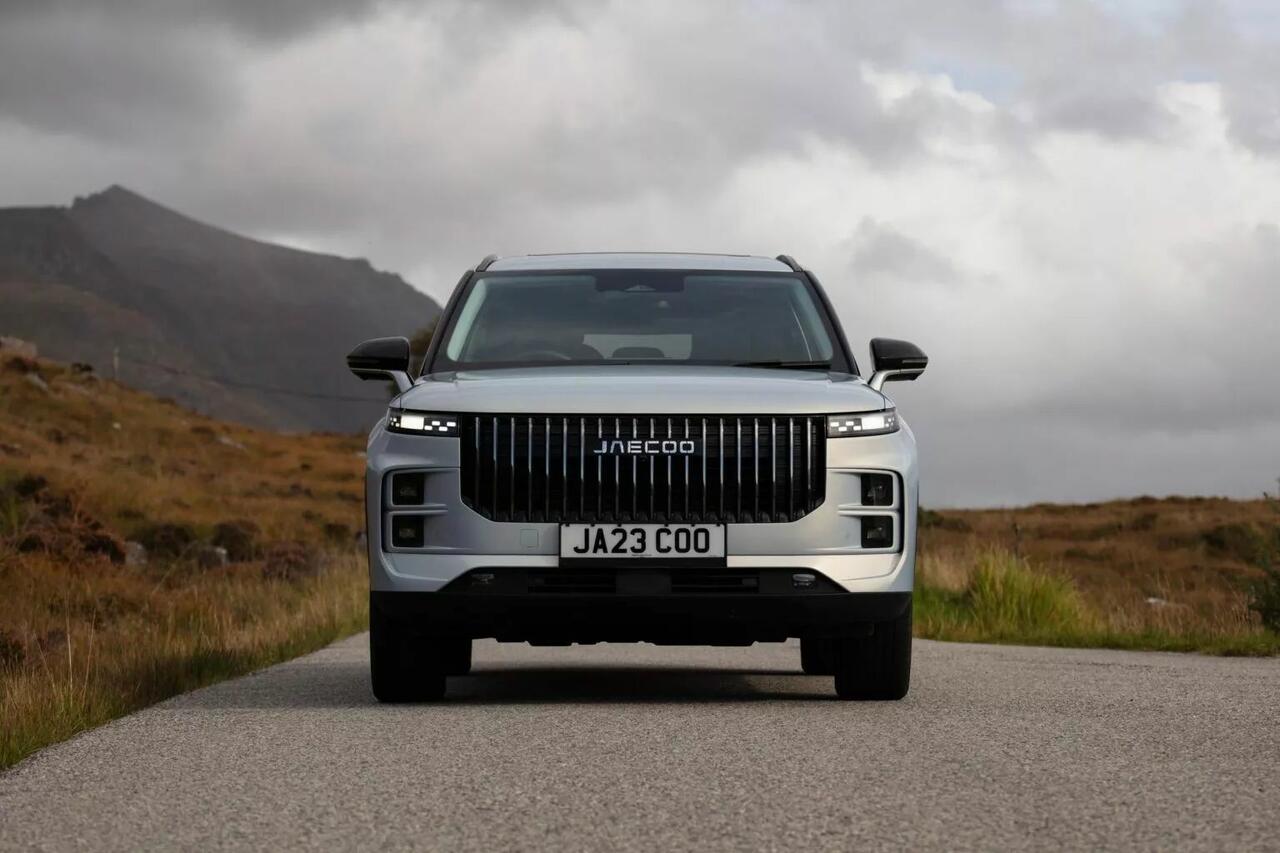
Chinese cars were once the butt of jokes, but they’ve become a major threat to Western automakers. That’s clear today as data from China’s General Administration of Customs has revealed exports of electric vehicles soared 87 percent in November.
That’s a huge increase compared to last year and the most popular destination in November was Mexico. Chinese EV exports to the country soared 2,367 percent to total 19,344 units. While the numbers don’t reveal which vehicles were responsible for the boost, the BYD Dolphin Mini has been a hit south of the border.
The small EV measures just 148.8 inches (3,780 mm) long and features a front-mounted motor developing 74 hp (55 kW / 75 PS) and 100 lb-ft (135 Nm) of torque. Customers can also get 30.1 and 38.8 kWh battery packs, which provide a NEDC range of up to 236 miles (380 km).
Mexico was followed by Indonesia and Thailand as the top markets for Chinese exports last month. The former country imported 17,503 vehicles, while the latter took in 13,517.
Focusing on Europe, exports to the UK soared 113 percent last month to 9,096. This means 121,555 Chinese EVs have arrived since the beginning of the year and this is an increase of 24 percent .
That pales in comparison to Belgium, where 195,309 Chinese EVs have been imported in the first 11 months of the year. However, it’s worth noting this is a 15 percent drop compared to 2024.
Where Most Chinese EVs Are Going
Asia remained the biggest market for Chinese EVs as exports climbed 71 percent to 110,061 units in November. They were followed by Europe and Latin America (including the Caribbean).
While Asian countries have imported nearly 1 million Chinese EVs through November, the big story is Europe’s 604,105. That’s 12 percent more than 2024 and the number shows why European automakers and politicians are so worried.
Tyler Durden
Sat, 01/03/2026 – 17:30
https://www.zerohedge.com/energy/chinese-ev-exports-are-exploding-and-west-has-no-way-stop-them

Visualizing The Distribution Of Household Income In America
Visualizing The Distribution Of Household Income In America
High income households in America capture a large share of the nation’s earnings, and this gulf has widened over time.
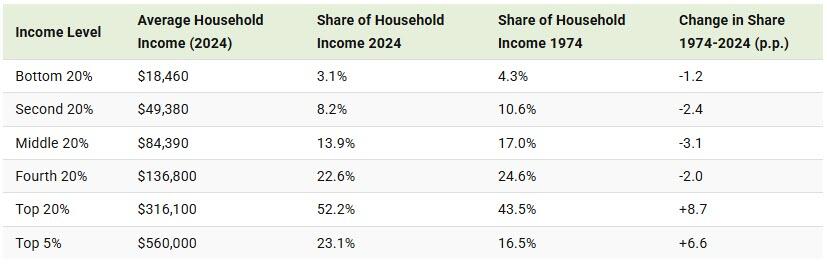
In 2024, the top 20% – with an average household income of $316,100 – took home 52.2% of all national income, up 8.7 percentage points from 1974.
Meanwhile, the bottom 20% received just 3.1%, further shrinking over the period.
This graphic, via Visual Capitalist’s Dorothy Neufeld, shows U.S. household income distribution in 2024, based on data from the U.S. Census Bureau.
Trends in U.S. Income Distribution (2024 vs. 1974)
Below, we show how household income is divided across different income brackets:
In 2024, the bottom fifth of U.S. earners averaged $18,460 in household income. While small, their share of total national income has fallen sharply, declining by about 28% since 1974.
Moreover, this group includes workers earning the federal minimum wage of $7.25 per hour, as well as the roughly 760,000 workers who earn below this level. In particular, younger workers make up a large portion of this bracket, with 43% of those earning minimum wage or less being 25 years old or younger.
As we can see, the middle fifth of earners received 13.9% of U.S. household income in 2024, down from 17% in 1974. With an average household income of $84,390, this bracket largely reflects median-wage workers, spanning occupations such as civil engineers, computer programmers, and clinical psychologists.
On the other hand, the top 5% of earners, averaging $560,000 in income has seen it share expand by 6.6 percentage points. Moreover, it is the only income bracket, along with the top 20%, to see its share of national income grow compared to 1974.
To learn more about this topic, check out this graphic on real wage growth by state.
Tyler Durden
Sat, 01/03/2026 – 16:55
https://www.zerohedge.com/personal-finance/visualizing-distribution-household-income-america
Venezuelans wonder who’s in charge as Donald Trump claims contact with Nicolás Maduro’s deputy
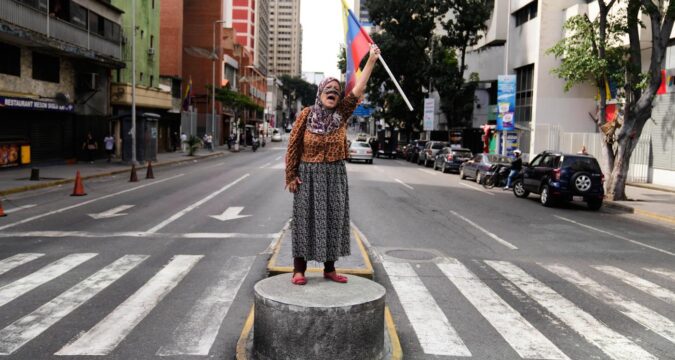
BUENOS AIRES, Argentina — Venezuelans on Saturday were scrambling to understand who is in charge of their country after a U.S. military operation that captured President Nicolás Maduro.
President Donald Trump delivered a shocking pick: The United States, perhaps in coordination with one of Maduro’s most trusted aides.
Delcy Rodríguez has served as Maduro’s vice president since 2018, overseeing much of Venezuela’s oil-dependent economy as well as its feared intelligence service. But she is someone the Trump administration apparently is willing to work with, at least for now.
“She’s essentially willing to do what we think is necessary to make Venezuela great again,” Trump told reporters of Rodríguez, who faced U.S. sanctions during Trump’s first administration for her role in undermining Venezuelan democracy.
In a major snub, Trump said opposition leader Maria Corina Machado, who was awarded last year’s Nobel Peace Prize, didn’t have the support to run the country.
Trump said Rodríguez had a long conversation with Secretary of State Marco Rubio in which Trump claimed she said, “‘We’ll do whatever you need.’”
“I think she was quite gracious,” Trump added. “We can’t take a chance that somebody else takes over Venezuela that doesn’t have the good of the Venezuelan people in mind.”
Rodríguez tried to project strength and unity among the ruling party’s many factions, downplaying any hint of betrayal. In remarks on state TV, she demanded the immediate release of Maduro and his wife, Cilia Flores, and denounced the U.S. operation as a flagrant violation of the United Nations charter.
“There is only one president in this country, and his name is Nicolás Maduro,” Rodríguez said, surrounded by top civilian officials and military commanders.
There was no immediate sign that the U.S. was running Venezuela.
“What will happen tomorrow? What will happen in the next hour? Nobody knows,” Caracas resident Juan Pablo Petrone said.
No sign of a swearing-in
Trump indicated that Rodríguez had been sworn in already as president of Venezuela, per the transfer of power outlined in the constitution. However, state television has not broadcast any swearing-in ceremony.
In her televised address, Rodríguez did not declare herself acting president or mention a political transition. A ticker at the bottom of the screen identified her as the vice president. She gave no sign that she would be cooperating with the U.S.
“What is being done to Venezuela is an atrocity that violates international law,” she said. “History and justice will make the extremists who promoted this armed aggression pay.”
The Venezuelan constitution also says a new election must be called within a month in the event of the president’s absence.
But experts have been debating whether the succession scenario would apply here, given the government’s lack of popular legitimacy and the extraordinary U.S. military intervention.
Venezuelan military officials were quick to project defiance in video messages.
“They have attacked us but will not break us,” said Defense Minister Gen. Vladimir Padrino López, dressed in fatigues.
Interior Minister Diosdado Cabello appeared on state TV in a helmet and flak jacket, urging Venezuelans to “trust in the political leadership and military” and “get out on the streets” to defend the country’s sovereignty.
“These rats attacked and they will regret what they did,” he said of the U.S.
Strong ties with Wall Street
A lawyer educated in Britain and France, Rodríguez has a long history of representing the revolution started by the late Hugo Chávez on the world stage.
She and her brother, Jorge Rodríguez, head of the Maduro-controlled National Assembly, have strong leftist credentials born from tragedy. Their father was a socialist leader who died in police custody in the 1970s, a crime that shook many activists of the era, including a young Maduro.
Unlike many in Maduro’s inner circle, the Rodríguez siblings have avoided criminal indictment in the U.S. Delcy Rodríguez has developed strong ties with Republicans in the oil industry and on Wall Street who balked at the notion of U.S.-led regime change.
Among her past interlocutors was Blackwater founder Erik Prince and, more recently, Richard Grenell, a Trump special envoy who tried to negotiate a deal with Maduro for greater U.S. influence in Venezuela.
Fluent in English, Rodríguez is sometimes portrayed as a well-educated moderate in contrast to the military hardliners who took up arms with Chávez against Venezuela’s democratically elected president in the 1990s.
Many of them, especially Cabello, are wanted in the U.S. on drug trafficking charges and stand accused of serious human rights abuses. But they continue to hold sway over the armed forces, the traditional arbiter of political disputes in Venezuela.
That presents major challenges to Rodríguez asserting authority. But experts say that Venezuela’s power brokers have long had a habit of closing ranks behind their leaders.
“These leaders have all seen the value of staying united. Cabello has always taken a second seat or third seat, knowing that his fate is tied up with Maduro’s, and now he very well might do that again,” said David Smilde, a sociology professor at Tulane University who has conducted research into Venezuela’s political dynamics over the past three decades.
“A lot depends on what happened last night, which officials were taken out, what the state of the military looks like now,” Smilde said. “If it doesn’t have much firepower anymore, they’re more vulnerable and diminished and it will be easier for her to gain control.”
An apparent snub of the opposition
Shortly before Trump’s press conference, Machado, the opposition leader, called on her ally Edmundo González — a retired diplomat widely considered to have won the country’s disputed 2024 presidential election — to “immediately assume his constitutional mandate and be recognized as commander-in-chief.”
In an triumphant statement, Machado promised that her movement would “restore order, free political prisoners, build an exceptional country and bring our children back home.”
She added: “Today we are prepared to assert our mandate and take power.”
Asked about Machado, Trump was blunt: “I think it would be very tough for (Machado) to be the leader,” he said.
“She doesn’t have the support or respect within the country.”
Venezuelans expressed shock, with many speculating on social media that Trump had mixed up the two women’s names. Machado has not responded to Trump’s remarks.
Goodman reported from Miami.
https://www.chicagotribune.com/2026/01/03/venezuelans-trump-maduros-deputy/
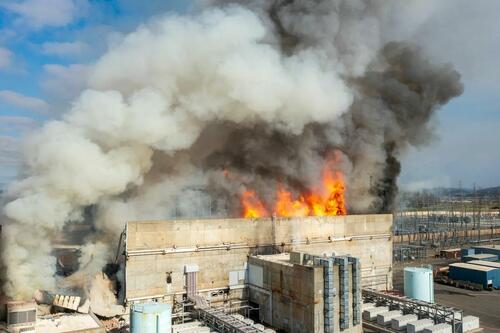
The Unreported Story Of Grid Scale Battery Fires
The Unreported Story Of Grid Scale Battery Fires
Authored by Francis Menton via the Manhattan Contrarian,
The geniuses who are planning New York’s energy future think that they can make intermittent wind and solar generators work to power the electrical grid by the simple device of providing some battery storage. The idea is that when there is abundant wind and sun, they can store up the power for use during those calm and dark periods in the winter. How much battery storage will that take? It’s a simple arithmetic calculation, but none of our supposed experts have taken the trouble to crunch the numbers.
Nevertheless, without any kind of feasibility study of whether this will work, they soldier forth building large grid-scale battery storage facilities. The battery building program is under way, at least to some degree, and a few such facilities are actually complete and operating out in the rural parts of the state. Meanwhile, there are plans for some much larger such facilities in New York City, including right in some of its most densely-populated sections. Is there any problem with this that we ought to know about?
In a post back in March 2024, I reported on the progress of our two “climate leader” states with developing grid-scale battery storage. It turned out that the big problem was that these facilities were subject to large and dangerous fires on a regular basis. In some cases the same facility would catch fire multiple times. That post reported on major fires in California at a site called Valley Center in San Diego County in September 2023, and at another one called Moss Landing south of San Francisco in September 2022. In January 2025, the Moss Landing facility had another major fire. From the EPA website:
On January 16, 2025, the Moss Landing 300 battery energy storage system at the Moss Landing Vistra power plant (Monterey County, Calif.) caught fire.
The 300-megawatt system held about 100,000 lithium-ion batteries.
About 55 percent of the batteries were damaged by the fire.
There were prior fires at the Moss Landing facility in September 2021 and February 2022.
Back here in New York, my March 2024 post reported on no fewer than three major fires at grid battery storage facilities in this state that had taken place during 2023. The following quote came from a piece at Canary Media from August 2023:
New York state is grappling with how to adjust its ambitious buildout of clean energy storage after fires broke out at three separate battery projects between late May and late July [2023]. . . . First, on May 31, a battery that NextEra Energy Resources had installed at a substation in East Hampton caught fire. . . . Then, on June 26, fire alarms went off at two battery units owned and operated by Convergent Energy and Power in Warwick, Orange County; one of those later caught fire. On July 27, a different Convergent battery at a solar farm in Chaumont caught fire and burned for four days straight.
Might you have the idea that these fires are becoming less frequent over time? If so, that’s only because these fires are one of those things — like the Somali welfare fraud in Minnesota — that the liberal media just don’t choose to report. It turns out that the Convergent Energy facility in Warwick, New York had another big fire just last week. From Etica AG, December 22:
Late on the evening of December 19, 2025, a fire occurred at the Church Street Battery Storage Facility in Warwick, New York, operated by Convergent Energy & Power. While no injuries were reported and the fire was confined to a single container, the incident remained active into the following day and prompted a multi-agency response, air quality monitoring, and renewed scrutiny of battery energy storage system (BESS) safety in the community. For Warwick residents and local leaders, the fire carried added weight. The town has experienced multiple battery storage incidents in recent years, and each new event raises difficult questions about risk, emergency response, and whether existing BESS designs are suitable for locations near homes, schools, and small businesses.
I can’t find any mention of this battery fire at the New York Times or at major media sites like CNN or the major television networks.
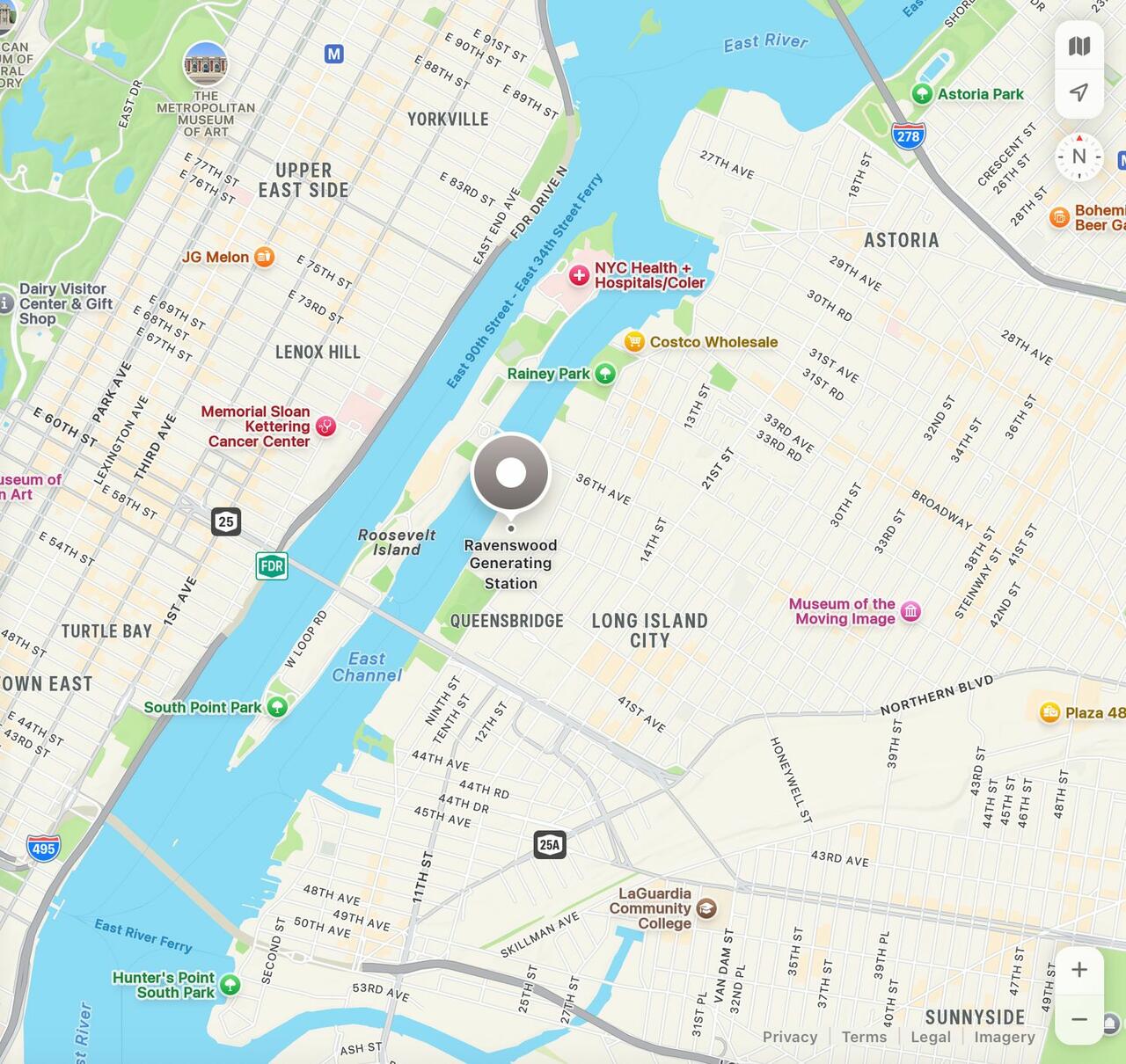
The Convergent Energy Warwick energy storage facility has a capacity of 12 MW and 57 MWh. Meanwhile, back here in New York City, there are plans, well advanced (although not quite yet under construction), to build a much larger grid battery storage facility in Ravenswood, Queens. That would be right on the East River, directly across from East Midtown and the Upper East Side of Manhattan:
You can see on the map how close much of Manhattan is to this facility. To be fair, the wind usually blows the other way, but the parts of Queens near this facility are also very densely populated. Something called Queensbridge Houses — the largest public housing project in the country — is immediately adjacent.
The planned capacity of the battery storage facility in Ravenswood is 316 MW/2528 MWh — some 25 or more times the size of the facility in Warwick that has now caught fire at least twice.
A New York agency going by the name NYSERDA (New York State Energy Research and Development Authority) is leading the charge to build these energy storage facilities, including in densely populated areas like Queens. On their website, they have a page touting the new battery storage project at the Ravenswood location. Believe it or not, their sales pitch is that the new battery facility is cleaner and greener than the prior natural gas power plants on the site. Here is a quote they take from Queens Borough President Donovan Richards:
“The days of environmental and economic injustice in Western Queens, especially for our historically marginalized public housing families, are coming to an end. As we prepare to transform the Ravenswood Generating Station into a clean energy producer, it’s critical that the surrounding community reaps the benefits of that transition,” said Borough President Richards.
Somehow, both NYSERDA and Donovan omit to mention the issue of the fires.
Tyler Durden
Sat, 01/03/2026 – 16:20
https://www.zerohedge.com/energy/unreported-story-grid-scale-battery-fires

Forgetting history can lead to oppression, clergy members warn
Historical amnesia can threaten freedom, Rev. Nicole P. Guns and others warned Thursday during an Emancipation Proclamation remembrance ceremony at Gary’s First Baptist Church.
The Interfaith Clergy Council of Gary & Vicinity held the service on Jan. 1, marking the anniversary of the effective date of President Abraham Lincoln’s Emancipation Proclamation. It took effect Jan. 1, 1863, freeing slaves in rebel states.
That proclamation was the start of bringing freedom, not the final product, Rev. Joy Heine, of Bethel Lutheran Church, said. “It took the war to end. It took the 13th Amendment, which didn’t even happen until a couple of years after the war.”
Heine and Guns warned that remembering history is vital to preserving freedom. “Any kind of history is being whitewashed like nobody’s business,” Heine said, with attacks on diversity, equity and inclusion and history being scrubbed by the Trump administration to downplay or erase contributions by minorities.
“It’s our time and year to tell the story,” Heine said.
Guns, senior pastor at First Baptist Church in Gary, preached a sermon based on scripture that told of the Israelites repeatedly forgetting their history and having God’s protection removed from them.
Members of the First Baptist Church music ministry sing during the 65th Emancipation Proclamation Service of Freedom at the First Baptist Church of Gary on Thursday, Jan. 1, 2026. (Kyle Telechan/for the Post-Tribune)
“There’s something sacred about remembering the journey,” she said. “When we forget where we come from, there are consequences.”
“History is not always fairy tales and lullabies,” Guns warned. Prior to the Emancipation Proclamation, slavery was the law in the rebellious states. Even with Lincoln’s executive order proclaiming freedom for the slaves, the practice continued until the war was completed.
But equality wasn’t automatic.
“Deliverance that does not lead to justice is not complete,” Guns said.
The cycle of oppression has continued. Slavery, Jim Crow, separate but equal, war on drugs, ICE and mid-decade redistricting are all signs of that oppression of minorities, she said. “It repeated itself. It just had another name.”
“Leadership changed, but the culture did not,” Guns said. “The people experienced freedom, but they never institutionalized justice.”
“Freedom without protection from abuse is backlash,” she said.
Indiana NAACP State Conference President Emeritus Barbara Bolling-Williams recites the Emancipation Proclamation during the 65th Emancipation Proclamation Service of Freedom at the First Baptist Church of Gary on Thursday, Jan. 1, 2026. (Kyle Telechan/for the Post-Tribune)
“We can’t allow people to whitewash our history,” Guns said.
“It is biblical to tell our story because it’s about what God did for us,” she said. “Give God the praise.”
Guns invoked the story of the Israelites not remembering their legacy.
“God told them to remember and to tell their story, so we’ve got to do the same,” she said. “This Emancipation Day is a holy day. It is a sacred day.”
Three things happen when a people forget their story, Guns said. “When we forget God, we are at risk of misdirected worship.”
“This generation had heard the story, but they had not inherited the testimony,” she said. “Forgetting God did not lead to freedom; it led to new forms of bondage.”
The Israelites drifted from God to other gods, “the gods who liked to put his name on buildings, who tore down historical buildings, these gods,” Guns said, implicating President Donald Trump without naming him.
“For some, your idol may be your success,” your wallet, your privilege, etc., Guns said. But that’s drifting away from God.
Rabbi Len Zukrow, of Temple Beth-El of Munster, recites Old Testament scripture during the 65th Emancipation Proclamation Service of Freedom at the First Baptist Church of Gary on Thursday, Jan. 1, 2026. (Kyle Telechan/for the Post-Tribune)
“This danger is not always about rebellion; it’s about a drift away,” she said. “They abandoned the source of their freedom.”
“We live in the days of misinformation and the rewriting of history,” Guns warned. “Whatever we serve begins to shape us, begins to redirect us.”
“We push Jesus as a mascot to push our political agenda,” corrupting what Jesus really stands for, she said.
“We are also at risk for moral vulnerability,” Guns said.
“The anger of the Lord was kindled against Israel,” she said. “This is not God abandoning them, it’s God removing God’s protection.”
Interfaith Clergy Council Gary president Dr. Shelley Fisher speaks during the 65th Emancipation Proclamation Service of Freedom at the First Baptist Church of Gary on Thursday, Jan. 1, 2026. (Kyle Telechan/for the Post-Tribune)
What once could not touch them now had access to them. “This is the danger of forgetting God.”
“Freedom without grounding leaves us exposed,” Guns warned. “You can be free in name but unprotected by systems. Freedom can be eroded from the outside and undermined from within.”
“Our missteps are repeated” when historical amnesia occurs, she said. “When freedom is not transformed, our oppression returns.”
“We’re in difficult times,” ICC President Rev. Shelley Fisher said. She denounced Christian nationalism, “where people say we are the pure race and this is our country and people are subservient to us.”
“We are the ones who are educating our children, our teenagers, even the adults of our history, the facts,” she said. “We need to resist with facts.”
Doug Ross is a freelance reporter for the Post-Tribune.

Democrats Melt Down Over Capture And Arrest Of Dictator Maduro
Democrats Melt Down Over Capture And Arrest Of Dictator Maduro
President Donald Trump ordered a midnight military raid that captured Venezuelan dictator Nicolás Maduro and his wife, Cilia Flores. U.S. forces pulled off the job without a hitch, hauling in the pair.
“The United States of America has successfully carried out a large scale strike against Venezuela and its leader, President Nicolas Maduro, who has been, along with his wife, captured and flown out of the Country,” Trump announced on Truth Social at 4:21 EST. “This operation was done in conjunction with U.S. Law Enforcement. Details to follow.”
Hours later, Attorney General Pam Bondi announced the pair had been indicted.
“Nicolas Maduro and his wife, Cilia Flores, have been indicted in the Southern District of New York,” she explained in a post on X. “Nicolas Maduro has been charged with Narco-Terrorism Conspiracy, Cocaine Importation Conspiracy, Possession of Machineguns and Destructive Devices, and Conspiracy to Possess Machineguns and Destructive Devices against the United States. They will soon face the full wrath of American justice on American soil in American courts.”
Bondi then thanked President Trump for “having the courage to demand accountability on behalf of the American People,” as well as a “huge thank you to our brave military who conducted the incredible and highly successful mission to capture these two alleged international narco traffickers.”
While Venezuelans hit the streets in wild celebration, popping bottles and celebrating freedom, Democrats in Washington, D.C., clutched their pearls and went into full meltdown mode, accusing Trump of getting us into a war and violating the Constitution.
“Trump’s unilateral operation last night was an illegal act of war without Congress’s authorization,” Rep. Dan Goldman (D-N.Y.) claimed.
“Maduro is a brutal dictator who has oppressed the Venezuelan people, but our constitution does not yield for bad people. If Congress is to survive as an institution, the Republican majority must join us exercising our power to hold this administration accountable for this flagrant violation of the constitution.”
He wasn’t the only Democrat to claim that Trump acted illegally.
“Without authorization from Congress, and with the vast majority of Americans opposed to military action, Trump just launched an unjustified, illegal strike on Venezuela,” Rep. Jim McGovern (D-Mass.) claimed.
“He says we don’t have enough money for healthcare for Americans—but somehow we have unlimited funds for war??”
Sen. Elizabeth Warren (D-Mass.) also chimed in.
“President Trump’s unilateral military action to attack another country and seize Maduro — no matter how terrible a dictator he is — is unconstitutional and threatens to drag the U.S. into further conflicts in the region,” she argued.
“The American people voted for lower costs, not for Trump’s dangerous military adventurism overseas that won’t make the American people safer.”
Sen. Ruben Gallego (D-Ariz.) similarly accused Trump of getting the United States into an “illegal” war.
“This war is illegal, it’s embarrassing that we went from the world cop to the world bully in less than one year,” he said.
But these claims don’t hold water.
“Trump does not need congressional approval for this type of operation,” explains constitutional scholar Jonathan Turley. “Presidents, including Democratic presidents, have launched lethal attacks regularly against individuals. President Barack Obama killed an American citizen under this ‘kill list’ policy. If Obama can vaporize an American citizen without even a criminal charge, Trump can capture a foreign citizen with a pending criminal indictment without prior congressional approval.”
Turley likened the operation to the 1989 capture and prosecution of Panamanian dictator Manuel Noriega. U.S. courts upheld the “abduction” model and rejected head‑of‑state immunity and extradition‑treaty objections.
“Legally, Trump has the upper hand in this case. Maduro will replay the arguments from the Noriega case. However, he presents an even weaker case on the merits under the controlling precedent than did Noriega,” Turley explained.
Tyler Durden
Sat, 01/03/2026 – 15:45
https://www.zerohedge.com/political/democrats-melt-down-over-capture-and-arrest-dictator-maduro
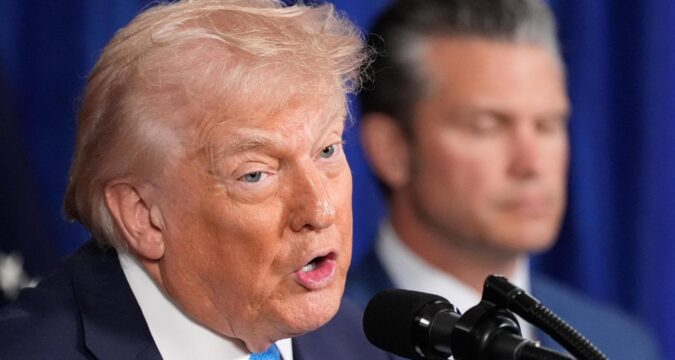
After ousting Nicolás Maduro in Venezuela, Donald Trump commits himself to another foreign policy project
WASHINGTON — President Donald Trump declared Saturday’s military operation that led to the ouster of Nicolás Maduro a major success as he offered a vague plan for his administration “to run” Venezuela until a transition of power can take place.
While there are no visible signs of a U.S. presence on the ground in Caracas, Trump was demonstrating chutzpah that’s become the trademark of his foreign policy approach. It’s one marked by a grand confidence that his will on the international stage is an immovable force.
“This was one of the most stunning, effective and powerful displays of American military might and competence in American history,” Trump declared at a news conference at his Mar-a-Lago resort in Florida.
The president strode into office with a promise to turn the page on America’s decades of foreign entanglements. But on Saturday, he committed the U.S. to help Venezuela usher in a period of “peace” and “justice” after decades of rule by strongmen.
The president’s pledge to a Venezuela project comes as he finds himself struggling to bring about a permanent peace between Israel and Hamas in Gaza and find an endgame to Russia’s nearly four-year war in Ukraine.
But the path ahead is treacherous. The White House will need to grapple with any power vacuum caused by Maduro’s ouster and inevitable complications of trying to maintain stability in a country that’s already endured years of hyperinflation, food and medicine shortages and brain drain despite its vast oil wealth.
It also remains to be seen what lessons U.S. adversaries may take from Trump’s decision to demonstrate American might in its sphere of influence in the aftermath of Trump’s play in Caracas. China’s Xi Jinping has vowed to annex the self-ruled island of Taiwan and Russia’s Vladimir Putin has designs on neighbor Ukraine and diminishing NATO’s eastern flank.
Yet Trump was unflinching in his confidence that the bad actors of the old government will be pushed aside as he helps make Venezuela “great again.” He also sought to reassure American taxpayers that they won’t be on the hook for his plan to help out Caracas.
“The money coming out of the ground is very substantial,” Trump said. “We’re going to get reimbursed for everything that we spend.”
Trump hasn’t shied away from flexing U.S. military might even as he has vowed to keep America out of war. He’s now twice used U.S. forces to carry out risky operations against American adversaries. In June, he directed U.S. strikes on key Iranian nuclear sites.
Saturday’s action stirred fresh anxiety in capitals around the world that have sought to adjust to a new normal in Trump 2.0, where the idea of the U.S. trying to find global consensus on issues of war and peace is now passe.
What’s next for Venezuela?
European allies had expressed concern as Trump built up a massive presence of troops in the Caribbean in recent months and carried out dozens of lethal strikes on suspected drug smugglers — many that the administration claimed were effectively an arm of the Maduro government.
Maduro was hardly viewed as a choir boy by the international community. His 2018 and 2024 elections were seen as riddled with irregularities and viewed as illegitimate.
But many U.S. allies greeted news of Maduro’s capture with a measure of trepidation.
European Commission President António Costa said he had “great concern” about the situation in Venezuela following the U.S. operation.
France’s Foreign Minister Jean-Noël Barrot said “the military operation that led to the capture of Maduro infringes the principle of the non-use of force that underpins international law.”
The criticism from some Democrats over Trump’s military action to oust Maduro was immediate.
“This war is illegal, it’s embarrassing that we went from the world cop to the world bully in less than one year.” Sen. Ruben Gallego of Arizona wrote on X. “There is no reason for us to be at war with Venezuela.”
Russia’s foreign ministry condemned what it called a U.S. “act of armed aggression” against Venezuela in a statement posted on its Telegram channel Saturday. The ouster of Maduro, who was backed by the Russians, comes as Trump is urging Putin to end his war on Ukraine.
“Venezuela must be guaranteed the right to determine its own destiny without any destructive, let alone military, outside intervention,” the statement said.
Similarly, China’s foreign ministry in a statement condemned the U.S. operation, saying it violates international law and Venezuela’s sovereignty.
Capture follows months of pressure
The operation was the culmination of a push inside the administration led by Secretary of State Marco Rubio and other like-minded foes of Maduro who have been urging Trump to take action against the Venezuelan leader for years.
In south Florida — the epicenter of the Venezuelan diaspora opposition to Maduro that has influenced Rubio’s thinking — Saturday’s operation was cheered as an era-changing moment for democracy.
Rep. Carlos Gimenez, a Florida Republican, said he had spoken to Rubio and thanked Trump for having “changed the course of history in our hemisphere. Our country & the world are safer for it,” he wrote on X, comparing Maduro’s ouster to the fall of the Berlin Wall.
Trump: Venezuela has no chance without his intervention
Maduro had sought a pathway to exit from power while saving face.
Venezuelan government officials had floated a plan in which Maduro would eventually leave office, The Associated Press reported in October.
The proposal called for Maduro to step down in three years and hand over to his vice president, Delcy Rodriguez, who would complete Maduro’s six-year term that ends in January 2031. Rodriguez would not run for reelection under the plan.
But the White House had rejected the proposal because the administration questioned the legitimacy of Maduro’s rule and accused him of overseeing a narco-terrorist state.
Maduro earlier this week said Venezuela was open to negotiating an agreement with the United States to combat drug trafficking and work with Washington on promoting U.S. further investment in the Venezuelan oil industry. Trump said Maduro was recently offered chances to surrender but declined.
Rubio held a long phone conversation on Saturday with Rodriguez, Trump said. In an address to the nation, she demanded the U.S. free Maduro but left open the possibility of dialogue with Trump.
“If we just left, it has zero chance of ever coming back. We’ll run it properly. We’ll run it professionally,” Trump said. “We’ll have the greatest oil companies in the world going in, invest billions and billions of dollars. … And the biggest beneficiary are going to be the people of Venezuela.”
Pentagon chief Pete Hegseth said Maduro “F’d around and found out.” He added adversaries of the U.S. should “remain on notice” that “America can project our will anywhere, anytime.”
“Welcome to 2026,” Hegseth said. “Under President Trump, America is back.”
Venezuela’s opposition says the rightful president is the exiled politician Edmundo González, an ally of opposition leader Maria Corina Machado.
Trump said he wasn’t ready to commit to a certain leader but pledged his administration has to remain “very involved” in Venezuela.
“We can’t take a chance of letting somebody else run it — just take over where (Maduro) left,” Trump said.
AP writers Darlene Superville in Palm Springs, Fla., Matthew Lee in Washington, Kanis Leung in Hong Kong, Sylvie Corbet in Paris, and Elise Morton in London contributed reporting.
https://www.chicagotribune.com/2026/01/03/maduro-venezuela-trump-foreign-policy-project/

North America Leads Largest LNG Export Surge Since 2022
North America Leads Largest LNG Export Surge Since 2022
Authored by Tsvetana Paraskova via OilPrice.com,
Surging liquefied natural gas exports from new North American export plants likely pushed global LNG shipments in 2025 by the most since 2022, Kpler data showed on Tuesday.
The annual rise in 2025 would be the steepest increase in global LNG exports since 2022, when shipments grew by 4.5% compared to 2021, the data showed.
North America was the key supplier of new LNG volumes, as Canada’s first-ever export facility, LNG Canada, started shipments in the middle of 2025, and Plaquemines LNG in Louisiana launched operations and ramped up shipments throughout the year.
Thanks to rising capacity and volumes, the U.S. is set to become the first LNG exporter in the world to have passed in 2025 the threshold of 100 million tons of LNG exports in one year.
Additional LNG supply is poised to hit the market between 2026 and 2030 as more U.S. export plants come online and Qatar begins shipments from its huge capacity expansion of the North Field export facilities.
The U.S. is set to export 14.9 billion cubic feet per day of LNG in 2025, up by 25% from 2024, the Energy Information Administration (EIA) said in its latest Short-Term Energy Outlook (STEO) for December. With new projects ramping up, the EIA expects U.S. LNG exports to jump to an average of 16.3 billion cubic feet per day in 2026.
Despite warnings of a near-term global LNG glut, top exporters in the Middle East, including Qatar and the United Arab Emirates (UAE), see strong demand going forward and flag insufficient investment in supply in the medium to long term.
The UAE is growing its LNG exports to meet surging global demand that will outpace investment in supply, Energy Minister Suhail al Mazrouei told Reuters earlier in December.
“I agree with his excellency, Minister of Qatar, that the demand is going to be much, much more than the projects that we are seeing,” the UAE official added.
Earlier this month, Saad Sherida Al-Kaabi, QatarEnergy’s CEO and the Minister of State for Energy Affairs of Qatar, said that global LNG demand will grow, led by increased power needs from AI-related data centers.
Tyler Durden
Sat, 01/03/2026 – 15:10
https://www.zerohedge.com/energy/north-america-leads-largest-lng-export-surge-2022
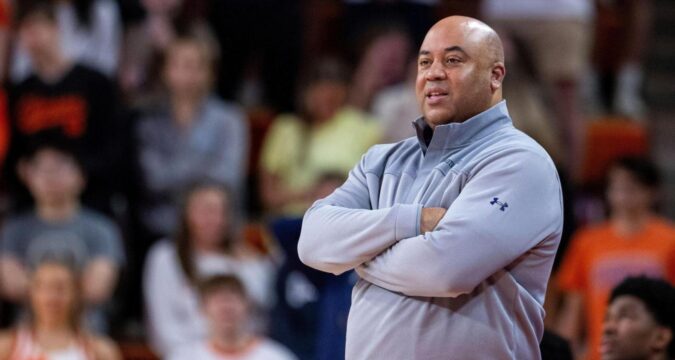
Notre Dame coach Micah Shrewsberry apologizes for chasing ref after controversial call late in loss to Cal
SOUTH BEND, Ind. — Notre Dame coach Micah Shrewsberry apologized Saturday, one day after charging at an official following his team’s controversial loss to Cal. He also received a public reprimand from the Atlantic Coast Conference for his actions.
Shrewsberry was angry over how what became a four-point play was officiated in the final seconds of the Fighting Irish’s 72-71 loss. The Irish, up by three, fouled Cal’s Dai Dai Ames — trying to keep him from attempting a tying 3-pointer.
Ames got the shot off anyway, then made the free throw that put the Bears ahead to stay. As time expired, Shrewsberry briefly charged off the court in the direction of referee Adam Flore, who had already left the floor.
“I want to apologize for what took place immediately after the Cal game last night,” Shrewsberry said in a statement released by Notre Dame. “My actions were inappropriate and not symbolic of the leader I strive to be and what Notre Dame expects of its coaches and educators. I will learn from this lack of judgment and be better in the future.”
Shrewsberry also apologized to his team, Notre Dame and its leadership, to the ACC and to Cal coach Mark Madsen and the Bears, “as my actions were unacceptable,” he said.
The ACC, in issuing the reprimand, said it considers the matter now closed. Shrewsberry is expected to meet with reporters in a regularly scheduled ACC teleconference Monday, and Notre Dame does not play again until a home game Jan. 10 against Clemson.
Shrewsberry “aggressively confronted” the referee, the conference said, adding that the “unsportsmanlike behavior that was displayed is unacceptable and tarnishes the on-court play between these institutions.”
It was a wild sequence. Officials originally called Ames’ shot good, then said the foul was before the shot, then changed their minds once again and deemed the 3-pointer good for a second time. Notre Dame’s Logan Imes was called for the foul, and replays showed he tried to foul Ames at least twice previously on the play — with neither drawing a whistle. Fouling, when leading by three points late in games, is a common strategy for some teams in an effort to prevent 3-point tries.
After Notre Dame missed a shot as time expired, Shrewsberry charged toward the corner of the floor — in Flore’s direction — and needed to be held back by several assistant coaches and players. Shrewsberry composed himself after a few moments and participated in the postgame handshakes with Cal players and coaches.
“Tremendous respect for Coach Shrewsberry and the entire Notre Dame program. It’s emotional for all of us,” Madsen said. “In the handshake line, it was nothing but class, class act. … We’ve had some battles for them. A lot of respect for Notre Dame.”
https://www.chicagotribune.com/2026/01/03/micah-shrewsberry-notre-dame-referee-reprimand/