Category: News

How Global Economic Power Has Shifted Over The Past 45 Years
How Global Economic Power Has Shifted Over The Past 45 Years
Over the past four decades, the global economic hierarchy has undergone profound change.
Some economies have grown steadily, others have surged, and a few have slipped down the rankings as new players emerged.
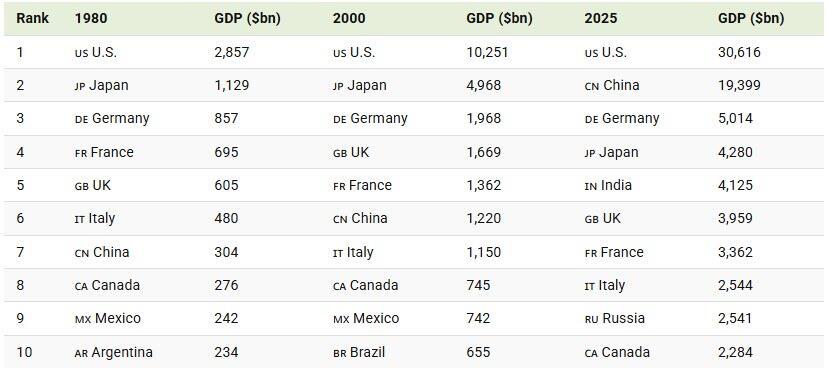
In the following visualization, Visual Capitalist’s Niccolo Conte charts the world’s top economies from 1980 to 2025.
The data for this visualization comes from the IMF’s World Economic Outlook (October 2025). GDP figures are measured in current U.S. dollars and are not adjusted for inflation.
The United States Remains on Top
Since 1980, the United States has consistently ranked as the world’s largest economy. Its GDP rose from about $2.9 trillion in 1980 to more than $30.6 trillion by 2025. While its global share has fluctuated, the U.S. has maintained its lead due to a large domestic market, deep capital markets, and sustained productivity growth.
China represents the most dramatic structural change in the global economy over the past 45 years.
In 1980, it ranked outside the top five, with GDP just over $300 billion. By 2010, China had already surpassed Germany and Japan, and by 2025 it stands firmly as the world’s second-largest economy at nearly $19.4 trillion.
Japan dominated the global economy in the late 1980s and early 1990s, briefly narrowing the gap with the United States. However, slower growth and demographic headwinds caused it to lose ground, falling to fourth place by 2025.
Europe’s largest economies—Germany, the United Kingdom, and France—have remained among the top 10.
Emerging Markets Gain Ground
Beyond China, several emerging economies climbed into the top ranks. India’s GDP expanded from under $200 billion in 1980 to more than $4.1 trillion in 2025, placing it among the world’s five largest economies.
Outside of the top 10, countries such as Brazil, Mexico, Indonesia, and Türkiye have also moved up the rankings, reflecting faster growth than many advanced economies over the long run.
If you enjoyed today’s post, check out Global GDP Growth Projections in 2025 on Voronoi, the new app from Visual Capitalist.
Tyler Durden
Sat, 01/03/2026 – 08:45
https://www.zerohedge.com/geopolitical/how-global-economic-power-has-shifted-over-past-45-years

Turkey To Launch First Overseas Deepwater Exploration Project Off Somalia
Turkey To Launch First Overseas Deepwater Exploration Project Off Somalia
Tukey is planning to send a drilling vessel to Somalia this February to begin its first deep water exploration project abroad, Energy Minister Alparslan Bayraktar said on Friday.
The minister said the operation with the Cagri Bey drilling vessel will focus on offshore areas in Somalia’s waters, but did not elaborate further. Ankara signed an energy exploration agreement with Somalia last year and has been seeking ways to diversify energy sources and reduce its reliance on imports.
Turkish President Recep Tayyip Erdogan had said earlier this week that a new drilling vessel would soon be operating on the Somali coast.
Alparslan’s announcement comes in the aftermath of Israel’s decision to recognize the separatist Republic of Somaliland. Israel last week became the first state to formally recognize Somaliland, which broke away from Somalia in 1991 but had never been recognized by any UN member state.
Somalia has slammed the move, which was also condemned by most members of the UN Security Council, as well as Turket.
“Preserving the unity and integrity of Somalia in all circumstances holds special importance in our view. Israel’s decision to recognize Somaliland is illegitimate and unacceptable,” Erdogan said.
Reports over the past year said Somaliland and Israel have been in talks to forcibly relocate displaced Palestinians from Gaza to the East African breakaway state.
Somalia’s President Hassan Sheikh Mohamud said two days ago that Somali intelligence confirms Somaliland accepted three Israeli conditions in exchange for recognition – specifically the resettlement of Palestinians, an Israeli military base on the Gulf of Aden coast, and accession to the Abraham Accords. Somaliland has denied this.
According to a new report by Israel’s Broadcasting Corporation (KAN), Somaliland’s president is planning an official visit to Israel and is expected to formally join the Abraham Accords.
NOW – Turkey’s Erdogan condemns Israel’s recognition of Somaliland as an illegal act aimed at destabilizing “the entire Horn of Africa.” pic.twitter.com/3TCW085JZQ
— Disclose.tv (@disclosetv) December 30, 2025
Israel’s i24 news outlet had previously reported that the recognition came after months of secret negotiations between the two sides.
Somalia and Turkey have accused Israel of trying to destabilize the Horn of Africa. Meanwhile, Yemen’s Ansarallah resistance movement has vowed to target any potential Israeli presence in Somalia.
Tyler Durden
Sat, 01/03/2026 – 08:10
https://www.zerohedge.com/energy/turkey-launch-first-overseas-deepwater-exploration-project-somalia

US strikes Venezuela and says leader Nicolás Maduro has been captured and flown out of the country
CARACAS, Venezuela (AP) — The United States hit Venezuela with a “large-scale strike” early Saturday and said its president had been captured and flown out of the country after months of intense pressure on Nicolás Maduro’s government — an extraordinary nighttime operation announced by President Donald Trump on social media hours after the attack.
The legal authority for the strike — and whether Trump consulted Congress beforehand — was not immediately clear. The stunning, lightning-fast American military action, which plucked a nation’s sitting leader from office, echoed the U.S. invasion of Panama that led to the surrender and seizure of its leader, Manuel Antonio Noriega, in 1990 — exactly 36 years ago Saturday.
Multiple explosions rang out and low-flying aircraft swept through the Venezuelan capital, and Maduro’s government accused the United States of attacking civilian and military installations, calling it an “imperialist attack” and urging citizens to take to the streets.
With Maduro’s whereabouts not known, the vice president, Delcy Rodríguez, would take power under Venezuelan law. There was no confirmation that had happened, though she did issue a statement after the strike.
“We do not know the whereabouts of President Nicolás Maduro and First Lady Cilia Flores,” Rodriguez said. “We demand proof of life.”
Maduro, Trump said, “has been, along with his wife, captured and flown out of the Country. This operation was done in conjunction with U.S. Law Enforcement.” He set a news conference for later Saturday morning.
The attack itself lasted less than 30 minutes and the explosions — at least seven blasts — sent people rushing into the streets, while others took to social media to report what they’d seen and heard. It was not known if there were any deaths or injuries on either side or if more actions lay ahead, though Trump said in his post that the strikes were carried out “successfully.”
Sen. Mike Lee, R-Utah, posted on X that Secretary of State Marco Rubio had briefed him on the strike and said that Maduro “has been arrested by U.S. personnel to stand trial on criminal charges in the United States.”
The White House did not immediately respond to queries on where Maduro and his wife were being flown to. Maduro was indicted in March 2020 on “narco-terrorism” conspiracy charges.
Maduro last appeared on state television Friday while meeting with a delegation of Chinese officials in Caracas.
The strike came after the Trump administration spent months increasing the pressure on Maduro, including a major buildup of American forces in the waters off South America and attacks on boats in the eastern Pacific and Caribbean accused of carrying drugs. Last week, the CIA was behind a drone strike at a docking area believed to have been used by Venezuelan drug cartels — the first known direct operation on Venezuelan soil since the U.S. began strikes in September.
As of Friday, the number of known boat strikes was 35 and the number of people killed at least 115, according to the Trump administration. Trump said that the U.S. is engaged in an “armed conflict” with drug cartels and has justified the boat strikes as a necessary to stem the flow of drugs into the U.S.
Maduro has decried the U.S. military operations as a thinly veiled effort to oust him from power.
Some streets in Caracas fill up
Armed individuals and uniformed members of a civilian militia took to the streets of a Caracas neighborhood long considered a stronghold of the ruling party. As daylight broke, some rallied while holding posters of Maduro,
In other areas of the city, the streets remained empty hours after the attack. Parts of the city remained without power, but vehicles moved freely.
Video obtained from Caracas and an unidentified coastal city showed tracers and smoke clouding the landscape as repeated muted explosions illuminated the night sky. Other footage showed cars passing on a highway as blasts illuminated the hills behind them. The videos were verified by The Associated Press.
Smoke was seen rising from the hangar of a military base in Caracas, while another military installation in the capital was without power.
“The whole ground shook. This is horrible. We heard explosions and planes,” said Carmen Hidalgo, a 21-year-old office worker, her voice trembling. She was walking briskly with two relatives, returning from a birthday party. “We felt like the air was hitting us.”
Venezuela’s government responded to the attack with a call to action: “People to the streets!”
The statement added that Maduro had “ordered all national defense plans to be implemented” and declared “a state of external disturbance.” That state of emergency gives him the power to suspend people’s rights and expand the role of the armed forces.
The website of the U.S. Embassy in Venezuela, a post that has been closed since 2019, issued a warning to American citizens in the country, saying it was “aware of reports of explosions in and around Caracas.”
“U.S. citizens in Venezuela should shelter in place,” the warning said.
Reaction begins to emerge
Inquiries to the Pentagon and U.S. Southern Command since Trump’s social media post went unanswered. The FAA warned all commercial and private U.S. pilots that the airspace over Venezuela and the small island nation of Curacao, just off the coast of the country, was off limits “due to safety-of-flight risks associated with ongoing military activity.”
The Armed Services committees in both houses of Congress, which have jurisdiction over military matters, have not been notified by the administration of any actions, according to a person familiar with the matter and granted anonymity to discuss it.
Lawmakers from both political parties in Congress have raised deep reservations and flat out objections to the U.S. attacks on boats suspected of drug smuggling on boats near the Venezuelan coast and Congress has not specifically approved an authorization for the use of military force for such operations in the region.
Deputy Secretary of State Christopher Landau said the military action and seizure of Maduro marks “a new dawn for Venezuela,” saying that “the tyrant is gone.” He posted on X hours after the strike. His boss, Rubio, reposted a post from July that said Maduro “is NOT the President of Venezuela and his regime is NOT the legitimate government.”
Cuba, a supporter of the Maduro government and a longtime adversary of the United States, called for the international community to respond to what president Miguel Díaz-Canel Bermúdez called “the criminal attack.”
“Our zone of peace is being brutally assaulted,” he said on X. Iran’s Foreign Ministry also condemned the strikes.
President Javier Milei of Argentina praised the claim by his close ally, Trump, that Maduro had been captured with a political slogan he often deploys to celebrate right-wing advances: “Long live freedom, dammit!”
Toropin and Associated Press writer Lisa Mascaro reported from Washington.
https://www.chicagotribune.com/2026/01/03/us-strikes-venezuela-nicolas-maduro/
Far-Left Radicals Attack F-35 Stealth Jet’s UK Supply Chain
Far-Left Radicals Attack F-35 Stealth Jet’s UK Supply Chain
Far-left activists targeted a critical supply chain node supporting the F-35 stealth fighter jet program, an attack that directly undermines Western national security interests and raises questions about whether foreign adversaries provided material support.
Stu Smith, an investigative analyst and researcher focused on extremism, influence networks, and transnational political activism at the Manhattan Institute, posted a video on X showing that, in the early hours of the new year, a group of radical leftists broke into Bruntons Aero Products in Musselburgh, Scotland, and went on a smashing spree.
The aerospace manufacturer produces precision parts and assemblies that become components in larger systems (such as electronic-warfare or survivability systems produced by Leonardo and others) that are integrated into the stealth jet through OEM supply chains.
“So this wasn’t “property damage” in the abstract. They’re bragging about sabotaging a link in the supply chain for aircraft self-protection systems — the kind of tech meant to help jets like the F-35 survive radar-guided missile threats,” Smith said, adding, “It’s sabotage in pursuit of a political cause and that’s exactly what terrorism is.”
🚨 Activists Sabotage the Tech That Keeps F-35s From Getting Hit by Missiles
Only hours into 2026, an “autonomous” direct-action group says it broke into Bruntons Aero Products in Musselburgh, outside Edinburgh, and destroyed machinery used to manufacture aerospace components… pic.twitter.com/i8EY6CLboS
— Stu Smith (@thestustustudio) January 1, 2026
Calla Walsh, founder of PalAction U.S. and Unity of Fields, and co-chair of the National Network on Cuba, commented on the incident, saying, “New year, same duty: shut down the factories of death.” Recall, Walsh previously worked for Senator Ed Markey’s 2020 reelection campaign and volunteered with other Democratic-aligned political efforts before leaving electoral politics in 2022.
New year, same duty: shut down the factories of death. https://t.co/77atAn43ui
— Calla (@CallaWalsh) January 1, 2026
Smith reminded readers that the mission of the Palestinian Youth Movement (PYM) has been to disrupt and dismantle the F-35’s supply chain.
And just the other day, I pointed out that this U.S.-based group’s international footprint is an interesting pressure point—and a potential avenue for pushback. Does PYM have any connection to this “autonomous” group? https://t.co/t9vd4I1rSR
— Stu Smith (@thestustustudio) January 1, 2026
In late fall, Senator Tom Cotton (R-Arkansas), Chairman of the Senate Intelligence Committee, sent a letter to FBI Director Kash Patel urging an investigation into PYM’s Aisha Nizar for openly calling for the destruction of the F-35’s supply chain.
Whether PYM is the group that attacked Bruntons Aero Products remains to be seen. What should be clear, however, is that a war on the West is being waged through nonprofit networks with foreign influence.
Tyler Durden
Sat, 01/03/2026 – 07:35
https://www.zerohedge.com/military/far-left-radicals-attack-f-35-stealth-jets-uk-supply-chain

Evanston starts hazmat response after woman found in distress near unknown substance
Evanston fire and police personnel called for a hazardous materials response and briefly closed down a street mid-morning Friday after a resident at a center for the chronically mentally ill fell into a state of distress, according to an Evanston Police Department news release.
First responders arrived at Greenwood Care, 1406 Chicago Ave., Evanston, around 10 a.m. and found the female resident “conscious but with altered mental status,” according to the release. They took her to the hospital and then, at 10:12 a.m., requested a hazardous materials response after finding in the resident’s room a substance described as suspicious. Fire Department personnel isolated the substance found in her room, as well as in a fanny pack, and the news release said they determined it did not pose a threat to the public.
Evidence technicians collected the substance to be sent to the Illinois State Police Crime Lab for narcotics analysis, according to the statement.
“The hazardous material has not been determined,” said Jessie Mayo, a spokesperson for the City of Evanston, adding authorities sent off the substance for testing. She described the event as an isolated incident.
“They followed all the proper protocols, so they just wanted to be extra cautious,” she noted.
The Evanston Police Department said it led the response, with support from the Evanston Fire Department, regional hazardous materials teams, and other partner agencies.
As part of the response, police closed Chicago Avenue between Dempster Street and Lake Street for a time.
Greenwood Care’s website describes it as an intermediate care facility with 145 beds for the chronically mentally ill.
https://www.chicagotribune.com/2026/01/03/evanston-starts-hazmat-woman-distress-unknown-substance/

Illinois State ‘comfortable being uncomfortable’ during historic road run to FCS national championship game
Illinois State coach Brock Spack saw it in his team in the season opener at Oklahoma.
Yes, Oklahoma, which made the College Football Playoff this year, won 35-3. The Sooners were obviously more talented than their FCS opponent.
But Spack thought his Redbirds played loose and well. He didn’t see a team that was fazed by playing in an atmosphere like the one at Oklahoma Memorial Stadium.
“This team is comfortable being uncomfortable,” Spack thought to himself. “They just thrive on it. They really like it.”
That, it turns out, has been a major key to the Redbirds’ remarkable run to the FCS national championship game Monday.
When Illinois State plays No. 2 Montana State at Vanderbilt’s FirstBank Stadium in Nashville, Tenn. (6:30 p.m., ESPN), it will be the Redbirds’ fifth game away from home in a little more than five weeks.
ISU (12-4) was unseeded entering the 24-team playoff, and each of its first four playoff games was against seeded teams on the road.
Nov. 29 in Hammond, La., a 21-3 win over No. 16 Southeastern Louisiana.
Dec. 6 in Fargo, N.D., a 29-28 win over No. 1 North Dakota State.
Dec. 13 in Davis, Calif., a 42-31 win over No. 8 UC Davis.
Dec. 20 in Villanova, Pa., a 30-14 win over No. 12 Villanova.
Illinois State coach Brock Spack addresses his team in the locker room after its 30-14 victory over Villanova in an FCS semifinal Dec. 20, 2025, in Philadelphia. (Tyler Coe/Illinois State Athletics)
No team in FCS history had ever won four road playoff games to make the championship before ISU.
ISU is 9-1 on the road this season, its only loss to Oklahoma. While Monday is technically a neutral-site game — and the Redbirds hope a big ISU crowd will show up for the matchup that’s within driving distance of Bloomington-Normal — it will have something that has helped make them successful on the road.
This team likes each other, Spack said, and so they enjoy the team bonding that comes with travel and hotel stays together. As an FCS team trying to save money, the Redbirds don’t stay in a team hotel before home games as many FBS programs do.
“I think we just feel more connected and more like a family when we’re on the road, and it seems like we play better because of that,” wide receiver Daniel Sobkowicz said.
Montana State (13-2) has plenty of ability to make opposing teams uncomfortable — a balanced team with big, long, physical players up front, Spack said. The Bobcats are fueled by dual 1,000-plus-yard rushers Julius Davis and Adam Jones and a defense that has 16 interceptions. They are making an appearance in their third title game in five seasons, though they haven’t yet won it under coach Brent Vigen.
But the Redbirds have the knowledge they can beat the best in FCS, even in an imperfect game.
They were down 14 points with three minutes to play against top-seeded North Dakota State in the second round. Quarterback Tommy Rittenhouse had thrown five interceptions in the game.
And yet, Sobkowicz made an impressive leaping catch on an 8-yard touchdown pass from Rittenhouse with 2:44 to play. The Redbirds forced a fumble on North Dakota State’s next possession. With a minute to play, Rittenhouse darted to the right to send a 6-yard touchdown pass to Sobkowicz, followed by the winning two-point conversion pass to Scotty Presson Jr.
Illinois State quarterback Tommy RIttenhouse takes off for a big gain during the Redbirds’ 30-14 victory over Villanova in an FCS semifinal Dec. 20, 2025, in Philadelphia. (Tyler Coe/Illinois State Athletics)
Spack called Rittenhouse, who is from Geneva and played in high school at St. Francis, “mentally tough,” a player capable of pulling himself and his team out of a tailspin. He has thrown for 3,257 yards and 36 touchdowns with 12 interceptions this season.
“Throwing five interceptions, but there was not one drop in confidence from him,” Sobkowicz said of Rittenhouse. “He was so confident in everything that he was doing, even when things go wrong or mistakes happen. He’s got so much confidence as a player, and he has confidence in all of us.”
The win, Spack said, sent the Redbirds’ confidence “through the roof.” They advanced with double-digit wins in the quarterfinals and semifinals behind big performances from Sobkowicz and running back Victor Dawson, who has rushed for 1,251 yards this season.
“I think our team did a really good job of regaining that focus and going 1-0 again against UC Davis that next week,” Rittenhouse said. “So it gave us a huge, huge boost of confidence. But you kind of have to rekindle that energy and just continue that focus and that grind of moving on to the next game.”
The run has been meaningful for Spack, who is in his 17th season as the Illinois State coach and is leading the Redbirds back to the title game for the first time since the 2014 season. He said the program took a hit during COVID-19, when some players transferred to bigger programs to play a fall season, but believes he and his coaching staff have rebuilt the team with the right type of players. He thinks this team is filled with smart, capable leaders.
“They take everything very seriously,” Spack said. “And they’re very motivated guys. You don’t have to motivate these guys. They’re just really good self-starters.”
Illinois State wide receiver Daniel Sobkowicz, right, outruns Villanova defensive back Zahmir Dawud during the Redbirds’ 30-14 victory in an FCS semifinal Dec. 20, 2025, in Philadelphia. (Tyler Coe/Illinois State Athletics)
And it’s meaningful for players like Rittenhouse and Sobkowicz, seniors who have been together at ISU for five seasons.
Sobkowicz, a 6-foot-3, 205-pound wide receiver who played at Rolling Meadows, said he had other schools looking at him to potentially transfer after the 2024 season, in which he had 80 catches for 1,108 yards. But he opted to stay and has 78 catches for 1,089 yards and 18 touchdowns this season.
His huge playoff performances — he has 29 catches for 403 yards and seven touchdowns in the four games — have pushed him to set ISU records with 257 career catches and 40 career touchdown catches.
“Just being with the guys that I grew up in college with for five years, I’d want to play with them for the last year,” Sobkowicz said. “And obviously I knew I was pretty close to certain records. … Knowing that our team was capable of playing at a really high level, at a national championship, especially, I’m not sure who else would leave if you have a team like that.”
https://www.chicagotribune.com/2026/01/03/illinois-state-fcs-national-championship/

Column: Finding edges in the running game fuels Ben Johnson’s evolution of the Chicago Bears offense
Offensive play callers have been dubbed innovators, gurus or geniuses over the last couple of decades for their ability to develop intricate passing attacks.
It has put many of those designers on the fast track to head coaching opportunities as many teams searching for their next leader are on a quest to find the next great quarterback whisperer.
The Chicago Bears landed on Ben Johnson last January, and he has been lauded for his work developing Caleb Williams in Year 2 while instilling a running game that ranks third in the NFL entering the final weekend of the regular season and might be the thing that truly has given the offense an edge and identity.
In the always evolving world of the NFL, things have swung back around to power football for some teams, the Bears for sure, and the team’s ability to make a deep run in the playoffs could be based on the ability to win with the offensive line and ground game.
It’s all about matchups, and while the Bears have a trio of exciting and talented wide receivers — Rome Odunze, D.J. Moore and rookie Luther Burden III — they also have remarkable versatility with tight ends Cole Kmet, rookie Colston Loveland and even Durham Smythe.
The adaptability of the skill-position players allows Johnson to dictate matchups and create advantages both on the ground and through the air. Go back to the Week 10 meeting with the New York Giants at Soldier Field when the Bears were first-and-goal at the 8-yard line midway through the first quarter.
Kmet was the tight end in 11 personnel (one running back, three wide receivers, one tight end), and the Giants countered by bringing nickel cornerback Dru Phillips on the field. When Kmet lined up as a fullback in the backfield, that brought Phillips into the box.
On the weak side iso run to rookie Kyle Monangai, the 6-foot-6, 257-pound Kmet easily put Phillips (5-11, 180) on the seat of his pants, clearing a path on the right side for a touchdown.
“In today’s NFL, everyone is looking for advantages in the passing game,” Kmet said. “But the big advantages and ways to get an edge are in the run game. I really believe that.”
The 250-pound linebackers that used to roam the middle of the field are endangered species. They’ve been replaced by leaner, faster linebackers with better coverage skills. On most downs, defenses are in some sort of sub package with an extra defensive back, whereas 20 to 25 years ago defenses lived with three linebackers on most downs.
Bears running back Kyle Monangai falls into the end zone for a first-quarter touchdown against the Giants on Nov. 9, 2025, at Soldier Field. (Dominic Di Palermo/Chicago Tribune)
“You have to be faster,” said Bears linebackers coach Richard Smith, who has coached the position for most of his 37 seasons in the NFL. “It’s a faster game. There aren’t any more 250-pound headbangers.”
When Johnson was hired, he brought with him a motto that was used in Detroit for wide receivers: “No block, no rock.” That was his way of letting wide receivers know they were crucial to the success of running plays. With a versatile trio of tight ends, the Bears can do a lot. Kmet and Loveland are skilled enough as wide receivers to make 13 personnel (one running back, three tight ends, one wide receivers) look like 12. They can make 12 personnel look like 11. Or they can line up and play old-school, smashmouth football.
And if you recall something Johnson said before the kickoff of the season, that is what really gets him juiced.
“I’ve got an affinity more so for the run game than what people might realize,” Johnson said. “I spend more time and I dabble in that maybe more than I do the passing game.”
The Bears tormented the Philadelphia Eagles defense three weeks after the win over the Giants, rushing for 283 yards in a 24-15 demolition on Nov. 28 at Lincoln Financial Field. They ran the ball 47 times, the Bears’ most in a non-overtime game since Dec. 14, 1991.
Bears running back D’Andre Swift runs for a touchdown in the first quarter against the Eagles on Nov. 28, 2025, at Lincoln Financial Field in Philadelphia. (Chris Sweda/Chicago Tribune)
Johnson threw the kitchen sink at Eagles defensive coordinator Vic Fangio with an array of unique ways to used the tight ends to trap, lead and insert, creating a variety of two-back sets. The Bears routinely got numbers to the play side and employed motion and misdirection to create hesitation at the second level for a good group of Eagles linebackers.
“With some of the bigger linebackers, the advantage was in the pass game because those guys couldn’t cover,” Kmet said. “Well, a lot of those guys can cover now if you are continually going after them in the run game, people don’t like that. It takes a disciplined play caller to stick with it like Ben, whereas a lot of other play callers, they want to throw it.”
Former Bears wide receivers coach Todd Haley, who had highly successful stints as the coordinator in Arizona and Pittsburgh and had the league’s top-ranked rushing offense when he was the head coach of the Kansas City Chiefs, marvels at what Johnson has done with the Bears ground game.
“We know the league is cyclical and college football kind of forced it into more spread offenses because of what they’re running and the bodies coming out of college,” Haley said. “The biggest thing to me, even with the Bears, is they have gotten under center. That’s the key. If you can get under center and run downhill, that brings play-action. You can’t get a real fake when you are in the shotgun and the back is sitting next to the quarterback. That does nothing to affect linebackers. It doesn’t help the offensive line because they are skating sideways all the time.
“It’s definitely come back to a little more power football, and under center and that’s a huge thing. You ask any defender would they rather see the quarterback in the gun or under center, he’s going to say in the gun because it just puts him such a bigger conflict of assignment. Do you you come downhill? Now, if you’re going to take a step, that opens up everything in the middle of the field.”
Related Articles
Philadelphia Eagles — in a battle with Chicago Bears for NFC’s No. 2 seed — to rest key starters in finale
NFL playoff picture: Final week of regular season arrives with No. 1 seeds still undecided in AFC and NFC
Rome Odunze returns to Chicago Bears practice — and the wide receiver is listed as questionable for Week 18
5 things to watch in the Chicago Bears-Detroit Lions game at Soldier Field — plus our Week 18 predictions
5 things we learned from the Chicago Bears, including seeking to avenge humiliating Week 2 loss to Detroit Lions
Haley said once an offense can establish the run — or a legitimate run threat — the defense is on its heels. He said the demise of Sunday’s opponent, the Detroit Lions, can be traced to the offense’s struggle to run the ball in the second half of the season. The Lions ranked sixth in rushing last year with Johnson calling plays, and with struggles on the interior of the offensive line, the Lions have dipped to 15th. They have totaled 74 rushing yards or less in four of their last seven games.
“All of a sudden, the Lions became a pedestrian drop-back passing offense that is average,” Haley said.
The Bears have been versatile all season. To Haley’s point, they’ve run 49.6% of plays under center, the fifth-highest percentage in the league behind the Los Angeles Rams (59.7%), Seattle Seahawks (55.8%), 49ers (50%) and Buffalo Bills (49.8%). The Bears have run 328 plays with 12 personnel (31.2%), the fifth-most in the league, and 83 in 13 personnel (7.9%), also the fifth-most.
D’Andre Swift enters the regular-season finale with 1,047 yards, and Monangai has 769. If Monangai gets 31 yards against the Lions, it will mark the first time the Bears have had two 800-yard running backs since 1978, when Walter Payton had 1,395 and Roland Harper 992.
Williams, who has 3,730 passing yards, is closing in on Erik Kramer’s franchise record of 3,838 and has a decent shot at reaching 4,000 against a depleted Lions secondary.
The foundation of what Johnson has installed is based on the ground game and the many ways the Bears can get after opponents running the ball. It’s the thing that is fueling a rush to the postseason. It might just be genius.
Scouting report
Lions wide receiver Isaac TeSlaa catches a 13-yard touchdown pass behind Packers cornerback Carrington Valentine during the second half Sept. 7, 2025, in Green Bay. (Matt Ludtke/AP)
Isaac TeSlaa, Lions wide receiver
Information for this report was obtained from NFL scouts.
TeSlaa, 6-foot-4 and 214 pounds, is a rookie out of Arkansas who was selected in the third round, 70th overall. Despite catching only 62 passes in two seasons for the Razorbacks after transferring from Division II Hillsdale College in Michigan, TeSlaa impressed at the combine with a 4.43-second 40-yard dash.
TeSlaa has only 15 receptions for 221 yards this season but has scored six touchdowns and has four in his last five games.
“It didn’t take long to study him at Arkansas because he wasn’t utilized very much,” the scout said. “He ran about three routes in that offense — a seam, a dig and a slant. That’s about it. Given his skill set, he was really underutilized. Phenomenal athlete. Big and long. Great catch radius. He’s got really good speed. A little linear in terms of his movement ability. He’s tight in the hips. That’s OK when you’re running straight-line routes.
“You’re seeing him when he’s getting some work in Detroit, he’s a playmaker. He can get downfield, get above the rim and he’ll go catch the football. He’s physical. He’s got very competitive play demeanor. He’s an interesting player to watch moving forward because he still has to develop a more diverse route tree.”
https://www.chicagotribune.com/2026/01/03/chicago-bears-ben-johnson-running-game/

No. 1 Indiana and Curt Cignetti keep making history — but No. 5 Oregon poses ‘big challenge’ as next CFP foe
PASADENA, Calif. — Curt Cignetti’s perpetual seriousness has become a big part of the Indiana coach’s burgeoning lore. His ever-glowering face on the sideline has sparked countless memes and has come to personify the sharp-eyed, no-nonsense manner in which these Hoosiers have rocketed through the sport in just two seasons.
With a couple of minutes left in No. 1 Indiana’s 38-3 thrashing of No. 9 Alabama in the 112th Rose Bowl on Thursday, Cignetti allowed himself a broad smile that was captured by TV cameras. He showed a few teeth again on the podium while the Hoosiers celebrated their first bowl victory since 1991 with confetti and roses.
Receiver Elijah Sarratt said it was “just about” the biggest smile he’d ever seen from his coach.
“You won’t be getting too much of those from coach Cig, so anytime you get one, you’ve got to appreciate it,” Sarratt said with a laugh.
But just a few minutes later, Cignetti had his business face back on. He was already thinking about the season-defining test presented to his Hoosiers (14-0) by No. 5 Oregon (13-1) in a College Football Playoff semifinal at the Peach Bowl on Friday in Atlanta.
“We’ll have a very big challenge ahead of us next week,” Cignetti said. “It’s very hard to beat a really good football team twice, there’s no doubt about that.”
Indeed, Indiana is responsible for the only blemish on the Ducks’ record. The Hoosiers won 30-20 on Oct. 11 in Eugene, physically trouncing the defending Big Ten champions in one of the landmark wins of Cignetti’s incredible tenure.
The Hoosiers are the Big Ten champions now after they knocked off Ohio State last month. They’ve added their school’s first Rose Bowl victory and first Heisman Trophy since that trip to Autzen Stadium.
But the Ducks also have grown and matured in the last three months, and the quarterfinals left them as clearly the biggest threat to stop Indiana’s march toward history. They earned that opportunity with an impressive 23-0 victory over No. 4 Texas Tech in the Orange Bowl on Thursday.
“That team in that locker room has shown time and time again that they’re ready for big moments,” Oregon coach Dan Lanning said.
Oregon coach Dan Lanning, second from left, shouts as he celebrates with his players after defeating Texas Tech in the Orange Bowl in a College Football Playoff quarterfinal Thursday, Jan. 1, 2026, in Miami Gardens, Fla. (Rebecca Blackwell/AP)
Lanning smiles and laughs a whole lot more than Cignetti, in public at least. But the coaches share a deep respect for what they’ve built at two schools that have never won a national title in football.
With Mississippi and Miami surprising most of the sport by advancing from the other two quarterfinals, it’s clear the winner of the Peach Bowl will be a significant favorite to claim an inaugural national title in the championship game Jan. 19 in South Florida.
And while Oregon is on an eight-game winning streak after throttling Texas Tech’s high-priced roster, Indiana has done nothing to suggest it shouldn’t be the favorite to cap this unprecedented two-year transformation by winning the biggest trophy of all.
A 35-point win the Rose Bowl was the latest improbable feat by Indiana, which had been in this stadium roughly 15 months earlier for the first Big Ten road game of Cignetti’s tenure. The Hoosiers beat UCLA that weekend, and they’ve transformed into a powerhouse since then.
Related Articles
No. 13 Nebraska remains unbeaten with 58-56 win over No. 9 Michigan State, extending streak to 18 games
Notre Dame’s Jordan Faison leaves lacrosse team to focus on football after a breakout season for receiver
Berry Wallace scores 22 points in Illinois’ 11th straight win — a 73-70 upset of No. 7 Maryland women
Georgia Tech women beat No. 18 Notre Dame in OT to snap Irish’s 5-game winning streak
Indiana and Oregon headed for a rematch, this time with a spot in the CFP national title game at stake
The Hoosiers and their grateful fans were having plenty of fun in Pasadena, but there’s little danger they’ll carry a celebratory hangover into Atlanta. From Heisman winner Fernando Mendoza to the support staff, nobody at Indiana seems to take this success for granted — because they all realize just how recently this position seemed impossible for the Hoosiers.
“We like being the underdogs,” defensive tackle coach Pat Kuntz said. “We like when people think we’re just ‘old Indiana.’ That’s all we need. We like that mentality. I hate it when we’re favored. I want us to be underdogs all the time. That’s our mentality. Never satisfied, always humble and hungry.”
The Hoosiers will also be the favorites because they didn’t show any significant weaknesses while rolling the Tide.
Meanwhile, Oregon’s offense wasn’t terribly impressive in the Orange Bowl, posting 309 yards and struggling on the ground with just 1.4 yards per rush when sacks were factored. The Ducks managed only 267 yards in their loss to the Hoosiers three months ago, while the Indiana defense has only improved, now ranking second in the nation in yards allowed (252.6) and points allowed (10.3).
Dante Moore was held to 186 yards passing with two interceptions by the Hoosiers, but the quarterback and his Ducks have a week to figure out how to knock off unbeaten Indiana.
“You never want to look too far ahead,” Moore said. “You want to be where your feet are at, being in the present moment. We’ve got to worry about the next day.”
CFP semifinals
Fiesta Bowl | Glendale, Ariz.
(6) Mississippi vs. (10) Miami, 6:30 p.m. Thursday, ESPN
Peach Bowl | Atlanta
(1) Indiana vs. (5) Oregon, 6:30 p.m. Friday, ESPN
Championship game: 6:30 p.m. Jan. 19, ESPN
https://www.chicagotribune.com/2026/01/03/indiana-oregon-cfp-semifinal-curt-cignetti/

US and Canada have injury replacements standing by for Olympic hockey rosters
While Jason Robertson and Adam Fox did not make the U.S. Olympic hockey roster, and Sam Bennett and Mark Scheifele were not picked to play for Canada, that doesn’t necessarily mean none of those players will be in Milan next month.
USA Hockey and Hockey Canada each has a group of players on standby who could get a call in the event of injuries.
“There’s a number of players that we’ve identified that can fill in if need be,” U.S. general manager Bill Guerin said Friday. “There is a plan in place.”
Like Guerin, Canada GM Doug Armstrong did not want to reveal how many players are on the waitlist, other than to say all were asked if they wanted to remain in consideration and told they’d need to keep doing Olympic drug-testing.
“It’s not one player out, one player in,” Armstrong said Thursday. “What we’re going to do is say: ‘If this style of player gets hurt, we’ll have a list of players to look at it. If this style of player, gets hurt, we’ll have a list of players to look at.’ That list, it’s long but not too long because there’s different style of players that we want.”
United States
Robertson leads all U.S. NHL players in points, and he has helped Dallas reach three consecutive Western Conference finals. Fellow forwards Alex DeBrincat and Cole Caufield are also in the top 10 in scoring among Americans.
“If we’re doing it like that, then you don’t need a general manager. You don’t need a coach. Just do it by stats,” Guerin said. “But in the end we have a job to do, and we’re putting together a team. Not just a group of individuals. It’s a team.”
Fox and former New York Rangers teammate Chris Kreider were the only U.S. players who took part in the 4 Nations Face-Off early last year who are not reprising their roles in Italy. The U.S. picked five left-handed-shooting defensemen and just three righties, so Fox would seem to be next in line over someone such as undersized Lane Hutson or New Jersey’s Luke Hughes.
“A lot of those players, there’s a chance some of them do get the nod,” Guerin said. “We don’t know what’s going to happen. There’s a lot of hockey between now and then. There’s so many players that could be on this roster that are not.”
In net, there are a handful of options if anything happens to Connor Hellebuyck, Jake Oettinger or Jeremy Swayman. One of the Chicago Blackhawks’ Spencer Knight, Vancouver Canucks’ Thatcher Demko and Seattle Kraken’s Joey Daccord figure to be on speed dial just in case.
Canada
Bennett, a back-to-back Stanley Cup champion with Florida, Travis Konecny and Seth Jarvis are the only skaters from Canada’s 4 Nations-winning roster not chosen for Milan. Bennett and Scheifele, a point-a-game player for Winnipeg, were perhaps the most surprising omissions, with 19-year-old Macklin Celebrini, Nick Suzuki and Tom Wilson making it as newcomers.
“There were a number of players who came right down to the wire,” Armstrong said when asked about Scheifele. “There’s so many players that are right on the cusp. No player has played their way off this team. We just had to narrow this down to 25.”
Canada brought back its entire 4 Nations blue line, though a standout rookie made that decision more difficult than expected. Matthew Schaefer was the top pick in the draft last year and has played so well for the New York Islanders in his first season in the league that he forced himself into the mix.
“I’ll be honest with you: He wasn’t on my radar at the start of the season,” Armstrong said. “He’s an 18-year-old man that we’re talking about playing in the Olympics. He’s a fantastic talent. He brings you out of your seat every night. He’s got maturity beyond his years on and off the ice. I was shocked at how quickly he worked his way into our conversations, and that’s a credit to him.”
Goaltending is undoubtedly Canada’s biggest unknown, though Jordan Binnington’s big-game ability has him penciled in as the starter, with Logan Thompson and Darcy Kuemper also on the roster. Colorado’s Mackenzie Blackwood and Scott Wedgewood have excelled for the top team in the NHL so far, which would make both of them slam dunk potential replacements.
https://www.chicagotribune.com/2026/01/03/us-canada-hockey-olympics-injury-replacements/
Germany’s Family Businesses Warn: Taxes, Energy Costs, And Bureaucracy Are Killing Competitiveness
Germany’s Family Businesses Warn: Taxes, Energy Costs, And Bureaucracy Are Killing Competitiveness
Submitted by Thomas Kolbe
At the turn of the year, the Foundation for Family Businesses, together with the ifo Institute, presented a corporate survey on tax policy and location attractiveness. The result is unequivocal: Germany is too expensive and no longer competitive as a business location.
There is nothing new under the sun. In their year-end Annual Monitor, the Foundation for Family Businesses and the ifo Institute once again went straight to the heart of the matter. A total of 1,705 companies across all sectors and size categories were surveyed on their assessment of current tax policy and Germany’s attractiveness as a business location. The evaluation of this corporate panel—1,358 of which were traditional family-owned businesses—turned out to be devastating, as expected.
Overburdened Labor Factor
More than 80 percent of companies perceive the overall tax and contribution burden—particularly in the area of personnel costs, i.e., wage taxes and social security contributions—as far too high. The heavy burden on the employee side is especially criticized by smaller family-owned businesses. It has become increasingly difficult to grant wage increases when the fiscal authorities take the lion’s share and key performers are bled ever more heavily with each pay raise due to the continuous increase in social security contribution ceilings.
This assessment is shared by Professor Rainer Kirchdörfer, member of the Foundation’s executive board, who comments on the study:
“Our new Annual Monitor shows just how much employers and employees are pulling in the same direction. It is precisely the high taxes on labor that paralyze both sides and drain the joy from performance. High-tax Germany has also lost ground here.”
Two-thirds of surveyed executives complain about excessive income tax rates. Income tax is particularly relevant for partnerships—and by international standards it is clearly too high. A recurring grievance is also the complexity of Germany’s tax system. The familiar quip holds that roughly two-thirds of global tax law literature originates in the Federal Republic. Even if exaggerated, the message is clear: Germany is a bureaucrat’s paradise.
Currently, 5.4 million people work in the public sector—around half a million more than five years ago. This despite technological progress, artificial intelligence, and increasing automation of internal processes.
The Bureaucracy Reduction Classic
A tangible reduction in bureaucracy, including tax law, has been overdue for decades. Yet no federal government dares to tackle this hot potato. German bureaucracy has grown too powerful, evolving at all levels into a state within the state. At the same time, policymakers view the public sector as a kind of buffer for a labor market that has slowly but steadily tipped.
As a reminder: over the past three years, German companies have been forced to create 325,000 additional jobs merely to cope with the ever-expanding bureaucratic workload. The state is effectively outsourcing its ballooning documentation, archiving, and compliance requirements to the private sector.
Ranked second and third among entrepreneurs’ main points of criticism are rising local business taxes (Gewerbesteuer) and energy-related levies. Both factors are likely to play a significant role in 2026. Municipal budgets, paralyzed by a cumulative deficit of €35 billion last year, are virtually screaming for sharp increases in local business tax rates.
This threatens to trigger a tax-driven recessionary spiral initiated by local governments seeking short-term relief—particularly in regions hard hit by the industrial downturn, such as the automotive hubs of Stuttgart, Ingolstadt, and Wolfsburg.
Additional Pressure from Energy Levies
As of January 1, 2026, under the Fuel Emissions Trading Act (BEHG), the CO₂ price corridor will rise to between €55 and €65 per ton. This represents another substantial erosion of Germany’s economic substance, as it struggles to keep energy-intensive production in the country amid intensifying competition with China and the United States.
Entrepreneurs’ demands are clear: a reduction in the electricity tax is long overdue as a first step toward restoring the competitiveness of German industry. The abolition of the solidarity surcharge, alongside an accelerated reduction in corporate taxes, also ranks high on the business community’s wish list for the coming year.
Germany is too expensive as a business location by OECD standards. Since 2018, this has also become evident in overall economic productivity, which has stagnated and even declined slightly in recent quarters.
Valid Criticism, But the Root Problem Remains Untouched
There is no question that entrepreneurs are correct in their assessment of fiscal overburdening on companies and private households. The German state has expanded excessively and—given steadily rising public debt—is increasingly living at the expense of future generations.
What is striking, however, is what the study fails to address. Neither the billion-euro follow-up costs of migration into Germany’s welfare system nor the fiscal and real-economic consequences of centrally planned climate policy are included in the assessment. Yet both factors significantly contribute to rising tax burdens and have sustainably weakened Germany’s industrial base.
What has materialized in energy costs—burdens sometimes three times higher than those in competing locations such as France or the United States—must become the subject of a broad public debate if a return to rational economic policy is ever to be possible.
Under the current federal government led by Chancellor Friedrich Merz, this appears fundamentally out of reach.
If not Germany’s economic middle class, who should initiate such a debate openly and courageously? We are still waiting for the icebreaker capable of overcoming the dogma of the alleged lack of alternatives in climate policy in a practical, rational, and unresentful manner. And it remains all too easy for policymakers, operating in an entrenched mode of accelerated debt accumulation, to align incentive structures and a lavishly funded subsidy machine in such a way that any critical voice from the business sector is ultimately silenced.
In the end, the study delivers a rapid situational assessment from which the familiar criticism emerges—criticism that, at all costs, seeks to avoid a collision with an ideologically hardened climate-socialist policy.
Tyler Durden
Sat, 01/03/2026 – 07:00