Category: News

White House: ‘Era Of Amnesty Is Over’
White House: ‘Era Of Amnesty Is Over’
Authored by Catherine Salgado via PJ Media,
“No more activist judges shielding criminal illegals. No more endless delays. Only results.” The Trump White House is celebrating multiple massive immigration enforcement wins that signal the era of mass migration and mass amnesty is over.
Since Donald Trump came back into office, federal authorities have removed three million illegal aliens from the United States through ICE deportations or voluntary deportations, which is the biggest reduction in illegal migration in modern history, according to a White House press release on April 9. This is exactly what the American people voted for. This is the sort of reform we hoped to see when immigration became one of the top issues in the 2024 election.
Besides the three million deportees, border officers have not released a single illegal alien into the United States at our borders for 11 straight months. The “era of amnesty is over,” indeed.
The overwhelming majority of asylum claims have long been fraudulent, and that is one major area where the Trump administration implemented reform. The U.S. immigration authority now grants asylum in only 7% of cases, slashing the number of criminals and illegal aliens who tried to use asylum claims as a free ticket into our country. In contrast, under Joe Biden and Kamala Harris, the government approved over 50% of asylum claims, according to the release.
I will give just two illustrations of why this is a big deal. First, just this week, the U.S. State Department revoked the lawful permanent resident status it had granted to Hamideh Soleimani Afshar, the niece of mass-murdering Iranian jihad leader Qasem Soleimani. Afshar had obtained residency and a life of luxury in the United States by claiming asylum here. Yet she repeatedly returned to Iran and regularly spouted pro-regime propaganda, illustrating how bogus her asylum claim was. And second, back in 2024, an Ecuadoran “asylum seeker” raped a 13-year-old at knifepoint in New York. These are only two examples of how broken our asylum system was before the Trump administration took over.
The White House release also highlighted the following wins:
Deportations and removal orders are surging: In fiscal year 2025, immigration courts issued nearly 500,000 removal orders — a 57% increase over the prior year — as criminal illegals are removed faster and in far greater numbers than ever before.
The massive court backlog is being slashed: Hundreds of thousands of cases have already been cleared since Inauguration Day, with reductions accelerating every month — ending the years-long delays that let illegals remain indefinitely.
And, as noted above, the Trump administration has successfully closed our borders.
The White House press release enthusiastically concluded, “President Trump promised to end the open borders nightmare — and he is delivering on that promise with unrelenting force. The era of catch-and-release, mass releases, and activist judicial amnesty is over.”
As we celebrate the 250th year of America’s existence, there is no better time to reflect on what national sovereignty and security mean.
* * *
Tyler Durden
Wed, 04/15/2026 – 16:20
https://www.zerohedge.com/markets/white-house-era-amnesty-over
Russia Vows To ‘Fill China’s Energy Resource Gap’ Amid Hormuz Crisis In Lavrov-Xi Meeting
Russia Vows To ‘Fill China’s Energy Resource Gap’ Amid Hormuz Crisis In Lavrov-Xi Meeting
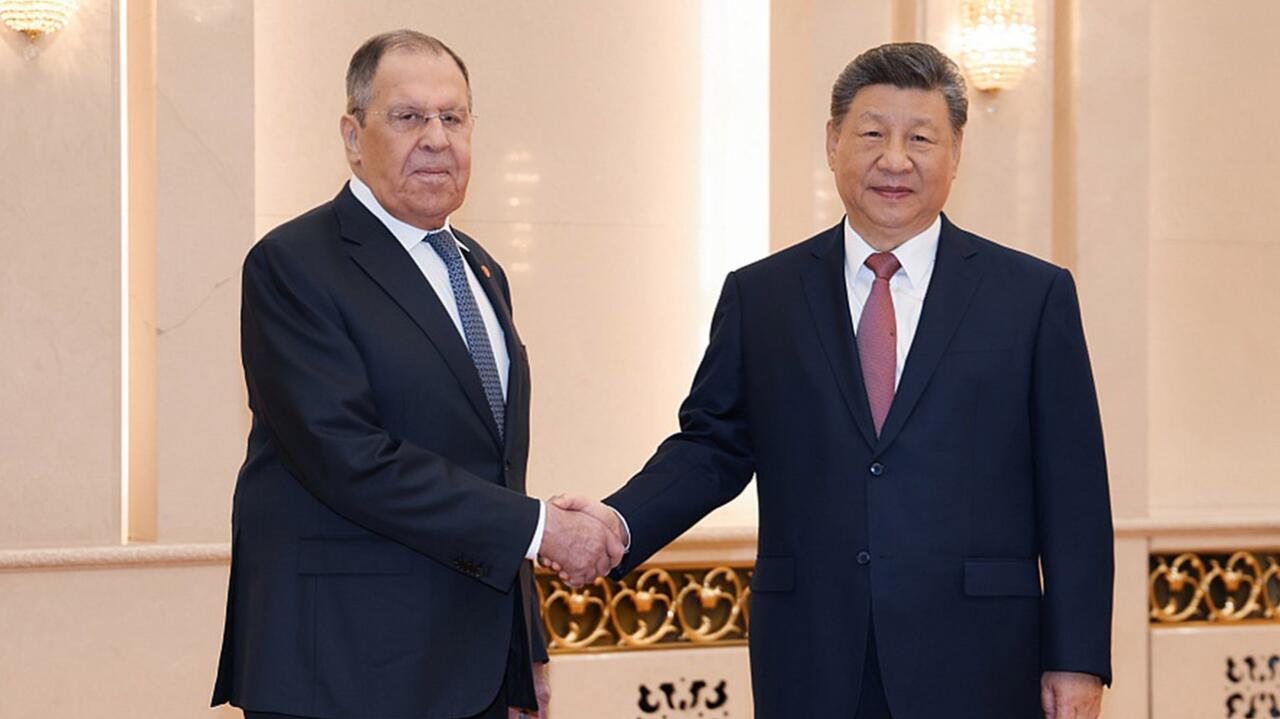
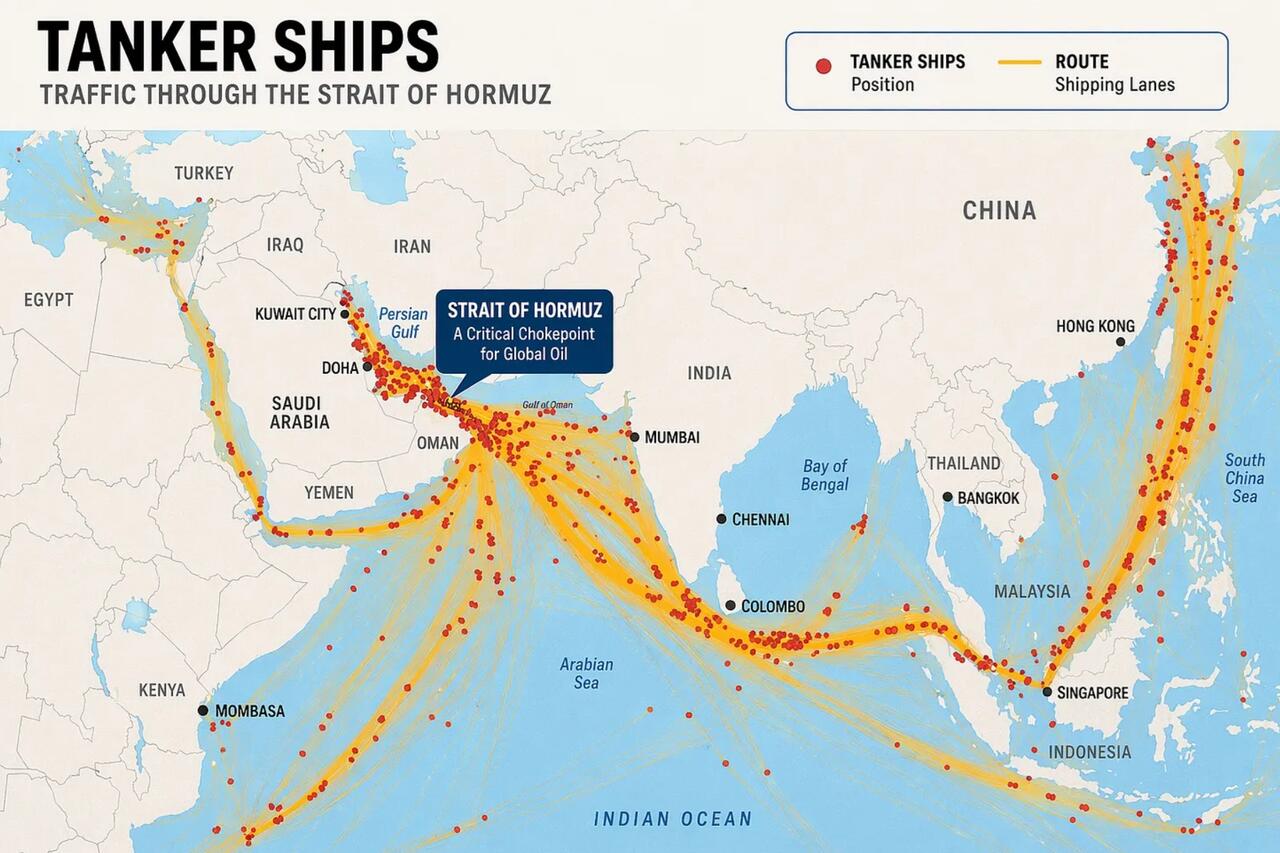
At a moment it remains a serious open question over just how vulnerable China is to the Hormuz Strait crisis, and now with the US-imposed US naval blockade of the vital oil transit waterway, Russian Foreign Minister Sergey Lavrov is in Beijing pledging energy support to China.
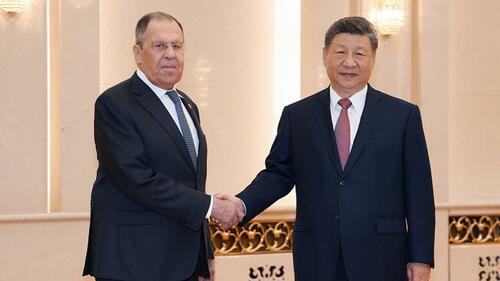
Lavrov met with President Xi Jinping on Wednesday, during which Xi urged China and Russia to “give full play to the advantages of geographic proximity and complementarity, deepen all-round cooperation and raise the resilience of each other’s development.”
Russia remains China’s top energy supplier. “Both sides should maintain strategic focus, trust each other, support each other, develop together,” Xi continued, according to a Chinese state media readout.
Lavrov in turn told Xi that Chinese-Russian relations play a “stabilizing role in world affairs” at a time of global “chaos and turmoil.” This has been a consistent theme on which relations and trust have been built between Beijing and Moscow going back to the start of the Ukraine war over four years ago.
Importantly, after the meeting the Russian foreign minister announced to a press conference that Moscow stands ready to increase energy supplies to China.
“Russia can certainly fill the resource gap that has arisen in China and other countries interested in working with us on an equal and mutually beneficial basis,” Lavrov stated.
The two-day Lavrov visit is toward laying the groundwork for an upcoming summit between Xi and Russian President Vladimir Putin. It’s expected for the first half of this year, but likely after Trump’s upcoming May 14-15 summit with the Chinese leader.
The Hormuz crisis is a threat to Chinese energy given Asia’s largest power still depends heavily on global supply routes it does not fully control. While Beijing has for many years sought to diversify through pipelines from Russia and Central Asia, the reality is that those projects take years to build and remain far too limited to replace the volume of oil moving through Hormuz.
However, there’s a strong counterargument pushing back against the assumption that Trump’s Iran moves will ultimately squeeze and devastate China. Alongside Russia coming to Beijing’s side with its recently unsanctioned oil, there are also these aspects to consider:
While China is to some extent dependent on Gulf oil, so is the rest of Asia. While the United States might be insulated from some of the worst consequences of the Hormuz closure, the economies of our Asian allies are not. Asian economies are among the most dependent on Middle Eastern oil, with South Korea receiving around 70 percent and Japan receiving a whopping 95 percent of their oil from the Middle East. The Council on Foreign Relations notes that in 2024, 84 percent of the oil and 83 percent of LNG shipped through Hormuz were bound for Asia. That is not a targeted squeeze. Instead, such a move looks to be made without much heed to Asia at all, hitting the very states Washington is supposedly positioning against Beijing.
China is actually one of the best-positioned countries in Asia to handle this exact crisis because of existing stockpiles, diversified supply chains, a coal-dependent electric grid, and pipeline alternatives. While China is vulnerable, it is more insulated than most of Asia, only receiving around 20 percent of its oil from Hormuz.
There’s a certain irony in the fact that an early element of blowback from the Iran war was that Washington scrambled to remove sanctions on Russian crude oil transiting the high seas, to bat down soaring global oil prices, and yet it is this very unsanctioned oil flow which will benefit China.
And the ‘unintended consequences’ continue to trickle over. The American Conservative writes, “This damage to our Pacific allies is not theoretical. Across Asia, partner governments are already scrambling as their economies face the worst crisis in decades. Asian nations are shortening workweeks and implementing fuel controls, disrupting their economies as tension mounts. Many Asian economies have turned to Russia amid this turmoil, bolstering the economy of another supposed U.S. enemy.”
Tyler Durden
Wed, 04/15/2026 – 15:40

Beige Book Confirms Uncertainty, Fuel Costs Surged On Iran War As Economy Grew At “Slight To Modest” Pace
Beige Book Confirms Uncertainty, Fuel Costs Surged On Iran War As Economy Grew At “Slight To Modest” Pace
US economic activity continued to increase at a “slight-to-modest” pace across most regions as the war with Iran generated a new wave of uncertainty and higher energy costs, the Federal Reserve said. The just released Beige Book – which featured information compiled by the New York Fed and collected through April 6, capturing the early effects of the war on the US economy – was the first one to discuss the state of the US economy after the Iran war started, and came at time when gas prices sstayed above $4/gal for two weeks after the biggest monthly jump in decades, with March fuel spending up 16% according to Bank of America card spending data.
So far, Bank of America said that discretionary spending remains resilient—but risks rise if Hormuz disruptions persist. The Fed agreed, with the Beige Book reporting that overall economic activity increased at a slight to modest pace in eight of the twelve Federal Reserve Districts, while two Districts reported little change (San Francisco and St Louis), and two Districts reported slight to modest declines (Boston and New York).
Price growth remained moderate overall, but energy and fuel costs rose “sharply” in all 12 Fed districts, the central bank reported in its Beige Book survey of regional business contacts released Wednesday.
“The conflict in the Middle East was cited as a major source of uncertainty that complicated decision-making around hiring, pricing and capital investment, with many firms adopting a wait-and-see posture,” the Fed said.
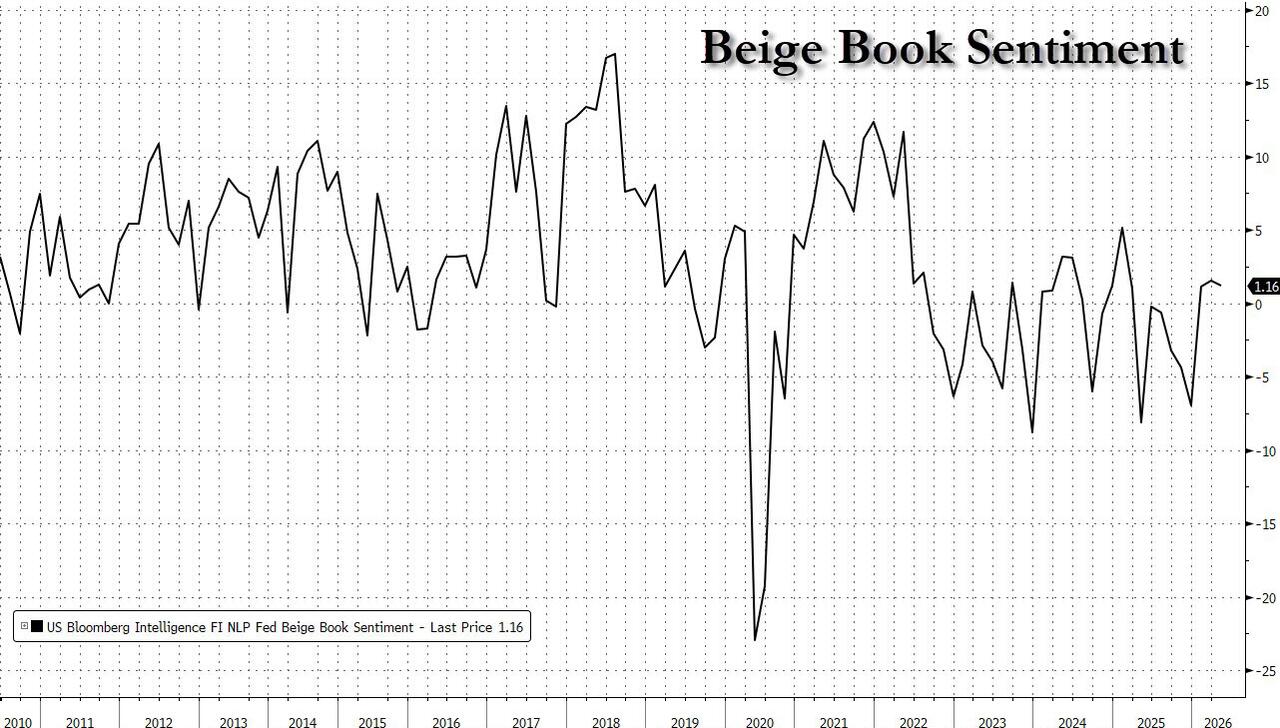
Bloomberg’s NLP model that measures net sentiment by evaluating hawkishness (+ score) and dovishness (- score) pictured below. Recent reading comes in at +1.2.
Several policymakers have signaled a preference to keep borrowing costs steady for quite some time while they evaluate the economic data. Officials are expected to leave their benchmark rate unchanged when they meet on April 28-29, according to pricing in futures contracts. A growing number of officials are concerned the war could fuel inflation, and more favored language at their March gathering that would have made it clear the Fed may need to raise interest rates.
Taking a closer look at the Beige Book, the conflict in the Middle East was cited as a major source of uncertainty that complicated decision-making around hiring, pricing, and capital investment, with many firms adopting a wait-and-see posture.
Manufacturing activity rose slightly to moderately in most Districts. Banking sector activity was generally steady with loan demand stable to up moderately.
On balance, consumer spending increased slightly despite harsh winter weather in some regions and higher fuel prices.
Many Districts continued to report signs of consumer financial strain, increased price sensitivity, and rising demand at food banks and other social service organizations, while spending among higher-income consumers was resilient.
Housing market activity softened across several Districts as heightened uncertainty and rising mortgage rates dampened buyer demand.
Commercial real estate markets improved, with strength in industrial properties, especially data center projects. Office markets saw solid demand for Class A space but weaker demand for lower-tier properties.
Energy activity was up slightly as oil prices rose, though many producers remained cautious about increasing drilling due to uncertainty about the persistence of higher prices. Agricultural activity was mixed, and several Districts reported that rising crop prices helped offset steep price increases of fertilizer and fuel.
Business outlooks varied amid widespread uncertainty about future conditions.
In terms of Labor Markets, the Beige Book noted the following:
On balance, employment was steady to up slightly during this reporting period, though one District noted a slight decline.
Most Districts described labor demand as stable, with low turnover, minimal layoffs, and hiring mostly for replacement.
Several Districts noted increased demand for temporary or contract workers, as firms remained cautious about committing to permanent hires.
Many Districts reported that labor availability had improved, although difficulty finding some skilled workers, especially in the skilled trades, persisted.
While most Districts indicated that AI had not yet significantly impacted overall staffing levels, some noted that AI-driven productivity improvements had enabled many firms to delay or reduce hiring. Wages generally continued to rise at a modest to moderate pace.
Some Districts noted continued wage pressures for some roles in health care and the skilled trades, though overall wage competition remained muted.
Energy prices were sharply higher
Price growth mostly remained moderate overall, with the vast majority of Districts reporting moderate increases and others pointing to modest growth. Generally, input cost increases outpaced selling price growth, compressing margins.
Energy and fuel costs rose sharply in all Districts, attributed to the Middle East conflict, leading to higher freight and shipping costs and higher prices for plastics, fertilizers, and other petroleum-based products.
Input cost pressures beyond energy-related increases were also widespread. Several Districts reported rising prices for metals due to tariffs, such as steel, copper, and aluminum. Technology costs rose for both hardware and software. Insurance premiums and health care costs continued to climb.
Finally, here are the main highlights by Fed districts:
Boston: Economic activity declined slightly, employment and wages were flat, and prices rose at a moderate pace. Consumer spending was flat, as was activity in most sectors, but home sales slowed further. The conflict in the Middle East contributed to rising energy prices and created fresh uncertainty, though the outlook remained optimistic on balance.
New York: Economic activity continued to decline modestly amid heightened uncertainty in large part due to shifts in tariff policy and the Middle East conflict. On balance, employment held steady, and wage growth remained modest. The pace of selling price increases remained moderate, and input price increases picked up markedly. Consumer spending grew slightly. Businesses generally expected little improvement in the months ahead.
Philadelphia: Economic activity in the Third District grew slightly, down from a modest pace last period. Employment declined slightly, and wages again rose modestly. Prices continued to rise moderately, although cost pressures increased. Activity held steady for nonmanufacturers and increased moderately for manufacturers. Firms expect growth over the next six months, but uncertainty has risen further.
Cleveland: Fourth District business activity increased modestly, with similar growth expected in the months ahead. Manufacturers reported increased demand, while retailers saw modest declines amid higher fuel prices. Residential real estate rebounded after a harsh winter. Employment grew slightly, and wages increased moderately. Nonlabor costs remained robust, while selling prices grew moderately.
Richmond: The regional economy continued to grow modestly in recent weeks. Consumer spending on retail, travel, and tourism increased modestly. Nonfinancial service providers also reported modest growth in demand. Other sectors of the regional economy reported little change this cycle. Employment expanded slightly, wages picked up modestly, and price growth remained moderate.
Atlanta: Economic activity grew at a modest pace. Employment remained flat and wages rose modestly. Prices and input costs also increased modestly. Retail sales and travel continued to expand. On balance, residential and commercial real estate conditions improved. Transportation and manufacturing activity expanded. Energy activity rose, but agricultural conditions were flat.
Chicago: Economic activity in the Seventh District increased slightly over the reporting period. Manufacturing demand rose modestly; consumer spending increased slightly; construction and real estate activity, employment and business spending were flat on balance; and nonbusiness contacts saw no change in economic activity. Prices rose moderately, wages rose modestly, and financial conditions tightened modestly. Farm income expectations for 2026 declined some.
St. Louis: Economic activity has remained unchanged since our previous report. Employment levels were unchanged and wage growth was moderate. Prices have risen moderately, but several contacts expressed concern about escalating energy costs. The outlook remains cautiously optimistic, yet contacts are attentive to risks to the economy associated with the conflict in the Middle East.
Minneapolis: District economic activity increased slightly. Employment increased slightly and labor demand turned positive over the past two months. Prices increased modestly overall, but input price pressures intensified as oil price spikes fed through to freight and raw materials. Contacts across industries reported significant uncertainty.
Kansas City: The Tenth District’s economy grew slightly over the reporting period, while employment levels remained flat. Manufacturing firms indicated suppliers have implemented automatic surcharges tied to logistics and energy inputs. District oil and gas activity remains steady. Overall, prices have increased modestly.
Dallas: Economic activity in the Eleventh District expanded slightly. Manufacturing output growth slowed, while activity in services was largely flat. Energy sector activity ticked up, and bank lending increased on strength in commercial real estate, while home sales were slow. Employment grew slightly, while wages and prices increased modestly to robustly. Outlooks deteriorated amid elevated geopolitical uncertainty and fuel price concerns.
San Francisco: Economic activity was stable at subdued levels over the reporting period. Employment levels were unchanged on net. Prices rose moderately, driven primarily by higher energy costs, while wages grew slightly. Retail sales grew slightly. Conditions were stable in services and manufacturing, down in agriculture, and mixed in real estate.
Tyler Durden
Wed, 04/15/2026 – 15:14

Tax Freedom Day Underestimates How Long You Work For The Government
Tax Freedom Day Underestimates How Long You Work For The Government
Authored by Jonathan Newman via The Mises Institute,
Tax Freedom Day, calculated by the Tax Foundation, “represents how long Americans as a whole have to work in order to pay the nation’s tax burden.”
It appears that they stopped publishing this in 2019, but others have picked up where they left off.
The idea is that the income earned by taxpayers over a certain proportion of the year goes to Uncle Sam.
In 2025, that date was April 16th.
But the burden of government is much larger than the amount we pay in taxes.
The government spends much more than it collects in taxes, diverting valuable resources away from where they would be used in the private market economy, subject to the profit and loss test of the market.
The difference is made up by new government debt.
Much of that debt is purchased by the Federal Reserve with new money, resulting in price inflation, exacerbated income inequality, booms and busts, and financial fragility.
The cost of government is much more than what we pay in taxes.
Rothbard suggested a measure of “total government depredation on the economy” that involves starting with net national product (like GDP but takes capital depreciation into account) and deducting all government spending at all levels, including transfer payments, government officials’ salaries, and the salaries of those employed by government enterprises.
Rothbard considered all government activity as a depredation.
In 2025, this total fiscal burden was $11 trillion.
Net national product was $25.7 trillion, which gives us a ratio of 42.7%.
When we turn that ratio into a date on the calendar, we get June 5.
In short, while Tax Freedom Day is mid-April, Rothbard’s measure of the government’s fiscal burden reveals that Americans don’t truly start working for themselves until June 5, over seven weeks later.
Tyler Durden
Wed, 04/15/2026 – 14:40

Iran War Leads To Fluoride Shortages For Some US Water Utilities
Iran War Leads To Fluoride Shortages For Some US Water Utilities
Authored by Zachary Stieber via The Epoch Times,
Multiple water providers have lowered the amount of fluoride they add to water for millions of Americans, amid shortages stemming from the U.S.–Iran war.
The Baltimore City Department of Public Works said on April 13 that it is reducing the level of fluoride from 0.7 milligrams per liter (mg/L) to 0.4 mg/L.
The move, officials said, was driven by disruptions to the supply chain caused by the ongoing conflict in the Middle East. A key Israeli supplier, specifically, has been struggling to meet demand.
“This is an adjustment driven solely by supply availability,” Matthew Garbark, director of the Baltimore City Department of Public Works, said in a statement.
“We remain committed to providing safe, high-quality drinking water.”
Some 1.8 million people in and around Baltimore, the most populous city in Maryland, are served water by the city of Baltimore utility.
Fluoride, a mineral, is put in water as a preventative for tooth decay and cavities. The Centers for Disease Control and Prevention recommends adding 0.7 mg/L.
WSSC Water, which serves 1.9 million people in Montgomery and Prince George’s counties in Maryland, said earlier in April it would be adding only 0.4 mg/L because of “nationwide supply chain disruptions.”
Hydrofluorosilicic acid, an important compound for water fluoridation, has been hard to source amid the war, including from a supplier in Israel, the utility said. Israel is one of the world’s top exporters of fluorosilicic acid, according to the U.S. Environmental Protection Agency, and the United States is among the world’s top five importers of the product.
“This is a temporary adjustment driven solely by supply availability,” Ben Thompson, WSSC Water’s director of production, said in a statement.
“We remain committed to maintaining safe, high-quality drinking water and will restore optimal fluoride levels as soon as supply conditions stabilize.”
In Pennsylvania, the borough of Lititz told its water customers in March that it had to halt fluoridation for a couple of weeks because of supply issues.
As the conflict continues, “there will likely be additional stressors placed on the supply chain, leading to shortages in additional communities,” said Dan Hartnett, chief policy officer for the Association of Metropolitan Water Agencies.
A few months’ drop in fluoride levels is probably not a cause for concern for most people, said Dr. Scott Tomar, an American Dental Association community water fluoridation expert. Lower levels can have an impact over the span of years, he said.
Tomar said younger children would be the first to experience tooth decay, because the fluoride strengthens enamel as their teeth are developing and once they have grown in.
Some states and municipalities have in recent months completely stopped water fluoridation, as officials have pointed to emerging data such as a 2024 report from the National Institutes of Health that concluded with moderate confidence that higher levels of fluoride exposure were linked to decreases in children’s IQ scores.
Health Secretary Robert F. Kennedy Jr. has said that fluoride from toothpaste is sufficient to keep teeth strong.
The Environmental Protection Agency said in January that it would assess the safety of adding fluoride to water.
Tyler Durden
Wed, 04/15/2026 – 14:00
https://www.zerohedge.com/commodities/iran-war-leads-fluoride-shortages-some-us-water-utilities
Iran Used Chinese Spy Satellite To Target US Bases During War, Outraged Beijing Denies
Iran Used Chinese Spy Satellite To Target US Bases During War, Outraged Beijing Denies
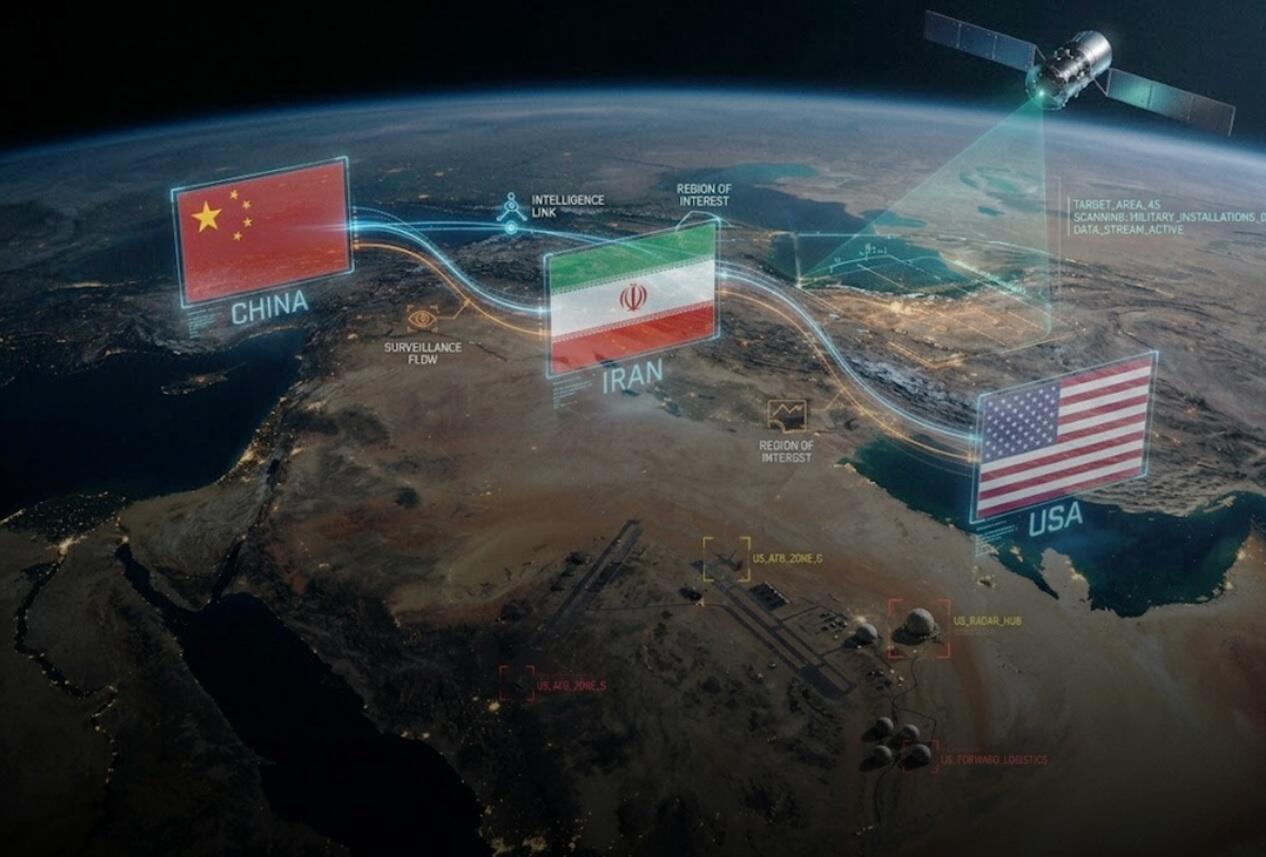
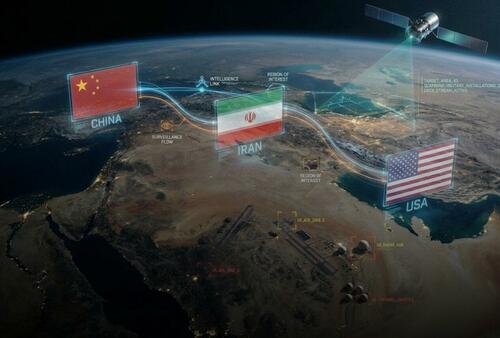
Iran quietly secured a Chinese spy satellite in late 2024 and used it to track US military bases across the Middle East during the current war, the Financial Times has newly – an allegation Beijing has flatly and angrily denied.
The TEE-01B satellite, built and launched by Chinese firm Earth Eye Co, was allegedly taken over by the Islamic Revolutionary Guard Corps’ (IRGC) Aerospace Force after launch from China, according to the report, which cites leaked Iranian military documents. Of course, the usual caveats must apply when it comes to major Western MSM reporting on an emerging ‘axis of evil’ doing all things anti-America: Russia, China, Iran (and certainly South Korea could soon be thrown in the mix given its pro-Moscow role in the Ukraine war).
“Recently, some forces have been keen on fabricating rumors and maliciously associating them to China,” according to the official statement from the Chinese Foreign Ministry. In the meantime, Earth Eye Co has not commented.
Further, the Chinese embassy in Washington told the Financial Times: “We firmly oppose relevant parties spreading speculative and insinuative disinformation against China.” But we should note that this wasn’t exactly a full-on denial of the charge, and the embassy would likely not have a full picture of what the highest echelons of Chinese intelligence is up to at any given moment in Beijing.
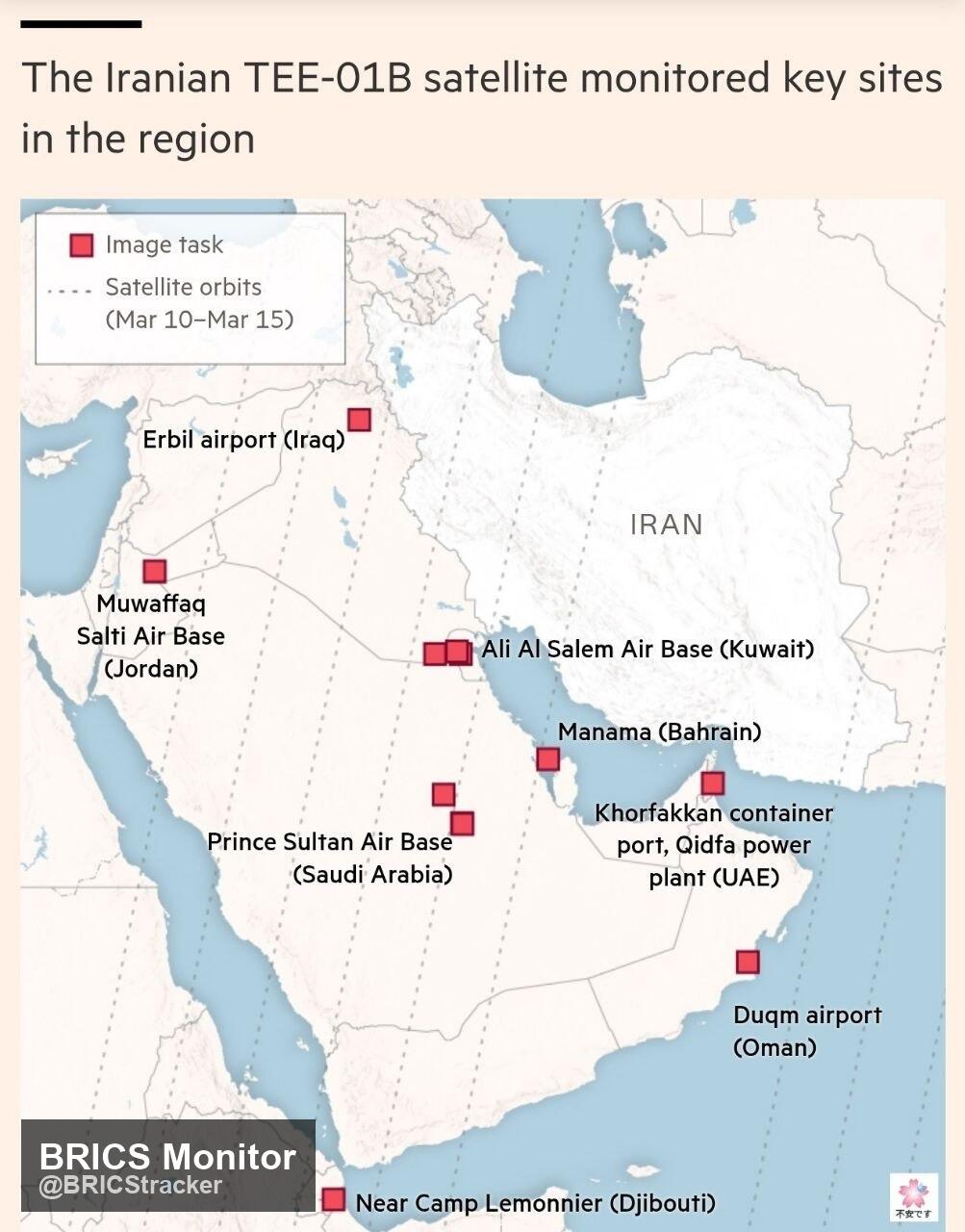
Per the FT report, Iranian commanders tasked the satellite with monitoring key US military sites, using time-stamped coordinate lists, satellite imagery, and orbital analysis. The Financial Times said the images were captured in March, before and after drone and missile strikes on those locations.
As part of the arrangement, the IRGC gained access to commercial ground stations run by Emposat, a Beijing-based satellite control and data provider with a network spanning Asia, Latin America, and beyond.
One surprising development within the first month of Trump’s Operation Epic Fury was that Iran’s ballistic missiles were able to reach very precise locations all the way over in Jordan, where US bases were pummeled, amid an alarming trend where billions of dollars in regional American air defenses were quickly taken out. Of course, sensitive Israeli military and energy sites were also hit, especially in Haifa and Tel Aviv. Reuters has also picked up on the FT report Wednesday, writing:
According to the report, the satellite also monitored Muwaffaq Salti Air Base in Jordan and locations close to the US Fifth Fleet naval base in Manama, Bahrain, and Erbil airport, Iraq, around the time of IRGC-claimed attacks on facilities in those areas.
US outposts in northern Iraqi Kurdistan have also been repeatedly hit by Iranian drones, or at times drones and projectiles possibly sent by local Tehran-aligned paramilitary forces.
As for more specifics cited in the original FT report, the satellite was described has having captured images of Prince Sultan Air Base in Saudi Arabia on March 13, 14, and 15.
There’s some credibility to this, given that on March 14, Trump confirmed that very expensive US surveillance aircraft at the base had been hit. “Four of the five had virtually no damage, and are already back in service. One had slightly more damage, but will be in the air shortly,” Trump had written at the time on Truth Social.
Still, Trump is trying to ‘play nice’ with Beijing – even amid such public and damning allegations – ahead of his planned mid-May visit, saying in a Wednesday Truth Social post he asked his Chinese counterpart Xi Jinping not to supply weapons to Iran, and Xi replied he was not doing so. “I had heard that China’s giving weapons to, I mean – you’re seeing it all over the place – to Iran.” This was in a newly published Fox Business interview.
FT produced the following graphic as part of its report:
“And I wrote him a letter asking him not to do that, and he wrote me a letter saying that essentially he’s not doing that.” Major media outlets previously reported that US intelligence indicated China was preparing to ship advanced weaponry to Iran. Beijing’s public rejection of the “baseless smear” – as the Foreign Minister called it – has indeed been swift and vehement.
Trump has also newly explained on Truth Social that China is “very happy that I am permanently opening the Strait of Hormuz” – this even though in many cases it is China bound tankers being blocked and turned back by the US naval armada. “This situation will never happen again,” Trump added. He is set to meet with Xi in Beijing on May 14-15. On this he wrote that “President Xi will give me a big, fat, hug when I get there in a few weeks. We are going working together smartly, and very well!” But then Trump says “But remember, we are very good at fighting, if we have to.”
Tyler Durden
Wed, 04/15/2026 – 13:25

Watch: Vance Pledges Probe Into Epstein ‘Pizza’ And ‘Grape Soda’ References
Watch: Vance Pledges Probe Into Epstein ‘Pizza’ And ‘Grape Soda’ References
Authored by Steve Watson via Modernity.news,
Vice President JD Vance has publicly committed to investigating references in the Jeffrey Epstein files that he says evoked the Pizzagate conspiracy theory, citing emails mentioning “pizzas or grape sodas” in odd contexts.
His remarks come as Acting Attorney General Todd Blanche doubled down on the Department of Justice’s position that every relevant document has already been released, leaving critics to question whether the full truth about Epstein’s network will ever see daylight.
In remarks at a Turning Point USA event, Vance described reviewing the files and encountering an email that stood out.
JD Vance says he is in the process of opening an investigation into the “Pizzagate conspiracy theory” after he read strange words involving pizza and grape soda in the Epstein files.
Vance has now publicly pledged to follow up on this matter.
“I remember it sounding like the… pic.twitter.com/eu122DyAhw
— Shadow of Ezra (@ShadowofEzra) April 14, 2026
“One person sent an e-mail to Jeffrey Epstein saying oh they were some really nice like pizzas or grape sodas or something like that,” he recalled. “And I remember it sounding like the Pizzagate conspiracy theory.”
His reaction was direct: “We should absolutely investigate.”
Vance added that he plans to follow up “to see whether we’ve investigated that person because we should. We absolutely should when you see evidence of sexual assault sexual misconduct regardless of who the powerful not fact.”
The comments have reignited scrutiny over language in the Epstein files that some have long argued resembles coded references first highlighted in 2016. Those earlier claims, known as Pizzagate, originated from WikiLeaks releases of John Podesta’s emails that contained repeated, seemingly out-of-context mentions of pizza alongside other odd terms.
Recent Epstein document dumps have revived the debate, with analysts pointing to hundreds of “pizza” references that do not appear to describe food.
New Jeffery Epstein documents have emails consistently use one very familiar word
The word Pizza
The emails they write when referring to pizza don’t make any sense if they were talking about the food….
Pizzagate was 100% real. Where are the arrests pic.twitter.com/KqkmsHk4c6
— Wall Street Apes (@WallStreetApes) February 6, 2026
Mike Benz, in analysis of the newer files, noted: “In these new files, you’ll see a lot of people talking about PIZZA in a way that (seems like a code), it’s kind of impossible.”
Mike Benz:
In these new files, you’ll see a lot of people talking about PIZZA in a way that (seems like a code), it’s kind of impossible.
Drop a ? if you’ve been vindicated
Cliphttps://t.co/M6YlH9oRMY
Full Interviewhttps://t.co/03XLFBWHQm pic.twitter.com/tSXCvFBOa5
— MJTruthUltra (@MJTruthUltra) February 5, 2026
A separate development underscores the tension. Acting Attorney General Todd Blanche appeared on Fox News and doubled down on declaring the Epstein files exhausted.
“We have released everything. We reviewed six million pieces of paper!” Blanche stated, adding “We are not sitting on a single piece of paper to be released.”
Acting Attorney General Todd Blanche tells Americans he will cover up the child trafficking network of Jeffrey Epstein by not releasing the rest of the Epstein files.
He says people should trust him when he says there is not a single document that the government has that should… pic.twitter.com/Hi52DfzKxM
— Shadow of Ezra (@ShadowofEzra) April 14, 2026
He insisted that if anything new surfaces it would be made public, but emphasized the DOJ’s review covered millions of pages unrelated to Epstein and that Congress could access unredacted materials if lawmakers chose to examine them.
ernity.news/wp-includes/js/wp-embed.min.js
The Pizzagate theory first gained traction in late 2016 after WikiLeaks published thousands of emails from Hillary Clinton’s campaign chairman John Podesta. Researchers flagged phrases like “pizza” and “hot dogs” appearing in contexts that seemed unrelated to meals—patterns that echoed an FBI intelligence bulletin on pedophile code words, where “pizza” was listed as slang for girl and “hot dog” for boy. Comet Ping Pong, a Washington, D.C. pizzeria, became the focal point after its owner’s Instagram posts and the restaurant’s alleged basement (which does not exist) fueled speculation of a child-sex ring operating out of the basement.
While mainstream outlets quickly labeled the theory a hoax, the Epstein files have now surfaced hundreds of similar “pizza” mentions. Multiple reports note exchanges involving Epstein’s urologist, Dr. Harry Fisch, that pair “pizza and grape soda” with references to erectile-dysfunction medication in ways that read as cryptic to outsiders. One 2018 message reads: “lets go for pizza and grape soda again. No one else can understand. Go kno.” Another simply states “Pizza and grape soda[.] Nough said.”
Debunkers argue these are innocent food references or jokes, yet many counter that the volume and context—especially when layered atop Epstein’s documented trafficking network—demand investigation rather than dismissal.
This latest flare-up fits a pattern of incremental disclosures followed by official assurances that the matter is closed. Vance’s willingness to revisit the “Pizzagate” framing, however tentatively, marks a rare high-level acknowledgment that some of the file language warrants a second look.
The Epstein saga has repeatedly exposed fractures between what officials claim has been fully disclosed and what the public believes remains concealed. Whether Vance’s pledged follow-up produces meaningful accountability—or joins the growing list of unfulfilled promises—will test whether transparency on elite networks is still possible. For now, the strange language in the files keeps the questions alive, and the public’s demand for answers shows no sign of fading.
Your support is crucial in helping us defeat mass censorship. Please consider donating via Locals or check out our unique merch. Follow us on X @ModernityNews.
Tyler Durden
Wed, 04/15/2026 – 12:50

Foggy, Foggy War
Foggy, Foggy War
By Michael Every of Rabobank
With US stocks up, the Nasdaq with its longest winning streak since 2021, and screen oil down for a second day in a row, markets continue to price the starkly binary physical outcomes smack in front of us on the side that’s full of stardust.
The IMF just warned of a potential world recession ahead if Hormuz stays shut. Its latest three global growth scenarios are ‘weaker’, ‘worse’ and ‘severe’ – “because markets”, and politics, the Fund chose the most benign as its base case, even as “downside risks are clearly very elevated.” That’s as Spain, for example, just released 4 of their 90 days of strategic oil reserves, with another 8 to follow. While that leaves 78, even if Hormuz reopened tomorrow, it would take at least 60 and possibly as many as 150 days before normal oil flows could be restored, according to IEA. Imagine driving home in a convoy through a blazing desert in an air-conditioned car knowing you all have 50 miles of fuel in the tank, and the next station is 30 miles away… and then hearing on the radio that it could be shut, and the following one is at least 60 miles away. That’s where much of the world economy stands now – and markets are opting to pump up the radio and aircon and say, ‘The next station will be open and I want a slushy.’
Most governments are doing the kind of pumping oil wells aren’t:
Brussels is pitching a “state subsidy bonanza” to combat the energy shock which “goes much further than the current state aid rules.”
Canada’s PM Carney, who ran two central banks, has suspended federal taxes on gasoline and diesel.
Malaysia is to increase its biofuel mandate.
Provided the war ends soon, those kinds of policies could cushion the economy: but across all schools of economic thought, textbooks are clear about what demand-side boosts into structural supply-side shocks do – leave you stuffed.
So, to the war. CENTCOM says no ships passed the Iran blockade in the first 24 hours. Moreover, the US Treasury says is not renewing its temporary easing of Iran oil sanctions and has sent notices to China and Hong Kong asking for help in enforcement. The US is clearly escalating hard vs Iran despite messages pinging yesterday that a sanctioned Chinese vessel, Starry Rich, had transited Hormuz, ignoring IF an interception was to be made, it would be in the Gulf of Oman or Arabian Sea; then clarified the vessel was carrying methanol from the UAE, not fuel from Iran, so wasn’t in scope; then the ship turned round anyway. Some press today claims the Saudis, who’ve been pushing the US to finish the job vs. Iran, are now pressuring it to ease the blockade in fear of a Red Sea counter-blockade that hasn’t taken place yet: more fog?
Yes, there will be more US-Iran talks in Pakistan, possibly tomorrow, which is the lodestar market bulls are guided by. As the Telegraph notes, this seems to be the one place that Iran’s battered leadership can physically meet without being killed: but what will they say that’s different from the last rejection of US demands on uranium, nuclear weapons, missiles, proxies, and Hormuz? Vice President Vance has reiterated Trump wants a “grand bargain” with Iran, not “a small deal,” and one that sees it abandon its nuclear ambitions. Trump has added that he wasn’t happy with the proposed 20-year moratorium on uranium enrichment offered in Pakistan and wants a permanent end to the matter. Israel is also stating that the removal of Iran’s enriched uranium is a “threshold condition” for it ending its Iran campaign – though the head of Mossad chief has additionally declared, “Our mission isn’t over until regime falls.”
The question is perhaps if any grand bargain is only US-Iran, or will involve others, as top Russian and Chinese envoys meet in Beijing to discuss Iran, Ukraine, and Taiwan. Yet showing how complex this gets as our global crises conflate, Ukraine, now providing anti-drone tech to the GCC, which aids Israel, has asked Jerusalem to detain a Russian ship carrying stolen grain that just docked in Haifa, which will infuriate Moscow. The US is elsewhere suggesting Cuba is complicit in helping Russia fight Ukraine, both countries being flashpoints between DC and Moscow. Isolated, Europe is drawing up plans for keeping Hormuz open once the war is over, which, beyond any aid with minesweeping, logically won’t be needed: if the war is over, energy will flow. The EU proposal is notably modelled on its Red Sea Aspides force, which failed to reopen it to normal trade flows.
On a positive note, if assuming ‘escalate to deescalate’, Israeli and Lebanese envoys just held an historic summit in the US to discuss a peace deal. As the Israelis put it, “Lebanon wants to be liberated from (Iran-backed) Hezbollah… we discovered today that we’re on the same side of the equation.” By contrast, France, with its Sykes-Picot-logical focus on Lebanon, insists Hezbollah has to be included in these talks aimed at removing it, so has been deliberately excluded from them.
On exclusion, after attacking the Pope, Trump has now done the same to Italian PM Meloni for “lacking courage”: the EU will need that and more fiscal spending again given the Wall Street Journal report it’s accelerating a NATO fallback plan in case Trump pulls out – or waters his commitment down: “Article 5, Shmarticle 5.” Militarily, 5% of GDP would need to be spent on defense a lot sooner than the 2035 planned if so, and the Journal notes Europe would need to reinstitute a draft in order to get the necessary personnel. Yet in terms of providing muscle for any Rules-Based Order 2.0 without the US, Europe’s primary military power, France, just had to scale back its participation in key Balikatan naval exercises in the Philippines to a mere 15 participants.
Meanwhile, the Financial Times warns of a ‘China shock 2.0’, this time with a flood of high-tech goods “that will change the world” – or at least deindustrialize other parts of it. Bloomberg matches that with a report underlining that India’s plans to develop its own manufacturing base are hamstrung by China’s controls over the critical tech supply chain within that sector. The Nikkei Asia argues China is snapping up US chip tools via Southeast Asia sources (in the same way that many Chinese exports to the US are being transshipped via third parties), which from a neo-mercantilist perspective again makes the case for a global economy fragmented into geopolitical trade blocs.
That reality is one of the reasons I’ve argued lies behind this Iran war, both in terms of control of oil and the related IMEC trade corridor; and it’s why escalation will continue until the economic pain is so great that one side submits.
Yet will the unfolding slow-motion catastrophe in the background get key global players to cooperate before it’s too late? Only time will tell; and it’s a binary outcome; and while your car journey as you ponder this may be comfortable for now, the fuel tank is still the fuel tank, and the blazing desert is still the blazing desert. And as I type that, I just heard the following play on my radio:
“Now I understand; What you tried to say to me; And how you suffered for your sanity; And how you tried to set them free; They would not listen, they did not know how; Perhaps they’ll listen now.”
Tyler Durden
Wed, 04/15/2026 – 12:15
Eos Energy Soars As Investors Focus On Zinc Batteries And AI-Driven Demand
Eos Energy Soars As Investors Focus On Zinc Batteries And AI-Driven Demand
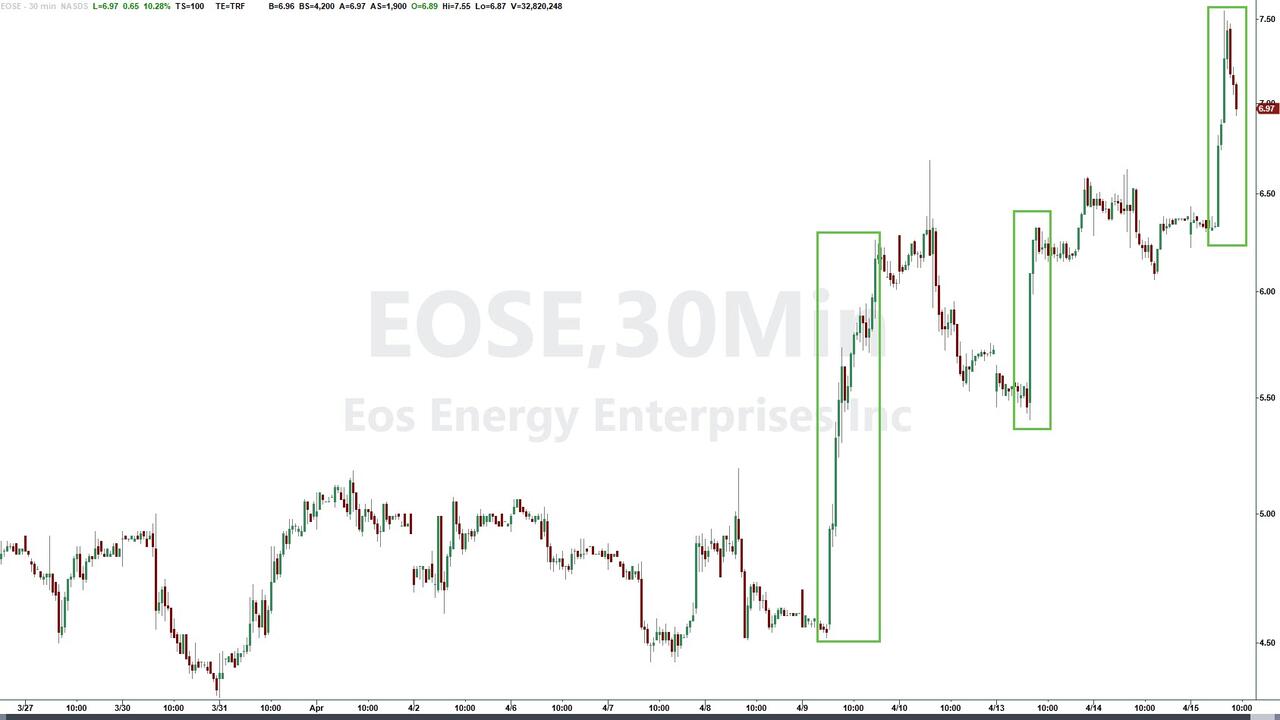
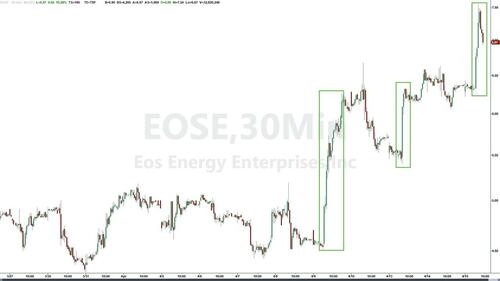
Eos Energy Enterprises’ stock jumped over 60% in the last few days as investor enthusiasm grew around its scaling production and role in powering AI-driven infrastructure demand, according to the International Business Times.
The company designs, develops, manufactures, and markets energy storage solutions for utility-scale, microgrid, and commercial and industrial applications in the United States. The stock surge builds on earlier momentum after the company reported strong preliminary Q1 2026 revenue of $56–$57 million. Growth was fueled by higher shipments, improved output, and better manufacturing efficiency at its Pennsylvania facility, signaling progress in ramping up its second production line.
This positive update helped ease concerns from earlier setbacks, including missed 2025 revenue guidance and ongoing class-action lawsuits tied to production projections. While legal risks remain, recent operational gains have renewed investor confidence.
IBT writes that Eos is positioning itself to meet rising electricity demand from AI and data centers, highlighted by a new partnership aimed at rapidly deploying large-scale power solutions. Its zinc-based batteries—seen as safer, cheaper, and more domestically sourced than lithium alternatives—are gaining attention as utilities and tech firms seek reliable energy storage.
Looking ahead, the company expects 2026 revenue between $300 million and $400 million, with improving margins as production scales. A $701 million backlog supports future growth, though profitability, cash needs, and execution risks remain concerns.
Analysts are cautiously optimistic and broader market optimism and policy support for U.S.-based energy solutions have also contributed to the stock’s recent strength.
Overall, Eos appears to be at a turning point. Continued manufacturing progress and successful contract wins could solidify its position in the energy storage sector—but uncertainty and risk remain part of the story.
Tyler Durden
Wed, 04/15/2026 – 12:00
BofA Sees Customer Gas Spending Jump 16%, But Discretionary Spending Holds Up
BofA Sees Customer Gas Spending Jump 16%, But Discretionary Spending Holds Up
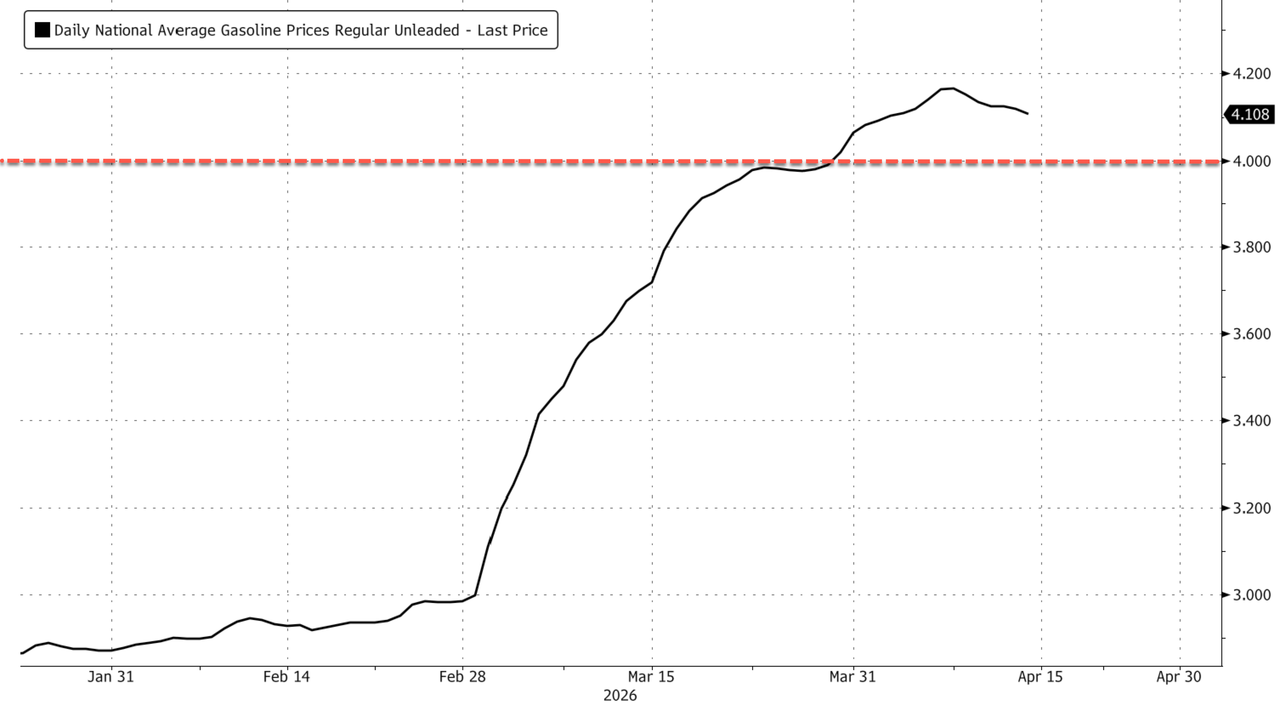
The national average for 87-octane gasoline has remained above the politically sensitive $4-a-gallon level for two straight weeks after the largest monthly jump in AAA data going back two decades. The fuel shock has Wall Street analysts focused on whether surging pump prices will begin crowding out discretionary spending.
Bank of America CFO Alastair Borthwick told analysts on a conference call earlier today that the fuel shock at the pump has not undermined overall consumer strength so far, though that could change if the Hormuz chokepoint is not resolved in the near term, according to Bloomberg.
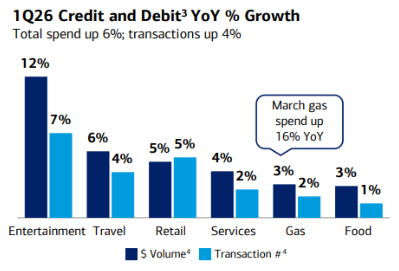
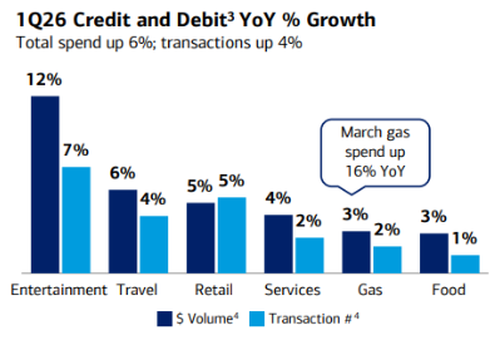
The BofA presentation Alastair cited showed that, for the first quarter, consumer spending at the pump was up 3%. For March, gas spending soared 16%. However, no meaningful spending pullbacks were visible elsewhere: Entertainment, travel, and retail spending all remained healthy, with entertainment spending rising 12% in the quarter.
BofA has joined a number of other firms, including Chime Financial, in disclosing gas-cost impacts on their customers. Chime’s CFO warned earlier this month that clients spent 25% more on fuel in March compared with the prior month.
Ally Financial, Capital One Financial, and American Express are set to report this week and will likely provide more color on fuel-shock impacts on their customers.
AAA data showed that the national average for 87-octane gasoline has hovered above the politically sensitive $4-a-gallon level for the last two weeks.
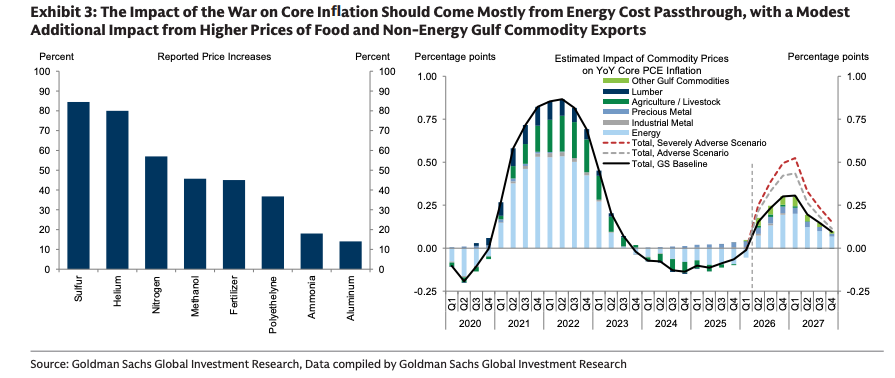
On the economy, Goldman analyst Jessica Rindels told clients on Sunday how the U.S.-Iran conflict, now in its seventh week, is set to produce a mild stagflation shock, though not on the scale of Russia’s invasion of Ukraine.
In our latest U.S.-Iran conflict report (read here), President Trump stated the war is “very close to over,” with another round of peace talks scheduled for this week. A Wall Street report cited U.S. officials overnight as saying that more than 20 vessels have passed through the Strait of Hormuz in the past 24 hours.
Tyler Durden
Wed, 04/15/2026 – 11:45