Category: News

From Trucks To Tanks: Pentagon Looks To Automakers To Rebuild America’s Arsenal
From Trucks To Tanks: Pentagon Looks To Automakers To Rebuild America’s Arsenal
With two active conflict areas in Eurasia – the Russia-Ukraine conflict in Eastern Europe and the U.S.-Iran theater in the Gulf – the world is moving deeper into a war cycle. The latest indicator is not only that militaries around the world are beginning to stockpile one-way attack drones, but also the early-stage push to convert underused civilian industrial capacity, including struggling auto production lines, into wartime manufacturing hubs.
The Wall Street Journal is out with a new report that describes just that, noting that the Trump administration is exploring whether U.S. manufacturers, including GM, Ford, GE Aerospace, and Oshkosh, can convert civilian industrial capacity into weapons production as conflicts across Eurasia drag on and deplete critical weapons stockpiles.
The effort to boost the war economy is part of what Defense Secretary Pete Hegseth has described as putting the defense industrial base on a “wartime footing.”
A Department of War official said the agency “is committed to rapidly expanding the defense industrial base by leveraging all available commercial solutions and technologies to ensure that our warfighters maintain a decisive advantage.”
Senior defense officials told the outlet that Mary Barra of General Motors and Jim Farley of Ford Motor have been briefed on converting auto production lines into weapons manufacturing facilities. The report did not provide details on what types of weapons could be produced in the factories or on the downtime required to convert those lines.
Those officials said GE Aerospace and vehicle and machinery maker Oshkosh were among other manufacturers briefed.
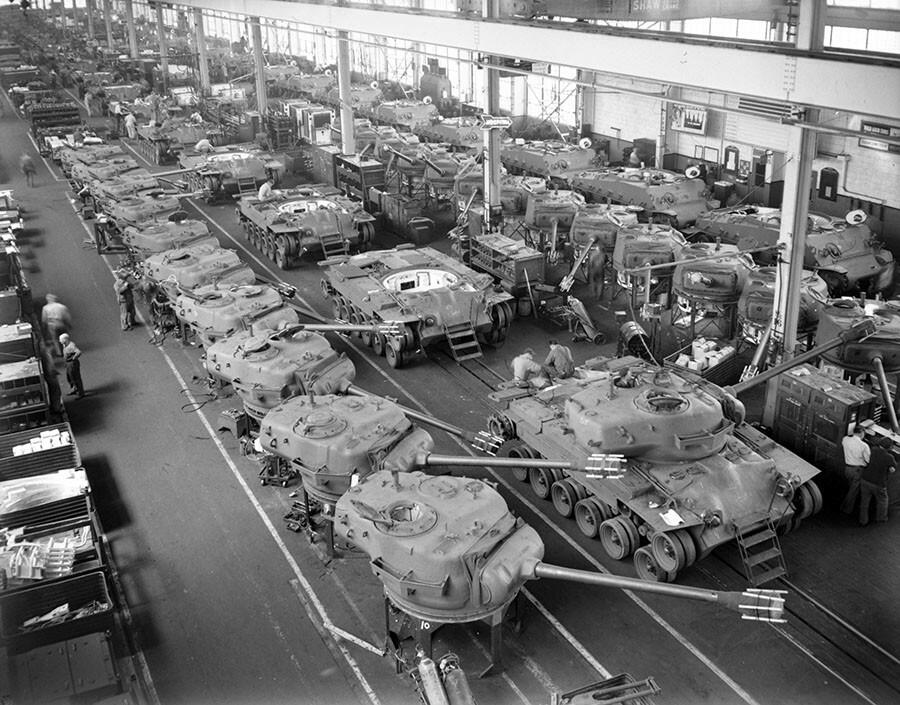
The historical precedent is that America converted its automotive base during World War II to produce record numbers of main battle tanks, bombers, and fighter planes to win the war.
Let’s not forget that GM and Ford both repurposed production lines during the Covid pandemic to produce ventilators, so it’s not far-fetched that these automakers could one day be rolling tanks down the production lines.
One major hurdle is the far-left unions, which could force labor actions such as strikes, as the broader left-wing ecosystem has transformed into a pressure campaign against anything related to Trump, whether foreign or domestic policy.
Evidence of converting underused civilian industrial capacity has already been seen with the German automaker Volkswagen, which will soon transform its Lower Saxony factory from producing T-Roc Cabriolets to manufacturing parts for the Iron Dome missile interceptor system.
In mid-February, we highlighted a conversation between Anduril Industries founder Palmer Luckey and Joe Rogan about how the U.S. won World War II. Luckey noted:
“How did the United States win World War II … Manufacturing. Some of it was new factories, but most of it was taking over old factories.”
.@PalmerLuckey “WWII we turned our automotive factories into missile factories” https://t.co/P6ZjQsPjeW pic.twitter.com/uUJmcTTupU
— Molly O’Shea (@MollySOShea) April 16, 2026
That’s why Chinese autos will never flood the U.S.: it would destroy the auto industrial base that can easily be converted to wartime production. However, the current left-wing regime in Europe has already chosen to hollow out its industrial core by flooding the continent with BYD cars.
This is wartime stuff.
Tyler Durden
Thu, 04/16/2026 – 07:45
https://www.zerohedge.com/military/trucks-tanks-pentagon-looks-automakers-rebuild-americas-arsenal

Goldman Sachs To Use Options Strategy For Planned Bitcoin Income ETF
Goldman Sachs To Use Options Strategy For Planned Bitcoin Income ETF
Authored by Nate Kostar via CoinTelegraph.com,
Goldman Sachs has filed with the US Securities and Exchange Commission (SEC) to launch a Bitcoin-linked exchange-traded fund designed to generate income while limiting exposure to the cryptocurrency’s volatility, according to a preliminary prospectus dated April 14.
The proposed Goldman Sachs Bitcoin Premium Income ETF would aim to deliver current income alongside capital appreciation by investing primarily in spot Bitcoin exchange-traded products (ETPs) and related options, rather than holding Bitcoin directly.
The fund would generate yield by selling call options on Bitcoin-linked ETPs, a strategy that can produce premium income but may cap upside in rising markets.
According to the filing, the actively managed fund would maintain at least 80% exposure to Bitcoin-linked assets and could allocate as much as 25% of its holdings through a Cayman Islands subsidiary, a structure commonly used to gain commodities exposure under the US Investment Company Act.
The fund expects to vary its options “overwrite” strategy — that is, selling call options against its holdings — between roughly 40% and 100% of its Bitcoin exposure depending on market conditions, and may distribute a significant portion of returns as income or return of capital.
It would gain exposure through a mix of spot Bitcoin ETPs and derivatives, combining direct holdings with options-based positions. The strategy may perform better in flat or moderately rising markets but could underperform during strong rallies as upside is capped.
Eric Balchunas, ETF analyst at Bloomberg, described the product as “Boomer Candy” in a post on X, suggesting the structure may appeal to investors seeking income and lower volatility over full upside exposure.
Source: Eric Balchunas
Separately, Goldman Chair and CEO David Solomon told analysts on Monday that the company last week closed on its acquisition of Innovator Capital Management, an issuer of defined outcome exchange-traded funds. The addition of Innovator’s 170 ETFs puts Goldman in the top 10 of global active ETF providers, Solomon said on the first-quarter earnings call.
Active crypto ETFs gain traction as strategies evolve beyond price tracking
The filing from Goldman Sachs comes as asset managers move beyond basic price-tracking crypto funds, with more complex and actively managed strategies gaining traction across the ETF market.
In January, Bitwise Asset Management launched an actively managed ETF designed to hedge against currency debasement.
The fund allocates across assets including Bitcoin, precious metals and mining equities, reflecting a broader push to integrate digital assets into diversified, macro-focused portfolios.
In March, T. Rowe Price amended its filing with the SEC for a proposed actively managed crypto ETF that would invest directly in digital assets.
The updated prospectus outlines a portfolio that may include assets such as Bitcoin, Ethereum and Solana.
Fund issuer 21Shares is also expanding into more sophisticated strategies. In February, the company launched a Europe-listed ETP tied to Strategy’s preferred stock (STRC), offering exposure to a yield-generating instrument linked to the company’s Bitcoin-focused capital strategy.
Speaking to Cointelegraph, 21Shares President Duncan Moir said the shift reflects broader demand for more advanced products, noting that crypto is “particularly well-suited to active management.”
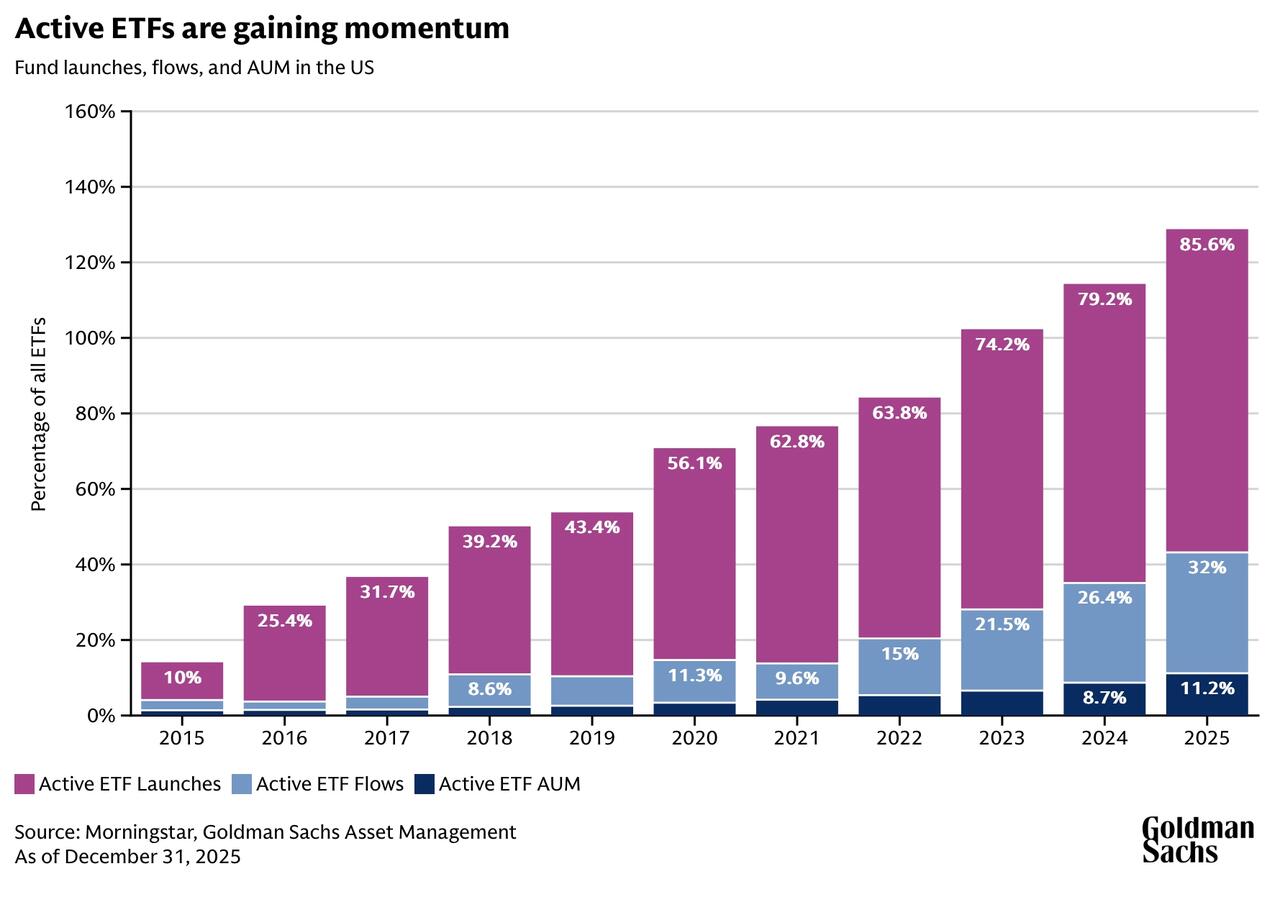
“Why Active ETFs Are Gaining Momentum as Investors Seek New Solutions.” Source: Goldmansachs.com
According to a March report compiled by Morningstar and Goldman Sachs Asset Management, active ETFs held nearly $1.8 trillion in assets globally at the end of 2025, with flows significantly outpacing passive products.
Tyler Durden
Thu, 04/16/2026 – 07:20
https://www.zerohedge.com/crypto/goldman-sachs-use-options-strategy-planned-bitcoin-income-etf

New Hungarian Prime Minister Says Borders Will Remain Shut To Immigrants
New Hungarian Prime Minister Says Borders Will Remain Shut To Immigrants
In the wake of Viktor Orbán’s election defeat, one of the greatest fears among conservatives in the region is an unconstrained EU able to take action on foreign policy, health, and immigration without the threat of a veto. It is widely assumed that the incoming prime minister of Hungary, Péter Magyar, will seek a fast resolution of Brussels’ key issues with Hungary in order to unlock some €35 billion in funding.
His election win was heralded as a substantial victory for the global left wing, from EU globalists to Democrats in the US. Their assumption is that with Orbán’s veto power out of play, they will be able to do they want in Ukraine and in Hungary. However, the new Prime Minster may not be as cooperative as they initially believed.
Magyar has stated that he will not try to block a €90 billion EU loan to Ukraine which Orbán originally vetoed, but he also stated that Hungary will not be contributing to such loans and that the government will not support any attempt to induct Ukraine into the EU. He also announced this week that he will not allow Hungary to join in the EU’s “Migration Pact” and that he plans to further strengthen Hungary’s borders.
This includes a continued rejection of the EU’s asylum rules, which are widely abused by third world migrants to freely enter Europe and gain access to welfare subsidies.
Beyond the Ukraine funding veto, it was Orbán’s refusal to submit to open borders and mass immigration that caused constant conflict with the EU. He was frequently referred to by the political left as a “dictator” and a “fascist” in part because of his strict border policies (even though he is voluntarily leaving office after losing the election, which is not the behavior of a dictator).
Ursula von der Leyen, President of the European Commission, attacked Orbán regularly for his border controls, stating that Hungary’s program to reinforce their borders with walls and barbed wire was in violation of EU immigration standards.
It appears that this will not stop under Magyar.
🇭🇺 HUGE! Magyar Péter REJECTS the EU Migration Pact:
“Hungary will not accept any pact. In fact, I’m going to reinforce the border fence even more.”
Ursula’s European Union cheered for nothing! pic.twitter.com/qndVbTRkIf
— Based Hungary 🇭🇺 (@HungaryBased) April 15, 2026
The purpose of the EU Commission is to subjugate member countries through centralized monetary dependency and a series of financial sanctions if they step out of line. Financial leverage has been used on a number of occasions by the Commission to force nations to accept ever expanding mass immigration, largely from Muslim fundamentalist populations in countries like Algeria, Morocco, Syria and Afghanistan. Hungary is one of the few European nations to resist this multicultural agenda.
Without any further comment.🇭🇺🤝🇺🇸
From President Donald Trump about Peter Magyar:
“He’s a good man. I think he’s going to do a good job.”
— Magyar Péter (Ne féljetek) (@magyarpeterMP) April 15, 2026
While it is a member state, Hungary is not currently in the eurozone, using its own currency, the Hungarian forint, rather than the euro.
It may be that the EU sees Magyar as an acceptable trade, as long as they get their funding package for Ukraine. They probably also intend to play the long game, hoping that once Hungary joins the eurozone they can be manipulated over time using monetary leverage. That said, their intentions have long focused on using Hungary as a fresh sponge to absorb migrants, and this is simply not going to happen according to Magyar’s post-election declarations.
Tyler Durden
Thu, 04/16/2026 – 06:55

Speculation Explodes Following Disappearance Of 10th Expert With UFO And Nuclear Secrets
Speculation Explodes Following Disappearance Of 10th Expert With UFO And Nuclear Secrets
Authored by Steve Watson via Modernity.news,
Following the revelation that yet another government contractor with links to nuclear secrets and suspected dark project UAP information has vanished, speculation as to what exactly is going on has massively intensified.
The case of Steven Garcia, a 48-year-old property custodian at the Kansas City National Security Campus in Albuquerque, New Mexico, marks the latest entry in a disturbing sequence of deaths and vanishings among individuals connected to NASA, nuclear weapons components, and sensitive aerospace research.
Los Angeles Magazine contributor Lauren Conlin joined “Jesse Weber Live” to discuss the case, noting its eerie parallels to prior incidents.
Garcia’s disappearance is being framed as the 10th missing person case in the UFO mystery.
The disturbing pattern of deaths continues to baffle.
Garcia was last seen leaving his Albuquerque home on foot on August 28, 2025, carrying only a handgun. He left behind his phone, keys, wallet, and car. Officials have described him as potentially a danger to himself, but no trace has been found in the remote area where he lived.
Conlin emphasized the chilling similarities during the NewsNation segment. “This one is chilling to me because, as you said it echoes Neal McCasland’s disappearance. It was like the same thing in the state of New Mexico,” she stated. McCasland, a retired Air Force major general with deep UFO community ties, vanished from the same region earlier in 2026.
Garcia held top security clearance at the Kansas City National Security Campus (KCNSC), which manufactures over 80 percent of the non-nuclear components for U.S. military nuclear weapons.
“So Stephen Garcia, I mean he had a top security clearance at KCNSC,” Conlin explained. “They manufacture 80% of non-nuclear components that go into building military nuclear weapons and I mean he oversaw tens of millions dollars of assets, equipment some classified.”
She added that Garcia’s role involved handling “some classified, some not,” leaving open questions about his knowledge base. “We don’t know what was going on in this guy’s head right, the officials had said that he may have been a danger to himself.”
Neighbors noted he lived in a very remote area and worked in aerospace research. Conlin even raised a provocative possibility on air: “I have to wonder, again I know this sounds crazy but it could be an option here is the government doing this? Are they taking out their own people because of XYZ.”
The timing adds to the intrigue. Garcia’s disappearance occurred amid heightened congressional scrutiny of UAP (unidentified anomalous phenomena) videos and related programs, including a deadline set by Rep. Anna Luna for the release of specific footage.
Multiple individuals on the list of those who have vanished or died worked at or with NASA’s Jet Propulsion Laboratory (JPL), Los Alamos National Laboratory, or Air Force Research Laboratory projects involving asteroid defense, rocket engines, and classified aerospace systems.
No official connections have been publicly confirmed by law enforcement between the cases, yet the geographic clustering in New Mexico and California, combined with shared professional networks in nuclear and space tech, continues to fuel speculation.
Online discussions on X and Reddit’s r/UFOs and related communities have exploded with theories attempting to explain the pattern. Many users point to foreign intelligence operations, suggesting adversaries like China or Russia may be targeting U.S. experts to steal or neutralize knowledge of advanced technologies, including those potentially linked to UAP reverse-engineering programs. Ex-FBI officials have been cited in reports noting that foreign services have long pursued Americans with critical tech secrets.
Others speculate a domestic cover-up angle: that insiders with knowledge of classified UAP programs or non-human technology are being silenced to delay or control disclosure efforts, especially as Congress pushes for more transparency on UAP videos and related footage. Some tie the cases to specific projects like advanced alloys (e.g., Mondaloy) or propulsion systems funded through overlapping NASA, DoE, and Air Force channels.
A smaller but vocal group questions whether personal factors—extreme stress from high-clearance work or mental health crises—could explain the cluster, though critics argue the sheer number and similarities make coincidence unlikely.
Calls for an independent task force or deeper FBI probe appear frequently in threads, with users linking the pattern to historical UFO lore around sites like Roswell and Wright-Patterson Air Force Base.
Whatever the explanation, the cases underscore ongoing questions about transparency in America’s most sensitive scientific and defense programs. As more details emerge on Garcia and the others, the public demand for answers only intensifies. The full picture may yet reveal connections that challenge assumptions about how these secrets are guarded—and at what cost.
Your support is crucial in helping us defeat mass censorship. Please consider donating via Locals or check out our unique merch. Follow us on X @ModernityNews.
Tyler Durden
Thu, 04/16/2026 – 06:30

Zelensky Goes Full “Lord Of War” As Ukraine Pitches Battle-Tested War Robots To Highest Bidder
Zelensky Goes Full “Lord Of War” As Ukraine Pitches Battle-Tested War Robots To Highest Bidder
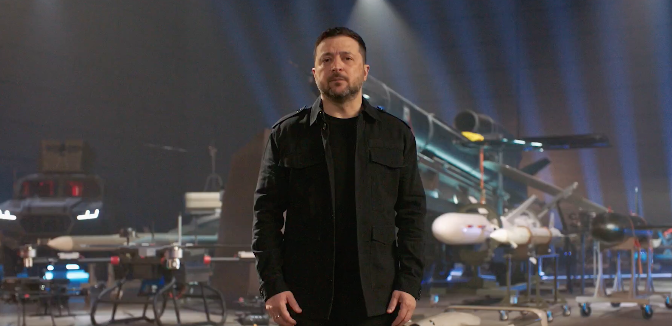
Ukrainian President Volodymyr Zelensky took the stage and stated that Ukraine’s military-industrial base has created some of the world’s most advanced unmanned platforms, already deployed against Russia and forever changing how warfare is conducted.
“For the first time in the history of this war, an enemy position was taken exclusively by unmanned platforms, ground systems, and drones,” Zelensky said in a post on X.
The future is already on the front line – and Ukraine is building it. These are our ground robotic systems. For the first time in the history of this war, an enemy position was taken exclusively by unmanned platforms – ground systems and drones. The occupiers surrendered, and the… pic.twitter.com/qLQKfxPdiB
— Volodymyr Zelenskyy / Володимир Зеленський (@ZelenskyyUa) April 13, 2026
He pointed to a growing number of Ukrainian defense firms, including Ratel, TerMIT, Ardal, Rys, Zmiy, Protector, and Volia, claiming their robotic systems have carried out more than 22,000 frontline missions in just three months.
Zelensky’s broader message seemed more like a PR pitch for Ukraine’s defense firms, which are capable of producing millions of FPV drones annually, as well as deep-strike systems, interceptors, ground robots, and maritime drone boats.
‼️ ZELENSKYY: For the first time in the war, an enemy position was captured entirely by ground robotic systems and drones – without any infantry. A robot entered the most dangerous zones instead of a soldier and took the positions.
«The future is here, on the battlefield, and… pic.twitter.com/maqECUunEj
— Kateryna Lisunova (@KaterynaLis) April 13, 2026
“Ukraine’s robots were sculpted by combat. I’ve seen the video footage of their UGVs taking hostages. This is what future battles will look like,” Foundation Robotics co-founder Mike LeBlanc said in a statement.
LeBlanc’s team is preparing its Phantom humanoid robots for testing and continues to develop militarized humanoid prototypes designed to operate alongside warfighters in high-risk environments.
In February, Foundation sent two Phantom MK1 robots to Ukraine for testing, according to a TIME Magazine article.
Ukraine’s capital markets have been frozen by war, leaving many of the country’s battlefield-proven “war unicorns” starved of traditional funding. However, the Middle East conflict has accelerated a new export pathway, as drone warfare and AI-enabled kill chains reshape how militaries think about defense.
Reuters has reported that Gulf states, including Saudi Arabia and the UAE, are exploring Ukrainian interceptor drones as a more affordable response to the emergence of Iranian one-way attack drones. At the same time, Ukrainian firms or their European subsidiaries are eyeing U.S. civilian and defense markets to sell their combat-tested systems. The first plausible path into the U.S. market appears to be through affordable counter-drone solutions and other layered air-defense technology.
Meanwhile, so-called “experts” cited by The Moscow Times called Zelensky’s X posts “mainly a PR move,” but highlighted how robots “are already transforming both tactics and strategy” in the four-year war.
Zelensky is correct: “The future is already on the front line.
Tyler Durden
Thu, 04/16/2026 – 05:45

UK Voters Call For Lower Taxes & Energy Bills As Economic Concerns Grow
UK Voters Call For Lower Taxes & Energy Bills As Economic Concerns Grow
Via CityAM,
According to a new poll, most British voters want lower energy costs and tax cuts to support growth.
A large majority rated the UK economy as poor and showed little faith in current progress.
Business leaders are also increasingly pessimistic, citing geopolitics and rising costs.
British voters want Rachel Reeves to cut taxes and reduce energy costs in order to focus on growth, as a majority of people felt the UK economy was “poor”, new research has shown.
Polling by Freshwater Strategy for the Institute of Economic Affairs (IEA), a free market think tank, suggested that the vast majority of Brits wanted the Labour government to focus on economic growth more than it currently does.
The findings back up the Labour government’s primary mission, which is to grow the UK economy.
But respondents in a survey and focus groups suggested that voters supported small-state policies to deliver improved growth, as much of the public was confused about the measurements used by the government to track achievements.
Polling found that 77 percent believed energy costs should be reduced, while 72 percent backed lower taxes for workers. A slightly lower portion, 66 per cent, backed tax cuts for businesses.
When faced with a direct choice, Britons backed economic growth even if it led to some environmental damage, while most also wanted energy to be cheaper, even if it meant slower progress to net zero.
Taxes and energy costs top Brits’ priorities
Respondents to the survey of 3,000 voters were also more likely to say that GDP growth benefited the government more than individuals.
In a damning indictment, nearly two-thirds of people (65 per cent) rated the UK economy as “poor” but overestimated the average wealth of Brits compared to Germans, Australians, and Americans.
Kristian Niemietz, editorial director of the IEA, said the lack of progress made in the last 18 years “should be the number one public policy issue of our time”.
“While political discourse in Britain may not always reflect it, Britain is clearly not a country that is comfortable with economic stagnation and relative decline,” Niemietz said.
“We still have the social expectations associated with a growing economy. What we do not have is the economic performance to match those expectations.”
Middle East war rattles finance chiefs
Low sentiment across the public reflects wider pessimism among business leaders, with one survey of 79 chief financial officers suggesting that confidence had fallen to a six-year low.
Deloitte’s finance chief survey suggested that the war in the Middle East had weakened top business leaders’ hopes of an economic recovery, as geopolitics was cited as the top risk.
Levels of concern around geopolitics were at a record high, according to the survey, while rising energy prices and the prospect of higher interest rates were also among the top risks.
Deloitte UK chief economist Ian Stewart said: “Rarely in the last 16 years have UK chief financial officers been more focused on cost control than today.
“This challenging environment is prompting chief financial officers to scale back expectations for margins and sharpen their focus on cost reduction and cash conservation.
“The immediate priority for finance leaders is to strengthen balance sheets in the face of external headwinds.”
Tyler Durden
Thu, 04/16/2026 – 05:00
Iran Boasts It Is Fast Rebuilding Bridges & Rail Lines After US Wrought Destruction
Iran Boasts It Is Fast Rebuilding Bridges & Rail Lines After US Wrought Destruction
Iran is seeking to put out images showing its resiliency after the country was hit with tens of thousands of airstrikes during over a month of the US-Israel Operation Epic Fury, including blowing up bridges, rail lines and other infrastructure.
The US and Israel struck bridges and rail lines to cripple Iran’s national transport network. Israel especially adopted attacks against key civilian infrastructure as a battle tactic, in hopes that eventually there would be a groundswell of anti-Tehran anger domestically, leading to government overthrow.
The bridge that was bombed by Israel and the US in Iran a few days ago, will be operational soon.
Iranian engineers are hard at work. pic.twitter.com/BJYicGKZud
— Sentletse 🇿🇦🇷🇺🇵🇸🇱🇧 (@Sentletse) April 15, 2026
However, Tehran officials and state publications have been boasting of restoring key rail links within days, showcasing the drive of its engineers and its reconstruction capacity.
This actually began happening even while the bombs were still falling while the ceasefire was in effect, with reports that even underground missile silos were being dug out and restored after some 12 hours of being attacked.
President Trump himself repeatedly threatening to bomb bridges, power plants, and other infrastructure to send Iran “back to the Stone Age.”
While vital infrastructure and even energy sites have indeed in many cases been obliterated, the lights are still on across the country, save for the persisting government-imposed internet blackout.
Since the fragile ceasefire took effect on April 8, Iranian officials say multiple damaged rail lines and bridges have been restored in record time – sometimes within 40 to 96 hours – using domestic engineering teams. These efforts have showcased by pro-Iran and even sometimes official diplomatic accounts on X.
An incredible railway bridge reconstruction in #Iran after a U.S.-Israel attack.
Speed, precision, and dedicated teamwork: Charbagh railway bridge back in service in just #72 hours🚂. pic.twitter.com/UJl4cL9ENe
— Embassy of Iran in Bulgaria (@IRANinBULGARIA) April 11, 2026
But the war has not yet been fully declared over, after one failed round of peace talks in Pakistan, and as the US still maintains a naval blockade on the Strait of Hormuz.
In many ways the current tense calm is a game of chicken, with each side seeing how much economic pain it can both impose and endure, before the other side blinks and backs down.
Tyler Durden
Thu, 04/16/2026 – 04:15

Continuing Slump In Global Media Climate Agitprop Bodes Ill For Future Net Zero Support
Continuing Slump In Global Media Climate Agitprop Bodes Ill For Future Net Zero Support
Authored by Chris Morrison via THE DAILY SCEPTIC,
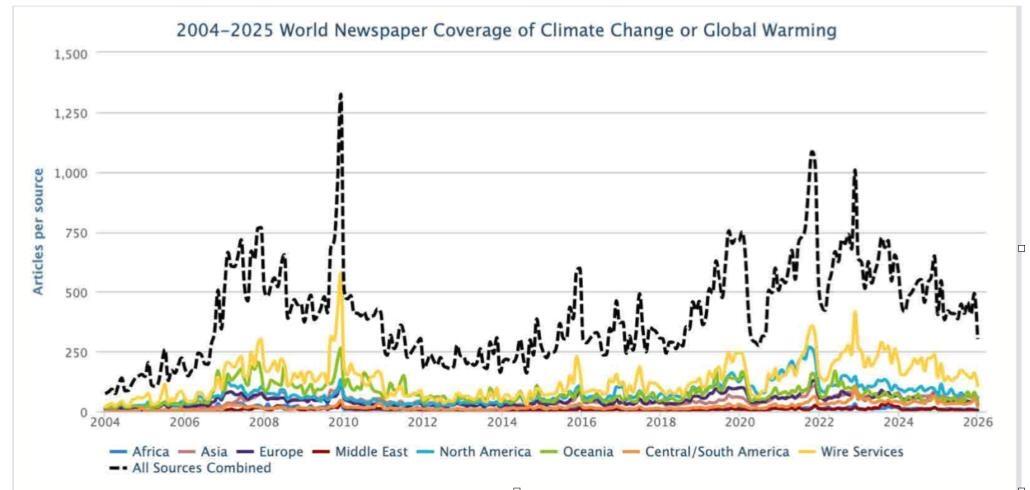
Decades of careful grooming of incurious journalists designed to whip up a non-existent climate emergency have failed to halt a dramatic continuing collapse in mainstream media stories backing the Net Zero fantasy. Last year saw a 14% global slump in climate-related stories compared to 2024, which was already 38% down on peak Greta hysteria in 2021. Perhaps there is only so long that once trusting consumers are prepared to read, let alone pay for identical, narrative-driven drivel that is often so one-sided that it is an insult to the intelligence. Exhibit 1: the BBC’s October 2023 classic – Climate change could make beer taste worse.
The greatest declines over 2025 were found in Africa, the Middle East and North America. Interestingly, the failed Amazon COP30 meeting in November 2025 was followed the month after by coverage falling off a cliff in Latin America (-61%), Oceania (-52%) and the European Union (-41%). A period of private grief seems to have given the long-suffering public a merciful break from the relentless cacophony of climate catastrophising.
News of the continuing falls in climate change and global warming coverage are contained in the latest annual report from the Media and Climate Change Observatory (MeCCO) at the University of Colorado Boulder. To produce its latest findings, MeCCO tracked the volume of newspaper, wire services, radio and TV climate stories across 59 countries and seven regions. The work is said to have used a consistent methodology since 2004.The graph below shows clearly the spikes in the Greta hysteria around the start of the current decade, and the earlier Gore grift that followed the release of his ‘An Inconvenient Truth’ film.
University journalism courses often run climate modules but prospects for aspiring students looking to make the world safe for Net Zero fanatics do not look good. The Guardian can only do so much, but in the UK, coverage was 34% down in the 12 months to November 2025. In the USA, the sackings have started with a vengeance. Last year, new managers at CBS News removed most of the climate crisis team. Recent reports suggest that everyone on the climate beat has now been binned. In February 2026, the Washington Post cut 14 climate writing positions, leaving only five journalists in place.
Last year was a bad time for the climate groomers that are largely funded by Green Blob billionaires seeking societal upheaval by depriving modern (and developing) industrial countries of vital hydrocarbons. Groomed journalists working in narrative-driven mainstream media are seen as key to driving up fear of the invented climate crisis. One of the first lessons taught to useful idiot fear mongers is that the opinion, often incorrectly referred to as a theory, that human cause most if not all recent climate change, is ‘settled’. The incurious are not encouraged to ask if this is the first scientific opinion to be declared settled, or at least the first since the Roman Popes of old adjudicated ex cathedra on these matters.
In the UK, the National Council for the Training of Journalists (NCTJ) is a respected industry-based charity that has operated since the 1950s. But its climate change training is laughable. In what other investigative fields are journalists encouraged to rely on a claimed ‘consensus’, and encouraged not to disclose alternative views? What quicker way is there, it might be asked, to replacing the writer with an AI tool? Funded by the Google News Initiative (GNI), the NCTJ offers a free e-learning course on climate change reporting. As with all climate science grooming agitprop sessions, there is a warning about avoiding ‘false balance’. In effect, this means denying publicity to sceptical scientists who investigate opinion by following the time-honoured process of scientific falsification.
GNI is a major funder of the attempts made to silence dissenting climate opinions. One of the major weapons deployed involve so-called ‘fact-checkers’ which, in the Daily Sceptic’s own experience, do little more than attack inconvenient science findings with opinionated claims of ‘misinformation’. Discussing the underlying science does not appear to be a priority, rather the negative verdicts are helpful in cancelling advertising, and diminishing impact in the social media sphere.
In the UK, GNI is a funder of the Reuters Institute for the Study of Journalism. Until recently, this operation ran a six-month groomer for climate writers under its Oxford Climate Journalism Network (OCJN) operation. The course has also attracted considerable funding from the former Extinction Rebellion paymaster Sir Christopher Hohn, and over four years it hosted around 800 journalists from 80 countries. Alas, the indoctrination pitstop pulled down the shutters late last year. The “flagship online course” will no longer be setting tasks asking participants to write a news story showing why mangoes are less tasty this year due to climate change. We can only pray that similar restrictions now apply to other climate-challenged comestibles.
It seems the world is getting tired of clickbait, centrally-determined climate claptrap that for too long has provided an unscientific base for the Net Zero fantasy. Pseudoscience gaslighting has allowed rigged computer models to predict headline-grabbing Armageddon ‘tipping points’, and contributed to the mainstream spread of unchallenged lies that extreme weather events are getting worse. Good news stories such as the major ‘greening’ of the Earth are ignored, while the vital role played in this by the gas of life carbon dioxide is downplayed. None more so than SciLine, a Green Blob-funded operation connected to the Association for the Advancement of Science, publisher of Science.
“In many cases, CO2 disproportionately favours weeds over crops causing more problems for agriculture”, it helpfully notes in its guide to journalists.
Tyler Durden
Thu, 04/16/2026 – 03:30

Germany Accelerates Kamikaze Drone Stockpiling With Rheinmetall Deal
Germany Accelerates Kamikaze Drone Stockpiling With Rheinmetall Deal
Germany’s parliament has approved a sizeable contract for defense giant Rheinmetall to supply loitering munitions, or kamikaze drones, to the Bundeswehr, underscoring just how quickly European militaries are internalizing drone warfare lessons from both the Russia-Ukraine war and, more recently, the U.S.-Iran conflict. Berlin’s latest procurement push makes it clear that one-way attack drones are becoming a serious threat, and the race to stockpile them has begun.
Bloomberg reports that the budget committee of the Bundestag approved the Defense Ministry’s proposal for an initial tranche of Rheinmetall’s suicide drones worth $345 million.
The deal is capped at around $1.2 billion for Rheinmetall loitering munitions and depends on the firm meeting development and delivery milestones. The drones are initially intended for Germany’s brigade in Lithuania, but there is a possibility that they will be deployed elsewhere.
The approval follows Germany’s February decision to purchase $637 million worth of strike drones from startups Helsing and STARK. Rheinmetall missed out on those deals because it lacked a working prototype at the time.
The Defense Ministry confirmed the latest contract without identifying Rheinmetall: “As with the other two contracts, there are clearly defined qualification requirements, termination milestones, and innovation clauses.”
Lessons learned from the current conflicts across Eurasia have served as a wake-up call for countries around the world, unleashing a frantic race among the world’s militaries to procure low-cost attack drones.
What follows will be counter-drone systems to combat this emerging threat, as the war in the Middle East showed that the US and its Gulf allies lacked low-cost solutions.
On the U.S. homeland front, the Federal Aviation Administration has given the U.S. military the green light to deploy high-energy counter-drone laser weapons in U.S. airspace. Alarmingly, there are very few, if not any, low-cost counter-drone systems guarding America’s data centers, transmission substations, stadiums, and other critical infrastructure.
One month before the US-Iran conflict broke out, we informed readers of the urgent need for data centers to consider counter-drone systems. What followed were multiple data centers struck by Iranian drones in the Gulf region. Civilian infrastructure will not be spared as the world becomes increasingly dangerous and chaotic.
Tyler Durden
Thu, 04/16/2026 – 02:45
https://www.zerohedge.com/military/germany-accelerates-kamikaze-drone-stockpiling-rheinmetall-deal

Europe’s Electrification Dream Is Hitting A Wall
Europe’s Electrification Dream Is Hitting A Wall
Authored by Gisele Widdershoven via OilPrice.com,
Europe’s electrification strategy is ambitious but constrained by lagging grid infrastructure, creating bottlenecks that are already delaying industry and investment.
Massive funding needs—running into trillions—combined with regulatory complexity and slow buildouts are exposing a gap between policy ambition and physical reality.
Without better coordination, prioritization, and financing, Europe risks higher costs, weaker competitiveness, and a stalled energy transition.
The message given by Ursula von der Leyen to electrify the European economy is strategically coherent, politically appealing, and, on the surface, even unavoidable. It will be the real deal to decarbonize industry and power transport, reduce dependence on imported fossil fuels, and anchor Europe’s competitiveness. The latter is especially valid in an increasingly fragmented geopolitical order. Electrification is presented as the backbone of Europe’s future prosperity and security.
However, beneath this clear vision lies a far more uncomfortable reality. Brussels is not only pursuing an energy transition but also transforming its industrial base, transport systems, infrastructure networks, and geopolitical posture. All of this needs to be done while facing an increased financial, physical, and strategic strain. Electrification is not failing at present because the overall idea or strategy is wrong, but because the system required to support it is already overstretched. At the same time, and maybe even more important, the bill to fix that system is only beginning to emerge.
The real core problem of Brussels is not its ambition, but the sequencing of it all.
Europe is already accelerating the electrification of demand, mainly in the industrial, transport, and heating sectors, while simultaneously pushing to expand renewable supply at an unprecedented speed. One pivotal issue, however, seems to be constantly forgotten: the infrastructure that must connect the two is lagging dangerously behind. Policymakers and advisors should realize that electricity systems are not abstract constructs, but physical networks with hard limits. Throughout Europe, these limits have already been reached.
The prime example of this situation is the Netherlands.
Throughout the continent, the Dutch energy transition has been presented as a model: one of the highest per-capita deployments of offshore wind in the world, widespread solar adoption, aggressive electrification policies, and a political consensus around decarbonization. If Brussels’ overall strategy were working as intended, the Netherlands should be its showcase.
In reality, however, it is its warning.
At present, the Dutch electricity grid is no longer able to keep pace with the pace of change. The country’s grid congestion has become structural, not incidental. An ever-growing list of thousands of companies, some even stating 15,000+, are already on waiting lists for grid connections or capacity upgrades. In several Dutch regions, industrial clusters cannot expand, while new investments are delayed or diverted. The most shocking issue is that even residential developments are hindered or blocked by the lack of electricity.
The paradox is striking. At certain moments, especially when there is a positive combination of wind and sun, the Netherlands produces more renewable electricity than it can use. At other times, the country cannot supply enough electricity to meet demand. The Dutch system is increasingly hit by a system that needs to deal with a simultaneous suffering of surplus and scarcity.
This is not a temporary imbalance but the predictable outcome of a system in which generation has outpaced infrastructure. It is also where Europe’s electrification narrative begins to unravel.
The EC’s strategy again assumes a relatively smooth scaling of supply, demand, and infrastructure. Reality, however, is much more complex. At present, infrastructure development lags due to permitting constraints, investment bottlenecks, and physical construction timelines. At the same time, demand does not scale linearly, especially when industries hesitate amid uncertainty about costs and grid access. The system itself introduces frictions, such as congestion, curtailment, and volatility, all undermining efficiency.
Across Europe, an increasing number of grid operators are issuing urgent warnings as connection queues grow while investment pipelines stall. All are looking at a situation where the congestion costs are rising. And yet the policy response remains focused primarily on accelerating renewable deployment and electrification targets, as if infrastructure will inevitably follow.
It will not.
Right now, now is that electricity grids cannot be expanded at the pace of policy ambition. Building high-voltage transmission lines takes years, often more than a decade. At the same time, distribution networks require massive upgrades to handle decentralized generation and electrified demand. Local opposition, environmental regulations, and supply chain constraints slow all of this.
Brussels dramatically underestimates the scale of investment needed, which should motivate industry leaders to develop innovative financing strategies and advocate for substantial capital allocation to meet the €660 billion annual target and beyond.
To be clear, this is not incremental spending, but a structural reallocation of capital on a scale rarely seen outside wartime economies.
Given the €1.2 trillion investment requirement for electricity grids alone by 2040, policymakers should explore innovative financing models, public-private partnerships, and EU-level funding instruments to mobilize the necessary capital efficiently.
Addressing electrification requires a collective effort to rebuild Europe’s entire energy backbone, highlighting the importance of coordinated strategic planning among policymakers, industry, and investors to prevent economic inefficiency and political fragility.
That is where the Dutch case becomes valid. The Netherlands has already demonstrated that high levels of renewable penetration do not automatically translate into effective electrification. Without grid capacity, renewable energy cannot be fully utilized. Without certainty about the connection, industrial electrification stalls. Without system flexibility, volatility increases.
In other words, the transition becomes economically inefficient and politically fragile.
Another major constraint is that the financial challenge does not exist in isolation. It is unfolding within a rapidly deteriorating geopolitical environment.
The European Union is simultaneously being forced to increase defense spending, support Ukraine, and respond to renewed instability in global energy markets. The war in Ukraine has already triggered a structural shift in defense priorities, with European defense spending reaching hundreds of billions annually and new EU-level instruments targeting up to €800 billion in mobilized resources.
Since the last two months, tensions in the Middle East, especially in Hormuz, have reintroduced energy security risks that Europe had hoped electrification would mitigate. Roughly a fifth of global oil and LNG flows through Hormuz. Even partial disruptions immediately translate into higher prices, increased volatility, and renewed dependence on external suppliers.
This strategic contradiction is compounded by geopolitical risks, such as disruptions in the Strait of Hormuz and increased defense spending, which threaten to undermine Europe’s energy security and complicate the transition to electrification despite its intended benefits.
Brussels attempts to invest heavily in electrification to reduce energy vulnerability, while simultaneously being forced to spend heavily on defense and absorb the costs of ongoing fossil fuel dependence. The energy transition does not replace one system with another, but it layers new costs on top of old ones.
This is the fiscal collision at the heart of the European project. The real question right now, which needs to be answered honestly, is: who is going to pay?
Most European governments are already fiscally constrained, as public debt levels remain elevated following the pandemic and energy crisis. They also need to deal with increased defense spending, while social pressures are rising. The idea that national budgets alone can finance the electrification of the economy is no longer credible.
Again, private capital is often presented as the solution. Brussels strategy relies heavily on mobilizing institutional investors, de-risking projects, and leveraging capital markets. However, private capital is not a substitute for public strategy. Private capital flows where risk-adjusted returns are predictable. Grid infrastructure, industrial electrification, and system flexibility often do not meet these criteria without significant public guarantees.
Moreover, the scale required goes far beyond what current mechanisms can deliver. Even ambitious instruments such as the Innovation Fund or the proposed Industrial Decarbonization Bank, targeting tens or even hundreds of billions, remain small relative to the annual investment gap.
Europe’s uncomfortable truth is that it will need to adopt a fundamentally different financing model. Electrification at this scale clearly requires something closer to a strategic investment doctrine than a collection of policy instruments. Brussels will need to deal with a reality that requires prioritization, coordination, and, for all parties, critical acceptance of trade-offs.
First, Europe will need to elevate energy infrastructure to the same strategic level as defense. If joint borrowing and coordinated financing can be justified for military capabilities, the same logic applies to cross-border electricity grids, storage systems, and industrial electrification corridors. These are not optional climate investments; they are the foundation of economic resilience.
Second, existing revenue streams, particularly from carbon pricing mechanisms, must be more aggressively redirected toward infrastructure. The current allocation is insufficient relative to the scale of need.
Third, public financial institutions, the European Investment Bank and national development banks—must significantly expand their role, particularly in areas where private capital remains hesitant.
All the above, however, will eliminate the need for prioritization.
The current reality shows that Europe cannot fund everything simultaneously. It cannot electrify all industries at once, build all infrastructure at once, and meet all geopolitical commitments without making choices. It is a political illusion to believe that coordination and efficiency gains will eliminate trade-offs.
The Dutch experience already demonstrates what happens when these trade-offs are ignored. Infrastructure constraints begin to shape economic outcomes. Investments are delayed or redirected. The energy transition loses momentum not because of political opposition, but because of practical limitations.
If we scale the Dutch experience to the European level, the consequences could be far more significant. Industries that depend on reliable, high-capacity electricity, especially chemicals, steel, and data infrastructure, will look beyond Europe if energy systems cannot deliver. Investment flows may shift to regions with more robust infrastructure. And Europe’s industrial base could erode at precisely the moment it seeks to strengthen it.
This is the risk embedded in the current electrification narrative.
Brussels assumes that more renewable energy and more electrification will automatically lead to lower costs, greater security, and enhanced competitiveness. Facts on the ground, however, show that without the infrastructure and financing to support it, the opposite may occur: higher costs, increased volatility, and reduced competitiveness.
The greatest danger is not a failure of electrification, but that it will proceed in an unbalanced way. There is a huge risk of too much generation without infrastructure, too much demand without connectivity, and too much ambition without sequence.
This is already happening.
The Netherlands shows that even a highly advanced energy transition can hit hard physical limits. These limits are not theoretical. They are visible in grid congestion, curtailed renewable output, delayed investments, and constrained economic growth.
Europe as a whole is now approaching the same inflection point.
Von der Leyen is right that electricity will define Europe’s future. However, to define the future is not the same as building it. Brussels needs to understand that building requires infrastructure that takes decades, capital that runs into trillions, and political choices that are far more difficult than current rhetoric suggests. We are not only looking at an energy strategy when pursuing electrification, but also at a test of Europe’s ability to align ambition with reality.
At present, that alignment is missing.
The physical limits of a grid need to be confronted by Europe, including the financial scale of its ambitions, and the geopolitical pressures shaping its choices. If not, the electrification agenda will remain incomplete. Again, the vision is not wrong, but the system required to deliver it is not yet ready. At the same time, the willingness to pay for it has not yet been fully acknowledged.
Tyler Durden
Thu, 04/16/2026 – 02:00
https://www.zerohedge.com/energy/europes-electrification-dream-hitting-wall