Category: News
Not Worth A Continental
Not Worth A Continental
Authored by Jeff Thomas via InternationalMan.com,
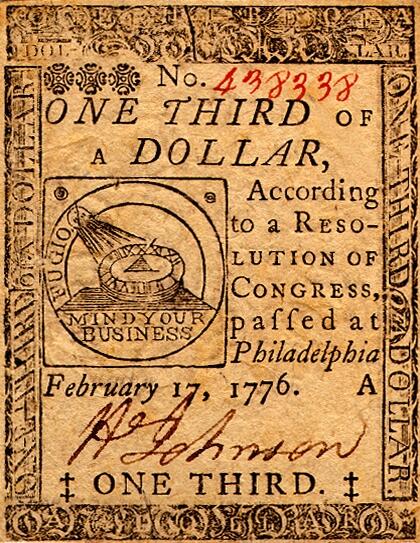
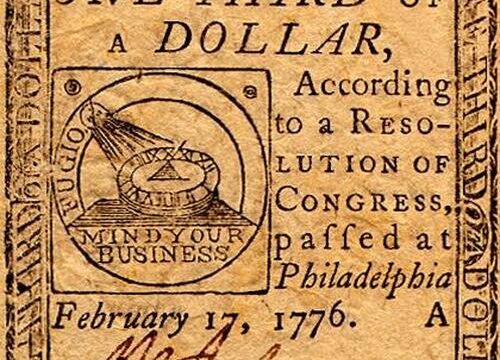
In late-18th-century America, something of minimal value was often described as being “not worth a continental,” which referred to the continental dollar, the American currency at the time of the revolution.
The continental was paper money. It had occurred to the colonists that, as their revolution was costing quite a bit to maintain, they could go into “temporary” debt to finance the war. Soon it became clear that the debt could not be repaid. Also, the printing of paper banknotes resulted in inflation. The solution? Print more of them. Further devaluation of the continental motivated the colonists to print more… then more… then still more. The continental became worthless, either for local trade or for repayment of debt.
The new country, the United States, then did something quite unusual. In its new Constitution, it created a clause to assure that this would never happen again. Under Article I, Section 10, the states were not permitted to “coin Money; emit Bills of Credit; [or] make any Thing but gold and silver Coin a Tender in Payment of Debts.”
The founding fathers of the US had figured out that the issuance of paper currency was a disaster in the making, and in 1792, passed the Coinage Act, denominating coins to be minted. The act authorized three gold coins: $10.00 eagles, $5.00 half eagles, and $2.50 quarter eagles, in addition to silver coins.
Of course, later US political leaders have largely committed the Constitution to the dustbin. Since that time, dozens of countries have followed a similar pattern of war/debt/hyperinflation. Let’s look at a few:
German 100 “billionen” mark banknote, ca. 1923
Reparations for WWI were required in hard currency. The papiermark was printed in mass quantity to buy foreign currency in order to pay reparations. The proliferation of bank notes caused the cost of goods to rise dramatically.
This rise was so dramatic that it led to a flight by Germans into hard assets, to avoid holding paper bank notes. (This is the classic tipping point at which inflation morphs into hyperinflation.) Predictably, governmental operation costs also rose. An increase in taxation was of no value, as it would be paid in the devaluating currency.
If the government stopped the inflation, this would cause immediate bankruptcies, unemployment, strikes, etc. But if they continued, they would default on the foreign debt through hyperinflation. They chose the latter, which, although ultimately more destructive, would buy the politicians a bit more time. (Hyperinflation is seen today as having paved the way for Adolf Hitler and the Nazi takeover of Germany.)
Hungarian 100 million billion pengő, ca. 1946
In 1945, Hungary was severely strapped for money, as a result of WWII. The Hungarian National Bank was instructed to issue currency proportional to whatever the budget required. Silver coinage disappeared. Banknotes were issued with no cover of any kind, and hyperinflation took hold.
As always, the government was confident that it could control inflation, but once hyperinflation took over, it was entirely beyond control. It is important to note that hyperinflation, once it begins, spreads like wildfire. The Hungarian hyperinflation began at the end of 1945 and peaked the following July.
Yugoslav 500 billion dinar banknote, ca. 1993
More recently, Yugoslavia, economically weakened by regional war, had used up all its hard currency reserves and decided to loot the savings of its citizens. This it did through the printing of money and increasing restrictions on citizens’ savings in government banks.
Not surprisingly, inflation rose dramatically. The government reacted by imposing price controls, which eliminated profits, so manufacturers ceased to produce essential goods. By 1993, when prices were doubling every fifteen hours, the country had reached the point that bakers stopped making bread.
Zimbabwe 100 trillion dollar banknote, ca. 2008
Zimbabwe’s civil war emptied the country’s treasury. Beginning in1998, President Robert Mugabe took land and other assets from white farmers and redistributed them to less-experienced black farmers. Food exports plummeted, prompting Mugabe to print more currency. Revenues to government suffered as a result, with wages failing to keep up. Hospitals and schools developed chronic staffing problems, because nurses and teachers could not afford bus fare to get to work. The capital of Harare was without water, because the authorities had stopped paying the bills to buy and transport the treatment chemicals. By 2008, prices were doubling every 24 hours.
There are many other examples, but the ones listed above provide a fairly good thumbnail sketch. There are many paths by which political leaders may destroy a country’s economy through hyperinflation. But those leaders who follow the standard checklist of the most common components to collapse can generally be assured that the economy will be destroyed. Let’s have a look at that checklist:
War (Can be one major war, or, as in today’s world, perpetual small wars)
Depletion of gold reserves
Excessive Debt (Create a debt level that is beyond the ability to repay)
Devaluation of currency (Print massive amounts of currency to diminish debt)
Loss of control of inflation (Inflation morphs into hyperinflation—a state in which citizens actively try to rid themselves of the currency, as it is devaluating so quickly.)
We are living in a period in which much of the world has committed the first three to four of the above grave errors and is reaching the tipping point at which the fifth kicks in. It’s important to emphasise that hyperinflation is never actually anticipated by governments; it always occurs suddenly, and it happens very fast. In addition, once begun, it never reverses direction. It always plays out until a complete monetary collapse occurs.
Back in the beginning paragraphs of this article, we mentioned that, in 1787, America’s founding fathers took the highly unusual step of enshrining in the Constitution a control to assure that private banks would never again create fiat currencies. The 1792 Coinage Act provided for a coin of the land—the “eagle,” which was to be made of gold.
The paper continental, along with the silver certificate and the gold certificate, has long since disappeared, but the US gold eagle is still being minted today.
And here’s the interesting aspect of gold coinage: The eagle has the same purchasing power as it did back in 1787. Whilst its nominal value may rise and fall, one ounce of gold purchases the same amount of goods as it has throughout history.
The significance of this is that gold, in essence, does not go up and down in value. Rather, gold is the standard by which currencies go up and down. Over the course of history, there have occasionally been anomalies in which gold is down for a brief time, or it is overbought and a bubble briefly occurs. But gold is like the seas: it has its tides, but like water, it seeks its own level and invariably continues as the standard of value.
In times like the present one, when we may anticipate the hyperinflation of numerous currencies, those seeking to preserve what they have, might wish to turn to gold as a relative safe haven, as mankind has done for 5000 years.
* * *
History is remarkably consistent. From the worthless continental to Weimar Germany, Hungary, Yugoslavia, and Zimbabwe, the pattern is always the same—governments print their way out of trouble, currencies collapse, and those holding paper wealth pay the price. The constant thread running through every one of these episodes is that gold did not fail; the currencies around it did. If you’d like a deeper, unfiltered look at why gold has survived every monetary breakdown for thousands of years—and why it matters now—we’ve arranged a free video featuring legendary investor Doug Casey. In it, he explains what most commentators still refuse to acknowledge about today’s monetary system and what history suggests comes next. Click here to watch the free video now.
Tyler Durden
Sat, 01/10/2026 – 17:30
https://www.zerohedge.com/personal-finance/not-worth-continental

EEUU lanza nuevos ataques de represalia contra el EI en Siria tras emboscada mortal
WASHINGTON (AP) — Estados Unidos lanzó otra ronda de ataques de represalia contra el Estado Islámico en Siria tras la emboscada del mes pasado en la que murieron dos soldados y un intérprete civil estadounidenses en el país.
Los ataques a gran escala, realizados por Washington junto con fuerzas aliadas, ocurrieron aproximadamente a las 12:30 de la tarde tiempo del Este de Estados Unidos, según el Comando Central estadounidense. En la ofensiva fueron alcanzados varios blancos del EI en toda Siria.
Los ataques del sábado forman parte de una operación más amplia, que a su vez es parte de la respuesta del presidente Donald Trump al mortal ataque del EI en el que murieron el sargento Edgar Brian Torres Tovar, el sargento William Nathaniel Howard y Ayad Mansoor Sakat, el intérprete civil, en Palmira el mes pasado.
“Nuestro mensaje sigue siendo firme: si dañas a nuestros combatientes, te encontraremos y te mataremos en cualquier parte del mundo, sin importar cuánto intentes evadir la justicia”, advirtió el Comando Central de Estados Unidos en un comunicado.
Un día antes, funcionarios sirios dijeron que sus fuerzas de seguridad habían arrestado al líder militar de las operaciones del EI en Oriente Medio.
Las fuerzas armadas estadounidenses indicaron que los ataques del sábado se llevaron a cabo junto con fuerzas aliadas, sin especificar qué fuerzas participaron.
El gobierno de Trump le puso Operación Hawkeye Strike a la respuesta a los ataques de Palmira. Torres Tovar y Howard eran miembros de la Guardia Nacional de Iowa.
Se inició el 19 de diciembre con otro ataque a gran escala que alcanzó 70 blancos en el centro de Siria, en los cuales había infraestructura y armas del EI.
Las Fuerzas Democráticas Sirias, encabezadas por los kurdos, han sido durante años el principal socio de Estados Unidos en la lucha contra el EI en Siria, pero desde la destitución del ex presidente sirio Bashar Assad en diciembre de 2024, Washington ha estado coordinando cada vez más con el gobierno central en Damasco.
Recientemente, Siria se unió a la coalición global contra el EI.
——-
Esta historia fue traducida del inglés por un editor de AP con la ayuda de una herramienta de inteligencia artificial generativa.

How the US could take over Greenland and the potential challenges
U.S. President Donald Trump wants to own Greenland. He has repeatedly said the United States must take control of the strategically located and mineral-rich island, which is a semiautonomous region that’s part of NATO ally Denmark.
Officials from Denmark, Greenland and the United States met Thursday in Washington and will meet again next week to discuss a renewed push by the White House, which is considering a range of options, including using military force, to acquire the island.
Trump said Friday he is going to do “something on Greenland, whether they like it or not.”
If it’s not done “the easy way, we’re going to do it the hard way,” he said without elaborating what that could entail. In an interview Thursday, he told The New York Times that he wants to own Greenland because “ownership gives you things and elements that you can’t get from just signing a document.”
Danish Prime Minister Mette Frederiksen has warned that an American takeover of Greenland would mark the end of NATO, and Greenlanders say they don’t want to become part of the U.S.
This is a look at some of the ways the U.S. could take control of Greenland and the potential challenges.
Military action could alter global relations
Trump and his officials have indicated they want to control Greenland to enhance American security and explore business and mining deals. But Imran Bayoumi, an associate director at the Atlantic Council’s Scowcroft Center for Strategy and Security, said the sudden focus on Greenland is also the result of decades of neglect by several U.S. presidents towards Washington’s position in the Arctic.
The current fixation is partly down to “the realization we need to increase our presence in the Arctic, and we don’t yet have the right strategy or vision to do so,” he said.
If the U.S. took control of Greenland by force, it would plunge NATO into a crisis, possibly an existential one.
While Greenland is the largest island in the world, it has a population of around 57,000 and doesn’t have its own military. Defense is provided by Denmark, whose military is dwarfed by that of the U.S.
It’s unclear how the remaining members of NATO would respond if the U.S. decided to forcibly take control of the island or if they would come to Denmark’s aid.
“If the United States chooses to attack another NATO country militarily, then everything stops,” Frederiksen has said.
Trump said he needs control of the island to guarantee American security, citing the threat from Russian and Chinese ships in the region, but “it’s not true” said Lin Mortensgaard, an expert on the international politics of the Arctic at the Danish Institute for International Studies, or DIIS.
President Donald Trump says the US ‘needs’ Greenland for Arctic security. Here’s why.
While there are probably Russian submarines — as there are across the Arctic region — there are no surface vessels, Mortensgaard said. China has research vessels in the Central Arctic Ocean, and while the Chinese and Russian militaries have done joint military exercises in the Arctic, they have taken place closer to Alaska, she said.
Bayoumi, of the Atlantic Council, said he doubted Trump would take control of Greenland by force because it’s unpopular with both Democratic and Republican lawmakers, and would likely “fundamentally alter” U.S. relationships with allies worldwide.
The U.S. already has access to Greenland under a 1951 defense agreement, and Denmark and Greenland would be “quite happy” to accommodate a beefed up American military presence, Mortensgaard said.
For that reason, “blowing up the NATO alliance” for something Trump has already, doesn’t make sense, said Ulrik Pram Gad, an expert on Greenland at DIIS.
Bilateral agreements may assist effort
U.S. Secretary of State Marco Rubio told a select group of U.S. lawmakers this week that it was the Republican administration’s intention to eventually purchase Greenland, as opposed to using military force. Danish and Greenlandic officials have previously said the island isn’t for sale.
It’s not clear how much buying the island could cost, or if the U.S. would be buying it from Denmark or Greenland.
Washington also could boost its military presence in Greenland “through cooperation and diplomacy,” without taking it over, Bayoumi said.
One option could be for the U.S. to get a veto over security decisions made by the Greenlandic government, as it has in islands in the Pacific Ocean, Gad said.
Palau, Micronesia and the Marshall Islands have a Compact of Free Association, or COFA, with the U.S.
That would give Washington the right to operate military bases and make decisions about the islands’ security in exchange for U.S. security guarantees and around $7 billion of yearly economic assistance, according to the Congressional Research Service.
It’s not clear how much that would improve upon Washington’s current security strategy. The U.S. already operates the remote Pituffik Space Base in northwestern Greenland, and can bring as many troops as it wants under existing agreements.
Influence operations expected to fail
Greenlandic politician Aaja Chemnitz told The Associated Press that Greenlanders want more rights, including independence, but don’t want to become part of the U.S.
Gad suggested influence operations to persuade Greenlanders to join the U.S. would likely fail. He said that is because the community on the island is small and the language is “inaccessible.”
Danish Foreign Minister Lars Løkke Rasmussen summoned the top U.S. official in Denmark in August to complain that “foreign actors” were seeking to influence the country’s future. Danish media reported that at least three people with connections to Trump carried out covert influence operations in Greenland.
Even if the U.S. managed to take control of Greenland, it would likely come with a large bill, Gad said. That’s because Greenlanders currently have Danish citizenship and access to the Danish welfare system, including free health care and schooling.
To match that, “Trump would have to build a welfare state for Greenlanders that he doesn’t want for his own citizens,” Gad said.
Disagreement unlikely to be resolved
Since 1945, the American military presence in Greenland has decreased from thousands of soldiers over 17 bases and installations to 200 at the remote Pituffik Space Base in the northwest of the island, Rasmussen said last year. The base supports missile warning, missile defense and space surveillance operations for the U.S. and NATO.
U.S. Vice President J.D. Vance told Fox News on Thursday that Denmark has neglected its missile defense obligations in Greenland, but Mortensgaard said that it makes “little sense to criticize Denmark,” because the main reason why the U.S. operates the Pituffik base in the north of the island is to provide early detection of missiles.
The best outcome for Denmark would be to update the defense agreement, which allows the U.S. to have a military presence on the island and have Trump sign it with a “gold-plated signature,” Gad said.
But he suggested that’s unlikely because Greenland is “handy” to the U.S president.
When Trump wants to change the news agenda — including distracting from domestic political problems — “he can just say the word ‘Greenland’ and this starts all over again,” Gad said.
https://www.chicagotribune.com/2026/01/10/us-greenland-options-explainer/

Did Trump Accidentally Pardon Accused Jan 6 Pipe-Bomber?
Did Trump Accidentally Pardon Accused Jan 6 Pipe-Bomber?
It took nearly five years for the FBI to finally arrest someone for planting pipe bombs outside the headquarters of the Democratic and Republican parties on the eve of the Jan. 6 Capitol Hill riot, but the suspect may avoid serving a prison sentence thanks to the language in President Trump’s sweeping pardon of those who participated in Jan. 6 mayhem.
In that pardon issued on the day of his 2025 inauguration, Trump commuted the sentences of 14 people convicted of offenses springing from the Jan 6 demonstrations. Next, seeking to free some 1,500 others from convictions or pending prosecutions, Trump wrote, “I do hereby…grant a full, complete and unconditional pardon to all other individuals convicted of offenses related to events that occurred at or near the United States Capitol on January 6, 2021.”
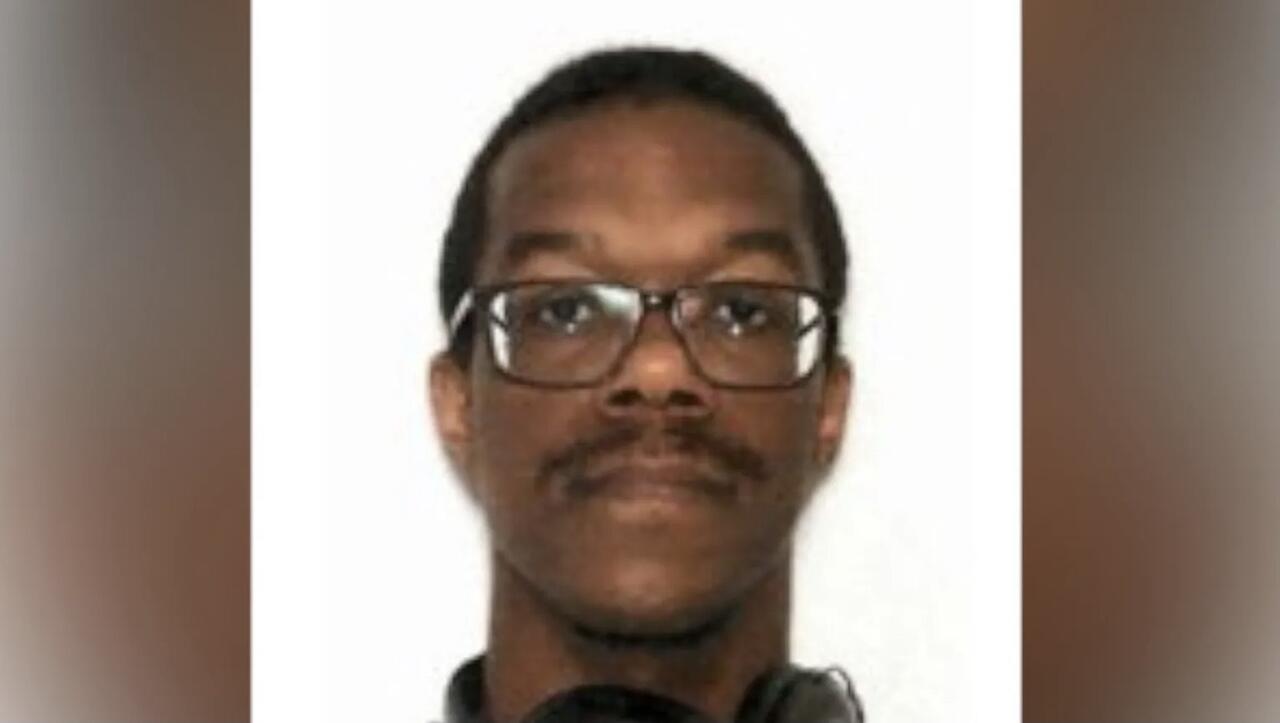
It seems immaterial that the charges against Brian Cole Jr for planting bombs came after Trump’s pardon, notes former federal prosecutor Ankush Khardori, writing at Politico:
Trump could have specified that the pardon applied only to people who had been convicted or charged “as of the date” of his pardon…but there is no such language in Trump’s proclamation. Lest there be any doubt, the Supreme Court made clear more than 150 years ago that presidents have the constitutional authority to do this — that is, to issue “preemptive pardons” for past conduct even if that conduct has not been charged at the time of the pardon.
In another context — relating to Trump’s pardon of those who sought to send alternate slates of electors to the 2020 Electoral College — Trump’s DOJ has claimed it has the power to determine which crimes Trump intended to include, but courts may take a dim view of that kind of de facto delegation of presidential pardon power, particularly where the plain language of the pardon is unambiguous and deliberately sweeping.
Federal prosecutors are behaving as if they fully appreciate the pardon’s potential to set Cole free and render their efforts futile. In both court filings and remarks in a hearing, they avoided using language that links Cole’s alleged actions to Jan. 6.
A neighbor of Brian J. Cole Jr described him as “almost autistic-like” (DOJ)
Federal agents say that, when they interviewed him, Cole confessed to planting the two devices. So far, no full transcripts of those interviews have been published, only quotes the DOJ chose to include in its court filings. Here’s one key excerpt:
“When asked why he placed the devices at the RNC and DNC, the defendant responded, ‘I really don’t like either party at this point’.” [Cole] also explained that the idea to use pipe bombs came from his interest in history, specifically the Troubles in Ireland. The defendant denied that his actions were directed toward Congress or related to the proceedings scheduled to take place on January 6.”
Seeking to make the case that the pardon doesn’t apply, prosecutors will surely emphasize Cole’s denial that his bombing attempt had anything to do with Jan. 6. (Then again, they don’t provide an actual quotation of this purported denial.) Then there’s the fact that both bombs were planted in the early evening of Jan. 5. Prosecutors also say he Cole set the kitchen timers on the bombs for their maximum duration of 60 minutes — meaning they would have also exploded on Jan. 5. He told agents that his timing sprang from wanting to avoid killing anyone.
However, before you conclude there’s nothing to the pardon concern, consider that the pardon uses the phrase “related to” events that occurred on Jan. 6. Having failed to detonate on Jan. 5, the bombs were discovered on Jan. 6. Cole’s lawyers can argue that the bombing attempt is “related” to Jan. 6 since it had the effect of diverting police to RNC and DNC headquarters.
There will also be scrutiny of Cole’s motives. While expressing disdain for both parties, some of Cole’s interview statements might be interpreted as sympathetic with the pro-Trump protesters, which could help substantiate a Jan. 6 nexus:
The defendant felt that “the people up top,” including “people on both sides, public figures,” should not “ignore[e] people’s grievances” or call them “conspiracy theorists,” “bad people,” “Nazis,” or “fascists.” Instead, “if people feel that their votes are like just being thrown away, then . . . at the very least someone should address it.”
Perhaps significantly, in his order directing that Cole continue to be detained, US Magistrate Judge Matthew Sharbaugh himself linked Cole’s alleged crimes to Jan. 6:
The specific circumstances by which the offenses are alleged to have been carried out—including the timing and broader context—further amplify their severity. After all, Mr. Cole is charged with placing the two IEDs in the immediate vicinity of the U.S. Capitol the night before U.S. lawmakers were set to gather to certify the results of the 2020 election. Although Mr. Cole, during his post-arrest interview, apparently disclaimed any intent to interfere with that process, the resulting fear and alarm followed all the same—and how could it not?
All that aside, there are some who still think there’s a whole lot more to the tale than has been told, including Rep. Thomas Massie, who has suggested the “autistic” Cole couldn’t have acted alone:
FBI claims an autistic man they arrested last month, 5 years after J6, is a lone wolf who planned, built, and placed the pipe bombs. They want to wrap up the case and put a bow on it, but I’m not buying it. It doesn’t add up.
latest from @SteveBakerUSA:https://t.co/TDVPoWgamw
— Thomas Massie (@RepThomasMassie) December 30, 2025
Tyler Durden
Sat, 01/10/2026 – 16:55
https://www.zerohedge.com/political/did-trump-accidentally-pardon-accused-jan-6-pipe-bomber
Trump firma orden ejecutiva para proteger los ingresos por la venta de petróleo venezolano
Por SEUNG MIN KIM
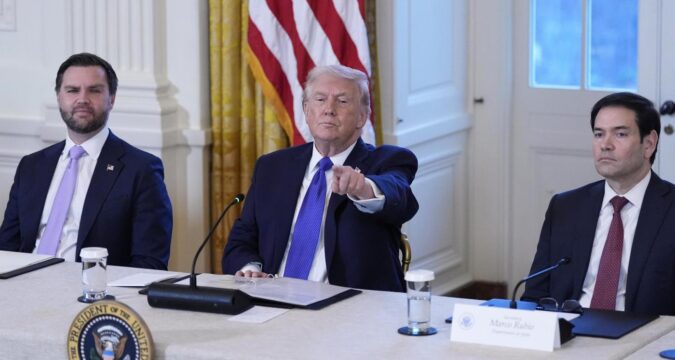
WEST PALM BEACH, Florida, EE.UU. (AP) — La nueva orden ejecutiva del presidente estadounidense Donald Trump sobre los ingresos petroleros de Venezuela tiene el objetivo de garantizar que el dinero permanezca protegido contra su uso en procedimientos judiciales.
El decreto ejecutivo, hecho público el sábado, dice que si los fondos fueran incautados para tal uso, ello podría “socavar los esfuerzos cruciales de Estados Unidos para asegurar la estabilidad económica y política en Venezuela”.
La orden llega en medio de la cautela de los principales ejecutivos de compañías petroleras, quienes advierten que la agitación e inestabilidad en Venezuela hacen que el país sea menos atractivo para la inversión privada y la reconstrucción.
“Si miramos las estructuras comerciales y los marcos existentes actualmente en Venezuela, hoy no es viable invertir allí”, expresó Darren Woods, director general de ExxonMobil —la mayor compañía petrolera de Estados Unidos— durante una reunión convocada por Trump con ejecutivos petroleros el viernes.
En esa sesión, el mandatario intentó apaciguar las preocupaciones de las empresas petroleras y dijo que los ejecutivos tratarían directamente con Estados Unidos, en lugar de con el gobierno venezolano.
Venezuela tiene un historial de incautaciones de activos estatales, sanciones estadounidenses en curso y décadas de incertidumbre política.
Lograr que las compañías petroleras estadounidenses inviertan en Venezuela y ayuden a reconstruir la infraestructura del país es una prioridad del gobierno de Trump tras la impactante captura del ahora depuesto líder Nicolás Maduro.
La Casa Blanca está enmarcando los empeños para “gestionar” Venezuela en términos económicos. Trump ha incautado buques tanque que transportan petróleo venezolano, ha dicho que Estados Unidos está tomando el control de las ventas de 30 a 50 millones de barriles de crudo venezolano previamente sancionado, y planea controlar las ventas a nivel mundial indefinidamente.
“Amo al pueblo venezolano, y ya estoy haciendo que Venezuela sea rica y segura nuevamente”, escribió en su red social el mandatario, quien actualmente se encuentra en el sur de Florida. “¡Felicitaciones y gracias a todas esas personas que están haciendo esto posible!”.
La orden establece que los ingresos petroleros son propiedad de Venezuela, la cual está siendo retenida por Washington para “fines gubernamentales y diplomáticos” y no está sujeta a reclamaciones privadas.
Sus fundamentos legales son la Ley de Emergencias Nacionales y la Ley de Poderes Económicos de Emergencia Internacional. En la orden, Trump dice que la posibilidad de que los ingresos petroleros pudiesen verse inmersos en procedimientos judiciales constituye una “amenaza inusual y extraordinaria” para Estados Unidos.
——-
Esta historia fue traducida del inglés por un editor de AP con la ayuda de una herramienta de inteligencia artificial generativa.
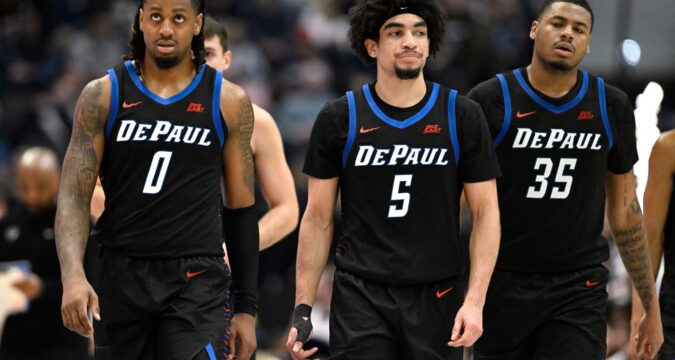
DePaul falls to No. 4 UConn 72-60 for its 21st consecutive loss in the series
HARTFORD, Conn. — Braylon Mullins had 16 points and Alex Karaban scored 15 as No. 4 UConn extended its winning streak to 12 with a 72-60 win over DePaul on Saturday.
Mullins was active on both sides of the court with seven rebounds, three assists, three steals and two blocked shots.
Silas Demary Jr. added 14 points, four assists and three steals for the Huskies (16-1, 6-0 Big East).
Layden Blocker had 16 points, Brandon Maclin 12 points and CJ Gunn nine of his 11 points in the second half for DePaul (10-7, 2-4), which lost its 21st consecutive game to UConn.
A three-point play by Mullins and a buzzer-beating 3-pointer by Demary put the Huskies up 37-27 at halftime. They opened the second half with an 11-3 run to bring their lead to 18.
DePaul didn’t get closer than 12 points the rest of the way. The Blue Demons had one field goal in the opening 8:25 of the second half.
UConn took its first double-digit lead in the opening half when Jayden Ross hit three free throws after being fouled on a 3-pointer. DePaul, which missed 12 of its first 15 shots, responded as Theo Pierre-Justin hit a pair of 3-pointers during a 10-4 run.
DePaul has held four consecutive Big East opponents under 80 points for the first time since the 2019-20 season.
Up next
DePaul: vs. Marquette on Friday.
UConn: at Seton Hall on Tuesday.
https://www.chicagotribune.com/2026/01/10/depaul-uconn-big-east/

Venezolanos afines al oficialismo piden en las calles la libertad de Maduro y su esposa
Associated Press
CARACAS (AP) — Al cumplirse una semana de la intervención militar estadounidense en Caracas, venezolanos afines al oficialismo marcharon en varias ciudades del país para exigir el retorno del expresidente Nicolás Maduro y su esposa, mientras que la presidenta encargada Delcy Rodríguez condenó la acción militar.
El exmandatario y su mujer, Cilia Flores, fueron capturados y trasladados a Estados Unidos, donde afrontan cargos por conspiración de narcoterrorismo, entre otros.
Mientras seguidores del gobierno se manifestaban el sábado en ciudades como Caracas, Trujillo, Nueva Esparta, Miranda y otras localidades, la presidenta encargada participaba en un evento público del sector social, en un intento por mostrar que el país continúa su rumbo.
Rodríguez, a cargo del poder tras la captura del líder venezolano, aseguró que en Venezuela “hay un gobierno, el del presidente Nicolás Maduro, y yo tengo la responsabilidad de encargarme mientras dure su secuestro… No vamos a dejar de condenar la agresión criminal” del 3 de enero.
En las calles, cientos de personas portaban banderas tricolor del país sudamericano, en una concentración que duró menos de lo habitual.
“Aquí estamos en resistencia, exigiendo al gobierno norteamericano que nos entregue a nuestro presidente Nicolás Maduro”, declaró el manifestante Daivy Cobo a la televisión pública.
En Estados Unidos, el presidente Donald Trump escribió en su red social: “amo al pueblo venezolano y ya estoy haciendo que Venezuela vuelva a ser próspera y segura”.
Tras la sorprendente acción militar que derrocó a Maduro, Trump aseguró que Washington regirá al país sudamericano y pidió acceso a recursos petroleros, que prometió utilizar “para beneficiar a la gente” de ambos países.
La víspera, Venezuela y Estados Unidos anunciaron que evalúan el restablecimiento de las relaciones diplomáticas, rotas desde 2019, y la reapertura de las sedes diplomáticas respectivas.
En tanto, familias con seres queridos en la cárcel se reunieron por tercer día consecutivo frente a las cárceles de Caracas y otras comunidades con la esperanza de recibir avisos sobre su posible liberación.
La familia de Diógenes Angulo quedó conmocionada apenas un par de minutos después de que saliera de prisión tras estar allí un año y cinco meses. Fue detenido por publicar un video de una manifestación de la oposición. “Gracias a Dios, voy a disfrutar de nuevo de mi familia”, dijo a The Associated Press, y agregó que los demás detenidos “están bien”.
Un familiar de la activista Rocío San Miguel, una de las primeras liberadas y que posteriormente se trasladó a España, precisó en un comunicado que su excarcelación “no se trata de una libertad plena, sino de una medida cautelar sustitutiva de la privación de libertad”.
La organización civil Foro Penal indicó el sábado que el número de excarcelados subió a 11, pero 809 continúan presos “por razones políticas”. Las autoridades niegan que haya presos políticos en el país, y acusan a los detenidos de conspirar contra el gobierno.
Entre los miembros destacados de la oposición política que fueron detenidos tras las elecciones presidenciales de 2024 y permanecen en prisión se encuentran el exlegislador Freddy Superlano, el exgobernador Juan Pablo Guanipa, y Perkins Rocha, abogado de la líder opositora María Corina Machado. El yerno del candidato presidencial opositor Edmundo González también sigue en la cárcel.
En medio de la expectativa mundial por el destino del país sudamericano, el canciller venezolano, Yván Gil, respondió al papa León XIV, quien el viernes pidió mantener la paz y “respetar la voluntad del pueblo de Venezuela”.
“Con respeto al Santo Padre y a su autoridad espiritual, Venezuela reafirma que es un país que construye, trabaja y defiende su soberanía con paz y dignidad”, refirió Gil en su cuenta de Telegram, e invitó al pontífice “a conocer más de cerca esta realidad”.
———
La periodista de The Associated Press Regina García Cano colaboró con este reporte desde Caracas.
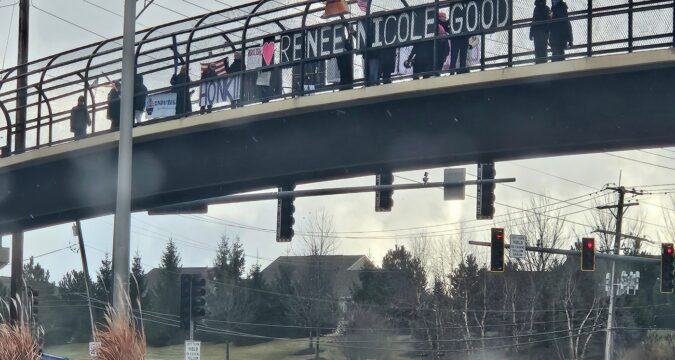
Fox Valley residents rally in wake of shooting death of Renee Nicole Good in Minnesota: ‘My heart’s broken’
Fox Valley activists came together for a rally Saturday in South Elgin in the wake of the recent death of Renee Nicole Good, who was shot and killed in her car by a federal immigration agent in Minneapolis.
A press release from We Can Lead Change-Fox Valley, a local activist group, said that the rally was part of a national effort called ICE Out For Good Weekend of Action “to demand accountability, honor the life lost and make visible the human cost of ICE’s actions.”
Federal officials have said the U.S. Immigration and Customs Enforcement agent acted in self-defense.
The local 90-minute rally began at noon and was held at the intersection of Randall Road and Silver Glen Crossing Mall.
The We Can Lead Change-Fox Valley group has been active for months mobilizing over issues including immigration as well as against many of the policies of the current U.S. administration.
St. Charles resident Miki Powell, a member of the group, said the Saturday rally was a lot “more raw for people.”
“A lot of our other rallies in general have been against the administration and their actions but this is specific to the fact that – you can’t have our federal government attacking and killing our fellow citizens,” Powell said. “This is widespread and I’m not surprised. The anger is palpable. People need something to do to feel like we are doing something together.”
A mix of snow showers with sun and then clouds covered the hundreds of protestors that took part in the rally.
At the event, Linda Robertson, of St. Charles, said it is an emotional time right now.
“To be honest about it, my heart’s broken by this shooting of Renee Good,” Robertson said. “Families are getting disrupted, and it’s obvious she wasn’t a terrorist. I think what’s frustrating people is a lack of clear, honest answers.”
Protestors line the sidewalk along Randall Road in South Elgin on Saturday, Jan. 10, 2026, during a rally in response to the recent death of Renee Nicole Good in Minneapolis. (David Sharos/For The Beacon-News)
Chris Thomas of Elgin described the recent events in Minnesota as “one more nail in the coffin of freedom and democracy.”
“I’m so glad it was on video from multiple angles because there’s no hiding what really happened,” Thomas said.
Thomas said rallies like the one on Saturday are important.
“I want my grandchildren to be able to grow up the way I did and right now, I’m scared at what’s happening in this country,” Thomas said.
David Sharos is a freelance reporter for The Beacon-News.
Investor Lessons From 2025 For 2026
Investor Lessons From 2025 For 2026
Authored by Lance Roberts via RealInvestmentAdvice.com,
Bulls Remain In Control
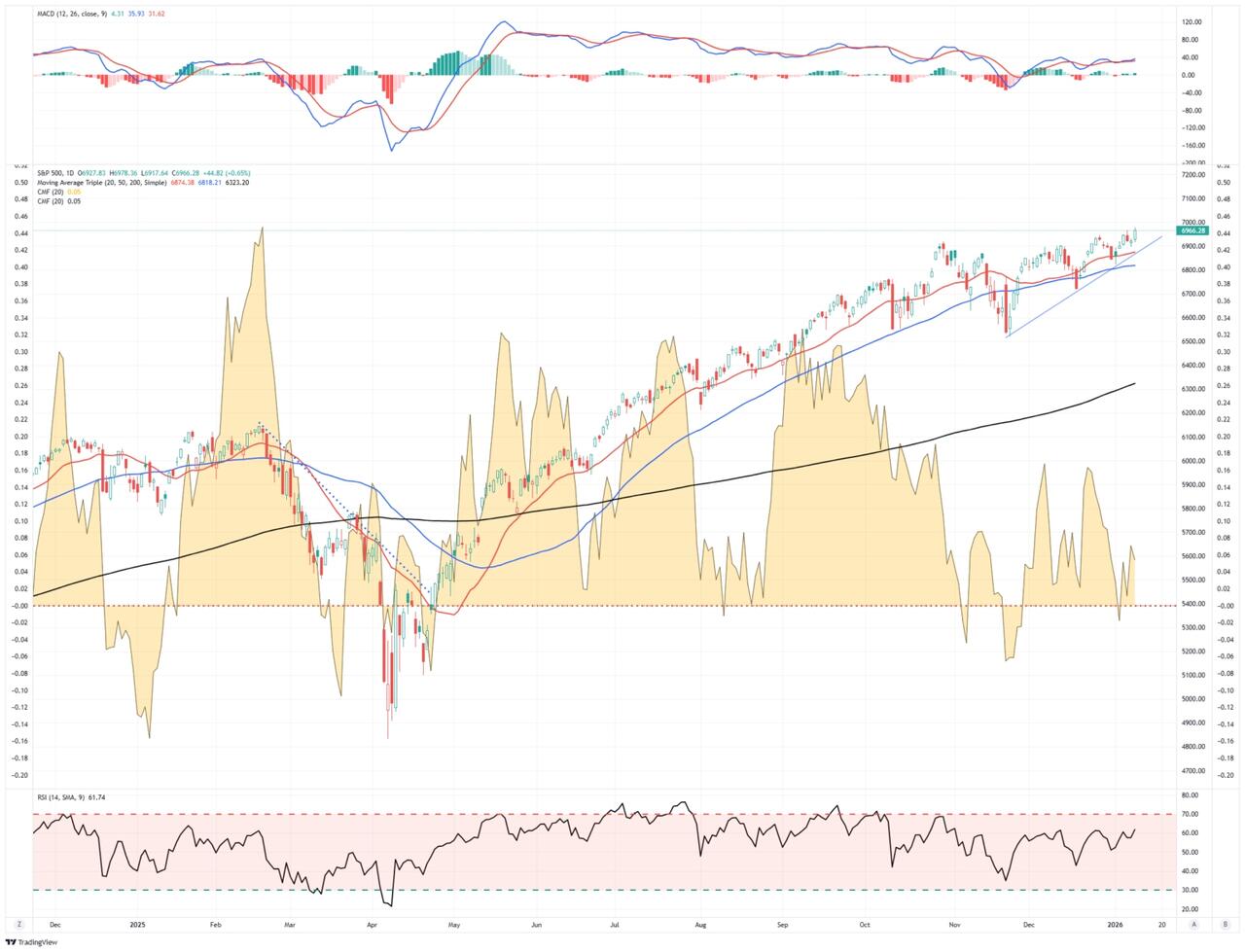
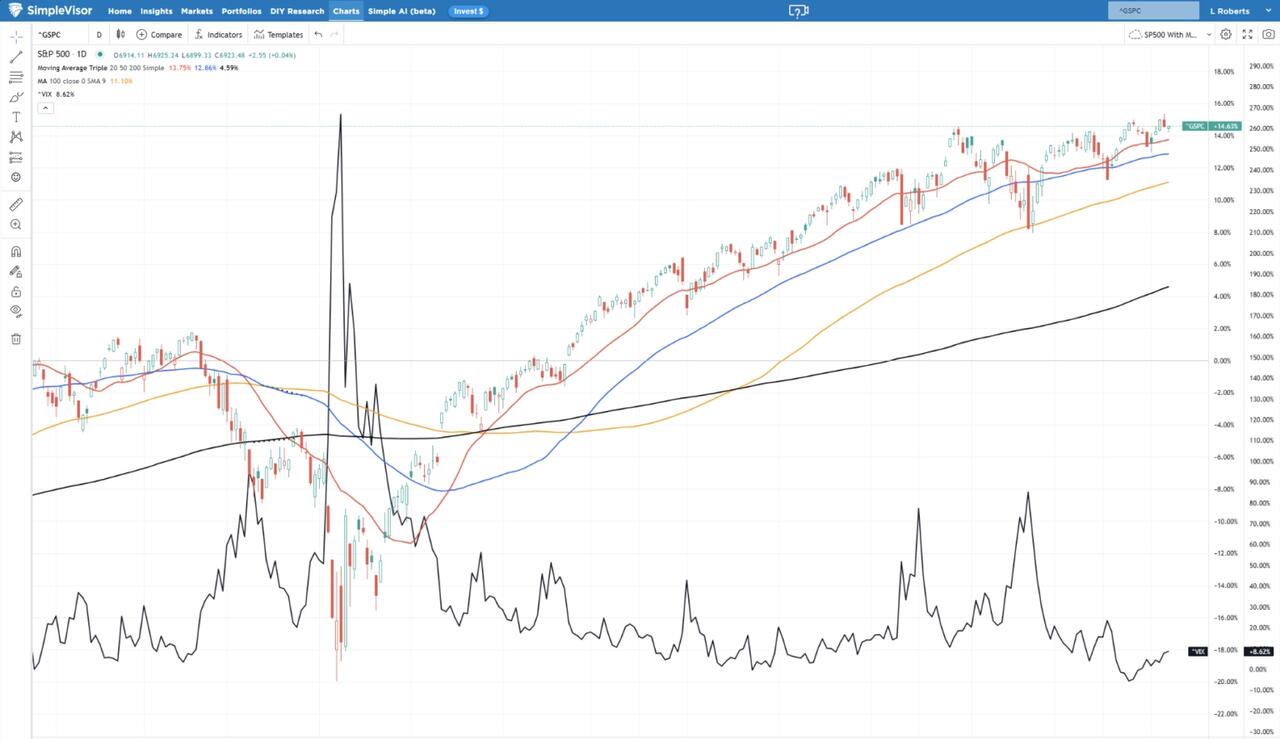
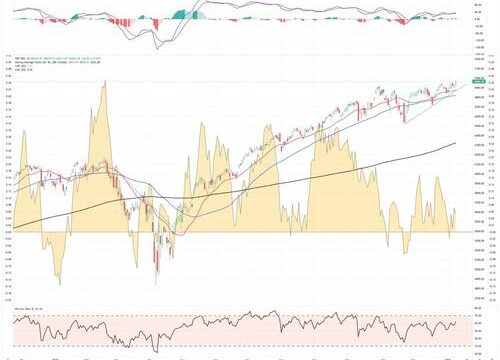
The S&P 500’s close at 6,966 on Friday confirmed the market remains in a bullish uptrend, continuing the positive trajectory that began in mid‑2025. Price action this week gained traction and has been tracking the rising bullish trendline from the November lows, printing a new all-time high on Friday. Technical indicators remain bullish and not overbought with a momentum “buy signal” intact. However, weak money flows continue to suggest some caution below the surface.
The price remains above its major moving averages, with the index trading above both the 20-day and 50-day moving averages. This alignment has remained a hallmark of the market since the April 2025 lows, and retracements to those moving averages continue to find buyers.
Notably, market breadth improved early in the week as more stocks participated in the advance, reflecting a broader rally that extended beyond just mega-cap technology names. As noted above, value has gained some traction in recent weeks, and the number of S&P 500 constituents in positive territory has improved. However, despite the broader advance, a divergence remains, with fewer stocks leading the market higher. Divergences like this can signal internal weakening, even as the headline index reaches new highs.
Volatility measures also remain bullish with the VIX and related volatility gauges printing near historically low ranges, indicating that investors are not pricing large near-term swings. Low implied volatility tends to reflect complacency, but also underscores that significant breakouts or breakdowns have less feared market reaction priced in.
Overall, the S&P’s advance this week lacked strong momentum expansion, but the technical support remains intact, and the market’s inability to push convincingly to new highs suggests a battle between profit‑taking and fresh buying remains. This puts emphasis on key support levels, which will be critical for next week’s directional bias.
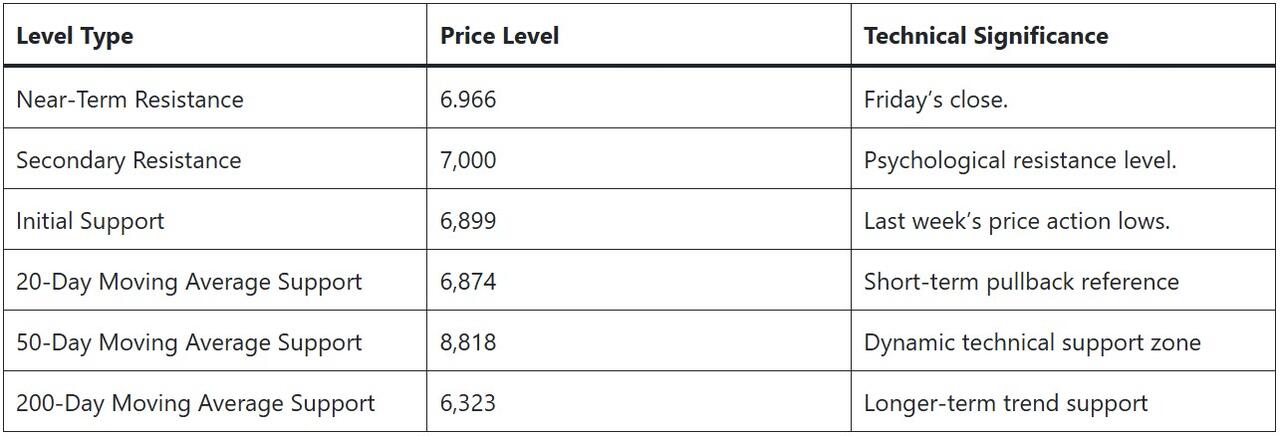
S&P 500 Technical Levels for Traders
Traders should view the 7,000–7,050 range as a key control zone for the market. If the index closes above this range with expanding volume, it increases the likelihood of continuation toward higher highs. Support at 6,900 is the first significant demand zone; loss of this area would expose the 50‑day average as a deeper test of trend integrity.
💰 Investor Lessons From 2025 For 2026
2025 reminded us of the many investor lessons that matter to surviving markets over the longer term. Some of those investor lessons were painful reminders during the “Liberation Day” sell-off, others were obvious, and some were just reminders of what we already knew. If you want to improve outcomes in 2026, you must absorb these investor lessons and implement them into your portfolio management practices.
Leave The Narratives For The Talking Heads
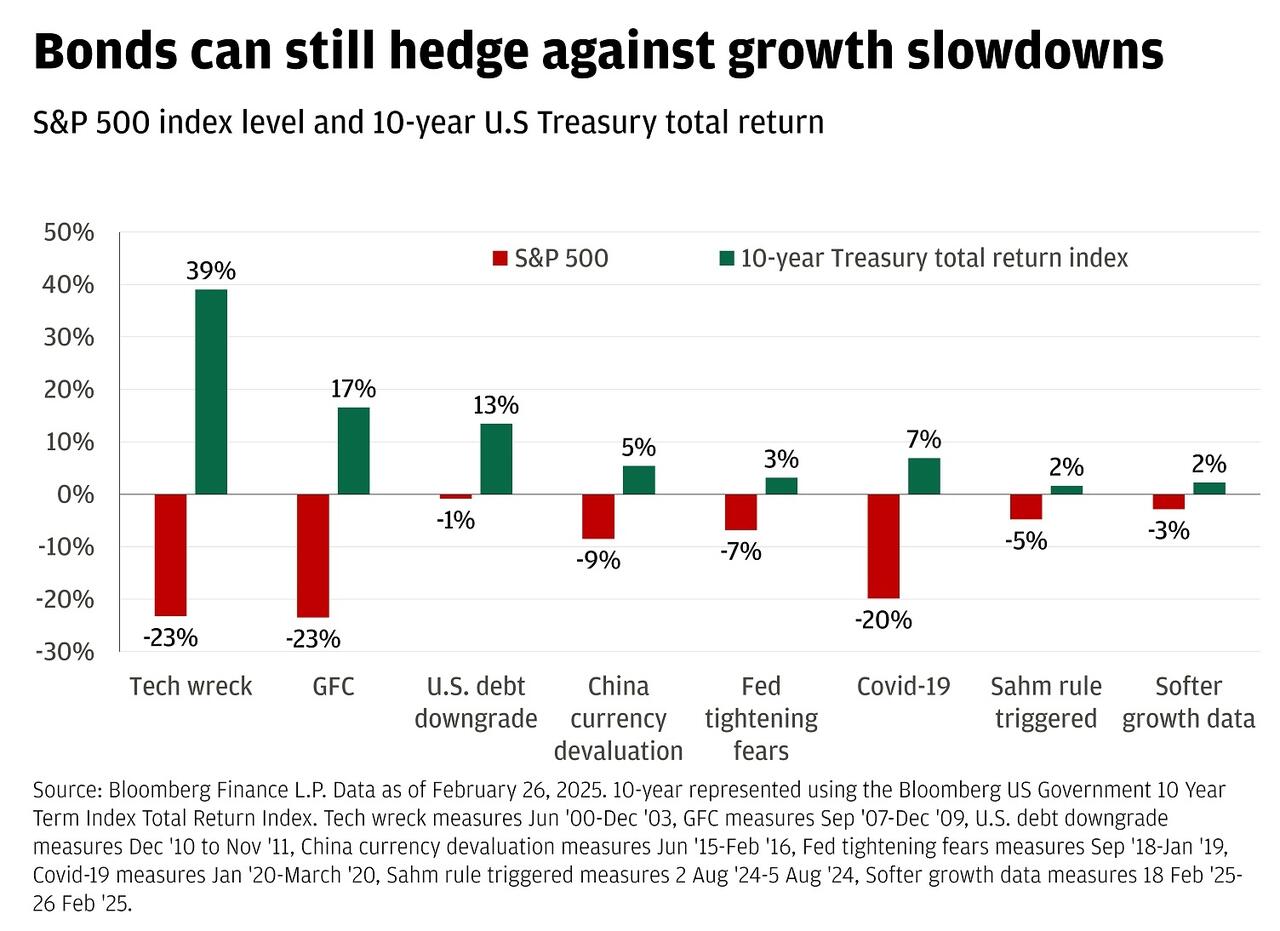
In 2025, numerous headlines predicted that interest rates would rise sharply, the “death of the dollar” was imminent, and tariffs would send inflation skyrocketing. None of those things happened, and Treasury bonds delivered positive returns for the year, with the broad index total return at approximately 7.08%. Given that bonds are often considered a“safe haven” during market turmoil, the investor lesson for 2026 is not to dismiss bonds as a risk diversifier when volatility arises.
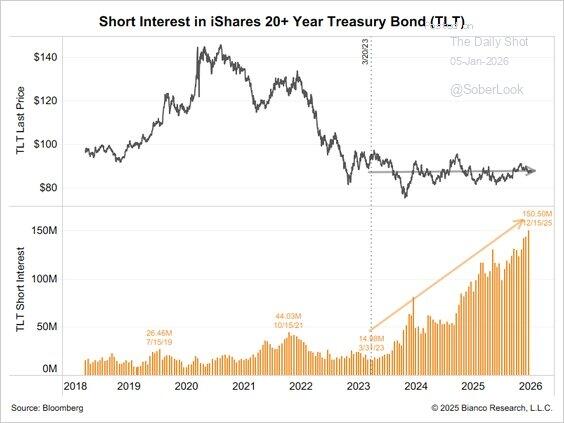
Such is particularly the case in 2026 as we enter the year with very elevated valuations and expectations, and a record level of short positioning against the 20+ Year Treasury Bonds ETF (TLT). The short position against Treasuries is most favored by arbitrageurs and hedgers, rather than long-term bets on rates. As Mark Hulbert for MarketWatch recently noted:
“Contrarian investors now believe bonds may outperform both stocks and gold because sentiment toward bonds is unusually pessimistic while optimism for stocks and gold is near historical highs, and history shows markets often rally after extreme pessimism and struggle after peak optimism, suggesting bonds could be a better bet in the months ahead despite strong 2025 performance in stocks and gold.”
As such, if Mark is correct, then any reversal that pushes money into safe-haven investments could cause an outsized move in yields, ie, higher bond prices, as short positioning is forced to cover. In other words, the odds favor the possibility that the consensus bets and narratives of 2025 could be out of favor in 2026.
Volatility Is Not Risk
Another valuable investor lesson in 2026 will be remembering that “risk” and “volatility” are not the same thing. Many investors equate volatility with risk, and as such, they panic sell at the first sign of a drop. Daily or even weekly market swings are not necessarily danger signs, as volatility is a normal part of the market cycle.
For example, 2025 experienced volatility, with stocks fluctuating up and down several times throughout the year. There were several spikes in the volatility index that had the “bears’ running for cover, proclaiming “AI was dead.” However, by the end of 2025, companies with strong earnings and solid cash flow held their value over time.
Risk is the permanent loss of capital. Volatility is price movement. While risk is certainly a byproduct of investing, the investor lesson for 2026 is to remember to hold quality assets, focus on fundamentals, and remember that volatility is the price of admission.
Cash Has Value
One of the worst narratives of 2025 was that “cash is trash.” The mistaken assumption was that investors buried their cash in the backyard, when in reality the majority of individuals have the cash in either higher-yielding money markets or invested in the asset markets. In either case, the rate of return on that cash exceeded the current U.S. inflation rate, protecting their purchasing power.
The investor lesson from 2025, and will remain in 2026, is that when markets do encounter periods of volatility, cash gives you options. Holding a higher level of cash in an uncertain environment hedges the portfolio against volatility, so investors are less likely to be forced into selling. Cash also provides “opportunity” by having purchasing power during market declines. As we discussed:
“Investors never face a choice of solely one investment over another. Instead, the goal is to invest in the correct asset at the correct time. When one is unsure, cash is a natural hedge against uncertainty. As many great investors throughout history state in one form or another: “The goal of investing is not only the ‘return ON my principal’ but also ensuring the ‘return OF my principal.’”
If I ignore the relevant risk, the outcome is that I will fall short of my financial goals. Importantly, I am not talking about being 100% in cash. Instead, I am suggesting that during periods of uncertainty, cash provides both stability and opportunity. Yes, cash will lose purchasing power over the holding period, but equities can lose a lot more when “fast risk” happens.
With the fundamental and economic backdrop becoming much more hostile toward investors in the intermediate term, understanding the value of cash as a “hedge” against loss becomes more important. Given the length of the current market advance, deteriorating internals, high valuations, and weak economic backdrop, reviewing cash as an asset class in your allocation may make some sense.”
In 2026, just as in 2025, you must allocate cash strategically. Cash is not dead money; it provides optionality, and you should consider holding enough to cover needs and seize opportunities.
Earnings Drive Long-Term Returns
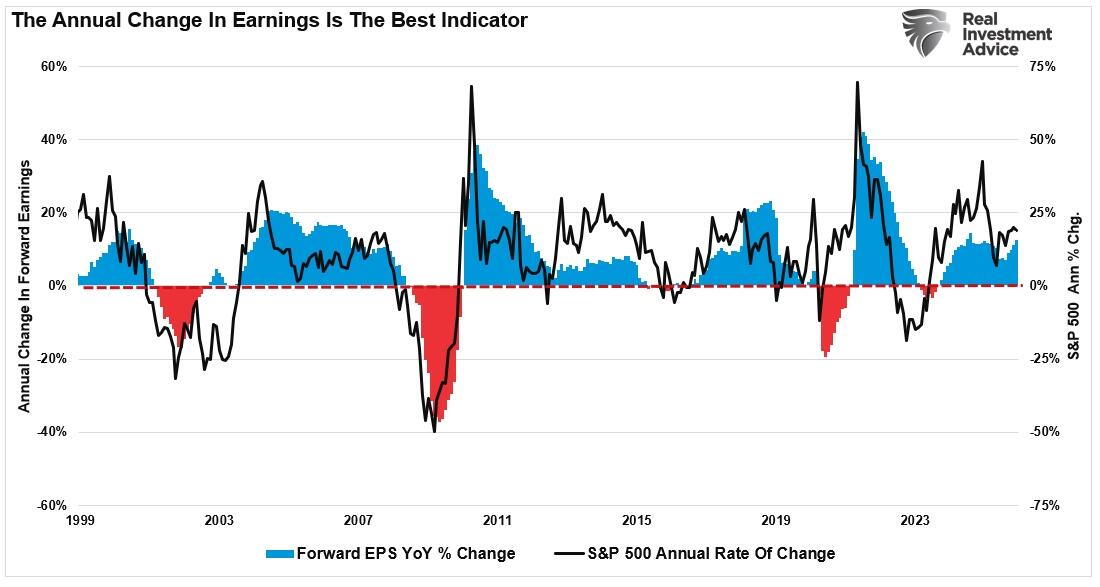
Investors chased momentum in 2025, buying low-quality companies with no earnings. In most cases, many of those investments have or will go bad, as earnings always matter in the end. The investor lesson for 2026 is that your focus must be on earnings growth and stability. Yes, price matters, but only in the short term. Ultimately, the market will track the annual rate of change in earnings.
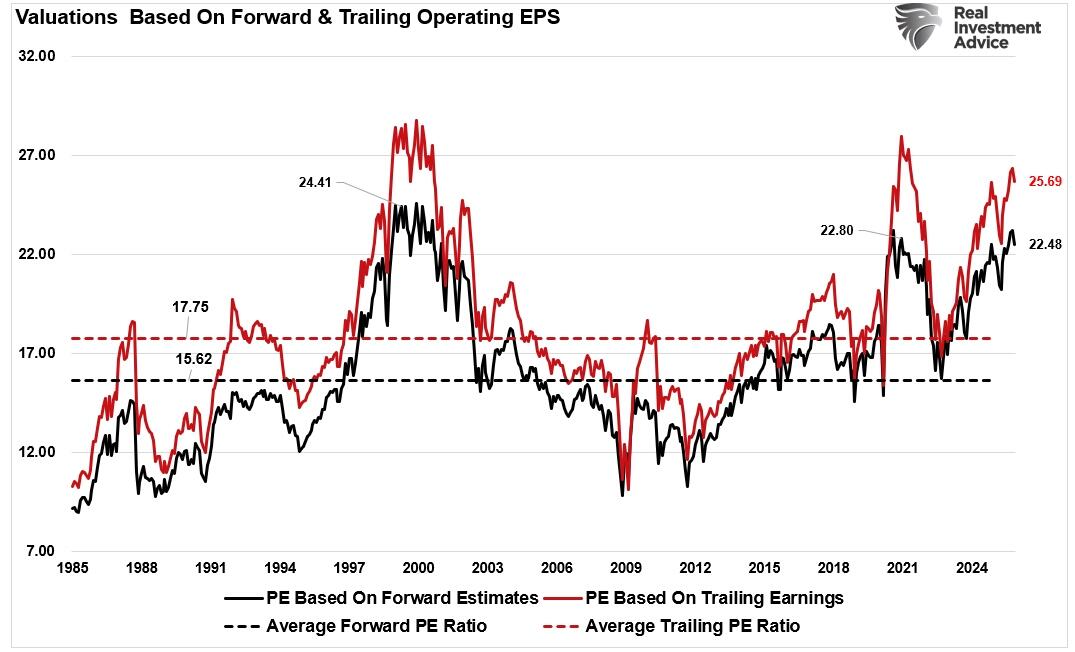
Of course, earnings are the “E” when considering valuations (P/E). With valuations elevated and forward returns expected to be lower, current expectations for another year of escalating earnings should likely be tempered.
Furthermore, given the overall sensitivity of earnings to economic growth, any slowdown in economic activity or employment in 2026 could become more problematic. With valuations and confidence elevated, investors should consider rebalancing portfolio risk to hedge against potential disappointment.
Your Plan Must Survive Stress
In 2025, many investors had plans until stress hit. Those plans changed rapidly when volatility unexpectedly struck in “all the wrong places.”
A notable example was the risk we repeatedly warned about in the options market, as reported by Morningstar:
“The options trader known as “Captain Condor” and his acolytes experienced a wipeout last week that incinerated tens of millions of dollars and cost some investors their life savings.
A strategy that had reliably produced winnings for the trader – whose real name is David Chau – and his group of roughly 1,000 investors went awry just before Christmas, saddling them with what was, by one count, a $50 million loss.
The fatal flaw – what finally caused Chau and his crew to lose most or all of their trading capital – was his use of the Martingale betting system. In the Martingale system, the bettor doubles down after each loss, hoping to recoup their money and then some. After a streak of mounting losses, Chau and his followers risked it all on Christmas Eve and saw the last of their capital wiped out as the S&P 500 SPX tallied a record closing high.
Some members of Chau’s group lost hundreds of thousands of dollars – most of their life savings – according to account statements reviewed by MarketWatch. One member launched a GoFundMe page soliciting donations to help cover basic living expenses.
While this is just one story among many, the investor lesson for 2026 is that whatever your investment plan is, it must include rules for buying, selling, risk control, and, most crucially, the protection of your investment capital.
The reason is simple: If you lose all of your capital, you are out of the game.
The investor lesson for this year is to test your plan against bad scenarios. Testing your plan against adverse outcomes will allow you to survive volatility without panic. Ultimately, a plan fosters discipline, and discipline safeguards capital.
Rebalancing Works
Most investors treat rebalancing like flossing. In other words, they know they should do it, but they wait until something hurts. For example, in 2025, those who adhered to a disciplined rebalancing strategy achieved stronger returns and lower risk than those who didn’t. The problem is that avoiding rebalancing leads to an unbalanced, or lopsided, portfolio that becomes systemically exposed to sharp corrections.
Rebalancing is a simple and painless process. When one part of your portfolio grows faster than others, it becomes too large a share of your total. That shift subtly changes your risk exposure without your consent. The investor lesson is not to let “greed” override the rebalancing process. When tech stocks surge, it becomes easy to “let it ride,” hoping they will become an even larger position in the portfolio. However, as noted above, the risk is that it becomes a concentrated bet. Concentrated bets work great as long as markets are rising, but eventually they will revert.
In 2025, tech surged early, then corrected sharply, and then soared again into the year-end before stalling. Those who rebalanced sold some of those gains in March, bought them back in April, and trimmed again as the year wrapped up. That shift added performance, reduced portfolio volatility, and enabled investors to navigate market volatility without panic. Rebalancing is not about guessing what wins next. It’s about managing risk while buying what’s undervalued and trimming what’s overextended.
How you rebalance your portfolio is up to you, but you do need rules to follow. Some rebalance on a regular schedule (monthly, quarterly or semiannually). We prefer thresholds such as when a position grows to represent more than 5% of the portfolio value, or is significantly larger than its target weight in the portfolio.
Most importantly, the investor lesson is that rebalancing works because it imposes discipline. It forces you to sell high and buy low. In 2026, that discipline will likely matter again as the market will tend to surprise you.
Key Catalysts Next Week
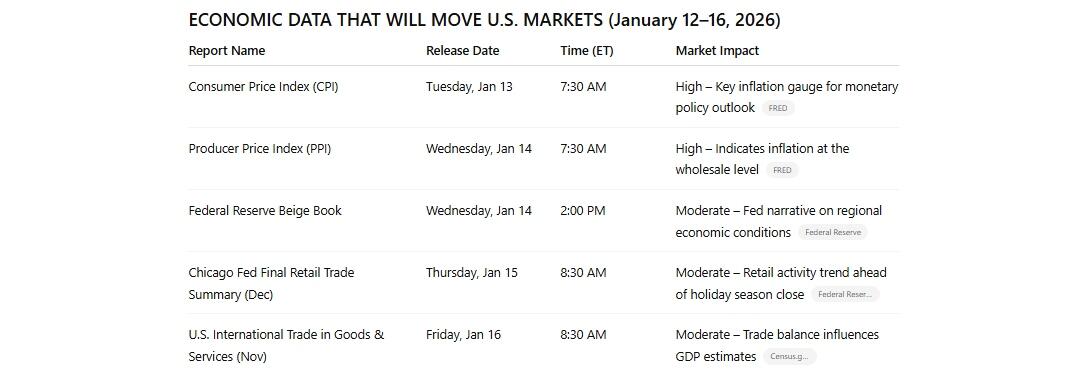
U.S. financial markets enter the second full week of January with a spotlight on inflation, producer costs, labor trends, and Federal Reserve guidance. Data flow is expected to pick up after the December jobs report, released last Friday, showed weaker payroll gains and raised renewed questions about the health of the labor market. Markets are weighing whether slower hiring reduces inflationary pressures or signals broader economic weakness. Recent labor data underscore a cooling of job growth and elevated uncertainty surrounding future Fed policy.
Economic releases this week will influence expectations for interest rates, corporate earnings forecasts, and risk assets. The Consumer Price Index (CPI) and the Producer Price Index (PPI) are among the most market‑sensitive releases. CPI will gauge whether consumer inflation is decelerating enough to influence the Fed’s pace of future rate adjustments. PPI will offer insight into the underlying cost pressures facing businesses. The Beige Book from the Federal Reserve will provide narrative detail on regional economic activity and pricing trends ahead of the late‑January FOMC meeting on the 27th and 28th. Market participants will parse this report for signs of tightening or easing conditions across the economy.
The overall market direction this week will hinge on whether inflation measures indicate a durable downtrend or a stubborn rebound. Any surprises in CPI, PPI, or labor indicators will drive volatility in equities, rates, and the U.S. dollar.
Thinking Ahead
As we head into 2026, the investor lessons outlined above will be crucial for navigating the market. Most notably, the mindset of investors must shift from forecasting or hoping for higher market returns to focusing on risk management. Markets are unpredictable, and as such, most predictions in 2025 fell short, even from seasoned professionals. That’s not a flaw in the market; it’s a flaw in overconfidence. You cannot control outcomes, but you can control your approach.
That starts with a margin of safety. Every investment should be made below fair value, with a cushion for mistakes, downturns, or bad luck. While investors escaped with overpaying in 2025, the question is whether they will be as lucky in 2026. Maybe they will, but the odds are increasing they won’t. Therefore, holding cash reserves, avoiding leverage, and prioritizing capital protection over chasing gains will be a winning formula.
Furthermore, you must be honest about your time horizon. Many investors claim to be long-term but will bail out at the first drawdown. Long-term investing means enduring volatility without flinching. If you lack the skill and systems to trade short-term, stop pretending. Focus on quality assets, reasonable prices, and a strategy you can live with in good times and bad.
Lastly, remember that the market punishes arrogance and rewards discipline. The pain of 2025 wasn’t random; it was a reminder. If you lost money, those losses came with a lesson. Don’t ignore it. In 2026, stay humble. Follow your rules, know your risks, protect your capital, and stick to fundamentals.
The reality is that the market will shift again; it is only a function of time. Therefore, your job is to stay ready, not reactive.
Tyler Durden
Sat, 01/10/2026 – 16:20
https://www.zerohedge.com/markets/investor-lessons-2025-2026

Donovan Mitchell anota 28 puntos en la victoria de los Cavaliers 146-134 sobre los Timberwolves
CLEVELAND (AP) — Donovan Mitchell anotó 28 puntos y los Cavaliers de Cleveland tomaron el control en la segunda mitad para vencer el sábado 146-134 a Minnesota, rompiendo la racha de cuatro victorias consecutivas de los Timberwolves.
Mitchell también encestó cuatro triples mientras que los Cavaliers tuvieron cinco jugadores que anotaron al menos 20 unidades por segunda vez en la historia de la franquicia. Evan Mobley sumó 24 puntos, Jaylon Tyson anotó 23 desde el banquillo y Darius Garland añadió 22.
Sam Merrill tuvo 20 tantos y estableció un récord de franquicia con al menos cinco triples en cuatro juegos consecutivos.
La última vez que los Cavaliers tuvieron cinco jugadores con al menos 20 puntos fue el 14 de marzo de 1972, contra los Bullets de Baltimore, según Sportradar.
Los 146 puntos son la cuarta mayor cantidad que los Cavaliers han anotado en un juego de tiempo reglamentario. Anotaron 148 en la victoria por 33 puntos sobre Washington el siete de noviembre.
Cleveland —que ha ganado 5 de 7— atinó el 55 de 92 de tiros de campo, y tuvo el 59,2% de efectividad, su mejor marca de la temporada. También encestó 15 de 31 triples.
Anthony Edwards y Naz Reid anotaron 25 puntos cada uno para Minnesota, que derrotó a Cleveland 131-122 el jueves por la noche. Julius Randle tuvo 20 puntos.
A pesar de la derrota, los Timberwolves tuvieron un 57.3% de efectividad de tiros de campo, el mejor de la temporada, con 51 de 89.
___
Deportes AP: https://apnews.com/hub/deportes