Category: News

US And Venezuela Explore Restoring Diplomatic Ties After Maduro’s Capture
US And Venezuela Explore Restoring Diplomatic Ties After Maduro’s Capture
Authored by Kimberley Hayek via The Epoch Times,
The United States and Venezuela announced Friday they are pursuing the possibility of reestablishing diplomatic relations, coming a week after a U.S. military operation that captured former leader Nicolás Maduro in Caracas and extradited him to face drug-trafficking charges in New York.
A U.S. delegation, including diplomats and security personnel, visited Venezuela to evaluate the potential reopening of the American Embassy in Caracas, the State Department said in a statement sent to media outlets. The department did not immediately return a request for comment.
The embassy has been shuttered since 2019, when ties were severed during U.S. President Donald Trump’s first term after the United States, along with multiple other countries, recognized opposition leader Juan Guaidó as Venezuela’s legitimate president amid allegations of election fraud. U.S. officials have also been accusing Maduro and his regime of backing cartels trafficking illicit drugs into the United States.
Venezuela’s interim government, led by acting President Delcy Rodríguez, responded by stating it intends to send a delegation to the United States. No timeline was provided yet.
“The government of Venezuela has decided to initiate an exploratory diplomatic process with the U.S. government, with a view to reestablishing the diplomatic missions in both countries,” the Venezuelan government said in a statement.
Such a visit would likely necessitate waivers from U.S. Treasury sanctions imposed on Venezuelan officials.
The move comes amid Rodríguez’s efforts to manage domestic pressures, including demands from Venezuela’s military hard-liners furious over Maduro’s capture. In phone discussions with the presidents of Brazil, Colombia, and Spain, she described the U.S. operation as “grave, criminal, illegal, and illegitimate aggression” against Venezuela.
Later, during a televised event at the opening of a women’s health clinic in Caracas, Rodríguez highlighted diplomacy as key to safeguarding the nation and facilitating “the return of President Nicolás Maduro and First Lady Cilia Flores.”
“We will meet face-to-face in diplomacy … to defend the peace of Venezuela, the stability of Venezuela, the future, to defend our independence and to defend our sacred and inalienable sovereignty,” Rodríguez said, without directly addressing the embassy’s potential reactivation.
Rodríguez on Jan. 5 extended an invitation for U.S. collaboration, writing on social media: “We invite the U.S. government to collaborate with us on an agenda of cooperation oriented towards shared development within the framework of international law to strengthen lasting community coexistence.”
She further emphasized moving toward “balanced and respectful international relations.”
Maduro appeared in federal court in New York on Jan. 5 and pleaded not guilty to drug trafficking charges, according to U.S. officials.
Following Maduro’s removal, Rodriguez, who served as Maduro’s deputy, assumed interim leadership. U.S. authorities said Washington would exercise oversight of the transitional government.
The U.S. president has urged Rodríguez and remaining Maduro allies to align with U.S. interests, particularly enforcement against drug trafficking and control over Venezuela’s vast oil reserves.
Venezuela’s oil sector holds the world’s largest proven reserves but has been mismanaged and financially neglected for years. Oil output has fallen from more than 3 million barrels per day in the early 2000s to less than 1 million barrels per day in recent years, according to data from the U.S. Energy Information Administration.
On Jan. 10, Trump invited executives of large oil companies to the White House on Friday to discuss investment opportunities that will restore Venezuela’s oil infrastructure following the ousting of Maduro. Trump said that American oil companies will invest at least $100 billion in Venezuela to boost its oil production.
“We’re going to discuss how these great American companies can help rapidly rebuild Venezuela’s dilapidated oil industry and bring millions of barrels of oil production to benefit the United States, the people of Venezuela, and the entire world,” Trump said as he welcomed the executives.
The president also announced on Jan. 6 that Venezuela will send 30 million barrels of oil, valued at approximately $4 billion, to the United States.
U.S. visits to Caracas have been infrequent since the embassy closure, with the most recent in February 2025 involving special envoy Richard Grenell, who secured the release of six detained Americans after meeting Maduro.
Tyler Durden
Sat, 01/10/2026 – 12:50

Unión de Berlin supera la nieve pero empata con el Mainz en la Bundesliga
BERLÍN (AP) — Los aficionados del Unión de Berlin pasaron la semana despejando la nieve alrededor de su estadio para que su partido de la Bundesliga contra el Mainz pudiera llevarse a cabo. Fueron recompensados con una recuperación tardía para rescatar un empate 2-2 con el Mainz el sábado.
Solo cuatro de los seis partidos de la Bundesliga programados para el sábado se llevaron a cabo después de que la fuerte nevada obligara a cancelar dos de ellos.
El partido del Unión estaba en duda, lo que llevó a los aficionados a reunirse con palas para despejar la nieve de las rutas de acceso al estadio el jueves. Esos esfuerzos y una nevada menor a la esperada el viernes permitieron que el partido se realizara, aunque el campo húmedo pronto se revolvió.
El entrenador del Mainz Urs Fischer, regresó a la casa del club al que llevó a la Liga de Campeones antes de su salida en el 2023 y casi se lleva la victoria.
Nadiem Amiri le dio la ventaja al Mainz con una volea y el exjugador del Union, Benedict Hollerbach, se negó a celebrar después de anotar el segundo gol del Mainz. El Unió respondió con goles de Jeong Woo-yeong a los 77 minutos y un remate a corta distancia de Marin Ljubicic al 86 para llevarse un punto.
Una mala entrada le costó caro al Hamburger SV en una derrota 2-1 ante el Freiburg, que terminó en medio de una nevada constante.
Hamburgo acababa de tomar la delantera cuando el defensor Daniel Edfadli cometió una torpe falta que resultó en un penal y le valió una segunda tarjeta amarilla. Vincenzo Grifo del Freiburg convirtió el penal antes de que Igor Matanovic anotara el gol de la victoria.
Heidenheim empató 2-2 con Colonia. Una audaz chilena de Marvin Pieringer le dio la ventaja a Heidenheim temprano antes de que Colonia igualara el marcador dos veces.
Bayer Leverkusen recibe más tarde al Stuttgart.
El partido de St. Pauli con Leipzig y el de Werder Bremen contra Hoffenheim fueron pospuestos debido a la nieve y el hielo.
___
Deportes AP: https://apnews.com/hub/deportes

Greenland’s party leaders firmly reject President Trump’s push for US control of the island
NUUK, Greenland — Greenland’s party leaders have rejected President Donald Trump’s repeated calls for the U.S. to take control of the island, saying that Greenland’s future must be decided by its people.
“We don’t want to be Americans, we don’t want to be Danes, we want to be Greenlanders,” Greenland Prime Minister Jens-Frederik Nielsen and four party leaders said in a statement Friday night.
Trump said again on Friday that he would like to make a deal to acquire Greenland, a semiautonomous region that’s part of NATO ally Denmark, “the easy way.” He said that if the U.S. doesn’t own it, then Russia or China will take it over, and the U.S. does not want them as neighbors.
“If we don’t do it the easy way, we’re going to do it the hard way,” Trump said, without explaining what that entailed. The White House said it is considering a range of options, including using military force, to acquire the island.
President Donald Trump says the US ‘needs’ Greenland for Arctic security. Here’s why.
Greenland’s party leaders reiterated that “Greenland’s future must be decided by the Greenlandic people.”
“As Greenlandic party leaders, we would like to emphasize once again our wish that the United States’ contempt for our country ends,” the statement said.
Officials from Denmark, Greenland and the United States met Thursday in Washington and will meet again next week to discuss the renewed push by the White House for the control of the island.
Danish Prime Minister Mette Frederiksen has warned that an American takeover of Greenland would mark the end of NATO.
The party leaders’ statement said that “the work on Greenland’s future takes place in dialogue with the Greenlandic people and is prepared on the basis of international laws.”
“No other country can interfere in this,” they said. “We must decide the future of our country ourselves, without pressure for quick decision, delay or interference from other countries.”
The statement was signed by Nielsen, Pele Broberg, Múte B. Egede, Aleqa Hammond and Aqqalu C. Jerimiassen.
While Greenland is the largest island in the world, it has a population of around 57,000 and doesn’t have its own military. Defense is provided by Denmark, whose military is dwarfed by that of the U.S.
It’s unclear how the remaining NATO members would respond if the U.S. decided to forcibly take control of the island or if they would come to Denmark’s aid.
https://www.chicagotribune.com/2026/01/10/greenland-leaders-reject-us-control/
Elina Svitolina y Wang Xinju se enfrentarán en la final del torneo WTA en Auckland
AUCKLAND, Nueva Zelanda (AP) — La máxima cabeza de serie, Elina Svitolina, jugará la final del evento del WTA Tour en Auckland por segunda vez después de vencer en la semifinal del sábado por 7-6 (5), 6-2 a la adolescente estadounidense Iva Jovic.
La número 13 del ranking también llegó a la final en 2024 cuando perdió ante la estadounidense Coco Gauff.
La oponente de Svitolina en la final del domingo será la séptima cabeza de serie, Wang Xinju de China, quien venció a la cuarta cabeza de serie, Alexandra Eala de Filipinas, 5-7, 7-5, 6-4 en la otra semifinal.
Svitolina parecía un poco cansada al principio el sábado después de un partido de cuartos de final de casi tres horas contra Sonay Katal el viernes por la noche, que ganó 6-4, 6-7 (2), 7-6 (5).
Perdió su servicio dos veces en los primeros tres juegos el sábado, quedando 3-0 en contra de la número 35 del ranking, Jovic, la octava estadounidense en el WTA Tour. Svitolina rompió el servicio dos veces para igualar 4-cuatro, luego perdió su servicio nuevamente permitiendo a Jovic servir para el primer set con 5-cuatro.
Pero Jovic perdió su servicio en cero y Svitolina llevó el set a un desempate en el que lideró 6-uno antes de llevarse el set en su tercera oportunidad.
Se deshizo rápidamente del segundo set, rompiendo el servicio de Jovic en el tercer y quinto juego y sellando el partido con dos aces en su último juego de servicio.
Svitolina ha sido apoyada toda la semana por su esposo Gael Monfils, quien jugará en el evento del tour masculino en Auckland a partir del lunes.
“Es agradable ganar en sets corridos. Ayer fue una gran batalla y hoy también en el primer set”, expresó Svitolina. “Iva estaba jugando muy bien y tuve que luchar mucho, esforzarme y tratar de encontrar mi nivel y estoy muy feliz de poder terminar este partido en dos sets para ahorrar algo de energía para la final”.
___
Deportes AP: https://apnews.com/hub/deportes

“Affordability!”: Trump Calls For Temporary 10 Percent Cap On Credit Card Interest Rates
“Affordability!”: Trump Calls For Temporary 10 Percent Cap On Credit Card Interest Rates
President Trump said on Jan. 9 that he would call for a one-year cap on credit card interest rates of 10 percent, potentially starting later this month, though its enforcement may depend on Congress.
In a Truth Social post, Trump said that Americans are being “ripped off” by credit card companies that charge interest rates between 20 and 30 percent, and vowed his administration will put an end to it.
“AFFORDABILITY! Effective January 20, 2026, I, as President of the United States, am calling for a one year cap on Credit Card Interest Rates of 10%,” the president stated.
The cap’s proposed start date coincides with the anniversary of Trump’s second-term inauguration and, if implemented, would fulfill his 2024 election campaign pledge.
Who could have seen that coming?
Two months later… https://t.co/POf3Y4jlrq pic.twitter.com/D4BlY4PD1i
— zerohedge (@zerohedge) January 10, 2026
As Bloomberg reports, card-lending has become highly lucrative with JPMorgan saying that in 2024 the net yield on its more than $200 billion in card loans was 9.73%. That drove the bulk of the $25.5 billion of revenue for its card services and auto unit, though the bank also had about $7 billion of charge-offs tied to cards.
Banking associations, including the Bank Policy Institute, issued a joint statement on Jan. 9 saying the 10 percent cap on credit card interest rates would reduce credit availability and adversely affect families and small business owners who rely on credit cards.
“We share the president’s goal of helping Americans access more affordable credit,” the groups said in a joint statement late Friday.
“At the same time, evidence shows that a 10% interest rate cap would reduce credit availability and be devastating for millions of American families and small business owners who rely on and value their credit cards, the very consumers this proposal intends to help.”
“If enacted, this cap would only drive consumers toward less regulated, more costly alternatives. We look forward to working with the administration to ensure Americans have access to the credit they need,” the statement reads.
A credit union trade group called a potential cap “devastating” for its members.
“Institutions will not be able to offer credit cards to most consumers at a 10% rate,” said Scott Simpson, the president of America’s Credit Unions.
“A 10% cap would mean the end of credit cards for most consumers except those who need them the least,” said Matthew Goldman, founder of Totavi, a consulting firm to electronic-payment and other financial technology companies. For example, “those with very good credit.”
As Aldgra Fredly reports for The Epoch Times, enforcement of the interest rate cap remains uncertain, given that the administration requires authorization from Congress to proceed.
There have been some legislative efforts in Congress to pursue such a proposal, but they have yet to become law. In his post, the president did not offer explicit support to any specific bill.
In February last year, Sens. Bernie Sanders (I-Vt.) and Josh Hawley (R-Mo.) introduced bipartisan legislation to limit credit card interest rates to 10 percent for five years.
According to the senators, credit card companies earned about $130 billion in interest and fees in 2022, while the average U.S. household with credit card debt carried more than $21,000 of it as of 2023.
“When large financial institutions charge over 25 percent interest on credit cards, they are not engaged in the business of making credit available. They are engaged in extortion and loan sharking,” Sanders said in a Feb. 4, 2025, statement.
“We cannot continue to allow big banks to make huge profits ripping off the American people. This legislation will provide working families struggling to pay their bills with desperately needed financial relief.”
In the same statement, Hawley said the proposed legislation aligns with Trump’s 2024 election pledge, adding that the cap will provide “meaningful relief” to working Americans.
Following Trump’s announcement on Jan. 9, Hawley signaled his support for the move, saying on social media, “Fantastic idea. Can’t wait to vote for this.”
Trump has sought to dismantle the Consumer Financial Protection Bureau (CFPB), the independent bureau within the Federal Reserve System responsible for overseeing credit card regulations. Acting Director Russell Vought, who also serves as the White House budget chief, has halted most of the agency’s operations.
Last year, the Trump administration asked a federal court to throw out a CFPB rule capping credit card late fees at $8, saying it agreed with business and banking groups that alleged the rule was illegal. A federal judge subsequently threw out the Biden-era rule.
The Epoch Times has reached out to the White House for comment and did not receive a response by the time of publication.
Tyler Durden
Sat, 01/10/2026 – 12:15

Ataque ucraniano incendia depósito de petróleo ruso tras nuevo misil hipersónico de Moscú
Associated Press
KIEV, Ucrania (AP) — Un ataque con drones ucranianos provocó un incendio en un depósito de petróleo en la región sureña de Volgogrado en Rusia, informaron las autoridades el sábado, luego que Rusia lanzara un poderoso misil hipersónico junto con drones y otras armas que interrumpieron el suministro de energía y calefacción de Kiev.
De momento no hay reportes de víctimas, según fue citado el gobernador de Volgogrado, Andrei Bocharov, en una publicación de Telegram difundida en el canal de la administración local. La publicación no especificó los daños, pero indicó que las personas que viven cerca del depósito podrían ser evacuadas.
El Estado Mayor General de Ucrania informó el sábado que había atacado el depósito de petróleo Zhutovskaya durante la noche. En un comunicado en Telegram, señaló que el depósito suministra combustible a las fuerzas rusas, y agregó que se estaba evaluando el daño.
Los ataques ucranianos con drones de largo alcance contra sitios energéticos rusos tienen como objetivo privar a Moscú de los ingresos por exportación de petróleo que necesita para continuar con su invasión a gran escala. Rusia pretende paralizar la red eléctrica ucraniana y negar a la población civil el acceso a calefacción, luz y agua potable en lo que las autoridades de Kiev consideran un intento de “convertir el invierno en un arma”.
El ataque del sábado se produjo el día después que Rusia bombardeara Ucrania con cientos de drones y decenas de misiles durante la noche del viernes, según funcionarios ucranianos, matando al menos a cuatro personas en la capital. Por segunda vez en la guerra de casi cuatro años, Moscú utilizó un nuevo y poderoso misil hipersónico que impactó el oeste de Ucrania en una clara advertencia a los aliados de la OTAN de Kiev.
El intenso bombardeo y el lanzamiento del misil Oreshnik, capaz de portar armas nucleares, se registraron tras reportes de un avance considerable en las conversaciones entre Ucrania y sus aliados sobre cómo defender al país de una mayor agresión de Moscú si se llega a un acuerdo de paz liderado por Estados Unidos.
Stéphane Dujarric, portavoz del secretario general de la ONU, dijo que los ataques del viernes “han causado bajas civiles significativas y han privado a millones de ucranianos de servicios esenciales, incluyendo electricidad, calefacción y agua en un momento de aguda necesidad humanitaria”.
La primera ministra ucraniana Yulia Svyrydenko afirmó que el suministro de calefacción se restablecerá completamente en Kiev para el sábado por la noche.
Svyrydenko añadió que las áreas pobladas en la ribera derecha del río Dniéper levantarán gradualmente los apagones de emergencia y volverán a los cortes programados. Pero reanudar el suministro de energía en la margen izquierda, donde se concentraron los ataques rusos, es más complicado debido a los daños significativos en la red eléctrica, agregó.
El Ministerio de Defensa de Rusia indicó el sábado que sus fuerzas utilizaron aviones, drones, misiles y artillería para atacar instalaciones energéticas ucranianas y depósitos de almacenamiento de combustible.
Rusia atacó a Ucrania con 121 drones y un misil balístico Iskander-M, según la fuerza aérea ucraniana. Agregó que 94 drones fueron derribados.
Por separado, el Ministerio de Defensa ruso subrayó que 59 drones ucranianos fueron neutralizados durante la noche sobre Rusia y la Crimea ocupada.
El ejército de Ucrania dijo que además del depósito de petróleo en Volgogrado, había atacado una instalación de almacenamiento de drones perteneciente a una unidad de la 19na División de Fusileros Motorizados de Rusia en Zaporiyia, en el sur de Ucrania, así como un punto de mando y control de drones cerca de la ciudad oriental de Pokrovsk.
___
Esta historia fue traducida del inglés por un editor de AP con la ayuda de una herramienta de inteligencia artificial generativa.

Minneapolis ICE Shooting Shows Left Wing’s Protest Industrial Complex Wants Another ‘George Floyd’-Type Riot
Minneapolis ICE Shooting Shows Left Wing’s Protest Industrial Complex Wants Another ‘George Floyd’-Type Riot
The latest iteration of the Democratic Party’s color-revolution-style operation was on full display in recent days as tensions erupted following the fatal shooting of a left-wing activist by an Immigration and Customs Enforcement (ICE) agent during a federal enforcement sweep in Minnesota. This incident demonstrates that the protest industrial complex, funded by left-wing billionaires, has been on standby, waiting for a catalyzing event to ignite mass mobilization.
MSM, the Democratic Party, and left-wing nonprofits are working hard to manufacture another ‘George Floyd’-type protest or riot by omitting key context about the woman shot and killed by an ICE agent. They conveniently left out her social justice “warrior” role in Minneapolis, including her reported involvement with “ICE Watch” and other operations to disrupt ICE raids in the sanctuary city. These details matter because MSM attempted to manufacture an outrage news cycle, while nonprofits create artificial multi-city protests aimed at shifting public opinion on ICE operations nationwide.
But Alpha News published cellphone camera footage from one of the ICE agents that confirmed the activist was indeed involved in a confrontation leading up to the deadly shooting.
BREAKING: Alpha News has obtained cellphone footage showing perspective of federal agent at center of ICE-involved shooting in Minneapolis pic.twitter.com/p2wks0zew0
— Alpha News (@AlphaNews) January 9, 2026
Hours after the shooting on Wednesday night, we pointed out how left-wing nonprofits from Minneapolis to New York deployed rapid response teams to ignite multi-city protests – this only shows how there is a vast network of radicals that operate on-demand protests.
There was even a report showing that an NGO network tied to CCP-linked communist billionaire Neville Roy Singham was allegedly activated as a command-and-control support node to organize nationwide anti-ICE protests.
EXPOSED 🚨 The protest tonight in New York City against ICE is being paid for and organized by ‘PSL New York City – Party for Socialism and Liberation’
They are funded by Neville Roy Singham who lives in China and works with the CCP
He donated over $20 million to entities like… pic.twitter.com/Fy508FFbqn
— Wall Street Apes (@WallStreetApes) January 8, 2026
By late in the week, left-wing groups and even Antifa or Antifa-aligned groups attempted to carry the protest and riot momentum into the weekend.
Here is the protest and riot activity across Minneapolis and other sanctuary cities on Friday night:
🚨 BREAKING: Radical anti-ICE protesters are now STORMING a building connected to a hotel they claim is housing our brave Federal Agents in Minneapolis!
Send in the troops! pic.twitter.com/e3i9cUaX1M
— Gunther Eagleman™ (@GuntherEagleman) January 10, 2026
BREAKING: Minneapolis Police, including Chief Brian O’Hara, were just chased down and attacked by anti-ICE rioters while escorting a squad car out of the protest area.
pic.twitter.com/kanvVOHh56
— Julio Rosas (@Julio_Rosas11) January 10, 2026
This is footage from the protest against ICE and Border Patrol here in Asheville NC.
I could not find a single person of color protesting yesterday, not one.
At least 80% of the people at the protest were white and over the age of 50…
Why is it only older white people? pic.twitter.com/ja604raQpw
— Matt Van Swol (@mattvanswol) January 9, 2026
Americans are DEMANDING National Guard deployment NOW!
Minneapolis PD has FULLY SURRENDERED, letting violent anti-ICE protesters BREAK INTO hotels and start LOOTING!
Gov. Tim Walz and Mayor Jacob Frey are complete FAILURES. pic.twitter.com/hY0QIlW4zU
— Gunther Eagleman™ (@GuntherEagleman) January 10, 2026
A short time ago near Washington Ave. S. & Park Ave. in downtown Minneapolis, our drone captured protesters appearing to chase out MPD officers, including Chief Brian O’Hara. The crowd has since converged outside the Canopy Hilton, where they believe ICE agents are staying. Some… pic.twitter.com/BKKV0DHsgV
— MN CRIME (@MN_CRIME) January 10, 2026
#BREAKING: Rioters in Minneapolis have ‘surrounded and blocked police from moving.’ pic.twitter.com/onsNWX8pe7
— Insider Wire (@InsiderWire) January 10, 2026
Critical reads from the week:
‘Comrade’ Singham Faces House Subpoena Over Alleged CCP-Linked NGO Network Fueling Anti-ICE Protests
Watch: New Footage Shows Federal Agent’s Perspective In Minneapolis ICE-Involved Shooting
Woman Killed In Minneapolis Was “ICE Watch” Left-Wing Activist Trained To Resist Fed Agents: Report
The takeaway here is that the Democratic Party is desperately seeking another George Floyd-style protest or riot to shift public opinion about Trump’s expanded ICE deportation operations nationwide, which are deporting criminal illegal aliens out of the country. If we understand that mass migration has been used by the party in an attempt to build a one-party-rule (California-style) nation, then we can see why these on-the-ground pressure campaigns against ICE even exist in the first place.
Tyler Durden
Sat, 01/10/2026 – 11:05
Congress is debating possible consequences for ICE and even Homeland Security Secretary Kristi Noem in the wake of Renee Good’s killing
WASHINGTON — The killing of a Minnesota woman by an Immigration and Customs Enforcement officer is reverberating across Capitol Hill where Democrats, and certain Republicans, are vowing an assertive response as President Donald Trump’s aggressive deportation operations spark protests nationwide.
Lawmakers are demanding a range of actions, from a full investigation into Renee Good’s shooting death and policy changes over law enforcement raids to the defunding of ICE operations and the impeachment of Homeland Security Secretary Kristi Noem, in what is fast becoming an inflection point.
“The situation that took place in Minnesota is a complete and total disgrace,” House Democratic leader Hakeem Jeffries of New York said as details emerged. “And in the next few days, we will be having conversations about a strong and forceful and appropriate response by House Democrats.”
Yet there is almost no consensus among the political parties in the aftermath of the death of Good, who was behind the wheel of an SUV after dropping off her 6-year-old at school when she was shot and killed by an ICE officer.
The killing immediately drew dueling narratives. Trump and Noem said the ICE officer acted in self-defense, while Democratic officials said the Trump administration was lying and they urged the public to see the viral videos of the shooting for themselves.
Vice President JD Vance blamed Good, calling it “a tragedy of her own making,” and said the ICE officer may have been “sensitive” from having been injured during an unrelated altercation last year.
But Good’s killing, at least the fifth known death since the administration launched its mass deportation campaign, could change the political dynamic.
“The videos I’ve seen from Minneapolis yesterday are deeply disturbing,” said Sen. Lisa Murkowski, R-Alaska, in a statement.
“As we mourn this loss of life, we need a thorough and objective investigation into how and why this happened,” she said. As part of the investigation, she said she is calling for policy changes, saying the situation “was devastating, and cannot happen again.”
What to know about the fatal shooting of a woman by an ICE officer in Minneapolis
Homeland Security funding is up for debate
The push in Congress for more oversight and accountability of the administration’s immigration operations comes as lawmakers are in the midst of the annual appropriations process to fund agencies, including the Department of Homeland Security, to prevent another federal government shutdown when money expires at the end of January.
As anti-ICE demonstrations erupt in cities in the aftermath of Good’s death, Democrats have pledged to use any available legislative lever to apply pressure on the administration to change the conduct of ICE officers.
“We’ve been warning about this for an entire year,” said Rep. Maxwell Frost, D-Fla.
The ICE officer “needs to be held accountable,” Frost said, “but not just them, but ICE as a whole, the president and this entire administration.”
Congressional Democrats saw Good’s killing as a sign of the need for aggressive action to restrain the administration’s tactics.
Several Democrats joined calls to impeach Noem, who has been under fire from both parties for her lack of transparency at the department, though that step is highly unlikely with Republicans in control of Congress.
Other Democrats want to restrict the funding for her department, whose budget was vastly increased as part of Republicans’ sweeping tax and spending bill passed last summer.
Connecticut Sen. Chris Murphy, the top Democrat on the subcommittee that handles Homeland Security funding, plans to introduce legislation to rein in the agency with constraints on federal agents’ authority, including a requirement that the Border Patrol stick to the border and that DHS enforcement officers be unmasked.
“More Democrats are saying today the thing that a number of us have been saying since April and May: Kristi Noem is dangerous. She should not be in office, and she should be impeached,” said Democratic Rep. Delia Ramirez, who represents parts of Chicago where ICE launched an enhanced immigration enforcement action last year that resulted in two deaths.
Immigration debates have long divided Congress and the parties. Democrats splinter between more liberal and stricter attitudes toward newcomers to the United States. Republicans have embraced Trump’s hard-line approach to portray Democrats as radicals.
The Republican administration had launched the enforcement operation in Minnesota in response to an investigation of the nonprofit Feeding Our Future. Prosecutors said the organization was at the center of the country’s largest COVID-19-related fraud scams, when defendants exploited a state-run, federally funded program intended to provide food for children.
Heading into the November midterm election, which Democrats believe will hinge on issues such as affordability and health care, national outcry over ICE’s conduct has pressured lawmakers to speak out.
“I’m not completely against deportations, but the way they’re handling it is a real disgrace,” said Rep. Vicente Gonzalez, D-Texas, who represents a district along the U.S.-Mexico border
“Right now, you’re seeing humans treated like animals,” he said.
Other ICE shootings have rattled lawmakers
In September, a federal immigration enforcement agent in Chicago fatally shot Silverio Villegas Gonzalez during a brief altercation after Gonzalez had dropped off his children at school.
In October, a Customs and Border Protection agent also in Chicago shot Marimar Martinez, a teacher and U.S. citizen, five times during a dispute with officers. The charges against Martinez brought by the administration were dismissed by a federal judge.
To Rep. Chuy Garcia, D-Ill., Good’s death “brought back heart-wrenching memories of those two shootings in my district.”
“It looks like the fact that a US citizen, who is a white woman, may be opening the eyes of the American public, certainly of members of Congress, that what’s going on is out of control,” he said, “that this isn’t about apprehending or pursuing the most dangerous immigrants.”
Republicans expressed some concern at the shooting but stood by the administration’s policy, defended the officer’s actions and largely blamed Good for the standoff.
“Nobody wants to see people get shot,” said Rep. Rich McCormick, R-Ga.
“Let’s do the right thing and just be reasonable. And the reasonable thing is not to obstruct ICE officers and then accelerate while they’re standing in front of your car,” he said. “She made a mistake. I’m sure she didn’t mean for that to happen, nor did he mean for that to happen.”
https://www.chicagotribune.com/2026/01/10/congress-debates-ice-consequences-for-renee-good/

Polonia vence a Estados Unidos en dobles mixtos y avanza a la final de la United Cup contra Suiza
SIDNEY (AP) — Polonia alcanzó la final de la United Cup después de que Katarzyna Kawa y Jan Zielinski vencieran el sábado 7-6 (5), 7-6 (3) a Coco Gauff y Christian Harrison en un decisivo partido de dobles mixtos.
Polonia enfrentará el domingo a Suiza en la final.
Kawa y Zielinski fueron nuevamente clave, habiendo ganado el decisivo partido de dobles mixtos en los cuartos de final contra Australia. La seis veces campeona de Grand Slam Iga Świątek, se apresuró a unirse a las celebraciones.
Anteriormente, Gauff venció por 6-4, 6-2 a la número 2 del mundo, Świątek, para forzar un decisivo partido de dobles mixtos.
Gauff, clasificada en el cuarto lugar mundial y campeona del Abierto de Francia, igualó la serie 1-1 en el evento por equipos después de que Hubert Hurkacz venciera 7-6 (1), 7-6 (2) a Taylor Fritz en el partido inaugural de individuales en el Ken Rosewall Arena. Fue la cuarta victoria consecutiva de Gauff sobre Świątek, la campeona actual de Wimbledon.
Los suizos avanzaron cuando Belinda Bencic se combinó con Jakub Paul en el decisivo partido de dobles mixtos para derrotar a la belga Elise Mertens y Zizou Bergs 6-3, 0-6, 10-5.
Bencic ha ganado sus cuatro partidos de individuales y cuatro en dobles mixtos esta semana en el evento por equipos. Paul, quien ganó solo seis partidos de dobles a nivel de gira el año pasado, tuvo varios tiros ganadores en la línea en momentos cruciales para llevar a Suiza a la final.
“Es tan valiente que es increíble”, dijo Bencic sobre Paul. “Le digo que vaya (por ello) y él realmente va. Es una locura”.
Anteriormente, Bencic extendió su racha invicta de apertura de temporada en individuales cuando venció por 6-3, 4-6,7-6 (0) a Mertens para poner a Suiza adelante 1-0. Pero Stan Wawrinka, quien se retirará al final de esta temporada, perdió pr 6-3, 6-7 (4), 6-3 ante Bergs, enviando el partido a un decisivo de dobles mixtos en el Ken Rosewall Arena.
El punto de inflexión en el partido Wawrinka-Bergs llegó en el octavo juego del tercer set cuando Bergs rompió el servicio de Wawrinka para ponerse arriba 5-3, luego mantuvo su servicio para ganar el partido.
Los organizadores del torneo comenzaron el juego 30 minutos antes de lo programado debido a que se pronostican temperaturas abrasadoras de hasta 43 grados Celsius (109 Fahrenheit) para Sídney.
Bencic había ganado los seis sets en sus primeros tres partidos en la United Cup. Estaba a dos juegos de otra victoria en dos sets antes de que Mertens llevara el partido a la distancia.
Luego, Mertens remontó de un 3-1 en contra en el tercer set, salvó un par de puntos de quiebre que le habrían dado a Bencic una ventaja de 4-1, y estuvo a dos puntos de ganar el set con Bencic sirviendo en 30-30, abajo 6-5.
Pero Bencic ganó los últimos nueve games del partido tras decidir cambiar su raqueta por una recién encordada.
“Siento como si 170 kilos se hubieran caído de mis hombros — estaba tan estresada; realmente quería hacerlo bien, y hoy sentí tanta presión por no decepcionar a mi equipo”, dijo Bencic.
___
Deportes AP: https://apnews.com/hub/deportes
US Trade Deficit Collapses In October: Structural Shifts In Global Trade Revealed
US Trade Deficit Collapses In October: Structural Shifts In Global Trade Revealed
Submitted by Thomas Kolbe
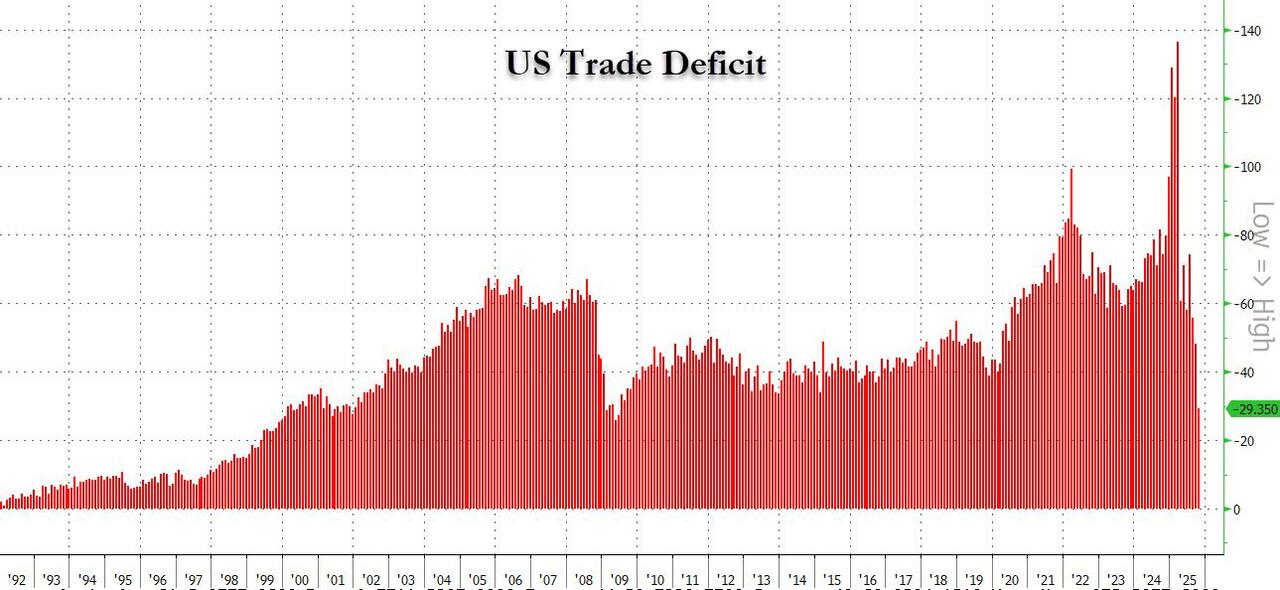
The US economy managed to drastically reduce its trade deficit in October of last year. Data delayed due to the government shutdown highlight structural shifts in the global trade landscape.
Reducing the massive trade deficit has been a primary goal of the US government’s economic agenda under President Donald Trump. This deficit is almost a mirror of the industrial weakness of the US economy in international comparison. It is also a consequence of the US dollar’s role as the global reserve currency. High demand for dollars facilitated imports and encouraged decades of outsourcing American industrial production to other locations.
In the year prior to his 2024 inauguration, the deficit reached a staggering $918 billion – roughly equivalent to China’s trade surplus.
The months-delayed surveys by the US Chamber of Commerce – a result of the prolonged government shutdown last year – now provide an insightful snapshot for October. During that period, the US trade deficit fell from $48.1 billion to just $29.4 billion, while markets had priced in a deficit of nearly $60 billion.
With the data lag now accounted for, several factors become clear.
Restrictive Trade Policy and Reindustrialization
One key driver is the US government’s restrictive trade policy. Tariffs make imports more expensive and have pushed down trade volumes with China, a topic heavily debated politically between Washington and Beijing. In this context, Trump’s trip to the Arab Gulf states is notable, culminating in investment pledges of hundreds of billions of dollars for American industrial production.
Trump is tackling the trade deficit on two fronts. US industry, which recently accounted for only about 10 percent of GDP, is being systematically rebuilt. This is particularly evident in massive investments in artificial intelligence and energy sectors.
At the same time, China, with its heavily subsidized export machine, is forced to pivot to other markets – increasingly putting pressure on the European Union.
The so-called inventory cycle effect is likely reflected in the Chamber of Commerce numbers. Due to US tariff policies, companies pulled imports forward along supply chains to hedge against potential price increases and supply risks. This effect is now reversing, showing up as declining import demand.
LNG Exports and Economic Warning Signals
Another obviously relevant factor is the export of liquefied natural gas (LNG), which the US government strategically uses as a geopolitical lever. LNG exports rose 25 percent last year to 116 million tons. Germany, in particular, has been involved in this trade since the halt of cheap Russian gas imports, facing a significantly higher price for US LNG.
Depending on market prices – estimated between $8.5 and $9.5 per MMBtu – the value of US LNG exports is likely well over $50 billion.
Another less-discussed factor potentially affecting the trade balance lies beneath the surface, in the middle- and lower-income brackets in the US. Private households may have curtailed demand due to persistently high prices, which could also influence the trade figures.
However, this effect is expected to moderate given the continued high growth momentum of the US economy. In the last two quarters of the previous year, GDP grew at an annualized rate of roughly 4.5 percent, while domestic energy prices continued to decline. Additionally, as part of the government’s deportation measures, property prices in some regions have reportedly started to ease. The US government recently reported the repatriation of roughly 2.6 million previously illegally residing immigrants. This could dampen rent and housing costs, easing the financial burden on households.
The International Monetary Fund (IMF) projects global economic growth of around 3 percent this year – well below the historical trend of 3.5–4 percent. Yet dynamic indicators, such as shipping indices, suggest a tentative recovery in global trade. The reference “Drewry World Container Index (WCI)” has shown early signs of improvement along main routes connecting China, the US, and European ports.
Apparently, companies along global supply chains have adapted to US tariffs and are gradually returning to normal operations.
German Exports Sluggish
Germany’s export sector performed modestly last year. Nominal exports rose 0.6 percent to roughly €1.6 trillion, while volume-adjusted exports lost about 2 percent.
The reasons are well known: the energy crisis and declining competitiveness weigh heavily on industrial core sectors. Structural pressure is most visible in the automotive and machinery industries. Consequently, Germany’s trade surplus with the US shrank by 7.3 percent.
Even sharper declines occurred in China, where German exporters lost around 10 percent of business volume. Meanwhile, Germany’s imports rose 4.4 percent year-on-year, notably driven by Chinese capital goods. This suggests a reversal in knowledge transfer: China is increasingly a technology exporter rather than merely the global “low-cost factory.”
For the full year 2025, pending final monthly data, Germany’s trade surplus is expected at roughly €195 billion – the lowest since 2012, excluding the exceptional Corona lockdown year.
* * *
About the author: Thomas Kolbe, born in 1978 in Neuss/ Germany, is a graduate economist. For over 25 years, he has worked as a journalist and media producer for clients from various industries and business associations. As a publicist, he focuses on economic processes and observes geopolitical events from the perspective of the capital markets. His publications follow a philosophy that focuses on the individual and their right to self-determination.
Tyler Durden
Sat, 01/10/2026 – 10:30