Category: News

Bulls vencen a Mavericks por 125-107 tras expulsión de Kidd en el 1er cuarto
CHICAGO (AP) — Coby White anotó 22 puntos, Ayo Dosunmu sumó 20 y los Bulls de Chicago vencieron el sábado 125-107 a los Mavericks de Dallas para cortar una seguidilla de tres derrotas.
Siete jugadores de los Bulls aportaron cifras de dos dígitos. Chicago superó 38-8 a los Mavericks de Dallas en puntos mediante contraataques y nunca estuvo en desventaja.
Nikola Vucevic y Matas Buzelis añadieron 15 puntos cada uno mientras Chicago tuvo un 51,5% de acierto en tiros de campo.
Los Mavericks comenzaron el duelo sin el lesionado Anthony Davis y perdieron al entrenador Jason Kidd a mitad del primer cuarto, cuando fue expulsado por discutir con el árbitro Scott Foster.
Ryan Nembhard totalizó 16 puntos y seis asistencias para los Mavs. El astro novato Cooper Flagg terminó con apenas 11 puntos y un rebote, al atinar cuatro de 13 disparos.
Dallas perdió su segundo partido consecutivo después de haber ganado dos seguidos. Davis sufrió daño en los ligamentos de su mano izquierda el jueves, en la derrota de los Mavericks ante Utah.
Kidd parecía estar molesto porque no se le permitió desafiar una decisión de interferencia de canasta contra Max Christie. Foster le marcó dos faltas técnicas y lo echó.
_____
Deportes AP: https://apnews.com/hub/deportes
Bob Weir, miembro fundador de los Grateful Dead, muere a los 78 años
Por ANDREW DALTON
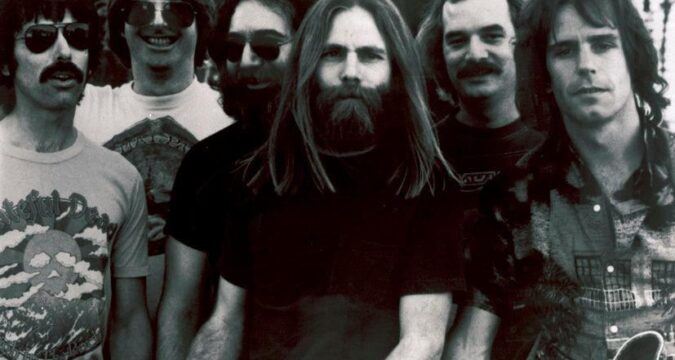
LOS ÁNGELES (AP) — Bob Weir, el guitarrista y cantante que, como miembro esencial de los Grateful Dead ayudó a fundar el sonido de la contracultura de San Francisco en la década de 1960 y lo mantuvo vivo a través de décadas de giras interminables y maratones de improvisaciones, ha fallecido. Tenía 78 años.
El fallecimiento de Weir fue anunciado el sábado en un comunicado en su página de Instagram.
“Es con profunda tristeza que compartimos el fallecimiento de Bobby Weir”, señala el texto. “Él hizo la transición pacíficamente, rodeado de seres queridos, después de vencer valientemente al cáncer como sólo Bobby podía. Desafortunadamente, sucumbió a problemas pulmonares subyacentes”.
Weir se unió a los Grateful Dead —originalmente los Warlocks— en 1965 en San Francisco, cuando sólo tenía 17 años. Pasaría los siguientes 30 años tocando en giras interminables con los Grateful Dead junto al también cantante y guitarrista Jerry Garcia, quien murió en 1995.
Weir escribió o coescribió y fue el vocalista principal en clásicos de los Dead, incluidos “Sugar Magnolia”, “One More Saturday Night” y “Mexicali Blues”.
Después de la muerte de Garcia, Weir sería el rostro más reconocible del grupo. En las décadas siguientes continuó tocando con otros proyectos que mantuvieron viva la música de la banda y su legendaria base de fanáticos, incluyendo Dead & Company.
“Durante más de sesenta años, Bobby salió a la carretera”, señala el comunicado. “Un guitarrista, vocalista, narrador y miembro fundador de los Grateful Dead. Bobby será para siempre una fuerza guía cuya singular creatividad transformó la música estadounidense”.
Con la muerte de Weir, el único miembro original sobreviviente es el baterista Bill Kreutzmann. El bajista fundador Phil Lesh murió en 2024. El otro baterista de la banda, Mickey Hart, prácticamente un miembro original desde que se sumó en 1967, también está vivo, con 82 años de edad. El quinto miembro fundador, Ron “Pigpen” McKernan, murió en 1973.
Dead and Company tocó una serie de conciertos en julio por el 60º aniversario de los Grateful Dead en el parque Golden Gate de San Francisco, atrayendo a unos 60.000 fanáticos por jornada durante tres días.
Nacido en San Francisco y criado en la cercana Atherton, Weir era el miembro más joven de los Dead y parecía un estudiante de secundaria en sus primeros años. En general era menos desaliñado que el resto de la banda, pero en años posteriores se dejó una larga barba como la de Garcia.
La banda sobreviviría mucho más allá de la época hippie en la que nació. A menudo, sus fanáticos ultradevotos —conocidos como Deadheads— los seguían en la carretera, en una gira prácticamente ininterrumpida que persistió a pesar de que, a su alrededor, la música y la cultura cambiaron con el paso de las décadas.
“La longevidad nunca fue algo que nos preocupara mucho”, expresó Weir cuando los Dead recibieron el honor de Persona del Año de MusiCares en los Grammys el año pasado. “Difundir alegría a través de la música fue todo lo que realmente tuvimos en mente, y logramos mucho de eso”.
Calcomanías y camisetas omnipresentes mostraban el logotipo de calavera de la banda, osos danzantes y coloridos también eran un símbolo suyo, y tenían frases distintivas como “no hay tiempo para odiar” y “no todos los que deambulan están perdidos”.
Los Dead ganaron pocos Grammys reales —siempre fueron un poco esotéricos— durante su carrera. Sólo obtuvieron un premio a la trayectoria en 2007 y el galardón al mejor filme musical en 2018.
Igualmente raros fueron sus sencillos pop que alcanzaron el éxito. “Touch of Grey”, la canción de 1987 que trajo un gran aumento en la popularidad de la envejecida banda, fue su único éxito en el Top 10 de Billboard.
Pero en 2024 establecieron un récord para todos los artistas con su 59º álbum en el Top 40 de Billboard. Cuarenta y una de esas ocasiones llegaron desde 2012, gracias a la popularidad de la serie de álbumes de archivo compilados por David Lemieux.
Su música —llamada rock ácido en sus inicios— incorporaría blues, jazz, country, folk y psicodelia en largas improvisaciones en sus conciertos.
“Me atrevo a decir que son la gran banda estadounidense”, declaró Andy Cohen, personalidad de televisión y devoto Deadhead, al conducir el evento de MusiCares. “Qué maravilla son”.
———
Esta historia fue traducida del inglés por un editor de AP con la ayuda de una herramienta de inteligencia artificial generativa.
Healthy Diets Are Getting Pricier, Yet More Affordable
Healthy Diets Are Getting Pricier, Yet More Affordable
A healthy diet is often discussed as a top public health issue, but affordability remains one of its biggest barriers.
Over the past decade, food prices have climbed due to inflation, supply chain disruptions, and climate-related shocks. At the same time, incomes and food access have improved in many regions.
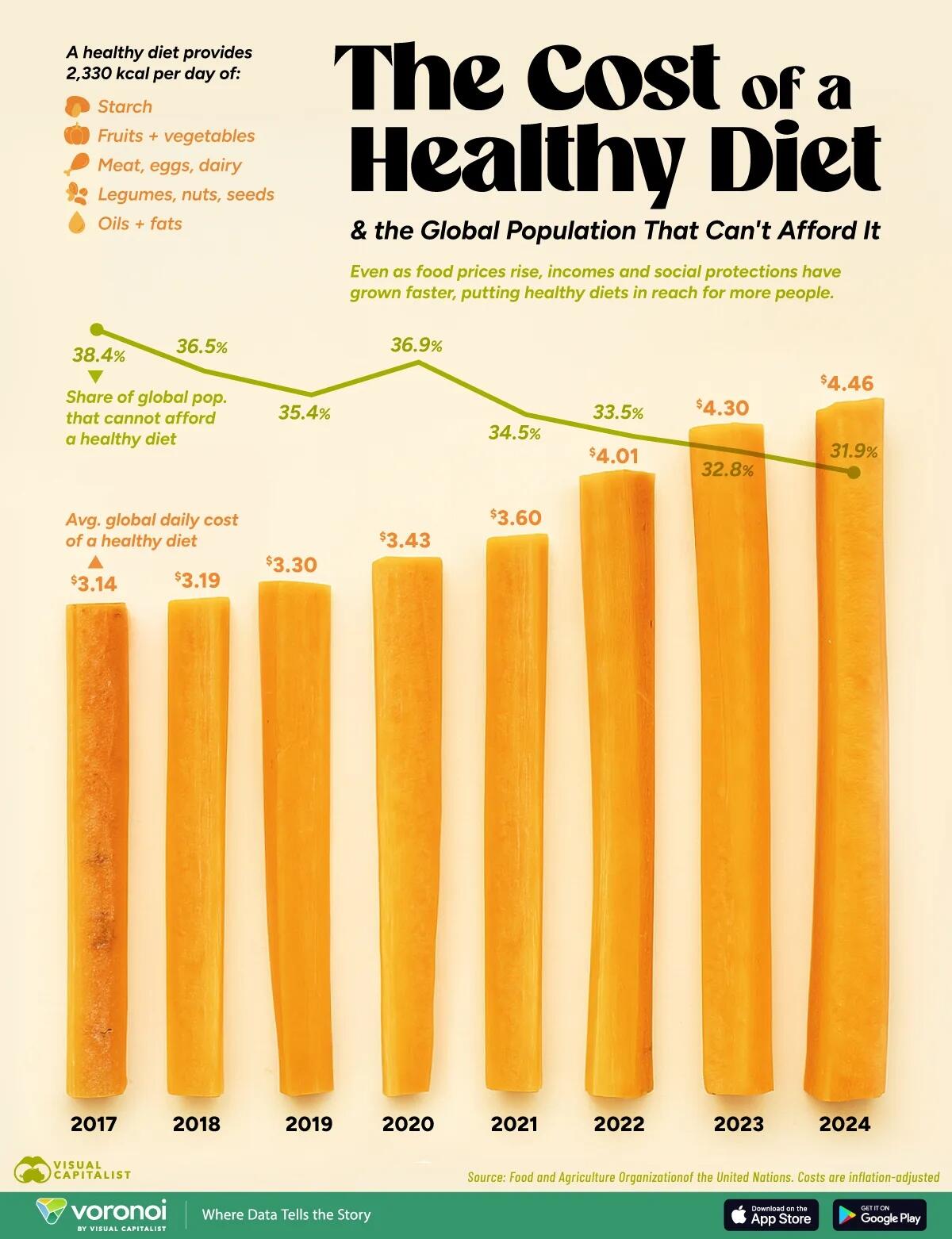
This graphic, via Visual Capitalist’s Niccolo Conte, highlights how these competing forces have shaped the global cost of eating well—and who is still being left behind.
The data for this visualization comes from the United Nations Food and Agriculture Organization. It tracks the average daily cost of a healthy diet worldwide.
Healthy Diet Costs Are Rising
A healthy diet is defined as providing 2,330 kilocalories per day, with nutritionally adequate proportions across six food groups. These include starchy staples, vegetables, fruits, animal-source foods, legumes, nuts and seeds, and oils and fats.
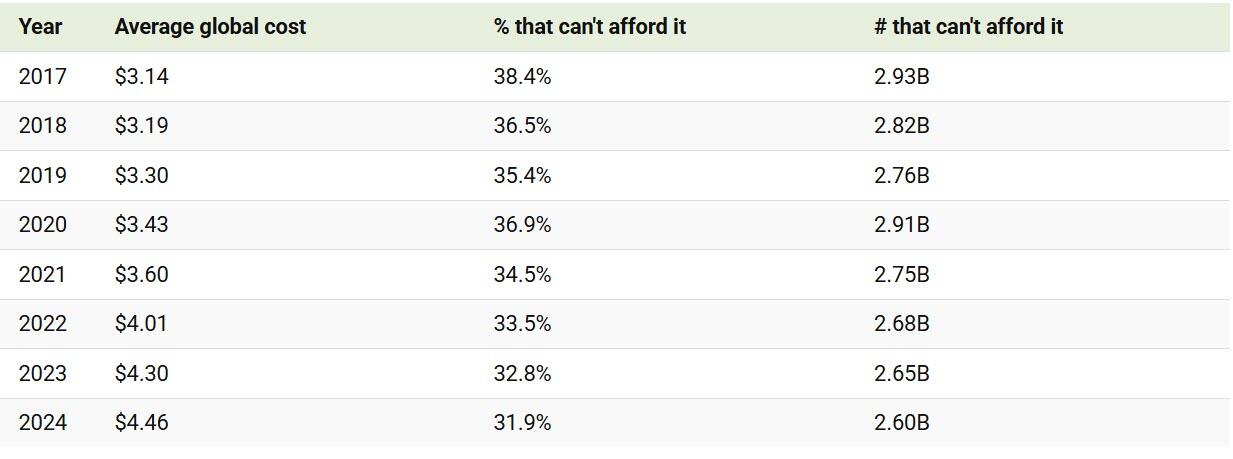
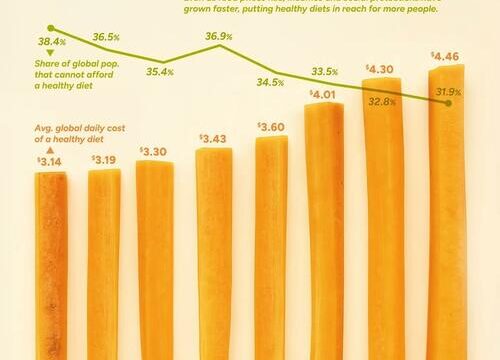
In 2017, the average global cost of a healthy diet was $3.14 per person per day. By 2024, that figure had climbed to $4.46. The sharpest increases occurred after 2020, coinciding with pandemic-related disruptions and global food price inflation.
Affordability Is Improving Despite Higher Prices
While costs have risen, affordability has steadily improved. In 2017, 38.4% of the global population—about 2.93 billion people—could not afford a healthy diet. By 2024, that share had fallen to 31.9%, representing roughly 2.6 billion people.
Despite global progress, affordability challenges remain concentrated in low-income and conflict-affected regions. Even small increases in food prices can have outsized effects where households already spend a large share of income on food.
If you enjoyed today’s post, check out How Much Meat do We Eat? on Voronoi, the new app from Visual Capitalist.
Tyler Durden
Sat, 01/10/2026 – 22:45
https://www.zerohedge.com/personal-finance/healthy-diets-are-getting-pricier-yet-more-affordable

Leonard, Collins y Harden lideran remontada de Clippers 98-92 ante Pistons
Associated Press
DETROIT (AP) — Kawhi Leonard anotó 26 puntos y John Collins agregó 25 mientras los Clippers de Los Ángeles se recuperaron para vencer el sábado 98-92 a los diezmados Pistons de Detroit.
Los Clippers estuvieron detrás por 19 puntos en la primera mitad y 14 en el último cuarto antes de terminar el juego con una racha de 28-8. Detroit perdió el balón 12 veces en el cuarto.
James Harden sumó 19 puntos, siete rebotes y siete asistencias para Los Angeles, que ha ganado nueve de 11.
Los Pistons jugaron sin Cade Cunningham (muñeca), Isaiah Stewart (enfermedad), Tobias Harris (cadera) y Jalen Duren (tobillo). Eso dejó a Detroit sin sus tres máximos anotadores, tres de sus cuatro mejores reboteadores y sus tres mejores bloqueadores de tiros. Cunningham también tiene 321 asistencias, siendo el único jugador que entró en acción el sábado con más de 100.
Duncan Robinson anotó 20 puntos, pero solo hizo un tiro en la segunda mitad. Ron Holland II anotó 16 y Tolu Smith agregó nueve puntos y un récord personal de 14 rebotes.
En la primera mitad, Detroit convirtió 14 pérdidas de balón de Los Angeles en 18 puntos, lo que también ayudó a construir una ventaja de 14-2 en puntos de contraataque.
___
Deportes en español AP: https://apnews.com/hub/deportes

Escobar: How Trump’s Oily Dreams May Collapse In A Venezuelan Dark Pit
Escobar: How Trump’s Oily Dreams May Collapse In A Venezuelan Dark Pit
Authored by Pepe Escobar,
So the Big Oil Picture in Venezuela is way more complex than the Trump 2.0 gang suspects…
Let’s start with neo-Caligula’s new edicts on the imperial satrapy he says he now owns; not exactly edicts but outright threats directed to interim President Delcy Rodriguez:
Crack down on “drug trafficking flows”. Well, this should actually be directed to Colombian and Mexican smugglers in cahoots with big American buyers.
Expel Iranian, Cuban, and other “operatives hostile to Washington” – before Caracas is allowed to increase oil production. Not happening.
Halt oil sales to “US adversaries”. Not happening.
Hence it becomes a near certainty that neo-Caligula may bomb Venezuela again.
Neo-Caligula, in a separate motormouth offensive, also clarified that he wants to somewhat overhaul the oil business in Venezuela via subsidies. It “could take less than 18 months”; then it morphed to “we can do it in less time than that, but it’ll be a lot of money”; and finally morphed to “a tremendous amount of money will have to be spent and the oil companies will spend it.”
No, they won’t, as several proverbial “industry insiders” have advanced. US energy majors balk at the sight of investing fortunes in a nation that may be engulfed by total chaos if neo-Caligula forces a traitorous government over 28 million people.
According to Rystad Energy Analysis, it would take no less than 16 years and at least $183 billion for Venezuela to produce a mere 3 million barrels of oil a day.
Neo-Caligula’s ultimate dream is to reduce global oil prices to a maximum $50 a barrel. For this purpose, the Trump 2.0 imperial gig will, in thesis, totally control PDVSA, including acquisition and sale of virtually all of its oil production.
US Energy Secretary Chris Wright, at a Goldman Sachs energy conference, let the oily cat out of the bag:
“We are going to market the crude coming out of Venezuela, first this backed up stored oil [up to 50 million barrels], and then infinitely, going forward, we will sell the production that comes out of Venezuela into the marketplace.”
So essentially the neo-Caligula gig will capture, actually steal the sale of crude from PDVSA, with the money theoretically deposited in US-controlled offshore accounts to “benefit the Venezuelan people”.
There’s no way Delcy Rodriguez’s interim government will accept what amounts to de facto theft. Even as Homeland Security Advisor Stephen Miller is bragging that the US is using “military threat” to maintain control of Venezuela. If you are really in control, you don’t need to issue threats.
So what about China?
China was importing roughly 746,000 barrels of oil a day from Venezuela. That’s not much. Beijing is already working on replacing it with imports from Iran. China essentially is not dependent on Venezuelan oil. Apart from Iran, it may also source from Russia and Saudi Arabia.
Beijing clearly sees that the imperial overdrive in the Western Hemisphere and in West Asia is not just about oil, but also to force China to buy energy with petrodollars. Nonsense: with Russia, the Persian Gulf and beyond, the name of the game is already petroyuan.
China is 80% energy independent. Venezuela de facto was accounting for a mere 2% of the 20% China imports – and this according to the US government’s own numbers.
China’s energy relationship with Venezuela goes way beyond cheap American formulas. Here is essentially outlined how “Chinese oil agreements with Venezuela are de facto binding financial contracts, with repayment mechanisms, collateral structures, penalty clauses, and derivative linkages embedded deep into global finance (…) They are connected – directly and indirectly – to Western financial institutions, commodity traders, insurers, and clearing systems, including entities tied to Wall Street. If these contracts are broken, the consequence is not China ‘taking a loss’. It is a cascade event: defaults triggering counterparty exposure, derivatives being repriced, legal disputes crossing jurisdictions, and confidence shock spreading outward. At a certain point, this ceases to be a Venezuelan problem and becomes a systemic global one.”
Moreover, “over the past twenty years, China has become the operational core of Venezuela’s oil industry. Not merely as a buyer, but as a builder. China provided refinery technology, heavy crude upgrading systems, infrastructure design, control software, spare parts logistics (…) Remove the Chinese engineers. Remove the technicians who understand the control logic. Remove the maintenance supply chains. Remove the software support. What remains is not a functioning oil industry waiting to be ‘liberated’, but an inert shell.”
Conclusion: “Converting Venezuela’s Chinese-built oil sector into an American one would take three to five years, minimum.”
Financial analyst Lucas Ekwame hits the major points. Venezuela produces superheavy oil as thick as tar. It doesn’t just flow; it needs to be melted to reach the surface, and after extraction, it hardens again, requiring diluent: no less than 0.3 barrels of diluent need to be imported for each exported barrel.
Compound it with Venezuela’s energy infrastructure shaped by China and at the same time suffering years of American sanctions, even worse than over Iraq in the early 2000s, and neo-Caligula’s faulty oil “strategy” becomes obvious.
That of course does not alter the short-term feast of imperial hedge fund vultures over Venezuela’s carcass, starting with ghastly Paul Singer, the billionaire Zionist hedge fund manager and MAGA super PAC donor ($42 million in 2024) whose Elliott Management acquired the Houston-based subsidiary of CITGO for $5.9 billion in November, less than a third of its $18 billion market value, thanks to the embargo on Venezuelan oil imports.
The speculative money crowd is bound to cash in on up to $170 billion in the debt market; defaulted PDVSA bonds alone are worth over $60 billion.
So the Big Oil Picture in Venezuela is way more complex than the Trump 2.0 gang suspects. Of course on the road ahead we may come to a situation where the Viceroy of Venezuela, the gusano Marco Rubio, cuts off the oil flow from Caracas to Shanghai. Well, considering Rubio’s strategic “expertise”, better start regimenting battalions of lawyers right away.
Views expressed in this article are opinions of the author and do not necessarily reflect the views of ZeroHedge.
Tyler Durden
Sat, 01/10/2026 – 22:10

Nembhard anota 29 y Pacers vencen 123-99 a Heat para segunda victoria al hilo
Associated Press
INDIANAPOLIS (AP) — Andrew Nembhard tuvo 29 puntos y nueve asistencias, Aaron Nesmith añadió 12 puntos y nueve rebotes antes de una salida temprana y los Pacers de Indiana aplastaron el sábado por la noche 123-99 al Heat de Miami.
Indiana igualó su racha de victorias más larga de la temporada con una rara segunda victoria consecutiva, esta vez tomando el camino fácil. Los Pacers nunca estuvieron en desventaja y mantuvieron una ventaja de dos dígitos durante la mayor parte del juego. Los Pacers encestaron 17 triples, uno menos que su récord de la temporada, con Nembhard igualando su mejor marca de la temporada con cuatro.
El suplente Micah Potter encestó cuatro triples y terminó con 14 puntos. Jarace Walker tuvo 13 puntos.
Tyler Herro tuvo 21 puntos, siete rebotes y cuatro asistencias en una noche en la que Miami solo encestó el 39.1% de sus tiros de campo. Jaime Jaquez Jr. añadió 16 puntos, y Bam Adebayo tuvo 13 puntos y nueve rebotes. Miami ha perdido tres de sus últimos cuatro partidos y falló sus primeros 11 triples el sábado.
El partido comenzó menos de 24 horas después de que otro enfrentamiento entre Miami e Indiana se estableciera en el juego de campeonato nacional de fútbol americano universitario. Y al igual que la victoria de los Hoosiers sobre Oregon el viernes por la noche, los Pacers no perdieron tiempo en marcar el ritmo o en tomar una gran ventaja.
___
Deportes en español AP: https://apnews.com/hub/deportes
These Are The World’s Top Silver Producers
These Are The World’s Top Silver Producers
Silver prices surged more than 5% in recent trading, breaking above $80 per ounce once again.
The rally has been driven by China’s restrictions on silver exports, rising demand from green technologies like solar power, and renewed interest in safe-haven assets.
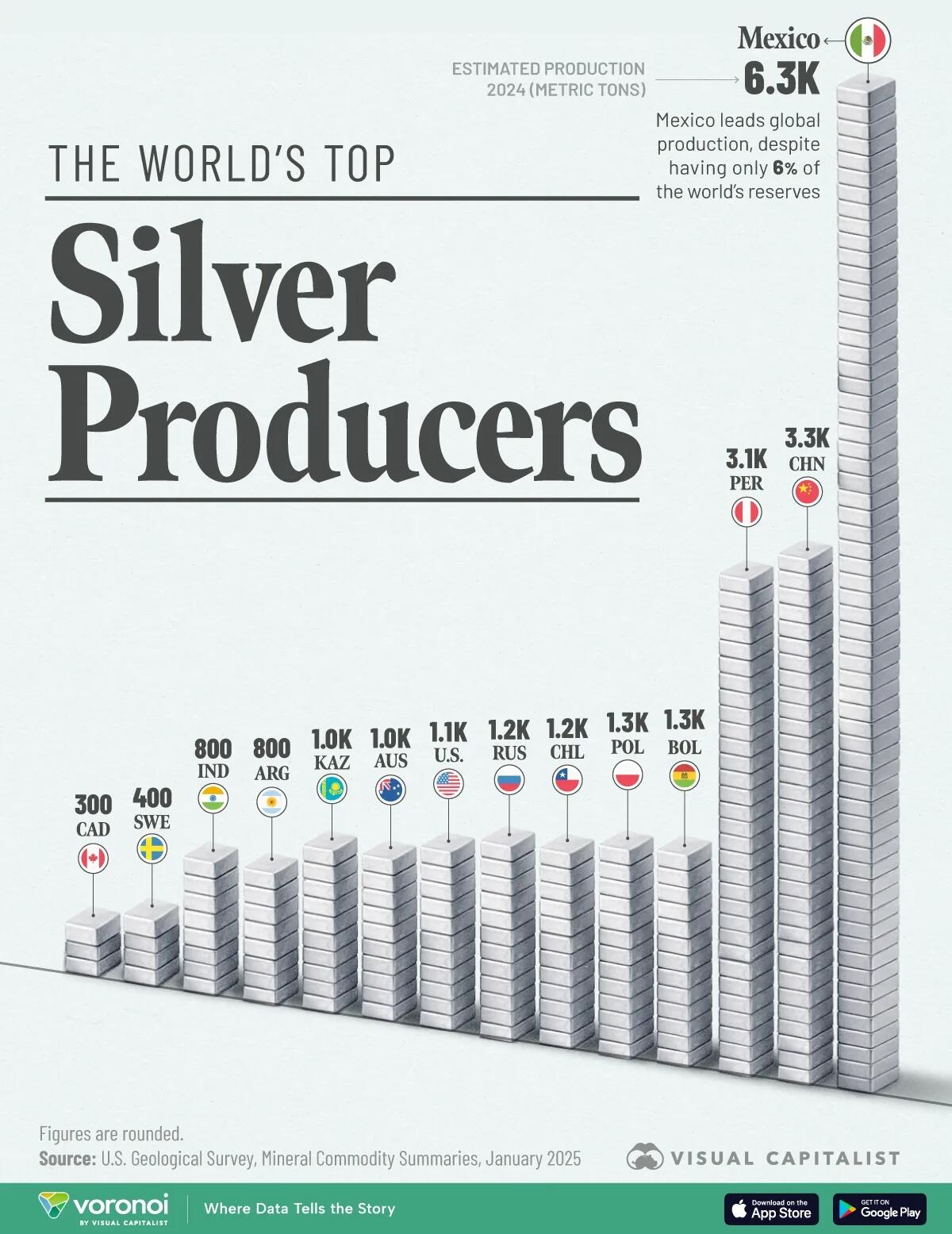
This visualization, via Visual Capitalist’s Bruno Venditti, highlights the world’s largest silver-producing countries and shows where global supply is most concentrated.
The data for this visualization comes from the U.S. Geological Survey’s Mineral Commodity Summaries 2025. It presents estimated silver mine production by country for 2024.
Mexico’s Production Dominance
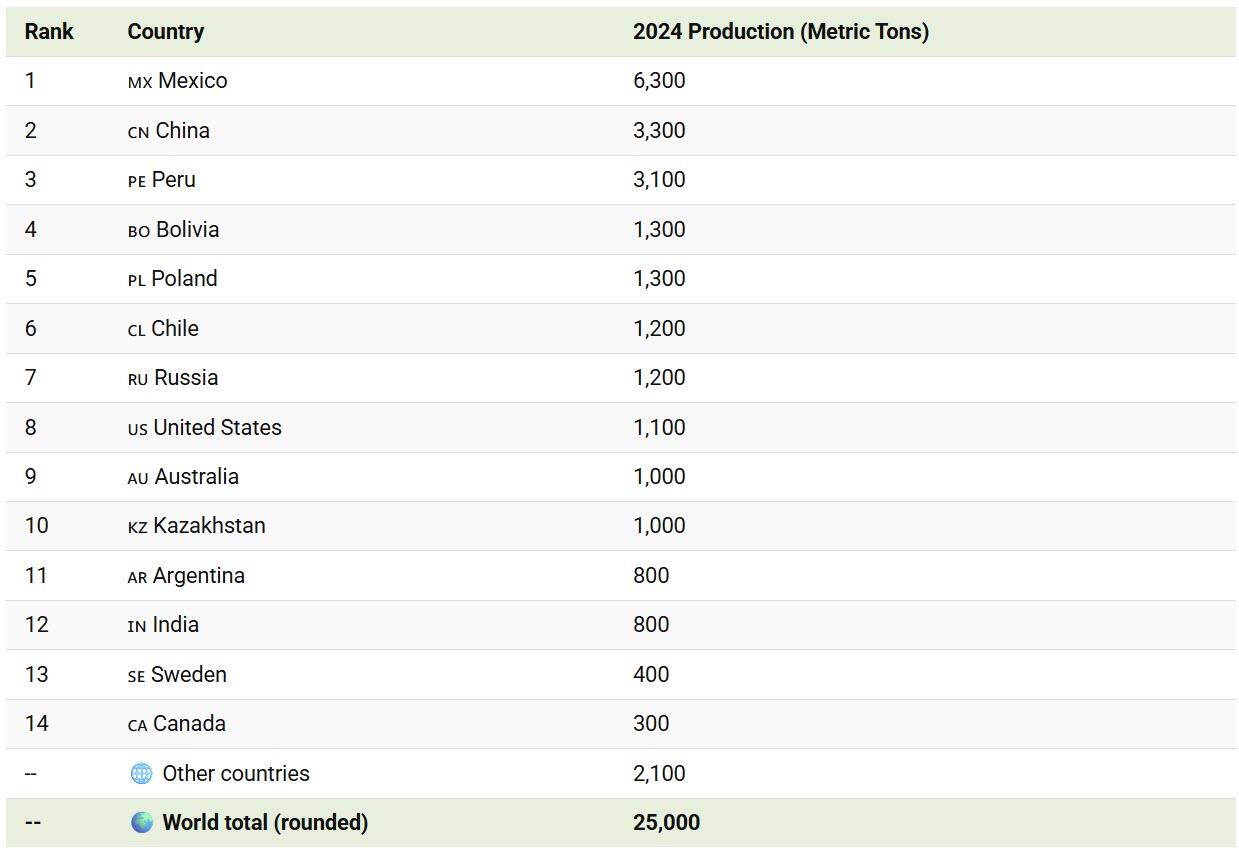
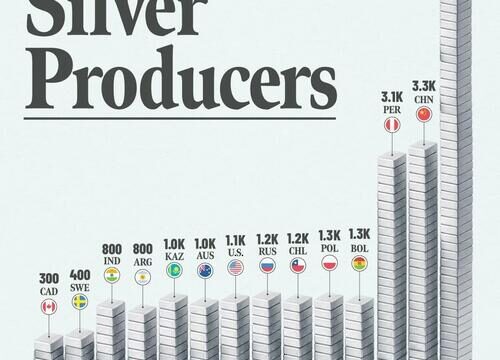
Total world silver production reached roughly 25,000 metric tons in 2024.
Mexico remained the world’s top silver producer in 2024, with an estimated 6,300 metric tons of output. The country has held this position for decades, supported by extensive mining infrastructure and high-grade deposits. Notably, Mexico produces far more silver than its reserve share might suggest, holding only about 6% of the world’s known reserves.
China and Peru Anchor Global Supply
China ranked second globally, producing around 3,300 metric tons of silver in 2024. Much of this output comes as a byproduct of large-scale base metal mining, particularly lead and zinc.
Peru followed closely with approximately 3,100 metric tons, reinforcing South America’s importance in global silver markets.
Together, these three countries accounted for more than half of global silver production.
Beyond the top producers, countries such as Bolivia, Poland, Chile, Russia, and the United States each produced between 1,100 and 1,300 metric tons. Australia, Kazakhstan, Argentina, and India also contributed meaningful volumes.
Despite this diversity, the silver market remains tight. Strong demand from solar panels, electronics, and electrification is expected to keep the market in a deficit, putting upwards pressure on silver prices.
If you enjoyed today’s post, check out All of the World’s Oil Reserves by Country, in One Visualization on Voronoi, the new app from Visual Capitalist.
Tyler Durden
Sat, 01/10/2026 – 21:35
https://www.zerohedge.com/precious-metals/these-are-worlds-top-silver-producers
Cifra de muertos en protestas contra la teocracia en Irán llega al menos a 116, según activistas.
DUBAI, Emiratos Árabes Unidos (AP) — Cifra de muertos en protestas contra la teocracia en Irán llega al menos a 116, según activistas.

California’s Billionaire Tax Is A Trojan Horse… Not A Solution
California’s Billionaire Tax Is A Trojan Horse… Not A Solution
Authored by Mollie Engelhart via The Epoch Times,
California was my home for most of my adult life—long enough to know that what looks good in a campaign slogan can feel very different when you’re the one carrying the load.
I built restaurants there. I employed people there. I signed permits, licenses, and applications like they were holiday cards. I navigated agencies that asked for more paperwork than profit statements. I paid into a system that always wanted one more filing, one more inspection, one more approval, one more fee. The joke was that my assistant didn’t work in hospitality—she worked in compliance. And it was true. That state turns compliance into a profession.
So when I see the latest proposal—a one-time 5 percent tax on anyone whose net worth exceeds $1 billion—I don’t see Robin Hood. I see Sacramento writing itself a permission slip.
The pitch says “billionaires.” But the mechanism says “total assessed wealth, declared by the owner, verified by the state, and enforceable through audit.”
That’s a power move, not a nuance.
A Tax Based on Valuation, Not Reality
Most taxes in America hit earnings or consumption. You pay when you make money, or when you buy something, or when you sell something. This proposal taxes accumulation. It doesn’t ask what you can afford. It asks what you have, and then hands a calculator to the agencies to determine the bill.
We’ve seen how this evolves. The Biden administration and Vice President Kamala Harris already proposed a federal wealth tax on Americans worth $100 million or more. Not billionaires—$100 million. That’s a signal flare, not a footnote.
It tells you exactly what you need to know: This idea isn’t anchored at the top. It’s already drifting toward the middle.
And middle is where most of the money actually lives.
The Constitution Saw This Coming
There’s a phrase from constitutional law that gets thrown around a lot in conversations like this: bill of attainder.
A bill of attainder is a law that punishes a specific person or small identifiable group without a trial, skipping the courts and due process entirely. In the United States, that kind of law is unconstitutional—lawmakers don’t get to play judge and jury and penalize a select group through legislation alone.
This proposal isn’t a criminal punishment, but the reason people bring the term up at all is because it targets a tiny group by valuation for a massive extraction event without a court proceeding first. That resemblance matters if you believe fairness isn’t optional.
The Wealthy Already Pay Plenty—Just Quietly
People talk about the “rich dodging taxes” like it’s gospel. Let me tell you what actually happens when you build something in California:
You don’t dodge taxes, you drown in them. Not just income tax, not just property tax, but sales tax, alcoholic beverage tax, payroll taxes, employer-side filings, permits, licensing fees, inspections, regulatory approvals, environmental health certificates, building permits, land use permits, and on and on and on.
That state has already been collecting revenue from business owners in every direction long before this proposal ever landed on the ballot.
If you want to know why business owners left, it wasn’t a lack of patriotism. It was math.
The Trojan Horse Isn’t the Billionaire—It’s the Precedent
The billionaires are the branding. The mascot. The costume the idea wears so voters don’t inspect the gears.
But the gears are what matter, because once a state passes a tax on total assessed wealth, future thresholds can be lowered, exemptions can be rewritten, valuation formulas can be expanded, and enforcement will land in the hands of agencies most voters will never meet—but business owners never stop meeting.
The real question is not “Should billionaires pay more?” but “Should the state have the right to tax total assessed wealth at all?”
Because once that precedent exists, the definition of “rich” will keep shifting, the net will keep widening, and the bill will keep climbing down the balance sheet toward the people who never imagined they’d qualify.
A millionaire today in California is someone who owns a house. A house today costs a million dollars there. That’s not a billionaire. That’s a math teacher and a firefighter and a family with a mortgage.
The net will widen because the money they need is not all at the top. There’s much more sitting in the middle.
And middle-class is where precedent always ends up grazing.
My Stance
I lean libertarian—I don’t want government in every aspect of our lives, our kitchens, our land, or our asset valuations. I’m a hard no on expanding its discretion any further. The slogans may be sticky, but freedoms are stickier—once lost, they don’t come back.
Views expressed in this article are opinions of the author and do not necessarily reflect the views of The Epoch Times or ZeroHedge.
Tyler Durden
Sat, 01/10/2026 – 21:00
https://www.zerohedge.com/political/californias-billionaire-tax-trojan-horse-not-solution

Pase de TD de Stafford a Parkinson da victoria a Rams 34-31 sobre los Panthers
Por STEVE REED
CHARLOTTE, Carolina del Norte, EE.UU. (AP) — Matthew Stafford lanzó un pase de touchdown de 19 yardas a Colby Parkinson con 38 segundos restantes para llevar a los Rams de Los Ángeles a una dramática victoria de 34-31 el sábado sobre los Panthers de Carolina en la ronda de comodines en el juego inaugural de los playoffs de la NFL.
Stafford completó 24 de 42 pases para 304 yardas con tres pases de touchdown y una intercepción, mientras que Puka Nacua tuvo diez recepciones para 111 yardas y dos touchdowns en total, ya que los Rams (13-5), que eran favoritos por diez 1/2 puntos, avanzaron a los playoffs divisionales.
Bryce Young lanzó para 264 yardas y un touchdown y corrió para otra anotación para Carolina (8-10), que terminó la temporada perdiendo cuatro de sus últimos cinco juegos. Jalen Coker tuvo máximos de carrera con nueve recepciones para 134 yardas con un touchdown y Chuba Hubbard corrió para 46 yardas y dos touchdowns.
Carolina redujo la ventaja a 17-14 al medio tiempo después de una carrera de touchdown de uno yarda de Hubbard y una escapada de 16 yardas de Young, la segunda carrera de touchdown más larga de su carrera.
Los Rams tuvieron la oportunidad de aumentar la ventaja, pero Nacua dejó caer un potencial tercer touchdown en un pase por la banda derecha de Stafford justo antes del medio tiempo.
___
Deportes en español AP: https://apnews.com/hub/deportes