
Category: News
Column: Tutors at Dominican Literacy Center in Aurora rise to the challenges of current immigration crackdown
For over three decades the Dominican Literacy Center in Aurora has been a haven for women immigrants who want to learn English in a safe and supportive environment. But that mission has become tougher under the Trump administration, says Executive Director Claire Wiesner-Smillie, with last year’s ICE presence in the city creating more fear and anxiety among students.
Plus, “the goal post keeps moving” for those working toward their citizenship, she adds, noting the U.S. naturalization exam is not only more difficult but application deadlines and testing dates are constantly in flux.
Still, “overall we are doing very well considering the circumstances,” says Wiesner-Smillie, pointing to a return to in-person tutoring for students who chose to learn remotely when federal immigration enforcement agents were so prevalent in Aurora.
Much of the credit for the center’s resiliency, she says, goes to its many volunteers, who come from Kane, DuPage, Kendall and DeKalb counties to work in weekly 90-minute one-on-one sessions with students from countries all over the world.
Now in her fourth year, Deb Schmalholz of St. Charles is one of those committed volunteers, who Wiesner-Smillie describes as “always ready to do” whatever is needed
“If we lose a volunteer, she steps right up” to fill that spot, says the executive director, praising the tutor’s “cheerful presence” and “can-do” attitude.
For Schmalholz, a retired educator who believed in empowering students throughout her career, the Dominican Literacy Center’s mission and its “communal caring” atmosphere resonates with her.
“These students are so wonderful … they are my heroes,” she insists, noting how immigrant women, who already have busy lives, must “step out of their comfort zones, especially with language and culture,” in their quest to better their futures and those of their families.
How can you not be “inspired by those women … their efforts, their stories?,” she asks. “I love this gig.”
Schmalholz thinks you might enjoy it as well.
The Dominican Literacy Center needs more volunteers, and is offering a training session at its headquarters at 260 Vermont Ave. from 9 a.m.-3:30 p.m. Jan. 17. To attend, call 630-898-4636 or email paula@dominicanliteracycenter.org.
Four years ago Schmalholz saw a similar outreach in her church bulletin, which piqued her interest because she not only had a desire to continue her “passion for teaching,” as a graduate of Dominican University, she saw it “as a sign.”
But you certainly don’t have to be a teacher or a Dominican alum to be successful at it, Schmalholtz insists, noting that the center, which was awarded the prestigious Library of Congress Literacy Award in 2023, has a “top notch” staff and “state of the art” curriculum that makes volunteering flexible and “so doable.”
Those feelings are shared by Pat Leatherwood, a retired CPA with the Internal Revenue Service who has been a volunteer for over 15 years.
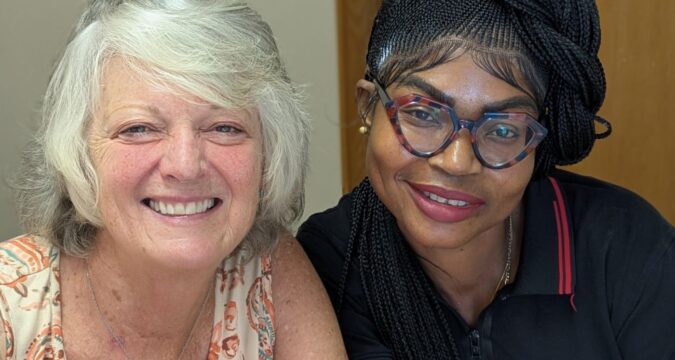
Pat Leatherwood, right, shown with her ESL student Aransazu, has been a longtime tutor at the Dominican Literacy Center in Aurora, which will hold a training session for new volunteers on Jan. 17. (Dominican Literacy Center)
While doing consulting work overseas, the 78-year-old Leatherwood “got a taste” for what it is like to be in a country where language and culture are different. And once she started teaching, “I loved what it did for people who really have a desire and a need to learn,” she says.
Wiesner-Smillie has nothing but praise for this longtime volunteer, who has not only committed so much one-on-one tutoring time but also holds fun literacy games for all the students during their morning breaks at the center.
Still, like Schmalholz, Leatherwood is adamant she receives far more than she gives.
Having grown up “very poor” in a Chicago inner city neighborhood, “I was given help to survive and thrive in society. So this gives me a feeling of being able to give back,” she says, adding that “what is so unique” about the Dominican Literacy Center is its focus on the women of immigrant households, who often are “the heart of the family.”
Currently, says Wiesner-Smillie, the center has 122 volunteers but looking to add another 25 weekly tutors for its ESL program and for classes that prepare men and women for their naturalization tests.
It’s been a challenge for both tutors and students, some of whom have had to start and stop sessions as they deal with the “fear and uncertainty” of this immigration crackdown, says Wiesner-Smillie. While there’s been a “huge increase” in those ready to take citizenship classes, she continues, 75% of students who have completed the course are waiting on a test date, which also contributes to their anxiety.
As an example, she points to a student from Afghanistan, a military interpreter for the U.S. for nine years, who passed his citizenship test along with his wife, but recently got a letter notifying them the planned ceremony had been cancelled.
“Our model is intentionally built to provide a safe place for them to learn, so in terms of their performances, they are still doing fine. It just makes it harder for everyone,” says Wiesner-Smillie. “These volunteers are caring people who stick it out because they know what they are doing is important.”
Which is why both tutors I spoke with encourage anyone who has even an inkling of interest to find out more about the center and its upcoming training.
“For me,” says Schmalholz, “it’s been a gift from heaven.”
dcrosby@tribpub.com
Editorial: Don’t blame Chicago cops for ICE and Border Patrol misconduct
On Thursday night, various left-wing activists and elected officials demanded the Civilian Office of Police Accountability and Chicago’s Office of Inspector General investigate the actions of the Chicago Police Department while agents from U.S. Border Patrol and Immigration and Customs Enforcement were causing havoc on the streets of Chicago.
We understand the boiling frustration following the fatal shooting on Wednesday of a Minneapolis woman by an ICE agent. These activists know they would not be taken seriously by the feds, so they are channeling their anger into a potentially more productive lane in a deep blue city: going after local cops, alleging cooperation with the hated federal agents.
Understandable, yes. Helpful, not at all.
Anyone who has watched the videos of the Minneapolis shooting with a clear head can see not just what happened but what did not happen: the intervention in, or at least the monitoring of, a dangerous situation by local police officers whose superior training and knowledge of their surrounding communities might well have prevented that killing from happening in the first place.
Minneapolis cops, who’ve suffered through all kinds of ill treatment from activists, were nowhere to be seen. Had they been the ones getting that vehicle to move, not the hyped-up paramilitary crew escalating everything, a person might still be alive and an agent might not have a shooting on his conscience. There was at least a chance of that.
We’ve said several times before that cops are in a near-impossible position when it comes to this wildly dysfunctional war between the federal government and local and state officials in Democratic cities. They’re typically prohibited from aiding in immigration enforcements by local and state laws and there are good reasons for that. But what has transpired in practice is that cops are sorely missed during ICE incursions.
That was the case on Wednesday, where the fatal shooting began as someone blocking a public road, generally an infraction of interest to police officers, who are trained to know the difference between impeding something and vociferously protesting against it.
More importantly, modern cops are trained to de-escalate matters and understand how people react under stress. Sure, the efficacy of that depends on the individual officer and Chicago has plenty of experience of that not happening as it should, but the training is there. Had the Minneapolis police been keeping order Wednesday, there might have been a better outcome.
Suffice to say, then, that the anger against the Chicago police over anything to do with ICE and the Border Patrol is misplaced and an act of projection. They were not the problem and were, depending on the moment, either hamstrung entirely or doing their best in difficult circumstances.
What happened Wednesday in Minneapolis merits a nonpartisan investigation that establishes all the facts of the matter, everything from the trajectory of the obstructive vehicle driven by the protester to the actions and statements of those public officials with higher rank than the agent who pulled the trigger.
The FBI has said it is investigating and we’re all for that. But given the chronic lack of trust here, we’d like to see federal and local officials standing together at a podium and announcing a joint investigation into what transpired on Wednesday.
We’re not holding our breath but at some point in this unannounced civil war, something like that will have to be done for it to end.
In the meantime and on this matter, our activist friends should leave our police officers alone.
Submit a letter, of no more than 400 words, to the editor here or email letters@chicagotribune.com.

Kenneth Seeskin: AI can’t do soul-searching. Here’s why we need philosophy.
As Bob Dylan once said: “The times, they are a-changin’.”
One only need to look to the emergence of artificial intelligence to know the lyrics from this 1964 song continue to ring true today. But for all its strengths — from offering travel tips to investment advice to writing term papers and poetry — AI content is also a double-edged sword, littered with bogus references and conclusions based on biased studies or incomplete information.
Singer-songwriter Bob Dylan at a news conference in London in 1966. (Express Newspapers/Getty)
And AI comes with a price to pay. For many people, that price will be measured in dollars and cents, as AI takes over jobs that used to belong to human beings. Why pay someone to write a report or plan a budget if AI can do it by pushing a button? Even if someone’s job is not taken over, AI may require them to undergo significant retraining to keep it.
But there is another price to pay, which cannot be measured in dollars and cents: the cost of intellectual stagnation. At its best, AI reflects the current thinking on a particular issue. That may be a good starting point. But what if the current thinking is wrong? What if we need a whole new way of looking at things? Where will new ideas come from?
Unless there are people willing to challenge the current thinking, the price we pay is intellectual stagnation.
Consider the kinds of questions that go beyond the retrieval of information or the completion of technical tasks, the hard questions that many of us face from time to time. Does God exist? Are some actions unforgivable? If someone you love committed a serious crime, would you turn them into the police? Should terminally ill patients be allowed to take their own lives? Here AI is of limited value. There is no way to tackle these questions without deep reflection and a great deal of soul-searching.
In the face of growing conformity, critical thinking skills are needed more than ever. According to a study, released last year, by the Journal of the American Philosophical Association that looked at 600,000 college students, those who majored in philosophy not only ranked higher than all others on verbal and logical reasoning, but also displayed more open-mindedness and intellectual curiosity. There is even evidence that philosophy majors have a higher acceptance rate to medical school than students who major in traditional subjects such as chemistry or biology.
While some may be surprised by these results, I am not. Standardized tests don’t just measure a student’s recall of facts; they also try to determine whether students can analyze arguments and are sensitive to verbal nuances. Because they are trained to question basic assumptions, define key terms and construct logical arguments on their own, philosophy majors often have an advantage over others.
When I taught basic classes in philosophy, for example, I made sure that for every thinker we read arguing for one position, we read an equally important thinker arguing for the opposite: an atheist and a believer, a materialist and an idealist, a defender of morality and a critic of it. Papers and exams were structured so that students had to analyze arguments both for and against a particular position and decide which side is right. In addition to the ability to analyze arguments, I hoped to instill a willingness to consider unconventional approaches to problems.
So while intellectual stagnation may not have an immediate effect on one’s pocketbook, it is a serious problem at a time when people have become so entrenched in their political views that they no longer listen to people who do not share them — in other words, a time when simple slogans and dogmatic pronouncements have become all too common. In this case, the price we pay is a deterioration in public discourse and a corresponding rise in prejudice and misunderstanding.
I am not arguing, of course, that philosophy has a monopoly on critical thinking. It often borrows insights from other subjects. It rarely produces established results in the way the sciences do, and other majors in the liberal arts also encourage creative thinking.
But if the recent study of college students is accurate, philosophy, though not a panacea, does an especially good job of preparing them for the AI age we are entering.
Kenneth Seeskin is professor emeritus of philosophy and the Philip M. and Ethel Klutznick professor of Jewish civilization at Northwestern University.
Submit a letter, of no more than 400 words, to the editor here or email letters@chicagotribune.com.
https://www.chicagotribune.com/2026/01/11/opinion-ai-philosophy-human-reason-nuance/

Illinois lawmakers return to Capitol facing $2.2B budget gap while pushing election-year affordability message
SPRINGFIELD — In an election-year General Assembly session where what won’t pass will likely be as telling as what might, Illinois lawmakers return to the Capitol facing a familiar but narrowing path: avoid politically radioactive fights, plug a more than $2 billion budget hole and sell voters on a single unifying theme Democrats are leaning on from Washington to Springfield — affordability.
With control of both chambers and the governor’s office, Democrats are anticipated to steer clear of sweeping, high-risk policy overhauls as they campaign for every House seat, a slate of Senate races, and Gov. JB Pritzker’s bid for a third term. Instead, legislative leaders are signaling major proposals — from health care and insurance regulation to energy policy and even how the state will entertain Chicago Bears stadium talks — will be filtered through a cost-of-living lens.
Hovering over it all is the fact that Illinois enters its new budget cycle on July 1 with a forecasted $2.2 billion shortfall and shrinking federal support from the Republican Trump administration. While Democrats say they are committed to balancing the budget without dramatic disruption, progressives inside the majority are pressing a familiar argument that the state should ask the wealthiest Illinoisans to pay more.
“I think everything’s going to come down around affordability issues. I think folks are concerned about their homeowners’ insurance, their car insurance,” House Speaker Emanuel “Chris” Welch, a Democrat from Hillside, said last week at a City Club of Chicago luncheon. “Listen, everything’s about affordability and that’s going to be our focus.”
The message mirrors a broader national Democratic strategy ahead of the November midterm elections, one that seeks to frame rising prices — from groceries to insurance premiums — as a political failure of Republicans, including President Donald Trump and his congressional allies. In Illinois, it also provides a governing rationale for a session likely to be heavy on caution and light on bold departures, even as Democrats remain vocal in criticizing Trump and Republicans.
The General Assembly’s roughly four-and-a-half-month session is scheduled to end May 31, with lawmakers juggling legislative work alongside the March 17 primary election. Pritzker, a vocal Trump critic who has also floated a potential 2028 presidential run, will deliver his budget proposal in mid-February and set the tone for negotiations that legislative leaders acknowledge will be unusually tight.
House Speaker Emanuel “Chris” Welch walks with state Rep. Sue Scherer following a caucus during the legislative session at the Illinois Capitol on Oct. 30, 2025, in Springfield. “Listen, everything’s about affordability and that’s going to be our focus,” said Welch about the upcoming session. (John J. Kim/Chicago Tribune)
The challenge is compounded by federal uncertainty. While Illinois has stabilized after years of fiscal distress — including ballooning pension liabilities and a bruising two-year budget impasse under former Republican Gov. Bruce Rauner — the state remains dependent on Washington. That reliance is increasingly risky as Trump’s tax and spending cuts ripple through Medicaid, food assistance, and other programs, and as Republicans who comprise Illinois’ legislative superminority continue to criticize the governor and their colleagues across the aisle for excessive spending.
Democratic Senate President Don Harmon of Oak Park described cost-of-living pressures as “an overriding theme” he hears from constituents.
“It’s health care, it’s housing, it’s insurance premiums, it’s utility bills,” Harmon said, adding that lawmakers are still developing proposals for the session. “I don’t know that there’s a silver bullet anyone’s devised yet.”
House Republican Leader Tony McCombie of Savanna on Thursday said she thinks 2026 “would be finally a good time for Democrats to bring Republicans into the room” given the midterm elections, but added the election doesn’t change much for Republicans who will continue to “expose and oppose bad policy.”
Senate Republican Leader John Curran of Downers Grove said his caucus wants to push for legislation that includes providing energy rebates and reducing the cost of medications — emphasizing in a statement how his caucus would be focused on “making life more affordable for Illinois families and businesses by advocating for policies to reduce costs and against the majority’s endless efforts to increase spending by raising taxes.”
The numbers underscore the difficulty. To close a deficit of more than $3 billion in the current fiscal year that ends June 30, Democrats last spring cut hundreds of millions of dollars in health care spending for non-U.S. citizens and approved more than $800 million in tax increases, including hikes on online sports betting, tobacco and vaping products. While the projected hole for the next budget is smaller, the state’s cushion is thinning as federal dollars recede.
A recent report from the bipartisan Commission on Government Forecasting and Accountability showed Illinois received $281 million from Washington in December — $83 million less than the same month a year earlier, excluding now-exhausted pandemic aid. An October analysis from Pritzker’s budget office warned that the spending cuts law that Trump approved July Fourth could reduce Medicaid funding to Illinois by $2.8 billion by fiscal year 2031, forcing the state to contribute an additional $1.7 billion to maintain coverage.
Pritzker’s budget office also projected added state costs for the Supplemental Nutrition Assistance Program, or SNAP, as the federal government shifts an additional 25% of administrative expenses to the state, amounting to $80 million annually, and imposes stricter penalties for payment errors, potentially adding more than $700 million in costs by the 2028 fiscal year.
Illinois Senate President Don Harmon speaks before Gov. JB Pritzker signs the Northern Illinois Transit Authority Act, a transit funding and reform bill at Union Station on Dec. 16, 2025. Harmon described cost-of-living pressures as “an overriding theme” he hears from constituents. (Eileen T. Meslar/Chicago Tribune)
All of those changes to SNAP and Medicaid could result in hundreds of thousands of Illinois residents losing those benefits, the budget office also said.
“My only personal priority is passing another responsible, balanced budget,” Harmon said. “That’s going to be challenging, not just because of economic conditions but also because of the lunacy coming out of Washington, where each morning brings us a potential new challenge.”
In part to brace for that volatility, Pritzker has ordered agencies to reserve up to 4% of their general funds in the current $55 billion budget and worked with lawmakers to create a special fund to backstop programs hit by federal cuts.
Even with modest revenue growth late last year — Illinois collected more than $230 million more in December than the same month the year before — Welch has renewed calls for a surcharge on millionaires, arguing the state still has a structural revenue problem. The idea has long been popular with progressive Democrats and has drawn voter support when floated in past ballot initiatives, though it remains politically fraught in an election year.
State Rep. Will Guzzardi, a Chicago Democrat and one of Welch’s budget negotiators, said rising health care costs and pension obligations leave little room to maneuver without new revenue.
“I think we need to invest in our schools and our communities and (lower) property taxes and (provide) social services for people, and we simply don’t have the capacity to do all that within the current budget constraints,” Guzzardi said. “I really believe that we have to grow the pie and we have to ask the wealthiest individuals and biggest corporations to pay their fair share so that we can invest in the services that people need.”
State Rep. Will Guzzardi, left, helps with a Thanksgiving grocery giveaway in the Portage Park neighborhood of Chicago on Nov. 24, 2025. “I think we need to invest in our schools and our communities and (lower) property taxes and (provide) social services for people, and we simply don’t have the capacity to do all that within the current budget constraints,” Guzzardi said. (Eileen T. Meslar/Chicago Tribune)
Chicago Mayor Brandon Johnson echoed that goal when he kicked off the new year by making a renewed pitch to state lawmakers for progressive revenue.
“My focus is going to be in Springfield, quite frankly as well, because there’s an appetite to generate more progressive revenue, particularly around a millionaires tax and other areas,” Johnson told reporters Wednesday when asked about his reelection aspirations, which he did not confirm or deny.
Johnson’s calls for Springfield to help him tax the rich are nothing new. But they have fallen on deaf ears throughout his term as the freshman mayor has struggled to build relationships in the state Capitol. Those frays were exacerbated by a proposal for a new partially taxpayer-funded Bears stadium that flopped, a constant stream of attacks on Pritzker from Johnson surrogates and a fledgling Springfield lobbying team.
Still, Johnson and his allies say the political temperature is better than ever for progressive revenue, even as threats persist that federal funding from the Trump administration is diminishing.
Even beyond the budget, affordability is shaping the menu. Though the U.S. House on Thursday passed a three-year extension of Affordable Care Act subsidies, with the measure now headed to the Senate, lawmakers in Springfield are eyeing action on the issue as the ACA subsidies expired at the end of last year and pushed premiums higher for many families. State Rep. Dagmara Avelar, a Bolingbrook Democrat, said pressure could prompt legislation targeting costly hospital visits.
“We have a lot of families who are just one emergency away from bankruptcy,” she said.
Energy prices are another flashpoint. State officials have warned that surging electricity demand — driven in part by data centers and artificial intelligence — could lead to chronic shortages and higher bills within five years, especially in northeastern Illinois, and as the state prepares to close dozens of coal- and natural gas-fired power plants to improve air quality. Pritzker last week signed energy legislation backing the use of large-scale battery storage and helping make wind and solar power more effective, a move Democrats say will eventually lower costs but Republicans note will add surcharges to consumers’ bills.
Gov. JB Pritzker signs the Clean and Reliable Grid Affordability Act at Joliet Junior College on Jan. 8, 2026. (Antonio Perez/Chicago Tribune)
Homeowners insurance has also become a political flashpoint after Bloomington-based State Farm announced rate increases of more than 27%, citing extreme weather and repair costs. While Pritzker and legislative leaders have called for stricter oversight of insurers, a proposal stalled last fall despite passing the Senate. A few weeks later, Pritzker renewed his call for legislation to establish a more stringent state oversight process, saying, “We don’t know if homeowners are being gouged, and that’s what it feels like.” The insurance industry has warned against what it calls overregulation, saying Illinois’ market remains competitive.
Not all issues fit neatly into the affordability frame.
Debate over the SAFE-T Act, the 2021 criminal justice overhaul that eliminated cash bail, could resurface after authorities say a man with an extensive criminal history set a woman on fire in an apparently unprovoked attack on a Chicago Transit Authority Blue Line train while he was out on electronic monitoring in a separate, aggravated battery case. Though the judge in that earlier case had the option of holding the suspect, Lawrence Reed, in custody, that fact didn’t stop detractors of the SAFE-T Act from decrying the law loudly enough for the Trump administration to take notice and threaten to deprive the CTA of federal funding if it didn’t improve its public safety measures.
Welch has signaled openness to tweaks, though specifics remain unclear.
Lawmakers may also revisit whether Illinois should allow autonomous vehicles as companies such as Waymo eye expansion. Safety, weather conditions and urban infrastructure remain unresolved concerns, according to state Sen. Cristina Castro of Elgin, who said she wants more data before advancing legislation.
“I have been in conversations with my colleagues about the possibility of bringing autonomous vehicle technology to Illinois, but, at this time, I have not filed legislation,” she said through a spokesperson. “Should I decide to file legislation on this issue, I want to ensure we have data that supports it can be done in a safe and reliable way.”
And then there’s the Bears. After years of lobbying for public incentives to build a new stadium in Arlington Heights, the team has hinted it could look to northwest Indiana. Pritzker and Democratic leaders have consistently said they’d reject taxpayer funding for a new stadium, and Welch made clear that stance is unlikely to change this spring.
“This is not to be insensitive to the Bears and their ownership but when these folks (Democratic state representatives) are out knocking on doors right now, they’re hearing people talk about the cost of prescription drugs, about the premiums of their health care insurance going up, grocery prices, rent,” Welch said at the City Club of Chicago. “They’re talking about things related to cost of living. I don’t know anyone that has knocked on a door and someone has said anything about the Chicago Bears.”
“And I think we have to stay focused on the things that people care about right now. And when folks say, ‘What’s your priorities going into the legislative session?’ We’re trying to bring down the cost of living,” he continued. “Talking about a brand-new Bears stadium when this one’s (renovated Soldier Field) not even 25 years old, that’s insensitive to what real people are going through right now.”
Transit is another issue that could bleed over from last year. After lawmakers approved landmark legislation in the fall following months of doomsday warnings about service cuts to Chicago-area transit, state Sen. Ram Villivalam, one of the key architects of that legislation, said at a City Club panel Wednesday that lawmakers would work on a trailer bill, though he wouldn’t specify what kind of tweaks they might be looking to make.
“We’re reviewing the law just like we would review any other law that’s passed that’s this major, and look to see if there’s any other enhancements or technical amendments that are needed,” the Chicago Democrat said.
Chicago Tribune’s Alice Yin and Talia Soglin contributed.
https://www.chicagotribune.com/2026/01/11/illinois-spring-legislative-session-2026/

Editorial: Ready or not, the data centers are coming. We must keep our electric bills from soaring.
Energy-intensive data centers are the backbone for artificial intelligence. They spike demand from our power companies and utilities at a rate we haven’t seen in generations.
We’ve heard about plans for these centers for years and wondered how many would come to fruition. Now there is hard evidence this all is getting very real, with consequences for everyone who pays an electric bill.
Commonwealth Edison announced last week that it had struck agreements with eight data center developers. ComEd will require nonrefundable payments totaling more than $2 billion to cover its costs of connecting those projects to the local power grid. While those arrangements will protect ComEd ratepayers from having to pay more if these projects crater or fall short of projections, to our mind the more important takeaway from the news was to provide policymakers and the public with the first solid indication that the predicted data center demand surge is coming. Quickly.
There are two more groupings of data center applications ComEd must process. The next one contains 15 projects that, combined, would consume 10,000 megawatts. ComEd will announce this spring how many of those applicants have agreed to proffer the $200 million to $300 million in nonrefundable commitments in order to move forward.
So, it’s time to consider this as a matter of urgency: What will be the impact on reliability and affordability of electricity in Illinois?
At peak times, power generators located in northern Illinois currently produce about 5,000 megawatts more than is consumed in this region. That excess juice is exported to other states that don’t have the same abundance of electricity. The 6,000 megawatts worth of new demand that appears to be coming online over the coming decade (the first of those northern Illinois data centers is expected to begin operation as early as 2028) will more than soak up that 5,000 megawatts in excess capacity.
On its face, the situation appears worrying and carries risk for more price hikes for consumers and businesses. After all, electricity is a commodity that’s subject to the laws of supply and demand just like other similar products. When demand outstrips supply, prices rise.
We’ve already seen such effects in our electric bills. Over the summer, ComEd rates rose substantially, in large part due to a dramatic increase in poorly-understood costs all ratepayers shoulder to compensate power producers for the promise to deliver during peak-demand periods such as heatwaves.
A primary reason for that sharp spike in those so-called capacity payments: Looming data-center consumption.
So now we’re rapidly nearing a crossroads. With investment in AI soaring, the technology will be more front and center in all our lives, whether personal or professional. But AI doesn’t happen without data centers, and data centers don’t operate without lots and lots of electricity.
Scott Stantis editorial cartoon for Sun, Jan 11, 2026, on future plans for data centers in Illinois. (Scott Stantis/For the Chicago Tribune)
So, as Illinois gets set to confront this brave new world, we suggest a few parameters to frame the debate.
First, ComEd ratepayers — businesses and households alike — shouldn’t be paying more than they would otherwise for electricity in order to accommodate these voracious commercial enterprises. There are multiple means available to to accomplish that policy outcome, but holding existing ratepayers as harmless as possible should be the north star for state lawmakers and other policymakers as they think about how to respond.
To that end, we expect to see bills introduced that, for example, would require data center operators to strike deals with new sources of power rather than tapping into existing facilities that are keeping the lights on already.
We’re already seeing examples of this kind of arrangement. In October, Google announced an agreement with a firm to construct a new natural gas-fired plant in downstate Decatur alongside a plant already run by Archer Daniels Midland. The power plant will generate 400 megawatts and incorporate technology to capture and bury carbon emissions from burning the gas.
As with all aspects of energy production and distribution, though, the devil is in the details when lawmakers get involved. Overly prescriptive solutions to legitimate problems often lead to unintended consequences that require yet more responses by policymakers. Frequently, ratepayers end up paying more in the wash.
On Thursday, facing the possibility of future electricity shortages, Gov. JB Pritzker signed major amendments to his 2021 Climate & Equitable Jobs Act that give state regulators more flexibility in phasing out fossil-fuel power plants. Those changes wouldn’t have been necessary had the original green-energy law provided for that common-sense flexibility in the first place.
That law also lifts Illinois’ nearly four-decade ban on new base-load nuclear power plants. Building a new nuke in Illinois would have been unthinkable just a few years ago — for economic reasons as well as legal ones. Times have changed quickly. Don’t be surprised to see plans to build a new nuke in Illinois within the next few years.
Additionally, Illinois already is home to the largest fleet of nukes in the country, and Baltimore-based Constellation, which owns the plants, has the capability to boost capacity at most if not all of those power stations. That could be a significant source of new supply.
Our guideline for major new power generation sources is that ratepayers shouldn’t be taking the risk on these massive investments. A new nuke, for example, would be the ideal facility for a deep-pocketed tech firm (or group of them) to finance for their own use. ComEd ratepayers paid for the existing fleet of nukes, which were built in the 1970s and 1980s; the cost overruns were legendary, as were operational difficulties that persisted for decades.
We’ll have more to say on data centers as the scope of the issue continues to become clearer. For now, lawmakers and regulators should do no harm. And, if it wants to avoid a nasty backlash, the date center industry should cover most of the cost of its power needs rather than look to the public.
Submit a letter, of no more than 400 words, to the editor here or email letters@chicagotribune.com.
https://www.chicagotribune.com/2026/01/11/editorial-data-centers-electricity-comed-bills-ai/
After Maduro’s capture, Venezuelans in the Chicago area face difficult choice: ‘People are afraid to stay and people are afraid to return’
Yvette Hernandez has four grandchildren she wants to meet someday. But they’re halfway across the world.
Hernandez came to the U.S. about a decade ago after fleeing Venezuela’s authoritarian regime in search of a better future. She lives in Elgin. Her daughter is in Venezuela, with Hernandez’s grandchildren.
“I haven’t been able to hug them, I don’t know them,” said Hernandez, 54, who is seeking asylum after arriving in the U.S. with a visa. “When the situation changes and I obtain my residency to travel back and forth … I can go hug them. That is the hope all of us here have.”
Her path toward a reunion is uncertain. After the U.S. captured and imprisoned Venezuelan President Nicolás Maduro last week, many Venezuelans are left with conflicting emotions: hope for the prospect of democracy in their home country yet mistrust that President Donald Trump — who has vowed to “run Venezuela” — will have their best interests at heart.
“We don’t want to live the same thing over again,” Hernandez said.
Meanwhile, some Venezuelans in the Chicago area who entered the country illegally or are without granted status have no protections from immigration enforcement under a second Trump administration — even as they seek to stay in the U.S. through legal avenues, experts say.
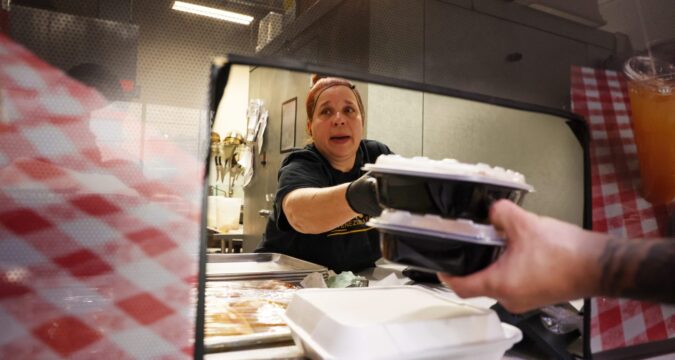
Yvette Hernandez, right, serves food to Nataly Silva, left, and Crispina Gil, center, at her restaurant, Carato’s Venezuelan Restaurant, on Jan. 8, 2026, in Roselle. (Stacey Wescott/Chicago Tribune)
Many now feel up against a wall, safe neither here nor there.
“People are afraid to stay and people are afraid to return,” said Ana Gil, founder of the Illinois Venezuelan Alliance. She said Maduro’s capture has further destabilized the country. Because of that instability, many Venezuelans in the Chicago area do not feel safe returning home, but also fear detention and deportation in the U.S.
The uncertainty comes as the Trump administration has launched mass deportation actions across the country, including the fall’s Operation Midway Blitz in the Chicago area that saw more than 4,300 people arrested, with Venezuelans among those. On Wednesday, Immigration and Customs Enforcement shot and killed a U.S. citizen in Minneapolis as it expands increasingly dangerous enforcement across the country. And Thursday, Border Patrol officers shot and injured two people from Venezuela in Portland, Oregon, during a targeted operation.
“People have seen the way ICE has treated Venezuelan migrants, even if they have an asylum case. People are afraid of being tortured inside detention centers or of being deported to other countries,” Gil said.
Luciano Pedota, also a member of the Illinois Venezuelan Alliance, said that although he rejoiced when he heard about Maduro’s capture, he is concerned over his compatriots who recently lost temporary protected status, which provided a job permit and protection from deportation.
After a back-and-forth under the Biden administration, which extended TPS to Venezuelans first in 2021 and again in 2023, the U.S. Supreme Court last year allowed the Trump administration to cancel TPS protections for roughly 350,000 Venezuelan immigrants.
Some have likely applied for asylum, a yearslong process, but if the Trump administration can argue that conditions have improved in Venezuela, experts say it could set the stage for asylum cases to be rejected, putting them in line for deportation, something that was already happening during court check-ins and interview appointments.
Angelika Charczuk, an attorney at ADC Immigration Law, called it the “million-dollar question” on how conditions in Venezuela will affect the asylum cases of her clients from the country. She’s already bracing for the government arguing a “fundamental change in country conditions,” which she said would likely decrease the merits of someone deserving refuge in the United States.
After more than five years in Chicago under TPS, Luis Jose Castro decided to return to Venezuela. Without protection and with little hope of obtaining asylum, he felt trapped. He also longed to see his two children and his parents who live there.
More than anything, he said, he wants to see his ailing father.
“It’s not worth it (staying here), I feel persecuted and I have never felt persecuted in my life,” Castro said of immigration enforcement.
Luis Jose Castro stands outside of his office along West 26th Street in Chicago on Jan. 9, 2026. Castro is from Puerto La Cruz, Venezuela. (Stacey Wescott/Chicago Tribune)
After arriving in Chicago, Castro worked as a construction worker before becoming a paralegal, helping thousands of recently arrived migrants assess their legal cases and apply for asylum.
On Jan. 27, Castro, an attorney by trade, plans to board a plane with a one-way ticket, hoping to take part in the creation of a new democracy in his country.
“Venezuela needs us more than ever,” Castro said.
Though there is uncertainty about who will lead, how change will come or when it will happen in Venezuela, he believes the U.S. and Venezuela will eventually establish a strong diplomatic relationship that will benefit those who remain in the U.S., those who return home and those already living there.
After all, his wife and son have chosen to remain in Chicago.
Mary Meg McCarthy, executive director of the National Immigrant Justice Center, said her team and other immigrant rights advocates are trying to gauge what the capture of Maduro, and the Trump administration’s attempt to take over running the country, means for migrants’ access to protection in the United States.
But “the resulting chaos and Venezuela’s governmental instability should strengthen existing claims for protection, despite the Trump administration’s repeated attempts to railroad people’s access to asylum and other legal status,” McCarthy said.
“It is apparent that the U.S. government has no plan to ensure human rights protections for Venezuelans who will be directly impacted by the fallout of the Trump administration’s removal of President Maduro,” she added.
NIJC has provided immigration legal services to hundreds of Venezuelans who arrived in the Chicago area since August 2022, when Texas Gov. Greg Abbott started busing immigrants to Chicago.
Carmen is one of about 50,000 Venezuelans who came to Chicago in those years. She and her family crossed the perilous Darien Gap, a strip of land dividing Colombia and Panama that has become a dangerous crossing point for migrants seeking asylum in the U.S. She declined to use her last name for the article because she feared immigration enforcement.
Back home in Venezuela, her children were frequently denied school access because there were not enough teachers; they had fled the country, Carmen said. Some mothers would let their children sleep until noon because they could only afford to feed them once a day, she said.
When she first heard about Maduro’s capture by the Trump administration in her native Venezuela last week, she ran to the bathroom. Her hands were shaking and she was overwhelmed with mixed feelings of anxiety and happiness.
“We felt it would be the end of so much suffering after so many years and so many things that only we, the Venezuelans who lived through it, know,” said Carmen, 41, who lives on Chicago’s South Side.
Now, after Maduro’s capture, Carmen sees a “light at the end of the tunnel” for those in her home country. But a sense of unease overshadows it.
Her husband was arrested in October while selling arepas, and after his release weeks later, the couple decided to stop selling out of fear of immigration enforcement activities. And as her asylum case remains pending, she fears deportation where she could face retaliation in her home country.
“Everything is mixed up right now,” she said in Spanish. “We came here, have freedom of expression … and now they’re deporting us.”
Advocates are urging Congress to step in. They are calling for the immediate reinstatement of TPS to restore legal protection and work authorization for nearly 600,000 Venezuelans currently living in the United States.
Until meaningful change happens in Venezuela, said Gil of the Illinois Venezuelan Alliance, protecting the Venezuelan diaspora is not just an immigration issue, it is a matter of safety and human rights.
Gil arrived in Chicago about a decade ago. There were only two Venezuelan restaurants in the city, she recalled. At the time, a small but growing group slowly established a community on the North Side.
“They used to call it ‘Buenazuela,’” Gil said. It was near West Buena Avenue and North Broadway.
Those who first arrived came by plane with visas and eventually requested asylum, fleeing political persecution, she said.
By 2017, more than 6,000 people attended a meeting that Gil organized to discuss their role in the elections in their home country. That was when she founded the Illinois Venezuelan Alliance, an organization created to provide humanitarian aid to those in need in their home country and that now provides guidance and resources to those who recently arrived.
In Illinois, Venezuelan culture and its influence have now expanded to include a number of restaurants, food stands, artists and traditional celebrations across the city, Gil said. The population particularly skyrocketed after thousands of Venezuelan migrants arrived in the city during President Joe Biden’s administration, most of them bused to the city in 2022.
Many of them made a home on the city’s South Side, where they were given housing through city and state programs after shelters were closed. Over the last year, nearly 20,000 babies were born to Venezuelan immigrants, according to the census.
“That means that the Venezuelan community and its culture will only keep growing in the city for years to come,” Gil said.
https://www.chicagotribune.com/2026/01/11/venezuela-chicago-maduro-immigration/

Today in History: Mark McGwire admits that he used steroids
Today is Sunday, Jan. 11, the 11th day of 2026. There are 354 days left in the year.
Today in history:
On Jan. 11, 2010, Mark McGwire admits that he’d used steroids and human growth hormone when he broke baseball’s home run record in 1998.
Also on this date:
In 1861, Alabama became the fourth state to declare its secession from the Union.
In 1908, the Grand Canyon was established as a national monument by President Theodore Roosevelt. The move protected it from mining and other activities until it became a national park in 1919.
In 1935, aviator Amelia Earhart began what would be the first solo flight from Hawaii to California, completing the 2,400-mile flight across the Pacific to Oakland in just under 19 hours.
In 1964, U.S. Surgeon General Luther Terry issued “Smoking and Health,” a report that concluded that “cigarette smoking contributes substantially to mortality from certain specific diseases and to the overall death rate.”
In 2002, the first al-Qaida prisoners from Afghanistan arrived at the U.S. military’s Guantanamo Bay detention camp in Cuba.
In 2021, House Democrats introduced an article of impeachment against President Donald Trump, charging him with “incitement of insurrection” after the attack on the U.S. Capitol building five days earlier.
Related Articles
Vintage Chicago Tribune: Bears playoff appearances — including the ‘Sneakers Game,’ ‘Fog Bowl’ and ‘Double Doink’
Treasures preserved from historic Crown Point church after demolition
Today in Chicago History: At minus 26 degrees, the city was colder than Hell (Mich.)
Today in History: President Barack Obama deliveres his farewell address in Chicago
Today in Chicago History: ‘McCaskey, you’re a bum!’ The coin flip that cost the Bears Terry Bradshaw.
In 2024, U.S. and British forces bombed more than dozen sites used by the Iranian-backed Houthis in Yemen, in a massive retaliatory strike for the militant group’s attacks on international cargo ships and other targets in the Red Sea.
Today’s birthdays: Filmmaker Alfonso Arau is 94. Golf Hall of Famer Ben Crenshaw is 74. Jazz guitarist Lee Ritenour is 74. Olympic swimming gold medalist Tracy Caulkins is 63. Filmmaker Malcolm D. Lee is 56. Singer Mary J. Blige is 55. Actor Amanda Peet is 54. Actor Devin Ratray is 49. Actor Aja Naomi King is 41. Singer and former competitive swimmer Cody Simpson is 29.
https://www.chicagotribune.com/2026/01/11/today-in-history-mark-mcgwire/
Today in Chicago History: Columnist Mike Royko moves to the Tribune
Here’s a look back at what happened in the Chicago area on Jan. 11, according to the Tribune’s archives.
Is an important event missing from this date? Email us.
Front page flashback: Jan. 11, 2003
Outgoing Gov. George Ryan on Jan. 11, 2003, commuted the sentence of every inmate on death row in Illinois. (Chicago Tribune)
2003: Two days before leaving office, Illinois Gov. George Ryan commuted the sentences of 164 death row inmates to life in prison without parole, citing a system “haunted by the demon of error.” Ryan pardoned four death row inmates, resulting in the release of three. Another three death row inmates had their sentences shortened to 40-year terms. The actions took 167 people off death row.
Weather records (from the National Weather Service, Chicago)
High temperature: 61 degrees (1880)
Low temperature: Minus 11 degrees (1977)
Precipitation: 0.64 inches (1918)
Snowfall: 5.9 inches (2011)
1895: Purdue University President James H. Smart and leaders from the University of Chicago, University of Illinois, University of Michigan, University of Minnesota, Northwestern University and University of Wisconsin met at the Palmer House to develop rules for the regulation of intercollegiate athletics.
Chicago Bears owner George Halas and George Allen, the Bears defensive coordinator and personnel director, selected Mike Ditka with the fifth pick in the 1961 draft. Even though Ditka was mostly a blocker at Pittsburgh, Halas and offensive coordinator Luke Johnsos had an audacious plan. Ditka would become the first tight end to affect the receiving and rushing games equally. (Chicago Tribune)
1961: University of Pittsburgh All-American Mike Ditka signed a contract to play for George Halas and the Chicago Bears.
The Bears got Ditka in the first round of the NFL draft after winning a coin toss with the Pittsburgh Steelers, who tied them in the league standings. (The Bears and Steelers also tied in 1970 and had to settle for another coin toss. The Bears lost that one, which meant the Steelers chose quarterback Terry Bradshaw.)
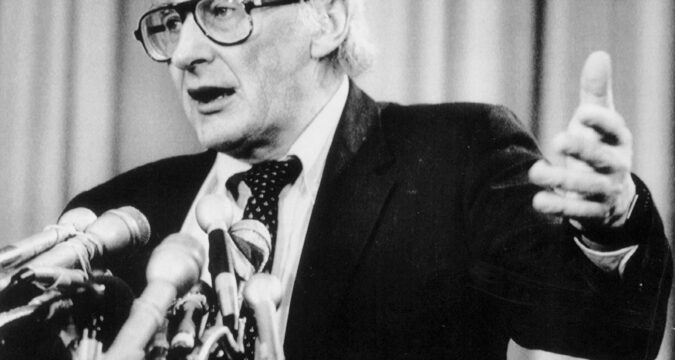
Newly signed Chicago Tribune columnist Mike Royko holds a news conference at Tribune Tower on Jan. 10, 1984. Royko said he signed a contract with the Tribune because, “Mr. Murdoch doesn’t own this paper.” (James Mayo/Chicago Tribune)
1984: Mike Royko brought his column to the Tribune. Read it here.
Take a look back at Mike Royko’s Chicago Tribune columns on the 25th anniversary of his death
Want more vintage Chicago?
Subscribe to the free Vintage Chicago Tribune newsletter, join our Chicagoland history Facebook group, stay current with Today in Chicago History and follow us on Instagram for more from Chicago’s past.
Have an idea for Vintage Chicago Tribune? Share it with Kori Rumore and Marianne Mather at krumore@chicagotribune.com and mmather@chicagotribune.com
https://www.chicagotribune.com/2026/01/11/january-11-chicago-history/
Chicago Bears LB T.J. Edwards and LT Ozzy Trapilo will miss remainder of the playoffs, coach Ben Johnson says
The Chicago Bears will be down two starters for the remainder of the postseason.
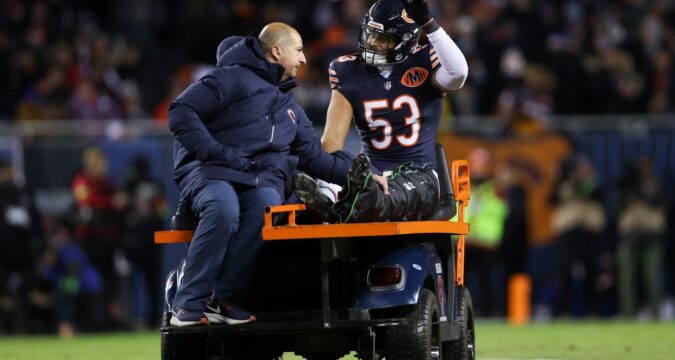
Linebacker T.J. Edwards and left tackle Ozzy Trapilo are likely both done for the remainder of the postseason, coach Ben Johnson said after Saturday’s comeback victory against the Green Bay Packers.
Johnson said Edwards suffered a left fibula fracture and Trapilo a patella tendon injury in his knee. Both would need further testing Sunday to confirm the severity of the injuries.
“Doesn’t look good for either one of them,” Johnson said.
Edwards, a Lake Villa native, was carted off with an air cast on his left leg in the first half. Backup linebacker D’Marco Jackson filled in for Edwards for the remainder of the game. Edwards appeared to step on a Packers player’s foot, and his left leg bent awkwardly.
Edwards played in 10 games this season, missing several while dealing with soft-tissue injuries. The Bears gave him a contract extension before the season.
“Praying for those guys,” linebacker Tremaine Edmunds said. “My partner in crime, T.J., definitely praying for him.”
Trapilo, a 2025 second-round draft pick, injured his knee on the final offensive possession of the night. He hobbled off to the side on his own, saving the Bears from having to use a timeout in the final two minutes of the game. The Bears quickly inserted Theo Benedet into the game at left tackle.
“Obviously it’s a bit of a whirlwind,” Benedet said after the game. “So much credit to Ozzy for getting off the field there. From a young player like that to have the awareness of the situation with obviously more than a bump. So just so impressed by him for that. I just ran out there and did my job.”
Trapilo appeared in 14 games this season with six starts at left tackle. He became a starter late in the year after replacing Benedet, who started eight games during the regular season.
https://www.chicagotribune.com/2026/01/11/chicago-bears-tj-edwards-ozzy-trapilo/

How the Chicago Bears pulled off another improbable comeback win to KO the Green Bay Packers from the playoffs
The comeback started at halftime.
No, back it up. Hit rewind. This comeback started six months ago.
That’s true of the Chicago Bears’ 31-27 win over the Green Bay Packers on Saturday night in the wild-card round of the playoffs. But Saturday’s 18-point comeback represented so much more than one victory.
Playoff recap: Chicago Bears pull off another 4th-quarter rally to beat Green Bay Packers 31-27
All that talk of a 15-year drought between playoff victories? It’s history now. The anguish of the Bears-Packers rivalry, one that a little over a year ago featured 11 straight Packers wins? Saturday didn’t erase all those losses, but something has changed unquestionably.
These Bears, these comeback kids with their fiery young coach, are rewriting the story.
How does a team become the comeback kings of the NFL with six fourth-quarter comebacks in the regular season? How does a franchise vanquish its archrival in a playoff game after trailing by 18 points at halftime to earn its first postseason victory in 15 years?
It doesn’t start with the halftime speech. It doesn’t start with one big play. There’s no switch to flip.
For this team, it started in training camp when first-year coach Ben Johnson showed his team the footage from Super Bowl LI, when the New England Patriots erased a 28-3 second-half deficit against the Atlanta Falcons.
The Bears added two key veterans over the offseason who emerged as team leaders and captains. That would be guard Joe Thuney and defensive tackle Grady Jarrett. Both played in Super Bowl LI — Thuney for the New England Patriots and Jarrett for the Atlanta Falcons. Johnson saw an opportunity to gain insight from two players who lived on both sides of the greatest Super Bowl comeback of all time.
“It was just great to get perspective from both of those players of how that game went down,” Johnson said. “It’s just a good lesson to be learned, that it’s 28-3 in the middle of the third quarter and still the game’s being played and there’s a lot of time left left.”
Bears receiver DJ Moore (2) celebrates with teammates after catching a touchdown pass in the fourth quarter against the Packers on Jan. 10, 2026, at Soldier Field. (Chris Sweda/Chicago Tribune)
There was a lot of time left when the Bears went into the locker room Saturday night down 21-3 at halftime against the hated Packers. There was, however, also no panic.
What did Johnson say in that moment?
“That we’re going to have the greatest comeback in Bears history,” tight end Cole Kmet said. “And then we did.”
Added receiver Rome Odunze: “I remember him just saying we’ve been here before. This might be one of the best comebacks in Bears history if we go pull this off.”
In Johnson’s own words, he told his team: “This is a great opportunity to turn this thing around into a game we’ll never forget.”
Nobody will forget Saturday night.
The Bears defense made a stop to start the third quarter, forcing the first punt of the game. That was all the spark the Bears needed. There was a glimmer of hope.
The Bears trailed 21-3 at halftime, 21-6 heading into the fourth quarter and 27-16 with the clock ticking under five minutes. These Bears had been here so many times before. They’d won games on last-second field goals and walk-off touchdowns. They’d converted an onside kick and had one converted against them in the waning minutes of games.
This was nothing new.
“When you’ve done it before, you know it’s possible,” right tackle Darnell Wright said.
Added Kmet: “We don’t want to keep doing it like this, but if this is how we have to do it, it is what it is.”
The defense forced four consecutive punts to start the second half. Little by little, the Bears put points on the board. An 8-yard touchdown pass from quarterback Caleb Williams to receiver Olamide Zaccheaus pulled the Bears within three points with about four minutes to go.
Jordan Love and the Packers countered, driving into Bears territory before the defense stopped them. When Packers kicker Brandon McManus missed a 44-yard field-goal try, the Bears took over with 2:51 remaining in the game.
Williams and the offense stepped onto the field knowing this was their chance. Williams connected with tight end Colston Loveland — who was a workhorse all night with eight catches for 137 yards — for a 12-yard gain. Running back D’Andre Swift picked up 6 yards with a run, then 23 yards on a pass from Williams on third down.
That set up a first down at the 25-yard line, and the Bears faked a screen pass to rookie receiver Luther Burden. It was enough to get the cornerback to bite, leaving DJ Moore wide open over the top. Williams wasn’t missing that pass.
Just like it was a few weeks ago in a come-from-behind win over the Packers on Dec. 20 at Soldier Field, it was Moore scoring the game-winning touchdown again Saturday night.
“They all triggered to Luther on the fake screen, and we were gone from there,” Moore said.
With 1:43 still on the clock, the Bears needed one more stop from their defense. Love moved the Packers downfield, converting on a fourth-down try with about a minute remaining and working their way into Bears territory.
Bears quarterback Caleb Williams celebrates after a victory over the Packers in an NFC wild-card game Saturday, Jan. 10, 2026, at Soldier Field. (Chris Sweda/Chicago Tribune)
With seven seconds on the clock, Love bobbled a snap and then bounced around the pocket seemingly forever before unleashing a last-ditch effort toward the end zone. The ball fell incomplete on the grass, and Soldier Field erupted into pandemonium. Bears players ran in all directions. The crowd shook.
“It was like a movie,” Moore said. “Literally.”
“Pure thrill,” Thuney said.
“The only thing I remember is the crowd going crazy,” linebacker Tremaine Edmunds said. “I think I took my helmet off and threw it somewhere. It was crazy just knowing that we did it.”
In his postgame victory speech, the ones that have become appointment viewing after Bears games, Johnson opened with “(expletive) the Packers, man!” Not in a long time had a Bears coach said something so relatable to fans.
Reflecting after the game, Johnson thought back on when he showed his team that Patriots comeback in the Super Bowl. His players clearly took that message to heart.
Months later, the Bears are living in their own comeback.
“It’s who those guys are now at this point,” Johnson said. “We’ve got a group of guys that just — they don’t waver.”
https://www.chicagotribune.com/2026/01/11/chicago-bears-green-bay-packers-comeback/


