Category: News

Beijing Boosts BeiDou Satellite System To Try And Compete With GPS
Beijing Boosts BeiDou Satellite System To Try And Compete With GPS
China is upgrading its BeiDou satellite navigation system, a domestic alternative to GPS, to expand its global reach and industry use, according to South China Morning Post.
The plan involves replacing older satellites with newer third-generation models and adjusting their orbits to improve worldwide coverage. The system will be streamlined from 50 to 37 active satellites, most operating in medium Earth orbit like GPS and Europe’s Galileo.
A few satellites will remain in specialized orbits to improve signal reliability in certain regions, including areas linked to China’s Belt and Road Initiative. The upgraded network will mainly use newer BDS-3 satellites, which are more accurate and advanced, while older BDS-2 units will be retired.
The SCMP writes that China also aims to boost international adoption of BeiDou, especially in Belt and Road countries where it’s already used in shipping, agriculture, and transport.
The upgrade supports a broader strategy to integrate space, air, and ground systems and expand satellite technology across industries. Officials expect BeiDou’s value to reach about $145 billion within five years.
In addition, the overhaul is designed to make the system more efficient by reducing the total number of satellites while improving overall performance. By focusing on newer technology and better orbital positioning, China hopes to deliver more reliable global coverage with fewer resources. The remaining unused slots in the network also leave room for future expansion and technological upgrades.
The move reflects China’s long-term goal of reducing reliance on Western navigation systems and strengthening its technological independence. By improving accuracy, coverage, and international partnerships, Beijing is positioning BeiDou as a competitive global alternative, particularly in developing regions where infrastructure projects are already closely tied to Chinese investment.
Tyler Durden
Fri, 04/17/2026 – 22:10
https://www.zerohedge.com/markets/beijing-boosts-beidou-satellite-system-try-and-compete-gps

Ditch The Sanitizer And Exercise Your Immune System
Ditch The Sanitizer And Exercise Your Immune System
Authored by Joel Salatin via The Epoch Times,
Bugs, viruses, and sickness—these maladies creep into countless conversations as people wrestle with the question: How do I strengthen my immune system?
The overriding answer from the conventional pharmaceutical and vaccine industry is that functional wellness comes from a pill, a needle, or some kind of medical treatment. As a farmer with thousands of animals and no vet bills, I can attest that the overriding conventional notion in the livestock industry is that a sick animal is apparently pharmaceutically disadvantaged.
I have a completely opposite paradigm: A sick animal testifies to my own mistakes. Maybe I chose weak seedstock. Over many decades of livestock farming, I’ve had half a dozen economically significant sickness outbreaks across various species. Every single time, the problem was my fault. Hygiene, diet, stress, discomfort, and toxins. An animal can get sick for many reasons, none of which is because it was medically deprived.
That brings me to people.
In his iconic New York Times bestseller “Guns, Germs, and Steel,” Jared Diamond explains the ascendancy of cultures that lived proximate to domestic livestock.
People groups who cultivated close relationships with domestic farm animals developed better immune systems.
Many years ago, British epidemiologist David Strachan observed that children with more older siblings had fewer allergies, suggesting that early exposure to infections offered lasting protection.
Many in this field of study rallied around this “hygiene hypothesis,” positing that the immune system is like a muscle and needs periodic exercise to be strong.
Consistent with Diamond’s overall findings, this theory is best supported by research in Finland.
Beginning a couple of decades ago, researchers in Finland began examining this “immune system as muscle” concept, comparing overall health between closely related children (cousins or siblings) who lived in different environments. The findings added substantial weight to the notion that the immune system has attributes similar to a muscle.
Children who grew up on farms and went to the barn as toddlers—and you know what a toddler does to everything on the fingers—were far more robust than their urban counterparts. A little bit of manure, dirt, and moldy hay or grain stimulated the immune system and reduced vulnerability to colds, flu, and other common childhood maladies.
Now for personal disclosure: Friends who know me know I routinely drink out of cow troughs with the cows. I do it not because I’m thirsty, but because I want a bigger variety of bugs in my microbiome. And I want some exposure to whatever unseen antagonist might be out there. The point is to exercise my immune system so that when something really serious comes along, it’s strong enough to fight it off.
Yes, I could die tomorrow. But for decades, I have gone many years without the common issues that plague most folks. That is not pride; it is humble acknowledgment that we have a fearfully and wonderfully made body that is ready to house health if we give it half a chance.
When I get on an airplane and the flight attendant stands there with a basket of antimicrobial sanitation cloths, I smile, lean over, and graciously say: “No, thank you; I really want your bugs.” That always gets a quizzical look and no doubt attendant conversations in the galley: “Do you see that weirdo over there? He wants my bugs.”
On a recent flight, a couple took seats A and B; I was in C, on the aisle. Wearing masks, they sat down and immediately brought out sanitation wipes. Meal trays, the back of the seat, and armrests—everything received a thorough wipe-down. Then she offered her rags to me, and I said: “No, thank you, ma’am, I really want to breathe in your bugs.” The mask hid what must have been a horrified countenance.
As soon as we were airborne, out came the snacks. Pringles, Twizzlers, Reese’s Pieces, soft drinks—I think they had an entire supermarket snack aisle in their bulky carry-on bag. I watched them chow down on all this junk for an hour. At hour two (it was a three-hour flight), they rang the call button. I wondered what that was all about.
“We’re having sugar issues; can you please bring us some apple juice?”
Are you kidding me?
Sterilizing everything and then consuming sugar and artificials, my overriding thought was: “And these people vote.”
Eating junk and bug paranoia are a recipe for immunological malfunction, but we see this kind of dystopian activity far too often.
Fortunately, the word seems to be getting around that muscle-equivalent immunology is real. New moms taking their toddlers to petting zoos and dirt piles appear to be the new mania in the infant wellness field. This is a healthy change and a trend that could yield many benefits.
If any savvy entrepreneurs have stayed with me in this column this long, here is my suggestion for a million-dollar business: Sell compost-and-dirt-infused permeable mats to urbanites yearning for robust immune function. It could be a subscription service where someone would come every four months and dump out the old compost and dirt and fill the mat with new material. It could be a welcome mat or perhaps even a mat you’d step on when exiting the shower to get all these goodies on your bare feet.
I’m sure someone is smart enough to figure out how to get the country to the city. To be sure, I’m not suggesting we go back to open sewers and no refrigeration. I am suggesting that humanity can become too sterile. Our multi-billion-member microbiome is not sterile, and the No. 1 measure of vibrancy is microbial diversity in the gut. You don’t need to pay me a commission for the idea; just brand it and run with it.
When we eat real food, unprocessed, we receive that microbial variety, and our immune system enjoys some exercise. As a techno-sophisticated society, we have become too sterile, and our immune systems suffer as a result. Let’s get back outside, in our gardens, in the dirt, share some bugs, and enjoy exercising our immune systems. At least go visit a farm. That’s a better approach than holding back our immune system while relying on needles and pills as a crutch to hold up the body’s atrophy, don’t you think?
Views expressed in this article are opinions of the author and do not necessarily reflect the views of The Epoch Times.
Tyler Durden
Fri, 04/17/2026 – 21:45
https://www.zerohedge.com/medical/ditch-sanitizer-and-exercise-your-immune-system
Brave New Autonomous World Takes Shape On America’s Highways
Brave New Autonomous World Takes Shape On America’s Highways
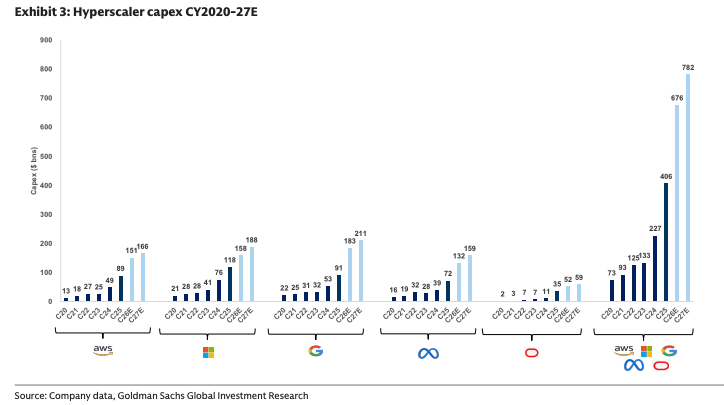
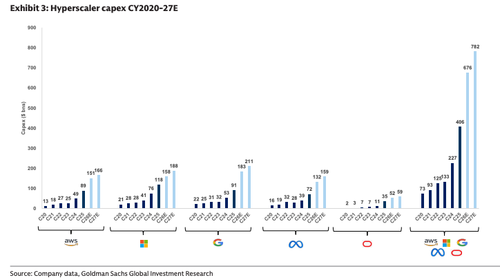
Wall Street remains hyper-focused on whether the hyperscalers’ AI-driven data center buildout, now approaching $700 billion and roughly 10 times 2020 levels, will ultimately generate enough returns to justify the massive spending boom.
Goldman analysts, led by Mark Delaney, focused on the “impact of AI on profit pools” and, more specifically, on the incremental profit AI-enabled initiatives in the transportation space could ultimately generate.
The good news is that nearly a year after Delaney’s June 2025 note to clients, his team found that the “pace of autonomous technology commercialization has accelerateProfits of Autonomous Mobility,” driven largely by expanding vehicle deployments in the U.S. and China, as well as rollouts in Europe.
“These deployments are enabled by both captive technology development (e.g. at Waymo, Tesla, Pony AI, etc.) and a growing set of merchant Physical AI tools, including from companies such as Nvidia (e.g. Alpamayo),” Delaney said.
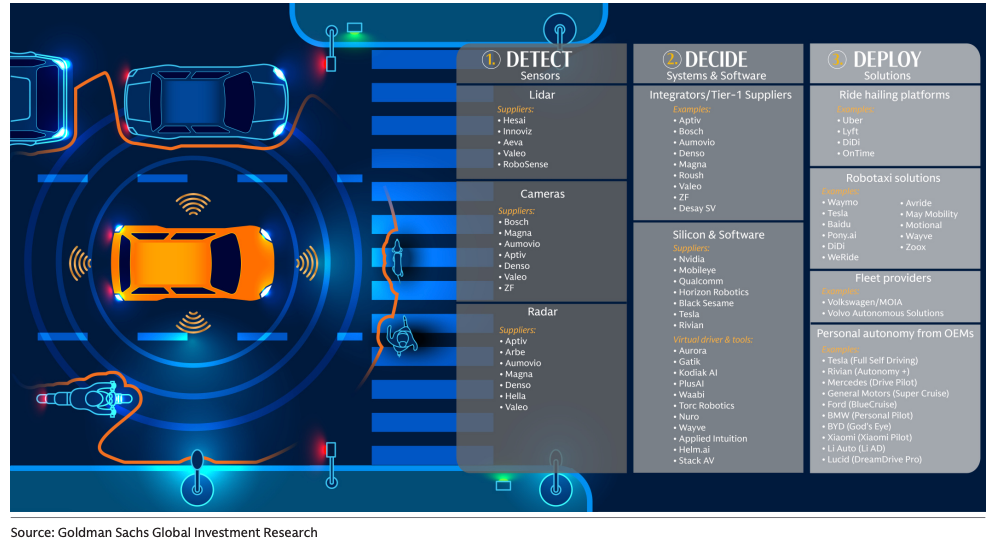
The autonomous ecosystem
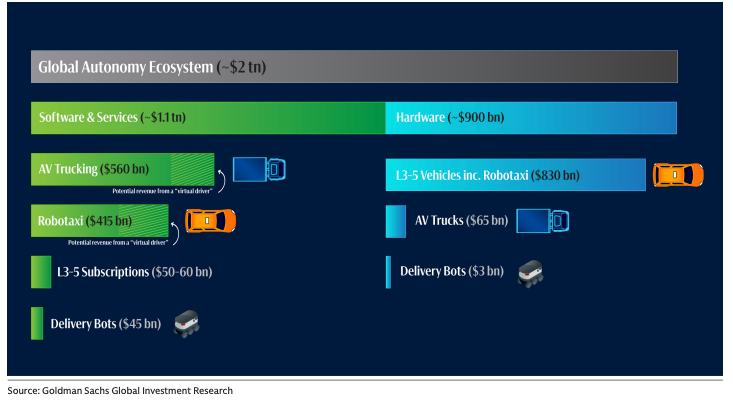
Potential global autonomy ecosystem market size in 2035
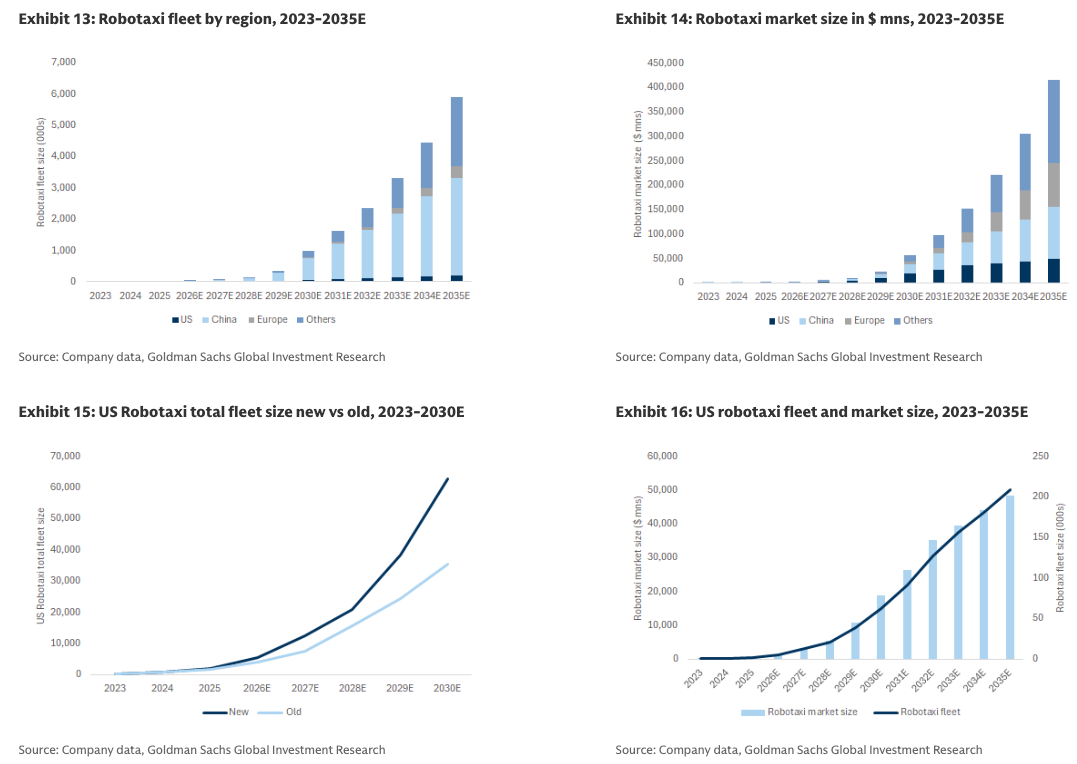
Delaney’s new estimate for the U.S. robotaxi market is set to top $19 billion by 2030, up from a prior $7 billion forecast, and continue rising to $48 billion by 2035.
How the analyst’s forecast shifted in just one year:
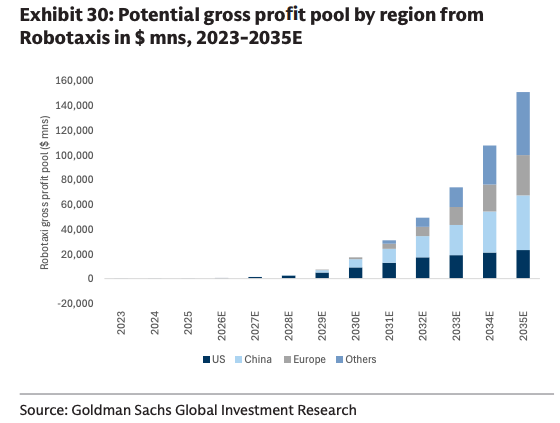
His team expects the global robotaxi market could reach $415 billion by 2035, with vertically integrated operators potentially generating gross margins of 30% to 50% and approximately $150 billion in gross profit by 20235.
Even though the rollout of AVs will unfold over a decade rather than all at once, the analyst still warned that the proliferation of these robotaxis will be highly disruptive to “existing markets in the long term.”
Delaney offered color on the incoming disruption, and it is something Uber and Lyft drivers should be paying close attention to, because over the coming years, their livelihoods could increasingly come under pressure as consumers gravitate toward cheaper rides from robotaxis.
In a worst-case scenario, taxi medallion holders and others will likely become increasingly infuriated by the emergence of these robotaxis.
Here’s more from the analyst about the disruption:
While a portion of AV volumes will likely be incremental demand (e.g. as new use cases become affordable or possible), we believe autonomy could also disrupt existing markets in the long-term. We frame risks and scenarios including to human-operated rideshare/taxis, trucking, and light vehicle unit sales in the United States in this report. We estimate the economic size that could potentially be disrupted in the US is ~$440 bn. This is comprised of wages for taxi/chauffeur/shuttle, delivery and truck drivers per BLS data, an estimate for the share of bookings from rideshare allocated to drivers, and how much auto sales could decline in a scenario where personal transport demand is served only by AV rideshare.
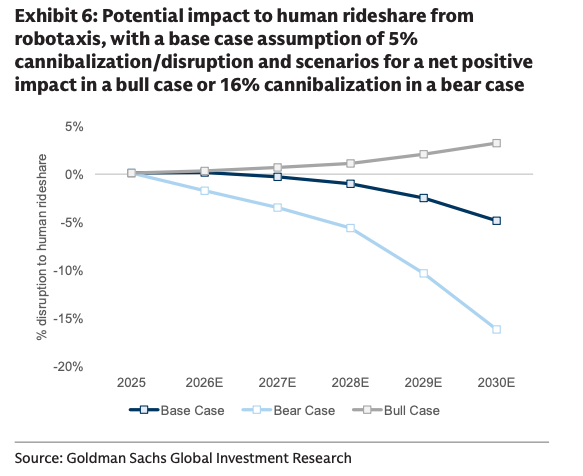
There are already signs of change, with Waymo’s share in SF reaching 30%, 20 months after being fully launched (per Yipit), and our base case view is for 5% cannibalization of UCAN rideshare gross bookings from AVs (and 16% in a bear case) by 2030.
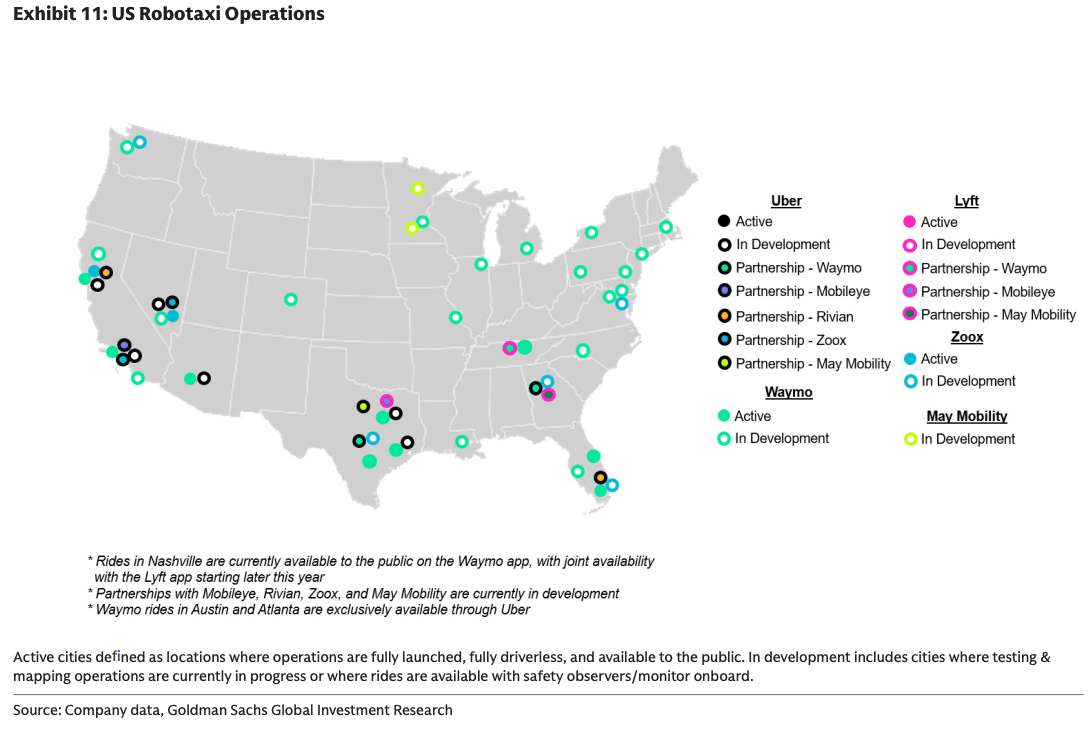
Here are the current robotaxi deployments across America:
Google searches already show consumer interest.
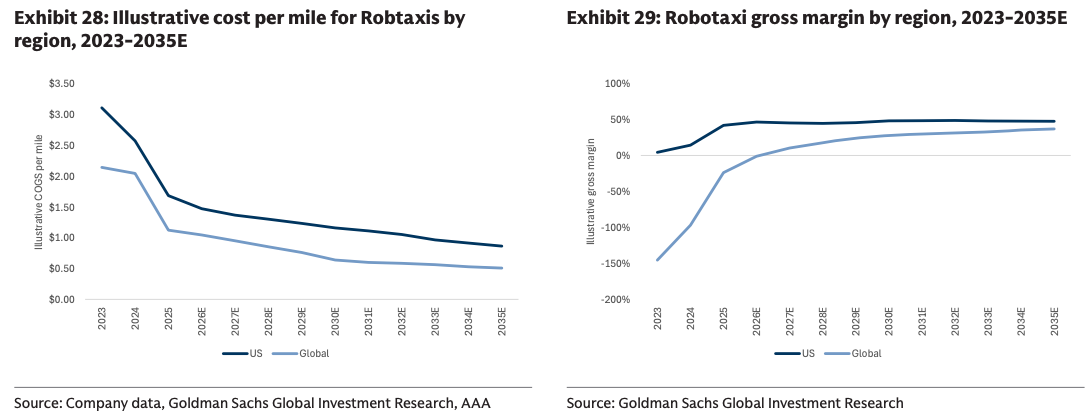
AV profitability is improving:
Profitability surges in 2030s
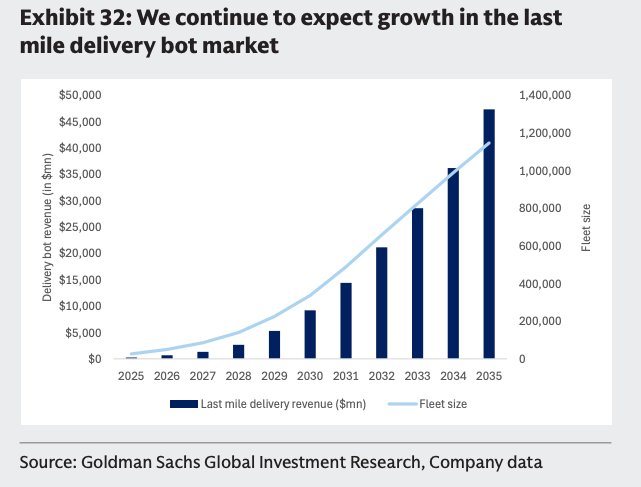
The proliferation of AVs will not just be limited to robotaxis. Delaney expects the last-mile delivery bot market to explode in the early 2030s.
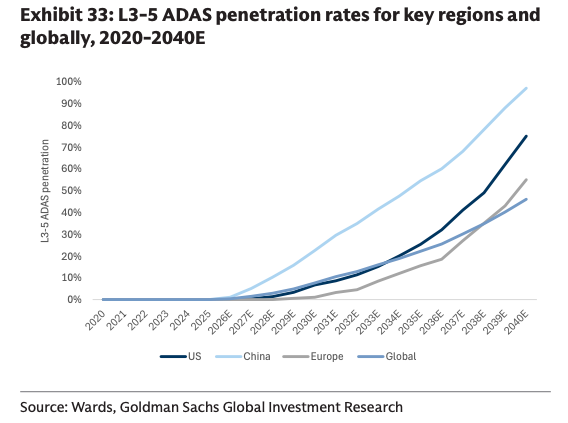
Beyond AVs, Delaney expects penetration rates for vehicles with autonomous capabilities to begin to soar worldwide by the early 2030s.
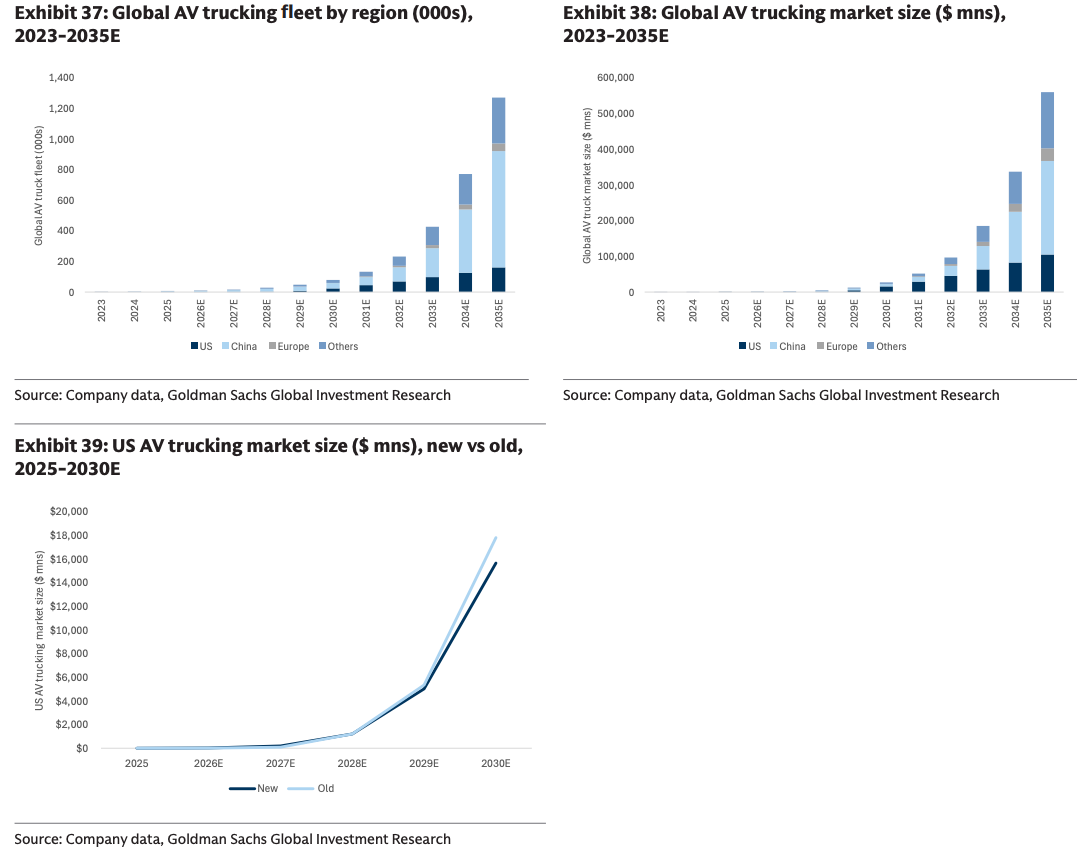
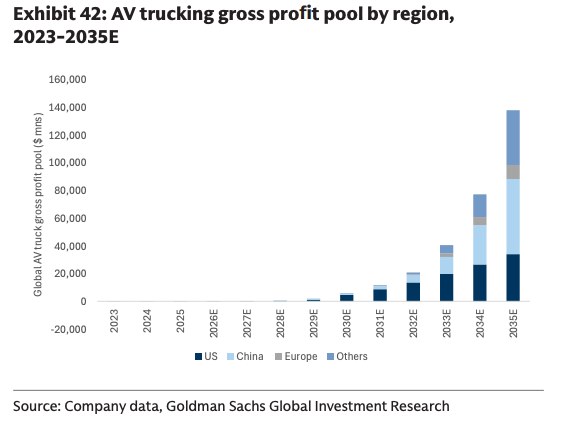
In addition to robotaxis, Delaney expects autonomous trucking to become another major profit pool, forecasting the U.S. Class 8 AV trucking market at $16 billion by 2030 and $105 billion by 2035, with the global market reaching about $560 billion in 2035. Gross profit from AV trucking could top $135 billion in 2035 and around $300 billion cumulatively over the next decade.
He noted that AV trucking companies across North America, including Aurora, Kodiak, Waabi, and Plus, are set to rapidly expand their fleets in the coming years.
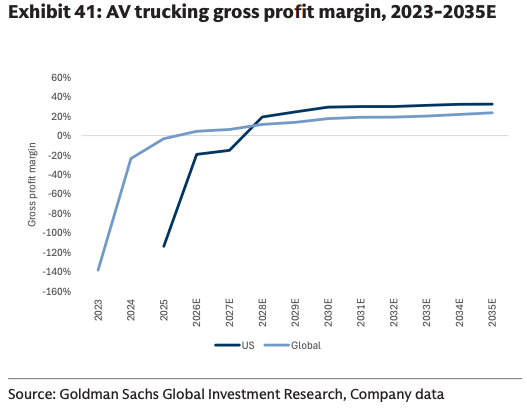
AV trucking costs per mile are set to collapse by the end of the decade and remain range-bound around the $2-per-mile mark by the midpoint of the next decade.
Profitability for AV trucking will be a story in several years.
“Overall, we expect these improving cost dynamics and scaling up of the AV trucking fleet to drive an increase in the global gross profit pool for AV trucking from close to zero in 2025 to ~$135 bn in 2035,” the analyst noted.
What’s clear is that America’s highways, as well as those in many other developed countries, are set to be flooded by AVs. Fleets are already operating, but real scaling begins next year. This will disrupt workers ranging from taxi drivers to delivery drivers and even truckers.
In equities, Goldman highlighted Alphabet, Tesla, Uber, Aurora, Amazon, Pony.ai, Rivian, Mobileye, Lyft, TE Connectivity, Hesai, XPeng, and Volvo Group as beneficiaries of AV deployment.
There’s a lot more in the Goldman note titled “Analyzing the Impact of AI on Profit Pools – Part II – A Transportation Case Study.” Professional subscribers can read the full note here at our new Marketdesk.ai portal.
Tyler Durden
Fri, 04/17/2026 – 21:20
https://www.zerohedge.com/ai/brave-new-autonomous-world-takes-shape-americas-highways
“Depraved Evil”: Gay Couple Mocks Baby’s Cry For ‘Mama’ In Viral Surrogacy Video
“Depraved Evil”: Gay Couple Mocks Baby’s Cry For ‘Mama’ In Viral Surrogacy Video
Authored by Steve Watson via modernity.news,
Two gay men in Nashville recorded themselves taunting the baby they obtained through surrogacy as he cried desperately for his mother. The now viral clip has ignited fury across X.
The clip opens with one man asking the infant, “Who do you want, Dada or Pop?” The baby responds, “Mama.” The man replies, “No, there is no mama,” and the baby cries.
Two gay men in Nashville are sparking nationwide outrage after recording a video of themselves mocking the baby they had via surrogacy as it cries for its mother for content.
Man: “Who do you want, Dada or Pop?”
Baby: “Mama”
Man: “No, there is no mama.”
Baby: cries pic.twitter.com/ym3ujfdS0Q
— Right Angle News Network (@Rightanglenews) April 16, 2026
Podcaster Tim Pool reacted “This is fucking depraved evil my god.”
This is fucking depraved evil my god https://t.co/gHwBs71iPE
— Tim Pool (@Timcast) April 16, 2026
The moment exposes the raw cruelty baked into certain surrogacy arrangements: a child biologically wired to seek his mother is denied her existence while adults film his pain for likes.
The evil one moves his thumbs up to the upper part of the sternum, and positions the baby for painful stimuli, because a baby wasn’t giving him the right answer. Just watch. pic.twitter.com/P1sVvltLBi
— Jesus Sotelo Jr. (@JesusSoteloJr44) April 17, 2026
As if that wasn’t bad enough, the man left the following responses to sick comments on the video:
Gay couple shared footage of their infant son repeatedly calling out for “Mama” and began crying.
One online commenter jokingly suggested, “Throw it away and start over.”
Commenter: “Throw it away and start over.”
Shane McAnally: “😂😂😂”pic.twitter.com/jD4rSaIGkI
— The Patriot Oasis™ (@ThePatriotOasis) April 17, 2026
No mainstream outlet has rushed to cover it yet, but the clip has racked up millions of views and replies laced with raw disgust.
When the baby answered wrong. He would dig his thumbs into the baby’s chest. Painful stimuli is often used to train mammals. This person is evils for sure. pic.twitter.com/rkkt2lfs6m
— Jesus Sotelo Jr. (@JesusSoteloJr44) April 17, 2026
Babies need the physical touch of their mother. This shit just pisses me off.
— Mr. Idaho (@IDSurvivalPrep) April 17, 2026
ABSOLUTELY SICKENING. Nashville gay surrogacy couple films their crying baby screaming “MAMA!” — then laughs in her face: “There is NO mama!”
Deliberately breaking an innocent infant’s heart for social media clout.
This is demonic child abuse. Denying a baby her mother is pure… pic.twitter.com/qVVc9xTCWL
— Dr From Long Island USA (M.D) (@nycliusa) April 17, 2026
A gay couple films their baby via surrogacy crying out for “Mama,” only to laugh and tell the child: “There is no mama.”
The toddler breaks down in tears while they mock the very longing every child instinctively feels for a mother.
This isn’t parenting — it’s cruelty… https://t.co/Xn7Bq2JsHv
— Myrna 𝕏 (@GigaBeers) April 17, 2026
The post continues : “…dressed up as content. Deliberately depriving a child of a mother, then laughing at their pain for likes? Children aren’t accessories or props for adult validation. They deserve a mom and a dad, not to be bought and emotionally tormented to prove a point. My heart aches for this little boy. How is this normalized? How is surrogacy that severs a child from their biological mother still legal? We’re failing our kids. Protect children first — always.”
These reactions represent just a fraction of the firestorm. The clip has exposed how surrogacy can reduce a living child to a prop for adult validation.
The story first broke wide via independent reporting that identified the Nashville couple as country music songwriter Shane McAnally and his husband Michael Baum, who shared the video on Instagram. McAnally had previously told People magazine he pursued surrogacy despite his age because “rules” do not apply to their “non-traditional family.” The pair already has adopted twins.
This is their third surrogacy pic.twitter.com/ATvM0pBckP
— CocoB (@Coco_B_7) April 17, 2026
Critics have long warned that commercial surrogacy treats children as commodities and severs the maternal bond children instinctively crave. The baby’s cry for “Mama” shattered any illusion that two dads can simply substitute. The video arrives amid growing pushback against unchecked surrogacy practices that prioritize adult desires over child welfare.
This is the logical endpoint of a culture that celebrates “families” built on contracts rather than biology and dismisses the mother’s irreplaceable role as outdated bigotry. Leftist media and activists who champion these arrangements remain silent while everyday Americans see the footage and feel visceral revulsion.
The surrogacy industry markets babies as customizable accessories. When the product cries for the one person it was denied, the response is laughter and a camera. That is not progress. It is a betrayal of the most vulnerable.
Your support is crucial in helping us defeat mass censorship. Please consider donating via Locals or check out our unique merch. Follow us on X @ModernityNews.
Tyler Durden
Fri, 04/17/2026 – 20:55

Xi Jinping Refocuses On Taiwan With Renewed Political Outreach
Xi Jinping Refocuses On Taiwan With Renewed Political Outreach
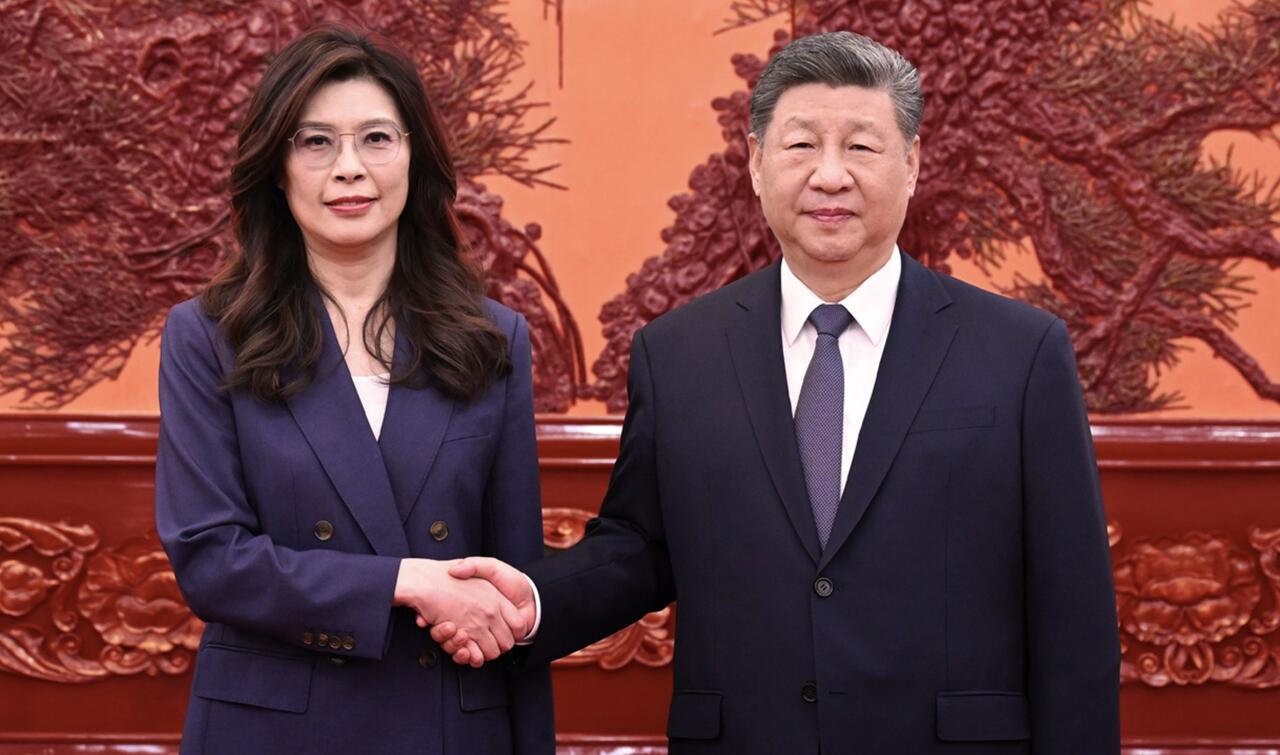
China hosted a high-profile meeting between Xi Jinping and a senior Taiwanese opposition figure from the Kuomintang (KMT), marking a notable resumption of party-to-party engagement after years of limited direct contact, according to Nikkei Asia.
The meeting was tightly choreographed, featuring an extended handshake, formal seating arrangements, and controlled media coverage. These elements were designed to convey parity and legitimacy, signaling that Beijing views engagement with Taiwan’s opposition as politically substantive.
The KMT has historically supported closer economic and political ties with mainland China under the framework of the “1992 Consensus,” which Beijing interprets as acknowledgment of “one China.” This has allowed the party to maintain communication channels with Chinese officials even when official cross-strait dialogue has broken down.
By contrast, Beijing has suspended most formal contact with Taiwan’s current government under Lai Ching-te of the Democratic Progressive Party (DPP). Chinese authorities characterize the DPP as promoting policies that move Taiwan further from eventual unification.
China continues to assert sovereignty over Taiwan and has increased pressure through military activity, including air and naval operations near the island, alongside diplomatic isolation efforts aimed at limiting Taiwan’s international space.
Within this context, the meeting reflects a broader recalibration in Xi’s Taiwan strategy. In addition to sustained military signaling, Beijing appears to be reinvesting in political engagement as a complementary tool.
Nikkei writes that outreach to the KMT provides Beijing with an avenue to influence Taiwan’s internal political discourse. It enables China to highlight divisions between major parties and to frame engagement with the mainland as both feasible and beneficial.
This approach may also be intended to shape public opinion in Taiwan, particularly by emphasizing economic cooperation and stability in contrast to the tensions associated with strained cross-strait relations under the current administration.
The timing of the meeting suggests a coordinated effort to increase Beijing’s visibility in Taiwan-related developments, with Xi taking a more direct role in signaling priorities and setting the tone for engagement.
Overall, the development indicates that Xi is refocusing attention on Taiwan, combining political outreach with ongoing military and diplomatic pressure to influence the island’s political trajectory and cross-strait relations.
Tyler Durden
Fri, 04/17/2026 – 20:30
https://www.zerohedge.com/markets/xi-jinping-refocuses-taiwan-renewed-political-outreach

More Young Men Than Young Women Now Say Religion Is ‘Very Important’ To Them, Gallup Finds
More Young Men Than Young Women Now Say Religion Is ‘Very Important’ To Them, Gallup Finds
Authored by Mark A. Kellner via The Epoch Times (emphasis ours),
Young men in the United States are more religious than young women for the first time in 25 years, according to a Gallup poll released on Thursday.
The data show that 42 percent of men aged 18 to 29 say religion is “very important” in their lives. That figure stood at 28 percent just two years ago. Young women’s attachment to religion held steady at about 30 percent during the same period.
The 14-point jump among young men represents a sharp departure from typical demographic trends. It has caught the attention, tempered with caution, of researchers who study religion in America.
“The magnitude of the jump they’re talking about [is] humongous—religious importance is up from 28 percent to 42 percent in two years. That’s not how demographics typically work,” Ryan Burge, a political scientist and statistician who studies religious trends, told The Epoch Times. “You don’t see a metric rise by 50 percent in two years.”
The Gallup findings, authored by Frank Newport and Lydia Saad, are based on biennial aggregates of religion data from 2000-2001 through 2024-2025. The 2024-2025 results draw from 4,015 U.S. adults, including 295 men and 145 women aged 18 to 29.
The reversal is confined to the youngest age group. Among adults 30 and older, women remain more religious than men.
At the start of the millennium, young women led young men by 9 percentage points on the importance of religion. That gap widened to 16 points in the early to mid-2000s before narrowing over the next decade.
By the mid-2010s, the difference had shrunk to about 5 points. The latest data mark a clear break.
The shift extends beyond attitudes about the importance of religion. The share of young men reporting monthly—or more frequent—attendance at religious services rose 7 points to 40 percent. That is the highest level since 2012-2013. Young women’s attendance rose three points to 39 percent.
Young men and young women are now statistically tied on attendance. On religious affiliation, 63 percent of young men report identifying with a faith, compared with 60 percent of young women.
Yet Burge, author of “The Vanishing Church: How the Hollowing Out of Moderate Congregations Is Hurting Democracy, Faith, and Us,” urged caution in interpreting the results. He noted that while the importance measure surged, other religious indicators did not show the same dramatic increase.
“To make the claim that now young men are coming back to religion en masse based on this one data point would be statistically inappropriate,” Burge said. “But I think it does move us closer to a preponderance of evidence that the gender gap has now clearly closed between young men and young women, and maybe possibly reversed.”
Burge described the importance-of-religion question as a “vibes metric” but perhaps not proof of religiosity.
“It’s not asking, ‘Are you religious, or do you go to church?’ But, ‘Do you think religion is important?’” Burge said. “So, are there people who never go to church who say religion is very important? They’re called conservatives.”
Gallup’s analysis points to partisan politics as a key driver. Religious attendance rose 7 points among young Republican men and 8 points among young Republican women since 2022-2023. Among young Democratic men, attendance rose 3 points. Young Democratic women showed little change.
The political dimension matters because 48 percent of young men identified as or leaned Republican in 2024-2025. Only 27 percent of young women did the same. Among young women, 60 percent identified as or leaned Democratic.
Burge said the political sorting concerns him.
“My worry is that these young men are being drawn towards church because of the politics of the church, you know, and that will only make evangelicalism and Catholicism even more conservative than it already is,” Burge said.
He argued that churches need political diversity to serve a healthy function in society.
“We need to seek out religious spaces that are diverse. I mean, but I mean moderate. I just don’t mean everyone’s a moderate. I mean for every conservative [there’s] a liberal,” Burge said. “You know, where it balances out to the middle.”
Burge said young women’s departure from religion has its own logic. He pointed to the #MeToo movement and concerns about patriarchal institutions.
“Young women are being pushed away from religion, and it has a lot to do with politics,” he said. “They’re seeing the church as being, you know, very paternalistic, very masculine, very patriarchal.”
Meanwhile, young men find institutions that still value their leadership, Burge said. Catholicism restricts the priesthood to men. Many evangelical denominations limit the roles of women.
“It kind of makes sense that young men would go one direction; young women go the other direction.”
Gallup did not immediately respond to questions about its findings.
Tyler Durden
Fri, 04/17/2026 – 20:05

Trump Turns The Screws On Israel In Biggest Pressure Move To Reign In Bibi Yet
Trump Turns The Screws On Israel In Biggest Pressure Move To Reign In Bibi Yet
The Lebanon ceasefire appears to be legitimate and holding, and the biggest evidence of this is that Lebanese citizens themselves are pouring back into the war-ravaged south of the country, seeking to recover to their homes which are in some cases ‘unlivable’.
“Thousands of families displaced by weeks of fighting filled the main highway to southern Lebanon on Friday in hopes of returning to their homes, as a 10-day cease-fire in Israel’s military campaign against Hezbollah went into effect,” writes NY Times on Friday.
This comes after the Rubio-mediated meeting between the Israel and Lebanon governments in Washington D.C. this week, which was a first in decades. However, Hezbollah was not represented and has rejected direct talks with Israel.
The situation and uneasy truce, which has for now seen Israel halt its bombing campaign over Lebanon (though dozens of airstrikes were reported in the south just on Thursday) – has been subject of some confusion and contradictory messaging.
First, Israeli Prime Minister Benjamin Netanyahu had declared that the fight with Hezbollah is not over, while at the same time confirming Israel’s agreement with the 10-day ceasefire in Lebanon.
“One hand holds a weapon; the other is extended for peace,” Netanyahu said in a fresh speech. “I will say honestly, we have not yet finished the job,” he continued. “There are things we plan to do regarding the remaining rocket threat and the drone threat, which I will not detail.”
Israel seeks to “dismantle” Hezbollah, Netanyahu continued, “but this will not be achieved tomorrow. It requires sustained effort, patience, and careful navigation in the diplomatic arena.”
President Trump meanwhile in a Friday morning Truth Social message said Israel has been “PROHIBITED” from attacking Israel by the US.
But Trump at the same time contradicted Tehran’s stance: “This deal is in no way subject to Lebanon, either, but the USA will, separately, work with Lebanon, and deal with the Hezbollah situation in an appropriate manner. Israel will not be bombing Lebanon any longer,” he wrote.
BREAKING: President Trump says Israel ‘prohibited’ by US from bombing Lebanon pic.twitter.com/wpuhtPxNV4
— Insider Paper (@TheInsiderPaper) April 17, 2026
Crucially, he added of the Israeli military: “They are PROHIBITED from doing so by the USA. Enough is enough.” The NY Times says this has put Netanyahu in a tough spot:
Now, the prime minister’s critics, and even some of his allies on the right, have seized on what appears plain as day: his inability to resist Mr. Trump’s pressure, not just in pushing to bring the long-distance war with Iran to a close but even in demanding a truce with an enemy directly across Israel’s northern border.
“A cease-fire must come from a position of strength and be an Israeli decision, reflecting leverage that serves negotiations,” said Gadi Eisenkot, a former military chief of staff whose new centrist opposition party, Yashar, is gaining in the polls. “A pattern is emerging in which cease-fires are being imposed on us — in Gaza, in Iran and now in Lebanon.”
This actually constitutes some of the toughest talk and restrictions ever imposed on Israel from this administration. This suggests the White House is indeed serious about cobbling together a final offramp.
Tyler Durden
Fri, 04/17/2026 – 19:40

Is America On The Verge Of A Nuclear Renaissance?
Is America On The Verge Of A Nuclear Renaissance?
Authored by Duggan Flanakin via WattsUpWithThat.com,
It has been more than seven years since President Donald Trump signed the Nuclear Energy Innovation and Modernization Act (NEIMA) into law – and it has taken all seven years (including four during the Biden Administration) for the Nuclear Regulatory Commission to issue a final rule implementing its provisions.
Even the Washington Post admits that the new Part 53 rules, intended to reduce review times from decades to 18 months or less, will make President Trump’s goal of revitalizing the U.S. nuclear energy industry more competitive – “to everyone’s benefit,” says the Post.
The old NRC permitting review process was built around light-water-cooled reactors (like the Westinghouse AP1000) and included prescriptive safety requirements specific to those designs – not the advanced reactors of all sizes being planned and built today.
Many nuclear companies are designing reactors that use liquid metals (like molten salt) or gases as coolants, enabling them to operate at higher temperatures. These reactors are ultimately safer than the (still very safe) water-cooled reactors, as they rely on natural forces like gravity or convection rather than pumps and motors to automatically stop the reactor in case of an incident.
The NRC says its final rule responds to NEIMA by creating an alternative, technology-inclusive regulatory framework that can accommodate licensing of future commercial nuclear plants, including advanced reactor designs that may not employ light-water technology. The new rules will hopefully expedite permitting of small modular reactors, microreactors, and even full-size reactors already under development.
The NRC says its alternative requirements and implementing guidance incorporate technology-inclusive approaches and risk-informed and performance-based techniques to ensure an equivalent level of safety to that of operating commercial nuclear plants. Part 53 is designed to provide optionality and flexibility for licensing and regulating a variety of technologies and designs for commercial nuclear reactors.
Not everyone is convinced that an agency with a lifelong track record of thwarting nuclear reactor permits has fully reformed. Noting that the real timeframe for the Part 53 rules is decades (not just 7 years), nuclear energy advocate Steven Curtis says “It’s hard to imagine the NRC being objective enough to lessen the burden for licensing, even for safer SMRs. The NRC sees its mortality in simplifying their process, so what is their incentive?”
NANO Nuclear Energy CEO James Walker calls the new Part 53 rules “a bridge to fleet deployment,” in that it does not fully eliminate site-specific licensing, environmental review installation review, or lifecycle issues around refurbishment, refueling, decommissioning, and relocation,” all needed for the microreactor industry. The NRC is reportedly developing guidance and another round of rulemaking – suggesting that Part 53 is foundational, not final.
The proof of a reformed NRC, if indeed it is now eager to move permits forward, will soon be made evident. Previous Presidents waited in vain. Trump waited 7 years for Part 53 regulations; the real microreactor rules have yet to be formally proposed.
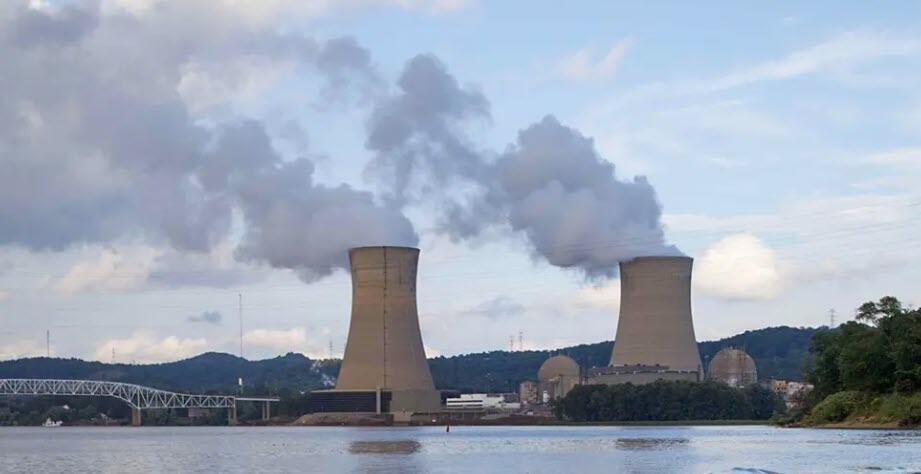
More evidence that the Trump Administration is serious about a nuclear energy revival comes from the National Reactor Innovation Center (NRIC), which announced last week that its Demonstration of Microreactor Experiments (DOME) test bed is now complete. This first-of-its-kind facility, located at Idaho National Laboratory (INL), will enable the rapid development, testing, and demonstration of privately developed advanced nuclear reactors.
The Department of Energy says DOME is an actual 100-foot-tall dome that is 80 feet in diameter – large enough to provide a safe environment to test experimental reactor concepts and gather performance data for use in informing future commercial licensing applications. Its completion dovetails with the new Part 53 NRC rules – as the U.S. seeks to accelerate the development and demonstration of advanced nuclear technologies.
Built from the repurposed Experimental Breeder Reactor-II containment structure, DOME will help reactor developers accelerate testing timelines – saving money and reducing project risk – and hopefully deployment timelines.
These microreactors are designed to be factory-built and portable, able to be placed in remote communities or to respond to natural disasters but perhaps primarily to serve independent microgrids (such as data centers), field-level military operations, and even space travel.
DOME is the only test bed in the world specifically designed to host fueled microreactor experiments that can generate up to 20 megawatts of thermal energy that can be used as heat or converted to electric power. [This is comparable in size to the reactors that have powered America’s nuclear submarines ever since the USS Nautilus was deployed in 1954.]
DOE Deputy Assistant Secretary for Nuclear Reactors Dr. Rian Bahran says the DOME is a vital component of reestablishing U.S. leadership in advance nuclear technologies – yet one wonders how many decades ago such a facility could have been built. Nuclear submarines can operate for 20 to 30 years without refueling, whereas conventional subs need refueling several times a year.
Better late than never – the DOME has already started a scheduled year-long test of Radiant Industries’ Kaleidos Demonstration Unit, a microreactor that uses TRISO fuel and is cooled by helium to produce 1 MW of electrical power or 3.5 MWt of thermal power. The U.S. Air Force is but one entity awaiting authorization for deploying Kaleidos. Other companies are queuing up to test their designs in DOME.
With the DOE envisioning nuclear megacities for such activities as uranium enrichment and fuel fabrication, at least four states have announced their willingness to serve as hosts even if managing high-level nuclear waste is part of the commitment.
Idaho and Tennessee have long-term experience in nuclear energy, while Utah and Nebraska are looking at the jobs and revenues to be gleaned from joining the nuclear community.
By contrast, Nevada has fought against managing nuclear waste and Texas and New Mexico have also objected to private interim nuclear waste storage (despite Texas’ push for nuclear energy development).
Meanwhile, the U.S. continues its ban on reusing nuclear waste to power reactors designed to burn (and thus dramatically reduce the volume of) nuclear waste by 95% and dramatically lower the cost of nuclear energy generation while virtually eliminating the controversial issue of nuclear waste storage.
Of course, a major increase in the number of nuclear powerplants in the U.S. will necessitate a major increase in the supply of nuclear fuel – and there is good news on that front as well. Newly launched FluxPoint Energy announced it is developing what would be the first new uranium conversion facility in the U.S. in 70 years.
FluxPoint says its mission is to “establish a fully American, vertically integrated nuclear fuel capability – supporting energy independence, enabling advanced reactor development, and strengthening national security.” Development of the facility, which will convert uranium oxide (U3O8) into gaseous uranium hexafluoride (UF6) that can be enriched in fissile uranium-235 for use as nuclear fuel, is “well under way.”
For that matter, these and other developments – and a reinvigorated nuclear energy industry – are signs that the U.S. is “well under way” to restoring its faith in a future and a renaissance already signified by the highly successful and warmly received Artemis II mission to the moon, another area of American excellence that was put into mothballs for decades.
Duggan Flanakin is a senior policy analyst at the Committee For A Constructive Tomorrow who writes on a wide variety of public policy issues.
Tyler Durden
Fri, 04/17/2026 – 19:15
https://www.zerohedge.com/political/america-verge-nuclear-renaissance

Google’s Stake In SpaceX Could Be Worth $122 Billion At IPO
Google’s Stake In SpaceX Could Be Worth $122 Billion At IPO
A long-held investment by Alphabet Inc. in SpaceX could become one of its most valuable bets if the rocket company moves ahead with a public listing, according to Bloomberg.
Regulatory filings indicate Google owned about 6.11% of SpaceX at the end of 2025. At a projected $2 trillion IPO valuation, that stake would be worth roughly $122 billion. After SpaceX’s merger with xAI, the holding is estimated to have diluted to around 5%, or about $100 billion at the same valuation.
The figures offer a clearer picture of Google’s position in SpaceX, which had previously been acknowledged without precise detail. Only Google and Elon Musk — who controls roughly 40% — were required to disclose holdings above 5%.
Bloomberg writes that SpaceX is targeting a potential June IPO and could raise as much as $75 billion, which would make it one of the largest listings ever. At that valuation, even a small fraction of ownership would translate into significant dollar value.
Early investors are positioned for outsized returns. Some analysts estimate that backers who entered as recently as 2021 could see gains of around 20 times their original investment.
Founded in 2002, SpaceX reached a $1 billion valuation within eight years, a relatively fast climb for a capital-intensive aerospace company.
Google first invested in 2015, joining Fidelity in a $1 billion funding round that valued SpaceX at $10 billion and gave the firms a combined 10% stake.
Ownership stakes have shifted over time due to dilution and secondary share sales. In 2020, Google held about 7.64% while Musk’s stake was around 47%. Early investor Founders Fund has since dropped below the 5% disclosure threshold.
Alphabet does not separately report its SpaceX holdings in earnings, though it has recorded sizable unrealized gains tied to private investments, including an $8 billion increase in early 2025 linked to SpaceX.
The IPO is expected to create significant liquidity for employees and insiders, potentially prompting departures as some cash out or pursue new ventures.
Board members and long-time investors also stand to benefit, underscoring the scale of wealth that could be generated by SpaceX’s anticipated debut.
Tyler Durden
Fri, 04/17/2026 – 18:50
https://www.zerohedge.com/markets/googles-stake-spacex-could-be-worth-122-billion-ipo
The Latest On The Redistricting Battles
The Latest On The Redistricting Battles
Authored by Jackson Richman & Joseph Lord via The Epoch Times (emphasis ours),
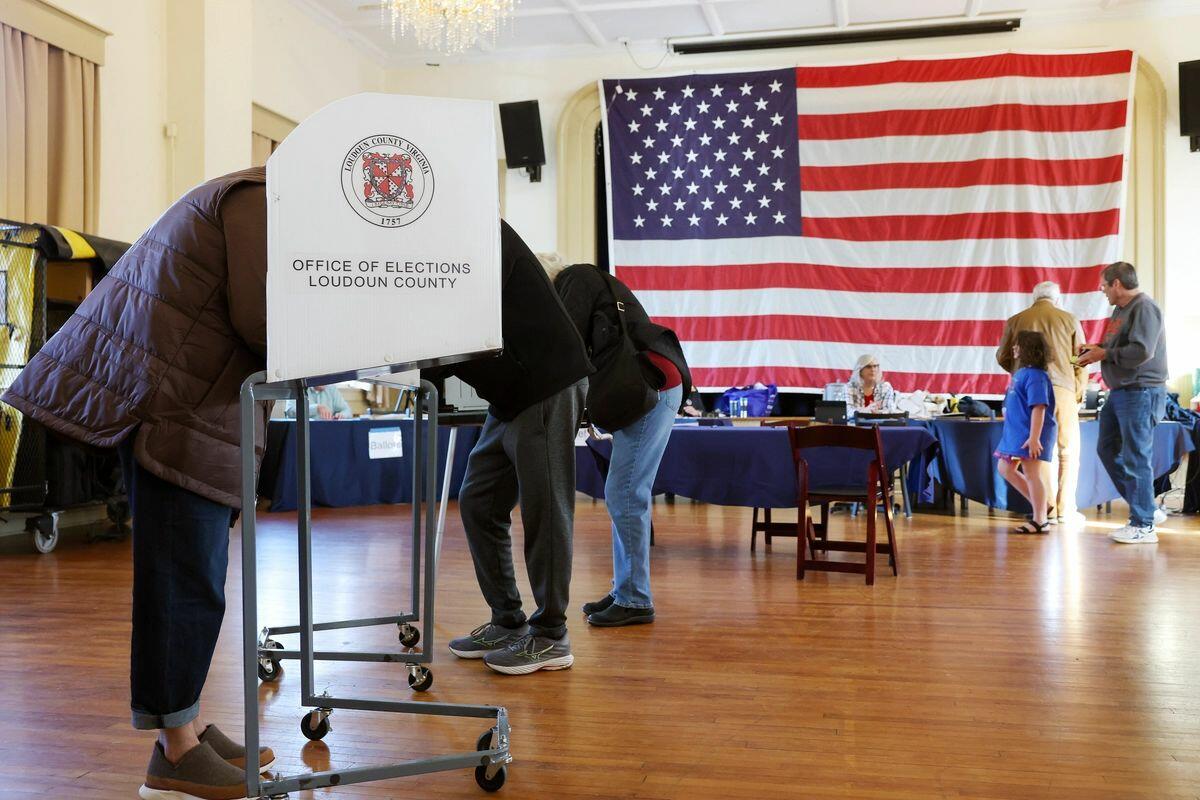
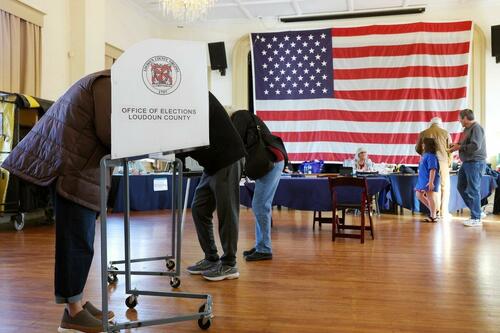
Despite the midterm season underway, the lines of congressional maps have not been finalized as redistricting battles continue nationwide.
Since Texas’s opening salvo, lawmakers in both parties from Florida to California have pushed for partisan redistricting in their states as a high-stakes midterm election season approaches.
Here is the latest on states redrawing their congressional maps.
Virginia
The Democratic-led General Assembly passed in February a new U.S. House map that will only go into effect if voters approve a referendum to allow the state to do mid-decade redistricting.
The state Supreme Court has yet to rule whether the effort is valid, but said the vote on the constitutional amendment can proceed. Before the court is an appeal of a county judge’s ruling that the amendment is illegal because lawmakers violated their own rules while passing it.
Florida
Gov. Ron DeSantis has called a special legislative session to begin Monday on redrawing the state’s congressional map. Republicans haven’t yet publicized what the lines would look like. However, the state constitution states that redistricting cannot favor or disfavor a political party or incumbent.
Texas
The Lone Star State last year added five congressional districts that favor Republicans after Trump urged the state to redistrict and after the Department of Justice suggested that several districts in the state unconstitutionally grouped minorities to make a majority. The U.S. Supreme Court has upheld the new map.
California
Voters in November approved a referendum that circumvents an independent commission by adding five congressional districts that favor Democrats.
The U.S. Supreme Court denied an appeal from Republicans, who claimed that the map favors Hispanics. The high court said the map could be used in this year’s election.
Missouri
Republican Gov. Mike Kehoe signed a revised House district map into law last September, a move that could give Republicans an additional seat.
A county judge ruled that the new map will remain in effect while election officials review whether a referendum petition meets constitutional requirements and includes enough valid signatures for a statewide vote.
The Missouri Supreme Court has already dismissed a lawsuit arguing that mid-decade redistricting is unlawful. The court is set to hear arguments in May over claims that the new districts fail to meet compactness standards and should be paused pending a possible referendum.
Ohio
A bipartisan panel, largely made up of Republicans, voted in October to approve a revised House map that could boost the party’s chances of gaining two additional seats. The redraw was required under the state constitution ahead of the 2026 election after Republicans enacted the previous map without enough Democratic backing following the last census.
North Carolina
The Republican-controlled General Assembly gave final approval in October to revised district lines that could help the party gain an additional seat. In November, a federal court panel declined to block the new map from being used in the midterm elections.
Utah
A judge in November ordered new House district boundaries that could give Democrats an opportunity to pick up a seat. The court found that lawmakers had sidestepped voter-approved anti-gerrymandering rules when drawing the previous map. In February, both a federal court panel and the state Supreme Court rejected Republican challenges to the court-imposed districts.
Maryland
While Maryland Gov. Wes Moore, a Democrat, has pushed the state legislature to redistrict the state’s single Republican seat, the push has so far failed to gain steam.
On April 13, the state legislature’s session ended without the passage of a bill to redistrict Maryland’s congressional map despite Moore’s encouragement. The state House had passed the bill, but it stalled in the state Senate.
New York
Though New York Gov. Kathy Hochul had pushed for the state to redraw its congressional boundaries, any such change has been blocked by the U.S. Supreme Court.
In March, the Supreme Court overturned a lower court order that had called on the state legislature to redraw Rep. Nicole Malliotakis’s (R-N.Y.) 11th congressional district seat.
Indiana
The Indiana legislature failed to pass redistricting legislation. The measure failed in December 2025 after 21 state Senate Republicans joined all 10 Democrats in the chamber to defeat the measure in a 31–19 vote.
It means the previous maps will remain in place for the upcoming elections.
Kansas
Though some Republicans in the GOP-dominated Kansas state legislature had pushed for the state to redraw its single Democrat-held seat, the push failed in late 2025 due to opposition from Gov. Laura Kelly.
Kelly vowed to veto any mid-decade map.
Illinois
While Illinois Gov. JB Pritzker indicated that the state was musing on redrawing maps to further favor Democrats, no push to that end has gained momentum. This year, Illinois is expected to use the same congressional maps it did in 2024.
Tyler Durden
Fri, 04/17/2026 – 18:25
https://www.zerohedge.com/political/latest-redistricting-battles