Category: News

Unpaid Trash Company Empties Dumpster Rental Load On Customer’s Front Lawn
Unpaid Trash Company Empties Dumpster Rental Load On Customer’s Front Lawn
A Bay Area dumpster company decided to skip collections and go straight to… lawn delivery.
Express Rental Dumpster said a San Pablo customer rented a bin while moving out, but the payment situation was, generously, fictional. The owner, Martin Perez, said the card kept getting declined while the customer kept promising “later”, according to Fox News.
So instead of eating the cost, the driver showed up and made a statement. Ring camera footage shows him briefly talking to someone off-screen, cracking open the truck so some trash spills out, then backing up and dumping the entire load onto the front lawn.
At one point, someone from inside the house comes out and starts yelling, though it didn’t reverse the sudden landscaping change.
Perez told KTVU he’d already lost money on the job and would’ve had to pay extra dumping fees himself—apparently a line he wasn’t interested in crossing.
Police eventually showed up and told the driver to at least move debris off the sidewalk and back onto the property. A neighbor, meanwhile, claimed the homeowner insisted they had paid about $700, which only makes the whole situation murkier.
But thank God for America’s growing homeless population…because in the end, the trash pile was picked through by scavengers and later cleaned up with help from a neighbor—because nothing says neighborhood bonding like surprise garbage mountain.
Tyler Durden
Fri, 04/17/2026 – 18:00

“F**k It…Just Do It”: Carville Lays Out Democratic Plan To Add States And Pack The Court To Retain Power
“F**k It…Just Do It”: Carville Lays Out Democratic Plan To Add States And Pack The Court To Retain Power
Authored by Jonathan Turley via jonathanturley.org,
Various Democrats have been openly discussing their plans after retaking power to change the system so they never lose power again. Democratic strategist James Carville has been one of the most vocal and returned to the subject this week in laying out how they will make D.C. and Puerto Rico states and pack the Supreme Court with a liberal majority.
On his podcast with Al Hunt, Carville explained, “If the Democrats win the presidency and both houses of Congress, I think on day one, they should make Puerto Rico [and] D.C. a state, and they should expand the Supreme Court to 13. F— it. Eat our dust.”
Notably, this week, New Jersey just elected a radical new member, Analilia Mejia, who ran on packing the Court and other radical agenda items. While some of us have written about the expansion of the Court, these politicians and pundits are pushing for the packing, not just gradual expanding, of the Court.
However, Carville (curiously on a national podcast) seriously suggested that Democrats should keep the plan quiet: “Don’t run on it. Don’t talk about it. Just do it.”
Call it the Nike School of Constitutional Law.
The need of the left to pack the Supreme Court is obvious. Many of the proposals coming from the left are clearly unconstitutional. You will need a partisan majority to make the political changes that these figures hope will give the Democrats a lock on power for years to come.
Years ago, Harvard professor Michael Klarman laid out a radical agenda to change the system to guarantee Republicans “will never win another election.” However, he warned that “the Supreme Court could strike down everything I just described.” Therefore, the court must be packed in advance to allow these changes to occur.
Likewise, Carville previously explained how this process of how the pack-to-power plan would work:
“I’m going to tell you what’s going to happen. A Democrat is going to be elected in 2028. You know that. I know that. The Democratic president is going to announce a special transition advisory committee on the reform of the Supreme Court. They’re going to recommend that the number of Supreme Court justices go from nine to 13. That’s going to happen, people.”
The push for court packing and war chests on the left remains unchanged despite conservatives on the Court ruling against the Administration on major cases. Carville and others cannot claim that the conservative justices are robotically voting with the Administration, but it does not matter. They want a Court that will consistently uphold the changes being planned by Democratic strategists.
The fact that these changes would come after the 250th anniversary of the most successful democratic system in history is a crushing irony. However, it is notable that the Democrats want Congress and the courts to push through these changes, not the public. The public remains opposed to court packing and making D.C. a state. That is why Carville wants candidates to keep quiet on the plan and run, like Virginia’s Abigail Spanberger, as faux moderates. Then, as in Virginia, they can move to fundamentally change districts and rules to guarantee their hold on power.
It is a mentality summed up by NEA President Becky Pringle:
The question is whether rage politics can convince a people to destroy the very democratic system that has brought centuries of stability and prosperity.
Tyler Durden
Fri, 04/17/2026 – 17:40
Meta To Unleash First Wave Of Mass Layoffs May 20 As It Eliminates 10% Of Its Workers
Meta To Unleash First Wave Of Mass Layoffs May 20 As It Eliminates 10% Of Its Workers
The FaceBook currently known as Meta for one failed venture that incinerated nearly $100 billion in cash for its failed transformation to a virtual reality hub while laying off thousands, is at it again.
As we previewed a few weeks ago, Meta – which inexplicably hasn’t changed its name to AIbook yet – will proceed with the first wave of mass layoffs planned for this year on May 20, with more coming later, Reuters reported citing sources.
The Facebook and Instagram owner will lay off about 10% of its global workforce, or close to 8,000 employees, in that initial round, as it swaps headcount for GPUs.
And that’s just the start: the company is planning further layoffs in the second half of the year, although details of those cuts, including date and size, have yet to be determined and will depend on just how much more money Meta burns in its experiment to prove that AI will actually generate positive cash flow.
Last month, Reuters reported that the company was planning to lay off 20% or more of its global workforce.
Meta’s layoffs this year will be the social media giant’s most significant since a restructuring in late 2022 and early 2023 that it dubbed the “year of efficiency,” when it eliminated about 21,000 jobs. At that time, Meta’s stock was in freefall and the company was struggling to correct for COVID-era growth assumptions that ultimately proved unsustainable. It will soon find itself in the same hole again.
The Menlo Park-based company employed nearly 79,000 people as of December 31.
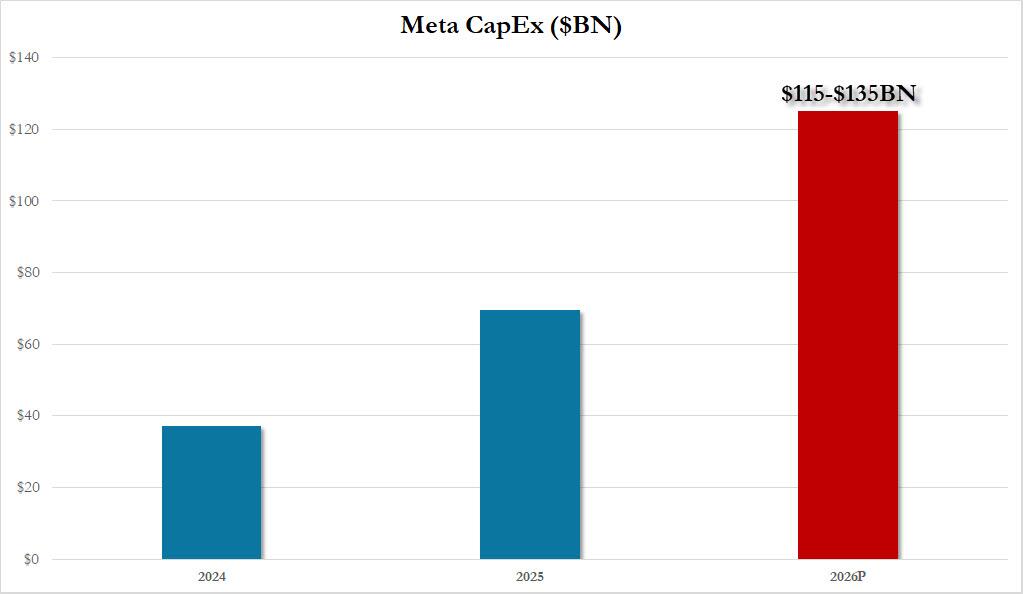
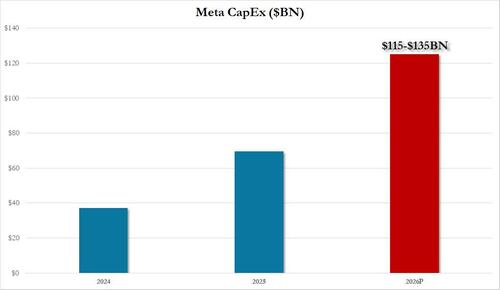
CEO Mark Zuckerberg has been pumping hundreds of billions of dollars into AI as he seeks to dramatically reshape his company’s core business around the technology, which has yet to generate any material returns proportional to the massive capex spend. In its latest earnings call, META raised its 2026 capex guidance to a record $115-$135 billion, more than double the prior years, and drastically more than anything META spent during the peak of its virtual reality phase.
Meta is not alone: Amazonrecently trimmed 30,000 corporate employees, representing nearly 10% of its white-collar workers, while in February the fintech company Block fired nearly half of its staff. In both of those cases, executives tied the cuts to efficiency gains from artificial intelligence. Of course, nobody actually think how mass layoffs of the best paid job in the US – Information – will impact end demand for AI if in a few years, America’s (formerly) best paid workers are struggling to pay their San Fran rent, let alone pay for the latest chatbot du jour.
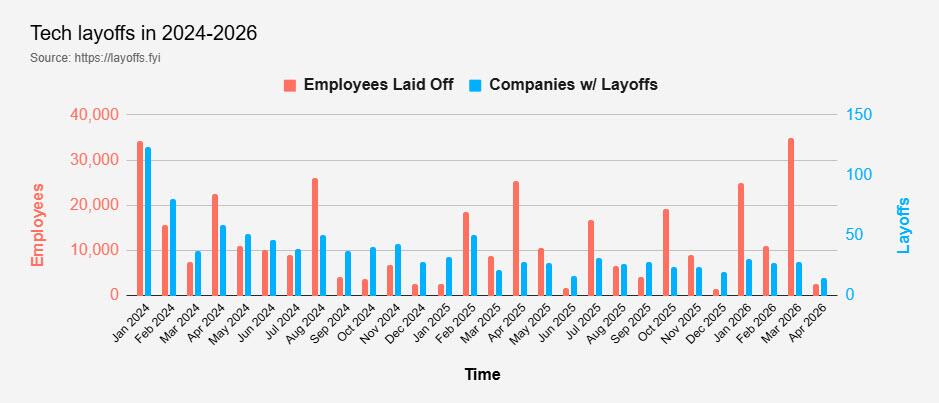
Layoffs.fyi, a website tracking tech job cuts around the world, reported that 73,212 employees have lost their jobs so far this year. For all of 2024, the figure was 153,000.
While META is in a more comfortable financial position now than it was during the 2022/23 purges, executives envision a future of fewer management layers and greater efficiency brought about by AI-assisted workers. Assuming of course the AI bubble doesn’t burst sooner as the market realizes the trillions in spending promises by the likes of OpenAI will never materialize.
Meta’s shares are up 3.68% since the start of the year, although they are down from a record high achieved last summer. Last year, it generated more than $200 billion of revenue and achieved a $60 billion profit despite outsized spending on artificial intelligence.
In a rerun of its catastrophic foray into virtual reality, in recent weeks, Meta has reorganized teams in its Reality Labs division and transferred engineers from throughout the company into a new “Applied AI” organization tasked with accelerating the development of AI agents that can write code and carry out complex tasks autonomously; expect this to pivot into whatever the AI buzzword of the day is.
Tyler Durden
Fri, 04/17/2026 – 17:20

No SAVE Act? Congress Still Holds The Trump Card
No SAVE Act? Congress Still Holds The Trump Card
Authored by Scott Yenor via American Greatness,
The failure of the United States Senate to pass the SAVE America Act is as regrettable as it is predictable. Noncitizen voting is already a federal crime in America. SAVE would have required voters to provide documentary proof of citizenship when registering to vote. States would have to purge noncitizens from voting rolls, too.
Perhaps reliance on hostile state officials to implement the law would have rendered the SAVE America Act ineffective. We will never know.
The cause of election integrity is not dead. Congress has the constitutional power to ensure election integrity.
The American election system divides power between the states and the federal government.
States determine the “time, place, and manner” of elections and, within constitutional limits, determine who can vote.
Some states allow mail-in ballots. Others, like Oregon, send every voter a ballot. Other states allow mail-in ballots under special circumstances. Some states allow ballots to arrive well after Election Day. Some states require no identification for voters. Some wink at noncitizens voting. Others have rigorous identification requirements. Some countenance practices that sow the appearance of cheating into the counting of votes. Other states have clean elections that bring election results right away on election night.
But Congress has a plenary power to judge whether a state’s election results are consistent with the basic demands of representative government.
According to Article 1, Section 5 of the United States Constitution, “Each House shall be the Judge of the Elections, Returns, and Qualifications of its own Members.”
Congress can ferret out fraudulent votes of all sorts—not just voting by noncitizens.
Congress can then declare elections invalid and order a new election when it judges elections to be fraudulent.
Both the Senate and the House have pre-established procedures for investigation, including the power to subpoena state officials and state voting data. This power helps Congress ensure its own integrity.
Hundreds of House elections have been challenged in American history. Often, complaints are frivolous. Sometimes complaints involve qualifications, strictly speaking. Albert Gallatin had his election to the U.S. Senate voided by a 14–12 vote in 1794 because he had not been a citizen for nine years.
Other investigations, like the McLane–Farr dispute from the 1918 election, concern corruption pure and simple. Patrick McLane was originally declared the winner in a Pennsylvania race, but once evidence of “wholesale fraud and illegality” from fictitious voters and voters who were not citizens came to light, Congress determined that John Farr won.
In the late 1990s, Loretta Sanchez defeated Congressman Bob Dornan by fewer than 1,000 votes. Dornan challenged the election. Congress found that more than 700 illegal votes were cast. Since it was not enough to sway the election, Dornan’s challenge was dropped.
Investigations into election integrity were especially common after the Civil War, when Democrat-secessionist voting practices led to severe undercounting of Republican votes in the South.
Voter intimidation compromised the entire voting environment.
Today, Republicans fear that similar broad-scale corruption plagues blue states like California, Illinois, Michigan, and Oregon, all of which seem to have weak voter identification laws, poor audit procedures, lax voter purging techniques, and a fear of federal investigations into their practices.
Are elections within these states outside the margin of fraud? To know the answer, we would have to know the margin of fraud in those states. And that requires congressional investigations.
Democrat establishments have little incentive to clean up their elections. They benefit from the fraud that keeps them in power, so they are wary of actually investigating their own elections. State election systems are not completely subject to federal oversight.
There are many reasons not to have confidence in Oregon’s elections for the national legislature, for instance. Noncitizens are welcomed and registered. Many counties have had more than 100 percent registrations among voters. Mail-in ballots are ubiquitous and automatic. Dead people or people who have moved out of state have voted in past elections, and Oregon has been particularly lax in purging its voting rolls. Oregon’s federal elections would be worth a serious look from Congress, especially federal races decided by less than 10,000 votes.
If Oregon does not want to fix its elections, it need not. The state must simply pay the penalty for porous elections by not having representation in the U.S. House or Senate.
Congress has the constitutional means and the motives to police state elections, not with new laws but with its investigatory powers.
If the rest of the country can have confidence in their elections, Congress would, no doubt, seat a delegation. Congress could deny representation to states without voter identification laws or those that wink at foreign nationals voting in their elections. Or Congress could require new elections when voting rolls are not properly purged.
Congress has the power to determine whether states have a republican form of government. States with rigged elections do not have republican governments. And Congress can dust off its own powers to ensure the integrity of the election of its own members, even without the SAVE America Act.
Tyler Durden
Fri, 04/17/2026 – 17:00
https://www.zerohedge.com/political/no-save-act-congress-still-holds-trump-card

Former Congressman Blows The Whistle On Blackmail And Honeypots In Congress
Former Congressman Blows The Whistle On Blackmail And Honeypots In Congress
In a candid interview with Human Events editor Jack Posobiec, former Rep. Madison Cawthorn (R-NC) alleged that blackmail and sexual honeypot operations are far more prevalent than the American public is aware of.
Cawthorn, who was elected to represent North Carolina’s 11th congressional district at just 25 years old in 2020, described the typical path these lurrid situations take. It often begins at donor dinners or late-night votes, when members unwind with drinks or head back toward Capitol Hill. While many lawmakers prefer socializing with fellow congressmen to avoid complications with staffers or outside interests, invitations can quickly turn strangely personal.
“Normally, the way I found that these things start getting off the ground is that it starts out—you’re maybe at a donor dinner or getting dinner after a late night of votes,” Cawthorn said. “Then, you know, everyone has friends inside of Congress, so you start hanging out with friends. Maybe you’re grabbing drinks, or on the way back to Capitol Hill, heading back to your homes.”
“Then you start building these relationships, and most congressmen like to hang out with other congressmen, just because there are so many problems when you hang out with staffers or people with different angles in other parts of the Beltway, the former lawmaker continued. “I will tell you, normally, the way I came across this is that people start inviting me and saying, “Hey, why don’t you come back? My wife would love to hang out with you, and we can see what could be going on here. I think we’d have a really good time if we all got together in this way.”
“Then you start piecing it together and say, “Wait a minute, what kind of invitation is this? This sounds really weird. What do you mean leave my phone at the house?” That doesn’t make any sense—these random things they’re saying. It becomes very clear what they’re looking for. That’s the big one—“check your phone at the door,” that kind of thing,” he added.
WATCH: Madison Cawthorn explains how honeytrapping operations work in US Congress
“Once they have you on video they own you”pic.twitter.com/OVGCx4a7s9
— Jack Posobiec (@JackPosobiec) April 15, 2026
Cawthorn told Posobiec that he made it clear he had zero interest in such activities.
“I’ve got a phenomenal life. I was only 25 years old when I was in Congress, so that didn’t interest me whatsoever. I thought the majority of people in the United States were very cognizant of that. So I came out and talked about it, and they tried to destroy me for it,” Cawthorn said.
Cawthorn lost his bid for reelection in the 2022 North Carolina Republican primary, falling to state Sen. Chuck Edwards (R), who later went on to win the general election.
“I’ll tell you, there were 16 people that I really hold responsible – the architects of trying to take down my political career,” Cawthorn explained. “I want you to ask yourselves: out of all the people who came out against me or sent funds to make sure I was pushed out of Congress, where are those people now?”
“I’m very happy that I was able to take the majority of them down, or that the majority of them are now out of office or have terrible personal lives at this point. But I will tell you, there are so many people inside Washington, D.C., that have much worse on them than what’s going on inside of this video,” he concluded.
Tyler Durden
Fri, 04/17/2026 – 16:40

“Overwhelming Puke-Stream”: It’s All Going To Come Out Now…
“Overwhelming Puke-Stream”: It’s All Going To Come Out Now…
Authored by James Howard Kunstler,
Showdown
“Everything that’s wrong is staring us right in the face, and half this country simply will not join us in fighting and fixing it. It’s infuriating and depressing and maddening.”
– James Woods on X
The closer this Iran war comes to a favorable resolution, the more garishly negative the puling Lefty-left gets, wishing fervently for the enemy to prevail. Why? Because the Lefty-left is also an enemy of our country. They want the operation to fail so they can reclaim power and resume wrecking and looting the USA.
By the way, what exactly would a favorable outcome of this war look like?
An Iran that doesn’t threaten nuclear jihad and doesn’t sponsor endless terror operations here, there, and everywhere. It looks like we are going to get to that. Iran’s choice is how deep do they want to take their own economic collapse before capitulating? If they’ll just stop now, they’ll still keep the lights on. They can be a normal, modern, developed nation without a death wish.
Anyway, the paradigm Iran was operating in as a rogue state is dead, especially the malign influence of Britain’s banking and MI6 intel matrix. Britain, proven by its actions to be not a friend of America. . . Britain, a wretched little has-been island empire with bad teeth, overrun by wrathful Islamists, and, alas, soon to be a caliphate.
President Donald Trump has rearranged the geopolitical landscape with startling speed and efficacy. Much of Europe, it turns out, are not our friends, either. They would not let us use the NATO bases we pay for to conduct air operations over Iran. Hence, NATO is four dead letters. They can go dangle while they figure out how to live without oil, possibly go back to their centuries-long condition as a nonstop slaughterhouse, besetting each other with stupid, age-old feuds. Not our problem anymore.
China?
Their Belt-and-Road isn’t what it was just six months ago. Mr. Trump has kicked them out of South America. Their oil supply is suddenly sketchy. Notice, they didn’t lend a hand helping to clear the Strait of Hormuz. Turned out that the radars and air defenses they gifted Iran didn’t work too well. Uncle Xi Pooh Bear will have to re-think situation.
Mr. Trump says he might travel to Pakistan this weekend if there are papers to sign with Iran.
Israel and Lebanon announced a ten-day truce to sort out where things stand. Both of them want Hezbollah expelled for good. Anyway, Hezbollah can no longer enjoy financial support from Iran, meaning no more munitions or salaries for Hezbollah warriors, meaning Hezbollah is out of business — a major regional irritant neutralized. Can you dare to imagine a peaceable Middle East?
So, things have changed-up greatly in this long-volatile corner of the world, and that will leave Mr. Trump freer to attend to the discord and animus at home, namely the psychopathic Democratic Party’s non-stop demolition of political norms, with assistance from the bureaucratic Deep State and the NGO underworld.
Just at hand this week, we have Director of National Intelligence Tulsi Gabbard sending criminal referrals to the DOJ on two key players (both liars) in Trump Impeachment No. 1: former Intel Inspector General Michael Atkinson and CIA agent “whistleblower” Eric Ciaramella — whose name the news media still fears to speak.
That impeachment, over the so-called “Ukraine phone call,” was from start to finish a complete fake, a criminal conspiracy. It involves a much larger cast-of-characters including then House Intel Committee Chair (now senator) Adam Schiff, then Secretary of State Mike Pompeo, CIA Director Gina Haspel, Chief Justice John Roberts, and virtually the whole Kiev US embassy staff at the time. Everybody involved was lying about one thing or another. The case is on Acting AG Todd Blanche’s desk now. Do you suppose it can just sit there?
It’s rumored that in the weeks ahead, Mr. Trump is fixing to conduct a declassification orgy of evidence unearthed by DNI Gabbard in the serial seditions run by US color revolutionists over the past decade. The presidential declass will obviate the usual tedious process of extracting declass permissions from every agency silo with a stake in the documents — meaning the evidence will go straight to US attorneys, including Jason Reding Quiñones, the United States Attorney for the Southern District of Florida, now running a grand jury out of Fort Pierce on the RussiaGate hoax.
Many of the players in that treasonous episode were involved in subsequent crimes against the nation: the 2020 election fraud; the Jan. 6 fed-provoked “insurrection” at the US Capitol; the fake House committee set up to pretend to investigate it; the Mar-a-Lago Raid; the multiple Trump prosecutions of 2024, the censorship campaign; and the manifold perfidious turpitudes of the “Joe Biden” administration, including the massive invasion of illegal immigrants.
It’s all going to come out now in one overwhelming puke-stream channeled into actual prosecutions. Only question is: will the massive revelation of truth prompt the millions of successfully brainwashed Americans to finally get their minds right over what has been perpetrated on our country?
Tyler Durden
Fri, 04/17/2026 – 16:20
https://www.zerohedge.com/political/overwhelming-puke-stream-its-all-going-come-out-now

Does Trump Know Something We Don’t About Potential SCOTUS Vacancies?
Does Trump Know Something We Don’t About Potential SCOTUS Vacancies?
Authored by Matt Margolis via PJMedia,com,
The midterm elections are coming up in November, and Democrats are generally favored to win the House, while the Senate is kind of a coin flip. While it would suck for Democrats to win the House because they’ll almost certainly find some bogus pretext to impeach President Donald Trump, there’s potentially more at stake regarding control of the Senate, including implications for confirming judges and potentially filling any potential Supreme Court vacancies.
No retirements have been announced, but speculation is mounting, and I’m starting to wonder if Trump knows vacancies are coming.
In a recent interview with Fox Business’ Maria Bartiromo, Trump confirmed he has a shortlist of potential nominees ready to go — and he’s prepared to fill as many as three seats if the opportunity arises.
“In theory, it’s two — you just read the statistics — it could be two, could be three, could be one,” Trump said.
“I don’t know. I’m prepared to do it. But when you mention Alito, he is a great justice.”
He added, “He does what’s right for the country. It’s the law, and he goes by it as much as anybody, but he gets to the point.”
High praise from a president who has been, let’s say, less enthusiastic about some of his own past nominees.
According to Fox News Digital, “Trump’s remarks sharpen the stakes around any potential vacancy, as the president has signaled he is ready to seize the opportunity to deepen the court’s conservative majority. With retirement speculation around Alito and Republicans eyeing the window before the 2026 midterms, the prospect of an opening is already putting fresh focus on succession politics.”
Rumors about Alito, 76, potentially retiring have grown because of his age, his two-decade tenure on the bench and speculation that he may want to make sure a conservative successor is confirmed by the current Republican-led Senate, especially before the upcoming midterm elections in which Republicans are at risk of losing or seeing a diminished majority.
The rumors were further fueled when it was revealed Alito was treated last month for dehydration after becoming ill at a Federalist Society dinner. A Supreme Court spokesperson clarified at the time that the justice was “thoroughly checked” and returned to the bench the following Monday.
A source close to Alito insists he is not stepping down this term and is in the process of hiring the rest of his clerks for the next term. So at least for now, it sounds like he’s not going anywhere.
Yet, Trump is ready with a shortlist of replacements? Is that a tell that he knows something we don’t?
It could be. Or it’s just being prepared.
After watching some of his own nominees drift from his expectations on high-profile rulings, you can be certain he’ll be far more deliberate this time around. Whatever seats open up, expect Trump to treat the selection process with a level of scrutiny he may not have applied before.
The bigger picture here is worth appreciating.
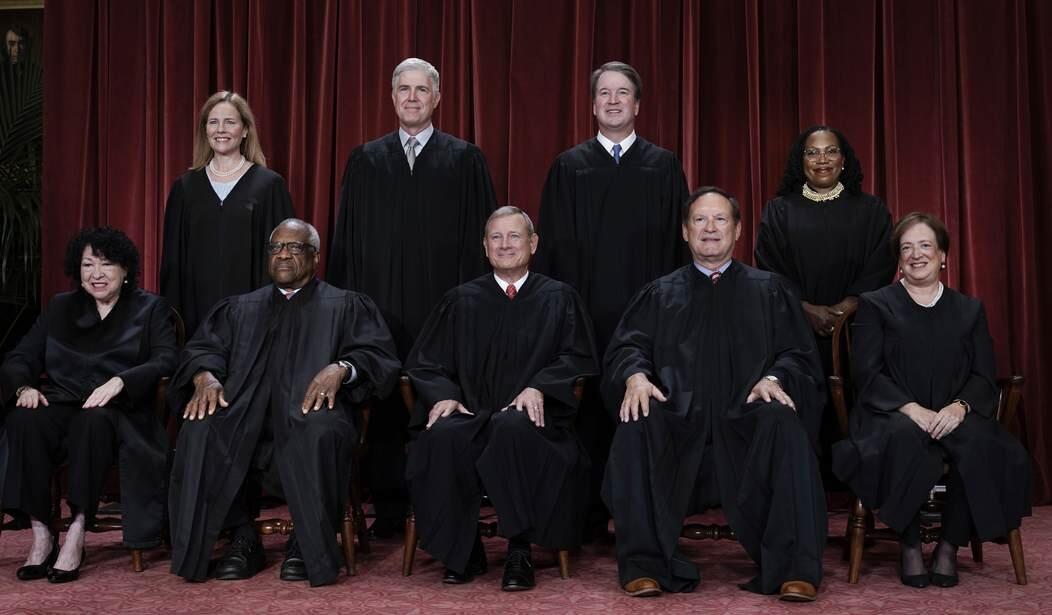
No president since Ronald Reagan has reshaped the Supreme Court the way Trump has. His first three appointments — Neil Gorsuch, Brett Kavanaugh, and Amy Coney Barrett — built the current 6-3 conservative majority. Trump may have an opportunity to secure a conservative majority for decades to come.
The question is, does he know that he will?
Tyler Durden
Fri, 04/17/2026 – 15:40
A “Bulging Lobe” Of Polar Vortex Madness Headed For U.S. East
A “Bulging Lobe” Of Polar Vortex Madness Headed For U.S. East
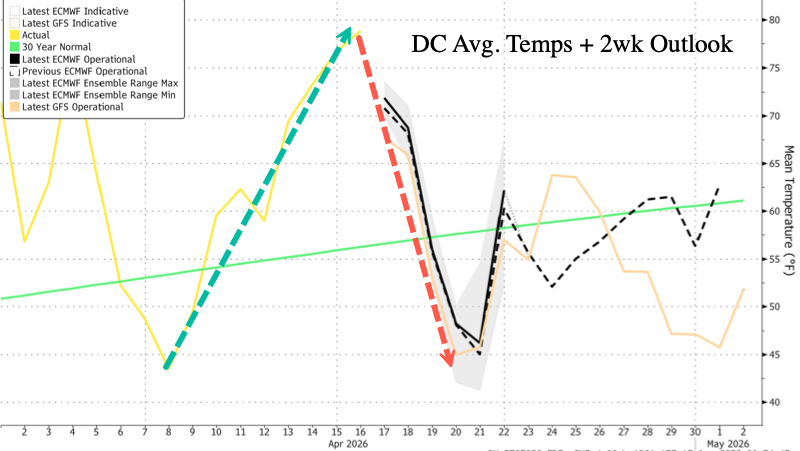
Mother Nature across the Mid-Atlantic can only be described by the Katy Perry lyric, “You’re hot, then you’re cold,” as a meteorologist warns that a “tropospheric polar vortex” will sweep across the Lower 48 this weekend into early next week, abruptly ending the summer-like conditions in Washington, D.C.
“A bulging lobe of the tropospheric ‘polar vortex’ will be tracking through the Lower 48, bringing a cold front and much cooler air to the Eastern U.S.,” meteorologist Ryan Maue wrote on X.
He added, “We’ll wave goodbye to the nearly unprecedented mid-April heat wave.”
A bulging lobe of the tropospheric “polar vortex” will be tracking through the Lower 48 bringing a cold front and much cooler air to the Eastern U.S.
We’ll wave goodbye to the nearly unprecedented mid-April heat wave. pic.twitter.com/gcgSX0Xwzo
— Ryan Maue (@RyanMaue) April 17, 2026
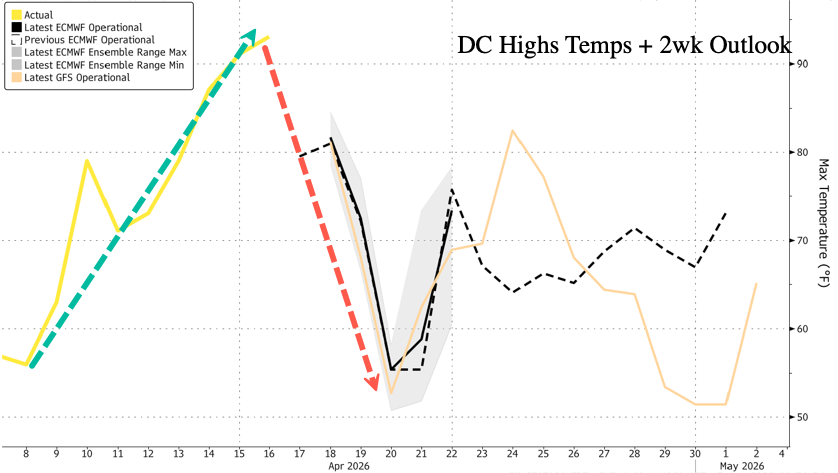
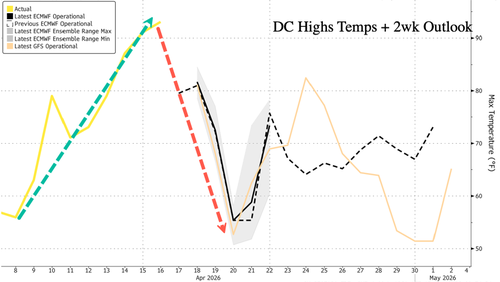
Folks in the Capitol Beltway will see a 40°F swing in high temperatures from yesterday’s 93°F to Monday’s 52°F, according to Bloomberg data.
Wild swing for DC high temps plus the forecast.
Average temperatures in Washington at this time of year typically run in the mid-50°Fs. Yet, like the Katy Perry lyric above, Mother Nature still cannot seem to settle on a steady rising temperature trend with Northern Hemisphere spring underway.
Related:
Meteorologists Warn About Super El Nino Event
Drought Engulfs 60% Of U.S. As Farmers Begin Spring Planting
Lefty MSM outlets would have us all believe that this schizophrenic weather is somehow because of cow farts and gasoline-powered cars and gas stoves, and we must be taxed to death to solve Al Gore’s global warming.
Tyler Durden
Fri, 04/17/2026 – 15:25
https://www.zerohedge.com/weather/bulging-lobe-polar-vortex-madness-headed-us-east

The End Of Oil Volatility As A Weapon
The End Of Oil Volatility As A Weapon
Authored by Tom Luongo via Gold, Goats, ‘n Guns blog,
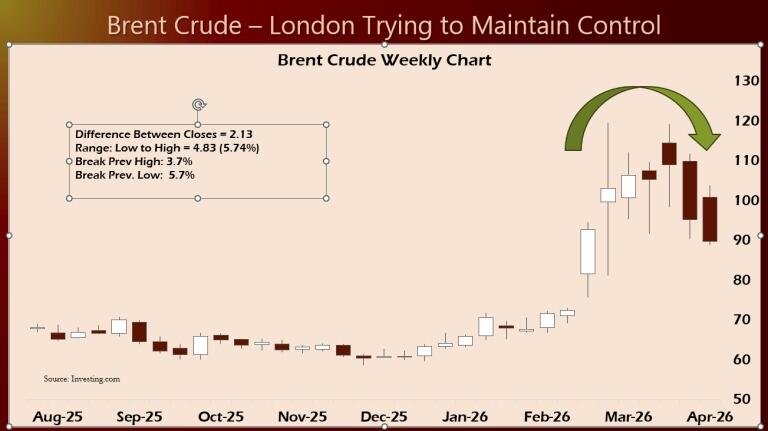
This is the only chart that matters right now…not borrowing costs (@lukegromen).
It’s the weekly chart of Brent Crude.
I’ve been telling my patrons for three weeks in the Market Reports that the Brent Crude chart has all the earmarks of a market being manipulated UP to support a narrative…
That narrative is Donald Trump is a madman who broke the world and is losing in Iran.
Look at the chart carefully, you see big gaps between weekly closes and opens. Also, note the tails to the downside versus the wicks to the upside. Tails are much longer than wicks…. telltale signs of a market that has topped but someone is trying to keep reflating it.
Why? Many reasons, from speculations, positions, narrative control, etc. Markets are the sum total of all of these players.
But the reality is that you can only manipulate a market over a short period of time (H/T@armstrongeconomics) unless you control the total pricing system for that market… i.e. central banks and currencies…. and why the gold and silver markets have been manipulated for years.
Oil is a market of immense volatility, with 5-year moving average of its Range/Price topping 7% on a weekly basis, which is in bitcoin territory. It should be the most boring market on the planet, since everyone depends on it. But it isn’t.
It trades like a penny stock on a double espresso. (H/T Dennis Miller).
Someone profits from that volatility. Someone works with others to create that volatility. All Roads don’t lead to DeMoines, FYI.
Oil volatility is the enemy of certainty. It retards investment in some cases and redirects it to other less viable investments in others… c.f. Wind, solar, LED lights, and all this Watermelon (Green on the outside, Commie Red on the inside) nonsense.
If we want a world of predictability, which is the essential purpose of Human Action (H/T Mises, something most Miseseans have forgotten), then we have to accept that sometimes we have to defend our right to a predictable future.
And no amount of asking for it nicely is going to get us there. We were never voting our way out of this.
That’s why I’ve been in full-throated favor of this conflict with Iran. It’s why I allowed myself to see the world differently than I did previously.
The Federal Reserve is just a tool. It can (and has) been a tool for evil, but it can also be a tool for good, like all technology. This is why SOFR was the beginning of this war, and why this morning’s announcement by Iran is end of the current battle in it. It should still be deprecated in importance, removed from duties it was never designed nor been allowed to perform.
The same can be said for the US military, which has been a tool used to enforce the “tyranny of evil men” (H/T Roger Avery & Quentin Tarantino, Pulp Fiction) on Wall St., Bay Street, K Street, and 10 Downing Street. But, like the Fed, it can be used judiciously, to serve humanity with the right set of circumstances and the right mission.
It did so.
We’ve been blackmailed by evil people for generations to accept this lack of investment certainty to indulge our cynicism, or lack of faith in humanity.
We chuckled in “Collapsitarian” for too many years. And I, frankly, just got sick of it.
It’s pathetic and evil and we shouldn’t tolerate it in them or ourselves for another gods-damned minute. Period. It’s anathema to human life, common decency, and civilization itself.
This is the truth. And it all goes back to the intersection of selling narrative while hitting desperate people where they live and breathe… in their pocketbooks.
In the end, oil prices want to fall because the fundamentals are bearish (H/T @DoombergT). There is no Peak Oil. There is no Green New Deal.
There is only Zul…. okay, maybe not Zul. *grin*
This chart is your literal snapshot of a pricing control system being destroyed in real time… by one guy, Donald J. Trump, with support from his Treasury Sec. Scott Bessent, Sec. War Pete Hegseth and his merry band of warfighters, and his Sec. of State Marco Rubio.
He has both exposed and stolen London’s control over oil flows to support its centuries-old evil by the studious application of Gold (dollars), Goats (American Industrial Might) ‘n Guns (Brrrrrt!).
Stew all you want, haters. But, he’s done it. The Hormuz Blackmail is done.
Trump has his hand on the global oil spigot now… and he can turn the volatility up or down. The US is the global price setter now, like it or not.
… Why?
Views expressed in this article are opinions of the author and do not necessarily reflect the views of ZeroHedge.
Tyler Durden
Fri, 04/17/2026 – 15:10
https://www.zerohedge.com/geopolitical/end-oil-volatility-weapon

Tanker Armada Races For Hormuz After Iran Says Strait Is Open
Tanker Armada Races For Hormuz After Iran Says Strait Is Open
An armada of at least eight oil tankers set off toward the Strait of Hormuz immediately after Iran’s foreign minister said the vital waterway was fully open to shipping.
Five of the carriers, which had been anchored north of Dubai, were moving into the waterway on Friday afternoon, soon after Iran’s foreign minister said it was completely open, vessel tracking data compiled by Bloomberg show. Three more, which were waiting about 70 miles west, have also begun moving in the direction of the strait.
The tankers moved despite reports in Iranian media that suggested the country was still seeking to impose restrictions. Iran’s Tasnim news agency reported that ships and cargoes linked to “hostile” countries would not be allowed through (in other words, no change from before). Passage via Strait of Hormuz will be closed if US naval blockade continues as it will be considered a violation of the ceasefire, the country’s Fars news agency reported. At the same time, Trump said that Iran-aligned ships would be barred passage as per the recently announced blockade until a ceasefire is finalized.
The U.S. naval blockade continues… pic.twitter.com/EBvglrf6FA
— U.S. Central Command (@CENTCOM) April 17, 2026
Hundreds of tankers have been stuck in the Persian Gulf as a result of the Middle East conflict, and the decision to transit depends on the owners, captains and crews. Several ship owners earlier told Bloomberg they were seeking more information before they would be ready to consider transiting.
Earlier in the day, before the news that the Strait had reopened, we learned that a Greek shipowner whose vessels have repeatedly braved the Strait of Hormuz during the Iran war, sent through its biggest oil supertanker since the start of the conflict. The Atokos, a VLCC with a transport capacity of about 2 million barrels, signaled its location in the Indian Ocean on Friday. That would suggest it navigated Hormuz, with its digital transponder off, over the past several days.
The closure of the strait caused a surge in oil, fuel and natural gas prices as it choked off a swath of shipments and caused the region’s top producers to cut output.
It’s not just tankers: according to MarineTraffic, today also saw the first cruise ship transit the Strait since conflict began. The cruise ship Celestyal Discovery has become the first passenger vessel to transit the Strait of Hormuz since the start of the conflict. The Malta-flagged vessel departed Dubai on 17 April after remaining docked
First cruise ship transits Strait of Hormuz since conflict began
The cruise ship Celestyal Discovery has become the first passenger vessel to transit the Strait of Hormuz since the start of the conflict. The Malta-flagged vessel departed Dubai on 17 April after remaining docked… pic.twitter.com/3wR1P6Lc6G
— MarineTraffic (@MarineTraffic) April 17, 2026
And merchant ships are also rushing to cross the strait before Iran changes it mind.
🚢 Several Merchant Vessels that were anchored near the UAE have now decided to cross the strait of Hormuz, right after the recent announcement from Iran. https://t.co/XVDFQim98Y pic.twitter.com/dBXWs8Mgoi
— MenchOsint (@MenchOsint) April 17, 2026
If all the ships ships headed for the strait are able to continue their voyages into the Gulf of Oman and the Arabian Sea beyond, their movements would be among the clearest signs yet that Hormuz might finally be opening up to shipping that isn’t connected to Iran since the war began on Feb. 28.
More importantly, amid the constant headline ping pong, there remains lots of confusion as to the actual state of affairs, although as we reported previously, the only thing that matters in this entire conflict is whether the Strait is reopened: in a few hours we will have the answer.
Tyler Durden
Fri, 04/17/2026 – 14:50