Category: News

The Democrats’ National Popular Vote Push Is About Fear, Not Fairness
The Democrats’ National Popular Vote Push Is About Fear, Not Fairness
Virginia Gov. Abigail Spanberger signed the National Popular Vote Interstate Compact into law this week, adding her state’s 13 electoral votes to a growing coalition that wants to effectively render the Electoral College a ceremonial relic. The move is strategically transparent, and it tells you almost everything you need to know about the Democratic Party’s relationship with electoral math right now.
The compact now covers 18 states and the District of Columbia, totaling 222 electoral votes – 82% of the 270-vote threshold required to trigger the agreement. When that threshold is crossed, every member state would be obligated to award its electoral votes to the winner of the national popular vote, regardless of how its own residents voted.
Democrats lead every single state that has signed the compact.
The stated rationale has always been simple: twice in the modern era, a Republican won the presidency despite losing the popular vote: George W. Bush in 2000 and Donald Trump in 2016. Democrats argued the system was undemocratic, a quirk of 18th-century compromise that distorted the popular will. Even though Bush and Trump both went on to win the national popular vote in their second terms, the compact’s momentum has not waned.
If anything, the push has accelerated – which reveals the real motivation behind it.
Democrats are staring at a demographic and geographic clock, and they don’t like what it’s telling them. Fox News projects the party could lose up to 14 net Electoral College seats following the 2030 Census, as population shifts continue favoring red states. Florida is projected to gain 2 electoral votes, Texas 3, Idaho and Utah 1 each. California stands to lose 3, Illinois 2, New York and Rhode Island 1 apiece.
🚨 MASSIVE: Democrats are staring down a devastating Electoral College loss of possibly 14 NET SEATS in the coming 2030 Census
This will SEVERELY constrain their ability to win the House and Presidency
FL: +2
TX: +3
ID: +1
UT: +1
CA: -3
NY: -1
IL: -2
RI: -1
Don’t count… pic.twitter.com/ez7js1apGo
— Eric Daugherty (@EricLDaugh) April 16, 2026
The compact, in this light, is less a principled stand for democratic purity and more a preemptive strike – an attempt to erase projected Republican gains before the new maps are even drawn.
The Virginia case is a useful illustration of how the compact actually works in practice – and how disconnected its logic has become from its stated ideals. Virginia voted for Kamala Harris in 2024. Under the compact, all 13 of its electoral votes would have gone to Trump, who won the national popular vote. Run that math based on the current compact membership, and Trump would have won the 2024 election 533-5 under the very system Democrats are fighting to implement.
There’s a structural argument for the Electoral College that gets less attention than it deserves: federalism works. The current system forces campaigns to engage with the regional particularities of states like Pennsylvania, Michigan, and New Mexico. Candidates have to build broad coalitions that speak to a range of economic, cultural, and geographic interests — not just run up the score in population centers.
Election integrity is another dimension the compact’s proponents prefer not to discuss in detail. The Electoral College system actually contains and isolates fraud risk because manipulating a presidential outcome requires coordinating across multiple jurisdictions. That’s a significantly harder logistical undertaking.
But, under a national popular vote, that calculation changes. Every fraudulent vote, wherever it’s cast, flows directly into the national tally. Padding a safely partisan state that currently has no effect on outcomes suddenly becomes a worthwhile project for bad actors.
The compact also creates a sovereignty problem that its advocates haven’t resolved. A state that invests in election security – tightening voter ID requirements, maintaining clean voter rolls, restricting mail-in balloting – could still have its presidential outcome determined by the looser practices of another member state. Voters in one jurisdiction effectively inherit the election administration decisions of every other. It’s a framework that rewards the lowest common denominator.
The Electoral College system was a genius invention by the Founding Fathers that has stood the test of time, while the National Popular Vote Interstate Compact is a proposal shaped by electoral anxiety, not democratic principle.
Tyler Durden
Sat, 04/18/2026 – 09:20
https://www.zerohedge.com/political/democrats-national-popular-vote-push-about-fear-not-fairness
Here’s What Happened Inside Gas Stations When Gas Hit $4
Here’s What Happened Inside Gas Stations When Gas Hit $4
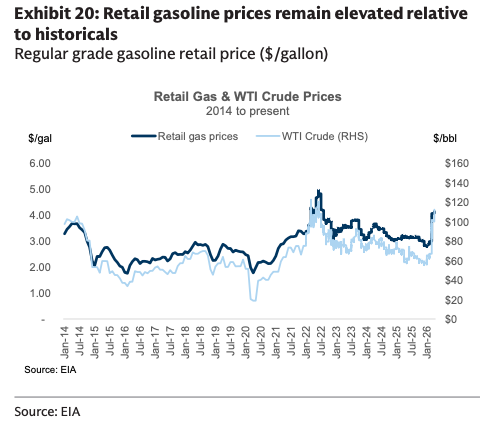
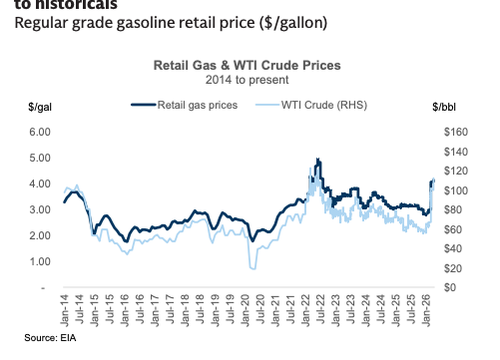
In Goldman’s first-quarter “Nicotine Nuggets” survey of retailers and wholesalers covering roughly 44,000 U.S. stores, or about 28% of all tobacco outlets nationwide, analysts observed that once the national average for regular 87-octane gasoline hit the politically sensitive $4-a-gallon level, the squeeze on consumers began to emerge. One of the clearest signs of stress was a downshift in purchases as budget-conscious consumers started pulling back on tobacco purchases or, in some cases, trading down.
“The outlook remains cautious but retailers & wholesalers generally see the environment as stable despite ongoing concerns on the consumer and recent pressure from higher gas prices,” Bonnie Herzog, managing director and senior consumer analyst at Goldman, wrote in a note on Friday morning.
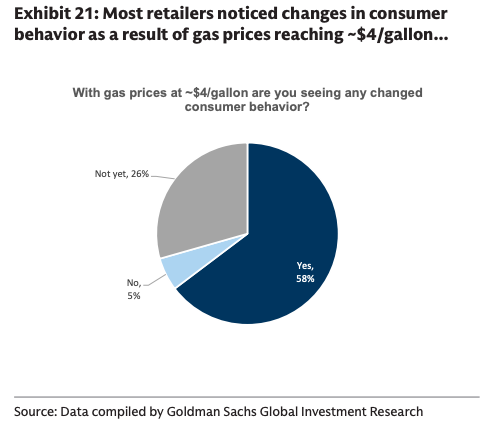
According to the survey, 58% of respondents said consumer behavior had noticeably changed once 87-octane gasoline prices at the pump crossed the $4 threshold, while another 26% said they have not seen changes yet but expect them if prices remain elevated.
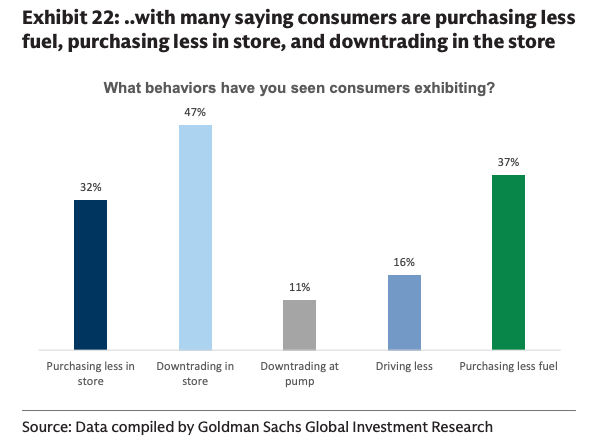
The biggest changes cited were consumers downtrading in stores, buying less fuel, and purchasing less overall inside stores. Some retailers also reported fewer trips, weaker inside sales, and more “splash and go” visits at the pump, where customers buy smaller amounts of fuel and skip in-store purchases.
She said, “Downtrading was strong in Q1, as roughly 80% of respondents indicated that deep-discount cigarettes gained share.”
Main points of the survey:
Specific changes in behavior noted included consumers purchasing less in stores (indicated by 32% of respondents), downtrading in stores (47%), downtrading at the gas pump (11%), driving less (16%), and purchasing less fuel (37%).
Multiple respondents noted seeing fewer customer trips to stores as a result of their higher retail fuel prices (with one noting higher basket sizes as a result of trip consolidation), along with overall lower levels for inside-store sales. One respondent pointed to considerable pressure on the consumer buying at budgeted dollar increments (a rapidly growing consumer segment), which naturally purchases less fuel as the price increases.
Negatively, one retailer is witnessing more “splash and go” trips to the pump (fewer gallons and fewer people converting to inside sales). That said, the retailer also sees a shift in consumer behavior toward value, which has been a benefit to the nicotine pouch category in this regard, as higher engagement with fuel reward promos has led to category sales – with VELO Plus sales for the retailer up 20%+ in the last three weeks.
Herzog and her team “remain cautious on the U.S. tobacco/nicotine industry near-term given continued cig volume declines in Q1 and pressures on the tobacco consumer as a result of the inflationary backdrop and recently higher gas prices, although we see continued robust growth for the nicotine pouch category.”
The “Nicotine Nuggets” report underscores just why politicians are so sensitive to surging gasoline prices: once fuel prices spike, cash-strapped consumers are forced into difficult trade-offs, whether that means buying less gas or diesel, cutting back elsewhere, or, in some cases, trading down in tobacco products.
Late last year, Herzog told clients, “Buy nicotine, energy drink, and candy stocks.”
Professional subscribers can read the “Nicotine Nuggets” note on our new Marketdesk.ai portal.
Tyler Durden
Sat, 04/18/2026 – 08:45
https://www.zerohedge.com/personal-finance/heres-what-happened-inside-gas-stations-when-gas-hit-4

Spain Erupts: Patriots Attacked By Socialist Mob Over Mass Illegal Migrant Amnesty
Spain Erupts: Patriots Attacked By Socialist Mob Over Mass Illegal Migrant Amnesty
Authored by Steve Watson via Modernity.news,
Violence broke out in the Spanish city of Granada when roughly 40 left-wing Antifa extremists tried to shut down a pre-election rally held by the nationalist party Vox in Plaza de las Pasiegas. Police had to form a cordon between the rival groups as fights broke out, delaying the event by around 30 minutes.
Vox leader Santiago Abascal refused to start the rally until the disruptors were removed. He stepped down from the platform, walked toward the rival group with supporters, and crowds chanted “Out, out!” as tensions spilled over. Abascal directly accused authorities of failing to protect free speech, stating: “They are preventing us from carrying out this act freely.”
He went further, blaming the unrest on the very politicians who enabled it: “They are the ones who put Sánchez in La Moncloa.”
Footage shows red paint thrown at attendees, shouting matches, and police struggling to keep the sides apart. Smaller groups of protesters reappeared near the square after the rally began, mobilized via social media.
Violence erupts in Spanish city days after controversial plan to grant amnesty to 500,000 migrants
Clashes broke out in Granada’s Plaza de las Pasiegas between right-wing Vox supporters and left-wing activists.
Around 40 left-wing protesters tried to disrupt a Vox rally,… pic.twitter.com/1VfeHsamIB
— G R I F T Y (@GriftReport) April 17, 2026
The clashes come just days after Prime Minister Pedro Sánchez’s socialist government approved plans to grant legal status, jobs, and benefits to around 500,000 migrants — with analysts warning the real number could hit 800,000.
As we reported earlier, this triggered immediate chaos at consulates across Spain, where thousands of migrants swarmed to submit paperwork:
Endless queues snaked through streets in cities like Almería, Bilbao, and Madrid. Migrants clambered over security gates. Immigration offices are now threatening strikes, overwhelmed by the sudden flood with only a handful of staff handling applications that were farmed out to post offices and NGOs.
Vox has hammered the policy as an “invasion” accelerated by Sánchez. The Granada rally turned into a flashpoint for that anger, with party figures accusing the government of promoting demographic replacement while the opposition People’s Party offered little resistance.
This is the direct result of Sánchez’s open-borders experiment, which prioritizes globalist virtue-signaling over Spanish citizens’ safety and cohesion. While the left screams about “fascism,” it is their own policies that are turning Spanish streets into battlegrounds between patriots demanding borders and radicals defending unlimited migration.
The amnesty is already facing a serious legal challenge that could freeze the entire process. The Spanish legal group Hazte Oír has taken the royal decree to the Supreme Court, which accepted the case and gave the government just 20 days to justify bypassing parliament:
Lawyers argue there was no “extraordinary and urgent need” for a decree instead of normal legislation, warning of irreversible damage to public services, housing, and social cohesion. A precautionary suspension is on the table — meaning the flood of new legal residents could be halted before it becomes impossible to reverse.
Abascal has been blunt about what comes next if the courts fail to act: “These are the lines to manage mass regularization in each municipality of Spain. Tomorrow this chaos will move to the health centers, to the social services, to the real estate agencies… It’s called thirdworldization. It’s already happening. Our priority is to reverse it, radically.”
Sánchez, meanwhile, calls the giveaway “an act of justice” and “a necessity,” claiming it simply recognizes migrants who “already form part of our everyday lives.” Critics point out Spain has run multiple amnesties since 1986 with over 1.75 million permits issued — yet illegal entries and integration failures continue unabated.
The left’s response to pushback is always the same: label patriots as extremists while their policies import the very tensions now exploding. Spain stands at a crossroads. Either the courts step in and the people demand sanity, or the socialist experiment will turn one of Europe’s great nations into a cautionary tale of what happens when globalism overrides national survival.
Your support is crucial in helping us defeat mass censorship. Please consider donating via Locals or check out our unique merch. Follow us on X @ModernityNews.
Tyler Durden
Sat, 04/18/2026 – 08:10

Ukraine Urges Israel To Act Against Russian Ship Carrying ‘Stolen’ Grain To Haifa Port
Ukraine Urges Israel To Act Against Russian Ship Carrying ‘Stolen’ Grain To Haifa Port
Ukraine is pushing Israel to seize a grain shipment it says was looted from Russian-occupied territory as the war persists in the east.
At the moment it does not appear that Israel complied with any interdict of the vessel, also as reports say the cargo is already offloaded and gone.
Ukraine’s government flagged the Russian vessel ABINSK, docking at Haifa, as part of Moscow’s so-called shadow fleet, alleging that it is tied to operations used to “illegally export, transport, and sell stolen Ukrainian grain” and bankroll Moscow’s war effort.
The saga has been featured in Ukrainian media, which says that despite a formal government-to-government request, Israeli authorities didn’t stop the shipment.
Some 43,765 tonnes of wheat – loaded at Russia’s Kavkaz port and believed to originate from Ukrainian regions controlled by the Russian military – was allowed to be unloaded.
Ukraine is still expressing hope for “fruitful and constructive interaction” between both sides, with its embassy in contact with Israeli officials, but Tel Aviv does not appear to be as eager to intervene.
According to some further details in Le Monde:
On April 12, it was permitted to dock in Haifa, where it may have unloaded its cargo, valued at about €8.5 million at current wheat prices. The Abinsk then left Haifa the same day, heading for the Dardanelles Strait with the Turkish port of Çanakkale listed as its next stop, according to Marinetraffic.com, a vessel-tracking website.
The Russian bulk carrier reportedly loaded its cargo at the port of Kavkaz on the Kerch Strait, which separates the Sea of Azov from the Black Sea and links the Russian Federation to Crimea, annexed by Moscow in 2014, according to Ukrainian investigative journalist Kateryna Yaresko, who works for the SeaKrime project at Myrotvorets, an online collaborative platform listing “enemies of Ukraine.”
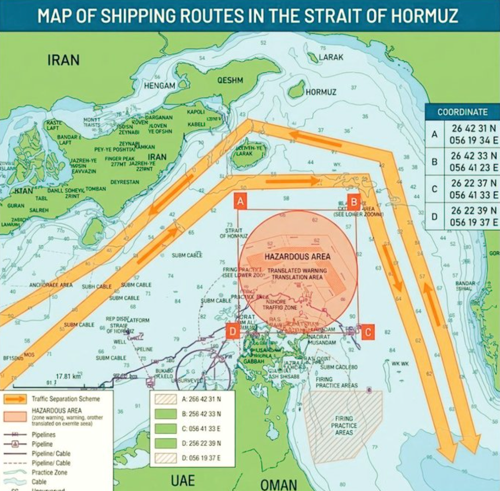
At a moment the Strait of Hormuz remains effectively blocked, and global shipping is feeling the disruption, the Israelis are unlikely to get too trigger happy when it comes to further disrupting trade – even if it comes from Russia or is in a ‘gray area’.
As for Ukraine and Israel, the two countries’ relations has lately improved given the two can find common cause in opposing Iran. President Zelensky has meanwhile been touting drone sales to US allies in the Gulf of late too.
Tyler Durden
Sat, 04/18/2026 – 07:50
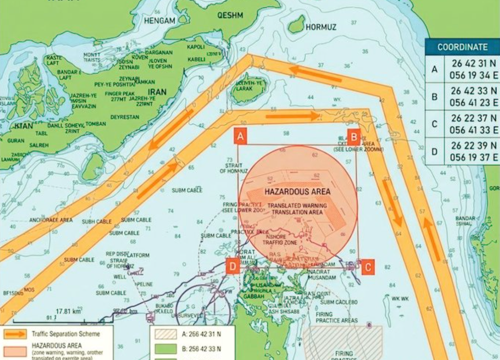
“Bit Of Chaos”: Hormuz Shuts Agains As Ships Make U-Turn
“Bit Of Chaos”: Hormuz Shuts Agains As Ships Make U-Turn
The Trump administration’s “baffle ’em with bullshit” methodology has been on full display, as the reopening of the Hormuz chokepoint on Friday drove a broad risk-on in markets: US equities soared, crude collapsed, and Treasury yields declined, based on the assumption that disruption to global energy flows had eased. However, as of early Saturday morning, those moves may prove premature.
The Wall Street Journal reports that the world’s most important maritime chokepoint is once again closed to commercial transit.
About 20 ships waiting to enter the Persian Gulf through the maritime chokepoint have turned back toward Oman after Iran’s military declared the waterway closed again, amid a U.S. blockade of Iranian ports.
And rejected: the two tankers taking the neutral route, Minerva Evropi and Nissos Keros, have turned around; the Sanmar Herald which appears to be taking the Iran-sanctioned Larak island route is proceeding. https://t.co/aceBI7ki0B pic.twitter.com/gmkM37iA1U
— zerohedge (@zerohedge) April 18, 2026
The OSINT community on X is reporting a Hormuz closure as well…
A bit of chaos in Hormuz this morning as nearly all of the outbound tankers have abruptly turned around.
Follows an announcement by Iranian military leadership that the Strait has “reverted to its previous state of strict military control.” pic.twitter.com/XSc6lvxwJo
— OSINTtechnical (@Osinttechnical) April 18, 2026
MERCHANT VESSELS RECEIVE RADIO MESSAGE FROM IRANIAN NAVY SAYING STRAIT OF HORMUZ SHUT AGAIN, NO SHIPS ARE ALLOWED TO PASS THROUGH, SHIPPING SOURCES SAY
— *Walter Bloomberg (@DeItaone) April 18, 2026
The vessels had reportedly been prepared to pay $2 million in tolls to Iran’s Revolutionary Guards to pass through, but radio warnings indicated the strait was closed.
WSJ notes:
They are now turning back because the Revolutionary Guards are sending radio messages that the strait is closed, according to one Hong Kong owner with a container ship waiting to transit the strait.
Overnight, Iran’s parliament speaker, Mohammad Bagher Ghalibaf, wrote on X that President Trump’s “false” claims won’t help in US-Iran negotiations…
The President of the United States made seven claims in one hour, all seven of which were false.
They did not win the war with these lies, and they will certainly not get anywhere in negotiations either.
With the continuation of the blockade, the Strait of Hormuz will not remain open.
Passage through the Strait of Hormuz will be conducted based on the “designated route” and with “Iranian authorization.”
Whether the Strait is open or closed and the regulations governing it will be determined by the field, not by social media.
Media warfare and engineering public opinion are an important part of war, and the Iranian nation is not affected by these tricks. Read the real and accurate news of the negotiations in the recent interview of the Foreign Ministry spokesman.
Earlier, President Trump said peace talks with Iran are making progress and will continue over the weekend.
“We had some pretty good news 20 minutes ago, but it seems to be going very well in the Middle East with Iran,” Trump told reporters traveling to Washington on Air Force One, according to MS Now. “We’ll know over a little period of time. We’re negotiating over the weekend.”
Trump said one main issue is recovering material from Iran’s nuclear program, which he said the U.S. would remove after any agreement is signed.
“Maybe I won’t extend it, but the blockade is going to remain. But maybe I won’t extend it, so you have a blockade, and unfortunately, we’ll have to start dropping bombs again,” Trump said.
Polymarket odds of the Hormuz chokepoint returning to normal status by the end of April have been on a rollercoaster ride over the last 24 hours, peaking at 64% on Friday morning after Iran announced the waterway was open, but dropping to 32% following Iran’s announcement that the maritime chokepoint was closed early Saturday.
Strait of Hormuz traffic returns to normal by end of April?
Yes 33% · No 68%
View full market & trade on Polymarket
Here are the latest headlines from the Middle East:
Strait of Hormuz Status
Iran reopened the Strait of Hormuz on Friday for commercial shipping during a 10-day ceasefire between Israel and Hezbollah in Lebanon (BN) (BN)
Iran swiftly reversed course on Saturday morning, reimposing restrictions on the Strait of Hormuz after the US said it would not end its blockade of Iran-linked shipping (AP) (SMP) (WSJ)
Iranian forces announced control over the Strait of Hormuz has returned to its previous status under strict Iranian administration and supervision (NS8) (AFP)
Some 20 ships lining up to cross the Strait of Hormuz were turning back toward Oman after Iran’s military said the waterway was closed again (WSJ)
Shipping Activity
A convoy of eight tankers was crossing the Strait of Hormuz on Saturday, comprising one very large crude oil carrier, several oil product and chemical tankers and LPG carriers (NS8)
Four tankers loaded with Qatari LNG within the Persian Gulf moved toward Hormuz in the last 12 hours, with no loaded LNG shipment having exited the Gulf since late February (BN)
More crude oil and gas carriers began testing the Strait of Hormuz on Saturday despite mixed messages from Iranian authorities (BN)
US-Iran Negotiations
Iran has not yet agreed to a next round of negotiations with the US due to Trump’s announcement of a naval blockade and excessive US demands (BV)
Trump said a deal with Iran to end the seven-week war may be imminent, claiming most main points are finalized (BN) (BN)
Trump claimed Iran has agreed to suspend its nuclear program indefinitely, though Iran’s Foreign Ministry said enriched uranium won’t be transferred anywhere under any circumstances (BN) (BN)
Market Activity
Strait To New Record Highs: Hormuz Hopes Spark Risk-On Wrecking Ball Across Markets
Inverse Fear Is Taking Over The Market
Friday’s US-Iran Wrap
Tyler Durden
Sat, 04/18/2026 – 07:31
https://www.zerohedge.com/geopolitical/bit-chaos-hormuz-reportedly-shuts-agains-ships-make-u-turn

The EU’s Digital Gulag Is (Apparently) Ready To Roll
The EU’s Digital Gulag Is (Apparently) Ready To Roll
Authored by Nick Corbishley via NakedCapitalism.com,
“It is for parents to raise their children, and not the platforms.”
Those were the words of European Commission President Ursula von der Leyen on Wednesday as she announced the readiness of the EU’s online age verification, ahem, platform. As we’ve been warning since November 2024, these platforms are ultimately a Trojan Horse for digital identity systems, which are in turn intended to serve as the cornerstone for the digital gulags being quickly assembled around the world.
What gets rarely mentioned in the public debate, including in Von der Leyen’s 11-minute speech below, is the fact that online age verification inevitable traps everyone, not just minors, in its web. “Protecting the children”, however, is always a seductive pretext for launching otherwise socially unacceptable policies. And there are few more socially unacceptable policies than the controlled death of online privacy and anonymity.
It is for parents to raise their children. Not platforms.
The European Age Verification App is ready ↓ https://t.co/EumEPEJOI7
— Ursula von der Leyen (@vonderleyen) April 15, 2026
To save readers from having to stomach Von der Leyen’s sickly sweet presentation of the European Age Verification App, here is a summary of the main points [incidentally, while listening to her address, punctuated with beaming smiles, I kept thinking of Pink Floyd’s classic tune, “Mother”, particularly the line “Momma’s gonna make all your nightmares come true”*]:
The app, VdL says, is necessary to make the online world safer for children — safer from online bullying, highly addictive content, highly personalised advertising, harmful and illegal content, and grooming from online predators.
VdL claims to have herself “carefully listened to the parents, who do not have proper solutions to protect their children” whose concerns she shares. “It is”, she says, “for EU institutions parents to raise their kids and not for platforms.”
To protect children from the dangers of the online world, the EU needs a “harmonised approach” — in other words, a “Europe-wide technical solution for age verification.” And the good news is that the European Age Verification app is “technically ready” and will soon be “available for people to use.”
VdL likened providing proof of age to access online platforms to supermarkets asking young people for ID to purchase alcoholic beverages. What she doesn’t say is that people of all ages, even adults well into retirement age, will have to provide proof of age to access online platforms. That is a major distinction that doesn’t once get mentioned. Also, once this system is in place, users would not just momentarily display their ID like one does when buying alcohol. Instead, they’d have to submit their ID to third-party companies, raising major concerns over who receives, stores, and controls that data.
France, Denmark, Italy, Spain, Greece, Cyprus and Ireland are the so-called “frontrunners” in adopting the app. From the horse’s mouth: “They are planning to integrate the app into their national [digital ID] wallets and I hope more member states and private sector companies will follow, so that every citizen can use pretty soon this app.”
VdL likened the age verification system to the COVID pass, which is not exactly reassuring. With another of her bone-chilling smiles, she said: “this is not the first time the Commission has come forward with an innovative solution to a new problem” that would then go on to became a template not just for EU member countries to use but also “our global partners” around the world. Which brings us to the part that merits direct quotation:
“We all remember the COVID pandemic. Our world came to a complete standstill. But as we came out of the lockdowns and as vaccines were available, the Commission came up with the COVID app in record time — it was three months — to help bring us back to normal life in a safe way. With a scan of our COVID certificate — you will remember, we could go to a concert, board a plane to travel, etc, etc — 78 countries in four continents were using this app.
So, it was a huge success. And now we are taking this success and applying it to the age verification app, following the same principles, following the same model. First, it was user friendly. You download the app, you set it up with your passport or ID card, you then prove your age when accessing online services. Second, it respects the highest privacy standards in the world… Third, it works on any device — phone, tablet computer, you name it. And finally, it is fully open source.”
What VdL describes as a “huge success” represented an unprecedented violation of basic rights, including personal privacy and bodily autonomy. It also further centralised power in the hands of the VdL Commission. Who can forget how VdL abused that power in her vaccine negotiations with Pfizer as well as the destruction of evidence that followed?
Naked Capitalism was among relatively few alternative media sites to flag the potential risks posed by the EU’s “Green Pass” on its launch in April 2021, as well as all the other digital health passes being developed by public private partnerships such as the Rockefeller Foundation’s Common Pass and ID2020’s Good Health Pass Collaborative.
As we warned in our April 13, 2021 post, “7 Reasons Why a Vaccine Passport (Pass, Certificate or Whatever They Want to Call It) Should Give Us Pause“, mission creep was arguably the biggest risk of all, especially with state-controlled digital IDs and programmable central bank digital currencies already on the horizon:
The framework is unlikely to be limited to health-care information. The use of the term “digital wallet”, both by the Vaccine Collective Initiative and IBM, to refer to their different digital health passes suggests that economic activity could become an integral part of the frameworks’ functions. The developer of the Vaccine Collective Initiative’s SMART Health Cards framework at Microsoft Health, Josh C. Mandel, hinted in a recent YouTube presentation that SMART Health Cards could soon be used as IDs for commercial activity, such as renting a car.
That this is all happening as central banks around the world are busily laying the foundations for central bank digital currencies, or CBDCs as they’ve come to be known, raises the specter of digital vaccine passports being used as a vehicle for the creation of a purely digital currency system to replace physical coins and notes. That’s not to say this will happen but it is a distinct possibility. If the vaccine passport does give way to a broader digital ID system, which in turn serves as the pass key for a CBDC, and cash is then eliminated, opting out will be much harder. And opting in will leave us subject to levels of surveillance and control that were heretofore unthinkable.
Now, VdL is herself openly admitting that the Commission is following the exact same principles and model behind the Green Pass to create the European Age Verification App. Coordination is already ramping up at the highest levels of the EU bureaucracy to ensure that the age verification platform is rolled out as quickly and as seamlessly as possible. From Reuters:
French President Emmanuel Macron will host a video call with other EU leaders and European Commission President Ursula von der Leyen to push for a coordinated approach on banning social media for minors, Macron’s office said Tuesday.
Spanish Prime Minister Pedro Sanchez and representatives of Italy, the Netherlands and Ireland will attend the conference call, among others, on Thursday, Macron’s office said, adding that the final list of attendees will be announced later.
“The main goal is to act in a coordinated manner and push the European Commission, in the positive sense of the term, to move ahead at the same pace as member states,” a presidential aide told reporters.
Thank you @emmanuelmacron for organising this discussion on the safety of our children online.
With the DSA, we have EU-wide rules.
And now we have an EU-wide app.
It’s piloted in 🇫🇷 🇩🇰 🇬🇷 🇮🇹 🇪🇸 🇨🇾 🇮🇪
And soon available to all.
Online platforms are held accountable.
Parents… https://t.co/PQQgZisvPP
— Ursula von der Leyen (@vonderleyen) April 16, 2026
A Totally Voluntary System, Apparently
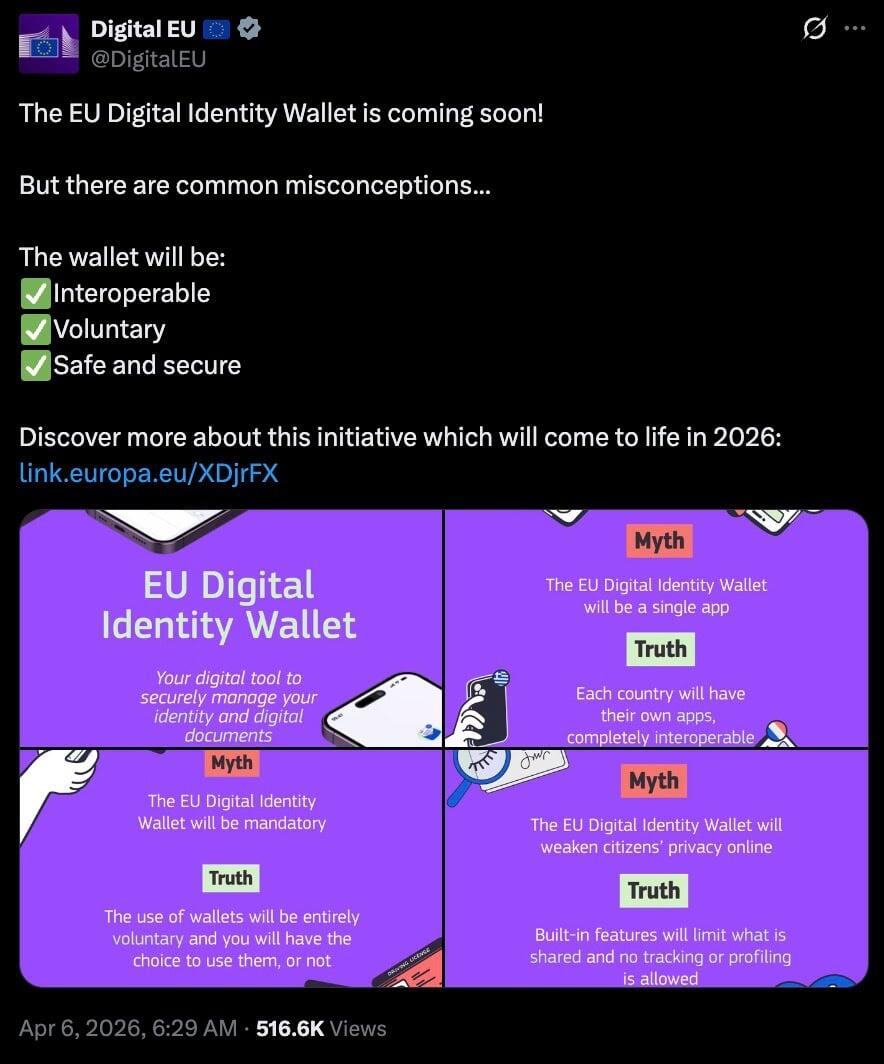
The Commission has been at pains to stress that the EU Digital Identity Wallet that forms the backbone of the age verification app will be voluntary as well as safe and secure, even producing the following infographic to supposedly debunk the claim.
Similar claims, of course, were made by Narenda Modi’s government before launching Aadhaar, India’s now de facto mandatory digital identity system. Since its launch over a decade and a half ago, the Indian authorities have struggled, and failed, to make Aadhaar fraud-proof. The world’s largest digital identity has suffered innumerable breaches, including one that potentially exposed the sensitive personal data of around 815 million Indian citizens.
As readers may recall, the EU’s digital vaccine certificate was also marketed as “voluntary” before becoming necessary for citizens to perform even the most basic of functions in many EU member states, from travelling to working to accessing basic public services. Some countries, including Germany and Austria, even used the vaccine passport system to impose lockdowns of the unvaccinated.
In its article, “EU Says EUDI Wallet Is Voluntary; Germany’s SPD Plan Says Otherwise“, Reclaim the Net outlines how the EU’s “voluntary” digital identity system can quickly become de facto mandatory through the online age verification requirements:
The EU’s digital identity wallet is voluntary. That’s the official position, repeated often enough that the European Commission felt the need to label the opposite claim a “myth.”
Under the eIDAS 2.0 regulation, use of the wallet is voluntary and free of charge for citizens. Nobody will be forced to download the app. Nobody will be compelled to link their government ID to a smartphone.
The EU has been very clear about this.
Germany is now showing everyone what “voluntary” actually means.
The country’s Social Democratic Party (SPD) has proposed making the EUDI Wallet the tool for accessing social media platforms, tying the proposal to an impulse paper circulated ahead of a CDU federal conference in Stuttgart.
The plan creates a three-tier system. Children under 14 would face a complete ban, with platforms required to “technically prevent access.” Users aged 14 to 15 would get youth-only platform versions with restricted algorithmic features, and everyone 16 and older would need mandatory EUDI Wallet verification.
That last category includes every adult in Germany. The wallet that nobody is forced to use becomes the only way to access Instagram, TikTok, or Facebook…
The broader EU framework around the wallet tells its own story about where “voluntary” is heading. Under the eIDAS 2.0 regulation, all Very Large Online Platforms and companies required by law to use strong customer authentication must accept the EUDI Wallet by late 2027.
The EU’s own Digital Decade target aims for 80% of citizens to use a digital ID solution by 2030, with the EUDI Wallet as the primary instrument for reaching that goal. You don’t set an 80% adoption target for something you genuinely intend to keep optional.
Open Source Claims
The German digital activist Michael Ballweg has described Von der Leyen’s claim that the EU’s age verification app is fully open source as “yet another typical Brussels half-truth that needs to be dissected”:
The truth is: The EU Commission, under the European Digital Identity Wallet (EUDI Wallet) project, is indeed making several key components of the Age Verification Solution available as open source on GitHub. The core – that is, the app building blocks, the protocols, and the zero-knowledge technology – is publicly accessible. Member states, developers, or even third countries can adopt and adapt it all. That’s the “blueprint,” the modular system.
But here’s the crucial catch, which they conveniently omit:
The finished app that you later download to your phone is not centrally provided by the EU. It comes from your national government or its service providers. It is integrated into the respective national digital wallet. And these national versions aren’t automatically 100% open source, even if they’re based on EU building blocks.
Some parts—especially the backend infrastructure, the servers, the connection to government databases, and specific national adaptations—can remain completely proprietary and opaque.
And that’s precisely what’s dangerous.
You’re presented with a nice, “privacy-friendly” frontend with zero-knowledge promises—but the real power, the control, the data flows in the background remain shrouded in mystery. Who’s really checking what’s happening with your ID cards, your devices, and your movement profiles when national authorities or their private partners operate the backend?
This isn’t an open system. It’s a modular system where the important drawers remain locked.
Then there’s the equally concerning question of security. Within literal minutes of the app’s launch, IT security consultants and hacktivists were already finding glaring flaws in the security architecture.
The “age verification app” the EU wants to impose on the world got hacked in 2 minutes.
Step 1: Present a “privacy-respecting” but hackable solution.
Step 2: Get hacked (you are here).
Step 3: Remove privacy to “fix” it.
Result: a surveillance tool sold as “privacy-respecting”.
— Pavel Durov (@durov) April 17, 2026
A tweet from International Cyber Digest:
The EU’s new Age Verification app was hacked with little to no effort. When you set it up, the app asks you to create a PIN. But that PIN isn’t actually tied to the identity data it’s supposed to protect. An attacker can delete a couple of entries from a file on the phone, restart the app, pick a new PIN, and the app happily hands over the original user’s verified identity credentials as if nothing happened.
It gets worse. The app’s “too many attempts” lockout is just a counter in a text file. Reset it to 0 and keep guessing. The biometric check (face/fingerprint) is a simple on/off switch in the same file. Flip it to off and the app skips it entirely.
Here is a demonstration video of how the ‘hack’ was performed. https://t.co/GA8oC9tRtn
— International Cyber Digest (@IntCyberDigest) April 16, 2026
Another major architectural flaw was flagged by a March 2026 security analysis of the app’s open-source code, reports Reclaim the Net in another article.
The system’s issuer component has no way to verify that passport verification actually happened on the user’s device.
The researchers who found the vulnerability noted an uncomfortable tradeoff at the heart of the design. Fixing the security gap would likely require sending full passport cryptographic data to the server, including the user’s name and document number, which would amount to a significant reduction in the privacy the system currently promises.
The Commission calls this a “mini wallet.” That nickname reveals more than the branding intends. The app is built on the same technical specifications as the European Digital Identity Wallets, ensuring compatibility and future integration.
A number of third party companies that manage digital age verification systems have already suffered serious data breaches, including AU10TIX, a major Israeli identity verification company, as well as one of the vendors used by leading gaming platform Discord.
Discord says a vendor breach exposed user data: names, emails, IP logs, billing info, and even some government IDs.
The attacker wanted ransom, but the real story is this: once platforms collect official IDs, the risk is permanent.
Governments keep pushing online ID mandates.… https://t.co/G0fKHcXVXS
— Reclaim The Net (@ReclaimTheNetHQ) October 4, 2025
That didn’t stop Discord from proceeding with plans to require a bio-metric face scan or ID verification for full access to the site.
A reminder that this is the same Discord that suffered a data-breach last October where some 70,000 images were exposed. https://t.co/3ACqfN8a2C
— STOPCOMMONPASS 🛑 (@org_scp) February 9, 2026
It’s not just alternative media that are warning of the risks:
Bank ID, Sweden’s de facto national digital ID system, was also hacked a couple of months ago.
🚨 BankID is Sweden’s defacto National Digital ID based system used across 7,500 services, including govt.
🤖 A severe data breach has been confirmed with hackers claiming they pulled source code, user data and other internal system data. https://t.co/JxmIItDSQo
— STOPCOMMONPASS 🛑 (@org_scp) March 18, 2026
As Electronic Frontier Foundation has repeatedly warned, “online age verification is incompatible with privacy“:
In the final analysis, age verification systems are surveillance systems. Mandating them forces websites to require visitors to submit information such as government-issued identification to companies like AU10TIX. Hacks and data breaches of this sensitive information are not a hypothetical concern; it is simply a matter of when the data will be exposed, as this breach shows.
But that doesn’t seem to matter. After Australia became the first Western country to roll out a full-fledged online age verification system in December, governments of all stripes are lining up to follow suit, including the UK, Turkey, Brazil, multiple states across the United States, and even the US federal government itself, where the idea appears to enjoy bipartisan support. No great surprise there.
The White House AI framework calls age verification “privacy protective.” There is no version of age verification that doesn’t require touching sensitive personal data. And there is no version of collecting sensitive personal data at scale that isn’t a breach waiting to happen… https://t.co/1v4GcNy84l
— Reclaim The Net (@ReclaimTheNetHQ) March 21, 2026
In Australia, meanwhile, VPN usage is surging as Internet users, presumably of all ages but one imagines that particularly the tech-savvy youth that are supposedly the target of all this legislation, seek workarounds to the age verification requirements. This in turn has prompted speculation that Canberra may choose the nuclear option of trying to ban VPNs, just as the UK, France and other European governments have threatened to do (as we discussed here).
None of this is happening in a vacuum. It is happening precisely at a time when governments across the so-called “liberal” West are resorting to increasingly intrusive and repressive measures to track and control their respective populaces. In the UK, police arrest 30 people a day for online posts, notes Silkie Carlo, the director of Big Brother Watch: “Over the past decade alone, police have racked up almost 150,000 “non-crime” hate incidents – that is, lawful speech.”
The UK, like many other governments, is also making it harder to protest while punishing subjects/citizens for protesting against Israel’s genocide in Gaza. As Grayzone reported this week, “the British state is so desperate to crush these antiwar activists and preserve Israeli death factories on its soil that it is resorting to crude anti-democratic tactics and corrupting the entire jury system.”
EXCLUSIVE: UK seeks to jail Palestine Action for ‘terrorism’ amid UK media blackout
6 activists could be sentenced as terrorists, facing long prison terms
But the jury has not been notified about the ‘terror’ designation, and UK media can’t report on ithttps://t.co/pbwG5JvhCo
— The Grayzone (@TheGrayzoneNews) April 12, 2026
Meanwhile, Brussels and Washington are imposing what amounts to starvation blockades on prominent individuals that have dared to challenge Israel’s genocide or Gaza or question the wisdom of the EU’s actions in Ukraine. They include the UN rapporteur on the Palestinian territories, Francesca Albanese, four International Criminal Court judges, the geopolitical analyst and former Swiss army colonel, Jacques Baud, and the pro-Palestinian journalist Hüseyin Dogru.
Their experience has a name: “civil death”. Their assets are frozen, access to banking services are blocked and the ability to participate in the official economy is almost completely paralyzed. The sanctions are imposed without prior judicial control and those affected are not given a legal hearing before they are listed. As in Kafka’s The Trial, once you get caught in the bureaucratic vice, there is no escape; it just keeps tightening.
On the one hand, governments and the corporations whose interests they serve want to digitise and tokenise everything, making us wholly dependent on digital platforms. On the other hand, they want to, and are close to, setting up internet controls governed by digital ID checkpoints that will strip away the very last vestiges of digital privacy and anonymity. These checkpoints will also allow them to block online access to anyone who is deemed a threat.
This, it seems, was always the plan. In my 2022 book Scanned: Why Vaccine Passports and Digital IDs Will Mean the End of Privacy and Personal Freedom, I quoted from a 2018 World Economic Forum report that openly admitted that while verifiable identities “create new markets and business lines” for companies, they also (emphasis my own) “open up (or close off) the digital world for individuals”. Welcome to the digital gulag.
Tyler Durden
Sat, 04/18/2026 – 07:00
https://www.zerohedge.com/geopolitical/eus-digital-gulag-apparently-ready-roll

The EU’s Digital Gulag Is (Apparently) Ready To Roll
The EU’s Digital Gulag Is (Apparently) Ready To Roll
Authored by Nick Corbishley via NakedCapitalism.com,
“It is for parents to raise their children, and not the platforms.”
Those were the words of European Commission President Ursula von der Leyen on Wednesday as she announced the readiness of the EU’s online age verification, ahem, platform. As we’ve been warning since November 2024, these platforms are ultimately a Trojan Horse for digital identity systems, which are in turn intended to serve as the cornerstone for the digital gulags being quickly assembled around the world.
What gets rarely mentioned in the public debate, including in Von der Leyen’s 11-minute speech below, is the fact that online age verification inevitable traps everyone, not just minors, in its web. “Protecting the children”, however, is always a seductive pretext for launching otherwise socially unacceptable policies. And there are few more socially unacceptable policies than the controlled death of online privacy and anonymity.
It is for parents to raise their children. Not platforms.
The European Age Verification App is ready ↓ https://t.co/EumEPEJOI7
— Ursula von der Leyen (@vonderleyen) April 15, 2026
To save readers from having to stomach Von der Leyen’s sickly sweet presentation of the European Age Verification App, here is a summary of the main points [incidentally, while listening to her address, punctuated with beaming smiles, I kept thinking of Pink Floyd’s classic tune, “Mother”, particularly the line “Momma’s gonna make all your nightmares come true”*]:
The app, VdL says, is necessary to make the online world safer for children — safer from online bullying, highly addictive content, highly personalised advertising, harmful and illegal content, and grooming from online predators.
VdL claims to have herself “carefully listened to the parents, who do not have proper solutions to protect their children” whose concerns she shares. “It is”, she says, “for EU institutions parents to raise their kids and not for platforms.”
To protect children from the dangers of the online world, the EU needs a “harmonised approach” — in other words, a “Europe-wide technical solution for age verification.” And the good news is that the European Age Verification app is “technically ready” and will soon be “available for people to use.”
VdL likened providing proof of age to access online platforms to supermarkets asking young people for ID to purchase alcoholic beverages. What she doesn’t say is that people of all ages, even adults well into retirement age, will have to provide proof of age to access online platforms. That is a major distinction that doesn’t once get mentioned. Also, once this system is in place, users would not just momentarily display their ID like one does when buying alcohol. Instead, they’d have to submit their ID to third-party companies, raising major concerns over who receives, stores, and controls that data.
France, Denmark, Italy, Spain, Greece, Cyprus and Ireland are the so-called “frontrunners” in adopting the app. From the horse’s mouth: “They are planning to integrate the app into their national [digital ID] wallets and I hope more member states and private sector companies will follow, so that every citizen can use pretty soon this app.”
VdL likened the age verification system to the COVID pass, which is not exactly reassuring. With another of her bone-chilling smiles, she said: “this is not the first time the Commission has come forward with an innovative solution to a new problem” that would then go on to became a template not just for EU member countries to use but also “our global partners” around the world. Which brings us to the part that merits direct quotation:
“We all remember the COVID pandemic. Our world came to a complete standstill. But as we came out of the lockdowns and as vaccines were available, the Commission came up with the COVID app in record time — it was three months — to help bring us back to normal life in a safe way. With a scan of our COVID certificate — you will remember, we could go to a concert, board a plane to travel, etc, etc — 78 countries in four continents were using this app.
So, it was a huge success. And now we are taking this success and applying it to the age verification app, following the same principles, following the same model. First, it was user friendly. You download the app, you set it up with your passport or ID card, you then prove your age when accessing online services. Second, it respects the highest privacy standards in the world… Third, it works on any device — phone, tablet computer, you name it. And finally, it is fully open source.”
What VdL describes as a “huge success” represented an unprecedented violation of basic rights, including personal privacy and bodily autonomy. It also further centralised power in the hands of the VdL Commission. Who can forget how VdL abused that power in her vaccine negotiations with Pfizer as well as the destruction of evidence that followed?
Naked Capitalism was among relatively few alternative media sites to flag the potential risks posed by the EU’s “Green Pass” on its launch in April 2021, as well as all the other digital health passes being developed by public private partnerships such as the Rockefeller Foundation’s Common Pass and ID2020’s Good Health Pass Collaborative.
As we warned in our April 13, 2021 post, “7 Reasons Why a Vaccine Passport (Pass, Certificate or Whatever They Want to Call It) Should Give Us Pause“, mission creep was arguably the biggest risk of all, especially with state-controlled digital IDs and programmable central bank digital currencies already on the horizon:
The framework is unlikely to be limited to health-care information. The use of the term “digital wallet”, both by the Vaccine Collective Initiative and IBM, to refer to their different digital health passes suggests that economic activity could become an integral part of the frameworks’ functions. The developer of the Vaccine Collective Initiative’s SMART Health Cards framework at Microsoft Health, Josh C. Mandel, hinted in a recent YouTube presentation that SMART Health Cards could soon be used as IDs for commercial activity, such as renting a car.
That this is all happening as central banks around the world are busily laying the foundations for central bank digital currencies, or CBDCs as they’ve come to be known, raises the specter of digital vaccine passports being used as a vehicle for the creation of a purely digital currency system to replace physical coins and notes. That’s not to say this will happen but it is a distinct possibility. If the vaccine passport does give way to a broader digital ID system, which in turn serves as the pass key for a CBDC, and cash is then eliminated, opting out will be much harder. And opting in will leave us subject to levels of surveillance and control that were heretofore unthinkable.
Now, VdL is herself openly admitting that the Commission is following the exact same principles and model behind the Green Pass to create the European Age Verification App. Coordination is already ramping up at the highest levels of the EU bureaucracy to ensure that the age verification platform is rolled out as quickly and as seamlessly as possible. From Reuters:
French President Emmanuel Macron will host a video call with other EU leaders and European Commission President Ursula von der Leyen to push for a coordinated approach on banning social media for minors, Macron’s office said Tuesday.
Spanish Prime Minister Pedro Sanchez and representatives of Italy, the Netherlands and Ireland will attend the conference call, among others, on Thursday, Macron’s office said, adding that the final list of attendees will be announced later.
“The main goal is to act in a coordinated manner and push the European Commission, in the positive sense of the term, to move ahead at the same pace as member states,” a presidential aide told reporters.
Thank you @emmanuelmacron for organising this discussion on the safety of our children online.
With the DSA, we have EU-wide rules.
And now we have an EU-wide app.
It’s piloted in 🇫🇷 🇩🇰 🇬🇷 🇮🇹 🇪🇸 🇨🇾 🇮🇪
And soon available to all.
Online platforms are held accountable.
Parents… https://t.co/PQQgZisvPP
— Ursula von der Leyen (@vonderleyen) April 16, 2026
A Totally Voluntary System, Apparently
The Commission has been at pains to stress that the EU Digital Identity Wallet that forms the backbone of the age verification app will be voluntary as well as safe and secure, even producing the following infographic to supposedly debunk the claim.
Similar claims, of course, were made by Narenda Modi’s government before launching Aadhaar, India’s now de facto mandatory digital identity system. Since its launch over a decade and a half ago, the Indian authorities have struggled, and failed, to make Aadhaar fraud-proof. The world’s largest digital identity has suffered innumerable breaches, including one that potentially exposed the sensitive personal data of around 815 million Indian citizens.
As readers may recall, the EU’s digital vaccine certificate was also marketed as “voluntary” before becoming necessary for citizens to perform even the most basic of functions in many EU member states, from travelling to working to accessing basic public services. Some countries, including Germany and Austria, even used the vaccine passport system to impose lockdowns of the unvaccinated.
In its article, “EU Says EUDI Wallet Is Voluntary; Germany’s SPD Plan Says Otherwise“, Reclaim the Net outlines how the EU’s “voluntary” digital identity system can quickly become de facto mandatory through the online age verification requirements:
The EU’s digital identity wallet is voluntary. That’s the official position, repeated often enough that the European Commission felt the need to label the opposite claim a “myth.”
Under the eIDAS 2.0 regulation, use of the wallet is voluntary and free of charge for citizens. Nobody will be forced to download the app. Nobody will be compelled to link their government ID to a smartphone.
The EU has been very clear about this.
Germany is now showing everyone what “voluntary” actually means.
The country’s Social Democratic Party (SPD) has proposed making the EUDI Wallet the tool for accessing social media platforms, tying the proposal to an impulse paper circulated ahead of a CDU federal conference in Stuttgart.
The plan creates a three-tier system. Children under 14 would face a complete ban, with platforms required to “technically prevent access.” Users aged 14 to 15 would get youth-only platform versions with restricted algorithmic features, and everyone 16 and older would need mandatory EUDI Wallet verification.
That last category includes every adult in Germany. The wallet that nobody is forced to use becomes the only way to access Instagram, TikTok, or Facebook…
The broader EU framework around the wallet tells its own story about where “voluntary” is heading. Under the eIDAS 2.0 regulation, all Very Large Online Platforms and companies required by law to use strong customer authentication must accept the EUDI Wallet by late 2027.
The EU’s own Digital Decade target aims for 80% of citizens to use a digital ID solution by 2030, with the EUDI Wallet as the primary instrument for reaching that goal. You don’t set an 80% adoption target for something you genuinely intend to keep optional.
Open Source Claims
The German digital activist Michael Ballweg has described Von der Leyen’s claim that the EU’s age verification app is fully open source as “yet another typical Brussels half-truth that needs to be dissected”:
The truth is: The EU Commission, under the European Digital Identity Wallet (EUDI Wallet) project, is indeed making several key components of the Age Verification Solution available as open source on GitHub. The core – that is, the app building blocks, the protocols, and the zero-knowledge technology – is publicly accessible. Member states, developers, or even third countries can adopt and adapt it all. That’s the “blueprint,” the modular system.
But here’s the crucial catch, which they conveniently omit:
The finished app that you later download to your phone is not centrally provided by the EU. It comes from your national government or its service providers. It is integrated into the respective national digital wallet. And these national versions aren’t automatically 100% open source, even if they’re based on EU building blocks.
Some parts—especially the backend infrastructure, the servers, the connection to government databases, and specific national adaptations—can remain completely proprietary and opaque.
And that’s precisely what’s dangerous.
You’re presented with a nice, “privacy-friendly” frontend with zero-knowledge promises—but the real power, the control, the data flows in the background remain shrouded in mystery. Who’s really checking what’s happening with your ID cards, your devices, and your movement profiles when national authorities or their private partners operate the backend?
This isn’t an open system. It’s a modular system where the important drawers remain locked.
Then there’s the equally concerning question of security. Within literal minutes of the app’s launch, IT security consultants and hacktivists were already finding glaring flaws in the security architecture.
The “age verification app” the EU wants to impose on the world got hacked in 2 minutes.
Step 1: Present a “privacy-respecting” but hackable solution.
Step 2: Get hacked (you are here).
Step 3: Remove privacy to “fix” it.
Result: a surveillance tool sold as “privacy-respecting”.
— Pavel Durov (@durov) April 17, 2026
A tweet from International Cyber Digest:
The EU’s new Age Verification app was hacked with little to no effort. When you set it up, the app asks you to create a PIN. But that PIN isn’t actually tied to the identity data it’s supposed to protect. An attacker can delete a couple of entries from a file on the phone, restart the app, pick a new PIN, and the app happily hands over the original user’s verified identity credentials as if nothing happened.
It gets worse. The app’s “too many attempts” lockout is just a counter in a text file. Reset it to 0 and keep guessing. The biometric check (face/fingerprint) is a simple on/off switch in the same file. Flip it to off and the app skips it entirely.
Here is a demonstration video of how the ‘hack’ was performed. https://t.co/GA8oC9tRtn
— International Cyber Digest (@IntCyberDigest) April 16, 2026
Another major architectural flaw was flagged by a March 2026 security analysis of the app’s open-source code, reports Reclaim the Net in another article.
The system’s issuer component has no way to verify that passport verification actually happened on the user’s device.
The researchers who found the vulnerability noted an uncomfortable tradeoff at the heart of the design. Fixing the security gap would likely require sending full passport cryptographic data to the server, including the user’s name and document number, which would amount to a significant reduction in the privacy the system currently promises.
The Commission calls this a “mini wallet.” That nickname reveals more than the branding intends. The app is built on the same technical specifications as the European Digital Identity Wallets, ensuring compatibility and future integration.
A number of third party companies that manage digital age verification systems have already suffered serious data breaches, including AU10TIX, a major Israeli identity verification company, as well as one of the vendors used by leading gaming platform Discord.
Discord says a vendor breach exposed user data: names, emails, IP logs, billing info, and even some government IDs.
The attacker wanted ransom, but the real story is this: once platforms collect official IDs, the risk is permanent.
Governments keep pushing online ID mandates.… https://t.co/G0fKHcXVXS
— Reclaim The Net (@ReclaimTheNetHQ) October 4, 2025
That didn’t stop Discord from proceeding with plans to require a bio-metric face scan or ID verification for full access to the site.
A reminder that this is the same Discord that suffered a data-breach last October where some 70,000 images were exposed. https://t.co/3ACqfN8a2C
— STOPCOMMONPASS 🛑 (@org_scp) February 9, 2026
It’s not just alternative media that are warning of the risks:
Bank ID, Sweden’s de facto national digital ID system, was also hacked a couple of months ago.
🚨 BankID is Sweden’s defacto National Digital ID based system used across 7,500 services, including govt.
🤖 A severe data breach has been confirmed with hackers claiming they pulled source code, user data and other internal system data. https://t.co/JxmIItDSQo
— STOPCOMMONPASS 🛑 (@org_scp) March 18, 2026
As Electronic Frontier Foundation has repeatedly warned, “online age verification is incompatible with privacy“:
In the final analysis, age verification systems are surveillance systems. Mandating them forces websites to require visitors to submit information such as government-issued identification to companies like AU10TIX. Hacks and data breaches of this sensitive information are not a hypothetical concern; it is simply a matter of when the data will be exposed, as this breach shows.
But that doesn’t seem to matter. After Australia became the first Western country to roll out a full-fledged online age verification system in December, governments of all stripes are lining up to follow suit, including the UK, Turkey, Brazil, multiple states across the United States, and even the US federal government itself, where the idea appears to enjoy bipartisan support. No great surprise there.
The White House AI framework calls age verification “privacy protective.” There is no version of age verification that doesn’t require touching sensitive personal data. And there is no version of collecting sensitive personal data at scale that isn’t a breach waiting to happen… https://t.co/1v4GcNy84l
— Reclaim The Net (@ReclaimTheNetHQ) March 21, 2026
In Australia, meanwhile, VPN usage is surging as Internet users, presumably of all ages but one imagines that particularly the tech-savvy youth that are supposedly the target of all this legislation, seek workarounds to the age verification requirements. This in turn has prompted speculation that Canberra may choose the nuclear option of trying to ban VPNs, just as the UK, France and other European governments have threatened to do (as we discussed here).
None of this is happening in a vacuum. It is happening precisely at a time when governments across the so-called “liberal” West are resorting to increasingly intrusive and repressive measures to track and control their respective populaces. In the UK, police arrest 30 people a day for online posts, notes Silkie Carlo, the director of Big Brother Watch: “Over the past decade alone, police have racked up almost 150,000 “non-crime” hate incidents – that is, lawful speech.”
The UK, like many other governments, is also making it harder to protest while punishing subjects/citizens for protesting against Israel’s genocide in Gaza. As Grayzone reported this week, “the British state is so desperate to crush these antiwar activists and preserve Israeli death factories on its soil that it is resorting to crude anti-democratic tactics and corrupting the entire jury system.”
EXCLUSIVE: UK seeks to jail Palestine Action for ‘terrorism’ amid UK media blackout
6 activists could be sentenced as terrorists, facing long prison terms
But the jury has not been notified about the ‘terror’ designation, and UK media can’t report on ithttps://t.co/pbwG5JvhCo
— The Grayzone (@TheGrayzoneNews) April 12, 2026
Meanwhile, Brussels and Washington are imposing what amounts to starvation blockades on prominent individuals that have dared to challenge Israel’s genocide or Gaza or question the wisdom of the EU’s actions in Ukraine. They include the UN rapporteur on the Palestinian territories, Francesca Albanese, four International Criminal Court judges, the geopolitical analyst and former Swiss army colonel, Jacques Baud, and the pro-Palestinian journalist Hüseyin Dogru.
Their experience has a name: “civil death”. Their assets are frozen, access to banking services are blocked and the ability to participate in the official economy is almost completely paralyzed. The sanctions are imposed without prior judicial control and those affected are not given a legal hearing before they are listed. As in Kafka’s The Trial, once you get caught in the bureaucratic vice, there is no escape; it just keeps tightening.
On the one hand, governments and the corporations whose interests they serve want to digitise and tokenise everything, making us wholly dependent on digital platforms. On the other hand, they want to, and are close to, setting up internet controls governed by digital ID checkpoints that will strip away the very last vestiges of digital privacy and anonymity. These checkpoints will also allow them to block online access to anyone who is deemed a threat.
This, it seems, was always the plan. In my 2022 book Scanned: Why Vaccine Passports and Digital IDs Will Mean the End of Privacy and Personal Freedom, I quoted from a 2018 World Economic Forum report that openly admitted that while verifiable identities “create new markets and business lines” for companies, they also (emphasis my own) “open up (or close off) the digital world for individuals”. Welcome to the digital gulag.
Tyler Durden
Sat, 04/18/2026 – 07:00
https://www.zerohedge.com/geopolitical/eus-digital-gulag-apparently-ready-roll
Kuwait Holds American Journalist After Reporting On ‘Friendly Fire’ Shootdown Incident
Kuwait Holds American Journalist After Reporting On ‘Friendly Fire’ Shootdown Incident
Authored by Chris Hedges via Consortium News
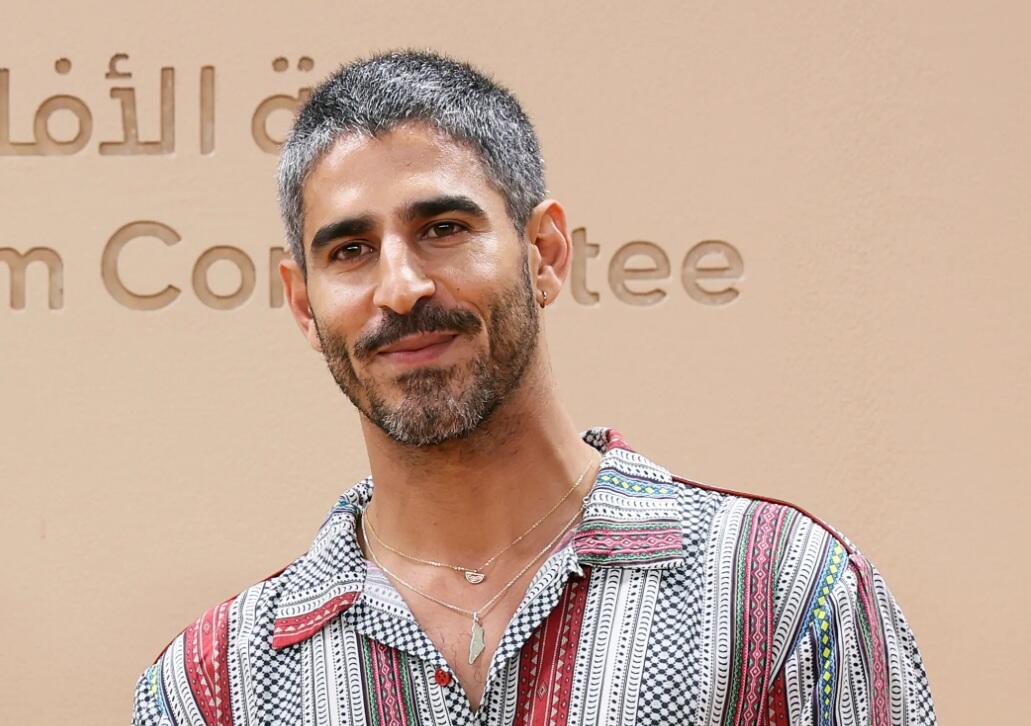
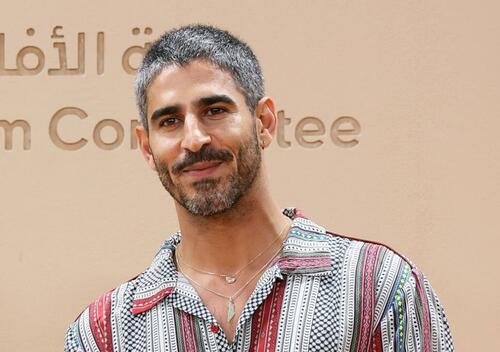
Ahmed Shihab-Eldin, a fearless Palestinian-American journalist (he’s an American-born Kuwaiti of Palestinian descent) whose writing and reports are defined by unparalleled integrity, depth and eloquence, was arrested on March 3rd in Kuwait.
He is charged with spreading false information and harming national security.
His arrest took place following his reporting of the shooting down of three U.S. fighter planes by the Kuwaiti military in an act of friendly fire during the U.S.-Israel war with Iran. Ahmed, along with other news outlets such as the BBC, published footage of a U.S. F-15 E Strike Eagle crashing in al-Jahra west of Kuwait City.
I fear Ahmed, a graduate of Columbia Journalism School who has worked for The New York Times, PBS Frontline, Al Jazeera English, Vice on HBO, The Huffington Post and appeared on numerous news outlets including the BBC and CNN, will be charged under new, draconian security laws instituted in Kuwait, which have already led to dozens of arbitrary arrests.
Kuwait has desperately tried to maintain the fiction that it did not serve as a staging area for US attacks on Iran.
The NY Times had also confirmed this week:
The arrest of the journalist, Ahmed Shihab-Eldin, which Kuwaiti authorities had yet to publicly confirm, would be one of many detentions across the Persian Gulf as governments there try to repress information about local effects of the war in Iran.
“It is understood that authorities have charged him with spreading false information, harming national security and misusing his mobile phone — vague and overly broad accusations that are routinely used to silence independent journalists,” the committee said in a statement.
He had not posted online or been seen in public since early March, it said. His Twitter and Instagram accounts appeared to have been deleted.
Iran repeatedly attacked Kuwait, including strikes on Kuwait International Airport, the Ali Al Salem Air Base, the U.S. garrison at Camp Buehring and an operations center that saw six U.S. soldiers killed and dozens wounded. Iran also attacked the Mina Al-Ahmadi refinery and a Kuwaiti oil tanker.
WATCH: Clear footage of a U.S. F-15E jet that was shot down over Kuwait on March 1-2 in a friendly fire incident by Kuwaiti F-18 jet. pic.twitter.com/rk1uAANWNh
— Clash Report (@clashreport) March 16, 2026
France 24 broadcast a video of HIMARS missiles allegedly being fired from Kuwait into Iran. Ahmed’s reporting also undercut the lie of Kuwaiti neutrality.
The Kuwaiti authorities will, I expect, for this reason, seek to turn Ahmed into an example for the rest of the press.
Tyler Durden
Fri, 04/17/2026 – 23:25

Spillover Conflict Still Raging In Iraq: Three Iranian Kurds Killed
Spillover Conflict Still Raging In Iraq: Three Iranian Kurds Killed
The Iran war seems to be cooling, as a two week ceasefire holds, but people are still dying from spillover effects and sporadic conflict in neighboring Iraq.
“Drone and rocket strikes in Iraq’s northern Kurdistan region on Friday killed three Iranian Kurds, including two women fighters, an exiled opposition group said, blaming the attack on Iran,” AFP reports. It’s unclear if the projectiles were sent across the border, or whether pro-Iran groups inside Iraq carried out the killings.
This comes several weeks after US officials first floated the possibility of arming Iranian Kurdish dissident groups. Kurdish organizations in Iraq and along the border insisted at the time that there was no plan to receive arms and training from the US.
The fear was that the US statements and avalanche of international press reports claiming a potential impending plan to use Kurds as a proxy ground force served to put a bright red target on the Kurdish community of Iran (and by extension Iraq).
Indeed throughout the conflict there had been sporadic Iranian attacks on Kurdish areas, particularly in northern Iraqi Kurdistan. That appears to still be happening, with the Friday report:
“The Islamic Republic of Iran launched a new wave of missile and drone strikes today targeting… civilian camps of the PDKI,” killing one person and wounding his father, the Democratic Party of Iranian Kurdistan (PDKI) said on X.
In a separate attack, two women fighters were killed and other fighters wounded, the party added.
A PDKI official told AFP the fighters were killed in an attack on their positions in the Soran area, nestled in the Zagros mountains near the Iranian border.
In other Iraq-related news connected to the Iran war, the US Treasury on Friday has slapped new sanctions on a series of Shia pro-Iran militia leaders.
The United States Treasury Department Office of Foreign Assets Control (OFAC) has targeted seven pro-Iran Iraqi militia commanders, accused of organizing and carrying out attacks against US soldiers and facilities.
They are “some of Iraq’s most violent Iran-aligned militia organizations,” such as Asa’ib Ahl Al-Haqq, Kata’ib Hezbollah, Kata’ib Sayyid Al-Shuhada, and Harakat Al-Nujaba – according to the Trump administration.
“We will not allow Iraq’s terrorist militias, backed by Iran, to threaten American lives or interests … Those who enable these militias’ violence will be held accountable,” US Treasury Secretary Scott Bessent stated.
Tyler Durden
Fri, 04/17/2026 – 23:00

Massive Cosmic Test Shows Newton And Einstein Still Explain Gravity Accurately
Massive Cosmic Test Shows Newton And Einstein Still Explain Gravity Accurately
Authored by Neetika Walter via Interesting Engineering,
Scientists have tested gravity across some of the largest structures in the universe and found that it behaves exactly as predicted by long-standing physical laws.
Galaxies and clusters trace gravity’s pull across the universe.iStock Photos
Researchers led by University of Pennsylvania used data from the Atacama Cosmology Telescope to examine how galaxy clusters move across vast cosmic distances.
Their results show that gravity weakens with distance in line with the inverse-square law first described by Isaac Newton and later embedded in Albert Einstein’s theory of general relativity.
The findings challenge alternative theories that suggest gravity changes at large scales and instead reinforce the idea that an unseen component, dark matter, is shaping cosmic motion.
Gravity holds at scale
“Astrophysics has been plagued by a massive discrepancy in the cosmic ledger,” said Patricio A. Gallardo.
“When we look at how stars orbit within galaxies or how galaxies move within galaxy clusters, some appear to be traveling way too fast for the amount of visible matter they contain.”
To test whether gravity itself might be responsible, the researchers analyzed subtle distortions in the cosmic microwave background as it passes through massive galaxy clusters.
These distortions, caused by the motion of hot gas around clusters, allowed the team to measure how quickly clusters are moving toward each other across distances spanning hundreds of millions of light-years.
The results closely matched predictions from classical and relativistic physics, showing no evidence that gravity weakens differently than expected at these scales.
“It is remarkable that the law of the inverse of the squares—proposed by Newton in the 17th century and then incorporated by Einstein’s theory of general relativity—is still holding its ground in the 21st century,” said Gallardo.
Dark matter case strengthens
The study addresses a long-standing puzzle in cosmology. Observations have consistently shown that stars at the edges of galaxies and galaxies within clusters move faster than visible matter alone can explain.
“That is the central puzzle,” Gallardo explained.
“Either gravity behaves differently on very large scales, or the universe contains additional matter that we cannot directly see.”
Because the new measurements confirm that gravity behaves as expected, the results strengthen the case for dark matter as the missing component.
“This study strengthens the evidence that the universe contains a component of dark matter,” said Gallardo. “But we still do not know what that component is made of.”
The work also places constraints on theories such as Modified Newtonian Dynamics, which attempt to explain cosmic motion by altering the laws of gravity.
By extending tests of gravity to distances far beyond the scale of individual galaxies, the research provides one of the most comprehensive validations of standard cosmological models to date.
Future observations using more detailed maps of the cosmic microwave background and larger galaxy surveys could further refine these measurements and test gravity with even greater precision.
“With so many unanswered questions, gravity remains one of the most fascinating areas of research. It’s a naturally attractive field,” Gallardo said.
The study was published in Physical Review Letters.
Tyler Durden
Fri, 04/17/2026 – 22:35